Trail 67- Northants and Bedfordshire Twinwood Farm (Part 4)

Part 3 of this trail saw the arrival of the Americans, a new name being added and a perplexing mystery about to unfold.

A mystery emerges.

In 1944, Twinwood Farm became etched into history as the last place Glenn Miller was seen alive. Miller, the pre-war musician who had revolutionised popular music with his distinctive style and sound, had enjoyed enormous success in America with hits such as In the Mood, Moonlight Serenade and Chattanooga Choo Choo. But after the United States entered the war, Miller was determined to use his music to support the armed forces overseas, while the loss of several key members of his orchestra to military service also encouraged him to find a way of contributing to the war effort.
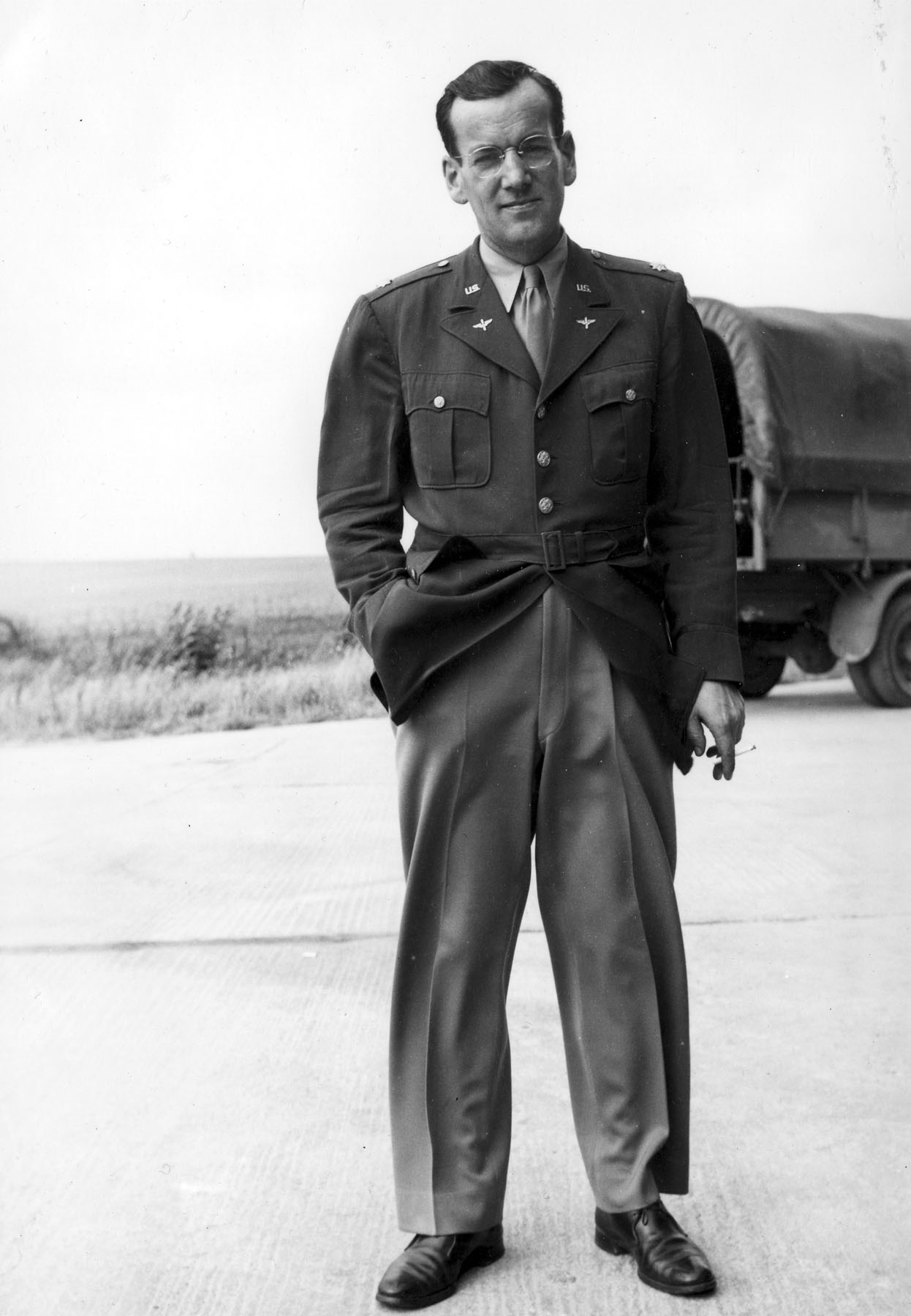
Maj. Glenn Miller in a relaxed pose. (IWM UPL 28085)

After initially being refused by the Navy, Miller joined the US Army on 7 October 1942. He eventually became involved with the Army Air Forces, where his musical expertise was put to use in developing military bands and entertainment for service personnel.

His eventual deployment to Britain came at the request of General Eisenhower, who wanted Miller to contribute to the Allied Expeditionary Forces’ programme and help maintain the morale of troops in Europe. Miller arrived in Britain in June 1944 and, after a short period in London, moved his organisation to the Bedford area.

On 9 July, Miller and his new band rehearsed at the Bedford Corn Exchange. The performance was broadcast on the AEF network that evening and was a huge success. It was the beginning of a period in which Miller and his musicians would perform at bases across Britain, with hangar dances becoming a popular way of raising morale among war-weary personnel. Miller had become a phenomenon.

But the joy Miller was bringing to Allied personnel was to be short-lived. In December, he was asked to travel to Paris to make arrangements for a forthcoming performance. He accepted an invitation to fly with Lt. Col. Norman Baessell, who was serving with VIII Air Force Service Command and was himself travelling to Paris on temporary duty.

Military driver Edward McCollough drove Miller to Twinwood Farm, from where Miller had departed on previous occasions with his band for concerts. There, he boarded a small Noorduyn UC-64 Norseman with Flight Officer John Morgan and Lt. Col. Baessell.

The aircraft took off from Twinwood at 13:55 on 15 December 1944 in thick fog. It was never seen again. Miller was officially declared missing on 18 December and was subsequently declared dead.

The nature of Miller’s disappearance has haunted historians ever since. His small aircraft disappeared somewhere on the journey across the Channel and neither it, nor its three occupants, was ever found. The absence of any wreckage or bodies inevitably encouraged speculation, and over the decades numerous theories have emerged.

Blister hangar

Former hangar now a music venue stage.

These have ranged from claims that Miller never left Britain to suggestions that he was killed in Paris, accidentally shot by American military personnel or even deliberately executed by members of the OSS. Another theory has blamed bombs jettisoned by returning RAF aircraft. There have also been claims from supposed eyewitnesses who said they saw either the aircraft or Miller after he had officially disappeared.

None of these theories has been conclusively established. The disappearance of one of the wartime era’s greatest musicians therefore remains one of the enduring mysteries associated with the Second World War.

Miller’s disappearance is not the only mystery associated with Twinwood Farm, but it is perhaps the strongest link between the airfield and the world of wartime secrecy. The surrounding area was heavily populated with airfields, transmitting stations and operational establishments, some of which were connected with clandestine Allied activities.

Among these were establishments associated with the British Special Operations Executive (SOE) and the American Office of Strategic Services (OSS). Both organisations operated in considerable secrecy, and much of their wartime work remained obscure for decades afterwards. Their activities inevitably contributed to the mythology that subsequently grew around the airfields and installations of Bedfordshire.

However, this is an area where caution is needed.

During the research for this trail, repeated claims were encountered suggesting that SOE or OSS agents assembled at Twinwood Farm before departing on secret missions. Despite extensive investigation, no contemporary documentary evidence has been found to support these claims.

It seems likely that the story has become confused with the well-documented activities at nearby RAF Tempsford, where agents were housed at Gibraltar Farm before embarking on clandestine flights into occupied Europe. Given the close proximity of the two airfields, the American presence at nearby Milton Ernest Hall and Miller’s links with the USAAF, it is perhaps unsurprising that local memories and later accounts have occasionally merged these separate wartime stories.

As far as the evidence currently shows, the American use of Twinwood was considerably less dramatic. The USAAF used the airfield as part of its wider network supporting VIII Air Force Service Command, with American aircraft using the station for the movement of officers, supplies, equipment and personnel. It was a useful staging and liaison point rather than a major American operational base.

Twinwood therefore remained, fundamentally, an RAF airfield operating alongside an additional American role. Under the USAAF’s identification system it was designated Station 506, or Milton Ernest (Twinwood Farm), but there is no evidence that the Americans took ownership of the airfield itself or assumed exclusive control of its facilities.

The war’s end and hope for the future.

In the summer of 1945, the war came to an end and many of the OTUs, now surplus to requirements, were disbanded. The axe fell heavily, and 51 OTU was one of the units to disappear, with June 1945 signalling its demise.

With its departure, RAF Twinwood Farm was left without any flying units, and only a small number of personnel remaining on site. It remained in this state for several months.

On 2 January 1946, the site was transferred to the Ministry of Aircraft Production, ceasing to operate as an RAF station by the end of the month. This move, however, did not signify the end of Twinwood as an aviation establishment.

In the post-war years, Twinwood’s links with both Thurleigh and Little Staughton would continue through an ambitious plan to create Britain’s foremost aeronautical research establishment, one intended to rival the famous Muroc test facility, later Edwards Air Force Base, in California.

The scheme, first conceived as early as 1944, recognised that the next generation of aircraft would be larger, faster and more powerful than anything seen during the war. Britain needed somewhere capable of developing and testing these advanced designs, requiring extensive flying space together with specialised research laboratories and engineering facilities. After examining a number of potential sites across England and Wales, the Ministry selected the neighbouring airfields of Thurleigh, Twinwood and Little Staughton.

Control Room

Inside the watch office.

The proposal was bold. Thurleigh and Little Staughton would be linked by an immense runway planned to extend for more than five miles, creating an aviation research runway on a scale never before attempted in Britain. Twinwood, connected by a taxiway, would become the scientific and engineering centre of the establishment, providing maintenance, workshops and the wind-tunnel complex that would support Britain’s rapidly developing aircraft industry.

Although the scale of the proposal would undoubtedly have transformed the surrounding countryside, it never progressed beyond the planning stage. Financial pressures and changing post-war priorities meant the giant runway was abandoned, and the establishment instead developed as separate but closely linked sites. Under this revised plan, Thurleigh became the principal experimental flying airfield of the Royal Aircraft Establishment (RAE Bedford), while Twinwood became the centre for aerodynamic testing.

Twinwood’s role nevertheless proved to be of national importance. As the war ended, Allied scientific teams moved quickly to secure Germany’s remarkable advances in aeronautical research. British, American and Soviet specialists examined laboratories, experimental aircraft and technical records, recognising that German engineers had achieved significant progress in areas such as high-speed flight, swept-wing design, compressibility and rocket propulsion.

British teams investigated a number of Germany’s principal research establishments, including the Aerodynamische Versuchsanstalt (AVA) at Göttingen, the research facilities at Braunschweig and the extensive experimental centre at Peenemünde. Thousands of technical reports, drawings and research papers were recovered and analysed, providing an invaluable foundation upon which Britain’s own post-war aeronautical research programme could be built.

Although the wind tunnels later constructed at Twinwood were British-built, they reflected many of the lessons learned from these German investigations and embodied the latest understanding of transonic and supersonic aerodynamics.

Within this scaled back plan, Twinwood became the centre for wind-tunnel research while Thurleigh remained responsible for experimental flying. Little Staughton, no longer required, was omitted from the project altogether.

Parts of the former wartime airfield at Twinwood were transformed into a modern scientific research complex containing the High Speed Laboratory, offices, engineering workshops, model shops and five major wind tunnels capable of investigating everything from low-speed handling characteristics to transonic and supersonic flight. Among these was the remarkable Vertical Spinning Tunnel, designed to study the behaviour of aircraft during stalls and spins, one of the principal causes of fatal flying accidents during the Second World War.

Despite the reduction in scale, the completed facilities still formed one of the most advanced aeronautical research centres in Europe, a status it retained throughout the 1950s and 1960s. This enabled Twinwood to contribute to the development of many of Britain’s most significant post-war aircraft.

Construction of the wind-tunnel complex began in 1948 under Dorman Long & Co. Ltd. of Middlesbrough together with Whessoe*7. The project was itself a notable engineering achievement, pioneering the on-site welding of large pre-formed steel plates to create the enormous pressure vessels required for the wind tunnels, a technique that was virtually unprecedented in Britain at the time.

The first of Twinwood’s major facilities entered service in 1955. Although the wider vision of a unified aeronautical research establishment centred on a five-mile runway had never been realised, the completed Vertical Spinning Tunnel represented a major advance in aerodynamic research. Standing 24.4 metres high and measuring 13.7 metres in diameter, it remained one of the most distinctive structures on the site and survives today as a Grade II listed building, recognised for both its engineering significance and its place in Britain’s post-war aviation heritage*8,*9

The site containing the wind tunnels was sufficiently far from the main airfield not to interfere with any flying that might take place. This allowed Twinwood, in the mid-1950s, to unexpectedly find another new role, this time as a flight-test airfield for gliders.

Engineers and test pilots from Slingsby, used the former wartime station to conduct meticulous performance trials on the company’s latest sailplanes. These experiments, carried out over many months using carefully controlled glide tests and supported by wind-tunnel investigations, contributed to the development of one of Britain’s most successful post-war competition gliders.*10

This short-lived reprieve for Twinwood did not, unfortunately, lead to any long-lasting aviation revival. In 1983, the Ministry of Defence finally put Twinwood Farm and its land up for sale.

The farm, which had been leased to A. T. Quenby since 1962,*11 consisted of a house, a bungalow and the usual mix of farm buildings. Other buildings remained from the RAF’s days, including a corrugated-iron hangar adjoining Little Oakley Wood, measuring 89 feet by 45 feet, together with a mess room and Nissen huts used as stores, measuring 91 feet by 28 feet.

With that, this small airfield returned to agriculture. The business park was subsequently sold and resold, developed and redeveloped. It remains today, although many of the original buildings have been removed.

The landowner of the airfield site has agreed to allow the watch office to become a thriving Glenn Miller memorial, while many of the surviving huts in the area have become museums documenting wartime life both on and off the airfield.

Another part of the site has become a music venue, staging regular festivals featuring music from the 1940s through to more modern times. It even utilises one of the remaining original hangars as a stage.

Although much of the former airfield has disappeared beneath later development, a small part of Twinwood survives. Through these developments, the memory of both Glenn Miller and the important work of the OTUs has been allowed to live on.

Twinwood’s legacy.

Twinwood Farm was a small and relatively insignificant airfield when it was established. Yet, despite continual struggles with accommodation, storage and the practical challenges of creating an operational station from open farmland, its personnel quietly made an important contribution to Britain’s air defence. Thousands of training sorties prepared numerous night-fighter crews for the demanding task of defending Britain’s skies after dark, while the airfield also supported Army Co-operation duties and became home to a variety of aircraft and units throughout the war.

Its post-war years were no less significant. Ambitious plans to transform the region into a major aviation research establishment ultimately failed to materialise. Although Twinwood established itself as a major centre for wind-tunnel research, its use as an airfield eventually came to an end. Remarkably, from those quiet beginnings emerged first a museum and later a music venue, ensuring that the site continued to attract visitors long after the last military aircraft had departed.

Yet, despite all that Twinwood Farm achieved, this is not the story that ultimately secured its place in history.

It would be easy to remember Twinwood simply as the place from which Glenn Miller made his final flight. But that is only part of the story. By 1944, the airfield had quietly become an important link in the wider logistical network supporting Headquarters, VIII Air Force Service Command at nearby Milton Ernest Hall. While RAF night-fighter training continued, Twinwood simultaneously supported the American headquarters with liaison and transport flights, connecting the administrative heart of the Eighth Air Force with the rapidly developing campaign in Europe.

It was this little-known dual role that brought Glenn Miller to Twinwood on that cold December day in 1944. Without it, one of the world’s most celebrated musicians would almost certainly never have passed through its gates.

In the end, Twinwood Farm’s legacy extends far beyond the disappearance of a single aircraft. It is the story of an unassuming Bedfordshire airfield that quietly fulfilled many roles, adapted to changing demands and made a contribution to the Allied war effort far greater than its modest size ever suggested.

Sometimes history is not written by the biggest stations or the most famous squadrons, but by places that simply did their job exceptionally well when they were needed most.

The full story of Twinwood Farm can be found in Trail 67.

Sources and further information (Twinwood Farm).

*1 RAFweb.org. website accessed 1.8.26

*2 National Archives Operation Record Book AIR 27/321

*3 Jackson, R., & Ritger, L., P-51 Mustang. Pen & Sword Aviation, 2020.

*4 National Archives Operation Record Book AIR27/1563/9

*5 National Archives Operational record Book AIR 27/1094/1

*6 Bedfordshire Archives Website [ref: WW2/AR/C2/182].

*7 Historic England website accessed 27/7/26

*8 28 days later website. Accessed 3/8/2026.

*9 Historic England Website. Accessed 3/8/2026.

*10 Ince, D., Combat and Competition* *Newton Publishers, 1992

*11 Bedfordshire Archives Website. Accessed 8/8/2026.

National Archives: Operational Record Books: AIR 27/1563/9; AIR 27/1085/35, AIR 27/1085/37

IWM American Archive Website Accessed 16.8.26

The Bedford aerodrome website contains extensive material on the current and some historical use of Thurleigh.

The Bedford Aeronautical Heritage Group website (now closed but accessible) contains information about the work and history of RAE Bedford. It has since been moved to the FAST website below.

Farnborough Air Services Trust website offers endless information about the services of RAE Bedford and RAE Farnborough.

Bedfordshire and Luton Archive and Record Service has an extensive collection of Third London Airport material as part of the Bedfordshire County Council archive which includes material for all four original sites. It also has material from BARA.

PPRuNe forum has information, photos and personal information about the research at Thurleigh and Twinwood Farm.

Osbourne, M. Defending Bedfordshire: The Military Landscape from Prehistory to the Present. Fonthill Media, 2021

Jackson, R. P-51 Mustang. Pen and Sword, 2020

Conyers Nesbit, R. Missing: Believed Killed. Pen & Sword Military 2010.

Spragg, D. Glenn Miller Declassified. Potomac Books, 2017

Grudens, R., Chattanooga Choo Choo. Celebrity Profiles Publishing Company, 2004.

The museum website can be accessed at: https://www.twinwoodaviationmuseum.org/

Trail 67- Northants and Bedfordshire Twinwood Farm (Part 3)

Part 2 of the trail saw Twinwood receive new aircraft in the form of the Tomahawk and then the P-51 Mustang. But that did little to alleviate problems on the base.

Newly delivered, the Mustangs soon found themselves grounded awaiting much need repairs and spare parts, none of which were readily available. But a change was coming, and soon, 169 Sqn was able to depart.

By 15 July, all but one of the Mustangs  – which was still awaiting repairs – had left Twinwood and were at their new base at Doncaster. A new era was about to begin for them.

While 51 OTU continued to perform its training duties, other squadrons continued to come and go. The next to arrive was 239 Sqn, another Mustang Mk.I unit, which arrived at the end of August 1942.

The Mustangs had been patrolling the skies along the south coast around Brighton and Beachy Head, and as far inland as Gatwick, their former station. No sooner had they arrived than a small detachment was sent to Snailwell, leaving the squadron split between three airfields: Gatwick, Twinwood and Snailwell.

The Snailwell section took part in exercises and returned briefly in early September, only to transfer to Castle Camps to take part in further Army Co-operation activities. The Gatwick section continued covering the south coast, while those newly arrived at Twinwood practised night landings in their Mustangs.

This fluid movement at Twinwood continued until 22 October, when the entire squadron moved to Cranfield to take part in further exercises. This effectively ended its association with Twinwood.

At Twinwood, night training was always hazardous, even for experienced pilots. A nearby homestead, Rutters Cottages, was the site of a tragedy on 28 November 1942, when one of 51 OTU’s Havocs crashed close by. Its pilot, Sergeant Leonard James Casey, was sadly killed. A New Zealander from Herne Bay, Auckland, Casey was just 21 years old and was buried in Kempston Cemetery.*6

His aircraft, Havoc I BJ501, was undertaking a solo night-training exercise and, at the time of the crash, was carrying out overshoots. As the aircraft pulled away it suddenly entered a dive and crashed. Casey was not killed outright, but was taken to Bedford County Hospital, where he later died from his injuries.

The Americans arrive and a reshuffle takes place.

By early 1943, the Eighth Air Force was gaining strength in Britain – the friendly invasion had begun. Lacking experience in night-fighter operations, the USAAF began sending airmen to Twinwood, where it was hoped they would benefit from British expertise, particularly that of the OTU.

One of these American units was the 417th Night Fighter Squadron, which arrived via Scotland on 11 May 1943.

Constituted as the 417th Night Fighter Squadron on 17 February that year, the unit came under the control of VIII Fighter Command, attached to the RAF. Its journey here began at Orlando Air Force Base, before moving to Kissimmee and eventually to Ayr on Scotland’s west coast, where a small detachment remained.

Twinwood Farm

Exposed shelter at Twinwood.

Training in the United States had been undertaken on the P-70, a converted Douglas A-20 Havoc/Boston. The purpose of the conversion was to provide the USAAF with an airborne radar interception capability, something it lacked at the time. With upgraded engines, the P-70 also carried the British Mk. IV radar, specifically designed for airborne interception. Intended as an interim solution until the Northrop P-61 Black Widow became available, only 160 P-70s were ever converted.

Once in the UK, however, the men of the 417th found themselves training on Bristol Beaufighters rather than the P-70s with which they were familiar.

Conversion and training began quickly and progressed well however. Before long, the Americans were ready for their own aircraft and were transferred to RAF Scorton in North Yorkshire, where some twelve Beaufighters duly arrived. Training continued there until August, at which point the squadron was declared ready for combat.

Their theatre of operations, however, was not to be the dark skies of Europe but the warmer climate of Algeria. The squadron would eventually receive its P-61s, but not until March 1945, when it returned to Europe to undertake night-fighter duties protecting Allied bridgeheads as the advance into Germany continued.

It was also during 1943 that a renumbering of training units led to the resident 51 OTU, along with other OTUs across the country, being renumbered. This was connected with Operation Saracen, later revised as Operation Banquet, the contingency plan for countering a German invasion of Britain. Under the scheme, OTUs had 500 added to their existing numbers, redesignating them as squadrons. Thus, 51 OTU became 551 Sqn.

While some units readily adopted their new numbers, many continued to be referred to by their original OTU designations. Consequently, when 51 OTU became 551 Squadron RAF on 17 September 1943, it continued its night-training duties much as before. In practice, little changed and, as with many of these newly numbered units, no formal change in organisation took place, nor were they ever formally recognised as RAF squadrons in their own right.

1944 – winds of change.

Between 5 and 13 January 1944, a small detachment of 164 Sqn, equipped with Hurricane IVs and Typhoon IBs, visited Twinwood. Whilst here, they carried out practice dive-bombing attacks against mock targets, while the bulk of the squadron remained at Fairlop flying armed sorties.

They would stay briefly but return for another short period in February, when further practice flights involved ground strafing and battle-formation flying. The late-winter rain, however, curtailed many of the planned activities, with some days seeing no flying at all.

Although US aircrew had previously been present at Twinwood, no American aircraft had been located there. That changed on 29 January 1944, when during a ferry flight to King’s Cliffe, the right engine of P-38J 42-67873 failed while the aircraft was approaching the airfield. As the pilot attempted an emergency approach, the left engine also failed and a wheels-up landing was made. The aircraft, flown by Harry V. Dulick, was believed to have been salvaged and returned to service.

During 1944, Twinwood acquired a second identity: USAAF Station 506. This appears to have been an American administrative designation rather than a replacement for its RAF identity. The airfield remained RAF Twinwood Farm, while its location and facilities brought it into the wider network supporting the United States Eighth Air Force. The official USAAF designation was Milton Ernest (Twinwood Farm), Station 506.

Twinwood Farm

Fire post.

The significance of this American connection was greater than a simple alteration of name. By 1944, VIII Air Force Service Command had become the vast logistical organisation responsible for keeping the Eighth Air Force operational across Britain and, following D-Day, on the Continent. Its headquarters was located at nearby Milton Ernest Hall, and Twinwood provided a convenient airfield for the movement of liaison aircraft, personnel, mail and equipment. The two sites were only a few miles apart, making Twinwood a useful addition to the American headquarters.

RAF activity continued alongside and dominated this American use. The night-fighter training role remained the airfield’s principal function, even after the resident training unit had been redesignated 551 Squadron in September 1943. The American presence was therefore an additional role rather than a complete takeover of the station. In fact, few local residents would have realised that their familiar RAF station was now being used as part of the wider logistical network supporting one of the largest air forces ever assembled.

It was this American connection that would ultimately secure Twinwood Farm’s place in popular history. Without the relationship between the airfield and the nearby headquarters of VIII Air Force Service Command, it is unlikely that one of the world’s most celebrated bandleaders would ever have passed through its gates. Yet, on a cold December day in 1944, the routine departure of a small American liaison aircraft would transform an otherwise unassuming Bedfordshire airfield into the setting for one of the Second World War’s most enduring mysteries.

With the arrival of American forces nearby a new association has begun. But this link, does little but lead to an intriguing mystery that has perplexed historians ever since. In the last part of the trail we see how Twinwood becomes famous and how its post war future looks temporarily bright.

The full story of Twinwood Farm can be found in Trail 67.

Trail 67- Northants and Bedfordshire Twinwood Farm (Part 2)

in Part 1 of this trail, Twinwood was identified as a satellite airfield but gradually, as it grew, it became a station in its own right. However, development was slow, and it remained poorly equipped and overcrowded – it was not a pleasant place to be stationed. As we return in Part 2, things just get worse.

More personnel arrive and conditions worsen.

This use of Twinwood as a temporary airfield continued well into 1942. The first unit to arrive that year, transiting from Doncaster, was 613 Sqn, in early April. The advanced party travelled by road, leaving Doncaster at 09:00 hours on 10 April. The main party followed the next day, also by road, led by F.O. Adcock. They arrived at Twinwood that evening after a long ten-hour journey. A third group, travelling by rail, had arrived two hours earlier. Hot meals were prepared for the arriving personnel, providing a welcoming, if not false start to their new posting. The rear party, which closed up at Doncaster, arrived on the evening of 12 April, marking the beginning of a new episode in the squadron’s history.

On arrival at Twinwood, however, 613 Sqn found that the airfield was still under construction. Personnel from 51 OTU were settled in, whilst other accommodation was being occupied by 2791 Defence Squadron along with two additional Flights. Conditions were far from ideal. Some of the latrines were full, and a contractor had to be brought in to empty them. Worse still, 613 Sqn had no latrines specifically allocated to them and none were readily available elsewhere.

To add to the initial discomfort, an inspection by the Senior Medical Officers from both Cranfield and Group discovered that there was no hot water and no telephone available for 613 Sqn’s Senior Medical Officer. The medical facilities themselves were also totally inadequate for dealing with more serious cases.

Twinwood Farm

It quickly became apparent that Twinwood was not going to be a particularly comfortable place to be, and soon personnel began to  complain about the lack of proper food; tea and biscuits being provided after a hard day’s work rather than anything more substantial. All in all, it was far from the grand start they had been hoping for.

Operating in the Army Co-operation role, the squadron continued to perform daily flights, with the flying personnel and their aircraft mainly located at Western Zoyland. These flights consisted largely of quick-reaction scramble exercises in Tomahawks, known as FXQT, together with cross-country navigation exercises in Lysanders.

FXQTs were the equivalent of today’s QRA (Quick Reaction Alert), requiring aircraft to become airborne very quickly in response to an alert of an imminent threat. There were numerous false alarms, resulting in twenty-four FXQTs on 13 April and a further twenty-seven on 14 April.

It was during this period at Twinwood that 613 Sqn began upgrading its aircraft to the P-51 Mustang Mk.I, with ten being collected by aircrew, from Speke, on 15 April. With a further seventeen FXQT flights being made by the Tomahawks together with four flights ferrying personnel to Speke, it was a busy period at Twinwood, and all whilst training continued.

A spell of poor weather curtailed many exercises over the next few days, although some cross-country flights were made, along with air-to-air firing, photographic runs and supply drops. By 24 April, the skies had cleared and four airmen did manage to get their Mustangs airborne, gaining valuable experience on the new type.

Meanwhile, 51 OTU continued to operate its Blenheims. On 24 April, two of the aircraft suffered mishaps. In the first, a Sergeant Instructor with a Sergeant pupil-pilot and gunner were carrying out sodium flare landing practice when their aircraft landed too far along the runway. To avoid running off the end, the pilot swerved, careered across the flarepath and came to an ungainly rest just beyond it. A fire tender and ambulance were quickly on the scene, but there were no casualties and no fire broke out.

Later that same day, another Blenheim fell victim to a freak incident. After landing normally, its starboard engine suddenly burst into flames without warning. The crew quickly brought the aircraft to a halt and escaped, and once again the fire tender was quickly on the scene. However, while extinguishing the fire, chemical fluid used to douse the flames covered one of the crewmen, A/C Goodwin, who subsequently required treatment for his eyes. The situation was made more serious by the lack of a telephone for the medical officer.

Meanwhile, 613 Sqn’s problems on the airfield continued to develop. In a further attempt to ease the chronic storage problems, attention turned to the nearby Oakley Hunt kennels at Milton Ernest. The medical officer of No. 613 Squadron inspected the site with a view to commandeering it as a storage and motor transport (MT) maintenance facility.

Yet, like so many other efforts to solve the station’s difficulties, this promising solution quickly encountered another obstacle. Before the site could be used, the water supply from its well had to be tested. Sample bottles were obtained from RAF Halton, filled and dispatched for analysis. The results were deeply disappointing: the water was found to be contaminated by sewage and was therefore unfit for use. It was yet another setback in the seemingly endless struggle to turn Twinwood into a fully functioning and operational station.

For a short period in early May 1942, the weather improved and the crews of 613 Sqn made the best use of the opportunity. Aerobatics, formation flying, navigation exercises, combat flights and other training sorties quickly filled the better days.

Over the following weeks, the squadron collected more Mustangs, allowing an increasing number of training flights to be carried out.

It was midway through this period, on 11 June 1942, that Wing Commander Campbell-Voullaire arrived at Twinwood to form and take command of a new squadron, 169 Sqn. In preparation, a number of personnel were posted in to 613 Sqn as supernumeraries, ready to transfer directly to 169 Sqn when it became operational. Five unmodified Mustangs also arrived and awaited their new pilots.

Finally, at 00:01 hours on 15 June 1942, 169 Sqn officially came into being, and the personnel already posted in began to transfer across.

The following day, W. Cmdr. Campbell-Voullaire interviewed and addressed all the squadron personnel, explaining the reason for the squadron’s creation. He explained that, as soon as the Army invaded the continent, they would fly in support of the armoured divisions. Until then, he told them, each and every man should consider himself a member of the “fighting troops”, prepared to undertake whatever job was required. *5

Almost as soon as the squadron was formed, however, investigations began into the suitability of Doncaster as an alternative location for the unit. W. Cmdr. Campbell-Voullaire visited the airfield on several occasions over the following weeks to ascertain its suitability.

Twinwood Farm

In the meantime, 169 Sqn continued to expand. The pilots and aircraft of ‘B’ Flight, 613 Sqn, formed the new ‘A’ Flight of 169 Sqn, while those personnel previously posted in formed its new ‘B’ Flight.

Over the next few days, additional vehicles arrived, along with two more unmodified Mustangs and a Tiger Moth. Tools and spares were less readily available however, and the ground crews had to rely on 613 Sqn for supplies. The unmodified Mustangs were essentially without radios, leaving their wireless operators with little to do. They were quickly attached to the squadron’s signals officer for further training.

With accommodation on the airfield now stretched even further, it was decided to billet the new crews of 169 Sqn at nearby Eastfield House. The food and bedding were considered ‘most satisfactory’, although the accommodation itself was somewhat overcrowded.

Living conditions at Twinwood remained an ongoing problem. The latrine arrangements had still not been fully resolved, and it was discovered that the contractor was emptying latrine buckets into the surrounding ground. An order was issued for this practice to cease, which it immediately did. On a more positive note, construction of more permanent accommodation was nearing completion, and some hopes were raised. While this offered hope for those stationed at Twinwood, it did little to relieve the immediate frustrations of crews still waiting for decent beds.

On 22 June, a further accident involving a 51 OTU Blenheim occurred. The aircraft, piloted by P.O. W. Gray, took off at 14:10 hours and crashed almost immediately, approximately two miles from the airfield. By the time the ambulance and crash team had  arrived, P.O. Gray had climbed out of the Blenheim and had been given a lift to Bedford County Hospital, where he was admitted with injuries.

At 22:00 hours the following evening, No. 613 Squadron made history by carrying out its first night flight in the new Mustangs. Three pilots took off and completed the sortie without incident, marking another important milestone in the squadron’s transition to the new aircraft.

The achievement, however, was soon overshadowed by two events that tested the resilience of those at Twinwood. The first was relatively minor but nevertheless disruptive: the cameras being fitted to the Mustangs had been installed in an unsatisfactory position and had to be repositioned.

The second was a far greater tragedy. The body of AC2 R. Douglas was recovered from the River Ouse near Oakley Bridge, after he disappeared while bathing with colleagues. Despite efforts to find him, he had drowned, casting a sombre shadow over an already disappointing start.

At the end of June 1942, the many visits by 169 Sqn’s Wing Commander Campbell-Voullaire to the north, culminated in the movement of the squadron’s headquarters’ section to Doncaster. Fifty personnel went with them, leaving only a small detachment of aircraft and aircrew at Twinwood Farm. The move eased the pressure on accommodation slightly, but the problems faced by the station’s longstanding residents were by no means solved.

Throughout July, 613 Sqn carried out exercises with other squadrons at Sawbridgeworth, Snailwell, Castle Camps and Old Sarum. But the mood at Twinwood continued to deteriorate, with those remaining at the station now complaining on a regular basis.

Twinwood Farm

This all came to a head on 7 July, when it was noted that the new huts intended exclusively for 613 Sqn had been completed. Yet officers, NCOs and junior ranks were still not allowed to use them, even though they stood just ten yards from where the men were currently sleeping. Much to the disapproval of the personnel, they were informed that they would have to wait until the entire site was completed before they could move into the new blocks.

If that wasn’t enough, the situation was then made worse by both the presence of the 169 Sqn detachment and an infestation of black beetles and earwigs in the old huts. Tempers began to fray.

169 Sqn was also experiencing problems of its own. On 4 July 1942, a crack was found in one of the hydraulic cylinders of a Mustang’s undercarriage during a routine inspection. As a result, all aircraft were grounded until remedial work could be carried out. However, the continuing shortage of spares and the tools needed to carry out the repairs did nothing to speed the process. The problem effectively nullified a new order to transfer all remaining aircraft and personnel to Doncaster.

Gradually, the necessary Mustang parts filtered through and repairs could be completed. Flights between Twinwood and the new station at Doncaster soon began and, before long, on 10 July, news arrived that fourteen fully modified Mustangs would soon be delivered to complement the unmodified aircraft already in use. Perhaps, at last, things were looking up for 169 Sqn.

As the situation appears to improve for 169 Sqn and those stationed at Twinwood, the future looks brighter. A new name and a new air force becomes linked to Twinwood and with it come new challenges.

The full story of Twinwood Farm can be found in Trail 67.

Trail 67- Northants and Bedfordshire Twinwood Farm (Part 1)

In Trail 68 we continue our journey around Bedfordshire and its neighbour, Northamptonshire.

In this next leg of our journey, we travel a short distance to an airfield that despite its modest size and limited operational role, earned a unique place in the history of the Second World War.

It is an airfield that might have gone relatively unnoticed had it not been for one man. His legacy has endured in legend, but the circumstances surrounding his life have remained a perplexing mystery for historians ever since.

Today, parts of the airfield remain. The watch office is now a museum, while a few surviving buildings house displays covering both everyday life during the war and the history of the airfield itself. Other parts of the site have since been transformed into a popular music venue. Despite all this, much of the airfield’s history continues to remain relatively unknown.

In Trail 68, we delve into the history of the former RAF Twinwood Farm, an airfield whose story is far more intriguing than its modest appearance might suggest.

RAF Twinwood Farm

The 330-acre airfield of RAF Twinwood Farm is located four miles north of Bedford. It was a small airfield situated east of the River Ouse, on a plateau 275 feet above sea level. It shares the region with the former airfields at Thurleigh to the north, Little Staughton to the east and Poddington to the west. With other stations such as Tempsford and Grafton Underwood also nearby, it is a region rich in wartime history. In the post-war years, the airfields at Twinwood Farm, Thurleigh and Little Staughton would share an ambitious and promising future but ultimately the plans would come to nothing.

Over its history, Twinwood Farm has been known by several different names, reflecting changes in ownership, administration and local usage. During the Second World War, it initially served as RAF Twinwood Farm prior to receiving the title USAAF Station 506, officially designated by the Americans as Milton Ernest (Twinwood Farm) under Headquarters, VIII Air Force Service Command. It has also appeared in official documents and contemporary accounts as Twinwood Farm Aerodrome, RAF Station Twinwood Farm and Twinwoods, whilst in more recent years the site has become linked to Twinwood’s Business Park.

Watch Office side

The watch office now a museum.

The name of the airfield was relatively unusual in itself, being one of the few that used a local farm as its namesake. Normally, RAF airfields took their names from the nearest village, aiming to avoid confusion with similarly named sites. American airfields, on the other hand, were given numbered designations to distinguish them from one another. To be named after a farm was therefore relatively unusual, sharing the honour with Mount Farm and Sutton’s Farm, perhaps two of the better-known examples.

The farm itself had its own history. Named Twin Wood Farm, it formed part of the Duke of Bedford’s Oakley Estate and was sold in 1918 as a large mixed farm of around 240 acres, with a modest farmhouse, extensive livestock and storage buildings, all  supporting traditional agricultural methods. By the 1920s, it had been absorbed into the wider Quenby family farming unit, incorporating several other holdings. Valuation records of the period show an area of mixed building quality, with basic services and high rents, reflecting the economic pressures faced by large estate farms.

It was this land that would later be requisitioned by the Government for use as a military airfield – RAF Twinwood Farm.

The airfield was constructed by a number of different contractors, opening in the summer of 1941 under the control of No. 12 Group, Fighter Command. Initially, it served as a satellite airfield to RAF Cranfield in the defence of Bedford. As a minor airfield, it only had grass runways, which were later upgraded in 1942 to three hard runways. The main runway, running north-west to south-east, was 1,600 yards long; a secondary runway running south-west to north-east was 1,400 yards; whilst a third, running west to east was 1,100 yards long. All were the standard 50 yards wide. The runway foundations were constructed from concrete and topped with a mixture of wood and rubber chippings.

Storage and maintenance facilities were not as extensive as those found on larger airfields, but were typical of similar sites. There were just six blister hangars in which aircraft maintenance could be carried out, together with twenty-two hardstandings around the site. Accommodation was entirely temporary and could house up to 70 officers, 118 SNCOs and 740 other ranks. With accommodation for a further 150 WAAFs, the site was intended to house just over 1,000 personnel.

Accommodation for these personnel was provided across several dispersed sites, all located on the south-western side of the airfield. A mixture of hut designs was used, including the common Laing huts, some of which still exist today.

airfield looking east

A view east over the airfield.

Operational life begins.

The operational life of Twinwood Farm began in the early months of 1941, when the airfield was used as a relief landing ground by No. 14 Service Flying Training School (formerly No. 14 Flying Training School), which had been formed at Kinloss in Scotland in April 1939. Although the unit operated a variety of aircraft types, including the Audax, Demon and Hind, and later larger aircraft such as the Anson and Oxford, its use of Twinwood was limited.

No. 14 SFTS moved out of Twinwood in August 1941 and was quickly replaced by No. 51 Operational Training Unit (OTU), which arrived on the 17th of that month. Whilst many other units would come and go, the OTU would remain as the primary user of Twinwood for the duration of the war.

Formed only a month earlier, No. 51 OTU was primarily based at RAF Debden in Essex, as part of No. 81 Group, Fighter Command, whose responsibility was to oversee the training units within the air force. The specific role of No. 51 OTU was to train pilots in night-time interception techniques, taking aircrew who had already completed their basic and advanced flying training and preparing them for operational service as night-fighter crews.

The majority of aircraft used for this specialised role were twin-engined types, initially Blenheims and Havocs, followed later by Beaufighters and Mosquitoes. Some of the crews trained in this way would likely go on to serve in the short-lived and ultimately unsuccessful Turbinlite squadrons elsewhere.

The OTUs were essentially the final stage in a progressive training system, where crews honed their skills before joining front-line squadrons. The focus was not simply on flying an aircraft, but on teaching crews the specialist skills required to perform their operational roles.

Night-fighter OTUs trained pilots and navigators, and later radar operators, in the use of Airborne Interception (AI) equipment. As night fighters, crews had to learn not only how to fly in darkness, but also how to operate in formation, use airborne radar, conduct air-to-air interceptions and carry out intruder operations. The latter involved flying over occupied territory to attack enemy aircraft as they landed or took off from their airfields, a tactic used to great advantage by both the allies and the Luftwaffe.

No. 51 OTU remained at Debden for only a short time before moving to Cranfield. While at Cranfield, a special Airborne Interception Conversion Flight was formed within the training unit. It would remain associated with the squadron for the remainder of the war and played an important role in the training of aircrew for the increasingly sophisticated night-fighter role.

Ops board

The ‘Ops board’.

Cranfield, however, quickly proved to be too small, and it became apparent that another site was also needed to accommodate the increasing number of personnel and aircraft involved in the training programme. A satellite site was therefore sought. Although Twinwood was far from ideal, with only grass runways and relatively poor facilities, it featured as a strong contender. With pressure mounting, the site was quickly allocated to the unit, and development began.

By April 1942, the small satellite airfield had been provided with concrete runways, together with basic supporting facilities for aircraft maintenance, repairs and accommodation. It was during this period of development that No. 51 OTU moved in.

The importance of the work undertaken at Twinwood Farm cannot be understated, and to meet the growing demand for night-fighter and intruder expertise, another specialist training unit, No. 2 (Intruder) Squadron, operating within the OTU, transferred to Twinwood to carry out this role. The squadron continued in this way for just over a year before converting to the recently renumbered No. 60 OTU at High Ercall.

The demand for trained pilots was high. At Twinwood, the expectation was that around seven crews would complete the course each month, qualifying as intruder crews. By early 1943, this demand had increased further, with the number expected to pass through each month rising to sixteen. This placed an even greater demand on the instructors.*1

No. 51 OTU would not have the airfield to itself however. Throughout this early period, a number of visiting units would use the site, many on a temporary basis while taking part in local and wider exercises.

On 30 September 1941, the first of these units arrived: two new squadrons that would use Twinwood as a temporary base. The first, 26 Sqn, stayed for just one day while transiting between RAF Barton Bendish in Norfolk and RAF Upwood in Cambridgeshire. ‘C’ Flight departed Barton Bendish at 08:30 hours, arriving at Twinwood at 13:00 hours. ‘A’ Flight arrived at about the same time, with the remainder of the squadron following at around 17:00 hours. To support the personnel, they brought rations with them from RAF Marham, Barton Bendish’s close neighbour.

The next day, the squadron’s Tomahawks operated out of Twinwood before moving on to RAF Upwood at around 18:30 hours. The air party left first, followed by the ground party, which transferred tools, tents and rations. A small section of the squadron remained at Twinwood until the following day, when they too departed heading directly for RAF Snailwell. Once, there, they re-joined the main body of the squadron, which had by then also moved on from Upwood.

Twinwood Farm

Twinwood’s accommodation site.

The entire operation was a planned exercise designed to familiarise personnel with rapid changes in operational circumstances, something that was described by 26 Squadron’s Sqn. Ldr. Hadfield as “a great benefit to all”. *2

26 Sqn was an Army Co-operation unit and, in October, would perform ground-attack duties in France. However, the vulnerabilities of the Tomahawk were quickly exposed, its poor performance making it easy prey for faster Luftwaffe fighters. The squadron would soon replace these aircraft with the P-51  Mustang and would become the first unit to carry out Mustang operations over occupied France the following year. *3

Joining them, also via Barton Bendish, was another Army Co-operation unit, 268 Squadron, which had been carrying out ‘Bumper’ sorties over Oxfordshire and Buckinghamshire. It left Barton Bendish at 08:00 hours, arriving at Twinwood some time later. Immediately upon arrival, the squadron began performing tactical reconnaissance duties, carrying out eighteen sorties on the first day and a further eleven on the second. By 18:00 hours on that second day however, it too had departed, moving with 26 Squadron to Snailwell.

Their short stay was marred by two accidents. Firstly, F.O. Morris landed with the undercarriage of his Tomahawk IIa in the up position. Secondly, F.O. Barlow taxied his aircraft into a fuel bowser. In both instances, severe damage was done to the aircraft, although neither pilot was injured.*4

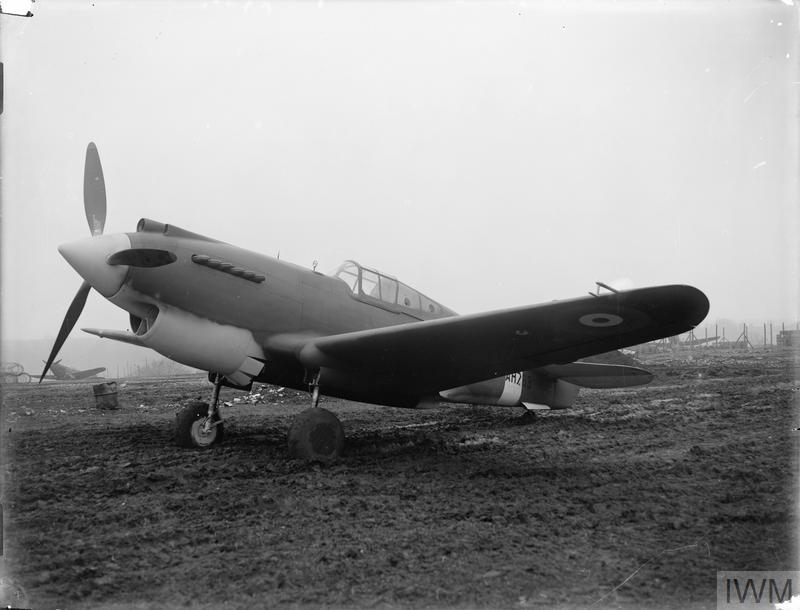
Tomahawk Mark I, AH769 at Boscombe Down, before serving with No. 268 Squadron

In Part 2 of this trail, yet more personnel arrive at Twinwood and the conditions for those residing here worsen.

The full story of Twinwood Farm can be found in Trail 67.

Trail 66 – RAF Chelveston – Part 9 – The End of an Era

Part 8 saw Chelveston at the crossroads of history. From the heroism of B-17 crews braving ferocious Luftwaffe attacks to the tense vigilance of Strategic Air Command jets in the early Cold War, the station had witnessed courage, innovation, and loss. Yet as international tensions shifted and technology advanced, even its longest runways and fortified hangars could not guarantee a future.

By the late 1950s, Chelveston faced an uncertain fate. What would become of a place that had once been alive with the roar of engines and the courage of men? Its final chapter was about to be written – but the outcome was far from certain.

During the late 1950s and early 60s, the world’s political landscape was shifting constantly and rapidly. France’s president, Charles de Gaulle, saw his country as a strong, independent nuclear power, wanting full control over its own defence. That vision did not accommodate large numbers of foreign – particularly American – forces on French soil. As a result, 1959 saw the start of a reduction in military numbers with strict limits being placed on the number of American forces allowed in France. Any personnel or equipment beyond this ceiling were required to leave immediately. This decision triggered a massive redeployment of forces, with many units being reassigned to Germany or Belgium, and others returning to the United Kingdom where they were accommodated at the so-called ‘Red Richard‘ bases, of which Chelveston was one.*20

Over the next several years, France saw a steady reduction in American personnel and units, a process that would culminate in 1966 with President Charles de Gaulle’s announcement of France’s withdrawal from NATO’s integrated military command. The decision required the removal of all foreign forces from French soil by April 1967, bringing an end to more than a decade of a large-scale American presence.

To accommodate the early relocations from the continent, a number of Britain’s newly modernised airfields were selected – Chelveston among them. Alongside RAF Alconbury and RAF Bruntingthorpe, each station received elements of the 10th Tactical Reconnaissance Wing (TRW), the 42nd Tactical Reconnaissance Squadron, of the 10th TRW, arriving at Chelveston in August 1959. Operating the twin-engined Douglas RB-66C Destroyer – electronic reconnaissance aircraft, eighteen of these machines, together with their crews and ground personnel, quickly took up residence. Shortly after their arrival, the aircraft were modified with updated electronic counter-measures equipment, reflecting the increasingly technical nature of Cold War aerial reconnaissance.

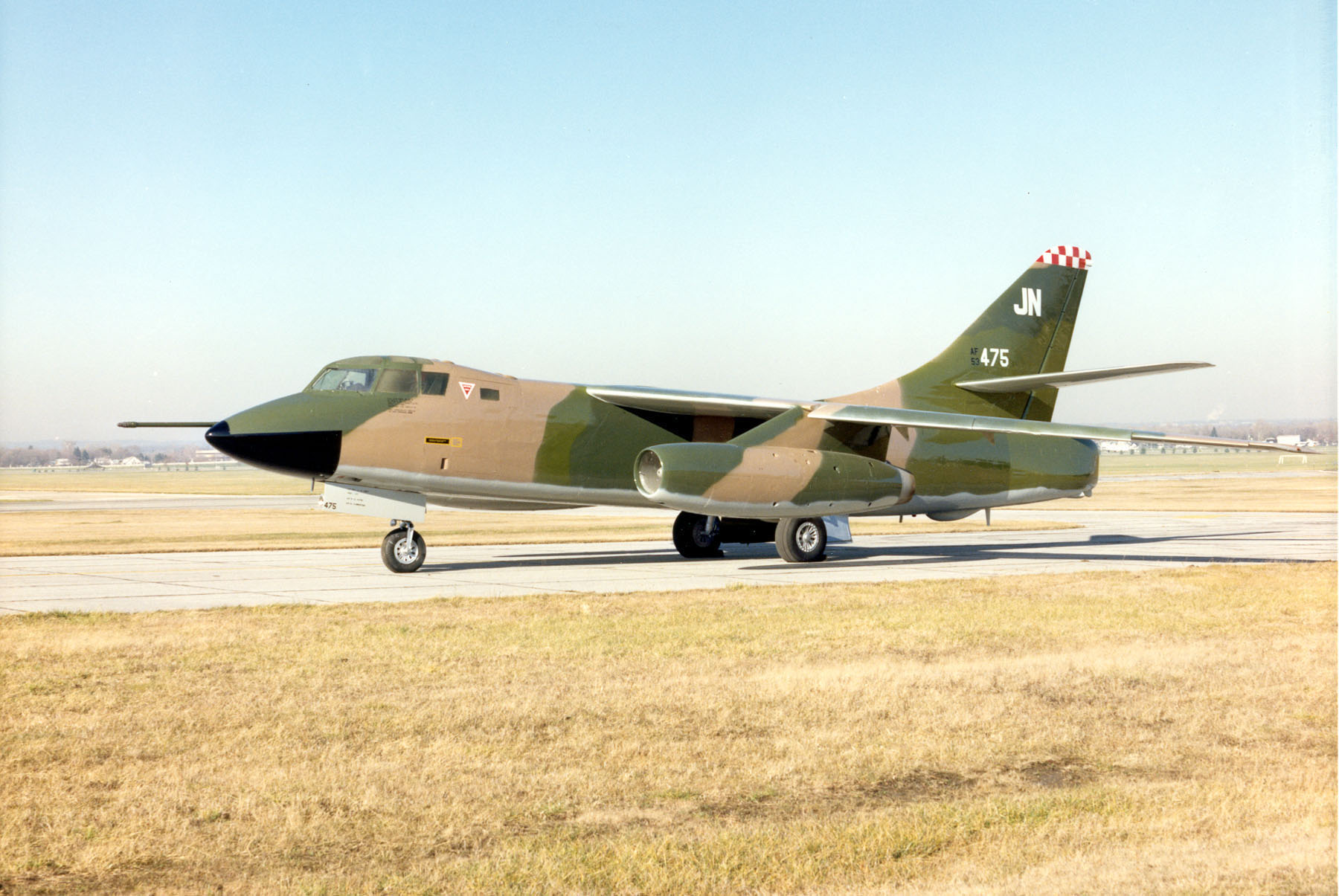
Douglas RB-66B Destroyer (U.S. Air Force photo)

The squadron remained at Chelveston for almost three years. Then, in the summer of 1962, both the 42nd Tactical Reconnaissance Squadron and the 19th Tactical Reconnaissance Squadron departed their respective Midlands stations for deployment to Toul-Rosières Air Base in eastern France. The move placed the wing’s reconnaissance assets closer to the Central European front line at a time when aerial reconnaissance was increasing. For Chelveston, however, it marked the effective end of its active flying role. With the Americans steadily reducing their UK footprint and Bruntingthorpe facing closure, the departure of the RB-66s signalled the beginning of the station’s final chapter.

Project Clearwater and the End of the Reflex Era

So, once again, Chelveston was left devoid of all main front line squadrons. Facing a reduction in demand for Cold War bases –  combined with both long expensive runways and a shift towards a more logistical, support and storage use – Chelveston’s runway was closed to all but infrequent, small aircraft – examples that could operate on shorter runways.

Before long, the airfield being used less and less, Chelveston closed to flying altogether, and it quickly reverted back to a reserve airfield status.

This shift in wider policy soon became formalised. On 26th July 1963, the United States Department of Defence announced ‘Project Clearwater’, the final phase in the reduction of American forces stationed on British soil.*21 Although Chelveston had already fallen largely silent, the base remained nominally under United States control while residual activities continued. That position ended on 19th June 1964, when Chelveston – together with RAF Fairford, RAF Greenham Common and RAF Sculthorpe – was formally closed and handed back to the Royal Air Force.

By 1st April 1965, Project Clearwater had effectively brought an end to Strategic Air Command’s Reflex bomber deployments in Britain, terminating large-scale rotational operations and leading to the inactivation of the 7th Air Division*22 Chelveston, retained by the RAF on a care-and-maintenance basis for a further period, would briefly assume a less glamorous role as a storage location for American equipment being withdrawn from the continent. The age of regular transatlantic bomber and reconnaissance operations from Northamptonshire had quietly drawn to a close.

From Runways to Renewables: The Final Transformation of Chelveston

With no flying units now operating from Chelveston, the runways and associated tracks began to deteriorate and break up. With the increasing demand for housing and the nearby new town of Milton Keynes expanding, hardcore was needed and Chelveston had a good supply just waiting to be quarried. The runways and perimeter tracks were all removed thus ending any chance of a reprieve for flying in the future. But it wasn’t to be the end of its military association just yet.

In 1977, Chelveston became home to a key part of the Royal Air Force’s Strike Command Integrated Communications System (STCICS). The site, equipped with a large array of antennas, formed an essential link in the RAF’s network, transmitting voice, data, and weather information to aircraft, and connecting military stations across the UK and beyond. For decades, it played a vital role in maintaining operational communications for Strike Command.

As technology and operational requirements evolved however, the Ministry of Defence upgraded the system, leading to the creation of the Defence High Frequency Communications Service (DHFCS). This new network integrated both air and naval communications into a single nationwide system, capable of maintaining secure links over long distances, and routing messages through a central control centre. By December 2003, with the network increasingly managed by civilian contractors,  Chelveston was vacated once more, thus marking the end of its role in the UK’s high-frequency military communications infrastructure.*23 *24

With their departure, the site became surplus to military requirements, and it was sold off in 2005, as a going concern. New businesses seeing it as a development opportunity, bought it up turning it into a diverse renewable energy park that is known today as Chelveston Renewable Energy Ltd.

A number of wind turbines have since been erected, all linked by  the remaining remnants of the perimeter track.  A solar farm has also been added, and the site has evolved into a major energy supplier utilising renewable energy sources.

Today, the former Chelveston airfield  continues in this state, and little evidence exists of its previous life; the runways, perimeter tracks and buildings all having been removed. Dotted about, within the confines of the private area, a small number of  temporary buildings are known to remain (as surveyed by Northamptonshire Archaeology in conjunction with West Northamptonshire Council) including one of the nuclear bomb stores, – the ‘igloo’. Because, of its excellent condition and rarity value, the structure has been put forward for long-term protection through the Scheduling process of West Northampton Council.  The store is considered to be ‘well-preserved and a relatively unaltered example of a distinctive 1950s USAF munitions storage area’ which ‘comprises characteristic storage bunkers or “Igloos” inspection buildings, and perimeter fencing.’ *25

Although largely privately owned, there is a footpath across the site running perpendicular to the post war runway. In addition, the Cold War accommodation blocks are still present adjacent to the site, and a small section is used by the Northamptonshire Fire and Rescue Service as a training centre, training fire-fighters.

On the ground little remains to be seen, and access to that is restricted. The concrete foundations used by the post war communications centre are visible, but otherwise, Chelveston, and its history, are merely records longing to be opened and read.

During its short wartime life, Chelveston witnessed many acts of great heroism. It bore heavy losses, saw significant developments in aerial warfare, and its crews endured sustained enemy attacks. Those who served here are now honoured by a memorial in the nearby village, a quiet reminder of the station’s wartime sacrifice. Yet the story of Chelveston did not end in 1945; for many years after the war, the airfield continued to play a major role in Europe’s front-line operations, a legacy that is not suitably acknowledged.

Now a thriving energy park its future has been sealed, The military have departed and private enterprise has taken over what little remains of its once glorious but reserved history.

The whole story of Chelveston can be read in Trail 66. Northants and Bedfordshire (Part 2)

Sources and Further Reading (RAF Chelveston)

*1 Chelveston renewable Energy Park website. Accessed 24 June 2025

*2 Chelveston Parish / Local history website. Accessed 24 June 2025

*3 Commonwealth War Graves Commission website. Accessed 5 July 2025

*4 The Airborne Assault Paradata website. Accessed 16 July 2025

*5 Air Force Historical research Agency Website. Accessed 18 August 2025

*6, *7 Vlahos, M. C., and Kehler, B., Leading the Way to Victory: A History of the 60th Troop Carrier Group 1940–1945. Woodbridge, CT: Knox Press, 2023.

*8 Wilhelm, D., ‘The flight of the bomber Phyllis’, Liberty, 5 December 1942, Imperial War Museums, document 50898.

*9 Missing Air Crew Report (MACR) 15501.

*10 Hamilton, J., The Writing 69th. Green Harbour Publications, 1999.

*11 Coffey, T. M., Decision Over Schweinfurt. Magnum Books, 1978.

*12 Freeman, R. A., Mighty Eighth War Diary. Jane’s Publishing Co., 1981.

*13 Bowman, M., The Bedford Triangle. Pen & Sword, 1989.

*14 Coffey, T. M., Decision Over Schweinfurt. Magnum Books, 1978.

*15 Congressional Medal of Honour website.  Accessed 5 August 2025

*16 Boyd, R. J., ‘Project Casey Jones 1945’, Penn State Hazleton Campus Library.

*17 United States Air Forces in Europe – Air Forces Africa – Third Air Force, website. Accessed 3 October 2025.

*18 West Northamptonshire Council, website. Accessed 27 September 2025.

*19 Rushden Research Group, website. Accessed 11 September 2025.

*20 West Northamptonshire Council, website. Accessed 27 September 2025.

*21 RAF Mildenhall, website. Accessed 17 September 2025.

*22 RAF Mildenhall, website. Accessed 17 September 2025.

*23 Everything Explained Today, website. Accessed 15 February 2026.

*24 Everything Explained Today, website. Accessed 15 February 2026.

*25 West Northamptonshire Council, Northamptonshire Historic Environment Record, website. Accessed 15 February 2026.

Additional references

National Museum of the United States Air Force Website accessed 2 March 2026

The Airborne Assault Paradata website. This provides a wealth of information about the AFEE and airborne operations. It is well worth a read.

Air mobility Command US Air Force, Website Accessed 12 October 2025

Chelveston-cum-Caldecott Parish Council website accessed 20 September 2025

Airfields of Britain Conservation Trust Website.

Rushden “Hearts & Soles” website accessed 20 September 2025

Trail 66 – RAF Chelveston – Part 8 – A new Chapter Begins

Throughout Part 7 the 305th Bomb Group continued to demonstrate extraordinary courage, with crews surviving horrific damage to their B-17s and earning multiple Medals of Honour for their heroism. By the final months of the war in Europe, they had flown 337 combat missions, dropped over 22,000 tons of bombs, and contributed to both strategic bombing and propaganda efforts. After Germany’s defeat, the group returned to the United States, later reactivating briefly in 1947, 1951, and 1994, leaving a lasting legacy as the “Can-Do Wing.”

From Wartime Urgency to Cold War Necessity

The immediate post-war years then presented the Government with a formidable practical and financial problem. At the end of 1945 there were close to 700 surplus military airfields scattered across the United Kingdom, many of them constructed hurriedly for a wartime need that now suddenly became redundant. Pressure for their disposal came swiftly. Farmers demanded the return of requisitioned land, local authorities saw opportunities for civil airports or industrial development, and the Treasury was keen to reduce the heavy burden of maintenance costs. At the same time, the Air Ministry argued that a proportion should be retained against future uncertainty, either as reserves or for storage and technical purposes.

Across the country the fate of these sites varied. On some airfields, huts and temporary accommodation sites were converted into short-term housing for displaced families during the acute post-war shortage. Elsewhere, hardstands and runways were broken up to provide much-needed hardcore for reconstruction projects. Yet a minority of airfields were kept within the RAF’s control, Chelveston being one of them. Returned to the RAF after the war, it passed to Maintenance Command and was designated as a satellite of No. 25 Maintenance Unit, although this arrangement remained brief. Thereafter, the station entered a period of care and maintenance, a quiet, role that lasted until September 1952.

Despite a rapid post war airfield closure programme, by the early 1950s the pace of reductions had slowed as the international climate dramatically shifted. The emerging Cold War, marked by the formation of the North Atlantic Treaty Organisation (NATO) in 1949 and intensified by conflicts such as the Korean War, prompted a reassessment of Britain’s defensive position. Air power, particularly with the advent of jets and the nuclear dimension, regained its strategic significance. Selected airfields  across Britain saw their runways lengthened, surfaces strengthened, and dispersal areas improved to accommodate modern aircraft. The 1956 Suez Crisis further strengthened the need for an operational readiness and an overseas capability.

Domestic policy was also playing its part. The National Service Act 1948, which introduced peacetime conscription, kick-started a steady flow of manpower into the armed forces throughout the 1950s. Although costly, and partly due to massed post war demobilisation, National Service enabled the RAF to sustain a larger trained strength than would otherwise have been possible; this made it important to retain, and in some cases reactivate, selected stations for training, reserve or operational activities.

On a wider scale, Anglo-American defence cooperation deepened. Several East Anglian airfields – including RAF Lakenheath, RAF Woodbridge, and RAF Bentwaters – were all developed or upgraded for US Air Force use, while strategic bomber bases such as RAF Wittering were adapted to meet the RAF’s demands in the nuclear era. Disposal of wartime airfields therefore continued, but more selectively: stations once considered redundant suddenly acquired a renewed military value, serving as insurance against an increasingly uncertain international environment.

From Wartime Relic to Strategic Stronghold

In light of these changes, in 1952, a detachment of the 7503rd Air Support Wing (later redesignated the 7253rd ASW) arrived at Chelveston to assess and prepare the station for reactivation, laying the groundwork for construction teams from the 817th Engineer Aviation Battalion (EAB), who began major redevelopment work just two months later. This followed the February 1951 launch of a major US construction programme across twenty-six UK airfields, driven by rising Cold War tensions.

The deployment of American aircraft on British soil was a direct response to the growing Soviet threat seen in both Korea and Eastern Europe. Stationing bombers in the UK significantly reduced flight times to potential targets, thus enhancing both rapid strike capability and strengthening the credibility of Western deterrence. Wartime stations that had lain largely dormant since 1945 were once again recognised as strategically valuable, reflecting the pressures of the emerging jet age and the rapidly evolving political-military situation in Europe.

These physical upgrades coincided with a decisive reorganisation of American air power in the UK. On 20th March 1951, the Strategic Air Command (SAC) activated the 7th Air Division to assume direct control of its strategic bomber forces in Britain; a move that separated nuclear strike responsibilities from the broader command. Weeks later, on 1st May 1951, the Third Air Division was replaced by the Third Air Force, which under NATO, managed tactical air operations, logistics, and support for U.S. units stationed in the UK.

Expanded, modernised, and re-equipped, these airfields were adapted to accommodate the new generation of SAC jet bombers – larger, faster, and more capable than any that had previously operated from British soil. Together, the redevelopment of Britain’s wartime airfields and the restructuring of command reflected the growing permanence of the United States’ commitment to Western Europe’s defence – a position that would endure throughout the Cold War.

This extensive refurbishment work would include new runways, updated or replacement accommodation blocks, secure nuclear-capable bomb stores (or ‘igloos’), larger fuel stores, and a range of technical buildings – and all rapidly constructed.

Chelveston, already being a large site with a long runway, was earmarked for such development. However, its wartime runway had deteriorated and was too short for the new jets. A new, longer, and stronger runway – 12,000 ft in length, among the longest in the UK – was therefore constructed, a task undertaken by the 817th Engineer Aviation Battalion.*17

From Stratojets to Silence

After nearly four years of development that saw the construction of not only the new runway, but additional hardstands, servicing platforms and a technically superior watch office (Type 5589/58 Tower with a visual control room mounted on top of a skeletal frame)*18, the site was transformed. It was then that the 3914th Air Base Squadron (ABS) of the 7th Air Division, SAC, took up residence.

As operators of the airfield, the 3914th ABS would complete any further modifications needed allowing for, in May 1956, the first jet bomber’s arrival. Boeing B-47E-65-LM Stratojet, 53-1881 was flown in by the base Commander Colonel Maynard E. White. On arrival, he was greeted by his deputy commander along with local civic leaders and American families who were now living on the new base. This moment marked the beginning of a new era in Chelveston’s history.*19

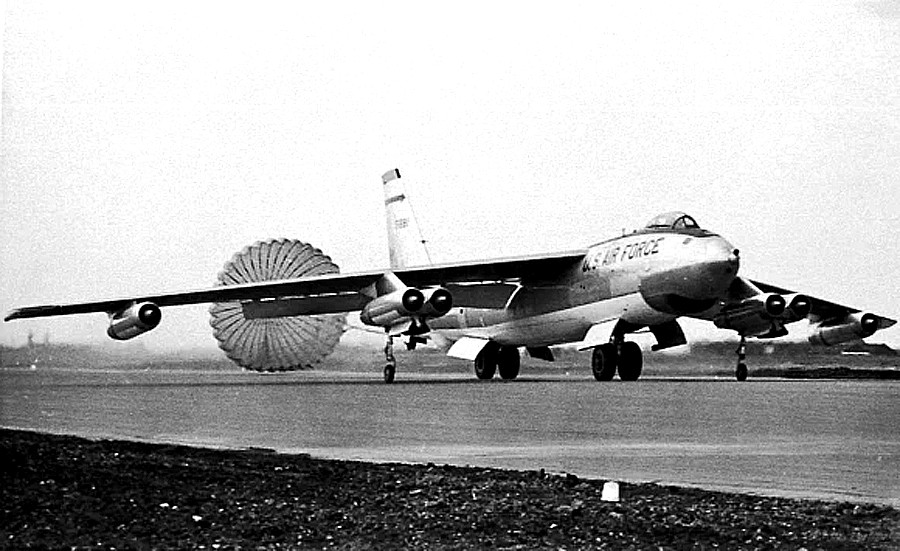
Believed to be the first B-47 Stratojet 53-1881 landing at Chelveston. (Public domain via Chelveston-cum-Caldecott Parish Council).

For a the next three years or so, Chelveston would house a small number of B-47s, all nuclear capable. But continual economic changes in the US defence network, meant that many were now placed on ninety day rotations instead of permanent postings.

The airfield became part of a chain of bases housing large bombers of the Strategic Air Command as part of a ‘Reflex Alert’ force. Kept armed and ready, they remained manned on a permanent 15 minute alert basis ready to respond to any Soviet threat that may have come.

With these rotas changing approximately every three months, families were moved about from base to base, a process that carried on for almost eighteen months until mid 1959.

A further change in the global political and strategic field in the last few months of this period, saw a change in aircraft too. The bomber era was now drawing to a close, and at Chelveston, this led to the arrival of the 301st Reconnaissance Wing (RW) equipped with RB-47s – a reconnaissance version of the B-47.

By now, intermediate-range ballistic missiles (IRBM) were being increasingly used more, and several UK bases now had them deployed as an alternative to the heavy bombers.  With ranges of up to 5,500km, they were the catalyst for an arms race, one that would see newer and more powerful weapons propel the world toward the edge of destruction.

As the story of Chelveston draws to a close IRBMs take centre stage, reshaping the balance of power and casting a long shadow over airfield. As these new weapons promise unprecedented reach and destructive potential, the once-bustling bomber base faces an uncertain future. What would become of Chelveston in this rapidly changing landscape – an abandoned relic, secret stronghold, or something else entirely? The final chapter will reveal a story few could have predicted.

The whole story of Chelveston can be read in Trail 66. Northants and Bedfordshire (Part 2)

Trail 66 – RAF Chelveston – Part 7 – 2 Medals of Honour

In Part 6, the 305th Bomb Group faced some of the most intense and costly operations of the war, including record-setting large formations and the brutal Schweinfurt raids, which inflicted heavy losses on the group. Crews endured extreme physical and mental strain, yet displayed remarkable heroism, earning multiple medals and citations while innovating new tactics and night operations. By late 1943 and early 1944, the group began to benefit from improved technology, navigation systems, and experience, setting the stage for record-breaking missions that would push both men and machines to their limits.

The formation was to cross to the continent where it would  split, each branch finding their predetermined targets, bomb and then reform for the long journey home. Although the weather was poor, fighter escorts did get airborne and they managed to stave off many of the attacks aimed at the bomber stream. For one 305th aircraft though, it would be a major struggle and an heroic one.

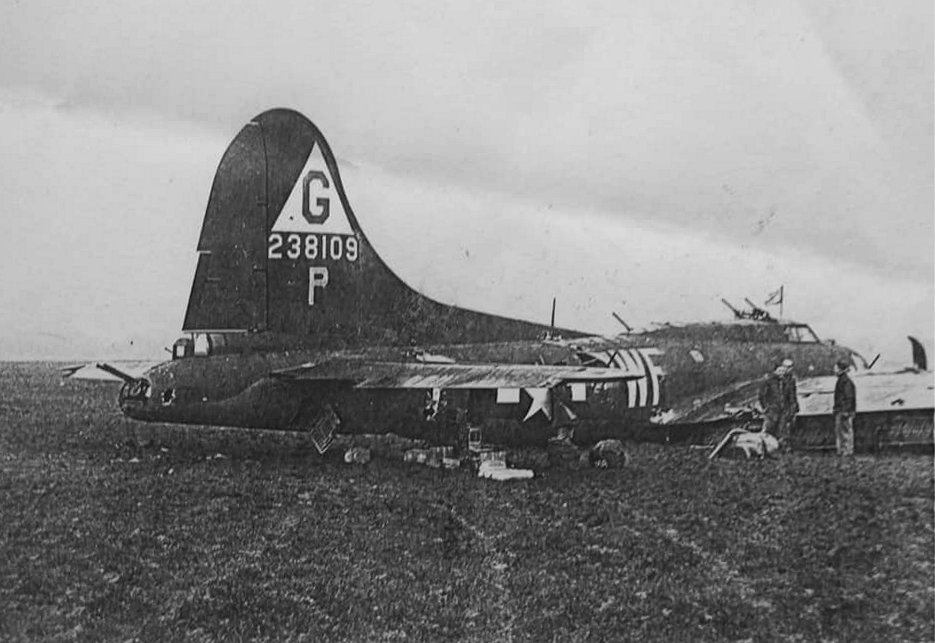
In B-17 42-38109 – ‘Cabin in the Sky’ – was pilot 1st Lt. William Robert Lawley Jr, flying only his tenth mission since joining the 364th BS, less than a year previously.

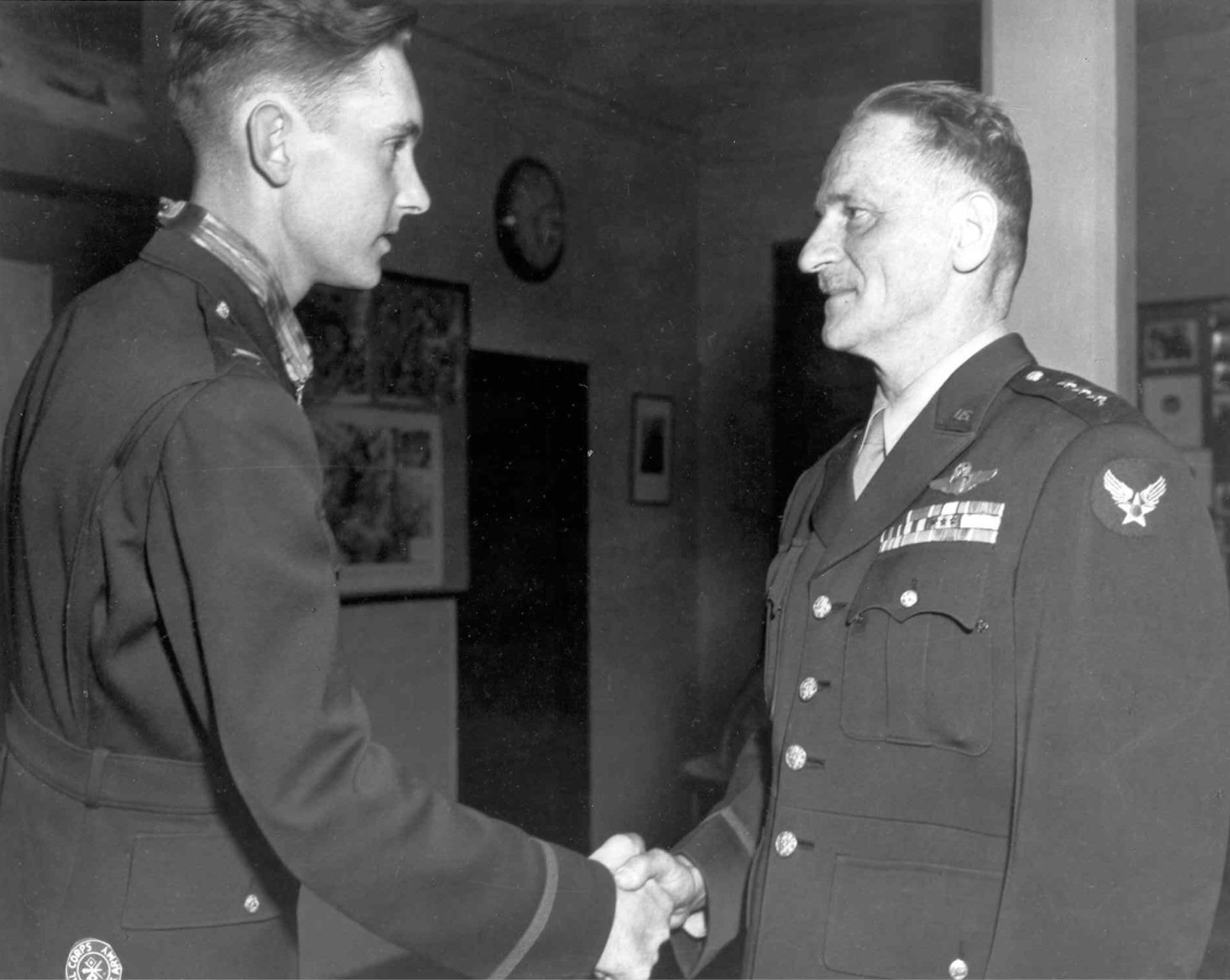
First Lieutenant William R. Lawley, Jr., is congratulated by Lieutenant General Carl Spaatz on the award of the Medal of Honour, 8th August 1944. (IWM UPL 55737)

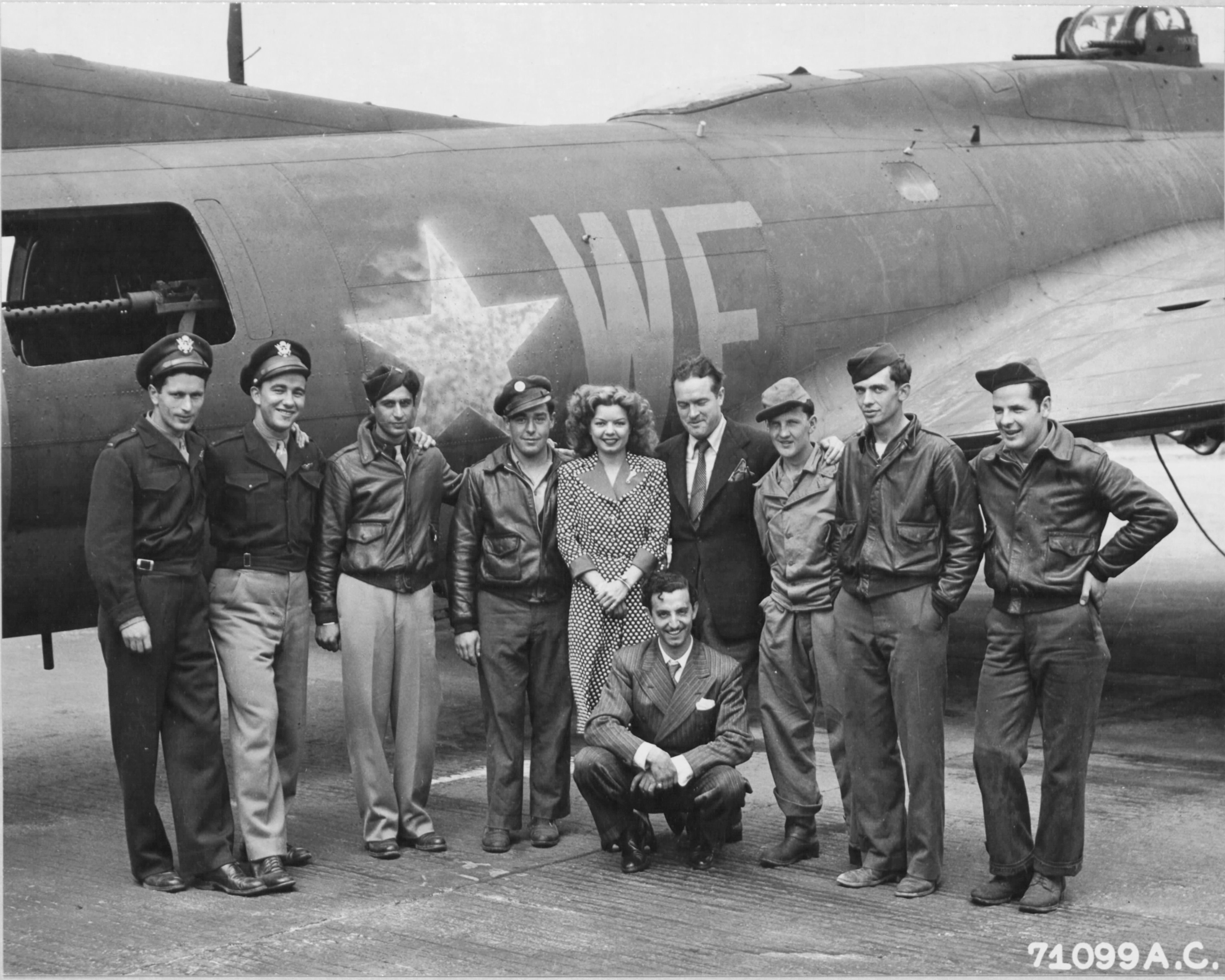
The aircraft, a B-17G-30-DL (WF-P) was departing the target area with its bomb load intact due to a frozen mechanism, when it suffered a full frontal attack by enemy fighters. Suddenly, a canon shell ripped into the cockpit  killing the co-pilot, Paul Murphy, and striking Lawley in the face severely wounding him.

The attack by around twenty enemy fighters, also wounded every other crewman, in addition to setting an engine on fire. The attack caused the B-17 to enter a dive which could well have been uncontrollable had Lawley not fought back the pain and forced the co-pilot’s hands off the controls with one hand, whilst fighting the aircraft with the other. With a hole in the blood soaked windscreen, cold air forced its way in, adding to the cockpit’s terrible conditions and to the extreme pain Lawley was already feeling.

In fear of an explosion, resulting in total destruction of the aircraft and its crew, Lawley gave the order to bale out, but no one did. Some were simply too injured to do so, and those that were able to, did not want to leave their buddies behind to what must have seemed to be an inevitable fate.

Even whilst enduring further attacks, the engine fire was somehow extinguished, only to be replaced by another in a different engine. Then, a glimmer of hope came over the intercom, the bombardier had managed to free the bombs, thus lightening the load. This allowed the badly injured Lawley to perform incredible evasive action.

But by now, Lawley was exhausted, and was suffering from huge blood loss. Acutely aware of the situation, Mason, the bombardier, took over until Lawley was able to regain his strength and take back the B-17’s controls. With two engines out, a new threat appeared – lack of fuel. Another engine suddenly stopped running, leaving just one to keep the heavy bomber aloft. Somehow, the aircraft managed to not only reach England, but pass over its coastline. Feeling somewhat relieved, but acutely aware of the ever present danger, the crew scoured the horizon for a safe place to land. Redhill suddenly came into view, and just in time, as the B-17 was now losing height, and fire was spreading across the wings.

In great pain, Lawley managed to bring the aircraft down to Earth, performing an amazingly controlled crash landing. Nine of the ten onboard survived to return to duty, Paul Murphy being the only casualty. For his determination to get home, Lawley was awarded the Medal of Honour, the US’s highest award for bravery.

This dramatic event was mirrored by a B-17 of the 351st, then based at  RAF Polebrook. Sadly though, this one ended in the loss of the three crewmen left on board, after the aircraft crashed in a field. For his action, Sgt. Archibald Mathies also received the Medal of Honour.

B-17 42-38109 ‘Cabin in the Sky‘, after crash landing at RAF Redhill. (IWM UPL 55733)

This would not be a solitary awarding of the prestigious Medal of Honour, for it would be repeated just two months later, highlighting the bravery shown by many crewmen during those dark days of World War II.

On April 11th 1944, the Germans yet again made a ferocious attack from the front, a tactic they had devised early on in the American’s war in Europe.

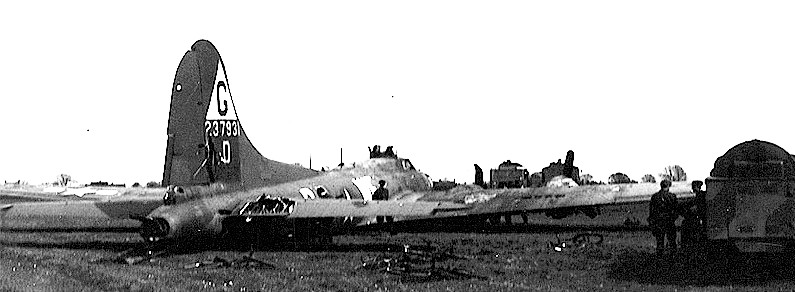
In this instance, 1st Lt. Edward S. Michael was piloting B-17G  ‘Bertie Lee’ 42-37931, as part of the 364th BS on operations to bomb various  targets in Germany, including the Focke-Wulf plant at Sorau. Other targets for the 341 B-17s of the 1st BD, included Cottbus, Dobberphel, Stettin and Trechel.

The aircraft, a Douglas-Long Beach B-17G-20-DL Fortress (WF*D), was flying in formation toward Stettin when it became the focus of a determined enemy attack. To the crew, German fighters appeared to single them out, pressing home repeated assaults, despite escorting fighters and heavy defensive fire from the bomber.

The ferocious attack shattered the cockpit, both pilot and co-pilot (2nd Lt. Franklin Westberg) were wounded, instruments failed, oil covered the windscreen and the aircraft fell into a 3,000 foot spin from which survival seemed over. With skill and strength however, 1st Lt. Michael managed to pull the aircraft out of the dive, only to discover that the bomb bay, still full of incendiaries, was on fire – the result of yet another attack. With damage to the release equipment, the crew were unable to jettison  the bombs – the situation was getting worse.
The only way they could survive now was to bale out, and so Michael gave the order. On doing so, he was greeted by the horrendous sight of the top turret gunner, Jewel Philips, holding his eye in his hand and blood gushing from a severe head wound.

Giving initial aid to the gunner, Michael, himself injured, helped him to the door and out of the aircraft, He was one of seven who made it away.

With the co-pilot and injured bombardier, Lt. Leiber,  still on board, Michael decided he was going to try a crash landing.  Working hard to save the ship for as long as they could, the bombardier managed to finally free the burning incendiaries, and by performing dramatic evasive manoeuvres, Michael managed to  shake off pursuing enemy aircraft; eventually reaching the relative safety of cloud cover.

Now being targeted by flak, he decided to get the aircraft down as low as he could, and flying at almost treetop level, he headed towards England. The aircraft continued to respond well considering the extensive damage it had received, and so they flew on for as long and as far as they could. Miraculously, they reached the English coast, but Michael was exhausted from both his continued efforts and a severe thigh wound, The bombardier took over, circling the aircraft in a holding pattern until Michael had the strength to bring the stricken aircraft down. With no hydraulics, the ball turret jammed down, the undercarriage locked up and the bomb bay doors locked open, it was not going to be an easy ride and the odds of survival were stacked heavily against them.

As if the gods were on their side though, Michael retook control and brought ‘Bertie Lee’ down, its metalwork crunching and groaning as it careered along the grass at RAF Waltham near to Grimsby in Lincolnshire.

For his incredible actions and determination to get home, 1st Lt. Michael received the unit’s second, highest level award, the Medal of Honour.

Extensively damaged, ‘Bertie Lee’ after crash landing at RAF Waltham (IWM UPL 40113).

1st. Lt. Michael’s citation*15 read:

For conspicuous gallantry and intrepidity above and beyond the call of duty while serving as pilot of a B-17 aircraft on a heavy-bombardment mission to Germany, 11 April 1944.

The group in which 1st Lt. Michael was flying was attacked by a swarm of fighters. His plane was singled out and the fighters pressed their attacks home recklessly, completely disregarding the Allied fighter escort and their own intensive flak. His plane was riddled from nose to tail with exploding cannon shells and knocked out of formation, with a large number of fighters following it down, blasting it with cannon fire as it descended.

A cannon shell exploded in the cockpit, wounded the co-pilot, wrecked the instruments, and blew out the side window. First Lt. Michael was seriously and painfully wounded in the right thigh. Hydraulic fluid filmed over the windshield making visibility impossible, and smoke filled the cockpit. The controls failed to respond and 3,000 feet were lost before he succeeded in levelling off.

The radio operator informed him that the whole bomb bay was in flames as a result of the explosion of three cannon shells, which had ignited the incendiaries. With a full load of incendiaries in the bomb bay and a considerable gas load in the tanks, the danger of fire enveloping the plane and the tanks exploding seemed imminent. When the emergency release lever failed to function, 1st Lt. Michael at once gave the order to bail out and seven of the crew left the plane.

Seeing the bombardier firing the navigator’s gun at the enemy planes, 1st Lt. Michael ordered him to bail out as the plane was liable to explode any minute. When the bombardier looked for his parachute he found that it had been riddled with 20-mm fragments and was useless. First Lt. Michael, seeing the ruined parachute, realized that if the plane was abandoned the bombardier would perish and decided that the only chance would be a crash landing.

Completely disregarding his own painful and profusely bleeding wounds, but thinking only of the safety of the remaining crewmembers, he gallantly evaded the enemy using violent evasive action despite the battered condition of his plane. After the plane had been under sustained enemy attack for fully 45 minutes, 1st Lt. Michael finally lost the persistent fighters in a cloud bank.

Upon emerging, an accurate barrage of flak caused him to come down to treetop level where flak towers poured a continuous rain of fire on the plane. He continued into France, realizing that at any moment a crash landing might have to be attempted, but trying to get as far as possible to increase the escape possibilities if a safe landing could be achieved.

First Lt. Michael flew the plane until he became exhausted from loss of blood, which had formed on the floor in pools, and he lost consciousness. The co-pilot succeeded in reaching England and sighted an RAF field near the coast. First Lt. Michael finally regained consciousness and insisted upon taking over the controls to land the plane.

The undercarriage was useless; the bomb bay doors were jammed open; the hydraulic system and altimeter were shot out. In addition, there was no airspeed indicator, the ball turret was jammed with the guns pointing downward, and the flaps would not respond. Despite these apparently insurmountable obstacles, he landed the plane without mishap.

Heroic actions like this, were widely mirrored across the beaches, seas and skies of Normandy that June, when vast numbers of ground, naval and air force personnel combined to carryout the greatest invasion ever known. With operations beginning in the early hours of June 6th 1944, Chelveston’s aircraft would again be involved, dropping leaflets to the French people warning them of the impending allied invasion. It would be a day that would go down in history.

Many of those involved in D-day looked forward to the day they would return home, but returning home was never a guarantee of safety. In December whilst on a mission to bomb the railway marshalling yards at Kassel in Germany, B-17 43-38973 received extensive damage with one engine put out of action. As the aircraft made its way home, it began to lose height and to make matters worse, England was shrouded in fog cutting visibility to near zero.

In an attempt to find a landmark, the pilot took the aircraft lower and lower, a risk that ended in tragedy when it struck a Gee mast at Borough Hill in Northamptonshire. All nine on board were killed in the collision.

337 Missions to Victory: The 305th’s Final Campaigns

The winter of 1944–45 descended with a familiar severity. Snow and ice gripped the airfields, while dense fog rolled across much of Europe, grounding aircraft and testing the endurance of even the most seasoned crews. Yet amid the bitter cold came decisive movement on the ground. Following the Allied breakthrough in the Ardennes, advancing forces pressed steadily into Germany itself. The war’s end was now clearly in sight, but its closing chapter would be anything but quiet. The months that followed brought an intense tempo of operations, as bomber formations crossed the Rhine with increasing confidence. With the Luftwaffe offering only sporadic and weakening resistance, B-17s and B-24s were able to penetrate deep into German territory with far less opposition than in previous years. Mission counts climbed rapidly. Many groups reached the formidable milestone of one hundred operations, and several of the original contingents went well beyond it, their longevity a testament to both endurance and experience.

Gradually, as allied forces made their way across Europe,  the heavy bombers of the allied forces pounded German cities. By March, the 305th had completed its 300th operation, having endured a long and demanding campaign since being amongst one of the first groups to deploy to the UK. In celebration, they were once again given the lead position in an attack on Böhlen-Rötha, Leipzig. Thirty-six aircraft set off that day to find near perfect weather over the target and so bombing was considered highly accurate despite heavy and accurate flak. Of the thirty-six, aircraft despatched, two B-17s were lost from the 305th, one of which carried the command crew – led by Lt. Col. Howell G. Crank in 44-8141. The aircraft was hit by flak and one of its engines knocked out. It then turned over and dived into the ground killing ten of those on board with one taken as a prisoner of war.

A month later on April 25th, 1945, shortly before the war’s end, the 305th would make their final bombing flight bringing Chelveston’s war in Europe to an end. The 305th had achieved an eye-watering 337 combat missions (480 including other types), dropping over 22,000 tons of bombs and over 70 tons of propaganda leaflets. During their time in Britain they had lost in the region of 154 aircraft, received two Distinguished Unit Citations and two airmen had both been awarded a Medal of Honour. In just three short months, on July 25th, they would leave England, heading for a new base at  St. Trond, Belgium (Army Airfield A-92). Their final departure leaving no operational front line units at Chelveston and little prospect of any arriving in the future.

After the defeat of Japan and the formal declaration of world peace in September 1945, the group was posted to Germany where the four squadrons were dispersed to various airfields, prior to their deactivation in the following December. The reason for the move was – and included the 306th from Thurleigh – to photograph two million square miles of land, ranging from Iceland in the north, through Europe to the Soviet frontier in the east, and on to north and west Africa in the south. By splitting the groups, it meant that flying time was reduced and coverage increased.*16

Following that, the 305th Bombardment Group returned to the United States. Crews were demobilised and dispersed, and the aircraft that had endured the rigours of combat over Europe were largely scrapped. The group would then briefly re-emerge in 1947 and again in 1951, each time for only a short period. After another short reprieve in 1994, it was reborn as the 305th Air Mobility Wing, a title under which it continues to operate today. The wartime service of the 305th at RAF Chelveston remains a key part of this lineage; the group’s achievements with the Eighth Air Force between 1942 and 1945 established the reputation of what became known as the “Can-Do Wing.” Chelveston is still recorded in U.S. Air Force historical archives as one of the stations from which the unit first earned its combat distinction, and with it, the legacy of the 305th  continues on.

As peace settled over Europe, Britain faced a daunting challenge: what to do with nearly 700 surplus wartime airfields, many hastily built and suddenly redundant. While some were dismantled or repurposed for civilian use, others – including Chelveston – were quietly retained, waiting for a world that was rapidly becoming uncertain once more. By the early 1950s, the rise of the Cold War, nuclear weapons, and jet bombers would transform these dormant relics into strategic strongholds, setting the stage for a dramatic new chapter in both British and American air power.

The whole story of Chelveston can be read in Trail 66. Northants and Bedfordshire (Part 2)

Trail 66 – RAF Chelveston – Part 6 – Records, Heroism and Morale

In Part 5, the 305th endured some of the harshest early missions of 1943, suffering heavy losses over the U-boat pens and German targets while crews faced flak, fighters, and extreme winter conditions. Individual acts of courage and ingenuity, from surviving ditchings to improving bomber defences, highlighted both the bravery and inexperience of the fledgling unit. By April, Chelveston was officially transferred to full American control, and the 305th began taking the lead in major operations, earning their first Distinguished Unit Citation for precision bombing and determined action under fire.

April–May 1943: Record Flights, Heroism, and Morale Boosts

Being so new to the war, and with only the four B-17 groups still forming the bulk of the air force, operational records were regularly set and broken. The month of April saw another such record set, with the largest formation of US aircraft taking part. The flight, consisting of 115 B-17s from the four Groups, flew in a new configuration. The 305th formed the rear box, in a new arrangement that only permitted 3,000 ft separation between the low and high boxes.

The four groups from Thurleigh, Bassingbourn, Molesworth and Chelveston had led the way for the 8th Air Force, and by April  they were all becoming very tired and fatigued, and in desperate need of replacements. Although short in coming, replacements and new squadrons were eventually to arrive, helping to bolster both the strength and size of the still small but determined Air Force.

This newly reinforced air force was employed for the first time on 13th May 1943, and again on the 14th and 15th. On this last mission, the 305th were again on the receiving end of the Luftwaffe’s fury, as they hit hard head-on to the formation. In one of these B-17s, every member of the crew, except the tail and right-waist gunner, suffered severe injuries. Such was the crew’s  determination in getting back to Chelveston though, that two DSCs, eight Silver Stars and seven Purple Hearts were awarded to them that day. Those on-board ‘Old Bill’ being the most decorated crew of the 305th by the war’s end.

B-17 42-29673 ‘Old Bill’ 422nd BS, damaged on Wangerooge 15th May 1943.  Featured ground crew: Cpl Willis Todd (inside) and Cpl Zimmerman (outside), (IWM UPL 30085).

The morale of airmen, who faced death on an almost daily basis, was always a problem. To keep spirits up, various visits were arranged, some of which included top entertainers from ‘back home,’ who toured the various airfields and bases in Britain. On July 5th 1943, Frances Langford, Bob Hope and Tony Romano all arrived at Chelveston. Posing for photo shoots, meeting the crews and performing for the personnel were just one way of keeping spirits high.

“Frances Langford, Bob Hope and Tony Romano pose with the crew of the Boeing B-17 ‘Lallah VIII‘ (A/C 242) 5th July 1943. L to R: (P) Lt. Sam Johnstone, (CP) Lt. Elsworth Kenyon, (N) Lt. Martin Licursi, (B/T) Sgt. Arthur Englehardt, Frances Langford, Tony Romano, Bob Hope, (E) Sgt. Donald Baer, (WG) Sgt Richard Lewis, (TG) Sgt. Homer Bagby.(IWM UPL 35399).

August 1943: Schweinfurt, Night Raids, and the Toll of War

But amid these rare glimpses of happiness and momentary reprieves from fear, the war would endure, and the ever-present face of death would soon turn toward them once more.

Whilst Berlin became a name to dread, one other target drove an even sharper stake into the hearts of US airmen, that of Schweinfurt.

Schweinfurt, was a major centre for ball-bearing production. Located north-west of Nuremberg, it was one of Germany’s most prolific suppliers of this vital component. Although it did not produce all of the ball-bearings required by the German war economy, allied strategists believed that by destroying the Schweinfurt plants, they would severely disrupt supplies. By doing so, they would undermine Germany’s ability to sustain the war and bring it to a rapid conclusion.

The first attack, on 1st August 1943, saw the 1st Bombardment Wing (BW) send out 230 bombers in two waves; one of 116 aircraft and the second 114. Of these, thirty-six were lost in the battle; the 382nd and the lead Group the 91st BG, taking the brunt of the attack. The 305th from Chelveston lost ‘only’ two, but a further fourteen were classed as damaged but fortunately  repairable. The initial figures for the overall losses would soon grow though as the full extent of the damage became apparent. The final count neared sixty-three aircraft that were deemed  irreparable and lost. The total loss of aircraft from the operation, rose to in excess of 90, an unsustainable loss for any raid and one that brought home the severity of what the American airmen were facing.

Despite these losses, the raid was considered a success. In Schweinfurt itself, as the last B-17 left the target, a cloud of smoke and fire could be seen, its ferocity engulfing the town. What had been a two hundred year old conurbation of peace and serenity burned ferociously after receiving in excess of 400 tons of bombs – a mix of high explosives, incendiaries and general purpose types. The tranquil, but productive coastal town was in ruins – but the cost in American airman had been high. *11,*12

That same day, the 4th BW sent another 146 of their heavy bombers to Regensburg. Like the Schweinfurt mission, it suffered heavy casualties, with the loss of twenty-four aircraft. All-in-all, August 1st had been a terrible day for the Americans, and despite delivering a devastating blow, the war was clearly far from over.

During September and into October 1943, the 422nd Bomb Squadron of the 305th Bomb Group was withdrawn from daylight flights and retrained for night bombing operations, becoming the first US Army Air Force unit to undertake such activities. During this period, the squadron flew eight night sorties, dropping approximately sixty-eight tons of bombs, along with the unit’s first ‘Nickel’ mission on the night of 7th/8th  October 1943.

‘Nickel’ operations were carried out in cooperation with the RAF, and involved the dropping of propaganda leaflets over occupied Europe. In total, the squadron dispersed around seventy-three tons of leaflets, many of these being thrown out by hand, a slow and exhausting process. To speed things up, crews soon began to push entire boxes from the aircraft in the hope they would burst open in mid-air. A relatively unsuccessful method, it was eventually replaced by an ingenious purpose-built ‘leaflet bomb’. This aerial device was designed to open at a set altitude – often around 1,500 feet – scattering more than 80,000 leaflets in a single drop.

During these operations the squadron worked alongside Radio Counter Measure units as well as the ‘Carpetbaggers’ who were based at RAF Harrington. A common feature of these clandestine organisations was their use of black-painted, often war-weary B-24 Liberators, each one especially adapted for night operations and special duties.*13

Return to Schweinfurt: Catastrophe in the Autumn Skies

The disaster of Schweinfurt would never be far away though. In October, the city would raise its head once more, and once again losses for the Eighth would be high.

The morning of the 14th was cold and foggy, and many hoped that the day’s mission would be cancelled. Unfortunately, no such call came, and as crews sat in their briefing rooms, a hush fell as the curtain was drawn all the way back to reveal Schweinfurt. Gasps and groans filled the various briefing rooms as the details of the operation were read out.

At take off, the 305th were late, by about six minutes, meaning  that they had to catch up with the formation who were gradually pulling away from them. As a result, they were out of their place as they left the English coast, and desperate to catchup for the protection that the formation gave. After flying around trying to locate their place, the lead pilot Major Charles Normand, decided to slot in to the 1st Combat Wing’s low position, replacing the also late 381st.

Shortly after 13:00 hrs, the fighter escort withdrew, leaving the bombers to fend for themselves and allowing the waiting Luftwaffe to make their move. Single and twin-engined fighters now attacked the formation from every direction. Stukas, dropped timed bombs from above, and from around the sides rockets, canons and machine guns were emptied into the formation. The 305th in the vulnerable low position, took the initial brunt. Gunners were frantic in their attempts to defend themselves, using up ammunition at an incredible rate.

As the formation approached Duren, a number of B-17s began to smoke and fall back. Single-engined fighters attacked head on, diving away at the last minute whilst twin-engined aircraft fired rockets from the rear. One of the 305th’s B-17s was hit by one of these rockets, its wing folding and the fuselage opening up revealing badly injured crewmen inside. With no parachutes they simply fell from the sky. The Pilot fought to keep what little of the B-17 was left together, a fruitless task that ended in an dramatic and final fireball.

Further attacks continued to focus on those aircraft of the 305th, the 92nd and Kimbolton’s 379th. Aircraft after aircraft began smoking, slowly falling out of formation with cut engines or damaged control surfaces. No longer able to keep up, they became sitting ducks.

Over the target, Luftwaffe fighters were joined by flak. A barrage of accurate and intense 88mm bursts welcomed the bombers whose numbers were by now depleted.

Still in the low squadron position, the 305th’s Major Normand now led only three aircraft, twelve of the original fifteen sent out had gone –  shot down by enemy fighters. Determined to do their job, they declined a move to a safer position and made their own bomb run into the target.

The mayhem wreaked havoc on the formation. By the time they reached the target the 305th were further out of position, and the lead bombardier requested a second try. Knowing how dangerous that would be and how it would put them in a lonely situation, Normand refused and told Lt. Pellegrini to ‘do his best’. As they left the city, another B-17 from Chelveston went down, and after 100 minutes of continuous attack, the 305th were down to just two aircraft.

On return to England, many aircraft became lost in thick cloud and were abandoned, left to fall out of the sky as crews parachuted out. Those that did find land tried to locate any airfield they could and get down whilst they still had fuel in their tanks. It had been a costly operation. 600 airmen were lost that day, 130 of them from Chelveston. The Mighty Eighth had taken another beating and it would almost end their aerial warfare campaign. The only saving grace being that one of the crews who went down, had manged to get to Switzerland where they were interned.*14

The losses suffered by the 305th that day were the highest of all groups who took part. It had been a devastating blow leaving Chelveston depleted of many young airmen who were by now experienced and battle hardened veterans – many still in their twenties. As a consolation for the group, when allied troops overran the city in April 1945, the captured Nazi flag that proudly flew for so long over the city, was handed to the 305th as a souvenir.

As for Schweinfurt, 500 tons of bombs had dealt another devastating blow to the historic town. Flak batteries had decimated the American formation, and fighters had given their all, but still the American’s determination got them through. Schweinfurt would go down in history. It would forever be remembered on American bases as the battle that took so many lives and the one that nearly killed off the Eighth Air Force.

The terrible losses that day would never be repeated by the Chelveston crews. As they approached the year’s end, they hoped for better and they got it. Unbeknown to them at the time, December 20th 1943, would be the start of a record fifty-six missions without loss for the 365th BS of the Chelveston group. – a run that took them almost to D-Day, 6th June 1944.

Against All Odds: Two Medals of Honour in the Winter of 1944

The early months of 1944, saw the first use of ‘Gee’ by American Pathfinders. A pioneering system that used radio navigation to significantly improve bombing accuracy by timing the gap between two radio signals from ground stations. Hardwick’s 329th, who were part of the 93rd BG, had been trialling the new system since 1942, and it was finally deemed ready for operations. In these early stages, missions focussed on ‘No ball’ targets – V1 launch sites – where Gee could be tested to the limit. Such was the desire to perfect the system that almost half of the 29 missions carried out in January and February, used it.

January would also see another major award for the Chelveston Group. On the 11th following a raid on the aircraft factory at Halberstadt, the 1st Bomb Division, (formerly 1st Bomb Wing), were awarded the Distinguished Unit Citation; for the 305th, it was their second of two such awards.

A month later, on 20th February 1944, a combined force of over one thousand American aircraft of the 1st, 2nd and 3rd Bomb Divisions (BD) took part in operations. The 305th, as part of the 1st BD, were ordered to hit targets at Leipzig, Heiterblick, Abtnaundorf, Bernburg, Oschersleben. Failing that, they were to hit any target that presented itself as an opportunity.

The sky over Europe had become a crucible, where bravery, skill, and sheer willpower were tested to their absolute limits. For the crews of the 305th, every mission brought them face-to-face with death, yet time and again they defied the odds, fighting through blazing cockpits, flaming engines, and relentless enemy attacks. As they pushed ever deeper into the heart of Nazi territory, every flight carried the weight of a nation – and the question hung in the air: who would make it home, and who would not?

The whole story of Chelveston can be read in Trail 66. Northants and Bedfordshire (Part 2)

Trail 66 – RAF Chelveston – Part 5 – Cinematic Fame

In Part 4, we saw how the arrival of the 305th Bombardment Group under Col. Curtis LeMay transformed Chelveston into a hub of innovation and determination. LeMay’s leadership and forward-thinking tactics shaped the group’s early operations, pioneering formation flying and lead-bomber bombing methods that would improve accuracy and survivability. Despite harsh conditions and a steep learning curve, the 305th quickly developed into a highly effective unit, setting the standard for future B-17 operations and laying the groundwork for its critical role in the air war over Europe.

Crews, Combat, and Cinematic Fame: Chelveston in 1943

Back in the United States, interest in joining the Army Air Forces remained high, fuelled in part by carefully crafted propaganda films designed to sustain public support and encourage enlistment. During the winter of 1942–43, both Bassingbourn and Chelveston became film locations for director William Wyler, who was already renowned for Mrs Miniver. His documentary-style productions would immortalise one particular B-17 – ‘Memphis Belle’, securing her place as perhaps the most famous Flying Fortress of them all.

Despite all these ventures back home, the USAAF remained an infant unit, who faced  an ever increasing number and ferocity of air battles as 1943 dawned.  The cold of January 3rd would see the 305th leading yet another attack on the submarine pens at St. Nazaire, which had so far proven indestructible. Not only were there heavy and accurate flak batteries protecting them, but the pen’s walls, over 9m thick, were impenetrable by any current weapon in the military arsenal.

For the bombers, the long, straight run in to the target seemed like running a gauntlet, met with a well-planned barrage placed in front of the bombers, it was a daunting sight for any crew to face. It was so fierce, that of the eighty-five aircraft sent out that day, seven were classified as missing, whilst more than half of those remaining suffered flak damage of varying degrees.

Carrying 1,000 lb General Purpose bombs, some 171 tonnes were released, a mere drop in the ocean compared to figures achieved later in the war – and it barely scratched the surface of the pens.

Although seen as a successful operation, it had seen the highest loss of the 8th Air Force’s war so far, and with two aircraft crash landing on return after getting lost – the lack of experience of these fledging crews was becoming evermore evident.

Despite the losses and cold though, there was no let up for the crews of the 305th. On the 27th January, they were once again in the winter skies. This time it would be Germany itself, and the 8th Air Force’s first venture in the Nazi airspace.

The target for the day was Vegesack on the Wesser river, seen as a priority target for air operations. However, once over the  continent, the bombers were faced with thick cloud and little chance of finding the target, let alone bombing it. Turning to their secondary target, they headed for Wilhelmshaven, where they  found only moderate flak and light fighter cover.

As a result, loses were light that day, three aircraft went down, one of which was a Chelveston bomber 41-24637 (KY-F), and even though many bombs fell harmlessly away from the target area, the mission was still widely celebrated and praised by the press.

The loss of the B-17 brought home the brutality of what they were facing. Although some of the crew managed to bail out (five were taken as POWs) another five were killed; the ball turret gunner Sgt. Roy Whitney and tail gunner S. Sgt. Robert Ames were killed in the attack. The other three, were attacked by fighters as they parachuted through the sky, two of whom, T.Sgt. Bernice Farmer and S. Sgt. Jerome Kissleheff were killed. The last crewman, S. Sgt. Le Roy Mason, died after hitting the ground, his parachute shot to pieces.*9

Trial by Fire: The 305th’s Gruelling February Raids

Typically, the opening days of February were marked by persistent poor weather, which resulted in several planned missions being abandoned, some even after the Fortresses had departed England. On 4th February, however, the 305th did manage to get airborne, dispatching eighteen aircraft toward Hamm. Although faced with adverse weather, the formation were undeterred, instead diverting to their secondary target – Emden.

Despite their determination and ‘Can do’ attitude, none of the 305th’s aircraft succeeded in bombing the target. What’s worse, the mission also proved costly, as one aircraft 41-24593 (WF-G) ‘El Lobo’, collided head-on with a FW-109 after it was hit by flak. Another B-17 was shot down by a twin-engined fighter – the likes of which had not been seen in the skies before.

‘El. Lobo’ and her crew before being lost over Hamm (IWM UPL 13288).

Later in the month, on 26th February, the 305th took part in another operation to Germany. The primary objective here was the Focke-Wulf factory at Bremen, with orders to divert to the submarine pens at Wilhelmshaven should weather conditions once again prevent an effective attack.

After briefing for Bremen, twenty B-17s of the 305th joined with  other B-17s of the 91st, (20), 303rd (19) and 306th (17), and seventeen B-24s of the 44th and 93rd BGs. Forming up over the Norfolk coast, the whole formation was led by the 305th.

Heading toward the target, they quickly became weakened. In the first one hundred miles, some twenty aircraft turned back, either through mechanical issues or personnel problems. As a result, the protective firepower of the group was significantly reduced, and those who were left faced a greater risk from attack.

On reaching Baltyrum Island, the formation began its descent toward the target. At this point, they were attacked by a lone fighter, an FW-190, only to be replaced minutes later by others from 12./JG1. Continuing on, the formation reached Oldenburg , albeit relatively unscathed. Here the formation experienced cloud cover, and the decision was made by Major J. Preston, the formation commander, to turn 1800 north, and head to the secondary target Wilhelmshaven.

Due to various reasons, the normally faster B-24s were unable to keep up with the B-17s, and three aircraft from the 44th, began to lag behind. Being vulnerable away from the protective firepower of the bigger formation, they were immediately attacked by enemy fighters, with two being brought down.

Over the next forty minutes or so, seven aircraft were shot down during a blistering attack by a mix of Me-109s, FW-190s, Ju-88s and Me-110s, who were not only firing canons into the formation, but dropping aerial bombs as well. Two of those lost during the melee were from the 305th whilst others from the same group were severely damaged.

On board one of those B-17s was 2nd. Lt. James Moberly, in 41-24617 ‘Southern Comfort’, but Moberly’s story is one of luck more than good judgement. Increasing crew injuries had led to them being advised to wear steel helmets, which were proving to be cumbersome and awkward in the heat of battle, many choosing not to wear them. Moberly had decided that day to wear his, a decision that would save his life.

Whilst firing one of the nose guns, a cannon shell struck the aircraft exploding just above his head, the force knocking him down so hard, he cracked the navigator table. After looking at the rather large hole in the fuselage, he examined his helmet to find several large dents caused by the shell that would otherwise have probably killed or at best, severely wounded him. From then on, he was convinced of the helmet’s benefits and it always went with him.

The plane was so badly damaged by flak in the attack, that one engine was knocked out, discharging oil over the wing. Furthermore, a four-foot hole had been blown in the rudder and the aircraft was riddled from nose to tail by bullets and canon fire. On setting a  hopeful course for home, the pilot asked those aboard to pray, a last ditch effort to save the aircraft and its crew. Whether through God’s help, or pure determination and will power, they reached Chelveston, and the pilot placed the aircraft down on the runway. Once news got out about their exploits, they became known as the crew that ‘prayed’ their aircraft back.

In another one of these aircraft B-17F 41-24604 ‘Arkie’ [KY:D], was pilot Everett E. Tribbett who, after baling out, was captured and sent to Frankfurt before ending up at Stalag Luft III. Once inside, his skills were quickly put to good use, becoming involved in clandestine radios within the camp – an activity that would have had severe consequences if discovered. The aircraft meanwhile, named after Tribbett’s  wife, came down at Hookseil, ten miles north of Wilhelmshaven.

In a third B-17, 41-24623, the ball turret gunner, S. Sgt. Lee ‘Shorty’ Gordon was captured after baling out of his stricken aircraft. His determination to ‘get home’, though, led to him escaping no less than a reported five times, even using his diminutive size to pose as a child in one failed attempt.

Gordon’s story was initially told in the Air Force’s Service Journal just after he was reported missing in action; followed in 1944 by the boy’s comic True Comic. It was later recalled in both The Writing 69th by Jim Hamilton (1999) and Air Gunner by Andy Rooney & Bud Hutton. As the first US airman to escape and make his way home, Gordon was awarded the Silver Star.*10

Gordon was only one of five survivors from the downed plane, each one of them being located in the mid and rear sections of the stricken aircraft.

Whilst the formation had taken a beating, the 303rd BG from Molesworth reported no damage at all. By contrast, Chelveston’s 305th reported fourteen aircraft damaged, from flak, cannon fire, or even falling shell cases from nearby aircraft.

Several enemy aircraft were claimed as either ‘kills’ or ‘damaged’ that day, but as with many of these early claims, the numbers of actual enemy aircraft shot down, was for various reasons, hugely exaggerated. It is now known that only one enemy aircraft was lost that day, a considerable difference, but an understandable one at that. Of the ninety-three bombers that took off on that mission, only sixty-five managed to bomb the target. It had been a difficult day for the Eighth, and one the 305th was relieved to leave behind.

Spring 1943: Hardship, Heroism, and American Takeover

But the winter had taken its toll. By the time spring arrived, the 305th had lost nearly half its crews, whilst the other fledgling groups were down to almost a fifth of their original number. Men on sick leave, or in hospital beds were ordered back into their aircraft, reports of fights, random gunfire in dormitories and aggressive behaviour were becoming commonplace. The mental state of some had deteriorated to new levels, resulting in temporary blindness, extreme behaviours and mental stress that  affected many. In fear of being labelled as cowards, many hid their true feelings lashing out at those closest to them. The air force’s answer was swift, to demote, move or even discharge these men before they ‘infected’ those around them.

With an aim to boost morale and lift falling spirits, the personnel of Chelveston were treated to a little bit of joy. On April 19th 1943 the airfield was officially handed over, by the RAF, to full American control. In a short, but simple ceremony, in which the Stars and Stripes were hoisted, Flt. Lt. H. W. Davies RAF handed over control to Brig-Gen Fredrick Lewis Anderson, of the 1st Bombardment Group USAAF. Chelveston was at last now officially an American base and would be known as Station 105.

Despite losses and misgivings though, the 305th were beginning to take centre stage in the air war. April’s first operation, on the 4th, saw them the lead group once more. After departing Chelveston in the late morning, they joined with the three other B-17 groups in the UK: the 91st, 303rd and 306th, taking an incredible three hours to form up and achieve cruising altitude. The escort of Spitfires that had joined them, had little to do on the way to the target, as the Luftwaffe were strangely no where to be seen.

Of the entire formation, the 305th achieved the most accurate bombing results, with a high proportion of their bombs falling on the target itself. This accuracy resulted in damage to a number of the Renault factory buildings, reputedly putting them out of action for several months afterwards.

On the flight home however, the 305th once again learned what it meant to be the lead group, when a large formation of enemy fighters struck head-on in a fierce, determined attack. It was here that three of the 305th’s B-17s went down and a forth would be forced to land away with wounded onboard at Dunsfold airfield.

Although the Chelveston group had taken a beating, they had also set a record. The gunners of ‘Dry Martini 4th’ claiming an unprecedented ten enemy aircraft shot down, half of those claimed that day by the entire 305th. For this and for showing great determination in leading the formation, on return, the 305th received its first Distinguished Unit Citation (DUC).

In Part 6, the 305th, still a relatively new and thinly stretched force, faced unprecedented challenges as the Eighth Air Force began flying ever-larger formations into increasingly hostile skies. From record-setting mass raids in May to the punishing assaults over Schweinfurt, Chelveston’s crews were pushed to the limits of endurance, bravery, and ingenuity, earning medals and accolades even as friends and aircraft were lost around them. As winter 1944 approached, with new navigation technology and record-breaking missions on the horizon, the 305th were about to step into a phase of the air war that would test everything they had learned – and threaten to change the course of the Eighth Air Force forever.

The whole story of Chelveston can be read in Trail 66. Northants and Bedfordshire (Part 2)

Trail 66 – RAF Chelveston – Part 4 – The ‘Can-Do’ Group

We saw in Part 3 how the USAAF’s 301st Bombardment Group transformed Chelveston into an operational heavy-bomber station, launching their first combat missions over Europe. Early operations brought the group face-to-face with enemy fighters, resulting in casualties and dramatic incidents, including a heavily damaged B-17 returning to RAF Gatwick and another ditching in the Channel. By late November, the 301st had departed for North Africa, leaving Chelveston ready to welcome its next unit, the 305th Bombardment Group.

These early battles gave great hope for the men of the 8th Air Force, with low losses they were perhaps, lured into a false sense of security and feelings of an easy battle ahead. But all that was to be washed away, when over the coming months, the 8th would become battle hardened and severely scarred.

Forging the ‘Can-Do’ Group: Col. Curtis LeMay and the 305th Bombardment Group

The 305th, who arrived here in early December 1942, were led by the tough and innovative Col. Curtis LeMay whose drive and leadership led to the rookie 305th, being known as the ‘Can do’ Group.

LeMay was a very quiet man, but commanded respect from those beneath him. He was slightly forgiving, but he would not tolerate being lied to. LeMay, never having been in battle himself, forged his career in the United States where he learnt every detail of the B-17, the bomber he was about to take to war. LeMay looked to the likes of Col. Armstrong for guidance, asking him question after question about his experiences and tactics, absorbing his advise like a sponge. Many of Armstrong’s answers he took strictly at face value, however, only to realise later, that perhaps Armstrong was not the man LeMay thought he was.

Through his leadership style, LeMay earned the title of ‘Iron Ass’, a grudging respect from those who followed him. The 305th, led by LeMay, would be a forward thinking group, one who would go on to develop pioneering methods of aerial bombing and battle formation flying.

The heavy armament of the B-17 gave the highest level of protection when in a tight formation, each gun covering a wide arc thus protecting all the others in the group. By forming a ‘box’, this level of protection was at its highest, a style developed by the 305th. With bombing accuracy becoming a major issue for the USAAF, the idea of a lead crew, was another idea stemming from the experiences of the 305th and LeMay. By having a single lead upon whom the whole formation would bomb, accuracy was improved and concentrations of bombs in the target area increased. Both these methods became standard operating procedures throughout the 8th Air Force during the Second World War.

The 305th like the 301st before them, and now their sister squadron the 306th at Thurleigh, were amongst the first few units to arrive in the UK, and as newbies with no battle experience, they faced an incredibly long and steep learning curve.

The 305th arrived in the UK forming initially at RAF Grafton Underwood around September 12th, 1942, bringing together both the ground and air echelons as they prepared to commence operations over Europe. The mud and cold that greeted them would quickly become their bed-partner, remaining with them for the duration of their wartime lives.

The conditions at Grafton were appalling and the airfield was totally unfit for a bomber unit. It would take an enormous amount of upgrading and huge renovations to improve it. This would mean the newly arrived 305th would have to move out, a move that signalled the beginning of their time at Chelveston. Over the Period 6th to 11th December, they transferred across, a temporary measure that quickly became permanent lasting the duration of the war.

Their journey to Chelveston began back at Salt Lake City where they were activated on March 1st 1942. They spent a large part of their training at Muroc Lake Air base (now Edwards Air Force base) before the ground echelon sailed on Queen Mary in early September, arriving at Greenock on 12th. The air echelon meanwhile didn’t leave until October, advanced flight training taking place at Syracuse, New York, in the weeks prior to their departure. Flying the usual northern route they brought their B-17Fs via Presque Isle, Gander and Prestwick, before routing to Grafton underwood.

Following Roosevelt’s controversial slimming down of the Eighth, the 305th, together with the 91st, 303rd and 306th, formed the only B-17 groups remaining in the command, while the 44th and 93rd were its sole B-24 units. Collectively, they constituted the backbone of an Eighth Air Force, stripped to little more than this handful of operational groups – a striking force reduced to a shadow of its intended strength. But then, even that would be cut back, with elements of the B-24s being sent to North Africa as well, and not returning to the UK until the following summer after which time, the B-17s had ‘flown the US’s flag’ over occupied Europe.

Fearing that heavy losses would catastrophically reduce the remaining groups to a handful of aircraft and crews, Spatz and Eaker mounted relatively ‘safe’ operations, those featuring little penetration into the European stronghold. However, the chances of loses, even at those short distances, continued to remain high.

Tactics and Innovation: The 305th’s Early Combat Lessons

The 305th’s first mission would happen a month after their arrival at Grafton on 17th November 1942 against the U-boat pens at St. Nazaire.  It was during these early missions that the Luftwaffe pilots worked out that a full frontal attack on a B-17 would target it’s weakest point – a blind spot in the gunners forward arc. Here, the fighters had both a better chance of survival and the ability to cripple an aircraft by killing both its pilot and co-pilot in a well aimed attack.

To combat this weakness. two innovative Thurleigh ground crew  devised a method by which the nose guns could be moved and supported thus filling the gap in the arc. After developing and trialling the new fixture, the system quickly became standard fittings on later B-17s across the air force.

For the 305th, the otherwise fierce attack of 17th November proved a rare exception: they returned without a single casualty – one of only a handful of units to do so – despite nearly a quarter of the dispatched aircraft sustaining damage from concentrated machine-gun and cannon fire.

These early battles highlighted a stark reality: losses and damage were disproportionately high when set against the relatively small numbers of aircraft taking part. LeMay, latched onto this, and quickly became the driving force behind efforts to improve both survival and bombing effectiveness.

After being told by Armstrong never to fly straight and level for more than a few seconds on the bomb run, LeMay did exactly the opposite, leading his group for some 4 minutes toward the target. Whilst this tactic was indeed a gamble, the 305th’s bombing record was soon to be far in excess of other groups especially those who followed the Armstrong doctrine.

LeMay, encouraged by these successes, also began experimenting with new combat formations, seeking a balance between maximising defensive firepower and reducing the risk of bombers damaging one another in the chaos of fighter attacks. His solution was the development of the staggered ‘box’ formation, arranged both vertically and horizontally. To preserve bombing accuracy and avoid aircraft jostling for position, all bombers would release their loads simultaneously on the lead aircraft’s command. These methods proved to be so effective that they were also quickly adopted as standard practice throughout the entire Eighth Air Force.

In the next part of Chelveston’s history, we see the 305th pushed to the limits of courage and endurance, facing punishing winter raids over the U-boat pens and the heart of Germany. Crews battled flak, fighters, freezing conditions, and the strain of inexperienced personnel, while stories of survival, heroism, and narrow escapes emerged from each mission. Just as morale teetered under the weight of losses, the airfield itself was officially handed over to full American control – yet even this milestone could not prepare them for the next series of deadly operations that would test the 305th like never before.

The whole story of Chelveston can be read in Trail 66. Northants and Bedfordshire (Part 2)