Trail 66 – RAF Chelveston – Part 9 – The End of an Era

Part 8 saw Chelveston at the crossroads of history. From the heroism of B-17 crews braving ferocious Luftwaffe attacks to the tense vigilance of Strategic Air Command jets in the early Cold War, the station had witnessed courage, innovation, and loss. Yet as international tensions shifted and technology advanced, even its longest runways and fortified hangars could not guarantee a future.

By the late 1950s, Chelveston faced an uncertain fate. What would become of a place that had once been alive with the roar of engines and the courage of men? Its final chapter was about to be written – but the outcome was far from certain.

During the late 1950s and early 60s, the world’s political landscape was shifting constantly and rapidly. France’s president, Charles de Gaulle, saw his country as a strong, independent nuclear power, wanting full control over its own defence. That vision did not accommodate large numbers of foreign – particularly American – forces on French soil. As a result, 1959 saw the start of a reduction in military numbers with strict limits being placed on the number of American forces allowed in France. Any personnel or equipment beyond this ceiling were required to leave immediately. This decision triggered a massive redeployment of forces, with many units being reassigned to Germany or Belgium, and others returning to the United Kingdom where they were accommodated at the so-called ‘Red Richard bases, of which Chelveston was one.*20

Over the next several years, France saw a steady reduction in American personnel and units, a process that would culminate in 1966 with President Charles de Gaulle’s announcement of France’s withdrawal from NATO’s integrated military command. The decision required the removal of all foreign forces from French soil by April 1967, bringing an end to more than a decade of a large-scale American presence.

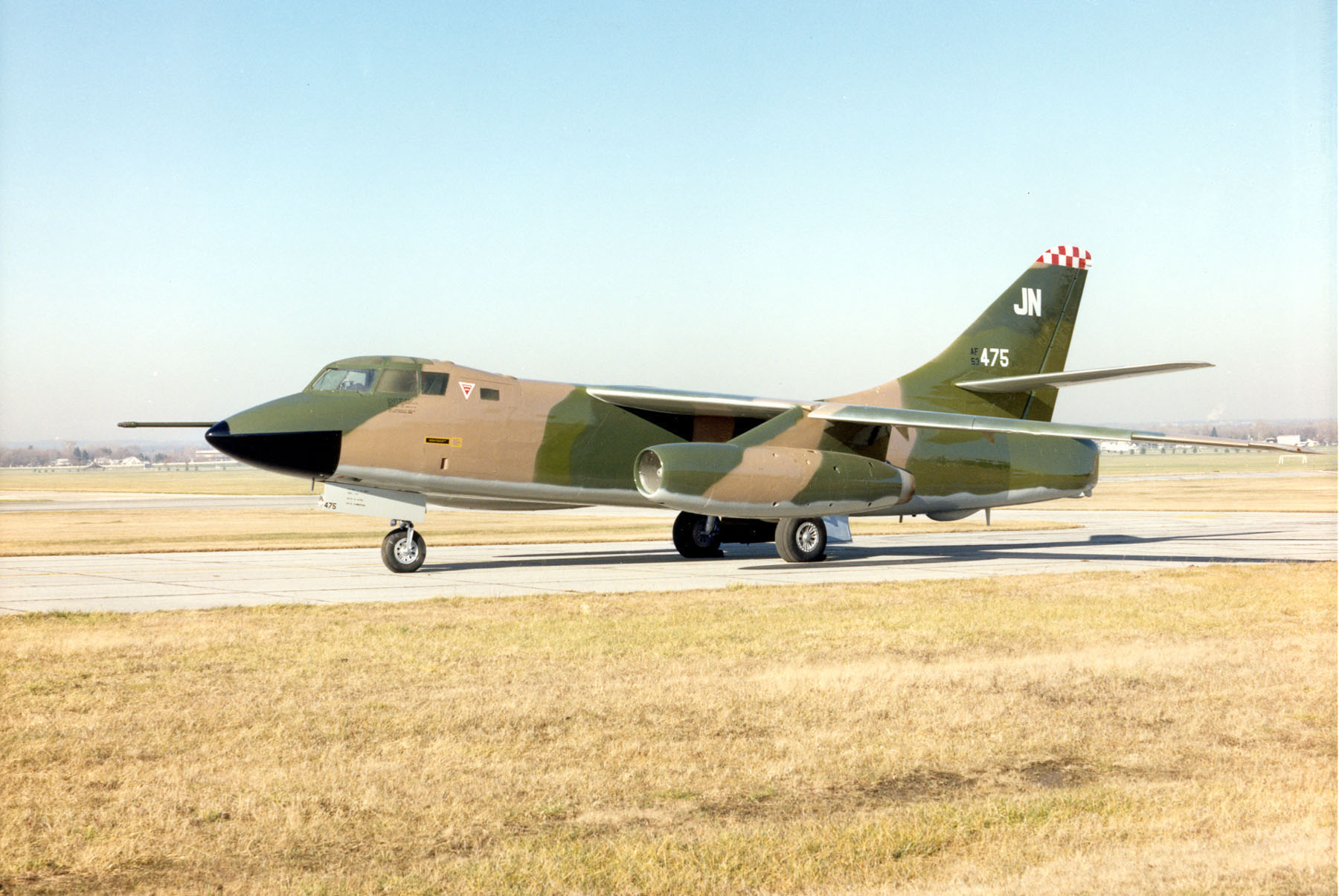
To accommodate the early relocations from the continent, a number of Britain’s newly modernised airfields were selected – Chelveston among them. Alongside RAF Alconbury and RAF Bruntingthorpe, each station received elements of the 10th Tactical Reconnaissance Wing (TRW), the 42nd Tactical Reconnaissance Squadron, of the 10th TRW, arriving at Chelveston in August 1959. Operating the twin-engined Douglas RB-66C Destroyer – electronic reconnaissance aircraft, eighteen of these machines, together with their crews and ground personnel, quickly took up residence. Shortly after their arrival, the aircraft were modified with updated electronic counter-measures equipment, reflecting the increasingly technical nature of Cold War aerial reconnaissance.

Douglas RB-66B Destroyer (U.S. Air Force photo)

The squadron remained at Chelveston for almost three years. Then, in the summer of 1962, both the 42nd Tactical Reconnaissance Squadron and the 19th Tactical Reconnaissance Squadron departed their respective Midlands stations for deployment to Toul-Rosières Air Base in eastern France. The move placed the wing’s reconnaissance assets closer to the Central European front line at a time when aerial reconnaissance was increasing. For Chelveston, however, it marked the effective end of its active flying role. With the Americans steadily reducing their UK footprint and Bruntingthorpe facing closure, the departure of the RB-66s signalled the beginning of the station’s final chapter.

Project Clearwater and the End of the Reflex Era

So, once again, Chelveston was left devoid of all main front line squadrons. Facing a reduction in demand for Cold War bases –  combined with both long expensive runways and a shift towards a more logistical, support and storage use – Chelveston’s runway was closed to all but infrequent, small aircraft – examples that could operate on shorter runways.

Before long, the airfield being used less and less, Chelveston closed to flying altogether, and it quickly reverted back to a reserve airfield status.

This shift in wider policy soon became formalised. On 26th July 1963, the United States Department of Defence announced ‘Project Clearwater’, the final phase in the reduction of American forces stationed on British soil.*21 Although Chelveston had already fallen largely silent, the base remained nominally under United States control while residual activities continued. That position ended on 19th June 1964, when Chelveston – together with RAF Fairford, RAF Greenham Common and RAF Sculthorpe was formally closed and handed back to the Royal Air Force.

By 1st April 1965, Project Clearwater had effectively brought an end to Strategic Air Command’s Reflex bomber deployments in Britain, terminating large-scale rotational operations and leading to the inactivation of the 7th Air Division*22 Chelveston, retained by the RAF on a care-and-maintenance basis for a further period, would briefly assume a less glamorous role as a storage location for American equipment being withdrawn from the continent. The age of regular transatlantic bomber and reconnaissance operations from Northamptonshire had quietly drawn to a close.

From Runways to Renewables: The Final Transformation of Chelveston

With no flying units now operating from Chelveston, the runways and associated tracks began to deteriorate and break up. With the increasing demand for housing and the nearby new town of Milton Keynes expanding, hardcore was needed and Chelveston had a good supply just waiting to be quarried. The runways and perimeter tracks were all removed thus ending any chance of a reprieve for flying in the future. But it wasn’t to be the end of its military association just yet.

In 1977, Chelveston became home to a key part of the Royal Air Force’s Strike Command Integrated Communications System (STCICS). The site, equipped with a large array of antennas, formed an essential link in the RAF’s network, transmitting voice, data, and weather information to aircraft, and connecting military stations across the UK and beyond. For decades, it played a vital role in maintaining operational communications for Strike Command.

As technology and operational requirements evolved however, the Ministry of Defence upgraded the system, leading to the creation of the Defence High Frequency Communications Service (DHFCS). This new network integrated both air and naval communications into a single nationwide system, capable of maintaining secure links over long distances, and routing messages through a central control centre. By December 2003, with the network increasingly managed by civilian contractors,  Chelveston was vacated once more, thus marking the end of its role in the UK’s high-frequency military communications infrastructure.*23 *24

With their departure, the site became surplus to military requirements, and it was sold off in 2005, as a going concern. New businesses seeing it as a development opportunity, bought it up turning it into a diverse renewable energy park that is known today as Chelveston Renewable Energy Ltd.

A number of wind turbines have since been erected, all linked by  the remaining remnants of the perimeter track.  A solar farm has also been added, and the site has evolved into a major energy supplier utilising renewable energy sources.

Today, the former Chelveston airfield  continues in this state, and little evidence exists of its previous life; the runways, perimeter tracks and buildings all having been removed. Dotted about, within the confines of the private area, a small number of  temporary buildings are known to remain (as surveyed by Northamptonshire Archaeology in conjunction with West Northamptonshire Council) including one of the nuclear bomb stores, – the ‘igloo’. Because, of its excellent condition and rarity value, the structure has been put forward for long-term protection through the Scheduling process of West Northampton Council.  The store is considered to be ‘well-preserved and a relatively unaltered example of a distinctive 1950s USAF munitions storage area’ which ‘comprises characteristic storage bunkers or “Igloos” inspection buildings, and perimeter fencing.’ *25

Although largely privately owned, there is a footpath across the site running perpendicular to the post war runway. In addition, the Cold War accommodation blocks are still present adjacent to the site, and a small section is used by the Northamptonshire Fire and Rescue Service as a training centre, training fire-fighters.

On the ground little remains to be seen, and access to that is restricted. The concrete foundations used by the post war communications centre are visible, but otherwise, Chelveston, and its history, are merely records longing to be opened and read.

During its short wartime life, Chelveston witnessed many acts of great heroism. It bore heavy losses, saw significant developments in aerial warfare, and its crews endured sustained enemy attacks. Those who served here are now honoured by a memorial in the nearby village, a quiet reminder of the station’s wartime sacrifice. Yet the story of Chelveston did not end in 1945; for many years after the war, the airfield continued to play a major role in Europe’s front-line operations, a legacy that is not suitably acknowledged.

Now a thriving energy park its future has been sealed, The military have departed and private enterprise has taken over what little remains of its once glorious but reserved history.

The whole story of Chelveston can be read in Trail 66. Northants and Bedfordshire (Part 2)
Sources and Further Reading (RAF Chelveston)

*1 Chelveston renewable Energy Park website. Accessed 24 June 2025

*2 Chelveston Parish / Local history website. Accessed 24 June 2025

*3 Commonwealth War Graves Commission website. Accessed 5 July 2025

*4 The Airborne Assault Paradata website. Accessed 16 July 2025

*5 Air Force Historical research Agency Website. Accessed 18 August 2025

*6, *7 Vlahos, M. C., and Kehler, B., Leading the Way to Victory: A History of the 60th Troop Carrier Group 1940–1945. Woodbridge, CT: Knox Press, 2023.

*8 Wilhelm, D., ‘The flight of the bomber Phyllis’, Liberty, 5 December 1942, Imperial War Museums, document 50898.

*9 Missing Air Crew Report (MACR) 15501.

*10 Hamilton, J., The Writing 69th. Green Harbour Publications, 1999.

*11 Coffey, T. M., Decision Over Schweinfurt. Magnum Books, 1978.

*12 Freeman, R. A., Mighty Eighth War Diary. Jane’s Publishing Co., 1981.

*13 Bowman, M., The Bedford Triangle. Pen & Sword, 1989.

*14 Coffey, T. M., Decision Over Schweinfurt. Magnum Books, 1978.

*15 Congressional Medal of Honour website.  Accessed 5 August 2025

*16 Boyd, R. J., ‘Project Casey Jones 1945’, Penn State Hazleton Campus Library.

*17 United States Air Forces in Europe – Air Forces Africa – Third Air Force, website. Accessed 3 October 2025.

*18 West Northamptonshire Council, website. Accessed 27 September 2025.

*19 Rushden Research Group, website. Accessed 11 September 2025.

*20 West Northamptonshire Council, website. Accessed 27 September 2025.

*21 RAF Mildenhall, website. Accessed 17 September 2025.

*22 RAF Mildenhall, website. Accessed 17 September 2025.

*23 Everything Explained Today, website. Accessed 15 February 2026.

*24 Everything Explained Today, website. Accessed 15 February 2026.

*25 West Northamptonshire Council, Northamptonshire Historic Environment Record, website. Accessed 15 February 2026.

Additional references

National Museum of the United States Air Force Website accessed 2 March 2026

The Airborne Assault Paradata website. This provides a wealth of information about the AFEE and airborne operations. It is well worth a read.

Air mobility Command US Air Force, Website Accessed 12 October 2025

Chelveston-cum-Caldecott Parish Council website accessed 20 September 2025

Airfields of Britain Conservation Trust Website.

Rushden “Hearts & Soles” website accessed 20 September 2025

Sgt. Archibald Mathies, USAAF, 510th BS, 351st BG (Medal Of Honour)

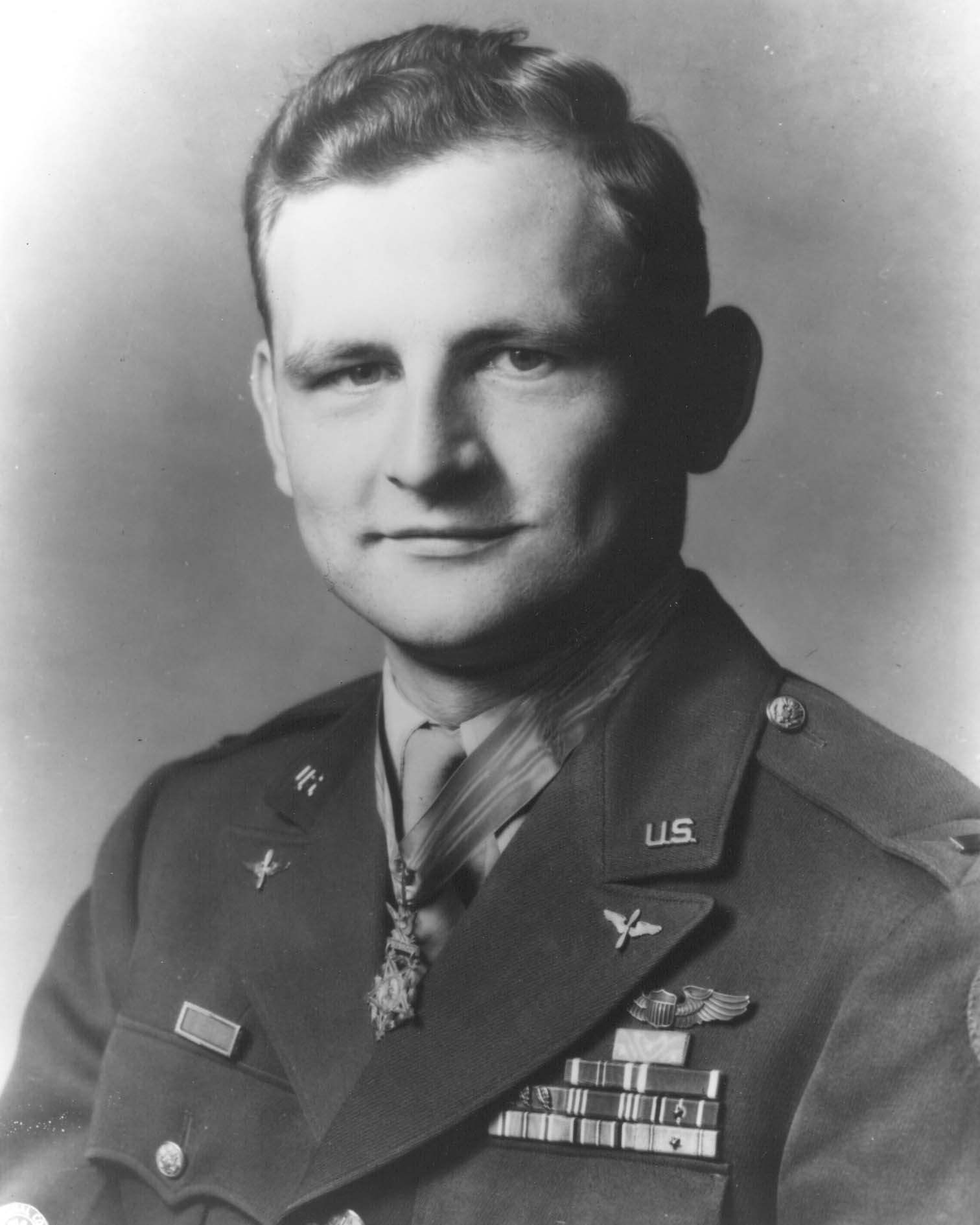
Staff Sgt. Archibald Mathies (U.S. Air Force file photo)*1

Born in the Scottish town of Stonehouse, South Lanarkshire, on the 3rd June 1918, Archibald (Archie) Mathies was to become a Second World War hero. He was awarded the Medal of Honour (MOH) for his actions whilst at RAF Polebrook (USAAF Station 110) in Northamptonshire, England.

It would be on the 20th February 1944, shortly after arriving at Polebrook, that he would earn this honour but his life would be dramatically cut short.

Not long after his birth in Scotland, Mathies moved with his family to the United States, to a small town in Western Pennsylvania called Finleyville, in Washington County.

After leaving school, he began work in a local coal mine. The work was hard, and the pay was low; Mathies was not inspired. Then, following the Japanese attack on Pearl Harbour, as many other brave young American men did, he joined the Army, enlisting in Pittsburgh on the 30th December 1940. Mathies would transition through a number of stations and training centres before finally completing a course in aerial gunnery on the 22nd March 1943. His last U.S. posting was to the 796th Bombardment Squadron at Alexandria, Louisiana for operational training duties flying B-17s. He would leave here on the 8th December 1943 bound for England and the European Theatre of Operations.

Mathies arrived in the U.K. eight days later. His initial assignment was with the Eighth Air Force Replacement Depot, before being attached to the 1st Replacement and Training Squadron. On the 19th January 1944, he received his first and only operational squadron posting; the 510th Bomb Squadron, 351st Bomb Group, based at RAF Polebrook, as an engineer/gunner. Promotion was swift, and on 17th February 1944, probably following his first mission, Mathies was awarded the rank of Staff Sergeant.

A few days later, on 20th February 1944, the allies began the enormous aerial campaign known as ‘Big Week’. During this short period a massive number of aircraft would attack targets deep in the heart of Nazi Germany. One of the first, (Mission 226) would see a total of 417 aircraft fly from airfields across England. From RAF Polebrook, 39 B-17s took off to attack Leipzig. In the lead planes were Maj. Leonard B. Roper (s/n O-734101 ) of the 510th BS forming the high group, and Maj. James T. Stewart (s/n O-659405) of the 508th BS, leading the low group.

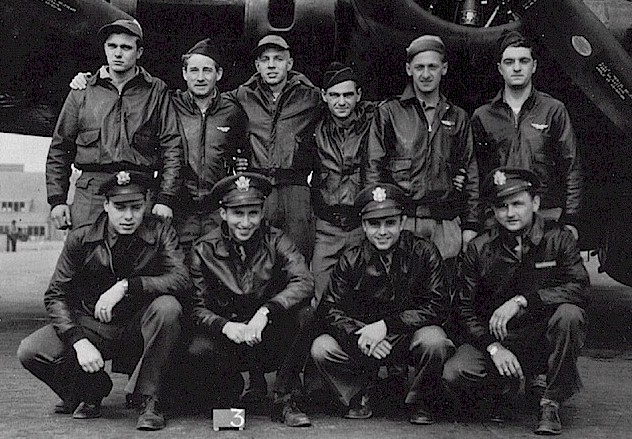
Flying in the number three ship of the lower Squadron, in B-17 (42-31763) ‘Ten Horsepower‘ was: Pilot: Clarry Nelson, Co-Pilot: Roland Bartley, Navigator: Walter Truemper, Engineer / Top Turret Gunner: Archie Mathies, Bombardier: Joe Martin, Radio Operator: Joe Rex, Ball Turret Gunner: Carl Moore, Waist Gunner: Tom Sowell, Waist Gunner: Russ Robinson, and Tail Gunner: Magnus Hagbo.

mathies page

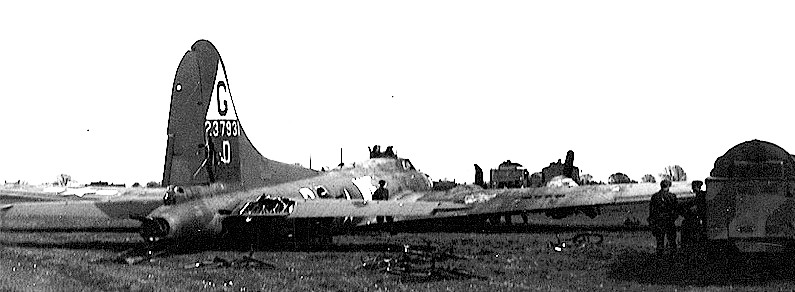
B-17 “Ten Horsepower” – cropped from the photo below- (TU-A, serial number 42-31763) taken prior to its crash”2.

On approaching the target, the formation was hit hard by fighters and flak, who would attack the formation for over an hour, hitting many aircraft in the subsequent melee. Ten Horsepower, was targeted repeatedly receiving many hits from 20mm cannon shells. In these attacks the co-pilot was killed and the pilot knocked unconscious from his wounds. Fearing the bomber was doomed, the bombardier jettisoned the bombs and then bailed out, later being captured by the Germans and becoming a prisoner of war. The remaining crew remained with the B-17 which soon began a deathly spiral toward the ground.

Mathies and the navigator (Walter Truemper) would eventually take over control of the aircraft and nurse it back to England. Once over their base at RAF Polebrook, the crew were instructed to bail out but both Mathies and Truemper refused to leave the injured pilot. After deliberation, they were given permission to try to land, the remaining two crew members prepared themselves for a heavy landing.

Guided in by a fellow aviator it was going to be very difficult. The first two attempts had to be aborted, but on the third attempt, as they approached the airfield, the aircraft struck the ground, killing all three crew members onboard.

The last moments of B-17G “Ten Horsepower” (TU-A, #42-21763) piloted by Second Lieutenant Walter E Truemper  and Sergeant Archibald Mathies, as it is guided by a fellow aircraft after the pilot was severely injured. Truemper and Mathies unsuccessfully attempted to land the aircraft at Polebrook and were posthumously awarded the Medal of Honour for their bravery, 20th February 1944. (IWM FRE 4724)

The crash was a severe blow for the base, both air and ground crews were devastated. On returning from the mission, five other aircraft (42-38028, 42-38005, 42-39760, 42-39853 and 42-6151). were forced to land at nearby Glatton (Conington) only a short distance away.

This was only Mathies’ second mission and sadly, his last.

For his bravery, Mathies was awarded the Medal of Honour; his name now appears on page 280 of the St. Paul’s Cathedral Roll of Honour. Also, as a dedication to him, one of the temporary lodging units at the Joint Base Anacostia-Bolling is named after him, as is the Airman Leadership School at RAF Feltwell,  and the Non commissioned Officer Academy at Keesler AFB, Mississippi. In addition, the bridge on Truemper Drive crossing Military Highway at Lackland Air Force Base, Texas; the USCIS Dallas District Office and the Mathies Coal Company in Pittsburgh, Pennsylvania, are all named in his honour.

Archibald Mathies  citation reads:

For conspicuous gallantry and intrepidity at risk of life above and beyond the call of duty in action against the enemy in connection with a bombing mission over enemy-occupied Europe on 20 February 1944. The aircraft on which Sgt. Mathies was serving as engineer and ball turret gunner was attacked by a squadron of enemy fighters with the result that the copilot was killed outright, the pilot wounded and rendered unconscious, the radio operator wounded and the plane severely damaged. Nevertheless, Sgt. Mathies and other members of the crew managed to right the plane and fly it back to their home station, where they contacted the control tower and reported the situation. Sgt. Mathies and the navigator volunteered to attempt to land the plane. Other members of the crew were ordered to jump, leaving Sgt. Mathies and the navigator aboard. After observing the distressed aircraft from another plane, Sgt. Mathies’ commanding officer decided the damaged plane could not be landed by the inexperienced crew and ordered them to abandon it and parachute to safety. Demonstrating unsurpassed courage and heroism, Sgt. Mathies and the navigator replied that the pilot was still alive but could not be moved and they would not desert him. They were then told to attempt a landing. After two unsuccessful efforts, the plane crashed into an open field in a third attempt to land. Sgt. Mathies, the navigator, and the wounded pilot were killed“.*3

Mathies was truly a brave and dedicated man, who in the face of adversity, refused to leave his wounded pilot and friend. Daring to land a badly damaged aircraft, he sadly lost his life showing both great courage and determination.

The crew of ‘Ten Horsepower‘ were:

Pilot: Clarry Nelson,
Co-Pilot: Roland Bartley,
Navigator: Walter Truemper
Engineer / Top Turret Gunner: Archie Mathies
Bombardier: Joe Martin (POW)
Radio Operator: Joe Rex,
Ball Turret Gunner: Carl Moore,
Waist Gunner: Tom Sowell,
Waist Gunner: Russ Robinson,
Tail Gunner: Magnus Hagbo

Notes:

*1 Photo from Malmstrom Air Force Base website.

*2 Photo IWM Freeman Collection FRE 4725

*3 Citation taken from: US Army Centre for Military History website.

401st BG, reputedly “The best damned outfit in the USAAF!”

Deenethorpe saw action by 4 squadrons from the 401st Bombardment group, reputedly the “The best damned outfit in the USAAF”. They flew 254 combat missions and received two Distinguished unit Citations. They had the best bombing accuracy of the mighty Eighth and one of the lowest loss ratios of any USAAF unit. However, a local disaster and inauspicious start, did not mean it was all plain sailing.

RAF Deenethorpe (Station 128)

Deenethorpe October 1942, taken by No. 8 OTU (RAF/FNO/166). English Heritage (RAF Photography). The memorial is to the bottom right*1

Constructed in 1942/43 as a Class ‘A’ airfield, it would have three concrete runways, a main of 2,000 yds and two secondary both 1,400 yds. The main runway ran in a north-east to south-west direction whilst the two secondary runways ran north-west to south-east and east-west respectively. The airfield was built adjacent to the (now) main A427 Weldon to Upper Benefield road and had around 50 loop style hardstands for aircraft dispersal.

For maintenance of the heavy bombers, two ‘T2’ hangars were sited on the airfield, one to the south-eastern corner and the second to the west, next to the apex of the ‘A’. Fuel stores were in the southern and northern sections, away form the technical site located to the south-east. Accommodation sites for 421 Officers and 2,473 enlisted men were also to the south-east beyond the road. Initially used by the RAF as a training base, it was quickly adopted by the USAAF and personnel soon moved in.

The main inhabitants of Deenethorpe were the four squadrons of the 401st BG, 94th Combat Wing, 1st Air Division. This Division, operated from nine airfields, in this Peterborough-Cambridge-Northampton triangle with three further fields to the south-east of Cambridge. A small cluster of sites located close together but away from the main 2nd and 3rd Air Divisions of Norfolk and Suffolk.

The 401st were a short-term unit operating until the end of the war; although they did go on to serve post war in the 1950s following reactivation. Originally constituted on March 20th 1943, they moved through various training airfields eventually arriving in England in October/November 1943.

B-17 Flying Fortress SC-O (42-97487) “Hangover Haven” of the 612th BS/401st BG after crash landing at Deenethorpe, 3rd October 1944*2

The four squadrons of the 401st, the 612th, 613th, 614th and 615th, all flew B-17Gs and operated with  the codes ‘SC’, ‘IN’, ‘IW’ and ‘IY’ respectively.  Using a tail code of a white ‘S’ in a black triangle, a yellow band was later added across the fin (prior to September 1943, the tail fin codes were reversed, i.e. black ‘S’ in a white triangle as in the above photo). The ground forces arrived via Greenock sailing on the Queen Mary, whilst the air echelon flew the northern routes via Iceland. Their introduction into the war would be a swift one.

The primary role of the 401st would be to attack strategic targets, such as submarine pens, ship building sites, heavy industrial units, marshalling yards and other vital transport routes. Many of these were heavily defended either by flak or by fighter cover, much of which was very accurate and determined.

On the 26th November 1943 they would fly their first mission – Bremen, headed by their commanding officer Colonel Harold W. Bowman. It was not to be an auspicious start though. With 24 crews briefed, engines started at 08:00, twenty-four B-17s rolled along the perimeter track to their take off positions at the head of the northern end of the main runway.

It was then that B-17 “Penny’s Thunderhead” 42-31098, of the 614th BS, slipped of the perimeter track trapping the following aircraft, commanded by the Station Commander Major Seawell, behind it. Then a further incident occurred where aircraft 42-39873, “Stormy Weather” suffered brake failure and collided into the tail of 42-31091 “Maggie“, severely damaging the tail. Four crews were out of action before the first mission had even starte. Bad luck was not to stop there. Once over the target, cloud obscured vision and whilst on the bomb run “Fancy Nancy“, 42-37838, collided with another B17 from the 388thBG. “Fancy Nancy” was luckily able to return to England, but severely damaged it could only make RAF Detling in Kent where it crash landed. So severe was the damage, that it could only be salvaged for parts and scrap. The mission report for the day shows that the ball turret gunner lost his life in the incident, the turret being cut free from the fuselage. A further gunner was wounded by flak and a third suffered frost injuries to his face.

On their second mission, the 401st were able to claim their first kill. A FW-190 was hit over the target at Solingen and the aircraft destroyed, but their luck was not necessarily about to change.

Within a matter of weeks the 401st were to have yet another set back and it was only due to the quick thinking of the crew that casualties were kept to a minimum. On December 5th 1943, mission 3 for the 401st, target Paris; B-17 42-39825, “Zenobia” crashed on take off coming to rest in nearby Deenethorpe village. The uninjured crew vacated the burning aircraft and warned the villagers of an impending explosion. Fire crews and colleagues rushed to the scene, and the two remaining injured crewmen were safely pulled out. Twenty minutes after the initial crash, the aircraft, full of fuel and bombs, finally exploded destroying a number of properties along with the fire tender. The explosion was so enormous, it was heard nine miles away.

The crew of the B17 which crashed on the village of Deenthorpe. L-R. T/Sgt William D Woodward, (t/t), Sergeant Waldon D Cohen, (b/t), Sergeant Harold J Kelsen, (w/g), Sergeant Robert V Kerr, (t/g), S/Sgt Benjamin C Misser, (r/o), and Lieutenant Walter B Keith, talking to Captain RJ White, who rescued the navigator Lieutenant King. The navigator and bomb-aimer are still in hospital, recovering from injuries. *3

The new year however, brought new luck. During operations in both January and February 1944 against aircraft production facilities, the 401st were awarded two DUCs for their action and as part of the 1st Air Division, they would be awarded a Presidential Citation. The 401st attacked many prestige targets during their time at Deenethorpe including: Schweinfurt, Brunswick, Berlin, Frankfurt, Merseburg and Cologne, achieving an incredible 30 consecutive missions without the loss of a single crew member.

Like many of their counterparts, they would go on to support the Normandy invasion, the break out at St Lo. the Siege of Brest and the airborne assault in Holland. They attacked communication lines in the Battle of the Bulge and went on to support the Allied crossing into Hitler’s homeland over the Rhine.

The 401st performed many operations, 254 in total. Their last being on April 20th 1945 to the Marshalling yards at Brandenburg. During the mission, B17 “Der Grossarschvogel” (The Big Ass Bird) was shot down. Five crew members were killed in the crash and several others, who had managed to escape, were beaten by civilians almost killing two of them. Ironically, they were ‘saved’ by Luftwaffe personnel, and in one case, even freed although the orders had been to shoot him.

These were not to be the last 401st fatalities though. On May 5th 1945, VE day of all days, Sgt G. Kinney was hit by the spinning propeller of a taxying B17 killing him; a devastating end to operational activities at Deenethorpe.

On June 20th, the 401st vacated Deenethorpe, returning via the same route that they came and were  then disbanded in the US. Deenethorpe was returned to RAF ownership and retained until the 1960s when it was sold off. The standard design 12779/41 tower was demolished in 1996 and the remainder of site returned to agriculture. All major buildings have been removed as have two of the three runways. The main one still exists today for light aircraft and microlights, as does most of the perimeter track – but as a mere fraction of its former self.

Whilst there is little to see of this once enormous airfield, best views can be obtained from the main road the A427 Weldon to Upper Benefield road. A few miles along from Weldon on your left is the airfield. Stop at the memorial. The original control tower, now gone, stood proud, visible from here beyond the memorial. The technical site would be to your right, and you would be looking almost straight down the secondary runway to your left. The communal and accommodation sites were directly behind you and traces of these can be seen but only as building footings. In the distance you can see the modern-day hangars used to store the microlights,

Access to this area is restricted, prior permission being needed before entering the site, records show that there have been a number of ‘incidents’ with landowners and users of the airfield. So what little remains is best viewed from here.

The memorial is flanked by two flags, is neat and well cared for. The runway layout is depicted on the memorial stone and it proudly states the achievements of the 401st. I am led to believe the ‘Wheatsheaf’ pub further along was the haunt of many an American airman and has a ‘401 bar’ with photos and memorabilia. I was not able to visit this  unfortunately and cannot therefore verify this. Definitely one for another day!

DSC_0155

Modern activity at Deenethorpe

Deenethorpe is one of those airfields that has quietly slipped away, the passage of time leaving only simple scars on the landscape. This once busy and prestigious airfield now nothing more than rubble and fields with a memorial to mark the brave actions, the death and the sacrifice made by crews of the United States Army Air Force so long ago.

A BBC news report covered the planting of a time capsule in June 2011, when the widow of Tom Parker (the last of the 401st Bombardment Squadron crew, that flew the B-17 plane “Lady Luck” out of Deenethorpe), kept their promise that whoever was last would bring a collection of tankards back to Deenethorpe with their own personal stories.  The tankards were a gift from the pilot of Lady Luck, Lt Bob Kamper who presented them to the crew at a reunion in 1972. Mr Parker, the last member of the crew, sadly died in March 2011.

May their stories live on forever more.

The BBC news report can be found here.

Deenethorpe falls under Northampton County Council, and like Kings Cliffe in the same area, has been the subject of planning applications. It is proposed that the airfield be removed and all flying activity stopped. A Garden Village will be built on the site, and the area landscaped accordingly. The proposal can be found here.

Deenethorpe was originally visited in Trail 6, ‘American Ghosts‘, from here we go onto an airfield that saw action involving a large numbers of paratroopers, we go to Spanhoe Lodge.

Sources and further reading.

*1 Photo from IWM American Air Museum In Britain.

*2 Photo Roger Freeman Collection, from IWM American Air Museum In Britain. FRE 8079

*3 Photo Roger Freeman Collection, from IWM American Air Museum In Britain. FRE 2218

The 401st BG website contain a vast amount of information about crews, aircraft and missions of the 401st. It can be accessed here.

I highly recommend the book, “The B-17 Flying Fortress Story“, by Roger Freeman, published by Arms and Armour, 1998. Some aspects may have been updated, but the detail is incredible and a worthwhile investment for anyone interested in this area.

Kings Cliffe under threat!

Following my recent revisit to RAF Kings Cliffe (Trail 6) I have been contacted by a reader who informs me that there is a planning application in to change the site to a caravan and camping site.

The application will utilise the site of the T2 hanger used by Miller for his final hangar concert in October 1944 and the memorial that now stands there. Details and photos of the site are in the trail update.

In the application, there is no reference to maintaining or preserving this memorial or any of the few remaining buildings that exist on this site.

This application was placed just prior to Christmas and so the offices have been shut for a large part of the holiday.

This is an area of natural beauty, used by walkers, cyclists and horse riders, not to mention visitors to the memorial. The roads are narrow and the surrounding villages are beautiful.

From an aviation point of view, Kings Cliffe is an historical site and is yet another example of world history being developed with little or no regard to its significance.

If you wish to see this application, it can be found on the East Northants Website application reference 14/02225/FUL. Linked below – The closing date for any objections is January 12th 2015.

http://pawebsrv.east-northamptonshire.gov.uk/online-applications/applicationDetails.do?activeTab=summary&keyVal=NFDYXIGO03N00 or google ’14/02225/FUL’

Thank you
Andy.

/home/wpcom/public_html/wp-content/blogs.dir/dc6/67045631/files/2015/01/img_2306.jpg

/home/wpcom/public_html/wp-content/blogs.dir/dc6/67045631/files/2015/01/img_2285.jpg

/home/wpcom/public_html/wp-content/blogs.dir/dc6/67045631/files/2015/01/img_2283.jpg