In Trail 67 we continue our journey around Bedfordshire and its neighbour, Northamptonshire.
In this next leg of our journey, we travel a short distance to an airfield that despite its modest size and limited operational role, earned a unique place in the history of the Second World War.
It is an airfield that might have gone relatively unnoticed had it not been for one man. His legacy has endured in legend, but the circumstances surrounding his life have remained a perplexing mystery for historians ever since.
Today, parts of the airfield remain. The watch office is now a museum, while a few surviving buildings house displays covering both everyday life during the war and the history of the airfield itself. Other parts of the site have since been transformed into a popular music venue. Despite all this, much of the airfield’s history continues to remain relatively unknown.
In Trail 67, we delve into the history of the former RAF Twinwood Farm, an airfield whose story is far more intriguing than its modest appearance might suggest.
RAF Twinwood Farm
The 330-acre airfield of RAF Twinwood Farm is located four miles north of Bedford. It was a small airfield situated east of the River Ouse, on a plateau 275 feet above sea level. It shares the region with the former airfields at Thurleigh to the north, Little Staughton to the east and Poddington to the west. With other stations such as Tempsford and Grafton Underwood also nearby, it is a region rich in wartime history. In the post-war years, the airfields at Twinwood Farm, Thurleigh and Little Staughton would share an ambitious and promising future but ultimately the plans would come to nothing.
Over its history, Twinwood Farm has been known by several different names, reflecting changes in ownership, administration and local usage. During the Second World War, it initially served as RAF Twinwood Farm prior to receiving the title USAAF Station 506, officially designated by the Americans as Milton Ernest (Twinwood Farm) under Headquarters, VIII Air Force Service Command. It has also appeared in official documents and contemporary accounts as Twinwood Farm Aerodrome, RAF Station Twinwood Farm and Twinwoods, whilst in more recent years the site has become linked to Twinwood’s Business Park.

The watch office now a museum.
The name of the airfield was relatively unusual in itself, being one of the few that used a local farm as its namesake. Normally, RAF airfields took their names from the nearest village, aiming to avoid confusion with similarly named sites. American airfields, on the other hand, were given numbered designations to distinguish them from one another. To be named after a farm was therefore relatively unusual, sharing the honour with Mount Farm and Sutton’s Farm, perhaps two of the better-known examples.
The farm itself had its own history. Named Twin Wood Farm, it formed part of the Duke of Bedford’s Oakley Estate and was sold in 1918 as a large mixed farm of around 240 acres, with a modest farmhouse, extensive livestock and storage buildings, all supporting traditional agricultural methods. By the 1920s, it had been absorbed into the wider Quenby family farming unit, incorporating several other holdings. Valuation records of the period show an area of mixed building quality, with basic services and high rents, reflecting the economic pressures faced by large estate farms.
It was this land that would later be requisitioned by the Government for use as a military airfield – RAF Twinwood Farm.
The airfield was constructed by a number of different contractors, opening in the summer of 1941 under the control of No. 12 Group, Fighter Command. Initially, it served as a satellite airfield to RAF Cranfield in the defence of Bedford. As a minor airfield, it only had grass runways, which were later upgraded in 1942 to three hard runways. The main runway, running north-west to south-east, was 1,600 yards long; a secondary runway running south-west to north-east was 1,400 yards; whilst a third, running west to east was 1,100 yards long. All were the standard 50 yards wide. The runway foundations were constructed from concrete and topped with a mixture of wood and rubber chippings.
Storage and maintenance facilities were not as extensive as those found on larger airfields, but were typical of similar sites. There were just six blister hangars in which aircraft maintenance could be carried out, together with twenty-two hardstandings around the site. Accommodation was entirely temporary and could house up to 70 officers, 118 SNCOs and 740 other ranks. With accommodation for a further 150 WAAFs, the site was intended to house just over 1,000 personnel.
Accommodation for these personnel was provided across several dispersed sites, all located on the south-western side of the airfield. A mixture of hut designs was used, including the common Laing huts, some of which still exist today.

A view east over the airfield.
Operational life begins.
The operational life of Twinwood Farm began in the early months of 1941, when the airfield was used as a relief landing ground by No. 14 Service Flying Training School (formerly No. 14 Flying Training School), which had been formed at Kinloss in Scotland in April 1939. Although the unit operated a variety of aircraft types, including the Audax, Demon and Hind, and later larger aircraft such as the Anson and Oxford, its use of Twinwood was limited.
No. 14 SFTS moved out of Twinwood in August 1941 and was quickly replaced by No. 51 Operational Training Unit (OTU), which arrived on the 17th of that month. Whilst many other units would come and go, the OTU would remain as the primary user of Twinwood for the duration of the war.
Formed only a month earlier, No. 51 OTU was primarily based at RAF Debden in Essex, as part of No. 81 Group, Fighter Command, whose responsibility was to oversee the training units within the air force. The specific role of No. 51 OTU was to train pilots in night-time interception techniques, taking aircrew who had already completed their basic and advanced flying training and preparing them for operational service as night-fighter crews.
The majority of aircraft used for this specialised role were twin-engined types, initially Blenheims and Havocs, followed later by Beaufighters and Mosquitoes. Some of the crews trained in this way would likely go on to serve in the short-lived and ultimately unsuccessful Turbinlite squadrons elsewhere.
The OTUs were essentially the final stage in a progressive training system, where crews honed their skills before joining front-line squadrons. The focus was not simply on flying an aircraft, but on teaching crews the specialist skills required to perform their operational roles.
Night-fighter OTUs trained pilots and navigators, and later radar operators, in the use of Airborne Interception (AI) equipment. As night fighters, crews had to learn not only how to fly in darkness, but also how to operate in formation, use airborne radar, conduct air-to-air interceptions and carry out intruder operations. The latter involved flying over occupied territory to attack enemy aircraft as they landed or took off from their airfields, a tactic used to great advantage by both the allies and the Luftwaffe.
No. 51 OTU remained at Debden for only a short time before moving to Cranfield. While at Cranfield, a special Airborne Interception Conversion Flight was formed within the training unit. It would remain associated with the squadron for the remainder of the war and played an important role in the training of aircrew for the increasingly sophisticated night-fighter role.

The ‘Ops board’.
Cranfield, however, quickly proved to be too small, and it became apparent that another site was also needed to accommodate the increasing number of personnel and aircraft involved in the training programme. A satellite site was therefore sought. Although Twinwood was far from ideal, with only grass runways and relatively poor facilities, it featured as a strong contender. With pressure mounting, the site was quickly allocated to the unit, and development began.
By April 1942, the small satellite airfield had been provided with concrete runways, together with basic supporting facilities for aircraft maintenance, repairs and accommodation. It was during this period of development that No. 51 OTU moved in.
The importance of the work undertaken at Twinwood Farm cannot be understated, and to meet the growing demand for night-fighter and intruder expertise, another specialist training unit, No. 2 (Intruder) Squadron, operating within the OTU, transferred to Twinwood to carry out this role. The squadron continued in this way for just over a year before converting to the recently renumbered No. 60 OTU at High Ercall.
The demand for trained pilots was high. At Twinwood, the expectation was that around seven crews would complete the course each month, qualifying as intruder crews. By early 1943, this demand had increased further, with the number expected to pass through each month rising to sixteen. This placed an even greater demand on the instructors.*1
No. 51 OTU would not have the airfield to itself however. Throughout this early period, a number of visiting units would use the site, many on a temporary basis while taking part in local and wider exercises.
On 30 September 1941, the first of these units arrived: two new squadrons that would use Twinwood as a temporary base. The first, 26 Sqn, stayed for just one day while transiting between RAF Barton Bendish in Norfolk and RAF Upwood in Cambridgeshire. ‘C’ Flight departed Barton Bendish at 08:30 hours, arriving at Twinwood at 13:00 hours. ‘A’ Flight arrived at about the same time, with the remainder of the squadron following at around 17:00 hours. To support the personnel, they brought rations with them from RAF Marham, Barton Bendish’s close neighbour.
The next day, the squadron’s Tomahawks operated out of Twinwood before moving on to RAF Upwood at around 18:30 hours. The air party left first, followed by the ground party, which transferred tools, tents and rations. A small section of the squadron remained at Twinwood until the following day, when they too departed heading directly for RAF Snailwell. Once, there, they re-joined the main body of the squadron, which had by then also moved on from Upwood.

Twinwood’s accommodation site.
The entire operation was a planned exercise designed to familiarise personnel with rapid changes in operational circumstances, something that was described by 26 Squadron’s Sqn. Ldr. Hadfield as “a great benefit to all”. *2
26 Sqn was an Army Co-operation unit and, in October, would perform ground-attack duties in France. However, the vulnerabilities of the Tomahawk were quickly exposed, its poor performance making it easy prey for faster Luftwaffe fighters. The squadron would soon replace these aircraft with the P-51 Mustang and would become the first unit to carry out Mustang operations over occupied France the following year. *3
Joining them, also via Barton Bendish, was another Army Co-operation unit, 268 Squadron, which had been carrying out ‘Bumper’ sorties over Oxfordshire and Buckinghamshire. It left Barton Bendish at 08:00 hours, arriving at Twinwood some time later. Immediately upon arrival, the squadron began performing tactical reconnaissance duties, carrying out eighteen sorties on the first day and a further eleven on the second. By 18:00 hours on that second day however, it too had departed, moving with 26 Squadron to Snailwell.
Their short stay was marred by two accidents. Firstly, F.O. Morris landed with the undercarriage of his Tomahawk IIa in the up position. Secondly, F.O. Barlow taxied his aircraft into a fuel bowser. In both instances, severe damage was done to the aircraft, although neither pilot was injured.*4
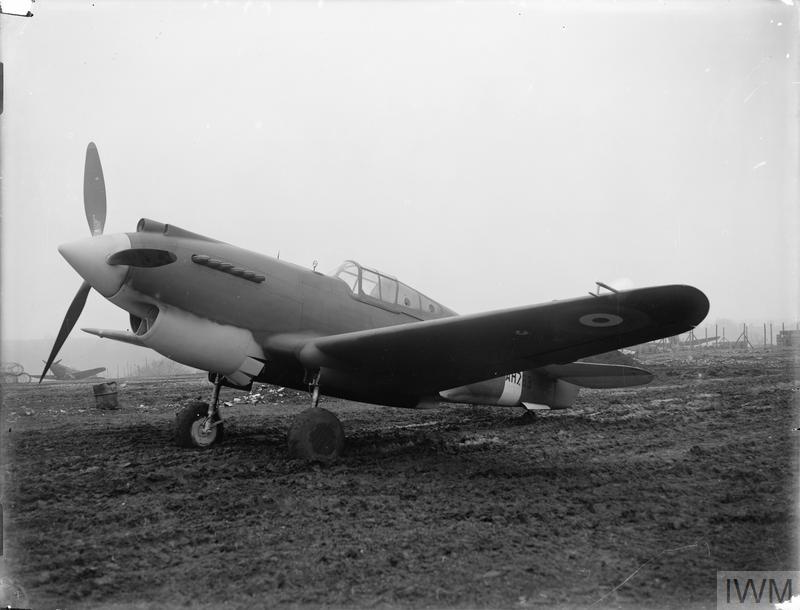
Tomahawk Mark I, AH769 at Boscombe Down, before serving with No. 268 Squadron
More personnel arrive and conditions worsen.
This use of Twinwood as a temporary airfield continued well into 1942. The first unit to arrive that year, transiting from Doncaster, was 613 Sqn, in early April. The advanced party travelled by road, leaving Doncaster at 09:00 hours on 10 April. The main party followed the next day, also by road, led by F.O. Adcock. They arrived at Twinwood that evening after a long ten-hour journey. A third group, travelling by rail, had arrived two hours earlier. Hot meals were prepared for the arriving personnel, providing a welcoming, if not false start to their new posting. The rear party, which closed up at Doncaster, arrived on the evening of 12 April, marking the beginning of a new episode in the squadron’s history.
On arrival at Twinwood, however, 613 Sqn found that the airfield was still under construction. Personnel from 51 OTU were settled in, whilst other accommodation was being occupied by 2791 Defence Squadron along with two additional Flights. Conditions were far from ideal. Some of the latrines were full, and a contractor had to be brought in to empty them. Worse still, 613 Sqn had no latrines specifically allocated to them and none were readily available elsewhere.
To add to the initial discomfort, an inspection by the Senior Medical Officers from both Cranfield and Group discovered that there was no hot water and no telephone available for 613 Sqn’s Senior Medical Officer. The medical facilities themselves were also totally inadequate for dealing with more serious cases.

It quickly became apparent that Twinwood was not going to be a particularly comfortable place to be, and soon personnel began to complain about the lack of proper food; tea and biscuits being provided after a hard day’s work rather than anything more substantial. All in all, it was far from the grand start they had been hoping for.
Operating in the Army Co-operation role, the squadron continued to perform daily flights, with the flying personnel and their aircraft mainly located at Western Zoyland. These flights consisted largely of quick-reaction scramble exercises in Tomahawks, known as FXQT, together with cross-country navigation exercises in Lysanders.
FXQTs were the equivalent of today’s QRA (Quick Reaction Alert), requiring aircraft to become airborne very quickly in response to an alert of an imminent threat. There were numerous false alarms, resulting in twenty-four FXQTs on 13 April and a further twenty-seven on 14 April.
It was during this period at Twinwood that 613 Sqn began upgrading its aircraft to the P-51 Mustang Mk.I, with ten being collected by aircrew, from Speke, on 15 April. With a further seventeen FXQT flights being made by the Tomahawks together with four flights ferrying personnel to Speke, it was a busy period at Twinwood, and all whilst training continued.
A spell of poor weather curtailed many exercises over the next few days, although some cross-country flights were made, along with air-to-air firing, photographic runs and supply drops. By 24 April, the skies had cleared and four airmen did manage to get their Mustangs airborne, gaining valuable experience on the new type.
Meanwhile, 51 OTU continued to operate its Blenheims. On 24 April, two of the aircraft suffered mishaps. In the first, a Sergeant Instructor with a Sergeant pupil-pilot and gunner were carrying out sodium flare landing practice when their aircraft landed too far along the runway. To avoid running off the end, the pilot swerved, careered across the flarepath and came to an ungainly rest just beyond it. A fire tender and ambulance were quickly on the scene, but there were no casualties and no fire broke out.
Later that same day, another Blenheim fell victim to a freak incident. After landing normally, its starboard engine suddenly burst into flames without warning. The crew quickly brought the aircraft to a halt and escaped, and once again the fire tender was quickly on the scene. However, while extinguishing the fire, chemical fluid used to douse the flames covered one of the crewmen, A/C Goodwin, who subsequently required treatment for his eyes. The situation was made more serious by the lack of a telephone for the medical officer.
Meanwhile, 613 Sqn’s problems on the airfield continued to develop. In a further attempt to ease the chronic storage problems, attention turned to the nearby Oakley Hunt kennels at Milton Ernest. The medical officer of No. 613 Squadron inspected the site with a view to commandeering it as a storage and motor transport (MT) maintenance facility.
Yet, like so many other efforts to solve the station’s difficulties, this promising solution quickly encountered another obstacle. Before the site could be used, the water supply from its well had to be tested. Sample bottles were obtained from RAF Halton, filled and dispatched for analysis. The results were deeply disappointing: the water was found to be contaminated by sewage and was therefore unfit for use. It was yet another setback in the seemingly endless struggle to turn Twinwood into a fully functioning and operational station.
For a short period in early May 1942, the weather improved and the crews of 613 Sqn made the best use of the opportunity. Aerobatics, formation flying, navigation exercises, combat flights and other training sorties quickly filled the better days.
Over the following weeks, the squadron collected more Mustangs, allowing an increasing number of training flights to be carried out.
It was midway through this period, on 11 June 1942, that Wing Commander Campbell-Voullaire arrived at Twinwood to form and take command of a new squadron, 169 Sqn. In preparation, a number of personnel were posted in to 613 Sqn as supernumeraries, ready to transfer directly to 169 Sqn when it became operational. Five unmodified Mustangs also arrived and awaited their new pilots.
Finally, at 00:01 hours on 15 June 1942, 169 Sqn officially came into being, and the personnel already posted in began to transfer across.
The following day, W. Cmdr. Campbell-Voullaire interviewed and addressed all the squadron personnel, explaining the reason for the squadron’s creation. He explained that, as soon as the Army invaded the continent, they would fly in support of the armoured divisions. Until then, he told them, each and every man should consider himself a member of the “fighting troops”, prepared to undertake whatever job was required. *5
Almost as soon as the squadron was formed, however, investigations began into the suitability of Doncaster as an alternative location for the unit. W. Cmdr. Campbell-Voullaire visited the airfield on several occasions over the following weeks to ascertain its suitability.

In the meantime, 169 Sqn continued to expand. The pilots and aircraft of ‘B’ Flight, 613 Sqn, formed the new ‘A’ Flight of 169 Sqn, while those personnel previously posted in formed its new ‘B’ Flight.
Over the next few days, additional vehicles arrived, along with two more unmodified Mustangs and a Tiger Moth. Tools and spares were less readily available however, and the ground crews had to rely on 613 Sqn for supplies. The unmodified Mustangs were essentially without radios, leaving their wireless operators with little to do. They were quickly attached to the squadron’s signals officer for further training.
With accommodation on the airfield now stretched even further, it was decided to billet the new crews of 169 Sqn at nearby Eastfield House. The food and bedding were considered ‘most satisfactory’, although the accommodation itself was somewhat overcrowded.
Living conditions at Twinwood remained an ongoing problem. The latrine arrangements had still not been fully resolved, and it was discovered that the contractor was emptying latrine buckets into the surrounding ground. An order was issued for this practice to cease, which it immediately did. On a more positive note, construction of more permanent accommodation was nearing completion, and some hopes were raised. While this offered hope for those stationed at Twinwood, it did little to relieve the immediate frustrations of crews still waiting for decent beds.
On 22 June, a further accident involving a 51 OTU Blenheim occurred. The aircraft, piloted by P.O. W. Gray, took off at 14:10 hours and crashed almost immediately, approximately two miles from the airfield. By the time the ambulance and crash team had arrived, P.O. Gray had climbed out of the Blenheim and had been given a lift to Bedford County Hospital, where he was admitted with injuries.
At 22:00 hours the following evening, No. 613 Squadron made history by carrying out its first night flight in the new Mustangs. Three pilots took off and completed the sortie without incident, marking another important milestone in the squadron’s transition to the new aircraft.
The achievement, however, was soon overshadowed by two events that tested the resilience of those at Twinwood. The first was relatively minor but nevertheless disruptive: the cameras being fitted to the Mustangs had been installed in an unsatisfactory position and had to be repositioned.
The second was a far greater tragedy. The body of AC2 R. Douglas was recovered from the River Ouse near Oakley Bridge, after he disappeared while bathing with colleagues. Despite efforts to find him, he had drowned, casting a sombre shadow over an already disappointing start.
At the end of June 1942, the many visits by 169 Sqn’s Wing Commander Campbell-Voullaire to the north, culminated in the movement of the squadron’s headquarters’ section to Doncaster. Fifty personnel went with them, leaving only a small detachment of aircraft and aircrew at Twinwood Farm. The move eased the pressure on accommodation slightly, but the problems faced by the station’s longstanding residents were by no means solved.
Throughout July, 613 Sqn carried out exercises with other squadrons at Sawbridgeworth, Snailwell, Castle Camps and Old Sarum. But the mood at Twinwood continued to deteriorate, with those remaining at the station now complaining on a regular basis.

This all came to a head on 7 July, when it was noted that the new huts intended exclusively for 613 Sqn had been completed. Yet officers, NCOs and junior ranks were still not allowed to use them, even though they stood just ten yards from where the men were currently sleeping. Much to the disapproval of the personnel, they were informed that they would have to wait until the entire site was completed before they could move into the new blocks.
If that wasn’t enough, the situation was then made worse by both the presence of the 169 Sqn detachment and an infestation of black beetles and earwigs in the old huts. Tempers began to fray.
169 Sqn was also experiencing problems of its own. On 4 July 1942, a crack was found in one of the hydraulic cylinders of a Mustang’s undercarriage during a routine inspection. As a result, all aircraft were grounded until remedial work could be carried out. However, the continuing shortage of spares and the tools needed to carry out the repairs did nothing to speed the process. The problem effectively nullified a new order to transfer all remaining aircraft and personnel to Doncaster.
Gradually, the necessary Mustang parts filtered through and repairs could be completed. Flights between Twinwood and the new station at Doncaster soon began and, before long, on 10 July, news arrived that fourteen fully modified Mustangs would soon be delivered to complement the unmodified aircraft already in use. Perhaps, at last, things were looking up for 169 Sqn.
By 15 July, all but one aircraft – which was still awaiting repairs – had left Twinwood and were at their new base at Doncaster. A new era was about to begin for them.
While 51 OTU continued to perform its training duties, other squadrons continued to come and go. The next to arrive was 239 Sqn, another Mustang Mk.I unit, which arrived at the end of August 1942.
The Mustangs had been patrolling the skies along the south coast around Brighton and Beachy Head, and as far inland as Gatwick, their former station. No sooner had they arrived than a small detachment was sent to Snailwell, leaving the squadron split between three airfields: Gatwick, Twinwood and Snailwell.
The Snailwell section took part in exercises and returned briefly in early September, only to transfer to Castle Camps to take part in further Army Co-operation activities. The Gatwick section continued covering the south coast, while those newly arrived at Twinwood practised night landings in their Mustangs.
This fluid movement at Twinwood continued until 22 October, when the entire squadron moved to Cranfield to take part in further exercises. This effectively ended its association with Twinwood.
At Twinwood, night training was always hazardous, even for experienced pilots. A nearby homestead, Rutters Cottages, was the site of a tragedy on 28 November 1942, when one of 51 OTU’s Havocs crashed close by. Its pilot, Sergeant Leonard James Casey, was sadly killed. A New Zealander from Herne Bay, Auckland, Casey was just 21 years old and was buried in Kempston Cemetery.*6
His aircraft, Havoc I BJ501, was undertaking a solo night-training exercise and, at the time of the crash, was carrying out overshoots. As the aircraft pulled away it suddenly entered a dive and crashed. Casey was not killed outright, but was taken to Bedford County Hospital, where he later died from his injuries.
The Americans arrive and a reshuffle takes place.
By early 1943, the Eighth Air Force was gaining strength in Britain – the friendly invasion had begun. Lacking experience in night-fighter operations, the USAAF began sending airmen to Twinwood, where it was hoped they would benefit from British expertise, particularly that of the OTU.
One of these American units was the 417th Night Fighter Squadron, which arrived via Scotland on 11 May 1943.
Constituted as the 417th Night Fighter Squadron on 17 February that year, the unit came under the control of VIII Fighter Command, attached to the RAF. Its journey here began at Orlando Air Force Base, before moving to Kissimmee and eventually to Ayr on Scotland’s west coast, where a small detachment remained.

Exposed shelter at Twinwood.
Training in the United States had been undertaken on the P-70, a converted Douglas A-20 Havoc/Boston. The purpose of the conversion was to provide the USAAF with an airborne radar interception capability, something it lacked at the time. With upgraded engines, the P-70 also carried the British Mk. IV radar, specifically designed for airborne interception. Intended as an interim solution until the Northrop P-61 Black Widow became available, only 160 P-70s were ever converted.
Once in the UK, however, the men of the 417th found themselves training on Bristol Beaufighters rather than the P-70s with which they were familiar.
Conversion and training began quickly and progressed well however. Before long, the Americans were ready for their own aircraft and were transferred to RAF Scorton in North Yorkshire, where some twelve Beaufighters duly arrived. Training continued there until August, at which point the squadron was declared ready for combat.
Their theatre of operations, however, was not to be the dark skies of Europe but the warmer climate of Algeria. The squadron would eventually receive its P-61s, but not until March 1945, when it returned to Europe to undertake night-fighter duties protecting Allied bridgeheads as the advance into Germany continued.
It was also during 1943 that a renumbering of training units led to the resident 51 OTU, along with other OTUs across the country, being renumbered. This was connected with Operation Saracen, later revised as Operation Banquet, the contingency plan for countering a German invasion of Britain. Under the scheme, OTUs had 500 added to their existing numbers, redesignating them as squadrons. Thus, 51 OTU became 551 Sqn.
While some units readily adopted their new numbers, many continued to be referred to by their original OTU designations. Consequently, when 51 OTU became 551 Squadron RAF on 17 September 1943, it continued its night-training duties much as before. In practice, little changed and, as with many of these newly numbered units, no formal change in organisation took place, nor were they ever formally recognised as RAF squadrons in their own right.
1944 – winds of change.
Between 5 and 13 January 1944, a small detachment of 164 Sqn, equipped with Hurricane IVs and Typhoon IBs, visited Twinwood. Whilst here, they carried out practice dive-bombing attacks against mock targets, while the bulk of the squadron remained at Fairlop flying armed sorties.
They would stay briefly but return for another short period in February, when further practice flights involved ground strafing and battle-formation flying. The late-winter rain, however, curtailed many of the planned activities, with some days seeing no flying at all.
Although US aircrew had previously been present at Twinwood, no American aircraft had been located there. That changed on 29 January 1944, when during a ferry flight to King’s Cliffe, the right engine of P-38J 42-67873 failed while the aircraft was approaching the airfield. As the pilot attempted an emergency approach, the left engine also failed and a wheels-up landing was made. The aircraft, flown by Harry V. Dulick, was believed to have been salvaged and returned to service.
During 1944, Twinwood acquired a second identity: USAAF Station 506. This appears to have been an American administrative designation rather than a replacement for its RAF identity. The airfield remained RAF Twinwood Farm, while its location and facilities brought it into the wider network supporting the United States Eighth Air Force. The official USAAF designation was Milton Ernest (Twinwood Farm), Station 506.

Fire post.
The significance of this American connection was greater than a simple alteration of name. By 1944, VIII Air Force Service Command had become the vast logistical organisation responsible for keeping the Eighth Air Force operational across Britain and, following D-Day, on the Continent. Its headquarters was located at nearby Milton Ernest Hall, and Twinwood provided a convenient airfield for the movement of liaison aircraft, personnel, mail and equipment. The two sites were only a few miles apart, making Twinwood a useful addition to the American headquarters.
RAF activity continued alongside and dominated this American use. The night-fighter training role remained the airfield’s principal function, even after the resident training unit had been redesignated 551 Squadron in September 1943. The American presence was therefore an additional role rather than a complete takeover of the station. In fact, few local residents would have realised that their familiar RAF station was now being used as part of the wider logistical network supporting one of the largest air forces ever assembled.
It was this American connection that would ultimately secure Twinwood Farm’s place in popular history. Without the relationship between the airfield and the nearby headquarters of VIII Air Force Service Command, it is unlikely that one of the world’s most celebrated bandleaders would ever have passed through its gates. Yet, on a cold December day in 1944, the routine departure of a small American liaison aircraft would transform an otherwise unassuming Bedfordshire airfield into the setting for one of the Second World War’s most enduring mysteries.
A mystery emerges.
In 1944, Twinwood Farm became etched into history as the last place Glenn Miller was seen alive. Miller, the pre-war musician who had revolutionised popular music with his distinctive style and sound, had enjoyed enormous success in America with hits such as In the Mood, Moonlight Serenade and Chattanooga Choo Choo. But after the United States entered the war, Miller was determined to use his music to support the armed forces overseas, while the loss of several key members of his orchestra to military service also encouraged him to find a way of contributing to the war effort.
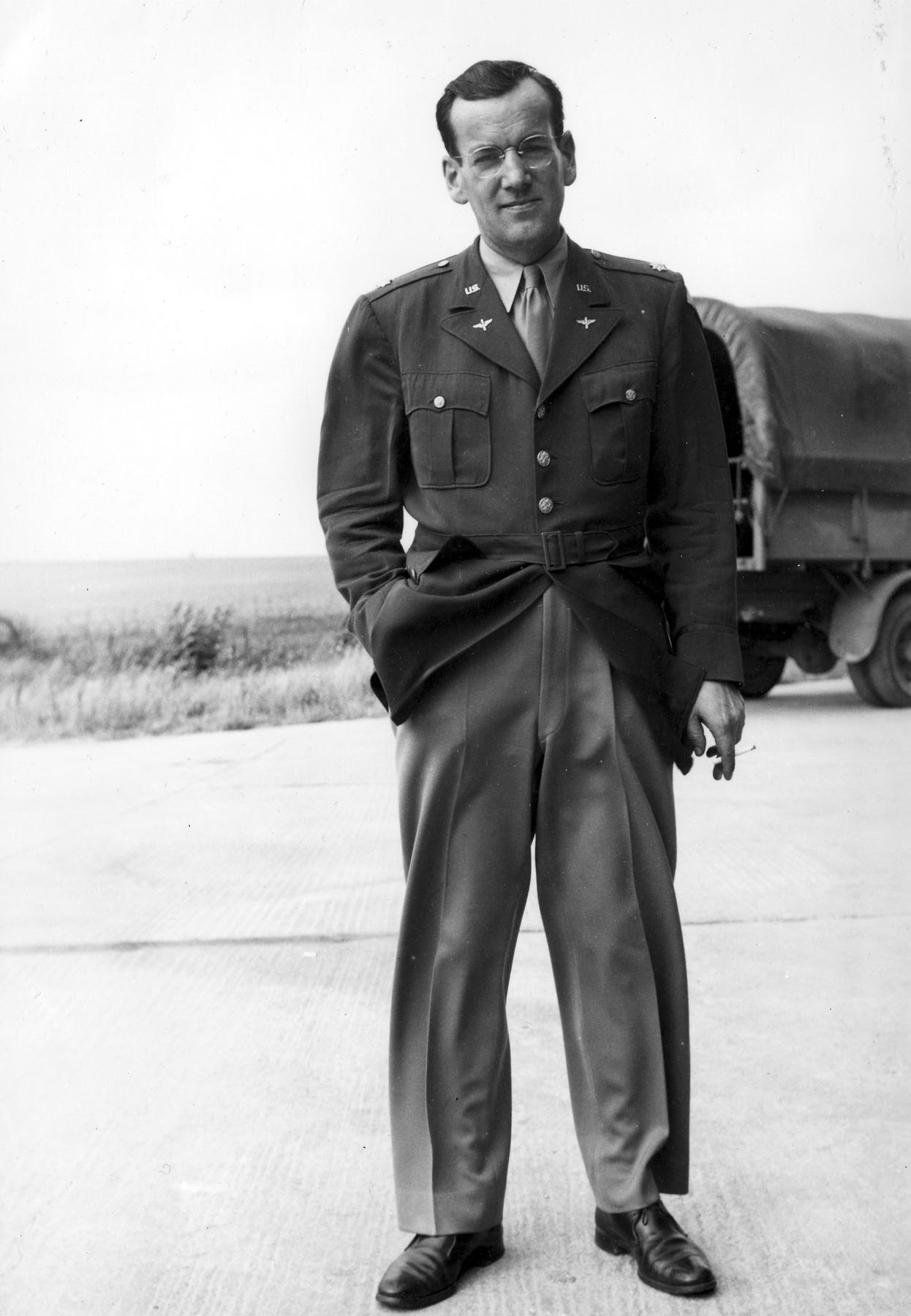
Maj. Glenn Miller in a relaxed pose. (IWM UPL 28085)
After initially being refused by the Navy, Miller joined the US Army on 7 October 1942. He eventually became involved with the Army Air Forces, where his musical expertise was put to use in developing military bands and entertainment for service personnel.
His eventual deployment to Britain came at the request of General Eisenhower, who wanted Miller to contribute to the Allied Expeditionary Forces’ programme and help maintain the morale of troops in Europe. Miller arrived in Britain in June 1944 and, after a short period in London, moved his organisation to the Bedford area.
On 9 July, Miller and his new band rehearsed at the Bedford Corn Exchange. The performance was broadcast on the AEF network that evening and was a huge success. It was the beginning of a period in which Miller and his musicians would perform at bases across Britain, with hangar dances becoming a popular way of raising morale among war-weary personnel. Miller had become a phenomenon.
But the joy Miller was bringing to Allied personnel was to be short-lived. In December, he was asked to travel to Paris to make arrangements for a forthcoming performance. He accepted an invitation to fly with Lt. Col. Norman Baessell, who was serving with VIII Air Force Service Command and was himself travelling to Paris on temporary duty.
Military driver Edward McCollough drove Miller to Twinwood Farm, from where Miller had departed on previous occasions with his band for concerts. There, he boarded a small Noorduyn UC-64 Norseman with Flight Officer John Morgan and Lt. Col. Baessell.
The aircraft took off from Twinwood at 13:55 on 15 December 1944 in thick fog. It was never seen again. Miller was officially declared missing on 18 December and was subsequently declared dead.
The nature of Miller’s disappearance has haunted historians ever since. His small aircraft disappeared somewhere on the journey across the Channel and neither it, nor its three occupants, was ever found. The absence of any wreckage or bodies inevitably encouraged speculation, and over the decades numerous theories have emerged.

Former hangar now a music venue stage.
These have ranged from claims that Miller never left Britain to suggestions that he was killed in Paris, accidentally shot by American military personnel or even deliberately executed by members of the OSS. Another theory has blamed bombs jettisoned by returning RAF aircraft. There have also been claims from supposed eyewitnesses who said they saw either the aircraft or Miller after he had officially disappeared.
None of these theories has been conclusively established. The disappearance of one of the wartime era’s greatest musicians therefore remains one of the enduring mysteries associated with the Second World War.
Miller’s disappearance is not the only mystery associated with Twinwood Farm, but it is perhaps the strongest link between the airfield and the world of wartime secrecy. The surrounding area was heavily populated with airfields, transmitting stations and operational establishments, some of which were connected with clandestine Allied activities.
Among these were establishments associated with the British Special Operations Executive (SOE) and the American Office of Strategic Services (OSS). Both organisations operated in considerable secrecy, and much of their wartime work remained obscure for decades afterwards. Their activities inevitably contributed to the mythology that subsequently grew around the airfields and installations of Bedfordshire.
However, this is an area where caution is needed.
During the research for this trail, repeated claims were encountered suggesting that SOE or OSS agents assembled at Twinwood Farm before departing on secret missions. Despite extensive investigation, no contemporary documentary evidence has been found to support these claims.
It seems likely that the story has become confused with the well-documented activities at nearby RAF Tempsford, where agents were housed at Gibraltar Farm before embarking on clandestine flights into occupied Europe. Given the close proximity of the two airfields, the American presence at nearby Milton Ernest Hall and Miller’s links with the USAAF, it is perhaps unsurprising that local memories and later accounts have occasionally merged these separate wartime stories.
As far as the evidence currently shows, the American use of Twinwood was considerably less dramatic. The USAAF used the airfield as part of its wider network supporting VIII Air Force Service Command, with American aircraft using the station for the movement of officers, supplies, equipment and personnel. It was a useful staging and liaison point rather than a major American operational base.
Twinwood therefore remained, fundamentally, an RAF airfield operating alongside an additional American role. Under the USAAF’s identification system it was designated Station 506, or Milton Ernest (Twinwood Farm), but there is no evidence that the Americans took ownership of the airfield itself or assumed exclusive control of its facilities.
The war’s end and hope for the future.
In the summer of 1945, the war came to an end and many of the OTUs, now surplus to requirements, were disbanded. The axe fell heavily, and 51 OTU was one of the units to disappear, with June 1945 signalling its demise.
With its departure, RAF Twinwood Farm was left without any flying units, and only a small number of personnel remaining on site. It remained in this state for several months.
On 2 January 1946, the site was transferred to the Ministry of Aircraft Production, ceasing to operate as an RAF station by the end of the month. This move, however, did not signify the end of Twinwood as an aviation establishment.
In the post-war years, Twinwood’s links with both Thurleigh and Little Staughton would continue through an ambitious plan to create Britain’s foremost aeronautical research establishment, one intended to rival the famous Muroc test facility, later Edwards Air Force Base, in California.
The scheme, first conceived as early as 1944, recognised that the next generation of aircraft would be larger, faster and more powerful than anything seen during the war. Britain needed somewhere capable of developing and testing these advanced designs, requiring extensive flying space together with specialised research laboratories and engineering facilities. After examining a number of potential sites across England and Wales, the Ministry selected the neighbouring airfields of Thurleigh, Twinwood and Little Staughton.

Inside the watch office.
The proposal was bold. Thurleigh and Little Staughton would be linked by an immense runway planned to extend for more than five miles, creating an aviation research runway on a scale never before attempted in Britain. Twinwood, connected by a taxiway, would become the scientific and engineering centre of the establishment, providing maintenance, workshops and the wind-tunnel complex that would support Britain’s rapidly developing aircraft industry.
Although the scale of the proposal would undoubtedly have transformed the surrounding countryside, it never progressed beyond the planning stage. Financial pressures and changing post-war priorities meant the giant runway was abandoned, and the establishment instead developed as separate but closely linked sites. Under this revised plan, Thurleigh became the principal experimental flying airfield of the Royal Aircraft Establishment (RAE Bedford), while Twinwood became the centre for aerodynamic testing.
Twinwood’s role nevertheless proved to be of national importance. As the war ended, Allied scientific teams moved quickly to secure Germany’s remarkable advances in aeronautical research. British, American and Soviet specialists examined laboratories, experimental aircraft and technical records, recognising that German engineers had achieved significant progress in areas such as high-speed flight, swept-wing design, compressibility and rocket propulsion.
British teams investigated a number of Germany’s principal research establishments, including the Aerodynamische Versuchsanstalt (AVA) at Göttingen, the research facilities at Braunschweig and the extensive experimental centre at Peenemünde. Thousands of technical reports, drawings and research papers were recovered and analysed, providing an invaluable foundation upon which Britain’s own post-war aeronautical research programme could be built.
Although the wind tunnels later constructed at Twinwood were British-built, they reflected many of the lessons learned from these German investigations and embodied the latest understanding of transonic and supersonic aerodynamics.
Within this scaled back plan, Twinwood became the centre for wind-tunnel research while Thurleigh remained responsible for experimental flying. Little Staughton, no longer required, was omitted from the project altogether.
Parts of the former wartime airfield at Twinwood were transformed into a modern scientific research complex containing the High Speed Laboratory, offices, engineering workshops, model shops and five major wind tunnels capable of investigating everything from low-speed handling characteristics to transonic and supersonic flight. Among these was the remarkable Vertical Spinning Tunnel, designed to study the behaviour of aircraft during stalls and spins, one of the principal causes of fatal flying accidents during the Second World War.
Despite the reduction in scale, the completed facilities still formed one of the most advanced aeronautical research centres in Europe, a status it retained throughout the 1950s and 1960s. This enabled Twinwood to contribute to the development of many of Britain’s most significant post-war aircraft.
Construction of the wind-tunnel complex began in 1948 under Dorman Long & Co. Ltd. of Middlesbrough together with Whessoe*7. The project was itself a notable engineering achievement, pioneering the on-site welding of large pre-formed steel plates to create the enormous pressure vessels required for the wind tunnels, a technique that was virtually unprecedented in Britain at the time.
The first of Twinwood’s major facilities entered service in 1955. Although the wider vision of a unified aeronautical research establishment centred on a five-mile runway had never been realised, the completed Vertical Spinning Tunnel represented a major advance in aerodynamic research. Standing 24.4 metres high and measuring 13.7 metres in diameter, it remained one of the most distinctive structures on the site and survives today as a Grade II listed building, recognised for both its engineering significance and its place in Britain’s post-war aviation heritage*8,*9
The site containing the wind tunnels was sufficiently far from the main airfield not to interfere with any flying that might take place. This allowed Twinwood, in the mid-1950s, to unexpectedly find another new role, this time as a flight-test airfield for gliders.
Engineers and test pilots from Slingsby, used the former wartime station to conduct meticulous performance trials on the company’s latest sailplanes. These experiments, carried out over many months using carefully controlled glide tests and supported by wind-tunnel investigations, contributed to the development of one of Britain’s most successful post-war competition gliders.*10
This short-lived reprieve for Twinwood did not, unfortunately, lead to any long-lasting aviation revival. In 1983, the Ministry of Defence finally put Twinwood Farm and its land up for sale.
The farm, which had been leased to A. T. Quenby since 1962,*11 consisted of a house, a bungalow and the usual mix of farm buildings. Other buildings remained from the RAF’s days, including a corrugated-iron hangar adjoining Little Oakley Wood, measuring 89 feet by 45 feet, together with a mess room and Nissen huts used as stores, measuring 91 feet by 28 feet.
With that, this small airfield returned to agriculture. The business park was subsequently sold and resold, developed and redeveloped. It remains today, although many of the original buildings have been removed.
The landowner of the airfield site has agreed to allow the watch office to become a thriving Glenn Miller memorial, while many of the surviving huts in the area have become museums documenting wartime life both on and off the airfield.
Another part of the site has become a music venue, staging regular festivals featuring music from the 1940s through to more modern times. It even utilises one of the remaining original hangars as a stage.
Although much of the former airfield has disappeared beneath later development, a small part of Twinwood survives. Through these developments, the memory of both Glenn Miller and the important work of the OTUs has been allowed to live on.
Twinwood’s legacy.
Twinwood Farm was a small and relatively insignificant airfield when it was established. Yet, despite continual struggles with accommodation, storage and the practical challenges of creating an operational station from open farmland, its personnel quietly made an important contribution to Britain’s air defence. Thousands of training sorties prepared numerous night-fighter crews for the demanding task of defending Britain’s skies after dark, while the airfield also supported Army Co-operation duties and became home to a variety of aircraft and units throughout the war.
Its post-war years were no less significant. Ambitious plans to transform the region into a major aviation research establishment ultimately failed to materialise. Although Twinwood established itself as a major centre for wind-tunnel research, its use as an airfield eventually came to an end. Remarkably, from those quiet beginnings emerged first a museum and later a music venue, ensuring that the site continued to attract visitors long after the last military aircraft had departed.
Yet, despite all that Twinwood Farm achieved, this is not the story that ultimately secured its place in history.
It would be easy to remember Twinwood simply as the place from which Glenn Miller made his final flight. But that is only part of the story. By 1944, the airfield had quietly become an important link in the wider logistical network supporting Headquarters, VIII Air Force Service Command at nearby Milton Ernest Hall. While RAF night-fighter training continued, Twinwood simultaneously supported the American headquarters with liaison and transport flights, connecting the administrative heart of the Eighth Air Force with the rapidly developing campaign in Europe.
It was this little-known dual role that brought Glenn Miller to Twinwood on that cold December day in 1944. Without it, one of the world’s most celebrated musicians would almost certainly never have passed through its gates.
In the end, Twinwood Farm’s legacy extends far beyond the disappearance of a single aircraft. It is the story of an unassuming Bedfordshire airfield that quietly fulfilled many roles, adapted to changing demands and made a contribution to the Allied war effort far greater than its modest size ever suggested.
Sometimes history is not written by the biggest stations or the most famous squadrons, but by places that simply did their job exceptionally well when they were needed most.
The museum website can be accessed at: https://www.twinwoodaviationmuseum.org/
Sources and further information (Twinwood Farm).
*1 RAFweb.org. website accessed 1.8.26
*2 National Archives Operation Record Book AIR 27/321
*3 Jackson, R., & Ritger, L., P-51 Mustang. Pen & Sword Aviation, 2020.
*4 National Archives Operation Record Book AIR27/1563/9
*5 National Archives Operational record Book AIR 27/1094/1
*6 Bedfordshire Archives Website [ref: WW2/AR/C2/182].
*7 Historic England website accessed 27/7/26
*8 28 days later website. Accessed 3/8/2026.
*9 Historic England Website. Accessed 3/8/2026.
*10 Ince, D., Combat and Competition* *Newton Publishers, 1992
*11 Bedfordshire Archives Website. Accessed 8/8/2026.
National Archives: Operational Record Books: AIR 27/1563/9; AIR 27/1085/35, AIR 27/1085/37
IWM American Archive Website Accessed 16.8.26
The Bedford aerodrome website contains extensive material on the current and some historical use of Thurleigh.
The Bedford Aeronautical Heritage Group website (now closed but accessible) contains information about the work and history of RAE Bedford. It has since been moved to the FAST website below.
Farnborough Air Services Trust website offers endless information about the services of RAE Bedford and RAE Farnborough.
Bedfordshire and Luton Archive and Record Service has an extensive collection of Third London Airport material as part of the Bedfordshire County Council archive which includes material for all four original sites. It also has material from BARA.
PPRuNe forum has information, photos and personal information about the research at Thurleigh and Twinwood Farm.
Osbourne, M. Defending Bedfordshire: The Military Landscape from Prehistory to the Present. Fonthill Media, 2021
Jackson, R. P-51 Mustang. Pen and Sword, 2020
Conyers Nesbit, R. Missing: Believed Killed. Pen & Sword Military 2010.
Spragg, D. Glenn Miller Declassified. Potomac Books, 2017
Grudens, R., Chattanooga Choo Choo. Celebrity Profiles Publishing Company, 2004.
 Aviation Trails