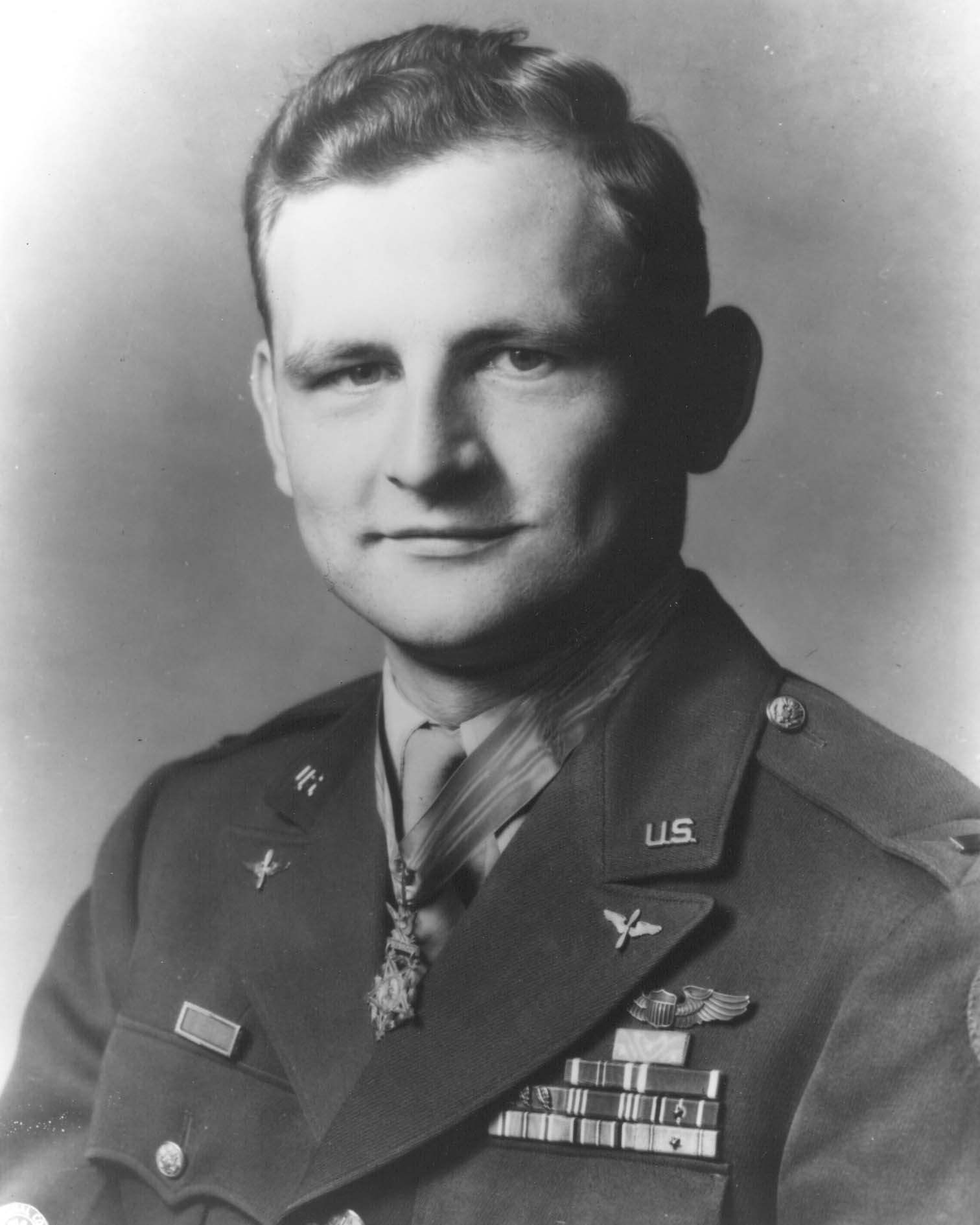
1st Lt. Michael (Wikipedia)
That practical grounding was interrupted by the growing pressures of global conflict. On 2 November 1940, he enlisted as a private in the United States Army Air Corps and was posted to Wheeler Field, Hawaii, where he was present during the Japanese attack of 7 December 1941. In 1942 he was selected for flight training, entering the demanding programme that transformed enlisted airmen into officers and pilots. By April 1943 he had earned his commission as a second lieutenant and completed both multi-engine and B-17 Flying Fortress training in Arizona and Washington State. It was during this period of intense preparation that he married Bertie Lee Parks in October 1943, later naming his B-17 Bertie Lee in her honour.
Serving with the 364th Bomb Squadron of the 305th Bomb Group at RAF Chelveston, Michael took part in numerous combat operations over occupied Europe and Germany. On 11 April 1944, he was piloting the B-17G Bertie Lee (42-37931) as part of a major bombing operation against targets in Germany, including the Focke-Wulf aircraft factory at Sorau. Other objectives for the 341 B-17s of the 1st Bomb Division included Cottbus, Dobberphul, Stettin and Trechel.
As the formation approached its target area, German fighters launched another ferocious frontal assault, a tactic that had proved highly effective against American bomber formations earlier in the air war. Michael’s aircraft, a Douglas-Long Beach B-17G-20-DL Flying Fortress (WF-D), soon became the focus of a determined enemy attack. To the crew, it appeared that the German fighters had singled them out, pressing home repeated assaults despite the presence of Allied escort fighters and the heavy defensive fire from the bomber formation.
The attack devastated the cockpit. Both Michael and his co-pilot, 2nd Lt. Franklin Westberg, were wounded, vital instruments were destroyed, oil coated the windscreen and the aircraft entered a 3,000-foot dive from which survival appeared impossible. With remarkable determination, Michael managed to regain control, only to discover that the bomb bay, still loaded with incendiaries, was on fire. Damage to the release mechanism meant the bombs could not be jettisoned, and the danger of an explosion increased with every passing moment.
The only apparent chance of survival was to bail out, so Michael gave the order. As the crew prepared to leave the aircraft, he was confronted by a horrific sight. Top turret gunner Jewel Philips was holding his injured eye in his hand while blood poured from a severe head wound. Despite his own injuries, Michael administered what aid he could before helping the gunner to the escape hatch. Philips was one of seven crewmen who managed to leave the aircraft.
With the co-pilot and the injured bombardier, Lt. Leiber, still on board, Michael decided that a crash landing offered their only realistic hope. While the crew fought to save the aircraft, the bombardier eventually succeeded in releasing the burning incendiaries. Through a series of violent evasive manoeuvres, Michael shook off the pursuing fighters and finally reached the relative safety of cloud cover.
Emerging from the clouds, the aircraft came under renewed attack from German flak. Michael brought the Fortress down to almost treetop height and headed towards England. Remarkably, the aircraft continued to respond despite the extensive damage it had suffered. They flew on for as long and as far as possible. Miraculously, they reached the English coast, but by now Michael was exhausted from his prolonged efforts and a severe thigh wound. The co-pilot took over, circling the aircraft while Michael recovered enough strength to attempt the landing himself.
With no hydraulics, the ball turret jammed in the lowered position, the undercarriage locked up and the bomb bay doors stuck open, the odds of survival remained heavily stacked against them. Against all odds, Michael retook control and brought Bertie Lee down at RAF Waltham near Grimsby in Lincolnshire, the damaged aircraft crunching and groaning across the grass before finally coming to a halt.
For his extraordinary actions and determination to save both his crew and aircraft, Michael received the Medal of Honour, the second such award made to a member of the 305th Bomb Group.
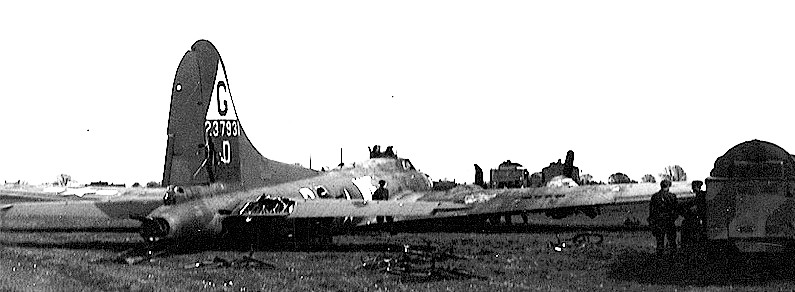
Bertie Lee after crash-landing at RAF Waltham (IWM UPL 40113)
1st Lt. Michael’s citation read*1:
For conspicuous gallantry and intrepidity above and beyond the call of duty while serving as pilot of a B-17 aircraft on a heavy-bombardment mission to Germany, 11 April 1944.
The group in which 1st Lt. Michael was flying was attacked by a swarm of fighters. His plane was singled out and the fighters pressed their attacks home recklessly, completely disregarding the Allied fighter escort and their own intensive flak. His plane was riddled from nose to tail with exploding cannon shells and knocked out of formation, with a large number of fighters following it down, blasting it with cannon fire as it descended.
A cannon shell exploded in the cockpit, wounded the co-pilot, wrecked the instruments, and blew out the side window. First Lt. Michael was seriously and painfully wounded in the right thigh. Hydraulic fluid filmed over the windshield making visibility impossible, and smoke filled the cockpit. The controls failed to respond and 3,000 feet were lost before he succeeded in levelling off.
The radio operator informed him that the whole bomb bay was in flames as a result of the explosion of three cannon shells, which had ignited the incendiaries. With a full load of incendiaries in the bomb bay and a considerable gas load in the tanks, the danger of fire enveloping the plane and the tanks exploding seemed imminent. When the emergency release lever failed to function, 1st Lt. Michael at once gave the order to bail out and seven of the crew left the plane.
Seeing the bombardier firing the navigator’s gun at the enemy planes, 1st Lt. Michael ordered him to bail out as the plane was liable to explode any minute. When the bombardier looked for his parachute he found that it had been riddled with 20-mm fragments and was useless. First Lt. Michael, seeing the ruined parachute, realized that if the plane was abandoned the bombardier would perish and decided that the only chance would be a crash landing.
Completely disregarding his own painful and profusely bleeding wounds, but thinking only of the safety of the remaining crewmembers, he gallantly evaded the enemy using violent evasive action despite the battered condition of his plane. After the plane had been under sustained enemy attack for fully 45 minutes, 1st Lt. Michael finally lost the persistent fighters in a cloud bank.
Upon emerging, an accurate barrage of flak caused him to come down to treetop level where flak towers poured a continuous rain of fire on the plane. He continued into France, realizing that at any moment a crash landing might have to be attempted, but trying to get as far as possible to increase the escape possibilities if a safe landing could be achieved.
First Lt. Michael flew the plane until he became exhausted from loss of blood, which had formed on the floor in pools, and he lost consciousness. The co-pilot succeeded in reaching England and sighted an RAF field near the coast. First Lt. Michael finally regained consciousness and insisted upon taking over the controls to land the plane.
The undercarriage was useless; the bomb bay doors were jammed open; the hydraulic system and altimeter were shot out. In addition, there was no airspeed indicator, the ball turret was jammed with the guns pointing downward, and the flaps would not respond. Despite these apparently insurmountable obstacles, he landed the plane without mishap.
After the war, Michael remained in military service, transitioning through the post-war restructuring of American air power and into the newly established United States Air Force. He served in both air transport and operational roles across the United States and the Pacific, attended Air University, and later trained on the B-47 Stratojet during the early Cold War period—an aircraft type that would also become familiar at RAF Chelveston.
Among his many decorations were the Distinguished Flying Cross, Purple Heart and Air Medal with four oak leaf clusters. These, together with a long list of campaign and service awards, reflected a military career that spanned three decades, multiple theatres of operation and the transformation of American air power from the Second World War into the Cold War era. His service ultimately took him to the rank of lieutenant colonel before he retired in 1971 after 30 years in uniform.
Michael later married Louise Erdmann and remained active in military service until his retirement. He died on 19 May 1994 and is buried in Evergreen Cemetery, Springville, Utah County, Utah.
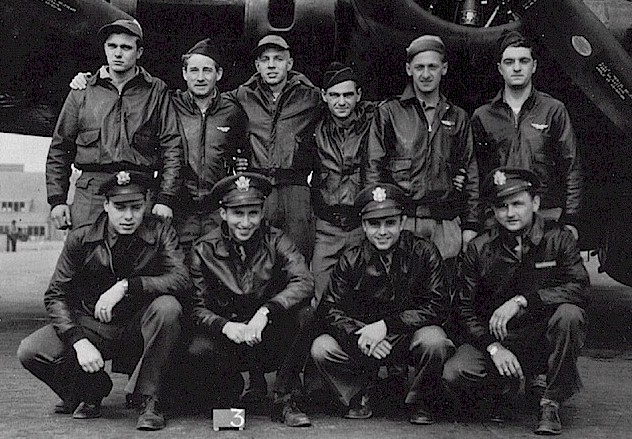
1st Lt. E Michael (kneeling right) with his crew 1943.(US Air Force)
Sources
*1 Congressional Medal of Honor website. Accessed 5 August 2025
The full story of RAF Chelveston can be read in Trail 66.

