In Trail 68 we continue our journey around Bedfordshire and its neighbour, Northamptonshire.
In this next leg of our journey, we travel a short distance to an airfield that despite its modest size and limited operational role, earned a unique place in the history of the Second World War.
It is an airfield that might have gone relatively unnoticed had it not been for one man. His legacy has endured in legend, but the circumstances surrounding his life have remained a perplexing mystery for historians ever since.
Today, parts of the airfield remain. The watch office is now a museum, while a few surviving buildings house displays covering both everyday life during the war and the history of the airfield itself. Other parts of the site have since been transformed into a popular music venue. Despite all this, much of the airfield’s history continues to remain relatively unknown.
In Trail 68, we delve into the history of the former RAF Twinwood Farm, an airfield whose story is far more intriguing than its modest appearance might suggest.
RAF Twinwood Farm
The 330-acre airfield of RAF Twinwood Farm is located four miles north of Bedford. It was a small airfield situated east of the River Ouse, on a plateau 275 feet above sea level. It shares the region with the former airfields at Thurleigh to the north, Little Staughton to the east and Poddington to the west. With other stations such as Tempsford and Grafton Underwood also nearby, it is a region rich in wartime history. In the post-war years, the airfields at Twinwood Farm, Thurleigh and Little Staughton would share an ambitious and promising future but ultimately the plans would come to nothing.
Over its history, Twinwood Farm has been known by several different names, reflecting changes in ownership, administration and local usage. During the Second World War, it initially served as RAF Twinwood Farm prior to receiving the title USAAF Station 506, officially designated by the Americans as Milton Ernest (Twinwood Farm) under Headquarters, VIII Air Force Service Command. It has also appeared in official documents and contemporary accounts as Twinwood Farm Aerodrome, RAF Station Twinwood Farm and Twinwoods, whilst in more recent years the site has become linked to Twinwood’s Business Park.

The watch office now a museum.
The name of the airfield was relatively unusual in itself, being one of the few that used a local farm as its namesake. Normally, RAF airfields took their names from the nearest village, aiming to avoid confusion with similarly named sites. American airfields, on the other hand, were given numbered designations to distinguish them from one another. To be named after a farm was therefore relatively unusual, sharing the honour with Mount Farm and Sutton’s Farm, perhaps two of the better-known examples.
The farm itself had its own history. Named Twin Wood Farm, it formed part of the Duke of Bedford’s Oakley Estate and was sold in 1918 as a large mixed farm of around 240 acres, with a modest farmhouse, extensive livestock and storage buildings, all supporting traditional agricultural methods. By the 1920s, it had been absorbed into the wider Quenby family farming unit, incorporating several other holdings. Valuation records of the period show an area of mixed building quality, with basic services and high rents, reflecting the economic pressures faced by large estate farms.
It was this land that would later be requisitioned by the Government for use as a military airfield – RAF Twinwood Farm.
The airfield was constructed by a number of different contractors, opening in the summer of 1941 under the control of No. 12 Group, Fighter Command. Initially, it served as a satellite airfield to RAF Cranfield in the defence of Bedford. As a minor airfield, it only had grass runways, which were later upgraded in 1942 to three hard runways. The main runway, running north-west to south-east, was 1,600 yards long; a secondary runway running south-west to north-east was 1,400 yards; whilst a third, running west to east was 1,100 yards long. All were the standard 50 yards wide. The runway foundations were constructed from concrete and topped with a mixture of wood and rubber chippings.
Storage and maintenance facilities were not as extensive as those found on larger airfields, but were typical of similar sites. There were just six blister hangars in which aircraft maintenance could be carried out, together with twenty-two hardstandings around the site. Accommodation was entirely temporary and could house up to 70 officers, 118 SNCOs and 740 other ranks. With accommodation for a further 150 WAAFs, the site was intended to house just over 1,000 personnel.
Accommodation for these personnel was provided across several dispersed sites, all located on the south-western side of the airfield. A mixture of hut designs was used, including the common Laing huts, some of which still exist today.

A view east over the airfield.
Operational life begins.
The operational life of Twinwood Farm began in the early months of 1941, when the airfield was used as a relief landing ground by No. 14 Service Flying Training School (formerly No. 14 Flying Training School), which had been formed at Kinloss in Scotland in April 1939. Although the unit operated a variety of aircraft types, including the Audax, Demon and Hind, and later larger aircraft such as the Anson and Oxford, its use of Twinwood was limited.
No. 14 SFTS moved out of Twinwood in August 1941 and was quickly replaced by No. 51 Operational Training Unit (OTU), which arrived on the 17th of that month. Whilst many other units would come and go, the OTU would remain as the primary user of Twinwood for the duration of the war.
Formed only a month earlier, No. 51 OTU was primarily based at RAF Debden in Essex, as part of No. 81 Group, Fighter Command, whose responsibility was to oversee the training units within the air force. The specific role of No. 51 OTU was to train pilots in night-time interception techniques, taking aircrew who had already completed their basic and advanced flying training and preparing them for operational service as night-fighter crews.
The majority of aircraft used for this specialised role were twin-engined types, initially Blenheims and Havocs, followed later by Beaufighters and Mosquitoes. Some of the crews trained in this way would likely go on to serve in the short-lived and ultimately unsuccessful Turbinlite squadrons elsewhere.
The OTUs were essentially the final stage in a progressive training system, where crews honed their skills before joining front-line squadrons. The focus was not simply on flying an aircraft, but on teaching crews the specialist skills required to perform their operational roles.
Night-fighter OTUs trained pilots and navigators, and later radar operators, in the use of Airborne Interception (AI) equipment. As night fighters, crews had to learn not only how to fly in darkness, but also how to operate in formation, use airborne radar, conduct air-to-air interceptions and carry out intruder operations. The latter involved flying over occupied territory to attack enemy aircraft as they landed or took off from their airfields, a tactic used to great advantage by both the allies and the Luftwaffe.
No. 51 OTU remained at Debden for only a short time before moving to Cranfield. While at Cranfield, a special Airborne Interception Conversion Flight was formed within the training unit. It would remain associated with the squadron for the remainder of the war and played an important role in the training of aircrew for the increasingly sophisticated night-fighter role.

The ‘Ops board’.
Cranfield, however, quickly proved to be too small, and it became apparent that another site was also needed to accommodate the increasing number of personnel and aircraft involved in the training programme. A satellite site was therefore sought. Although Twinwood was far from ideal, with only grass runways and relatively poor facilities, it featured as a strong contender. With pressure mounting, the site was quickly allocated to the unit, and development began.
By April 1942, the small satellite airfield had been provided with concrete runways, together with basic supporting facilities for aircraft maintenance, repairs and accommodation. It was during this period of development that No. 51 OTU moved in.
The importance of the work undertaken at Twinwood Farm cannot be understated, and to meet the growing demand for night-fighter and intruder expertise, another specialist training unit, No. 2 (Intruder) Squadron, operating within the OTU, transferred to Twinwood to carry out this role. The squadron continued in this way for just over a year before converting to the recently renumbered No. 60 OTU at High Ercall.
The demand for trained pilots was high. At Twinwood, the expectation was that around seven crews would complete the course each month, qualifying as intruder crews. By early 1943, this demand had increased further, with the number expected to pass through each month rising to sixteen. This placed an even greater demand on the instructors.*1
No. 51 OTU would not have the airfield to itself however. Throughout this early period, a number of visiting units would use the site, many on a temporary basis while taking part in local and wider exercises.
On 30 September 1941, the first of these units arrived: two new squadrons that would use Twinwood as a temporary base. The first, 26 Sqn, stayed for just one day while transiting between RAF Barton Bendish in Norfolk and RAF Upwood in Cambridgeshire. ‘C’ Flight departed Barton Bendish at 08:30 hours, arriving at Twinwood at 13:00 hours. ‘A’ Flight arrived at about the same time, with the remainder of the squadron following at around 17:00 hours. To support the personnel, they brought rations with them from RAF Marham, Barton Bendish’s close neighbour.
The next day, the squadron’s Tomahawks operated out of Twinwood before moving on to RAF Upwood at around 18:30 hours. The air party left first, followed by the ground party, which transferred tools, tents and rations. A small section of the squadron remained at Twinwood until the following day, when they too departed heading directly for RAF Snailwell. Once, there, they re-joined the main body of the squadron, which had by then also moved on from Upwood.

Twinwood’s accommodation site.
The entire operation was a planned exercise designed to familiarise personnel with rapid changes in operational circumstances, something that was described by 26 Squadron’s Sqn. Ldr. Hadfield as “a great benefit to all”. *2
26 Sqn was an Army Co-operation unit and, in October, would perform ground-attack duties in France. However, the vulnerabilities of the Tomahawk were quickly exposed, its poor performance making it easy prey for faster Luftwaffe fighters. The squadron would soon replace these aircraft with the P-51 Mustang and would become the first unit to carry out Mustang operations over occupied France the following year. *3
Joining them, also via Barton Bendish, was another Army Co-operation unit, 268 Squadron, which had been carrying out ‘Bumper’ sorties over Oxfordshire and Buckinghamshire. It left Barton Bendish at 08:00 hours, arriving at Twinwood some time later. Immediately upon arrival, the squadron began performing tactical reconnaissance duties, carrying out eighteen sorties on the first day and a further eleven on the second. By 18:00 hours on that second day however, it too had departed, moving with 26 Squadron to Snailwell.
Their short stay was marred by two accidents. Firstly, F.O. Morris landed with the undercarriage of his Tomahawk IIa in the up position. Secondly, F.O. Barlow taxied his aircraft into a fuel bowser. In both instances, severe damage was done to the aircraft, although neither pilot was injured.*4
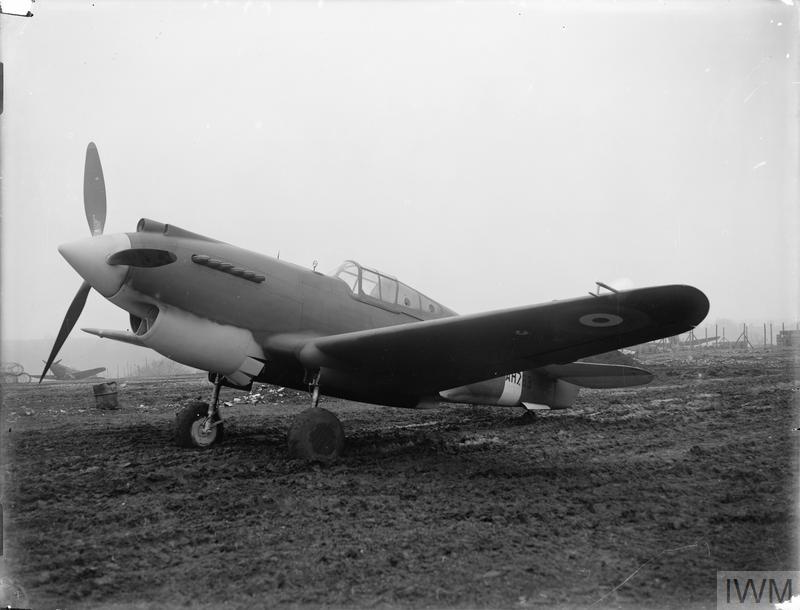
Tomahawk Mark I, AH769 at Boscombe Down, before serving with No. 268 Squadron
In Part 2 of this trail, yet more personnel arrive at Twinwood and the conditions for those residing here worsen.
The full story of Twinwood Farm can be found in Trail 67.

