Throughout the Second World War, countless airmen pushed themselves beyond the limits of human endurance to save not only their crews, but also their aircraft. Wounded, exhausted, and flying bombers shattered by enemy fire, they somehow found the strength to keep going until the safety of England could be reached.
One such man was First Lieutenant William R. Lawley Jr. of the 364th Bomb Squadron, 305th Bomb Group. On his tenth combat mission from RAF Chelveston, Lawley fought to keep his crippled B-17 Flying Fortress in the air despite severe injuries and the loss of his co-pilot. For his extraordinary courage and determination that day, he was awarded the Medal of Honor, the United States’ highest award for gallantry.
Early Life and Childhood
William Robert Lawley Jr. was born on August 23, 1920 in Leeds, Jefferson County, Alabama, the son of William R. Lawley snr. and Emma Hazelwood.
He grew up in Leeds alongside his brothers and sisters in a close-knit and deeply religious family. A practising Baptist, Lawley regularly attended Leeds Baptist Church with his siblings.
Known as “W.R.” to his friends, Lawley attended Leeds High School, where he pitched for the school baseball team. He was well liked by his classmates and was often seen joking and laughing with friends before and after games. Reflecting on his school days many years later, the principal described him as average in most subjects, “not excelling in any particular subject” and “just one of the boys.” Like many youngsters of the time, he also had a particular fondness for ice cream. *1
Lawley graduated in 1938 and, after a short period of civilian employment, joined the Sinclair Oil Company in 1941. Working as a delivery truck driver, he quickly earned a reputation as a dependable and hardworking employee. His professionalism, calm temperament, and friendly manner led colleagues and managers alike to describe him as a quiet, level-headed, ambitious young American. *2
Joining the Army Air Forces
Like many Americans, the Japanese attack on Pearl Harbor in December 1941 inspired Lawley to play his part in the war effort, setting him on a path that would change his life forever.
The following year brought both personal tragedy and new opportunities. While mourning the loss of his mother, he also enlisted for flying training, two events that would profoundly shape his future.
Lawley’s determination and continued work ethic soon paid dividends. In April 1943, while training at Altus Army Airfield, Oklahoma (established in 1942), he earned his pilot’s wings and received his commission as an officer. That same month, on 21 April, he married his sweetheart, Amelia Dodd, making it a period of both professional and personal celebration.
Following further training, Lawley was assigned to an operational crew. In November 1943, he and his fellow airmen were posted to the European Theatre of Operations as part of the 364th Bomb Squadron, 305th Bomb Group, Eighth Air Force, where he would serve as a pilot aboard the Boeing B-17 Flying Fortress.
His father, a former Baptist minister who now served as a volunteer circuit preacher, was immensely proud of his son’s achievements. Following the death of his wife, he remained devoted to William and, when his son served overseas, he carried a photograph of him in his pocket at all times. *3
Flying from RAF Chelveston
Flying the northern route, the 305th Bomb Group had first arrived in England in September 1942, operating initially from RAF Grafton Underwood (Station 106) in north Northamptonshire. In December of that year the group moved to RAF Chelveston (Station 105), where it served under the command of the formidable Colonel Curtis “Iron Ass” LeMay.
By the time Lawley arrived at Chelveston in late 1943, the group had already endured a brutal air war. Casualties had been heavy, experienced crews had been lost, and replacement airmen were urgently needed to maintain operational strength. Lawley was among those sent to reinforce the battle-weary unit.
He was soon flying combat operations, and by February 1944 had completed nine missions. His tenth would make him famous.
On 20 February 1944, more than one thousand aircraft from the First, Second, and Third Bomb Divisions participated in a major offensive against targets in Germany. The 305th Bomb Group, operating as part of the First Bomb Division, was assigned targets at Leipzig, Heiterblick, Abtnaundorf, Bernburg, and Oschersleben. If these could not be attacked, crews were authorised to strike targets of opportunity.
The bomber force crossed the continent before separating to attack their designated objectives, intending to regroup for the long return journey to England. Although weather conditions were poor, Allied fighter escorts succeeded in disrupting many German attacks. For the crew of Lawley’s B-17, however, the mission would become a desperate struggle for survival.
Flying B-17G-30-DL 42-38109, Cabin in the Sky (WF-P), Lawley departed the target area with his bomb load still aboard after frozen release mechanisms prevented it from being dropped. Without warning, the aircraft came under a devastating head-on attack from German fighters. A cannon shell tore into the cockpit, killing co-pilot 2nd Lt. Paul Murphy and severely wounding Lawley in the face.
The assault, launched by approximately twenty enemy fighters, left every surviving crew member wounded and set one of the aircraft’s engines ablaze. The damaged bomber entered a steep dive that appeared uncontrollable. Despite his injuries, Lawley forced the dead co-pilot’s body away from the controls with one hand while fighting to regain command of the aircraft with the other. Blood covered the cockpit, visibility was severely restricted, and freezing air rushed through holes torn in the windscreen.
Fearing an explosion, Lawley ordered the crew to bail out. No one did. Some men were too badly wounded to leave the aircraft, while those still capable of escaping refused to abandon their injured comrades.
As enemy attacks continued, the burning engine was eventually extinguished, only for another engine fire to erupt shortly afterwards. Then came a small but crucial piece of good news. The bombardier succeeded in releasing the jammed bombs, reducing the aircraft’s weight and giving Lawley a better chance of keeping it airborne.
Acutely aware that Lawley was weakening from blood loss and exhaustion, the aircraft’s bombardier Lieutenant Harry Mason, assisted him at the controls. When Lawley eventually collapsed, Mason helped keep the aircraft under control until the wounded pilot recovered sufficiently to resume command.
The crisis was far from over. With two engines disabled, fuel shortages soon created a new danger. Another engine failed, leaving the Flying Fortress struggling to remain airborne on a single functioning engine. Against all odds, the battered aircraft crossed the English coast.
Relief was short-lived. Fire was once again spreading across the wings and the aircraft was rapidly losing altitude. As the crew searched desperately for somewhere to land, the small fighter station, RAF Redhill, came into view.
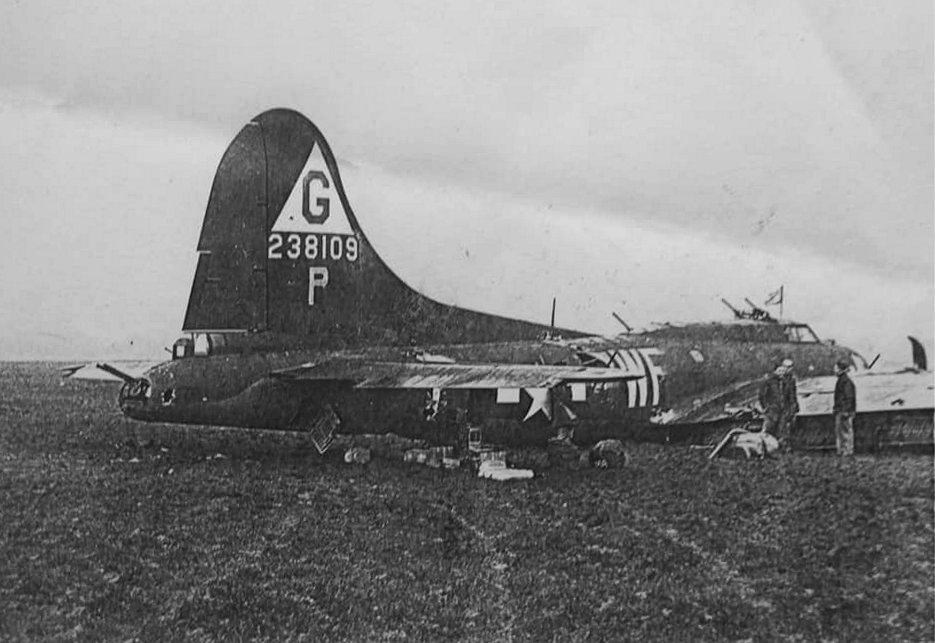
B-17 42-38109 ‘Cabin in the Sky’, after crash landing at RAF Redhill. (IWM UPL 55733)
Despite his injuries and exhaustion, Lawley managed to bring the crippled bomber down in a remarkably controlled crash landing. Of the ten men aboard, nine survived and eventually returned to duty. Only Paul Murphy lost his life.*4
For his extraordinary courage, determination, and flying skill, Lawley was awarded the Medal of Honor, the United States’ highest award for gallantry. His citation reading:
For conspicuous gallantry and intrepidity in action above and beyond the call of duty, 20 February 1944, while serving as pilot of a B-17 aircraft on a heavy bombardment mission over enemy-occupied continental Europe. Coming off the target he was attacked by approximately 20 enemy fighters, shot out of formation, and his plane severely crippled. Eight crewmembers were wounded; the co-pilot was killed by a 20-mm shell. One engine was on fire, the controls shot away, and 1st Lt. Lawley seriously and painfully wounded about the face. Forcing the co-pilot’s body off the controls, he brought the plane out of a steep dive, flying with his left hand only. Blood covered the instruments and windshield and visibility was impossible. With a full bomb load the plane was difficult to manoeuvre and the bombs could not be released because the racks were frozen. After the order to bail out had been given, one of the waist gunners informed the pilot that two crewmembers were so severely wounded that it would be impossible for them to bail out. With the fire in the engine spreading, the danger of an explosion was imminent. Because of the helpless condition of his wounded crewmembers 1st Lt. Lawley elected to remain with the ship and bring them to safety if it was humanly possible, giving the other crewmembers the option of bailing out. Enemy fighters again attacked but by using masterful evasive action he managed to lose them. One engine again caught on fire and was extinguished by skilful flying. First Lt. Lawley remained at his post, refusing first aid until he collapsed from sheer exhaustion caused by loss of blood, shock, and the energy he had expended in keeping control of his plane. He was revived by the bombardier and again took over the controls. Coming over the English coast one engine ran out of gasoline and had to be feathered. Another engine started to burn and continued to do so until a successful crash landing was made on a small fighter base. Through his heroism and exceptional flying skill 1st Lt. Lawley rendered outstanding distinguished and valorous service to our nation.
Lawley received his award from Lieutenant General Carl Spaatz at High Wycombe in August 1944.
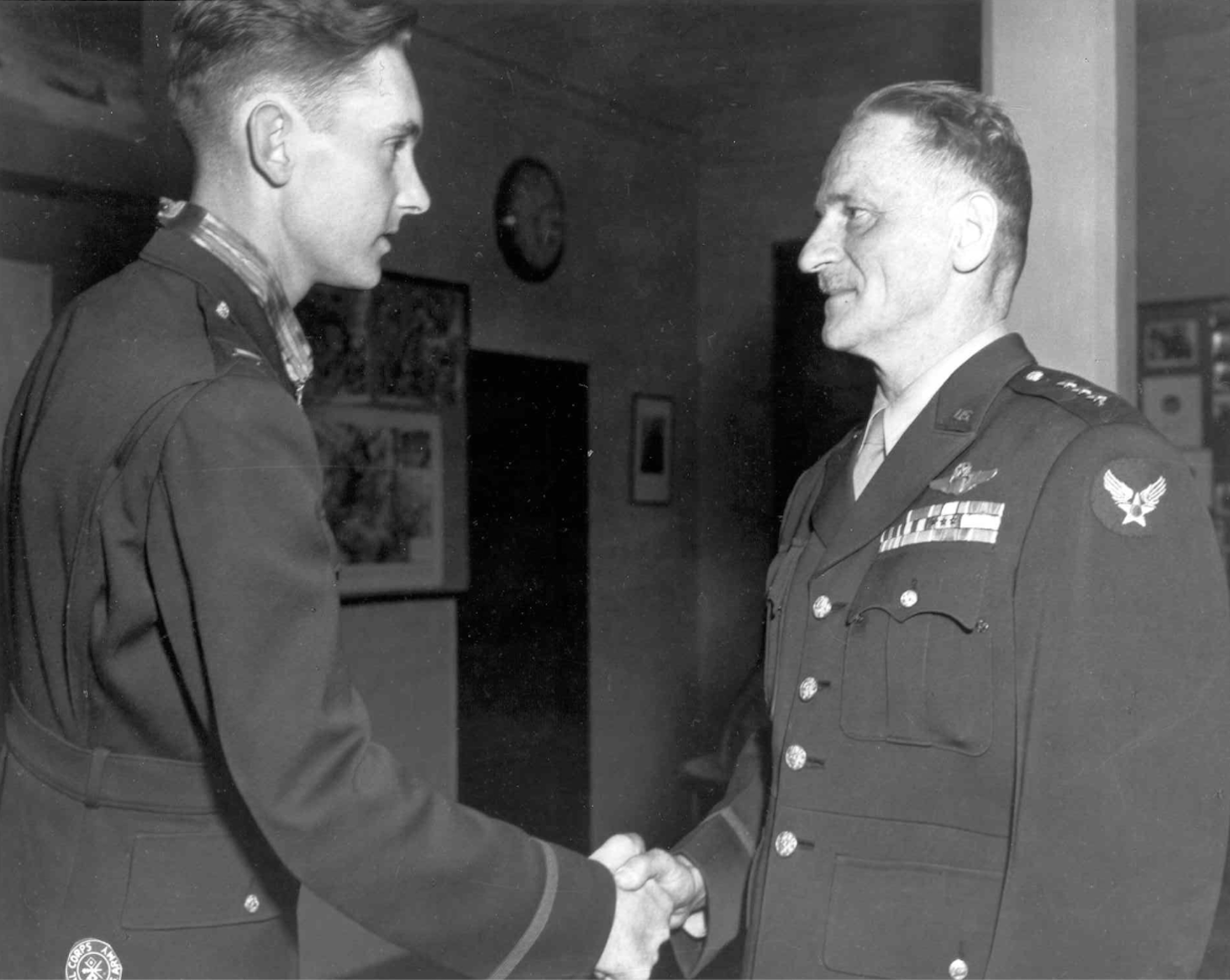
First Lieutenant William R. Lawley, Jr., is congratulated by Lieutenant General Carl Spaatz on the award of the Medal of Honor, 8th August 1944, at High Wycombe (IWM UPL 55737)
Lawley returned to duty remarkably quickly and, as a First Lieutenant, flew a total of fourteen combat missions before completing his operational tour in June 1944. In September of that year he returned to the United States.
Continued Service
Remaining in military service, Lawley was subsequently assigned as a public relations officer at Hendricks Field Army Airfield near Sebring, Florida, a training base for B-17 and B-24 crews, where he was promoted to Captain.
In January 1945 he completed advanced public relations training at Craig Field, Alabama, and the Air Tactical School at Tyndall Field, Florida. During this period he also served as an aide to General Muir S. Fairchild at Maxwell Field, Alabama.
Lawley’s military career continued to advance. He was later assigned to Headquarters, United States Air Force, in Washington, D.C., serving as an administrative assistant to Major General David M. Schlatter on a special weapons assignment. In August 1949 he was promoted to Major.
As a major, Lawley undertook a series of specialised assignments. He completed courses at the Navy Language School at Fort Myer and the Strategic Intelligence School in Washington, D.C. Following this training, he was posted to Brazil as Assistant Air Attaché, receiving promotion to Lieutenant Colonel and serving there until 1954.
In subsequent years he attended the Air Command and Staff School at Air University, Maxwell Air Force Base, Alabama. Upon graduation he assumed command of the 55th Air Refuelling Squadron at Forbes Air Force Base, Kansas.
Lawley remained on active service for many years, holding a variety of senior appointments at Forbes, including Aircrew Maintenance Staff Officer for the 21st Air Division, Deputy Base Commander, and Deputy Vice Commander of the 815th Combat Support Group.
His final promotion came on 27 March 1959 when he was promoted to Colonel. In January 1963 he became Assistant Phase Chief and Director of Curricular Affairs at the Air War College, Maxwell Air Force Base. After three decades of military service, he retired in 1972.
The Final Chapter
William Robert Lawley Jr. died on 29 May 1999 at Montgomery Hospital, Alabama, aged seventy-eight.
Remembered as a softly spoken, hardworking man with traditional values, he was buried in the Veterans’ Field of Honour, Section 12, Greenwood Cemetery, Montgomery.
His funeral service was held in Chapel No. 2 at Maxwell Air Force Base and was conducted by Colonel Emilio Chaviano. He was survived by his wife of fifty-six years, Amelia “Amy” Lawley, daughters Susan Decker and Anne Sheftic, son William Lawley III, and five grandchildren. *5
RAF Chelveston appears in Trail 66, and RAF Grafton Underwood in Trail 6.
Sources:
*1 “Congressional Medal Winner From Leeds Is Ordinary Boy” The Birmingham News, Birmingham, Alabama, 09 Aug 1944, Wed, Page 10 via newspapers.com website
*2, 3 “Pilots Brings Back Crippled Flying Fortress Safely” Dixon Evening Telegraph, Dixon, Illinois, 3 Jun 1944, Page 8. Via newspaper.com website
*4 Crew of Cabin in the Sky:
Pilot: 1st Lt. William R. Lawley, Jr.
Co-Pilot: 2nd Lt. Paul Murphy (KIA)
Navigator: 2nd Lt. Harry Seraphine
Bombardier: 2nd Lt. Harry Mason
Top Turret/Radio Eng.: SSgt Carroll Rowley
Radio operator: SSgt Thomas Dempsey
Tail Gunner: Sgt. Alfred Wendt,
Ball Turret: TSgt. Joseph Kobierecki,
Waist Gunner: Sgt. Ralph Braswell
Waist Gunner: Sgt Charles J. Spears (Probable)
A surviving crew photograph identifies the aircraft’s second waist gunner as Sgt. Spears. Records from the American Air Museum archive show Charles Joseph Spears serving with the 364th Bomb Squadron, 305th Bomb Group, making it highly likely that he was the crew member shown in the photograph and aboard Cabin in the Sky on 20 February 1944. Definitive confirmation would require a surviving mission loading list or crew roster for the aircraft.
Contemporary crew photographs identify the bombardier as Lt. Harry Mason. The Medal of Honor citation confirms the bombardier revived Lawley after he collapsed.
*5 “Hero: Lawley remained at post until he collapsed from exhaustion”. The Montgomery Advertiser, Montgomery, Alabama, 31 May 1999, Pages 1 and 2. Via newspaper.com website.
Congressional Medal of Honor Society. William R. Lawley Jr. Medal of Honor Citation. Accessed 27 May 2026.
IWM American Archive website Accessed 27 May, 2026
The Hall of Valour Project – William Robert Lawley website. Accessed 28 May 2026

