September 8th 1943 – Tragedy at RAF Mepal.

On the night of September 8/9th 1943,  a force of 257 aircraft comprising 119 Wellingtons, 112 Stirlings, 16 Mosquitoes and 10 Halifaxes took off from various bases around the U.K. to bomb the Nazi gun positions at Boulogne. Included in this force were aircraft from the RAF’s Operational Training Units, and for the first time of the war, five B-17s flown by US aircrews of the USAAF’s 422nd BS, 305th BG at Chelveston. This was the first of eight such missions to test the feasibility of the USAAF carrying out night operations over Europe.  After the remaining seven missions, in which the squadron had dropped 68 tons of bombs, the idea was scrapped, the concept considered ‘uneconomical’ although the aircraft themselves proved to be more than capable of the operations.

The Gun battery targeted, was the emplacement that housed the Germans’ long-range guns, and the target would be marked by Oboe Mosquitoes. With good weather and clear visibility, navigation was excellent, allowing the main force to successfully drop their bombs in the target area causing several huge explosions. However, not many fires were seen burning and the mission was not recorded as a success. Reports subsequently showed that the emplacement was undamaged due to both inaccurate marking by Pathfinders, and bombing by the main force. However, as both anti-aircraft fire and night fighter activity were light, no aircraft were lost during the flight making it a rather an uneventful night.

However, the mission was not all plain sailing, and whilst all crews returned, the night was marred by some very tragic events.

Three Stirlings were to take off from their various bases that night: at 21:00 hrs from Chedburgh, Stirling MK. III, EF136, piloted by F/S. R. Bunce of 620 Sqn; at 21:30, another Stirling MK.III, from 75 Sqn at RAF Mepal, BK809 ‘JN-T*1‘ piloted by F/O I.R.Menzies of the RNZAF; and lastly at 21:58 also from Chedburgh, Stirling MK. I, R9288 ‘BU-Q’ piloted by N.J. Tutt  of 214 Sqn.  Unfortunately all three aircraft were to suffer the same and uncanny fate, swinging violently on take off. The first EF136 crashed almost immediately, the second BK809 struck a fuel bowser, and the third R9288 ended up in the bomb dump. Miraculously in both the Chedburgh incidents there were no casualties at all, all fourteen crew men surviving what must have been one of their luckiest escapes of the war! The same cannot be said for the second though.

Stirling BK809 was part of a seventeen strong force of 75 Sqn aircraft. Each aircraft was carrying its full load made up of 1,000lb and 500lb bombs. As the Stirling was running along the runway, it swung violently, striking a fuel bowser which sent it careering into houses bordering the edge of the airfield.

One of the occupants of one of the houses, Mr. P. Smith, saw the aircraft approaching and ran into the street to warn others to get clear. As the aircraft struck the rear of the houses, it burst into flames causing some of the bombs to detonate. This brought considerable rubble down on the occupants of the second house, Mr and Mrs John Randall.

Mrs Randall managed to get out, her legs injured, whereupon she was met by a local fireman, Mr. A.E. Kirby of the National Fire Service. Mr. Kirby went on to help search in the wreckage of the house until his attempts were thwarted by another explosion. His body, along with that of Mr. Randall, was found the next day.

Two other people were also killed that night trying to provide assistance, those being F/Sgt Peter Gerald Dobson, RNZAF and Section Officer Joan Marjorie Easton WAAF. F/Sgt. Dobson was later mentioned in despatches. Three members of the crew lost their lives as a result of the accident, F/O. Menzies and F/O. N. Gale both died in the actual crash whilst Sgt. A. Mellor died later from injuries sustained in the accident.

A number of others were injured in the crash and one further member of the squadron, Cpl Terence Henry King B.E.M, was awarded the British Empire Medal “for his bravery that night in giving assistance“.

The mission on the night of September 8/9th 1943 will not go down as one of the most remarkable, even though  it was unique in many respects, but it will be remembered for the sad loss of crews, serving officers and civilians alike in what was a very tragic and sad event.

The crew of Stirling BK809 were:

F/O. Ian Robert Menzies RNZAF NZ415002. (Pilot).
P/O. Derek Albert Arthur Cordery RAFVR 136360. (Nav).
P/O. Norman Hathway Gale RAFVR 849986. (B/A).
Sgt. Ralph Herbert Barker RNZAF NZ417189. (W/O).
Sgt. Albert Leslie Mellor RAFVR 943914. (Flt. Eng).
Sgt. Bullivant G RAFVR 1395379. (Upp. G)
Sgt. Stewart Donald Muir RNZAF NZ416967. (R/G).

RAF Mepal was visited in Trail 11.

Sources and Further Reading.

*1 Chorley, 1996 Bomber Command Losses 1943 notes this aircraft as AA-T.

Chorley, W.R., Bomber Command Losses – 1943, Midland Counties, (1996)

Middlebrook M., & Everitt C., The Bomber Command War Diaries  Midland Publishing, (1996)

Further details of this accident, the crews and those involved can be found on the 75 (NZ) Sqn blog. This includes the gravestones of those killed and a newspaper report of the event.

My thanks also go to Neil Bright for the initial  information.

Flying Officer John Cruickshank V.C. 210 Sqn (RAF)

In Trail 60 we visited the former RAF Oban (Karrera) on Scotland’s west coast, from which various squadrons operated flying a mix of flying boats notably the Short Sunderland and Consolidated Catalina. One of these squadrons, 210 Sqn, was posted from Oban to Sullom Voe, a major deep water harbour on the Shetland Isles. These squadrons were used primarily for maritime patrols – U-boat searches and convoy escorts – flying for many hours out over the Atlantic and northern reaches toward Iceland.

Flying Officer John Alexander Cruickshank, V.C. (IWM CH 13745)

It was from Sullom Voe that 210 Sqn Flying Officer John Cruickshank, earned himself the Victoria Cross for his action against a heavily armed German U-boat. During the attack, Cruickshank and four other crewmen were severely injured, his navigator was killed and the aircraft badly damaged. He continued to fly his aircraft (Catalina Mark IVA, JV928 ‘Y’) before relinquishing control to his second pilot. But knowing he couldn’t land the aircraft, Cruickshank refused morphine, circling over the base until daylight which allowed him to supervise the landing of the Catalina by the Second Pilot. His actions that night undoubtedly went a long way to saving his crew and his aircraft.

Cruickshank was the last living recipient to have been awarded the Victoria Cross during the Second World War.

Born on 20th May, 1920 in Aberdeen, on Scotland’s north-east coast, Cruickshank spent some of his life in both Aberdeen and Edinburgh being educated at the Royal High School in Edinburgh, the Aberdeen Grammar School and Daniel Stewart’s College in Edinburgh. Before the war, he was employed by the Commercial Bank of Scotland, joining them in 1938.

In 1939 he served in the Territorial Army as a gunner, before joining up in May. Not long after in August, his regiment, the 129th Field Regiment Royal Artillery, were mobilised. In June 1941, he transferred across to the Royal Air Force completing his flying training in both the US and Canada before returning to England and an operational squadron. By 1942 he had earned his wings and after further training he was assigned to an operational unit, 210 Squadron, who were operating flying boats on maritime and anti-submarine patrols. By 1944 he was an accomplished and experienced pilot, flying many hours with 210 Sqn.

At 13:45 hrs on 17th July 1944, F.O. John Cruickshank, along with his crew: Flg. Off. J.C. Dickson (Navigator); Flt. Sgt. J.S. Garnett (2nd Pilot); Sgt. F. Fidler (3rd Pilot); Flt. Sgt. S.B. Harrison (Flt. Engineer); W. Off. W.C. Jenkins (1st Wireless Op.); Flt. Sgt. H. Gershenson (2nd Wireless Op);  Sgt. R.S.C. Proctor (Wireless Op/Air Gunner); Flt. Sgt. F.J. Appleton (Wireless Op/Air Gunner) and Flt. Sgt. A.I. Cregan (Rigger), took off in Catalina Mark IVA, (JV928) ‘Y’ from Sullom Voe as part of Operation ‘Mascot‘, an operation designed to attack and sink the German Battleship ‘Tirpitz’.

Tirpitz was anchored at her mooring in Kaafjord, Norway, and the RAF’s 18 Group role was to protect the British attacking fleet from a defensive force of twelve German submarines designated Group Trutz. Cruickshank and 210 Sqn, were, at the time, part of that RAF 18 Group.

Following the unsuccessful attack, the British fleet returned, Group Trutz was re-positioned to lay in wait for them and it was here that Cruickshank made his attack. At 21:45 at the position 6842N 0612E and a height of 1,500 ft, Cruickshank’s radar operator picked up a signal some 15 miles away, a position west of the Lofoten Islands, west of Narvik. The aircraft turned and vectored onto the vessel.

At 5 miles distance they sighted an unknown surface vessel, and went to investigate. The aircraft reduced altitude to 200 ft on a course of 220o noting that the vessel was at that time stationary. After entering cloud, Cruickshank then sighted the vessel again at 2 miles, this time is was moving at a speed of about 20 knots and turning to starboard. The crew at this time considered it to be a ‘friendly’ and so fired a recognition flare whilst signalling the letter of the day.

It was then that the vessel began to open fire, confirming that it was indeed a U-boat and not a British vessel. The Catalina, followed the U-boat (believed to be a German type VIIC submarine U-361) as it turned to port, and made a complete circuit remaining at 2 miles distance. Once ahead, the aircraft began its run in.

Diving from 1,000 ft to 500 ft, it headed straight for the U-boat, inaccurate flak being met with fire from the Catalina’s front turret. As the aircraft passed the U-boat, depth charges were dropped and the blister turrets opened fire; hits were seen on the coning tower by both front and port blister turrets. Unfortunately, the depth charges didn’t release, and so Cruickshank turned the aircraft for a second attack.

This time, the U-boat was stationary and firing more accurate flak. The Catalina was hit several times, killing the navigator, Flg. Off. John C. Dickson, and seriously wounding Cruickshank along with three other crewmen. At 50 ft, 6 depth charges were released, this time successfully, the two blister turrets confirming wash from the drops but no defined ‘hits’. Immediately after the attack the Catalina entered thick sea fog obscuring any further views.

A photograph taken from Cruickshank’s Catalina during the attack. It shows the splashes from the first of six depth charges dropped on the second attack, landing astern of the U-boat which was making violent ‘S’ turns in an effort to escape. Machine gun fire from a gun housed in one of the Catalina’s ‘blisters’ can also be seen at top left. (IWM C 4590)

At 21:58 the attack was over, the Second Pilot took control of the Catalina, himself injured in the hand. The Wireless Operator Flt .Sgt. Appleton, treated the various injured crewmen, dressing their wounds, including those of Cruickshank. Flt. Sgt. Fidler took over the navigation from the killed navigator. He calculated the aircraft’s fuel and consumption and initial results were not good, but with damaged instruments this proved to be difficult. A message was sent back to Sullom Voe that an ambulance was required urgently. A conversation then began between the ground and the second Pilot in which it was said that the flying boat’s hull had been damaged and the pilot was unable to land the aircraft as he was badly wounded.

The Catalina informed Sullom Voe that they had about 5 hours of fuel (450 Gallons) available. It was also clear by this point that the radio wasn’t working. Whilst dressing Cruickshank’s wounds Appleton realised how seriously injured the pilot was, but knowing the Second Pilot, Flt. Sgt. Garnett, could not land the Catalina, he refused morphine, instead insisting on being carried back to the controls to oversee the landing. Garnett set a course for home, and just after 03:00 hrs they arrived over Sullom Voe.

With unsuitable weather and darkness still enshrouding the base, the aircraft circled the area burning off fuel and waiting for daylight, beaching being the only option due to the aircraft’s damage. For a further hour, some five and half hours after the attack,  the Catalina circled the base, Cruickshank giving instructions, keeping a watchful eye over the proceedings. Finally, daylight appeared and the aircraft was able to land, successfully beaching at 04:05 hrs

On examination, Cruickshank was found to have seventy-two separate wounds, including his lungs and legs, and the aircraft had been badly damaged. Cruickshank was given an immediate blood transfusion and then transferred to Lerwick hospital, with one further stop over before finally being transferred south. Cruickshank made a good recovery but despite this he didn’t return to flying operationally again.

On 29th August 1944, his award appeared in The London Gazette, receiving the Victoria Cross from King George at Holyrood Palace in Edinburgh, on 21st September 1944; he was just 24 years of age.

He eventually left the RAF in 1946 and served for two years as ADC to the Lord High Commissioner to the General Assembly of the Church of Scotland. After this, he returned to banking, the career he had held before the war, before finally returning to his homeland Scotland, from South Africa in 1977. He finally retired in 1985.

For his efforts and determination Flt. Sgt. J.S. Garnett was awarded the DFM. The submarine was later confirmed as sunk, which that night, enabled the British fleet to sail through a gap in the German Submarine line, a gap made possible by both Cruickshank and one other successful sinking. On May 20th 2020 John Cruickshank VC turned 100, his story was widely celebrated and reported about on BBC Scotland. On 1st September 1944, Number 36682, p. 4073, Cruickshank’s citation appeared in The London Gazette, its states:

“The KING has been graciously pleased to confer the VICTORIA CROSS on the undermentioned officer in recognition of most conspicuous bravery: — Flying Officer John Alexander CRUICKSHANK (126700), Royal Air Force Volunteer Reserve. No. 210 Squadron.

This officer was the captain and pilot of a Catalina flying boat which was recently engaged on an anti-submarine patrol over northern waters. When a U-boat was sighted on the surface, Flying Officer Cruickshank at once turned to the attack. In the face of fierce anti-aircraft fire he manoeuvred into position and ran in to release his depth charges. Unfortunately they failed to drop. Flying Officer Cruickshank knew that the failure of this attack had deprived him of the advantage of surprise and that his aircraft offered a good target to the enemy’s determined and now heartened gunners. Without hesitation, he climbed and turned to come in again. The Catalina was met by intense and accurate fire and was repeatedly hit. The navigator/bomb aimer was killed. The second pilot and two other members of the crew were injured. Flying Officer Cruickshank was struck in seventy-two places, receiving two serious wounds in the lungs and ten penetrating wounds in the lower limbs. His aircraft was badly damaged and filled with the fumes of exploding shells. But he did not falter. He pressed home his attack, and released the depth charges himself, straddling the submarine perfectly. The U-boat was sunk. He then collapsed and the second pilot took over the controls. He recovered shortly afterwards and, though bleeding profusely, insisted on resuming command and retaining it until he was satisfied that the damaged aircraft was under control, that a course had been set for base and that all the necessary signals had been sent. Only then would he consent to receive medical aid and have his wounds attended to. He refused morphia in case it might prevent him from carrying on.

During the next five and half hours of the return flight he several times lapsed into unconsciousness owing to loss of blood. When he came to, his first thought on each occasion was for the safety of his aircraft and crew. The damaged aircraft eventually reached base but it was clear that an immediate landing would be a hazardous task for the wounded and less experienced second pilot. Although able to breathe only with the greatest difficulty, Flying Officer Cruickshank insisted on being carried forward and propped up in the second pilot’s seat. For a full hour, in spite of his agony and ever-increasing weakness, he gave orders as necessary, refusing to allow the aircraft to be brought down until the conditions of light and sea made this possible without undue risk. With his assistance the aircraft was safely landed on the water. He then directed the taxying and beaching of the aircraft so that it could easily be salvaged.

When the medical officer went on board, Flying Officer Cruickshank collapsed and he had to be given a blood transfusion before he could be removed to hospital. By pressing home the second attack in his gravely wounded condition and continuing his exertions on the return journey with his strength failing all the time, he seriously prejudiced his chance of survival even if the aircraft safely reached its base.

Throughout, he set an example of determination, fortitude and devotion to duty in keeping with the highest traditions of the Service.”

John Cruickshank sadly died on August 16th 2025 at the age of 105, the last surviving person to have received the V.C. in the Second World War.

His story appeared in the Sunday Telegraph Sunday 17th and Monday August 18th 2025.

Sources and further reading

The Shetland Museum Archives website.

The Scottish Saltire Air crew Assosiation website.

The Fourth Supplement to The London Gazette of 29th August 1944. Published on 1st September 1944, Number 36682, p. 4073

2nd Lieutenant John C. Morgan – Medal Of Honor

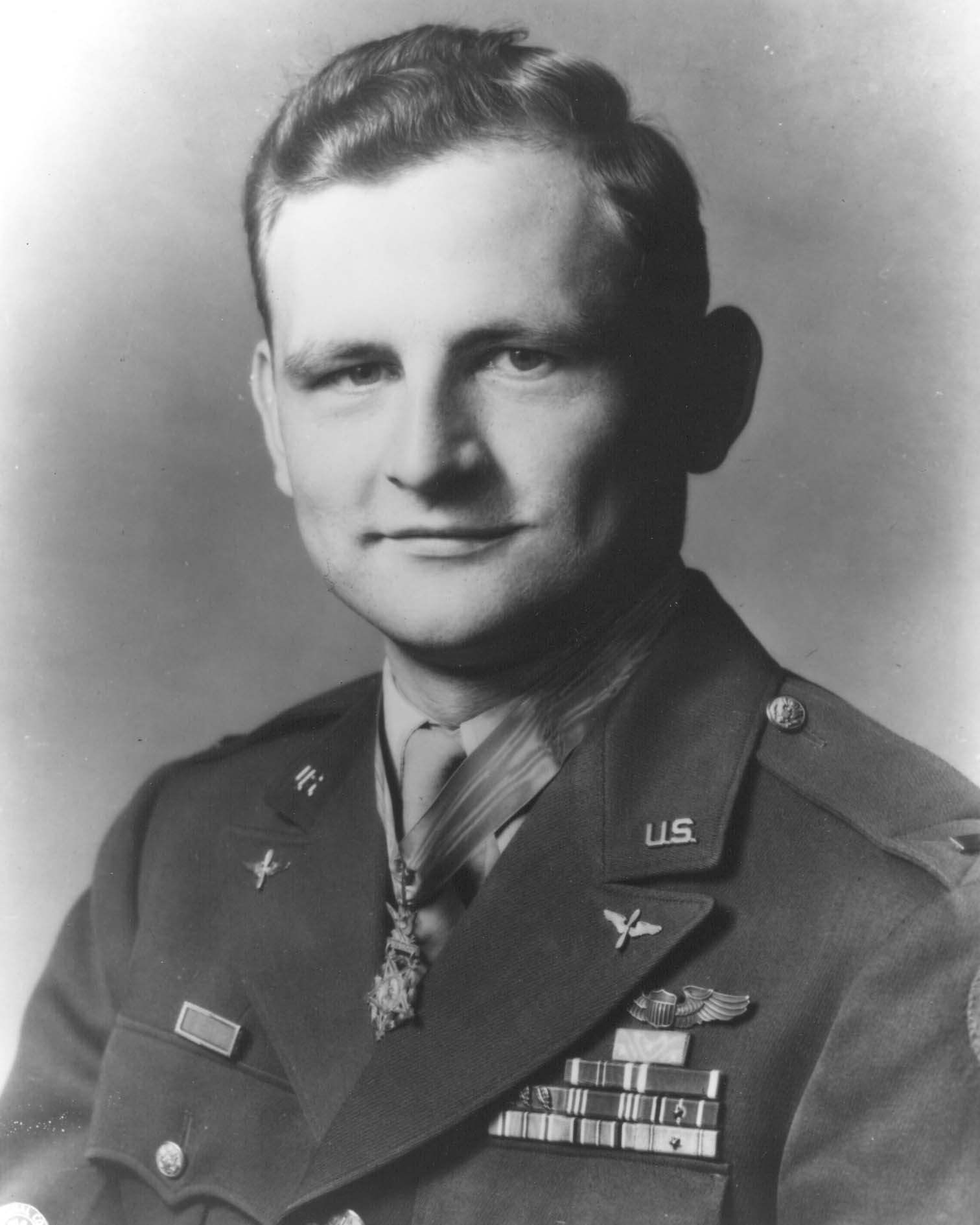
On July 26th 1943, a dramatic and heroic act enabled not only the safe return of a badly damaged B-17, but also the majority of its crew, who no doubt, would have otherwise perished or at best, be captured and incarcerated. For his actions that day, the co-pilot, John C. Morgan Flight Officer (later 2nd Lt.) was awarded the highest military honour a US serviceman can receive – the Medal of Honor.

Born on August 24th, 1914 in Vernon, Wilbarger County, Texas, Morgan was the son of an attorney and the oldest of four children. At the age of 17 he graduated from Military school, going on to attend a number of further establishments including: the Amarillo College, the New Mexico Military Institute, a teacher college and a university, both in his home state Texas.  In 1934 he learned to fly, a passion that would shape his future.

john morgan page

Lieutenant John C “Red” Morgan of the 482nd Bomb Group with a B-17 Flying Fortress. (IWM FRE 2007)

After leaving education early , Morgan moved to Fiji where he worked on a plantation growing pineapples, staying there for four years until 1938. Still wanting to fly, he returned to the United States aboard the liner S.S.Monterey, where upon he tried to enlist in the US Army Air Corps. However, the Air Corps considered his education to be too poor, and so he was refused entry. With little alternative, Morgan sought employment in the booming Texas oil fields instead. A vast desert of oil pumps, Texas’ rich oil fields had begun what became known as the ‘Usher age’ – the start of the great period of oil.

In December 1939, Morgan married Margaret Maples in Oklahoma City, sadly though, the marriage would last just seventeen months. The cause of the demise of the union is not known, but it was whilst working in the oil fields that Morgan sustained a broken neck, an industrial accident that would potentially end all future prospects of work.

With his opportunities now restricted, in 1940, he attempted to join the US Army, and unsurprisingly was classified as medically unqualified for military service (graded ‘4-F’). Undeterred though, Morgan then tried an alternative route, enlisting in the Royal Canadian Air Force (RCAF) on August 4th, 1941. Somehow, Morgan manged to pass his medical gaining his place within the armed forces of Canada. Training at Saskatchewan and Ontario, he soon transferred to England and the instructor training site RAF Church Lawford. Following a spell  with the RAF, Morgan was awarded the rank of Flight Officer, a status he took with him on his transfer in March 1943 to the fledgling USAAF.

His initial posting would be flying in B-17s with the 92nd Bomb Group’s 326th Bomb Squadron, based at RAF Alconbury. The 92nd had only been activated a year earlier initially flying anti-submarine operations off the US coast. After moving to England in July\August, they carried out minor operations before taking on the training of replacement bomber crews. Major operations for the 92nd didn’t begin in earnest until the May 1943.

On his fifth mission, two months later, on July 26th 1943, John C. Morgan (s/n: O-2044877) would be co-pilot in B-17F 42-29802  ‘Ruthie II’. The aircraft, one of nineteen from the 92nd, was one of sixty from the 1st Bombardment Wing heading for the tyre plant at Hanover, when a canon shell ripped through the windscreen splitting the pilots head. The B-17 also suffered damage, the oxygen system to the tail, radio and waist gun positions was now inoperable. In the relentless attack that followed, the top turret gunner lost the use of both of his arms, one being completely shot off, as well as major injuries to his side; the intercom system was put out of action and several crew members had lost consciousness due to the lack of Oxygen.

Luftwaffe aircraft repeated their attacks, causing extensive injury and further damage to the B-17. The navigator, Keith Koske, tried in vain to assist the stricken top turret gunner, but in desperation, attached his parachute and pushed him out of the aircraft. Thankfully it worked, the gunner somehow survived the descent and was cared for by German surgeons until being repatriated n 1944.

Morgan meanwhile grappled with the severely wounded pilot, 1st Lt. Robert Campbell, who had by now wrapped his arms around the controls, to try and maintain level flight. Morgan, taking control, decided the protection of the formation was better than heading for home alone, and so for the next two hours he flew on holding the pilot back with one hand whilst steering with the other. Eventually, after completing the bomb run, the navigator came forward and gave assistance allowing the aircraft to reach the safety of England and RAF Foulsham. Sadly, 1st Lt. Robert Campbell died from his terrible injuries shortly after the severely damaged B-17 landed at Foulsham .

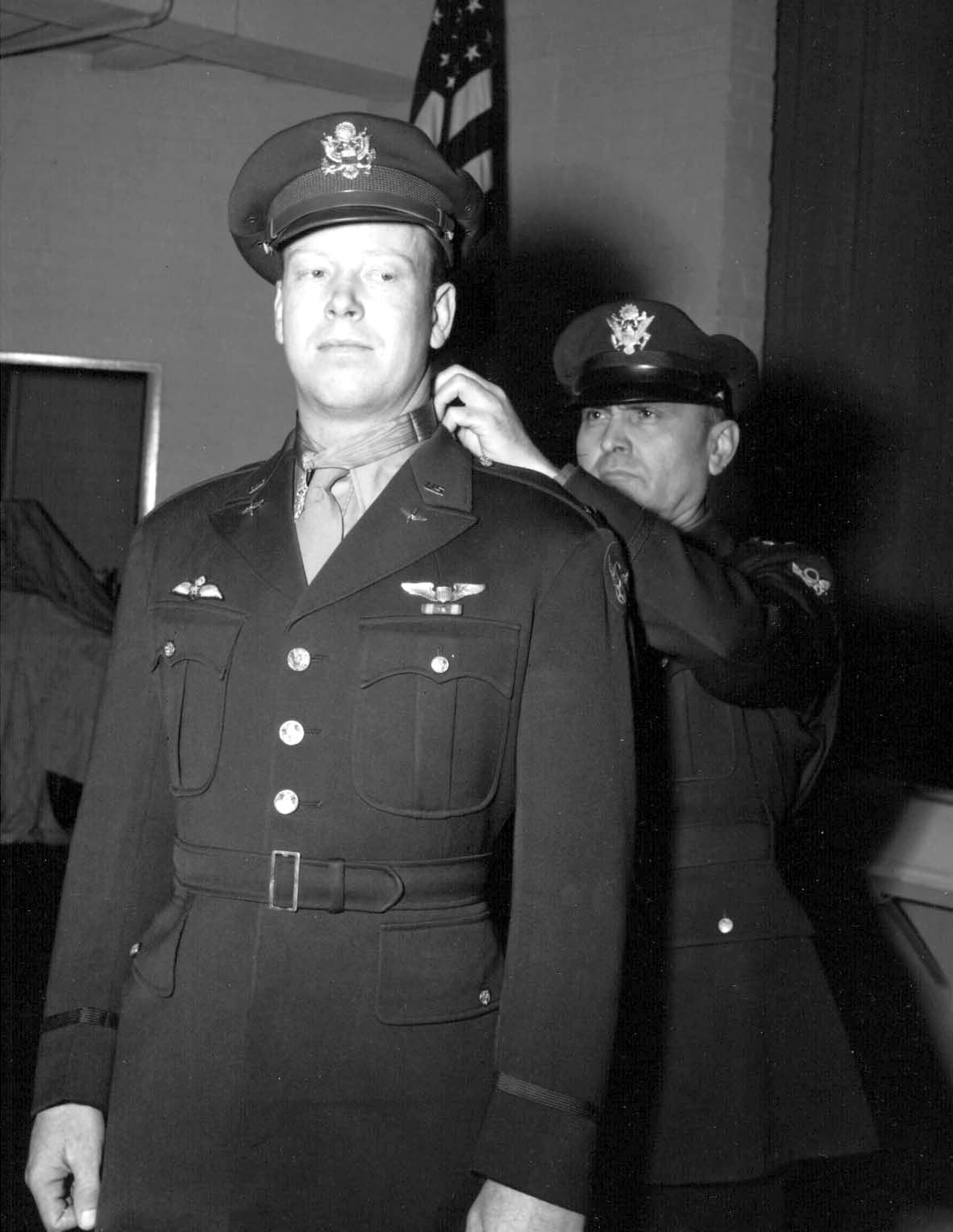
For his actions that day, Morgan received the Medal of Honor in the following December. The ceremony was presided over by Lt. General Ira C. Eaker. Morgan’s citation read*1:

The President of the United States of America, in the name of Congress, takes pleasure in presenting the Medal of Honor to Second Lieutenant (Air Corps) John Cary “Red” Morgan (ASN: 0-2044877), United States Army Air Forces, for conspicuous gallantry and intrepidity above and beyond the call of duty, while serving with the 326th Bombardment Squadron, 92d Bombardment Group (H), Eighth Air Force, participating on a bombing mission over enemy-occupied continental Europe, 28 July 1943. Prior to reaching the German coast on the way to the target, the B-17 airplane in which 2d Lt. Morgan was serving as copilot was attacked by a large force of enemy fighters, during which the oxygen system to the tail, waist, and radio gun positions was knocked out. A frontal attack placed a cannon shell through the windshield, totally shattering it, and the pilot’s skull was split open by a .303-caliber shell, leaving him in a crazed condition. The pilot fell over the steering wheel, tightly clamping his arms around it. Second Lt. Morgan at once grasped the controls from his side and, by sheer strength, pulled the airplane back into formation despite the frantic struggles of the semiconscious pilot. The interphone had been destroyed, rendering it impossible to call for help. At this time the top turret gunner fell to the floor and down through the hatch with his arms shot off at the shoulder and a gaping wound in his side. The waist, tail, and radio gunners had lost consciousness from lack of oxygen and, hearing no fire from their guns, the copilot believed they had bailed out. The wounded pilot still offered desperate resistance in his crazed attempts to fly the airplane. There remained the prospect of flying to and over the target and back to a friendly base wholly unassisted. In the face of this desperate situation, 2d Lt. Morgan made his decision to continue the flight and protect any members of the crew who might still be in the ship and for two hours he flew in formation with one hand at the controls and the other holding off the struggling pilot before the navigator entered the steering compartment and relieved the situation. The miraculous and heroic performance of 2d Lt. Morgan on this occasion resulted in the successful completion of a vital bombing mission and the safe return of his airplane and crew.”

(Whilst his citation notes July 28th as the day of Morgan’s action, the Hanover raid actually took place on July 26th and the citation is an error.)

Morgan receives the MOH from Lt. General Ira C. Eaker (IWM UPL 29867)

Morgan then returned to duty, undertaking further operations in a bomber over occupied Europe.

On March 6th 1944, Morgan would once again find himself in the thick of a heavy and prolonged battle over Germany. Flying withing a formation of 262 1st Bomb Division aircraft, it would prove to be another decisive day.

Morgan’s B-17. 42-3491 ‘Chopstick’, was flying with the 812nd BS, 482nd BG from Alconbury, when the aircraft was hit by flak over Berlin. The aircraft, which had been fitted with H2X , caught fire and exploded. Only four crew members were able to escape the fireball, Morgan amongst them. Once on the ground, their safety was by no means ensured, and very soon all four were captured by German ground forces. Morgan himself was incarcerated in Stalag Luft I for the next fourteen months. The remainder of the crew on board all perished.

For his actions and continued dedication to the Air Force, Morgan was rewarded with a promotion to the rank of 2nd Lieutenant, a move that occurred  in September 1944.

It is believed that this event made Morgan (who was now on his twentieth-sixth mission) the only known Medal of Honor recipient, to have been captured after receiving the Medal.

@IWM UPL 29865

42-3491 ‘Chopstick’ with Morgan on board. This plane is one of the original twelve H2X radar equipped pathfinders. Hit by 88mm flack near Berlin on 6th March 1944, the No.3 engine caught fire setting fire to the wing, causing the aircraft to explode and crash near Lake Havel, Berlin.  The plane was the lead bomber and Colonel Russell Alger Wilson, Commander of the 4th Bomb Wing, was onboard as Combat Leader. Wilson was one of the those killed in the explosion. (@IWM UPL 29865).

After the war Morgan remained in the new reformed air force, the USAF, serving in Korea until his retirement as a Lieutenant Colonel in 1953.

On January 17th, 1991 Morgan passed away, being was laid to rest at Arlington National Cemetery in Virginia, Section 59; Site 351.

The incredible story of Morgan’s bravery would form a part of the story line in the book and movie Twelve O’Clock High when at the beginning, Lt. Jesse Bishop’s B-17 belly lands with a badly injured crew. (08:00 – 14:05).

Sources and further reading.

*1 The Congregational Medal of Honor website.

92nd BG website

B-17 Bomber Flying Fortress – The Queen Of The Skies website

Arlington National Cemetery website

B-17 Crash Beachamwell – January 2nd 1945

On January 2nd 1945, the skies over Norfolk resonated once again with the sound of a crashing aircraft, when B-17 42-32112 of the 337th BS/96th BG based at Snetterton Heath crashed whilst forming up over Beachamwell a stone’s throw east of RAF Downham Market and ten miles north of its base.

The aircraft, a Boeing B-17G-35-BO was delivered to Cheyenne Airport from Modification Centre 10 on 2th January 1944, and then passed to Hunter Air Force Base the following month. After passing through Presque Island on March 6th it was assigned to 337th BS, 96th BG as “AW-F” then based at Snetterton Heath (Station 138) England.*1

Its history was full of drama. On the 1st October 1944, it was carrying out a training operation with another B-17G 44-6137 ‘The Abortion Queen (AW-J) also of the 337th BS and a P-47D Thunderbolt 42-25690 (WZ-U) ‘Lady Helen’ of the 84th FS, 78th FG, RAF Duxford. During the manoeuvres, the P-47 would make mock attacks on the two aircraft allowing the gunners to train under simulated combat conditions. After completing the operation, the P-47 pulled alongside the two aircraft but misjudged his position and collided with  the two B-17s.

The P-47, severely damaged, crashed in a filed near to the church in Grinstead Green, Halstead, Essex, killing the pilot who reportedly veered away from the church at the last minute. The two B-17s both landed without injury to either crew.

Then later, on 2nd January 1945, the B-17 was was again in action, this time forming up over Norfolk as part of a massive 1,000 bomber raid consisting of B-24s and B17s from each of the 1st, 2nd and 3rd Air Divisions, escorted by 500 P-51s and P47s of the same Divisions. The 96th were ordered to attack Erhang, Germany.

As the 41 aircraft of the 96th gathered and jostled for position  in the Norfolk skies, B-17 42-32112 collided with another aircraft causing it to fall from the sky, crashing ten miles north of the base over Beachamwell, not far from Downham Market, Norfolk,  with the loss of all on board.

The nine crew that day were: Pilot: 2nd Lt. Joseph H. Miller, Co-pilot: James P. Thoeness, Navigator: Robert I. Drum, Togglier: Raymond F. Freidmann, Flight engineer/top turret gunner: Sgt. Stephen Duhon, Radio Operator: Tech. Sgt. Leon R. Grabill, Ball turret gunner: S. Sgt. James J. Flaherty, Waist gunner: S. Sgt. Donald E. Willgus, and Tail gunner: S.Sgt. William E. Parton*2.

It was the only aircraft lost by the squadron that day and was later salvaged.

The full story of RAF Downham Market appears in Trail 7, and the history of Snetterton Heath appears in Trail 27.

Sources:

*1 Freeman. R., The B-17 Flying Fortress Story. Arms and Armour, 1998

*2 American Air Museum website. accessed 4.6.2026

The 96th BG Association website accessed 10/6/2026

F/O. Edwin C. Gardner, RAF Hemswell, 61 Squadron

One of many young men killed in the Second World War whose stories deserve to be told.

Flying Officer E. Gardner, RAF(VR) Flying Officer Edwin Charles. Gardner (s/n 72558) was stationed at RAF Hemswell with 61 Squadron flying Hampden Mk.I bombers. He was part of the RAF(VR) and was killed 17th October 1940 age 24.

F/O E Gardner

Flying Officer E. Gardner, RAF(VR),

61 Sqn (RAF), a former World War I unit,  was re-formed on March 8th 1937 at RAF Hemswell as a bomber squadron flying Audax aircraft. Over the next two years they would transition through a number of makes – Anson Mk I and Blenheim Mk I eventually equipping with the Handley Page Hampden in February 1939. They were formed as part of No. 5 Group, Bomber Command, and would take part in several prestige operations. During the early part of the war they would carry out the very first attack on a German land target, (Hornum, 19th/20th March 1940), the first major bombing raid on the German mainland (Monchengladbach, 11th/12th May 1940), and take part in the first RAF bombing raid on Berlin on the night of August 25th/26th 1940.

It was two months after this, that Flying Officer Gardner would lose his life at the age of 24.

Gardner’s aircraft, X-2979, QR-? took off around 18:00 to attack the German city of Merseburg. They would form part of a 73 strong formation made up of both Wellington and Hampden aircraft, attacking a number of targets at: Bremen, Kiel, Bordeaux and the Harz Forest, intending to set it alight with incendiaries. The force included aircraft from a number of squadrons that night.

With F.O. Gardner were the Pilot – Pilot Officer William Herbert Clemenson (s/n 81027), Wireless Operator – Sgt William Hutchinson Hewitt (s/n 822581) and Sgt Dominick Flanagan (s/n 532927), the air gunner on board the aircraft.

The force attacked their designated targets successfully, returning home to their respective bases after having suffered very lightly (3 aircraft in total) over the target areas. On the return trip however, they encountered dense fog which, combined with technical problems with a number of aircraft, caused 10 Hampdens and 4 Wellingtons to crash, many with loss of life.

Reports show that Gardner’s aircraft contacted Hemswell twice in the early hours of the Thursday Morning to gain fixes on their positions. Possibly out of fuel, the aircraft finally came down at Sporle, a few miles west of Norwich, killing all four crew, members.

Flying Officer Gardner was laid to rest at All Saints Church Tacolneston, Norfolk a few miles west of Norwich. His companions were returned to their respective parishes. His grave stands alone in a quiet corner of this 13th Century church. May he rest in peace.

‘Death is Swallowed up in Victory’

Sources

Chorley. W.R., Bomber Command Losses Vol I, 1939-40, Classic Publication, 1992.

William R. Lawley Medal Of Honor – RAF Chelveston

Throughout the Second World War, countless airmen pushed themselves beyond the limits of human endurance to save not only their crews, but also their aircraft. Wounded, exhausted, and flying bombers shattered by enemy fire, they somehow found the strength to keep going until the safety of England could be reached.

One such man was First Lieutenant William R. Lawley Jr. of the 364th Bomb Squadron, 305th Bomb Group. On his tenth combat mission from RAF Chelveston, Lawley fought to keep his crippled B-17 Flying Fortress in the air despite severe injuries and the loss of his co-pilot. For his extraordinary courage and determination that day, he was awarded the Medal of Honor, the United States’ highest award for gallantry.

Early Life and Childhood

William Robert Lawley Jr. was born on August 23, 1920 in Leeds, Jefferson County, Alabama, the son of William R. Lawley snr. and Emma Hazelwood.

He grew up in Leeds alongside his brothers and sisters in a close-knit and deeply religious family. A practising Baptist, Lawley regularly attended Leeds Baptist Church with his siblings.

Known as “W.R.” to his friends, Lawley attended Leeds High School, where he pitched for the school baseball team. He was well liked by his classmates and was often seen joking and laughing with friends before and after games. Reflecting on his school days many years later, the principal described him as average in most subjects, “not excelling in any particular subject” and “just one of the boys.” Like many youngsters of the time, he also had a particular fondness for ice cream. *1

Lawley graduated in 1938 and, after a short period of civilian employment, joined the Sinclair Oil Company in 1941. Working as a delivery truck driver, he quickly earned a reputation as a dependable and hardworking employee. His professionalism, calm temperament, and friendly manner led colleagues and managers alike to describe him as a quiet, level-headed, ambitious young American. *2

Joining the Army Air Forces

Like many Americans, the Japanese attack on Pearl Harbor in December 1941 inspired Lawley to play his part in the war effort, setting him on a path that would change his life forever.

The following year brought both personal tragedy and new opportunities. While mourning the loss of his mother, he also enlisted for flying training, two events that would profoundly shape his future.

Lawley’s determination and continued work ethic soon paid dividends. In April 1943, while training at Altus Army Airfield, Oklahoma (established in 1942), he earned his pilot’s wings and received his commission as an officer. That same month, on 21 April, he married his sweetheart, Amelia Dodd, making it a period of both professional and personal celebration.

Following further training, Lawley was assigned to an operational crew. In November 1943, he and his fellow airmen were posted to the European Theatre of Operations as part of the 364th Bomb Squadron, 305th Bomb Group, Eighth Air Force, where he would serve as a pilot aboard the Boeing B-17 Flying Fortress.

His father, a former Baptist minister who now served as a volunteer circuit preacher, was immensely proud of his son’s achievements. Following the death of his wife, he remained devoted to William and, when his son served overseas, he carried a photograph of him in his pocket at all times. *3

Flying from RAF Chelveston

Flying the northern route, the 305th Bomb Group had first arrived in England in September 1942, operating initially from RAF Grafton Underwood (Station 106) in north Northamptonshire. In December of that year the group moved to RAF Chelveston (Station 105), where it served under the command of the formidable Colonel Curtis “Iron Ass” LeMay.

By the time Lawley arrived at Chelveston in late 1943, the group had already endured a brutal air war. Casualties had been heavy, experienced crews had been lost, and replacement airmen were urgently needed to maintain operational strength. Lawley was among those sent to reinforce the battle-weary unit.

He was soon flying combat operations, and by February 1944 had completed nine missions. His tenth would make him famous.

On 20 February 1944, more than one thousand aircraft from the First, Second, and Third Bomb Divisions participated in a major offensive against targets in Germany. The 305th Bomb Group, operating as part of the First Bomb Division, was assigned targets at Leipzig, Heiterblick, Abtnaundorf, Bernburg, and Oschersleben. If these could not be attacked, crews were authorised to strike targets of opportunity.

The bomber force crossed the continent before separating to attack their designated objectives, intending to regroup for the long return journey to England. Although weather conditions were poor, Allied fighter escorts succeeded in disrupting many German attacks. For the crew of Lawley’s B-17, however, the mission would become a desperate struggle for survival.

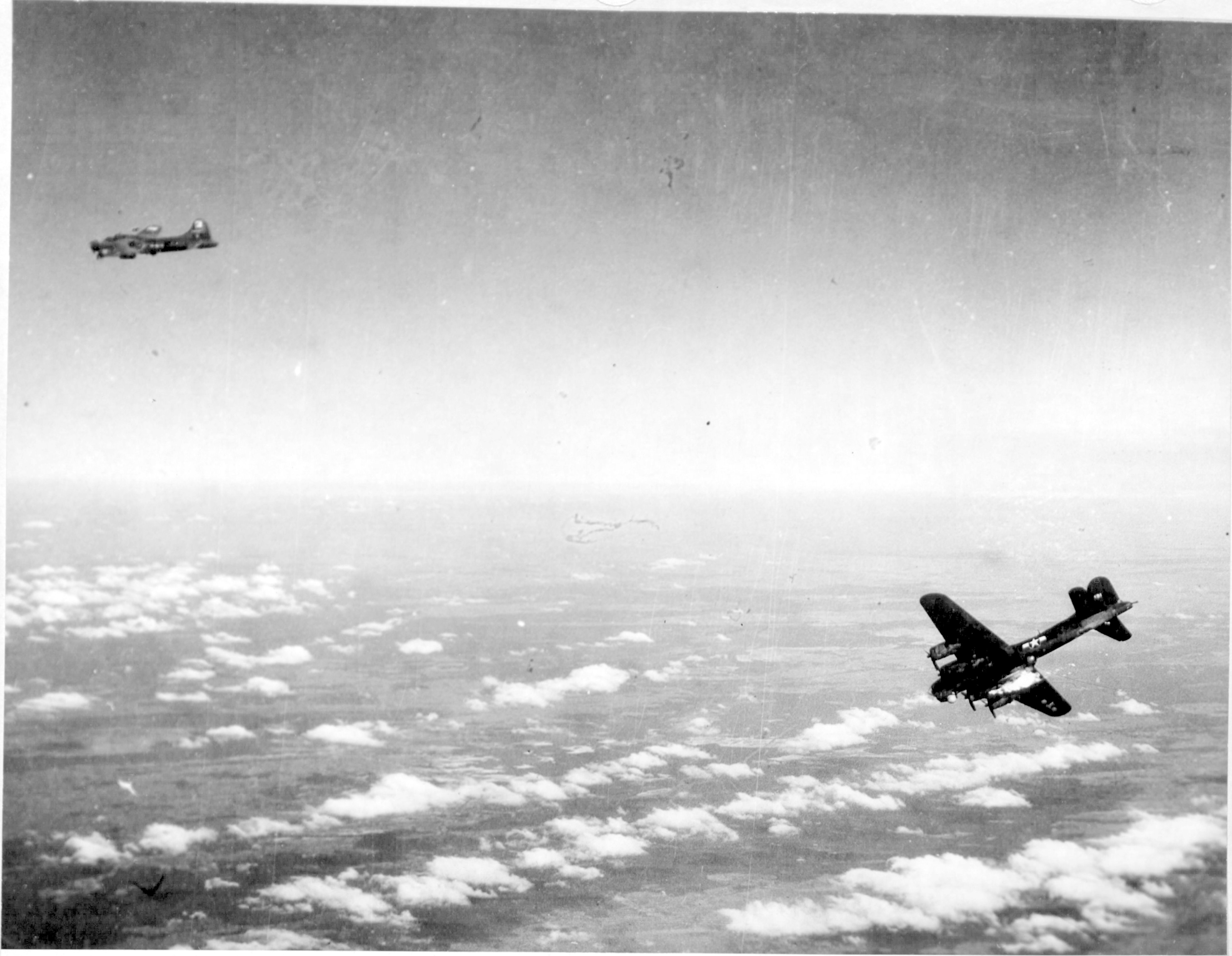
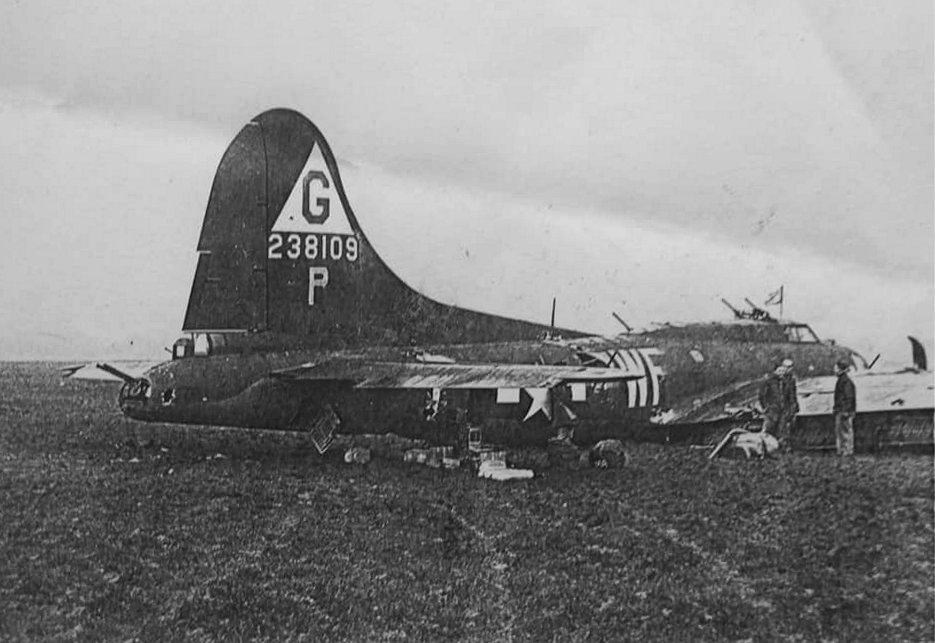
Flying B-17G-30-DL 42-38109, Cabin in the Sky (WF-P), Lawley departed the target area with his bomb load still aboard after frozen release mechanisms prevented it from being dropped. Without warning, the aircraft came under a devastating head-on attack from German fighters. A cannon shell tore into the cockpit, killing co-pilot 2nd Lt. Paul Murphy and severely wounding Lawley in the face.

The assault, launched by approximately twenty enemy fighters, left every surviving crew member wounded and set one of the aircraft’s engines ablaze. The damaged bomber entered a steep dive that appeared uncontrollable. Despite his injuries, Lawley forced the dead co-pilot’s body away from the controls with one hand while fighting to regain command of the aircraft with the other. Blood covered the cockpit, visibility was severely restricted, and freezing air rushed through holes torn in the windscreen.

Fearing an explosion, Lawley ordered the crew to bail out. No one did. Some men were too badly wounded to leave the aircraft, while those still capable of escaping refused to abandon their injured comrades.

As enemy attacks continued, the burning engine was eventually extinguished, only for another engine fire to erupt shortly afterwards. Then came a small but crucial piece of good news. The bombardier succeeded in releasing the jammed bombs, reducing the aircraft’s weight and giving Lawley a better chance of keeping it airborne.

Acutely aware that Lawley was weakening from blood loss and exhaustion, the aircraft’s bombardier Lieutenant Harry Mason, assisted him at the controls. When Lawley eventually collapsed, Mason helped keep the aircraft under control until the wounded pilot recovered sufficiently to resume command.

The crisis was far from over. With two engines disabled, fuel shortages soon created a new danger. Another engine failed, leaving the Flying Fortress struggling to remain airborne on a single functioning engine. Against all odds, the battered aircraft crossed the English coast.

Relief was short-lived. Fire was once again spreading across the wings and the aircraft was rapidly losing altitude. As the crew searched desperately for somewhere to land, the small fighter station, RAF Redhill, came into view.
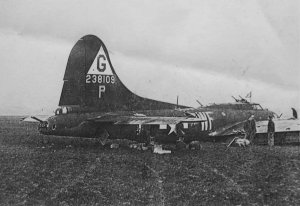
B-17 42-38109 ‘Cabin in the Sky’, after crash landing at RAF Redhill. (IWM UPL 55733)

Despite his injuries and exhaustion, Lawley managed to bring the crippled bomber down in a remarkably controlled crash landing. Of the ten men aboard, nine survived and eventually returned to duty. Only Paul Murphy lost his life.*4

For his extraordinary courage, determination, and flying skill, Lawley was awarded the Medal of Honor, the United States’ highest award for gallantry. His citation reading:

For conspicuous gallantry and intrepidity in action above and beyond the call of duty, 20 February 1944, while serving as pilot of a B-17 aircraft on a heavy bombardment mission over enemy-occupied continental Europe. Coming off the target he was attacked by approximately 20 enemy fighters, shot out of formation, and his plane severely crippled. Eight crewmembers were wounded; the co-pilot was killed by a 20-mm shell. One engine was on fire, the controls shot away, and 1st Lt. Lawley seriously and painfully wounded about the face. Forcing the co-pilot’s body off the controls, he brought the plane out of a steep dive, flying with his left hand only. Blood covered the instruments and windshield and visibility was impossible. With a full bomb load the plane was difficult to manoeuvre and the bombs could not be released because the racks were frozen. After the order to bail out had been given, one of the waist gunners informed the pilot that two crewmembers were so severely wounded that it would be impossible for them to bail out. With the fire in the engine spreading, the danger of an explosion was imminent. Because of the helpless condition of his wounded crewmembers 1st Lt. Lawley elected to remain with the ship and bring them to safety if it was humanly possible, giving the other crewmembers the option of bailing out. Enemy fighters again attacked but by using masterful evasive action he managed to lose them. One engine again caught on fire and was extinguished by skilful flying. First Lt. Lawley remained at his post, refusing first aid until he collapsed from sheer exhaustion caused by loss of blood, shock, and the energy he had expended in keeping control of his plane. He was revived by the bombardier and again took over the controls. Coming over the English coast one engine ran out of gasoline and had to be feathered. Another engine started to burn and continued to do so until a successful crash landing was made on a small fighter base. Through his heroism and exceptional flying skill 1st Lt. Lawley rendered outstanding distinguished and valorous service to our nation.

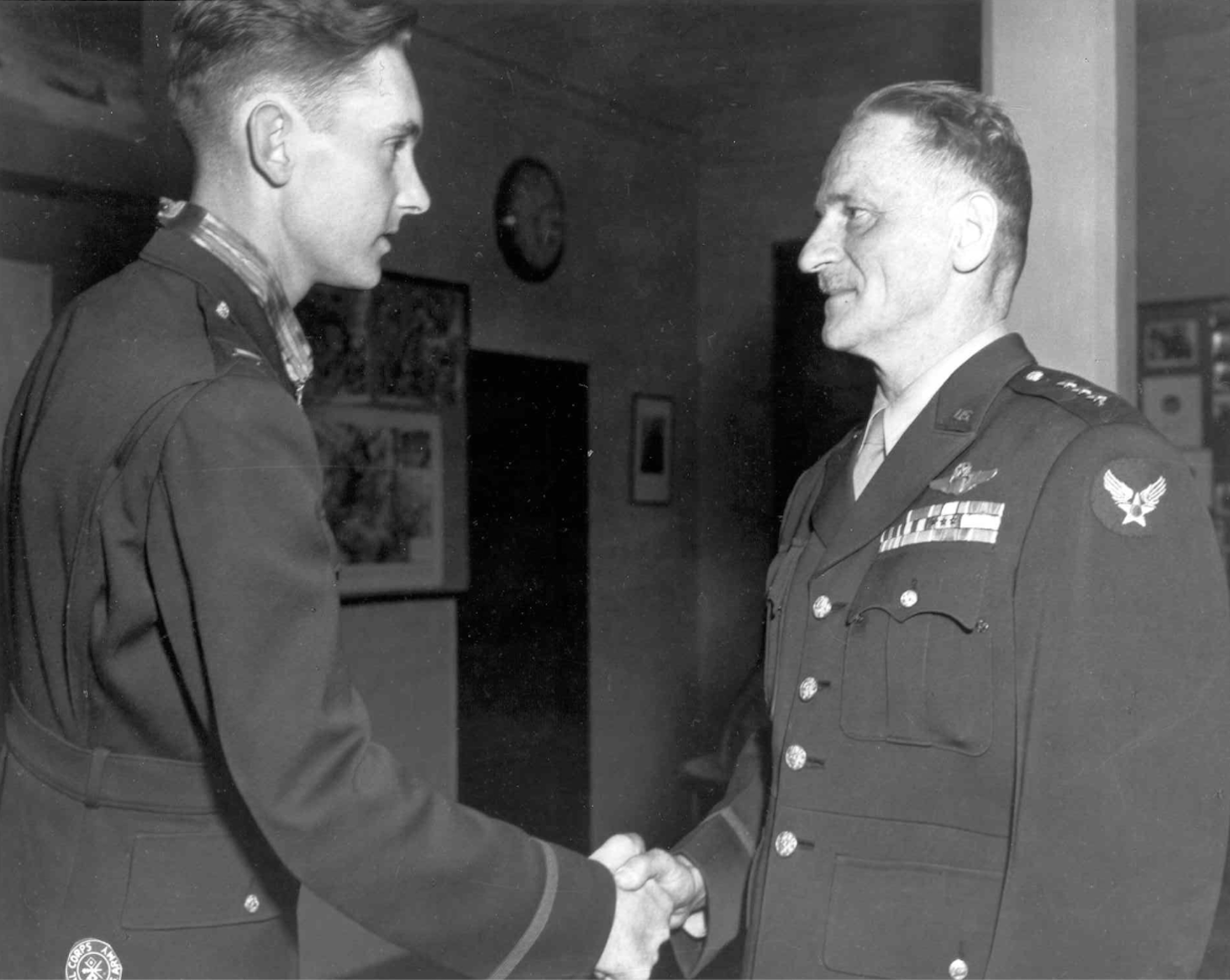
Lawley received his award from Lieutenant General Carl Spaatz at High Wycombe in August 1944.
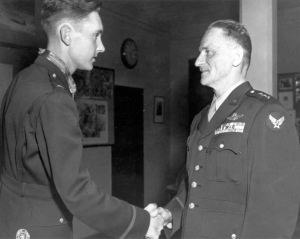
First Lieutenant William R. Lawley, Jr., is congratulated by Lieutenant General Carl Spaatz on the award of the Medal of Honor, 8th August 1944, at High Wycombe (IWM UPL 55737)

Lawley returned to duty remarkably quickly and, as a First Lieutenant, flew a total of fourteen combat missions before completing his operational tour in June 1944. In September of that year he returned to the United States.

Continued Service

Remaining in military service, Lawley was subsequently assigned as a public relations officer at Hendricks Field Army Airfield near Sebring, Florida, a training base for B-17 and B-24 crews, where he was promoted to Captain.

In January 1945 he completed advanced public relations training at Craig Field, Alabama, and the Air Tactical School at Tyndall Field, Florida. During this period he also served as an aide to General Muir S. Fairchild at Maxwell Field, Alabama.

Lawley’s military career continued to advance. He was later assigned to Headquarters, United States Air Force, in Washington, D.C., serving as an administrative assistant to Major General David M. Schlatter on a special weapons assignment. In August 1949 he was promoted to Major.

As a major, Lawley undertook a series of specialised assignments. He completed courses at the Navy Language School at Fort Myer and the Strategic Intelligence School in Washington, D.C. Following this training, he was posted to Brazil as Assistant Air Attaché, receiving promotion to Lieutenant Colonel and serving there until 1954.

In subsequent years he attended the Air Command and Staff School at Air University, Maxwell Air Force Base, Alabama. Upon graduation he assumed command of the 55th Air Refuelling Squadron at Forbes Air Force Base, Kansas.

Lawley remained on active service for many years, holding a variety of senior appointments at Forbes, including Aircrew Maintenance Staff Officer for the 21st Air Division, Deputy Base Commander, and Deputy Vice Commander of the 815th Combat Support Group.

His final promotion came on 27 March 1959 when he was promoted to Colonel. In January 1963 he became Assistant Phase Chief and Director of Curricular Affairs at the Air War College, Maxwell Air Force Base. After three decades of military service, he retired in 1972.

The Final Chapter

William Robert Lawley Jr. died on 29 May 1999 at Montgomery Hospital, Alabama, aged seventy-eight.

Remembered as a softly spoken, hardworking man with traditional values, he was buried in the Veterans’ Field of Honour, Section 12, Greenwood Cemetery, Montgomery.

His funeral service was held in Chapel No. 2 at Maxwell Air Force Base and was conducted by Colonel Emilio Chaviano. He was survived by his wife of fifty-six years, Amelia “Amy” Lawley, daughters Susan Decker and Anne Sheftic, son William Lawley III, and five grandchildren. *5

RAF Chelveston appears in Trail 66, and RAF Grafton Underwood in Trail 6.

Sources:

*1 “Congressional Medal Winner From Leeds Is Ordinary Boy” The Birmingham News, Birmingham, Alabama, 09 Aug 1944, Wed, Page 10 via newspapers.com website

*2, 3 “Pilots Brings Back Crippled Flying Fortress Safely” Dixon Evening Telegraph, Dixon, Illinois, 3 Jun 1944, Page 8. Via newspaper.com website

*4 Crew of Cabin in the Sky:

Pilot: 1st Lt. William R. Lawley, Jr.
Co-Pilot: 2nd Lt. Paul Murphy (KIA)
Navigator: 2nd Lt. Harry Seraphine
Bombardier: 2nd Lt. Harry Mason
Top Turret/Radio Eng.: SSgt Carroll Rowley
Radio operator: SSgt Thomas Dempsey
Tail Gunner: Sgt. Alfred Wendt,
Ball Turret: TSgt. Joseph Kobierecki,
Waist Gunner: Sgt. Ralph Braswell
Waist Gunner: Sgt Charles J. Spears (Probable)

A surviving crew photograph identifies the aircraft’s second waist gunner as Sgt. Spears. Records from the American Air Museum archive show Charles Joseph Spears serving with the 364th Bomb Squadron, 305th Bomb Group, making it highly likely that he was the crew member shown in the photograph and aboard Cabin in the Sky on 20 February 1944. Definitive confirmation would require a surviving mission loading list or crew roster for the aircraft.

Contemporary crew photographs identify the bombardier as Lt. Harry Mason. The Medal of Honor citation confirms the bombardier revived Lawley after he collapsed.

*5 “Hero: Lawley remained at post until he collapsed from exhaustion”. The Montgomery Advertiser, Montgomery, Alabama, 31 May 1999, Pages 1 and 2. Via newspaper.com website.

Congressional Medal of Honor Society. William R. Lawley Jr. Medal of Honor Citation. Accessed 27 May 2026.

IWM American Archive website Accessed 27 May, 2026

The Hall of Valour Project – William Robert Lawley website. Accessed 28 May 2026

1st Lt. E.S. Michael MOH – RAF Chelveston

Every airfield has its heroes, and RAF Chelveston was no exception. Among the men who flew from the Northamptonshire base was 1st Lt. Edward Stanley Michael of the 364th Bomb Squadron. In April 1944, while flying a mission deep into Germany, he found himself at the centre of one of the most remarkable survival stories of the American air war. Wounded, outnumbered and flying a crippled aircraft, Michael’s determination to bring his crew home would earn him the Medal of Honour and secure his place in the history of RAF Chelveston.
Edward Stanley Michael was born on 2 May 1918 in Chicago to Stanley William Michael and Lillian Harriet Konior. He grew up in an industrial city defined by machinery, manufacturing and hard-edged practicality – an environment that perhaps influenced his early move into skilled technical work. He attended Chicago High School, graduating in 1936, and by 1940, was working as a machinist, a trade that demanded precision and patience in equal measure.

1st Lt. Michael (Wikipedia)

That practical grounding was interrupted by the growing pressures of global conflict. On 2 November 1940, he enlisted as a private in the United States Army Air Corps and was posted to Wheeler Field, Hawaii, where he was present during the Japanese attack of 7 December 1941. In 1942 he was selected for flight training, entering the demanding programme that transformed enlisted airmen into officers and pilots. By April 1943 he had earned his commission as a second lieutenant and completed both multi-engine and B-17 Flying Fortress training in Arizona and Washington State. It was during this period of intense preparation that he married Bertie Lee Parks in October 1943, later naming his B-17 Bertie Lee in her honour.

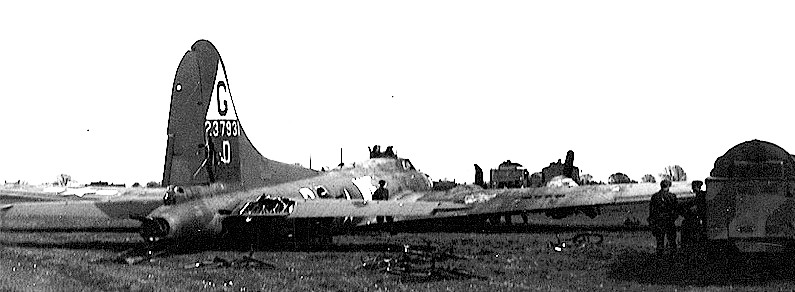
Serving with the 364th Bomb Squadron of the 305th Bomb Group at RAF Chelveston, Michael took part in numerous combat operations over occupied Europe and Germany. On 11 April 1944, he was piloting the B-17G Bertie Lee (42-37931) as part of a major bombing operation against targets in Germany, including the Focke-Wulf aircraft factory at Sorau. Other objectives for the 341 B-17s of the 1st Bomb Division included Cottbus, Dobberphul, Stettin and Trechel.

As the formation approached its target area, German fighters launched another ferocious frontal assault, a tactic that had proved highly effective against American bomber formations earlier in the air war. Michael’s aircraft, a Douglas-Long Beach B-17G-20-DL Flying Fortress (WF-D), soon became the focus of a determined enemy attack. To the crew, it appeared that the German fighters had singled them out, pressing home repeated assaults despite the presence of Allied escort fighters and the heavy defensive fire from the bomber formation.

The attack devastated the cockpit. Both Michael and his co-pilot, 2nd Lt. Franklin Westberg, were wounded, vital instruments were destroyed, oil coated the windscreen and the aircraft entered a 3,000-foot dive from which survival appeared impossible. With remarkable determination, Michael managed to regain control, only to discover that the bomb bay, still loaded with incendiaries, was on fire. Damage to the release mechanism meant the bombs could not be jettisoned, and the danger of an explosion increased with every passing moment.

The only apparent chance of survival was to bail out, so Michael gave the order. As the crew prepared to leave the aircraft, he was confronted by a horrific sight. Top turret gunner Jewel Philips was holding his injured eye in his hand while blood poured from a severe head wound. Despite his own injuries, Michael administered what aid he could before helping the gunner to the escape hatch. Philips was one of seven crewmen who managed to leave the aircraft.

With the co-pilot and the injured bombardier, Lt. Leiber, still on board, Michael decided that a crash landing offered their only realistic hope. While the crew fought to save the aircraft, the bombardier eventually succeeded in releasing the burning incendiaries. Through a series of violent evasive manoeuvres, Michael shook off the pursuing fighters and finally reached the relative safety of cloud cover.

Emerging from the clouds, the aircraft came under renewed attack from German flak. Michael brought the Fortress down to almost treetop height and headed towards England. Remarkably, the aircraft continued to respond despite the extensive damage it had suffered. They flew on for as long and as far as possible. Miraculously, they reached the English coast, but by now Michael was exhausted from his prolonged efforts and a severe thigh wound. The co-pilot took over, circling the aircraft while Michael recovered enough strength to attempt the landing himself.

With no hydraulics, the ball turret jammed in the lowered position, the undercarriage locked up and the bomb bay doors stuck open, the odds of survival remained heavily stacked against them. Against all odds, Michael retook control and brought Bertie Lee down at RAF Waltham near Grimsby in Lincolnshire, the damaged aircraft crunching and groaning across the grass before finally coming to a halt.

For his extraordinary actions and determination to save both his crew and aircraft, Michael received the Medal of Honour, the second such award made to a member of the 305th Bomb Group.

Bertie Lee after crash-landing at RAF Waltham (IWM UPL 40113)

1st Lt. Michael’s citation read*1:

For conspicuous gallantry and intrepidity above and beyond the call of duty while serving as pilot of a B-17 aircraft on a heavy-bombardment mission to Germany, 11 April 1944.

The group in which 1st Lt. Michael was flying was attacked by a swarm of fighters. His plane was singled out and the fighters pressed their attacks home recklessly, completely disregarding the Allied fighter escort and their own intensive flak. His plane was riddled from nose to tail with exploding cannon shells and knocked out of formation, with a large number of fighters following it down, blasting it with cannon fire as it descended.

A cannon shell exploded in the cockpit, wounded the co-pilot, wrecked the instruments, and blew out the side window. First Lt. Michael was seriously and painfully wounded in the right thigh. Hydraulic fluid filmed over the windshield making visibility impossible, and smoke filled the cockpit. The controls failed to respond and 3,000 feet were lost before he succeeded in levelling off.

The radio operator informed him that the whole bomb bay was in flames as a result of the explosion of three cannon shells, which had ignited the incendiaries. With a full load of incendiaries in the bomb bay and a considerable gas load in the tanks, the danger of fire enveloping the plane and the tanks exploding seemed imminent. When the emergency release lever failed to function, 1st Lt. Michael at once gave the order to bail out and seven of the crew left the plane.

Seeing the bombardier firing the navigator’s gun at the enemy planes, 1st Lt. Michael ordered him to bail out as the plane was liable to explode any minute. When the bombardier looked for his parachute he found that it had been riddled with 20-mm fragments and was useless. First Lt. Michael, seeing the ruined parachute, realized that if the plane was abandoned the bombardier would perish and decided that the only chance would be a crash landing.

Completely disregarding his own painful and profusely bleeding wounds, but thinking only of the safety of the remaining crewmembers, he gallantly evaded the enemy using violent evasive action despite the battered condition of his plane. After the plane had been under sustained enemy attack for fully 45 minutes, 1st Lt. Michael finally lost the persistent fighters in a cloud bank.

Upon emerging, an accurate barrage of flak caused him to come down to treetop level where flak towers poured a continuous rain of fire on the plane. He continued into France, realizing that at any moment a crash landing might have to be attempted, but trying to get as far as possible to increase the escape possibilities if a safe landing could be achieved.

First Lt. Michael flew the plane until he became exhausted from loss of blood, which had formed on the floor in pools, and he lost consciousness. The co-pilot succeeded in reaching England and sighted an RAF field near the coast. First Lt. Michael finally regained consciousness and insisted upon taking over the controls to land the plane.

The undercarriage was useless; the bomb bay doors were jammed open; the hydraulic system and altimeter were shot out. In addition, there was no airspeed indicator, the ball turret was jammed with the guns pointing downward, and the flaps would not respond. Despite these apparently insurmountable obstacles, he landed the plane without mishap.

After the war, Michael remained in military service, transitioning through the post-war restructuring of American air power and into the newly established United States Air Force. He served in both air transport and operational roles across the United States and the Pacific, attended Air University, and later trained on the B-47 Stratojet during the early Cold War period—an aircraft type that would also become familiar at RAF Chelveston.

Among his many decorations were the Distinguished Flying Cross, Purple Heart and Air Medal with four oak leaf clusters. These, together with a long list of campaign and service awards, reflected a military career that spanned three decades, multiple theatres of operation and the transformation of American air power from the Second World War into the Cold War era. His service ultimately took him to the rank of lieutenant colonel before he retired in 1971 after 30 years in uniform.

Michael later married Louise Erdmann and remained active in military service until his retirement. He died on 19 May 1994 and is buried in Evergreen Cemetery, Springville, Utah County, Utah.

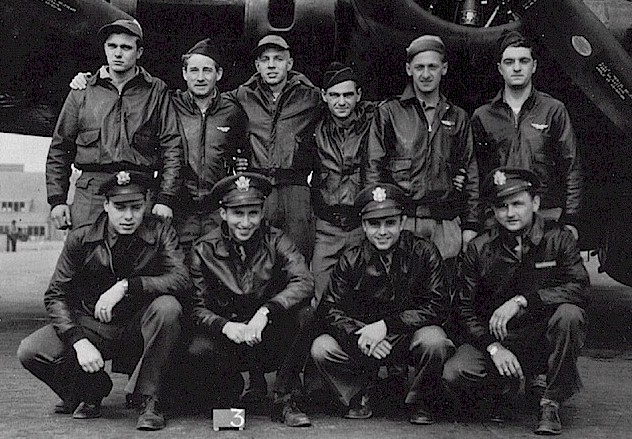
1st Lt. E Michael (kneeling right) with his crew 1943.(US Air Force)

Sources

*1 Congressional Medal of Honour website.  Accessed 5 August 2025

The full story of RAF Chelveston can be read in Trail 66.

Trail 66 – RAF Chelveston – Part 9 – The End of an Era

Part 8 saw Chelveston at the crossroads of history. From the heroism of B-17 crews braving ferocious Luftwaffe attacks to the tense vigilance of Strategic Air Command jets in the early Cold War, the station had witnessed courage, innovation, and loss. Yet as international tensions shifted and technology advanced, even its longest runways and fortified hangars could not guarantee a future.

By the late 1950s, Chelveston faced an uncertain fate. What would become of a place that had once been alive with the roar of engines and the courage of men? Its final chapter was about to be written – but the outcome was far from certain.

During the late 1950s and early 60s, the world’s political landscape was shifting constantly and rapidly. France’s president, Charles de Gaulle, saw his country as a strong, independent nuclear power, wanting full control over its own defence. That vision did not accommodate large numbers of foreign – particularly American – forces on French soil. As a result, 1959 saw the start of a reduction in military numbers with strict limits being placed on the number of American forces allowed in France. Any personnel or equipment beyond this ceiling were required to leave immediately. This decision triggered a massive redeployment of forces, with many units being reassigned to Germany or Belgium, and others returning to the United Kingdom where they were accommodated at the so-called ‘Red Richard bases, of which Chelveston was one.*20

Over the next several years, France saw a steady reduction in American personnel and units, a process that would culminate in 1966 with President Charles de Gaulle’s announcement of France’s withdrawal from NATO’s integrated military command. The decision required the removal of all foreign forces from French soil by April 1967, bringing an end to more than a decade of a large-scale American presence.

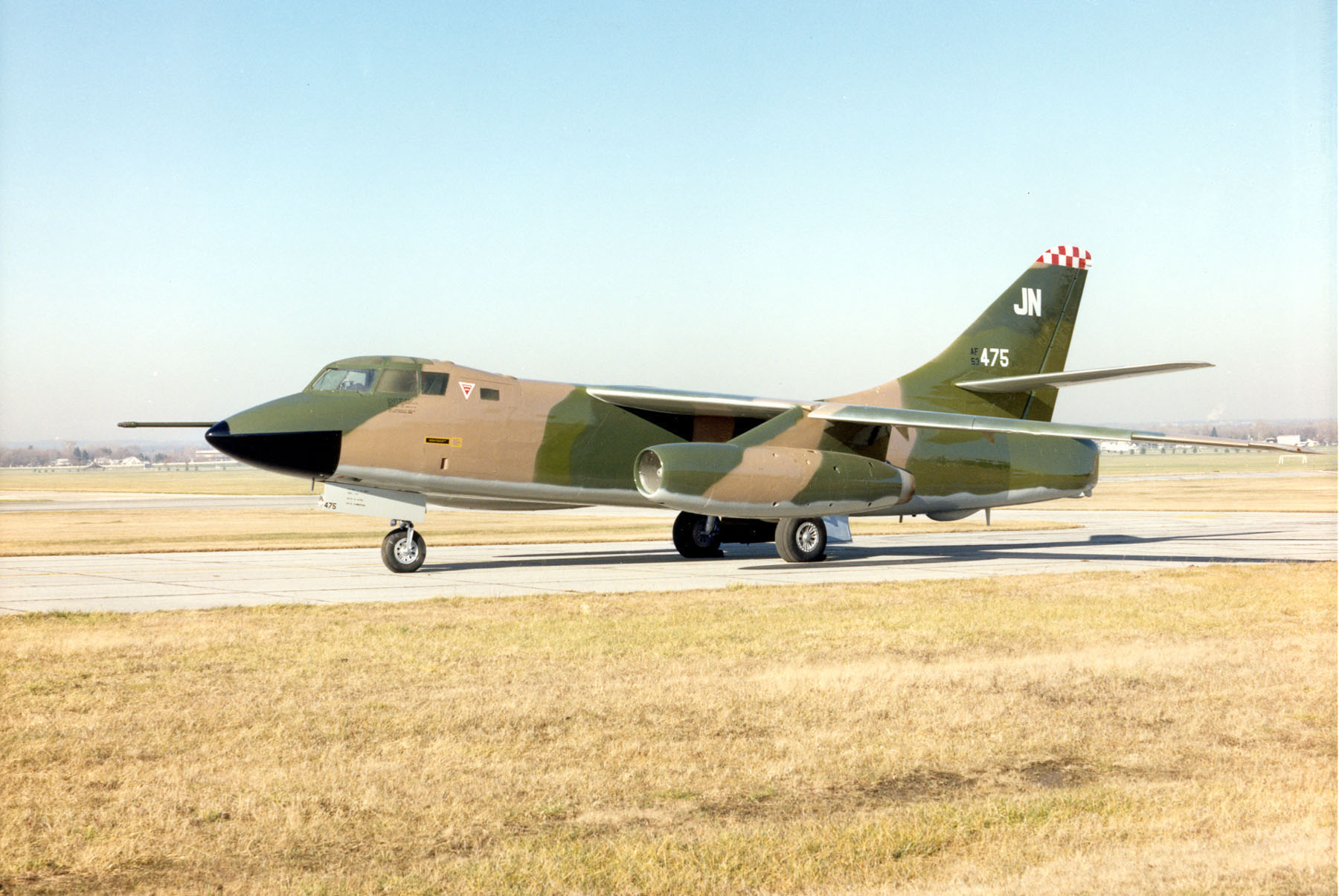
To accommodate the early relocations from the continent, a number of Britain’s newly modernised airfields were selected – Chelveston among them. Alongside RAF Alconbury and RAF Bruntingthorpe, each station received elements of the 10th Tactical Reconnaissance Wing (TRW), the 42nd Tactical Reconnaissance Squadron, of the 10th TRW, arriving at Chelveston in August 1959. Operating the twin-engined Douglas RB-66C Destroyer – electronic reconnaissance aircraft, eighteen of these machines, together with their crews and ground personnel, quickly took up residence. Shortly after their arrival, the aircraft were modified with updated electronic counter-measures equipment, reflecting the increasingly technical nature of Cold War aerial reconnaissance.

Douglas RB-66B Destroyer (U.S. Air Force photo)

The squadron remained at Chelveston for almost three years. Then, in the summer of 1962, both the 42nd Tactical Reconnaissance Squadron and the 19th Tactical Reconnaissance Squadron departed their respective Midlands stations for deployment to Toul-Rosières Air Base in eastern France. The move placed the wing’s reconnaissance assets closer to the Central European front line at a time when aerial reconnaissance was increasing. For Chelveston, however, it marked the effective end of its active flying role. With the Americans steadily reducing their UK footprint and Bruntingthorpe facing closure, the departure of the RB-66s signalled the beginning of the station’s final chapter.

Project Clearwater and the End of the Reflex Era

So, once again, Chelveston was left devoid of all main front line squadrons. Facing a reduction in demand for Cold War bases –  combined with both long expensive runways and a shift towards a more logistical, support and storage use – Chelveston’s runway was closed to all but infrequent, small aircraft – examples that could operate on shorter runways.

Before long, the airfield being used less and less, Chelveston closed to flying altogether, and it quickly reverted back to a reserve airfield status.

This shift in wider policy soon became formalised. On 26th July 1963, the United States Department of Defence announced ‘Project Clearwater’, the final phase in the reduction of American forces stationed on British soil.*21 Although Chelveston had already fallen largely silent, the base remained nominally under United States control while residual activities continued. That position ended on 19th June 1964, when Chelveston – together with RAF Fairford, RAF Greenham Common and RAF Sculthorpe was formally closed and handed back to the Royal Air Force.

By 1st April 1965, Project Clearwater had effectively brought an end to Strategic Air Command’s Reflex bomber deployments in Britain, terminating large-scale rotational operations and leading to the inactivation of the 7th Air Division*22 Chelveston, retained by the RAF on a care-and-maintenance basis for a further period, would briefly assume a less glamorous role as a storage location for American equipment being withdrawn from the continent. The age of regular transatlantic bomber and reconnaissance operations from Northamptonshire had quietly drawn to a close.

From Runways to Renewables: The Final Transformation of Chelveston

With no flying units now operating from Chelveston, the runways and associated tracks began to deteriorate and break up. With the increasing demand for housing and the nearby new town of Milton Keynes expanding, hardcore was needed and Chelveston had a good supply just waiting to be quarried. The runways and perimeter tracks were all removed thus ending any chance of a reprieve for flying in the future. But it wasn’t to be the end of its military association just yet.

In 1977, Chelveston became home to a key part of the Royal Air Force’s Strike Command Integrated Communications System (STCICS). The site, equipped with a large array of antennas, formed an essential link in the RAF’s network, transmitting voice, data, and weather information to aircraft, and connecting military stations across the UK and beyond. For decades, it played a vital role in maintaining operational communications for Strike Command.

As technology and operational requirements evolved however, the Ministry of Defence upgraded the system, leading to the creation of the Defence High Frequency Communications Service (DHFCS). This new network integrated both air and naval communications into a single nationwide system, capable of maintaining secure links over long distances, and routing messages through a central control centre. By December 2003, with the network increasingly managed by civilian contractors,  Chelveston was vacated once more, thus marking the end of its role in the UK’s high-frequency military communications infrastructure.*23 *24

With their departure, the site became surplus to military requirements, and it was sold off in 2005, as a going concern. New businesses seeing it as a development opportunity, bought it up turning it into a diverse renewable energy park that is known today as Chelveston Renewable Energy Ltd.

A number of wind turbines have since been erected, all linked by  the remaining remnants of the perimeter track.  A solar farm has also been added, and the site has evolved into a major energy supplier utilising renewable energy sources.

Today, the former Chelveston airfield  continues in this state, and little evidence exists of its previous life; the runways, perimeter tracks and buildings all having been removed. Dotted about, within the confines of the private area, a small number of  temporary buildings are known to remain (as surveyed by Northamptonshire Archaeology in conjunction with West Northamptonshire Council) including one of the nuclear bomb stores, – the ‘igloo’. Because, of its excellent condition and rarity value, the structure has been put forward for long-term protection through the Scheduling process of West Northampton Council.  The store is considered to be ‘well-preserved and a relatively unaltered example of a distinctive 1950s USAF munitions storage area’ which ‘comprises characteristic storage bunkers or “Igloos” inspection buildings, and perimeter fencing.’ *25

Although largely privately owned, there is a footpath across the site running perpendicular to the post war runway. In addition, the Cold War accommodation blocks are still present adjacent to the site, and a small section is used by the Northamptonshire Fire and Rescue Service as a training centre, training fire-fighters.

On the ground little remains to be seen, and access to that is restricted. The concrete foundations used by the post war communications centre are visible, but otherwise, Chelveston, and its history, are merely records longing to be opened and read.

During its short wartime life, Chelveston witnessed many acts of great heroism. It bore heavy losses, saw significant developments in aerial warfare, and its crews endured sustained enemy attacks. Those who served here are now honoured by a memorial in the nearby village, a quiet reminder of the station’s wartime sacrifice. Yet the story of Chelveston did not end in 1945; for many years after the war, the airfield continued to play a major role in Europe’s front-line operations, a legacy that is not suitably acknowledged.

Now a thriving energy park its future has been sealed, The military have departed and private enterprise has taken over what little remains of its once glorious but reserved history.

The whole story of Chelveston can be read in Trail 66. Northants and Bedfordshire (Part 2)

Sources and Further Reading (RAF Chelveston)

*1 Chelveston renewable Energy Park website. Accessed 24 June 2025

*2 Chelveston Parish / Local history website. Accessed 24 June 2025

*3 Commonwealth War Graves Commission website. Accessed 5 July 2025

*4 The Airborne Assault Paradata website. Accessed 16 July 2025

*5 Air Force Historical research Agency Website. Accessed 18 August 2025

*6, *7 Vlahos, M. C., and Kehler, B., Leading the Way to Victory: A History of the 60th Troop Carrier Group 1940–1945. Woodbridge, CT: Knox Press, 2023.

*8 Wilhelm, D., ‘The flight of the bomber Phyllis’, Liberty, 5 December 1942, Imperial War Museums, document 50898.

*9 Missing Air Crew Report (MACR) 15501.

*10 Hamilton, J., The Writing 69th. Green Harbour Publications, 1999.

*11 Coffey, T. M., Decision Over Schweinfurt. Magnum Books, 1978.

*12 Freeman, R. A., Mighty Eighth War Diary. Jane’s Publishing Co., 1981.

*13 Bowman, M., The Bedford Triangle. Pen & Sword, 1989.

*14 Coffey, T. M., Decision Over Schweinfurt. Magnum Books, 1978.

*15 Congressional Medal of Honour website.  Accessed 5 August 2025

*16 Boyd, R. J., ‘Project Casey Jones 1945’, Penn State Hazleton Campus Library.

*17 United States Air Forces in Europe – Air Forces Africa – Third Air Force, website. Accessed 3 October 2025.

*18 West Northamptonshire Council, website. Accessed 27 September 2025.

*19 Rushden Research Group, website. Accessed 11 September 2025.

*20 West Northamptonshire Council, website. Accessed 27 September 2025.

*21 RAF Mildenhall, website. Accessed 17 September 2025.

*22 RAF Mildenhall, website. Accessed 17 September 2025.

*23 Everything Explained Today, website. Accessed 15 February 2026.

*24 Everything Explained Today, website. Accessed 15 February 2026.

*25 West Northamptonshire Council, Northamptonshire Historic Environment Record, website. Accessed 15 February 2026.

Additional references

National Museum of the United States Air Force Website accessed 2 March 2026

The Airborne Assault Paradata website. This provides a wealth of information about the AFEE and airborne operations. It is well worth a read.

Air mobility Command US Air Force, Website Accessed 12 October 2025

Chelveston-cum-Caldecott Parish Council website accessed 20 September 2025

Airfields of Britain Conservation Trust Website.

Rushden “Hearts & Soles” website accessed 20 September 2025

Trail 66 – RAF Chelveston – Part 8 – A new Chapter Begins

Throughout Part 7 the 305th Bomb Group continued to demonstrate extraordinary courage, with crews surviving horrific damage to their B-17s and earning multiple Medals of Honour for their heroism. By the final months of the war in Europe, they had flown 337 combat missions, dropped over 22,000 tons of bombs, and contributed to both strategic bombing and propaganda efforts. After Germany’s defeat, the group returned to the United States, later reactivating briefly in 1947, 1951, and 1994, leaving a lasting legacy as the “Can-Do Wing.”

From Wartime Urgency to Cold War Necessity

The immediate post-war years then presented the Government with a formidable practical and financial problem. At the end of 1945 there were close to 700 surplus military airfields scattered across the United Kingdom, many of them constructed hurriedly for a wartime need that now suddenly became redundant. Pressure for their disposal came swiftly. Farmers demanded the return of requisitioned land, local authorities saw opportunities for civil airports or industrial development, and the Treasury was keen to reduce the heavy burden of maintenance costs. At the same time, the Air Ministry argued that a proportion should be retained against future uncertainty, either as reserves or for storage and technical purposes.

Across the country the fate of these sites varied. On some airfields, huts and temporary accommodation sites were converted into short-term housing for displaced families during the acute post-war shortage. Elsewhere, hardstands and runways were broken up to provide much-needed hardcore for reconstruction projects. Yet a minority of airfields were kept within the RAF’s control, Chelveston being one of them. Returned to the RAF after the war, it passed to Maintenance Command and was designated as a satellite of No. 25 Maintenance Unit, although this arrangement remained brief. Thereafter, the station entered a period of care and maintenance, a quiet, role that lasted until September 1952.

Despite a rapid post war airfield closure programme, by the early 1950s the pace of reductions had slowed as the international climate dramatically shifted. The emerging Cold War, marked by the formation of the North Atlantic Treaty Organisation (NATO) in 1949 and intensified by conflicts such as the Korean War, prompted a reassessment of Britain’s defensive position. Air power, particularly with the advent of jets and the nuclear dimension, regained its strategic significance. Selected airfields  across Britain saw their runways lengthened, surfaces strengthened, and dispersal areas improved to accommodate modern aircraft. The 1956 Suez Crisis further strengthened the need for an operational readiness and an overseas capability.

Domestic policy was also playing its part. The National Service Act 1948, which introduced peacetime conscription, kick-started a steady flow of manpower into the armed forces throughout the 1950s. Although costly, and partly due to massed post war demobilisation, National Service enabled the RAF to sustain a larger trained strength than would otherwise have been possible; this made it important to retain, and in some cases reactivate, selected stations for training, reserve or operational activities.

On a wider scale, Anglo-American defence cooperation deepened. Several East Anglian airfields – including RAF Lakenheath, RAF Woodbridge, and RAF Bentwaters – were all developed or upgraded for US Air Force use, while strategic bomber bases such as RAF Wittering were adapted to meet the RAF’s demands in the nuclear era. Disposal of wartime airfields therefore continued, but more selectively: stations once considered redundant suddenly acquired a renewed military value, serving as insurance against an increasingly uncertain international environment.

From Wartime Relic to Strategic Stronghold

In light of these changes, in 1952, a detachment of the 7503rd Air Support Wing (later redesignated the 7253rd ASW) arrived at Chelveston to assess and prepare the station for reactivation, laying the groundwork for construction teams from the 817th Engineer Aviation Battalion (EAB), who began major redevelopment work just two months later. This followed the February 1951 launch of a major US construction programme across twenty-six UK airfields, driven by rising Cold War tensions.

The deployment of American aircraft on British soil was a direct response to the growing Soviet threat seen in both Korea and Eastern Europe. Stationing bombers in the UK significantly reduced flight times to potential targets, thus enhancing both rapid strike capability and strengthening the credibility of Western deterrence. Wartime stations that had lain largely dormant since 1945 were once again recognised as strategically valuable, reflecting the pressures of the emerging jet age and the rapidly evolving political-military situation in Europe.

These physical upgrades coincided with a decisive reorganisation of American air power in the UK. On 20th March 1951, the Strategic Air Command (SAC) activated the 7th Air Division to assume direct control of its strategic bomber forces in Britain; a move that separated nuclear strike responsibilities from the broader command. Weeks later, on 1st May 1951, the Third Air Division was replaced by the Third Air Force, which under NATO, managed tactical air operations, logistics, and support for U.S. units stationed in the UK.

Expanded, modernised, and re-equipped, these airfields were adapted to accommodate the new generation of SAC jet bombers – larger, faster, and more capable than any that had previously operated from British soil. Together, the redevelopment of Britain’s wartime airfields and the restructuring of command reflected the growing permanence of the United States’ commitment to Western Europe’s defence – a position that would endure throughout the Cold War.

This extensive refurbishment work would include new runways, updated or replacement accommodation blocks, secure nuclear-capable bomb stores (or ‘igloos’), larger fuel stores, and a range of technical buildings – and all rapidly constructed.

Chelveston, already being a large site with a long runway, was earmarked for such development. However, its wartime runway had deteriorated and was too short for the new jets. A new, longer, and stronger runway – 12,000 ft in length, among the longest in the UK – was therefore constructed, a task undertaken by the 817th Engineer Aviation Battalion.*17

From Stratojets to Silence

After nearly four years of development that saw the construction of not only the new runway, but additional hardstands, servicing platforms and a technically superior watch office (Type 5589/58 Tower with a visual control room mounted on top of a skeletal frame)*18, the site was transformed. It was then that the 3914th Air Base Squadron (ABS) of the 7th Air Division, SAC, took up residence.

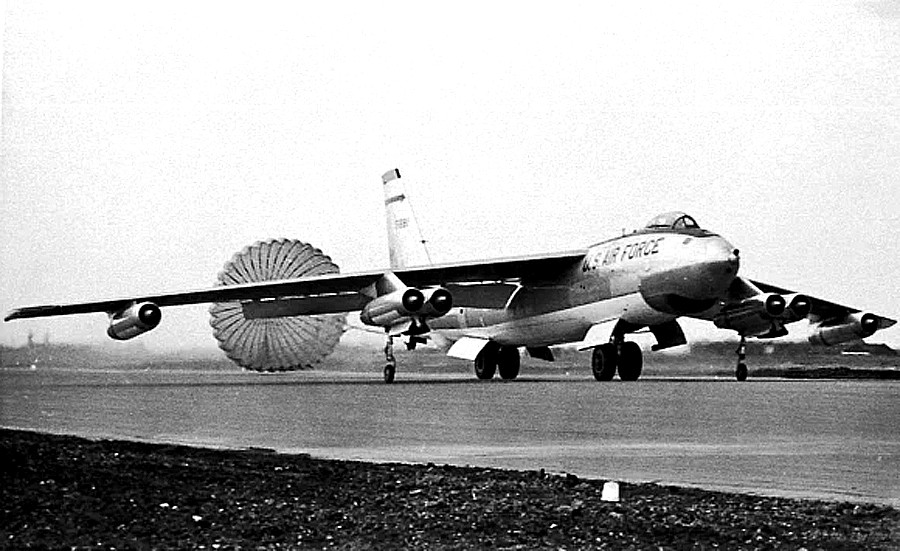
As operators of the airfield, the 3914th ABS would complete any further modifications needed allowing for, in May 1956, the first jet bomber’s arrival. Boeing B-47E-65-LM Stratojet, 53-1881 was flown in by the base Commander Colonel Maynard E. White. On arrival, he was greeted by his deputy commander along with local civic leaders and American families who were now living on the new base. This moment marked the beginning of a new era in Chelveston’s history.*19

Believed to be the first B-47 Stratojet 53-1881 landing at Chelveston. (Public domain via Chelveston-cum-Caldecott Parish Council).

For a the next three years or so, Chelveston would house a small number of B-47s, all nuclear capable. But continual economic changes in the US defence network, meant that many were now placed on ninety day rotations instead of permanent postings.

The airfield became part of a chain of bases housing large bombers of the Strategic Air Command as part of a ‘Reflex Alert’ force. Kept armed and ready, they remained manned on a permanent 15 minute alert basis ready to respond to any Soviet threat that may have come.

With these rotas changing approximately every three months, families were moved about from base to base, a process that carried on for almost eighteen months until mid 1959.

A further change in the global political and strategic field in the last few months of this period, saw a change in aircraft too. The bomber era was now drawing to a close, and at Chelveston, this led to the arrival of the 301st Reconnaissance Wing (RW) equipped with RB-47s – a reconnaissance version of the B-47.

By now, intermediate-range ballistic missiles (IRBM) were being increasingly used more, and several UK bases now had them deployed as an alternative to the heavy bombers.  With ranges of up to 5,500km, they were the catalyst for an arms race, one that would see newer and more powerful weapons propel the world toward the edge of destruction.

As the story of Chelveston draws to a close IRBMs take centre stage, reshaping the balance of power and casting a long shadow over airfield. As these new weapons promise unprecedented reach and destructive potential, the once-bustling bomber base faces an uncertain future. What would become of Chelveston in this rapidly changing landscape – an abandoned relic, secret stronghold, or something else entirely? The final chapter will reveal a story few could have predicted.

The whole story of Chelveston can be read in Trail 66. Northants and Bedfordshire (Part 2)

Trail 66 – RAF Chelveston – Part 7 – 2 Medals of Honour

In Part 6, the 305th Bomb Group faced some of the most intense and costly operations of the war, including record-setting large formations and the brutal Schweinfurt raids, which inflicted heavy losses on the group. Crews endured extreme physical and mental strain, yet displayed remarkable heroism, earning multiple medals and citations while innovating new tactics and night operations. By late 1943 and early 1944, the group began to benefit from improved technology, navigation systems, and experience, setting the stage for record-breaking missions that would push both men and machines to their limits.

The formation was to cross to the continent where it would  split, each branch finding their predetermined targets, bomb and then reform for the long journey home. Although the weather was poor, fighter escorts did get airborne and they managed to stave off many of the attacks aimed at the bomber stream. For one 305th aircraft though, it would be a major struggle and an heroic one.

In B-17 42-38109 – ‘Cabin in the Sky’ – was pilot 1st Lt. William Robert Lawley Jr, flying only his tenth mission since joining the 364th BS, less than a year previously.

First Lieutenant William R. Lawley, Jr., is congratulated by Lieutenant General Carl Spaatz on the award of the Medal of Honour, 8th August 1944. (IWM UPL 55737)

The aircraft, a B-17G-30-DL (WF-P) was departing the target area with its bomb load intact due to a frozen mechanism, when it suffered a full frontal attack by enemy fighters. Suddenly, a canon shell ripped into the cockpit  killing the co-pilot, Paul Murphy, and striking Lawley in the face severely wounding him.

The attack by around twenty enemy fighters, also wounded every other crewman, in addition to setting an engine on fire. The attack caused the B-17 to enter a dive which could well have been uncontrollable had Lawley not fought back the pain and forced the co-pilot’s hands off the controls with one hand, whilst fighting the aircraft with the other. With a hole in the blood soaked windscreen, cold air forced its way in, adding to the cockpit’s terrible conditions and to the extreme pain Lawley was already feeling.

In fear of an explosion, resulting in total destruction of the aircraft and its crew, Lawley gave the order to bale out, but no one did. Some were simply too injured to do so, and those that were able to, did not want to leave their buddies behind to what must have seemed to be an inevitable fate.

Even whilst enduring further attacks, the engine fire was somehow extinguished, only to be replaced by another in a different engine. Then, a glimmer of hope came over the intercom, the bombardier had managed to free the bombs, thus lightening the load. This allowed the badly injured Lawley to perform incredible evasive action.

But by now, Lawley was exhausted, and was suffering from huge blood loss. Acutely aware of the situation, Mason, the bombardier, took over until Lawley was able to regain his strength and take back the B-17’s controls. With two engines out, a new threat appeared – lack of fuel. Another engine suddenly stopped running, leaving just one to keep the heavy bomber aloft. Somehow, the aircraft managed to not only reach England, but pass over its coastline. Feeling somewhat relieved, but acutely aware of the ever present danger, the crew scoured the horizon for a safe place to land. Redhill suddenly came into view, and just in time, as the B-17 was now losing height, and fire was spreading across the wings.

In great pain, Lawley managed to bring the aircraft down to Earth, performing an amazingly controlled crash landing. Nine of the ten onboard survived to return to duty, Paul Murphy being the only casualty. For his determination to get home, Lawley was awarded the Medal of Honour, the US’s highest award for bravery.

This dramatic event was mirrored by a B-17 of the 351st, then based at  RAF Polebrook. Sadly though, this one ended in the loss of the three crewmen left on board, after the aircraft crashed in a field. For his action, Sgt. Archibald Mathies also received the Medal of Honour.

B-17 42-38109 ‘Cabin in the Sky‘, after crash landing at RAF Redhill. (IWM UPL 55733)

This would not be a solitary awarding of the prestigious Medal of Honour, for it would be repeated just two months later, highlighting the bravery shown by many crewmen during those dark days of World War II.

On April 11th 1944, the Germans yet again made a ferocious attack from the front, a tactic they had devised early on in the American’s war in Europe.

In this instance, 1st Lt. Edward S. Michael was piloting B-17G  ‘Bertie Lee’ 42-37931, as part of the 364th BS on operations to bomb various  targets in Germany, including the Focke-Wulf plant at Sorau. Other targets for the 341 B-17s of the 1st BD, included Cottbus, Dobberphel, Stettin and Trechel.

The aircraft, a Douglas-Long Beach B-17G-20-DL Fortress (WF*D), was flying in formation toward Stettin when it became the focus of a determined enemy attack. To the crew, German fighters appeared to single them out, pressing home repeated assaults, despite escorting fighters and heavy defensive fire from the bomber.

The ferocious attack shattered the cockpit, both pilot and co-pilot (2nd Lt. Franklin Westberg) were wounded, instruments failed, oil covered the windscreen and the aircraft fell into a 3,000 foot spin from which survival seemed over. With skill and strength however, 1st Lt. Michael managed to pull the aircraft out of the dive, only to discover that the bomb bay, still full of incendiaries, was on fire – the result of yet another attack. With damage to the release equipment, the crew were unable to jettison  the bombs – the situation was getting worse.
The only way they could survive now was to bale out, and so Michael gave the order. On doing so, he was greeted by the horrendous sight of the top turret gunner, Jewel Philips, holding his eye in his hand and blood gushing from a severe head wound.

Giving initial aid to the gunner, Michael, himself injured, helped him to the door and out of the aircraft, He was one of seven who made it away.

With the co-pilot and injured bombardier, Lt. Leiber,  still on board, Michael decided he was going to try a crash landing.  Working hard to save the ship for as long as they could, the bombardier managed to finally free the burning incendiaries, and by performing dramatic evasive manoeuvres, Michael managed to  shake off pursuing enemy aircraft; eventually reaching the relative safety of cloud cover.

Now being targeted by flak, he decided to get the aircraft down as low as he could, and flying at almost treetop level, he headed towards England. The aircraft continued to respond well considering the extensive damage it had received, and so they flew on for as long and as far as they could. Miraculously, they reached the English coast, but Michael was exhausted from both his continued efforts and a severe thigh wound, The bombardier took over, circling the aircraft in a holding pattern until Michael had the strength to bring the stricken aircraft down. With no hydraulics, the ball turret jammed down, the undercarriage locked up and the bomb bay doors locked open, it was not going to be an easy ride and the odds of survival were stacked heavily against them.

As if the gods were on their side though, Michael retook control and brought ‘Bertie Lee’ down, its metalwork crunching and groaning as it careered along the grass at RAF Waltham near to Grimsby in Lincolnshire.

For his incredible actions and determination to get home, 1st Lt. Michael received the unit’s second, highest level award, the Medal of Honour.

Extensively damaged, ‘Bertie Lee’ after crash landing at RAF Waltham (IWM UPL 40113).

1st. Lt. Michael’s citation*15 read:

For conspicuous gallantry and intrepidity above and beyond the call of duty while serving as pilot of a B-17 aircraft on a heavy-bombardment mission to Germany, 11 April 1944.

The group in which 1st Lt. Michael was flying was attacked by a swarm of fighters. His plane was singled out and the fighters pressed their attacks home recklessly, completely disregarding the Allied fighter escort and their own intensive flak. His plane was riddled from nose to tail with exploding cannon shells and knocked out of formation, with a large number of fighters following it down, blasting it with cannon fire as it descended.

A cannon shell exploded in the cockpit, wounded the co-pilot, wrecked the instruments, and blew out the side window. First Lt. Michael was seriously and painfully wounded in the right thigh. Hydraulic fluid filmed over the windshield making visibility impossible, and smoke filled the cockpit. The controls failed to respond and 3,000 feet were lost before he succeeded in levelling off.

The radio operator informed him that the whole bomb bay was in flames as a result of the explosion of three cannon shells, which had ignited the incendiaries. With a full load of incendiaries in the bomb bay and a considerable gas load in the tanks, the danger of fire enveloping the plane and the tanks exploding seemed imminent. When the emergency release lever failed to function, 1st Lt. Michael at once gave the order to bail out and seven of the crew left the plane.

Seeing the bombardier firing the navigator’s gun at the enemy planes, 1st Lt. Michael ordered him to bail out as the plane was liable to explode any minute. When the bombardier looked for his parachute he found that it had been riddled with 20-mm fragments and was useless. First Lt. Michael, seeing the ruined parachute, realized that if the plane was abandoned the bombardier would perish and decided that the only chance would be a crash landing.

Completely disregarding his own painful and profusely bleeding wounds, but thinking only of the safety of the remaining crewmembers, he gallantly evaded the enemy using violent evasive action despite the battered condition of his plane. After the plane had been under sustained enemy attack for fully 45 minutes, 1st Lt. Michael finally lost the persistent fighters in a cloud bank.

Upon emerging, an accurate barrage of flak caused him to come down to treetop level where flak towers poured a continuous rain of fire on the plane. He continued into France, realizing that at any moment a crash landing might have to be attempted, but trying to get as far as possible to increase the escape possibilities if a safe landing could be achieved.

First Lt. Michael flew the plane until he became exhausted from loss of blood, which had formed on the floor in pools, and he lost consciousness. The co-pilot succeeded in reaching England and sighted an RAF field near the coast. First Lt. Michael finally regained consciousness and insisted upon taking over the controls to land the plane.

The undercarriage was useless; the bomb bay doors were jammed open; the hydraulic system and altimeter were shot out. In addition, there was no airspeed indicator, the ball turret was jammed with the guns pointing downward, and the flaps would not respond. Despite these apparently insurmountable obstacles, he landed the plane without mishap.

Heroic actions like this, were widely mirrored across the beaches, seas and skies of Normandy that June, when vast numbers of ground, naval and air force personnel combined to carryout the greatest invasion ever known. With operations beginning in the early hours of June 6th 1944, Chelveston’s aircraft would again be involved, dropping leaflets to the French people warning them of the impending allied invasion. It would be a day that would go down in history.

Many of those involved in D-day looked forward to the day they would return home, but returning home was never a guarantee of safety. In December whilst on a mission to bomb the railway marshalling yards at Kassel in Germany, B-17 43-38973 received extensive damage with one engine put out of action. As the aircraft made its way home, it began to lose height and to make matters worse, England was shrouded in fog cutting visibility to near zero.

In an attempt to find a landmark, the pilot took the aircraft lower and lower, a risk that ended in tragedy when it struck a Gee mast at Borough Hill in Northamptonshire. All nine on board were killed in the collision.

337 Missions to Victory: The 305th’s Final Campaigns

The winter of 1944–45 descended with a familiar severity. Snow and ice gripped the airfields, while dense fog rolled across much of Europe, grounding aircraft and testing the endurance of even the most seasoned crews. Yet amid the bitter cold came decisive movement on the ground. Following the Allied breakthrough in the Ardennes, advancing forces pressed steadily into Germany itself. The war’s end was now clearly in sight, but its closing chapter would be anything but quiet. The months that followed brought an intense tempo of operations, as bomber formations crossed the Rhine with increasing confidence. With the Luftwaffe offering only sporadic and weakening resistance, B-17s and B-24s were able to penetrate deep into German territory with far less opposition than in previous years. Mission counts climbed rapidly. Many groups reached the formidable milestone of one hundred operations, and several of the original contingents went well beyond it, their longevity a testament to both endurance and experience.

Gradually, as allied forces made their way across Europe,  the heavy bombers of the allied forces pounded German cities. By March, the 305th had completed its 300th operation, having endured a long and demanding campaign since being amongst one of the first groups to deploy to the UK. In celebration, they were once again given the lead position in an attack on Böhlen-Rötha, Leipzig. Thirty-six aircraft set off that day to find near perfect weather over the target and so bombing was considered highly accurate despite heavy and accurate flak. Of the thirty-six, aircraft despatched, two B-17s were lost from the 305th, one of which carried the command crew – led by Lt. Col. Howell G. Crank in 44-8141. The aircraft was hit by flak and one of its engines knocked out. It then turned over and dived into the ground killing ten of those on board with one taken as a prisoner of war.

A month later on April 25th, 1945, shortly before the war’s end, the 305th would make their final bombing flight bringing Chelveston’s war in Europe to an end. The 305th had achieved an eye-watering 337 combat missions (480 including other types), dropping over 22,000 tons of bombs and over 70 tons of propaganda leaflets. During their time in Britain they had lost in the region of 154 aircraft, received two Distinguished Unit Citations and two airmen had both been awarded a Medal of Honour. In just three short months, on July 25th, they would leave England, heading for a new base at  St. Trond, Belgium (Army Airfield A-92). Their final departure leaving no operational front line units at Chelveston and little prospect of any arriving in the future.

After the defeat of Japan and the formal declaration of world peace in September 1945, the group was posted to Germany where the four squadrons were dispersed to various airfields, prior to their deactivation in the following December. The reason for the move was – and included the 306th from Thurleigh – to photograph two million square miles of land, ranging from Iceland in the north, through Europe to the Soviet frontier in the east, and on to north and west Africa in the south. By splitting the groups, it meant that flying time was reduced and coverage increased.*16

Following that, the 305th Bombardment Group returned to the United States. Crews were demobilised and dispersed, and the aircraft that had endured the rigours of combat over Europe were largely scrapped. The group would then briefly re-emerge in 1947 and again in 1951, each time for only a short period. After another short reprieve in 1994, it was reborn as the 305th Air Mobility Wing, a title under which it continues to operate today. The wartime service of the 305th at RAF Chelveston remains a key part of this lineage; the group’s achievements with the Eighth Air Force between 1942 and 1945 established the reputation of what became known as the “Can-Do Wing.” Chelveston is still recorded in U.S. Air Force historical archives as one of the stations from which the unit first earned its combat distinction, and with it, the legacy of the 305th  continues on.

As peace settled over Europe, Britain faced a daunting challenge: what to do with nearly 700 surplus wartime airfields, many hastily built and suddenly redundant. While some were dismantled or repurposed for civilian use, others – including Chelveston – were quietly retained, waiting for a world that was rapidly becoming uncertain once more. By the early 1950s, the rise of the Cold War, nuclear weapons, and jet bombers would transform these dormant relics into strategic strongholds, setting the stage for a dramatic new chapter in both British and American air power.

The whole story of Chelveston can be read in Trail 66. Northants and Bedfordshire (Part 2)