In Part 5, the 305th endured some of the harshest early missions of 1943, suffering heavy losses over the U-boat pens and German targets while crews faced flak, fighters, and extreme winter conditions. Individual acts of courage and ingenuity, from surviving ditchings to improving bomber defences, highlighted both the bravery and inexperience of the fledgling unit. By April, Chelveston was officially transferred to full American control, and the 305th began taking the lead in major operations, earning their first Distinguished Unit Citation for precision bombing and determined action under fire.
April–May 1943: Record Flights, Heroism, and Morale Boosts
Being so new to the war, and with only the four B-17 groups still forming the bulk of the air force, operational records were regularly set and broken. The month of April saw another such record set, with the largest formation of US aircraft taking part. The flight, consisting of 115 B-17s from the four Groups, flew in a new configuration. The 305th formed the rear box, in a new arrangement that only permitted 3,000 ft separation between the low and high boxes.
The four groups from Thurleigh, Bassingbourn, Molesworth and Chelveston had led the way for the 8th Air Force, and by April they were all becoming very tired and fatigued, and in desperate need of replacements. Although short in coming, replacements and new squadrons were eventually to arrive, helping to bolster both the strength and size of the still small but determined Air Force.
This newly reinforced air force was employed for the first time on 13th May 1943, and again on the 14th and 15th. On this last mission, the 305th were again on the receiving end of the Luftwaffe’s fury, as they hit hard head-on to the formation. In one of these B-17s, every member of the crew, except the tail and right-waist gunner, suffered severe injuries. Such was the crew’s determination in getting back to Chelveston though, that two DSCs, eight Silver Stars and seven Purple Hearts were awarded to them that day. Those on-board ‘Old Bill’ being the most decorated crew of the 305th by the war’s end.
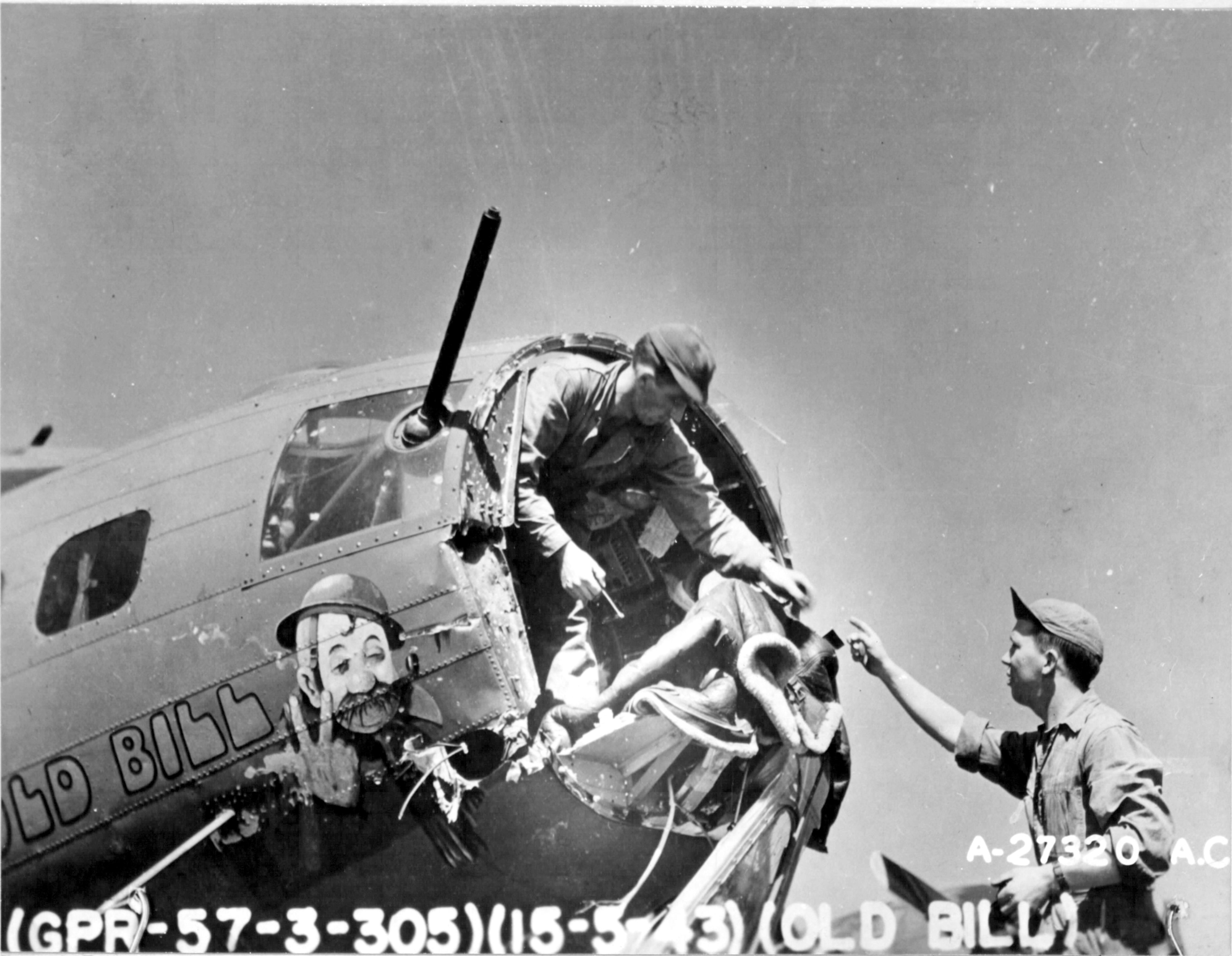
B-17 42-29673 ‘Old Bill’ 422nd BS, damaged on Wangerooge 15th May 1943. Featured ground crew: Cpl Willis Todd (inside) and Cpl Zimmerman (outside), (IWM UPL 30085).
The morale of airmen, who faced death on an almost daily basis, was always a problem. To keep spirits up, various visits were arranged, some of which included top entertainers from ‘back home,’ who toured the various airfields and bases in Britain. On July 5th 1943, Frances Langford, Bob Hope and Tony Romano all arrived at Chelveston. Posing for photo shoots, meeting the crews and performing for the personnel were just one way of keeping spirits high.
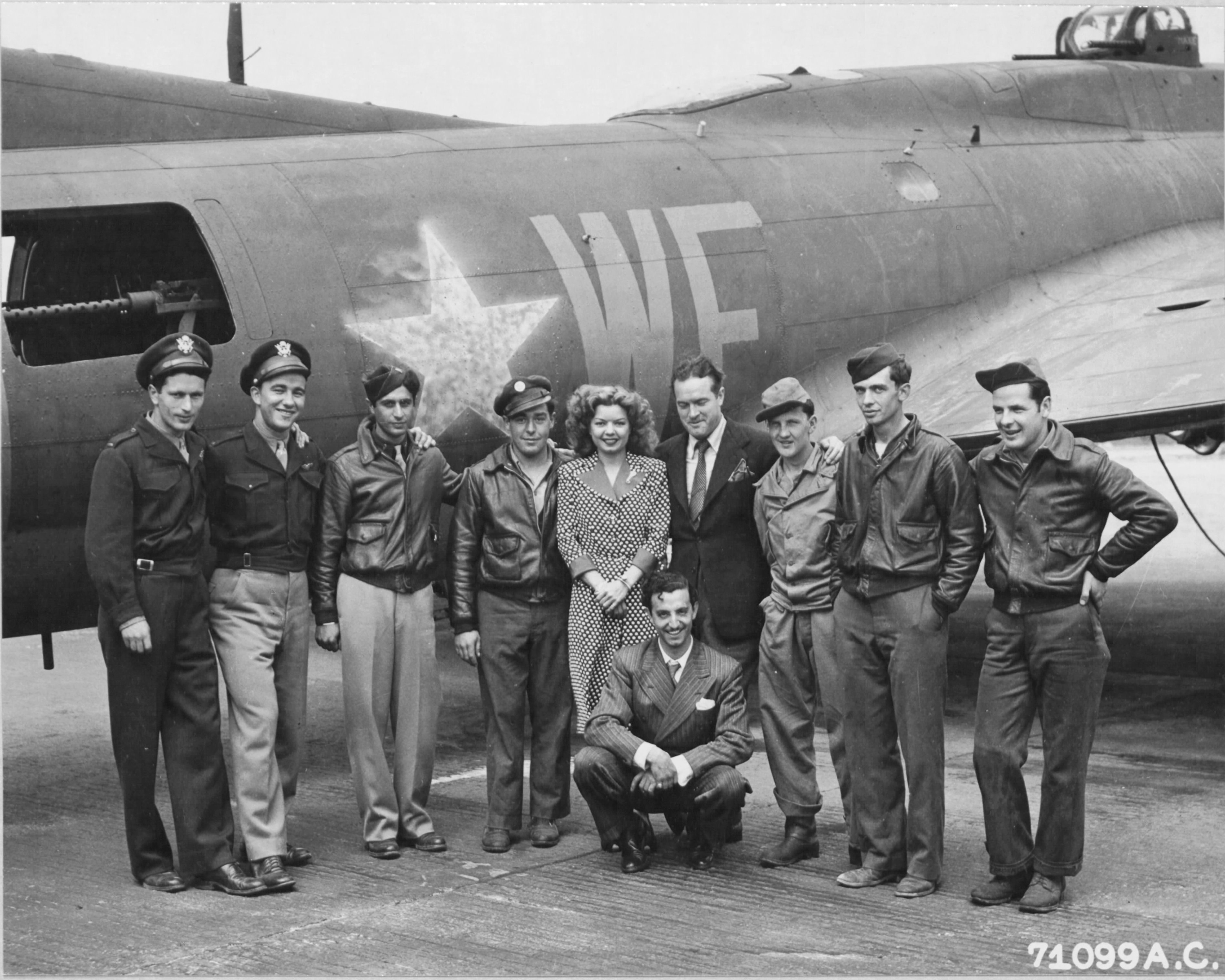
“Frances Langford, Bob Hope and Tony Romano pose with the crew of the Boeing B-17 ‘Lallah VIII‘ (A/C 242) 5th July 1943. L to R: (P) Lt. Sam Johnstone, (CP) Lt. Elsworth Kenyon, (N) Lt. Martin Licursi, (B/T) Sgt. Arthur Englehardt, Frances Langford, Tony Romano, Bob Hope, (E) Sgt. Donald Baer, (WG) Sgt Richard Lewis, (TG) Sgt. Homer Bagby.(IWM UPL 35399).
August 1943: Schweinfurt, Night Raids, and the Toll of War
But amid these rare glimpses of happiness and momentary reprieves from fear, the war would endure, and the ever-present face of death would soon turn toward them once more.
Whilst Berlin became a name to dread, one other target drove an even sharper stake into the hearts of US airmen, that of Schweinfurt.
Schweinfurt, was a major centre for ball-bearing production. Located north-west of Nuremberg, it was one of Germany’s most prolific suppliers of this vital component. Although it did not produce all of the ball-bearings required by the German war economy, allied strategists believed that by destroying the Schweinfurt plants, they would severely disrupt supplies. By doing so, they would undermine Germany’s ability to sustain the war and bring it to a rapid conclusion.
The first attack, on 1st August 1943, saw the 1st Bombardment Wing (BW) send out 230 bombers in two waves; one of 116 aircraft and the second 114. Of these, thirty-six were lost in the battle; the 382nd and the lead Group the 91st BG, taking the brunt of the attack. The 305th from Chelveston lost ‘only’ two, but a further fourteen were classed as damaged but fortunately repairable. The initial figures for the overall losses would soon grow though as the full extent of the damage became apparent. The final count neared sixty-three aircraft that were deemed irreparable and lost. The total loss of aircraft from the operation, rose to in excess of 90, an unsustainable loss for any raid and one that brought home the severity of what the American airmen were facing.
Despite these losses, the raid was considered a success. In Schweinfurt itself, as the last B-17 left the target, a cloud of smoke and fire could be seen, its ferocity engulfing the town. What had been a two hundred year old conurbation of peace and serenity burned ferociously after receiving in excess of 400 tons of bombs – a mix of high explosives, incendiaries and general purpose types. The tranquil, but productive coastal town was in ruins – but the cost in American airman had been high. *11,*12
That same day, the 4th BW sent another 146 of their heavy bombers to Regensburg. Like the Schweinfurt mission, it suffered heavy casualties, with the loss of twenty-four aircraft. All-in-all, August 1st had been a terrible day for the Americans, and despite delivering a devastating blow, the war was clearly far from over.
During September and into October 1943, the 422nd Bomb Squadron of the 305th Bomb Group was withdrawn from daylight flights and retrained for night bombing operations, becoming the first US Army Air Force unit to undertake such activities. During this period, the squadron flew eight night sorties, dropping approximately sixty-eight tons of bombs, along with the unit’s first ‘Nickel’ mission on the night of 7th/8th October 1943.
‘Nickel’ operations were carried out in cooperation with the RAF, and involved the dropping of propaganda leaflets over occupied Europe. In total, the squadron dispersed around seventy-three tons of leaflets, many of these being thrown out by hand, a slow and exhausting process. To speed things up, crews soon began to push entire boxes from the aircraft in the hope they would burst open in mid-air. A relatively unsuccessful method, it was eventually replaced by an ingenious purpose-built ‘leaflet bomb’. This aerial device was designed to open at a set altitude – often around 1,500 feet – scattering more than 80,000 leaflets in a single drop.
During these operations the squadron worked alongside Radio Counter Measure units as well as the ‘Carpetbaggers’ who were based at RAF Harrington. A common feature of these clandestine organisations was their use of black-painted, often war-weary B-24 Liberators, each one especially adapted for night operations and special duties.*13
Return to Schweinfurt: Catastrophe in the Autumn Skies
The disaster of Schweinfurt would never be far away though. In October, the city would raise its head once more, and once again losses for the Eighth would be high.
The morning of the 14th was cold and foggy, and many hoped that the day’s mission would be cancelled. Unfortunately, no such call came, and as crews sat in their briefing rooms, a hush fell as the curtain was drawn all the way back to reveal Schweinfurt. Gasps and groans filled the various briefing rooms as the details of the operation were read out.
At take off, the 305th were late, by about six minutes, meaning that they had to catch up with the formation who were gradually pulling away from them. As a result, they were out of their place as they left the English coast, and desperate to catchup for the protection that the formation gave. After flying around trying to locate their place, the lead pilot Major Charles Normand, decided to slot in to the 1st Combat Wing’s low position, replacing the also late 381st.
Shortly after 13:00 hrs, the fighter escort withdrew, leaving the bombers to fend for themselves and allowing the waiting Luftwaffe to make their move. Single and twin-engined fighters now attacked the formation from every direction. Stukas, dropped timed bombs from above, and from around the sides rockets, canons and machine guns were emptied into the formation. The 305th in the vulnerable low position, took the initial brunt. Gunners were frantic in their attempts to defend themselves, using up ammunition at an incredible rate.
As the formation approached Duren, a number of B-17s began to smoke and fall back. Single-engined fighters attacked head on, diving away at the last minute whilst twin-engined aircraft fired rockets from the rear. One of the 305th’s B-17s was hit by one of these rockets, its wing folding and the fuselage opening up revealing badly injured crewmen inside. With no parachutes they simply fell from the sky. The Pilot fought to keep what little of the B-17 was left together, a fruitless task that ended in an dramatic and final fireball.
Further attacks continued to focus on those aircraft of the 305th, the 92nd and Kimbolton’s 379th. Aircraft after aircraft began smoking, slowly falling out of formation with cut engines or damaged control surfaces. No longer able to keep up, they became sitting ducks.
Over the target, Luftwaffe fighters were joined by flak. A barrage of accurate and intense 88mm bursts welcomed the bombers whose numbers were by now depleted.
Still in the low squadron position, the 305th’s Major Normand now led only three aircraft, twelve of the original fifteen sent out had gone – shot down by enemy fighters. Determined to do their job, they declined a move to a safer position and made their own bomb run into the target.
The mayhem wreaked havoc on the formation. By the time they reached the target the 305th were further out of position, and the lead bombardier requested a second try. Knowing how dangerous that would be and how it would put them in a lonely situation, Normand refused and told Lt. Pellegrini to ‘do his best’. As they left the city, another B-17 from Chelveston went down, and after 100 minutes of continuous attack, the 305th were down to just two aircraft.
On return to England, many aircraft became lost in thick cloud and were abandoned, left to fall out of the sky as crews parachuted out. Those that did find land tried to locate any airfield they could and get down whilst they still had fuel in their tanks. It had been a costly operation. 600 airmen were lost that day, 130 of them from Chelveston. The Mighty Eighth had taken another beating and it would almost end their aerial warfare campaign. The only saving grace being that one of the crews who went down, had manged to get to Switzerland where they were interned.*14
The losses suffered by the 305th that day were the highest of all groups who took part. It had been a devastating blow leaving Chelveston depleted of many young airmen who were by now experienced and battle hardened veterans – many still in their twenties. As a consolation for the group, when allied troops overran the city in April 1945, the captured Nazi flag that proudly flew for so long over the city, was handed to the 305th as a souvenir.
As for Schweinfurt, 500 tons of bombs had dealt another devastating blow to the historic town. Flak batteries had decimated the American formation, and fighters had given their all, but still the American’s determination got them through. Schweinfurt would go down in history. It would forever be remembered on American bases as the battle that took so many lives and the one that nearly killed off the Eighth Air Force.
The terrible losses that day would never be repeated by the Chelveston crews. As they approached the year’s end, they hoped for better and they got it. Unbeknown to them at the time, December 20th 1943, would be the start of a record fifty-six missions without loss for the 365th BS of the Chelveston group. – a run that took them almost to D-Day, 6th June 1944.
Against All Odds: Two Medals of Honour in the Winter of 1944
The early months of 1944, saw the first use of ‘Gee’ by American Pathfinders. A pioneering system that used radio navigation to significantly improve bombing accuracy by timing the gap between two radio signals from ground stations. Hardwick’s 329th, who were part of the 93rd BG, had been trialling the new system since 1942, and it was finally deemed ready for operations. In these early stages, missions focussed on ‘No ball’ targets – V1 launch sites – where Gee could be tested to the limit. Such was the desire to perfect the system that almost half of the 29 missions carried out in January and February, used it.
January would also see another major award for the Chelveston Group. On the 11th following a raid on the aircraft factory at Halberstadt, the 1st Bomb Division, (formerly 1st Bomb Wing), were awarded the Distinguished Unit Citation; for the 305th, it was their second of two such awards.
A month later, on 20th February 1944, a combined force of over one thousand American aircraft of the 1st, 2nd and 3rd Bomb Divisions (BD) took part in operations. The 305th, as part of the 1st BD, were ordered to hit targets at Leipzig, Heiterblick, Abtnaundorf, Bernburg, Oschersleben. Failing that, they were to hit any target that presented itself as an opportunity.
The sky over Europe had become a crucible, where bravery, skill, and sheer willpower were tested to their absolute limits. For the crews of the 305th, every mission brought them face-to-face with death, yet time and again they defied the odds, fighting through blazing cockpits, flaming engines, and relentless enemy attacks. As they pushed ever deeper into the heart of Nazi territory, every flight carried the weight of a nation – and the question hung in the air: who would make it home, and who would not?
The whole story of Chelveston can be read in Trail 66. Northants and Bedfordshire (Part 2)


I was not aware any American bomber groups performed night missions. It sounds like night missions did not last long, though. Was the 305th the only group to fly these for the 8th USAAF?
LikeLiked by 1 person
I believe they were the only ones Cindy. It was very short lived, more a trial to see of it could be done, rather than any major step forward toward a night bombing campaign. Tight formations at night were even more hazardous than in daylight although, the actual reason they stopped was more to do with the American’s desire for precision bombing, as opposed to the British saturation or carpet bombing – Something that could not be achieved at night.
LikeLiked by 1 person