RAF Watton – The origins of ECM (Part 2)

In part 1 we saw how Watton had been built as a pre-war expansion period airfield and how the Blenheims that were stationed here were decimated in the face of a superior enemy. Eventually begin withdrawn, they were simply outclassed.

Eventually, the airfield like so many in this area, was handed over to the Americans. It was re-designated and would take on a different role. Watton would now grow and develop.

The USAAF renamed the airfield Station 376, they redeveloped the accommodation blocks, added more hardstands and laid a steel mat runway. The original hangars were added to so that there were now not only the original ‘C’ types, but also the more modern ‘B1’ and ‘T2’ types, along with three smaller blisters hangars. In 1944, the steel matting was removed and a concrete runway built in its place. The airfield’s history would now become a little more complex as it officially became two sites utilising the same single runway.

The main airfield itself would house aircraft of the 802nd Reconnaissance Group (Provisional), who were later renamed the 25th Bomb Group (Reconnaissance). Whilst on the southern edge of the site, a new complex was built for the repair and refurbishment depot the 3rd Strategic Air Depot (SAD). This complex grew so large that it became a site in its own right, gaining the designation Neaton (Station 505). The name has been somewhat confusing however, as the site was actually closer to the village of Griston that it was to Neaton.
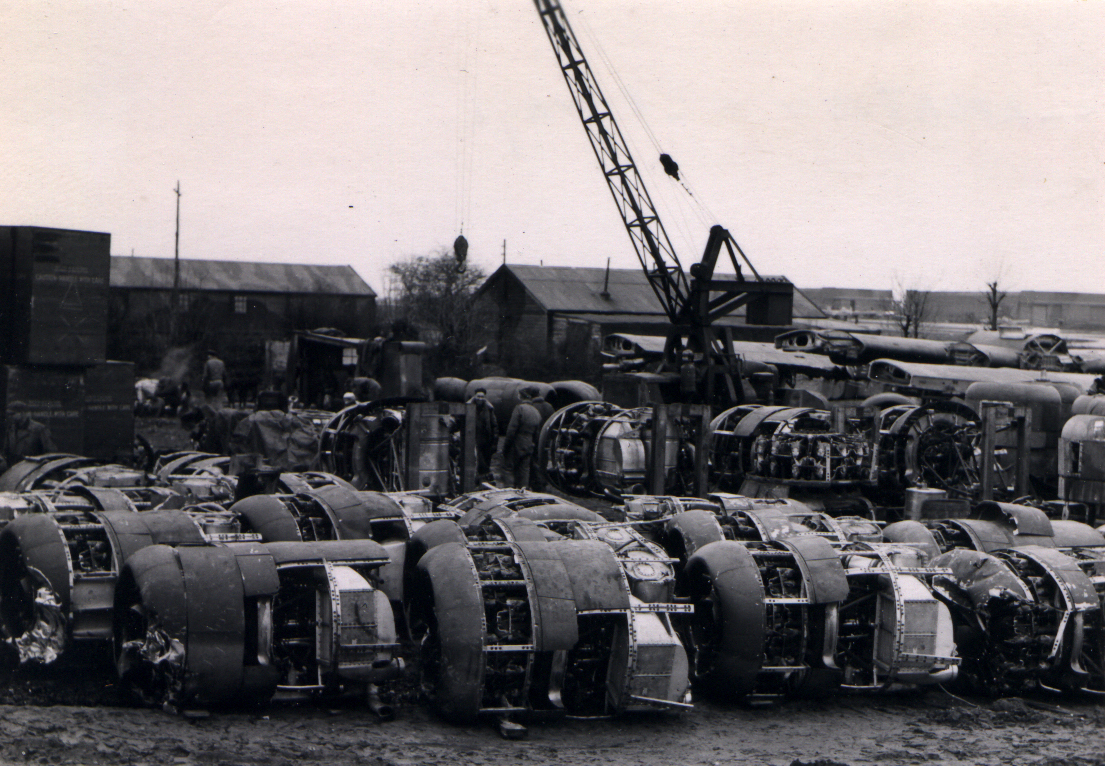
A collection of B-24 engines removed from their mounts. (IWM UPL 5385)

The role of the 3rd SAD was to maintain and repair the battle damaged B-24s of the 2nd Air Division, that had by now, flooded into the UK from the United States. This unenviable task required the recovery of the heavy bombers, washing them out and  perhaps removing the remains of airmen before returning them to flyable condition once more. Whilst not designed to be so, the acronym SAD certainly reflected the role perfectly.

Neaton consisted of a number of sites, 4 accommodation sites, a communal site, a sick quarters, two motor sites, a ‘miscellaneous’ site housing a Steam Jenny and then a 9AD site with tool sheds and other maintenance related buildings. The majority of these accommodation sites incorporated either the more common Laing or Nissen huts.

Watton itself would now become synonymous with reconnaissance, surveillance and electronic countermeasures (ECM). A new unit, 25th Bomb Group (Reconnaissance), it was constituted on 17th July 1944, and activated in England on 9th August that year. They would only serve from one UK airfield, that of Watton, where they would stay until VE day serving under the umbrella of the 8th Air Force. A visit by the famous ‘Carpetbaggers‘ (the special operations group designed to support French resistance operations) also saw the black Liberator’s fly regular missions from here during this time.
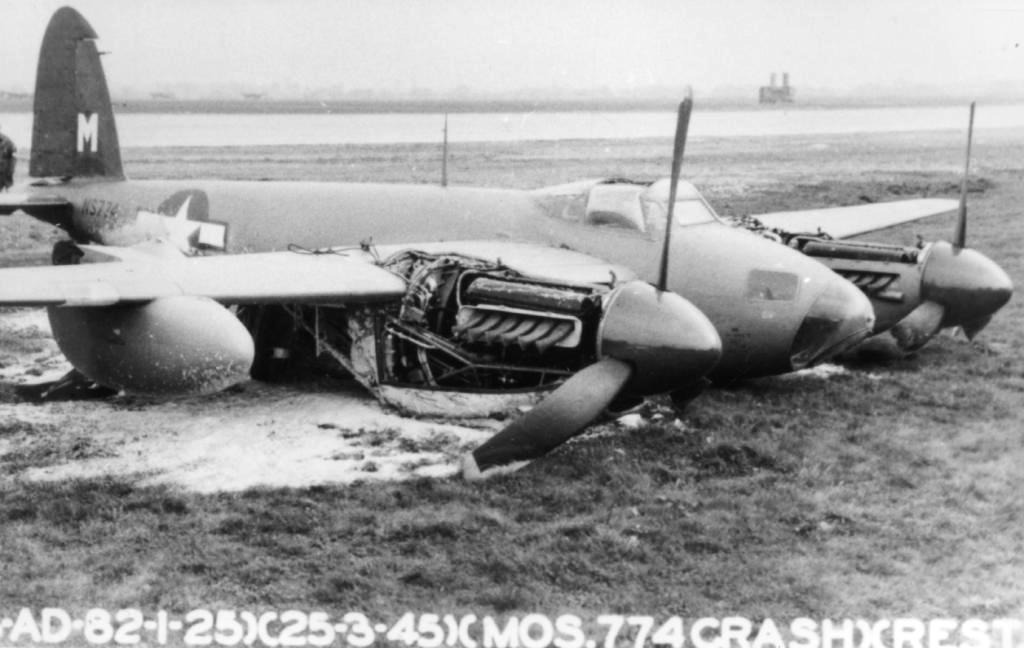
The end of Mosquito PR Mk XVI “M” NS774 of the 25th BG after crashing at RAF Watton (Station 376) 25th March 1943. (IWM UPL 6964)

The role of the Watton Group was to carryout reconnaissance missions over the seas around Britain and the Azores, gathering meteorological data. Combined with flights over the continent, the information they would gather, would help in the preparation of bombing missions. They would also carryout aerial mapping and photo reconnaissance missions, identifying German troop movements both at night and during the day.  Many of these operations involved major battles, including northern France, the Rhineland and the Ardennes. Additional tasks included electronic countermeasures using ‘chaff’, and flying ahead of large formations to ascertain last minute weather reports. A varied and dangerous collections of roles, they used a number of aircraft types including: B-17s, B-24s, B-25s, B-26s and P-38 Lightnings.

When VE day did finally arrive, the American unit departed returning to Drew Field in Florida. The August of that year must have been quite surreal, as the Americans left, flying was reduced and Watton was returned back to RAF ownership.

With the war now over, flying units began to return to the UK, many being disbanded not long after. One such unit was 527 Sqn who arrived here in the November, only to be disbanded in the April of 1946.

The next four years saw no other front line ‘operational’ flying units here at Watton, but the 1950s would bring a number of units back through its gates. With the introduction of the jet engine at the end of the war, piston engines fighters were soon being replaced by newer designs.

RAF Watton

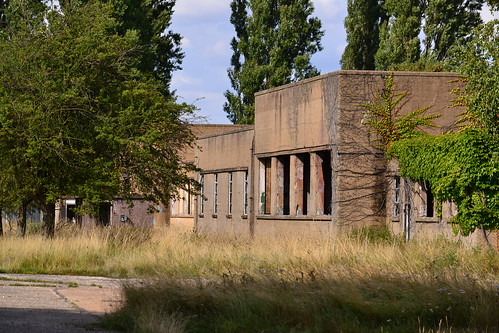
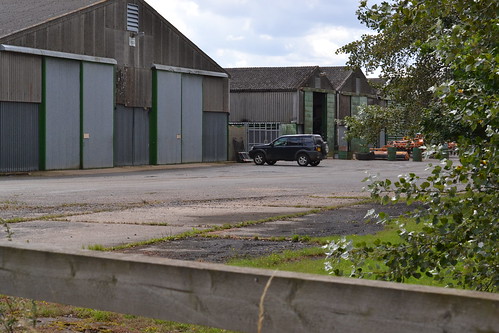
One of Watton’s many accommodation blocks in modern use.

The ECM activity initiated at Watton by the 25th Bomb Group, would continue on in these early post-war years. For some twenty years or so in fact, through a variety of aircraft including: the Mosquito, Wellington, Domine, Lincoln, Anson, Proctor, Canberra, Meteor, Sea Fury, Firefly, Venom and many others. Each of these would not only play a vital part in the development and use of ECM, but radio research and training as well. Warfare had taken on a very new twist.

This move would see Watton becoming a hub for ECM activity. A number of RAF and Naval squadrons would operate from here undertaking such tasks. At the end of the war, Watton had become home to the Radio Warfare Establishment (RWE), renamed in 1946 to  the Central Signals Establishment (CSE). It was only one of five such units operating jointly between the military and National Air Traffic Services Organisation (NATS).  The Navy and RAF would jointly use Watton at this time, albeit for only a short period of time between March and September 1947, when the Naval Air Warfare Radio Unit moved in under the disguise of 751 NAS.

The role of the CSE was very complex, for too complex to discuss here, but with a number of squadrons operating under different roles whilst at Watton, it would culminate in 1948 in the forming of three un-numbered units: a Signals Research Squadron, a Monitoring Squadron and a Radio Countermeasures (RCM) Squadron. In essence, their role was to monitor and jam Soviet electronic communications and defence systems – it was an total airborne electronic warfare operation.*1

But the use of un-numbered squadrons was short lived, by the end of the decade the CSE had reverted to using numbered squadrons once more, their role to probe the air defences along the Soviet borders. British aircraft combined with ground stations, would monitor the reaction and activity of Soviet communications, seeing how they responded to intrusions into their airspace. By knowing this detail,  countermeasures could be put in place to jam or scramble these communications, ideally rendering them useless or at least temporarily incapacitated. The first of these numbered squadrons were 192 and 199, who were originally  the calibration and training units of the CSE.

Reformed here in July 1951 flying Mosquitoes, Lincoln B.2s and then the enormous Washington (B-29), 192 Sqn would not receive their first jet until January 1953 when the Canberra B.2 arrived. 192 Sqn would also fly the Varsity and the Comet C.2 before being disbanded and renumbered as 51 Sqn in August 1958.

199 Squadron (reformed on the same day) flew both the Lincoln B.2 and the Mosquito NF.36, in the same role as 192; their stay lasting until April 1952, at which point they moved to Hemswell in Lincolnshire where they picked up their first jet engined aircraft.

The August of 1952 saw a number of other units reform, disband or pass through Watton. 116 Sqn were reformed on the 1st, another ex Calibration flight of the CSE, it stayed until August 1958 when it was disbanded and reformed as 115 Sqn. A battle hardened squadron from Bomber Command, they had since themselves been disbanded. No longer flying operational bombers, the Varsitys 115 Sqn would operate would be the new form of transport, as they were reformed and moved on within days of their inception in that August.

On that same day in late August 1958, 245 Sqn would reform, also from the renumbering of another squadron – 527 Sqn. Flying Canberras they too were gone within days of their reformation.

As 1959 began to close and 1960 dawned, Watton would become the home of a new unit, 263 Sqn, who were operating Bloodhound missiles, the RAF’s ground to air missile used to defend Britain’s airfield against attacking aircraft. The operational use of these giant weapons lasted here until June 1963.

The 1960s saw the last of the flyers, lasting only between January 1962 and May 1963, 151 Sqn operated from here as the Signals Development Squadron, bringing back the props of the Hastings, Lincoln and Varsity before being renumbered again and subsequently disbanded.

Other units at Watton included 97 Sqn from 1963 – 1967; 98 Sqn (1/10/63 – 17/4/69), 360 Sqn (1/10/63 – 17/4/69) and 361 Sqn (2/1/67 – 14/7/67) two of which were both reformed and disbanded at Watton.

As can be expected, there were a large number of subsidiary and support units based at Watton, many of these attached to the Radio Warfare Establishment, along with SAM Training units, a range of flight units and other various regiments.
RAF Watton

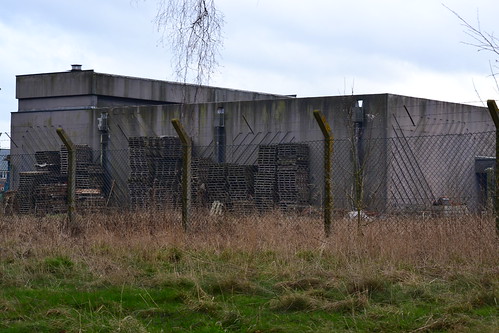
Part of the disused Eastern Radar complex.

By the 1970s all flying had ceased leaving Eastern, and latterly Border Radar, the only ‘operational’ activity on the site. Eventually of course, even these were moved in the early 1990s, signalling the demise of the airfield as an active base. Watton was then handed over to the British Army.

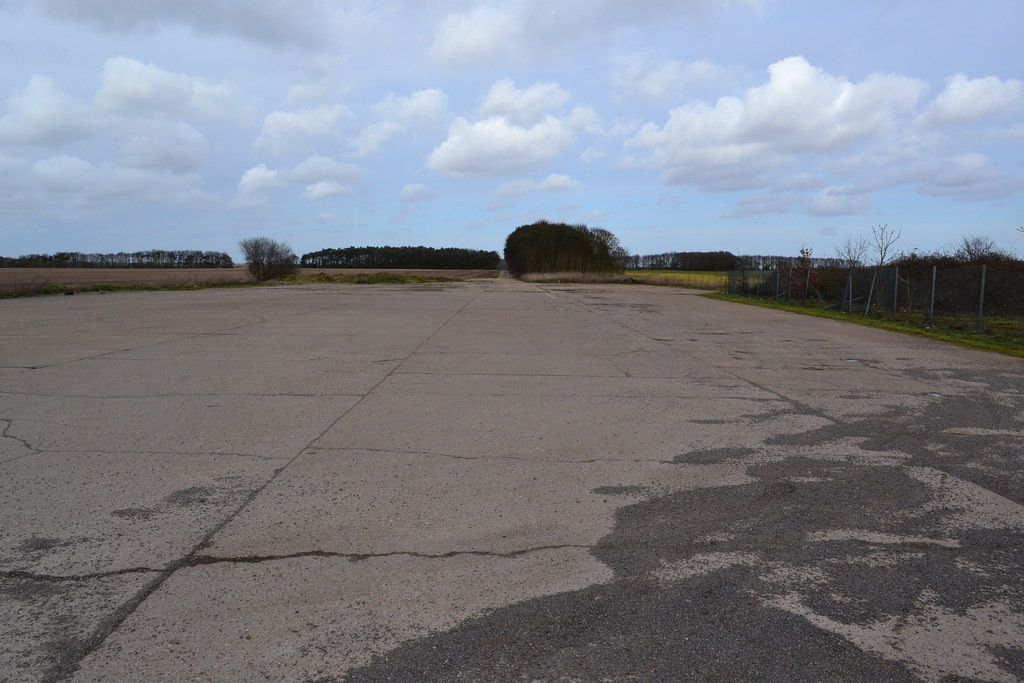
A few years later the Army also reduced it use of Watton and the accommodation areas were sold off for private housing; a move that helped retain that airfield ‘feel’ that it still maintains today. More of the site was then sold later and new housing estates were built on the land where this previously stood; the entire feel of this has now since gone, replaced instead by a rabbit warren of roads with boxes for houses. The last remaining parts of the main airfield were sold off in 2012, the runway and peri-track being retained by the farmer and used for agricultural purposes.

Neaton too was sold off and has now been replaced by HMP Wayland, a prison holding category ‘C’ prisoners at her majesty’s pleasure.  One gruesome part of history being replaced by another.

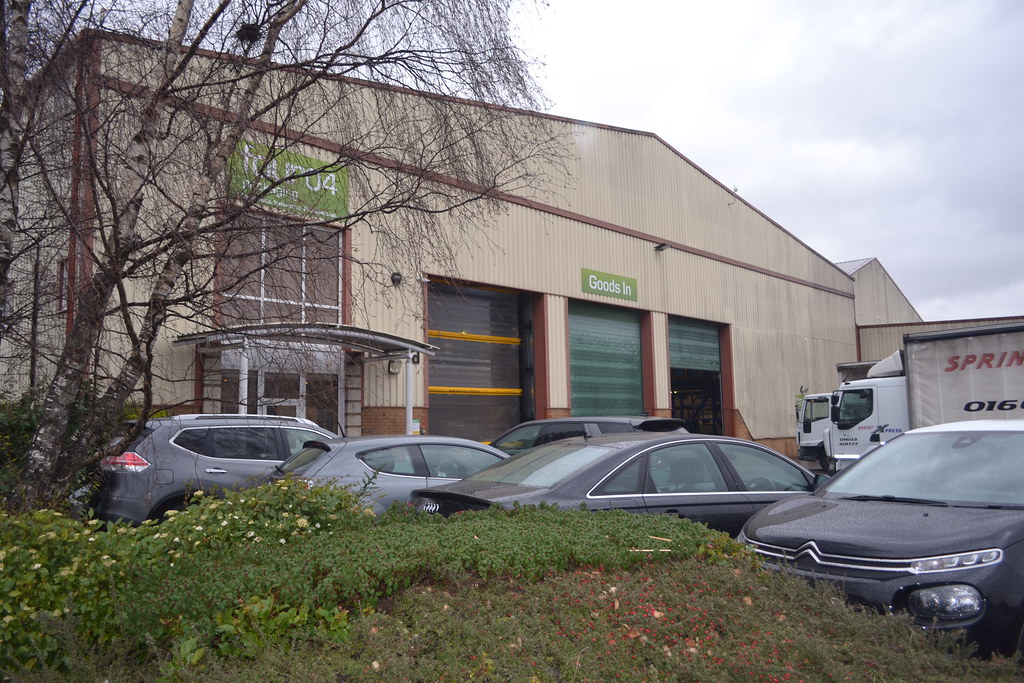
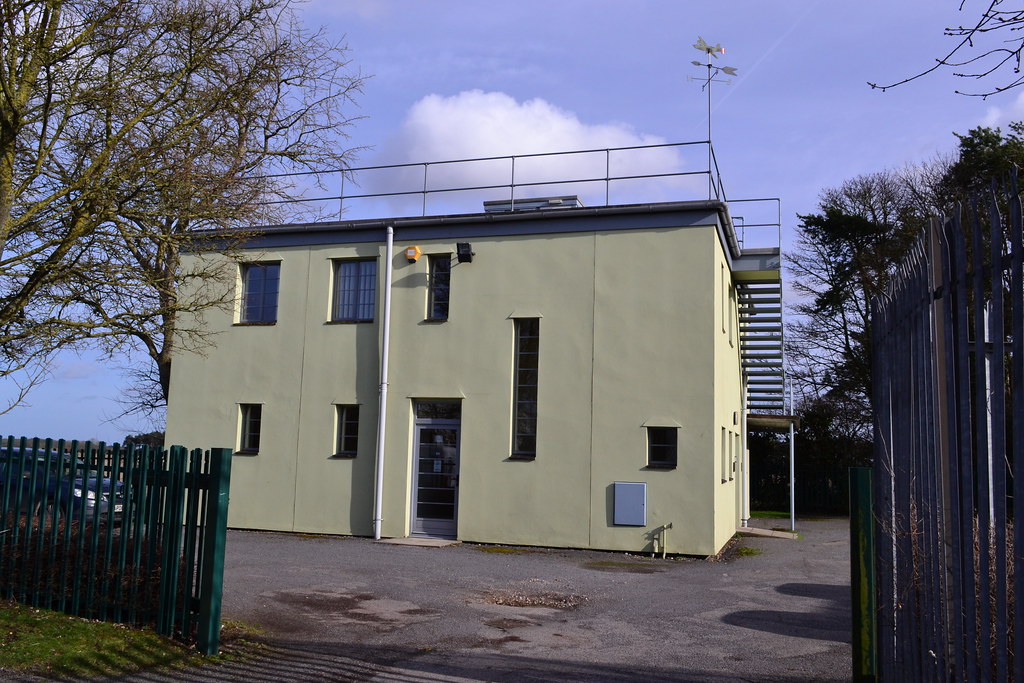
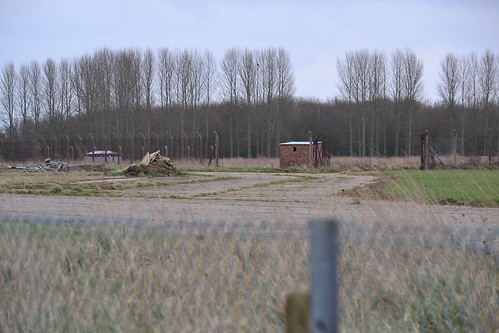
Today, the perimeter tracks, runways and hard standings support nothing more than housing. A proportion of the perimeter track remains with a small wire fence being the only defence to the continued onslaught of development. The original 4 “C” type hangars were all demolished as were the two control towers, one of which was built to support the new jet-era. Some minor buildings continue to remain surrounded by the original RAF housing, but these are few and far between, and even their future is uncertain.

Almost as lip service, many roads are named after an aircraft, Liberator, Marauder, etc., those aircraft synonymous with the operations of Watton and Neaton. Various concrete remains poke through the undergrowth and make this part of the site rather untidy. How long is it before they too disappear?

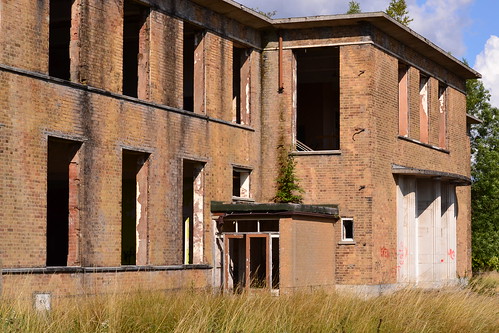
The site is split by the main road with some of the former administration buildings remaining on one side with the airfield and accommodation on the other. Some of these buildings are still in use with civilian operators and as such, have been well-preserved; others such as the technical site, have not been so fortunate and have become very rundown and in high states of disrepair.
RAF Watton

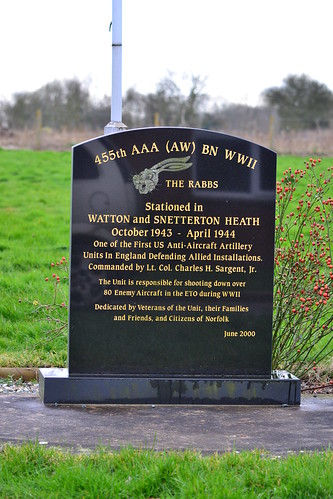
Memorial to the 455th AAA ‘The Rabbs’ located on the airfield site.

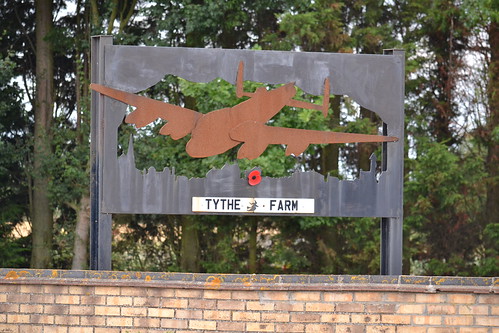
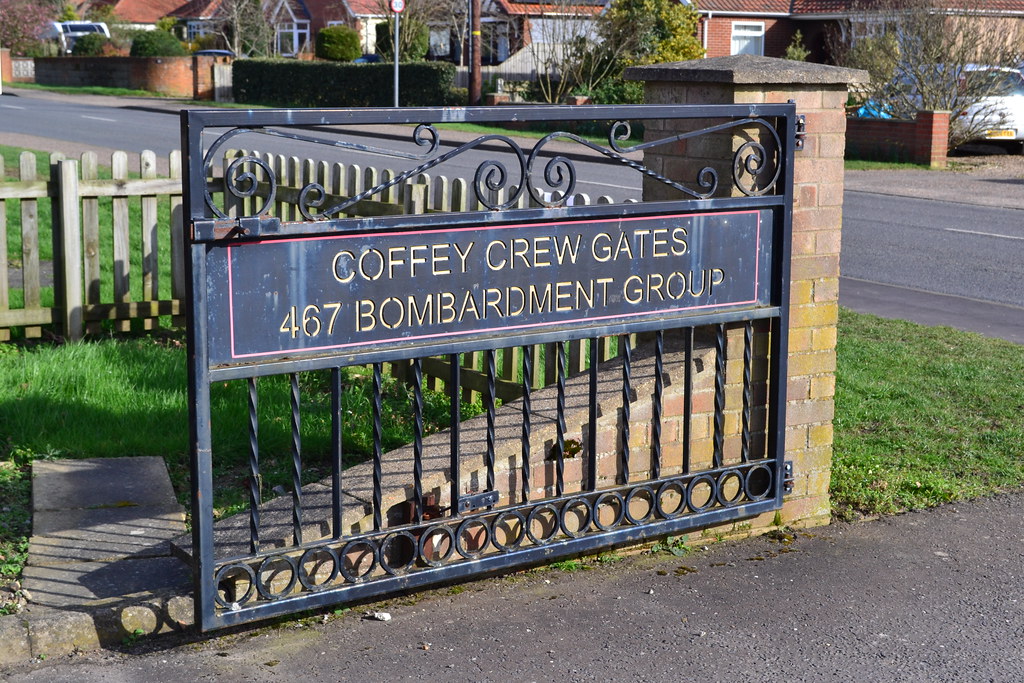
As for the airfield itself, two small memorials ‘guard’ the entrance to the new development. On the one side is the bent propeller recovered from a crashed Blenheim (R3800) shot down in the loss of eleven aircraft over Aalborg on 13th August 1940; on the other side a memorial that commemorates the 25th Bomb group USAAF. On the original housing site itself, a further memorial commemorates the 455th AAA ‘The Rabbs‘ who were given the task of defending Britain’s airfields against the Luftwaffe.  Owned by Stanford Training Area (STANTA) for a period of time and used for air mobile training, the odd Hercules or Army helicopter might have been seen here. However, this has now ceased and housing is creeping ever closer. I’m sure it won’t be long before many of these remaining remnants are lost to the developer’s digger.

Sources and Further Reading.

*1 Flintham, V., “High Stakes: Britain’s Air Arms in Action 1945-1990Pen and Sword, Oct 2008.

National Archives AIR 27/263/1: AIR 27/263/2

A website dedicated to RAF Watton has an extensive range of personal stories and information about life at Watton. It also has a video of the retrieval of Blenheim R3821 being recovered from Aalborg airport.

Further Pictures of the remains at these sites can be seen on Flckr.

NB: There is a museum commemorating the lives of the Watton personnel, open on limited days only, details can be found on their website.

Watton can be found on Trail 9.
RAF Watton – The origins of ECM (Part 1)

Norfolk once boasted many major airfields, virtually all of which are now closed to military flying. Marham is the only major survivor spearheading the RAF’s front line fighter force, in conjunction with Lincolnshire’s RAF Coningsby and RAF Lossiemouth in Moray, Scotland.

However, during the Second World War the Norfolk landscape was very different; it was littered with front line airfields, composed mainly of light bomber and fighter squadrons, all of which could be found with relative ease.

One such airfield was that of Watton. Used by a range of light and heavy aircraft, its history was chequered, bearing witness to some of the more gruesome aspects of the air-war.

Today it is a housing estate, the single runway remains and is used for storage, the hangers and technical buildings have gone and the accommodation areas have all been sold off. That said, the perimeter track remains in part, the ‘feel’ of the airfield hangs over the area and a number of memorials pay silent tribute to those who served here.

Found on the edge of the town of Watton in Norfolk, we go back to this once busy RAF base and see what has changed, and relive the life of RAF Watton.

RAF Watton (Station 376)

RAF Watton, located some 11.5 miles north-east of Thetford, opened in 1939 as a medium bomber station with the RAF. Unusually it only had one runway, a grass example, which was later extended to 2,000 yards and crossed the airfield in an east-west direction.

The late 1930s saw a massive expansion of Britain’s military might, and in particular, its airfields. With little foresight into what lay ahead, these pre-war and early war airfields were not designed, nor built, as dispersed sites. Once the realisation of what the war would bring hit home however, later examples would be dispersed, giving a new dimension to airfield design. As a result, Watton (built by the John Laing company) was constructed with much of the accommodation block, technical area, hangars and so on, all being placed closely together on one single site.

Housing for the personnel was located in the north-western corner, with the technical area just east of this. The bomb dump, an ideal target, was further to the east of this area. Four ‘C’ type hangers were constructed each having a span of 150 feet, a length of 300 feet and a height of 35 feet. Whilst Watton was a medium bomber airfield, and thus aircraft were relatively small, it was envisaged at this time that larger, heavier bombers would soon come on line, and so foresight deemed larger than necessary hangar space be provided. A 1934/35 design, these hangars would be common place across expansion period airfields.

Another architectural design found at Watton was the redesigned Watch Office, an all concrete affair built to drawing 207/36, it was one that would very quickly become inadequate, requiring either heavily modifying or, as was in many other cases, replacing altogether.

RAF Watton

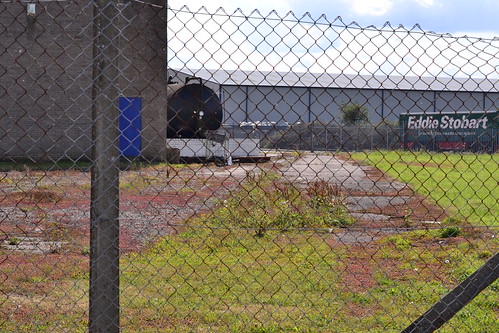
Part of Watton’s decaying perimeter track.

Partially opened in 1937, the airfield wasn’t fully completed and handed over to the RAF until 1939. Being a pre-war design, building materials were in good supply, and so the  accommodation blocks were constructed using brick, and they catered well for those who would find themselves posted here.

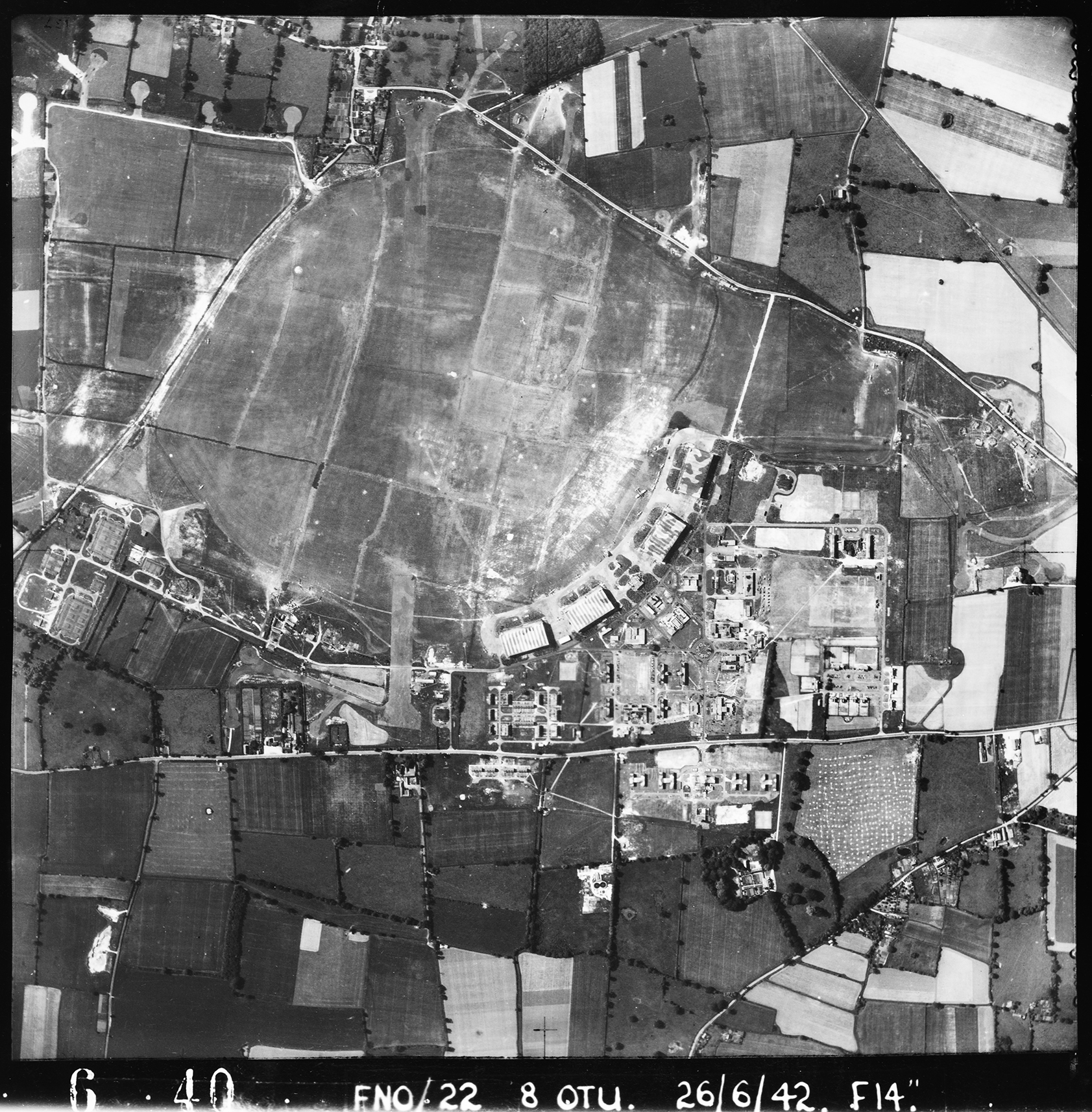
Another aspect considered at this time was that of camouflage; airfields were enormous open expanses and could be easily seen from great distances and heights. Numerous proposals for hiding them were put forward, a move that resulted in the formation of a special unit within the Directorate of Works led by Colonel Sir John Turner. Watton came under the eyes of Sir John and his department, and this led to an ingenious camouflage pattern of fields and hedges being painted across the entire airfield,  thus disguising it from prying eyes above. Whilst not completely effective, it certainly went some way to protecting it from attack.

RAF_FNO_22_RV_6040

Watton airfield taken in 1942 by No. 8 Operational Training Unit. The four hangars can be seen in the centre of the photo with the patchwork of ‘fields’ disguising the main airfield. English Heritage (RAF Photography).

The first postings to arrive were the men and machines of 21 and 34 Squadrons RAF. Their arrivals on March 2nd 1939 saw a reuniting of both squadrons under the Command of Group Captain P. J. Vincent DFC and 6 (B) Group . On the 7th, the airfield was inspected by the Group’s AOC after which 34 Sqn performed a flypast; one such event that would be the start of many visits from numerous dignitaries including the Marshall of the Royal Air Force himself, Sir Edward Ellington  GCB, CMG, CBE.

Little flying took place by either squadron at this time however, as the aerodrome was soon unserviceable due to the very poor British weather. Grass runways soon became bogs, and as was found across many grassed airfields at this time, unsafe for aircraft to either take off or land without mishap. From April  things picked up slightly, and intensive training began in the form of station tactics and defence exercises. The weather would however, continue to be the worst enemy, repeatedly preventing or restricting flying from taking place.

In August, 34 Sqn received orders to depart Watton and  proceed to Singapore, and so on the 12th, the air and ground parties began their long transit leaving Watton and England far behind. The quiet of their departure would not last ling however, as within a few days of them leaving, their empty beds would be filled once more, when the Blenheims and crews of 82 Sqn arrived.

At 11:05 on September 3rd 1939, notification came though to Watton of Britain’s declaration of war. Within days of the announcement aircraft were being moved out under the ‘Scatter’ scheme to another airfield, Sealand, for there was a fear of imminent air attacks following the war’s declaration. The Blenheims remained at Sealand until mid September, at which point they were recalled and prepared for attacks on vessels belonging to the German Navy. These vessels were not located however, and so the order to stand by was cancelled and the crews stood down. This would sadly become a regular and frustrating occurrence for the men of 21 Sqn.

Shortly after on the 9th, the first of the new MK.IV Blenheims were collected from Rootes Ltd at Speke, with further examples arriving over the next few days. Further movements saw aircraft detached to Netheravon and then onto Bassingbourne where Blenheim L8473 was damaged as it ‘nosed over’ whilst taxiing. A minor, but unfortunate accident, it would be the first of many more serious losses for the squadron.

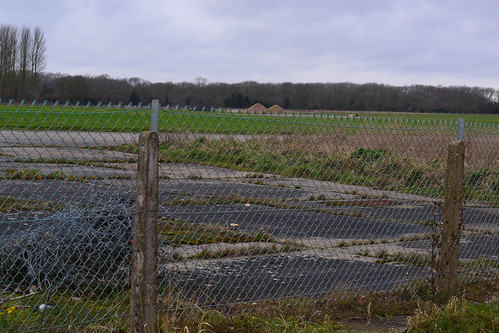
RAF Watton

A fence separates the housing estate from the airfield remains.

On 26th September, another order came through for aircraft of 21 Sqn to stand by to attack  the German fleet, whilst a further two Blenheims (L8734 and L8743) would fly to the Rhur to carry out a photographic reconnaissance mission. However, bad weather, industrial smoke and a faulty camera prevented both aircraft from carrying out their duties: each one returning to Watton empty handed but unscathed – crews reporting heavy flak over the target area. The whole of October and November were pretty much a wash-out. Bad weather with prolonged heavy rain prevented any substantial flying beyond the local area. Air gunnery and co-operation flights were carried out whenever  possible, but the late months of 1939 had certainly been a ‘phoney war’ for 21 Sqn.

As 1940 dawned, things on the continent began to heat up and ground attacks increased for both Watton squadrons. Low-level sorties saw them attacking troop formations and enemy hardware as its galloped its was across the low-countries. Whilst bravely flying on and escorted by fighters, overall loses for the slower Blenheims of 2 Group were beginning to rise, a pattern that would only increase in the face of a far superior enemy in the coming months.

These losses were borne out by 82 Sqn in dramatic style on the 17th May, when twelve aircraft took off at 04:50 to attack Gembloux. They were met with heavy anti-aircraft fire and overwhelming fighter opposition – fifteen BF.109s, decimated the squadron. All but one aircraft was lost, the only survivor being P8858 crewed by Sgt. Morrison, Sgt. Carbutt and AC Cleary. Whilst not injured in the melee, the aircraft was badly damaged and as a result, was deemed irreparable and written off. An entire squadron had all but been wiped out in one fell swoop.

This disaster would be reflected right across 2 Group, who had now suffered its greatest overall loss to date, but for 82 Sqn it would not yet be the end of this traumatic and devastating period. The burning cauldron that was now facing the light bomber was taking its toll on crews, who were all at a distinct disadvantage to their Luftwaffe counterparts. On the 21st, three more aircraft were lost from Watton, with one being forced down in France, another lost without trace and a third limping home so badly damaged it also had to be written off.

A short visit by 18 Sqn between 21st and 26th May barely interrupted proceedings at Watton. After returning from France, they had spent no less than nine days in May at five different airfields including the nearby Great Massingham.

By early June 1940 Operation Dynamo had been completed and France was lost. The British Bulldog, whilst not a spent force, had shown her teeth, been bitten hard and was now licking her heavy wounds. Preparations would now begin to protect her own shores from the impending invasion.

Fuelled by revenge, combined attacks by both 21 and 82 Sqn continued on into the summer months. But revenge alone does not protect a crew from superior fighters and heavy flak. On June 11th, three more 21 Sqn aircraft were lost whilst attacking positions around La Mare, it is thought all three fell to Luftwaffe fighters. Two days later on the 13th, another five aircraft were lost, two from 21 Sqn and three from 82 Sqn; losses were mounting for the light bombers and Watton was amongst those bearing the brunt of these. On the 24th, 21 Sqn saw a reprieve, whether to rest crews, take on a new role or simply regroup, they began a move north to RAF Lossiemouth in Scotland. 82 Sqn however, would remain at Watton, where they would carry on with the punishing raids over the continent.

After the arrival and departure of another short stay unit, 105 Sqn between 10th July and 31st October, Watton was now left in the lone hands of 82 Sqn, a situation that would remain until the spring of 1942.

The dramatic loss of eleven crews back in May would come back to haunt 82 Sqn in August that year. On the 12th, another twelve aircraft took off on a high altitude bombing mission to Aalborg in Denmark. The airfield they were to target was well defended, and as if history were to repeat itself, once again eleven of the twelve aircraft were lost. The only one to return, that of R3915 crewed by Sgt. Baron, Sgt. Mason and Sgt, Marriott, turned back early due to low fuel.

In the space of three months, an entire squadron has been all but wiped out not once, but twice, unsustainable losses that would surely bring the squadron to its knees.

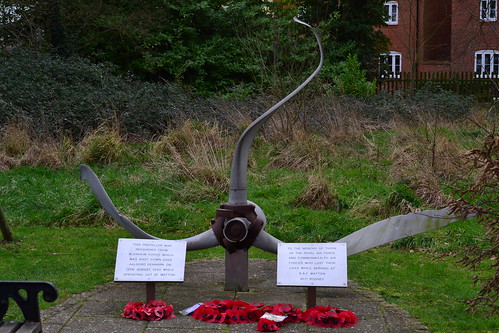
RAF Watton

Memorial to the crews lost at Aalborg, 13th August 1940. The propeller of Blenheim R3800, that crashed that day.

It was loses like this that helped convince the authorities to eventually withdraw Blenheims from front line service during 1942 – the Blenheim being long outdated and outclassed. At this time, Watton’s 82 Sqn, would begin their transfer to the Far East, a place they would remain at until the war’s end.

A lull in operations meant that Watton was then reduced to mainly training flights, through the Advanced Flying Unit. Small single and twin-engined aircraft providing the activity over the Norfolk countryside. Many of the crews being trained here would be shipped out to the satellite airfield at Bodney, before returning here for their evening meals.

A brief interlude in the May of 1942 saw the rebirth of the former 90 Squadron, a First World War unit that had gone through this very process on a number of occasions since its inception in 1917.

Flying the American B-17 ‘Flying Fortress’ or Fortress I as it was in RAF designations, 90 Sqn was set up to trial the use of the four-engined heavy for its suitability as an RAF bomber. During the first 15 days at Watton, the squadron gained personnel and received their first aircraft,  after which they moved to nearby RAF West Raynham. Here they would begin these trials which also required the use of a number of smaller airfields in the local area. These included both RAF Great Massingham and RAF Bodney, neither of which were particularly suited to the heavy bombers.

Watton then saw no further operational units, and in the mid 1943, it was handed over to the Americans who began to develop the airfield into something more suitable for their needs. It was now that Watton would take on a more sinister role.

In Part 2 we see how the Americans developed Watton, and how it became two sites rather than just one, and also, how its role in Electronic countermeasure took it into the post war years.

The full story of Watton can be found in Trail 9.

RAF Upwood (Trail 17) – The Graveyard of RAF Squadrons (Part 4)

In Part 3 Upwood became part of the Pathfinders operating Mosquitoes on major operations as Bennett’s Pathfinder Force. Eventually the war drew to a close and bombing operations wound down. Then we entered the jet age.

With the war in Europe now over, Upwood would become a ‘graveyard’ for RAF squadrons. The first of these 105 Squadron, arrived in the same month as 156 departed, with Mosquito XVIs. By the end of January 1946 they were gone, but like the Phoenix of Greek folklore, they would arise from the ashes at Benson in the early 1960s.

102 Squadron were another typical example of this, arriving in February 1946, only to be disbanded two weeks later, being renumbered as 53 Squadron. 53 Sqn made a conscious effort to buck the trend by  flying with the four engined heavies the Liberator VIs and VIIIs, but sadly they too did not last long, closing in the summer of that same year.

1946 was a busy year at Upwood, with what seemed a constant ebb and flow of ‘heavies’, this motion setting a scene that would prevail for the next eight years or so.

February 1946 finally saw the departure of 139 Sqn to Hemswell, after two years at Upwood, their time here had come – their historic role had come to an end. But for Upwood, it was still not the final curtain, for on July 29th, another unit would arrive, 7 Squadron. The unit was reduced to just ten aircraft prior to the move, and would not take on any new models until 1949 when the Lincoln B.2 arrived. An aircraft developed from the highly successful Lancaster, it would be used in operations over Malaya until the squadron was disbanded and then reformed elsewhere with Valiants in 1956.

Back in November 1946, two other squadrons would reform here at Upwood, both 148 and 214 Sqns, and both with Lancaster B.1 (F.E.). These ‘tropicalised’ versions of the B.1 had been destined to go to the Far East to fly operations against Japan as the ‘Tiger Force‘. These modifications included changes made to the radio, radar, navigational aids and included having a 400 gallon fuel tank installed in the bomb bay. Faced with the high temperatures of the Far East, they were painted white on top to reduce heat absorption, and black underneath. Fortunately though, the war with Japan had ended before they could be used, and in 1949, both these units would lose them in favour of the Lincoln also. This meant that Upwood now boasted three Lincoln squadrons, the war may have been over, but the power of the Merlin continued on well into the mid 1950s, these three squadrons disbanding between 1954 and 1956.

In the summer months of 1952, Dirk Bogarde starred in a film made at Upwood using Lancasters in an ‘Appointment in London‘.

A wartime story it was made by Mayflower Film Productions, and used four Lancasters crewed by Upwood airmen. Starring Dirk Bogarde, it is a story of intense rivalry between a Wing Commander aiming for his 90th mission, and an American officer, there is the usual love story attached as the two try to put aside their rivalry to achieve their own personal aims.

On February 23rd 1954, a forth Lincoln squadron arrived at Upwood, 49 Squadron took the number of four engined heavy bombers even further, staying here until August 1st the following year, at which point they were disbanded only to be reborn at Wittering in 1956.

By now, the RAF’s long range jet bomber, the Canberra, had been in service for a few years, and had proved itself as a more than capable aircraft. A first generation medium bomber, it was designed by W. E. W. ‘Teddy’ Petter, and would go on to set the world altitude record of 70,310 ft two years after entering service here at Upwood.

The success of the Canberra would be one to rival the Lancaster and Spitfire. Being built in twenty-seven different versions, it was exported to over fifteen countries world wide. In the RAF it served with no less than thirty-five squadrons, several of them ending up here at Upwood. Over 900 examples were built by British companies, with a further 403 being built under licence by the American Martin Company and designated the B-57. In RAF service, it reigned for fifty-seven years, the last examples being stood down in 2006.

Between 22nd May 1955 and 11th September 1961, eight RAF squadrons: 18, 61, 50, 40, 76, 542 and finally 21,  were all disbanded at Upwood, and all operating the aforementioned Canberra; primarily the B.2 or B.6 models, few of them operating the model for more than three years. There was also a return of 35 Sqn, the former Bomber Command unit who operated from Upwood in early 1940; they came over from Marham having operated as the Washington Conversion Unit before renumbering as 35 Sqn. They remained here until September 1961 whereupon they were disbanded for the penultimate time.
After the last Canberra Sqn had departed, Upwood remained under RAF control as part of the RAF’s Strike Command, until 1964 when they too pulled out leaving a small care and maintenance unit behind. Over the next few years Upwood would be used in the training of non-flying duties, until these units also left, the last in 1981. Upwood’s future now looked very insecure.
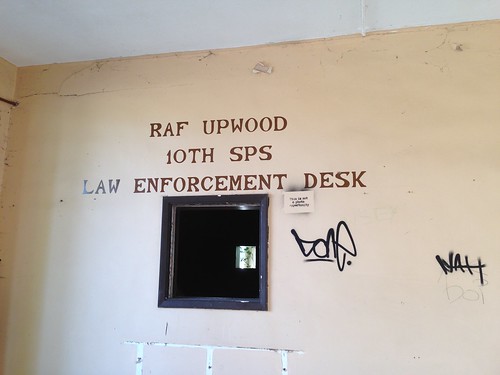
RAF Upwood

Inside the Gate house, the USAF presence. (Security Police Squadron).

Fortunately though, control of Upwood was then passed to the USAF for training and support services for nearby RAF Alconbury and RAF Lakenheath. It was earmarked for medical services, and should an attack occur during the Cold War, it would quickly be turned into a control area ready to deal with heavy nuclear attack casualties. Thankfully this was never put to the test though, and gradually the USAF phased out its use of Upwood, and as other airfields closed, personnel numbers became less and the homes they used emptied. Eventually, even the 423rd Medical Squadron pulled out, taking their community support, equipment and staff with them.

Upwood finally closed on 26th October 2012, and the remaining buildings including the NAFFI and NCO homes, were all sold off to developers and the site wound down. Since then, there have been numerous attempts to purchase the site and develop it with housing. These have all faltered along the way for one reason or another. On the positive side, the hangars remain actively used by an aero-engine company who refurbish jet engines. A glider club has been agreed a 10 year lease on the remaining parts of the runways (although these have been removed) and two Nissen huts have been fully refurbished to allow modern use. This part of the airfield looks and feels like a real and active military base, whilst the admin and medical side are ghostly reminders of its past. Standing on the site looking around, the imagination can only begin to think how this lonely and desolate place once bustled with crews and aircraft, crews going about their business and vehicles ferrying aircrew to their machines.

RAF Upwood

RAF Upwood’s hangars are still in use today. Aero engines outside await work.

Today it is an enormous site covered with derelict buildings as if left following an atomic blast. The windows are all shattered, the buildings vandalised and graffiti daubed on all the walls. Two tanks have been brought in and a small urban assault company use it for mock battles. The guardroom, officers quarters and associated mess halls all remain, some in a worse state than others.

In 2017 the redundant site was acquired without conditions, and planning permission obtained for a comprehensive development of a small six acres of the site. This plan, put forward by Lochailort *5 included 60 houses. Huntingdon District Council have now incorporated Upwood into their long term Local Plan, and a proposal is under consideration for further development which would include the removal of large quantities of the buildings. It would also see hardstands being replaced by a mix of housing (450 homes) and business premises. The intention is to keep the architecturally significant buildings and layout, along with the hangars, thus retaining the military atmosphere, developing it “in a way which respects its setting and former use“.*4 I only hope that the sympathetic approach is indeed used, and that this incredible and historic site does not become another of Britain’s matchbox towns.

Post Script:

A website dedicated to RAF Upwood shows a range of older photographs, squadron details and information about Upwood’s history. Created by Sean Edwards, it is well worth a visit for more specific details.

A local gentleman has purchased a scrapped Canberra nose section that once flew  from Upwood, and has rebuilt it. It remains in his garage and is displayed at shows around the country.

Sources and further reading.

National Archives – AIR 27/379/4
National Archives – AIR-27-961-4

BAE Systems Website

*1 Photo from the UK Archives, (https://www.flickr.com/photos/nationalarchives) no known copyright restrictions.

*2 Josepf Jakobs story can be read on the: Josef Jakobs blog with further information on the Upwood Website.

*3 Middlebrook, M & Everitt, C. “The Bomber Command War Diaries 1939-1945“, Midland Publishing (1996)

*4 Huntingdonshire District Council Local Plan Proposal

*5 Lochailort Investments Ltd, Webiste.

Thirsk, I., “de Havilland Mosquito an illustrated History – Vol 2” Crecy publishing (2006)

For more information and details of the Pathfinders, see the excellent RAF Pathfinders Archive at: https://raf-pathfinders.com/

The full text can be read in Trail 17 – The Pathfinders

RAF Upwood (Trail 17) – The Graveyard of RAF Squadrons (Part 3)

In Part 2 Upwood progressed through the early war years as a training airfield operating a range of aircraft types. As the larger, heavier aircraft came n line, its wet and boggy ground became churned up necessitating the construction of hard runways.

By the end of the year these runways were completed, and in the early months of 1944, two more new squadrons would arrive at the airfield, 139 and 156 in February and March respectively.

By  now Bomber Command aircraft had been pounding German cities and industrial targets, the period January to March 1944 was to see Berlin hit particularly hard, and with Stirlings being withdrawn due to their high losses, the Lancaster crews would now be taking the brunt.

Now under the control of Bennett’s new Pathfinder Force (PFF), 139 (Jamaica) Sqn would bring with them the beautiful and much loved Mosquito MK.XX. Coming from nearby RAF Wyton, they had already begun replacing these with the MK.XVI, flying both models whilst performing operations from the Cambridgeshire airfield. The following month a Lancaster squadron, 156, who were based at another PFF airfield, RAF Warboys, joined 139. Within a month Upwood had become a major front line airfield, the roar of multiple Merlins now filling the Cambridgeshire skies.

RAF Upwood

139 (Jamaica) Squadron had a long history, which had begun on July 3rd 1918. This first period of their existence lasted only a year, the unit being disbanded in March 1919. With the onset of war they were called back into operation being reformed in 1936, when they went on to fly Blenheims, and later Hudsons, until being disbanded and renumbered as 62 Sqn in April 1942. Reformed again in the June of that year 139 Sqn would go on to serve well into the late 1950s.

Named ‘Jamaica’ Squadron, 139 acquired their name as a result of the huge effort of the colony to provide enough money for twelve Blenheims, a remarkable effort considering the nature and size of the country. It was from Trinidad that Sqn. Ldr. Ulric Cross came, the most decorated West Indian of World War II, who earned himself the DSO and DFC whilst flying with the Pathfinders.

139’s drafting in to the Pathfinders occurred at the end of May 1943, leaving 2 Group for Don Bennett’s 8 Group, they formed the nucleus of the Light Night Striking Force (LNSF).  At this time they were still at RAF Marham, but moved across to Wyton and then onto Upwood arriving here on 1st February 1944, with a mix of Mosquito IV, IX, XX and XVIs.

There would be no settling in period for 139 Sqn, their first sortie, marking for a raid on Berlin, was due that very night. Take off for F.O. D Taylor and F.Lt. C. Bedell in Mosquito DZ 476, was at 17:50; they dropped their Target Indicator which was subsequently bombed on by Mosquitoes from another squadron. Whilst flak was recorded as ‘slight’, the aircraft was heavily engaged over Neinburg. The Mosquito landed back at Upwood, ending the squadrons first successful operation from here, at 22:40.

Photograph taken during an attack by De Havilland Mosquito B Mark IVs of No. 139 Squadron, on the locomotive sheds at Tours, France (date unknown) © IWM C 3409

156 Squadron were one of the four initial Pathfinder units having been taken on by the new Group in August 1942 whilst at RAF Warboys a few miles up the road. After two years of relatively high losses for the Squadron, the time for change had come, and they moved across here to RAF Upwood. Hopefully a new start for the depleted unit would see better results and higher morale. As 156 moved in, the few remaining aircraft of the NTU moved out, rejoining the main collection at Warboys, the unit having been split over the two sites for some time.

However, the first three months of 1944 were to prove to be the worst for 156 Sqn, over half its total yearly losses occurring during this period. This culminated, at the end of March, with the loss of four Upwood aircraft. Lancaster MK.IIIs: ND406 (S),  ND466 (Z), ND476 (V) and ND492 (L) all left as part of a seventeen strong force from Upwood joining with a further ninety-three other PFF aircraft to attack Nuremberg. Even though the weather was against the bombers, the operation went ahead, the 795 heavy bombers of Bomber Command making their way east. Strong winds caused havoc, with large parts of the force drifting off course, much farther north than they should have done. This resulted in them unknowingly bombing Schweinfurt and not Nuremberg. Outward bound, the German defences waited, many picking off the bombers before they even reached Germany. In total 95 bombers were lost, 82 of them on the outward journey. For 156 Squadron it was another devastating blow, and for Bomber Command a disaster, their biggest loss of the entire war*3.

RAF Upwood

A huge number of derelict buildings remain on the now abandoned site.

Of the thirty 156 Sqn airmen lost that night (two Lancasters were carrying eight crewmen), only six survived, each of these being incarcerated as POWs, the rest all being killed and buried in this region of Germany.

The months preceding June were taken up with missions to support the impending D-Day landings. With Bomber Command forces being pulled away from targets in Germany, many missions now focused on V weapons sites, rail and transport links, coastal batteries and airfields across western France. The number of Pathfinder Mosquitoes increased, as did the need for precision bombing, the wider ‘blanket’ bombing not being implemented on these small scale targets.

The transportation plan as it was known, required intense operations from 8 Group, and although the number of missions rocketed the number of casualties fell. Morale was on the increase and things were looking up for the crews of Upwood based aircraft.

With the Pathfinders being mainly experienced and skilled crews, any loss was considered damaging. In the period up to D-Day, losses for both squadrons were  in single figures, but of those who were lost, many were DFC or DFM holders, including on the 27th – 28th April, 156 Sqn Lancaster III ND409, which had five DFC bearing crewmen on board.

During this raid, which was only some four weeks after Nuremburg, 323 aircraft attacked Friedrichshafen’s engineering plants, where components were made for German tanks. Highlighted as an ‘outstanding’ raid, marking was near perfect which resulted in the entire destruction of the plant and almost three-quarters of the town.

Meanwhile, the Canadians were busily building Mosquitoes for the RAF, and on May 10th – 11th, the first Bomber Command MK. XX built in Canada, was written off when a flare ignited inside the aircraft. Returning from Ludwigshafen, the marker had failed to release only to cause disaster near Cambridge on the return flight. Inside the aircraft were Flying Officers G. Lewis and A. Woollard DFM, Woollard going on to survive a second serious crash on 12th June when his aircraft crashed in Sweden after it was hit by flak. Flying Officer Lewis in the first crash failed to survive.

In June 1944, a very special aircraft was unveiled at the de Havilland Canada Downsview factory during the ‘Million Dollar Day’ ceremonies. Mosquito KB273 was unveiled by  the cousin of Geoffrey de Havilland Junior, Joan Fontaine, the Hollywood film star, who gave her name to the aircraft. KB273 ‘Joan‘ would be passed to 139 Sqn here at Upwood before being handed over to 608 Sqn in August. In fact, KB273 was one of many Mosquitoes from this same stable that passed through 139 Sqn to the Downham Market unit. It was sadly lost on 29th February 1945, its pilot evading capture whilst the navigator was taken as a POW.

Losses remained relatively low on a month by month basis for the two squadrons, an excellent improvement compared to previous months and against other units. By the end of the year, 139 Sqn had sustained twenty operational losses whilst 156 Sqn suffered fifty-two. All in all 1944 had been a little more positive.

The dawn of 1945 saw the world entering the final stages of the war. The long and cold winter of 1944-45 prevented many operations from being carried out, and even though the Luftwaffe were finding it difficult to put up sufficient numbers of aircraft and skilled pilots, losses in Bomber Command were still high overall. Last ditch efforts saw attacks from fighter jets, mainly Me 262s, and 1945 would signify the end of operations from Upwood for one of the two Pathfinder squadrons based here.

For 156 Sqn the early months of 1945 would be their last, and although there was an all out effort, casualties were relatively light. With one Lancaster being lost in January (PB186) with all on board; three in February – two over the Prosper Benzol plant at Rottrop, (ME366, PB505) and another (PB701) over Dussledorf – January and February would close with few losses. March similarly would see another two in the closing hours of the month over Berlin, both crews of PB468 and PB517 being completely wiped out.

Germany continued to be pounded by large formations during April, a month that saw many of the last major operations for several squadrons. For 156, their final bombing mission came on the 25th, sixteen aircraft taking part in a raid to Wangerooge in which Bomber Command lost seven aircraft – six of which were collisions in near perfect weather. For 156 though, the raid was casualty free, and with that their bombing raids ceased. The final capitulation of Germany was taking place and mercy raids could now be flown to supply those who had lived in terror and hunger under the Nazi regime.

3010671412_0a0a4fd717

Aerial photo taken on 25th April 1945 over Wangerooge*1.

In that month alone, Squadron crews were awarded no less than: one DSO; nineteen DFCs; a CGM and three DFMs. Aircrews had flown over 850 operational hours in 141 sorties, a small fraction of the 4,839 they had flown in their three year existence. By June, operations for 156 Sqn had wound down at Upwood and they moved back to Wyton, finally being disbanded and removed from the  RAF register in September.

139 Sqn meanwhile, had continued their marking for night raids on German cities. During the period late February to the end of March, 139 Sqn carried out thirty-six consecutive night raids on Berlin, one of these being the largest ever attack by Mosquitoes on the German capital. On this operation, 142 twin-engined ‘Wooden Wonders’ from a number of different squadrons unleashed their loads in two waves over the German city. 139 Sqn leading the Light Night Striking force using up to date models of H2S.

After the Battle of Berlin had ended, along with a winter of heavy bombing, the analysis would now begin. Bomber Command’s effectiveness, and in particular its bombing strategy, would suddenly be under the spotlight, with its leader Sir Arthur Harris, the focal point. It would be a legacy that would last for generations to come, even to this day the debate continues, and there are many that fight the cause in support of Harris’s operational strategy.

The end of the bombing war for 139 Sqn came in May 1945, ironically their busiest month of the year, flying 256 sorties which culminated with an attack on Kiel.

Throughout their operational tour, 139 Sqn had lost a total 23 aircraft in 438 raids , the highest of all the Mosquito PFF squadrons.

Part 4 takes us into the Cold War, the development of the jet engine in which Upwood becomes a graveyard for disbanding RAF Squadrons.

The full text can be read in Trail 17 – The Pathfinders

RAF Upwood (Trail 17) – The Graveyard of RAF Squadrons (Part 2)

In Part 1 we saw how Upwood was formed and how the first squadrons arrived ready to show off their new Fairey Battles. As September 1939 dawned, war was declared and Upwood stepped up to the mark and prepared itself for the conflict.

The immediate issuing of order S.D.107 and S.D.107a, resulted in the whole of 63 Sqn, including their dispersed aircraft, being moved to Abingdon, whose crews and aircraft were in turn moved to France. The transfer of men and machinery being completed by 08:00 on the 8th September, at which point 63 Sqn joined No.6 Group, leaving Upwood far behind.

52 Sqn also brought back their aircraft from Alconbury filling the spaces left by 63 Sqn, before moving themselves to Kidlington, and then onto Abingdon where they would join once again with 63 Sqn.

The outbreak of war saw huge changes for the RAF. The immediate mobilisation began with the implementation of the ‘Scatter Scheme’, where aircraft were dispersed away from parent airfields to avoid the ‘imminent’ threat of attack. Over at West Raynham, 90 Sqn were doing just that. In mid September, aircraft that were dispersed to Weston-on-the-Green were now brought over to the all but vacant Upwood, in a move that preceded a more long lasting move by the squadron to the airfield.

RAF Upwood

Guard house to the former airfield.

Over the next few weeks a mix of Mk.I and MK.IV Blenheims were collected and brought into Upwood supporting the training role carried out by 90 Sqn. Training was a risky business, as many trainee crews would find out. On the 18th October, two Upwood Blenheims crashed, one in a field with its undercarriage retracted following an engine failure, and the second on the airfield itself. The worst of these was Blenheim L4876 which crashed on take off, and resulted in the loss of the life of the pilot P.O T. Peeler. His observer, Sgt. Dobbin was injured, whilst the wireless operator, AC2 Brown,  managed to escape without injury.

Over the winter months Upwood would rise in the league tables of airfields notorious for flooding and water logged  ground. The heavy rains making the airfield unserviceable on numerous occasions. This caused great concern for the air staff who made the difficult decision to cut short training programmes, thus enabling the supply of aircrew to be maintained. It did however, mean that there would be a supply to front line squadrons of crews with partial or less than perfect training.  This problem would persist at Upwood for some time to come, eventually being partly solved by the building of hard runways.

1940 brought with it another training squadron, 35 Sqn, who also found the ground at Upwood difficult, their move being hampered for several weeks before they could finally settle in and begin operations properly. The summary for February shows thirteen days were lost to bad weather and nine to waterlogged surfaces!

March 12th 1940, saw another fatal accident at Upwood, with the death of trainee pilot Sgt. Alphonse Hermels (s/n: 517823) whose aircraft collided with a Blenheim on detachment from  90 Sqn, the two aircraft taking off simultaneously but neither apparently being aware of the other’s presence.

In early April, both 35 and 90 Sqns were disbanded and amalgamated to form No. 17 Operational Training Unit (OTU). The name of 35 Sqn would be reborn as part of Bomber Command at Boscombe Down at the year’s end, but that would be their ties with this rather wet airfield cut, until in 1956, when it would return extending its stay to a more permanent five years. For the next three years the OTU would be the main user of Upwood, flying with a wide range of aircraft types, including: the Lysander, Anson, Hurricane, Spitfire, Wellington and Fairey Battle. The unit  eventually departed to Silverstone – famous for British Motor Racing – in December 1943.

As the BEF were being withdrawn from the beaches of Dunkirk, Britain began to brace itself for the impending invasion. Although the Battle of Britain would not officially start for some time yet, the period immediately after Dunkirk saw minor attacks on British airfields, particularly those in East Anglia. On several days during June, enemy bombers would penetrate British airspace and unload their small bomb loads on these sites. Some of the first enemy intruder missions were recorded at this time, and Upwood would receive its fair share of bombings although little damage was done.

This operational ‘dry spell’ was momentarily broken when 26 Squadron appeared on the scene at Upwood. For what must be one of the most mobile squadrons of the RAF, 26 Squadron were constantly transferring from airfield to airfield, staying here on an overnight stop in early October. In the space of less than a week the squadron had operated from no less than 6 different airfields including: Twinwood Farm (Glenn Miller’s last stop), Barton Bendish, and Snailwell.

RAF Upwood

Upwood’s collection of buildings are numerous.

Upwood was to experience some rather difficult times and localised action. Numerous accidents were interspersed with attacks by marauding Luftwaffe aircraft, they even had their own parachuting spy. The event caused a great deal of excitement around the base, and saw the spy,  42 yr old Josef Jakobs, being found guilty of treason and subsequently executed at the Tower of London.

Jakobs, who parachuted into England on January 31st 1941, broke his ankle when he landed at Dovehouse Farm, Ramsey Hollow, a few miles from the airfield. He was found by passing farm workers (Charles Baldock and Harry Coulson) after firing shots into the air. With him were maps with both RAF Upwood and RAF Warboys identified, transmitting equipment, codes, £497 in £1.00 notes and false papers. He was arrested, taken to Cannon Row Police Station in London where he was handed over to Lt. Col. Tommy ‘Tar’ Robertson of MI5.

Robertson took Jakobs to ‘Camp 020’ a special interrogation camp run by MI5, on Ham Common, where he was treated for his injuries and interrogated with a view to turning him into a ‘double agent’. However, his position had already been compromised because of local gossip about his capture, and so MI5 could not guarantee his position with the spy network.

Jakobs was finally tried under the Treachery Act under military law – a court martial consisting of four military figures. The court hearing began on 4th August and lasted two days. He was subsequently found guilty of treason and on the morning of the 15th he was shot by a firing squad formed from the Holding Battalion of the Scots Guards at the Tower of London, his body being buried in an unmarked grave in St. Mary’s Roman Catholic Cemetery in Kensal Green, North-West London.*2

Often, training airfield squadrons would operate in conjunction with various specialised units, in this case 11 Blind Approach Training Flight who were formed here at Upwood, in October 1941, with Air Speed Oxfords. This unit was quickly renamed 1511 (Beam Approach Training) Flight, and trained pilots in the use of navigation beams for poor weather or night landings. These twin engined Oxfords were found in numerous training flights and at numerous airfields across Britain and in Canada, and were generally popular with trainees.

As the war progressed new advances meant that the older aircraft were becoming tired and in need of replacement. With larger bombers coming on line, Wellingtons pulled from front line service were now being used in training operations. Added to this, the introduction of the Lancasters of the Navigation Training Unit (NTU) in June 1943, meant that Upwood’s runways could no longer withstand the churning up by heavy aircraft, and it was now that Upwood’s notoriously bad surface began to really show its true colours.

RAF Upwood

A scene typical of the buildings at Upwood

Being a heavier breed than the Blenheims and Oxfords, the ground began to break up, and it was for this reason that the OTU moved to Silverstone, and the Beam Training Flight moved out to Greenham Common. This left the airfield devoid of all operational aircraft apart from the NTU. It was now time to make amends at Upwood.

Whilst the site was all but vacant, one of the RAF’s Airfield Construction Flights moved in and construction began on the three concrete runways needed for Upwood to continue operations. The brain child of Wing Co. Alexander John ‘Daddy’ Dow, they were a huge organisation that supported the RAF’s front line squadrons by building, repairing and maintaining their runways.

In Part 3 Upwood see the arrival and use of the four engined heavies. The Pathfinders are born and Upwood becomes a front line bomber airfield.

The full text can be read in Trail 17 – The Pathfinders

RAF Upwood (Trail 17) – The Graveyard of RAF Squadrons (Part 1)

In the second part of Trail 17 we visit a station  with a history going back to World War One. This airfield saw a spy caught and hanged; the making of a film using Lancaster bombers, and more recently the site of a hospital for the treatment of victims of a nuclear war. Ever since its closure it has been the subject of numerous failed planning applications, and seems to have hung on by the skin of its teeth – perhaps until now.

This site must rank as one of Britain’s largest collection of ex military buildings (albeit subjected to the usual vandalism) for its collection is huge, and its a collection that includes wartime hangars. We of course go to RAF Upwood near Huntingdon.

RAF Upwood

RAF Upwood is a remarkable site to visit. Its buildings remain very empty stripped of their dignity and daubed with a wide range of graffiti, yet within its boundaries lay many years of history.

Located in the south-western corner of Cambridgeshire, not far from both RAF Alconbury and RAF Warboys, Upwood is possibly one of the countries most photographed aviation sites.

RAF Upwood has seen no less than twenty-two different RAF flying units grace its runways, the majority of these being post war operational units, many coming here prior to their disbandment – it is perhaps the graveyard of RAF squadrons.

However, whilst the latter part of the 20th Century saw it gain its recognition, its origins lay way back in the First World War.

Originally opened in September 1917, as Bury (Ramsey) after the adjacent village, it had no permanent buildings and was merely a grassed airfield with no fixed squadrons of its own. Towards the end of the war though, in 1918, five hangars and a small number of huts had been built, and it was at this time that it became officially known as ‘Upwood’.

RAF Upwood

Post war, Upwood served as a hospital and most of the buildings survive.

Then, when the war ended, the personnel departed and the site was cleared of all military related artefacts, the site being returned to the local community once more.

However, the impending conflict in the late 1930s, required a massive rethinking into Britain’s defences and the need for greater air power. A number of locations were earmarked for opening, and as a former airfield, Upwood was one of them. Designed as a medium bomber station, plans were put in place for as many as five large hangars, although only four were ever completed.

Opened in early 1937, during the expansion period of pre-war Britain, it was home to both 52 and 63 Squadrons Royal Air Force. In March the two newly formed squadrons arrived, 52 Sqn from Abingdon, No. 1. Bomber Group, and 63 Sqn from Andover, No. 2 Bomber Group. At the time of opening conditions were far from ideal, only half of the total number of hangars had been built, and more importantly, there was no provision for permanent accommodation; instead, crews were faced with a rushed collection of inadequate, temporary blocks. 52 Sqn were first, followed two days later by 63 Sqn, by which time conditions had changed marginally for the better, the officers mess being one such building to open as a permanent structure – clearly rank was to have its privileges.

For 52 Sqn it was a complete change, the move being managed over just two days, which also saw them transfer to No. 2 Bomber Group bringing them in line with 63 Sqn. Initially, 52 Sqn brought with them seven Hawker Hinds, then four more on the 8th and a further two on the 10th, bringing the total number of aircraft on role to thirteen. Six of these Hinds were immediately put into reserve saved for the formation of a ‘B’ Flight.

Meanwhile, 63 Sqn began to upgrade their aircraft taking on four replacement Audaxes, each being delivered straight from the A.V. Roe factory (Woodford Aerodrome)  in Manchester. With a further three and then two more being delivered from A.V. Roe’s on the 17th and 18th respectively, the number of aircraft at Upwood now amounted to twenty-two.

This was a busy time for Upwood, with personnel coming and going, new postings arriving and staff being posted out, there was considerable movement before things finally began to settle down and operations bed in.

On the 22nd and 24th, both squadrons took turns to carry out search operations over the local countryside looking for the remains of a DH Moth belonging to Mary Russell, the Duchess of Bedford, which disappeared on the evening of the 22nd during a snowstorm. Both searches proved unsuccessful, with no sightings been made. It later transpired that the Duchess had crashed into the North Sea, her body never being found.

With 52 Sqn’s ‘B’ Flight being formed on April 6th and 63’s on the 12th, the scene was almost set, and with visits by both Air Chief Marshall Sir John Steel KCB, KBE, CMG (Air Officer Commanding in Chief of Bomber Command), and then the Under Secretary State for Air a few days later; Upwood was finally on the map and making progress toward being both operational and fighting fit.

63 Squadron would then take a step forward, having the honour of being the first operational unit to receive the new Fairey Battle, K7559 landing at Upwood on May 20th 1937, some 6 months before 52 Sqn received theirs.

Throughout the summer of 1937, the number of delivered Battles gradually increased, each one coming directly from Ringway Aerodrome, one of Fairey’s main sites. For 63 Sqn, the following months would be a busy time ‘showing off’ their new aircraft to various dignitaries from around the globe. A massive PR stunt, it started with the Gaumont British Film Company, who filmed nine of the aircraft taking off, landing and flying in formation, scenes being recorded for the film “Under the Shadow of the Wing“.

During this period, Upwood would be inundated with visitors; his Highness the Duke of Aosta along with Italian representatives started the ball rolling, followed by: Major Woutieres of Belgium; Lt. Lim Weir K’nei of the Chinese Air Force; Air Chief Marshal Sir E. Ludlow-Hewitt KCB, CMG, DSO, MC; Air Commodore S. Goble CBE, DSO, DSC. and even a consortium from Germany – General der Flieger Milch, General Lieutenant Stumpff, General Major Udet along with their entourage. These three high ranking officials were, from the 1930s onward, key to the development, build up and use of Germany’s illegal Luftwaffe. Accompanying them, were a number of high ranking British Air Force personnel, who openly guided the party through a range of inspections of the Battles, a programme of events that included a flying display at RAF Mildenhall.

Generalfeldmarschall
Erhard Milch March 1942 (Source: Wikipedia)

By the end of 1937, 63 Sqn had flown 2,256 hours, many of these to show off their aircraft. With little else to do at this time, a range of pageants and shows kept the crews busy in between the obligatory gunnery and navigation training sessions.

1938 would be filled with similar such undertakings, but as the year drew on training  would take on a more serious and predominant role, mock bombing attacks being regularly practised by the squadron on various sites including Upwood itself.

After a short period away training at West Freugh, the squadron was placed in a ‘precautionary’ state, in readiness for immediate mobilisation – the threat of war in Europe now growing ever stronger. This period was short lived however, and the squadron temporarily returned to normal duties, with yet more visits from both high ranking officials and royal dignitaries from overseas.

November 25th 1938, would be a sad day for Upwood crews, training flights proving to be hazardous, and even fatal.

New Zealander P.O. K Vare, managed to land and walk away from Battle K7603 as it burned on a nearby railway line, whilst 63 Sqn Battle K7567 crashed in poor weather whilst undertaking a navigation exercise over Hampshire. The aircraft, piloted by P.O. J Ellis (killed), collided with trees severely injuring Cpl. A Thoroughgood and ejecting AC2 V. Rawlings. Being thrown from the aircraft was possibly Rawlings’s saviour, the likely hood of being killed himself higher had he not been.

Fairey Battle Mk.I (K7602) of 52 Squadron, at RAF Upwood.© IWM H(am) 179

On the 16th December, in a ceremony attended by the station staff, P.O. Ellis’s ashes were scattered over the airfield, the procedure being carried out from another Fairy Battle from the squadron.

After a short Christmas break, 63 Sqn returned to their duties once more, training flights, many of which were in conjunction with squadrons from other airfields, increasing in frequency as events across the Channel took on an even more sinister turn.

In mid March, a new policy was issued that would affect the operation of both the Upwood squadrons. This policy turned both 52 and 63 into ‘non mobilising’ units, meaning that the more senior officers would remain on site as instructors, whilst the ‘regular’ crews would be posted to operational units. The spaces left by these vacating staff being filled by Volunteer Reserves from the various Flying Schools. After a period of some months, these trained staff would revert to civilian status, but as reserves, they could be called upon if, or more likely when, war was declared – the war machine was again stepping up a gear. A further element of this change was the allocation of 10 new Avro Anson aircraft, each of these twin-engined training aircraft arriving over the next few weeks direct from Woodford.

This period would see world tensions rise even further, and as war looked even more likely, changes were again made to Upwood’s staff. Rehearsals in dispersing aircraft were carried out, passes were restricted to ensure sufficient numbers were always on hand in case of war being declared, and mock attacks on the airfield were carried out. During these mock attacks ‘Gas’ was sprayed by both ‘attacking’ aircraft and from a ground based “High Pressure Jenny”, a devise developed in America to spray water and steam over the outside of aircraft.

Upwood then experienced a second fatal accident, which occurred on the night of 25th July 1939, the crash involving Fairy Battle K9412 of 63 Sqn with the loss of all on board: Sgt. Albert Shepherd, Sgt. Aubrey Sherriff and AC2 William Murphy. The aircraft struck the ground and caught fire whilst taking part in one of these preparatory exercises.

The end of August saw a further ramping up of the gears with the implementation of the Bomber Command War Order (Readiness ‘D’). Aircraft of both squadrons were now restricted to essential tests and practises only, being dispersed across the airfield, bombed up but without fuses, ready for flight. Personnel were also put on high alert, anyone on leave was recalled and had to return back to the station.

As September dawned, the full readiness ‘D’ plan was brought into full force. 52 Sqn were ordered to disperse aircraft at nearby Alconbury, with twenty-four Battles and five Ansons being flown across, along with a small guard and a selection of maintenance personnel. The Royal Air Force as a body was mobilised by Royal Proclamation, and preparations were made for war, the entry in the Operations Record Book for 63 Sqn simply stating:

3rd Sept. 11:00 “A state of war is declared between Great Britain and the German Reich

In Part 2, Upwood goes to war, major changes come in terms of both aircraft and infrastructure. New squadrons arrive and an unwelcome visitor is caught.

The entire text can be read in Trail 17 – The Pathfinders.

RAF Warboys – Home to the Pathfinders (Part 1)

In the south-western corner of Cambridgeshire, are a group of airfields that are synonymous with the Second World War’s target marking units, the Pathfinders. This is an area rich in aviation history, and an area that played a major part in not only the European Theatre of Operations of World War Two, but military operations long into the Cold war and beyond. Within a short distance of each other are the airfields at Wyton, Warboys, Upwood and Alconbury to name but a few, and it is two of these we visit in Trail 17.

Our first stop is the former RAF Warboys, once home to the Pathfinders.

RAF Warboys.

Warboys village is an ancient village with records of inhabitants going back to 7,000BC, it also has links to the Bronze age, the Romans, Vikings and the Doomsday book. Even further back, some 350 million years, there was an active volcano in the area, not far from where we start today.

RAF Warboys

The farm sign reminds us of the aviation link (it would appear that this sign may have recently been removed).

The airfield itself was initially constructed as a satellite for RAF Upwood, with a requirement for three 50 yards wide tarmac runways; one of 2,000 yards, another measuring 1,400 yards and the last 1,350 yards. There were initially twenty-four frying pan hardstands, two of which were then used as hangar bases, with a further eighteen loop style hardstands added after. This gave a total of forty dispersal points available for aircraft, and they would certainly be needed.

As with many airfields of this time there were two type ‘T2’ hangars, one each side of the airfield, supplemented with a ‘B1’ hangar. A well developed bomb store lay to the west of the airfield, and eleven domestic sites lay to the eastern side of the A141 to the south of the main airfield. These would accommodate up to 1,959 men and 291 women. Even before its completion, Warboys would undergo further development, an order coming through to extend two of the runways to 2,097 yards and 1,447 yards, its was a sign perhaps, of things to come. This extension work meant altering the perimeter track layout and diverting the main road around the airfield as it would be dissected by the new extension (the original road was reinstated post war, the end of the main runway being cut off as a result).

Construction began in 1940 with the airfield opening in September 1941, initially as a satellite bomber station. Whilst intended for Upwood, it was first of all used by Short Stirling’s from XV Squadron as an overflow from nearby RAF Wyton. As a satellite, Warboys was never far from the war when not long after the first Wyton aircraft landed, the Commanding officer of XV Squadron,  Wing Commander P. Ogilvie, crashed the Stirling he was piloting (W7439) here in bad weather. Luckily he and his crew escaped major injury but unfortunately the aircraft was written off completely. This crash would signify a run of accidents occurring at the airfield whilst XV squadron used Warboys.

However, XV Sqn’s stay was short-lived, and they soon departed the site their vacant place being taken by the Blenheims of ‘D’ Flight, 17 OTU (Operational Training Unit).*1

The Training unit was expanding, and their base at RAF Upwood was becoming crowded. Their move over to Warboys on 15th December 1941, was a part of this expansion, and led to four flights being created, each with a range of aircraft including: Lysanders, Ansons, Blenheims and even the odd Hurricane and Spitfire.

In August 1942, the OTU would receive orders moving the unit elsewhere, whilst over at RAF Alconbury, a few miles to the south-west, instructions came through to 156 Squadron to relocate here to RAF Warboys. The instruction specified that the move was to take place on the 5th and be completed by the 7th, it would involve the ferrying of large numbers of crews and their aircraft. On the 5th the first aircraft was brought across, and then on the 6th a further six aircraft were transferred. This was followed by another seven on the 7th.

Following the move the squadron was put straight onto operations, but many of these were cancelled because of the poor autumn weather. One of the first, occurring on August 11th, saw ten aircraft detailed for operations, and whilst all of them managed to take off,  three of them X37998 (Flt.Sgt. F. Harker); Z1595 (Sqn. Ldr. J. Beavis) and BJ603 (P/O. C. Taylor) would fail to return. All but three of the sixteen aircrew onboard would perish – the squadron’s first fatalities whilst at Warboys.

RAF Warboys

The remnants of the main runway are used for buildings.

On the night of 15th August 1942, eight more Wellingtons took off from Warboys for Dusseldorf, of these, three returned early with a forth being lost. The Operational Record Book simply stating “This aircraft failed to return” – a rather unembellished statement that became so common in operational records. Reports about the raid later highlighted the poor visibility and scattered bombing, with little or no industrial damage being done as a result.

Whilst August 1942 was not proving to be in anyway remarkable for 156 Sqn, it would prove to be a very historic month for Bomber Command. On the same day as the Dusseldorf raid, the Pathfinders – an elite force designed to locate and mark targets for the main bomber stream –  officially came into being. This idea had long been on the minds of the Air Ministry, causing a prolonged and difficult relationship between Sir Arthur Harris and Group Captain Sidney Bufton (Director of Bomber Operations at the Air Ministry). The fallout culminated in the intervention of the Chief of Air Staff, Sir Charles Portal, who came down on the side of Group Captain Bufton. He disagreed with Harris’s arguments, announcing that the Pathfinders were going to go ahead as planned.

This did not meet with Harris’s approval, he feared the Pathfinders would ‘skim off’ the cream of his bomber force, creating a corps d’elite, whilst Bufton was adamant it would vastly improve Bomber Commands accuracy, something that desperately needed to be done.

Harris gained the backing of his Group Commanders, explaining that removing individual crews from squadrons would be bad for morale within the groups and be divisive amongst the squadrons. He and his Commanders preferred a target marking unit within each Group, thus retaining these elite crews keeping the unity of the squadrons and the skills they possessed together. However, the long fight between Harris and Bufton came to a climax with the intervention of Sir Charles Portal, and an ultimatum was given to Harris, ‘accept the new Pathfinders or leave’.

The job of organising this new command fell to the then Group Captain Don Bennett D.S.O., an experienced pilot himself who advocated the use of target marking to improve bombing accuracy; something Bennett had indeed tried himself. However, it was not going to be an easy ride for the Group Captain, for the squadrons chosen all operated different aircraft types: Wellingtons, Stirlings, Halifaxes and Lancasters. The Wellingtons were becoming outdated and the Stirlings, whilst liked, had their own set of problems. Added to the mix the fact that German defences were improving and electronic counter measures (ECM) were on the increase, difficult times were definitely ahead.

RAF Warboys

Industry marks the south-western perimeter.

As a new force, only four squadrons were initially used, although more were considered and earmarked: 7 (No. 3 Group), 35 (No. 4 Group), 83 (No. 5 Group) and 156 (No. 1 Group), but it would take time for the new crews to settle and for improvements in bombing accuracy to shine through. All the while Pathfinder crews were operating, the remainder of the squadrons continued in their normal duties, this would allow the Pathfinder force to steadily grow.

For the large part, target marking in the latter part of 1942 would be by visual means only – a ‘Finder‘ and an ‘Illuminator‘ using flares and incendiaries respectively. This would prove to be an unsatisfactory method, the markers often being ‘lost’ amongst the fires that followed, or they were simply too difficult to see. However, photos taken after these early bombing raids showed that the number of bombs falling within 3 miles of the aiming point, post August, had in fact risen to 37% from 32%; those falling within 3 miles of the centre of concentration rising to 50% from 35%.*2 Whilst these figures were quite small, and bombing was still relatively inaccurate, it was at least a step in the right direction, and a boost to those who supported both Bufton and Bennett.

So, on the 15th August 1942, Bomber Command operations changed for good, the four squadrons moved to their respective airfields and the Pathfinders began preparations for a new battle. 156 Sqn at Warboys, would be a major part of this. Being one of the four pioneering airfields, Warboys would be joined by Graveley, Oakington and Wyton, as initial homes for the new force.

On the night of the 18th -19th August 1942, the Pathfinders would be put to the test for the first time, and two Wellingtons from 156 squadron were to be a part of it. The raid to Flensburg would not be successful though, one aircraft having great difficulty in locating the target through the haze, and the second having to ditch its flares five miles from the airfield after one ignited inside the aircraft. Of those that did get to mark, it proved to be inaccurate, and one Pathfinder aircraft, from 35 Sqn, was lost.

RAF Warboys

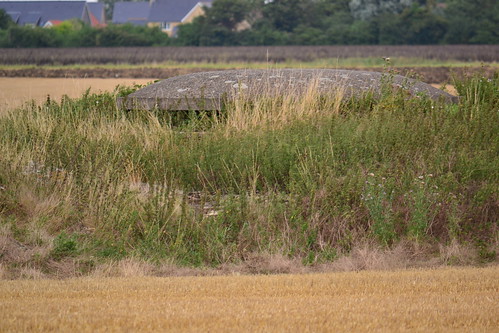
Airfield defence in the form of an ‘Oakington’ pill box.

The day after this, Group Captain Bennett visited Warboys to give a lecture on the Pathfinder Force and to promote its use; he must have made a good impression for after the lecture six Warboy’s crews volunteered for Pathfinder duties.

Further operations were carried out on the night of  27th – 28th August to Kassel. A good night for visual marking meant that bombing was accurate, and as a result all of the Henschel factories were damaged. However, the cost to the Pathfinders was very high. It was on this operation that the Pathfinders suffered one of their greatest losses. Thirty-one aircraft were missing of which fourteen were Wellingtons and three were from 156 Sqn. The next day, the mess hall was devoid of three crews, those from: ‘X3367’, ‘Z1613’ and ‘DF667’, and unbeknown to those sitting around the mess, there were no survivors. A fourth bomber (BJ883) returned to Warboys after the pilot, Sgt. E. Bowker, suffered severe head pains and was unable to carry on.

Not all operations were as bad. On the night of 19th – 20th September following action over Saarbrucken, a flare became lodged in the bomb bay of one of the 156 Sqn Wellingtons. Whilst sitting there it ignited causing a fire in the aircraft’s belly. The Pilot,  New Zealander Sqn. Ldr. A. Ashworth, instructed his crew to bail out, after which the fire extinguished itself allowing him to fly the aircraft back single-handedly, landing at the fighter station RAF West Malling in Kent. The operation itself, undertaken by 118 aircraft, was otherwise uneventful, although haze proved to be an obstacle for the markers.

The last 156 Sqn Wellington raid for 1942 occurred on December 21st and took the squadron to Munich as part of a force of 137 aircraft. The loss of ‘BK386’ crewed entirely by Canadians brought 1942 to a close, and a loss of 15 aircraft this year. To add insult to injury, whilst the majority of the bombers claimed to have hit the city starting large fires, photographs showed that in fact most bombs had fallen outside of the city in open countryside, possibly as a result of a successful decoy employed by the Germans. It had not been the most auspicious of starts for the Pathfinders, nor 156 Squadron at Warboys.

However, by early January, a new aircraft type was starting to arrive at Warboys – Avro’s mighty four engined heavy, the Lancaster MK.I. Created out of the under-performing Manchester, the Lancaster would go on to be one of the most iconic aircraft of the Second World War. Perhaps now the tide of misery would turn and Warboys crews would begin a new era in aviation history.

RAF Warboys

The beautiful Memorial window dedicated to the Pathfinders.

The full trail appears in Trail 17

Spitfires Galore! – RAF Ludham (Part 3)

In the previous parts of RAF Ludham, we have see how it got off to a slow start and how Spitfire squadrons used Ludham for off shore patrols. We saw how the airfield was handed over to the Americans and redeveloped with concrete runways and a new watch office. Now it was the turn of the Royal Navy to use Ludham, an experience they would rather have not had.

Being only four miles from the Norfolk coast, Ludham (or HMS Flycatcher, RNAS Ludham as it was now known) would have normally been ideal for the Royal Navy, however, this was not the case. The RN had recently set up the Mobile Naval Airfields Organisation, (MNAO) and was looking for a suitable location for its headquarters. The RN had considered locations as far away as the Far East, but in desperation had turned to the RAF for help with a suitable site. The RAF offered Ludham which the Royal Navy reluctantly accepted.

A small party arrived at Ludham and took charge, led by Commander (A) J.B. Wilson and Captain L.J.S. Edes. The airfield still being closed to flying, was commissioned for use by the RN on September 4th.

The purpose of the MNAO, which had by now changed names to Mobile Naval Air Base (MONAB), was as a facility providing airfield facilities working in conjunction with the Fleet as they progress across the Pacific toward Japan. They would take control of captured airfields or otherwise construct their own, thus providing air support and maintenance work for Royal Naval aircraft*1. The range of aircraft that Ludham would cater for included: the Avenger; Corsair; Expeditor; Firefly and Hellcat.

The creation and structure of MONAB is complex, each unit consisting upward (and sometimes in excess) of 1,000 personnel a number that would cause great problems for those at Ludham. With new personnel coming in, the numbers would exceed those that Ludham could realistically cater for and so many were put up in tents or other temporary accommodation. The winter of 1944 – 45 being one of the worst, eventually turned Ludham into a bog, cold, wet and very muddy! Ludham soon became a terrible place to work, let alone live! The RN decided to split the MONAB so that only the Receipt & Dispatch Unit was based at Ludham, which in itself led to more complications. As time went on, the RN began searching for a more suitable location, one with good road and rail connections as well as better accommodation facilities.

The whole saga ended up being so poor, that by January the RN were almost as desperate for a new location as they were before being offered Ludham. In February, the Air Ministry offered Middle Wallop, an airfield under the control of 7 Group RAF. On the 16th, the transfer occurred and RNAS Ludham ceased to be, Middle Wallop taking on the both the role and the name HMS Flycatcher.

After the Fleet Air Arm vacated Ludham, the airfield was handed back to RAF control, although many of the functions continued to be carried out by the remaining Naval personnel. In mid February, the former Station Commander of Matlask Sqn. Ldr. P. G. Ottewill (previously awarded the George Medal) arrived to formally take over control of Ludham. His arrival would signify the definitive end of the Navy’s links, and the last Naval personnel finally moved out on the 24th.

Ludham wouldn’t stay quiet for long though. Within days of the Navy’s departure two new squadrons would arrive bringing back the old favourite, the Spitfire, with the arrival of both 602 and 603 Sqns.

Armourers set the tail fuses on a clutch of 500lb bombs in front of a Spitfire XVI, 603 Squadron, Ludham, March 1945. The bombs were destined for V-2 sites in the Netherlands (© IWM CH 14808).

Both 602 (City of Glasgow) Squadron and 603 (City of Edinburgh) Squadron were Auxiliary Air Force (AAF) Squadrons, devised out of the remnants of the First World War, and led by Sir Hugh Trenchard. Post war apathy however, prevented the official formation of this force until 1924 when a Bill was passed in Government making them both legal and official. Initially designed to be ‘reservists’ they were to be located near to the city of their name and would be called upon to protect that region in the event of an attack. Manned by a cadre of regulars and non-regulars, the Auxiliary Air Force officially came into being on January 17th, 1939. Throughout the war the AAF, sometimes seen as ‘part-timers’, were responsible for a number of both high ranking officials and remarkable feats. Indeed, the AAF were a force to be reckoned with, the first Luftwaffe aircraft shot down over Britain*2 (the ‘Humbie Heinkel) going jointly to both 602 and 603 Sqns in an attack over Edinburgh.

602 (City of Glasgow) Sqn had the honour of being the first of these AAF units to emerge from this Bill, being formed on 12th September 1925 at Renfrew, Glasgow. 603 (City of Edinburgh) Sqn joining them not long after on 14th October 1925 at Turnhouse. Throughout the war years both units would move around covering the length and breadth of Britain (603 even having postings to Egypt) before reuniting here at Ludham in February 1945.

February 1945 had been a wintery month, the poor weather causing several missions to be postponed, with all commands of the Allied forces suffering. 602 Sqn returned from France to Coltishall, after which they moved between Matlask, Swannington and back to Coltishall before arriving here at Ludham on February 23rd 1945. The following day, their sister squadron 603 Sqn, arrived having been abroad operating with Beaufighters. Their arrival here at Ludham meant that 12 Group would have six operational squadrons in the vicinity, all dedicated to defeating the V2 rocket menace that was plaguing London and the south east. Upon moving in, neither squadron took long to settle, and the general consensus was that Ludham was a ‘good airfield’ to be based at, especially compared to Matlask and Swannington!

By this time 602 would have the Spitfire XVI which allowed for a 1,000lb bomb-load. This would be used not only against ‘Big Ben‘ (V2) sites, but bridges, railways and other communication lines across Holland and western Germany. 603 Sqn had the LF XVIE Spitfire, capable of carrying a more modest 500lb bomb load (either as 2 x 250lb or 1 x 500lb bomb) as a dive bomber, a role that the Spitfire was not designed for. As might be expected, a friendly rivalry had grown between the two squadrons resulting in a competition to see who could hit the most locomotives or other vehicles. This resulted in numerous ground attacks being carried out, some 1,008 hours being flown by 603 Sqn alone.

The daily routine continued with the bombing of sites in Holland as ‘Ramrod‘ missions. Crews from Matlask, Swannington and Coltishall all joining the Ludham crews. These sorties focusing on the V2 rocket sites, the Haagsche Bosch taking a particular pasting  in these last few cold days of February 1945.

Following information provided by the Dutch resistance, these Spitfires would patrol, with, pretty much, ‘free-reign’ over the Dutch countryside concentrating on areas around The Hague. Woodland became a source for many attacks, the Germans being particularly clever at hiding mobile V2 sites in such areas. Pilots, being acutely aware of Dutch civilians, would look for any traffic movement on roads around these areas and these were to be ‘fair game’, civilian traffic unlikely to be roaming so freely at this time.

Pilots of No. 602 Squadron study targets in Holland, with the aid of a large-scale map and target photographs in the Operations Room at RAF Ludham (possibly March 1945). This was part of a series of ‘posed’ photographs. Note the pilots names on the lockers and the seat-type parachute on the top of one. The pilots are (left to right): P.O. W. J. Robert, F.O. R. F. Baxter (the famous TV presenter, Raymond Baxter), Sgt. S. Gomm, W.Off. L. T. Menzies, W. Off. Crossland, Sgt. T. L. Love, W. Off. J. Toone and W. Off S. Sollitt. (© IWM CH 14810)

Attacks would normally come in from between 6,000 and 8,000 ft, diving down at about 70o, letting bombs go at around 3,000 ft. It was a difficult attack, keeping the target in the sights whilst avoiding flak and keeping the aircraft together. On one occasion, a Spitfire was seen to lose its wings pulling out of a dive too quickly, the bombs still attached to their mounts.

The whole of March saw similar patterns, attacks on railway yards, locomotives, transport facilities, trucks and V2 sites.

By April,  the war was all but over, with which came a final move for both 602 Sqn and 603 Sqns to Coltishall. Prior to this, on the 3rd, the two squadrons were given an ‘Easter gift’ in the form of a day out on the Norfolk Broads. For 603 breakfast finished at 10:30 at which point the bar opened for Guinness, providing a liquid recreation for those who wished it. Other 603 Sqn crews took boats up to the Broads where they joined with 602 crews spending the day relaxing on its quiet waterways.

On the 4th the order to vacate Ludham came through, the airfield was busied, sorting and packing equipment and tools, and on the 5th all aircraft, ground staff and equipment of both squadrons departed in shuttle flights for Coltishall – another link had been broken.

However, this was not to be the end of Ludham. Even as the Nazi war machine ground to a halt, Ludham would continue on, with two more squadrons arriving. Throughout the war the Spitfire in its various marks had been the main type to use Ludham, this was no different, 91 Sqn bringing the Spitfire XXI (8th April), and 1 Sqn the F.21.

There time here at Ludham was filled with mass formation flying, cross-country flights, dive bombing practise and regular parties. The crews even enjoying time fishing and boating on the Broads. Events were becoming so predictable that almost anything different was news, on August 1st Fl. Lt.R. (Tac) Brown became a father, a baby son being recorded in the ORB for that day!

Both units would stay until mid / late July 1945, at which point they departed, 1 Squadron heading to Hutton Cranswick, the Spitfire being the last piston-engined fighter aircraft to fly with this prestigious unit before taking on jets; and 91 Sqn to Fairwood Common, again the Spitfire seeing the end of piston engined aircraft before the dawn of the jet age. With their departure, the end had now come for Ludham as an active military airfield. The site was closed, put into care and maintenance and eventually sold off for agriculture.

By the time it closed Ludham had developed from a basic satellite station to an airfield in its own right, with the addition of three hard runways, twelve pens, nine hardstands and the addition of (US type) single and double hardstands. It also had one type T2 hangar and four blister hangars – one of which survives today although not in its original location.

As with many of Britain’s wartime airfields, Ludham returned to agriculture, the runways were dug up and many of the buildings pulled down. Some remained used for agricultural purposes and part of one runway was left, used for crop sprayers and private light aircraft, one of the blister hangars was uprooted and placed on the end of the runway. Those buildings that were left decayed, including the two watch offices. In 2000 – 01, they were restored, and in 2005, Historic England (entry No: 1393540) designated both buildings as Grade II listed, as an “exceptionally well-preserved example of a Second World War control tower.” However, they were both left empty and the inevitable happened again, they began to decay and fall into disrepair once more a state they exist in today*3.

Dotted around the perimeter (a mere track) are a handful of buildings, defensive posts and firing butts, all remnants of Ludham’s once chaotic but meaningful past.

Ludham airfield rests between the villages of Ludham (to the south west) and Potter Higham (to the south east). The main A149 passes to the eastern side and the entire site is circumnavigated by a minor road. From this road, the majority of remnants can be seen, with good views across the entire site. A small private road leads up to the watch offices, and parts of the peri track and runways are still in evidence. Various buildings and structures can be found around this track too, some hidden in private gardens and utilised for storage.

Ludham started out as a satellite airfield, its future seemingly never intending to be major. But, circumstances dictated otherwise, eventually becoming a major player in the front line against enemy shipping, the V2 menace and as a safe haven for returning aircraft, limping home from battles over occupied Europe. If that isn’t sufficient for an entry in the history books, then what is?

The full story of RAF Ludham appears in Trail 58.

Sources and further reading.

National Archives: AIR 27/253/24 
National Archives:AIR 27/2107/15
National Archives: AIR 27/2107/19
National Archives: AIR 27/1164/17
National Archives: AIR 27/1164/14
National Archives: AIR 27/2078/31
National Archives: AIR 27/2080/29
National Archives: AIR 27/4/33

*1 For further information and a detailed explanation of MONAB, including photographs and history, see The MONAB Story – A history of the mobile airfields of the Royal Navy website.

*2 The shooting down of the ‘Humbie Heinkel‘ can be read in Trail 42 – East Lothian, Edinburgh’s Neighbours. 

*3 Historic England Website Listing 1393540

Simpson, B., “Spitfire Dive-Bombers versus the V2” Pen and Sword (2007) – for further information about Spitfires used against the V2 rockets.

RAF Rackheath – The 467th BG, the highest bombing accuracy (pt2).

In Part 1 we saw how Rackheath had been developed, and how the 467th BG, the resident group had been subjected to a fierce introduction to the war.

Now, in part 2, we continue our visit to Rackheath and the bizarre event of December 1944.

On December 24th,  B-24 #42-50675 “Bold Venture III” piloted by 1st. Lt. P. Ehrlich, was one of sixty-two B-24s from the 467th taking part in a maximum effort attack on a range of targets in Germany. Hit by flak over the target, five of the  crew, including the pilot, bailed out fearing the aircraft was lost. All five were subsequently captured and incarcerated as prisoners of war. The fires in the engines then extinguished themselves allowing the remaining crew to engage the auto-pilot, taking the aircraft homeward and over allied territory. Once over France, they too bailed out as they were unable to land the heavy bomber, each of these men being safely picked up by allied forces. The plane then continued on, unmanned across the Channel, until it ran out of fuel.

RAF Rackheath

The former hangar has been completely refurbished.

At this point, the story becomes confused. Some say it landed / crashed  in a field near to  Lower House Farm, Vowchurch Common in Herefordshire. The wreck being salvaged the following day. However, there is little evidence of this event, and other sources (Freeman “The Mighty Eighth“) have it landing in a Welsh marsh a little further west. Whatever the truth is, its a remarkable, but not unique, story of  a crewless bomber flying ‘home’ coming to rest safely on British soil.

Also on that Christmas Eve, another Rackheath B-24, #42-95220, piloted by First Lieutenant William W. Truxes Jr , was hit over Pruen. The aircraft then exploded over Rettigny in Belgium, killing Sgt. Walter Walinski (TG); Sgt. Stanley P. Koly (LWG); Fl. Off. David J. Countey (Nav); Sgt. Roland L. Morehouse (BA); St. Sgt. Peter Hardick Jr (TTG); St. Sgt. John N. Ellefson (Radio Op) and Sgt. Alek Onischuk (RWG). Only the Nose Gunner St. Sgt. Robert J. Ball Jr. returned to duty the remainder being taken prisoners of war.

On the 29th the continuing appalling weather caused the loss of two more B-24s, both crashing attempting to take off from a foggy Rackheath (#42- 95115 and #42-51572). A third (#42-94881) was then abandoned over the sea, and a forth (#44- 10607) crashed at Attlebridge also after sustaining damage on its take off. The  visibility was so poor that day that the crews couldn’t even make out the edge of the runway. As a result of these crashes, the mission to Prum, was finally scrubbed, but by then fifteen airmen had already been lost.

The dawn of 1945 saw the Ardennes offensive continuing, and at Rackheath B-24 ‘Witchcraft‘ was approaching its 100th Mission an achievement it made on January 14th 1945. In just 140 days since arriving, it had reached its 70th mission an average of one mission every two days, but what made this particular achievement so remarkable was not this incredible average, but the fact that the aircraft had been mechanically sound throughout, not having to turn back from any sortie it had undertaken. A remarkable achievement, and a solid testament to the dedication of the ground crews who kept her in the air.

The Witch“, as she affectionately became known, would go on to complete a total of 130 missions without a single abort nor injury to any crewman. She became one of the most celebrated aircraft in the 8th Air force’s history. This total would surpass all other B-24s in the whole of the European theatre of operations. Like many though, ‘The Witch‘ eventually returned to the US where she was unceremoniously taken apart at Altus, Oklahoma. In memory of the aircraft, her achievements and the crews who were lost flying B-24s, she is now represented by the world’s last flying Liberator, currently owned and operated by the Collings Foundation, Massachusetts.

Ground crew of the 467th BG B-24 “Witchcraft“. Standing Crew Chief Joe Ramirez, Chamberlin. Front Row Walter Elliot, Geo Dong, Joe Vetter, Ray Betcher.’ (IWM FRE 1979)

As 1945 progressed the end of the war was near. Attempts by the Luftwaffe to curtail bomber intrusions into German airspace were becoming desperate. The introduction of the Me 262 was too little, too late, to make a major difference. But so determined to stop the bombers were the Luftwaffe pilots that many still got through and they were finding the bombers.

Other fighters more determined to bring down the enemy began ramming them. A specialist squadron the ‘Sonderkommando Elbe‘  was set up using volunteer pilots. They were instructed to strike the fuselage of the bomber between the wing and tail thus cutting the aircraft in two, a tactic that would  allow the German pilot to bail out of his aircraft whilst taking down the bomber.

On April 7th, the unit was put into action in its one and only recorded attack, as over 1,000 heavies flew towards German airfields, oil storage facilities and factories in north-west Germany. From the 2nd AD, 340 B-24s headed for Krummel, Duneburg and Neumunster. As the force approached they were targeted by a mix of over 100 Luftwaffe fighters including 109s, 190s and 262s. In this mix was the Sonderkommando Elbe. Whilst the tactic would prove to be more devastating to the rammer than the target, one of Rackheath’s B-24s #42-94931 ‘Sack Time‘ was hit in the tail severing the starboard stabiliser. The B-24’s pilot, Lt. Robert Winger, managed to keep the aircraft flying but with little control, he ordered the crew to abandon the aircraft once over allied territory. The B-24 then crewless, fell from the sky.

It is not known whether the attack was a deliberate act by the Sonderkommando Elbe, or as a result of the tail gunner Robert (Bob) Perkins’s action. Perkins in his attempt to defend the B-24, fired desperately at the attacker, Heinrich Henkel, striking the aircraft several times.

Then for three days in mid April, the heavies of the USAAF turned their attention to the gun batteries around Royan. These German strong holds were hindering the allied plans to use the port at Bordeaux, they had to be ousted.

During one of the missions, on April 15th, the 467th would make history again when three of the four squadrons released all their 2,000lb bombs within 1,000 ft of the mean point of impact, half of these being within 500 ft – a record that would not be beaten by any other USAAF unit. This was the ‘icing on the cake’ for the 467th who were building a strong reputation for consistent and accurate bombing.  So determined were the Americans to remove the defenders on the ground, that they used Napalm in 500 lb tanks, a rather horrific weapon used to great effect during the Vietnam war.

By the end of April the war was all but over, and at bases all around the UK, air and ground crews eagerly awaited the notice to cease operations. Some units were already being stood down, and very soon operations would begin to drop food rather than bombs. As the end of hostilities was announced, the figures began to be totted up. The 379th BG at Kimbolton were recorded as dropping the greatest number of bombs on a target, with the 467th BG at Rackheath achieving the greatest accuracy. This Rackheath record was due, in part, to the dedication, support and drive of its Commander, Colonel Albert Shower.

On April 25th 1945, the 467th completed its last mission, a total that amounted to 212 (5,538 sorties credited), dropping 13,333 tons of bombs. With 29 aircraft classed as ‘missing’, and a further 19 lost on operations, the war had not been cheap.

RAF Rackheath

The former runway looking north-east.

On May 13th, the 467th were to lead the Victory Flypast over High Wycombe, the headquarters of the Eighth Air Force operations, the choice of a B-24 as lead fuelling the ‘ill-feeling’ between B-24 and B-17 crews even further.

Over the next month, the aircraft and men of the 467th would return to the US, the majority of aircraft departing Rackheath on June 12th, whilst the ground echelons left via the Queen Mary from Greenock, the same port they had arrived at just over a year earlier. Eventually the 467th would be disbanded, renamed the 301st, but for Rackheath it was the end, and within a year much of the airfield was already being ripped up, the runways were disappearing and many of the accommodation buildings had been torn down. The entire site measuring just short of 4 km2  was already beginning to disappear.

Gradually agriculture has taken over, much of the main airfield site are now fields. The technical area has since been developed into an industrial estate with many of the original buildings being re clad, redeveloped, modernised or pulled down. The watch office has thankfully been refurbished and from the outside resembles a watch office typical of the time. Inside it is now offices. The one surviving T2 hangar, has had brickwork added to it, other buildings are almost indistinguishable from their modern counterparts. A memorial, dedicated to the men and Women of the 467th was unveiled on 29th July 1990, by the then 80 year old Colonel Albert J. Shower, returning for one last time to the place he had built up a reputation for hard graft whilst appreciating the need for recreation.

If approaching from the south, take the A1270 from Norwich heading north, leave at the roundabout with Salhouse Road turning right. The Holy Trinity Church is a few hundred yards along this road. Here you will find the village sign, memorial benches and numerous plaques in memory of the 467th. The two wrought iron gates at the entrance of the church were donated by the Coffey crew. Inside here (the church was closed on my visit) a collection of photographs and letters bring the Rackheath to life once more.

RAF Rackheath

The memorial gates donated by the Coffey crew.

When leaving the church, go back but turn right along Green Lane West. This takes you past the remaining hardstands and along to the industrial estate. Enter by Wendover Road, named after Wendover Field in Utah. Turning into Bidwell Road, (following the signs) you will find the main memorial on the the corner of Bidwell Road and Liberator Close.

Coming back again, turn left, follow Wendover Road to the corner with Witchcraft Way, a small road to your left. Here you will see the Watch Office. Also along here are Ramirez Road, Albert Shower Road, the T2 and other buildings of interest. A real rabbit warren, it is best explored to really discover the many buildings and plaques that remain.

The main accommodation areas were located back across the from the entrance of Wendover Road. Today a new road has been cut through this wooded area but within these woods, remains of huts still exist, some with etchings on the walls. All on private land, they are also gradually disappearing from view.

Rackheath was a short lived base, operating for just a short part of the war. But its contribution and the contribution of its crews, was nonetheless immense. With high accuracy and the determination to win, they took the war into the heart of Germany itself. The names of these young men now live on, in the road names and plaques that adorn many of the building and streets around this beautiful and now peaceful area of Norfolk.

After departing Rackheath we head a few miles east, toward the coast. Not far away, is another airfield, this time a former RAF site. Long gone it continues to use part of the original runway, two watch offices remain, and a smattering of wartime buildings lay dormant in the corner of now agricultural fields. In part 2 of Trail 58 we visit RAF Ludham.

Sources and further reading RAF Rackheath

For more detail on Mission 311 see: McLachlan, I., “Night of the Intruders” Pen and Sword (1994).

RAF Rackheath – The 467th BG, the highest bombing accuracy (Pt1).

In Trail 58 we head to the east of Norwich into an area known as the Norfolk Broads; an area created through turf extraction in medieval times. The large, shear sided pits were later flooded giving more navigable inland waterways than both Venice and Amsterdam.

Today, it attracts a wide range of wildlife, and offers a range of boating, bird watching and fishing holidays. The shear size and scope of the Broads attracting some 7 million visitors per year to enjoy the rich nature and peace of the Broads.

But in this area during the Second World War, life was very different. Overhead, the drone of aircraft engines was a constant reminder of a war being fought both across the sea and here in East Anglia.

Between Norwich and the East Anglian coast we visit two airfields, one USAAF and one RAF, both now long closed, they each played a vital part in the destruction of the Nazi tyranny across the sea in Europe.

Our first stop is a former bomber base. Now a huge industrial estate where many of the original wartime buildings have been demolished. But some still remain, refurbished, re-clad and in many cases almost indistinguishable from their original design. A memorial, located in the heart of the estate, denotes the technical area of the former base, and a local church displays a collection of wartime photographs.

Our first stop on this trail is the former US bomber base RAF Rackheath (Station 145).

Rackheath (Station 145)

Rackheath airfield lies approximately 5 miles north-east of Norwich, bordered to the east by the  East Norfolk Railway Line, and to the west by the (modern) A1270.

RAF Rackheath

Rackheath village sign denotes its history and links to the base.

Built over the period 1942-43, it was built as a Class A airfield incorporating three runways: one of  2,000 yds and two of 1,400 yds in length, each 50 yds wide and each covered with concrete.

A large number of hardstands lined the perimeter track, some 50 altogether, all being of the spectacle type; with  a bomb store to the north of the main airfield site, sitting surprisingly close to the majority of the hardstands and nearby Rackheath village.

A wide range of technical buildings, supported by two T2 hangars for aircraft maintenance, allowed for repairs and crew preparation: crew rooms, parachute stores, dingy stores, armouries, photographic blocks and so on. The watch office (design 12779/41) stood proud of the technical area located to the south-west of the site. All personnel areas – eleven accommodation and three ancillary sites – lay to the west of the airfield, dispersed around Rackheath Hall, an early 19 Century listed building with its notable architectural features and its own turbulent history. These sites, hidden amongst the woodland, were both extensive and well serviced by concrete roads that led to the main airfield site.

Rackheath was initially designed as a bomber airfield, but during the construction phase, it was re-designated as a fighter airfield. However, delays in the construction process, led to it never being operated as a fighter station, instead it was manned by the Eighth Air Force’s 467th Bombardment Group (BG) and B-24 Liberators.

The 467th BG consisted of the 788th, 789th, 790th and 791st Bomb Squadrons (BS), each flying Consolidated’s heavy bomber the B-24 Liberator. The group’s long journey to Rackheath started on 19th May 1943 at Wendover Field in Utah. After being activated on August 1st, they moved to Mountain Home Army Airfield in Idaho, then back to Utah and Kearns, from there onto Wendover Field again where they remained for fifteen weeks undertaking intensive training. On 12th February the ground echelons made their way, by train, to Camp Shanks, New York where they boarded the US ship Frederick Lykes. Their Atlantic journey brought them, like so many before them, to Greenock, a major port on the Clyde on Scotland’s west coast. From here, they boarded trains and made their way to Rackheath.

The air echelon in the meantime flew the southern route, tragically en route, they lost one of their B-24s (#42-52554 “Rangoon Rambler“) with all its crew, over the Atlas mountains in North Africa. The remainder of the group finally arrived here at Rackheath combining with the ground echelons in late March 1944, where they began to prepare for their first operation on April 10th.

Operating initially within the 2nd Bombardment Division (later the 2nd Air Division) 96th Combat Wing (CBW), they flew Liberator ‘H’, ‘J’, ‘L’ and ‘M’ models under the command of Colonel Albert J. Shower, the only US group commander to have brought and remained with the same group until the end of hostilities.

The 467th’s first mission was to bomb Bourges airfield, a relatively light target in which 730 bombers pounded aviation targets across the low countries. On the next day, they formed part of a even larger force of over 900 heavies attacking aircraft production factories in Germany, their honeymoon was well and truly over in one fell swoop.

But the first major event of the war for the 467th was to occur shortly after this on April 22nd 1944, on a day that has since become infamous in American aviation history. Mission 311, was an attack by 803 heavy bombers of the 1st, 2nd and 3rd Bombardment Divisions on targets at Hamm, Soest and Koblenz along with targets of opportunity. The Massed formation, escorted by 859 fighters, were led by the 445th BG, 2nd Air Division from Tibbenham. The 96th CBW portion was led  by the 458th BG from Horsham St Faith, with the 466th BG from Attlebridge on the low left, and the 467th ‘The Rackheath Aggies‘  on the high right.

As teleprinters rattled across the East Anglian area, B-24s were bombed up, fuelled and checked over by mechanics who meticulously prepared their machines for war. Maps were drawn up, meteorological reports were read out and orders were strict – ‘avoid the Ruhr!’

Once in the air, brightly coloured assembly ships gathered their flocks together in tight formations, and then it was time to set off for Germany. On route, technical problems dogged the lead plane, which led to inaccurate navigation, and ultimately brought the entire force into Ruhr Valley – exactly where they did not want to be.

Dividing up, the massed formations hit a range of targets, Hamm being the focus of the 467th. Surprisingly though, results were good, especially considering the many problems the formation had suffered flying over to Germany. Pleased with their results, the 467th set course for home, blissfully unaware of the dangers that were lurking not far away as they made the return leg of their journey.

The whole operation had been meticulously planned, but it meant that many of the bombers would be arriving home in the dark, an environment alien to many American crews. Experience had told them that Luftwaffe fighters lurked in the dark, unseen and dangerously accurate in their attacks.

When approaching from the east, Rackheath and Nearby Horsham St. Faith were the first two large airfields available, a distance of just some 4 miles separating them. With navigation lights and landing lights illuminating the aircraft, airfields were lit up like christmas trees, each one inviting their bombers home to safety. These lights were also a beacon for the as yet unknown, marauding Luftwaffe night fighters. As the first Rackheath Liberator approached, the air filled with requests for landing  permission, fuel now getting critically low and crews tired from the long flight. Gun places were vacated and crews began preparing to land, everyone was starting to relax – they were home.

It was this point that all hell was unleashed over Rackheath. Canon shells ripped in to the wings and fuselage of 1st Lt. Stalie Reid’s B-24 #42-52445, setting both starboard engines on fire.  The lead Luftwaffe pilot Staffelkapitaen Hauptmann Dieter Puttfarken of II/KG51, taking his companions, in their mix of night fighters, right into the heart of the flight path of the returning bombers. Here they waited, unseen, until the moment the bombers were at their most vulnerable.

RAF Rackheath

The former Watch Office has been refurbished and used as offices.

As the Liberator began to fall uncontrollably out of the sky, four of the crewmen manged to don their parachutes and escape, the remaining six failing to vacate the aircraft in time. All six were lost in the ensuing crash when the aircraft hit the Earth near to Barsham in Suffolk. For Sgt. Edward Hoke, one of those lucky enough to escape, his troubles were not yet over, for somehow, he was pulled from his parachute, and without a means to slow his descent, he too  fell to his death. It was only the third mission of the war for the crew.

Meanwhile, other aircraft began to line up desperate to land. Near misses were now becoming a risk, aircraft suddenly appearing out of the darkness within feet of each other. Then a second B-24 went down –  struck by the terror of the night. B-24 #42-52536 piloted by 2nd Lt. James A. Roden was hit by canon fire. So severe and so accurate were the strikes, that it severed the tail of the Liberator from the fuselage. Now split in two, the aircraft went into a spin and eventual fireball. The entire crew were lost that night.

Not content with picking aircraft off in the air, the Luftwaffe night fighters then began to attack, with bombs and guns, the main airfield site, strafing ground targets almost at will. By now crews were starting to panic, some withdrew from the landing pattern and headed off away from the airfield only to run the gauntlet of friendly Anti-Aircraft guns who were not expecting to see heavy American bombers at night.  By now it was becoming clear what had happened, and to protect the airfield all lights were extinguished. Aircraft were unable to see the runways, parts of which were now only illuminated by fires of wrecks and bombs. Waiting patiently, or diverting to other bases, B-24s light on fuel, circled frantically the field trying to find some sign that it lay below. The confusion that night, repeated across numerous US airbases, tore a hole in the hearts of the American flyers as numbers of those lost across East Anglia began to filter through.

April 22nd would go down in history as the worst loss in one night to intruders alone, made even worse by the fact that once over home territory, you consider yourself to be ‘safe’. Some American gunners were able to retaliate and there are records of intruders being shot down, but the statistics clearly fell heavily in favour of the intruders.

With that, the 467th had finally cut their teeth, their war was real, and it was having an effect.

On D-Day, the 467th were assigned to bombing shore installations and bridges near to Cherbourg, then as the allies progressed through France they supported them by attacking supply lines at Montreuil. A few days after the D-Day landings, a 467th BG Liberator became the first four engined bomber to land on a beach-head airstrip. The B-24 #42-95237, ‘Normandy Queen‘ piloted by 1st Lt. Charles Grace was hit by flak and badly damaged. Unable to make the crossing back home, he ordered the crew to bail out whilst he and his co-pilot brought the aircraft down onto an allied fighter airstrip, luckily without further mishap. All the crew that day survived to tell the tale.

B-24 Liberator (4Z-U, #42-95237) 791st BS, 467th BG parked on the grass in a field in Normandy – the first four engined heavy to do so. (IWM FRE 8431)

By now the allied onslaught of occupied Europe was well under way. Continual flying began to make its mark on both air and ground crews. The summer months seeing over 28,000 sorties being flown, meaning that many crews were reaching their quotas of missions in a very short space of time.

In early August a reshuffle of command within the Eighth saw several changes at the highest levels. Lower down, in the front line units, further reshuffles saw crews and squadrons move from one unit to another. The 788th BS, who had been taken to form the 801st Group to perform ‘Carpetbagger‘ operations in the lead up to D-Day, now rejoined their original Group back at Rackheath.

The long, cold winter of 1944-45 was known for its persistent fog, snow and ice that hampered air operations, and all just as the German army was about to make its one last push through the Ardennes forest. Christmas 1944 would be sombre time for the US forces, with the loss of both Brigadier General Frederick W. Castle and the fighter ace Major George Preddy who was inadvertently shot down by friendly fire and killed.

For the 467th BG it would also be a period of misery, a period that started with one of the most bizarre events in their history. We shall revisit Rackheath again in Part 2.