There were many airfields in the eastern region of England during the Second World War, and countless crews were lost flying in combat operations. Undeterred and undaunted by these losses, many continued the brave fight to release Europe from the evil grip that was slowly strangling it. Loses were high, but at one particular airfield, the loses of one Group were the highest, and of those that came here, few were to return home alive.
The second part of this trip, takes us closer to Swaffham and away from Thetford Forest. Here we visit an airfield with a history that resembles a Shakespeare play, loss, tragedy and a little success. Our second stop is an airfield that was used by a range of light and heavy aircraft, its history was also chequered, bearing witness to some of the more gruesome aspects of the air-war. Our first stop though is at the former USAAF airfield RAF North Pickenham.
RAF North Pickenham (Station 143)
RAF North Pickenham was built in the later part of the Second World War (1943/44) and was officially handed over to the USAAF, 492nd Bomb Group (BG), on May 22nd 1944, by an RAF Officer during a ceremonial hand-over parade. This handover would see the culmination of USAAF takeovers of British Airfields – some sixty-six in all. America’s ‘friendly invasion’, would result in eighty-two major operational units moving to the UK, all of which would occupy some seventy-seven military sites in total.
RAF North Pickenham (Station 143) was built with three concrete runways, 50 ‘spectacle’ style hardstands and a substantial bomb store to the north-west. Accommodation for the crews, was divided into a: communal site (site 3), mess site (site 4), six officers’ quarters (sites 6 to 11) and a sick quarters (site 5). Three further sites, 12-14, consisted of a small sentry post, sewage disposal site and H.F.D.F station. All the accommodation areas were to the eastern side of the airfield well away from the extended bomb store to the west.
The 492nd were a new unit, only being activated in the previous October. On arrival in the UK in April, they were assigned to the 2nd Bomb Division, 14th Combat Wing and sent to RAF North Pickenham where they entered combat on May 11 1944. The main body of the ground echelon was formed with personnel taken from units already in the U.K. whilst the air echelons were trained states-side and then ferried across the southern Atlantic route.
This first mission, which took the 492nd to marshalling yards in north-eastern France, saw 364 B-24s of the 2nd and 3rd Bomb Divisions combine with 536 fighters over occupied Europe. Whilst relatively uneventful for the 492nd, two B-24s did run out of fuel on their return journey; the first, B-24J, 44-4087 “Sweet Chariot” crashing at Bury St. Edmunds, whilst the second, came to grief at West Wittering in Sussex. Thankfully, only one crewman was lost (3 were injured), but he was to be the first of the many casualties of the 492nd’s operational war.
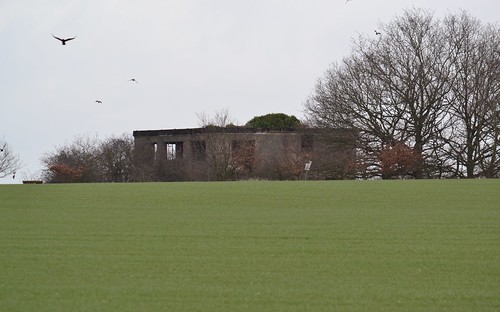
North Pickenham
Throughout the month of May, the 492nd operated against industrial targets in Germany, and being a new unit, their loses would be high. On May 19, 1944, a week into operations, they suffered their first major casualties, eight aircraft in total, all shot down in operations over Brunswick. Loses were not only happening in air either, only two days later, on May 21st, two B-24s collided on the ground whilst taxing -‘What’s Next Doc’ struck ‘Irishman’s Shanty’ – causing the former to be written off. It was not a good omen for the 492nd.
In the following month, on June 20, a massed 2nd Bomb Division formation attacked Politz, an attack that saw the 492nd lose a further fourteen aircraft, six of which managed to limp to Sweden before finally coming down.
Things then went from bad to worse for the 492nd, but undaunted and undeterred, they would continue their quest, attacking V-weapons sites, coastal batteries, and other defences along the Normandy coast. Apart from supporting the St. Lo breakout on July 25, they continued to attack targets in the German homeland for the remainder of what would be their brief existence.
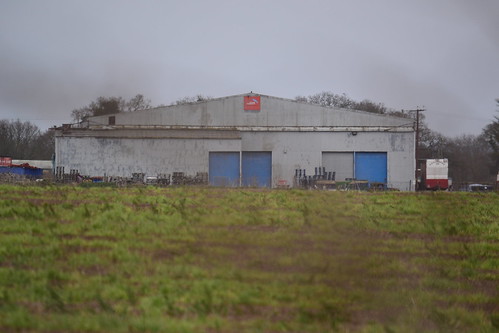
North Pickenham’s last remaining hangar before it was burnt down in 2014.*1
Consisting of the 856th, 857th, 858th and 859th Bomb Squadrons, they were not to fare well at all. In total, the 492nd would carry out sixty-six missions accumulating just over 1,600 sorties. During these operations, they would lose fifty-seven aircraft (including six non-operationally) which was the highest loss of any B-24 unit of the entire Eighth Air Force. Talk of ‘blame’ for these losses was rife; some blamed the aircraft’s all metal finish, saying it attracted fighter attention, others pinned loses on the Luftwaffe’s determination to bring down one single group, whilst another placed it solely at the inability of the crews to fly in neat well-structured formations. Whatever the reasons, it was certain that the 492nd were often ‘Tail-end Charlies‘ finding themselves in the weakest and most vulnerable positions of the formations – easy pickings for the now determined and desperate Luftwaffe pilots.
With loses continuing to climb and talk of a jinxed group spreading, an order came though on August 5 1944 for the 492nd to withdraw from combat missions and take over ‘Carpetbagger‘ operations previously being performed by the 801st at RAF Harrington. This order would not end the 492nd’s increasing casualties though. On the following day, another two B-24s would both collide on approach to the airfield. 44-4016 ‘Sugar-n-Spice’ and 42-50719 ‘Sans Souci’ struck each other causing them both to crash. The accident resulted in the loss of eleven crewmen with another nine injured.
Finally, on 7 August the order was put in place and after the last mission that day, the move began. This reshuffle of numbers and crews was in reality the disbandment of the 492nd, the crews and ground staff being spread far and wide and the 492nd name being transferred to an already well established unit – the 801st. The loss of these personnel gave North Pickenham a short respite from the rigours of war. But it would only be short. Within a few days, conflict would return as yet another B-24 unit, the 491st Bomb Group, would move in.
Originally designated to reside at North Pickenham, they were instead directed to RAF Metfield, primarily due to the immense progress that the 492nd had made in their training programme. Whilst there must have been concerns around the jinxed airfield, in terms of operational records, the 491st were to be quite the reverse of the 492nd. The 491st arrived at North Pickenham on the 15 August, and continued with their operations over occupied Europe. Like their previous counterparts, they focused on industrial targets in Germany, flying deep in to the heart of the Reich: Berlin, Hamburg, Cologne. Gelsenkirchen, Hannover and Magdeburg.
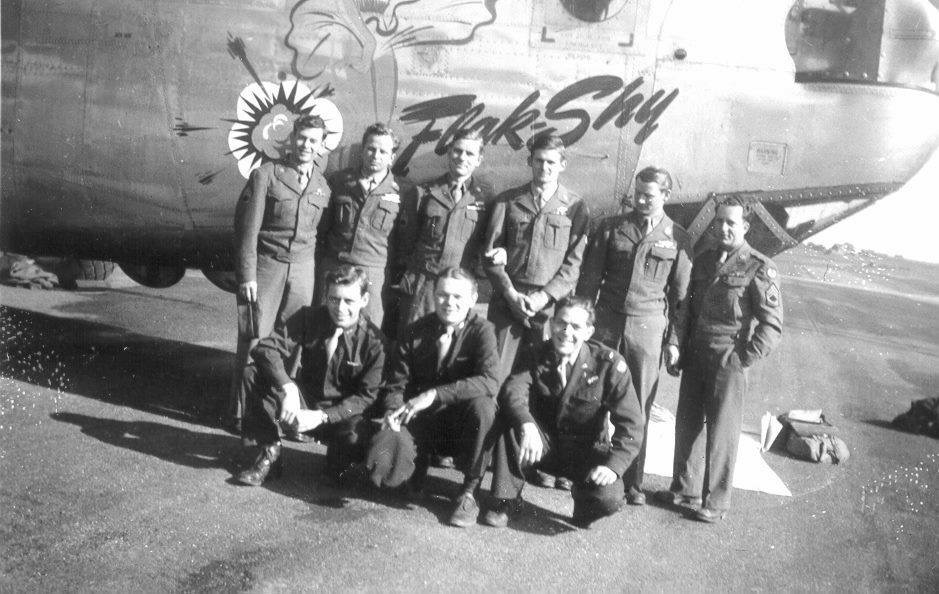
Ben Glidden front left pilot of ‘Flak Shy’ 491BG (Photo John Glidden)
It was on one of these missions, on November 26 1944, that they were awarded a Distinguished Unit Citation (D.U.C.) for successfully bombing their target in Misburg despite very heavy loses from a prolonged and determined German counter attack. Out of the original 27 aircraft that set out from North Pickenham that day, 15 were lost to enemy action.
As 1944 turned into 1945 the appalling European weather set in. The cold snows of the 1944/45 winter were one of the worst on record, as troops in the Ardennes and ground crews of the Allied Air Forces were to find out to their discomfort.
Many bombing missions were scrubbed, often at the last-minute, but desperate attempts were regularly made to not only get supplies through, but to bomb strategic positions held by the Germans. On January 5 1945, heavy snows fell across England and in an attempt to attack German positions, two B-24s of the 491st took off from North Pickenham with disastrous results.
The two aircraft, B-24, 44-40165 ‘Rage in Heaven’ the unit’s assembly ship, and B-24J, 42-50793, both crashed just after take off, with considerable loss of life. As a result, the decision was then made for the 491st to abandon any further attempts to get aircraft airborne, and their part in this operation was cancelled. Even though some 1,000 aircraft of the 1st, 2nd and 3rd Air Divisions would get aloft that day, January 5 would become a black day and notoriously famous for a number of such incidents across the English countryside.
Eventually by April 1945, ‘The Ringmasters’ as they had become known, had amassed over 5000 sorties, dropping over 12,000 tons of bombs, for the loss of only 47 aircraft on operational missions over occupied Europe. In June and July, after cessation of conflict, they began their withdrawal and a gradual return to the United States. A few days of ‘R and R’ then led to their inactivation on September 8 1945.
After the group left North Pickenham, no other flying squadrons were based here, neither American or RAF, but a brief residency of Thor missiles operated by 220 Sqn between 22 July 1959 and 10 July 1963, saw the site brought back to life momentarily. Finally, a last reprieve in 1965 saw testing of the Kestrel VTOL aircraft which of course became famous as the Harrier, one of the many British Jet Aircraft to see combat operations in the post war eras.
After the Kestrel trials were over, the site was closed and sold off, returning to a mix of poultry farming, and light industry. Many of the hardstands were removed, buildings left to deteriorate and the perimeter track reduced to a fraction of its former self. As time has gone on wind turbines have sprouted up across the open landscape making good use of the winds that blow across the Norfolk countryside.
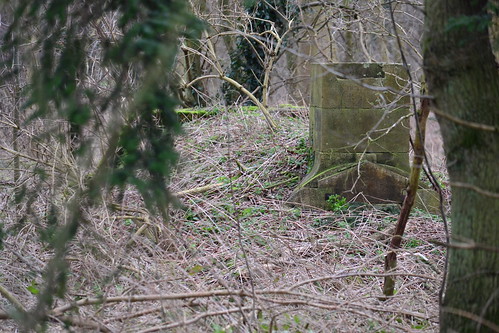
“Stanton” shelter located at South Pickenham.
Despite this decline, there are still signs of this once busy station to see. If approaching from the south, you will pass through South Pickenham first. Follow the leafy road toward the village, but keep a sharp eye open for amongst the trees are a series of “Stanton” air raid shelters of which there are five in total. Many of these are only visible by the escape hatches serving the top of the shelter. These were part of the domestic site that once served the airfield.
Some of these shelters are easily accessible being a few feet from the roadside, but as always, caution is the key word when visiting, and remember the laws of trespass! Moving further on, take a left and you pass a small collection of buildings on the right hand side.
These are the operations block and the store for the American Norden M7 bomb sight. In a very poor state of repair, they once played a major role in the American offensive over Nazi Germany, – there must be many stories held within their crumbling and decaying walls. Continue past the buildings and you arrive at a ‘T’ junction. Turning right will take you to the airfield, now an industrial site and turkey farm. Access from here is both limited and private. Instead turn left, follow the road along, and then join the B1077. Turn right and drive for a mile or two, the airfield is on your right. A suitable parking space allows views across the field where its enormity can be truly understood. Now containing many turkey sheds along its runways, the outline is distinct and relatively clear considering its age. Up until November 2014 one of the original hangars still remained*1 fire destroying the structure, and what was left then subsequently removed. A number of ordnance huts mark the former location of the bomb dump, these can still be seen in the foreground from this high vantage point. The Watch Office, built to design 12779/41, was demolished many years ago but stood opposite you and to the right.

Views across the Airfield, propellers of the wind turbines replace the propellers of B24s.
It is also possible to view the main runway. By driving around the site via Swaffham, or retracing your steps though the village, the best view is from the northern end of the airfield on the road from Swaffham to Bradenham, close to the village where the base gets its name. Substantial is size, these runways have fared remarkably well and the sheer size of them easily discernible from the views at this end.
North Pickenham may truly fit the description of ‘ghost’ airfield, its chequered history includes one of the worst fatality records of the whole eighth Air Force. Handed over to the Americans in May 1944, it was the 66th and final one to be so, thus ending a remarkable chapter in world history.
A memorial to the servicemen who flew from North Pickenham, lays silently in the village on the edge of a new housing development. Wreaths from nearby RAF Lakenheath enforce the link between the current American Air Force and Norfolk’s legendary flying history.
On leaving the remnants and stories of North Pickenham, we continue south-east, toward the former RAF Watton, another now extinguished British airfield.

Memorial dedicated to those who flew from, and never returned to, North Pickenham.
North Pickenham was originally visited in early 2014, this post has since been updated.
*1 This hangar was burnt down in November 2014. My thanks to the anonymous reader for the updates and corrections.
RAF Watton (Station 376)
RAF Watton, located some 11.5 miles north-east of Thetford, opened in 1939 as an RAF medium-bomber station. Unusually, it had only one runway, a grass strip that was later extended to 2,000 yards and ran east–west across the airfield.
The late 1930s saw a massive expansion of Britain’s military might, particularly its airfields. With little foresight into what lay ahead, these pre-war and early-war airfields were not designed or built to protect the personnel using them. Airfields built in this way became known as non-dispersed sites.
Once the reality of what the war would bring had become clear, however, later airfields were designed with greater dispersal, introducing a new dimension to airfield planning. Watton, built by the John Laing company, was constructed with much of its accommodation, technical area, hangars and other facilities grouped closely together on a single site.
Housing for personnel was located in the north-western corner, with the technical area just to the east. The bomb dump, an ideal target, lay further east. Four C-type hangars were constructed, each with a span of 150 feet, a length of 300 feet and a height of 35 feet. Although Watton was a medium-bomber airfield, and its aircraft were therefore relatively small, it was envisaged that larger, heavier bombers would soon enter service. Consequently, more hangar space than was necessary for the aircraft then in use was provided. Based on a 1934/35 design, these hangars would become commonplace across airfields built during the expansion period.
Another architectural feature at Watton was the redesigned Watch Office, an all-concrete structure built to Drawing 207/36. This design soon proved inadequate, requiring substantial modification or, as happened at many other airfields, complete replacement.
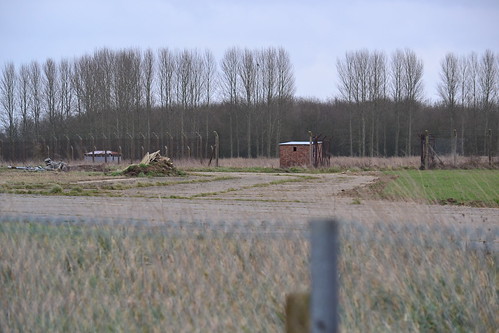
Part of Watton’s decaying perimeter track.
Although partially opened in 1937, the airfield was not fully completed and handed over to the RAF until 1939. As a pre-war design, it benefited from the ready availability of building materials, and the accommodation blocks were constructed in brick, providing suitable quarters for the personnel posted there.
Another aspect considered at this time was camouflage. Airfields were large, open expanses that could be seen from considerable distances and altitudes. Numerous proposals for concealing them were put forward, resulting in the formation of a special unit within the Directorate of Works, led by Colonel Sir John Turner. Watton came under the scrutiny of Sir John and his department, leading to an ingenious camouflage pattern of fields and hedges being painted across the entire airfield to conceal it from aerial observation. Although not completely effective, it went some way towards protecting the airfield from attack.
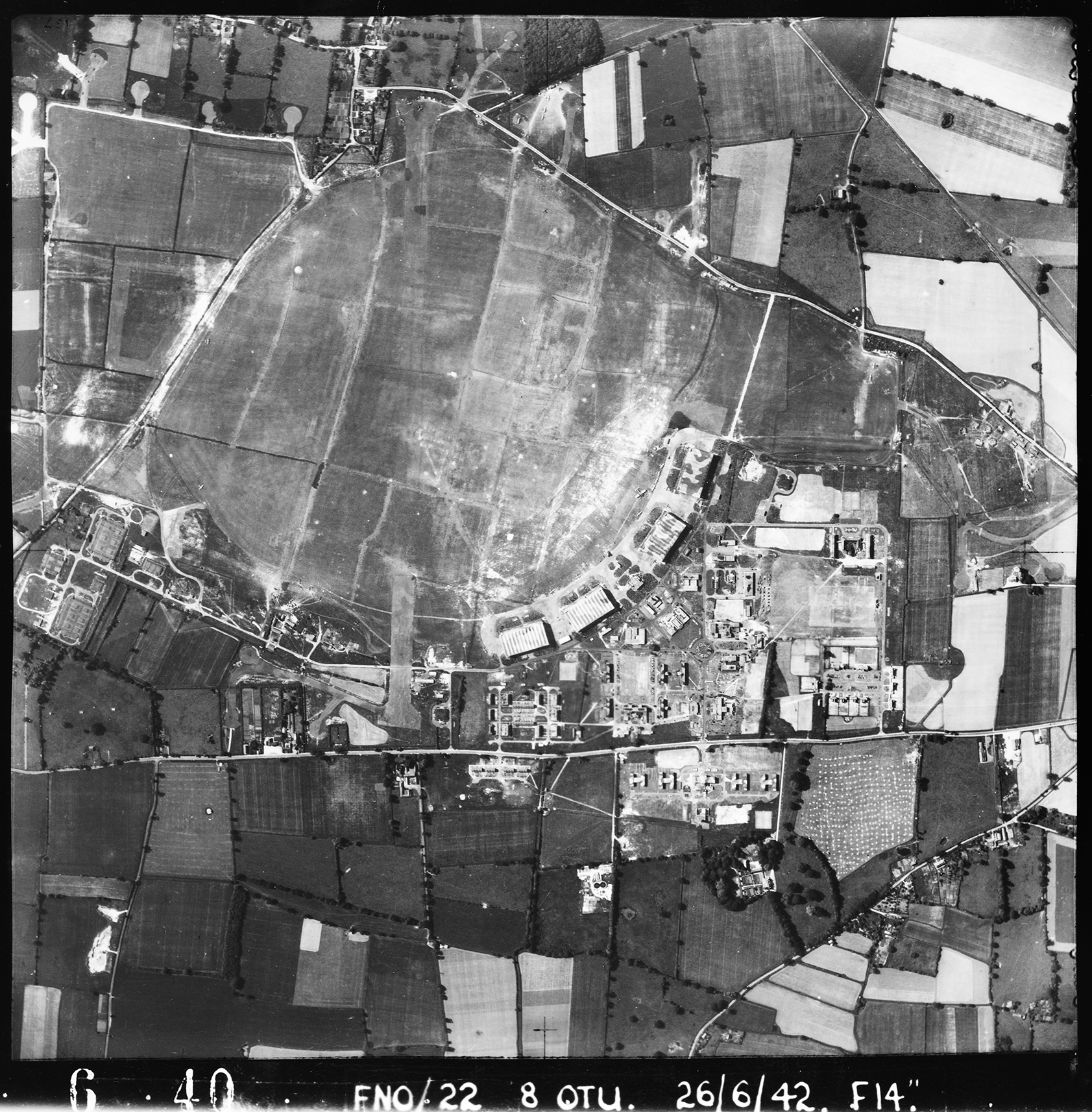
Photograph of Watton airfield taken in 1942 by No. 8 Operational Training Unit. The four hangars can be seen in the centre of the photograph, with the patchwork of ‘fields’ disguising the main airfield. English Heritage (RAF Photography).
The first arrivals were the men and aircraft of 21 and 34 Squadrons RAF. Their arrival on 2 March 1939 reunited the two squadrons under the command of Group Captain P. J. Vincent, DFC, and 6 (B) Group. On 7 March, the airfield was inspected by the Group’s AOC, after which 34 Squadron performed a flypast. This was the first of many visits by dignitaries, including the Marshal of the Royal Air Force himself, Sir Edward Ellington, GCB, CMG, CBE.
Little flying took place by either squadron at this time, however, as the aerodrome soon became unserviceable due to the very poor British weather. Grass runways quickly became boggy, making them unsafe for aircraft to take off or land without mishap, as was the case at many grass airfields during this period. From April, conditions improved slightly, and intensive training began, including station tactics and defence exercises. However, the weather continued to be the crews’ greatest enemy, repeatedly preventing or restricting flying.
In August, 34 Squadron received orders to leave Watton and proceed to Singapore. On 12 August, the air and ground parties began their long journey, leaving Watton and England behind. The quiet following their departure would not last long, however. Within days, the empty accommodation was occupied once more, as the Blenheims and crews of 82 Squadron arrived.
At 11.05 on 3 September 1939, notification reached Watton that Britain had declared war. Within days, aircraft were moved to Sealand under the ‘Scatter’ scheme, amid fears of imminent air attacks following the declaration of war. The Blenheims remained at Sealand until mid-September, when they were recalled and prepared for attacks on German naval vessels. These vessels could not be located, however, and the order to stand by was cancelled, allowing the crews to stand down. This would sadly become a regular and frustrating occurrence for the men of 21 Squadron.
Shortly afterwards, on 9 September, the first of the new Mk IV Blenheims were collected from Rootes Ltd at Speke, with further examples arriving over the following days. Further movements saw aircraft detached to Netheravon and then to Bassingbourn, where Blenheim L8473 was damaged when it ‘nosed over’ while taxiing. Although a minor accident, it was an unfortunate incident and the first of many more serious losses for the squadron.
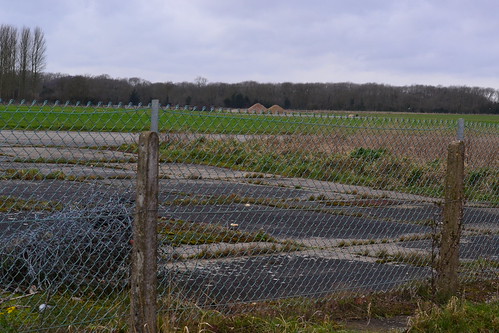
A fence separates the housing estate from the airfield remains.
On 26 September, another order came through for aircraft of 21 Squadron to stand by to attack the German fleet, while a further two Blenheims (L8734 and L8743) were sent to the Ruhr on a photographic reconnaissance mission. However, bad weather, industrial smoke and a faulty camera prevented both aircraft from completing their duties. They returned to Watton empty-handed but unscathed, with their crews reporting heavy flak over the target area. October and November were largely a washout. Bad weather and prolonged heavy rain prevented any substantial flying beyond the local area. Air gunnery and co-operation flights were carried out whenever possible, but the final months of 1939 had certainly been a ‘phoney war’ for 21 Squadron.
As 1940 dawned, events on the continent began to intensify, and ground attacks increased for both Watton squadrons. Low-level sorties saw them attacking troop formations and enemy equipment as they advanced across the Low Countries. Despite the crews’ bravery and the provision of fighter escorts, losses among the slower Blenheims of 2 Group were beginning to rise. This pattern would only worsen in the face of a far superior enemy in the coming months.
These losses were borne out by 82 Squadron in dramatic fashion on 17 May, when twelve aircraft took off at 04.50 to attack Gembloux. They were met with heavy anti-aircraft fire and overwhelming fighter opposition. Fifteen Bf 109s decimated the squadron. All but one aircraft were lost; the sole survivor was P8858, crewed by Sgt Morrison, Sgt Carbutt and AC Cleary. Although the crew were uninjured in the encounter, the aircraft was badly damaged and deemed irreparable, so it was written off. An entire squadron had been all but wiped out in one fell swoop.
This disaster was reflected across 2 Group, which had now suffered its greatest overall loss to date. For 82 Squadron, however, this was not the end of a traumatic and devastating period. The fierce fighting was taking its toll on crews, who were at a distinct disadvantage compared with their Luftwaffe counterparts. On 21 May, three more aircraft were lost from Watton: one was forced down in France, another was lost without trace, and a third limped home so badly damaged that it too had to be written off.
A short visit by 18 Squadron between 21 and 26 May barely interrupted proceedings at Watton. After returning from France, the squadron had spent no less than nine days in May at five different airfields, including nearby Great Massingham.
By early June 1940, Operation Dynamo had been completed and France was lost. The British Bulldog, while not a spent force, had shown her teeth, been bitten hard and was now licking her wounds. Preparations would begin to protect British shores from the impending invasion.
Fuelled by a desire for revenge, 21 and 82 Squadrons continued their combined attacks into the summer months. But revenge alone could not protect crews from superior fighters and heavy flak. On 11 June, three more 21 Squadron aircraft were lost while attacking positions around La Mare; it is thought that all three fell to Luftwaffe fighters. Two days later, on 13 June, another five aircraft were lost: two from 21 Squadron and three from 82 Squadron. Losses among the light bombers were mounting, and Watton was one of the airfields bearing the brunt of these operations. On 24 June, 21 Squadron was given a reprieve. Whether to rest crews, take on a new role or simply regroup, the squadron began moving north to RAF Lossiemouth in Scotland. 82 Squadron, however, remained at Watton to continue the punishing raids over the continent.
After the arrival and departure of another short-stay unit, 105 Squadron, which was at Watton between 10 July and 31 October, the airfield was left in the sole hands of 82 Squadron. This situation would continue until the spring of 1942.
The dramatic loss of eleven crews in May would come back to haunt 82 Squadron in August that year.
On 12 August, another twelve aircraft took off on a high-altitude bombing mission to Aalborg in Denmark. The target airfield was well defended and, as if history were repeating itself, eleven of the twelve aircraft were lost. The sole aircraft to return was R3915, crewed by Sgt Baron, Sgt Mason and Sgt Marriott. It had turned back early because of low fuel.
In the space of three months, an entire squadron had been all but wiped out not once, but twice. Such losses were unsustainable and threatened to bring the squadron to its knees.
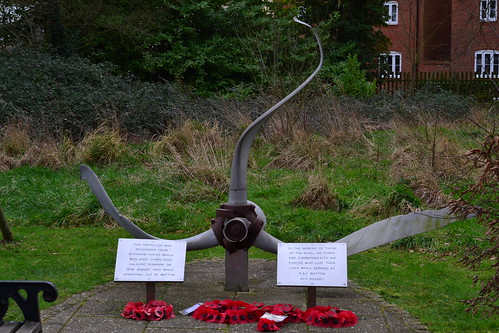
Memorial to the crews lost at Aalborg, 13 August 1940. The propeller of Blenheim R3800, that crashed that day.
It was losses like these that helped convince the authorities eventually to withdraw the Blenheim from front-line service during 1942, as the aircraft had become outdated and outclassed. At this time, Watton’s 82 Squadron began its transfer to the Far East, where it would remain until the end of the war.
A lull in operations meant that Watton was used mainly for training flights through the Advanced Flying Unit. Small, single- and twin-engined aircraft provided activity over the Norfolk countryside. Many of the crews trained here would be sent to the satellite airfield at Bodney before returning to Watton for their evening meals.
A brief interlude in May 1942 saw the rebirth of the former 90 Squadron, a First World War unit that had undergone this process several times since its formation in 1917.
90 Squadron flew the American B-17 Flying Fortress, known in RAF designations as the Fortress I. The squadron was established to trial the four-engined heavy bomber and assess its suitability for RAF service. During its first 15 days at Watton, the squadron gained personnel and received its first aircraft, after which it moved to nearby RAF West Raynham. There, it began trials that also required the use of several smaller airfields in the local area. These included RAF Great Massingham and RAF Bodney, neither of which was particularly suited to heavy bombers.
Watton saw no further operational units, and in mid-1943 it was handed over to the Americans, who began developing the airfield to better suit their needs. It was at this point that Watton would take on a more sinister role.
The USAAF renamed the airfield Station 376 and redeveloped the accommodation blocks, added more hardstands and laid a steel-mat runway. The original hangars were supplemented by more modern B1 and T2 types, along with three smaller blister hangars. In mid-1944, the steel matting was removed and replaced with a concrete runway. The airfield’s history became more complex as it officially became two sites sharing a single runway. Although a number of different activities took place at Watton, it became synonymous with reconnaissance, surveillance and electronic warfare.
The first heavy groups to arrive were the 36th and 406th Bombardment Groups, known as the ‘Carpetbaggers’. These special operations squadrons were designed to support French resistance and special agent activities. Flying B-24s, the pair were initially stationed at Alconbury, but the airfield was becoming overcrowded, forcing these two squadrons to move out. The new airfield at Harrington had yet to be earmarked for them, so, as a temporary measure, the two squadrons transferred to Watton. Once there, its personnel found themselves without proper accommodation, while the grass runways were covered with PSP planking. This caused major problems, as fully laden B-24s could not operate from such surfaces.
The lack of suitable accommodation only made matters worse. Tents were supplied and pitched on the muddy flats of the airfield. After rain, these became quagmires through which personnel had to wade to get anywhere.
By 17 February 1944, the transition was complete, but it was far from ideal, particularly as operations had already begun.
The discomfort of these conditions was short-lived, however. By the end of March, Harrington was ready enough to receive the group, and the Watton contingent of the 406th departed, no doubt glad to leave this muddy part of Norfolk behind.
The main airfield itself would soon house aircraft of the 802nd Reconnaissance Group (Provisional), later renamed the 25th Bombardment Group (Reconnaissance). The group comprised the 652nd Bombardment Squadron (Heavy, Weather Reconnaissance), the 653rd Bombardment Squadron (Light, Weather Reconnaissance) and the 654th Bombardment Squadron (Heavy, Reconnaissance, Special).
The 25th BG was constituted on 17 July 1944 and activated in England on 9 August that year. Its wartime service was confined to a single UK airfield: Watton, where it remained until VE Day, serving under the 8th Air Force.
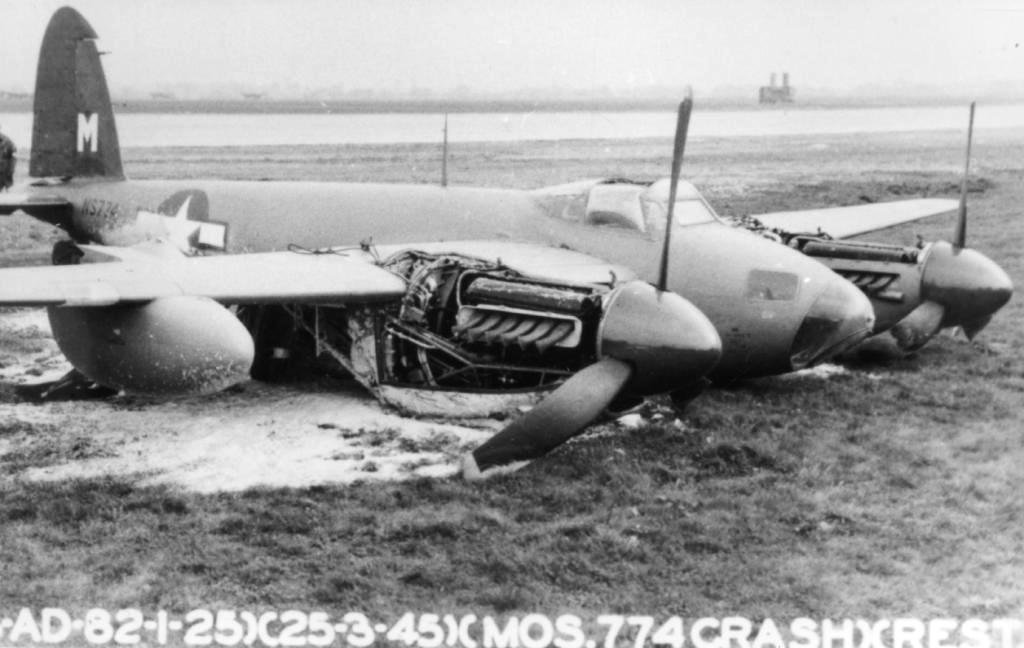
The end of Mosquito PR Mk XVI ‘M’, NS774, of the 25th BG, after it crashed at RAF Watton (Station 376). (IWM UPL 6964)
The role of the Watton-based group was to carry out reconnaissance missions over the seas around Britain and the Azores, gathering meteorological data. These missions were code-named Blue Stocking (weather flights), Joker (night reconnaissance flights) and Dilly (daytime reconnaissance flights). The flights gathered substantial amounts of data, helping planners improve mission planning, bombing accuracy and the assessment of results.
Combined with flights over the continent, the information gathered helped prepare bombing missions. The group also carried out aerial mapping and photographic reconnaissance, identifying German troop movements both at night and during the day. Many of these operations supported major battles, including those in northern France, the Rhineland and the Ardennes. Additional tasks included electronic countermeasures using ‘chaff’ and flying ahead of large formations to obtain last-minute weather reports. This varied and dangerous range of roles involved several aircraft types, including B-17s, B-24s, B-25s, B-26s, L-5s, P-38 Lightnings and Mosquito XVIs.
It was these units and aircraft that were earmarked to trial a new communications system used by the OSS.
Initially, OSS agents used the S-Phone, a cumbersome and heavy communications system carried in a suitcase. As a result, agents often attracted attention and had to move constantly from one safe house to another, despite such locations being few and far between in occupied Europe.
To solve the problem, William Casey, head of the OSS and later the CIA, gave the go-ahead to Stephen Simpson, a Texas scientist, to investigate a better system for agents. Simpson developed the DeWitt R. Goddard system, which was exceptionally small and very difficult for German listening vans to trace.
After it was renamed the Joan-Eleanor system (Joan being the ground device and Eleanor the airborne unit), it was submitted to the authorities for approval. The Americans, however, did not like the idea of heavy B-24s flying at low level, so they instructed Simpson to redesign the system, which he did.
Simpson was posted in the direction of the Watton Group and given two war-weary Mosquitoes for his trials. These were subsequently adapted to accommodate an operative and the Eleanor device in the now-sealed bomb bay. The Air Force codenamed the operation ‘Red Stocking’.
The first flight using the new system took place on 22 October, with Simpson himself aboard the Mosquito carrying the Eleanor set.
The first operational use of the set took place on 10 November 1944. Although the agent drop was successful, it took several attempts to contact him. Once contact was established, ‘Bobbie’ (Anton Schrader) provided valuable information about the locations of German Panzers, helping the Allies prevent reinforcements from reaching Arnhem. Despite the system’s success, only a few aircraft were subsequently fitted with the equipment.*1
The work carried out at Watton by the 25th BG ran in conjunction with that of other units, including the ‘Carpetbaggers’, who had themselves been stationed here only months earlier. Their move to Harrington had not severed the connection between them and the 25th.
Meanwhile, alongside the electronic operations taking place at Watton, a new complex was built on the southern edge of the site to house the 3rd Strategic Air Depot (SAD), responsible for aircraft repair and refurbishment. The unit had to move away from the main airfield to this less comfortable location when the Bombardment Group and the 7th Photographic Group moved in. Both groups operated within the 325th Photographic Wing, headed by Colonel Elliot Roosevelt, son of the American President, who wielded considerable influence.
The complex grew so large that it became a separate site in its own right, designated Neaton (Station 505). The name has caused some confusion, however, as the site was actually closer to the village of Griston than to Neaton.
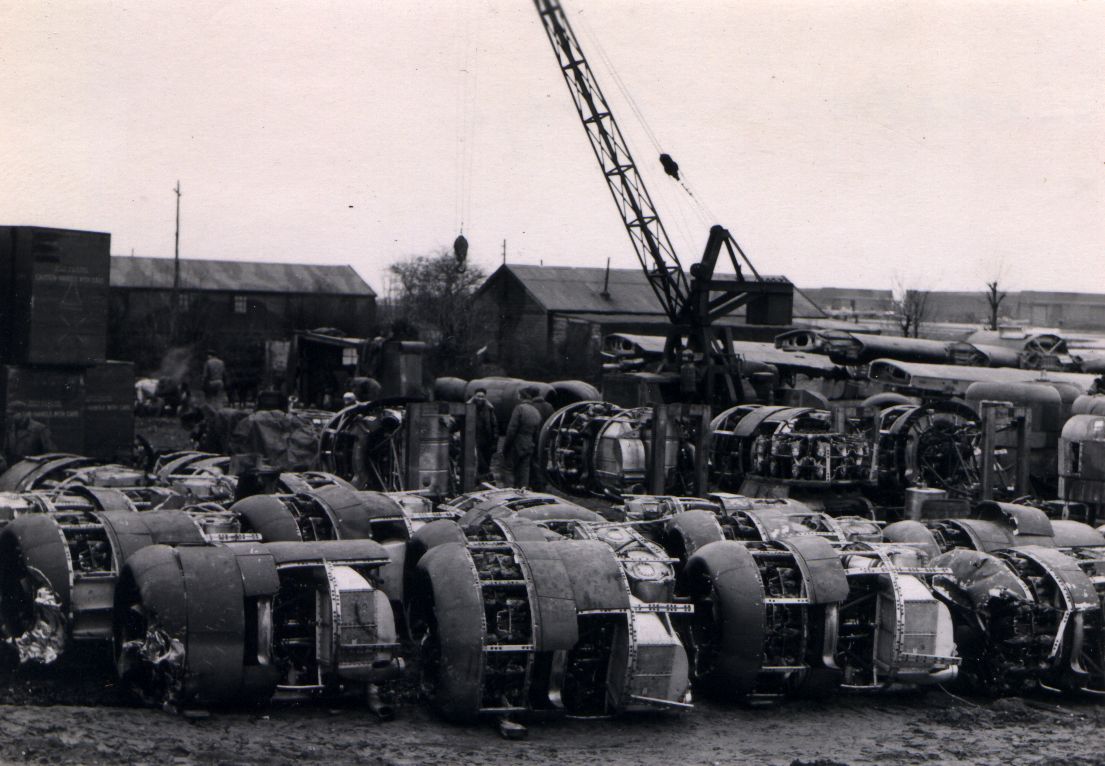
A collection of B-24 engines removed from their mounts. (IWM UPL 5385)
The role of the 3rd SAD was to maintain and repair the battle-damaged B-24s of the 2nd Air Division, which had flooded into the base following operations. This unenviable task involved recovering the heavy bombers, washing them out and, where necessary, removing the remains of airmen before returning the aircraft to flyable condition. Although not intended to do so, the acronym SAD certainly reflected the nature of the work.
Neaton consisted of several sites: four accommodation sites, a communal site, sick quarters, two motor sites, a miscellaneous site housing a Steam Jenny, and a 9AD site containing tool sheds and other maintenance-related buildings. Most of the accommodation sites incorporated either the more common Laing huts or Nissen huts.
When VE Day finally arrived, the American units departed, returning to Drew Field in Florida. That August must have been quite surreal: as the Americans left, flying activity reduced and Watton returned to RAF ownership.
With the war over, flying units began returning to the UK, many to be disbanded not long afterwards. One such unit was 527 Sqn, which arrived at Watton in November, only to be disbanded in April 1946.
The next four years saw no other front-line operational flying units at Watton, but the 1950s would bring a number of units back through its gates. With the introduction of the jet engine towards the end of the war, piston-engined fighters were soon being replaced by newer designs.

One of Watton’s many accommodation blocks in modern use.
The electronic countermeasures (ECM) activity initiated at Watton by the 25th Bomb Group continued into the early post-war years, lasting for some twenty years or so. A variety of aircraft were involved, including the Mosquito, Wellington, Dominie, Lincoln, Anson, Proctor, Canberra, Meteor, Sea Fury, Firefly and Venom, among others. Each played a part in the development and use of ECM, as well as in radio research and training. Warfare had taken on a very different dimension.
This development saw Watton become a hub for ECM activity, with a number of RAF and Naval squadrons operating from the airfield to undertake these tasks. At the end of the war, Watton became home to the Radio Warfare Establishment (RWE), renamed the Central Signals Establishment (CSE) in 1946. It was one of five such units operating jointly between the military and the National Air Traffic Services Organisation (NATS). The Navy and RAF jointly used Watton for a short period between March and September 1947, when the Naval Air Warfare Radio Unit moved in under the designation 751 NAS.
The role of the CSE was too complex to discuss here in detail. However, with a number of squadrons operating in different roles at Watton, the work culminated in the formation of three unnumbered units in 1948: a Signals Research Squadron, a Monitoring Squadron and a Radio Countermeasures (RCM) Squadron. In essence, their role was to monitor and jam Soviet electronic communications and defence systems. It was a wholly airborne electronic warfare operation.*2
The use of unnumbered squadrons was short-lived. By the end of the decade, the CSE had reverted to using numbered squadrons, whose role was to probe air defences along the Soviet borders. British aircraft, working with ground stations, monitored Soviet communications and the responses of Soviet forces to intrusions into their airspace. This information enabled countermeasures to be developed to jam or scramble communications, ideally rendering them useless or temporarily incapacitating them. The first of these numbered squadrons were 192 and 199, originally the calibration and training units of the CSE.
Reformed at Watton in July 1951, 192 Squadron initially flew Mosquitoes and Lincoln B.2s, followed by the enormous Washington (B-29). It did not receive its first jet aircraft until January 1953, when the Canberra B.2 arrived. The squadron also flew the Varsity and the Comet C.2 before being disbanded and renumbered as 51 Squadron in August 1958.
199 Squadron, reformed on the same day, flew both the Lincoln B.2 and the Mosquito NF.36 in the same role as 192 Squadron. Its stay at Watton lasted until April 1952, when it moved to Hemswell in Lincolnshire and acquired its first jet-engined aircraft.
In August 1952, several other units reformed, disbanded or passed through Watton. 116 Squadron was reformed on 1 August. Another former calibration flight of the CSE, it remained at Watton until August 1958, when it was disbanded and reformed as 115 Squadron. A battle-hardened Bomber Command squadron, 115 had itself previously been disbanded. No longer flying operational bombers, the reformed 115 Squadron used Varsitys as its new form of transport before moving on within days of its reformation that August.
On the same day in late August 1958, 245 Squadron reformed, having been renumbered from 527 Squadron. Flying Canberras, it too left Watton within days of its reformation.
As 1959 drew to a close and 1960 began, Watton became home to a new unit, 263 Squadron, which operated Bloodhound missiles. These ground-to-air missiles were used by the RAF to defend British airfields against attacking aircraft. Their operational use at Watton continued until June 1963.
The 1960s saw the last of Watton’s flying units. From January 1962 until May 1963, 151 Squadron operated from the airfield as the Signals Development Squadron. It brought the propeller-driven Hastings, Lincoln and Varsity back to Watton before being renumbered and subsequently disbanded.
Other units based at Watton included 97 Squadron, which was there from 1963 to 1967; 98 Squadron (1 October 1963 – 17 April 1969); 360 Squadron (1 October 1963 – 17 April 1969); and 361 Squadron (2 January 1967 – 14 July 1967). Two of these squadrons were both reformed and disbanded at Watton.
As might be expected, a large number of subsidiary and support units were also based at Watton. Many were attached to the Radio Warfare Establishment, alongside surface-to-air missile (SAM) training units, various flight units and other regiments.
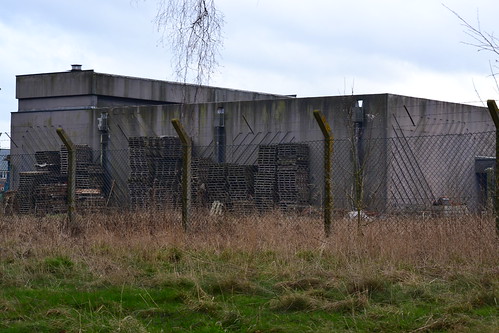
Part of the disused Eastern Radar complex.
By the 1970s, all flying had ceased, leaving Eastern Radar, and later Border Radar, as the only operational activities on the site. These operations eventually moved elsewhere in the early 1990s, signalling the end of Watton as an active airbase. The site was then handed over to the British Army.
A few years later, the Army reduced its use of Watton, and the accommodation areas were sold off for private housing. This helped preserve some of the airfield’s distinctive character, which can still be seen today. More of the site was subsequently sold, and new housing estates were built on land previously occupied by the airfield. The original character of these areas has largely disappeared, replaced by a maze of roads and box-like houses. The last remaining parts of the main airfield were sold off in 2012, while the runway and perimeter track were retained by the farmer and used for agricultural purposes.
Neaton, too, was sold off and has since been replaced by HMP Wayland, a prison holding Category C prisoners. One grim chapter of history has been replaced by another.
Today, the perimeter tracks, runways and hardstands sit alongside the surrounding housing, with little remaining of their former purpose. Part of the perimeter track survives, with a small wire fence providing the only barrier against further development. All four original C-type hangars have been demolished, as have the two control towers, one of which was built to support the jet era. A few minor buildings remain, surrounded by the original RAF housing, but these are few and far between, and their future is uncertain.
Almost as a gesture of remembrance, many of the roads are named after aircraft such as the Liberator and Marauder, both synonymous with operations at Watton and Neaton. Various concrete remains poke through the undergrowth, making parts of the site look untidy. How long will it be before these, too, disappear?
The site is divided by the main road, with some of the former administration buildings on one side and the airfield and accommodation areas on the other. Some buildings remain in use by civilian operators and have been well preserved. Others, including the technical site, have been less fortunate and have fallen into a poor state of repair.
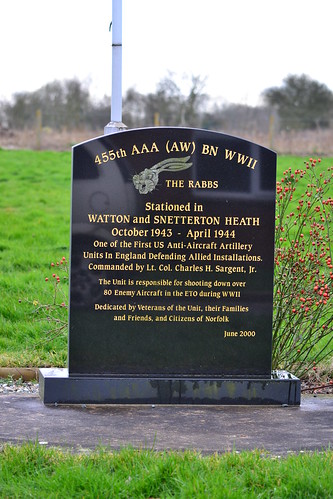
Memorial to the 455th AAA ‘The Rabbs’ located on the airfield site.
As for the airfield itself, two small memorials stand guard at the entrance to the new development. On one side is the bent propeller recovered from Blenheim R3800, lost during the raid on Aalborg on 13 August 1940, when eleven aircraft were lost. On the other is a memorial commemorating the 25th Bomb Group, USAAF.
On the original housing site, a further memorial commemorates the 455th AAA ‘The Rabbs’, who were tasked with defending Britain’s airfields against the Luftwaffe. For a time, the site was owned by the Stanford Training Area (STANTA) and used for air-mobile training, so the occasional Hercules or Army helicopter might have been seen there. This activity has now ceased, however, and housing is creeping ever closer. I am sure it will not be long before many of these remaining traces of the past are lost to the developer’s digger.
Sources and Further Reading (RAF Watton).
*1 Quoted in Bowman, M., The Bedford Triangle (2009), The History Press, pp. 184–192.
*2 Flintham, V., High Stakes: Britain’s Air Arms in Action 1945-1990 Pen and Sword, Oct 2008.
National Archives AIR 27/263/1: AIR 27/263/2
A websitededicated to RAF Watton contains an extensive collection of personal stories and information about life at the airfield. It also features a video showing the recovery of Blenheim R3821 from Aalborg Airport.
Further photographsof th e remains at these sites can be seen on Flickr.
Note: A museum commemorating the lives of personnel who served at Watton is open on limited days. Details can be found on its website.


As promised…
https://colinfranksorensen.wordpress.com/2019/12/29/march-1942/
LikeLiked by 1 person
Thank you Pierre!
LikeLike
Next Sunday we are off to No. 53 OTU. Very informative letters about training at an OTU.
LikeLiked by 1 person
That should be very interesting Pierre. I look forward to it.
LikeLike
It is!
LikeLiked by 1 person
On December 29, 2019, I will be posting the letters a Spitfire pilot who had his advanced flying training at No. 17 AFU, RAF Watton in 1942. I will add your post sending my readers here.
LikeLiked by 1 person
Thank you Pierre. I look forward to reading them.
LikeLike