In Tail 9, we visited Watton, a former airfield in Norfolk now the target of housing. Built during the rapid expansion of the RAF in the years leading up to the Second World War, it was a product of a period when Britain’s air defences were being transformed. From its early days as a pre-war bomber station, through the wartime operations that followed, Watton would become an important part of Britain’s aerial campaign. This first part explores the creation of the airfield, its early design and camouflage, and the experiences of the squadrons stationed there as war broke out and the conflict intensified in 1940.
RAF Watton (Station 376)
Building a pre-war bomber station
RAF Watton, located some 11.5 miles north-east of Thetford, opened in 1939 as an RAF medium-bomber station. Unusually, it had only one runway, a grass strip that was later extended to 2,000 yards and ran east–west across the airfield.
The late 1930s saw a massive expansion of Britain’s military might, particularly its airfields. With little foresight into what lay ahead, these pre-war and early-war airfields were not designed or built to protect the personnel using them. Airfields built in this way became known as non-dispersed sites.
Once the reality of what the war would bring had become clear, however, later airfields were designed with greater dispersal, introducing a new dimension to airfield planning. Watton, built by the John Laing company, was constructed with much of its accommodation, technical area, hangars and other facilities grouped closely together on a single site.
Housing for personnel was located in the north-western corner, with the technical area just to the east. The bomb dump, an ideal target, lay further east. Four C-type hangars were constructed, each with a span of 150 feet, a length of 300 feet and a height of 35 feet. Although Watton was a medium-bomber airfield, and its aircraft were therefore relatively small, it was envisaged that larger, heavier bombers would soon enter service. Consequently, more hangar space than was necessary for the aircraft then in use was provided. Based on a 1934/35 design, these hangars would become commonplace across airfields built during the expansion period.
Another architectural feature at Watton was the redesigned Watch Office, an all-concrete structure built to Drawing 207/36. This design soon proved inadequate, requiring substantial modification or, as happened at many other airfields, complete replacement.
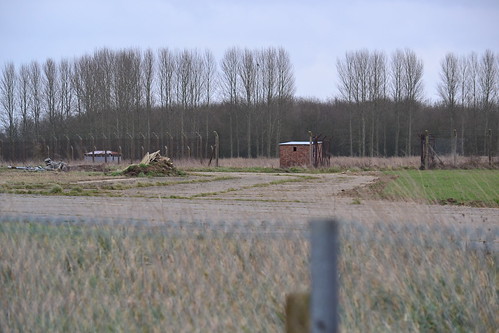
Part of Watton’s decaying perimeter track.
Although partially opened in 1937, the airfield was not fully completed and handed over to the RAF until 1939. As a pre-war design, it benefited from the availability of building materials, and the accommodation blocks were constructed in brick, providing suitable quarters for the personnel posted there.
Camouflage and concealment
Another aspect considered at this time was camouflage. Airfields were large, open expanses that could be seen from considerable distances and altitudes. Numerous proposals for concealing them were put forward, resulting in the formation of a special unit within the Directorate of Works, led by Colonel Sir John Turner. Watton came under the scrutiny of Sir John and his department, leading to an ingenious camouflage pattern of fields and hedges being painted across the entire airfield to conceal it from aerial observation. Although not completely effective, it went some way towards protecting the airfield from attack.
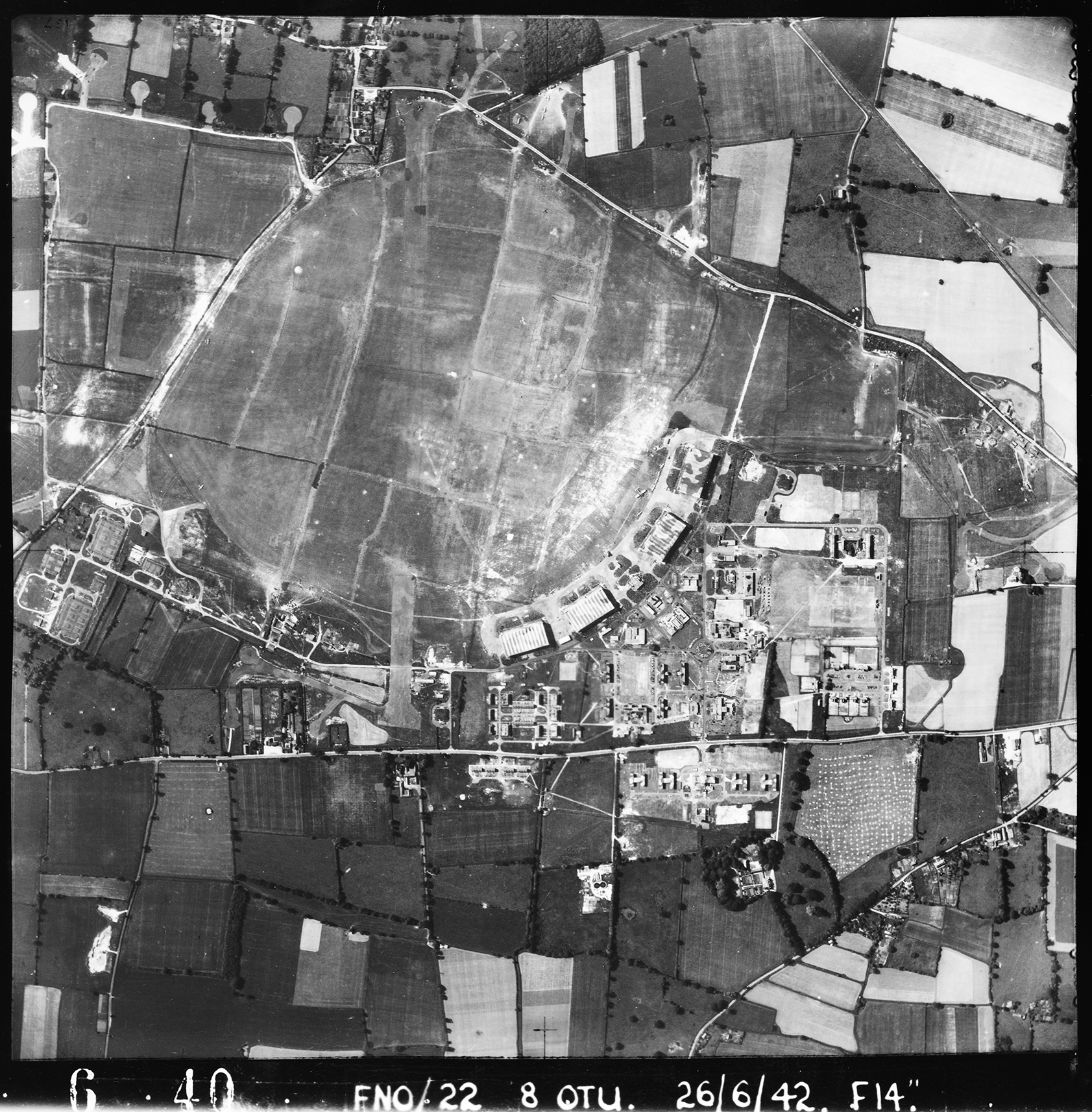
Photograph of Watton airfield taken in 1942 by No. 8 Operational Training Unit. The four hangars can be seen in the centre of the photograph, with the patchwork of ‘fields’ disguising the main airfield. English Heritage (RAF Photography).
The first squadrons arrive
The first arrivals were the men and aircraft of 21 and 34 Squadrons RAF. Their arrival on 2 March 1939 reunited the two squadrons under the command of Group Captain P. J. Vincent, DFC, and 6 (B) Group. On 7 March, the airfield was inspected by the Group’s AOC, after which 34 Squadron performed a flypast. This was the first of many visits by dignitaries, including the Marshal of the Royal Air Force himself, Sir Edward Ellington, GCB, CMG, CBE.
Little flying took place by either squadron at this time, however, as the aerodrome soon became unserviceable due to the very poor British weather. Grass runways quickly became boggy, making them unsafe for aircraft to take off or land without mishap, as was the case at many grass airfields during this period. From April, conditions improved slightly, and intensive training began, including station tactics and defence exercises. However, the weather continued to be the crews’ greatest enemy, repeatedly preventing or restricting flying.
In August, 34 Squadron received orders to leave Watton and proceed to Singapore. On 12 August, the air and ground parties began their long journey, leaving Watton and England behind. The quiet following their departure would not last long, however. Within days, the empty accommodation was occupied once more, as the Blenheims and crews of 82 Squadron arrived.
At 11.05 on 3 September 1939, notification reached Watton that Britain had declared war. Within days, aircraft were moved to Sealand under the ‘Scatter’ scheme, amid fears of imminent air attacks following the declaration of war. The Blenheims remained at Sealand until mid-September, when they were recalled and prepared for attacks on German naval vessels. These vessels could not be located, however, and the order to stand by was cancelled, allowing the crews to stand down. This would sadly become a regular and frustrating occurrence for the men of 21 Squadron.
Shortly afterwards, on 9 September, the first of the new Mk IV Blenheims were collected from Rootes Ltd at Speke, with further examples arriving over the following days. Further movements saw aircraft detached to Netheravon and then to Bassingbourn, where Blenheim L8473 was damaged when it ‘nosed over’ while taxiing. Although a minor accident, it was an unfortunate incident and the first of many more serious losses for the squadron.
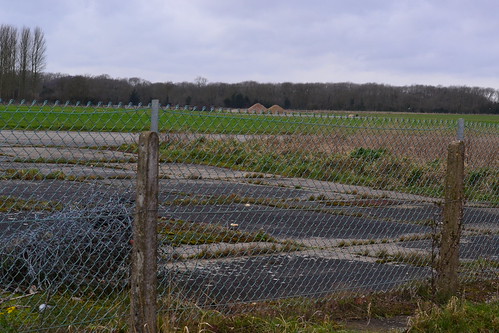
A fence separates the housing estate from the airfield remains.
On 26 September, another order came through for aircraft of 21 Squadron to stand by to attack the German fleet, while a further two Blenheims (L8734 and L8743) were sent to the Ruhr on a photographic reconnaissance mission. However, bad weather, industrial smoke and a faulty camera prevented both aircraft from completing their duties. They returned to Watton empty-handed but unscathed, with their crews reporting heavy flak over the target area. October and November were largely a washout. Bad weather and prolonged heavy rain prevented any substantial flying beyond the local area. Air gunnery and co-operation flights were carried out whenever possible, but the final months of 1939 had certainly been a ‘phoney war’ for 21 Squadron.
War comes to Watton
As 1940 dawned, events on the continent began to intensify, and ground attacks increased for both Watton squadrons. Low-level sorties saw them attacking troop formations and enemy equipment as they advanced across the Low Countries. Despite the crews’ bravery and the provision of fighter escorts, losses among the slower Blenheims of 2 Group were beginning to rise. This pattern would only worsen in the face of a far superior enemy in the coming months.
These losses were borne out by 82 Squadron in dramatic fashion on 17 May, when twelve aircraft took off at 04.50 to attack Gembloux. They were met with heavy anti-aircraft fire and overwhelming fighter opposition. Fifteen Bf 109s decimated the squadron. All but one aircraft were lost; the sole survivor was P8858, crewed by Sgt Morrison, Sgt. Carbutt and A.C. Cleary. Although the crew were uninjured in the encounter, the aircraft was badly damaged and deemed irreparable, so it was written off. An entire squadron had been all but wiped out in one fell swoop.
This disaster was reflected across 2 Group, which had now suffered its greatest overall loss to date. For 82 Squadron, however, this was not the end of a traumatic and devastating period. The fierce fighting was taking its toll on crews, who were at a distinct disadvantage compared with their Luftwaffe counterparts. On 21 May, three more aircraft were lost from Watton: one was forced down in France, another was lost without trace, and a third limped home so badly damaged that it too had to be written off.
A short visit by 18 Squadron between 21 and 26 May barely interrupted proceedings at Watton. After returning from France, the squadron had spent no less than nine days in May at five different airfields, including nearby Great Massingham.
By early June 1940, Operation Dynamo had been completed and France was lost. The British Bulldog, while not a spent force, had shown her teeth, been bitten hard and was now licking her wounds. Preparations would begin to protect British shores from the impending invasion.
In Part 2, Watton take on new ownership, leading to a very different chapter in Watton’s history.
The full story of Watton can be read in Trail 9

