Is this the missing Stirling LJ850?

A recent report has identified what is believed to be the wreckage of Stirling LJ850 ‘QS-Y’ of 620 Squadron (RAF), that crashed whilst on a mission to drop paratroopers behind German lines.

Crew of Missing Stirling LJ850

The crew of LJ850 *1

The aircraft was part of a three ship formation and disappeared on the night of 17th / 18th June 1944, with a number of RAF personnel and the 1st SAS Regiment servicemen on board, – there were no survivors*2.

There has been considerable speculation about the fate of this aircraft and a number of theories as to what happened to it.

It was last heard from whilst over the English Channel, and initial thoughts were that it crashed into the sea. Other reports state it crashed into high ground on the run-in to the drop zone in the Morvan Mountains area near Les Valottes. A further report states it crashed 100 miles off course in the Savoy Hills, but there were never any reports by the German authorities at the time and no substantial wreckage has as yet been found.

Fragments form this particular wreckage may have been located a few miles inland of what was Omaha Beach, a possible location if LJ850 did come down shortly after its last transmission.

It is known that there were very few heavy bomber activities that night, and no bomber casualties were reported. Early indications are that the wreckage is of a Stirling bomber, so could this be the wreck of LJ850?

Before any investigations can proceed, a permit is required, but French officials are refusing to grant permission for any detailed search of the site, as the site is a “war grave”. They also quite rightly raise concerns over the conservation of the site, safety issues, and also jurisdictional considerations. So, for now, the story and final closure of LJ850 looks set to continue for some time yet.

620 Squadron was formed on 17th June 1943 at Chedburgh, and were initially involved in night bombing duties. In November 1943, they converted to airborne operations, dropping supplies, Paratroops and performing glider tug operations. Between March 18th 1944 and 18th October 1944, they operated from RAF Fairford, Gloucestershire, before moving to Great Dunmow and subsequently to the Middle East at the end of the war.

The crew of the Stirling were:

Wing Commander R.W. Crane  RAAF (s/n 413535) (Pilot)
Fgt. Sgt. F.N. Johnson  RAFVR (s/n 1395038) (Nav.)
W.O. II J.P. Clasper RCAF (s/n R159971) (B/A)
Sgt. D.W. Evans RAFVR (s/n 1407968) (Flt. Eng)
Flt. Sgt. G.W. Stopford RAFVR (s/n 657479) (W/O – A/G)
Flt. Sgt. B.J. Profit RCAF (s/n R189226)  (A/G)
Sgt. P. Wilding RAFVR (s/n 1345156) (Parachutist Dispatcher)*2.

The crew are represented on the Runnymede memorial.

Included on that flight when it crashed was Sgt. Reginald Wortley, (s/n 4863732) of the 1st Special Air Service Regiment. Wortley was one of the founder members of the SAS.

The names of the paratroops appear on the Bayeux Memorial.

The reported story can be found here.

*1 photo from CBC News website.

*2 In Dennis Williams’ book “Stirlings in Action with the Airborne Forces“, the crew list omits Wilding, the dispatcher, and lists 15 SAS troops killed on the night. Many thanks go to reader Darren Sladden for the further information and book recommendation, which I too recommend to anyone with an interest in this area of aviation. The Book was published by Pen and Sword Books, 2008, ISBN 184415648-6,

‘Black Thursday’ took the lives of many crews – RAF Bourn.

In Trail 31 we continue our trip around the historic countryside of Southern Cambridgeshire. Moving on from the open expanses of Graveley and Caxton Gibbet, we visit two more airfields both of which continue for now, to uphold their aviation heritage. Our first stop is the current small airfield on the former RAF Bourn.

RAF Bourn.

Bourn sits between the towns of Cambourne to the west and Hardwick to the east and is confined by the new dual carriageway cutting across its northern side. Both the immediate eastern and western sides are heavily built upon and with further developments under proposal, the future of this historic airfield remains in the balance.

RAF Bourn was built-in 1940 /41 initially as a satellite for nearby RAF Oakington. With growing pressure from Bomber Command it would eventually become a bomber station  in its own right and come under the control of Air Commodore Donald Bennett’s 8 Group operating the elite Pathfinder Force (PFF). Accommodation would be suitable for 1,805 males and 276 females making it a relatively large airfield. Its three ‘A’ style concrete runways, would be extended later in 1942 to accommodate the heavier aircraft that were to use Bourn thus raising its profile as a bomber base. By the end of the war, Bourn squadrons would lose 135 aircraft in total accounting for: 60 Lancasters, 32 Short Stirlings, 24 Mosquitos and 19 Wellingtons – a considerable number of lives.

runway

Views along one of Bourn’s enormous runway.

Bourn would serve a number of RAF squadrons during its short wartime life: 15, 97, 101, 105, 162 and 609 would all play a part in its rich wartime tapestry. The first to arrive were the Wellington ICs of 101 Squadron (RAF). They arrived at Bourn very soon after the runways were constructed on February 11th 1942. During this time 101 were going through the process of updating their Wellingtons with the new Mk III. One of the first casualties of Bourne would be one of these models. Wellington ‘X3656’  SR-L, was lost on the night of March 8th/9th 1942, on a mission to Essen. Flight Sgt. S. Brown, P.O. C. Luin and Sergeants L. Calderhead, R. Lawrence and C. Parry were all lost in the attack; the aircraft missing in action and the crew presumed dead. Their names are now inscribed  on the wall of remembrance at Runneymede Cemetery.

101 sqn would continue the fight staying at Bourn until the 11th August that same year. They would then move on to Stradishall and Holme-on-Spalding Moor where they took on the Lancaster.

As 101 left, 15 Sqn (RAF) moved in, bringing the much heavier Short Stirling MkI. Having a rather checkered history behind them, 15 Sqn would operate the MkIs until the following January when the MK IIIs came into operation. Built by Short Brothers, the Stirling was a massive aircraft, dwarfing many of its counterparts with a cockpit height of some 22 feet. A forbidding aircraft, it was cumbersome on the ground but was said to be very agile in the air, some would say it could out-turn a Spitfire! Sadly though, it was a slow aircraft and whilst heavily defended, loses were to be high leading to its eventual withdrawal from front line operations .

A few miles away at Cambridge, an industrial unit of some  six / seven hangars were built by Short Sebro Ltd who manufactured the Stirling parts. Final assembly and air testing was then carried out at Bourn, the wings being transported by ‘Queen Mary’ trailers and the fuselage on specially made carriers pulled by tractors. To help, three large hangars would be built away to the east of the airfield to accommodate both these and battle damaged bombers for repair.

ROYAL AIR FORCE BOMBER COMMAND, 1942-1945.

The crew of the Short Stirling Mk I, N3669 ‘LS-H’, of No. 15 Squadron after their 62nd mission. © IWM (CH 7747)

It was here at Bourn that a record would be set by a 15 Squadron crew. Stirling Mk I, N3669 ‘LS-H’,  would go on to complete 67 operations, a record for the type. N3669 would eventually be reduced to an instructional airframe in February 1943.

A short spell of conversion proceeded 15 Sqn moving to their new base at RAF Mildenhall on April 14th 1943, where they would eventually take on the new and more successful Lancaster I. It was here that LL806 “J-Jig”, would become one of the most famous Lancasters in Bomber Command, flying 134 sorties accumulating 765 hours in the air. Two incredible records were now set by 15 squadron aircraft and their crews.

Bourn would then have just another short spell visitor, 609 Sqn. Battled hardened from covering the BEF withdrawal at Dunkirk and defending Britain in the Battle of Britain, 609 Sqn moved in on 26th August 1942, with the potent Typhoon IB. Accustom as they were to moving around, their stay at Bourn would last only 4 days.

It was at this time that Bourn really came into its own as a bomber base. 97 squadron (RAF) arrived on April 18th 1943 with their Lancaster Is and IIIs. With small detachments at nearby Graveley, Gransden Lodge and Oakington, they would stay here until moving on to Coningsby a year to the day later. Whilst at Bourn, they became a ‘marker’ squadron as part of the PFF  Group.  Notable target’s were both the  Zeppelin works at Friedrichshafen in June 1943 and the Italian naval base at Spezia in April 1944; an event that became to be the first RAF “shuttle-bombing” raid. The introduction of Lancasters at Bourn greatly reduced the number of crews being lost. However, 97 Sqn were to suffer one of the worst nights on Bomber Command record, and not through enemy action either. During the night of December 16th /17th 1943, a large number of aircraft left from some 20 squadrons*1 to attack Berlin. Casualties to and from the target were on the whole low but for 97 Squadron it was arriving home that their troubles were to begin. This night would become known as ‘Black Thursday’.*2.

Aug 2015 014

A Nissen huts survives in modern use.

As they approached Cambridgeshire, they were informed that the weather had closed in on Bourn and landing would be very difficult if not impossible. In an effort to get the bombers down safely, all manner of tactics were used to move the fog and illuminate the runways.  Some aircraft managed to divert to other bases in Lincolnshire and Norfolk where FIDO was in operation, but many tried to wait it out. The result was a critical loss of fuel and subsequently several aircraft crashed in the dense fog. The loss that night was devastating for 97 Sqn: JB531 ‘OF-Y’; JA963 ‘Q’; JB243 ‘P’; JB482 ‘S’; JB219 ‘R’; JB117 ‘C’; JB119 ‘F’ and JB176 ‘K’ were all lost crashing in the vicinity of the airfield with many of the crews being killed.*3

It was during these last few weeks of 97 Sqn’s stay that Bourn would start to accept new residents. The smaller and much more agile Mosquito IX of 105 Squadron arrived to continue the pathfinder operations. Noted for their unusual black paint work, they would carry out many notable operations from here, especially in the lead up to D-day in June 1944, identifying and marking coastal batteries for the heavier bombers to attack in preparation for the invasion. One of these aircraft, MM237, would sadly fall victim to ‘friendly fire’. On crossing the coast on its way home, on March 6th 1945, it was shot down by a British night fighter. The crew luckily managed to bale out moments before the aircraft struck the ground.

105 would stay at Bourn for the duration of the war, taking on a new model Mosquito XVI in March 1944. They would mark high-profile targets such as: oil refineries, road and rail junctions, marshalling yards and coastal batteries. Many targets were as far afield as the German heartland; 105’s  final operational sorties would take  4 Mosquitos to Eggebeck on the night of 2nd/3rd May 1945, a month before they left Bourn for Upwood and final disbandment.

In December 1944, the last residents of Bourn would arrive and join 105 Sqn. Being reformed here on December 16th, 162 Squadron (RAF), would fly the Mosquito XXV until February the following year when they would replace them with the Mosquito Mk XX. As part of the light-bomber unit of the Light Night Striking Force, 162 would quickly establish their effectiveness, striking hard at the heart of Germany, Berlin, in 36 consecutive raids.  162 would eventually leave Bourn on July 10th 1945 to go to RAF Blackbushe and their disbandment. Even though they were only here at Bourn for a short period, they would amass 4,037 flying hours in 913 operational sorties. Their loss rate would reflect the effectiveness of the Mosquito as a fighter, a bomber and a PFF weapon, losing only four aircraft in operational missions.

The departure of 162 Sqn would leave Bourn both desolate and very quiet.

Aug 2015 012

One of the few derelict buildings that still survive.

Post war, Bourn lay idle, the nearby hangars were used by Marshalls of Cambridge for vehicle repairs but eventually these were sold at auction, leaving the  site empty. It was completely closed down three years later. The land was sold off in the early 1960s and development has gradually encroached ever since. One small saving grace for Bourn is that a small flying club operated by the Rural Flying Corps is utilising a small part of the field including sections of two of the original runways. It is hoped that this will continue and keep the history of Bourn airfield alive.

Recently affected by the building of extensive housing developments and a new dual carriageway, Bourn has had much of its original infrastructure removed. The runways were cut slightly short and much of the accommodation and technical site redeveloped. However, a small gain from this is that the dual carriage way offers some interesting views along the remains of its enormous stretches of runway.

If approaching from Caxton Gibbet to the west, leave the dual carriageway and pull on to the smaller Saint Neots road that runs parallel. From the bank you can see along the runway taking in its enormous width. Other views of this, can be seen from the bridge that takes you back over the A428 toward the village of Bourn to the south.

It is also along this road that the fire tender station can be found, now utilised by a small industrial company it is one of the few original buildings surviving in good condition today.

Aug 2015 016

The fire tender shed, now a small business unit.

Many tracks can also be seen along here, pathways that would have led to the admin and accommodation areas of Bourn, the road now separating the two areas. There are a couple of Nissen huts here too, again used by small industrial companies, whilst other buildings stand derelict and in grave danger of demolition by weather or developer.

Whilst the runways are intact, large parts are used for storage and a section is used for motorcycle training. A lone windsock flies over the flying club.

Recent archeological investigations have revealed late prehistoric and Roman connections around the site, including a Roman burial site within the grounds of the airfield. Great crested Newts are also known to inhabit the area, perhaps history and nature will prevail. With continued development and further proposed housing, the future of Bourn is very uncertain and should these plans go ahead, Bourn like many other airfields of Britain will most likely cease to exist.

After leaving Bourn, we travel a stones throw south-west to a small airfield now more commonly seen with sedate gliders than fearsome fighters of the Second World War. We stop at Gransden Lodge.

Notes:

*1 loses were recorded from 7, 9, 12, 44, 57, 97, 100, 101, 103, 156, 166, 207, 405, 408, 426, 432, 460, 576, 619, 625 squadrons all Lancasters.

*2 a website dedicated to 97 Squadron gives detailed information into ‘Black Thursday’ including personal accounts, the unit, men and operations.

*3 records from aircrew remembered

Australian Flt. Sgt. Rawdon H. Middleton VC (RAAF) 149 Sqn RAF

100641

Pilot Officer Rawdon Middleton (RAAF)*1

Middleton (s/n: 402745) was born on 22nd July 1916 in Waverley, New South Wales, Australia. Son of Francis and Faith Middleton, he was educated at Dubbo Hugh School. Nicknamed ‘Ron’ by his friends, he was a keen sportsman excelling at many sports particularly cricket and football. After leaving school, he worked as a ‘Jackaroo’ (cattle handler) until joining the Royal Australian Air Force on the 14th October 1940 under the Empire Air Training Scheme. He learnt to fly at Narromine, New South Wales and then was sent to Canada for further training in preparation for his posting to the UK. He finally arrived in Britain in September 1941, as a second pilot, and his first operational squadron was No. 149 Squadron RAF, who were flying Short Stirling bombers out of both Lakenheath and nearby Mildenhall in Suffolk.

P01019.003

Five student pilots from No. 7 Empire Air Training Scheme (EATS) course at No. 5 Elementary Flying Training School (5 EFTS) Narromine. They are left to right: Aircraftman (AC) Gordon Orchard; AC Douglas Scott; Leonard Reid; Pilot Officer (PO) Douglas Wilberforce Spooner (DFM); PO Rawdon Hume Middleton*2

Middleton’s first experience of operations, was in a Short Stirling over the Rhur, the industrial heartland of Nazi Germany. After spending a short time with 149 squadron he moved temporarily to No. 7 Squadron (RAF).

In July 1942, as first pilot, he was given his own aircraft and crew, it was also around this time that he returned to 149 squadron.

Their first mission together would be on July 31st, to bomb the strategic and heavily defended target, Düsseldorf. Middleton and his crew would continue to fly together and took part in other prestigious missions; namely Genoa on the 7th of November and his 28th mission, Turin on the 20th November. His 29th and final mission, would take place on the night of 28/29th November 1942.

In the early evening of the 28th he took off in Stirling BF372 coded ‘OJ-H’ as part of the raid on the Fiat works in Torino, Italy, along with 227 other aircraft which included – 117 Avro Lancasters, 46 Short Stirlings, 45 Handley Page Halifaxes, and 19 Vickers Wellingtons.

Middleton’s crew consisted of: Ft.Sgt. Leslie Anderson Hyder, Ft. Eng: Sgt. James Ernest Jeffrey, Bomb Aimer F.O. G. R. Royde, Wireless Operator: Sgt. John William Mackie; Gunners: P.O. N. E. Skinner, Sgt. D. Cameron and Sgt. H. W. Gough. Three of these had already completed their tour of 30 operations and could have left. However, their dedication to Middleton kept them together.

The mission would take the aircraft over the Alps and the Stirling, laden with bombs and fuel combined with having a notoriously poor ceiling, had to negotiate through the mountains rather than fly over them. A factor that often resulted in a high number of casualties.

Once over the target area, OJ-H was subjected to an extreme flak barrage. With poor visibility, Middleton had to make three passes over the target area to enable his crew to positively identify it. It was on the third pass that a shell burst hit the cockpit. The resulting damage was severe, and fragments had hit Middleton’s head badly injuring him. His right eye was lost and his skull exposed. There were further hits on the aircraft’s fuselage causing considerable damage to the control systems and airframe. Knocked unconscious by the blast, Middleton lost control and the aircraft plummeted through the skies to an altitude of around 800ft. The second pilot, Fl.Sgt. Hyder eventually managed to take the controls, release the bombs over the target and then pull the aircraft into a climb, safely reaching 1,500ft.

With his aircraft severely damaged, Middleton had a choice, get his crew to bail out over occupied France and certain capture, fly to Africa or head back to England; a journey that would last over 4 hours and put the aircraft at risk of attack and the crew in danger. Wanting to give them a fighting chance of getting home, he opted for the latter, and set a course for England.

SUK10501

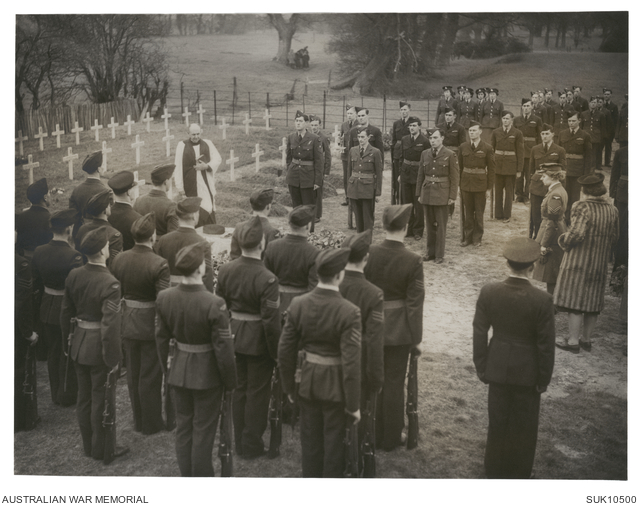
Middleton was buried with full military honours at St. Johns Church, Beck Row. Suffolk.*3

The aircraft experienced a number of attacks as they crossed occupied France, but Middleton, fighting for survival, kept reassuring the crew that he would get them home. Eventually, and against all the odds, they made the English coast, and once over land Middleton ordered the crew to bail out. Five crewmen left the stricken aircraft whilst the other two remained to help him control it. Turning for the Channel, Middleton ordered the two remaining crew members to bail out, whilst he stayed at the controls, steadying the aircraft.

By now the Stirling was very low on fuel and it finally gave up the fight and crashed at 03:00 on the morning of November 29th 1942. Middleton, too injured and too weak to escape the wreckage, drowned within the aircraft fuselage. His two crew members, Sgt. James Ernest Jeffrey (576050) age 19 and Wireless Operator Sgt. John William Mackie (994362) age 30, despite escaping, also drowned. Both the bodies of Sgt Mackie and Sgt. Jeffrey were washed ashore later that day on the 29th.

Middleton’s body remained in the aircraft, but was eventually freed from the wreckage by the action of the sea, and was washed ashore on Shakespeare Beach, Dover, in February 1943. His remains were taken to RAF Lakenheath and he was buried in St John’s churchyard, Beck Row, within sight of his airfield in Suffolk, with full military honours. Middleton was only 26 and only one mission away from ending his tour and returning home.

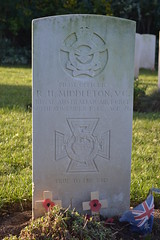
For his action, dedication and bravery, Flt. Sgt. Middleton was posthumously awarded the Victoria Cross, the first to any serving member of the R.A.A.F in World War II. He was also posthumously awarded a commission as Pilot Officer, backdated to mid November before his sortie to Turin. Thirty years later, in 1978, Middleton’s V.C. was presented to the Australian War Memorial, in Canberra for safe keeping and preservation.

For their actions, the other crew members received three DFMs and two DFCs. Fl.Sgt. Leslie Hyder (DFM) was injured, P.Officer. N. Skinner (DFC) was also injured, along with Sgt. H. W. Gough (DFM). F.O. G. R. Royde (DFC) and Sgt. D. Cameron (DFM) escaped unhurt.

The London Gazette published a report on 12th January 1943. It said:

“Fl. Sgt. Middleton was captain and first pilot of a Stirling aircraft detailed to attack the Fiat Works in Turin one night in November, 1942. Very difficult flying conditions, necessitating three low altitude flights to identify the target, led to excessive petrol consumption, leaving barely sufficient fuel for the return journey. Before the bombs could be released the aircraft was damaged by anti-aircraft fire and a splinter from a shell which burst in the cockpit wounded both the pilots and the wireless officer. Fl. Sgt. Middleton’s right eye was destroyed and the bone above it exposed. He became unconscious and the aircraft dived to 800 ft. before control was regained by the second pilot, who took the aircraft up to 1,500 ft. releasing the bombs, the aircraft meanwhile being hit many times by light flack. On recovering consciousness Fl. Sgt. Middleton again took the controls and expressed his intention of trying to make the English coast, so that his crew could leave the aircraft by parachute. After four hours the badly damaged aircraft reached the French coast and there was once more engaged and hit by anti-aircraft fire. After crossing the Channel Fl. Sgt. Middleton ordered the crew to abandon the aircraft. Five left safely, but the front gunner and the flight engineer remained to assist the pilot, and perished with him when the aircraft crashed into the sea”.

Funeral service for 402745 Flight Sergeant Rawdon Hume Middleton, the RAAF’s first VC winner. He was buried with full military honours in a country churchyard near his station. Air Vice Marshal H. N. Wrigley represented the High Commissioner for Australia (Mr S. M. Bruce) and the RAAF. The graveside service was conducted by Squadron Leader H. C. Thrush of Prospect, SA, RAAF Chaplain. (Australian War Memorial Public Domain)

Middleton’s citation read:

“Flight Sergeant Middleton was determined to attack the target regardless of the consequences and not to allow his crew to fall into enemy hands. While all the crew displayed heroism of a high order, the urge to do so came from Flight Sergeant Middleton, whose fortitude and strength of will made possible the completion of the mission. His devotion to duty in the face of overwhelming odds is unsurpassed in the annals of the Royal Air Force”.

In honour of Middleton’s bravery, Number 1 RAAF Recruit Training Unit at RAAF Base Wagga has renamed the club in his name, the “Middleton VC Club”, and he also appeared on one of the 1995 Australian 45c stamps. The dining hall located at the nearby (now American) base at RAF Mildenhall in Suffolk, has also been named in his honour.

St. John's Church Beck Row, Mildenhall Fl. Sgt. Rawdon Hume Middleton, VC (RAAF) 149 Sqn RAF, St. John’s Church, Beck Row, Suffolk.

Middleton was a brave and dedicated young man who gave his life to save those of his crew. Each and every one of them acted with the highest dedication, sadly for some, it cost them dearly.

Sources

*1 photo courtesy of Australian War Memorial, image 100641, Public domain.

*2 photo courtesy of Australian War Memorial, image P01019.003, Public domain.

*3 Photo courtesy of Australian War Memorial, Image SUK10501, Public domain

*4 Photo courtesy of Australian War Memorial, Image SUK10500, Public domain

156 Sqn RAF – a 15% chance of survival!

Due to high losses, 156 sqn became known as the ‘chop’ squadron and consequently,  morale fell. With a 15%  chance of survival, morale continued to be an issue and the station was stood down for a short period. In a desperate attempt to bolster the men’s spirits and raise morale, a royal visit was arranged for the Queen. Read more about RAF Warboys and the valuable work they did here.

DSC_0112

Warboy’s Church Memorial to the Pathfinders.