RAF Sawbridgeworth – Part 4 – The end of an Era.

Continuing on from Part 3

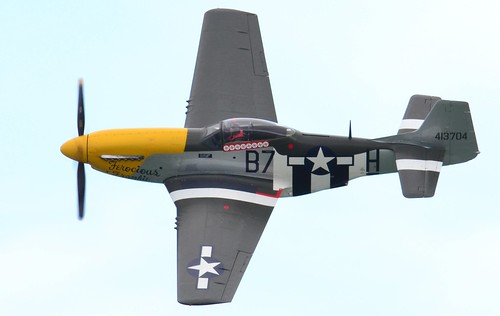
2 (AC) Sqn by now, also had a move away on the cards, and following a meeting on the 28th January the advanced party departed first, followed on the 31st by the ground party. The Mustangs moving to RAF Bottisham, from where they would now operate before being divided and part moving to Fowlmere.  After a short stay at the two sites they returned to the Hertfordshire airfield once more. Their departure had lasted a mere four months.

RAF Sawbridgeworth Emergency generator

The Standby Generator House now a stores for machinery.

Whilst they were away, the airfield was used on a temporary basis by 652 Sqn flying Austers, On arrival, they immediately took over Blount’s Farm and used it for their own personal use. In the short time they were here, they participated in Exercise “Spartan” again in conjunction with the Army, departing the airfield in late  March.

After being spilt between Bottisham and Fowlmere, 2 (AC) Squadron was now reunited and returned to training flights, air to air firing, ground support flights and increased operational activities. A large part of the squadron’s role now included photographic reconnaissance of enemy territory, many of these operations taking place over the Hook of Holland, den Helder, Kijduin, and Ameland. Some of these required the squadron to detach to other stations but the majority of operations flew from Sawbridgeworth, the Mustangs fairing much better than the heavy Typhoons of 182 Squadron earlier on.

In Mid may, disaster struck again for the unit when three aircraft crashed into a hillside after setting off on a photo reconnaissance flight to photograph locomotive movements in northern France in Operation “Asphalt“. On the way out, a bank of sea fog was encountered and the order to climb was given. Unfortunately, flying abreast,  three of the ten Mustangs failed to clear the hill they encountered, and Pt. Off. J. McLeod, Fl. Off. D. Hirst and Fl. Off. N. Miller were all killed. The remaining aircraft then flew to Thruxton where they were detached to,  and a search commenced for the missing airmen. Their bodies were later recovered and funerals held in their respective homes at the end of the month.

Photo reconnaissance flights and attacks on shipping, increased becoming the main role for the squadron.  Sadly during one of these operations, Operation “Lagoon“, Fl. Off. Butt was killed when his Mustang crashed into the ground before he was able to land. The resultant explosion and fire killing him.

July 1943 saw yet another move for the squadron, this time to Gravesend, where they were immediately billeted under canvas and then inspected for fitness to serve overseas. No such move came through though, and after moving around various other local airfields, in November, 2 Sqn returned to the Hertfordshire airfield that had become their semi-permanent home; this time though, they were not unaccompanied, they brought with them the Mustangs of 4 Squadron.

During their absence, Sawbridgeworth had not been deserted, in fact it had been very busy and home to several other squadron detachments. On the 12th November 1943, 63, 168 and 170 Squadrons had all moved in with Mustangs, then on the 30th, both 63 and 168 departed moving back to their parent unit, their short detachment coming to an end; whilst 170 remained here until mid January when they were disbanded.

The return of 2 Sqn and the new Mustang unit that November, saw a continuation of reconnaissance operations  over the continent. 4 Sqn had been dogged by mechanical issues resulting in many unserviceable aircraft and even for the move, only five aircraft were able to make the initial flight. It was these ongoing issues that led to them to begin changing their old models for newer examples, a change that would unfortunately take time to complete.

For much of December the weather played the dominant part, the winter of 1943 – 44 being extremely wet and foggy. For much of the month the airfield was yet again, unserviceable and only top priority operational flying could take place and even that was sporadic.

At nearby Hunsdon, both a Mosquito and a Spitfire along with suitable trainers were made available, and it soon became known that 4 squadron was going to re-equip with both and move to Aston Down.  At last, the older, problematic Mustangs were being replaced by a much needed and higher performing aircraft.

Conversion of the crews would take place at Hunsdon who would transfer across regularly to take flight instructions whenever the weather allowed.  It didn’t come a moment too soon either as serviceability for the Mustangs of both squadrons, remained critically low; at the end of the month, 4 Sqn only had two airworthy aircraft.

In early January 1944, 4 Sqn finally got their departure orders and made the move to Aston Down. The conversion had been successful, and further training flights were carried out once at Aston Down, gradually more and more of the new models arrived bringing the squadron back up to full strength once more. That was not the end of 4 Squadron though, as on March 3rd 1944, they returned to Sawbridgeworth with their new Spitfires and their Mosquitoes, their period of reconnaissance training on the two types now almost complete.

On the 3rd March, two parties left Aston Down, the road party in the morning and then, in the afternoon, the air party, forming the largest ‘Balbo‘ the unit had known for some time. in all, twenty-two aircraft made up of Spitfires, Mosquitoes and Mustangs flew in formation all the way to Sawbridgeworth, their arrival in the late afternoon must have been a magnificent sight for those waiting on the ground.

The squadron was then divided into two flights, ‘A’ Flight flying the Spitfires and ‘B’ Flight the Mosquitoes. During March the ‘A’ Flight Spitfire XIs were used to fly photo reconnaissance sorties over ‘Noball‘ targets – rocket installations in France, the first operational sortie since December 12th. However, and a blow to the squadron, there was 10/10ths cloud over the target area and no photos were taken as a result.

With ‘A’ Flight busy on operational sorties, ‘B’ Flight continued with their Training flights in their Mosquitoes. However, as with the Typhoons earlier, things were not as straight forward and easy and they may have been. It was found that stones and clinker had found its way onto the tracks and these had been thrown up damaging the tail plane of the aircraft rendering all the aircraft used unserviceable.

Poor weather continued to hamper operations as it had done for months, the Mosquitoes now taking part in photographic flights having their flights cancelled and the squadron being stood down on several occasion.

In early April, they were ordered out of Sawbridgeworth and on the 4th, both air and ground parties left for Gatwick, their penultimate stop before moving to the continent where they would stay for many years after the war’s end.

Meanwhile, 2 Sqn had continued operations over enemy territory, carrying out both air-ground attacks and reconnaissance flights over the continent. Yet more detachments away at various airfields including Benson and North Weald, led to them being divided once more. However,  being posted to North Weald caused problems for the resident 268 Sqn who were now forced to leave there and come to Sawbridgeworth, North Weald being too small to accommodate both units. When 2 Sqn returned to Sawbridgeworth on March 26th to continue their operational activities, 268 departed, being transferred to RAF Gailes where the entire squadron undertook a Naval Bombardment course.

During their time here, 268 had been operational flying regular sorties over France. With the impending invasion, they photographed beach defences along the French coast, Radar station at Ostend and carried out “Noball” operations searching for and photographing V1 launch sites.

2 Sqn’s last departure from Sawbridgeworth than came, and on 24th March 1944, they along with 4 squadron shortly after, departed the airfield for Gatwick, never to return to Sawbridgeworth again.

2 Sqn would go on to serve well into the future, taking their Tornadoes to Marham in 1991 after serving in Germany post war. With a long and distinguished history that extends as far back as 1912, they would operative some of the worlds most modern aircraft including: Meteors, Hunters and Jaguars all in front line operations.

With 2 Squadron now departed and not going to return, there was room for other squadrons to utilise the airfield. April saw the arrival of both 80 Squadron on the 24th April followed by 126 Sqn on the 30th; both units flying Spitfires VB and IX respectively.

80 Sqn had been overseas for the last few years and as soon as they arrived at Sawbridgeworth, they were granted leave of up to seven days. Many were disgruntled at such a short period of time and some were given extensions. On return, the squadron then moved immediately to Hornchurch to form a new Wing along with 229 and 274 Squadrons.

Only one other squadron used the airfield after that, 126 Sqn, who, like 80 Squadron, had been abroad and were essentially regrouped here. No flying took place and once settled they were assigned to RAF Culmhead.

After D-Day no other units used the airfield and Sawbridgeworth had had its day. Now redundant it was handed over to the Maintenance Command and placed into care. All flying ceased, military units were pulled out and the airfield gradually wound down.

Its demise was swift, the mesh runways were quickly removed using POWs,  the tower was demolished a year after the cessation of conflict in 1945, and many other buildings were removed or demolished; the land rapidly turned back to agriculture.

Wandering the site today, there is luckily still quite a bit of evidence about. The perimeter track is complete, not in its full width throughout, but a large proportion of it. A number of pill boxes remain scattered around the perimeter of the site and the Battle Headquarters (design 11008/41) can be found with determined searching amongst the brambles and hedgerows.

To the west of the site is a small industrial complex utilising what was a ten-bed sick quarters, dental annex, a twelve bed Barrack hut that doubled as a hospital ward, mortuary and an ambulance shed. An ablutions block is was also located here and the site is more or less complete. Not far from here, is a modern farm, which houses a number of smaller original buildings including a Parachute store (built to drawing 11137/41), fabric store, sub station, main stores and other technical buildings. These are all located on private land and in use by the farmer. There is also a signals block, located nearby to these sites and easily visible from the road.

Across to the east of the airfield, is whats left of the communal site. Here stood 33 buildings in total, incorporating a wide range of supporting units for recreation and general living. The only remaining buildings being the standby generator house and the grocery store. Both are used by local businesses.

A memorial to those who served at Sawbridgeworth stands outside what was the guard house. A recent addition, it is a nice reminder of the dedication of the crews who were stationed here during two world wars.

Sawbridgeworth took years to develop and continually struggled with nature and her elements. Those stationed here struggled with mud and poor weather, undertaking co-operation flights, photographic reconnaissance operations and attacks on enemy targets on the continent. But it never really reached its true, and full potential, languishing in the background with no real direction or planning to see it thrive. Possible loved by many, but loathed by some, it remains today as a reminder of what those dark days of the 1940s were all about.

It is a small well hidden airfield and takes some finding. Hidden by woodland and crops, it was created through luck rather than good planning. The crews and aircraft of Sawbridgeworth played a big part in the Second World War, and all in its short but yet significant life.

Whilst in the area, a third,  very important and still active airfield, can be found not far away at North Weald.

Sources and Further Reading (Sawbridgeworth)

*1 Herts Memories website accessed 30/6/24

*2 National Archives AIR 27/406/1, 39 Squadron Operational Record Book 1916 May 01 – 1930 June 30

*3A Fleeting Peace’ website. visited 1/9/2024.

*4 (a form of gas that is thought to be harmless and used in trials. Mustard Gas would be stored and used in the event of an invasion). National Archives Air/27/19.

*5 National archives AIR 27/1135/1 – 182 Squadron Operational Record Book

National Archives: AIR 27/19/9;  AIR 27/19/13, AIR 27/19/15; AIR 27/19/19;  AIR 27/19/21, AIR-27-2876; AIR 27/19/25; AIR 27/19/30; AIR 27/19/33; AIR 27/19/32; AIR 27/19/36; AIR 27/19/30; AIR 27/1564/5; AIR 27/671/7;

For personal stories and further information see the Wartime Airfields website.

The Hertfordshire Airfields and Memorial Group have further information about the site and the memorial on their website.

The full story can be read in Trail 25.

RAF Sawbridgeworth – Part 3 – P-51s Arrive.

Continuing on from Part 2

With all Tomahawks now airworthy, if not troublesome, exercises away at other airfields were the main order of the day. Courses held here were well attended meaning the airfield would see a range of personnel, including naval staff, residing at the site for short durations, over the coming months.

RAF Sawbridgeworth Perimeter Track

Perimeter track

Personnel spirits were raised once more when Flt. Lt. Houseman and Sqn. Ldr. Eyres visited RAF Duxford in February to see the new American built P-51 ‘Mustang’, it was thought this was to be the new replacement for the Tomahawks which had been nothing but problematic throughout their time at Sawbridgeworth.

Convinced of the Mustang’s superiority, arrangements were quickly made for other personnel to also visit the airfield and see for themselves what the new aircraft was capable of. Then, in April 1942, after some initial training at Bottisham, the first three Mustangs arrived at Sawbridgeworth flown in from Speke, Liverpool. With a further six arriving the next day, the total number of Mustangs at the airfield quickly began to increase.

RAF Mustangs of 2 (Army Cooperation) Sqn.

As with the introduction of the Tomahawk, the introduction of a new aircraft takes time and is rarely trouble free. On April 9th, no less than three Mustangs were either written off or substantially damaged in accidents. The first, ‘AG401’, was on a message dropping flight when it inadvertently hit hidden HT cables severing its pitot head and aerial. With no air speed indicator, the aircraft made a fast landing causing the wheel to slip off the tracking and hit a hole in the ground. The wheel lodged itself in the hole causing the aircraft to flip onto its nose. In the second accident,  as ‘AG403’ piloted by Pt.Off. G. Gosnell, ran down the runway, it struck a second Mustang, ‘AG488’ piloted by Pt. Off. P. Willmett, who was taxiing prior to taking-off. After the impact, ‘AG403’ rose into the air, flipped onto its back and crashed into the ground fatally wounding Pilot Officer Gosnell. Pt. Off. Willmett in the second Mustang was however, uninjured in the collision.

Only ten days later Pt. Off. Willmett was involved in another accident when the Mustang he was flying, this time ‘AG492’, suffered a stalled engine. Unable to restart it, Willmett made a forced landing in a field near to High Wycombe. Neither he nor the aircraft suffered any injury or damage.

In June, further consideration was given to extending the runway once again and more surveys were made of the ground by Captain Storey of C.R.E. Bottisham. But any positive news from this was marred by the two deaths of personnel from Sawbridgeworth. Firstly , P. O. G. Young was killed in an air firing exercise at Stert Point ranges on Fenning Island. The aircraft failed to pull up after the attack and subsequently hit the sea wall completely destroying the aircraft. The cause of the accident remains unknown. The second person to die was LAC Dodds, who accidentally drowned whilst swimming in a river local to the airfield, both tragic accidents that marred an otherwise positive day.

Exercises in July took detachments to both  Snailwell and Wendling. Residing at Shipdham, they carried out forty-six sorties altogether all with excellent results – the Mustang and its crews were performing well. With the official release of the P-51 at the end of the month, the squadron was visited by press officials who were invited to take photos and also meet the crews who would be flying them.

On August 8th, 1942,  one of many support training units that were to operate from the airfield, was created here at Sawbridgeworth. The 1495 (Target Towing) Flight, who like 2 (AC) Sqn early on, was equipped with the Lysander and Martinet. It was a short lived unit though, created to support air-to-air gunnery practice using targets towed behind the aircraft; being absorbed into another unit at Hutton Cranswick merely a year later.

The naval link continued in September when a detachment of No. 809 Sqn Fleet Air Arm, arrived bringing with them Fairey Fulmars. The three aircraft staying here, were practising low level attacks through smoke screens in conjunction with 54 Division Battle School. A further twelve officers and six more aircraft then arrived at the end of the month bringing the total number of naval personnel to nine. These were very quickly supplemented over the next few days, and soon the airfield was awash with staff.

This cooperation between units brought many varied aircraft and personnel to Sawbridgeworth. A detachment of 239 Sqn arrived here for a short stay between 22nd October and 18th November, flying their own Mustang Is in conjunction with those of 2 (AC) Sqn, this move would have considerably increased the number of aircraft using the site and the station would have become increasingly active.

RAF Sawbridgeworth Sick quarters

Former Sick quarters

October 29th would sadly be another black day for the airfield though, with the loss of three more Mustangs during night manoeuvres. Flying in bad weather and unsure of their location, the flight of three descended to lower altitudes to gain visual references. In doing so, the first aircraft, ‘AG605’ flown by Pt. Off. D.  Williams, collided with trees and crashed. The aircraft was destroyed and the pilot was sadly killed. In the second incident, one of the wingmen (AG633), was forced to make a wheels up landing in a field next to the airfield after attempting an overshoot. The pilot, Pt. Off. P. Whittenham luckily escaped without injury. The last of the three, the leader of the flight (AG465), ran out of fuel and baled out leaving the aircraft to crash into hotel grounds at Ludgershall, Buckinghamshire. He landed without further incident.

Further cooperation flights, involved the arrival at the end of November, of sixteen Spitfires from the Norwegian squadron then based at North Weald. The pilots were here to train in Army cooperation, again operating alongside the Mustangs of the now expert 2 (AC) Sqn.

With the principle aircraft now being the Mustang for 2 (AC) Sqn, a few Tomahawks still remained on their books, and it was  one of these that would crash on landing causing minor injuries to the pilot Pt. Off. P. Gordon-Crosby in ‘AK144’. The type had by now though, seen its day and was largely phased out of squadron use by this time.

As 1942 drew to a close, Sawbridgeworth had grown and developed. It had links with squadrons across the country and across different forces, it had also seen a variety of nationalities reside at its grounds. Whilst it was at least now making its mark, conditions at the site were far from perfect, a problem that was to be highlighted when news came in to 182 Squadron based at Martlesham Heath that they were to relocate to Sawbridgeworth. In preparation, the station commander, Sqn. Ldr. T. Pugh and adjutant Flt. Lt. R. Melhuish, set off by road to inspect the airfield, paying particular attention to its  accommodation facilities, hardstands and runways.

It was clear from the outset that the airfield was “going to give everyone a formidable array of difficulties to face, the accommodation is uncompleted, the dispersals are uncompleted and deep in thick, clayey mud, and the larger hangar is only half erected and has no roof, and everywhere is mud, thick and sticky.” *5

These findings were then confirmed by  Flt. Lt. Manak, who returned to Martlesham after landing a Hurricane at Sawbridgeworth. The entry recorded in the ORB *5 reflected Manak’s feelings in just a few words: “He returns with a very dismal face.”

As a result, Sqn. Ldr. Pugh contacted Headquarters 11 Group to express his deepest concerns at the state of the airfield, but promised to try and see if the squadron could operate from it,despite the difficulties they would face. It was a brave attempt that would not last long. That night, in honour or the squadron, a party and competition were held between 132 and 182 Sqns at Martlesham which, as often happens, became a little ‘boisterous’ resulting in the C.O. and Squadron Engineer Officer both being sent to hospital for injuries sustained in the activities.

Then, on the 6th December, the ground party began their move, followed the next day by the air party lead by Flt. Lt. Manak, in which seventeen Typhoons and one Hurricane took off in groups of four, set for Sawbridgeworth. The problems they were going to face became immediately obvious as they were faced with sticky mud as soon as they landed. Undaunted by the challenges ahead, by the evening they are all bedded down ready for the challenges of their new home.

Conditions at the dispersals made flying virtually impossible for the heavier Typhoons, and considerable work was needed to bring them up to any sort of standard, deep “cleyey‘” mud prevailed making movement difficult, even the runways were a challenge despite the fact there was matting lain down.

By the 13th December, a week into their stay things had improved slightly, and flying began with thirteen officers putting in twelve hours thirty-five minutes of patrols.

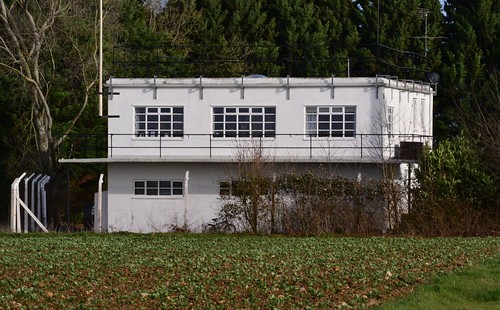
RAF Sawbridgeworth Signals Block

Former Signals block

But by the 15th, the rain had returned, and the airfield became difficult to fly from once more. Further rain followed and by the 17th it was completely out of commission, a state it remained in for many days thereafter. With flying scaled right back, it was decided to make good use of the time by providing ground lectures covering a wide-range of topics. By the end of the month, little had changed and six aircraft were ordered to disperse as soon as possible to nearby RAF Hunsdon so that some flying could, at least, take place.

It was not until the 29th December that the airfield was in any state to permit flying to take place.  The six aircraft destined for Hunsdon then managed to take off, lead by Sqn. Ldr. Manak. To support them, a ground party also left taking with them supplies and spares to Hunsdon from where they would now operate until further notice.

To combat the continuing mud problem, the north-south runway was eventually relaid, the east-west runway was considered ‘usable’, as long as there was no further rain, and it was therefore left in situ. The slightest amount of rain however, would simply turn the ground into thick mud and slush.

Christmas then passed, and 1943 would see little change in the weather. After a few dry days, adverse weather returned once more, and once again the early days of January saw little flying take place. However, a short break did allow history to be made when, on the 3rd January 1943, the first operational sortie of 182 Squadron was made. Two Typhoons, flown by Flt. Lt. Manak and Sergeant Shields, flew to Martlesham Heath, where they were ‘ bombed up’ with 250lb bombs and then attacked inland port installations at Bruges. Whilst the overall outcome of the operation was not known, it was nevertheless the squadron’s first operation since its inception and there were no losses.

Between then and the 17th, bad weather persisted, it became so bad, that at one point the mud seeped through the mesh and a substantial amount of flying by the squadron, had to be cancelled as a result. However, on the 17th, ten aircraft were able to get airborne and after joining with four of those detached at Hunsdon, they made their way, with two lighter Mustangs from 2 (AC) Sqn, to RAF Snailwell where they would take part in ground support operation with Army Command. Snailwell’s resident 181 Sqn welcomed their sister squadron with open arms, and threw a huge party in their honour. The following day, they all took part in the training exercise “Shatter“, before all aircraft, from both squadrons, returned to Sawbridgeworth and the mud they had left behind. 182 Sqn then made the decision to attempt to operate the all its aircraft from the airfield, but, with mud accumulating along the track, by 23rd the new station commander W. Cdr. Bristow, had had enough and declared the runways unserviceable and the airfield all but closed.

By the 27th, concerns for Sawbridgeworth had reached the higher ranks of the military and the Air Officer Commanding  Army Co-operation Command, Air Marshal Sir Arthur Barratt KCB, CMG, MC, who arrived at the airfield to discuss the future of 182 Squadron with W. Cdr. Pugh. The outcome was that the squadron would have to move elsewhere as training had been held up for far too long, and this must now stop; a move away was on the cards and not a moment too soon either.

By the 30th January, all was set and the squadron managed to get airborne returning to their former station at Martlesham Heath. The following day all ground personnel also left and the squadron settled in at their former airfield, leaving a disastrous stay at Sawbridgeworth well and truly behind.

Part 4 continues with the end of the war and the end of Sawbridgeworth. The full story can be read in Trail 25.

RAF Sawbridgeworth – Part 2 – 1941

Continuing on from Part 1

The New Year 1941, started with good news when Wing Commander Geddes, received an OBE in the New Years Honours list. Celebrations were only slightly marred with two more attacks by German bombers; as before, there was no major damage and there were no casualties as a result.

Winter being what it was in 1941, poor weather very soon made its mark, and as a result, little flying was achieved over the whole of the new month.

It was during 1941, that Wing Commander Geddes and 2 (AC) Sqn would be heavily involved in the secret work of the Special Operations Execute (SOE) who were involved in dropping agents into occupied France. Much of the training of the aircrews for this role took place here at Sawbridgeworth, with practice flights using the famous ‘Black’ Lysanders. Even today, many years later, these operations and the role of the photographic reconnaissance units based here, remain deeply buried in the Archives, hidden from many a prying eye.

Winter lectures and the occasional flights, were interrupted by a three day visit by Colonel L. Kennedy, Air Liaison Officer of the American Armoured Forces. He inspected various aspects of the airfield and met with the airmen on various occasions.

The next few weeks up to spring saw little change, with fog, rain and snow persisting until mid March when warmer weather finally broke. But the persistent heavy rain had rendered the airfield unserviceable for even the Lysander, and so it was out of operation for much of the time. Not only had the rain affected flying, but the huts now being used for personnel had flooded, and as such, were classed as ‘uninhabitable’;  a position they remained in for a good while. Eventually, if only temporarily, routine training flights did resume, working in conjunction with the Army once again, they performed more gas attacks and dive bombing flights, but April’s infamous showers would soon return and play havoc, closing the airfield to flying due to the ground being waterlogged.

At the end of May, there was a hint of changes to come, when radio equipment was sent to Henlow to be fitted to Curtis Tomahawks, suggesting a replacement  aircraft was now on the cards. This, followed by several visits by the Works and Buildings representatives to discuss runway extensions and improvements, further went to affirming the suggestion of another step forward, both new facilities and a new aircraft – hopefully one that could operate in the damper weather now dogging the crews at Sawbridgeworth.

The weather over May then improved significantly, hot dry days helped dry out the previously sodden ground, and just in time too as 170 men from the Aerodrome maintenance company arrived to be housed under canvas for the duration of their week’s stay. Their role, to lay Army Track, the first hard runway used at the airfield.

With fine warm weather now presiding, pilots in groups of three, were sent to Old Sarum, a former WWI airfield, for conversion training to the new Tomahawks. Their return was greeted by a visit from both Marshal Viscount Trenchard CGB, GCVO, DSO, DSL, LLD and Air Marshal Sir Arthur Barrett KCG, CMG, MC. who were here to inspect the squadron and their current facilities.

RAF Sawbridgeworth Pill box

Part of the defence network

By the middle of August 1941, virtually all air crew were transitioned onto the Tomahawk, and were ready to fly the new type, the first of which began arriving from the Cunliffe Aircraft Co. Ltd over the next few weeks. The transition would not go smoothly however, with two aircraft, AH945 and AH928, both ground looping on the 9th and 10th September respectively. In addition, a further Tomahawk, ‘AH940’, was forced to land in a field the following week, when the engine cut out for no apparent reason. Whilst the pilot was unharmed, the aircraft sustained considerable damage to its underside and propellers. An investigation began immediately which revealed that faulty generator drive had been responsible, and so all Tomahawks were grounded until the bevel gears had been inspected by engineers from the Air Ministry.

September would prove to be a dark month for the squadron. Not only were the Tomahawks proving to be troublesome, but a water tanker hit and killed a 15 year old girl (Doris Bird) from the nearby village. An investigation was also held into this and no blame was apportioned to the driver. Doris’s funeral took place a short time later and was well attended by members of the station.

The continual presence of officials from various departments were bolstered by the arrival of representatives of the AMWD (Air Ministry Works Department) on both the 26th September and 10th October 1941, who inspected the runways and perimeter tracks. Within days, on 16th October, Flt.Lt. Hampton brought along revised plans for development of these tracks, taking into account the layout and difficulties that had been suffered, it would go on to change the format of the entire airfield once again.

Two days after this, Mr. Pallott, an electrical engineer from 10 Works Area, met with staff at the airfield to discuss the fitting of the Drem lighting. Development plans were now well in hand and Sawbridgeworth was heading ever closer toward expansion and classification as an airfield in its own right.

The sunny summer weather soon passed and by November ‘fair weather’ was the main description recorded in the operations books. Making best use of what dry weather there was, enabled both photographic and navigational exercises to take place. Then finally, on November 28th 1941, Sawbridgeworth’s day had at last arrived when Flt. Lt. K.K. Horn MC, took over control of the newly named Royal Air Force Sawbridgeworth, the name and title were now official, and the airfield had at last achieved its independence.

Little immediately changed however. The plans for development continued to roll on, as no work had as yet, been carried out, and the Lysanders, still being used, continued to take off for photographic sorties and training exercises;  lectures and ground based training also continued for all personnel, and many of the Tomahawks which were now airworthy again, also took part in exercises such as “Scorch” and “Swift“.

The weather continued to be a mix of high winds, fair days and rain, the weather again cancelling several night flights. Manoeuvres continued in conjunction with the various troop units and gas spraying training flights carried on as usual. During many of these manoeuvres, flights would disperse to other airfields giving the appearance of vacating Sawbridgeworth. These exercises could take days, and so the airfield became quiet for short periods of time whilst ground parties took spares, vehicles and rations to wherever they were being temporarily stationed.

The remaining personnel made good use of the facilities at Hyde Hall, attending ENSA shows and enjoying a christmas meal served by the Officers and NCOs. With spirits high, it was hoped that the new year 1942, would be a year that would bring further changes to both the airfield and those stationed here.

One thing that didn’t change though, was the seemingly continual arrival of ‘guests’, with both Sir Archibald Sinclair, Secretary of State for Air along with Group Captain Sir Louis Greig, looking round the station before enjoying an evenings ENSA entertainment.

In the middle of January, yet more dignitaries arrived, but these were not social visits but more strategic ones. A group made up of Air Commodores, Wing Commanders, Group Captains and Squadron Leaders along with representatives of the Army and the Air Ministry, all arrived to attend a meeting to discuss the future of RAF Sawbridgeworth. The many aspects of its design were discussed including the accommodation facilities, technical blocks, runways and wider airfield development, aspects that had no yet been reflected upon until now.

RAF Sawbridgeworth dispersal pen

The remaining dispersal pen

The meeting had a very positive outcome for Sawbridgeworth, and would see it finally become a fully developed airfield able to operate in its own right. It was unfortunately decided that concrete runways could not be laid down at the current time, and so Sommerfeld tracking would have to be the preferred option. However, it was also decided that a concrete perimeter track could be laid down and that it should be able to marry up with concrete runways in the future when and if, they were to be added. As Army Tracking was already in place, this would need to be replaced, and so it was decided to extend the runways at the same time. With limitations on the length of the runways due to the geographical nature of the site, it was decided to extend them as far as was feasible at that time. With this is mind, it was decided to lengthen the main east / west to 1,750 yards, whilst the north / south runway was to be extended to 1,200 yards, and the the North-east / south-west runway to 1,400 yards, not the full Fighter Command lengths but certainly large enough to take most light aircraft.

The runways here had given considerable problems over the years particularly with the poor weather, and many flights had had to be cancelled, sometimes for days at a time. In order to solve the problem, a number of different materials were trialled, including (as referred to in some resources) ‘coir matting’ an experimental material using coconut fibres formed into a mat (still commonly used today as domestic door mats) and laid down as a runway. However, this was found to be a failure, as it, like grass, soaked up the water causing great difficulty for the aircraft. This type of matting also required a lot of maintenance, and so metal Army track was used. During this latest upgrade the Sommerfeld tracking chosen would see Sawbridgeworth through to the end of the war and no concrete would be laid for runways.

Pieced together using interlocking sections, Sommerfeld Track required a lot less maintenance and was very strong.  With the new runways came the Drem lighting system which was developed at RAF Drem in Scotland, and was fast becoming the standard airfield lighting system. Here at Sawbridgeworth, it was placed alongside the track embedded into concrete blocks as opposed into the runway edges itself.

Now designated a Class ‘C’ aerodrome, Sawbridgeworth would also have concrete dispersals; fighters on the north side with Army Command on the south; both commands would also have dispersals located north of Matham’s Wood. In addition, hangars would be built as well as hardstands, the number of each being initially determined by Fighter Command requirements; six double Blenheim pens; two hardstands and four extra-over blister hangars. With further developments and later upgrades,it would eventually have eleven Dorman Long (4630/42) blister hangers along with one type T2 hangar. Buildings were upgraded and developed too. In the technical area there would be a parachute store; designed to drawing 11137/41, they are easily identifiable by their unique roof structure, designed to accommodate the hanging of parachutes as they dried out in the temperature controlled environment within.

As with many airfields a Battle Headquarters would also be added, (drawing 11008/41) these were sunk or partially sunk, and constructed with 13.5 inch thick walls. Inside was a PBX, an office and a space for messengers. In many cases only the roof and viewing slit was visible from the outside.

Around the perimeter thirteen (and not the original six) ‘Blenheim’ style aircraft pens were added with an additional fifteen (as opposed to two) frying pan style hardstands of 40 ft diameter each. In addition, eight dispersed sites of temporary construction were eventually added to the east of the airfield for accommodation, Hyde Hall accommodation would cease and it would be passed over to the Army for Motor vehicles storage and maintenance. A watch tower, fire tender station, hospital, grocery store, Link trainer, gymnasium and the usual accommodation blocks all added to create a much bigger site than had been previously been designed . At its peak Sawbridgeworth would accommodate 1,000 personnel of mixed rank and gender.

The conditions at the airfield were considered so poor at this time though, that immediate changes had to be made in order to keep it operationally active. The ground and accommodation areas being totally unsuitable for an operational airfield. The new upgrade would take time, so basic changes were made, and all in line with the longer term plans. These would enable Sawbridgeworth to operate both fighter and army Co-operation aircraft, even before the upgrade had taken place. The development was going to require a lot of maintenance and constructions workers to be on site, but rather than move the squadron and all its personnel to another airfield, it was decided to keep them all here and operate in conjunction with the development crews.

Part 3 continues with the development of Sawbridgeworth. The full story can be read in Trail 25.

RAF Sawbridgeworth – Humble Beginnings.

In Hertfordshire (Trail 25) is a small long, gone airfield that was once home to a number of squadrons including both 2 and 4 Squadrons RAF; two squadron that went on to operate, for many years, in Germany post war.

It is an airfield that its origins in the First World War. It struggled with poor weather, exceedingly bad drainage and was one that developed not through careful planning, but more the luck and perseverance of its station commander.

With remnants of its part still remaining, we take a look at the former RAF Sawbridgeworth.

RAF Sawbridgeworth

RAF Sawbridgeworth, also known as Mathams Wood and RFC Sawbridgeworth, was originally constructed as a second-class night landing ground during April 1916. After considering three sites in the area, Sawbridgeworth, a 31 acre site to the west of Shingle Hall was chosen, the reason being it had good approaches, was flat and had a main public road running alongside it.

Facilities at the ground were limited however; there were no hangars and only a small wooden hut with an occasional tent was provided in cases of bad weather. Any aircraft landing due to difficulties or damage, could have minor repairs carried out, but little more than that. As a result, staffing at the site was also minimal, manned by just one RFC officer and a handful of civilians who would carry out repairs and maintenance to any aircraft using the site. Whilst based here, the primary role of the RFC Officer was merely to provide signals to landing aircraft by using flares laid out in the form of an ‘L’ with the longer leg pointing downwind.*1

Sawbridgeworth was small, only being intended to take aircraft from 39 Sqn, a home defence unit who were currently based at nearby North Weald, and who were activated to combat the Zeppelins flying in from Germany to bomb targets in southern and eastern England.

It was indeed Lt. Leefe Robinson of 39 Sqn who attacked and shot down the first Zeppelin over British Territory on 2nd September 1916. Called the ‘Cuffley Zeppelin’ after the village near to where it crashed, Robinson was immediately  awarded the Victoria Cross for his action on that night, an honour not bestowed lightly.

Wreck of the German Zeppelin L 21 at Cuffley, Hertfordshire (IWM Q73672).

The squadron was initially formed with its headquarters at Hounslow, and had two Flights – one based at Hainhault Farm, and the other at Sutton’s Farm – both part of the Home Defence force, and were directed to protect London from Zeppelin attacks from the north-east coming across the Wash and down through East Anglia.

In August, the Headquarters were transferred to Woodford in Essex and a third Flight established at North Weald Bassett. The three Flights were then merged to form 39 Sqn RFC. The squadron would indeed primarily attack Zeppelins, but records show they also attacked a number of German Gothas also used to attack the capital..*2

Little use was made of Sawbridgeworth however, and in November 1918 it was closed as a landing ground, the site quickly reverting to its former agricultural use.

For almost 20 years the site remained in this form, until 1928, when a small gliding club was formed at nearby Shingle Hall Farm. It would turn out to be a short -lived venture however, ceasing to operate within a year or so. But despite this, all was not lost, and in 1933, a ‘Great Air Pagent’ took place in which fifteen aircraft paraded past a growing crowd who had come to experience the thrills and spills of flying. The Pagent itself, was part of a wider programme designed to tour the country raising money for local hospitals, and successfully visited 180 towns and cities across the country, being seen by over one million spectators. *3

Led by Mr. Charles W. A. Scott, AFC, the famous airman who held the world record for his flight from England to Australia, the event was to specifically raise money for a new wing at the Bishops Stortford Hospital, and would showcase a range of daring flying stunts to amaze the gathered crowd. The event was a great success, and a new wing was indeed opened at the hospital as a result. Also taking part was one of the more notable aviators, Pauline Gower, who would later go on set up the Women’s Section of the Air Transport Auxiliary in 1939.

However, there was no further flying activity at the site after the pageant, and no further aviation interest was shown in the area, until after 1934 when a beacon was located on the south side of the field.

Then, with tensions rising on the continent, it was decided to begin training troops in preparation for what may lie ahead, and in order to do this, a new landing ground was needed in the vicinity. However, due to developments in aircraft design, size and power, the site at Shingles Farm was determined too small and not able to accommodate the new types of aircraft coming through. To remedy the problem another area just a short distance away, was then chosen as the new site. *1

The new site lay between Shingle Hall Farm and a wooded area known as Matham’s Wood, (seen on 1/4 inch map sheet 9, Ref:L 9137) located to the north-west of the farm, and was larger in area then the previous site used. The Ministry obtained it in 1937, and it was passed directly to the control of Army Co-Operation (AC) Squadrons, commanded by the 22nd Army Co-Operation Command. It would immediately become an Advanced Landing Ground (ALG).

Designated Matham’s Wood ALG, Army Co-Operation units, in particular, 2 (AC) Squadron, would operate with Army units, under operational conditions, simulating what it would be like for the troops to perform in times of war. These training operations would later become fundamental in the training of SOE agents who would be transported into occupied Europe to work with numerous groups including the French Resistance. Whilst the site was only used intermittently, it nevertheless set the seeds for the growth of the site into the what would become Sawbridgeworth airfield.

Former grocery store

The former Grocery store.

2 (AC) would remain the primary user of Matham’s Wood arriving in June 1940 after their retreat from France earlier in May. Whilst on the continent, they were  attacked on many occasions by the advancing Germany forces, receiving as many as 75 bombs in one attack alone. In support of the Allied retreat to Dunkirk,  they carried out sorties both over the town itself and over the advancing German front lines; eventually being forced to pull back to England and Bekesbourne in Kent, where they initially made their new home.

On June 15th 1940, Matham’s Wood ALG officially opened with its first ‘resident’ units, and was referred to as Sawbridgeworth Advanced Landing Ground for the first time. Flt Lt. P. Edinger was the Officer in Charge, who would oversee two Flights on rotation in conjunction with a third Flight then based at Hatfield. With them, were the associate section 5 A.I.L and a photographic section with their trailer. In support of operations, a range of appropriate night flying equipment was also transported over to the airfield.

The move would also see the requisition of Blounts Farm on the southern side of the airfield – this would be used as the Flight Office. Crew accommodation however, would once again be rudimentary at best – initially tents being the main form of accommodation for anyone stationed here.

Over the next few months various tactical flights would take place in conjunction with numerous Army Units, many of these involving the Lysanders of 2 (AC) Sqn ‘dive bombing’ the ground troops or performing mock gas spraying attacks. This rather deadly weapon was kept stored at various airfields around the country including Macmerry in Scotland and were a back up to thwart any invasion attempt made by the Germans.

Later, at the end of July, the bulk of 2 (AC) Sqn was divided, one Flight moving from Hatfield to Cambridge, leaving the other two Flights at Sawbridgeworth.  This meant that ‘C’ Flight, now at at Cambridge, would operate under HQ 2 Corps, whilst ‘A’ and ‘B’ Flights left at Sawbridgeworth, would operate under XI Corps. This move, whilst minor in itself,  was the next step forward in establishing an airfield here at Sawbridgeworth. For the next few years 2 (AC) Sqn would operate out of Sawbridgeworth, spending in some cases days or even weeks at a time at other airfields as part of their operational role. This would be a regular occurrence until mid 1944 when they finally departed and moved onto the continent following D-day.

Following the defeat of the Allied forces in France and their retreat from Dunkirk, the fear of invasion was now high, and tactical reconnaissance sorties were flown daily over the coast and inland water ways looking for intruders. Lysanders of the two units based at Sawbridgeworth carried out many of these flights, photographing areas of coastline stretching from The Wash in Norfolk, to the Thames Estuary in the south.

Fearing that Lysanders were no match for enemy fighters, Wing Commander Geddes of 2 (AC) Sqn, put in a request for fighter aircraft for the Squadron to support any action that may be needed. The Boulton-Paul Defiant was identified as a possible model, and so flight trials began, trials which continued well into September.

The crews at Sawbridgeworth, still residing in temporary accommodation, were given a ray of hope on September 11th, 1940, when the Great Hyde Hall, a 15th  Century Manor House, was requisitioned for the billeting of 2 (AC) Sqn personnel; because of its size and location though, it would be destined to become a temporary Station Headquarters and the Officer’s Mess.

With this increasing use, Sawbridgeworth ALG was gradually growing and developing into an airfield in its own right. This was largely through luck more than careful planning, and was mainly due to the efforts of the Commanding Officer of 2 (AC) Squadron, Wing Commander A. W. Geddes.

It was Geddes who made another step forward when he met with the Section Officer, No. 10 Works, on September 20th, 1940 to discuss further improvements to Sawbridgeworth. These talks were very fruitful and the future of the site began to look more promising.

During all this, operations continued with co-operation and reconnaissance flights occurring regularly. The use of gas in these training sessions was a high priority as there was a fear that the Germans would use such a weapon themselves, or that if the invasion came, the Lysanders would be ordered to use it as well. To meet the demand for training, supplies of “S3D” gas were constantly forthcoming, with 650 Gallons of the type arriving at Sawbridgeworth at this time*4

October 1940 began with a parade and the awarding of the DFC to Sgt. J. Clark by Air Vice Marshal C.H.B. Blount CB, OBE, MC; after the parade, the AOC went on to inspect the ‘airfield’ including the Great Hyde Hall, to see how it was being used  following its requisitioning earlier on. On the same day, Brigadier Withington of XI Corps also visited Sawbridgeworth, examining the few huts now on site to check their suitability for a possible aerodrome guard, a cookhouse and possible accommodation blocks. These visits were all seen as positive steps for the airfield.

RAF Sawbridgeworth

Remains of a building located in Mathams Wood.

By now, the airfield had gained the attention of the Luftwaffe, firstly when a Ju 88 crashed nearby at Bishops Stortford church, exploding on impact, and secondly, a few days later on 8th October 1940, when two parachute mines were dropped in the grounds of Hyde Hall  causing damage to the windows, but thankfully without causing any casualties.

Another major move then came on October 9th, when the first permanent members of 2 (AC) Sqn moved in, a move that was followed five days later, when nearby Townsend House was taken over by the Equipment Section, and immediately turned it into a stores block.

On the 20th, nine more bombs fell, this time they hit the cricket field of Great Hyde Hall, but with little overall effect except perhaps, to disrupt the challenge of playing matches. In all these attacks, no one was hurt nor any major damage sustained, but each bomb brought the front line that little bit closer to home once more.

December came and Christmas approached adding a little merriment to the routines of airfield life. It was a worrying time for the cooks though, as the cook house located in the Assembly Hall in Sawbridgeworth itself, burnt down. A new cookhouse was quickly set up within the Great Hyde Hall, and was duly opened on December 24th just in time for a much welcomed Christmas dinner the following day.

Part 2 continues with the development of Sawbridgeworth. The full story can be read in Trail 25.

Trail 32 RAF Nuthampstead – The end of an Era – Part 4

After Part 3 of our journey, we see the US bomber airfield at Nuthampstead finally come to a close. But as the war approaches its conclusion, operations continue to be flown and losses continue to mount.

The US forces would go to Dresden the morning after the RAF had been. 431  B-17s of the entire 1st Bombardment Division, would prepare for take off at 07:00 hrs to be over Dresden at mid-day. With two other Divisions also in the air that day, escort would be from 784 Mustangs, with the 20th FG protecting the leaders the 1st Bombardment Wing, the 398th BG, followed by the 91st and 381st Bomb Groups respectively. In all, in excess of 2,000 American aircraft would fly into the heart of Germany that day.

It was to go disastrously wrong for the Group though, for even as they flew over Holland, they were already off course and now the weather was moving in. With their Gee system being constantly interfered with and throwing up faults, the lead plane of the 389th decided to take the more southerly route to fly around the cloud, taking the formation near to Munster, a city heavily guarded by flak. Although objecting to the move, both the 381st and the 91st followed – a move they would come to regret. The 91st were hit hard; many aircraft were damaged and their crewmen badly injured. Then, another defensive turn took the Wing, some 137 aircraft, a total of fifty miles of course. They were now heading to Schweinfurt, the scene of such devastation in August 1943 where high loses resulted the US temporarily ceasing air operations as a result. Not wanting to relive the experience, the formation then turned south again, taking them, and their escorts, even further off course.

By now, the leader’s Gee system had completely failed, and as the formation approached the target, the deputy’s system also ceased working. Lost and confused, they were gifted with a break in the cloud through which they could see an ancient city with a river running through it. The order was given and bombs were dropped. With little to no flak and no enemy fighters to resist them, the formation unleashed its devastating load onto those below. Unfortunately, it was not Dresden at all, but the Czech capital Prague, they were some eighty miles off course.*5

The 398th flew their final operation on April 25th 1945, a flight that took them to the Skoda Armament Works at Pilsen. The 398th were joined that day by the 91st, 92nd, 303rd, 305th, 379th, 384th, and the 381st Bomb Groups. With simultaneous operations happening elsewhere at Munich and the Me 262 airfield in Prague, 198 aircraft were flew to Pilsen to bomb the Skoda works.

In contrast to their first mission, take off was controlled and in good order. The first aircraft was airborne at 05:20 and the last 35 minutes later. Forming up took place over Debden Buncher (RAF Debden) at 5,000 feet and the Buncher was left at 06:40, when the entire formation headed for the coast. at 07:37, they crossed the French shoreline.*10

The 398th BG were tasked with leading the 1st Combat Bombardment Wing, totalling three Bomb Groups made up of 120 B-17s. In charge was Captain Michael Robinson, Commanding Offcier of the 601st BS. The weather was predicted to be good, so a visual bomb run was planned, however, over the target, this proved not to be the case and 10/10 cloud completely obscured the target. Forced to go round again, the formation made a 360o turn bringing them back in at the rear of the formation. By now flak had become both intense and accurate.

Two aircraft from the 602nd in the high squadron were hit. The first B-17G #42-97266 (K8-G, “Godfathers Inc.“) piloted by 2nd Lt. Allan Ferguson, quickly left the formation spiralling out of control. Three of those on board managed to escape the aircraft as it fell earthward. Of the crew, six were killed whilst two were captured becoming prisoners of war for the last remaining days of action*6*7

The second aircraft that day was that of Lt. Paul Coville, B-17G #43-38652 (K8-V, “Stinker Jr“). After the second bomb run, the aircraft was hit behind the #3 engine, leaving a large hole and a damaged engine. After falling out of formation and feathering the engine, Lt. Coville brought the aircraft back, at which point the engine caught fire. A small explosion then ripped the right wing off outboard of the engine, sending the aircraft spiralling towards the ground. The crew inside, frantically tried to get out, assisting each other with parachutes. All crewmen except the ball turret gunner S. Sgt. Charles Walker, manged to escape the aircraft, managing to find allied troops on the ground and safety.

During their search for safety both Coville and the waist gunner S. Sgt. Harry Overbough, took two prisoners each, Overbough’s ending up being revealed as escaped Jewish prisoners who had donned German army uniforms to help them escape. *7*8

After bombs away, the formation made a right turn and headed as briefed toward home, crossing the English coast at 14:26. The first aircraft touched down at Nuthampstead at 15:02.*10

With the last mission flown, Nuthampstead’s days were now numbered. A handful of ‘Revival’ flights were made transferring POWs from Barth in Germany to airfield A-10 in France. In addition, flights carrying ground crews over Germany also took place. By May 1945 though, the war was over and the exodus of American forces back to the united States began. Over the period May / June,  1945, the 398th would depart Nuthampstead, the ground force returning to the US  from Greenock onboard the Queen Elizabeth, whilst the air personnel flew back between 21st and 27th May. After thirty days of rest and recuperation, the Group assembled at Drew Field, Florida where many officers and enlisted men were discharged from the service. The remaining handful were given duties elsewhere and transferred almost immediately.

A VE day service held at Nuthampstead airbase. (@IWM UPL 35448)

On September 1st 1945, Major Gene Nelson and Major Dean Ashworth, quietly and without ceremony, inactivated the Group – the 398th would be no more.

By the time the war had come to a close, the 398th had completed 6,419 operational sorties (175 missions) dropping some 15,700 tons of bombs. They lost some seventy*10 aircraft in operations. For their determination and outstanding flying over Derben on April 8th, the Group received a Presidential Unit Citation, this came in addition to 2,124 Air Medals, 531 DFCs, 2 Silver Stars, 18 Bronze Stars and 4 Purple Hearts (with others being awarded elsewhere). Whilst their losses were perhaps hugely significant compared to other Groups, they nonetheless performed gallantly and with dedication deserving of any military group.

Returned to RAF ownership a month later the airfield became a store and maintenance station storing ordnance for disposal, and by 1954 the military had no further interest in it, and it closed some 5 years later.

During the 1960s Nuthampstead was in the limelight once more when it was considered as a site for London’s third airport after Heathrow and Gatwick. Being so close to the capital made it an ideal proposition, but the proposal faced huge opposition from those living and working in the area. The decision would eventually favour Stansted, a site not even shortlisted in the initial phase.

The Roskill Commission Inquiry (1968-70), identified seventy-eight initial sites, reducing it to four possibles: Nuthampstead, Thurleigh (Bedford), Cublington (Bucks) and Foulness on the Essex coast, ignoring Stansted on grounds of air traffic, noise and poor road access.

After great debate, Cublington was finally chosen, however, following in-house arguments and disagreements, this was later overturned in favour of Foulness (Maplin Sands),*9 Nuthampstead being rejected on various points including most noise, most agricultural loss and the requirement of a rail link.

With work intending to start in the early 1970s, the plans were eventually shelved due to the 1973 oil crisis and instead a smaller proposal was put forward to build a site at Stansted, itself a former war-time airfield. The build eventually went ahead and today Stansted sees in excess of 15 million passengers, all of which could have been located at Nuthampstead.

With that, Nuthampstead was destined to be become farmland once more. The Forestry Commission planted tress in the former bomb store, itself leading to large quantities of munitions being discovered after the site was abandoned. A small strip was retained for karting and a small crop spraying business utilised part of the airfield. Much of this has now also ceased and whilst parts of the original runway and peri track concrete surfaces still exits, farmland prevails once more over the site.

Built mid war, Nuthampstead had a rather unfortunate start, with many serious problems for the 55th FG and their P-38 Lightnings. The 398th, the Group synonymous with the airfield, were a rookie Group but one that went on to perform 195 operations many over Germany, losing a number of aircraft and crews in the process. They took part in some the the war’s most ferocious battles including Schweinfurt on October 9th, Berlin on several occasions and the US Air Force’s last operation of the war, Pilsen on April 25th 1945.
Transferred back to RAF ownership post war it was  a serious contender for London’s third airport, however, this was not to be and the airfield was largely removed, buildings were demolished and the runways were dug up for hardcore. Little remains of it today, a small private airstrip utilises some of the site, and a thriving museum continues to tell the story of those who served here. A stunning memorial stands outside the local pub frequented once by so many personnel who served here, at Nuthampstead, in those days of the 1940s.
The full history of RAF Nuthampstead can be read in Trail 32.

Sources and further information (Nuthampstead)

*1 Investigation of the US National Defense Program, Part 35. US Government Printing Office Available on Google books

*2 Fooy. F., “One of Thousands – A Navigator in the European Air War.” Lulu Publishing, 2015 Via Google Books

*3 Wilson. K. “Blood and Fears – How America’s Bomber Boys and Girls in England Won their War“. Weidenfeld & Nicholson, 2016 page 390

*4 American Air Museum Website accessed 11/2/24

*5 Taylor, F., “Dresden – Tuesday 13th February 1945“, Bloomsbury, 2004

*6 MACR 14224.

*7  “Hell from Heaven – Ch 35 – Mission 31 – Pilsen, Czechoslovakia,  Our Last Combat Mission – April 25, 1945” published by Leonard Streitfeld, Bombardier, 600th Squadron on the 398th BG Memorial Association Website.

*8 MACR 14220

*9 Banister, D., “Transport Planning In the UK, USA and Europe”  Taylor & Francis, 2003

*10 United States Army Air Forces, “The History of the 398th Bombardment Group (H)” (1945) World War Regimental Histories Book 124.

Missing Air Crew Reports 12214 and 12215

Ethell. J., & Price. A., “Target Berlin – Mission 250: March 6th 1944“. Janes, 1981

A good many photos, official records and personal stories are available on the 398th BG Memorial website. A great resource for those wanting to read more about the history of the 398th BG,

Trail 32 RAF Nuthampstead – The end of the 55th – Part 2

In Part 1, we looked at the construction of Nuthampstead and were introduced to the 55th FG,  the first residents of the airfield. There had been a good start to their war, but things were about to take a turn for the worst.

Two days later, the 55th were again joined again by elements of the 20th FG, swelling their number into the fifties. A shortage of Lightnings had meant that the bulk of the deliveries had gone to Nuthampstead, leaving the Kings Cliff Group to fly along side the 55th until their own numbers had reached full capacity. However, very soon after take off that day, mechanical problems struck several of the Lightnings and they were forced to return. Forty-seven aircraft then continued on to their rendezvous point, but the Liberators of the 2nd BD were nowhere to be seen. Extremely low temperatures then caused further issues with the Allison engines and several more P-38s were forced to abort the mission and return home empty handed. By the time the bombers were located, the 38th FS were the only ones about, and the sixteen aircraft of the squadron began to protect their bigger friends from a swarm of attacking 109s and 190s.

Once back at Nuthampstead, claims were once again put in with a loss of none of their own. Apart from ongoing mechanical issues, the war was going well for the 55th.

On the 13th however, the gremlins struck again and this time they struck hard. The 55th were ordered to protect the 1st, 2nd and 3rd BD bombers to Bremen. Before they had even reached the bombers, three had to return due to mechanical problems with the engines and yet again, the extremely cold temperatures and humidity made flying difficult and the possibility of further problems more likely. Both engine issues and a determined fighter attack took its toll on the 55th, with seven aircraft failing to return that day, five being shot down and two lost from suspected engine problems that were by now dogging the Group.

These gremlins then reared their ugly heads again on the 29th, and once more it was over Bremen. Flying out over the Dutch coast the flight was attacked by a swarm of FW 190s, with full drop tanks and heavily laden, the Lightnings suffered badly once more with another seven P-38s failing to return to Nuthampstead.

Ongoing losses had meant that by the end of the month a third of the Group’s aircraft had been lost, either on operations or as a result of crashing on their return – the failings of the Lightning were now showing themselves in dramatic style. Poor performance at higher altitudes, where the bombers operated, seriously curtailed the ability of the engines to perform even satisfactorily. Oil turned to sludge and pipelines froze often leading to a catastrophic failure of the engines. Over the winter of 1943-44, over half the P-38 losses experienced were put down to the engine’s inability to cope with the moisture and freezing temperatures of the European skies. Compounding this, poor heating for the pilots led to immense discomfort, and even frost bite for some. Lengthy flights were taking their toll not only on the aircraft’s performance, but also the pilots ability to fight the better equipped enemy.

The new year of 1944 brought new challenges to the 55th. The mechanical problems of the Lightning continued, even with the introduction of the newer ‘J’ model, major engine problems prevented it from becoming the fighter it was designed to be, and as a result, losses continued to grow.

In February, the infamous ‘Big Week’ operation took place, the intended mass destruction of the German industrial region along the Rhine. The 55th offered a supporting role to the bombers but by no means was it a front row seat.

In March, after much speculation, the 8th Air Force turned its attentions to Berlin once more, a target that had been previously planned but scrubbed before take off, raised its head again. An initial flight in the first hours of March led to nothing more than failure after many bombers took too long to form up and subsequently returned low of fuel, those that did get away were forced to return due to cloud. On the 4th, another attempt was equally affected with many aircraft forced to attack targets elsewhere. But even after the recall was given, a small number of bombers did get through dropping the first, but totally ineffective, US bomb on the German capital.  With them, acting as escort, were the P-38s of the 55th FG, Led by Lieutenant-Colonel Jack S. Jenkins, commanding officer, who would become the first US fighter pilot to reach Berlin. Although the operation was a failure, it would nevertheless be a milestone in America’s part in the war.

Lt. Col. Jack S. Jenkins, of Levelland, Texas, in his P-38 “The Texas Ranger.” (#42-67074) Jenkins was the first US fighter pilot to fly over Berlin. (@IWM FRE 2425)

On the way in, Jenkins and his companions in the 38th FS, had received hits from flak, and as usual, were suffering from engine trouble, so much so that only half the 38th made it to the target area. Flying in his later P-38 “Texas Ranger IV” (#42-67825), Jenkins failed to locate the bombers and upon turning for home, had to outrun a number of enemy aircraft at low level. When the story of his achievement hit the headlines it was both big news and a welcome morale booster for not only the 55th, but for the US forces in general.

Sadly, Lt. Col. Jenkins, the ‘hero’ of Berlin, would only fly for a further month following his flight over the capital, being shot down on April 10th, in the same P-38 “Texas Ranger IV” he had flown so well. He survived the incident but was captured and taken prisoner by the Germans, whether they knew of his achievement or not is not known.

On the day following the Berlin operation, March 6th, the USAAF returned to ‘The Big ‘B”. The 55th were again to be a part of the operation, directed to protect the bombers on their return leg of the mission. Once at the rally point north of Berlin, the bombers began their flight home seeking the protection of the forty-seven P-38s that the 55th put up. Once over enemy territory though, the gremlins that had now played almost as big a part in the war as the Group, reared their heads once more and sixteen of the aircraft developed faults forcing them, and an escort for them, to return home. It had been a black time for the 55th.

In the following month, a new model of the P-38 would emerge, the ‘Droopsnoot’ P-38, a fighter bomber version of the Lightning. Both the 20th FG and the 55th FG flew the version on this day, thirty-four of them being from the 55th. But the ‘Droopsnoot’s’ arrival would  also mark the departure of the 55th from Nuthampstead, along with the simultaneous arrival of a new and very different Group.

Their time at Nuthampstead had been mixed. Scores of enemy aircraft had been claimed but many good airmen had been lost, and the aircraft they flew had proven to be less than perfect in the cold, damp European skies. But as the 55th left, the bombers of the 398th Bomb Group (BG) took over operations with the heavy bomber the B-17 Flying Fortress, this would be the aircraft and Group that Nuthampstead would become synonymous with.

Nuthampstead and the 55th FG in particular had suffered badly. Mechanical issues and caused untold damage and many losses in aircrew. Now it was time for them to move on and for a new group tp arrive at this Hertfordshire airfield. With departure of the 55th, came the Heavy Bomber Group the 398th.

In the next part, we travel along with the 398 BG as they take the war to Germany. But as new crews, things do not initially go their way, their first operations being ‘untidy’, a  trait that inevitably leads to losses.

The full history of RAF Nuthampstead can be read in Trail 32.

Trail 32 RAF Nuthampstead (Station 131) – Part 1

Nuthampstead airfield is located in Hertfordshire, 5.5 miles south east of Royston and a short distance from the village that gave it its name. As an American airfield, it was given the designation Station 131, to hide its true location from the enemy, and was controlled mainly by the 8th Air Force’s 398th Bomb Group (BG).

The airfield itself was opened in 1943 with a US investment of over $2 million*1 and was the American’s nearest airfield to London. Built late in the war by construction workers of the 814th and 830th Engineer Battalions of the US Army, it used rubble brought in from the bomb sites of both London and Coventry. Nuthampstead was a Class A airfield with three intersecting runways of standard lengths; one of 2,000 yards, and two of 1,400 yards, and each the standard 50 yards wide. The Pinnacle of the ‘A’ pointed easterly, with the main runway running north-east to south-west, with the second and third runways running roughly north to south and east to west; all three were of a tarmac-covered concrete construction. The surrounding perimeter track contained some 50 spectacle hardstands and linked the airfield to two T2 hangars.

The technical area, located on the western side of the airfield, housed a wide range of technical huts and buildings including the watch office of a 12779/41 brick and reinforced concrete design; AM bombing teacher; photographic block; fuel compound and a Dinghy block along with a collection of typical wartime airfield buildings. Whilst most of these were Nissen huts, there were also both Romney and Seco huts on site as well.

As with all Class A airfields the accommodation sites were dispersed away from the main airfield to protect those on the base from air attack. These covered twelve separate areas capable of holding just short of 3,000 personnel. These sites were also standard designs and included: two communal areas, two WAAF sites, an Officers site, sick quarters, and both an airmen’s and sergeants’ quarters. All accommodation blocks were Nissen design with both ‘Jane’ and Romney hutting also being evident. As was common with all temporary built dwellings they were cold and not very homely.

Perhaps the one saving grace for those stationed here was that the technical site was connected to the accommodation site by a road that passed the Woodman Inn, a 17th Century pub that became very popular with those stationed here. The pub currently contains a number of photos and memorabilia relating to the airfield and a separate excellent museum can be found at the back of the pub’s car park. In addition to the draw of the local pub, personnel stationed here were provided with a baseball field, basketball courts, volleyball courts, a football field and even a rodeo, all of which led to Nuthampstead having the 8th Air Force’s champion basketball team ‘Frank’s Yanks’.*2

The baseball team, captained  by Lt. Irwin Cohen, achieved a total of 34 consecutive wins against teams from the 1st, 2nd and 3rd Air Divisions as well as teams from various Fighter Groups of the 8th. They won the Eighth Air Force Championship on March 4th 1945.

By the time construction was started, gas attacks were seen as a much lower threat than they were at the beginning of the war, and as such, decontamination centres were now being built out of Nissen huts rather than the more sturdy thick walled brick designs used at the start of the war. Nuthampstead featured such an example, designed to drawing number 6517/42, it was an 18 bay Nissen hut combining all the facilities needed for decontamination should a gas attack occur. One of each of these was located at both Site 2 and Site 3.

Primarily a bomber station, Nuthampstead was initially operated by the 55th Fighter Group (FG) between September 1943 and April 1944, who flew the P-38 twin-boomed Lightning and later the P-51 ‘Mustang’.

The 55th were constituted on November 20th, 1940 being fully activated in January the following year. In May of 1942, they were converted from their initial fighters the P-43, to the P-38 whereupon they began training on the new type. A year later, over August and September 1943, they moved to England and were assigned to the US 8th Air Force and Nuthampstead.

The first personnel of three squadrons, the 38th Fighter Squadron (FS), 338th FS and 343rd FS travelled across the Atlantic from McChord Field in Washington, arriving at Nuthampstead in August. Preparations then began for the remainder of the Group and the airfield was re-designated Station 131 under the US naming system.

Their arrival in the Autumn of 1943 marked the arrival of the P-38, a 1939 design that soon gained devastating notoriety in several theatres of war.

The P-38 was a long range fighter that excelled more in the Far East than it did in the European theatre, but with this aircraft, the 55th FG claimed not only the honour of being the first fighter group to fly this long range aircraft, but also the first US fighter to fly over Berlin once long range tanks had been added.

The first of these aircraft, the improved P-38H, arrived in October with two groups, the 55th being one and the 20th FG at Kings Cliffe being the other. Whilst the ‘Lightning’ had previously been based in England in 1942, teething problems and modification work prevented them from actively taking part in any operational flights, being dispatched to North Africa before becoming fully operational in Europe.

Thus the 55th, were the first fully operational group, taking flight on October 15th when they undertook fighter sweeps along the Dutch coast, an uneventful flight it nevertheless marked the first operation of the type in Europe.

Previous problems with the type, notably around the aircraft’s mechanics, had not been fully resolved however, but that didn’t stop operations to the continent taking place. On November 3rd, the 55th performed their first deep penetration flight, escorting B-17s and B-24s of the 1st, 2nd and 3rd Bombardment Divisions in an attack on Wilhelmshaven. In the bomb run, the flight was attacked by Me 109s and FW190s, the 55th immediately joined in and claimed as many as six aircraft destroyed and several damaged. Their second mission had been a success, there had been no losses and several enemy aircraft were claimed as shot down – morale was riding high.

In part 2, we see how the 55th FG’s luck begins to run out, and how ongoing mechanical problems hamper operations. Losses would begin to mount up.

The full history of RAF Nuthampstead can be read in Trail 32.

398th BG (RAF Nuthampstead) Memorial Window.

Numerous churches across England have beautiful and ornate stained glass windows, many depicting stories from the Bible, some simply as decoration and some describing the lives of Saints, heraldry or angels. They are from a wide range of periods and cover a range of styles, although in each, lead framing provides the medium in which the glass is held together to form the window as a whole.

Each one is made from delicate and fragile glass, and although very decorative, they are vital to the churches integrity and to prevent water ingress. The oldest in-situ window dates back to the 12th Century, but fragments of glass have been found dating as far back as the 7th Century, when they were excavated at two  monastery sites in both Monkwearmouth and Jarrow, both in Northumbria, in Northern England.

However, with the decline in the need for stained glass windows, the skill of making them has also declined. Thankfully though, due to the need for restoration and demand from modern churches, some skilled professionals do still make and restore these delightful pieces of art.

Stained galls windows have also been used more recently in the post war period as memorials to various bases, squadrons, and personnel who were lost during the Second World War, and these are just as ornate and delicate in their design as their original forbears.

Examples of these windows include those at: Grafton Underwood, Gransden Lodge, Graveley, Great Dunmow, Warboys and Steeple Morden to name but just a few.

A more recent example, and probably the most intricate one I’ve seen, is the memorial window in the Norman church St. George’s, Anstey, in East Hertfordshire, not far from the former RAF Nuthampstead, previously an American bomber base and the airfield to which it applies.

The window itself – dedicated in 2000 – was designed by Patrick Reyntiens, himself a veteran whose artistic career includes work at Westminster Abbey, Coventry Cathedral and the Washington Cathedral in Washington DC. He took his inspiration for this window from the Old Testament, in particular the journey of the Israelites out of Egypt, and when designing the window, split it into three separate panels.

The right panel depicts a pillar of fire, which led the Israelites by night. It is intertwined with B-17s utilising the fire to show the chaos and violence from which the crews emerged after their daylight bombing raids. Each B-17 shows the tail identification letter and the red wing and tail stripes of the 398th BG. The left panel portrays a pillar of smoke, from Exodus in the Old Testament, which led the Israelites by day, and again depicts the B-17s of the 398th as they perform their daylight operations. The centre panel, is a series of flying butterflies, mainly in silver, and symbolise the flight and transformation of the soul after death; something that occurred to all squadrons and bomb groups of the allied Air Forces.  A close look at the window will reveal several of these butterflies are yellow, each forming part of a huge cross whose arms stretch out across the top of the window encompassing three birds.

What is particularly significant about these butterflies is that twenty-eight of them hold the names and squadron number of all those who lost their lives whilst serving with the 398th BG at Nuthampstead.

In all, there were 278 men killed on operations, with a further 10 either killed on base or in transit from the States, and another 7 killed whilst training in the United States – 294 personnel in total.

398th BG Memorial Window

One of the many butterflies that hold the names of those lost at Nuthampstead.

St. George’s church was itself involved in the war when a B-17 from nearby Nuthampstead crashed into the castle mound located behind the church. No major damage was done to the church as the aircraft’s bombs did not explode, but, windows were blown damaged, the remnants of which are visible today.

The church can be found in the small village of Anstey, just south-west of the airfield site. To accompany the window, a booklet, free to visitors, has been complied by two, now very grown up, children of former 398th BG crewmen, Lee Anne Bradbury and Randy Strange. The booklet details every name on the window with details of its precise location within the butterflies. It also details each mission and loss statistic including those lost on training or whilst not on operations. It is a very useful and valuable addition to this amazing window.

Sources and Further reading.

A history and explanation of different window styles can be seen at the Ely Museum of Stained Glass Windows website.

Modern stained glass windows as memorials can be seen on the RAF and USAAF Memorials page.

RAF Nuthampstead appears in Trail 32.

RAF Fersfield – where history was changed forever.

After leaving the open expanses of Deopham Green and the roar of Snetterton, we head to a very remote and quiet airfield. Quiet and remote for a very special reason. From here, crews would experience top-secret flights, we would see a link to one of America’s greatest and most powerful families, and from here, the RAF would strike another blow at the heart of the Gestapo. We head to RAF Fersfield.

RAF Fersfield (Station 140/554)

https://upload.wikimedia.org/wikipedia/commons/1/15/RAF_Fersfield_-_29_Aug_1946_Airfield.jpg

29th August 1946. Photograph taken by No. 541 Squadron, sortie number RAF/106G/UK/1707. English Heritage (RAF Photography).*1

Originally built as a satellite for RAF Knettishall, RAF Fersfield was built-in late 1943. The third Class A airfield on this Trail, its main runway ran along a NE-SW direction, was 2,000 yds in length and was constructed of concrete. There was a second and third runway each of 1,400 yds running N-S and E-W, again of concrete. Fersfield had two T-2 Hangars, one to the north side and one to the south, and 50 loop dispersals for aircraft storage. The bomb dump was located to the north, the technical area to the south and the accommodation blocks to the south and south-west. Fersfield would eventually be able to accommodate up to 2,000 personnel of mixed rank and gender.

Initially, the airfield was called Winfarthing and designated station 140, it was then handed over  to the USAAF who would rename it Station 554.

Fersfield was specifically chosen for its remote location as, unknown to those who came here, it was going to play a major role in the battle over Europe.

The first residents were a detachment of the 388th Bomb Group (BG) who were then based at Knettishall, and consisted of four bomb squadrons: the 560th, 561st, 562nd and 563rd. A detachment specifically from the 562nd, were brought here to perform special operations and research into radio controlled bombs using war-weary B-17s and B-24s. These special flights taking place between July 12th 1944 and 1st January 1945.

The 388th were unique in many ways. Aside from their work in radio controlled flights, they were also the only unit in the USAAF to not have formal squadron  identification codes. However, after VE day and the end of hostilities, wireless transmitter codes were applied to aircraft under the left wing preceded with the aircraft’s individual letter as a prefix. This then, gave a unique four letter identification on each aircraft. Similarly, the various aircraft used as remote controlled aircraft had the top surfaces of each wing and tailplane painted white for recognition purposes. *4

T2 Hangar now a store

An original T2 Hangar now stores grain.

Operating as Operation ‘Aphrodite‘, the idea of these operations was to remove all operational equipment from the aircraft, fill it with around 20,000 lb of ‘Torpex’ and fly it by remote control, into a specified target such as ‘V’ weapon sites, submarine pens (Operations Crossbow and Noball) or similar high prestige targets that were otherwise difficult to destroy .

Both the USAAF and USN were carrying out these trials. The Navy, also using Fersfield, called their operations ‘Anvil‘ and used the PB4Y (the Navy version of the B-24 ‘Liberator’) as their drone.

The first Aphrodite mission took place on August 4th 1944, and was to set the tone for all future operations. Mission 515, was flown using four B-17 ‘babies’ with four accompanying ‘mothers’ to target ‘V’  weapon sites at : Mimoyecques, Siracourt, Watten, and Wizernes. Escorting them were sixteen P-47s and sixteen P-51s. One of the babies, B-17 (#42-39835) ‘Wantta Spa(r)‘ (TU-N), had completed 16 missions between November 18th 1943 and July 6th 1944 with the 351st at Polebrook, and was declared to be “war-weary”. It took off but very quickly the crew – Lt J. Fisher and T/Sgt E. Most – realised there was a problem with the altimeter causing it to climb too quickly. Whilst T/Sgt Most bailed out, Lt. Fisher struggled on with the controls until it finally crashed in an almighty fireball in woodlands at Sudbourne, Suffolk, creating a crater 100ft wide. The three remaining ‘babies’ carried on but all failed to hit their designated targets. One Mother lost control and the baby hit a Gun Battery at Gravelines, the second overshot and the third B-17F formally (#41-24639) “The Careful Virgin”  (OR-W) of the 91st BG (323rd BS), hit short due to controller error.

The Careful Virgin 41-24639

B-17F “The Careful Virgin” before modification and whilst in the hands of the 91st BG. (USAF Photo)

Similar results were to follow in another mission only two days later, and then again in further operations throughout both the Aphrodite and Anvil projects.

The most famous tragedy of these missions was that of Lieutenant Joseph P. Kennedy Jnr, who was killed when his PB4Y unexpectedly blew up over Suffolk killing both him and his co-pilot on 12th August 1944.*2 In all, there were twenty-five drone missions completed, but none successfully hit their designated target with either control or accuracy. The missions were all considered failures and the operations were all cancelled soon after.

Operations Block

Former Operations Block south of the Technical site.

Another secret operation taking place from Fersfield, also involved radio controlled bombs. Designated Operation ‘Batty‘ it involved GB-4 television controlled bombs being  slung underneath B-17s and guided onto targets using TV. The 563rd BS provided much of the support whilst the other squadrons in the 388th BG, the crews. In the later part of 1944, a small number of these operations were flown again with little success and this too was abandoned before it could have any significant effect on the war.

All in all, the operations carried out here, were disastrous, killing as many crews and causing as much damage to the UK as it did the enemy. However, it did mean that the Allies had entered into the drone war and set the scene for future military operations. In all, there were 19 Aphrodite missions and 6 Batty operations carried out from RAF Fersfield.

The Americans left Fersfield toward the end of 1944, and it was then handed back to the RAF. A number of units used it for short periods, primarily for aircrew training, but none for major operational flights. However, it was not the end for the airfield, as Fersfield was to have one last remarkable mission and a further claim to fame.

Accomodation Site

Nissan Huts on the former accommodation site.

One of those squadrons who came here was 613 (City of Manchester) Squadron, who arrived at Fersfield on November 20th 1944. They were one of the twenty-one Royal Auxiliary Squadrons, and were considered the ‘baby’ of the Auxiliary Air Force by the other units. Formed on 1st February 1939 as part of No. 22 (Army Cooperation) Group, under Fighter Command, they were initially created with Hawker Hinds and a few Avro Tutors. It was then with another biplane, the Hawker Hector, and the monoplane the Lysander, that they moved with to France, early in the war to attack German gun positions and drop supplies to troops trapped in Calais by the advancing Wehrmacht.

613 performed a mix of roles, from Air Sea rescue operations from Martlesham Heath, to spraying lethal gas on troops in the event of an invasion, they moved from airfield to airfield gradually exchanging their older obsolete aircraft for more modern fighters as they went. They would take on both the North American Tomahawk followed by the incredible Mustang. It was with these aircraft that they were to escort the Venturas of 487 Sqn in their disastrous attack on the the Amsterdam power station in which Leonard Trent was awarded the VC. A mix up in rendezvous times meant the Venturas went on alone to the target, and thus paid the price for not having an escort with them.

In mid 1943, 613 Sqn operated from Snailwell near Newmarket, after which the ground personnel were sent to Sculthorpe and the aircrew to Lasham in Hampshire. This was to train all the personnel on the new Mosquito that the squadron was about to receive.

On joining the 2nd Tactical Air Force, they began attacks with their ‘Mossies’ on ‘Noball’ targets, and locomotives operating on the continent. It was at Lasham that 613 would become part of the newly formed 138 Wing, which would move soon after to Swanton Morley, but not before performing a very secret and daring mission.

Flying at very low level, they were to bomb the Kunstzaal Kleizkamp Art Gallery in the Hague, a former gallery turned Gestapo records office. Here documents relating to Dutch citizens for executions, deportation to concentration camps or labour camps were kept, and so it became a vital target for the wing. The operation was a total success, the building being all but demolished whilst nearby Dutch properties remained completely untouched.

The unit operated both on D-day, and supported the Americans in the Ardennes, flying through poor weather to strafe enemy ground troops who were trying to break through the American lines.

In November, the squadron moved to the continent in support of the allied forces whilst a small detachment of Mosquito VIs arrived here at Fersfield. They remained here until 7th August 1945, taking part in training flights, the last flight out taking place on August 5th 1945. At that point the squadron was disbanded the personnel transferring to 69 Squadron until their service ran out.

However, it was on March 21st 1945, that the crews of 613 Sqn would reunite with 487 Sqn, when the three Mosquito VI units of 21 Sqn (RAF), 464 Sqn (RAAF) and 487 Sqn (RNZAF) – now part of 140 Wing – were pulled back from the continent for a special mission to attack the Gestapo Headquarters at Copenhagen. Previously based at Hunsdon, the mission was Led by Gp. Capt. R. Bateson and Sqn. Ldr. E. Sismore, who took off in Mosquito RS570 ‘X’ at 08:35 and led a group of Mosquitoes in three waves of 6 aircraft in Operation Carthage.

The Shellhaus building raid gained notoriety for two reasons. Firstly, a large part of the building was bombed and destroyed and important documents were set alight, thus achieving the overall objective of the mission; another low-level, daring raid, it was operationally a great success.

However, Mosquitoes following the initial wave, attacked what they believed to be the target building, but it was in fact, a school masked by fire and smoke. This attack caused a significant number of unintentional civilian casualties including children at the school.

Six aircraft failed to return from the mission, four Mosquitoes (one of which crashed causing the smoke and fire that masked the school) and Two P-51s that were part of a twenty-eight strong fighter escort.

This operation was one of many daring low-level raids that the wing carried out, attacking various prestige targets including  the Amiens prison. Together with 138 Wing, the Mosquito under the charge of Basil Embry, more than proved itself as a successful low-level bomber aircraft capable of delivering high precision attacks on pin-point targets.

The aircraft eventually left Fersfield which signified the end of overseas operations for the site, and Fersfield would become a staging post for units prior to disbandment. Between November 1944 and September 1945 a number of units would be located here  which included: 98 and 107 (one week each); 140 (four days); 180 (one week), along with 226, and 605 Sqns. Operating a number of aircraft types including: Mosquitoes (T.III), Bostons (IIa), Hurricanes (IV), Martinets (TT.III), Mitchells (III) and Anson Is, Fersfield had now had its day, and in the last months of 1945, the site was closed and the land was sold off. Fersfield had closed its door for the last time and history had been written.

Post war, Fersfield had a brief spell of motor racing on its tracks and runways, but unlike Snetterton or Podington it would not last, and in 1951 Fersfield became agricultural once more, with many of the buildings being demolished and the remainder left to rot or, some thankfully, used for storage.

Nissen Huts

A few buildings remain on the technical Site.

Today a few buildings still do remain clinging onto life. The T-2 on the south side stores grain, and a number of Nissen huts  that housed the technical aspects of the airfield, are now storage for farm machinery and other associated equipment. All these can be located at the end of a small road from the village, and when visiting, I found the workers here only too willing to allow the visitor to wander freely among them. Footpaths cross the southern side of this site and to the north across the field dissecting the airfield. The path is very poorly marked and you are simply wandering across the crops. From here, you can find the last few remains of the accommodation site, further south a short distance away. Latrines and other communal buildings are shrouded in weeds, gradually disappearing beneath the undergrowth. Trees sprout from between the walls where so many walked before or after a mission. Nissen huts survive further out, now dilapidated and hastily patched, their memories mixed amongst the personal belongings of new owners.

Latrine Block

One of the many Latrines on the communal site.

It is hard to believe that an airfield with such an iconic history such as Fersfield never made it to the high status of so many others, as  surprisingly, it was here in this quiet and remote part of Norfolk that aviation history was made and American politics changed forever.

Squadrons that stayed at Fersfield in the last months of the war.

98 Sqn – Arrived here first, on April 18th 1945, remaining here until December 18th that same year with the Mitchell. They were disbanded at this point.

605 Sqn – Arrived 25th April 1945 staying until 31st August 1945 as a detachment of Mosquito VIs. They were then disbanded and renumbered as 4 Squadron.

226 Sqn – Joined 605 at Fersfield on 27th April 1945, also as a detachment but with Mitchell IIs. They too were disbanded on September 20th that same year.

180 Sqn – stayed here between 7th June and 14th June 1945, a weeks break from their airfield at Achmer to where they returned.

107 Sqn – Arrived at Fersfield a month later on 3rd July, also staying for one week with Mosquito VIs coming across from France to where they to returned.

140 Sqn – Stayed here between the 9th and 12th July 1945 with Mosquito XVIs, whilst en route from Eindhoven to Acklington.

Mosquito Mk.VIs involved in the Operation Carthage,*3.

No 487 Squadron

RS570 ‘X’ Gp Capt R N Bateson / Sqn Ldr E B Sismore (Raid Leader)
PZ402 ‘A’ Wg Cdr F M Denton / Fg Off A J Coe (damaged, belly landed at base)
PZ462 ‘J’ Flt Lt R J Dempsey / Flt Sgt E J Paige (hit by flak, 1 engine u/s, returned safely)
PZ339 ‘T’ Sqn Ldr W P Kemp / Flt Lt R Peel
SZ985 ‘M’ Fg Off G L Peet / Fg Off L A Graham
NT123 ‘Z’ Flt Lt D V Pattison / Flt Sgt F Pygram (missing)

No 464 Squadron

PZ353 Flt Lt W K Shrimpton RAAF (Pilot) / Fg Off P R Lake RAAF
PZ463 Flt Lt C B Thompson / Sgt H D Carter
PZ309 Flt Lt A J Smith RAAF / Flt Sgt H L Green RAAF (Flt. Lt. Green’s first given name was “Eric” known to all as “Les”, a common abbreviation in Australia. H.L. Green is used in the ORBs)*5
SZ999 Fg Off H G Dawson RAAF / Fg Off P T Murray (missing)
RS609 Fg Off J H Palmer RAAF / 2nd Lt H H Becker RNorAF (missing)
SZ968 Wg Cdr Iredale RAAF / Fg Off Johnson
All aircraft took off at 0840; last back landed 1405.

No 21 Squadron

SZ977 Wg Cdr P A Kleboe / Fg Off K Hall (missing)
PZ306 Sqn Ldr A F Carlisle / Flt Lt N J Ingram
LR388 Sqn Ldr A C Henderson / Flt Lt W A Moore
HR162 Flt Lt M Hetherington / Fg Off J K Bell
No 21 Squadron records list only these four aircraft and crews above as taking part in this operation.
All aircraft took off at 0835; the three which returned did so at 1355.

Sources and further reading.

*1 Photograph in Public Domain, taken from Wikipedia 20/8/15

*2 For a more detailed explanation of the operation that killed Joseph Kennedy Jnr. see  ‘The Last Flight of Joe Kennedy and Wilford Willy‘.

*3 Information from The National Archives, 21/8/15

*4 Freeman. R., “The Mighty Eighth” Arms and Armour, 1986

*5 My thanks go to Chris Berkley of the Canowindra Historical Society and Museum Inc. for the correction.

National Archives: AIR-27-1924-54, AIR-27-1924-53

1st. Lt. William G. Rueckert, 93BG, 409BS, RAF Hardwick

In early 2020, I posted an article about the crash and subsequent death of William G. Rueckert of the 93rd BG, 409 BS at RAF Hardwick in Norfolk. Since posting this article, I was contacted by his son, ‘Little Bill’, who has very kindly sent me a collection of photographs, letters, documents and a considerable amount of information around both his father’s life and his tragic accident. I wholeheartedly thank Bill for this – in some cases – very personal information, which has helped to build a bigger and more detailed image of the life of William Rueckert. This has been added to the page and is included here with Bill’s permission. I am republishing this in honour of the man who gave his all for freedom.

The journey of how ‘Little Bill’ found out the details of his father’s death was a long and somewhat difficult one, as many of the official records were destroyed in the St. Louis fire. It was made more difficult by the fact that at home, 1st. Lt. William Rueckert was never talked about by Bill’s mother and step father (2nd Lt. Leroy H. Sargent), and as Bill was only two and a half  years old at the time of his father’s death, he knew little of him. It’s only since Bill’s mother sadly passed away in 1994 that Bill has been able to make proper enquires, kick started by the discovery of a copy of the “Ladies Home Journal” in the attic of her house. All Bill knew before this, was that his father was a pilot and that he died in a crash in England.

Ladies Home Journal ( Jan. 1945)

Ladies Home Journal (Jan. 1945) The magazine that started Bill’s journey to find out about his father.

Since then, Bill has written an article for the “STAR”, a journal for “AWON” (American War Orphans Network) and he has been given an article published in the ‘Weekender’, a supplement published by the Eastern Daily Press*1 newspaper in Norwich, UK, written in December 2014; the title of which was “No Greater Love”, an article about Bill’s mother and father.

His journey also allowed him to make friends with David Neale, an officer of the “Friends of the 2nd “, an organisation he joined not long after. Since then, he has travelled to England on many occasions, including attending the 2nd Air Division  American Library Dedication in Norwich, in November 2001; visiting Madingley Cemetery and the former Hardwick airfield (owned and run by David Woodrow) where Bill’s father lost his life. He has also donated a replica of William’s Purple Heart to the local church at Topcroft, who honour both him and all those who served at Hardwick, every year.

This is 1st. Lt. William Rueckert’s story.

William Gamble Rueckert (S/N: 0-420521) was born June 9th 1920, in the Lutheran Hospital, Moline, Illinois. His father, Reuben Franklin Rueckert (26) was a chief electrician whilst his mother, Fay Wilforim Gamble (24) was a Housewife.

At school, William was a model student, developing a studious and conscientious approach to his studies. He worked hard at all he did, continuously achieving high grades; a work ethic he would carry and continue throughout his short life.

William, Dee and Little Bill

Dorothea ‘Dee’, Little Bill and William

At 18 years of age William joined the Cavalry Reserve Officers’ Training Corps (ROTC) at the University of Illinois, becoming a member of  the ‘Scabbard & Blade‘, an Honorary Military Society that promotes and develops the “Five Gold Stars”: Honour, Leadership, Professionalism, Officership, and Unity.  Here William studied law and used his passion for reading, particularly the classics like Shakespeare and Proust, to continue to achieve those high grades he was known for. His reputation for hard work and dedication was his bedfellow.

Whilst in the Cavalry, William got the nickname ‘Square John‘, he took to fencing and riding, whilst enjoying ‘Breaded Veal chop’ and listening to Ernie Pyle, an American journalist who would become one of the most famous war correspondents of World War II. One of the rules as a Cavalry Cadet  was that you had to carry a ‘handkerchief’, this was used to fulfil the joyful operation of cleaning your horse’s rear, a very unpleasant but ‘necessary’ duty.

On graduating, William would be presented with a sabre from his class, fulfilling both roles of president of the Cavalry Officers’ Club and as a Cadet Major. The sabre would remain in the family home for many years after.

William 'Square John' Horse jumping,

William ‘Square John‘ Horse jumping,

It was at University, on April 29th 1939, that William met on a blind date, his wife to be, Dorothea Griffiths, the woman he later referred to as ‘Dee’. Even before meeting up, the two were destined to face problems, a faulty car doing its utmost to prevent William from getting to his destination on time. But as a lover of dancing, William charmed Dee with his dance floor moves, and they turned out to be the perfect match, Dee forgiving William’s lateness and agreeing to see him a second time.

The two became inseparable, and within a year they were married, on June 10th, 1940, when William was just one day over 20 years old. The ceremony took place at Clinton, Iowa, but it would be here that the second of their problems would arise. Angry at the marriage, William’s mother objected, stating that he was too young to be legally married. Successfully, and much to the anger of William and Dee, she had the marriage annulled. However, the two were not to going to accept that, they simply ran away to repeat the wedding and reinstate their marriage vows in a new ceremony – love had conquered all.

Second Marriage Certificate

William and Dee’s second Marriage Certificate

After leaving the Cavalry and returning to his studies, he graduated from the University of Illinois with a Bachelor of Science in Commerce and Law on June 9th, 1941.  William and  Dee then moved to 64 Sommers Lane, Staten Island, on the southern edge of New York, Dee’s home town. William managed to secure himself a job with the Bethlehem Steel Co.  a company that would become a major supplier of armour plate and ordnance to the U.S. armed forces. Here William worked in the accounts department, whilst all the time continuing to work for his law license with the New York State Bar.

University Certificate

William’s University Certificate

With the war in Europe escalating, William, being a reserve at this time, was called up under President Roosevelt’s Defence plan, in August 1941, and he was sent to the Maintenance Officer Company, 35th Armoured Regiment, Fourth Armoured Division Pine Camp, Watertown, New York. He served as a 1st Lt. Artillery Officer in Company ‘A’, 1st Battalion. It was here that the dedication and hard work that he had shown throughout his education would shine through yet again, quickly standing out from other cadets. William also stood out on the ranges, soon winning himself a medal for artillery and rifle shooting.

A heavily pregnant Dee joined William at Watertown not long after his call up, remaining at home as a ‘Housekeeper’ whilst William went about his duty. The love between them never faltering once. In an interview after his death, Dee described William as “Sweet” saying that “Even after we were married, he would telephone for a date and arrive home with flowers and candy.”

It was this love for each other that produced at 5:45pm on December 1st, 1941, the same month as the Japanese attacked Pearl Harbour, their first child, William Griffiths Rueckert (Little Bill). Bill being born in a small Catholic Hospital just outside the base at Watertown. In those first few years of his life, Bill would grow very fond of his father, a father who would sadly be taken away from him far too soon. William and Bill developing a mutual love for each other.

Four years after his military career had begun with the cavalry, and one year after leaving the Armoured Division at Pine Camp, William would make a big change in his career,  resigning his commission and  volunteering for the United States Air Corps. In Bill’s words referring to why his father left the Army he said:  “After four years of wiping his horse’s ass, and looking up at the new way to travel, he had the flying bug“.

William Rueckert’s life then changed forever. In 1942 as a 1st Lt. Trainee Pilot, he left New York, Dee and his son, and moved to the West Coast Training Centre whose headquarters and administration centre was at Santa Ana Airbase in California.

Early Flight Training.

William would have progressed through several stages of training, from primary to basic, then on to advanced flying and eventually to the heavy bombers. This would take him through many courses at several sites. After primary flight training, he would have gone onto basic flying. Here a nine week course of some 70 hours or so would have taught William more basic flying skills, including: instrument flying, aerial navigation, night flying, long distance flying, radio operations and etiquette, and finally formation flying.

One of these first stations would be Lemoore AAF in California. Whilst here, William would learn firsthand the perils of flying, when on May 20th, 1943 he was involved in a mid air collision with another aircraft piloted by Air Cadet Donald. W. Christensen (S/N: 39677502). Sadly, Christensen would die in the crash whilst William would suffer a wound to the forehead.

I have, since the original post, been able to establish beyond doubt that this is the accident that Dee refers to, although she would later retell the event believing it was a B-24 at a Biggs Field, El Paso, in Texas.

The Army Air Corps used a range of aircraft to train pilots in basic flying, one of the more powerful and complex models was the single engined aircraft the Vultee BT-13 (replaced by the Vultee BT-15). On that day (May 20th, 1943) William was flying solo in BT-15 #42-1957 at Lemoore AAF, and was approaching to land.

The official records (crash number 43-5-20-6)*8 held at the Air Force Historical Research Agency, states that:

At 17:02, May 20, 1943, while upon final approach at Lemoore Field at the termination of a routine training flight, Student Officer, 1st. Lt. W.G. Rueckert collided with A/C  D.W. Christedsen [sic].

Both airplanes were approaching the field in the usual manner. The wind was slightly from the right at 10 mph. Position of the approaching ships gave the control ship stationed on the south-west corner of the mat no cause for alarm. A/C Christensen in ship 32 was in front below and to the right of Lt. Rueckert in ship 12. Several hundred yards from the south-west edge of the mat. Lt. Rueckert noticeably dropped the nose of his ship which struck the A/C Christensen’s airplane behind the canopy. Both airplanes remained in contact and fell to the edge of the mat from a height of about 50 feet. A/C Christensen plane landed on its back, exploded and burned killing A/C Christensen immediately. Lt. Rueckert’s landed nose first, broke clear of the other plane and the pilot jumped out and attempted to extinguish the blaze with his fire extinguisher. He sustained a cut on his forehead and shock. The fire truck and ambulance arrived immediately afterward, put out the blaze and conveyed Lt. Rueckert to the hospital.

Lt. Rueckert stated that he never saw A/C Christensen’s plane in the traffic pattern.

It is probable that one or both pilots were making improper correction for wind drift although witnesses were located at angles which made it impossible to verify this fact.”

The enquiry that followed concluded:

Failure of pilot in airplane to look around. Poor correction for drift on the part of one or both pilots. Lack of control tower in the vicinity of mat. Present control tower is approximately four thousand feet from the scene of the accident.

Dee would later retell the story to Bill, describing how she went to the hospital and how she had to remove little splinters of the shatter windshield from William’s forehead for weeks after the crash. It had been a hard lesson learnt for William.

On completion of the basic course, he then transferred to the multi engined Advanced Flying Course at Stockton Field*4, California, the Air Force’s first west-coast Advanced Flying Field. Here William was enrolled in Class 43-H.

On the Advanced Flying Course at Stockton Field, William would have undertaken a further seventy hours of multi-engined flying, formation flying, night flying and instrument flying using standard training aircraft such as the: Curtiss AT-9, Beech AT-10 or the Cessna AT-17 / UC-78. Upon completion of this course, William would receive his wings and a Commission.

Whilst William was here at Stockton Field, his son Bill, would reach his first birthday and William would send a heartfelt letter home telling Bill how much he missed him, and looked forward to spending time with him again. In his opening paragraph William said to Bill: “This eventful year you have quickly grown from an infant, into one grand, little boy, and I’m certainly proud of you, Billy.

WIlliam's letter to Little Bill on his first birthday.

William’s letter to Little Bill on his first birthday

The course lasted well into 1943, and on August 30th, Lt. William G. Rueckert graduated received his wings and his commission – his dreams were slowly becoming a reality.

For his next posting, William would be transferred to Kirtland Field, New Mexico (formerly known as Albuquerque Army Air Base, being renamed Kirtland Field in 1942 after Colonel Roy C. Kirtland), which specialised in navigation and bombardier training. The aircraft used here were the twin-engined Beechcraft AT-11 or the Douglas B-18 Bolo aircraft. Although split into three specialist schools, it also trained entire crews ready for the heavy Bombers the B-17 and B-24. It would be here that William would have his first encounter with the B-24 ‘Liberator’.

On October 28th 1943, William passed his instrument flying test, and by the time he was finished at Kirtland Field, he was a qualified pilot instructor on B-24s. With this under his belt, William was now ready, his flying training completed, he would transfer again, this time to Biggs Field, El Paso, Texas.

It would be here at Biggs Field that the family would be reunited once again, Dee and Bill joining William on the base’s accommodation. It would also be here that Dianne, Bill’s sister, would be born. Dianne sadly passing away in 2007.

Little Bill in El Paso

Little Bill in El Paso. The boots, he tells me, he still owns today!

Dee’s account of the accident that is now believed to have been the Lemoore AAF collision was retold later to Bill. Her account of the day’s events being sketchy. I am continuing to search for evidence of this but it is unlikely that William was involved in an accident whilst here at El Paso.

Finally, the draw of the war led William to requesting a post overseas. But before departing, he would pick his own crew members,  Harold Emerson Roehrs – his co-pilot, and Jimmy Gardner – his navigator, both of whom he had become good friends with at El Paso.

Later in life, Harold Roehrs would write his own biographical account, “Harold’s Story“, in which he mentions William in a dedication. William being the one who taught Harold to fly a B-24, something Harold had to prove to his Commanding Officer Major (later Lt. Colonel) Thermand D. Brown. In doing so, Harold flew Major Brown around the skies of Hardwick until he was convinced, and convinced he was! In his book, Harold pays homage to William saying of him: “My pilot and friend who shared his knowledge and taught me how to fly a B-24 Liberator“.  William being one of those many people who helped shaped Harold’s life.

L to R: William, Jimmy and Harold at El Paso

Left to Right: William, Jimmy and Harold at El Paso

The three friends would all be posted together to RAF Hardwick, Norfolk, England to join the 409th BS, 93rd BG, 20th Combat Wing, Eighth Air Force, in April 1944. All three serving in the same crew.

The three left Biggs Field travelling to Forbes Field, Topeka, Kansas at the end of March 1944, where they would collect their B-24 to fly to England. The aircraft was loaded up and they took off heading over the southern route.

Off to War.

"Harold's story"

“Harold’s Story” is dedicated to many including William Rueckert.

Harold detailed the journey in his book “Harold’s Story”*3, shining an immense light on the enormity of the trip, one that was made by many crews transporting themselves and aircraft across the vast southern hemisphere to a war very far away.

The journey would be broken into stages, each covering many miles, with hours of flying over water. Much of the journey taking in hot humid days broken by the cold nights, the time when they would fly the most.

The first part of the journey took them from Topeka to West Palm Beach on Florida’s southern point, then via Aguadilla, Porto Rico, to Georgetown in British Guiana. The crew would then fly onto Belem in Brazil before arriving at Fortaleza, their last stop before the next leg and the Atlantic.

The crossing of the Atlantic, then took the crew from Fortaleza, across the monotonous waters of the southern Atlantic Ocean. They were aiming for Dakar on the Cape Verde Peninsula, Africa’s most westerly point. The 1,928 miles would take them exactly twelve hours and thirty-five minutes, and cross four time zones point to point.

After a nights rest, the crew then flew from Dakar to Marrakesh in Morocco, where they waited for five days until the notoriously poor British weather cleared sufficiently for them to proceed. Finally, they were given the go-ahead, and the last leg would take them around neutral Spain and Portugal, wide of the Bay of Biscay, arriving finally at the US Staging post RAF Valley in Wales.  (RAF Valley, had been designated a major staging post for US arrivals along with St. Mawgan in Cornwall and Prestwick in Scotland).

As in many cases, the aircraft flown over by the crews was not the aircraft they would keep as part of their operational unit. The new aircraft being taken and flown by ferry crews to other operational squadrons. From Valley, crews would make their way to Liverpool where they would then be transferred to their assigned squadrons, William, Jimmy and Harold making their way to Hardwick by train. The journey not being a direct one, would lead to them arriving at Hardwick (Station 104) on April 24th 1944.

Formed only two years earlier on 22nd April 1942, the 409th was to be William’s only operational squadron. Having won three D.U.C.s already for operations over Europe including, the raid on the Romanian oil fields at Polesti, and the enormous raids of February 1944 ‘Big Week’, the 93rd were already a battle hardened group.

rueckert page

A B-24 Liberator (YM-H, serial number 42-95258) of the 409th Bomb Squadron, 93rd Bomb Group (IWM FRE 3762)

Ted’s Flying Circus” as they were to be known, were very much in the front line of operations, taking part in the preparations for D-Day, completing much of their bombing missions over the Normandy area. Here they focused on cutting German supply lines and vital communication routes across France.

First and last Mission.

William’s first and only mission, was on May 1st 1944, one week after his arrival at the base. It was to be an early morning flight, take off at 05:00. Mission 332 was for more than 500 heavy bombers of the 1st, 2nd and 3rd Bomb Divisions, to attack V- Weapons’ sites in northern France. These “Crossbow” operations were designed to destroy launching areas for the Nazi Terror weapons the V-1s that were targeting London and the South East. On that day William and Jimmy decided to volunteer to fill the vacant co-pilot and navigator spots in the crew of pilot Second Lieutenant Albert Schreiner (s/n: 0-805532) on B-24 ‘Joy Ride‘ #42-7621, leaving his other regular crewmen behind at Hardwick including Harold. William’s work ethics playing one last card as he wanted to get familiar with combat missions before taking his own crew out.

2nd Lt. Schreiner, a veteran pilot from Gloucester County, New Jersey had been along a similar path to  William’s, the ‘green’ newcomer. A Cavalry man he had enlisted in 1941, joining the National Guard before transferring across to the Air Corps.

On the night before the mission, William visited the local church at Topcroft, here he said his prayers in preparation for the following day’s flight. The church having strong links with the base, continues to honour the crews today.

The next morning, May Day 1944, two missions were planned, the first to the V Weapons site at Bonnieres, the second to a Brussels railway yard. About half the aircraft managed to get airborne for the first sortie, then it was the turn of ‘Joy Ride’.

The engines roared into life, 2nd Lt. Schreiner had signed the aircraft off fit for flight after a fuse for heating the suits had been replaced; the brakes were released and the aircraft began its roll along the perimeter track to the end of the runway where it sat waiting. After the signal to go was given, the engines were brought to full power, the brakes released and the aircraft shook and shuddered its way down runway 020 heading south. As it reached almost mid point it began to lift off, and when about 20 – 30 feet in the air, Schreiner gave the order to raise the undercarriage. S/Sgt. Monnie Bradshaw, the Top Turret Gunner / Flt. Engineer reported all instruments were well. He reached down to the undercarriage levers, when suddenly the aircraft hit the ground with an almighty sound.

A heavy landing tore off the left undercarriage leg and the nose wheel collapsed. Unable to gain any height, the aircraft crashed down and slid along the rest of runway 020 spinning round several times before ending up at the crossing with runway 032. Flames had by now engulfed the bomb bay and fuselage, Bradshaw pushed open the top hatch striking the Navigator 2nd Lt. James E. Gardner, on the head. Not seriously injured, both men escaped from the aircraft through the hatch, the top turret now resting on the nose of the stricken B-24, the fuselage engulfed in fire.

In the B-24 lined up behind William’s aircraft was Radio Operator Sgt. Cal Davidson who was stood between the pilot and co-pilot, a common practise on ‘night’ flights which allowed the pilot to focus on the instruments whilst the Radio operator watched the runway. Watching carefully between the rows of burning oil drums that lit the darkened runway, Davidson had a grandstand view of the incident that unfolded in horrifying detail in front of him. He described how he watched as William’s B-24 carrying a full load of fuel and bombs, took off from Hardwick’s north-south runway 020. In his diary that day, Sgt. Davidson wrote*5:

May 1 Blue Monday. No sleep last night as we were called for a mission, briefed at 2:00 and scheduled for a 4:00 take off flying the “War Goddess” to go on a practice mission before going to the actual target. As we sat on the runway next in line to take off, the plane ahead of us didn’t make it off crashing and exploding about 2/3rds of the way down the runway. Flames shot up and lit up the whole field. As I was standing between the Pilot and Co-pilot, the three of us watched stunned at what had just happened. Neast [The pilot: John K Neast] put his head down on the controls and said “O God why did this happen?”. He’d never taken off in the dark before and said he was all set until this happened.  The tower sent up red flares and told all remaining crews to get out of their planes. Once out of the plane with the engines quiet you could hear the 50 calibre bullets going off and the 500 lb bombs began exploding. Colonel Fiegel Base Commander and our Sq. C.O. Major Brown had tears in his eyes as he told us it was a 409th plane. Major Brown is one of the finest officers I have ever met.”

He then goes onto say:

One of those killed was a young French-Jewish boy from our barracks and had the bunk next to mine. We had nicknamed him ‘Frenchie’

‘Frenchie’ was Radio operator Sgt. Sheldon Sheinfine, who claimed to be probably the only French-Jew in the Eighth Air Force, he shared a barrack hut with Davidson, having adjacent bunks. Davidson himself, cleared out Sheinfine’s belongings almost immediately, and his loss, and the loss of the crew, had a great impact of Davidson.

Sgt. Cal Davidson front

Sgt. Cal Davidson (laying down front)

Two nearby Groundcrew Sgt. Harry Kelleher*2 and Sgt. Johnny Findley also witnessed the crash. Sgt. Findley was closest and recalled how he heard “the squeaking sparks flying off, as the plane slid along the runway“. Then he watched as it “burst into flames as it continued down 020 north-south to 032  runway“. Findley ran over to one of the ejected crew members holding him until rescue crews arrived. Sgt. Kelleher leapt into a jeep and raced over to the crash site picking up a further two crewmen. “At that point” Kelleher said ,”the gas tanks exploded knocking over the jeep“. That was enough and they made a quick exit, in Kelleher’s words “they got the hell away.”

Standing on dispersal number 8, Engineering Officer Captain Thomas H. Jackson also saw the aircraft “crash and burn“, as it slid along the runway it “burst into flames“.

Another witness, ground crewman Corporal Johnny Fridell Jr*7, who was standing by runway 020 as the B-24 slid along on its belly, described sparks flying from the aircraft until it reached the crossing with 032, spinning around catching fire. Fridell then jumped into a shelter fearing what was about to happen. Over the next half an hour, seven of the 500 lb bombs on board the B-24 exploded, the full complement of fuel caught fire and the ten  ammunition boxes containing nine yards of .50 calibre bullets, began exploding too. It was a massive fireball from which it was unlikely anyone would survive.

Standing on the balcony of the control tower, the Commander Colonel Leland Gordon Fiegel, also watched as the lumbering B-24 came down onto the runway and caught fire. From where he stood, he didn’t think the damage was any more worse than “an ordinary belly landing“, but noted how “the fires increased rapidly in their intensity“.

B-24 "Joy Ride" Tail section

The tail section of B-24 “Joy Ride” after the crash.

Ground crewman Cpl. Johnny Fridell , along with rescue crews, then ran toward the fireball to try and help anyone they could. Miraculously, of the total number of crew, three were uninjured: Navigator 2nd Lt. James Gardner, Waist Gunners S/Sgt. Harold Loucks and T/Sgt. Kerry Belcher, mostly located within the rear of the aircraft between the bomb bay and the tail. Two further crewmen received injuries; Top Turret/ Flight Engineer S/Sgt. Monnie Bradshaw and  Tail Gunner Sgt. Anthony Constantine. The remaining five, including Rueckert, were killed: Pilot 2nd Lt. Albert Schreiner, Bombardier 2nd Lt. Paul Sabin, Radio Operator S/Sgt. Sheldon Sheinfine and Nose Gunner Sgt. John Dalto. All of these were located in the front portion of the aircraft. The fire and explosions were so intense only a single thumb was found by rescuers.

The B-24 after the fireball

The remains of Reuckert’s B-24.

By 16:00 RAF Bomb Disposal crews had managed to remove and deal with the remaining bombs, it was thought at this stage the aircraft may have suffered from prop wash, a devastatingly dangerous effect caused by preceding aircraft creating turbulent air.

The explosion caused such damage that it created a huge crater closing the two main runways for five days. The mission was scrubbed (22 aircraft had already gotten airborne and carried on), red flares being fired into the night sky instructing crews to abandon their aircraft and return. For the next week all aircraft had to take off using the short runway and climb up over nearby woods approaching Topcroft village. As a result of the difficulty in doing so, there were subsequent crashes at Hardwick, with aircraft falling into the woods beyond the airfield. The crater and burnt debris of William’s B-24 leaving a stark reminder of the dangers of flying a heavy bomber laden with combustible and explosive materials.

Dee finds out!

For seventeen days Dee knew nothing of her husband’s fate. At home, she had been working on the new family flat at St. George, on the north-eastern corner of Staten Island, whilst living a few miles away with her family at Castleton Corners. Dee had been writing letters every day, in many cases two or three times a day, but unbeknown to her they were not reaching her husband very quickly – if at all.

To Dee, the old furniture with scratches and rips from the dogs they had owned held fond memories of their early days together. The many moves they had made as William had been posted from one training airfield to another, were emphatically etched in their structure.

Dee was at her mum’s house on May 18th when the buff telegram arrived. With ‘Western Union’ emblazoned across the top and two tell-tale red stars*6 in the bottom left corner, Dee knew exactly what it meant, she didn’t need to open it. As the tar stained hand of her father held it out to her, her life fell apart. The man she had adored for the last five years was gone, the moment she, and all serving personnel wives’ feared, had happened. She became ill and slid towards depression. Seeing the changes in her, Dee’s mother took charge, she gave up her own job and took Dee and the two children in. Encouraging Dee to go out and get a job, as she cared for Bill and Dianne and nursed Dee back to full strength.

Gradually, Dee recovered and got her life back on track. Small reminders would never be far away though, each one bringing William back to her thoughts. Not long after his death, flowers he had ordered only days before the accident, finally arrived on Dee’s doorstep.

The Telegram that brought the terrible news to Dee

The dreaded Telegram that brought the news of William’s death to Dee

Shortly after the 20th, a confirmation letter arrived from the War Department in Washington D.C. In three short paragraphs it confirmed that William had been “killed in action on 1 May 1944 over England.” It said nothing about the incident, as these are “prepared under battle conditions and the means of transmission are limited“. Signed by Brigadier General Robert H. Dunlop, it told Dee that William’s service had been “heroic“.

Back in the UK, those that had escaped, particularly William’s good friend James ‘Jimmy’ Gardner the Navigator, went into shock. He was sent to London to recuperate, before being sent home. In later years Bill tried to talk to him about the crash, but the shutters came down and Jimmy understandably turned away from Bill.  In June 1944, Harold, Bill’s other good friend from  their days at El Paso, would convince Col. Brown of his flying abilities, being approved as a pilot and then assigned another crew, he would go on to complete 37 missions with the 93rd at Hardwick.

In the official enquiry that followed the crash the engineer stated that all engines were running OK, each at 2,600 rpm with 49” M.P. (Manifold Pressure) in each one; recognised as sufficient power to achieve a good take off with the load being carried by the bomber. Schreiner’s training record was scrutinised and found to be in order. The pre-flight mechanic’s report was checked and several eye witness accounts were taken. After deliberations the committee apportioned 100% blame to the pilot Lt. Schreiner’s night take off technique, saying that he had allowed the aircraft to land again without realising what he had done. As a result, the committee recommended modified training for all crews to include further training in night take off and landings.

First page of the Crash Report

The first page of the accident report which blamed the pilot for his ‘take off technique’. Note the misspelling of William’s name.

Rueckert’s remains was initially buried at the Cambridge American Cemetery and Memorial at Madingley, a few miles outside of Cambridge, along with the pilot 2nd Lt. Albert Schreiner. Later on, William’s mother asked Dee if his body could be returned to Illinois to be placed along side his father in the family plot in Moline. Dee, still angry at her attempts to stop the marriage, and knowing there was little more than bricks in the coffin, agreed to the move and the coffin was returned in 1952. Of the others, Bombardier 2nd Lt. Paul Sabin was buried in section 14 of the Mount Carmel Cemetery, Raytown, Jackson County, Missouri, and Radio Operator S/Sgt. Sheldon Sheinfine was buried at the Beth Israel Memorial Park, Woodbridge, Middlesex County, New Jersey. Sheinfine was only nineteen years of age. The last crewman to lose his life that day, was twenty-one year old Sgt. John Dalto, who was buried in the Long Island National Cemetery, East Farmingdale, Suffolk County, New York. The average age of the crew that day was only 20 years old.

At the end of the war, one of William’s original crewmen stopped off at Dee’s to explain that William had volunteered to fly in ‘Joyride‘ that fateful day, the purpose being to gain experience before taking his own crew into heavily defended enemy territory.

Since discovering a lot more about his father’s death, his son ‘Little Bill’, has repeatedly returned to Hardwick and has become very good friends with the site owner David Woodrow. William’s wings and wedding ring were never recovered from the crash site, and remain buried in Hardwick’s 032 runway, where the concrete patch stands today.

On the farm that now stands in the place of Hardwick airfield, is a small museum, maintained by a volunteer crew set up by both David Neale and David Woodrow. The farm also has a memorial to the 93rd BG and regularly honours those who served. During the time the airfield was open, a pond was located in this area, into this pond aircrew who had passed their statutory mission number were thrown, a right of passage that allowed them to go home. Many however didn’t, choosing to stay on and serve for longer.

Following the accident, 1st. Lt. Rueckert was awarded the Purple Heart, as was the pilot. His son Bill, has since donated a replica of the medal to the church at Topcroft, the church William visited the night before his death.

Purple Heart Certificate

William Rueckert’s certificate for his Purple Heart.

Inside the church, a plaque sits on the wall remembering the 668 men who never returned to Hardwick from missions. William’s name also appears in the St Paul’s Cathedral Roll of Honour, on page 365.

William G Rueckert was a brave young man who, like many others, went to fight a war a long way from home. Doing their duty came above all else, but like many others he longed to see his wife and family. Sadly, that day never came, and William lost his life serving the country and people he loved.

RAF Hardwick and the story of the 93rd BG whilst based here appears in Trail 12

William G Rueckert appears on the World War II Honours list of Dead and Missing, State of New York 1946 Page 136.

Sources, notes and further reading.

Much of the basic information used was supplied by William Rueckert (Little Bill) through emails, and all pictures (unless stated) were donated and used by kind permission from Bill to whom I am truly grateful.

*1 The Eastern Daily Press ‘Weekender’ was published on December 13th 2014.

*2 Sgt. Harry Kelleher went with the 39th BG when it took part in the Polesti raid. His rank was that of Non-flying Ordnance ground crew. However, it is believed he joined Captain Llewellyn L. Brown’s crew taking the position of Ball Turret Gunner on the B-24 #41-24298 ‘Queenie‘ which was hit by flak and diverted to Sicily. Harry had been denied the opportunity to fly in the bomber by his superiors, but went anyway. He is credited as Ball Turret Gunner on the ‘American Air Museum’ website having been awarded the Air Medal and the Distinguished Flying Cross. Harry had relayed the story to Little Bill before passing away, however, none of the crew have ever verified his claim and no other record seems to exist of it.

*3 Extracts from “Harold’s Story” written by Harold Emerson Roehrs, William’s best friend, were kindly given to me by Bill. The book I believe is now out of circulation.

*4 The History of Stockton Field can be found on the Military museum website, including images of Stockton Field taken during the war.

*5 Email from Cal Davidson to Bill Rueckert 25/8/04, courtesy of Bill Rueckert.

*6 One Red Star would signify Missing in Action or wounded, whereas two meant they were killed. Hence anyone seeing the telegram would know before even opening it what it meant. Dee’s father owned as company that repaired water tanks on top of the skyscrapers using tar, hence his hands were always covered with it.

*7 Corporal John L. Fridell Jr (s/n: 14077456) was one of the ground crew for ‘The Sleepy Time Girl‘ also referred to as “Sleepytime Gal‘ which completed 135 missions without returning once with mechanical problems.

*8 Accident number 43-5-20-6 Lemoore Army Air Field provided by the Air Force Historical Research Agency.

All quotes regarding the crash of the B-24 are from witness statements taken from the War Department Investigation, Report of Aircraft Accident Number 0000198.

USAAF Training Aircraft Fuselage Codes of WW II website

Abandoned and Little known Airfields website has a  very interesting collection of photographs and information on Lemoore AAF.

Kirtland Air Force Base Website

MyBaseGuide website

Aviation Archaeological Investigation & Research website.

El Paso Times Website.

2Lt. Thomas E. Cartmell Blog by Michael John Hughey, MD

My sincere thanks go to Bill for allowing me to publish his father’s story and to all those who have contributed comments, corrections and information about the accident. I am continuing to search for further information, if / when this arrives, I shall add it to the text.