On July 26th 1943, a dramatic and heroic act enabled not only the safe return of a badly damaged B-17, but also the majority of its crew, who no doubt, would have otherwise perished or at best, be captured and incarcerated. For his actions that day, the co-pilot, John C. Morgan Flight Officer (later 2nd Lt.) was awarded the highest military honour a US serviceman can receive – the Medal of Honor.
Born on August 24th, 1914 in Vernon, Wilbarger County, Texas, Morgan was the son of an attorney and the oldest of four children. At the age of 17 he graduated from Military school, going on to attend a number of further establishments including: the Amarillo College, the New Mexico Military Institute, a teacher college and a university, both in his home state Texas. In 1934 he learned to fly, a passion that would shape his future.

Lieutenant John C “Red” Morgan of the 482nd Bomb Group with a B-17 Flying Fortress. (IWM FRE 2007)
After leaving education early , Morgan moved to Fiji where he worked on a plantation growing pineapples, staying there for four years until 1938. Still wanting to fly, he returned to the United States aboard the liner S.S.Monterey, where upon he tried to enlist in the US Army Air Corps. However, the Air Corps considered his education to be too poor, and so he was refused entry. With little alternative, Morgan sought employment in the booming Texas oil fields instead. A vast desert of oil pumps, Texas’ rich oil fields had begun what became known as the ‘Usher age’ – the start of the great period of oil.
In December 1939, Morgan married Margaret Maples in Oklahoma City, sadly though, the marriage would last just seventeen months. The cause of the demise of the union is not known, but it was whilst working in the oil fields that Morgan sustained a broken neck, an industrial accident that would potentially end all future prospects of work.
With his opportunities now restricted, in 1940, he attempted to join the US Army, and unsurprisingly was classified as medically unqualified for military service (graded ‘4-F’). Undeterred though, Morgan then tried an alternative route, enlisting in the Royal Canadian Air Force (RCAF) on August 4th, 1941. Somehow, Morgan manged to pass his medical gaining his place within the armed forces of Canada. Training at Saskatchewan and Ontario, he soon transferred to England and the instructor training site RAF Church Lawford. Following a spell with the RAF, Morgan was awarded the rank of Flight Officer, a status he took with him on his transfer in March 1943 to the fledgling USAAF.
His initial posting would be flying in B-17s with the 92nd Bomb Group’s 326th Bomb Squadron, based at RAF Alconbury. The 92nd had only been activated a year earlier initially flying anti-submarine operations off the US coast. After moving to England in July\August, they carried out minor operations before taking on the training of replacement bomber crews. Major operations for the 92nd didn’t begin in earnest until the May 1943.
On his fifth mission, two months later, on July 26th 1943, John C. Morgan (s/n: O-2044877) would be co-pilot in B-17F 42-29802 ‘Ruthie II’. The aircraft, one of nineteen from the 92nd, was one of sixty from the 1st Bombardment Wing heading for the tyre plant at Hanover, when a canon shell ripped through the windscreen splitting the pilots head. The B-17 also suffered damage, the oxygen system to the tail, radio and waist gun positions was now inoperable. In the relentless attack that followed, the top turret gunner lost the use of both of his arms, one being completely shot off, as well as major injuries to his side; the intercom system was put out of action and several crew members had lost consciousness due to the lack of Oxygen.
Luftwaffe aircraft repeated their attacks, causing extensive injury and further damage to the B-17. The navigator, Keith Koske, tried in vain to assist the stricken top turret gunner, but in desperation, attached his parachute and pushed him out of the aircraft. Thankfully it worked, the gunner somehow survived the descent and was cared for by German surgeons until being repatriated n 1944.
Morgan meanwhile grappled with the severely wounded pilot, 1st Lt. Robert Campbell, who had by now wrapped his arms around the controls, to try and maintain level flight. Morgan, taking control, decided the protection of the formation was better than heading for home alone, and so for the next two hours he flew on holding the pilot back with one hand whilst steering with the other. Eventually, after completing the bomb run, the navigator came forward and gave assistance allowing the aircraft to reach the safety of England and RAF Foulsham. Sadly, 1st Lt. Robert Campbell died from his terrible injuries shortly after the severely damaged B-17 landed at Foulsham .
For his actions that day, Morgan received the Medal of Honor in the following December. The ceremony was presided over by Lt. General Ira C. Eaker. Morgan’s citation read*1:
“The President of the United States of America, in the name of Congress, takes pleasure in presenting the Medal of Honor to Second Lieutenant (Air Corps) John Cary “Red” Morgan (ASN: 0-2044877), United States Army Air Forces, for conspicuous gallantry and intrepidity above and beyond the call of duty, while serving with the 326th Bombardment Squadron, 92d Bombardment Group (H), Eighth Air Force, participating on a bombing mission over enemy-occupied continental Europe, 28 July 1943. Prior to reaching the German coast on the way to the target, the B-17 airplane in which 2d Lt. Morgan was serving as copilot was attacked by a large force of enemy fighters, during which the oxygen system to the tail, waist, and radio gun positions was knocked out. A frontal attack placed a cannon shell through the windshield, totally shattering it, and the pilot’s skull was split open by a .303-caliber shell, leaving him in a crazed condition. The pilot fell over the steering wheel, tightly clamping his arms around it. Second Lt. Morgan at once grasped the controls from his side and, by sheer strength, pulled the airplane back into formation despite the frantic struggles of the semiconscious pilot. The interphone had been destroyed, rendering it impossible to call for help. At this time the top turret gunner fell to the floor and down through the hatch with his arms shot off at the shoulder and a gaping wound in his side. The waist, tail, and radio gunners had lost consciousness from lack of oxygen and, hearing no fire from their guns, the copilot believed they had bailed out. The wounded pilot still offered desperate resistance in his crazed attempts to fly the airplane. There remained the prospect of flying to and over the target and back to a friendly base wholly unassisted. In the face of this desperate situation, 2d Lt. Morgan made his decision to continue the flight and protect any members of the crew who might still be in the ship and for two hours he flew in formation with one hand at the controls and the other holding off the struggling pilot before the navigator entered the steering compartment and relieved the situation. The miraculous and heroic performance of 2d Lt. Morgan on this occasion resulted in the successful completion of a vital bombing mission and the safe return of his airplane and crew.”
(Whilst his citation notes July 28th as the day of Morgan’s action, the Hanover raid actually took place on July 26th and the citation is an error.)
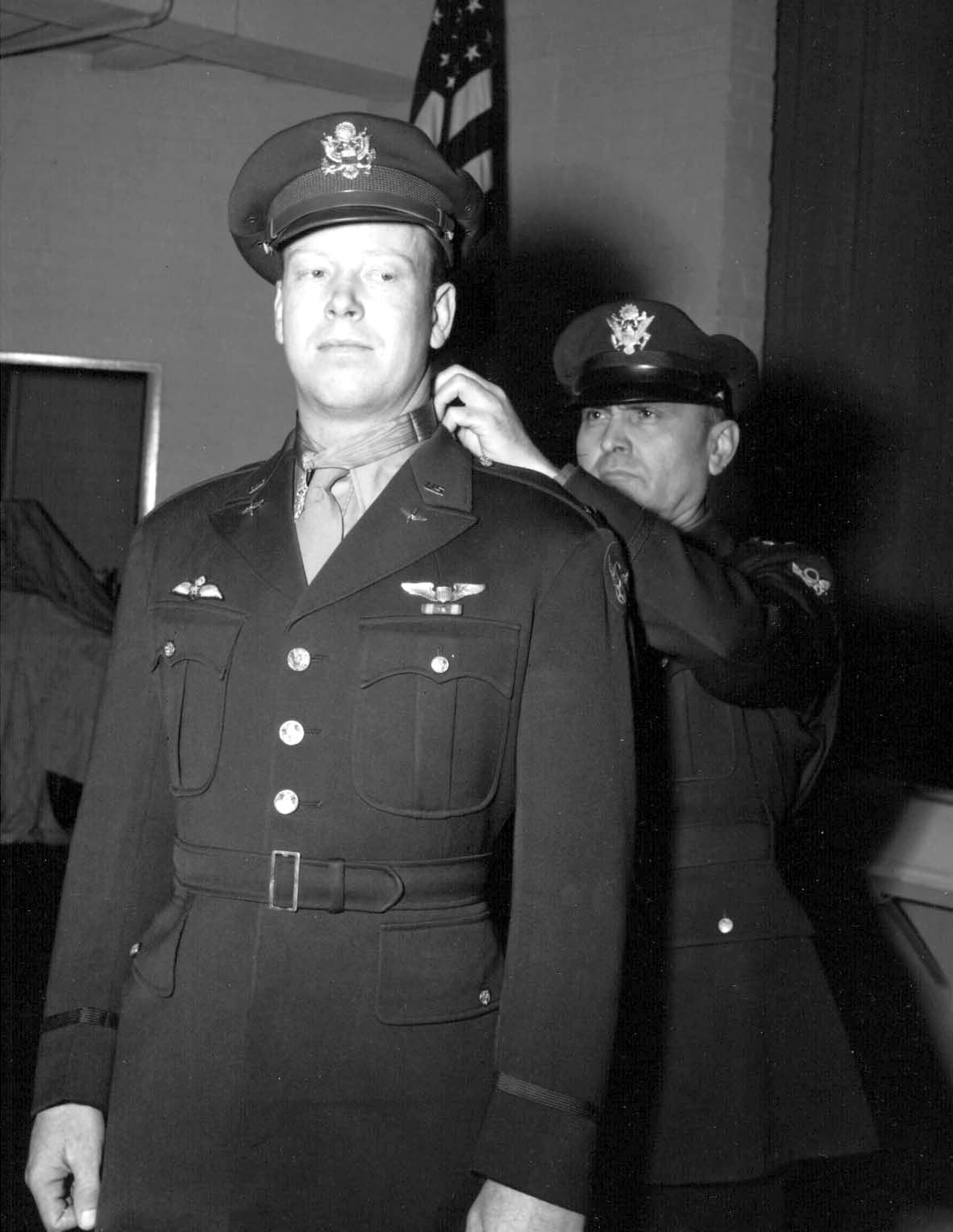
Morgan receives the MOH from Lt. General Ira C. Eaker (IWM UPL 29867)
Morgan then returned to duty, undertaking further operations in a bomber over occupied Europe.
On March 6th 1944, Morgan would once again find himself in the thick of a heavy and prolonged battle over Germany. Flying withing a formation of 262 1st Bomb Division aircraft, it would prove to be another decisive day.
Morgan’s B-17. 42-3491 ‘Chopstick’, was flying with the 812nd BS, 482nd BG from Alconbury, when the aircraft was hit by flak over Berlin. The aircraft, which had been fitted with H2X , caught fire and exploded. Only four crew members were able to escape the fireball, Morgan amongst them. Once on the ground, their safety was by no means ensured, and very soon all four were captured by German ground forces. Morgan himself was incarcerated in Stalag Luft I for the next fourteen months. The remainder of the crew on board all perished.
For his actions and continued dedication to the Air Force, Morgan was rewarded with a promotion to the rank of 2nd Lieutenant, a move that occurred in September 1944.
It is believed that this event made Morgan (who was now on his twentieth-sixth mission) the only known Medal of Honor recipient, to have been captured after receiving the Medal.
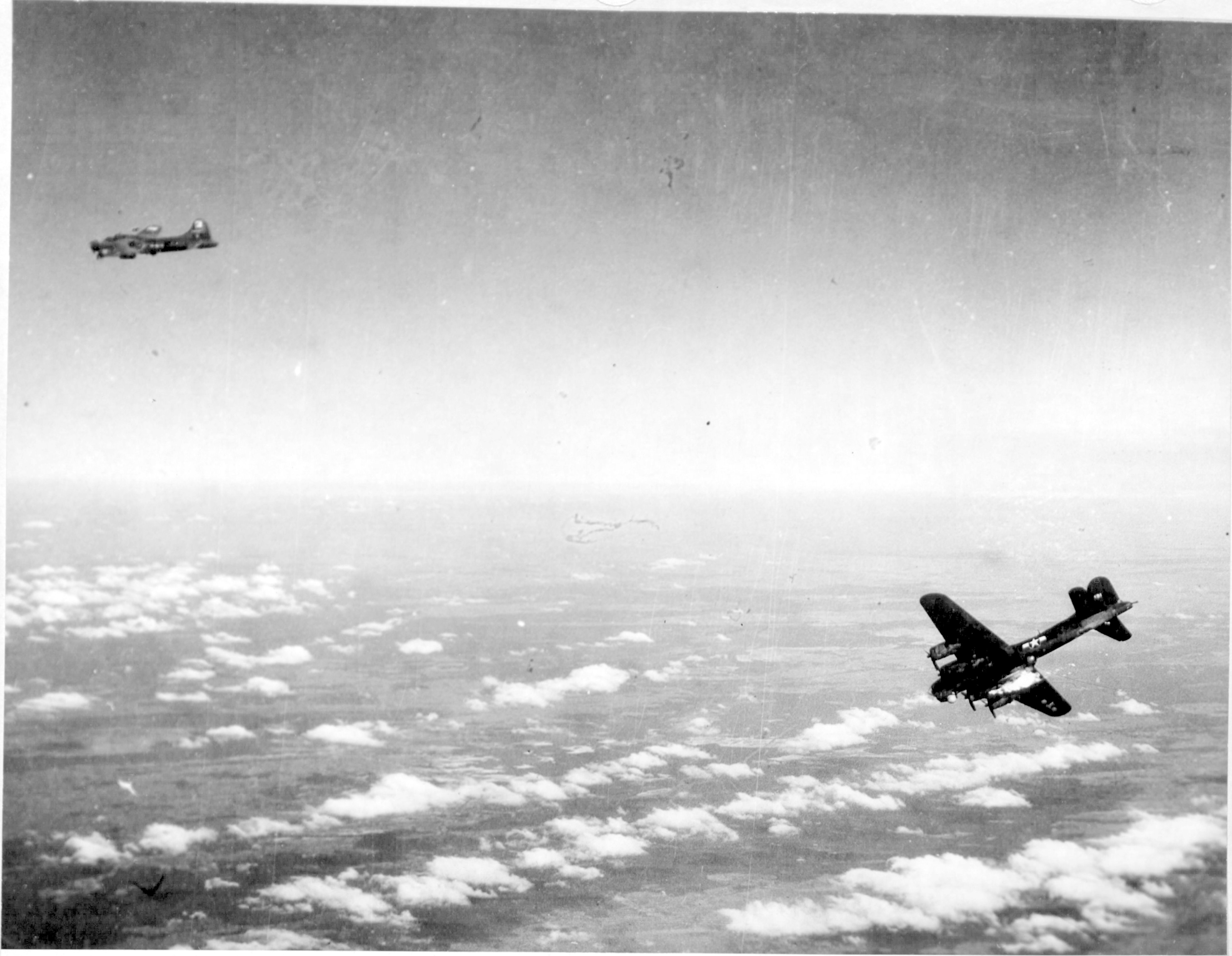
42-3491 ‘Chopstick’ with Morgan on board. This plane is one of the original twelve H2X radar equipped pathfinders. Hit by 88mm flack near Berlin on 6th March 1944, the No.3 engine caught fire setting fire to the wing, causing the aircraft to explode and crash near Lake Havel, Berlin. The plane was the lead bomber and Colonel Russell Alger Wilson, Commander of the 4th Bomb Wing, was onboard as Combat Leader. Wilson was one of the those killed in the explosion. (@IWM UPL 29865).
After the war Morgan remained in the new reformed air force, the USAF, serving in Korea until his retirement as a Lieutenant Colonel in 1953.
On January 17th, 1991 Morgan passed away, being was laid to rest at Arlington National Cemetery in Virginia, Section 59; Site 351.
The incredible story of Morgan’s bravery would form a part of the story line in the book and movie Twelve O’Clock High when at the beginning, Lt. Jesse Bishop’s B-17 belly lands with a badly injured crew. (08:00 – 14:05).
Sources and further reading.
*1 The Congregational Medal of Honor website.
92nd BG website
B-17 Bomber Flying Fortress – The Queen Of The Skies website
Arlington National Cemetery website