RAF West Raynham Trail 21 – Part 3.

In Part 2 we saw how Basil Embry was assigned to West Raynham but never made it, attacks by Blenheims on the German fleet and how the B-17 was used for trails as an RAF bomber. In part 3 we see more daring attacks by West Raynham aircraft, one of which saw the awarding of fifteen medals to airmen, many of which were West Raynham crews.

The summer of 1941 saw a great deal of activity at West Raynham. The changes, led by the departure of 90 Sqn in June, was quickly followed by the departure of West Raynham’s long standing 101 Sqn to Oakington in July. This meant that space was freed up for two new squadrons 114 Sqn and 268 Sqn along with a detachment of 614 Sqn.

RAF West Raynham

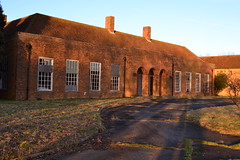
One of the many ‘H’ accommodation blocks on site (2015).

The first of these units, 268 Sqn, was not based here but stayed on a short temporary basis whilst on a ‘Bulldog‘ exercise; ‘A’ and ‘B’ echelons transferring in on the 20th June from RAF Snailwell near Newmarket. At the time, the exercise was said to be the biggest such operation to be held in the UK, an event that saw co-operation between air and ground forces. A section from this party travelled from West Raynham to open an Advanced Landing Ground (ALG) at Barton Bendish, not far from Downham Market, in Norfolk. The next day was then spent opening communication lines between West Raynham, the Corps Headquarters and Barton Bendish.

Over the next couple of days aircraft flew out of both Barton Bendish and West Raynham, amassing some twenty-five sorties in all, mainly low-level reconnaissance flights, collecting a mass of information about the ‘ground forces’ taking part in the exercise. On the 24th, the exercise was completed, and both air and ground staff departed West Raynham heading back to their base at Snailwell.

The second squadron, a detachment of Lysander IIIs, arrived here from the Macmerry based 614 Sqn. The small unit exchanged these aircraft for Blenheim IVs shortly after their arrival, performing in the Air Sea Rescue role for almost a year before they too departed this Norfolk site.

The last of the three units, 114 Sqn, arrived overnight of the 19th / 20th July, crews and ground personnel ferrying aircraft and equipment to West Raynham in three separate parties. With little time to settle in, operations began almost immediately.

On the 22nd, with ten aircraft heading to targets along the French coast, attacks were made by six Blenheims from between 10,000 and 15,000 ft on sheds and slipways, a number of hits were seen and the sheds appeared to be badly damaged in the attack. On leaving the target, clouds of smoke were seen to be rising from the ground, a welcome sight for the unwelcome intruders. A further three aircraft however, failed to find their primary target in a separate attack, and a single aircraft on a beat patrol also failed to locate a target, and so no bombs were dropped by either of these two sections. Flak was generally light on all occasions and still the Luftwaffe failed to make a dedicated appearance.

These intruder operations continued on, and on July 23rd another small raiding party attacked similar targets in similar locations, these however, were met with considerably more anti-aircraft fire. Regardless of the intense ground fire though, all aircraft returned without any major problems although some had received extensive damage to their air frames.

During August, a major attack was arranged with massed fighter escort on target GO.1237 – the Knapsack Power Station in northern Germany. The attack was to involve fifty-four Blenheims along with their fighter escorts. The operation, led by Wing Commander Nicol, was a daylight raid which took place in the late morning between 400 and 500 feet. Considerable damage was seen to be done to the plant; chimneys were hit, pipes were fractured, sheds were hit by bombs and a considerable amount of debris was thrown up into the air. The attack, the first of several, had proved to be a big success. The return journey then proved to be as eventful as the attack itself; flying at low-level, Dutch citizens were seen to wave to the bombers, a cheering site no doubt, and certainly one more pleasurable than the unfortunate flight of ducks that were struck by  some of the aircraft. One of the observers on return commented “the impact was as terrifying as flak“.*1

The attack was considered so successful and so daring that an entry was made in the London Gazette 357237 on 12th September 1941, in which the crews’ bravery was highlighted and the many awards that had subsequently been granted were listed. It read:

Air Ministry, 12th September, 1941.
ROYAL AIR FORCE.

“The KING has been graciously pleased to approve the following awards in recognition of gallantry displayed in flying operations against the enemy: —

On the morning of I2th August, 1941, Blenheim bombers carried out  simultaneous attacks on the great power stations near Cologne. A strong force attacked the station at Knapsack, whilst a smaller force attacked two stations at Quadrath. These missions involved a flight of some 250 miles over enemy territory which was carried out at an altitude of 100 feet. At Knapsack the target was accurately bombed and machine gunned from between 200 and 800 feet and at Quadrath both power stations were hit from the height of the chimneys; the turbine House at one of the two stations was left a mass of flames and smoke. The success of this combined daylight attack and the co-ordination of the many formations of aircraft depended largely on accurate timing throughout the flight. That complete success was achieved, despite powerful opposition from enemy ground and air forces, is a high tribute to the calm-courage and resolute determination displayed by .the following officers and airmen, who participated, in various capacities as leaders and members of the aircraft crews”.

The medals included two DSOs, ten DFCs and three DFMs. Among them was Wing Commander James Nicol (DSO); Acting Squadron Leader Alan Judson (DFC); Flying Officer Herbert  Madden (DFC) and Acting Flying Officer Thomas Baker (DFC) all of 114 Sqn. The remaining awards being given to crews in other squadrons who also took part in the daring attack.

Two days after the operation, on the 14th August, Wing Commander James Nicol along with Sqn. Ldr. Judson and Sgt. Davidson, with their respective crews, travelled to RAF Polebrook to meet the A.O.C about the operation. The A.O.C. chatted to the men before congratulating them on their great success. The next day, Sgt. Griffiths (W.Op/G) travelled to London to make a recording for the BBC about the raid, talking about it from an eye-witness’s point of view. The recording was then broadcast over the next two days giving both the squadron and the nation a much needed boost in morale.

The joy for Wing Commander Nicol was to be short lived though. On the 19th August 1941, his plane failed to return from operations, Nicol along with Sgt. E. Jones and F.O. H. Madden were classed as “Presumed Missing”, they were later found to have been killed. A second Blenheim from the squadron also went missing that night, a reconnaissance flight with the loss of three more crewmen.*3 Nicol and his crew remain with no known grave and so are all commemorated on the Runnymede Memorial.

The October saw more changes to the gunnery training unit being performed here at  West Raynham. 2 TTF was disbanded and renamed as 1482 (Target Towing and Gunnery) Flight. Some additional aircraft were brought in including the Defiant and Tomahawk, but their work, towing targets for gunners to aim at, continued on. In late 1942, it would change name again this time becoming 1482 (Bomber) Gunnery Flight. The unit would eventually disband in 1944 at Swanton Morley, the use of such units now being seen as obsolete.

The opening of January 1942, saw 114 Sqn off operational flying as a new training flight was created from within the unit. The number of new recruits, many of whom had directly transferred across from army co-operation units, was so high that this flight had became urgent. For the time being, gunnery training, formation flying and other training flights took precedence over all operational flying.

The training was interrupted on February 12th 1942 though, when orders came through to 114 Sqn to immediately dispatch six aircraft to attack the German warships Scharnhorst and Gneisenau which were making their way up the English Channel from Brest to their home docks in Germany. Joined by Prinz Eugen and a host of other vessels, this became known as the “Channel Dash” in which Bomber Command, the Fleet Air Arm and the Royal Navy all had a hand in. The first West Raynham group took off early afternoon and attacked from a height of 15,000 ft, diving through cloud cover they experienced “intense flak”. A second order came through some three hours later for a further three aircraft from 114 Sqn, and they too departed, bombed up, to attack the fleet.

As with the first wave, they dived through cloud from 15,000 ft. Not only did they experience intense flak, but the weather was appalling, heavy rain and poor visibility made sighting very difficult. Some bombs were dropped and photographs were taken, but the attack was not a success and the Blenheims returned to West Raynham, some still with their bombs on board after having been unable to sufficiently see their targets.

In September, there was another change at West Raynham with the forming of yet another new squadron, 180 Sqn along with the reforming of a former World War I unit, 98 Sqn, both within a day of each other.  Given North American B-25 ‘Mitchell’ IIs, both units very quickly moved out of West Raynham, each one transferring to RAF Foulsham where they would begin performing new duties within the month.

The departure of 114 Sqn in November signalled another major change for this Norfolk airfield. Now effectively left without any operational squadrons, a major refurbishment was on the cards, and it wouldn’t be too long before the contractors would move in.

For the whole of 1943, little flying activity took place here at West Raynham. A short interruption by the arrival and subsequent departure of 342 (Lorraine) Sqn (a Free French unit) on April 1st and May 15th respectively, did little to delay the upgrading.

The entire site was then expanded. The first move was to replace the two grass runways with concrete and tarmac examples (one 2,000 yards and the other 1,400 yards). In addition, more hardstands were added around the perimeter track, and on the technical site, a new watch office was constructed.

West Raynham

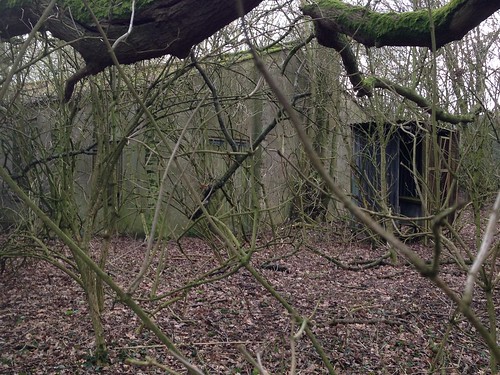
One of the many buildings left on site.

A new two storey design (4698/43) the Watch Office allowed new airfield lighting equipment to be installed at the site. This would assist aircraft when landing or taking off, making the airfield more visible when needed.

In addition to these improvements, the accommodation area was also expanded, this is was thought, would allow for the perceived influx of new personnel. By the end of the upgrading, West Raynham would be able to accommodate up to 2,500 men and 660 WAAFs.

In December 1943, the airfield passed over to 100 (Bomber Support) Group, where upon two more squadrons arrived at the newly refurbished base – 141 Sqn and 239 Sqn. Both these units would operate the D.H Mosquito the ‘Wooden Wonder‘ in a variety of marks: II, FB, VI and NF 30, all performing as night intruders. Both units would retain these aircraft to the war’s end and their eventual disbandment in the summer of 1945.

That month was not only filled with intruder flights, but football matches. A series of games culminated on December 23rd when a West Raynham team beat Norwich City 5-1 – a marvellous result for the RAF.

Outside of football, sorties continued, and for 141 Squadron, their last operational flight was to bomb the airfields at Hohn and Flensburg in Germany using Napalm gel. Buildings were set alight and a dog-fight ensued but one Mosquito was unable to jettison one of its Napalm tanks, and brought it home to West Raynham dropping it on the runway. The damage this caused meant that those crews from 239 Sqn who had also been out, supporting bombing raids at Keil, had to divert to alternative airfields. The subsequent problems led to the 239 Sqn Wing Commander being somewhat annoyed, blaming the “untidiness of a pilot of No. 141 Squadron who brought home one of his nasty oil bombs and dropped it on the runway“.*4 More associated with Vietnam, the squadron had dropped in excess of 11,000 gallons of the gel causing extensive damage by the war’s end.

With the announcement of VE day just days later, the celebrations began. The airfield beacon was changed to flash ‘V’ instead of ‘WR’, and the ‘Sandra Lights’ (three search lights positioned around the airfield which could be directed upwards to form a homing cone) were switched on. A large bonfire was enjoyed by all and even with 22 barrels of beer, there was a lot of “quiet fun and no excesses at all“.

The month closed with a great deal of uncertainty, a comment in the Operational Record Books summing up the general feelings: “The cessation of operational flying and the transition to a semi peace-time basis, is a little disturbing after the day to day activities of the months gone by.”

Understandably as talk of the Far East or disbandment became rife, many questions were asked about their future . The Wing Commander of 239 Sqn adding his personal concerns to the ORB*4Who is going where? Am I for the Far East? If so, on what type? Am I going to Transport Command? Am I going to be a flying instructor again?” These thoughts no doubt reflecting those of many based around Britain’s wartime airfields at this time.

With the arrival of VE day thoughts of those at West Raynham quickly turned elsewhere. In Part 4 of this visit, we see how West Raynham undergoes another upgrade, the airfield takes on a new role and West Raynham enters the jet age.

The full story can be read in Trail 21 – North Norfolk Part 2.
RAF West Raynham Trail 21 – Part 2.

Carrying on from Part 1, we see a new Station Commander appointed. His determination to lead by example though, led to an ‘unfortunate incident’ which prevented his arrival here at this Norfolk site. We also see how West Raynham aircraft took part in attacks on the German fleet and a new heavy bomber arrives for trails.

It was also at this time that a new station commander was appointed, Acting Group Captain Basil Embry, whose career to date had been varied and long. He had served in the RAF for 20 years already, in locations that included Turkey, the Middle East, the Far East and the UK. Embry led by example, taking his squadron into daring battles over Norway much against the ideals and wishes of those who were higher up in the chain of command. The move to put him in charge at West Raynham was considered an attempt to restrict his flying ambitions forcing him to keep his feet firmly on the ground. A move that Embry didn’t appreciate.

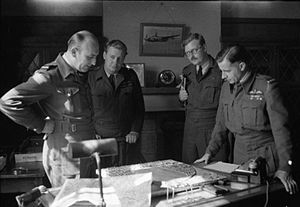
Royal Air Force- 2nd Tactical Air Force, 1943-1945. CL2739.jpg

Sir Basil Embry and his staff (right). Wikipedia

On the day of his appointment, he had one last flight, and took both his crews and a new Commanding Officer, Wing Commander L.R. Stokes into battle. However, his luck was to run out, and on leaving the target near St. Omer, his aircraft was shot down. The air gunner was killed in the attack, but Embry, along with his navigator, managed to bale out. What happened next was a dramatic series of events that led to Embry attempting to escape three times finally being successful on the last attempt. After making his way across France to Spain, he then made his way back to England where he took up active service once more.

Embry was highlighted as a possible leader for the new Pathfinder Group, but he  was overlooked by Arthur Harris in favour of Donald Bennett. However, this did not inhibit Embry’s career, for he reached the heights of Air Chief Marshal and a service record with the RAF that extended long after the war had ended.

However, the incident meant that Embry never made it to West Raynham, his absence being briefly filled by the arrival of 139 Sqn. As the personnel were settling in, they were greeted with the news that their own Commanding Officer, Wing Commander Louis W. Dickens, was to be awarded the DFC for his action in leading nine Blenheims in an attack in which they faced heavy Luftwaffe opposition. The entire Squadron, apart from a ‘skeleton staff’, were all given eight days leave following the announcement.

Shortly after, and as was with many other units who found themselves here, 139 Sqn were soon ordered out of West Raynham once more, and by early June all squadron personnel had departed, neither Embry nor 139 Sqn had experienced much of this expanding Norfolk airfield.

The pattern of sort stay squadrons would continue on, and June would see yet another one, that of 18 Sqn, who on arrival, made their headquarters in No. 2 Hangar at the airfield. Classed as a medium bomber squadron it would have the ‘standard complement of personnel’ split into two flights. Another Blenheim unit, they quickly took up operations flying over Germany and the low countries, attacking targets in northern Germany, France and Belgium. These initial operations were regularly hampered by poor weather though, and many of the aircraft had to regularly return early due to fog, heavy cloud or rain. On the better days, when attacks were successful, sorties took them over Holland and Northern France attacking airfields and barges moored along the coast.

The squadron was soon transferred out of West Raynham though, and by early  September, 101 Sqn was once again the only operational flying unit at the airfield.

At this point, it was decided to redevelop the airfield with new hardstands being constructed around the perimeter track. The process would last well into 1941 before it was completed, but it would allow aircraft to be parked and maintained on hard surfaces rather than grass where manoeuvring must have proven difficult over the previous poor winter months.

The new year brought a new tactic to 2 Group. With fighter flights failing to bring the Luftwaffe up to engage, it was decided to send the light bombers of 2 Group to entice them up. These ‘Circus‘ operations were designed to bring enemy fighters up so the escorting Spitfires and Hurricanes could engage with them.  Primarily as bait, this new tactic would be the main focus for the Group for the remainder of the year.

Then in April 1941, another new major operation was mounted and it would be 101 Sqn who would be the first to take part.

Officially known as ‘Channel Stop’, the idea was to prevent enemy shipping from using the English Channel, the vital link between the North Sea and Baltic bases and the wide open expanses of the Atlantic Ocean. Aircraft transferred across to RAF Manston in Kent, where they would be kept on alert to attack at a moments notice. Their targets being any enemy shipping seen attempting to traverse the narrow stretch of water between England and France. These attacks would be carried out during daylight hours, and backed up at night by Motor Torpedo Boats (MTB) from the Royal Navy. The first of the 101 Sqn Blenheims assigned to the role, flew from West Raynham to Manston during April, and on the 28th, their first targets were spotted. Over the next few days, a number of ships were attacked with mixed results, a 2,000 tonne vessel being one of the more prized examples that fell to the Blenheims.

But by the 9th May, aircraft losses had mounted significantly, and so the remaining six aircraft of the flight were sent back home and a temporary stop was put to the operation. It was at this point, that the now outdated Blenheim would finally be replaced with the Wellington, a new aircraft with its unique geodesic design was now appearing at the Norfolk site.

The month of May also saw the return of 90 Sqn, a unit that had been resident here at the outbreak of war with their Blenheims. This time they were not bringing twin engined models with them though, this time it was the Fortress I the mighty US four engined heavy, the B-17.

AMERICAN AIRCRAFT IN ROYAL AIR FORCE SERVICE 1939-1945: BOEING MODEL 299 FORTRESS.

A B-17 Fortress I, AN521 ‘WP-K’, of No. 90 Squadron taken at Hatfield, during an inspection of newly-arrived American aircraft by the Chief of the Air Staff and the US Air Attache. (© IWM CH 2873)

90 Squadron were trialling the use of the bomber, and whilst based at West Raynham, they also operated from RAF Great Massingham and RAF Bodney in an attempt to see if these grass airfields were suitable for the Fortress. However, it was quickly realised that such an operation with these models was not feasible and so they departed a month later, transferring out to RAF Polebrook, in Northamptonshire. Further tests revealed problems with the B-17’s guns at high altitude, the cold causing many to freeze and become inoperable. Within four months of arriving, the B-17s were sent packing, their use as an RAF bomber having been rejected.

In Part 3 we see more activity at West Raynham, and a daring raid by Blenheims in which no less than fifteen medals were awarded for action. We also see a return to attacks on the German fleet, an attack that would be met with very heavy resistance.

The full story can be read in Trail 21 – North Norfolk Part 2.
RAF West Raynham Trail 21 – Part 1.

From Sculthorpe in Trail 21, we travel a few miles south, just a stone’s throw to its sister station and another of Britain’s post-war relics. This site, closed as late as 1994, was then sold for housing development and light industrial use. With its founding in 1938, it was a long standing and also important post-war airfield, one that saw many units and aircraft types adorn its runways and buildings. In my last visit, the site was closed off and under development, so today we revisit the airfield and see what has become of it since then. As the gates are now open, we delve once more into the history of the former RAF West Raynham.

RAF West Raynham

West Raynham lies in the heart of Norfolk, west of the village that gave it its name, and five miles south-west of Fakenham. The entire site covers some 158 acres, and encompasses around 37,000 sq metres of buildings.

As a classic expansion period airfield (using garden city principles with squares and tree-lined avenues), it was built during the period 1937-39. As was common at that time, it had a number of neo-Georgian buildings, notably the Officers Mess and unmarried Officers’ quarters – the larger examples even having servants’ quarters built within. Airfields of this period had to pass a severe scrutiny from both early environmental and planning groups, and so were built with aesthetics, rather than functionality, in mind. The restrictions placed on new developments meant that these pre-war stations were far more ‘ornate’ in design than their wartime counterparts.

RAF West Raynham

The classic Officers’ mess, a neo-Georgian style building built with aesthetics in mind (2015).

Construction of the airfield was initially undertaken by the Allot Ltd company. It had two grass runways both of which were replaced later in May 1943 by hard  concrete and tarmac examples. The longest of these runways at 2,000 yds, lay north-east to south-west and the shorter at 1,400 yds directly east to west.

During its initial construction, four ‘C’ Type hangars were erected, two of which were allocated to the Ministry of Aircraft Production (MAP).  These hangars, were a mid 1930’s design which used reinforced concrete, and were commonly found on pre-war airfields, thus their dominating appearance became well known on the British landscape at that time. In close proximity to the hangars stood the Watch Office (with Fort) – another 1930’s design (built to drawing 207/36) it also utilised concrete as it was strong and in abundance at this time. Also found close by were the gunnery/training dome, a range of technical stores, workshops and numerous ancillary buildings as was common to airfields of this pre-war period.

C Type Hangar

One of the four hangars (2015). The newly installed solar panels can just be seen where the runways would have been.

The perimeter track was built with thirty-six heavy bomber design hardstands, and the accommodation area (which being non-dispersed was located on the airfield site) could house around 2,000 personnel. Following later developments the number of hardstands  were increased as was the accommodation area. At its peak, West Raynham could house around 3,000 personnel.

The site officially opened in May 1939, just prior to the outbreak of war, under the control of No. 2 (Bombing) Group whose headquarters had by now moved to RAF Wyton. Formed on March 20th 1936, the group was made up of five Wings: 70 (Upper Heyford), 79 (Watton), 81 (here at West Raynham), 82 (Wyton) and 83 (Wattisham). As a parent airfield West Raynham would use nearby Great Massingham as a satellite, with relief landing grounds at both Bircham Newton and North Pickenham. To deter marauding Luftwaffe bombers in the area, two decoy sites would also be used, one at Fulmodestone and the other at Gateley.

In May 1939, the first two squadrons arrived at West Raynham. Transferring across from Bicester were 101 Squadron and 90 Sqn, both flying with the twin engined Bristol Blenheim IV. On arrival though, it was found that the airfield was far from ready, and only with personnel carrying out the remaining work, did it finally become operational three days later.

The two squadrons soon took part in long distance flights over France. Inter mixed with these were tactical training exercises, with 101 Sqn acting as the enemy attacking ‘distant’ targets, these being ‘protected’ by other units. By August though, the situation on the continent had deteriorated considerably, and war seemed inevitable. As a result, and shortly after being sent to 5 A.T.S. Penrhos for training, both squadrons were quickly recalled to West Raynham and preparations began for war.

On 2nd September, mobilisation orders came through instructing the units to ‘Scatter’ aircraft. This national scheme was implemented to spread aircraft around alternative airfields, thus ‘thinning them out’ in case of an attack. Both units used a variety of airfields including: Bircham Newton, Brize Norton, Weston-on-the-Green and later Upwood, sending small groups of aircraft to each site.

In both units, staff vacancies were quickly filled with new recruits, and whilst both squadrons remained as training squadrons, they were nonetheless brought up to a war footing. Then in the middle of September, 90 Sqn were stood down once more, now awaiting official transfer from 2 Group to the 6 Group Training Pool.  Transferring out of West Raynham to their new home at Upwood, they left 101 Sqn the only active unit here.

101 Sqn was at the time led by Wing Commander J.H. Hargroves, who presided over twenty-two officers and 207 airmen. Between them, they would fly twenty-one Blenheim aircraft divided into two flights – ‘A’ and ‘B’.

In preparation for flights over France, the aircraft were given the Air Ministry (squadron) letter ‘N’. After being fitted with long range drop tanks, they had their engines boosted to provide the greater take off power needed for the additional weight they would now carry.

For the next three months though little happened, Britain had now entered the Phoney War. Initially alerts and false alarms came through thick and fast, crews being ready to respond at a moments notice.  However, nothing came of these alarms, and so the squadron was repeatedly ‘stood down’ from action. At Christmas, with no immediate threat pending, it was decided to grant four days leave to the majority of the squadron personnel, with many off site visiting family, the airfield all but shut down.

January 1940 brought little change, and even though still classed as a training unit, 101 Sqn remained at the ready to respond to action. To make the lull in action even worse, the cold weather now worsened and snow began to fall across the country. What training flights that were occurring were now hampered by the bad weather and cold winter air.  On several days West Raynham was classed as ‘unserviceable’, snow and a frozen surface preventing aircraft from taking off or landing. The poor weather lasted well into March with only sporadic flying taking place. With such poor conditions and inexperienced crews, training flights would ultimately result in some accidents,  the handful that did occur soon culminating in fatalities.

During this time it was decided to set up a new unit to take on the training role that 101 Sqn were currently performing. This would allow 101 to officially become an ‘operational’ squadron. To this end, 2 Group Target Towing Flight  (2 TTF) was formed  here at West Raynham, operating the Fairey Battle, Gloster Gladiator and the Avro Tutor. The relief to 101 Squadron however, would not be felt for some time, and it would be the middle of the year before they would be ready to take on the might of the Luftwaffe.

On the 7th, March 1940, a break in the weather allowed a number of crews from 101 Sqn to take part in an air firing exercise at Wainfleet Sands, but for one of those crews things would go very badly wrong.

RAF West Raynham

The Officer’s Mess in rather a sorry state. It is earmark for redevelopment (2015).

The Blenheim IV, ‘N.6165’ piloted by F.O. F.C Mottram with A/Sgt. A.E. Maudsley and Cpl. R. Hartland on board, crashed at Botesdale near to Diss. The pilot and observer were both killed in the accident whilst the wireless operator escaped with injuries. A second aircraft, a Fairey Battle also from 101 Squadron, also ran into difficulties that day. More fortunately for the crew of this aircraft though, it managed a forced landing with no further problems nor injuries to those on board.

During April another new training squadron was formed here at West Raynham, that of 76 Sqn, which was supposed to fly the Hampden. After being disbanded earlier that month at Upper Heyford, any thoughts of longevity were soon dismissed, when before any real organisation could take place, and for whatever reason, the squadron was disbanded once more. Its life at West Raynham lasting just four weeks.

As the weather improved so training flights gradually picked up again for those based at this Norfolk airfield, and by May operational sweeps over the North Sea had begun, with reconnaissance flights out looking for enemy shipping. But still 101 squadron failed to see any major action and so flights became routine.

By May 1940 the skies of southern England were beginning to hot up. With attacks on airfields signifying the start of the Luftwaffe’s campaign to destroy the RAF, West Raynham would not be immune.

Although these attacks were mainly targeted at airfields in the south, West Raynham would be visited on no less than twelve different occasions, the first of which was on 25th. Whilst little damage was done to the airfield, the war had nonetheless been brought home to those who were stationed here, it had become incredibly real at last.

In Part 2 a new Station Commander is due to arrive, but his determination to led by example leads to an ‘unfortunate incident’ meaning his arrival at West Raynham is prevented from happening. We also see attacks on the German Fleet and a new, heavy bomber arrives for trials.

The full story can be read in Trail 21 – North Norfolk Part 2.
B-17 Pilot 1st Lt.D. J. Gott and 2nd. Lt W. E. Metzger

War makes men do terrible things to their fellow mankind. But through all the horror and sometimes insurmountable odds, courage and bravery shine through. Two gallant young men both in the same B-17 were awarded the Medal of Honour for acts of extreme bravery in the face of certain death.

Born on 3 June  1923, Arnett. Oklahoma, Donald Joseph Gott, began his air force career at the local base in 1943. By the end of the first year he had achieved the rank of First Lieutenant in the US Army Air Corps. Posted with the 729th. Bomber Squadron, 452nd Bombardment Group to Deopham Green, Norfolk, England, he was to fly a B-17 (42-97904) ‘Lady Jeannette’ along with his crew and co-pilot  William E. Metzger.

Metzger was born February  9, 1922 – Lima, Ohio and by the time he was 22 he was a 2nd Lieutenant. He was to meet Gott at Deopham Green, Norfolk and together they would fly a number of missions over occupied Europe bombing strategic targets.

On the 9th November 1944, they took off with their crew on a mission that would take them into the German heartland to bomb the marshalling yards at Saarbrucken.

On this run, the aircraft, was badly hit by flak, three of the engines caught fire and were inoperable, the fires were so fierce that they were reaching the tail of the stricken aircraft.

Further fires within the fuselage started when flares were ignited, and this rapidly caught a hold. Hydraulic lines were severed and the liquid from within was jettisoned onto the burning fuselage.  With communication lines cut and unable to contact the crew, both Gott and Metzger had some difficult decisions to make. They had not yet reached the target, the aircraft still held its bomb load and they were deep into occupied territory.

The crew too had suffered badly at the hands of the anti-aircraft fire. The engineer was wounded in the leg and the radio operators  arm was severed below the elbow causing great pain and loss of blood. He would die very quickly if medical help was not found. Despite the quick thinking and application of  tourniquet by fellow crew members, he soon passed out and fell unconscious.

Gott and Metzger decided that jettisoning the injured radio operator  would not result in his receiving medical help and so they would drop the bombs and head for the nearest friendly territory where they could crash-land. Doing this, would risk not only the life of the operator, but that of the crew and themselves should the stricken aircraft explode.

Over the target, they released their bombs and flew alone toward allied territory. Flying low over the village of Hattonville, the aircraft was seen to swerve avoiding a church and homes. At this point, Metzger personally crawled through the aircraft and instructed the crew to bail out. Three chutes were seen by local people, two fell to earth and the third became entangled on the stabiliser and was trapped. A further three were seen moments later, all these escaped. Metzger decided to remain with Gott and try to land the aircraft with the radio operator on board. With only one working engine, Gott and Metzger brought the aircraft down through a series of tight turns and at only 100 feet from safety the aircraft banked and exploded. Crashing to earth it again suffered a second explosion and disintegrated killing all three crew members on board and the crew member still attached to the tail.

1st Lieutenant Gott and his co-pilot 2nd Lieutenant Metzger had shown great courage and determination to complete their mission, and to save their crew from certain death. They had shown the greatest of  valour in what was to be the final act of their short lives.

Both men were killed on that day, November 4th 1944 aged 21 and 22 respectively. They were both posthumously awarded the Medal of Honour on the 16th May 1945.

Gott’s remains were returned to the United States and he was buried at the Harmon Cemetery, in Harmon, Ellis County, Oklahoma, USA. Metzger, was returned to his home town and was buried at Woodlawn Cemetery, Lima, Ohio.

Along with Gott and Metzger, crew members who did not survive were:  T/Sgt Robert A, Dunlap and S/Sgt T.G. Herman B, Krimminger. The survivors were picked up by a a local field hospital and treated for their injuries: 2nd lt John A, Harland ; 2nd lt Joseph F, Harms ; S/Sgt B.T. James O, Fross ; S/Sgt R.W. William R, Robbins and T/Sg T.T. Russell W Gustafson.

A memorial now stands close to the site of the crash site.

metzger

2nd Lieutenant William Metzger (@IWM UPL 16264)

gott

1st Lieutenant Donald Gott (@IWM UPL 16265)


November 7th 1945 – World Air Speed Record Herne Bay.

Trail 44 takes a look at the aviation highlights of the North Kent Coast in the small town of Herne Bay and its neighbour Reculver. It was here, on November 7th 1945, that the World Air Speed record was set in a ‘duel’ between two Gloster Meteors, as they raced across the Kent Sky.

On that day, two Meteor aircraft were prepared in which two pilots, both flying for different groups, would attempt to set a new World Air Speed record over a set course along Herne Bay’s seafront. The first aircraft was piloted by Group Captain Hugh Joseph Wilson, CBE, AFC (the Commandant of the Empire Test Pilots’ School, Cranfield); and the second by Mr. Eric Stanley Greenwood O.B.E., Gloster’s own chief test pilot. In a few hours time both men would have the chance to have their names entered in the history books of aviation by breaking through the 600mph air speed barrier.

The event was run in line with the Fédération Aéronautique Internationale‘s rules, covering in total, an 8 mile course flown at, or below, 250 feet. For the attempt, there would be four runs in total by each pilot, two east-to-west and two west-to-east.

With good but not ideal weather, Wilson’s aircraft took off from the former RAF Manston, circling over Thanet before lining his aircraft up for the run in. Following red balloon markers along the shoreline, Wilson flew along the 8 mile course at 250 feet between Reculver Point and  Herne Bay Pier toward the Isle of Sheppey. Above Sheppey, (and below 1,300 ft) Wilson would turn his aircraft and line up for the next run, again at 250ft.

Initial results showed Greenwood achieving the higher speeds, and these were eagerly flashed around the world. However, after confirmation from more sophisticated timing equipment, it was later confirmed that the higher speed was in fact achieved by Wilson, whose recorded speeds were: 604mph, 608mph, 602mph and 611mph, giving an average speed of just over 606mph. Eric Greenwood’s flights were also confirmed, but slightly slower at:  599mph, 608mph, 598mph and 607mph, giving an overall average speed of 603mph. The actual confirmed and awarded speed over the four runs was 606.38mph by Wilson*1.

The event was big news around the world, a reporter for ‘The Argus*2‘ – a Melbourne newspaper – described how both pilots used only two-thirds of their permitted power, and how they both wanted permission to push the air speed even higher, but both were denied at the time.

In the following day’s report*3, Greenwood described what it was like flying at over 600 mph for the very first time.

As I shot across the course of three kilometres (one mile seven furlongs), my principal  worry was to keep my eye on the light on the pier, for it was the best guiding beacon there was. On my first run I hit a bump, got a wing down, and my nose slewed off a bit, but I got back on the course. Below the sea appeared to be rushing past like an out-of-focus picture.

I could not see the Isle of Sheppey, toward which I was heading, because visibility was not all that I wanted.

At 600mph it is a matter of seconds before you are there. It came up just where I  expected it. In the cockpit I was wearing a tropical helmet, grey flannel bags, a white silk shirt, and ordinary shoes. The ride was quite comfortable, and not as bumpy as some practice runs. I did not have time to pay much attention to the gauges and meters, but I could see that my air speed indicator was bobbing round the 600mph mark.

On the first run I only glanced at the altimeter on the turns, so that I should not go too high. My right hand was kept pretty busy on the stick (control column), and my left hand was. throbbing on the two throttle levers.

Greenwood went on to describe how it took four attempts to start the upgraded engines, delaying his attempt by an hour…

I had to get in and out of the cockpit four times before the engines finally started. A technical hitch delayed me for about an hour, and all the time I was getting colder and colder. At last I got away round about 11.30am. 

He described in some detail the first and second runs…

On the first run I had a fleeting glance at the blurred coast, and saw quite a crowd of onlookers on the cliffs. I remembered that my wife was watching me, and I found that there was time to wonder what she was thinking. I knew that she would be more worried than I was, and it struck me that the sooner I could get the thing over the sooner her fears would be put at rest.

On my first turn toward the Isle of Sheppey I was well lined up for passing over the Eastchurch airfield, where visibility was poor for this high-speed type of flying. The horizon had completely disappeared, and I turned by looking down at the ground and hoping that, on coming out of the bank, I would be pointing at two balloons on the pier 12 miles ahead. They were not visible at first.

All this time my air speed indicator had not dropped below 560 mph, in spite of my back-throttling slightly. Then the guiding light flashed from the pier, and in a moment I saw the balloons, so I knew that I was all right for that.

On the return run of my first circuit the cockpit began to get hot. It was for all the world like a tropical-summer day. Perspiration began to collect on my forehead. I did not want it to cloud my eyes, so for the fraction of a second I took my hands off the controls and wiped the sweat off with the back of my gloved hand. I had decided not to wear goggles, as the cockpit was completely sealed. I had taken the precaution, however, of leaving my oxygen turned on, because I thought that it was just that little extra care that might prevent my getting the feeling of “Don’t fence me in.”

Normally I don’t suffer from a feeling of being cooked up in an aircraft, but the Meteor’s cockpit was so completely sealed up that I was not certain how I should feel. As all had gone well, and I had got half-way through the course I checked up my fuel content gauges to be sure that I had plenty of paraffin to complete the job.

I passed over Manston airfield on the second run rather farther east than I had hoped, so my turn took me farther out to sea than I had budgeted for. But I managed to line up again quite satisfactorily, and I opened up just as I was approaching Margate pier at a height of 800 feet. My speed was then 560 mph.

Whilst the first run was smooth, the second he said, “Shook the base of his spine”.

This second run was not so smooth, for I hit a few bumps, which shook the base of my spine. Hitting air bumps at 600 mph is like falling down stone steps—a series of nasty jars. But the biffs were not bad enough to make me back-throttle, and I passed over the line without incident, except that I felt extremely hot and clammy.

After he had completed his four attempts, Greenwood described how he had difficulty in lowering his airspeed to enable him to land safely…

At the end of my effort I came to one of the most difficult jobs of the lot. It was to lose speed after having travelled at 600 mph. I started back-throttling immediately after I had finished my final run, but I had to circuit Manston airfield three times before I got my speed down to 200mph.

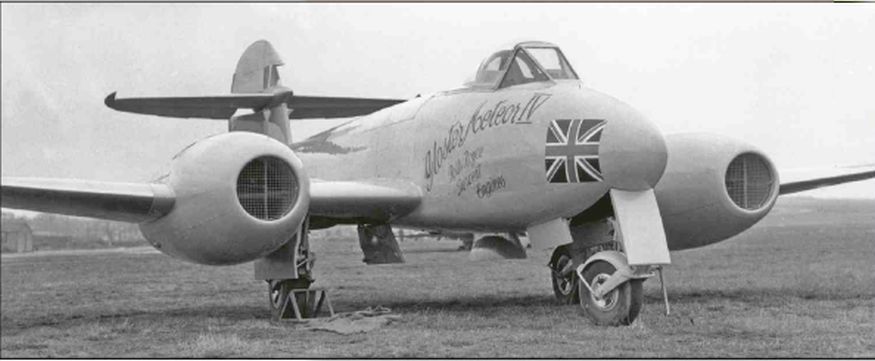
The two Meteor aircraft were especially modified for the event. Both originally built as MK.III aircraft – ‘EE454’ (Britannia ) and ‘EE455’ (Yellow Peril) – they had the original engines replaced with Derwent Mk.V turbojets (a scaled-down version of the RB.41 Nene) increasing the thrust to a maximum of 4,000 lbs at sea level – for the runs though, this would be limited to 3,600 lbs each. Other modifications included: reducing and strengthening the canopy; lightening the air frames by removal of all weaponry; smoothing of all flying surfaces; sealing of trim tabs, along with shortening and reshaping of the wings – all of which would go toward making the aircraft as streamlined as possible.

Related image

EE455 ‘Yellow Peril’ was painted in an all yellow scheme (with silver outer wings) to make itself more visible for recording cameras.*4

An official application for the record was submitted to the International Aeronautical Federation for world recognition. As it was announced, Air-Marshal Sir William Coryton (former commander of 5 Group) said that: “Britain had hoped to go farther, but minor defects had developed in ‘Britannia’. There was no sign of damage to the other machine“, he went on to say.

Wilson, born at Westminster, London, England, 28th May 1908, initially received a short service commission, after which he rose through the ranks of the Royal Air Force eventually being placed on the Reserves Officers list. With the outbreak of war, Flt. Lt. Wilson was recalled and assigned as Commanding Officer to the Aerodynamic Flight, R.A.E. Farnborough. A year after promotion to the rank of Squadron Leader in 1940, he was appointed chief test pilot at the Royal Aircraft Establishment (R.A.E.) who were then testing captured enemy aircraft. He was promoted to Wing Commander, 20th August 1945, retiring on 20th June 1948 as a Group Captain.

Eric Greenwood, Gloster’s Chief Test Pilot, was credited with the first pilot to exceed 600 miles per hour in level flight, and was awarded the O.B.E. on 13th June 1946.

His career started straight from school, learning to fly at No. 5 F.T.S. at Sealand in 1928. He was then posted to 3 Sqn. at Upavon flying Hawker Woodcocks and Bristol Bulldogs before taking an instructors course, a role he continued in until the end of his commission. After leaving the R.A.F., Greenwood joined up with Lord Malcolm Douglas Hamilton (later Group Captain), performing barnstorming flying and private charter flights in Scotland.

Greenwood then flew to the far East to help set up the Malayan Air Force under the guise of the Penang Flying Club. His time here was adventurous, flying some 2,000 hours in adapted Tiger Moths. His eventual return to England saw him flying for the Armstrong Whitworth, Hawker and Gloster companies, before being sent as chief test pilot to the Air Service Training (A.S.T.) at Hamble in 1941. Here he would test modified U.S. built aircraft such as the Airocobra, until the summer of 1944 when he moved back to Gloster’s – again as test pilot.

It was whilst here at Gloster’s that Greenwood would break two world air speed records, both within two weeks of each other. Pushing a Meteor passed both the 500mph and 600mph barriers meant that the R.A.F. had a fighter that could not only match many of its counterparts but one that had taken aviation to new record speeds.

During the trials for the Meteor, Greenwood and Wilson were joined by Captain Eric ‘Winkle’ Brown, who between them tested the slimmed-down and ‘lacquered until it shone’ machine, comparing  drag coefficients with standard machines. Every inch of power had to be squeezed from the engine as reheats were still in their infancy and much too dangerous to use in such trials.

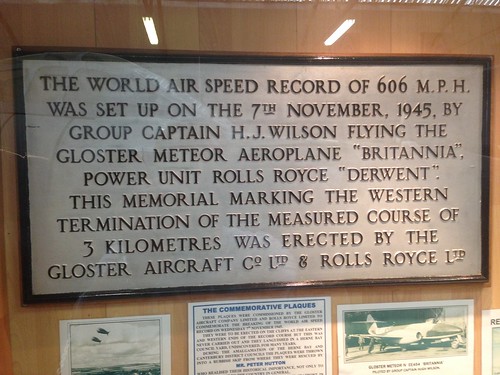
To mark this historic event, two plaques were made, but never, it would seem, displayed. Reputed to have been saved from a council skip, they were initially thought to have been placed in a local cafe, after the cliffs – where they were meant to be displayed – collapsed. The plaques were however left in the council’s possession, until saved by an eagle-eyed employee. Today, they are located in the RAF Manston History Museum where they remain on public display.

RAF Manston History Museum

One of the two plaques now on display at the RAF Manston History Museum.

To mark the place in Herne Bay where this historic event took place, an information board has been added, going some small way to paying tribute to the men and machines who set the world alight with a new World Air Speed record only a few hundred feet from where it stands.

Part of the Herne Bay Tribute to the World Air Speed Record set by Group Captain H.J. Wilson (note the incorrect speed given).

Sources and Further Reading.

*1 Guinness World Records website accessed 22/8/17.

*2 The Argus News report, Thursday November 8th 1945 (website) (Recorded readings quoted in this issue were incorrect, the correct records were given in the following day’s issue).

*3 The Argus News report, Thursday November 9th 1945 (website)

*4 Photo from Special Hobby website.

The RAF Manston History Museum website has details of opening times and location.

The Manston Spitfire and Hurricane Memorial museum website has details of opening times and location.

RAF Downham Market (Part 2 – D-Day to the War’s End)

In Part 1 Downham was born, serving the Stirlings of Bomber Command before becoming part of Bennett’s Pathfinder Force. A large airfield, it was often busy and as the war progressed toward D-Day, preparations began for operations over the invasion area.

On June 3rd 1944 Lancaster ND841 ‘F2-D‘ piloted by F/O. George. A. Young (s/n: 134149) RAFVR 635 Squadron, was detailed to attack Calais as part of the preparations for the forthcoming D-Day invasion. There would be eight other aircraft from RAF Downham Market also detailed for the mission, and take off would be late that evening.

The mission as a whole would involve 127 Lancasters and 8 Mosquitoes of 1, 3 and 8 Groups and the targets would be the gun batteries at both Calais and Wimerereux. It was a  diversionary raid as part of Operation “Fortitude South“, the elaborate plan to fool the Germans into believing the invasion would occur in the Pas-de-Calais region.

At 28 minutes past midnight, F/O. Young lined the Lancaster up on the runway, opened the throttles and began the long run. As the Lancaster approached take off, it began to swing striking the roof of the B1 Hangar. In an uncontrollable state the aircraft crashed just outside the airfield killing all those on board. What was left of the aircraft was salvaged, and three of the crew buried in the local cemetery in Downham Market.

Downham Market Cemetery

F.Sgt. Stanley Wharton (RAFVR) 635 Sqn. One of seven Killed 4th June 1944.

Two months later, another pilot of 635 Sqn, also flying a Lancaster III, ND811, ‘F2-T’, Squadron Leader Ian Bazalgette, would be awarded the second of Downham’s Victoria Crosses.

On August 4th 1944, flying Lancaster ‘T’ for Tommy, on a daylight raid to mark the V1 storage depot at Trossy St. Maximin, the aircraft was hit by flak knocking out both starboard engines and setting the aircraft on fire. Bazalgette pressed on, marked the target and then instructed the crew to bail out. Two of the crew were so badly injured they could not do so, and so Bazalgette attempted a crash landing. Unfortunately on impact with the ground the aircraft exploded, killing all three remaining crew members on board.

For his bravery and sacrifice, Ian Bazalgette was also awarded the V.C., the highest honour for military personnel. The London Gazette, of 14th August 1945, announced the award, citing: “His heroic sacrifice marked the climax of a long career of operations against the enemy. He always chose the more dangerous and exacting roles. His courage and devotion to duty were beyond praise“.

During that same month, August 1944, another squadron would appear here at Downham. Joining 635 Sqn were 608 Sqn, who had previously been operating abroad. They were reformed here on August 1st that year, also joining Bennett’s elite group. Another Mosquito squadron, they bolstered the number of aircraft and personnel present here at Downham. Flying the Mosquito XX, XXV and eventually XVI, they remained at Downham for a year whereupon they were once more disbanded. Whilst operating these aircraft, 608 Sqn would fly 1,726 operational sorties all as part of Bennett’s Pathfinder Force.

608 Sqn’s primary role was to carry out night strikes as part of the Pathfinder Operations focusing on the German heartland. Targets included: Berlin, Frankfurt, Hanover, Essen, Stuttgart, Nuremberg, Hamburg, Emden and Kiel. Their first operational sortie from Downham was on the night of 5th/6th August 1944, when a single Mosquito took off and bombed Wanne-Eickel.

Then, a month later, on the night of 6th November 1944, twelve aircraft from 608 Sqn took off in a diversionary attack on targets at Gelsenkirchen. The idea was to draw defences away from a much larger force attacking both Gravenhorst and Koblenz. The plan was for 608 to begin their attack five minutes ahead of the other forces, a plan that went like clockwork.

The full story of Mosquito KB364, piloted by P.O. James McLean (26) and Sgt. Mervyn Lambert Tansley (21), appears in Heroic Tales, but this was to be their final, fatal flight.

On return, the aircraft careered into All Saints’ Church, Bawdeswell, some 30 miles north-east of the airfield, setting it alight. The impact was such that parts of the aircraft struck two other homes, causing extensive damage to both properties. The resultant fire took four hours to extinguish and included crews from other nearby airfields. In honour of the two airmen, a plaque manufactured from part of the Mosquito has been mounted on the church wall inside the building.

The Christmas period of 1944 was a busy one for Downham and for the FIDO operators. With freezing fog, snow and general poor weather causing many problems for those on the continent and for those on British soil attempting to take off, FIDO crews were going to be busy. FIDO primarily designed as a landing aid, also permitted take offs during poor visibility. However, getting to the runway was a challenge in itself. Often with visibility down to just feet, ground staff would line the perimeter tracks with torches to guide each aircraft safely along. Anyone who made a mistake took the risk of running off the perimeter track, sinking into the ground along side or worse.

By the dawn of 1945 the war in Europe was all but over. Operations began to focus on troop concentrations, possible German escape routes and harbours. Both 635 and 608 Sqns continued operational flying until the war’s end. In August and early September these last two operational squadrons at Downham Market were disbanded, 608 Sqn on August 24th and 635 Sqn on September 1st. This left Downham devoid of all front line units.

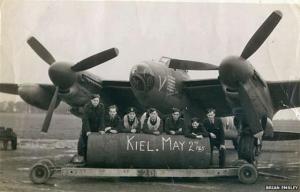
last raid - Kiel canal ground & air crew photo 2 May 1945 at Downham Market found by Brian Emsley, Welwyn G, father Edward Emsley far left httpwww.bbc.co.uknewseducation-32532153

A recently discovered photograph showing a D.H. Mosquito of Downham Market, taken on May 2nd 1945. It was taken just prior to the last mission undertaken by RAF aircraft on an attack on the Kiel Canal. It shows Ground & Aircrew next to their Mosquito and ‘Cookie’. It was found by Brian Emsley,  his father Edward Emsley is far left.*

With peace now settling across Europe, focus turned to returning personnel back to ‘Civvy street’. Within 8 Group, a new scheme was set up, and personnel were encouraged to make use of it. Across the range of Pathfinder stations, EVT (Educational and Vocational Training) was introduced. These classes were designed to give personnel the much needed skills in a range of civilian areas, to help them integrate back into civil life. Classes were broad and included a range of domestic activities such as: landscape gardening, cookery, music and carpentry. Some of these such as ‘domestic science’ were designed with the WAAFs in mind, whilst others were geared more (but not exclusively) toward the men.

"CIVVY STREET COURSE" IN R.A.F. PATHFINDER GROUP

1945 – Landscape and floral gardening are subjects given in the E.V.T. classes at Downham Market. Leading Aircraftman Arthur Pickersgill [centre] is now the station instructor. (IWM CH16028)

RAF Downham Market finally closed in 1946, but in 1948 the site was used for night Helicopter flight trials by BEA – the civil air company – transporting mail using Sikorsky S-51 Helicopters. This was a short lived venture but was by the end, considered a very successful companion to the day times routes recently started between Peterborough and a number of towns between Kings Lynn and Norwich. The venture included installing a flashing Sodium Beacon at Downham Market, its precise location on the airfield is not known and it may well have been a mobile unit*4.

Eventually in 1957, the land was sold off. The site was returned to agriculture but the airfield’s runways remained intact. In the 1970s, the Downham Market by-pass was built and the concrete runways were an ideal source of local hardcore. All three were subsequently removed along with large sections of the perimeter track leaving a mere road’s width for the larger part. Many of the buildings were at this time left, and small businesses soon took them over. One of these, a kitchen sales shop, now houses a small display relating to the history of the airfield.

At ground level, the discerning eye and a general appreciation of airfield structure and layout, suggest a presence of something more interesting. Huts, whilst in very poor condition, poke through overgrown trees and bushes, and provide shelter and storage facilities for local industry. The condition of windows and brickwork suggest that time is gradually running out for this once thriving airfield, unless other businesses move in.

The main runway ran east – west and for many years a small section of this remained for the farmers use. It was this runway that utilised FIDO, the storage area (at the far end) now taken over by the car dealership.

Downham Market Runway remains

The remnants of the main runway. Sadly this has now also been removed. It was this runway that utilised FIDO.

The remaining two runways were both removed for the hardcore. The western perimeter track remains in part width, from the threshold of the second runway virtually to the top to the threshold of the northern end of the third runway. However, the A10 road now dissects this and the uppermost part has been removed also. A new track (a public track) has been built for the farmer, this cuts across the northern end of the airfield and it is here that the (flooded) Battle Headquarters can be found. Now part of a ditch, its roof forms a bridge into one of the adjoining fields, it can only be found with careful searches of this ditch!

Battle Headquarters

A flooded Battle Headquarters. Several rooms exist below ground level, but these are all flooded, some said to be very deep.

Virtually the entire length of the northern part of the peri track can be walked round to the eastern end of the main runway. Part way along, another track leads off to the former bomb store, this is private the store now a wooded area. Also along here is the ultra heavy fusing point, a shed that is now used by the local farmer. At the far end of the peri track is where the accommodation area was constructed for the FIDO installers using Laing Hutting. Across the road can be seen the car dealership built on what was the FIDO installation. None of the original buildings remain here, but the peri track widens out to full width again at this point and heads east back toward the technical area.

Across the road from the technical area is the camp entrance and Bexwell, a small collection of houses and a church. Here a small memorial is placed telling the stories of the two heroic and brave crew members Aaron and Bazalgette. This road is the old road that led to all the accommodation areas. The WAAF site being the first and one of only two sites left with buildings still in place.

RAF Downham Market

Buildings on the WAAF site.

The other sites here include the Communal Site 1, Dormitory Site 1 (A), Sick Quarters, Dormitory Sites No. 2 (B), 3 (C), 4 (K) and 5 (J). Another track leads off to a sewage works. The road eventually joins the main A10. Across from here is the Communal Site 2, the second site with buildings still in use, and currently used by an engineering firm. A First World War memorial is also located here oddly hidden away amongst the bushes. Alongside these buildings are a pathway that leads to the second sewage treatment works.  This site can also be accessed by public footpath from the main road into Downham itself.

looking back to accomodation area

The sewage site. Through the trees you can see the remains of Communal Site 2.

Downham Market is an airfield that has a remarkable history, the dedication and bravery of the crews being second to none. What is left of this historic site is continually under threat, decay and dilapidation rapidly taking over.

The town is regularly overflown by F-35s from Marham, but when I was first here, two Tornadoes flew over whilst I was reading the dedications to both Bazalgette and Aaron. A fitting tribute not only to the two brave pilots, but all the crews that served here and to a station originally built to serve as a satellite for the very same airfield.

In 2015, a £170m regeneration plan was announced, perhaps signalling the end of Downham Market airfield for good (see here) – further details of these plans were to be released in the early part of 2016, but the funding for the scheme seemed to have been withdrawn in January 2020. No more seems to have been said about this venture, but more recently, development work for a fast-food outlet and shop was started alongside the western perimeter track, hopefully this won’t lead to further loss.

In April 2017 a project was launched to raise money for a seven slab memorial to be built close to the site of the former Dormitory Site 1, adjacent to the A10 road. The project hoped to raise in the region of £250,000 to cover the cost of the memorial and provide a lasting memory of those who flew and died whilst serving at RAF Downham Market. The full story and pictures can be accessed on the Eastern Daily Press website. There are more details and a link to the donations page on the RAF Downham Market website. I have been unable to confirm latest details and it may be another victim to the pandemic of 2020/21, only time will tell.

Trail 7 next leaves Downham Market heading east towards Norwich, stopping off at RAF Marham. On the way, we pass through the Norfolk countryside and a secret that shall no doubt, forever remain just that.

Sources and further reading (Downham Market).

* Photo published by the BBC 3/5/2015.

Technical information regarding the site was obtained from official drawings 50/W/117/42 and 50/W/116/42 courtesy of RAF Museum Hendon.

*1 National Archives AIR 27/1350

*2 National Archives AIR 27/1352/5

*3 National Archives AIR 27/2155/1, AIR 27/381/5

*4 Woodley, C. “The History Of British European Airways” Pen & Sword, 2006

The RAF’s pathfinder group, 635 squadron, flew daring missions in Lancasters, and a site dedicated to the crew and personnel of the squadron can be found on the RAF pathfinders archive website. A superb collection of photographs and personal accounts bring their memories alive.

The full Trail appears in Trail 7.

RAF Narborough – The Great Government Aerodrome.

Resting not more than a mile or so from the boundary of Britain’s front line fighter base RAF Marham, is an airfield that never made it beyond the First World War. However, its importance cannot be denied nor should it be over looked. Key to aviation in Norfolk and to the Royal Air Force as a whole, it played a major part in both, and therefore is pivotal to today’s modern air force. Opened originally as a satellite by the Royal Naval Air Service, it became not only Norfolk’s first, but the biggest First World War, fixed wing aircraft airfield, only four airship stations were bigger.  Leading the way for the aviators of today’s Royal Air Force, we look back at the former RAF Narborough.

RAF Narborough

Built as the largest, aircraft based, World War One aerodrome, Narborough has been known under a range of different names. The most common, ‘The Great Government Aerodrome’ reflected not only its size (over 900 acres) but also its multinational stature; the range of aircraft and personnel based here, and its achievements in aviation history. Used by the Royal Naval Air Service (RNAS), the Royal Flying Corps (RFC) and the Royal Air Force (RAF), it would have names that reflected each of these fledgling services.

Records show that Narborough had military links as far back as 1912, in the year that the RFC was established when both the Naval Air Organisation and the Air Battalion of the Royal Engineers were combined. Unfortunately, little exists to explain what it was used for at this time, but in later years, it was used to counteract the threat from both the German Zeppelin and Schütte-Lanz airships, and also to train future pilots of the RFC and RAF.

Narborough’s history in these early days is sketchy, few specific records existing as to the many changes that were taking place at this time or to the development of the RFC and RNAS. Its activities – and history though – was no doubt influenced on July 1st 1914, when the name RNAS was officially adopted, and all Naval flying units of the RFC were transferred to the control of the Navy. A major development in the formation of both forces, there were at this point, a total of: 111 officers, 544 other ranks, seven airships,  fifty-five seaplanes (including shipborne aircraft) and forty aeroplanes in RNAS service.*1 Some of these may well have been used at Narborough at this point.

By 1915, Narborough’s future had been sealed, designated as a satellite station to RNAS Great Yarmouth, (itself commissioned in 1913) it was initially to be used as a night landing ground for those aircraft involved in attacks on enemy airships. No crews were permanently stationed here at this time however, but as time went on ‘on-duty’ crews would fly in, and await the call to arms should an airship raid take place over East Anglia.

The first recorded arrival was in August 1915, an event that would keep the site in use by the RNAS for the next ten months, before being designated as surplus to requirements and handed over to the RFC in June 1916.

It was in June 1916 that the first RFC squadron would make use of Narborough as an airfield, 35 Sqn transferring over here from Thetford with Vickers FB.5 and FE.2bs. disposing of their DH2s and Henry Farman F.20s in the process. Within two months of their arrival, the nucleus of the squadron would then be used to form a new unit, 59 Sqn, also here at Narborough, under the command of Lieutenant A.C. Horsburgh with the RE8s. Narborough was already beginning to grow.

It was in that same month, that the perils of war would be brought home to those based at Narborough, when one of 59 Sqn’s pilots, Lt. Gordon William Hall, was killed when the DH.1 (4631) he was flying,  side slipped on approach to the airfield crashing as a result. A court of enquiry confirmed that the aircraft had been “banked too steeply” and that the pilot had put the aircraft into a dive that made it uncontrollable. A verdict of ‘accidental death’ was recorded against Lt. Hall.*2

In August, it was the turn of 35 Sqn to suffer its first fatality in a non too dissimilar accident. On the 29th, an Armstrong Whitworth F.K.3 (6201), was written off after it too side slipped and dived following a slow turn. The Pilot – Air Mechanic 1st Class –  Moses Boyd was tragically killed in the accident flying an aircraft that was based at Thetford but undertaking a training exercise here at Narborough. Already, the dangers of flying were becoming all too apparent and the glamour of flying was becoming tarnished.

Within two months, another 35 Sqn aircraft would also crash, this time one of the two crewmen, pilot 2nd Lt. Robert Leslie Edward would escape with just injuries. The observer, 2nd Lt Ernest Hildreth, however, was not so lucky and was killed in the resultant crash.

As the First World War raged on the European continent, the demand for aircraft was growing. It was quickly developing into a lethal weapon and a very potent reconnaissance vehicle. To fill vacant spaces and meet high demand, training programmes were rushed into place, meaning Narborough would become a preparation ground for new recruits. With training considered very basic by any standards, recruits only had to pass a number of tests before being sent to the front. Written examinations followed up by twenty hours solo flying, cross-country flights and two successful landings, were followed by flying for fifteen minutes at 8,000 feet and landing with a cut engine. Barely enough experience to see anyone through a violent war.

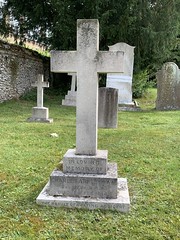
During these flights, these daring young men, many who were considered dashing heroes by the awe-inspired locals, would display their skills for all who lined the local roads to watch. As they were quickly learning though, life was not always ‘fun’, and the dangers of the craft were ever present. Accident rates were high and survival from a crash was rare, even ‘minor’ accidents could prove fatal. The local church yard at Narborough, paying testament to their dangerous career with fourteen of the eighteen graves present being RFC/RAF related.

The RFC was now building in strength, not only in its front line units but in its reserves too. On November 2nd, 1916 a new reserve squadron was constituted and formed here at Narborough, 48 (Reserve) Squadron (RS). Models flown by the unit at this time included the Grahame White XV, the Maurice Farman Shorthorn and Sopwith’s Pup. Over the next period of time, there followed a number of other reserve units: No 50, 53 and 64 (Reserve) Squadron (later designated Training Squadrons*3) all passing through Narborough at some point. However, and even with this large influx of personnel in these early days, Narborough was not to be the most exotic of locations.

As a training ground, accommodation was basic to say the least, being described by one ‘resident’ as a “desolate God-forsaken place“*4. It was soon realised by the authorities that new buildings needed to be erected for not only accommodation, but for training and maintenance roles as well. In response, a total of seven Boulton and Paul hangars, and up to 150 buildings would be built on the site over the next two years. A development that would by the end of the war, see some 1,000 personnel based here at Narborough – a number comparable with any modest Second World War airfield.

Meanwhile the threat from Zeppelins had not yet receded, and as a result 1916 would close with a small detachment of 51 Sqn BE.12s tasked with attacking these marauding menaces. Whilst primarily based at Hingham, 51 Sqn would have detachments spread across a number of East Anglia airfields, all preparing to meet the continued threat from Germany’s enormous airships.

With increasing numbers of squadrons and men being required for front line units in France, both 35 and 59 Squadrons departed Narborough in early 1917, and by the end of February both were gone.

All Saints Church Narborough, Norfolk

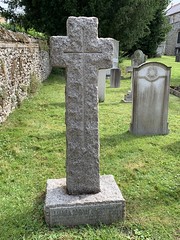
2nd Lt. Allen Ingham Murphy, killed March 30th 1917 ‘in an aeroplane accident’.

This left the reserves at Narborough, and it wouldn’t be long before they too suffered causalities. The first of these to lose a valuable pilot was 50 RS on March 30th 1917. A young Canadian, not yet out of his teens, 2nd Lt. Allen Ingham Murphy, was killed when his Armstrong Whitworth F.K.8 ‘A2720’ stalled whilst turning after take off. 2nd Lt. Murphy was the first of four casualties from the units that year – training young pilots was not getting any easier.

This danger was made no more obvious than on October 29th, when two aircraft, both from 50 RS were lost in separate accidents. The first an Armstrong Whitworth FK.8 (A2730) side slipped during a turn and nose dived into the ground killing both crewmen, 2Lt. Norman Victor Spear (aged 29) and Air. Mech. 1 Sidney Walter Burrell (age 22).  The second aircraft, also an Armstrong Whitworth F.K.8 (B219) spun off a low climbing turn also killing its pilot 2Lt. Laurence Edward Stuart Vaile (aged 23). It was indeed a black day for 50 RS and a stark reminder to the trainees.

All Saints Church Narborough, Norfolk

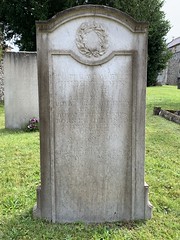
2Lt. Laurence Edward Stuart Vaile, killed in an aeroplane accident August 29th 1917.

In October and December two more units bolstered the numbers of trainees at Narborough. Firstly, 1 Training Squadron were formed here on October 1st, whilst 83 Sqn, born out of 18 (Reserve) Squadron (RS), arrived at Narborough during December that year bringing a range of aircraft that they quickly swapped for FE.2bs.

83 Squadron soon departed Narborough though, heading to France in March 1918 where they performed attacks on troop concentrations, attempting to stem the early spring offensive.

On June 8th, 1917 Lt. Hubert J. Game was killed when the B.E.2e (A2794) he was flying suffered a catastrophic wing failure when pulling out of a dive whilst looping the loop. Lt. Game was originally a Lieutenant in the Royal
Field Artillery (RFA) and was attached to 53 (Training) Sqn RFC at Narborough, when he was tragically killed. Hubert was the younger brother of Air Vice-Marshal Sir Philip Woolcott Game, and was just 26 years old at the time of his death. He is another one of those whose grave lays a short distance away from the site of Narborough airfield.

All Saints Church Narborough, Norfolk

Lt. Hubert J. Game, All Saints Church Narborough.

The occurrences of these tragic accidents were becoming so frequent, that one instructor, Capt. W.E. Johns, creator of ‘Biggles’ later cited spies as the cause of many ‘accidents’ – tampering with machines causing the deaths of the crews on board. Johns, himself having written of many machines, believed Americans with German sounding names were to blame for aircraft breaking up in mid-air or crashing at the bottom of loops. More likely, the fault lay with over exuberant or poorly trained recruits.

As the war drew to a close, one further squadron would be formed here at Narborough. On New Year’s day 1918, 121 Squadron were formed here, initially created to use DH.9s, they instead flew a variety of aircraft until they moved out to Filton in mid August. Shortly after their arrival here they were disbanded.

The last months of the war had no let up in training. Keen to join the RFC young men continued to train to fly. In mid February 1918 two 18 year old boys would perhaps be fulfilling a dream when it all went tragically wrong. Flying a DH.4, 2Lt. John Fyffe Shaw and 2Lt. Charles Arkley Law were both killed after the aircraft’s engine failed causing it to stall and then nose dive into the ground.

All Saints Church Narborough, Norfolk

2Lt. Charles Arkley Law killed after his engine failed and the aircraft stalled.

By August, war was over, and the the big wind down of squadrons would soon begin. At Narborough, two squadrons 69 (Training) Squadron and 26 (Reserve) Squadron would both merge to form a new 22 Training Depot Station. Many other similar units would soon follow suit and either disband or merge. This dramatic wind down continued on into, and beyond, 1919. In February, both 56 Sqn and 64 Sqn arrived as cadres; 64 Sqn was disbanded here later that year whilst 56 transferred to Bircham Newton where they too were disbanded later that same year. A third squadron, 60 Sqn also suffered the same fate, arriving as a cadre mid February before themselves being sent to Bircham Newton and disbandment.

With one last roll of the dice in mid March 1919, 55 Training Deport Station also disbanded here at Narborough, but out of the ashes was born a new unit 55 Training Squadron. With that though, Narborough was heading for closure, its days now over, it was soon to be surplus to requirements.

The post war years then saw the closure of many of Britain’s war time airfields including Narborough. But unlike its sister station RAF Marham a mile or so away, it would remain closed. The buildings were all sold off in what was considered to be one of the biggest auctions in Norfolk, with some of them going to local farmers, other for small industrial units, some to schools and the like, Narborough was now scattered to the four corners of the county. The remainder of the site was sold to the farmer and it quickly returned to agriculture, a state it remains in today. Some of these original buildings are reputed to still exist at various locations around the area today, whether that is true or not, is difficult to ascertain, but most have long since succumbed to age, the inevitable deterioration and eventual demolition.

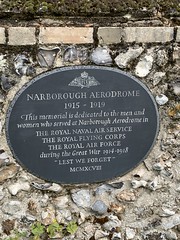
Narborough itself having no hard runways or perimeter tracks has long since gone. A small memorial has been erected by a local group aiming to promote and preserve the memory of Narborough, a memorial plaque also marks the graves of those who never made it to France; and the small Narborough Museum & Heritage Centre holds exhibits of 59 Squadron in the local church.

All Saints Church Narborough, Norfolk

The Plaque at All Saint’s Church Narborough, honouring those who served at Narborough.

Significant not only in size, but in its history, Narborough has now been relegated to the history books. But with the dedication and determination of a few people the importance and historical significance of this site will hopefully continue to influence not only the aviators of tomorrow, but also the public of today.

Updated memorial August 2021

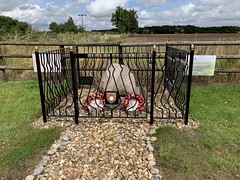
The Narborough memorial which sits at the entrance to Narborough airfield. It was refurbished after the original was struck by a vehicle.

Sources and further Reading (Narborough)

*1 Fleet Air Arm Officers Association Website accessed 14/6/21

*2 RAF Museum Story Vault Website accessed 14/6/21

*3 On May 31st 1917, all RFC ‘Reserve Squadrons’ were renamed ‘Training Squadrons’.

*4 Letter from 2/AM C. V. Williams from 59squadronraf.org.uk

Narborough appears in Trail 7.

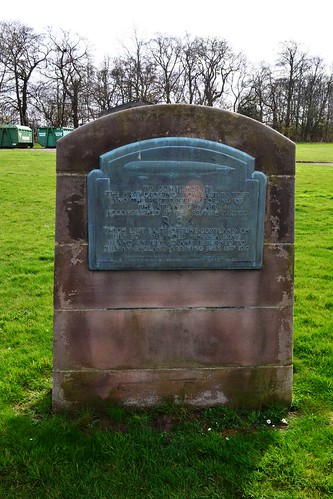
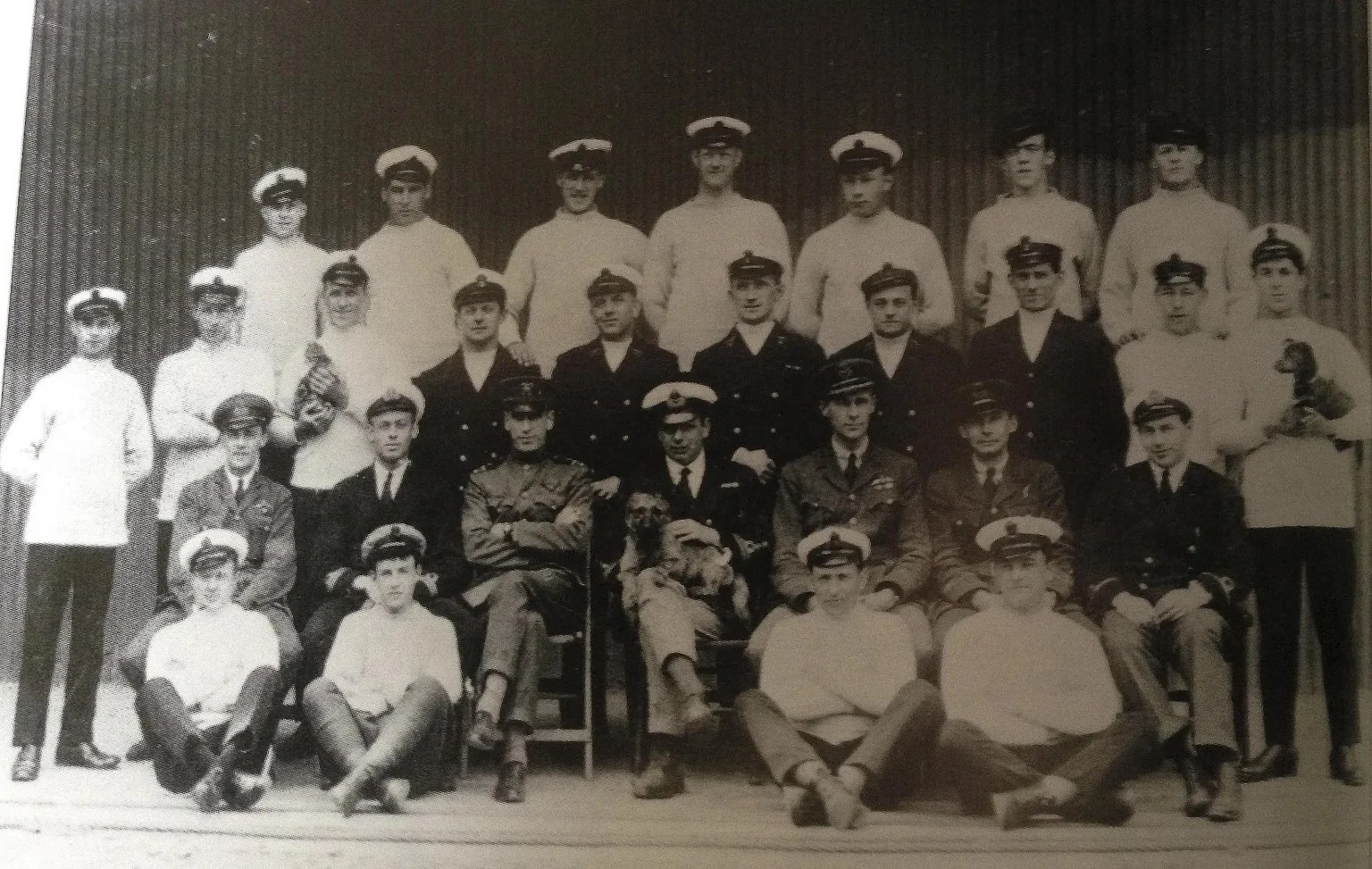
July 2nd 1919, H.M.A. R.34 Sets A World Record Flight.

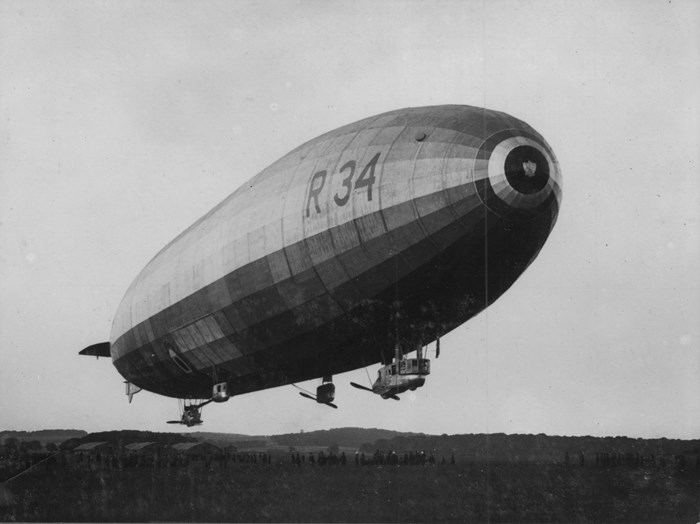
On July 2nd 1919 at 01:42, airship R.34 lifted off from the airfield at East Fortune, east of Edinburgh, to make an epic voyage – the first crossing of the Atlantic Ocean east to west by a powered aircraft.

R.34 possibly at East Fortune. (author unknown)

Conceived as early as 1916, R.34 was built at the works of William Beardmore and Co. Ltd. of Inchinnan near Glasgow. At 634 feet in length with a top speed of 62 mph, she would have five 270 hp Sunbeam ‘Maori’ engines, and would cost £350,000 to build. Her massive size gave her an impressive 1,950,000 cubic feet for gas storage, and she would be equivalent in size to a Dreadnought battleship. A major step forward in airship design, her aerodynamic shape reduced total air resistance to that of just 7% of an equivalently sized flat disc.

As she was designed under war specifications, R.34 would be built to carry twenty 100 lb and four 550 lb bombs, a range of Pom-Pom guns, Lewis machine guns and a small number of two-pounder quick-firing guns; but as she wasn’t finished until after the war, none of these were ever fitted, nor was she ever flown in anger.

Completed in early 1919, she just missed out on achieving the record of the first Atlantic crossing, being laid up by damage caused by poor handling, and thus beaten to the record now held by Alcock and Brown.

In May, she arrived at East Fortune airfield, a major airship station in East Lothian, from where she carried out a number of test flights including an endurance flight across the Scandinavian countries. In July she was set to make the first  Atlantic crossing, east to west.

In preparation for the flight, eight engineers were sent to the United States to train ground crews in the safe handling of the airship. The Admiralty provided two  warships, the Renown and Tiger, as surface supply vessels, and should R.34 have got into difficulty, she could have been taken in tow by one, or both of the two vessels.

On the evening of 1st July 1919 the ship was fueled to capacity (some 6,000 gallons), and in the early hours of the morning she was moved out of her shed and prepared for the flight. Her captain, Major G. H. Scott, gave the order to release early, and at 1.42 am (GMT) R.34 lifted slowly in to the Scottish sky.

After battling strong winds and Atlantic storms, R.34 finally arrived at Mineola. Huge crowds had turned out to greet her and her crew, a grandstand had been erected, parks and public spaces were packed with onlookers. Major J. Pritchard (The Special Duties Officer) put on a parachute and jumped from the airship to become the first man to arrive in America by air. He helped organise ground staff and prepared the way for R.34 to safely dock. As she settled on her moorings, she had not only become the fist aircraft to fly the Atlantic East to West, but broke the current endurance record previously held by the North Sea Airship NS 11, also based at East Fortune.

A record was made, R.34 had put British Airship designs and East Fortune firmly on the map. After 108 hours and 12 minutes flying time, R.34, her crew and two stowaways: William Ballantyne and a small tabby kitten called “Whoopsie”, had landed at Mineola, Long Island, New York.

After a 3 day stay in which the crew were treated like the heroes they were, R.34 was prepared for the homeward journey. On Wednesday July 10th 1919, at 23:54 she lifted off and set sail for home.

With prevailing winds carrying her eastward, she made an astonishing 90 mph, giving the opportunity to cut some of the engines and preserve fuel. This gave the crew a chance to divert over London, but due to a mechanical breakdown, this was cancelled and R.34 continued on her original route. Poor weather at East Fortune meant that she was ordered to divert to Pulham Air Station, Norfolk, but even after clarification that the weather had improved, her return to East Fortune was denied and she had to continue to Pulham – much to the disgust of the crew on board. At Pulham, the reception was quiet, RAF personnel greeted her and secured her moorings. She has covered almost 7,500 miles at an average speed of 43 mph.

Eventually after a major refit at East Fortune, R.34 left for the return to Pulham. After six weeks of static mooring, R.34 was sent to Yorkshire, to Howden Airship Station. Here she was used to train American crews, was modified for mast mooring and used for general training duties. During one such training mission, she was badly damaged in strong winds, and after sustaining further damage whilst trying to moor and secure her, she began to buckle. Falling to the ground, she broke up and was damaged beyond repair. R.34 was then stripped of all useful materials and the remainder of her enormous structure sold for scrap – a rather ungainly ending to an incredible and historical machine.

H.M.A. R.34 and her crew had become the first to cross the Atlantic east to west, they had achieved the  longest endurance flight, and become the first aircraft to complete a double-crossing of the Atlantic.

East Fortune

The memorial stone at East Fortune airfield commemorating the epic flight of R.34.

The Flight Crew for the Atlantic journey were:

Major G. H. Scott A.F.C – Captain
Captain G. S. Greenland – Second Officer
Second Lt. H. F. Luck- Third Officer
Second Lt. J. D. Shotter – Engineering Officer
Major G. G. H. Cooke DSC – Navigator
Major J. E. M. Pritchard O.B.E. – Special Duties
Lt. G. Harris – Meteorological Officer Second
Lt. R. F. Durrant – Wireless Officer
Lt. Commander Z. Lansdowne – Representative U S Navy
Brigadier General E. M. Maitland – Special Duties
Warrant Officer W. R. Mayes – First Coxswain
Flight Sergeant W. J. Robinson – Second Coxswain

Sergeant H. M. Watson – Rigger
Corporal R. J. Burgess – Rigger
Corporal F. Smith – Rigger
F. P. Browdie – Rigger
J. Forteath – Rigger Corporal

H. R. Powell – Wireless Telegraphy
W. J. Edwards – Wireless Telegraphy

W. R. Gent – Engineer
R. W. Ripley – Engineer
N. A. Scull – Engineer
G. Evenden – Engineer
J. Thirlwall – Engineer
E. P. Cross – Engineer
J. H. Gray – Engineer
G. Graham – Engineer
J. S. Mort – Engineer
J. Northeast – Engineer
R. Parker – Engineer

W. Ballantyne – Stowaway
“Whoopsie” – a small tabby kitten and stowaway

The crew of R.34 Crew – with the crew pets.

East Fortune airfield appears in Trail 42.

RAF Bradwell Bay Event July 17th 2021

A recent request from Eric Simonelli at the RAF Bradwell Bay Preservation Group. Eric is a key member of the group who are trying to preserve and promote the former RAF Bradwell Bay. He has kindly supplied a short write up and a flyer promoting a study day to be held in July for anyone interested. If you are, please contact the group direct and not myself at Aviation Trails.

RAF Bradwell Preservation Group.

Bradwell started off as a small grass aerodrome serving the firing range on the Dengie Peninsula, in the late 1930’s. In 1942 the aerodrome was expanded and became a large bases for 2,500 personnel who were to fly intruder missions to the continent and provide refuge for bombers returning with damage, casualties and short of fuel. To enable this level of activity there were many career opportunities for both men and women. This included aircraft maintenance, radio control, catering, motor transport and may more. Women were to fill all roles, apart from combat.  Today the RAF is fully inclusive.

RAF Bradwell Bay was host to many different squadrons up to the end of the war, with a variety aircraft types including Boston Havocs’, Mosquito’s, Spitfire’s, Tempest’s, Blenheim’s and Beaufighter’s. Other aircraft were based there for training and administrative purposes such as Miles Magisters, De-Haviland Dominies, Tiger Moths. At sometimes Bradwell Bay would have been an aeroplane spotter’s paradise. At least 25 squadrons are known to have been based there at different times.

Some parts of the airfield survive including the runways and control tower. However, the site is under threat of being demolished to make way for a second nuclear power station. As a group we are working to preserve as much as is possible, including building an archive to preserve memories and stories.

We have an unusual memorial and now are building an exhibition in the, nearby, Othona Centre. We are hoping to staff the exhibition at weekends or by appointment.

Bradwell Bay Memorial

Bradwell bay Memorial (Photo Eric Simonelli 2021)

more information can be found at: www.rafbradwellbay.co.uk

or email at: info@rafbradwellbay.co.uk

Eric has asked me to add the following ‘flyer’ to let you know about the study day being held locally for anyone interested in supporting the group and their aim to preserve Bradwell Bay. 

Inaugural Study Day

@ The Othona Community Centre

Saturday 17th July 2021

09:30 Reception and Coffee

3 Talks

WARTIME MALDON (World War 2) – by Stephen P. Nunn

A talk on George folliottPowell-Shedden by His Daughter

The Last CO – by Eric Simonelli

£25 inc Lunch, tea, and coffee (please advise of any dietary requirements on booking)

To book your place please complete the contact form on our website http://www.rafbradwellbay.co.uk

Members discount available

My thanks to Eric and good luck to them in their venture. 

Memories of a Vulcan XH558 Restoration Volunteer.

I was recently contacted by Trevor Danks, a volunteer during the restoration of Vulcan XH558, until 2015, the world’s last flying Vulcan bomber. Trevor very kindly sent me his memories along with a selection of his photos, taken whilst working as a volunteer during the aircraft’s restoration.

The Vulcan’s final farewell flight took place on October 28th 2015.

My sincere thanks go to Trevor for sharing his memories and photos with me.

Memories of a Vulcan XH558 Restoration Volunteer.

I joined the 558 Club at the RIAT 2000 at RAF Cottesmore. At that time I was unable to play any active part due to work commitments. However by 2005 I was semi retired and when the request came out for volunteers to help out with the restoration of XH558, I replied immediately.

I had been an Airframe Mechanic during my National Service in the RAF between 1955 and 1957. I had been fortunate to be posted to 232 OCU Valiant Squadron at RAF Gaydon and became a member of a ground crew on a Valiant. So the prospect of being in close proximity to the Vulcan was an exciting prospect.

Following the first call for volunteers an e-mail was sent out asking if anyone knew someone who could do a drawing of the hangar at Bruntingthorpe, at minimum cost. I replied by e-mail to say that I would do it on my CAD system at no cost as part of my volunteer work. So on a cold April morning in 2005, I met Colin Marshall at Bruntingthorpe to discuss what was required. The first task was to take measurements of the hangar.  I was also supplied with a drawing of the Vulcan which had to be shown in position in the hangar. Another volunteer, Derek Bates, helped with the measuring of the hangar. The original drawing was to be part of a document for the Heritage Lottery Fund. However as time passed the drawing was amended a few times and the later version is shown below, which shows the visitors walkway.

Hangar Layout (Bruntingthorpe).

Hangar layout

The Hangar layout at Bruntingthorpe (Trevor Danks)

I became a member of the Wednesday Crew (See photo) together with a number of other volunteers. On that day there were a basic six of us who, from the start, did a variety of jobs. In the beginning we helped to set up the hangar to meet the requirements of Marshall Aerospace, the hangar becoming part of their engineering facilities located at Cambridge. Apart from the tidying up, dismantling or erecting shelving and racking, we participated in the setting up of the technical library, under the supervision of Frank Edmondson, this held all the Air Publications (AP’s).

Our main task lay with the 600 tons of spares held in the Deep Store, better known as “The Shed”. Over the days of the restoration we sorted, counted, placed in boxes and put the spares in the racking. This information was input to the computer. After which we then had to find and retrieve spares as and when required by the engineers. All this was carried out under the supervision of Simon Chipman. We were a happy bunch beavering away in The Shed, sometimes very hot and sometimes very cold depending on the time of the year. During tea and lunchtime breaks in the Airfield Diner we would reminisce about our days in the RAF or times past when the Vulcan was flying at displays.

In August 2006 it had reached a critical point where more finance was need to be able to complete the restoration. A fund raising operation had been carried out but the trust was still £500,000 short so the paid employees had been put on notice to end their employment. Everyone was convinced that it looked as this was to be the end of the project. After the aircraft had been rolled out to loud cheers a louder cheer went up as Sir Michael Knight, Chairman of VTTS Trust, announced a donation of £500,000 had been received from a mystery donor. The donor turned out to be Jack Hayward, owner at the time of Wolves football club.

When the Vulcan finally got to the stage of emerging from the hangar for such as engine runs we joined together with all the other volunteers who came on other days of the week. This usually required us to do a ‘FOD Plod’ which entailed us doing a walk of where the Vulcan was to pass, picking up any debris lying about. The first time the Vulcan was taken out for an engine test run, it was taken to a dispersal pad on the edge of the airfield. Having run the engines individually the time came to run them together up to 75% full power. I and a colleague were stationed on the perimeter track to prevent anyone coming along it. As the power increased we noticed a shed on the side of the perimeter track beginning to move. We quickly flagged the ground crew to shut down before the shed disappeared into the trees. The aircraft was then repositioned to continue the engine run.

First Flight.

The most enjoyable FOD Plod was on 18th October 2007 when we were all out on the runway at 7.30am as dawn broke. The expectancy on that day was electric; our little crew had been appointed as the emergency team in the team bus with the task of dashing to an emergency entrance on the edge of the airfield. This was to let in emergency vehicles in the event of a mishap. Fortunately the day blossomed into a beautiful day both weather-wise and the rebirth of a much loved aircraft. When the crew of XH558 let off the brakes and that famous engine “Howl” was heard, one minute it was rushing down the runway and the next 100 feet up as it went past us in the viewing area.  We cheered like mad and hugged each other with not a dry eye in the house.

Sqd Ldr Dave Thomas - VOC Display Pilot ; AEO Barry Masefield - VOC AEO & Radio Op; Sqd Ldr Al McDicken - Marshalls Test Pilot

Sqd. Ldr Dave Thomas – VOC Display Pilot:  AEO Barry Masefield – VOC AEO & Radio Op.: Sqd Ldr Al McDicken – Marshalls’ Test Pilot

This was not the end but the beginning, as much had to done to get it to the stage of giving a display at the Waddington Air Show in 2008. There were other engine runs and flights, with XH558 getting her certificate to display just two days before the first day of the Air Show. All the time the Vulcan remained at Bruntingthorpe I continued to visit there on a Wednesday. When it moved to RAF Lyneham and the office to Hinckley, I changed my visits to Hinckley and became part of the education team. From this I developed my Power Point presentation to give talks about the restoration time.  However I retain the happy memories of our days at Bruntingthorpe and count myself very lucky to have been part of what can only be described as a great adventure. I was at Waddington for that first display and also managed to attend the day she flew with the two Lancaster bombers.

Since those days I have managed to visit Robin Hood Airport on a couple of occasions. The last time I managed to get the signatures of Taff Stone and Andrew Edmondson added to all the other signatures in my copy of Vulcan 607.

Photo Collection.

Weds crew John, Trevor, Peter, Dave, Bob and Vic.

‘The Wednesday Crew’ – John, Trevor, Peter, Dave, Bob and Vic.

Volunteers with Brunty Bear (XH558 Mascot)

Volunteers with ‘Brunty Bear’ (XH558 Mascot) On head centre front row.

Roll Out Day - XH558 Outside for first time August 2006

Roll Out Day – XH558 Outside for first time August 2006.

With Starboard Undercarriage Leg on Roll Out Day

With Starboard Undercarriage Leg on Roll Out Day.

First Flight.

Nose Wheel Off for First flight

Nose Wheel Off for First flight.

Volunteers after the First flight.

Volunteers after the First flight.

Start of Display Season.

Starting Fod Plod along runway April 2008 ready for display Season (John, Bob, Trevor)

Starting ‘Fod Plod’ along runway April 2008 ready for display Season. (John, Bob, Trevor).

At RAF Lyneham

At RAF Lyneham.

Trevor Danks – VOC Volunteer.
Founding Guardian No. 338.

My personal thanks again to Trevor and all the volunteers who took part in the restoration and displaying of XH558 and also to those who continue to work for her preservation.