A Happy New Year!

As 2015 fades away I would like to take this opportunity to thank each and every one of you who has visited, followed, liked, reblogged, commented and generally supported “Aviation Trails” during the last year. Without you, it would not be the site it is today.

It has certainly grown over the last year and taken on a new dimension. Investment in research material has enabled much longer posts and more personal information to be included, something that I know many people like to see. Not only do ‘we’ as enthusiasts, historical ‘writers’, modellers, relations of veterans etc. preserve our common history, but openly promote and educate others through the writing we do.

I believe it is important to remember what went on, the sacrifice and dedication to freedom, and if I can go a small way to helping that then it has all been worthwhile.

I have been inspired to take up old hobbies, learnt about aspects of military and natural history that I had never heard of, found new places in the world and been a part of a group of people who share the desire to learn, educate and inform others. It has been a wonderful year.

The tally of airfields I have visited is now around 75, double what it was this time last year. I have walked in the footsteps of famous people like Guy Gibson, Glenn Miller and Joe Kennedy, stood where important and famous missions have been planned and executed, trodden the very ground where so many young men and women served their country, many thousands giving the ultimate sacrifice.

It has been a most humbling experience.

So to each and every one of you, a heartfelt thank you, and here’s to a happy, peaceful and rewarding 2016.

Engines roar over Grafton Underwood once more. 

The ‘updated’ memorial at the former American Airbase,  RAF Grafton Underwood (Station 106), has been revealed with the help of Europe’s only flying B17 – ‘Sally B‘.

A large crowd gathered at the Memorial On Friday 29th May 2015, to hear speakers and see the beautiful ‘Sally B‘ perform a number of flypasts over the skies of Station 106 once more.

I sadly could not go due to work commitments, but have been informed that it was a resounding success and that it was very well attended by well wishers and members of the public alike.

This updating, has been in the pipeline for a while now and all the hard work has finally paid off. A new parking area and flag poles have been added and the site generally improved for visitors.

I have obtained and attached a short ‘You Tube’ video taken by one of the visitors to the event for you to see.

A lovely end to a remarkable tail.

My thanks go to Kevin for all his hard work and dedication keeping the memorial in such great condition and the memories of the 384th BG (H) well and truly alive.

The video of the event was kindly sent to me,  I don’t know who took it but all credit goes to them. I will try to find their name and attach it when I can.

Grafton Underwood appears in Trail 6.

A new parking area for the 384th BG memorial Grafton Underwood

Following many months of lobbying, letters and phone calls, a friend of mine, whom I met whilst trailing ‘American Ghosts‘, has finally secured and had built, a new parking area adjacent to the Memorial of the 384th BG at the former airfield, RAF Grafton Underwood (Station 106).

Kevin Fleckner, has maintained the site for some considerable time, which is located on the former airfield at the end of the 6000ft long, No.1 runway, part of which can still be seen in front of the memorial today.

Kevin’s next aim is to get both the ‘Stars ‘n’ Stripes’ and the union Flag raised once more, something that has not happened since the end of hostilities, 70 years ago.

The parking area is now tarmac, with top soil, seed and bollards placed to repair damage done by tractors and other road traffic.

It is accessible by wheelchairs and is a superb memorial, paying tribute the many men and women who served at Grafton Underwood during the Second World War.

My congratulations and thanks go to Kevin, for his dedication and for all the hard work he puts in maintaining the memorial on behalf of us all.

Well done buddy!

Grafton memorial

Grafton memorial

DSC_0127

The remains of the No.1 Runway

The memorial is bottom left by the road.

The memorial is bottom left by the road.


DSC_0115

The Church memorial window dedicated to the 384th BG


As Heard on the BBC: RAF Kings Cliffe – Time is Running Out!

We recently published a post highlighting the proposed development of the former RAF Kings Cliffe airfield (Trail 6), and in particular the Glenn Miller Memorial located at Jack’s Green, which is part of Rockingham Forest in Northamptonshire, England (post 6/1/15).

IMG_2285

The memorial and hangar base where Maj. Glenn Miller played his last hangar concert on 3rd October 1944.

The proposal, by the land owner/developer, Philip Ashton-Jones, states that a ‘caravan site’ with access and associated buildings would be built on part of the former airfield. This outlined plan includes the location of the memorial on the hangar base where Maj. Glenn Miller performed his final hangar concert (3rd October 1944) before his mysterious disappearance over the English Channel in December that year.

Whilst promoting the issue, Marcella, contacted John Griff at BBC Northants, who in turn asked for an interview on the Stuart Linnell Breakfast Show. Living in the U.S., this would prove interesting as there is a time difference of 5 hours. However, a suitable time was agreed and arrangements made for a pre-recorded rather than live interview.

The proposal has, unsurprisingly, been met with resistance from the local community. Some of the issues include: impact on local property and the current roads around Kings Cliffe which pass a quarry and lead to the back of Kings Cliffe village. The roads are very narrow, and unsuitable for high levels of traffic. The area is relatively high up and gives great views of the surrounding countryside, a reason why it is used by walkers, horse riders, cyclists etc. Furthermore, there is a wide range of wildlife including a herd of  deer that roam freely through the forest – it is indeed an idyllic area of pristine and natural beauty.

Of course there is the NIMBY aspect, no one wants a holiday village in their back garden. There are fears of ‘development creep’ and damage to the local finely balanced ecosystem. To Aviation Trails, it is not only the environment, but it the future of the Glenn Miller Memorial that is at stake, as are the remains of the airfield where so many brave young men, who gave the ultimate sacrifice, flew from during the Second World War.

The BBC broadcast both sides of the debate, including an interview with the landowner/developer, Mr. Philip Ashton-Jones, who slipped into admitting it was not caravans but 55 ‘luxury lodges’ that are being proposed. This was one of several ‘suspicious’ actions, along with the time at which the planning application was made public (i.e. prior to the Christmas holiday when the planning offices were closed), that caused some concern. This action reduced the amount of time objectors had to raise their concerns.

We feel these issues and the memorial in particular, are an important part of our shared British and American history. RAF Kings Cliffe comes from an era that changed the world, and Maj. Glenn Miller was a man whose musical talents helped shape and develop popular music for years to come.

These ancient forests are now delicate ecosystems, the memorials, rapidly disappearing monuments to past generations and Anglo-American heritage. Both need protection from permanent and sustained damage.

The BBC site has the various interviews available through their website, (links are valid for 30 days from the 9th February 2015 – but may be available on archives). They are for entire shows, but we have noted the timings of the relevant parts.

The BBC news website article can be found here.

A facebook page here, anyone can access this.

The radio interview with Marcella can be found here at 1:39:20

The interview with Ian Sharpe and Mr Philip Ashton-Jones can be found here at 2:39:15

A further report from the site can be found here on the John Griff show at 1:15:30

A big thanks also goes to my good friend, Kevin Fleckner, who wrote in support of the memorial.

As an additional note, there is also talk of development on the nearby RAF Deenethorpe site, another Northampton historical site likely to disappear. See the BBC report here.

Andy Laing and Marcella Beaudreau

Sgt. Archibald Mathies, USAAF, RAF Polebrook (Medal Of Honour)

Staff Sgt. Archibald Mathies (U.S. Air Force file photo)*1

Born in the Scottish town of Stonehouse, South Lanarkshire, on the 3rd June 1918, Archibald (Archie) Mathies was to become a Second World War hero. He was awarded the Medal of Honour (MOH) for his actions whilst at RAF Polebrook (USAAF Station 110) in Northamptonshire, England.

It would be on the 20th February 1944, shortly after arriving at Polebrook, that he would earn this honour but his life would be dramatically cut short.

Not long after his birth in Scotland, Mathies moved with his family to the United States, to a small town in Western Pennsylvania called Finleyville, in Washington County.

After leaving school, he began work in a local coal mine. The work was hard, and the pay was low; Mathies was not inspired. Then, following the Japanese attack on Pearl Harbour, as many other brave young American men did, he joined the Army, enlisting in Pittsburgh on the 30th December 1940. Mathies would transition through a number of stations and training centres before finally completing a course in aerial gunnery on the 22nd March 1943. His last U.S. posting was to the 796th Bombardment Squadron at Alexandria, Louisiana for operational training duties flying B-17s. He would leave here on the 8th December 1943 bound for England and the European Theatre of Operations.

Mathies arrived in the U.K. eight days later. His initial assignment was with the Eighth Air Force Replacement Depot, before being attached to the 1st Replacement and Training Squadron. On the 19th January 1944, he received his first and only operational squadron posting; the 510th Bomb Squadron, 351st Bomb Group, based at RAF Polebrook, as an engineer/gunner. Promotion was swift, and on 17th February 1944, probably following his first mission, Mathies was awarded the rank of Staff Sergeant.

A few days later, on 20th February 1944, the allies began the enormous aerial campaign known as ‘Big Week’. During this short period a massive number of aircraft would attack targets deep in the heart of Nazi Germany. One of the first, (Mission 226) would see a total of 417 aircraft fly from airfields across England. From RAF Polebrook, 39 B-17s took off to attack Leipzig. In the lead planes were Maj. Leonard B. Roper (s/n O-734101 ) of the 510th BS forming the high group, and Maj. James T. Stewart (s/n O-659405) of the 508th BS, leading the low group.

Flying in the number three ship of the lower Squadron, in B-17 (42-31763) ‘Ten Horsepower‘ was: Pilot: Clarry Nelson, Co-Pilot: Roland Bartley, Navigator: Walter Truemper, Engineer / Top Turret Gunner: Archie Mathies, Bombardier: Joe Martin, Radio Operator: Joe Rex, Ball Turret Gunner: Carl Moore, Waist Gunner: Tom Sowell, Waist Gunner: Russ Robinson, and Tail Gunner: Magnus Hagbo.

A B-17 believed to be “Ten Horsepower” (TU-A, serial number 42-31763) taken prior to its crash”2.

On approaching the target, the formation was hit hard by fighters and flak, who would attack the formation for over an hour, hitting many aircraft in the subsequent melee. Ten Horsepower, was targeted repeatedly receiving many hits from 20mm cannon shells. In these attacks the co-pilot was killed and the pilot knocked unconscious from his wounds. Fearing the bomber was doomed, the bombardier jettisoned the bombs and then bailed out, later being captured by the Germans and becoming a prisoner of war. The remaining crew remained with the B-17 which soon began a deathly spiral toward the ground.

Mathies and the navigator (Walter Truemper) would eventually take over control of the aircraft and nurse it back to England. Once over their base at RAF Polebrook, the crew were instructed to bail out but both Mathies and Truemper refused to leave the injured pilot. After deliberation, they were given permission to try to land, the remaining two crew members prepared themselves for a heavy landing.

The first two attempts had to be aborted, but on the third attempt, as they approached the airfield, the aircraft struck the ground, killing all three crew members onboard.

The crash was a severe blow for the base, both air and ground crews were devastated. On returning from the mission, five other aircraft (42-38028, 42-38005, 42-39760, 42-39853 and 42-6151). were forced to land at nearby Glatton (Conington) only a short distance away.

This was only Mathies’ second mission and sadly, his last.

For his bravery, Mathies was awarded the Medal of Honour; his name now appears on page 280 of the St. Paul’s Cathedral Roll of Honour. Also, as a dedication to him, one of the temporary lodging units at the Joint Base Anacostia-Bolling is named after him, as is the Airman Leadership School at RAF Feltwell,  and the Noncommissioned Officer Academy at Keesler AFB, Mississippi. In addition, the bridge on Truemper Drive crossing Military Highway at Lackland Air Force Base, Texas; the USCIS Dallas District Office and the Mathies Coal Company in Pittsburgh, Pennsylvania, are all named in his honour.

Archibald Mathies  citation reads:

For conspicuous gallantry and intrepidity at risk of life above and beyond the call of duty in action against the enemy in connection with a bombing mission over enemy-occupied Europe on 20 February 1944. The aircraft on which Sgt. Mathies was serving as engineer and ball turret gunner was attacked by a squadron of enemy fighters with the result that the copilot was killed outright, the pilot wounded and rendered unconscious, the radio operator wounded and the plane severely damaged. Nevertheless, Sgt. Mathies and other members of the crew managed to right the plane and fly it back to their home station, where they contacted the control tower and reported the situation. Sgt. Mathies and the navigator volunteered to attempt to land the plane. Other members of the crew were ordered to jump, leaving Sgt. Mathies and the navigator aboard. After observing the distressed aircraft from another plane, Sgt. Mathies’ commanding officer decided the damaged plane could not be landed by the inexperienced crew and ordered them to abandon it and parachute to safety. Demonstrating unsurpassed courage and heroism, Sgt. Mathies and the navigator replied that the pilot was still alive but could not be moved and they would not desert him. They were then told to attempt a landing. After two unsuccessful efforts, the plane crashed into an open field in a third attempt to land. Sgt. Mathies, the navigator, and the wounded pilot were killed“.*3

Mathies was truly a brave and dedicated man, who in the face of adversity, refused to leave his wounded pilot and friend. Daring to land a badly damaged aircraft, he sadly lost his life showing both great courage and determination.

The crew of ‘Ten Horsepower‘ were:

Pilot: Clarry Nelson,
Co-Pilot: Roland Bartley,
Navigator: Walter Truemper
Engineer / Top Turret Gunner: Archie Mathies
Bombardier: Joe Martin (POW)
Radio Operator: Joe Rex,
Ball Turret Gunner: Carl Moore,
Waist Gunner: Tom Sowell,
Waist Gunner: Russ Robinson,
Tail Gunner: Magnus Hagbo

Notes:

*1 Photo from Malmstrom Air Force Base website.

*2 Photo IWM Freeman Collection FRE 4725

*3 Citation taken from: US Army Centre for Military History website.
RAF Polebrook (USAAF Station 110)

In April / May 1943, Station 110 once more resounded with American voices, the arrival of the 351st Bomb Group. Assigned to the 94th Combat Wing, (1st bombardment Division) they flew B-17s of the: 508th, 509th, 510th and 511th Bomb squadrons. These aircraft would be distinguished by a Triangular ‘J’ on the tail.

The 351st were only activated in the previous October, and were, as ‘rookies’, to take part in some of the most severe aerial battles of the Second World War.

Primary targets they would attack included: Schweinfurt, Mayen, Koblenz, Hannover, Berlin, Cologne, Mannheim and Hamburg. The 351st would later go on to attack submarine pens, harbours and ‘V’ weapons sites. Ground support was also provided for the Normandy invasion, the Battle of the Bulge and other major European ground battles.

foundations

Stone Foundations Poke Through the Undergrowth

In October 1943, the 351st received the first of its two Distinguished Unit Citations, with highly accurate bombing in very challenging conditions raising the standing of this new group. A second DUC was to follow in January 1944 for action deep in the heart of Germany. During an attack on Leipzig in the ‘big week’ campaign of 20th-25th February 1944, two crewmen of the 510th, 2nd Lt Walter Truemper (Navigator) and Sgt. Archibald Mathies (Flt. Engineer), both received Medals of Honour for taking over their stricken aircraft when both Pilot and Co-Pilot were injured / killed.  On attempting to land the aircraft, the B-17 crashed between Glatton (Trail 6) and Polebrook, exploding it killed all three remaining crew members.

It was during this time that (Cp.) Clark Gable was stationed at RAF Polebrook, initially to make recruitment films for air gunners. He only flew five combat missions in all, taking a film crew on each one. The first of these missions was on 4th May 1943 and his last on 23rd September that same year. He was initially awarded the Air Medal, and later the Distinguished Flying Cross, finally leaving Polebrook with over 50,000 feet of film on 5th November 1943. In 1944, the film ‘Combat America’, narrated by Gable himself, was shown in theaters around the United States.

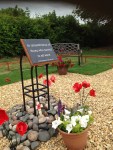
A memorial looks over the remnants of the main runway.

A memorial looks over the remnants of the main runway.

The 351st remained at Polebrook until shortly after VE day, returning to the US and becoming deactivated on August 28th 1945. Polebrook became quiet once more being put under care and maintenance until its final closure in 1948.

During the three years the 351st were at Polebrook, they flew a total of 279 B-17s on 9,075 sorties with 7,945 of them dropping 20,778 tons of bombs. Air gunners on these aircraft were credited with 303 enemy aircraft destroyed. In all they flew 311 credited missions losing 124 B-17s in all.

The story of RAF Polebrook,  how it looks today and the story behind the men can be found here.