RAF Sutton Bridge Part 2 – Flying Circuses and Fatal Risks.

Part 1, gave us an insight into the reason for Sutton Bridge’s origin and how it developed into a more recognisable and efficient airfield.

The 1920s and 1930s, then saw Sutton Bridge develop further becoming a hub of daring displays, training activities, and aviation firsts. From thrilling aerobatics over the Fens to early bombing and gunnery trials, pilots and crews developed both skill and courage, often at deadly risk. As biplanes gave way to faster monoplanes and the Fleet Air Arm joined in, the airfield transformed from a seasonal training camp into a fully established RAF station, laying the foundations for its crucial role in the Second World War.

Flying Circuses and Fatal Risks: The 1920s at Sutton Bridge

The 1920s saw a  range of squadrons use the site for short, week long stays, each flying in, completing practise days and then departing back to their home airfield. Many of the early users of the range and Sutton Bridge arrived in Leyland 3-ton trucks, a 1918 model with hard tyres. These advanced party trucks were packed with additional equipment: Bowsers, tail-trolleys, chocks and extra tool kits; all of which had to be unloaded before anyone could find themselves a bed for the night. The main party usually arrived shortly after, using the more comfortable train whilst the pilots took a leisurely flight bringing their aircraft in later on. *3

The number and range of aircraft that attended Sutton Bridge is far too many to list at this time, but records show the presence of some fifteen squadrons in one year alone, bringing a wide range of models and personnel. Such aircraft included: Hawker Woodcocks, Gloster Gamecocks, Bristol F2B Fighters, A.W. Siskins, Hawker Furys and Bristol Bulldogs to name but a few.

Interspersed with these flying activities, aircrew would put on displays for the locals who readily accepted them into their homes, pubs and dance halls. Dramatic flying completing loops and almost zero feet aerobatics amazed the gathered crowds, and the local swing-bridge became a ‘target’ to buzz and even fly underneath!*4 With all this daring activity, there was as a result, accidents both in the air and on the ground. Many of those lost were seasoned pilots from the First World War, and it would become a trend rather than a short lived phase in the airfield’s life.

The routine of bombing, air firing and displays would continue on until the weather began to close in, around about October. With that, the site would then shut with the tents and temporary accommodation taken away until the following spring.

From Experiment to Establishment: Sutton Bridge in the 1930s

The 1930s saw a global recession along with an increasing interest in Hitler’s activities in Germany. The British were beginning to think ahead, and Sutton Bridge quickly became a hive of activity, with wave after wave of dignitaries presenting themselves at the airfield to see the activities occurring at the site. Out on the ranges however, all was not going well. Biplanes of the 1930s launched bombs from carriers fitted beneath the fuselage, close to where the undercarriage was fixed, and on several occasions, the bombs caught the axle detonating in mid air. On more than one occasion, the aircraft was destroyed and the pilot killed by this very issue. Eventually, the Air Ministry called a halt to dive bombing, particularly at steep angles, but it had taken an airman’s death to trigger the move – at least until a better way of fixing the bombs could be found.

During these early years, the Fleet Air Arm (FAA) began to join the RAF in using Sutton Bridge, several Flights came and went enjoying the benefits of the nearby range. For the naval squadrons, Sutton Bridge offered an ideal shore base from where gunnery practice could be carried out over the Wash, away from the constraints of crowded airfields or carrier decks.

Among the earliest visitors was 801 Squadron, which detached to Sutton Bridge on a number of occasions – first recorded in July 1933, and again in May 1935 and January 1938. These short stays were typical of the Fleet Air Arm’s use of practice camps, allowing pilots and air gunners to sharpen their skills before re-joining their carriers. 802 Squadron followed a similar pattern, making use of Sutton Bridge in August 1934 and again in May 1935, its aircraft temporarily filling the skies over Lincolnshire before returning to front-line duties.*5*6

As the decade drew to a close, Fleet Air Arm activity at the airfield increased. In February 1939, 803 Squadron moved from Worthy Down to Sutton Bridge, settling in for a period of flying and training ashore. Not long afterwards, 800 Squadron, newly disembarked from HMS Ark Royal, also linked into this circuit of shore training, taking advantage of Sutton Bridge’s ranges as part of its spring 1939 programme.*7

Outside of the FAA’s activities, things at the airfield began to move forward. In 1933, prior to the winter closing in October, 23 Squadron took part in night firing trials using tracers being fired at drogues illuminated by searchlights on the ground. The first event witnessed by Group Captain Tedder, would eventually open a new chapter in the life of the airfield, allowing aircraft to fly from Sutton Bridge over the range to carry out night firing activities, something that continues on the range today.

Sutton Bridge officially became an airfield on March 1st, 1936, as a result of the reorganisation of the RAF commands. No longer a Summer Armament Training Camp, it received the status it needed – RAF Station Sutton Bridge – although it continued to  remain under the control of the Air Armament School.

Pageantry and Public Spectacle

Sutton Bridge’s elevation to official RAF station status in that year brought little immediate operational change, but one development was significant: the construction of married quarters along Chalk Lane. These quarters still stand today but now as private housing. When built, they would accommodate married couples providing a comfortable alternative to those supplied to single men.

Peri track west Side

Perimeter track west side.

As a way of show-casing the RAF, many air pageants sprouted up around the country during this time, with military stations opening their doors to the general public. Sutton Bridge was no exception, with some 3,000 people attending its first on 23rd May 1936. A grand display of aerobatics and formation flying, was supported by open hangars and pilots keen to provide information and encouragement to those wanting to know more.

During these shows, pilots would fly along the adjacent River Nene, which being banked by high flood banks, could approach unseen by those waiting on the other side. As they neared the swing bridge they would rise up and over the bank in dramatic style surprising the waiting audience. A feat of daring that was repeated regularly up until a year later in the 1937 Empire Day at the airfield. This final event, was a dismal day, with very poor weather and low visibility, little flying took place, and whilst it would have been hoped to have continued on, it would unfortunately be the end for Sutton Bridge, as it was to never take part in public days again. With war now inevitable, preparations began to be made that would supersede any public engagements.

From Biplanes to Monoplanes: Trials at Sutton Bridge

The looming war accelerated change. Outdated biplanes, long  being the backbone of the RAF, began to give way to sleek new monoplanes. Hurricanes, Spitfires and Blenheims were soon seen at Sutton Bridge, foreshadowing the modern era of aerial warfare, though training still relied heavily on older aircraft. The introduction of the Henley, Hawker’s own monoplane bomber designed to a specification for a light day-bomber that was capable of providing close air-support, was tried and tested with 350 initially ordered by the government. However, after a change in policy, this was reduced to 200 and even these being demoted to second line duties.

The promising aircraft, the younger brother of the Hurricane, never reached its potential, cut short before it had time to prove itself; many ended up as engine test beds or more likely, target tugs which caused many to have engine problems due to the low speeds it had to maintain with its high powered Merlin engine.

The second Henley prototype, K7554, fitted with a windmill-driven target winch (@BAE Systems.)*8

It was four of these Henleys that found themselves at Sutton Bridge where they were ‘downgraded’ and used as a Target Towing aircraft under 3 ATS between 1936 and 1939.

The Shadow of War: Sutton Bridge in 1939

1939 saw Europe heading catastrophically toward conflict, and this conflict was the reason for the reduced stay of 64 Sqn in August that year. On the 12th, they were ordered from their base at Church Fenton to Sutton Bridge for an armament training period, but owing to the worsening situation on the continent, this was cut short, and on the 24th, they were recalled. Within a week, like many other squadrons, they were ordered to mobilise.

Just before the outbreak of war, a sudden posting of the Training School from Sutton Bridge signalled what may have been its demise. But, the next day, one of the world’s most famous speeches was given, and Britain entered the war with Germany.

By the end of the 1930s, Sutton Bridge had grown from a temporary summer camp into a fully operational RAF station, shaped by innovation, spectacle, and the relentless demands of training aircrew. The lessons learned here – from aerobatic displays and night-firing trials to early experiments with new aircraft – prepared both pilots and the airfield itself for the pressures of wartime service. As Europe edged closer to conflict, Sutton Bridge stood ready, its evolving infrastructure and experienced personnel poised to meet the coming challenges of the Second World War.

The full story can be read in Trail 3 – Gone but not Forgotten.

RAF Sutton Bridge Part 1 – Its Origins and Early Days.

On the windswept Fens bordering Lincolnshire and Norfolk lies a site that shaped the skies of World War II. Far more than a quiet airfield, it was a crucible for pilots from Britain, the Commonwealth, and beyond, where Hurricanes, Spitfires, and Wellingtons soared – and often fell – as young airmen learned the deadly art of aerial warfare.

From rocket-firing trials to emergency landings, from multinational trainees to seasoned instructors, this airfield was a hub of innovation, skill, and courage. Lives were lost, lessons were learned, and generations of aircrew left ready to defend Britain’s skies. Though the airfield has largely returned to nature, its legacy remains – a testament to bravery, determination, and the high stakes of war in the air.

In Trail 3, we revisit the airfield that was RAF Sutton Bridge.

RAF Sutton Bridge

The origins of Sutton Bridge airfield are rooted some 20 years before the start of the Second World War, and largely owes its creation to the Holbeach firing range located in the shallows of the Wash just a stones throw north of the airfield. The range, which is still in operation today, was first supported by the airfield at Sutton Bridge as early as 1926 – a basic airfield from which to base those units using the range.

From Fens to Flying Fields

The airfield itself sits on the edge of the Fens, a flat, open area often referred to as ‘desolate’ and ‘drab’. In winter, certainly the wide open expanses allow winds to blow freely across its dark silt substrate, much of which lay under water for millions of years previously. But this dark open landscape offers prime agricultural and historical prospects, the Romans, Vikings and the Icini people all having made their mark on its dramatic landscape.

The airfield’s roots go back as far as the end of the First World War, the then newly formed RAF was cut back hard, reduced to a mere twenty-five squadrons for both home defence and to protect the commonwealth’s interests abroad. With little need seen for a home based air force, little thought was put into preparing pilots and gunners for any likely future conflict. To keep pilots busy, aerobatics and formation flying took preference over mock dog fights, aerial warfare tactics and ground attack practise.

But by the 1920s, this was not seen as productive and thoughts began to turn to training crews more responsibly, after all, if a pilot cannot engage and defeat his enemy then what use is he? So, a new firing range was sought to train pilots and gunners in the art of ground attack and air-to-air firing. The area required for such a task would need to be away from the public, but easily accessible and coastal, preferably with shallows waters. In 1925, several areas were seen as possible candidates; Catfoss, Donna Nook and an area known as Holbeach Marsh on the Lincolnshire / Norfolk border. After inspection by the Air Ministry, all three were deemed ideal, and so they took control creating three new ranges for the RAF’s use.

To be able to access the range at Holbeach, a nearby airfield was then needed, and being the closest, the former World War 1 site at Tydd St. Mary was given first consideration. However, strong objections from both local landowners and the council jointly, persuaded the military otherwise, and so an alternative had to be found.

The Birth of Sutton Bridge

The Ministry looked further east, nearer to the Wash, and found a small area close to the village of Sutton Bridge on the Lincoln / Norfolk border, about a mile or so from the sea. It would be perfect, and so an area of some 130 acres was obtained through either purchase or lease, allowing, on 1st September 1926, the birth of the soon to be, RAF Sutton Bridge.

The airfield’s main entrance gate and guard house, leading down towards the Mechanical Transport (MT) Shed, Bessonneau hangars and the airfield ground beyond. Visible in the far left background is the new Hinaidi type aircraft hangar built during the 1930s replacing two of the airfield’s original four Bessonneau type aircraft hangars. (source wiki)

Sitting on prime agricultural land, the airfield was hemmed in by both the River Nene along the western boundary and a former LNER railway line (now the A17 road) along the northern boundary. The borders of the two counties, Lincolnshire and Norfolk, cross the airfield resulting in it being divided between the two. The nature of this design though, would later on, lead  to many problems. The airfield being irregular in shape, meant that landing across it – cross-wind east / west – was very difficult if not impossible as there was insufficient room to do so. This would, in itself, restrict the number of days on which flying by trainees could take place, thus forcing them to make difficult cross-wind landings when they did.

In these early days Sutton Bridge would be rudimentary at best, bell tents being the main form of accommodation; only developing as new and longer training courses were needed. More permanent buildings were gradually erected including an Officers’ Mess, permanent accommodation blocks and maintenance workshops.

The 1920s was not a time for major airfield construction though, very few companies had developed or mastered the necessary skills needed for good airfield development. A local business,  Messers Thomson and Sons of Peterborough, were initially brought in, commencing the construction with small roads and tracks, along with four canvas Bessonneau hangars for storage and maintenance. Rudimentary maybe, but it was beginning to take some shape.

Original Entrance

The original entrance today.

Expansion and Identity: Sutton Bridge in the 1930s

The emergence of the ‘expansion period‘ in the 1930s, saw a period of rapid change and development in the military, where the need for airfields and a strong air force was seen as priority. Airfield development now began to improve and new companies, skilled in their design and construction, emerged onto the scene. One of these, “En-Tout-Cas”, in conjunction with other smaller companies, was enlisted to oversee the continued construction of the site at Sutton Bridge. These new and more experienced companies were employed under contract directly with the Air Ministry, using both civilian workers and their equipment, to build not only Sutton Bridge but Catfoss, Lee-on-Solent and Sealand as well *1

On January 1st 1932, the various training sites including Sutton Bridge were given formal titles – Armament Training Camps (ATC) – with each being given a number to distinguish them. Sutton Bridge became known as No. 3 ATC, handling fighter squadrons. Over the next few years it would go through a series of name changes, the first being on 1st April 1938, when it became 3 Armament Training Station (ATS), and then again, a year later, it would close only to reopen under the name of 4 Air Observers School (AOS).

Being better skilled in airfield design and construction, specific buildings for particular tasks were now being added to the work already done, small blocks for administration, maintenance sheds and such like all began to spring up. Being a pre-war construction, all buildings, including accommodation blocks, were placed directly on the airfield site rather than being dispersed as was the norm later on. Dispersals for aircrew were located at different points around the airfield’s perimeter, alongside the aircraft dispersals, and were brick built to protect crews from the heat and cold of the Fen weather.

The early Bell tents and Marquees were gradually replaced with more permanent brick structures arranged neatly in rows alongside the access road. Even with more permanent structures to bed down in, the comforts of a proper bed failed to materialise, instead metal stretchers with sawdust filled wadding for a mattress became the norm. *2

Wartime Growth and Shifting Commands

The runways of which there were three, were initially grass, but as the war progressed these were upgraded to ‘hard’ surfaces using a mix of steel matting, 080 American Planking and 130 Sommerfeld Track; all variants of metal planks that locked together to form a temporary but hard base. A concrete perimeter track was installed and fourteen hardstands were added using a hardcore base with tarmac coverings. In addition, two Bellman hangars, one Aeroplane Repair Section (ARS) Hangar and twelve 69 ft blister hangars were also erected on site. By the time it was established it had become a formidable site.

Sutton Bridge was passed directly to RAF control fourteen days after initial construction began, followed two weeks later by the arrival of the first RAF personnel from RAF Bircham Newton.

In these pre and early war years, the airfield would go through a series of ‘owners’ with 25 (Armament Training Group) under The Flying Training Command taking over in 1937 followed by 12 Group Fighter Command in September 1939 and finally back to The Flying Training Command once again in April 1942. The rapid change of ownership reflecting the many changes that the airfield would go through and the many units that would use its meagre but highly regarded facilities.

All these changes would mean that personnel numbers would fluctuate throughout the war depending upon who was there and what courses were being run, but in general the airfield accommodation could initially cater for 109 Officers, 110 Senior Non-Commissioned Officers and 110 ordinary rank male personnel; WAAFs were also catered for with 6, 12 and 361 respectfully. The fluctuation in staff would also reflect the numbers and types of aircraft on site. It is known that at one point there were no less than ninety Hurricanes plus other trainers along with Spitfires and Wellingtons on the airfield at one time.

For those travelling here on a posting, a train station was conveniently placed across the road from the airfield, getting to and from it was therefore relatively easy as long as the trains were running.

Photograph of the airfield’s main entrance (left) the Mechanical Transport (MT) Shed and on-site airfield road leading down towards four Bessonneau hangars and the airfield ground beyond. (Source via Wiki)

So far we have seen how Sutton Bridge began, how its origins owe its thanks to the range at Holbeach and how over the immediate post war years it developed as an airfield. In Part 2, we progress  through the 1920s and 1930s towards war, during which time, Sutton Bridge shone in the public eye, with pageants and air displays that enthralled the locals.

The full story can be read in Trail 3 – Gone but not Forgotten.

New Years Eve 1943 – The death of 2nd Lt. John W. Crago (RAF Kings Cliffe)

In 2021, I was contacted by Mike Herring and Trevor Danks, regarding the story of 2nd Lt. John Crago who was based at RAF Kings Cliffe in Northamptonshire during World War 2.

It was sad tale of how one young man died in a tragic accident not long after arriving in the UK from the United States. Mike and Trevor kindly allowed me to reproduce the entire text with photos to share with you, my sincere thanks go to them both.

This is the story of 2nd Lt. John Walter Crago who tragically lost his life in an aircraft crash on 31st December 1943 whilst operating from Kings Cliffe airfield.

Firstly, however, let us look at his origins.

His grandparents were Harry and Bessie Crago who were born and lived in Cornwall on the SW tip of England. Harry was born in Liskeard in November 1858 and Bessie in Duloe in May 1862.

The surname “Crago” is quite common in that area. Cornwall had been a major source of tin and lead for many years and there were extensive mine works around the county.

After leaving school Harry worked in the mines from about the age of 12.

In 1878 Harry and Bessie, still unmarried, moved to the coal mining village of Wingate, near Durham, in the North East of England, where Harry worked as a coal miner.

In the early part of 1879 Harry and Bessie married at Wingate and by 1881 they were living at 13, Emily Street, Wheatley Hill, Wingate and had a one year old son with them – William.

As an aside the village of Wingate is well known to some people in Kings Cliffe. It was the home of the writer’s wife’s parents until their recent death and  brothers and sisters still live there.

The coincidence increases as it is also the place where friends, Rodger Barker, living in Kings Cliffe, and Jim Vinales, managed to crash a Vulcan bomber in 1971, that had lost two engines. The crew fortunately survived. (see chapter one of “Vulcan 607” Corgi books).

In 1882 Harry and Bessie emigrated to the USA, by now having two children , and it is no co-incidence that they settled in Pennsylvania which was a significant coal mining area, Harry working there as a miner.

Their third child, Walter P Crago, was born at Houtzvale, P.A. on 16th August 1893. He is the father of the subject of this story.

In the US Census of 1910 16 year old Walter is shown as having no occupation, although his father and elder brother are working as miners.

In the 1920 US Census, Walter is married to Margaret K Crago and they have a one year old son, John Walter, born 5th April 1917 who is the subject of our story. His father’s marriage to Margaret does not seem to have lasted as by 1930 Walter has married Lorena C Crago (nee’ Curtis).

John Walter Crago is brought up in Philipsburg, PA, a small town of about 3000 people (twice as big as Kings Cliffe) which is situated about 200 miles due west of New York.

Philisburg main street via Mike Herring

A view of modern Philipsburg main street.

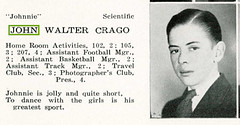
Our next glimpse of John W is in his High school Year book in 1934 when he was 17 years old.

John Walter Crago via Mike Herring

Johnnie did one year in high school and was clearly keen on his sport as well as the local girls!

Six year later in the US Census of 1940 John’s father, Walter, is by then the part owner and bar tender of a restaurant/tap room in Philipsburg and John W is working for him.

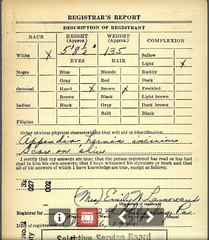
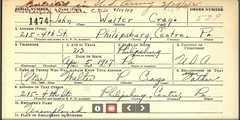
In Europe WW2 is in full flow and clearly the US is preparing for its possible involvement as John is signed on in the draft on 16th October 1940.

He is described on his draft form as 5’-8 ½” (1.74m) tall, weighing 135 pounds (61kg) with hazel eyes, light completion and brown hair.

draft via Mike Herring

John’s Draft paper.

draft 2 via Mike Herring

John trained to be an Army Air force pilot and joined the 55th fighter squadron, part of the 20th fighter group.

They arrived at Clyde in Scotland in August 1943, then travelled to their new base at Kings Cliffe in Northamptonshire, England. The 20th fighter group consisted of three squadrons of about 14 planes each – 55th, 77th and 79th.

The group was the first to fly the new P-38 Lightning escort, fighter ground attack air craft in combat in Europe.

P-38 via Mike Herring

P-38 Lightning

There was insufficient room at Kings Cliffe for all of three squadrons and therefore 55 Fighter Squadron , of which John Crago was a member, were based at RAF Wittering, just two miles North of Kings Cliffe.

The P-38 Lightning had a somewhat chequered history in its’ early days. It had several recognised problems, but because of the needs in Europe for a powerful, high flying escort aircraft, the early ones were shipped out without those problems being resolved. They suffered from many engine failures, and instability in certain circumstances.

Of significance to our story is part of the Wikipedia article on the development of the P-38 which reads –

“Another issue of the P-38 arose from its unique design feature of outwardly rotating, counter rotating propellers. Losing one of the two engines in any two engine non centre line thrust aircraft on take-off creates sudden drag, yawing the nose towards the dead engine and rolling the wing tip down on the side of the dead engine. Normal training in flying twin engine aircraft when losing one engine on take-off is to push the remaining engine to full throttle to maintain airspeed. If the pilot did this on a P-38, regardless of which engine had failed, the resulting engine torque produces an uncontrollable yawing roll and the aircraft would flip over and hit the ground.”

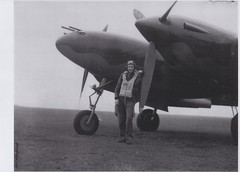
Crago with P-38 via Mike Herring

John Crago with his P- 38J Lightning – 1943


Crago at Kings Cliffe 1943 via Mike Herring

John W Crago in 1943 at Kings Cliffe

The first mission for 55 squadron was on 28th  December 1943 consisting of a sweep across the Dutch coast without encountering enemy aircraft. The mission summary report for that day reads –

28th December 1943

  1. 55th Fighter Squadron, 20th Fighter Group, Captain McAuley leading.
  2. 12 up at 1308 Down Wittering 1510
  3. Nil
  4. O 4 SWEEP
  5. To N. Nil
  6. Altitude over English coast mid-channel R/T jammed and remained so until mid-channel return trip. Landfall in, Wooderhoodf, at 1402. Altitude 20,000 feet. Light to moderate flak accurate for altitude over Flushing. Left turn and proceeded from Walchern to Noordwal 18 to 20,000 feet.
  7. Landfall out 1416 Noordwal. Weather clear all the way.

The second mission on the 30th December was more serious, escorting B-17 and B-24 bombers on an attack on a chemical plant near Ludwigshafen. The mission report for that day reads –

30th December 1943

  1. 55th Fighter Squadron, 20th Fighter Group
  2. 14 up 1121 at Kings Cliffe. Down 1500 Wittering.
  3. 3 aborts. Captain Jackson, Lt. Col. Jenkins – Radio. Lt. Sarros, gas siphoning.
  4. Bomber escort. Field order No. 210
  5. Nil
  6. Nil
  7. Nil
  8. Nil
  9. Landfall Ostend 24,000 feet at 1212. Climbed to 25,000 feet Brussels circled area 15 minutes. Proceeded to R/v with bombers. St. Menechoulde 25,000 feet at 1312. Reims 2 Me 109’s seen diving through bomber formation. Squadron left Bombers Compegiegne 1346. Encountered light flak Boulogne. Landfall out 1407, 24,000 feet. Clouds 6/10 over channel. 10/10 just inland. R/t ok.

The third mission was scheduled for 31st December and involved escorting bombers on an attack on a ball bearing factory at Bordeaux. John Crago was one of the 14 pilots of 55 squadron scheduled to be on this trip. He was temporarily based at RAF Wittering whilst suitable accommodation was built at Kings Cliffe and was flying from Wittering to Kings Cliffe to be briefed on the mission with the other pilots of 55, 77 and 79 Squadron who made up 20 Group. On arriving at Kings Cliffe he reported problems with his landing gear and did a low level fly past the control tower so that they could observe any obvious problem. As he approached the tower smoke was seen coming from his left hand engine.

He would have been flying slowly, close to stall speed, so that the tower had more time to observe any problem. Bearing in mind the reported problem with the P-38 flying on one engine the plane probably became uncontrollable. He clearly achieved some height as his eventual crash site was about two miles away at the village of Woodnewton. He did not survive the crash.

map via Mike Herring


location of crash via Mike Herring

Map of Woodnewton – crash site marked in red.

Lt. Crago's crash site

Lt. Crago’s crash site. (Photo courtesy Trevor Dank)

Lt. Crago's crash site

Lt. Crago’s crash site. (Photo courtesy Trevor Dank)

John Crago is buried at the Cambridge American Cemetery; plot A/5/22.

Commemoration Plaque

Plaque to commemorate Lt. Crago. (Photo courtesy Trevor Dank)

His was one of the bodies of American servicemen whose next of kin decided not to repatriate.  One could conjecture that he was left to rest in the land where many generations of his forefathers had lived.

Grave via Mike Herring


Kings Cliffe old blokes via Mike Herring

‘Kings Cliffe Old Blokes Club’ at the grave of John Crago.

Mike Herring
Kings Cliffe Heritage

Sources:

Vulcan 607 by Rowland White, Corgi Books.
US Census 1900, 1910, 1920, 1930, and 1940.
UK Census 1861, 1871,and 1881
Ancestry.com
Ancestry.co.uk
The American Air Museum – Duxford  www.iwm.org.uk/duxford
2nd Air Division Memorial Library – Norwich www.2ndair.org.uk

Report from Woodnewton Heritage Group

New Year’s Eve this year marks the 75th anniversary of a tragic accident in Woodnewton which resulted in the death of an American pilot and brought the realities of the Second World War closer to the inhabitants of our village.

JOHN WALTER CRAGO

John Walter Crago held the rank of 2nd Lieutenant in the US Army Air Force. He died instantly in an accident on 31st December 1943 when his aircraft crash landed in Woodnewton, in the field known as Stepping End just beyond Conegar Farm.

Lieutenant Crago was born on 5th April 1917 in Phillipsburgh, Pennsylvania, the son of Walter P Crago and Margaret K Jones. He had enlisted in March 1942 and was a member of the 55th Fighter Squadron of the 20th Fighter Group.  This Group was under the command of the 67th Fighter Wing of the Vlll Fighter Command of the USAAF. When he died he was 26 years old.

The circumstances leading to the accident on 31st December are recorded here in general terms only as told by former and existing residents of Woodnewton and supported by information from the Internet. It is not meant to be definitive.

The USAAF was assigned RAF Kings Cliffe in early 1943 and it was re-designated as Station 367. It was the most northerly and westerly of all US Army Air Force fighter stations. At that time RAF Kings Cliffe was a very primitive base, lacking accommodation and other basic facilities, so the Americans undertook an extensive building programme at the base during 1943. The 20th Fighter Group arrived on 26th August 1943 from its training base in California having crossed the USA by railway and then the Atlantic aboard HMS Queen Elizabeth on a five-day unescorted trip. The Group comprised three Fighter Squadrons; two of those Squadrons were based at Station 367 whilst the third, the 55th Fighter Squadron (Lieutenant Crago’s), was based at RAF Wittering whilst additional accommodation was being built at Kings Cliffe. The Group did not come back together at Station 367 until April 1944. Up to December 1943 the Group flew Republic P-47 Thunderbolt planes. With the arrival of their new Lockheed P-38 Lightening planes in late December 1943 the 20th Fighter Group entered fully into operational combat and was engaged in providing escort and fighter support to heavy and medium bombers to targets on the continent.

In the early morning of 31st December 1943 Lieutenant Crago was to fly from RAF Wittering to Station 367 to be briefed on his first combat mission – to provide escort protection on a bombing mission to attack an aircraft assembly factory at Bordeaux and an airfield at La Rochelle. This was to be just the 3rd mission by the fully-operational Group flying P-38’s. The planes of the 55th Squadron took off from RAF Wittering three abreast but unfortunately the right wing-tip of Lieutenant Crago’s plane struck the top of a search light tower on take-off.  Lieutenant Crago must have lost some control of the aircraft but not it would appear the total control of the plane. He flew it from Wittering and was trying to get to Station 367. Unfortunately, he only got as far as Woodnewton.

The plane approached the village from the north-east, flying very low over Back Lane (Orchard Lane) and St Mary’s Church but crash landed in the field known as Stepping End just beyond Conegar Farm. Eyewitnesses said that the pilot discharged his guns to warn people on the ground that he had lost control of the plane and was about to crash. Wreckage from the plane was still visible in Stepping End in the 1950’s and a “drop tank” (for additional fuel) could also be seen in the hedge between King’s Ground and Checkers. A brief reconnoitre in November 2018 however found no recognisable evidence of the plane in the hedgerows around the fields.

Stepping End is the first open field – no hedges or fencing – on the right-hand side of the track from Woodnewton to Southwick. From Mill Lane, cross the bridge over the Willowbrook, and continue until the land begins to rise at the start of the hill. King’s Ground and Checkers are the next two fields on the right along the same track.

It is understood that 2nd Lieutenant Crago, whilst no doubt a qualified and proficient pilot, had had only 7 hours flying experience in the Group’s new P-38 Lightning at the time of the accident.

A memorial plaque to Lieutenant Crago was put up in St Mary’s Church to commemorate his death. The wording on this memorial faded over time however, and the plaque was replaced in 2001, although the wording on the two plaques is the same.

2nd Lieutenant John Crago is buried and commemorated at the Cambridge American Cemetery and Memorial (Plot A Row 5 Grave 22). His photograph can be seen at “www/20thfightergroup.com/kiakita”.

My sincere thanks go to Mike and Trevor for sending the text and pictures and for allowing me to share the sad story of Lt. John Walter Crago. 

The death of the Robson Children, 1st December 1943.

It was on Wednesday 1st December 1943, that a 75 Squadron Stirling MK.III (EH880)  piloted by F/S J. S. Kerr (s/n 1558163) would be diverted from RAF Mepal and instructed to land at RAF Acklington in Northumbria.

The aircraft had been on operations to plant mines in the Danish coastal waters. On the final approach it undershot striking a family farmhouse in Togston near Amble. Inside the house, Cliff House Farmhouse, was the Robson family. The five children, ranging in ages from 19 months to 9 years of age, were all killed, whilst the parents who were playing cards downstairs, escaped with varying injuries after being pulled from the rubble by helpers. All but one of the Stirling’s crew were killed, the mid upper gunner Sgt K Hook, was pulled from the burning wreckage, his burning clothes being extinguished, by the local butcher, Jim Rowell.

This crash was the greatest civilian loss of life in the district,

The crew of Stirling EH880 ‘AA-J’ were:

F/S George John Stewart Kerr, RAFVR (s/n 1558163) – Pilot.
Sgt. Donald Frank Wort, RAFVR (s/n 1585034) – Navigator.
Sgt. Ronald Smith, RAFVR (s/n 1239376) – Air Bomber.
Sgt. Derek Arthur Holt, RAFVR (s/n 1217087) – Wireless Operator.
Sgt. Leonard George Copsey, RAFVR (s/n 1691471) – Flight Engineer.
Sgt. Kenneth Gordon Hook, RAFVR (s/n 1335989) – Mid Upper Gunner.
Sgt. George William Thomas Lucas, RAFVR (s/n 1250557) – Rear Gunner.

The Robson children were:

Sheila (19 months)
William (3 Years)
Margery (5 Years)
Ethel (7 Years)
Sylvia (9 Years)

The ‘Times’ Newspaper, published the story of 3rd December 1943:

Aircraft Crash on Farmhouse. Family of five young children killed.

Five children – all their family – of Mr and Mrs W. Robson were killed when an Aircraft crashed into Cliff House, a small dairy farm near Amble, Northumberland, on Wednesday night. The children’s ages ranged from one to nine years. They were sleeping in an upstairs room.

The mother and father, who with two friends Mr. and Mrs Rowell of Dilston [Terrace] Amble, were sitting in a downstairs room, were injured but not seriously. One of the crew of the aircraft, a gunner, was saved by Mr. Rowell.

Mr Rowell said last night: “We did not realise what had happened until the house collapsed above our heads. We managed to stand up, bruised and badly dazed, and, looking upward we saw the sky. Mrs Robson tried to make her way towards the stairs, which had been blown away. My wife called my attention to a burning object outside which was moving about.  We rushed over and found it was a gunner with his clothes alight. Mr Rowell rolled the airman on the ground to extinguish the burning clothes. Although badly burned, the gunner was alive.

The children’s partly charred bodies were recovered later.

Five streets on a housing estate near to the crash site in Amble have since been named after each of the Robson children. The crew are remembered on a plaque in St. John the Divine, the official church of RAF Acklington St. John.

November 7th 1945 – World Air Speed Record Herne Bay.

Trail 44 takes a look at the aviation highlights of the North Kent Coast in the small town of Herne Bay and its neighbour Reculver. It was here, on November 7th 1945, that the World Air Speed record was set in a ‘duel’ between two Gloster Meteors, as they raced across the Kent Sky.

On that day, two Meteor aircraft were prepared in which two pilots, both flying for different groups, would attempt to set a new World Air Speed record over a set course along Herne Bay’s seafront. The first aircraft was piloted by Group Captain Hugh Joseph Wilson, CBE, AFC (the Commandant of the Empire Test Pilots’ School, Cranfield); and the second by Mr. Eric Stanley Greenwood O.B.E., Gloster’s own chief test pilot. In a few hours time both men would have the chance to have their names entered in the history books of aviation by breaking through the 600mph air speed barrier.

The event was run in line with the Fédération Aéronautique Internationale‘s rules, covering in total, an 8 mile course flown at, or below, 250 feet. For the attempt, there would be four runs in total by each pilot, two east-to-west and two west-to-east.

With good but not ideal weather, Wilson’s aircraft took off from the former RAF Manston, circling over Thanet before lining his aircraft up for the run in. Following red balloon markers along the shoreline, Wilson flew along the 8 mile course at 250 feet between Reculver Point and  Herne Bay Pier toward the Isle of Sheppey. Above Sheppey, (and below 1,300 ft) Wilson would turn his aircraft and line up for the next run, again at 250ft.

Initial results showed Greenwood achieving the higher speeds, and these were eagerly flashed around the world. However, after confirmation from more sophisticated timing equipment, it was later confirmed that the higher speed was in fact achieved by Wilson, whose recorded speeds were: 604mph, 608mph, 602mph and 611mph, giving an average speed of just over 606mph. Eric Greenwood’s flights were also confirmed, but slightly slower at:  599mph, 608mph, 598mph and 607mph, giving an overall average speed of 603mph. The actual confirmed and awarded speed over the four runs was 606.38mph by Wilson*1.

The event was big news around the world, a reporter for ‘The Argus*2‘ – a Melbourne newspaper – described how both pilots used only two-thirds of their permitted power, and how they both wanted permission to push the air speed even higher, but both were denied at the time.

In the following day’s report*3, Greenwood described what it was like flying at over 600 mph for the very first time.

As I shot across the course of three kilometres (one mile seven furlongs), my principal  worry was to keep my eye on the light on the pier, for it was the best guiding beacon there was. On my first run I hit a bump, got a wing down, and my nose slewed off a bit, but I got back on the course. Below the sea appeared to be rushing past like an out-of-focus picture.

I could not see the Isle of Sheppey, toward which I was heading, because visibility was not all that I wanted.

At 600mph it is a matter of seconds before you are there. It came up just where I  expected it. In the cockpit I was wearing a tropical helmet, grey flannel bags, a white silk shirt, and ordinary shoes. The ride was quite comfortable, and not as bumpy as some practice runs. I did not have time to pay much attention to the gauges and meters, but I could see that my air speed indicator was bobbing round the 600mph mark.

On the first run I only glanced at the altimeter on the turns, so that I should not go too high. My right hand was kept pretty busy on the stick (control column), and my left hand was. throbbing on the two throttle levers.

Greenwood went on to describe how it took four attempts to start the upgraded engines, delaying his attempt by an hour…

I had to get in and out of the cockpit four times before the engines finally started. A technical hitch delayed me for about an hour, and all the time I was getting colder and colder. At last I got away round about 11.30am. 

He described in some detail the first and second runs…

On the first run I had a fleeting glance at the blurred coast, and saw quite a crowd of onlookers on the cliffs. I remembered that my wife was watching me, and I found that there was time to wonder what she was thinking. I knew that she would be more worried than I was, and it struck me that the sooner I could get the thing over the sooner her fears would be put at rest.

On my first turn toward the Isle of Sheppey I was well lined up for passing over the Eastchurch airfield, where visibility was poor for this high-speed type of flying. The horizon had completely disappeared, and I turned by looking down at the ground and hoping that, on coming out of the bank, I would be pointing at two balloons on the pier 12 miles ahead. They were not visible at first.

All this time my air speed indicator had not dropped below 560 mph, in spite of my back-throttling slightly. Then the guiding light flashed from the pier, and in a moment I saw the balloons, so I knew that I was all right for that.

On the return run of my first circuit the cockpit began to get hot. It was for all the world like a tropical-summer day. Perspiration began to collect on my forehead. I did not want it to cloud my eyes, so for the fraction of a second I took my hands off the controls and wiped the sweat off with the back of my gloved hand. I had decided not to wear goggles, as the cockpit was completely sealed. I had taken the precaution, however, of leaving my oxygen turned on, because I thought that it was just that little extra care that might prevent my getting the feeling of “Don’t fence me in.”

Normally I don’t suffer from a feeling of being cooked up in an aircraft, but the Meteor’s cockpit was so completely sealed up that I was not certain how I should feel. As all had gone well, and I had got half-way through the course I checked up my fuel content gauges to be sure that I had plenty of paraffin to complete the job.

I passed over Manston airfield on the second run rather farther east than I had hoped, so my turn took me farther out to sea than I had budgeted for. But I managed to line up again quite satisfactorily, and I opened up just as I was approaching Margate pier at a height of 800 feet. My speed was then 560 mph.

Whilst the first run was smooth, the second he said, “Shook the base of his spine”.

This second run was not so smooth, for I hit a few bumps, which shook the base of my spine. Hitting air bumps at 600 mph is like falling down stone steps—a series of nasty jars. But the biffs were not bad enough to make me back-throttle, and I passed over the line without incident, except that I felt extremely hot and clammy.

After he had completed his four attempts, Greenwood described how he had difficulty in lowering his airspeed to enable him to land safely…

At the end of my effort I came to one of the most difficult jobs of the lot. It was to lose speed after having travelled at 600 mph. I started back-throttling immediately after I had finished my final run, but I had to circuit Manston airfield three times before I got my speed down to 200mph.

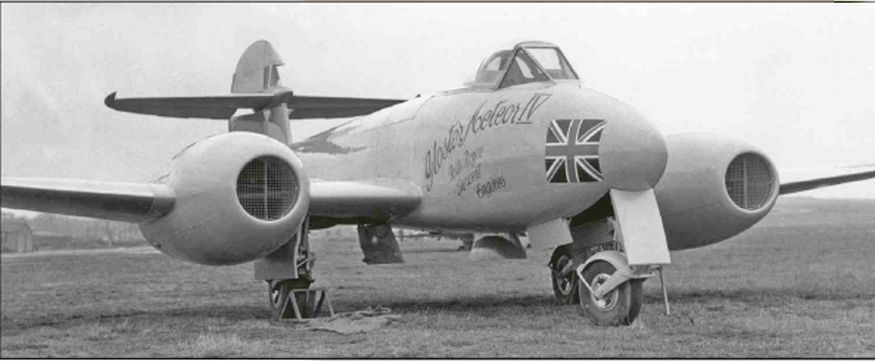
The two Meteor aircraft were especially modified for the event. Both originally built as MK.III aircraft – ‘EE454’ (Britannia ) and ‘EE455’ (Yellow Peril) – they had the original engines replaced with Derwent Mk.V turbojets (a scaled-down version of the RB.41 Nene) increasing the thrust to a maximum of 4,000 lbs at sea level – for the runs though, this would be limited to 3,600 lbs each. Other modifications included: reducing and strengthening the canopy; lightening the air frames by removal of all weaponry; smoothing of all flying surfaces; sealing of trim tabs, along with shortening and reshaping of the wings – all of which would go toward making the aircraft as streamlined as possible.

Related image

EE455 ‘Yellow Peril’ was painted in an all yellow scheme (with silver outer wings) to make itself more visible for recording cameras.*4

An official application for the record was submitted to the International Aeronautical Federation for world recognition. As it was announced, Air-Marshal Sir William Coryton (former commander of 5 Group) said that: “Britain had hoped to go farther, but minor defects had developed in ‘Britannia’. There was no sign of damage to the other machine“, he went on to say.

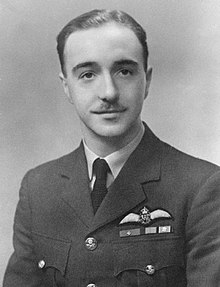
Wilson, born at Westminster, London, England, 28th May 1908, initially received a short service commission, after which he rose through the ranks of the Royal Air Force eventually being placed on the Reserves Officers list. With the outbreak of war, Flt. Lt. Wilson was recalled and assigned as Commanding Officer to the Aerodynamic Flight, R.A.E. Farnborough. A year after promotion to the rank of Squadron Leader in 1940, he was appointed chief test pilot at the Royal Aircraft Establishment (R.A.E.) who were then testing captured enemy aircraft. He was promoted to Wing Commander, 20th August 1945, retiring on 20th June 1948 as a Group Captain.

Eric Greenwood, Gloster’s Chief Test Pilot, was credited with the first pilot to exceed 600 miles per hour in level flight, and was awarded the O.B.E. on 13th June 1946.

His career started straight from school, learning to fly at No. 5 F.T.S. at Sealand in 1928. He was then posted to 3 Sqn. at Upavon flying Hawker Woodcocks and Bristol Bulldogs before taking an instructors course, a role he continued in until the end of his commission. After leaving the R.A.F., Greenwood joined up with Lord Malcolm Douglas Hamilton (later Group Captain), performing barnstorming flying and private charter flights in Scotland.

Greenwood then flew to the far East to help set up the Malayan Air Force under the guise of the Penang Flying Club. His time here was adventurous, flying some 2,000 hours in adapted Tiger Moths. His eventual return to England saw him flying for the Armstrong Whitworth, Hawker and Gloster companies, before being sent as chief test pilot to the Air Service Training (A.S.T.) at Hamble in 1941. Here he would test modified U.S. built aircraft such as the Airocobra, until the summer of 1944 when he moved back to Gloster’s – again as test pilot.

It was whilst here at Gloster’s that Greenwood would break two world air speed records, both within two weeks of each other. Pushing a Meteor passed both the 500mph and 600mph barriers meant that the R.A.F. had a fighter that could not only match many of its counterparts but one that had taken aviation to new record speeds.

During the trials for the Meteor, Greenwood and Wilson were joined by Captain Eric ‘Winkle’ Brown, who between them tested the slimmed-down and ‘lacquered until it shone’ machine, comparing  drag coefficients with standard machines. Every inch of power had to be squeezed from the engine as reheats were still in their infancy and much too dangerous to use in such trials.

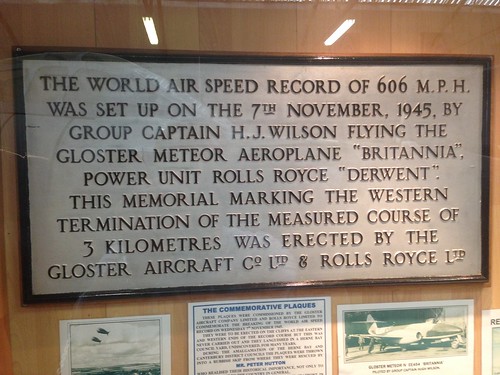
To mark this historic event, two plaques were made, but never, it would seem, displayed. Reputed to have been saved from a council skip, they were initially thought to have been placed in a local cafe, after the cliffs – where they were meant to be displayed – collapsed. The plaques were however left in the council’s possession, until saved by an eagle-eyed employee. Today, they are located in the RAF Manston History Museum where they remain on public display.

RAF Manston History Museum

One of the two plaques now on display at the RAF Manston History Museum.

To mark the place in Herne Bay where this historic event took place, an information board has been added, going some small way to paying tribute to the men and machines who set the world alight with a new World Air Speed record only a few hundred feet from where it stands.

Part of the Herne Bay Tribute to the World Air Speed Record set by Group Captain H.J. Wilson (note the incorrect speed given).

Sources and Further Reading.

*1 Guinness World Records website accessed 22/8/17.

*2 The Argus News report, Thursday November 8th 1945 (website) (Recorded readings quoted in this issue were incorrect, the correct records were given in the following day’s issue).

*3 The Argus News report, Thursday November 9th 1945 (website)

*4 Photo from Special Hobby website.

The RAF Manston History Museum website has details of opening times and location.

The Manston Spitfire and Hurricane Memorial museum website has details of opening times and location.

Flt. Lt. William ‘Bill’ Reid VC 61 Squadron, RAF Syerston

In 1942 Air Ministry Directive S.46368/D.C.A.S. turned Bomber Command’s focus to the morale of the German population and in particular its industrial workforce. Bomber Command now turned to strategic bombing, a controversial campaign that was debated for many years after, it was seen as a way to destroy the enemy’s industrial output, by attacking the very workforce that produced it.

William Reid VC.jpg

Flt. Lt. Bill Reid VC (IWM CHP 794)

But as loses had mounted, Bomber Command had been forced to fly at night, a task that was almost impossible to satisfactorily achieve for most bomber crews who had been trained to bomb in daylight. Indeed, only some 3 in every 100 bombers were hitting within 5 miles of the aiming point at the start of the campaign.

Harris himself knew that hitting a single target consistently, at night was impossible, and so there was little choice seen other than the controversial bombing campaign.

On one of these raids, on the night of 3rd/4th November 1943, Bomber Command sent a large raid of almost 600 aircraft to Germany. In that raid was Acting Flight Lieutenant William (Bill) Reid, a Scot born in Baillieston, Glasgow, and the son of a Blacksmith .

Reid performed his duties that night in a manner that would see him earn the Victoria Cross, the highest honour possible, for taking his damaged Lancaster to the heart of Dussledorf and bombing the target even though he himself and his Flight Engineer were wounded; the navigator killed and the aircraft severely damaged and so difficult to fly.

That evening, eleven Lancasters from 61 Squadron, RAF Syerston, took off on a mission to bomb Dusseldorf. Reid’s aircraft, Lancaster LM360 was second to depart taking off at 16:59. On board with Flt. Lt. William (Bill) Reid were: Sgt. J. Norris (Flt Eng); Flt. Sgt. J. Jeffries (Nav); Sgt T. Rolton (Bomb Aimer); Flt. Sgt. J. Mann (WT/ Air Gunner); Flt. Sgt. S. Baldwin (Air Gunner) and Flt. Sgt. A. Emerson (Air Gunner).

As the aircraft crossed the Dutch coast there was a terrific bang outside the aircraft  which resulted in the windscreen being shattered and partially blown out. Reid was wounded in the head, shoulders and hands, and the plane temporarily went out of control. Flak continued to burst all around the Lancaster with one further burst injuring the Flight Engineer, who was next to read, and causing further injuries to Reid himself. The port elevator had been shot away and to compensate, Reid had to pull the stick fully back just to keep the plane straight and level. Between Reid and the Flight Engineer, they maintained level flight as part of the formation of almost 600 aircraft across an 8 to 10 mile span of up to 6000 feet deep – the option of turning back was not a viable one.

Keeping the plane straight and level, Reid watched the target indicators. The bombs were dropped and the photographic evidence taken. Turning the aircraft away, the Lancaster headed for home. Reid knew that he was the only one who could fly the aircraft and even with with no elevator, virtually no instruments and at night, he was determined to make it back safely. With further attacks from night fighters on the return trip, it was not an easy journey, but they eventually made it to England. Once over the English coast they looked for a suitable airfield to land, they came across the beacons at the American base at RAF Shipdham in Norfolk, and Reid put the aircraft down. Almost immediately, the legs of the undercarriage collapsed and the aircraft hit the runway on its belly, sliding along for some 50 yards or so, before coming to a complete stop. At this point Reid realised the Navigator had died slumped in his seat behind him.

Reid, severely injured, had managed to fly the badly damaged aircraft, without oxygen and with wounded on board, for many hours from deep inside Germany, the actions of which earned the 22-year-old acting Flight Lieutenant the Victoria Cross.

His citation in the Third Supplement to the London Gazette on Tuesday 14th December 1943 covered an entire page and read:

Air Ministry, 14th December, 1943.

The KING has been graciously pleased to confer the VICTORIA CROSS on the undermentioned officer in recognition of most conspicuous bravery: —

Acting Flight Lieutenant William REID (124438), Royal Air Force Volunteer Reserve, No. 61 Squadron.

On the night of November 3rd, 1943, Flight Lieutenant Reid was pilot and captain of a Lancaster aircraft detailed to attack Dusseldorf.

Shortly after crossing the Dutch coast, the pilot’s windscreen was shattered by fire from a Messerschmitt 110. Owing to a failure in the heating circuit, the rear gunner’s hands were too cold for him to open fire immediately or to operate his microphone and so give warning of danger; but after a brief delay he managed to return the Messerschmitt’s fire and it was driven off.

During the fight with the Messerschmitt, Flight Lieutenant Reid was wounded in the head, shoulders and hands. The elevator trimming tabs of the aircraft were damaged and it became difficult to control. The rear turret, too, was badly damaged and the communications system and compasses were put out of action. Flight Lieutenant Reid ascertained that his crew were unscathed and, saying nothing about his own injuries,
he continued his mission.

Soon afterwards, the Lancaster was attacked by a Focke Wulf 190. This time, the enemy’s fire raked the bomber from stem to stern. The rear gunner replied with his only serviceable gun but the state of his turret made accurate aiming impossible. The navigator was killed and the wireless operator fatally injured. The mid-upper turret was hit and the oxygen system put out of action. Flight Lieutenant Reid was again wounded and the flight engineer, though hit in the forearm, supplied him with oxygen from a portable supply.

Flight Lieutenant Reid refused to be turned from his objective and Dusseldorf was reached some 50 minutes later. He had memorised his course to the target and had continued in such a normal manner that the bomb-aimer, who was cut off by the failure of the communications system, knew nothing of his captain’s injuries or of the casualties to his comrades. Photographs show that, when the bombs were released, the aircraft was right over the centre of the target.

Steering by the pole star and the moon, Flight Lieutenant Reid then set course for home. He was growing weak from loss of blood. The emergency oxygen supply had given out. With the windscreen shattered, the cold was intense. He lapsed into semi-consciousness. The flight engineer, with some help from the bomb-aimer, kept the
Lancaster in the air despite heavy anti-aircraft fire over the Dutch coast.

The North Sea crossing was accomplished. An airfield was sighted. The captain revived, resumed control and made ready to land. Ground mist partially obscured the runway lights. The captain was also much bothered by blood from his head wound getting into his eyes. But he made a safe landing although one leg of the damaged undercarriage collapsed when the load came on.

Wounded in two attacks, without oxygen, suffering severely from cold, his navigator dead, his wireless operator fatally wounded, his aircraft crippled and defenceless,  Flight Lieutenant Reid showed superb courage and leadership in penetrating a further 200  miles into enemy territory to attack one of the most strongly defended targets in Germany, every additional mile increasing the hazards of the long and perilous journey home. His tenacity and devotion to duty were beyond praise.

Reid would go on to fly in Bomber Command being transferred to the famous 617 Sqn at Woodhall Spa after his recovery. Here he would fly with Leonard Cheshire, another VC holder, on Tallboy missions, dropping the enormous weapon onto heavily fortified or deeply buried structures.

On 31st July 1944, sixteen Lancasters and two Mosquitoes of 617 Sqn were ordered to attack the V-1 site at Rily-la-Montage, a railway tunnel used by the Germans to store the pilot-less flying bombs ‘The Doodlebug’.  Here Flt. Lt. William ‘Bill’ Reid’s luck would finally run out.

He had managed so far to evade either death or capture, only to be struck down by bombs from one of his own. The Lancaster Mk.I (ME557) ‘KC-S’ he was flying with 617 Sqn, shuddered as allied bombs crashed through the Lancaster severing the control cables, fracturing the structure of the Lancaster’s body and removing one of the port engines. Uncontrollable, the aircraft then entered a spin. Reid gave the order to bail out, himself escaping through the hatch above his head. He landed heavily, breaking an arm in the process – an injury that would hinder his escape from his pursuers. Within an hour he was captured, interrogated and sent on to a POW camp. Reid and one other crewman, Flying Officer D. Luker, were the only two airmen to escape the stricken  Lancaster, the remaining five all being killed in the crash.

As the allied forces moved ever closer, the much admired Reid was moved from camp to camp, ending his war at Stalag III – a POW camp made famous by ‘The Great Escape’ and ‘The Wooden Horse’.

Back at the RAF Woodhall Spa in Lincolnshire, he colleagues ‘mourned’ his capture by joking that he had escaped with all their money, money he had won in an early morning card game in the officers mess at the Petwood Hotel. *1.

Liberated in May 1945, Reid returned home and became well known in the agricultural business. He became great friends with the that other Scottish VC holder John Cruickshank a friendship that lasted a good many years.

Some time after moving to his new home in Crieff, Bill Reid sadly passed away; his death being announced  on November 28th 2001. He was buried in the local cemetery at Crieff.

Sources and Further Reading.

National Archives AIR 27/578/22
National Archives  AIR 27/2128/24
National Archives  AIR 27/2128/23

The Third Supplement of The London Gazette Publication date: 10th December 1943; Supplement: 36285 Page: 5435

World At War Series BBC narrated by Lawrence Olivier Episode 12

*1 Sweetman, J. “Bomber Crew – Taking on the Reich“, Abacus, 2004 pg 207

The Scotsman Newspaper website, 29th November 2001.

Captain Edwin Swales VC, DFC RAF Little Staughton.

The Royal Air Force was made up of many nationals including both those from the Commonwealth and those from across the globe.

In Bomber Command, and the Pathfinders in particular, one man stood out not just for his nationality, but for his bravery and dedication in the face of death.

That man was one Acting Major*1 Edwin Essery Swales VC, DFC based at RAF Little Staughton on the Bedfordshire / Cambridgeshire border.

Swales (fourth from right) and his crew with their Lancaster ‘M’ Mother *9

Swales was born on 3rd July 1915, the son of Harry Evelyn Swales and Olive Essery, in Inanda, Natal South Africa. He was one of four children whose father was a farmer. Whilst Edwin was young, his father, Harry, died from  the influenza epidemic that claimed some 50 million lives after the First World War. Without a father, the family were unable to maintain the farm, and so they moved away to Berea in Durban.

Once of high school age, the young Edwin Swales attended Durban High School, he also joined the Scouts learning valuable skills with like minded youngsters, that would help in him in later life. After leaving school Swales landed himself his first job, working at the international branch of Barclays Bank in Durban. But with with war looming, Swales like many young men at the time, was drawn to military service, and so he joined up, posted to the Natal Mounted Rifles where he achieved the rank of Sergeant Major.

Whilst with the Mounted Rifles, Swales served in several locations including: Kenya, Abyssinia and North Africa where he fought bravely alongside his compatriots and the Eighth Army under Montgomery. He would remain with the rifles until January 1942 at which point he transferred to the South African Air Force, obtaining his wings on 26th June a year later. Two months after this milestone, he, like many others from across the commonwealth, was seconded to the Royal Air Force ensuring his position overseas.

Swales (s/n: 6101V) like many new recruits to the Royal Air Force, would undergo a tense period of retraining, eventually being posted to fly heavy bombers within Donald Bennett’s 8 Group – ‘The Pathfinders’. His first and only posting, would be at Little Staughton with 582 Sqn.

During his short time at Little Staughton, Swales would fly a number of missions piloting Avro’s delight, the four engined heavy bomber the Lancaster.

Swales took part in many operations over occupied Europe, including the ill-fated attack on Cologne on December 23rd 1944, which saw the loss of five  aircraft from 582 Sqn. In total, eight aircraft from seventeen flying from both Little Staughton and Graveley were lost that day including the lead bomber flown by Sqn. Ldr. Robert Palmer who himself was awarded the Victoria Cross for his actions.

On that day, an Oboe mission that went terribly wrong, Swales heard the instruction to bomb visually releasing his bombs at 12:51hrs. Flak and fighter attacks were so ferocious, that Swales, like many others in the formation, had to take “violent evasive action” to shake off persistent and accurate attacks from fighter and ground based gunners. He was able to return his aircraft and crew safely to Little Staughton landing at 14:35*2

The action taken by Swales that day was indicative of his determination to succeed and protect both his aircraft and crew, and one that would be repeated time after time by the airman. As a result, it was seen fit to award Captain Swales the DFC for his action that night, his citation stating:

This Officer was pilot and Captain of an aircraft detailed to attack Cologne in December, 1944. When approaching the target, intense anti-aircraft fire was encountered. Despite this, a good bombing attack was executed. Soon afterwards the aircraft was attacked by five enemy aircraft. In the ensuing fights, Capt. Swales manoeuvred with great skill. As a result his gunners were able to bring effective fire to bear upon the attackers, one of which is believed to have been shot down. Throughout this spirited action Captain Swales displayed exceptional coolness and captaincy, setting a very fine example. This Officer has completed very many sorties during which he has attacked a variety of enemy targets*3

Within two months of the operation and at the time his award was being awarded, Swales would be in a similar position again.  This time as Master Bomber leading the formation and directing the bombers to the target.

On that night, only ten days after the historical attack on Dresden, 367 Lancasters and 13 Mosquitoes from 1, 6 and 8 Groups were detailed to attack the city of Pforzheim to the north-west of Stuttgart. This would be the only attack on the city during the war and it would prove almost as devastating as both Dresden and Hamburg.

Flying along side Swales that night in his Lancaster III PB538 ‘N’, were seven other crewmen, including two navigators as was commonplace for Oboe fitted aircraft.

On the run in to the target, the Lancaster was badly mauled by night fighters who successfully put one engine and the rear turret guns out of action. But undeterred, Swales remained on station guiding the following bombers onto the target with the greatest of precision.

When he was finally satisfied that the attack had been carried out successfully, he left his station and turned the aircraft for home. It had been difficult to keep the Lancaster flying, but Swales had persevered in order to complete the job. But he was now easy prey for enemy fighters and inevitably more attacks came.

Soon a second engine was put out of action and flying controls were damaged further with some now completely inoperable. With a reduced speed and difficult flying conditions he headed for the allied lines, where he hoped to get his crew out safely.

All those on board made the jump to safety, leaving just Swales at the controls of the failing Lancaster. As if someone had been watching over them, just as the last man left, the Lancaster finally gave up the struggle and dived into the earth –  Edwin Swales was still sat at the controls when it was found later on.

The attack on Pforzheim  was considered to be very accurate, with over 1,800 bombs having been dropped in as little as twenty minutes or so. Over 17,000 people were known to have died that night in the raging fire that followed the bombing, and a post-war photo, revealed that 83% of the built up area had been destroyed by the raid *4

Following the death of Captain Swales, Air Chief Marshall Sir Arthur Harris KCB, OBE, AFC, Chief of Bomber Command, personally write to Swales’ mother saying: “On every occasion your son proved to be a fighter and a resolute captain of his crew. His devotion to duty and complete disregard for his own safety will remain an example and inspiration for all of us.”*10

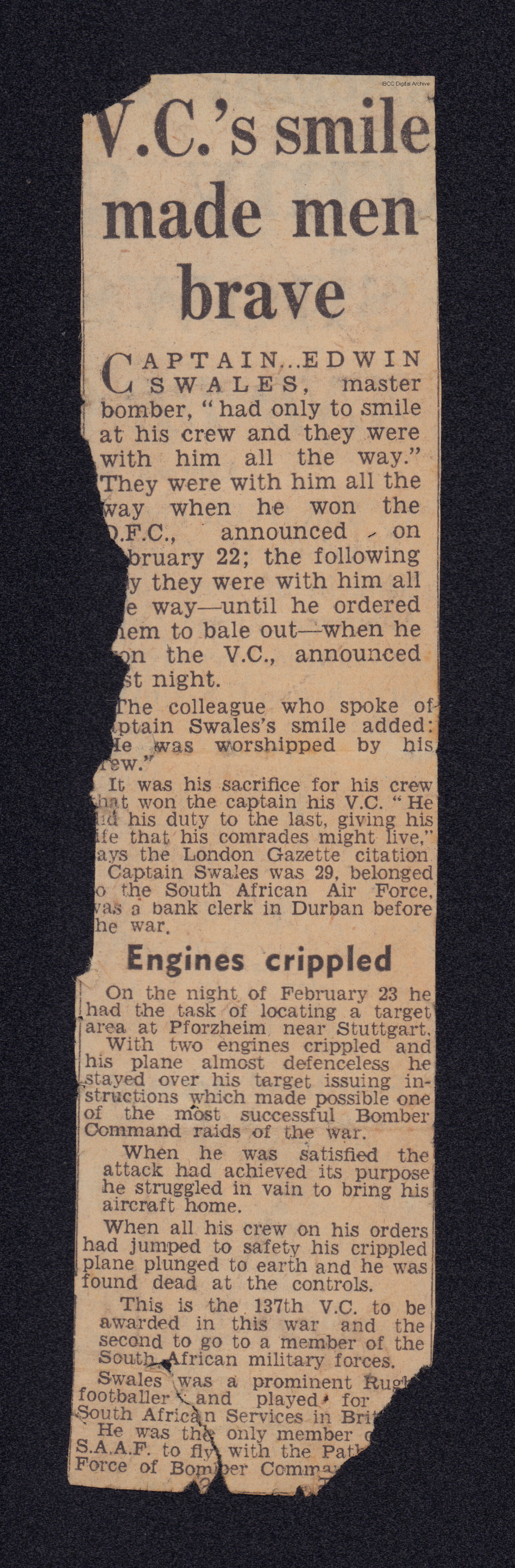
For his action, bravery and dedication to duty, 29 year old Edwin Swales, a prominent rugby player and South African “who only had to smile at his crew and they were with him all the way“*5  was awarded the Victoria Cross posthumously, the second such award to go to an airman of RAF Little Staughton, just one of three to the Pathfinders and one of only four South Africans to be awarded the Victoria Cross during the war. His citation appeared in the Fifth Supplement to The London Gazette, of Friday, the 20th of April, 1945:

Air Ministry, 24th April, 1945.

The KING has ‘been graciously pleased to confer the VICTORIA CROSS on the undermentioned officer in recognition of most conspicuous bravery:.—

Captain Edwin SWALES, D.F.C. (6101V), S.A.A.F., 582 Sqn. (deceased).

Captain Swales was ” master bomber ” of a force of aircraft which attacked Pforzheim on the night of February 23rd, 1945. As ” master bomber,” he had the task of locating the target area with precision and of giving aiming instructions to the main force of bombers following in his wake.

Soon after he had reached the target area he was engaged by an enemy fighter and one of his engines was put out of action. His rear guns failed. His crippled aircraft was an easy prey to further attacks. Unperturbed, he carried on with his allotted task; clearly and precisely he issued aiming instructions to the main force. Meanwhile the enemy fighter closed the range and fired again. A second engine of Captain Swales’ aircraft was put out of action. Almost defenceless, he stayed over the target area issuing his aiming instructions until he was satisfied that the attack had achieved its purpose.

It is now known that the attack was one of the most concentrated and successful of the war.

Captain Swales did not, however, regard his mission as completed. His aircraft was damaged. Its speed had been so much reduced that it could only with difficulty be kept in the air. The blind-flying instruments were no longer working. Determined at all costs to prevent his aircraft and crew from falling into enemy hands, he set course for home. After an hour he flew into thin-layered cloud. He kept his course by skilful flying between the layers, but later heavy cloud and turbulent air conditions were met. The aircraft, ‘by now over friendly territory, ‘became more and more difficult to control; it was losing height steadily. Realising that the situation was desperate Captain Swales ordered his crew to bale out. Time was very short and it required all his exertions to keep the aircraft steady while each of his crew moved in turn to the escape hatch and parachuted to safety. Hardly had the last crew-member jumped when the aircraft plunged to earth. Captain Swales was found dead at the controls.

Intrepid in the attack, courageous in the face of danger, he did his duty to the last, giving his life that his comrades might live.*6

His body was removed from the aircraft in which he gave his life and was interned at the War Cemetery at Leopoldsburg, in Belgium, Section VIII Grave C.5.

In honour of Captain Swales, two memorial stones were laid and revealed outside his Durban High School on Armistice day 2009. One in the Memorial Courtyard of the School and the second on the Memorial Wall of the Natal Mounted Rifles also in Durban. In attendance were both his niece, Professor Edwina Ward, and Lt. Gen. Carlo Gagiano, Chief of the South African Air Force.

In 2013, Swales was also awarded the “Bomber Command” clasp to be worn on the 1939 – 1945 Star already awarded.

Edwin Swales was indeed a very brave man, who through sheer determination managed to save his crew in spite of the dangers facing him. His award was in no doubt deservingly awarded.

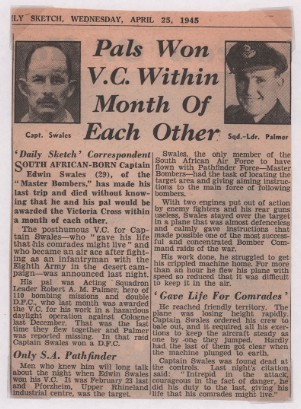
The story of pals Edwin Swales and Robert Palmer both of whom won VCs posthumously whilst at RAF Little Staughton.*7

NColeFIG170709-020001.jpg

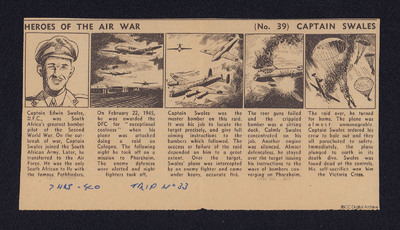
The story of Captain Swales appeared in a newspaper cartoon “Heroes of the Air War”.*8

RAF Little Staughton appears in Trail 29.

Sqn Ldr. Robert Palmer’s story appears in Heroic Tales.

Sources and further reading.

*1 the documents showing Captain Swales’ promotion to the rank of Major only reached the UK authorities after his death and as a result he was cited as being a Captain. (South African Aviation Foundation)

*2 National Archives 582 Operational Record Book AIR-27-2052-18

*3 Supplement 36954, to The London Gazette, 23rd February 1945, published 20th February 1945, page 1070

*4 Middlebrook, M., Everitt. C., “The Bomber Command War Diaries“, Midland Publishing Ltd, 1996

*5 International Bomber Command Centre National Archive website.

*6 Fifth Supplement to The London Gazette, of Friday 20th April 1945. Published on Tuesday 24th April 1945, Supplement 37049, Page 2173.

*7 “Newspaper cuttings concerning awards of Victoria Crosses,” IBCC Digital Archive, accessed November 11, 2023,

*8 “Heroes of the Air War (No. 39) Captain Swales,” IBCC Digital Archive, accessed November 11, 2023,

*9 Photo The South African Legion of Military Veterans website

*10 South African Aviation Foundation website

9th October 1944, loss of Mosquito KB261 RAF Downham Market

On October 9th 1944 Mosquito KB261 608 (PFF) Sqn, took off with 21 other Downham Market aircraft to attack the naval port at Wilhelmshaven in Lower Saxony, Germany. Situated on the western side of the Jade Bight, a bay of the North Sea in Northern Germany, it was a major target frequently attack by allied bombers during the war.

The Mosquito, ‘D’ – Dog, a MK. XX, piloted by Flt. Lt. Reginald George Gardner (s/n 68776) with Fl. Off. Oswald Cuthbert Sweetman DFM*1 (s/n 145171) as navigator, departed Downham Market at 18:03 carrying a mix of bombs. It arrived over the target only to see 10/10ths cloud, and the target obscured. However, bombs were released successfully on red target indicators, after which crews reported seeing several flashes beneath the cloud along with large explosions lasting several seconds.

In debriefing, all crews reported a successful operation although visual confirmation was difficult due to the cloud cover which had extended to between 6 and 8,000 ft in height.

However, Mosquito KB261 never made it down. It arrived home and circled the airfield waiting for its turn to land, it showed no signs of distress or problem – all appeared well. As it entered the ‘funnel’ it suddenly – and without explanation, –  dived into the ground from around 1,000 ft, crashing at 21:30.

The aircraft hit a cowshed in the nearby hamlet of Barroway Drove, to the south-west of the airfield, killing both pilot and navigator. A farm building was slightly damaged and some animals in or near the shed were also killed.

The aircraft had been fully flight tested and reported  ‘serviceable’ that afternoon by the pilot Flt. Lt. Gardner, and both engines were known to be running at the time of the crash.

A report into the accident concluded it as “obscure” with no known cause, although the Station Commander witnessed the crash saying “…it would appear that while turning into the funnel the aircraft did a slipping turn resulting in rapid loss of height and final crash.”

In the Accident Report Form 765C, the pilot was noted to have called the tower on the downwind leg, but there was no report at that time, from him, as to any problems with the aircraft and all appeared to be in order.

The two crewmen were both married. Flt. Lt. Gardener was born in 1913 and married Nancy Buttle of Bearstead, Kent, where his remains are buried*2; and Fl. Off. Sweetman, born 1916, was married to Jessie James from Newcastle in 1940, he also remains buried in his home town*3.

On the following two nights, October 10th and 11th, two more 608 Squadron Mosquitoes were lost; KB404 ‘6T-T’ and KB348 ‘6T-M’.

In KB404, a Mosquito B MK. 25, both crewmen (pilot – Fl. Off. James Arthur Smith DFC RAAF, and navigator Sgt. John Burchell) emerged safely from the aircraft which crash landed in a field near to the airfield. The port engine was reported to have cut out at approximately 100 feet after take off, whereupon the pilot managed to perform a wheels up landing bringing the aircraft down safely.

In the third Mosquito, KB348, (MK.XX), the aircraft was hit by Flak over the city of Berlin and crashed at the Bornstettin Army Exercise Grounds near Potsdam at 04:02 hrs. The pilot,  Fl. Off.  Stanley Warren Reeder (RAFVR), and navigator Flt. Sgt. Robert John Bolton (RAAF) were both killed. Initially buried locally in Potsdam, they were, in 1946, interred in the Berlin 1939-1945 War Cemetery, Plot 4, Row K, Graves 26 and 27, where they remain today.

608 Squadron were only reformed at Downham Market on August 1st 1944, after being disbanded earlier at the end of July. They remained at Downham Market for the remainder of the war being disbanded again on 24th August 1945. In May 1946 they reformed once more only to disband for the last time on March 10th, 1957 at Thornaby whilst flying Vampires. It was at Thornaby that they were initially formed in 1930.

Downham Market Runway remains

The last remnants of the main runway being approached by the Mosquito before they were removed.

The history of Downham Market appears in Trail 7 – North West Norfolk.

Notes and sources.

*1  Fl. Off. Sweetman’s DFM was gazetted on 5th February 1943, for service he carried out with 104 Sqn flying Wellingtons in the Middle East.

*2 Flt. Gardener was buried in the Holy Cross Churchyard, Section N, Grave 184

*3 Fl. Off. Sweetman was buried in All Saints Cemetery, Section E, Unconsecrated Grave 191.

National Archives: AIR-27-2101-19, AIR-27-2101-20

Chorley, W.H. “Bomber Command Losses – Vol 5 1944” Midland Publishing,. 1997

Aviation Safety Network website, accessed 11/1/25

Downham Market Heritage Centre

Loss of Lancaster EE118, 156 Sqn PFF – RAF Warboys.

Lancaster, a MK.III, took off from RAF Warboys, at 18:24 on September 29th 1943 on operations to Germany. It was joined by nine other Lancasters from the same squadron to bomb Bochum in Western Germany. Over the target, flak was moderate and visibility was good. Marking was in the form of skymarkers, along with red and green target indicators (TI) and bombing was reported as scattered with smoke rising to 5,000 ft.

On Lancaster EE118 that night was Flt. Sgt. Frederick H. Ray (Pilot); Sgt. David R. Booker (Bomb aimer);  Fl. Off. Sydney K. Smith RCAF (Navigator); Sgt. Norman P. Winterburn (Wireless Op); Sgt. William A. Lineham (Flt. Engineer); Sgt. Frederick D. Dickens (Air Gunner) and Sgt. Arthur S. W. Orchard (rear Gunner).

The aircraft had suffered heavy flak damage, several of the instruments were not working including the compass and altimeter, and a 1,000lb bomb remained ‘hung-up’ in the bomb bay, Their return to Warboys would take them over the North Sea, across the Wash and south-east toward Warboys, but they requested landing permission at RAF Downham Market as it was closer. Permission was granted, and the ‘hung-up’ bomb was safely disposed of over the Wash.

Lancaster EE118 crash plaque

The Memorial Plaque to Lancaster EE118.

Downham Market was at the time shrouded in thick fog and the FIDO installation recently added was not yet fully serviceable. Flt. Sgt. Ray made his approach, and with 10/10ths cloud as low as 1,000 feet, it was very difficult to make out where he was.

On his first approach, Flt. Sgt. Ray missed the runway and so headed north, and then turned in a south-west direction to make a new approach from the east. On his run in toward the final turn, the rear wheel caught the tree tops of a Slubberdike Wood, located  north-west of the airfield. This slowed the aircraft down sufficiently to prevent it from climbing, and as they passed over Allotments at nearby Wimbotsham village, the port wing clipped a raised air-raid shelter near to the allotment entrance. This caused the wing tip to break off and resulted in the aircraft colliding with a telegraph pole at the end of Hop Pikel field near to Milller’s Lane which flipped the aircraft over bring it down in an orchard.

In the accident, all but the rear gunner Sgt. Orchard were killed outright, Sgt. Orchard being thrown clear from his rear turret.

The noise of the crash alerted  local people who went out to see what had caused all the noise, and suspecting an air crash, they searched for wreckage. Gardens at the end of Miller’s Lane were strewn with bits of aircraft and a two young boys by the name of Gutteridge, came across Sgt. Orchard with a large branch across his legs. Fearing he had broken it, Sgt. Orchard begged them not to move it and await medical assistance in case it made the injury worse.

In the confusion that followed, Sgt. Orchard couldn’t remember if the 1,000 lb bomb had been dropped or not, so the police on the scene cleared the nearby houses sending everyone into their various bomb shelters for protection. It was not necessary however, and soon the all clear had been given and they returned to their homes.

Another young boy, 12 years old at the time, recalled how the rest of the crew were found in his garden, 39 Miller’s Lane, and how they were removed by RAF personnel during the night. Wreckage was found across the orchard and in local gardens, until RAF salvage teams took the aircraft away some 3 – 4 weeks later.

aerial photo

An aerial photo of Wimbotsham showing the direction the Lancaster flew on that fateful night. The scar in the orchard is clearly visible. The airfield is in the bottom right hand corner.

On the 30th September 2023, a plaque was attached to the Wimbotsham village sign to commemorate the loss of the crew nearby. The ceremony was opened by Mr. Ian Cable, Chairman of Wimbotsham Parish Council with a greeting and introduction from Reverend Canon Dr. David Karoon. After the hymn ‘O God our help in ages past’, Group Captain Frederick Wigglesworth, Station Commander RAF Marham, gave the Bible reading Isaiah 40:25:31 which was followed by a prayer of dedication led by The Rev. (Wing Commander) Eddie Wynn.

Dr. Karoon then gave a blessing of the memorial after which followed  ‘The Airman’s Hymn’ sung by those gathered at the service.

Memorial dedication EE118

Mr. Dutton gives background information on the Pathfinders with Rev. Canon Dr. Davis Karoon, The Rev (Wing Cdr) Eddie Wynn and Group Captain Frederick Wigglesworth looking on.

Following the Lords Prayer, a further dedication was given by Bill Bower, the R.A.F.A. Chairman, which preceded the Last Post and a minutes silence. The ceremony was closed with some back ground information on the Pathfinders by Tim Dutton, and the Benediction from Dr. Karoon. Lastly, the National Anthem was sung and a thanks to those involved given by Mr. Cable.

In the gathering were relatives of both Sgt. Arthur Orchard and Sgt. David Booker, the bomb aimer, along with villagers who remember the crash in 1943.

Tea, cake and a display of material from the crash and personal letters from Arthur Orchard to relatives of the crew were made available in the village hall, itself a former RAF Downham Market admin building.

The crew in Lancaster EE118 (GT-?)

Flt. Sgt. Frederick H. Ray (Pilot), s/n: 1391599, age 26
Sgt. David R. Booker (Bomb aimer), s/n: 1413457, age 20
Fl. Off. Sydney K. Smith RCAF. (Navigator), s/n: J/14174, age 21
Sgt. Norman P. Winterburn (Wireless Op), s/n: 1439760, age 21
Sgt. William A. Lineham (Flt. Engineer), s/n: 1815307, age 19
Sgt. Frederick D. Dickens (Air Gunner), s/n: 1613337, age 20
Sgt. Arthur S. W. Orchard (rear Gunner) – survived

The Lancaster, a MK.III, was built as part of the fourth production batch of 620 aircraft (the final contract of No. 6427) by A.V. Roe & Co Ltd. at Chadderton. It was delivered to 32 Maintenance Unit (MU) on 27th May 1943 transferring to 156 Sqn. on 22nd June 1943. It was struck off charge after the Wimbotsham crash on 19th October 1943.

A range of resources were used in the compiling of this post, including:

National Archives: AIR 27/1041/40

Chorley, W.H. “Bomber Command Losses of the Second World War – 1943“, Midland Counties, 1996.

Holmes, H. “Avro Lancaster – The Definitive Story“, Airlife Publishing, 1997

Personal letters and photos on display from Arthur Orchard and Derek Neal.

Trail 65 – RAF Thurleigh Part 5 – Development, Research and London’s Third Airport.

Part 4 of this trail saw Thurleigh reach the war’s end and the 306th rise victoriously from early disasters. But, even as the last B-17s roared over the Bedfordshire countryside, the future of Thurleigh was already stirring in whispers and blueprints. The airfield, freshly scarred by the demands of war, seemed poised on the edge of a new era—one that promised to push aircraft faster, higher, and farther than anyone had imagined. Across Britain, minds were turning toward the possibilities of jet power, supersonic flight, and technologies that could transform not just military aviation, but the very way people would travel the skies. Somewhere in these plans, Thurleigh would emerge—not just as a relic of wartime heroism, but as the stage for an ambitious experiment in Britain’s post-war aeronautical future.

Post-War Vision: Thurleigh and the Rise of RAE Bedford

In the immediate post war years, the bulk of what was left after ‘demobbing’, the 306th along with their sister squadron the 305th at Chelveston, moved abroad, the 306th to Geibelstadt, Germany as part of Project ‘Casey jones‘; to photograph 2 million square miles of Europe, Iceland and both north and west Africa. They transferred from base to base, the four squadrons being significantly reduced by the points system, until their final disbandment on Christmas Day, 1946*33.

As the B-17s of the 306th were flying their final missions from Thurleigh, forward-looking minds were already envisioning a future shaped by peace and rapid advancements in aviation. The war had more than proven aviation’s strategic power and hinted at its potential to revolutionise post-war life, particularly through fast and efficient global air travel. The development of the jet engine – pioneered in both Britain and Germany – ushered in a new era where speed and altitude were no longer limited by ‘slow’ piston engines.

With the dawn of the jet age came a fresh frontier: supersonic flight. Many wartime aircraft had already nudged the sound barrier, revealing strange and unpredictable aerodynamic behaviours; behaviours that demanded further study and investigation. This not only posed new scientific challenges, but created huge opportunities for further aviation development. As Britain looked ahead, there was a growing interest into which sites could support such serious, large-scale aeronautical research facilities.

In these closing months of the war, the government recognised that any attempt to carry out this research would require heavy investment in cutting-edge technology. In February 1945, several months before the war’s end, Sir Stafford Cripps, (the new Minister of Aircraft Production), confirmed in the House of Commons that a new national research centre would indeed be created. The question then became where?

The natural choice would have been the already established Royal Aircraft Establishment (RAE), at Farnborough, but it could not expand sufficiently in terms of either its runway, nor its infrastructure, and so an alternative had to be found.

Following a detailed national survey, Bedfordshire was then chosen as the prime location; its gentle rolling landscape and access to several wartime airfields made it an ideal choice. Part of this grand scheme was to create a new independent agency the ‘National Experimental Establishment’, but as time went on, this evolved into the National Aeronautical Establishment (NAE). With its base at Thurleigh, it would eventually be renamed, in 1955, as the Royal Aircraft Establishment Bedford (RAE Bedford).

RAF Thurleigh (as it was still known), with its long wartime runways and open surroundings, was a natural fit. Early thoughts considered it a possible location for a UK test facility to rival the Muroc Field in California’s Mojave Desert (now Edwards Air Force Base). That bold idea involved joining Thurleigh with RAF Twinwood Farm (to the south) and RAF Little Staughton (to the east) via a massive five-mile runway and taxiway, creating one vast experimental complex. However, this ambitious and frankly unrealistic vision was ultimately scaled back, and although some ground work had begun, the full development plan never materialised in this form.

With the idea ‘still on the table’, the programme was pushed ahead, but on a much smaller and by no means less ambitious scale, with both sites at Thurleigh and Twinwood Farm being developed and taking on new roles; both becoming central to Britain’s aviation future.

Development Begins: A New Thurleigh Rises

Development of the new facility was therefore split across the two sites. Firstly, on land near to Milton Ernest, close to the old Twinwood Farm airfield, a network of four powerful, ex Luftwaffe Research Station, wind tunnels were erected. Varying in size and power, each of these would test different aspects of aerodynamic behaviours under different conditions; one for example, measuring 8 feet by 8 feet, could test models in wind speeds up to Mach 5, an unprecedented achievement in post war Britain. *22

Meanwhile, Thurleigh itself was transformed into a highly advanced flight test centre. This required substantial redevelopment of the airfield: buildings were demolished, the  infrastructure overhauled, and some original wartime hangars repurposed – two of these still exist in situ and in use today.

Thurleigh

One of Thurleigh’s wartime hangars (former Aero Flight) still in use today.

Thurleigh’s new runway – measuring 3,400 metres (2.11 miles) long and 97 metres wide, was one of the largest in Europe at the time, and reflected both the size and speed of the aircraft it was going to need to accommodate. Upgraded by the company John Laing, a second runway was also extended reaching over 2,000 metres (1.2 miles) in length, each with a substantial 92 cm*23 of concrete beneath their surface. Even though full development wouldn’t be completed until 1957, the first residents moved in starting their research work as early as 1954.

The work at the new facility, spanned numerous aeronautical fields: aircraft control and handling, blind landing systems, all-weather operations, approach and landing aids, air traffic management, and military vertical take-off and landing systems, which would later culminate in the iconic Harrier jump jet. The site also supported naval aviation research and contributed significantly to the early development of Concorde, contributing to both the aerodynamic and avionic systems of the supersonic airliner.

Throughout the 1950s, the facility’s work was invaluable. The Naval Air Department (NAD) arrived at Thurleigh in mid-1954, formed by merging the Carrier Equipment Department and naval elements of the Aerodynamics Department at Farnborough. Tasked with developing launch and recovery systems for increasingly larger and heavier carrier-based aircraft such as the F-4 Phantom and Blackburn Buccaneer, the NAD’s base was on the northern side of Thurleigh airfield, alongside one of the original unmodified runways of the Second World War. It featured both flush and elevated catapults, arrester gear, a full proving base, and specialist equipment like Catapult Alignment Equipment (CALE) and Jet Blast Deflectors (JBDs). Unique among shore-based facilities, it included a prototype steam catapult system, one that would eventually become standard on naval carriers worldwide. This unique facility also caught the eyes of Britain’s neighbours, being used by the French Navy to test aircraft such as the Étendard and Alizé, highlighting its world-class research and development status.

The NAD operated at Thurleigh until 1970, when it was disbanded following the 1967 Defence White Paper, which ended the Royal Navy’s fixed-wing  aircraft carrier operations. As a consequence, and with little need for fixed wing research, the naval research facility at Thurleigh closed. *24 *25

Not long after the NAD’s arrival though, in 1955, the Flight Division of the Aerodynamics Department – known as ‘Aero Flight’ joined them at Thurleigh. This division was comprised of three sections: Supersonic Flight, Subsonic Flight, and Dynamic Stability Research. They investigated aircraft stability, control, and flying qualities right across the speed spectrum. Over time, their work expanded into vertical take-off and landing systems, flight simulation, and helicopter trials. To achieve these aims, Aero Flight regularly used various aircraft models including the Gloster Meteor, Hawker Hunter, De Havilland Venom, and English Electric Canberra (WT327), (WK163), (WK163), all in the famous ‘Raspberry Ripple’ paint scheme. They also tested purpose-built experimental aircraft such as the Boulton Paul P.111; Avro 707; Short SC1 (XG900, XG905) and SB5; Hunting Jet Flap; Fairey FD2; Hawker P1127 (XP831, XP984) and Handley Page HP115 (XP115), all of which appeared regularly at Thurleigh.*26

The SC1 (XG905) at RAE Bedford

In 1957, a third unit arrived at the site: the Blind Landing Experimental Unit (BLEU) which was originally formed in 1945 to develop early aircraft blind approach systems. Initially tested on De Havilland Devon aircraft, the BLEU progressed to Canberras, going on later to equip many military aircraft, including the ‘V’ bombers, with automatic landing systems – technology now standard on civil airliners worldwide.

Trident Two G-AVFA landing at Thurleigh, March 1968 as part of the testing for the  ILS ‘Triplex’ automatic landing system (FAST) *27

The 1950s and 60s, saw the pinnacle of the Cold War, with countries world Wide placed on a war footing, ready for what seemed to be yet another terrifying conflict. With the RAF’s first ‘Blue Danube’ atomic bomb being delivered to RAF Wittering in 1953, the UK was ready, and able, to retaliate should the need arise. In preparation for such an event, the ‘V’ Force bombers would be dispersed to airfields across the country ready to take off at a moments notice. Thurleigh, with its extensive runway, was earmarked to hold four such aircraft each one sitting on its pan ready for a quick and decisive launch.*28

1960s: The Search for London’s Third Airport and Thurleigh’s Role

Even with the Cold War climbing towards its pinnacle, aviation interests in Thurleigh continued to grow, and by the mid-1960s, Britain was beginning to face the growing pressures of low-cost air travel, and nowhere was this felt more than at its major airports – London Heathrow and Gatwick, which were already struggling to keep up with demand. A White Paper “The Third London Airport” published in May 1967 listed nine possible sites, including Thurleigh, but ruled out many of these due to conflicts with nearby military installations. In response, the government set up the Roskill Commission in 1968, who went on to conduct a detailed two-year investigation into a number of potential sites  all capable of becoming London’s third airport.

The inquiry followed a detailed five-stage process. First, four candidate locations were shortlisted: Foulness in Essex; former RAF Nuthampstead in Hertfordshire; Wing in Buckinghamshire (Clublington) and Thurleigh in Bedfordshire.

Background information on each site was then published, followed by public hearings held near each of the shortlisted locations. These hearings provided an opportunity for local authorities, campaigners, and residents alike to express their views and raise concerns.

Reaction in Bedfordshire – both to the Thurleigh and Wing proposals – was largely unfavourable. Local residents expressed concerns, both verbally and through graffiti – “Not Thurleigh” – about noise, pressure on roads, public services, and the broader environmental impact. County  Councils, including Bedfordshire, opposed the airport plans outright.

In the north of the county, those living around Thurleigh formed the Bedford Airport Resistance Association (BARA) to give local opposition a voice, while in the south, similar resistance was growing against the Wing plan. Yet, not everyone objected. A smaller local group, the Thurleigh Emergency Committee for Democratic Action (TECDA), welcomed the idea, arguing that an airport could boost jobs and bring long-term economic benefits to the area. The resultant hearings all took place during 1969.

Stage Three saw the Commission’s own Research Team gather technical data and examine submissions from expert witnesses and interested parties. This work fed into a comprehensive report, which formed the basis for further discussion in Stage Four. At this point, members of the Commission met with representatives from key organisations – including Bedfordshire County Council, BARA and TECDA – to debate the findings and test individual arguments.

The final stage was a lengthy series of formal hearings – 74 days in all – held at the Piccadilly Hotel in London. Here, all sides presented their evidence, with cross-examinations led by barristers representing the various parties. After the exhaustive process was over, the Commission recommended, by majority vote, that the new airport be built at Wing, accompanied by further plans for an  additional “Airport City.” Only one member disagreed favouring Foulness as the better site.

Ultimately though, Wing was dropped and the government shifted its focus to Maplin Sands, close to Foulness. However, later in 1974, in the face of public pressures, that plan was also abandoned, and attention turned to other pre-existing sites. Luton was briefly considered, but by 1979, the decision was made: Stansted would be developed as London’s third airport, leaving Thurleigh’s long term airport development plans permanently shelved.*29

1970s: Consolidation and Systems Integration at RAE Bedford

Meanwhile at the now renamed RAE Bedford (the airfield no longer under military ownership) the 1970s brought significant organisational changes. In 1974, the various departments were merged to create the Flight Systems Department, bringing together a diverse range of expertise under the one roof. This integration fostered a comprehensive, systems-based approach to aeronautical research and development, moving beyond the previously isolated group of technical fields.

The new department was structured into three core areas: Flight Dynamics (FS1), Operational Systems (FS2), and Common Services (FS6). Collectively, these units covered flight dynamics and control, operational systems & flight management, and flight simulation technology.*30

This broader, interdisciplinary approach allowed RAE Bedford to expand its research across both military and civilian aviation sectors. Employing more modern aircraft – including the Tornado and later the Typhoon – enabled the development of sophisticated radar, tracking, landing, and handling systems. These advancements would shape aviation technology well into the coming decades.

The End of an Era and a New Beginning: Thurleigh in the 1990s and Beyond

By the early 1990s, shifts in defence policy led to a significant reduction in government-funded test flying activities. In 1994, official flying operations at Thurleigh came to an end, and the airfield was officially closed. All ongoing research activities were transferred to Boscombe Down, marking the close of a pivotal chapter in Thurleigh’s aviation history. Despite this closure though, the eastern runway continued to see occasional use by civil aircraft, preserving a faint echo of its once glorious former life.

In 1996, ownership of much of the site changed hands again, with the majority being sold to St. Modwen Properties Ltd, a company specialising in the regeneration of brownfield sites. Meanwhile, a smaller portion of the airfield remained under the control of QinetiQ, the successor to the Ministry of Defence’s Defence Evaluation and Research Agency (DERA), allowing continued military research on advanced defence systems. However, by 2008, QinetiQ too had left, and the once-bustling research complex at Thurleigh gradually fell into disrepair.*31

The Rise of The Phoenix: Thurleigh’s Comeback.

A new chapter in Thurleigh’s long book then began in 1999, when the former Formula 1 driver Jonathan Palmer and his MotorSport Vision Group (MSV), purchased a 384 acre section of the eastern side of the airfield. Palmer went on to design and develop the site into four different circuits utilising 5 miles of original airfield and newly developed track, providing a private circuit for participants to test their skills in high speed racing.*32

A year later, in 2010, marking seventy years since the start of Thurleigh’s crucial role in the Second World War, Thurleigh airfield was re-licensed by the Civil Aviation Authority (CAA) and given the new name Bedford Aerodrome, symbolising a return to aviation.

Whilst the main part of the business is owned and run by Palmer’s Group, civil aviation is permitted and the two projects run alongside each other on this former wartime airfield.

During 2025 the hard runways were out of use until further notice, however, a new grass runway was provided and its use was by arrangement with the operators permission. Helicopter flights continued as usual, so, whilst limited aviation does still continue at Thurleigh, its main operations lay elsewhere. Part of the airfield has since been converted into a business park and its disused runways store considerable quantities of vehicles ready for the open market. A large portion of the perimeter track continues to be utilised by the aforementioned car racing organisation for motor sport activities.

A former small arms building not far from Galsey Wood and the former bomb store, has been converted into a small but excellent 306th Bombardment Group Museum run by local volunteers, and the memorial which once stood in the village, has now been moved and placed outside the museum appropriately on the airfield itself.

Thurleigh

The former small arms building is now a well run museum.

Although no longer a hub of government research, Thurleigh’s legacy now endures as a testament to British aviation history — a site that witnessed both the resilience of wartime efforts and the ambitious technological strides of the post-war jet age.

Throughout this trail we have seen how Thurleigh evolved from a wartime bomber base into a cornerstone of British aviation research and development. During the Second World War, it served as home to the USAAF’s 306th Bomb Group, from where young crews flew dangerous missions – many never to return. The cost was high, and the loss of so many lives remains a poignant part of its story. In the post-war years, the site became part of RAE Bedford, pushing the boundaries of flight technology and innovation. Though official flying ended in 1994, its legacy endures – rooted in sacrifice, resilience, and remarkable achievement.

Today, Thurleigh stands as more than an airfield – it is a testament to the daring spirit of those who dared to fly, build, and innovate. Its story is a mix of triumphs and trials, quiet reinventions, and bold leaps into the unknown – a narrative that continues to echo across its runways.

Thurleigh – 306th BG Museum.

The 306th Museum is located in a former small arms building (building 185) close to the bomb site at Galsey Woods. It can be accessed by following the perimeter track (now road) around from the main entrance to the site through a gate. There is a small amount of free parking available and access is also free.

The museum is run by volunteers, and is well stocked with photos and artefacts pertaining to the 306th and Thurleigh. It was donated by Johnathan Palmer when part of the woods were removed.

Inside are various uniforms, photographs and artefacts, both a home front display, a jeep and a ‘pub’ bar.

Its an excellent little museum and well worth the effort of visiting.  More information can be found by visiting their website.

Thurleigh

One of the displays inside the museum.

Sources and further reading (Thurleigh)

*1 Bedfordshire Archives website. Accessed 7 July 2025.

*2 Bedfordshire Archives website [ref: WW2/AR/CO2/3] Accessed 7 July 2025.

*3 Bedford Aerodrome History website. Accessed 7 July 2025.

*4 Miller, D.L. ” Eighth Air Force” Aurum 2008

*5 Miller, D.L. “ Eighth Air Force” Aurum 2008

*6 Goodrum. A., “School of Aces” Amberley Books 2019.

*7 Miller, D.L. “ Eighth Air Force” Aurum 2008

*8 Freeman. R., “The B-17 Flying Fortress Story“. Arms and Armour. 1998

*9 Freeman, R., “The Mighty Eighth“. Arms and Armour. 1989.

*10 306th BG War Diaries via 306th BG Historical Association website. Accessed 8 July 2025.

*11 MACR 15502 via 306th BG Historical Association website. Accessed 8 July 2025.

*12 MACR via 306th BG Historical Association website. Accessed 8 July 2025.

*13 Mission reports 1943 via 306th BG Historical Association website. Accessed 8 July 2025.

*14 306th Combat war Diary March 1943 via 306th BG Historical Association website. Accessed 9 July 2025.

*15 306th BG Mission Report 17th April, 1943 via 306th BG Historical Association website Accessed 9 July 2025

*16 Mission Report, October 14th 1943 via 306th BG Historical Association Website Accessed 11 July 2025

*17 306th War diaries October 1943, via 306th BG Historical Association Website Accessed 11 July 2025

*18 Bedfordshire Archives [ref: WW2/AR/CO2/3] via website Accessed July 11 2025

*19 Mission Report 24th April 1944, via 306th BG Historical Association website. Accessed 11 July 2025

*20 306th BG War Combat Diaries via 306th BG Historical Association website. Accessed 11 July 2025.

*21 306th BG Mission Report April 1945, via 306th BG Historical Association website. Accessed 18 July 2025.

*22 Farnborough Air Sciences Trust (FAST) website Accessed 19 July 2025

*23 Osbourne, M., “Defending Bedfordshire“. Fonthill Media Ltd, 2021

*24 Bedford Aeronautical Heritage Group website Accessed 19 July 2025

*25 Farnborough Air Sciences Trust (FAST) website Accessed 19 July 2025

*26 Bowles. M., “Work and Play – Tales of an Unremarkable Engineer“. Austin Macauley Publishers Ltd. 2024 Accessed 20 July 2025

*27 Farnborough Air Sciences Trust (FAST) Website Accessed 19 July 2025

*28 Osbourne, M., “Defending Bedfordshire“. Fonthill Media Ltd, 2021

*29 Bedfordshire Archives website Accessed July 19 2025

*30 Farnborough Air Sciences Trust (FAST) website Accessed 19 July 2025

*31 QinetiQ website. Accessed 20 July 2025

*32 Bedford Autodrome accessed 26 July 2025

*33 Boyd, R.J., “Project Casey Jones 1945 – 46” PennState Hazelton Campus Library.

National Archives: AIR 27/1065/1

American Air Museum in Britain Website. Accessed July 2025

Coffey, T., “Decision over Schweinfurt“. Magnum Books 1980

Woodley. C., “Stanstead Airport – Through Time“. Amberley Publishing. 2012. Accessed July 23 2025

National Archives Website .”Roskill Commission on the Third London Airport” Accessed July 23 2025

The Bedford aerodrome website contains extensive material on the current and some historical use of Thurleigh.

The Bedford Aeronautical Heritage Group website (now closed but accessible) contains information about the work and history of RAE Bedford. It has since been moved to the Farnborough Air Services Trust (FAST) website which also offers endless information about the services of both RAE Bedford and RAE Farnborough.

Bedfordshire and Luton Archive and Record Service has an extensive collection of Third London Airport material as part of the Bedfordshire County Council archive which includes material for all four original sites. It also has material from BARA.

PPRuNe forum has information, photos and personal information about the research at both Thurleigh and Twinwood Farm.

Airfields of Britain Conservation Trust website. Accessed 24 July 2025