Part 8 saw Chelveston at the crossroads of history. From the heroism of B-17 crews braving ferocious Luftwaffe attacks to the tense vigilance of Strategic Air Command jets in the early Cold War, the station had witnessed courage, innovation, and loss. Yet as international tensions shifted and technology advanced, even its longest runways and fortified hangars could not guarantee a future.
By the late 1950s, Chelveston faced an uncertain fate. What would become of a place that had once been alive with the roar of engines and the courage of men? Its final chapter was about to be written – but the outcome was far from certain.
During the late 1950s and early 60s, the world’s political landscape was shifting constantly and rapidly. France’s president, Charles de Gaulle, saw his country as a strong, independent nuclear power, wanting full control over its own defence. That vision did not accommodate large numbers of foreign – particularly American – forces on French soil. As a result, 1959 saw the start of a reduction in military numbers with strict limits being placed on the number of American forces allowed in France. Any personnel or equipment beyond this ceiling were required to leave immediately. This decision triggered a massive redeployment of forces, with many units being reassigned to Germany or Belgium, and others returning to the United Kingdom where they were accommodated at the so-called ‘Red Richard‘ bases, of which Chelveston was one.*20
Over the next several years, France saw a steady reduction in American personnel and units, a process that would culminate in 1966 with President Charles de Gaulle’s announcement of France’s withdrawal from NATO’s integrated military command. The decision required the removal of all foreign forces from French soil by April 1967, bringing an end to more than a decade of a large-scale American presence.
To accommodate the early relocations from the continent, a number of Britain’s newly modernised airfields were selected – Chelveston among them. Alongside RAF Alconbury and RAF Bruntingthorpe, each station received elements of the 10th Tactical Reconnaissance Wing (TRW), the 42nd Tactical Reconnaissance Squadron, of the 10th TRW, arriving at Chelveston in August 1959. Operating the twin-engined Douglas RB-66C Destroyer – electronic reconnaissance aircraft, eighteen of these machines, together with their crews and ground personnel, quickly took up residence. Shortly after their arrival, the aircraft were modified with updated electronic counter-measures equipment, reflecting the increasingly technical nature of Cold War aerial reconnaissance.
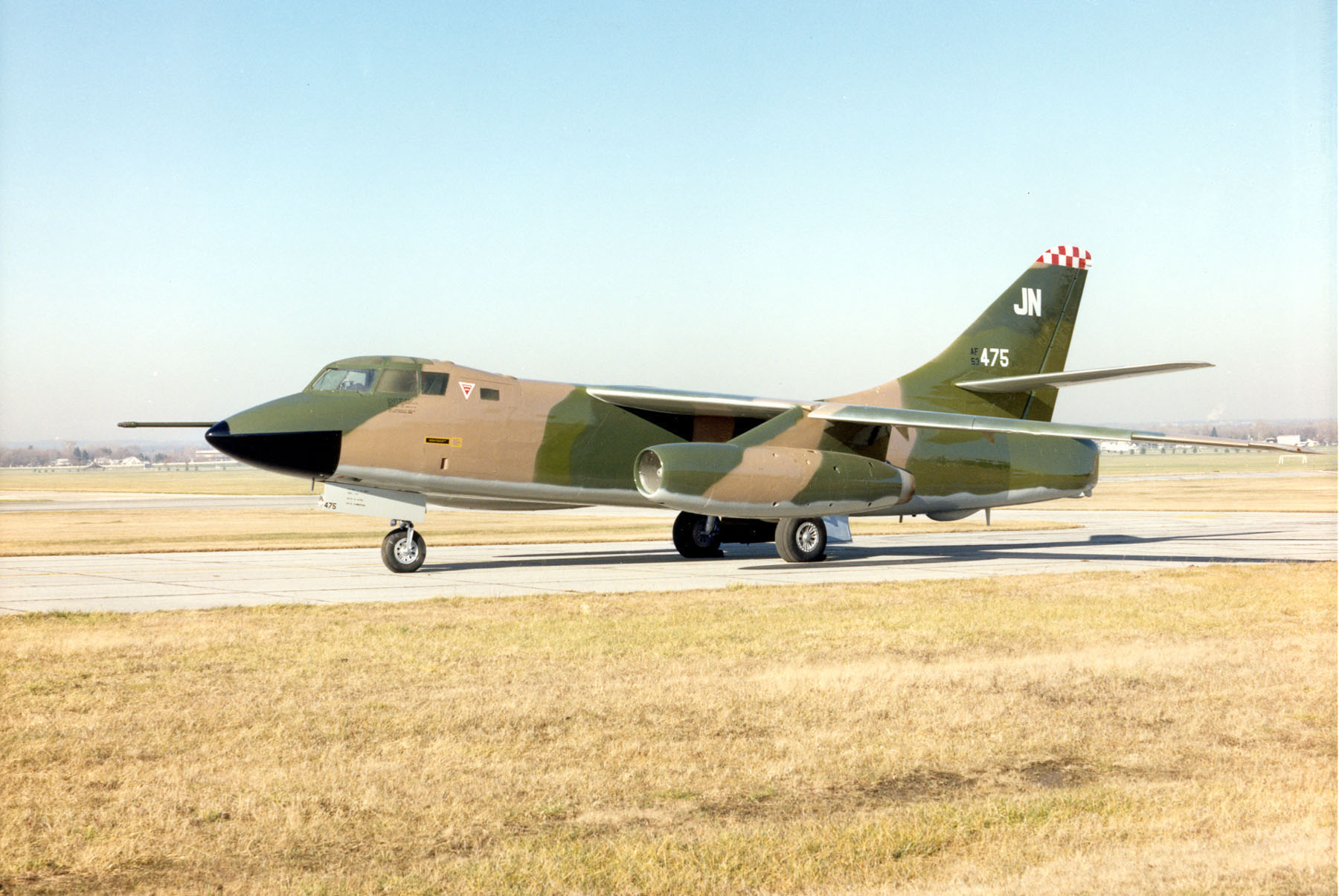
Douglas RB-66B Destroyer (U.S. Air Force photo)
The squadron remained at Chelveston for almost three years. Then, in the summer of 1962, both the 42nd Tactical Reconnaissance Squadron and the 19th Tactical Reconnaissance Squadron departed their respective Midlands stations for deployment to Toul-Rosières Air Base in eastern France. The move placed the wing’s reconnaissance assets closer to the Central European front line at a time when aerial reconnaissance was increasing. For Chelveston, however, it marked the effective end of its active flying role. With the Americans steadily reducing their UK footprint and Bruntingthorpe facing closure, the departure of the RB-66s signalled the beginning of the station’s final chapter.
Project Clearwater and the End of the Reflex Era
So, once again, Chelveston was left devoid of all main front line squadrons. Facing a reduction in demand for Cold War bases – combined with both long expensive runways and a shift towards a more logistical, support and storage use – Chelveston’s runway was closed to all but infrequent, small aircraft – examples that could operate on shorter runways.
Before long, the airfield being used less and less, Chelveston closed to flying altogether, and it quickly reverted back to a reserve airfield status.
This shift in wider policy soon became formalised. On 26th July 1963, the United States Department of Defence announced ‘Project Clearwater’, the final phase in the reduction of American forces stationed on British soil.*21 Although Chelveston had already fallen largely silent, the base remained nominally under United States control while residual activities continued. That position ended on 19th June 1964, when Chelveston – together with RAF Fairford, RAF Greenham Common and RAF Sculthorpe – was formally closed and handed back to the Royal Air Force.
By 1st April 1965, Project Clearwater had effectively brought an end to Strategic Air Command’s Reflex bomber deployments in Britain, terminating large-scale rotational operations and leading to the inactivation of the 7th Air Division*22 Chelveston, retained by the RAF on a care-and-maintenance basis for a further period, would briefly assume a less glamorous role as a storage location for American equipment being withdrawn from the continent. The age of regular transatlantic bomber and reconnaissance operations from Northamptonshire had quietly drawn to a close.
From Runways to Renewables: The Final Transformation of Chelveston
With no flying units now operating from Chelveston, the runways and associated tracks began to deteriorate and break up. With the increasing demand for housing and the nearby new town of Milton Keynes expanding, hardcore was needed and Chelveston had a good supply just waiting to be quarried. The runways and perimeter tracks were all removed thus ending any chance of a reprieve for flying in the future. But it wasn’t to be the end of its military association just yet.
In 1977, Chelveston became home to a key part of the Royal Air Force’s Strike Command Integrated Communications System (STCICS). The site, equipped with a large array of antennas, formed an essential link in the RAF’s network, transmitting voice, data, and weather information to aircraft, and connecting military stations across the UK and beyond. For decades, it played a vital role in maintaining operational communications for Strike Command.
As technology and operational requirements evolved however, the Ministry of Defence upgraded the system, leading to the creation of the Defence High Frequency Communications Service (DHFCS). This new network integrated both air and naval communications into a single nationwide system, capable of maintaining secure links over long distances, and routing messages through a central control centre. By December 2003, with the network increasingly managed by civilian contractors, Chelveston was vacated once more, thus marking the end of its role in the UK’s high-frequency military communications infrastructure.*23 *24
With their departure, the site became surplus to military requirements, and it was sold off in 2005, as a going concern. New businesses seeing it as a development opportunity, bought it up turning it into a diverse renewable energy park that is known today as Chelveston Renewable Energy Ltd.
A number of wind turbines have since been erected, all linked by the remaining remnants of the perimeter track. A solar farm has also been added, and the site has evolved into a major energy supplier utilising renewable energy sources.
Today, the former Chelveston airfield continues in this state, and little evidence exists of its previous life; the runways, perimeter tracks and buildings all having been removed. Dotted about, within the confines of the private area, a small number of temporary buildings are known to remain (as surveyed by Northamptonshire Archaeology in conjunction with West Northamptonshire Council) including one of the nuclear bomb stores, – the ‘igloo’. Because, of its excellent condition and rarity value, the structure has been put forward for long-term protection through the Scheduling process of West Northampton Council. The store is considered to be ‘well-preserved and a relatively unaltered example of a distinctive 1950s USAF munitions storage area’ which ‘comprises characteristic storage bunkers or “Igloos” inspection buildings, and perimeter fencing.’ *25
Although largely privately owned, there is a footpath across the site running perpendicular to the post war runway. In addition, the Cold War accommodation blocks are still present adjacent to the site, and a small section is used by the Northamptonshire Fire and Rescue Service as a training centre, training fire-fighters.
On the ground little remains to be seen, and access to that is restricted. The concrete foundations used by the post war communications centre are visible, but otherwise, Chelveston, and its history, are merely records longing to be opened and read.
During its short wartime life, Chelveston witnessed many acts of great heroism. It bore heavy losses, saw significant developments in aerial warfare, and its crews endured sustained enemy attacks. Those who served here are now honoured by a memorial in the nearby village, a quiet reminder of the station’s wartime sacrifice. Yet the story of Chelveston did not end in 1945; for many years after the war, the airfield continued to play a major role in Europe’s front-line operations, a legacy that is not suitably acknowledged.
Now a thriving energy park its future has been sealed, The military have departed and private enterprise has taken over what little remains of its once glorious but reserved history.
The whole story of Chelveston can be read in Trail 66. Northants and Bedfordshire (Part 2)
Sources and Further Reading (RAF Chelveston)
*1 Chelveston renewable Energy Park website. Accessed 24 June 2025
*2 Chelveston Parish / Local history website. Accessed 24 June 2025
*3 Commonwealth War Graves Commission website. Accessed 5 July 2025
*4 The Airborne Assault Paradata website. Accessed 16 July 2025
*5 Air Force Historical research Agency Website. Accessed 18 August 2025
*6, *7 Vlahos, M. C., and Kehler, B., Leading the Way to Victory: A History of the 60th Troop Carrier Group 1940–1945. Woodbridge, CT: Knox Press, 2023.
*8 Wilhelm, D., ‘The flight of the bomber Phyllis’, Liberty, 5 December 1942, Imperial War Museums, document 50898.
*9 Missing Air Crew Report (MACR) 15501.
*10 Hamilton, J., The Writing 69th. Green Harbour Publications, 1999.
*11 Coffey, T. M., Decision Over Schweinfurt. Magnum Books, 1978.
*12 Freeman, R. A., Mighty Eighth War Diary. Jane’s Publishing Co., 1981.
*13 Bowman, M., The Bedford Triangle. Pen & Sword, 1989.
*14 Coffey, T. M., Decision Over Schweinfurt. Magnum Books, 1978.
*15 Congressional Medal of Honour website. Accessed 5 August 2025
*16 Boyd, R. J., ‘Project Casey Jones 1945’, Penn State Hazleton Campus Library.
*17 United States Air Forces in Europe – Air Forces Africa – Third Air Force, website. Accessed 3 October 2025.
*18 West Northamptonshire Council, website. Accessed 27 September 2025.
*19 Rushden Research Group, website. Accessed 11 September 2025.
*20 West Northamptonshire Council, website. Accessed 27 September 2025.
*21 RAF Mildenhall, website. Accessed 17 September 2025.
*22 RAF Mildenhall, website. Accessed 17 September 2025.
*23 Everything Explained Today, website. Accessed 15 February 2026.
*24 Everything Explained Today, website. Accessed 15 February 2026.
*25 West Northamptonshire Council, Northamptonshire Historic Environment Record, website. Accessed 15 February 2026.
Additional references
National Museum of the United States Air Force Website accessed 2 March 2026
The Airborne Assault Paradata website. This provides a wealth of information about the AFEE and airborne operations. It is well worth a read.
Air mobility Command US Air Force, Website Accessed 12 October 2025
Chelveston-cum-Caldecott Parish Council website accessed 20 September 2025
Airfields of Britain Conservation Trust Website.
Rushden “Hearts & Soles” website accessed 20 September 2025

