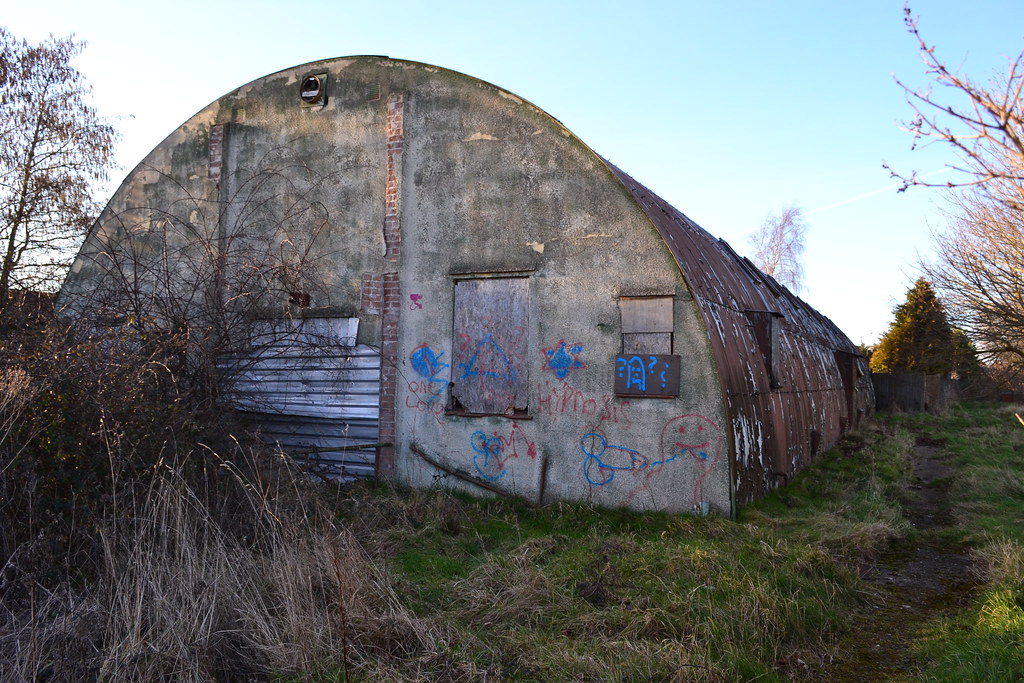
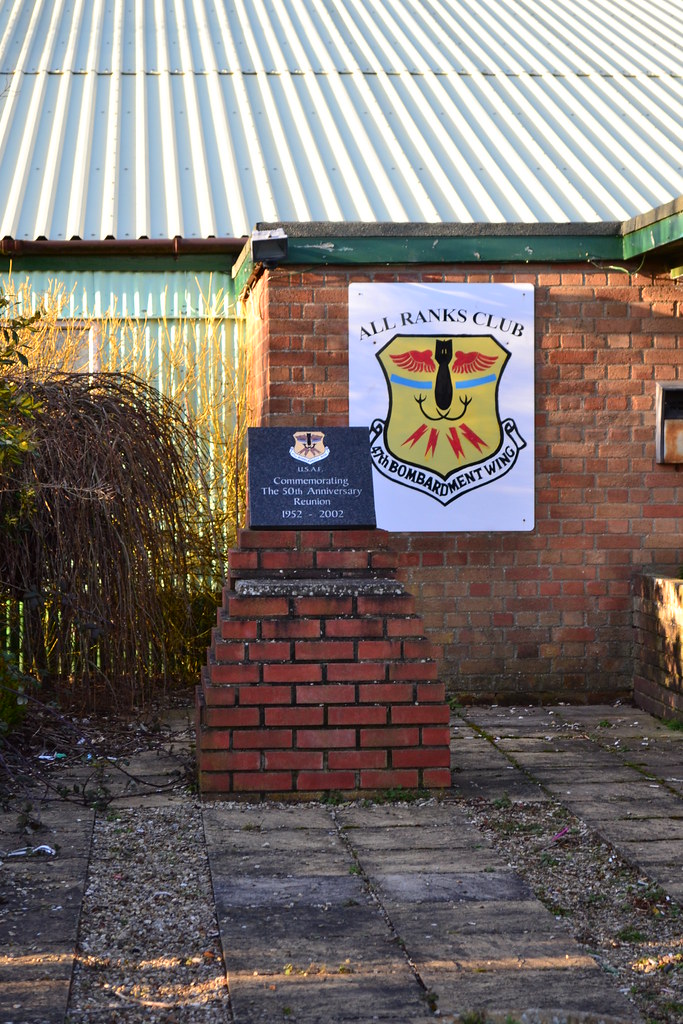
RAF Sculthorpe – The Beginnings of a New Airfield (1)

Not long before Christmas, I had the opportunity to return to RAF Sculthorpe to revisit the small collection they had in the Heritage Centre not only before it closed for the season, but before it moved to its new location in the former Chapel on the base. The Chapel itself, was hugely overgrown and in a very poor state after being left vacant for many years, but has been painstakingly refurbished, by the volunteers at the centre, with an aim to opening early this year (2024).

This gave me an opportunity to also revisit the airfield and see how it had fared.

RAF Sculthorpe

Sculthorpe airfield is located a few miles to the north-west of the town of Fakenham in Norfolk, in a parish that has links as far back as the Romans and even pre-historic eras. The airfield itself however, has its origins more recently in the latter part of the Second World War, but it has a much larger claim to fame , and one that it still retains to this day.

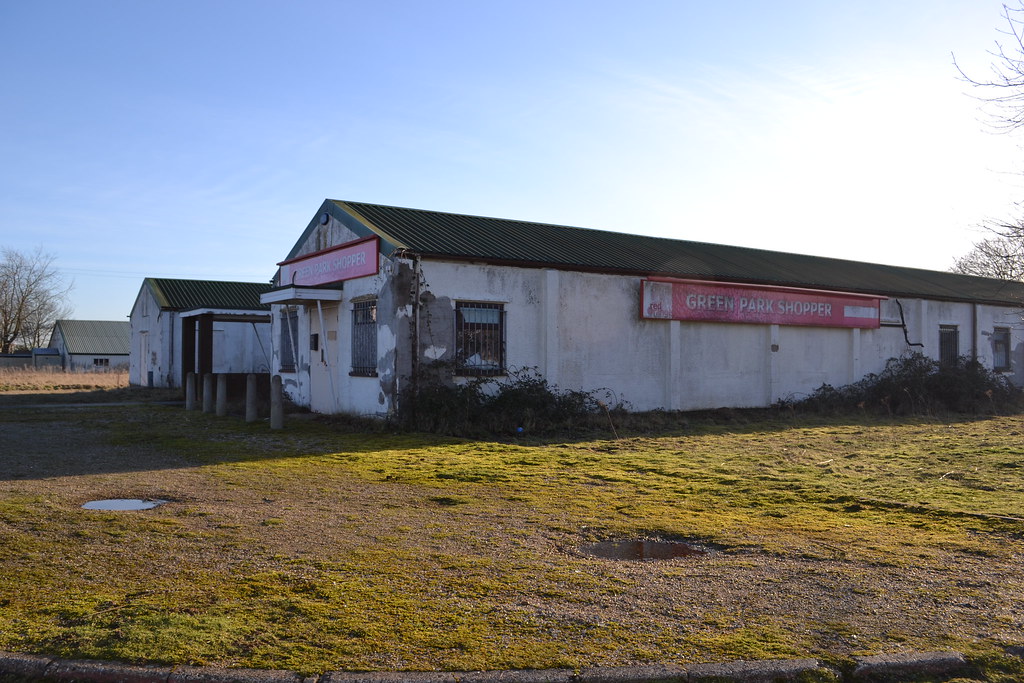
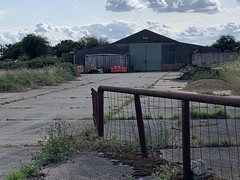
A once busy shop

A former American school and more recently a shop now derelict and forgotten.

Designed initially as a heavy bomber site, and satellite to RAF West Raynham, Sculthorpe would initially be built with three runways, ten accommodation sites, a bomb store and a large technical area. Over time, these runways were extended to one of 12,000ft and two of 6,000ft, and all made of concrete. By the end of its life, its accommodation area would have grown enormously, as would its technical and administration sites, housing at its height, 10,000 personnel and their families. Such enormous facilities along with the fact that it was capable of holding around 100 aircraft, gave Sculthorpe the ability to boast being one of the biggest airfields in Western Europe, an honour it retains to this day.

Built by a collection of major companies including: Bovis Ltd, John Laing & Sons, and Constable Hart & Co. Ltd; it would boast as many as five major hangars – one B1 and four T2s, along with nine blister hangars all located around the site. Around the perimeter there would be 36 hardstands, many of which would be absorbed during extension work leaving 29 by 1958.

Although built in the Second World War, Sculthorpe had a limited War life, its heyday coming much later in the Cold War, during which time it became a major nuclear capable airfield housing American bombers on 90 day rotations.

Initially though, following a reshuffle of Bomber Command, it fell under the control of 2 Group Bomber Command but the first users of the airfield were not the bomber crews but the personnel of the 11 Heavy Glider Maintenance Section along with 2 Heavy Glider Maintenance Unit, who both moved in during early 1943, before the site was officially opened. As non-flying units they prepared, repaired and maintained thirty-two Horsa gliders, many of which would have been used the following year in the Normandy invasion. These units remained in situ at Sculthorpe for almost a year, departing mid March 1944.

2 Group were formed primarily of light bombers, and on May 15th 1943, the first of the main residents arrived in the form of Boston IIIAs belonging to 342 (Lorraine) Squadron.

342 Sqn had originally been set up as a Free French squadron in September 1941, operating in the Middle East with French crews. Their time there had not been good though, with many losses as a result of flying what were now considered ‘out of date’ aircraft – the Blenheim. It was then decided, after talks between the RAF and General Valin, the Commander of the Free French Air Force, to bring these men back and retrain them on more modern aircraft, and so in September 1942, orders from the UK directed many of these airmen back to the UK. Sadly however, during their return voyage, two of the four ships that were used to transport them, were sunk by German U-boats, and many of the  personnel were lost at sea.

Once in the UK, refresher courses were undertaken with 342 Sqn being officially re-formed on April 1st 1943, using these French personnel at nearby RAF West Raynham . Once formed, training continued, followed not long after by the first loss, when one of the aircraft attempted an emergency landing after running out of fuel. That aside, the Boston IIIa, or A20, they were now using, was considered a much improved model compared to the Blenheim, with both greater power and better armament, and was far more suited to the role it was about to perform.

Following further training, the squadron finally transferred over to Sculthorpe on May 15th 1943, where crews attended lectures on “evasive action and fighter control”. Two further crashes would cost the squadron several more airmen, some of whom were highly experienced and valued members of the unit.

As the saying goes, any port in a storm, and Sculthorpe provided that port. On May 19th, an American B-17 was forced to make an emergency landing at the airfield. On board the aircraft were three injured crewmen, the ball turret gunner, and the two waist gunners. The Ball Turret Gunner was given urgent medical assistance, but unfortunately he later died from those injuries, whilst the two waist gunners, both with frost bite to their hands and ears, thankfully survived. A second B-17 landed some time after the landing and collected the crewmen, transferring them back to their own base where they received further medical assistance.

There then came yet another change at Sculthorpe, as the Free French unit was combined with two other squadrons, 88 and 107 to form the new 137 Wing; a Wing made up of both French and British units.  On June 12th 1943, under the new Wing, 342 Sqn’s first operational flight took place, a ‘circus’ raid undertaken in conjunction with 107 Sqn. These types of operations would become the norm for the next month, and whilst there were some losses, they were thankfully light. In mid July, orders came through for the unit to depart Sculthorpe and move to nearby RAF Great Massingham, a move that was well organised and one that went smoothly. By the evening of July 19th all but two aircraft had departed Sculthorpe, and crews were settling in well to their new home.

There was no let up at Sculthorpe though, as over the next two days two more squadrons would move in to the now vacant premises. Orders for the transfer of both 464 (RAAF) and 487 (RNZAF) Squadrons were received with mixed emotions though. To make things worse, the transfer of both men and machinery did not go totally to plan and only happened following a change in operations and planning. Both Squadrons had been flying from  RAF Methwold, an airfield not far from Sculthorpe, as light bomber units with Lockheed’s Venturas. They regularly attacked targets in western Europe, often without fighter escort, which resulted in some heavy losses for the units.

RAF Sculthorpe

The Commissary and BX next door are still on site today

It was whilst at Methwold that Sqn. Ldr. Leonard Trent would perform so bravely receiving the Victoria Cross for his actions on May 3rd, 1943, with 487 (RNZAF) Sqn. The whole process began in mid June with an initial order requiring 464 (RAAF) Sqn, to move to Dunsfold, however, that move never materialised, the order being cancelled on July 4th. This meant that preparations would stop, and the squadron would remain at Methwold. They then entered a period of training, the weather having curtailed many operational flights for both this unit and others across the UK.

Then on July 10th, the weather broke just enough for an operational flight to be carried out by 464 Sqn, attacking targets at St. Omer. These were hit with great success; the 487 squadron commander commenting “a wizard piece of bombing”,  but still the squadron awaited, with anticipation, news of its next posting. Then two days later, whilst a contingent of the Australian press where visiting, news came through that the two units were to change its aircraft for Mosquitoes, and that the pilots would be fully trained within 6 weeks. The swap although not what was expected, was generally accepted well by the squadrons, but it brought disappointment for both the wireless operators and air gunners of each unit, who would have no place on board the two-seat ‘Mossie’,  and would have to be transferred out.

Following a period of further training, the long awaited news finally arrived. For 487 Sqn it arrived on July 16th, noted as ‘Panic day’, and on July 17th for 464 Sqn. Both squadrons would now transfer over to Sculthorpe. In preparation, 464 Sqn’s station adjutant visited the new airfield on the 19th to assess its condition, but he was not impressed! He reported that “there was very little of it to work in comfort and everything is drastically dispersed.”*1 His aggrieved feelings about the site were further exasperated by a lack of office space, the only silver lining to the whole move, being that more accommodation was apparently ‘in the pipeline’.

487 were the first to transfer. On the 19th, the advance party left Methwold followed in the early afternoon of the 20th by the main road party. The aircraft and crews then transferred over an hour or so after them.  On the 21st the aircraft of 464 Sqn also departed Methwold, the departure tinged with sadness as many were sorry to be leaving what had been a good home. The weather typical as it is, once again closed in, and several aircraft had to try two or three times before finally getting down safely at Sculthorpe. Fortunately there were no mishaps and all crews and aircraft arrived safely.

By the evening all personnel were unpacked and settling down for the night. The lack of buildings became quickly evident though, a fact made worse by the lack of bicycles, Sculthorpe being so widespread meant it was difficult to get around without transport. As a result, more bikes were needed and an order was placed with an urgent request. Coinciding with this, was a memo informing staff, of the impending move to form a new headquarters here, a move which would see both new recruits along with an increase in staffing levels. This was a further worry as there was still insufficient accommodation for those already here.

The month ended on a better note however, with good weather, night sorties and training on new equipment gave a hint of things to come. A new station Commander also arrived at this time, in the form of Group Captain P.C. Pickard DSO, DFC, once again hopes for the two squadrons were rising. Pickard’s arrival was by no means a coincidence – a new Wing was being formed and he had been chosen to lead it. Pickard’s record as a leader was outstanding, and he had been hand picked, for the role, by none other than Air Vice Marshall Basil Embry.

Pickard’s role here at Sculthorpe was to set up and command 140 Wing, a new unit consisting of three Mosquito squadrons, under the control of 2 Group of the Second Tactical Air Force headed by Embry himself. Even while the new Wing was being formed, training continued for those already here at Sculthorpe. On August 18th, whilst on one such flight, one of the Venturas (AE668) of 464 Sqn crashed into a Welsh hillside at Llandwrog, with the loss of all four crewmen. What was unusual, and concerning, was why the aircraft was so far off course at the time; the Welsh mountains not being where the aircraft should have been. It was not known why the aircraft crashed nor indeed whether the deviation of course was a factor in the accident, but it was a heart felt tragedy and the squadron’s first accident whilst at Sculthorpe.

Three days after this, on August 21st, the first of the new replacement aircraft arrived, two D.H. Mosquitoes, a milestone that coincided the following day with the setting up of a Mosquito Conversion Flight. The purpose of the Flight was to convert Ventura aircrew from both 464 and 487 Sqns over to the Mosquito.

Flying was slow to start with, as appalling weather prevented any chance of taking off even in the day-time, a situation that would prevail for some time. By now, the new postings for the surplus gunners of both units had begun to filter through, and gradually, one by one, they trickled out of Sculthorpe to their new respective squadrons elsewhere. It wasn’t  just the aircrew that were being posted out either, a number of tradesmen were also posted out, but oddly enough, they were not being replaced. The distinct lack of skilled technical personnel soon raised alarm bells amongst the units, for as a Mosquito squadron, 487 had no carpenters, and other skilled workers were becoming distinctly lacking.

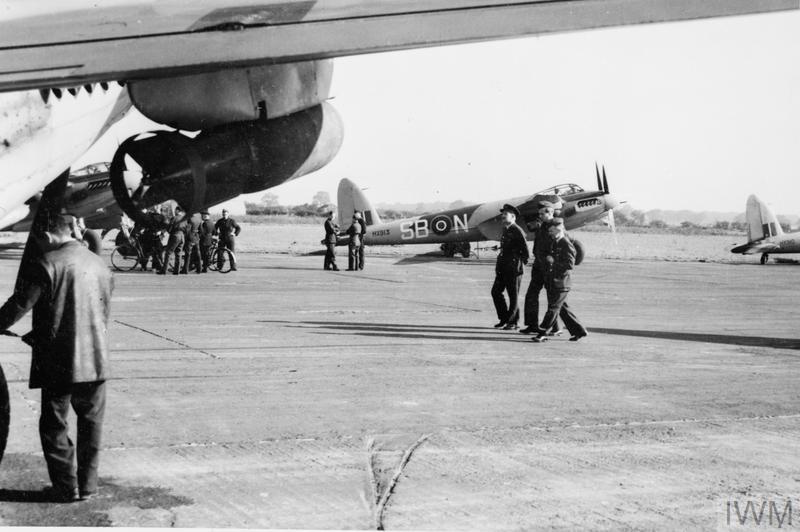
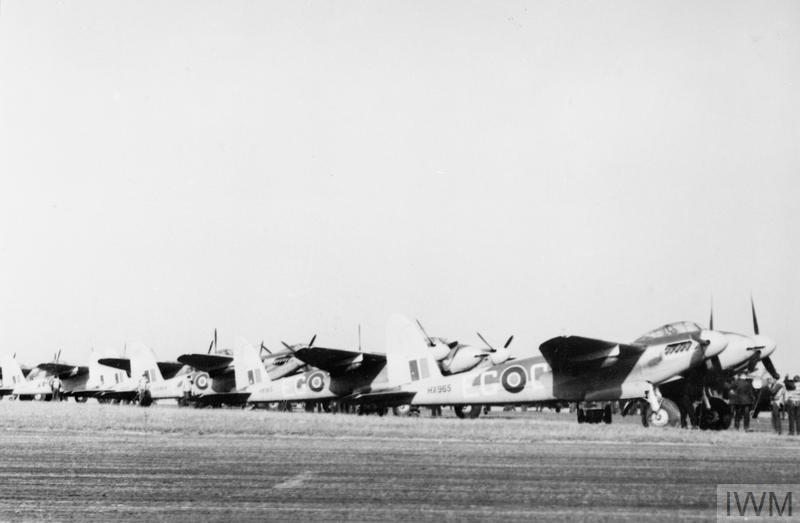
Mosquito FB Mk VIs (HX965 ‘EG-C’ leading) of No. 487 Squadron, lined up at Sculthorpe, prior to taking off on the first Mosquito raid mounted by No. 140 Wing. 24 aircraft from 464 and 487 Squadron RNZAF successfully attacked two power stations in France without loss. (©IWM HU 81325)

By early September Mosquito numbers had reached well into double figures, the lack of manpower was now the issue which was being made worse by the lack of spares, a situation that led to many aircraft being classed as unserviceable. A common problem seemed to be the undercarriage, repairs taking longer than usual keeping aircraft annoyingly grounded.

The 15th September 1943 saw another significant turn in the status of Sculthorpe, as it gained its own independence and became an operational airfield in its own right. With this, Sculthorpe had finally grown up. On the 28th, the numbers of aircraft on the books had reached over 70 when another squadron (21) arrived to join both 464 and 487 thus completing the formation of the Wing. The ORB for 464 Sqn stating that the airfield was not built for three squadrons (and a conversion flight) and that overcrowding was now a major issue for those based here at a cold and wet Sculthorpe.

21 Sqn was another Ventura unit, themselves having a history as far back as 1915, and very soon after their arrival, they too, would begin to receive the Mosquito. As with 464 and 487 Sqns, pilots were quickly placed on the conversion course flying with the Conversion Flight at Sculthorpe, the transition from Ventura to Mosquito being expedited with all speed.

By the 4th October, virtually all pilots had converted and completed cross country solo flights at low level. Only the incident on the 1st, when Flt. Lt. Henderson suffered engine trouble and subsequent fire, marred the otherwise rapid and clean transfer across. In the incident, Flt. Lt. Henderson managed to bring the aircraft down safely at RAF Attlebridge. Other good news for the unit was that those in the administration offices were now able to move from their cold and unsuitable temporary accommodation block to a new permanent building, this new block being the ‘best they had experienced since leaving RAF Oulton‘. Improvements were indeed coming but they were somewhat slow.

In Part 2 the two squadrons fly operationally, but it would not be the great start they had wished for. There would be further changes and more new arrivals at the airfield and larger four-engined bombers would also arrive.The full story can be read in Trail 21.

Lt. Jack Watson 303rd BG. – From Villain to Hero.

The end of training flights in the Second World War in the quiet and blue skies of the United States, were occasionally ‘celebrated’ with flyovers and ‘buzzing’ of the home town of family or girl friends. Whilst this unofficial activity was frowned upon, in general, a blind eye was turned by Commanding Officers of the various Groups. However, one such activity was not taken quite so lightly, and almost led to the end of a promising career before it had even started.

At RAF Molesworth (Station 107) not far from Huntingdon, Cambridgeshire, the 303rd Bomb Group (BG) had been serving the Allied offensive since mid September 1942. They had taken heavy casualties after participating in many prestige missions including the disastrous August and October raids on the ball-bearing plant at Schweinfurt. The invincibility of the heavily armed B-17 was very quickly shown to be a myth.

After a period of calm, primarily due to persistent bad weather rather than any  significant strategic military decision, the USAAF was allowed unofficial time to recuperate, rebuild and rearm. During this period, new recruits and aircraft poured into the United Kingdom via either the Northern or the Southern transit routes over the Atlantic Ocean.

On one of these aircraft was Lt. Jack Watson, a ‘green’ pilot’ who had recently completed his training, and was now on his way to fight in a war a long way from his Indianapolis home.

jack watson page

A fresh faced 2nd Lt. Jack Watosn who bravely brought home his burning and crippled B-17 bomber after ordering his crew to bail out. (IWM UPL 32160)

On eventual arrival at Molesworth, Lt. Watson was soon to experience for himself the horrors and reality of war. On January 11th 1944, he was part of a 291 bomber force attacking both the FW190 production factory as Oschersleben and the Junkers factory at Halberstadt, Germany. On what became one of the blackest days for the Group, eleven out of the forty aircraft dispatched were lost, an attrition rate of just over 25%, which was also the highest loss of the entire force.

On the inward flight, the weather, which had dogged much of the winter, closed in over the continent.  A recall message was sent out, the 2nd and 3rd Divisions turning for home, but it was ignored by Brigadier General Robert F. Travis, 1st Bombardment Division Commander in the lead plane – ‘The Eight Ball‘. Original orders were to bomb by visual methods but if cloud cover prevailed then pathfinder Liberators  were to mark the target.

As the weather had deteriorated, cloud being present as high as 24,000 feet, fighter cover was all but withdrawn. The bombers were now virtually on their own and much smaller in number.

Alerted early on, the Luftwaffe had managed to form an enormous welcoming party for the now weakened force. It would be the strongest collection of Luftwaffe aircraft since the October raids, and it was waiting, eager for blood.

The first contact between the two forces was made over the shallow waters of the  Zuiderzee on the inward flight. A collection of rocket-firing fighters launched a gruesome attack on the lead section of the 303rd, an attack that lasted for several hours and took out numerous aircraft.

From the Initial point (IP) to the target, flak was light but accurate, more aircraft took hits and further damage was sustained by the formation. Those bombers that did get through managed to bomb the target, the accuracy of which was considered ‘excellent’.

On the return flight  B-17F #42-29524 ‘Meat Hound‘, piloted by Lt. Jack Watson was attacked again by waves of enemy fighters who zoned in on the bomber and its supporting formation. With many aircraft now crippled, the B-17s were easy targets for the fierce and determined Luftwaffe defenders.

Lt. Watson’s aircraft, (a B-17F-55-BO, which had previously been assigned to the 306th BG transferring to the 303rd in July 1943), was hit hard over Durgerdam. The damage looked terminal, two engines were on fire, there was substantial damage around the wing root and the left elevator had been shot completely off. With such damage, not only was the aircraft difficult to control but it was losing vital airspeed and altitude as well.

Lt Watson, gave the bail out order, holding the aircraft steady until all the crew had departed. Lt. Watson, who had by then put the aircraft on automatic pilot, was himself preparing to jump, but the thought of the cold waters below forced his retreat to the cockpit and the challenge of getting home alone.

Of those who did jump, four fell into the Ijsselmeer and sadly drowned, and another four were caught by occupying forces and sent to POW camps. The ninth, Lt. Col. Clayton David, the Co-Pilot, managed to evade capture eventually making his way back to England. Clayton’s journey took him through Holland and Belgium and on into France, where he headed south, eventually crossing the Pyrenees into Spain. From there, he reached Gibraltar eventually returning to England in May 1944, four months after he was reported as ‘Missing in Action.’ For his efforts he received the Purple Heart*1.

Lt. Watson, now alone in the crippled B-17 fought on, keeping the aircraft flying toward England. Once over home territory he brought the aircraft down through the thick cloud that had dogged so many of Britain’s airfields that winter, landing at RAF Metfield, an American Fighter airfield home at that time to the 353rd Fighter Group.

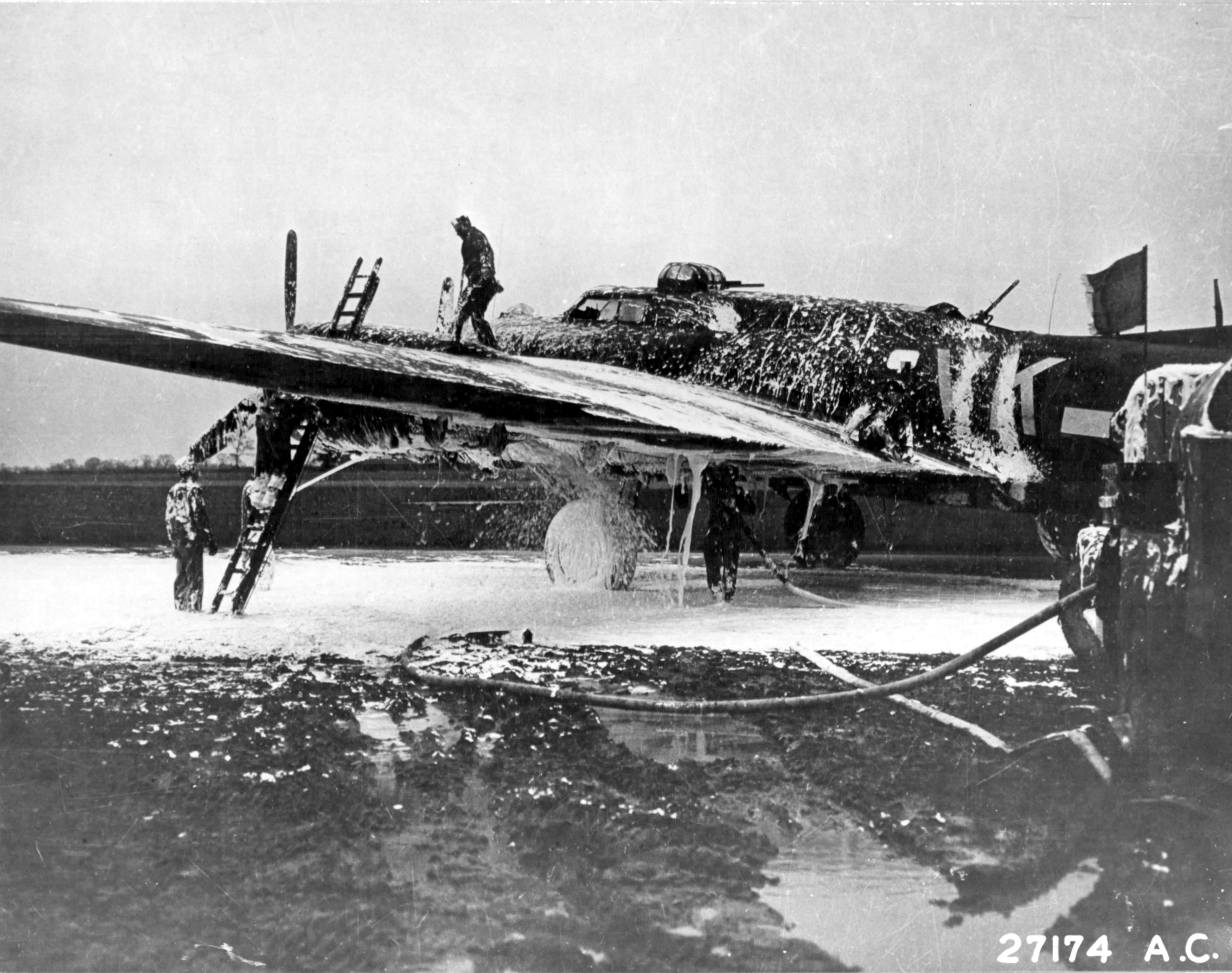
So severe was the fire on the aircraft that it took fire crews a considerable time to extinguish it. These crews were not only amazed to see just one crewman exit the aircraft, but also to find an unexploded shell sitting directly behind the pilots seat.

WM UPL 32171

B-17 ‘Meat Hound‘ on the ground at Metfield, Suffolk after landing with two burning engines. The aircraft was subsequently written off and salvaged for usable parts.  (IWM UPL 32171).

On his arrival back at Molesworth, Lt Watson received a telegram sent by New York Mayor Fiorello LaGuardia, forgiving Watson for his villainous activity previously in late 1943.

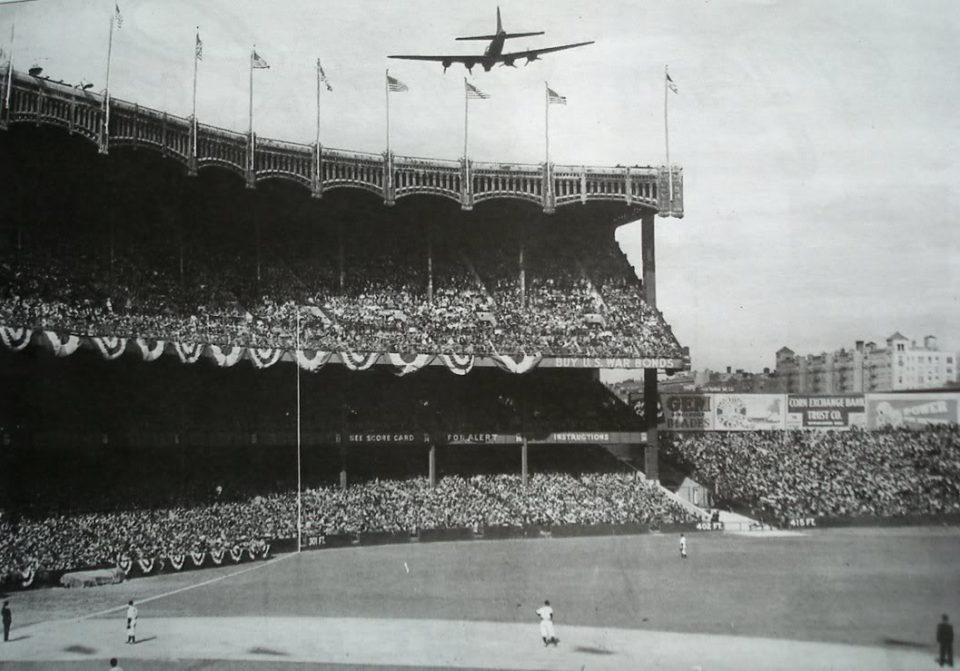
It was at this time that Watson along with three other pilots; 2nd Lts. Robert Sheets, Elmer Young, and Joseph Wheeler, buzzed the World Series game between St. Louis Cardinals and the New York Yankees at the Yankee Stadium, New York. Mayor LaGuardia was so incensed by the action at the time, that he insisted Watson and the others be disciplined, court martial proceedings being instigated as soon as the four landed in Maine*2.

However, it was not to be, the top brass needing every aircraft and crewman they could muster, sent the four on their way with a $75 fine and a stiff telling off!

Although tinged by the sad loss of his crew, the villain of the World Series’ Buzzing, had gone on to prove himself more than a worthy pilot, making history in more ways than one.

Yankee Stadium, Bronx, NY, October 5, 1943 – B-17 Flying Fortress bombers makes a surprise visit during the first game of the 1943 World Series

A Boeing B-17 ‘buzzes’ the Yankee stadium October 5th 1943. (Author unknown).*3

The crew of ‘Meat Hound‘ were:

Pilot – 2nd Lt. Jack Watson (Returned to Duty)
Co-Pilot – Lt Col. Clayton David (Evaded)
Navigator – 2nd Lt. John Leverton (POW)
Radio Operator –  Stf. Sgt. Harry Romaniec (KIA)
Bombardier – 2nd Lt. Vance Colvin (KIA)
Flight Engineer/Top Turret Gunner – Stf. Sgt. Sam Rowland (POW)
Right Waist Gunner – Sgt. William Fussner (KIA)
Left Waist Gunner – Gene Stewart (POW)
Tail Gunner – Sgt. Roman Kosinski (POW)
Ball Turret Gunner – Sgt. Fred Booth (KIA)

The B-17F, #42-29524, was delivered to Denver 31st December 1942; then assigned to the 423rd BS (306th BG) as ‘RD-D’ at Thurleigh 2nd March 1943. It was later transferred to the  358th BS (303rd BG) as ‘VK-K’ based at Molesworth on 30th July 1943.

For their efforts in this mission, the 303rd Bomb Group were awarded a Distinguished Unit Citation, the only time the entire unit achieved such an accolade.

This and other similar stories appears in Heroic tales of World War 2.

Sources and Further Reading.

Missing Air Crew Report 4269

*1 Herald-Whig Obituaries Website accessed 27/5/19

*2 303rd BG website ‘Outfield Fly’ by Hap Rocketto accessed 27/5/19

*3 Photo appeared in ‘Old-Time Baseball Photos and Essays’, blogsite. accessed 27/5/19

Squadron Leader Robert Palmer V.C., D.F.C and Bar.

There are many stories of great bravery as a result of action over occupied Europe during the Second World War; all are a test of human endurance pushing the human body to its limits and beyond. In some such cases, the recipient received the highest honour that could be bestowed on any member of the armed forces – the Victoria Cross.

One such award went to a Pathfinder, one of only three to go to the entire Group. Donald Bennett, the commander of 8 Group, himself even said he would not award such an accolade to any living person, it was not therefore given lightly, nor easily obtained.

In this instance the recipient was a pilot based at RAF Little Staughton on the Cambridgeshire – Bedfordshire border. It was a short lived airfield and only had two operational squadrons use it, both squadrons were part of the RAF’s Pathfinders.

This is his story.

Robert Anthony Maurice Palmer, the older brother of Douglas, was born on July 7th, 1920 in Gillingham, Kent, son of Arthur Palmer and Lilian Skuse. His father, Arthur Palmer, had served in the Essex and West Kent Regiments during the First World War before joining the fledgling Royal Air Force in May 1918. He would remain in the Air Force as an instructor at RAF Duxford until being demobbed the following year.

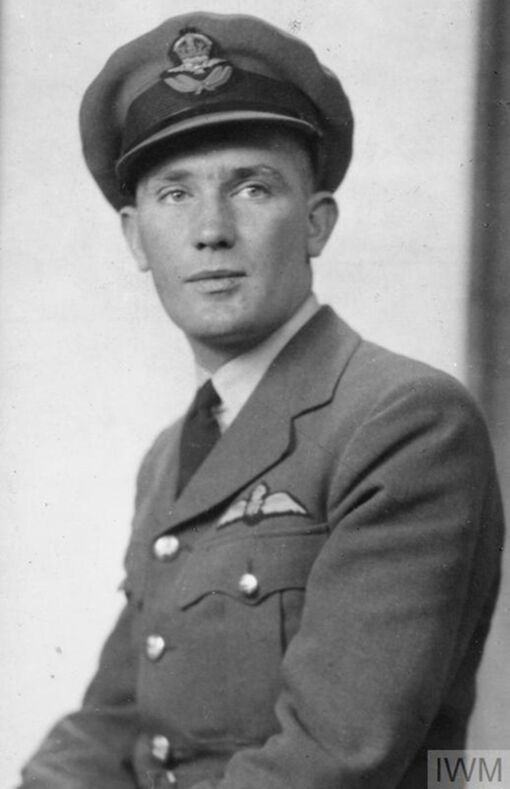
Sqn Ldr. Robert Palmer (IWM HU 1996)

Arthur and his stories of flying, reinforced by the exploits of the 1920’s aviation pioneers, would inspire Robert, and fuel his desire to enter the world of flight himself. It was a desire that would enable him to fulfil his dreams but ultimately lead to his death.

After attending his first school, Cecil Road in Gravesend, Robert would join The County School for Boys, in Darnley Road, Gravesend, run then by the Reverend Samuel Lister.

Once his school life was over, Robert obtained his first job, joining the Borough’s Surveyor’s Office where he showed good potential before volunteering as a pilot for the Royal Air Force Volunteer Reserves on 22nd August 1939. Given the initial service number of 758016 (later 115772), Robert was awarded the initial rank of Aircraftsman II/ under training pilot.  The following day he was promoted to the rank of sergeant, before being transferred from Hastings to Rochester, his first training post. Between then and June 1941, Robert worked through a number of training units starting with No.12 Flying Training School followed by No. 15 Officer Training School. During his short time here, he would gain good grades and show his true potential as a future pilot within the Royal Air Force.

Once qualified, Robert Palmer would be posted to his first operational squadron, 75 (New Zealand) Squadron flying Wellington ICs at RAF Feltwell in Norfolk, the date November 16th 1940.

The move was designed to give Robert the experience of life in an operational unit. Being shepherded by the experienced P. Off. Morton, he would gain a good understanding  of the huge responsibilities a pilot in an operational unit would have. Whilst at Feltwell, Robert would continue to grow and show further good potential as a pilot now in Bomber Command.

Robert’s stay at Feltwell would last for just ten days, transferring to his own aircraft with 149 Squadron at RAF Mildenhall on the 26th of November. Here Robert would have to gather and mould a new crew, creating a camaraderie that would hopefully keep them both alive and together, through some of the worst battles that the RAF were likely to experience. The operational schedule was so intense that it would take just three months for them to complete their first tour of thirty operations.

Now as a seasoned pilot, he and his crew who had jelled together so well, were to be split, each one being posted to a different training unit where they could share their experiences and knowledge to other crewmen. Robert was sent to No. 200 Training Unit arriving in February 1941 where he remained for a year. Five months into the posting, he would be promoted to Temporary Flight Sergeant*1, a grade he remained at until January 28th 1942, at which point he was discharged on appointment to a Temporary Commission as Pilot Officer within the RAFVR, a promotion that came with another transfer to No. 20 Operational Training Unit (OTU) at Lossiemouth in Scotland, again as an instructor. This appointment was confirmed and he officially became a Flying Officer in October 1942.

Some ten days after his appointment, he was sent to No. 1501 Beam Approach Training Flight learning to land on instruments, a course that lasted a mere week, Robert then returned to 20 OTU where he remained as instructor for a further year. He, like many instructors, was keen to get back into operational flying, and pressed his superiors for a transfer back to a front line squadron.

It would be whilst at the OTU that Palmer would come into contact with Squadron Leader Ian Bazalgette DFC. another pilot who would go onto the be awarded the VC posthumously. Bazalgette recognised the potential of Palmer and put in a recommendation for his transfer to a front line unit.

Robert’s wish then came true. After a short spell training on Mosquitoes at the RAF Warboys based 1685 Mosquito Training Unit and the Pathfinders in early November 1943, he transferred out, being posted to 109 Squadron at RAF Marham, Norfolk, a front line squadron within the Pathfinders’ Group. Thirteen days after his arrival, he would be promoted again, this time to Flight Lieutenant.

The Pathfinders were commanded by Donald Bennett and were an ‘elite’ group of pilots and aircrew, who had proven themselves to be excellent flyers. Arthur Harris, the Commander in Chief of Bomber Command had been completely opposed to the idea of an elite unit,  citing a drop in morale as the cream of his bomber squadrons would be taken away to form a new unit. But 8 Group came into being and Flt. Lt. Robert Palmer was soon one of them.

109 Squadron were about to receive the Mosquito XVI to supplement the Mk, IX they already had, and with both variants, the unit transferred from Marham to RAF Little Staughton on the Cambridgeshire / Bedfordshire border some 60 miles south-west. The move in April 1944 would be Robert’s final transfer.

As a Mosquito pilot, Robert would undertake many operations whilst here at Little Staughton, and in recognition of both his gallantry and his devotion to duty, he was awarded the Distinguished Flying Cross (DFC) on June 30th, 1944. *2

It was then, a combination of this devotion to duty and the fact that he quickly reached the milestone of 100 operations, that led him to receive a second DFC in the form of a bar on his first; an accolade that acknowledged his determination to succeed and his skill as a pilot. *3

With two DFCs under his belt, Robert Palmer would soon receive his final promotion, being granted the rank of acting Squadron Leader on 10th December 1944.

December would prove to be the end of the line for Sqn. Ldr. Palmer though. After flying his last Mosquito operation on December 6th in ‘MM171’ to Osnabruck, he would soon change to Avro’s baby the Lancaster. On the 23rd, two days before Christmas, he was assigned to fly in a daylight raid to Gremberg, a daring raid that would use Oboe to pinpoint the target. As a Pathfinder, his role was to identify the target and drop markers/bombs for the following bombers to bomb on. It was a dangerous and daring mission and one which Sqn. Ldr. Palmer and his navigator Flight Lieutenant George Russell, would lead as Master Bomber in a 582 Sqn aircraft with Flight Lieutenant Owen Milne and his crew.

The morning was cold, wet and foggy, simply described as “miserable” by Bill Lanning*6. After dragging themselves out of bed and performing their morning ablutions, they headed off to the mess hall for a hearty breakfast of egg, bacon and beans, the standard morning feast for those flying on ops that day.

At briefing, the two crews met, Russell remaining quietly reserved whilst Palmer was introduced to Milne’s crew. The target was revealed and the various experts gave their reports: escort, weather, flak, bomb run etc.

By 09:30 briefing was over and the various crews made their way to the locker room and parachute stores to collect their belongings for the flight. The temperature was expected to be at -20oC, it would be very cold.

Palmer’s take off time was recorded as 10:27, but the mission was already doomed. Over England two Lancasters at the rear of the last flight, misjudged the distance between them and collided with the loss of both crews. Meanwhile, Palmer leading the operation, had become separated from the main formation, his two flights were alone and undefended as their escort raced to catch-up. Flying on Oboe meant they would have to fly both straight and level for fifteen minutes before they could drop their bombs, in daylight and clear skies this would be suicidal. The 6/10 cloud they had been promised didn’t materialise, and it was indeed clear and cloudless.

Flak came first. Very quickly the German gunners found their mark and aircraft were peppered with shrapnel. A reserve Pathfinder Mosquito flying alongside, went first and soon Palmer’s Lancaster was also hit. Two engines were quickly put out of action,  flying controls were damaged and even though the aircraft was difficult to fly, Palmer maintained a straight and level approach. Four minutes from the target the Luftwaffe pounced. Determined not to let Palmer and his two flights through, they hounded the formation some of whom had by now, begin to scatter. Communications had all but broken down but still Palmer continued on. Although “burning fiercely” he successfully bombed from 17,500 ft, laying his eleven 1,000 lb general purpose bombs spot on the target.

Within seconds of dropping their explosive bomb load, Palmer’s aircraft took further devastating hits and it began to fall from the sky. All but one of the crew would die that day. A very short statement details their loss: “aircraft are missing”.*5

Palmer stayed at his station commanding the aircraft until the end, an act of selfless heroism and bravery trying to save his fellow crewmen before himself. For his actions he was awarded the Victoria Cross posthumously.

The 24 year-old’s citation appeared in the Fourth Supplement to The London gazette of March 20th 1945*4

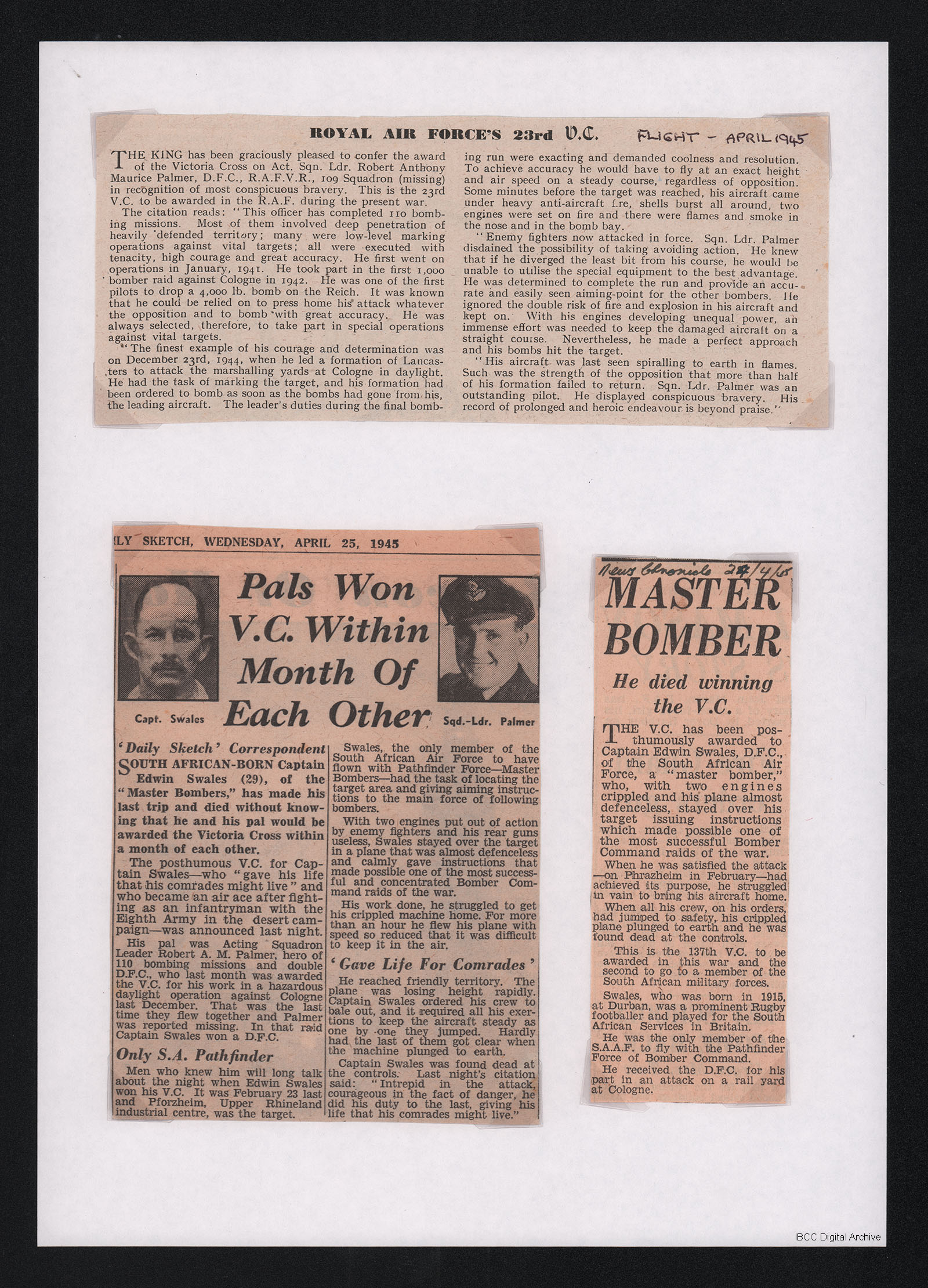
“This officer has completed 110 bombing missions. Most of them involved deep penetration of heavily defended territory; many were low-level “marking” operations against vital targets; all were executed with tenacity, high courage and great accuracy. He first went on operations in January, 1941. He took part in the first 1,000 bomber raid against Cologne in 1942. He was one of the first pilots to drop a 4,000 lb. bomb on the Reich. It was known that he could be relied on to press home his attack whatever the opposition and he bombed with great accuracy. He was always selected, therefore, to take part in special operations against vital targets.

The finest example of his courage and determination was on the 23rd December, 1944, when he led a formation of Lancasters to attack the marshalling yards at Cologne in daylight. He had the task of marking the target and his formation had been ordered to bomb as soon as the bombs had gone from his, the leading aircraft.

The leader’s duties during the final bombing run were exacting and demanded coolness and resolution. To achieve accuracy, he would have to fly at an exact height and air speed on a set course regardless of opposition.

Some minutes before the target was reached, his aircraft came under heavy anti-aircraft fire, shells burst all around, two engines were set on fire and there were flames and smoke in the nose and in the bomb bay.

Enemy fighters now attacked in force. Squadron Leader Palmer disdained the possibility of taking avoiding action. He knew that if he diverged the least bit from his course, he would be unable to utilise the special equipment to the best advantage. He was determined to complete the run and provide an accurate and easily seen aiming-point for the other bombers. He ignored the double risk of fire and explosion in his aircraft and kept on. With its engines developing unequal power, an immense effort was needed to keep the damaged aircraft on a straight course. Nevertheless, he made a perfect approach and his bombs hit the target.

His aircraft was last seen spiralling to earth in flames. Such was the strength of the opposition that more than half of his formation failed to return.

At 24 years old, Squadron Leader Palmer was an outstanding pilot. He displayed conspicuous bravery. His record of prolonged and heroic endeavour is beyond praise”.

Sqn. Ldr. Robert Anthony Maurice Palmer (s/n: 115772) was buried in the Commonwealth War Cemetery at Rheinberg, Plot: 14. Row: C. Grave: 13-14 along with the other’s in the crew.

In honour of Sqn. Ldr. Palmer, the Grammar School he attended continues to pay homage to his brave and selfless act by hanging both his portrait and his V.C. citation in the school hall. A nearby church, St Peter and St Paul Church located at East Milton Road, Milton, Gravesham has his name inscribed above the Lych Gate at the church entrance. He is also remembered at the Rheinberg War Cemetery, Germany. At his former home in Denton, a plaque was unveiled  in 2006 by then mayor, Raymond Parker.

RAF Little Staughton appears in Trail 29.

Those on board that day were:

Pilot – Sqn Ldr. Robert Palmer VC, DFC and Bar; (RAFVR), age 24, s/n:115772
Pilot – Flt. Lt. Owen Strachan Milne, (RAFVR), s/n: 132625
Navigator – Sqn Ldr. Albert Leslie Carter, DFC, (RAF), age 29, s/n:44553
Navigator – Flt. Lt. George Russell DFC,  (RAFVR), age 21, s/n:129583
Wireless Op. – Flt. Sgt. Bert Nundy, (RAFVR) age 21, s/n: 1671822
Gunner – Fl. Off. William Dalgarno,  (RAFVR), s/n:161283
Gunner – Flt. Sgt. R K Yeulett (RCAF), (survived taken as POW)

Sources and further reading.

*1 The London Gazette, Issue 35531, page 1754, dated April 21st 1942.

*2 The London Gazette, Fourth Supplement of Tuesday June 27th 1944, dated Friday 30th June 1944. Issue 36589, Page 3089

*3 The London Gazette, Issue 36831, Page 5634, dated 8th December 1944

*4 The London Gazette, Fourth Supplement of Tuesday 20th March 1945, dated Friday 23rd March 1945, Supplement:36997, Page:1593

*5 National Archives Operational Record Books 109 Squadron December 1944 AIR 27/855/9

*6 Lanning, Bill. A personal account recorded for The International Bomber Command Centre, which also includes other eyewitness and personal accounts of that day.

National Archives: AIR 27/855/10

Feast, S., “Heroic Endeavour“, Grub Street Publications, 2006

RAF Pathfinders Archive Website.

Commonwealth War Graves Commission website.

Kent online newspaper website 17th December 2019

Gravesend Grammar School Commemorative Archive website

IBCC website 

Australian Flt. Sgt. Rawdon H. Middleton VC (RAAF) 149 Sqn RAF

100641

Pilot Officer Rawdon Middleton (RAAF)*1

Middleton (s/n: 402745) was born on 22nd July 1916 in Waverley, New South Wales, Australia. Son of Francis and Faith Middleton, he was educated at Dubbo Hugh School. Nicknamed ‘Ron’ by his friends, he was a keen sportsman excelling at many sports particularly cricket and football. After leaving school, he worked as a ‘Jackaroo’ (cattle handler) until joining the Royal Australian Air Force on the 14th October 1940 under the Empire Air Training Scheme. He learnt to fly at Narromine, New South Wales and then was sent to Canada for further training in preparation for his posting to the UK. He finally arrived in Britain in September 1941, as a second pilot, and his first operational squadron was No. 149 Squadron RAF, who were flying Short Stirling bombers out of both Lakenheath and nearby Mildenhall in Suffolk.

P01019.003

Five student pilots from No. 7 Empire Air Training Scheme (EATS) course at No. 5 Elementary Flying Training School (5 EFTS) Narromine. They are left to right: Aircraftman (AC) Gordon Orchard; AC Douglas Scott; Leonard Reid; Pilot Officer (PO) Douglas Wilberforce Spooner (DFM); PO Rawdon Hume Middleton*2

Middleton’s first experience of operations, was in a Short Stirling over the Rhur, the industrial heartland of Nazi Germany. After spending a short time with 149 squadron he moved temporarily to No. 7 Squadron (RAF).

In July 1942, as first pilot, he was given his own aircraft and crew, it was also around this time that he returned to 149 squadron.

Their first mission together would be on July 31st, to bomb the strategic and heavily defended target, Düsseldorf. Middleton and his crew would continue to fly together and took part in other prestigious missions; namely Genoa on the 7th of November and his 28th mission, Turin on the 20th November. His 29th and final mission, would take place on the night of 28/29th November 1942.

In the early evening of the 28th he took off in Stirling BF372 coded ‘OJ-H’ as part of the raid on the Fiat works in Torino, Italy, along with 227 other aircraft which included – 117 Avro Lancasters, 46 Short Stirlings, 45 Handley Page Halifaxes, and 19 Vickers Wellingtons.

Middleton’s crew consisted of: Ft.Sgt. Leslie Anderson Hyder, Ft. Eng: Sgt. James Ernest Jeffrey, Bomb Aimer F.O. G. R. Royde, Wireless Operator: Sgt. John William Mackie; Gunners: P.O. N. E. Skinner, Sgt. D. Cameron and Sgt. H. W. Gough. Three of these had already completed their tour of 30 operations and could have left. However, their dedication to Middleton kept them together.

The mission would take the aircraft over the Alps and the Stirling, laden with bombs and fuel combined with having a notoriously poor ceiling, had to negotiate through the mountains rather than fly over them. A factor that often resulted in a high number of casualties.

Once over the target area, OJ-H was subjected to an extreme flak barrage. With poor visibility, Middleton had to make three passes over the target area to enable his crew to positively identify it. It was on the third pass that a shell burst hit the cockpit. The resulting damage was severe, and fragments had hit Middleton’s head badly injuring him. His right eye was lost and his skull exposed. There were further hits on the aircraft’s fuselage causing considerable damage to the control systems and airframe. Knocked unconscious by the blast, Middleton lost control and the aircraft plummeted through the skies to an altitude of around 800ft. The second pilot, Fl.Sgt. Hyder eventually managed to take the controls, release the bombs over the target and then pull the aircraft into a climb, safely reaching 1,500ft.

With his aircraft severely damaged, Middleton had a choice, get his crew to bail out over occupied France and certain capture, fly to Africa or head back to England; a journey that would last over 4 hours and put the aircraft at risk of attack and the crew in danger. Wanting to give them a fighting chance of getting home, he opted for the latter, and set a course for England.

SUK10501

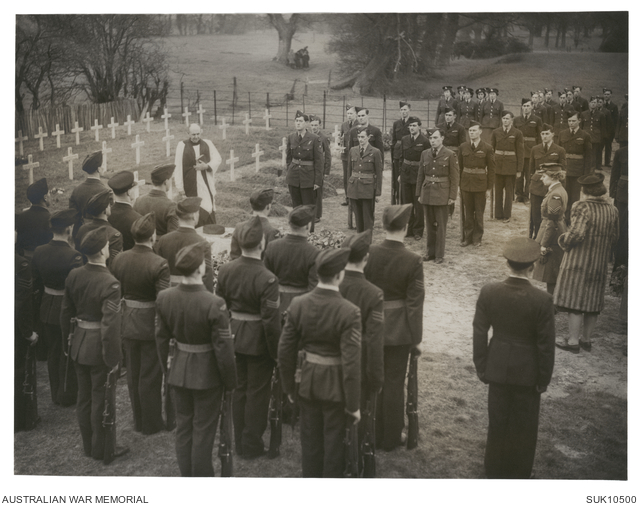
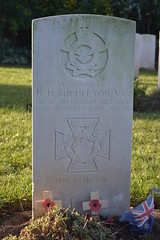
Middleton was buried with full military honours at St. Johns Church, Beck Row. Suffolk.*3

The aircraft experienced a number of attacks as they crossed occupied France, but Middleton, fighting for survival, kept reassuring the crew that he would get them home. Eventually, and against all the odds, they made the English coast, and once over land Middleton ordered the crew to bail out. Five crewmen left the stricken aircraft whilst the other two remained to help him control it. Turning for the Channel, Middleton ordered the two remaining crew members to bail out, whilst he stayed at the controls, steadying the aircraft.

By now the Stirling was very low on fuel and it finally gave up the fight and crashed at 03:00 on the morning of November 29th 1942. Middleton, too injured and too weak to escape the wreckage, drowned within the aircraft fuselage. His two crew members, Sgt. James Ernest Jeffrey (576050) age 19 and Wireless Operator Sgt. John William Mackie (994362) age 30, despite escaping, also drowned. Both the bodies of Sgt Mackie and Sgt. Jeffrey were washed ashore later that day on the 29th.

Middleton’s body remained in the aircraft, but was eventually freed from the wreckage by the action of the sea, and was washed ashore on Shakespeare Beach, Dover, in February 1943. His remains were taken to RAF Lakenheath and he was buried in St John’s churchyard, Beck Row, within sight of his airfield in Suffolk, with full military honours. Middleton was only 26 and only one mission away from ending his tour and returning home.

For his action, dedication and bravery, Flt. Sgt. Middleton was posthumously awarded the Victoria Cross, the first to any serving member of the R.A.A.F in World War II. He was also posthumously awarded a commission as Pilot Officer, backdated to mid November before his sortie to Turin. Thirty years later, in 1978, Middleton’s V.C. was presented to the Australian War Memorial, in Canberra for safe keeping and preservation.

For their actions, the other crew members received three DFMs and two DFCs. Fl.Sgt. Leslie Hyder (DFM) was injured, P.Officer. N. Skinner (DFC) was also injured, along with Sgt. H. W. Gough (DFM). F.O. G. R. Royde (DFC) and Sgt. D. Cameron (DFM) escaped unhurt.

The London Gazette published a report on 12th January 1943. It said:

“Fl. Sgt. Middleton was captain and first pilot of a Stirling aircraft detailed to attack the Fiat Works in Turin one night in November, 1942. Very difficult flying conditions, necessitating three low altitude flights to identify the target, led to excessive petrol consumption, leaving barely sufficient fuel for the return journey. Before the bombs could be released the aircraft was damaged by anti-aircraft fire and a splinter from a shell which burst in the cockpit wounded both the pilots and the wireless officer. Fl. Sgt. Middleton’s right eye was destroyed and the bone above it exposed. He became unconscious and the aircraft dived to 800 ft. before control was regained by the second pilot, who took the aircraft up to 1,500 ft. releasing the bombs, the aircraft meanwhile being hit many times by light flack. On recovering consciousness Fl. Sgt. Middleton again took the controls and expressed his intention of trying to make the English coast, so that his crew could leave the aircraft by parachute. After four hours the badly damaged aircraft reached the French coast and there was once more engaged and hit by anti-aircraft fire. After crossing the Channel Fl. Sgt. Middleton ordered the crew to abandon the aircraft. Five left safely, but the front gunner and the flight engineer remained to assist the pilot, and perished with him when the aircraft crashed into the sea”.

Funeral service for 402745 Flight Sergeant Rawdon Hume Middleton, the RAAF’s first VC winner. He was buried with full military honours in a country churchyard near his station. Air Vice Marshal H. N. Wrigley represented the High Commissioner for Australia (Mr S. M. Bruce) and the RAAF. The graveside service was conducted by Squadron Leader H. C. Thrush of Prospect, SA, RAAF Chaplain. (Australian War Memorial Public Domain)

Middleton’s citation read:

“Flight Sergeant Middleton was determined to attack the target regardless of the consequences and not to allow his crew to fall into enemy hands. While all the crew displayed heroism of a high order, the urge to do so came from Flight Sergeant Middleton, whose fortitude and strength of will made possible the completion of the mission. His devotion to duty in the face of overwhelming odds is unsurpassed in the annals of the Royal Air Force”.

In honour of Middleton’s bravery, Number 1 RAAF Recruit Training Unit at RAAF Base Wagga has renamed the club in his name, the “Middleton VC Club”, and he also appeared on one of the 1995 Australian 45c stamps. The dining hall located at the nearby (now American) base at RAF Mildenhall in Suffolk, has also been named in his honour.

St. John's Church Beck Row, Mildenhall

Fl. Sgt. Rawdon Hume Middleton, VC (RAAF) 149 Sqn RAF, St. John’s Church, Beck Row, Suffolk.

Middleton was a brave and dedicated young man who gave his life to save those of his crew. Each and every one of them acted with the highest dedication, sadly for some, it cost them dearly.

Sources

*1 photo courtesy of Australian War Memorial, image 100641, Public domain.

*2 photo courtesy of Australian War Memorial, image P01019.003, Public domain.

*3 Photo courtesy of Australian War Memorial, Image SUK10501, Public domain

*4 Photo courtesy of Australian War Memorial, Image SUK10500, Public domain

RAF Little Staughton – Winner of Two VCs. Part 2

In Part 1, we saw how Little Staughton had developed initialled used by the USAAF as a depot for repairs and refurbishments, and how soon after it was handed back to the RAF and the Bennett’s Pathfinders.

The end of 1944 would be pivotal though, but not the happy celebratory time it should have been, but a solemn and heart rendering time for those stationed here.

On December 23rd 1944, twenty-seven Lancasters along with their three Mosquito reserves, would take off from Little Staughton and their sister airfields at Bourn and Gravely, to be joined by their escorts – three squadrons of Mustangs from 150 Wing, over France. Once out of the English fog and cloud that had harassed the bombers for several days before hand, the aircraft began to jostle for their correct position in the formation. The three formations, each made up of two Flights, A and B, would gradually settle down now able to see each other in the clearer skies above the heavy English cloud.In such a clear sky, it might be ill-considered to think that anything could go drastically wrong – but go wrong it did.

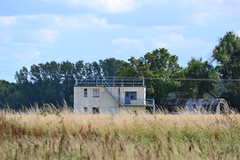
Little Staughton The watch office at Little Staughton is now a listed building.

Assemblies could always be a danger and would be unsettling for any crew. At the back of the six flight formation and unseen to the Little Staughton crews at the front, Graveley’s 35 Sqn’s Flying Officer G.S. Lawson in Lancaster ‘H-How’ (PB683) began closing in on his friend Pilot Officer R. Clarke in ‘F-Freddie’ (PB678). Misjudging the narrow distance between them, Lawson’s aircraft inadvertently made contact with the wing of Clarke’s, sending both aircraft, fully laden with fuel and bombs, spiralling to the icy waters of the English Channel below. As the two Lancasters fell uncontrollably towards Earth, others in the formation could do nothing except watch in horror and prey that chutes would somehow emerge from the two Lancasters. Miraculously, six airmen did manage to escape the stricken bombers before they either broke apart due to the extreme forces exerted upon them, or they hit the water.

A rescue search was mounted immediately. Little Staughton’s reserve pathfinder Mosquito from 105 Sqn, who was sat at the rear of the formation and witnessed everything, remained on station continually radioing the airmen’s positions back to control.  He remained there, watching out, until the launch arrived to begin the arduous task of searching for signs of life. But the icy winter waters of the channel were too much for the badly protected airmen, and although six managed to escape the stricken bombers, all the crew of the launch could do was pull dead bodies from the cold water. Only one crewman was unaccounted for, the body of  Flt.Lt. John Faulkner was some weeks later washed up on the beach at Dieppe. He remains buried there to this day.

Meanwhile, the front two formations consisting of Lancasters from Little Staughton flew on oblivious to the carnage that had occurred behind them. Being an Oboe operation meant that the aircraft had to fly for fifteen minutes straight and level without any deviation from the beam they were following. Hopefully, the predicted cloud over the target would give them some protection from flak and fighters, hence the reason for using Oboe. When they got there however, there was none, just clear bright skies and it was daylight. Ramrod 1415 was about to feel the brunt of the Luftwaffe’s determined pilots.

The first formation had somehow become detached from the second and third, meaning their escort was way behind and having to race to catch-up. With eight minutes to target they were alone, in clear skies and vulnerable.

It was then that the flak began. 88mm and 105mm shells began exploding all around the aircraft, peppering the fuselages like hailstones on a tin can.

Within minutes the gunners had found their mark, and the first aircraft was hit. Mosquito ML998 ‘HS-B’ with 25 year old Flt. Lt. Eric Carpenter, a Canadian, and Fl. Off. William Lambert as navigator, was on fire with both engines out. Moments later, the Mosquito exploded in a massive fireball. Neither airmen would survive and Little Staughton was now one crew down.

With three minutes to go, not only had the flak intensified but fighters had appeared on the scene too. The master bomber, Sqn. Ldr. Robert Palmer in Lancaster PB 371 ‘V’, received hits causing two engines to cut. His Lancaster was now more than ever difficult to fly but on he went fighting the reluctant aircraft every inch of the way. Then further hits badly damaged the Lancaster’s tail forcing the aircraft to turn over and tumble out of the bright German sky.

As the aircraft tumbled over and over, the rear gunner Flt.Sgt. R Yeulatt, another Canadian, manged to escape his turret, more by luck than skill. After his turret was separated from the spiralling Lancaster his body was forced out between the doors by the wind. This incredible escape would be his saviour – he would be the only survivor of the seven man crew.

With all Lancasters receiving intense fire it was going to be carnage – and it was.

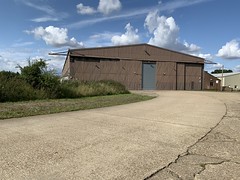
Little Staughton One of the original hangars still in use today.

The second Lancaster to fall from the sky was that of American (RCAF) Flt.Lt. Arndt Reif in PB120 ‘P’. Reid’s aircraft was hit by both flak and enemy fighters. Reif himself was badly injured, and so he gave the order to bale out. Only two crewmen, Flt. Sgts MacLennan and Pearce, both Canadians, escaped with their lives, being picked up on the ground and incarcerated by the Germans.

Flt. Lt. R. Hockley in Lancaster PB141 ’60-F’ went down next. With no controls and one wing on fire, he gave the order to jump, and all seven crewmen managed to escape the burning wreck. Six were picked up by the Germans below, the seventh, 24 year old Pilot Officer Ken Hewitt was attacked by murderous civilians and shot several times. Efforts to save him by a local policeman failed and the murder was the subject to a post war criminal investigation, which concluded that the fatal shot came from Hubert Wester, who was later killed on the Eastern front. No other charges were brought against any of those present.

With one Mosquito and three Lancasters now gone, the deaths were stacking up. Fl. Off. R. Terpenning, an Australian, in Lancaster PB558 ‘A’ had by now taken several hits and was flying ‘on the deck’ to try and make his escape. Pounced on by further fighters, time was definitely of the essence.

The Lancaster’s gunners fought bravely to ward off continued determined Luftwaffe attacks. Fuel now streamed from the wing; two engines were out; the top turret had been severely damaged and many controls were out of action, it was a miracle the aircraft was still in the air. Once over Belgium and the relative safety of the allied lines, Terpenning gave the order to bale out, himself being the last to leave. All seven airmen made it safely out of the Lancaster and were back at Little Staughton just four days later.

By now chaos reigned. Communications were bad at best. Only some aircraft received the order to scatter and had done so, others meanwhile received orders to bomb visually and not by Oboe. Some of the formation dispersed, each aircraft beginning its own unscheduled bomb run.

The last of the formation aircraft to come down was that piloted by 22 year old  Flt. Lt. Peter Thomas, in Lancaster PB523 ‘J’. It, like the others, had received substantial hits and was doomed to crash. After battling against persistent fighters and damaged controls, Thomas finally gave the order to bale out. With himself and a wounded Canadian P. Off. Frederick (Tex) Campbell upfront, the remaining crew escaped and the aircraft crashed. In the wreckage still at the controls, was the body of the pilot Flt. Lt. Thomas.

Of those who escaped four became prisoners of war, the fifth, twenty year old Flt. Sgt. Vivian Hobbs was killed after his chute collapsed on the descent.

Of the seventeen Little Staughton 582 Sqn Lancasters that went to Cologne that day, five failed to return along with a Mosquito of 109 Sqn. With a further two Lancasters from Gravely a total of eight aircraft were lost that day, along with all but one of their crews. The operation had been a disaster from the start, and the crews had paid the price.

After the operation Sqn. Ldr. Palmer, who was on his third operational tour and 111th sortie,  was posthumously awarded the Victoria Cross for his determination in continuing on to the target, even though his aircraft was severely damaged. He insisted on flying straight and level to allow Oboe to pinpoint the target. As a result the crew placed their markers precisely on the target allowing those left following to bomb accurately.*3

The full story and VC citation for Sqn Ldr. Palmer, can be read in ‘Heroic Tales‘.

Little Staughton A Robins Aircraft Hangar still in use today.

The return trip to Cologne on New Year’s eve must have filled the crews with dread, however it proved to be uneventful in that all aircraft returned safely and without incident. Although losses were comparatively light for the two units, seventeen aircraft lost from 109 Sqn and around thirty from 582; equating to some 250 airmen in total; it was still a blow to the squadrons and to Little Staughton as a whole.

With a successful and uneventful last operation, the dawn of 1945 must have brought renewed hope for fewer losses and that of a forthcoming allied victory.

The poor weather of the Christmas period however, did little to deter operations over Germany. On 1st January 1945, 582 Sqn were once again in action flying to both Dortmund and Witten. For almost fifteen days crews would be flying operations, training flights or both. It was a gruelling time but losses were low. It wasn’t until the 16th-17th that the first aircraft would go down. Baling out over allied territory all crew apart from the rear gunner, Sgt. McNamara, survived. With 109 Sqn losing only one Mosquito on the 31st – again both airmen returning safely – January had proven light despite the increase in operations.

It was then in February that another Little Staughton airman would earn himself the Victoria Cross, the second for bravery and dedication to duty.

On the night of 23rd-24th  February,  only ten days after the historical attack on Dresden that resulted in a firestorm, 367 Lancasters and 13 Mosquitoes from 1, 6 and 8 Groups were detailed to attack the city of Pforzheim to the north-west of Stuttgart. This would be the only attack on the city and it would prove almost as devastating as Dresden and Hamburg.

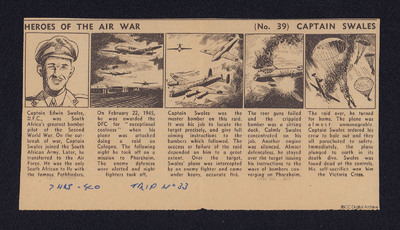
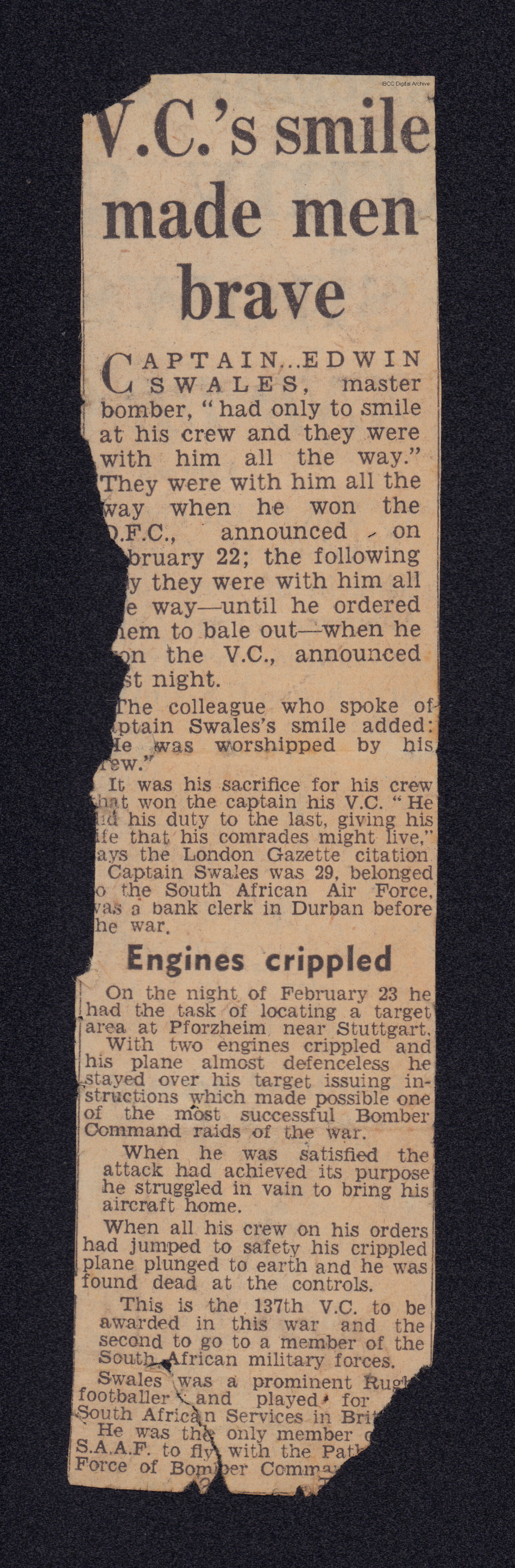
The Master Bomber that night was a 582 Squadron Lancaster piloted by the only South African pilot in the Pathfinders, Captain Edwin Swales DFC. In his Lancaster III PB538 ‘N’, were seven other crewmen, including two navigators.

On the run in to the target, the Lancaster was badly hit by night fighters putting one engine and the rear turret guns out of action. Undeterred, Swales continued to perform his role, guiding the following bombers onto the target with the greatest of precision.

Only when he was satisfied that the attack had been carried out did he leave the target area. Now easy prey to more attacks, soon a second engine was put out of action, controls were damaged with some being inoperable. With a reduced speed and difficult flying conditions he headed for the allied lines, and once safely over them, he gave the order to bale out. All those on board made the jump to safety, leaving Swales at the control trying to maintain steady flight. Just as the last man left, the Lancaster gave up the struggle and was reported to hit high tension cables causing it to crash. Captain Swales was still at the controls when it was found later on.

The attack on Pforzheim  was considered to be very accurate, with over 1,800 bombs having been dropped in little over twenty minutes. Over 17,000 people were known to have died that night in the raging fire that followed, and a post-war photograph, revealed that 83% of the built up area had been destroyed by the raid*4.

Swales’ VC was awarded posthumously, being the second such award to go to airman of Little Staughton, and the third of only three to the Pathfinders. His citation appeared in the Fifth Supplement to The London Gazette, of Friday, the 20th of April, 1945, and concluded: “Intrepid in the attack, courageous in the face of danger, he did his duty to the last, giving his life that his comrades might live.” His story also appears in ‘Heroic Tales’

The war was by now drawing to its inevitable conclusion, and the end of the Nazi’s reign of terror was near. For Little Staughton crews however, the job was far from over. By now the allies were so close to Germany that Oboe stations and forward operating airfields allowed accurate Oboe bombing of Berlin. On the 8th March 109 Squadron’s history was made with their first Oboe marking of Berlin and Munich; the longest range they ever attempted. Eighteen aircraft were ordered out to four targets, the other two being Dessau and Hamburg, The night was not the most successful though, with technical problems causing issues with a number of Pathfinder aircraft. On the Hamburg raid, four of the six aircraft marked well, one aircraft lost an engine and had to return early, whilst over Berlin, two of the four markers had to return without marking also due to technical issues. The Dessau raid suffered similar technical issues.

By now the war was in its last stages, and the night of 20th-21st April saw yet another pivotal moment in the history of the war, with the RAF’s last attack on the German capital. 109 Sqn were again in action, and it was Mosquito XVI ML929, piloted by F.O. A.C. Austin and F.O. P. Moorhead, who claimed the honour of dropping the last RAF bomb on the city. It was yet another feather in the cap for Little Staughton crews.

Little Staughton One of the original hardstands now has farmers sheds on it.

Other German cities then took the brunt of the Allied attacks. To the south, allied troops were approaching Hitler’s lair at Berchtesgaden,  but the night’s attack in April would not be one to remember, as all Little Staughton’s aircraft suffered technical issues preventing them from marking the target. It is thought that the surrounding mountains had interrupted the Oboe signal leading to poor reception by the Pathfinders. Due to fog and snow, identifying the target was then made more difficult for the following bombers, but with relatively accurate strikes, the raid was considered a success. However, it was not to be the Pathfinder’s final night of glory.

Attention then turned to Manna operations, and 109 began to mark targets in Holland for food parcels. A remarkable effort allowing foodstuffs and urgent supplies to be dropped to starving civilians in Holland.

Whilst bomber command was concentrating on humanitarian flights, 109 Squadron took part in the final raid on Kiel on May 2nd-3rd, with four aircraft taking part. One suffered problems and was unable to mark leaving the remaining three to identify and mark the target.  It was solely a Mosquito attack using aircraft from both 8 and 100 Group, after which large fires were seen rising from several parts of the town. After the last remnants of the German army left, it was declared ‘undefended’ and open, and allied troops entered unopposed just 36 hours later.

With the war’s end, the Pathfinders returned to dropping markers for food supplies, and ‘cooks’ tours began, aircrew taking ground crews on ‘sight-seeing’ trips over Germany to show the extent of the devastation caused by the war and the allied pounding of Germany’s towns and cities. An event that really brought home the effects of the war on Germany.

In September 1945 after much speculation and many staff movements, both squadrons were ordered to disband. 582 was first on the 10th with 109 Squadron soon after on the 30th. A glimmer of hope then came for 109 Sqn, when it was reborn through the renumbering of 627 Sqn at Woodhall Spa. To all intents and purposes though it was a different squadron to the one that had worked so hard and with such dedication here at Little Staughton. The operational record books for 582 Squadron simply states: “No further entry, Squadron disbanded as of 10th September 1945“. On roll were 147 airmen and 92 Officers, six of which were New Zealanders. The records also show that the squadron had dropped over 8,000 tons of bombs cumulatively, while 109 Sqn recorded: “This is the finish, all our aircraft were flown to Upwood today.”

Some 522 raids had been flown by 109 Squadron, covering over a staggering 5,400 sorties, while at either Little Staughton, Wyton or Marham, all with a loss of just 18 aircraft. 582 on the other hand had flown over 2,100 sorties in 165 raids with a loss of 28 Lancasters all whilst based at this little airfield in the Cambridgeshire countryside*4.

Throughout the war, thoughts had never been far away from post war aviation and in particular the development of new, larger and faster aircraft, both military and civil. With it would come the demand for bigger airfields and longer runways, which led to a search for possible extensions to existing airfields.  Farnborough and the RAE (Royal Aircraft Establishment), was the preferred choice, but the site was penned in and unable to have its runway extended to the five miles thought necessary to accommodate new types of aircraft. Alternatives were sought with the final decision being the amalgamation of three airfields: Twinwood Farm, Thurleigh and Little Staughton; a five mile runway linking Thurleigh with Little Staughton which would then be linked by a taxi way with Twinwood Farm. The idea behind the huge development was to replicate the Californian Muroc test facility (now Edwards Air Force Base) to enable testing of new developments in aviation. The idea never materialised though, and would have no doubt faced serious opposition had it ever got to the consultation phase*1.

So, with no real need for Little Staughton it was soon surplus to military requirements, and with their dramatic reduction of assets, its days were sadly numbered.

Following the departure of the two squadrons, the airfield became used as a transport base, before finally closing in December 1945, and being placed into care and maintenance. In the 1950s the runway was given consideration again and work began to extend it for use in emergencies by US military aircraft, but this was also a short lived exercise, and by the end of the decade this too had ceased, and the site was closed to all military activity. For a short while it was used by the civilian Brooklands Aviation company as a repair depot, but was soon returned to farmland although the runway, and some of the perimeter tracks remain, used by a small aviation company along with several of the hangars which are used by light industry.

The Watch Office continues to stand and is now a Grade II listed building, being listed in December 2005 for its ‘special architectural and historic interest’. Historic England describe it as “One of a very small number of control towers of the Second World War period that have survived in a substantially complete state of preservation…This is an exceptionally well-preserved example of a 1941 control tower design for bomber satellite stations, of which 24 out of 45 built survive.”*2

With that, Little Staughton quietly slipped in to the history books. The buildings left standing echoing the hectic activities of two Pathfinder Squadrons, from which over 250 airmen lost their lives.

582 Sqn had been purposefully created for a role, a role it performed to the highest standard and with the greatest pride of any squadron in the RAF. 109 Sqn had performed with the same dedication and determination, meaning that Little Staughton crews were awarded two of the three VCs the Pathfinders earned, the highest honour to be bestowed on any military personnel. In addition to these, numerous other gallantry medals were also awarded to the many crews of both squadrons, a number of whom had flown in excess of 100 sorties whilst based here at Little Staughton.

Little Staughton Remnants of the airfield still exist as farm tracks.

Little Staughton was only operational for a short period of time. But in that time it achieved some of the highest accolades possible in military terms. It brought a great sense of pride to the local area, and a huge influx of men and machinery. Today it stands quiet, just outside of the village which marks its history with a small stone laid close to the end of the main runway. The local church, All Saints, also has a roll of honour commemorating all those personnel who lost their lives here, and a memorial stone close by pays homage to those who served and died in this remarkable place.

The entire story can be read in Trail 29.

Sources and further reading (Little Staughton)
*1 Smith, D., “Britain’s Military Airfields 1939 – 45” Patrick Stephens Limited, 1989
*2 Historic England Website accessed 17/9/23

*3 Much of the report from this comes from a combination of Operational record books and secondary resources including Feast., S., “Heroic Endeavour“, Grub Street Publications, 2006.

*4 Middlebrook, M., Everitt. C., “The Bomber Command War Diaries“, Midland Publishing Ltd, 1996

National Archives Operational Records:

AIR 27/2052/2; AIR 27/2052/1; AIR 27/854/8; AIR 27/854/7; AIR 27/2052/7; AIR 27/2052/8; AIR 27/2052/10; AIR 27/2052/9; AIR 27/855/2; AIR 27/2052/14; AIR 27/2052/13; AIR 27/856/7; AIR 27/856/9; AIR 27/2449/1; AIR 27/2052/27

RAF Little Staughton – Winner of Two VCs. Part 1.

Trail 29 saw a trip to two airfields both of which have now gone. A new addition to this trail, takes us back to the west of Cambridgeshire to the Bedford border and a small airfield that continues to operate as a flying entity. But, and perhaps more importantly, it is one where two VCs were won, and where RAF Pathfinders reigned supreme. Having only a short life itself, and only two front line squadrons, its rather unassuming presence hides a remarkable tale of heroism, bravery and dedication that transports it high into the ranks of wartime history.

In the latest addition to this trail we visit the small village with two airfields, starting with RAF Little Staughton.

RAF Little Staughton

The village of Little Staughton sits on Oxford Clay, a Jurassic marine sediment, and is located about 4.5 miles from Kimbolton and 8 miles from Bedford. The village itself resides in the upper most regions of Bedfordshire, but this is not the original village, that being abandoned following the bubonic plague, and so the village we see today being created as a result.

Little Staughton is unusual in that it has been home to two wartime airfields, RFC Little Staughton which was open between October 1916 and June 1917, and its World War II counterpart, RAF Little Staughton. Both add further complexities to the name by each being located over the county border in Cambridgeshire.

RAF Little Staughton, like many of its contemporaries, was cold and draughty. The staff huts dispersed around the various sites provided little comfort to those inside seeking warmth and shelter from the elements outside.

Built by a mix of construction companies including the AMWD  (Air Ministry Works Directorate), it had three concrete and tarmac runways measuring 1,920 x 50 yards; 1,340 x 50 yards and 1,000 x 50 yards with the main runway running in an approximate east-west direction.

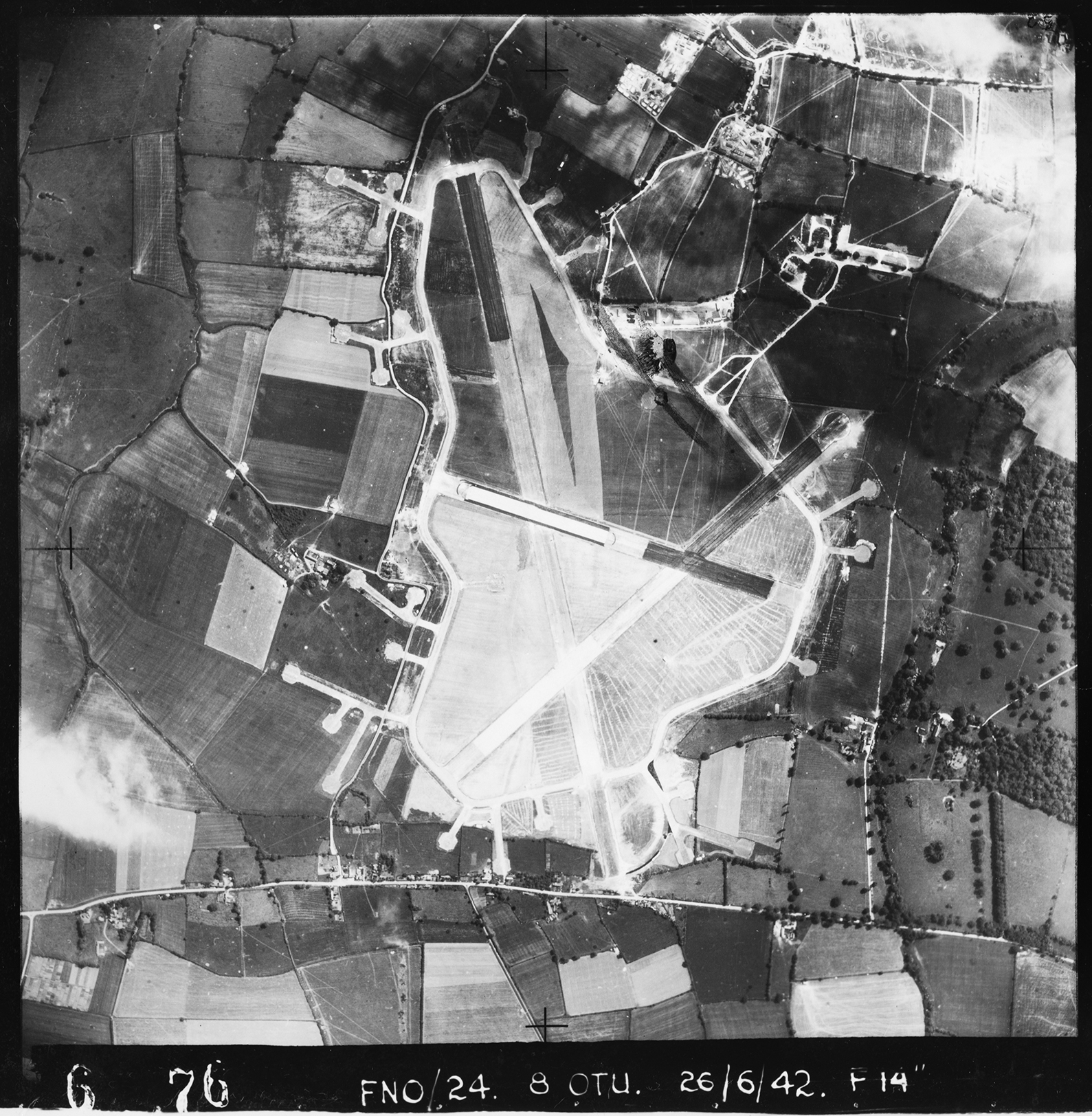
Little Staughton (east upward) whilst under construction, 26th June 1942. Note the accommodation and technical areas have not yet been started and the spectacle hardstands are missing. Photo taken by No. 8 OTU. English Heritage (RAF Photography RAF/FNO/24).

Aircraft maintenance and storage consisted of eight Robin and three ‘T2’ hangars with an additional Butler hangar. Butler hangars were built in limited quantity for use on American airfields, and were supplied in kit form from the Butler Manufacturing Company, Kansas. They were made of box-section girders and then clad with canvas to keep out the elements and provide some protection for those inside. Butler stores buildings of which there were two at Little Staughton, were similar, but with rigid frames and beams forming a forty foot span. The presence of these buildings give a little insight into the origins of the airfield, as neither were found elsewhere on RAF airfields.

Around the perimeter track, there were thirty-seven pan style hardstands along with an additional sixteen spectacle hardstands. Personnel accommodation blocks for approximately 2,500 staff of mixed rank and gender, were spread to the east, behind the technical area, and incorporated eleven sites including a waste water treatment plant, three communal sites and a sick quarters. A further site housed the airfield’s transmitter.

Staff accommodation was made by a mix of suppliers and materials. These included Laing, Nissen and Ministry of Works, using both asbestos and corrugated iron. It is also known that ‘Jane Huts’ existed at Little Staughton, timber frames with plasterboard, or later, corrugated iron covering reinforced with chicken wire – hardly a home from home!

The technical area itself housed the usual collection of maintenance and training buildings including: three link trainers, a free gunnery trainer, a parachute store, workshops, an A.M. bombing teacher and various stores built from numerous materials. Located not far from the technical area is the watch office, built in 1942 using the Air Ministry’s Directorate of Works and Building’s design, Drawing No. 13726/41, it was rendered brick with an asphalt roof, with the watch office to the front on the ground floor and a meteorological office, switch room and lavatories to the rear. The first floor has the control room to the front of the building with 2 large windows, and to the rear was the controller’s rest room and signals office. Access to the second floor is via external steel stairs and a balcony  provides extensive outside views of the airfield as was common with wartime watch offices.

Opened in December 1942, Little Staughton was handed over to the USAAF to be used as No.2 Advanced Air Depot (AAD) and renamed in accordance with the US naming system as Station AAF127. This provides an explanation as to why Butler structures appear at the site.

The main role for the 2nd AAD (previously known as SAD – Strategic Air Depot) was to expedite repairs, modifications and in-depth maintenance to the B-17s of the 1st Bomb Wing. A role that could prove grizzly as many would have been badly shot up with the inevitable casualties languishing inside. A number of similar bases were established and then further developed by the Americans, these included: Warton, Burtonwood and Langford Lodge. Being the only one at the time in East Anglia though, Little Staughton was given priority and quickly established itself as a high level maintenance base.

A year after it opened however, the US authorities decided to move the depot from Little Staughton to a new base at Abbots Ripton adjacent to the huge American base at Alconbury. Little Staughton, then surplus to their needs, was subsequently handed back to the Royal Air Force and Bomber Command, who, on March 1st, took over control and began moving new personnel and aircraft on to the site.

Little Staughton

One of Little Staughton’s technical huts now used for light industry.

8 (PFF) Group, under the command of Donald Bennett, and to whom the airfield was allocated, was undergoing a reduction in squadron flights from three to two at this point, and so a month later to the day, the first aircraft, Lancasters of ‘C’ Flight, 7 Squadron at Oakington along with Lancasters of ‘C’ Flight 156 Squadron from Upwood, arrived to form a new squadron, 582 Sqn, as part of the Pathfinder force and based here at Little Staughton. The squadron would use both the Mark I and Mark III Lancaster, and would be the last of the heavy bomber units to be formed under the Pathfinders.

On April 1st 1944, fifty officers arrived at Little Staughton, and were immediately assigned to the command of Squadron Leader (Acting Wing Commander) C.M. Dunnicliffe DFC from 97 Sqn at Bourn. Sqn. Ldr. Welbourn and Sqn. Ldr. McMillan were placed in temporary charge of ‘A’ and ‘B’ Fights respectively. The squadron headquarters, flight offices, crew rooms and specialist offices were all quickly put to good use and various alterations made to the buildings to suit the new squadron. The crew rooms were perhaps deemed better than some, being described as “commodious” by the new admin staff.

582 Sqn were not alone for long though, being joined within twenty-four hours by the twin-engined Mosquitoes of 109 Sqn from RAF Marham, the various aircraft being ferried in over a two day period.

There would be no respite for the two squadrons though. 582’s Lancaster crews began training immediately, flying cross country flights, “Y” training flights, fighter affiliation flights and so on. 109 Sqn on the other hand began operations to the continent almost immediately. On the 4th, four Mosquitoes were detailed to Essen, two to Rhinehausen, two more to Aachen, Kreffield, Cologne and two more to an unnamed target. Only one aircraft had problems that night, Mosquito IV ‘DZ256’ suffered engine problems and so the pilot instructed the navigator to bale out over the coast. The Mosquito then managed to land at Bradwell Bay, a difficult task in a Mosquito especially as the propeller on the faulty engine could not be feathered.

Bradwell Bay was soon to see more of the 109 Sqn Mosquitoes. On the 8th, a second one crash landed there after being hit by flak over Essen. Thankfully, both pilot and navigator were unhurt in the landing.

The rest of the month was operationally similar. With numerous flights to the continent marking and bombing targets, some requiring markers whilst some didn’t, and in these cases the target indicators (TIs) were brought home. Several aircraft over the month had failed to bomb due to ‘technical problems’, mainly failing oxygen systems, faulty aircraft undercarriage or engine trouble.

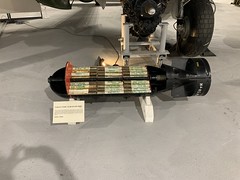
Hendon RAF Museum

A thousand lb Target indicator Bomb at Hendon.

582 Sqn on the other hand, continued throughout the month with training flights inter-dispersed with a small number of operations over the continent. On April 23rd they received a blow, when Lancaster III JA933 ‘S’ flown by New Zealander Flt. Sgt. Wallis B. Forfar failed to return from a seven ship formation to Laon. Sadly all seven crew on board were killed that day, and their bodies remained buried together in Roye New British Cemetery in the Somme. Their known ages ranged from just 19 years of age to 22.

Operations and training flights were interrupted on April 29th, when Air Vice Marshall Don Bennett visited the airfield, and in particular 109 Sqn’s Messes. He presented watches ‘on behalf of a foreign admirer of the Royal Air Force‘ to Pilot Officer Sexton and Flight Sergeant Marchant who had both completed  seventeen sorties to Berlin.

By the end of the month both squadrons had been on operations almost daily, the routine of training now taking a back seat. These continual operations meant that the two squadrons amassed in excess of 300 sorties between them. Little Staughton and it’s crews had certainly made their mark.

Over the next few months, operations took both squadrons to strategic targets, V-1 sites were especially targeted, accurately marked by the Mosquitoes of 109 Sqn. Railway yards and road junctions were also hit in an attempt to slowdown advancing German reinforcements into Normandy. The Pathfinder squadrons were making good use of their skills.

July 11th 1944, would prove to be a first for both Bomber Command and for 8 Group in particular. The modification of a 582 Sqn. Lancaster, ND817 ‘S’ meant it was the first to carry the new ‘Oboe’ equipment. It was then piloted by Wing Commander G.F. Grant of 109 squadron, who directed the first ‘heavy Oboe’ operation of the war. Grant, himself a seasoned Mosquito pilot, was able to direct the bombers accurately onto the target, initiating bombing when he bombed, and so aiming to obtain a higher level of success than had previously been achieved.

The attack by seven Lancasters on the flying bomb’s site at Gapennes, proved uneventful in terms of losses or incidents, but was no doubt a notable point in the bombing war. Now they could hit small, precision targets with heavy bombers using Oboe.

A second such operation on July 20th to the flying-bomb site at Foret-du-Croc was not so fortunate though, 582 squadron suffering the loss of the leading aircraft, Lancaster ED908 ‘Z’ flown by Sqn. Ldr. J. Foulsham DFC, AFC.

Using the new Oboe equipment required considerable training, and so four of the crew, including Sqn. Ldr. Foulsham, had been reassigned to the aircraft from 109 Sqn. With two navigators on board the aircraft, the eight man crew were all lost when the aircraft was shot down, crashing with great force on the run-in to the target. Sqn. Ldr. Foulsham may have been a late change on that operation as the ORB doesn’t list him as flying that day. All eight crewmen are buried in the Canadian War Cemetery in Dieppe.

With two more Lancasters lost on July 23rd-24th and another on the night of 28th-29th, 582’s losses were slowly mounting. In one of the Lancasters lost on 23rd, was the South African airman Lt. Swales, who went on to later be awarded the VC in 1945. Whilst the aircraft was lost in an emergency landing, the crew were all safe and they continued flying almost immediately. Additionally, in the last Lancaster to go down that July, was one of Bomber Command’s oldest airmen Flt. Sgt. C. Lewis at age 39. Seven of the eight airmen were lost including Flt. Sgt. Lewis.

August would prove to be one of the heaviest months for operations, especially for 109 Sqn, who would mount in excess of 500 sorties flying against Flying Bomb sites, oil plants, rail junctions, fuel depots and other strategic targets.

In late 1944, Arthur Harris was partially released of the tight constraints applied to him by the Supreme Allied Commanders, and so he was now able to turn his forces to his favoured targets – the cities of Germany. Although directed to focus on oil, many of these cities had close connections to oil, and so Harris was able to circumnavigate the directive with few complaints from those above him.

As aircrew casualties began to fall and the number of available heavy bombers began to rise, the RAF were now able to increase their operations, dropping almost half of all their wartime tonnage in the remaining few months of the war*4

August 1944 would prove to be another pivotal month in Bomber Command, as the first major daylight raid since 1941 was launched against German targets. 582 Sqn sent ten Lancasters to Minoyecques, whilst 109 Sqn sent eight Mosquitoes to Homburg in Saarland and six Mosquitoes to Minoyecques in support of the Lancasters. All aircraft returned safely to Little Staughton, some bringing indicators back with them as they were not needed due to accurate and extensive marking. The end of the month ended on a more sour note for the two squadrons however, with the loss of one Lancaster along with all of its crew, and two Mosquitoes. It is believed that all four crewmen from the Mosquitoes managed to evade capture, although their fate is not yet known.

Perhaps the most successful operations for 582 Sqn came on October 3rd, when 252 Lancasters and 7 Mosquitoes attacked the sea walls at Walcheren, targets that dominated the approach to Antwerp. By breaching the sea wall it was hoped that the sea would flood the defences behind, and drastically hinder any defence against an allied assault on the town. Once Antwerp was taken, an estimated 40,000 tons of supplies could then be poured through to the front line of the allied advance, who were now getting very low on supplies and losing momentum as a result.

The operation led by Master Bomber Grp. Cptn. P. Cribb in Lancaster ND750 ‘E’, of 582 Sqn was a great success, with the walls being breached across a 100 foot span,  through which millions of gallons of water could pass. The attack was carried out by eight waves of Lancasters with Pathfinder Mosquitoes and Lancasters leading the way. At the back of the formation were 617 Sqn Lancasters carrying Tallboy bombs, but because the bombing was so successful and accurate, these were not needed and 617 Sqn took them back home with them.

By the winter of 1944/45, and although a long way from beaten, the Luftwaffe were now on the back foot and the allies were becoming masters of the skies. By the end of the year RAF daylight operations were commonplace, but they were not without their problems.

In Part 2 we see how Little Staughton crews took the brunt of the Luftwaffe’s determination to take back control of the skies. In one mission alone, they would sacrifice eight aircraft and most of their crews. It would however, bring the first of two VCs to the little airfield.

The entire story can be read in Trail 29.

Loss of Lancaster EE118, 156 Sqn PFF – RAF Warboys.

On 30th September 2023, a dedication was paid to the loss of Lancaster EE118 of 156 Squadron PFF, RAF Warboys, which crashed 80 years prior.

The Lancaster, a MK.III, took off from Warboys at 18:24 on September 29th 1943 on operations to Germany. It was joined by nine other Lancasters from the same squadron to bomb Bochum in Western Germany. Over the target, flak was moderate and visibility was good. Marking was in the form of skymarkers, along with red and green target indicators (TI) and bombing was reported as scattered with smoke rising to 5,000 ft.

On Lancaster EE118 that night was Flt. Sgt. Frederick H. Ray (Pilot); Sgt. David R. Booker (Bomb aimer);  Fl. Off. Sydney K. Smith RCAF (Navigator); Sgt. Norman P. Winterburn (Wireless Op); Sgt. William A. Lineham (Flt. Engineer); Sgt. Frederick D. Dickens (Air Gunner) and Sgt. Arthur S. W. Orchard (rear Gunner).

The aircraft had suffered heavy flak damage, several of the instruments were not working including the compass and altimeter, and a 1,000lb bomb remained ‘hung-up’ in the bomb bay, Their return to Warboys would take them over the North Sea, across the Wash and south-east toward Warboys, but they requested landing permission at RAF Downham Market as it was closer. Permission was granted, and the ‘hung-up’ bomb was safely disposed of over the Wash.

Lancaster EE118 crash plaque

The Memorial Plaque to Lancaster EE118.

Downham Market was at the time shrouded in thick fog and the FIDO installation recently added was not yet fully serviceable. Flt. Sgt. Ray made his approach, and with 10/10ths cloud as low as 1,000 feet, it was very difficult to make out where he was.

On his first approach, Flt. Sgt. Ray missed the runway and so headed north, and then turned in a south-west direction to make a new approach from the east. On his run in toward the final turn, the rear wheel caught the tree tops of a Slubberdike Wood, located  north-west of the airfield. This slowed the aircraft down sufficiently to prevent it from climbing, and as they passed over Allotments at nearby Wimbotsham village, the port wing clipped a raised air-raid shelter near to the allotment entrance. This caused the wing tip to break off and resulted in the aircraft colliding with a telegraph pole at the end of Hop Pikel field near to Milller’s Lane which flipped the aircraft over bring it down in an orchard.

In the accident, all but the rear gunner Sgt. Orchard were killed outright, Sgt. Orchard being thrown clear from his rear turret.

The noise of the crash alerted  local people who went out to see what had caused all the noise, and suspecting an air crash, they searched for wreckage. Gardens at the end of Miller’s Lane were strewn with bits of aircraft and a two young boys by the name of Gutteridge, came across Sgt. Orchard with a large branch across his legs. Fearing he had broken it, Sgt. Orchard begged them not to move it and await medical assistance in case it made the injury worse.

In the confusion that followed, Sgt. Orchard couldn’t remember if the 1,000 lb bomb had been dropped or not, so the police on the scene cleared the nearby houses sending everyone into their various bomb shelters for protection. It was not necessary however, and soon the all clear had been given and they returned to their homes.

Another young boy, 12 years old at the time, recalled how the rest of the crew were found in his garden, 39 Miller’s Lane, and how they were removed by RAF personnel during the night. Wreckage was found across the orchard and in local gardens, until RAF salvage teams took the aircraft away some 3 – 4 weeks later.

aerial photo

An aerial photo of Wimbotsham showing the direction the Lancaster flew on that fateful night. The scar in the orchard is clearly visible. The airfield is in the bottom right hand corner.

On the 30th September 2023, a plaque was attached to the Wimbotsham village sign to commemorate the loss of the crew nearby. The ceremony was opened by Mr. Ian Cable, Chairman of Wimbotsham Parish Council with a greeting and introduction from Reverend Canon Dr. David Karoon. After the hymn ‘O God our help in ages past’, Group Captain Frederick Wigglesworth, Station Commander RAF Marham, gave the Bible reading Isaiah 40:25:31 which was followed by a prayer of dedication led by The Rev. (Wing Commander) Eddie Wynn.

Dr. Karoon then gave a blessing of the memorial after which followed  ‘The Airman’s Hymn’ sung by those gathered at the service.

Memorial dedication EE118

Mr. Dutton gives background information on the Pathfinders with Rev. Canon Dr. Davis Karoon, The Rev (Wing Cdr) Eddie Wynn and Group Captain Frederick Wigglesworth looking on.

Following the Lords Prayer, a further dedication was given by Bill Bower, the R.A.F.A. Chairman, which preceded the Last Post and a minutes silence. The ceremony was closed with some back ground information on the Pathfinders by Tim Dutton, and the Benediction from Dr. Karoon. Lastly, the National Anthem was sung and a thanks to those involved given by Mr. Cable.

In the gathering were relatives of both Sgt. Arthur Orchard and Sgt. David Booker, the bomb aimer, along with villagers who remember the crash in 1943.

Tea, cake and a display of material from the crash and personal letters from Arthur Orchard to relatives of the crew were made available in the village hall, itself a former RAF Downham Market admin building.

The crew in Lancaster EE118 (GT-?)

Flt. Sgt. Frederick H. Ray (Pilot), s/n: 1391599, age 26
Sgt. David R. Booker (Bomb aimer), s/n: 1413457, age 20
Fl. Off. Sydney K. Smith RCAF. (Navigator), s/n: J/14174, age 21
Sgt. Norman P. Winterburn (Wireless Op), s/n: 1439760, age 21
Sgt. William A. Lineham (Flt. Engineer), s/n: 1815307, age 19
Sgt. Frederick D. Dickens (Air Gunner), s/n: 1613337, age 20
Sgt. Arthur S. W. Orchard (rear Gunner) – survived

The Lancaster, a MK.III, was built as part of the fourth production batch of 620 aircraft (the final contract of No. 6427) by A.V. Roe & Co Ltd. at Chadderton. It was delivered to 32 Maintenance Unit (MU) on 27th May 1943 transferring to 156 Sqn. on 22nd June 1943. It was struck off charge after the Wimbotsham crash on 19th October 1943.

A range of resources were used in the compiling of this post, including:

National Archives: AIR 27/1041/40

Chorley, W.H. “Bomber Command Losses of the Second World War – 1943“, Midland Counties, 1996.

Holmes, H. “Avro Lancaster – The Definitive Story“, Airlife Publishing, 1997

Personal letters and photos on display from Arthur Orchard and Derek Neal.

September 26th 1942, a near tragedy for three RAF Squadrons.

The Eagle Squadrons were three RAF Squadrons made up of American volunteers, their achievements and records are well-known and well documented, however, it was not all plain sailing for these determined and courageous flyers. For one Squadron in particular, 133 Squadron, September 26th 1942 would be a disaster, a disaster that would almost wipe out the entire flight of twelve airmen.

133 Squadron had been on the front line serving at RAF Biggin Hill and RAF Martlesham Heath before arriving at RAF Great Sampford, a satellite for RAF Debden. The ground crews were predominately British, assisting and training the US ground crews in aircraft maintenance and support. All the pilots however, were US volunteers, formed into three separate squadrons but under RAF control.

1st Lt Dominic ‘Don’ Gentile and Spitfire BL255 ‘Buckeye-Don’. The photo was taken after 133 Squadron RAF was disbanded and absorbed into the USAAF as the, 336th FS, 4th FG, 8th AF. (@IWM UPL 15072)

133 Squadron would arrive at RAF Great Sampford on September 23rd 1942, the same day as 616 Sqn RAF departed, they would be the last operational unit to fully use the airfield before its eventual closure.

Initially flying the Spitfire VBs, they soon replaced them with the MK.IX, a Spitfire that was essentially a MK.V with an updated engine. Having a higher ceiling than the FW-190 and being marginally faster, its improved performance took the Luftwaffe by complete surprise. It was so new and improved, that it remained on the secret list until after this particular operational flight.

On that fateful day, September 26th 1942, fourteen Spitfires of 133 Sqn took off from RAF Great Sampford in Essex, piloting those Spitfires were:

BS313 – F/Lt. Edward Gordon Brettell DFC (61053) The only British pilot and leader
BS275 – P/O. Leonard T. Ryerson (O-885137)
BS446 – P/O. William H. Baker Jr (O-885113)
BS137 – P/O. Dennis D. Smith (O-885128)
BR638 – P/O. G.B. Sperry (O-885112)
BS445 – P/O. Dominic “Buckeye-Don” S. Gentile (O-885109)
BS138 – P/O. Gilbert G. Wright (?)
BS279 – F/Lt. Marion E. Jackson (O-885117)
BS447 – P/O. R.E. Smith (O-885110)
BR640 – P/O. C.A. Cook (O-885112)
BS148 – P/O. Richard “Bob” N. Beaty (?)
BS301 – P/O. G.H. Middleton Jr (O-885127)
BS140 – P/O. Gene P. Neville (O-885129)
Unknown  – P/O. Ervin “Dusty” Miller (O-885138) (not listed but known to have been on the flight).

They were to fly to RAF Bolt Head in Devon, where they would meet with 401 Squadron (RCAF) and 64 Squadron RAF, refuel and be briefed for the mission. A mission that was supposed to be straight forward and relatively uneventful.

The aim of the mission was to escort US bombers to Morlaix on the Brest peninsula. The usual commander of 133 Sqn, Red McColpin, was not placed in charge that day, instead he had been posted, and a British Pilot, F/Lt. Edward Gordon Brettell DFC, was issued with the task.

McColpin was a strict disciplinarian and his leadership was admired by those who followed him. Without this leadership, 133’s preparation was slack and they ultimately paid the price for this.

After landing at 12:30 hours, they realised there were no facilities at Bolt Head for refuelling, and they would have to go with what they had. This would kick-start a catalogue of errors that would ultimately seal the fate of the flight. Following a briefing in which Wing Commander Kingcombe DFC and all but two of 133 Sqn pilots had failed to show up for, the flight (which included the sixteen 401 (RCAF) Squadron Spitfire IXs from RAF Kenley) took off at 13:50 hours. Of the fourteen 133 Sqn Spitfires sent to Bolt Head, only twelve would be needed, and two pilots were instructed to remain at Bolt Head, they were P/O. Ervin Miller, and P/O. Don “Buckeye-Don” S. Gentile, they would be the luckiest two men of the squadron that day.

The briefing, a very vague and rushed one, instructed the flight to carry out a ‘Circus‘ mission escorting seventy-five B-17 Flying Fortresses from the 92nd BG, 97th BG and the 301st BG, who were bombing Cherbourg and the airfields at Maupertus and Morlaix in Brittany. When the squadron took off the weather was clear, and winds were predicted to be 35 mph at 24,000 feet, but 5 miles off the English coast, they encountered 10/10th cumulus cloud cover at 7,000 feet, and so had to climb above it so that they could locate the bombers more easily.

The take of was a mess, disorganised and lacking both radio information and in many cases maps, the aircraft were lucky not to collide with each other.

Of the three RAF squadrons involved in the mission, 401 would take the high position, 133 the middle and 64 Squadron, the lower. They were to form up over Bolt Head at 2,000 feet and then head at 200o at 180 mph to overtake the bombers before they arrived at the target. If they could not locate the bombers, the flight was to circle the target for three minutes and then depart.

As the flight approached the rendezvous area, one 133 Squadron Spitfire had to drop out of formation and return home, as he had encountered engine problems; this problem was thought to be due to his low fuel. The remainder of the flight  scanned the skies for any sign of the bomber formation, and after searching for some 45 minutes, they spotted the bombers, some 50 miles south of Brest. The bombers had in fact already turned for home after having discarded their bombs near to the Pyrenees.

By now the 301st BG had been recalled, as their fighter escort failed to materialise, whilst the 97th BG had continued on. However, due to the heavy cloud cover over the target area, they had been ineffective as no bombing of the target had taken place. The American bombers, who were only three months into their European air war, had inadvertently miscalculated a tail wind putting them off track well away from the Bay of Biscay.

P/O. G.H. Middleton Jr of 133 Squadron RAF was shot down and taken Prisoner of War (@IWM UPL 18927).

The three squadrons formed up on the bombers at just after 16:45 hours, with 64 Squadron on the port side, 401 Squadron on the starboard and 133 Squadron behind. The whole formation then flew north for 30 minutes, at which point it became evident that the wind speed was in fact over 100 mph, and not the 35 mph as stated by the Meteorological Office, or at the briefing! It has since been revealed that this information was known to those in authority, but it had not been passed down the chain of command and the pilots were never informed.

The formation then spotted land, the bombers thought they were over Falmouth and turned right. 64 and 401 Squadron broke away maintaining height, but 133 Squadron dropped down below the cloud base and prepared to land.

133 Squadron then began to search for the airfield, and after searching in vain, they found a large town, this they hoped would give them the vital fix they desperately needed. Flying low over the houses they realised they were not over England at all but in fact still over France. The flight, uninformed of the 100 mph north-easterly wind at their altitude, had also been blown wildly off course, and after 1.5 hours flying time, the situation had suddenly become very severe indeed.

The Squadron flight Leader, Flight Lieutenant E.G. Brettell, wanting to ascertain his exact position, called up a ground direction finding station who provided a  bearing and heading – 100 miles off the English coast with a homing vector of 020o. It was at this point they suddenly realised they were over the port of Brest, one of the most heavily defended ports under German occupation.

Immediately, the sky filled with flak and small arms anti-aircraft fire. The pilot in the number 2 position, Pilot Officer Gene Neville (O-885129) in Spitfire #BS140, took a direct and fatal hit, he was killed instantly. Three other aircraft were to be shot down in the melee that followed: Pilot Officer William H Baker Jr (O-885113) in Spitfire #BS446; Pilot Officer Leonard Ryerson (O-885137) in Spitfire #BS275 and Pilot Officer Dennis Smith (O-885128) in Spitfire #BS294 – all four were killed, and all four were awarded the Purple Heart.

2nd Lt. Gene P. Neville 133 (Eagle) Sqn RAF, stands before his MK. IX Spitfire at Great Sampford. He was Killed during the Morlaix disaster. (@IWM UPL 18912)

The remainder of 133 Squadron struggling to defend themselves, they scattered and were forced to land out of fuel, either on the island of Ouissant or on the French mainland.

Of the seven 133 squadron pilots who crash landed on French soil, five were known to have been captured immediately and taken prisoner: P/O. G.B. Sperry; F/Lt.  Edward Brettell; F/Lt. M.E. Jackson; P/O. C.A. Cook and P/O. G.H. Middleton Jr., with a sixth, P/O. G.G. Wright, evading the Germans for several days before being captured later on.

Of these initial five, F/Lt. Jackson was injured in his crash and hospitalised for eight weeks. He was then taken to Stalag Luft III from where he was able to escape for about ten days by jumping from the roof of his cell house into a lorry load of evergreen branches that were being taken away from the camp.

Another Pilot, F/Lt.  Edward Brettell  DFC. was executed for his part in the Great Escape from the same prison camp, Stalag Luft III, whilst P/O. Robert E. Smith, the last remaining pilot, managed to abandon his aircraft evading capture, eventually returning to England on 18th January 1943.

The pilot who turned back early due to his own engine problems,  P/O. Robert Beatty,  crash landed his Spitfire at Kingsbridge in Devon after he too ran out of fuel over the Channel. During the crash he sustained severe injuries but luckily survived his ordeal and was able to give an account of the mission through what he heard over the radio.

Several of the 401 Squadron pilots,  who had continued on, also reported being low on fuel and gave their intention to bail out before land was finally sighted. One of these, P/O. Junius L. Hokan (s/n: J/6833), did have to bail out over the sea, he was last seen in a gradual dive, his aircraft heading seaward. His body was never recovered. Others in the flight that day only just made land fall, one crashed and was taken to hospital where he recovered from his injuries, the others just managed to reach either RAF Bolt Head or RAF Harrowbeer. The Operational Record Books for 401 Squadron state that “many casualties were avoided by the clear thinking and cool behaviour of all members of our Squadron“.

A full report of the days tragic events was issued to Fighter Command Headquarters by Wing Commander Kingcombe DFC, Squadron Leader Gaze and Squadron leader K. Hodson DFC.

S/L Gordon Brettell, 133 Eagle Squadron, executed for his part in the Great Escape breakout at Stalag Luft III  (@IWM UPL 25574)

The effect on those left behind in 133 Squadron was devastating. The result of poor preparation, inadequate briefings and sub-standard communication between the Met. Office and Fighter Command had cost many lives, and very nearly many, many more. A number of postings to the Far East soon followed, and many lessons weren’t that day that led to improvements preventing such a tragedy ever happening again.

133 Squadron would continue to operate after this, transferring over to the USAAF being renumbered as 336th FS, 4th FG, three days later as planned, leaving both RAF Great Sampford and the sad memories of that very tragic day far behind.

New York Times September 16 1942.

Sources and further reading.

Great Sampford appears in Trail 50.

National Archives: Operational Record Book 133 Sqn – AIR 27/945/2

National Archives: Operational Record Book 401 Sqn – AIR 27/1772/17

National Archives: Operational record Book 64 Sqn – AIR 27/590/41

*3 Price. A., “Spitfire – A Complete Fighting History“, Promotional Reprint Company,  (1974).

Trail 64 – Central Scotland (Part 3)

Part 2 of this trail saw a range of units arrive at Grangemouth, each one bringing new aircraft and new personnel to this small Scottish site. Some, playing a rather sinister role, eventually move on to leave Grangemouth’s longest standing unit here to see the war out.

58 OTU was initially set up to train night fighters, but was quickly turned into a Spitfire training unit, the purpose to train pilots to fly the Spitfire, many of these trainees would be Polish. In fact, so many were training here that by February 1941, the unit had grown from a small half sized unit to a full unit with in excess of 50 Spitfires and 20 Masters available to the trainees. To help accommodate the aircraft, Grangemouth was paired with a satellite airfield located at Balado Bridge*8 between Edinburgh and Perth.

Lysander TT Mark IIIA target tug, V9905, on the ground at Westland’s Ltd, Yeovil, Somerset, before delivery to No. 58 Operational Training Unit at Grangemouth. (© IWM ATP 10716B)

The training unit would become the longest standing resident unit at Grangemouth and this would set the scene for its future.

The turn of the year though, really saw little change, except the weather got even colder. More rain and fog was joined by frost, and on several days the airfield was closed, its ground simply unsuitable for any flying activity.

Even though the weather was playing havoc, the work that both 58 OTU and the resident 614 Sqn would do in conjunction with the Polish airmen, led an affiliation between 614 and the Polish forces on January 10th 1941; an acknowledgement of the good work that was being done jointly between the two.

March 1941 then brought the news that 614 Squadron would be moving on, to Tranent (Macmerry), perhaps a welcome move as the last few months had seen flying hours drop to around 200 in the day and less than 20 at night. Several accidents had left aircraft badly damaged, crewmen injured and the squadron short of aircraft, it had not been a good year. But by early in the month, the move had taken place and 614 had departed to its new home where it could continue to carry out its sinister role.

With that, the OTU remained the main sole user of Grangemouth until on 10th March 1941,  when the Aircraft Delivery Flight Grangemouth was set up. (A month later it would be re-designated 4 Aircraft Delivery Flight). During its lifetime it would operate a number of aircraft: Oxfords, Dominies, Lysanders, Beaufighters, Mustangs and Typhoons. The role of the flight was to ferry aircraft from one location to another, taking new aircraft to new squadrons in support of 13 and 14 Groups.

Fighter pilot instructors give a demonstration of tight formation flying with Spitfires at Grangemouth 25th April 1941 (© IWM H 9180)

Delivering aircraft was not without its problems either. On October 2nd, a Hurricane IIA was being transferred by Sgt. Arthur Carl Young of the Flight from Martlesham Heath to Grangemouth. The pilot became disorientated in cloud, and so bailed out leaving the Hurricane to its fate crashing in an area near Goole.

The numbers of trainees at Grangemouth had grown significantly by 1942, so much so, that within 58 OTU a dedicated squadron was formed. Designated as ‘A’ squadron, it was manned by both British and Polish instructors, many of these were hardened veterans including Sqn. Ldr. Henryk Drobinski who had multiple kills and awards to his name.

But Grangemouth would be a multinational training centre, taking pilots from all around the world. The diversity of languages must have been a headache for some, the non- English speaking airmen having to learn very quickly indeed.

Collisions played a large part in the accident roll at Grangemouth, such was the nature of the training programme and those learning to fly the Spitfire, close formation flying being a large part of the syllabus here at the airfield.

In his biography “Challenge in the Air” (William Kimber, 1988), Miroslav Liskutin describes how on a six week course, six of the thirty pilots on his course were killed, a fact they simply lived with.

On April 17th, two pilots were killed when Spitfires R7073 and X4905 collided over Falkirk. One was killed outright, whilst the other died during an attempted crash landing following the incident. Sgt. Siemienczuk (26) along with P/O. Malkiewicz (24), both from Poland, were subsequently buried in Grangemouth Grandsable Cemetery located to the south of the airfield site.

In fact, 1942 saw no less than six collisions or near collisions, all of which resulted in either one or both pilots being killed. All these young men were in their 20s and from countries far beyond Britain’s own borders.

As the demand for training increased and subsequently the numbers of trainees increased, it was decided to increase the length of the main east–west runway by some 300 yards. This would allow for a greater amount of time to land and come to a stop and would allow for faster or larger aircraft to utilise the airfield should the requirement demand. Whilst the necessary work was carried out, operations and training flights continuing unhindered.

Ten months old Marian Edward, held by his mother Audrey Bełc (née Stephenson), receiving his late father’s DFC from Air Commodore W. H. Dunn during an award ceremony at RAF Grangemouth, 21 September 1942. The pilot standing far right in the group in the background is Flight Lieutenant Stanisław Brzeski, also of No. 58 OTU. Note also the former terminal building behind.(© IWM CH 7431)

The extension of the runway however, didn’t prevent further accidents from happening whether in the air or on the ground. Collisions with parked aircraft appear on several occasions, although and perhaps the worst incident, would occur some distance away from the airfield site.

On January 16th 1943, three Spitfires from the OTU were out on a formation flying exercise when they collided with a hillside killing two of the three airmen. It is what happened subsequent to the crash that is perhaps more incredible.

The accident occurred on Saturday 16th January 1943, when bad weather intervened in their flight plans. Initially they were ordered to land at the satellite airfield at Balado Bridge, but an accident there prevented this and so they were diverted to Perth.

In dense mist the three Spitfires X4614 (Ia), AR254 (Ia) and P8276 (IIa) remained in formation resulting in all three colliding with a 648ft high hill known as King’s Seat in the Ochils, 3km north of Dollar, Clackmannanshire. In the collision, two of the three pilots F.O. Hugh Gordon ’Bud’ Reynolds and Sgt. Gordon Murray Duda were both killed instantly.  The third pilot, an RAAF airman, Sgt. Vincent P Daly, managed to see the hillside in time and pulled his Spitfire’s nose up at the last minute to reduce the impact on the hillside. As a result, he survived sustaining only a broken leg and other minor injuries.

F.O. Reynolds, his Spitfire behind him. *6

The crash site being high up in the hills and covered in snow, would not be reached for some time though, and so Daly, even though suffering from a range of injuries (a compound fracture, bruising and cuts to head and body), managed to drag himself down the hillside where he was found two days later by a local farmer.

Daly had managed to use his scarf at the time of the crash, to tie his legs together making a make shift splint to support his broken tibia. He then set off, in freezing conditions, down the hill side toward safety and help. During the decent, he began to contract double pneumonia and suffered severe frostbite to both his toes and his nose – the tip of which he lost.

Once he had been located, Daly was transferred to Larbert Military Hospital, where he made a partial recovery, having to use special shoes and a walking stick to walk. Once out of hospital, he was sent back to RAF Grangemouth, but he never recovered sufficiently to fly again in the RAF. He died in 1969 in his home country, Australia, at the age of just 48 from a heart condition.

Reynolds and Duda were both flying with the RCAF (Duda being an American) and their bodies were eventually found and brought back to be buried at Grangemouth Grandsable Cemetery.

In memory of the airmen and as a lasting tribute a Cairn has been erected at the site (as is common in Scottish mountain crashes) in 2009, and was marked with a flypast by the BBMF Spitfire, Hurricane and Lancaster.

Cairn memorial dedicated in 2009 (© Gordon Brown)*7

Later that year, on October 5th 1943, 58 OTU would finally be disbanded in name, the aircraft and training programme being reused under the new name  2 Combat Training Wing still here at Grangemouth. For just the next two weeks or so, the unit would operate under this guise, before on the 15th yet another renaming would take place and it would become 2 Tactical Exercise Unit.  Continuing to use the Hurricane, Masters and Spitfires, it operated until 25th June 1944, at which point it was seen as surplus to requirements and disbanded for good. This move began the slow and inevitable run down of the airfield.

Between 1944 and 1945 Grangemouth was used by several maintenance units, including both No. 14 MU and No. 243 MU, who used the site after the departure of the OTU to store materials and ammunition. This took the airfield into the late 1940s, at which point there followed a period of limited flying, primarily through a number of RAF gliding schools.

The first of these was No. 6 Gliding school , who were formed here in January 1945 using Cadets, Grunau Baby IIBs and Sedburgh TX.1s.  In 1947 a second school, No. 2 Gliding School was also reformed here after being disbanded at Dumfries earlier in the war.

Then on April 1st, 1948,  No. 13 Reserve Flying School was formed here at Grangemouth, under the control of Airwork Ltd,. This organisation ran a number of flying training units around the country including two at Scone outside of Perth. 13 RFS used six Tiger Moths and were led by Wing Commander F. Nugent. The School was disbanded a year later in 1949, with almost 200 trainees on their books at various stages.

In 1949, the two Gliding Schools were also amalgamated, the Scone operations continuing at the demise of Grangemouth and absorbing all their equipment.

A third school No. 4 Gliding School then joined Grangemouth in 1951, and eventually all three were absorbed into one under the control of No. 2 Gliding School. A year later the grand terminal building, which had now stood throughout the war, would be destroyed by a major fire, which further helped the demise of the airfield categorically killing any future it may have had.

By 1955, neither Glasgow nor Edinburgh councils had shown any interest in the site as an aviation project, despite the money that had been spent on it previously. Scottish Aviation had also pulled out its resources and so, with all glider schools gone, the terminal building destroyed and no prospect of further flying, the land was put up for sale with an £11m price tag.*9

With that, the airfield was closed. The great dream of civilian aviation at Grangemouth would never materialise again after that. The runways became a proving ground for the young, and new car drivers honed their skills on the concrete paths. By the 1960s, the site was being ripped up and built upon, houses very quickly filled the gaps and the oil refinery took over most of the site. The runway extension, built to allow for longer landings, now holds the Charlotte Dundas Shopping centre along with further housing.

Grangemouth’s humble existence started off as an amazing dream, one that was shattered by the calling of war. A future that was so promising for Scotland’s Aviation industry sadly failed to materialise. Instead, Grangemouth became a training ground for many young men who were far away from their homes in Europe and across the commonwealth. In all,  80 air and ground crew lost their lives while serving at Grangemouth, 60 of those being aircrew. The majority of these lay buried in the local cemetery close to the airfield where they served all those years ago. There are many famous names synonymous with Grangemouth too, many of these were ‘Aces’, highly decorated pilots who achieved many ‘kills’ in their attempt to turn the tide of war.  Becoming trainers they also set many trainees off on their long journeys to the war’s end. One such pilot was Neville Duke the test pilot, who went on to achieve great things in the aviation industry.

Whilst elements of the site are still visible,  (the two original hangars and traces of one of the runways as part of a Inchyra play park) the airfield leaves few distinguishing features and you would be forgiven for not knowing such a site ever existed close to this growing Scottish town.

In 2013, the cadets of 1333 (Spitfire) Squadron led by Squadron Leader Tom McMorrow, finally saw their plans come to fruition when they were present at the unveiling of their Spitfire memorial outside the original hangar that remains standing today.

Their work and dedication ensures that the memories of those who not only who died here, but served at Grangemouth will go to survive so that we can enjoy the peace we have today.

The full story appears in Trail 64.

Sources and Further Reading (Grangemouth)

National Archives: AIR-27-969-1; AIR-27-1547-1;  AIR-27-1550; AIR-27-2073; AIR-27-2079-1; AIR-27-2120-1

*1 Falkirk Herald newspaper website accessed 24/6/23

*2 Delve. K., “The Military Airfields of Britain – Scotland and Northern Ireland“, Crowood Press Ltd. 2010.

*3 During this early part of the Grangemouth’s operation, the unit names became interchangeable, the use of ‘civil’ in 10 CANS being dropped in many situations, and 10 AONS being referred to in the ORBs as early as September.

*4 Secret Scotland website (unsubstantiated)

*5 Aviation Safety Network Website.

*6 Photo from Daily Record newspaper website. Accessed 1/7/23

*7 Photo © Copyright Gordon Brown via Geograph Website Accessed 1/7/23

*8 The Airfields of Britain Conservation Trust placed a marker on the site of Balado Bridge on 8/7/23.

*9 McCloskey, K., “Airwork A History“, The History Press, 2012 (via Google books)

Trail 64 – Central Scotland (Part 2)

In Part 1, we saw how Grangemouth was created through incredible vision, but how the impending war shattered that dream. Also how it then went on to become a training airfield, training young pilots to fly Spitfires. This was not an easy task, the weather playing havoc with training schedules and an ill prepared airfield adding to the cauldron of problems that would culminate in the inevitable accidents and resultant deaths.

On October 1st 1939, F.O. James A. B. Somerville (known as Young Hamish, to his family) was taxiing his Spitfire I. (L1047), when P.O. J.S. Morton flying Spitfire I (L1059) landed on top of him. In the resulting accident Somerville was killed outright and his aircraft totally written off. P.O. Morton was uninjured and his aircraft received only minor damage, however, the accident would no doubt have a lasting impact the injuries to F.O. Somerville being so severe. *5

On October 6th, the order to move the entire 602 Squadron finally came though and the next day the main portion of the unit transported its belongings to Grangemouth. More poor weather prevented another early departure by the aircraft, but by lunchtime, all ground and air crew along with their Spitfires, were over at Grangemouth. Lacking in accommodation, airmen had to be billeted off site in the town itself, whilst Officers took up residency in one of the vacant houses just north of the airfield. The war had finally started for this small airfield in Central Scotland.

602’s stay at Grangemouth was to be short lived though. With threats of German attacks coming from the east, it was decided to move 602 elsewhere, and within a week new orders had come through to move lock, stock and barrel to RAF Drem, in North Berwickshire. By the 13th October, the Spitfires and all their personnel, were gone and Grangemouth was vacant once more.

602 Sqn would go on to make further ‘firsts’ whilst at Drem, when on the 16th of October, pilot George Pinkerton would intercept and shoot down, a Heinkel 111. In doing so, he would be the first pilot to to fire in anger in the skies over Great Britain. It would also be 602 who would down the first ‘intact’ enemy aircraft onto British soil. Known as the Humbie Heinkel, it would become famous for this reason.

It would then be all change again, and on the 19th October 1939, Grangemouth would see the arrival of a new squadron and a new aircraft.  141 Squadron Led by Pilot Officer H. Anderson,  another former Turnhouse unit, brought with them Gloster’s Galdiator, an outdated but much loved biplane that began being supplemented during November by the more updated Blenheims.

Like their predecessors, airmen were billeted in three halls in the town whilst officers occupied two vacant houses -110 Boness Road and its neighbour. Whilst accommodation was far from ideal, it would do for now and all those assigned here were soon in and settled.

On the next day, a funeral guard of honour was provided back at Turnhouse for the burial of several German airmen. Those who were to stay behind had the unenviable task of filling sandbags, which were to be used around the dispersal points to protect aircraft from attacking bombers; a task that was eventually postponed due to yet more heavy Scottish rain.

In the following weeks little happened at Grangemouth. Six Gladiators were eventually brought in and used for local flying practise. The squadron tried to use the Air Observer School Ansons and although permission was eventually granted by Fighter Command, no instructors were available due to the School’s own backlog of hours. Further sand was delivered and yet more bags were filled, the monotony of such duties being broken only by the trickle of a small number of Blenheims from Hullavington.

Training flights were fraught with danger, and there were several accidents including on November 12th 1939, a crash on a night approach by  Sgt. P. Green in his Gladiator. Sgt. Green was unfortunately injured in the accident, but after being taken to nearby Falkirk hospital for treatment, he made a good recovery. Also in November five Gladiators were sent to Acklington for firing practice. Due to bad weather though, all five had to make emergency landings en route, P.O. Louden hit a wall and P.O. Smith landed badly. In both incidences the aircraft received substantial damage but thankfully neither pilot was injured. The other three aircraft reported no damage after their various forced landings.

P.O. Louden would have a second lucky escape in the following January when the Blenheim he was flying, overshot the runway and crashed beyond the airfield boundary. Again the aircraft was badly damaged but P.O. Louden was once more unhurt.

The weather in southern Scotland can be terrible, and persistent heavy rain not only caused cancelled flights, but also made the ground boggy and difficult to traverse. Even the floodlight tractor became bogged down and stuck in the mud causing further problems for night flying activities.

The routine of local flying, link training and lectures then became the norm for the days leading into the new year. January 1940  saw snow, rain and fog play a large part in the daily lives of those stationed here, causing as many issues on the ground as it did in the air. In the following month, the squadron was given new orders to transfer to Prestwick, a move it made on the 13th. But before they had time to unpack and settle in, further orders came in to return back to Grangemouth, their stay at Prestwick lasting no more than a week!

The early part of the year saw yet more night flying practice and yet more landing accidents. The Blenheims taking a bit of beating as heavy landings caused considerable damage to landing gear and aircraft structures.

By April 1940 another new aircraft was being delivered to the Grangemouth squadron, the Boulton Paul Defiant I. A ‘fighter’ that had failed miserably in its initial role – falling foul of the enemy’s superior aircraft – but would later become more effective as a night fighter. The first of these aircraft was delivered on April 4th 1940, by from 24 Maintenance Unit (MU) based at Ternhill.

141 Squadron continued to re-equip with the Defiants, and by the end of June 1940 they were carrying out target practice at various sites around the UK. Excitement then came to the airfield when on 26th June 1940, crews were called to standby – the first air raid warning of the year sounded over Grangemouth. No bombs were dropped but an enemy aircraft was seen to be shot down. Those pilots from 141 Sqn who were put on stand by at the airfield were not needed and probably disappointed for not having the opportunity to put into practice their new found flying skills.

RAF Grangemouth

Replica Supermarine Spitfire Mark I X4859 PQ-N -which crashed 15th September 1941 over Avondale estate killing Sergeant Eugeniusz Lukomski. It stands at the front of the former airfield as a memorial to all those who trained here, especially the Polish airmen. Unveiled by 1333 Grangemouth Air Cadet Squadron in 2013.

A second warning sounded again on the 28th June, but once more those 141 Sqn pilots put on standby were not required, another disappointment for those waiting for the signal to scramble and a chance to get their revenge.

On that very same morning  (June 28th 1940), new orders came through to 141, their posting to Grangemouth had come to an end.  It was all move once more. Busses began to ferry the staff and their equipment from Grangemouth back to Turnhouse, a move that lasted for most of the day. By the late afternoon all aircraft and personnel had made the transfer across and the settling in process would begin once more. This wouldn’t be the end of the link however, for a small detachment would return in July before the ties between Grangemouth and 141 Sqn were finally severed for good.

The month of June would see many changes at Grangemouth, not only did 141 Squadron depart, but there would be three other units all arrive within days of each other before the month was out.

On the 8th, 614 Squadron arrived, followed the next day on the 9th by No 52 (Army Co-operation) Wing and then on the 28th, 263 Squadron. It would be a hectic time for this small and ill prepared airfield.

Two of these units, 52 ACW and 263 squadron would both be short lived stays, neither remaining beyond the end of September 1940.

The role of No. 52 (Army Co-operation) Wing, was a tactical move to help defend the northern regions from enemy attack. These Lysanders and Defiants were brought in to free up valuable Spitfires and Hurricanes who could subsequently be moved south to protect London and the South East. Here in Scotland, they could protect not only the industrial regions of the north from attack, but assist in army training operations ready for their return to the continent – whenever that would be. Being located at Grangemouth, they were in easy reach of both the west and east coast, an area they began patrolling almost immediately. This stay would be yet another short lived one though and they soon would move on elsewhere just a month after their arrival.

The second of these short stay units were the Hurricanes from 263 Squadron.  263 had been re-established at RAF Drem earlier in the month, after flying on board naval carriers,  including HMS Glorious until she was sunk on June 8th 1940. They were now firmly a land based unit, and gradually getting back to full strength.

The other change came with the introduction of Westland’s Whirlwind for 263 Squadron. The underrated and rather obscure fighter being brought in to replace the Hurricanes they had been using since their reformation the month before.

In early September 1940, the time for change came once more, this time it was 263 who were to transfer from Grangemouth back to Drem, taking their newly acquired Whirlwinds with them. This would be the squadron’s only spell at Grangemouth before their final disbandment in 1963.

Aircraft of No. 58 Operational Training Unit at Grangemouth: a Miles Master Mark I undergoes an engine service in the hangar, while another Master is parked on the hard standing outside. In the background a Spitfire can be seen taxiing on the airfield.(© IWM H 9190)

The first of these June moments however, was to be the longer lasting one, remaining at Grangemouth until March 1941. 614 (County of Glamorgan) Squadron arrived on June 8th 1940, transferring north from Odiham

Over the next two days, twenty-two Lysanders  would arrive, the crews being billeted in tents around the airfield site; hardly an ideal situation considering the location of the airfield and the weather they were experiencing at the time.

614 Sqn was another of the twenty-one Auxiliary Air Force units, and the only one formed in Wales. It had been operating in France assisting the Army as artillery spotters, providing coordinates for the French and British gunners desperately trying to stem the tide that was the blitzkrieg.

Once settled, 614 Squadron began practise flights dropping messages and performing tactical reconnaissance sorties.  By the 17th June 1940, day long patrols were being carried out along the east coast of Scotland, covering an area from Inverness to Berwick, flying over the coastline and up to 5 miles inland. None of these patrols provided any signs of enemy action though.

Over the next few weeks further patrols and practise flights took place, one aircraft was damaged when struck by a second trying to land, and others had to land in fields due to bad weather or engine failures. There were no causalities but some of the aircraft were badly damaged in these incidents.

614 were also used to test gas spraying techniques in a chemical warfare role. Parts of Grangemouth were off limits and heavily guarded, and permits had to be issued to those personnel needing access to such areas. The idea behind this was that of the enemy launched an invasion force along the Scottish coast, then mustard gas (stockpiled at Grangemouth) would be used against them. This secret and somewhat underhand method of warfare was carried on by 614 once it moved to Macmerry in the following year.*4

In July 1940, internal changes saw the headquarters, motor transport unit and armaments sections move from one part of the airfield to a farm located at the northern side of the site. Simultaneously 180 airmen moved into  the recently requisitioned annex at the local Grange School, whilst a further 100 moved into the school itself. A temporary measure that would only last until the next school term started. Other duty personnel were moved to tents around the airfield, perhaps somewhat reluctantly, especially as within days, heavy rain would flood them out resulting in them being billeted off site as well.

Over the next few weeks little flying took place as bad weather continued to cause problems. Airfield defences continued to be erected and a visit by the Inspector General Sir E. Ludlow-Hewitt, broke the monotony of the pouring rain.

On August 10th 1940 an accident occurred when Lysander P9186 piloted by F.O. N. Merrett and F.O. J. Harper collided with Lysander N1251 flown by P.O. Cheminant. During the evasive tactics exercise the aircraft struck Merrets Lysander losing virtually all its main-plane. The aircraft then crashed to the ground killing both occupants. The second aircraft, whilst damaged, managed to land safely.

Bad landings caused extensive damage to several aircraft in the month that followed, whilst three others were grounded awaiting spares. Luckily none of the occupants in the poor landings were injured, but it did mean the squadron was now six aircraft down causing issues with both cover and patrols.

The last few days of September 1940 brought other incidents and fatalities. Outside the airfield, a dispatch rider was killed in a head on collision with a car, and an enemy bomber dropped a bomb in the vicinity of the airfield. No damage was done to the site but it brought home the fact that war was never very far away. At this time work also began on building the asphalt runways, which up until now had remained as grass. With luck, the heavy rain that had continued throughout the summer would soon not hinder flying activities.

At the close of September 1940, 754 hours had been flown by crews in daylight but only 17 had been flown at night; it had not been a great summer all round.

On the 4th November (1940) news came though that Grangemouth was transferring from 22 Group back to Fighter Command, the news brought little more than hope, those units already here remaining where they were and with what they had.

The miserable weather of 1940/41 brought little to cheer about at Grangemouth. Perhaps the greatest interest, apart from a hopeful christmas break, was the formation of a training unit in December. On the 2nd, 58 Operational Training Unit (OTU) was set up and provided with Spitfires along with a selection of Fairy Battles, Hurricanes and a Whitley amongst others. The OTU was supposed to have been formed earlier in November, but when Sqn. Ldr, (later Air Vice Marshal) Henry Hogan arrived, it was not ready for the OTU and so he left disappointed having to return the following month.

The last part of the trail shows how Grangemouth met it demise. Once the dream of a visionary it slowly begins to decay as the war comes to an end and units are gradually pulled out, surplus to requirements. The end comes slowly, but not before its last and longest standing unit arrives.

The full story appears in Trail 64.