RAF East Kirkby – Part 1 – A new Station emerges.

In the heart of Lincolnshire lies a former wartime bomber base that holds a particular and unique item dedicated to those who served in Bomber Command. The airfield where it is housed, was only used for a relatively short period of time, and by two main operational squadrons, yet it was one which saw the greatest number lost in the whole command.

In the next part of the trail, we travel away from Woodhall Spa to a former airfield synonymous with the Lancaster – RAF East Kirkby.

RAF East Kirkby

RAF East Kirkby is one of many Bomber Command airfields located in the Eastern county of Lincolnshire, a region that known as ‘Bomber County’. During its life it was home to two main front line squadrons along with a handful of other support units.

The airfield sits some 4 miles south-west of Spilsby and 12 miles north of Boston, in an area strongly associated with the Romans. Indeed, Lincoln – or Lindum Colonia as the Romans called it – became one of the largest and most influential Roman towns in England. Later, this area was where many invading Vikings settled, providing the local towns with examples of their own Nordic names, many of which can still be seen today. As time passed, both the Normans and the armies of Cromwell played their own part in the development of Lincolnshire, meaning the region has been left littered with several hundred monuments and numerous sites of archaeological and historical interest to offer the visitor.

Being in the lower regions of Lincolnshire, parts of it are only 40 feet above sea level meaning it is an area with a rich agricultural history as well; some areas being used to grow crops and of course tulips, bringing a wealth of colour and a wide range of crop to the area. It is all this that gives Lincolnshire both its beauty and its wide ranging historical interest.

Initially, East Kirkby airfield was built as a decoy site for nearby Coningsby and Manby, the site, complete with decoy wooden Whitley bombers, was decommissioned on June 27th 1941 and the area designated for a class A airfield –  RAF East Kirkby. Following requisition of the farmland in 1942, construction began by the building company John Laing & Sons Ltd., which included, amongst others, the first flushing toilets in the area. The airfield was finally completed in 1943, opening on August 20th that same year under the control of Bomber Command.

Located to the south-east of the village that gave it its name, the apex of the ‘A’, formed by the three standard runways, pointed westward with the main runway approximately north-south and the two subsidiaries west to north-east and west to south-east, each being the standard 2,000 and 1,400 yards in length and 50 yards wide.

As a bomber airfield the much needed runways would be of a concrete construction, and the airfield would boast six T2 hangars and a single B1 for maintenance and storage; a technical area stood to the north-west, with accommodation and the bomb store, spread around the area away from the main airfield site. Dispersals for aircraft storage and preparation consisted of twenty-seven spectacle hardstands along with five loop hardstands, all located around the extensive perimeter track.

As a decoy site, it had been bombed on several occasions, and having accommodation and high explosives near to the airfield was not a good combination. These accommodation blocks were of  a ‘temporary’ construction, very different to the luxury of Scampton, from where the first residents would come.  At its height RAF East Kirkby could cater for 1,965 RAF personnel with a further 482 WAAFs all of mixed rank.

Initial ownership went to 5 Group Bomber Command, whose headquarters were at the time at Morton Hall near Swinderby, in the North Kesteven district of Lincolnshire, and would operate as 55 Base, the parent station of sub-stations Spilsby and Strubby.

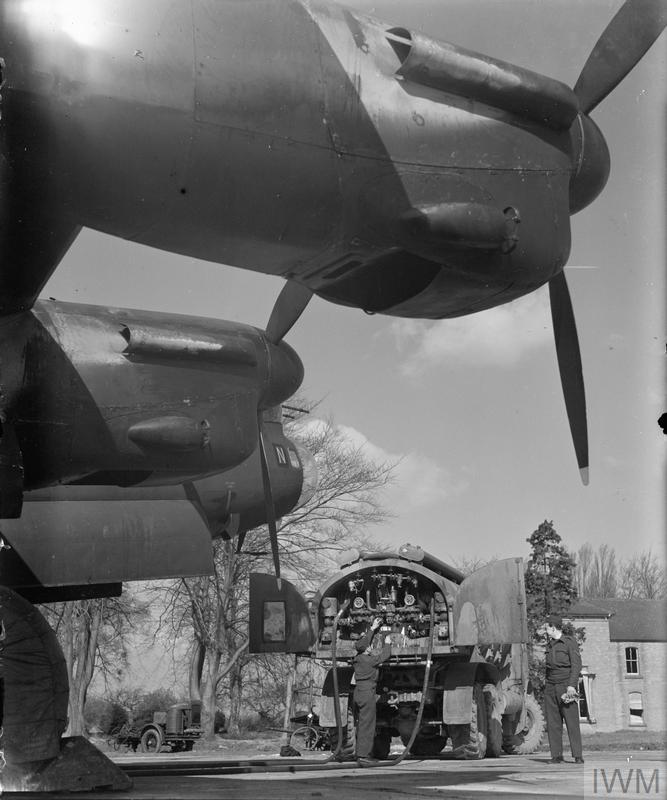
A somewhat posed photo of Flt. Sgt. J Morgan, the rear gunner of a 630 Sqn. Lancaster at East Kirkby. @IWM (CH 12776)

The first resident unit was that of 57 Squadron who took it on immediately upon its opening, bringing both the Lancaster MK.I and MK.III with them.

After forming in 1916, they were, like many other squadrons at that time, disbanded after the war’s end in 1919, but then, as similar events unfolded on the continent once more, they were reformed (in 1931) to run continuously to the end of the Second World War. With further breaks post-war, they would continue to operate up to the current day, flying a wide range of aircraft from Victor tankers in the Falklands to their current model the Prefect T1 trainer at RAF Cranwell.

57’s history goes far deeper than that though, for it was whilst at Scampton, their previous home before East Kirkby, that ‘C’ Flight was separated from the main squadron to form the basis of 617 Squadron, better known as ‘The Dambusters‘; the Flight Commander, Sqn. Ldr. ‘Dinghy’ Young only being appointed to 57 Sqn a matter of weeks before the transfer took place.

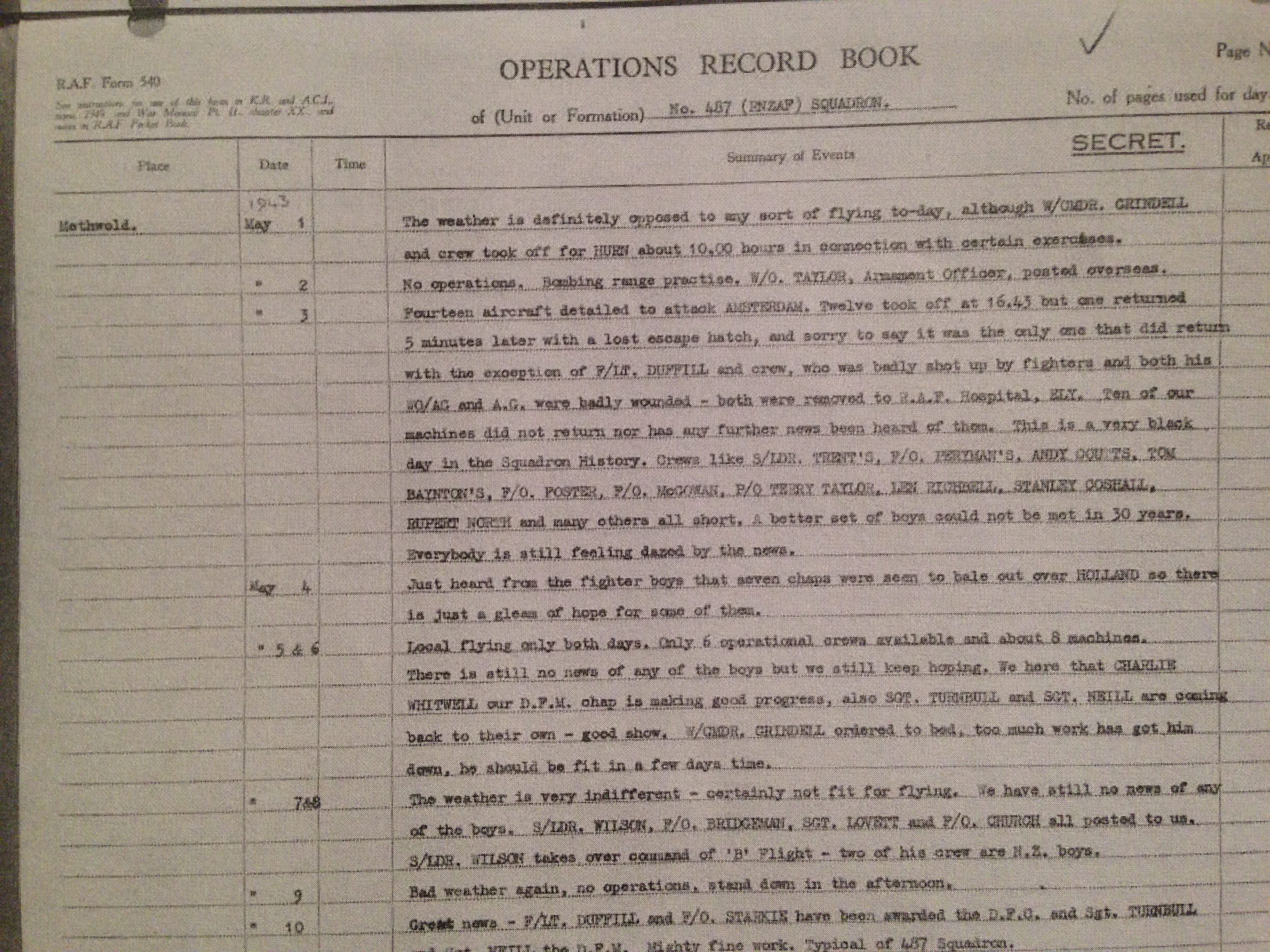
However, it was at East Kirkby that 57 Squadron were now based. On August 27th 1943, just after the split, the advanced party arrived at East Kirkby to start what would be three days of moving and settling in. The first section of the main party arrived on the 28th with the remainder joining them on the 29th. During this time all flying operations were understandably cancelled and the time was allocated to the huge task of moving men and equipment over to their new base.

Operations commenced quickly on the 30th, when fourteen aircraft were detailed for operations to Munchen-Gladbach. All aircraft except one, completed the operation in which ground defences were ‘light’ and bombing was recorded as being ‘good’ with a large explosion seen in the target area. The only casualty of the flight being Lancaster MK.III ‘ED655’ which returned early with an engine failure. Thankfully though, there were no injuries nor any further problems incurred.

On the following night another fourteen aircraft were detailed to attack Berlin, the ‘big city’, an operation which brought August to an end and a total of twelve operations (179 sorties) amounting to over 940 hours flying time for the month.

It wouldn’t be long though before the first causalities would arise at the new station. On the night of September 3rd 1943, Lancaster ‘JA914’  DX-O was part of another fourteen flight raid on Berlin. On board that night was Australian Pilot Flt. Sgt. W. Grindley and his crew, which included one other Australian and a New Zealander.

After departing East Kirkby at 19:30 hrs, the aircraft made its way toward the capital. As it neared the target, search lights managed to cone the bomber, allowing a German night fighter (FW190) flown by pilot Unteroffizier Fritz Brinkmann of the Stab/JG 300, to attack the aircraft, bringing it down at Zehrensdorf with the loss of all seven crewmen on board.

Three of the crew were recovered and remained buried in the Berlin 1939-1945 War Cemetery whilst the remaining four were not. They have been commemorated on the Runnymede Memorial.  The remains of the bomber were themselves discovered in a lake, and recovered on September 29th 1997; a large section of wing which is now displayed in the Deutsches Technik Museum, in Berlin.*1

On the 22nd September, a further crew were lost when an intruder, since known to be Major Wolf Dietrich Meister of the Stab V./KG 2, flying an Me 410 A-1 from Schiphol airfield, followed the bomber home and intercepted it near to the airfield. As it fell from the sky both the Flight Engineer and the Bomb Aimer managed to escape the burning wreck, both parachuting to safety, but the other five failed to get out and were killed in the resultant crash and fire.

In Part 2, we continue with the ups and downs of life in Bomber Command, seeing how the airfield continues to develop and how the war affects those based at the Lincolnshire airfield.

The full page can be read in Trail 1 – Lower Lincolnshire.

Lt. Jack Watson 303rd BG. – From Villain to Hero.

The end of training flights in the Second World War in the quiet and blue skies of the United States, were occasionally ‘celebrated’ with flyovers and ‘buzzing’ of the home town of family or girl friend

The end of training flights in the Second World War in the quiet and blue skies of the United States, were occasionally ‘celebrated’ with flyovers and ‘buzzing’ of the home town of family or girl friends. Whilst this unofficial activity was frowned upon, in general, a blind eye was turned by Commanding Officers of the various Groups. However, one such activity was not taken quite so lightly, and almost led to the end of a promising career before it had even started.

At RAF Molesworth (Station 107) not far from Huntingdon, Cambridgeshire, the 303rd Bomb Group (BG) had been serving the Allied offensive since mid September 1942. They had taken heavy casualties after participating in many prestige missions including the disastrous August and October raids on the ball-bearing plant at Schweinfurt. The invincibility of the heavily armed B-17 was very quickly shown to be a myth.

After a period of calm, primarily due to persistent bad weather rather than any  significant strategic military decision, the USAAF was allowed unofficial time to recuperate, rebuild and rearm. During this period, new recruits and aircraft poured into the United Kingdom via either the Northern or the Southern transit routes over the Atlantic Ocean.

On one of these aircraft was Lt. Jack Watson, a ‘green’ pilot’ who had recently completed his training, and was now on his way to fight in a war a long way from his Indianapolis home.

jack watson page A fresh faced 2nd Lt. Jack Watosn who bravely brought home his burning and crippled B-17 bomber after ordering his crew to bail out. (IWM UPL 32160)

On eventual arrival at Molesworth, Lt. Watson was soon to experience for himself the horrors and reality of war. On January 11th 1944, he was part of a 291 bomber force attacking both the FW190 production factory as Oschersleben and the Junkers factory at Halberstadt, Germany. On what became one of the blackest days for the Group, eleven out of the forty aircraft dispatched were lost, an attrition rate of just over 25%, which was also the highest loss of the entire force.

On the inward flight, the weather, which had dogged much of the winter, closed in over the continent.  A recall message was sent out, the 2nd and 3rd Divisions turning for home, but it was ignored by Brigadier General Robert F. Travis, 1st Bombardment Division Commander in the lead plane – ‘The Eight Ball‘. Original orders were to bomb by visual methods but if cloud cover prevailed then pathfinder Liberators  were to mark the target.

As the weather had deteriorated, cloud being present as high as 24,000 feet, fighter cover was all but withdrawn. The bombers were now virtually on their own and much smaller in number.

Alerted early on, the Luftwaffe had managed to form an enormous welcoming party for the now weakened force. It would be the strongest collection of Luftwaffe aircraft since the October raids, and it was waiting, eager for blood.

The first contact between the two forces was made over the shallow waters of the  Zuiderzee on the inward flight. A collection of rocket-firing fighters launched a gruesome attack on the lead section of the 303rd, an attack that lasted for several hours and took out numerous aircraft.

From the Initial point (IP) to the target, flak was light but accurate, more aircraft took hits and further damage was sustained by the formation. Those bombers that did get through managed to bomb the target, the accuracy of which was considered ‘excellent’.

On the return flight  B-17F #42-29524 ‘Meat Hound‘, piloted by Lt. Jack Watson was attacked again by waves of enemy fighters who zoned in on the bomber and its supporting formation. With many aircraft now crippled, the B-17s were easy targets for the fierce and determined Luftwaffe defenders.

Lt. Watson’s aircraft, (a B-17F-55-BO, which had previously been assigned to the 306th BG transferring to the 303rd in July 1943), was hit hard over Durgerdam. The damage looked terminal, two engines were on fire, there was substantial damage around the wing root and the left elevator had been shot completely off. With such damage, not only was the aircraft difficult to control but it was losing vital airspeed and altitude as well.

Lt. Watson, gave the bail out order, holding the aircraft steady until all the crew had departed. Lt. Watson, who had by then put the aircraft on automatic pilot, was himself preparing to jump, but the thought of the cold waters below forced his retreat to the cockpit and the challenge of getting home alone.

Of those who did jump, four fell into the Ijsselmeer and sadly drowned, and another four were caught by occupying forces and sent to POW camps. The ninth, Lt. Col. Clayton David, the Co-Pilot, managed to evade capture eventually making his way back to England. Clayton’s journey took him through Holland and Belgium and on into France, where he headed south, eventually crossing the Pyrenees into Spain. From there, he reached Gibraltar eventually returning to England in May 1944, four months after he was reported as ‘Missing in Action.’ For his efforts he received the Purple Heart*1.

Lt. Watson, now alone in the crippled B-17 fought on, keeping the aircraft flying toward England. Once over home territory he brought the aircraft down through the thick cloud that had dogged so many of Britain’s airfields that winter, landing at RAF Metfield, an American Fighter airfield home at that time to the 353rd Fighter Group.

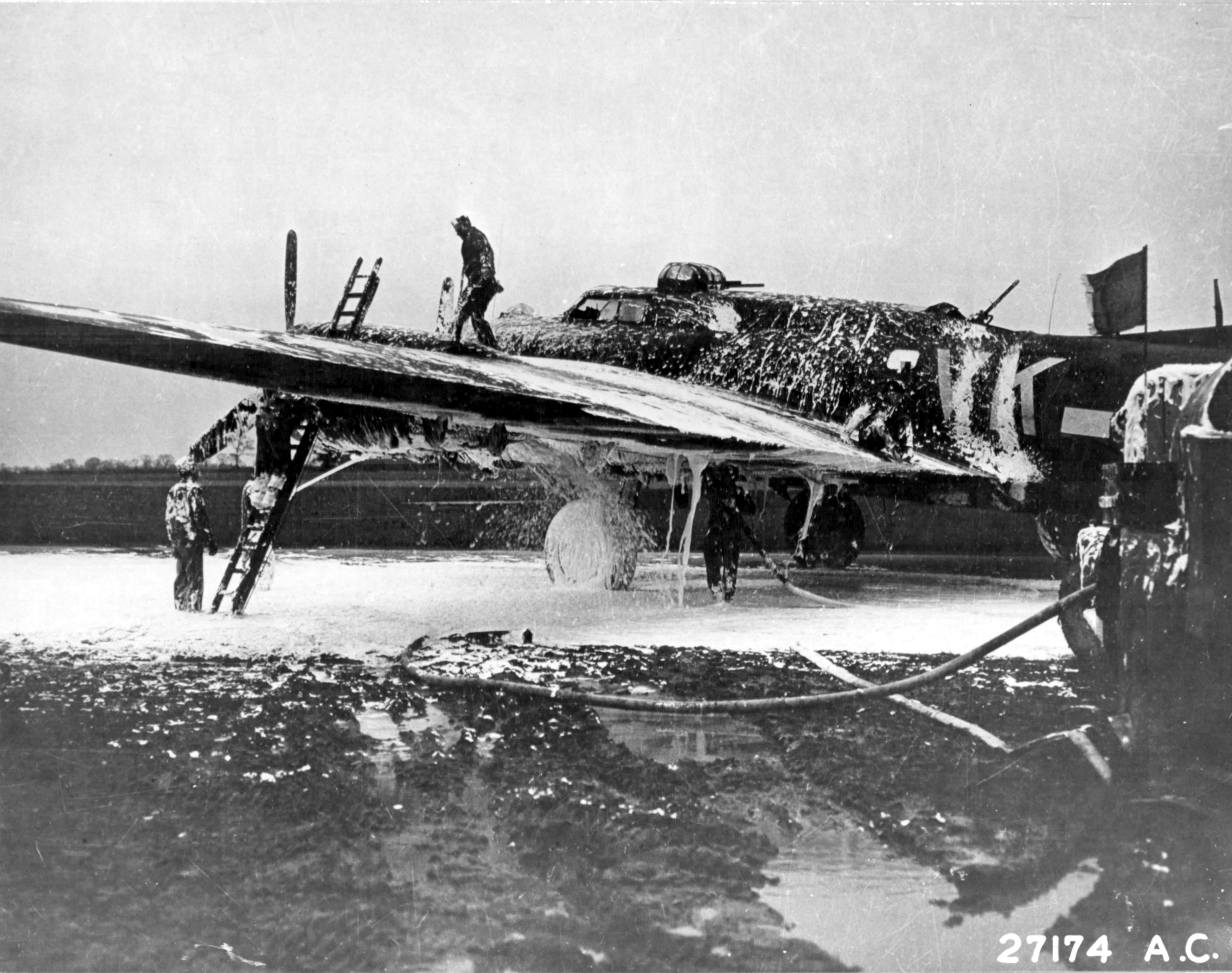
So severe was the fire on the aircraft that it took fire crews a considerable time to extinguish it. These crews were not only amazed to see just one crewman exit the aircraft, but also to find an unexploded shell sitting directly behind the pilots seat.

WM UPL 32171 B-17 ‘Meat Hound‘ on the ground at Metfield, Suffolk after landing with two burning engines. The aircraft was subsequently written off and salvaged for usable parts.  (IWM UPL 32171).

On his arrival back at Molesworth, Lt Watson received a telegram sent by New York Mayor Fiorello LaGuardia, forgiving Watson for his villainous activity previously in late 1943.

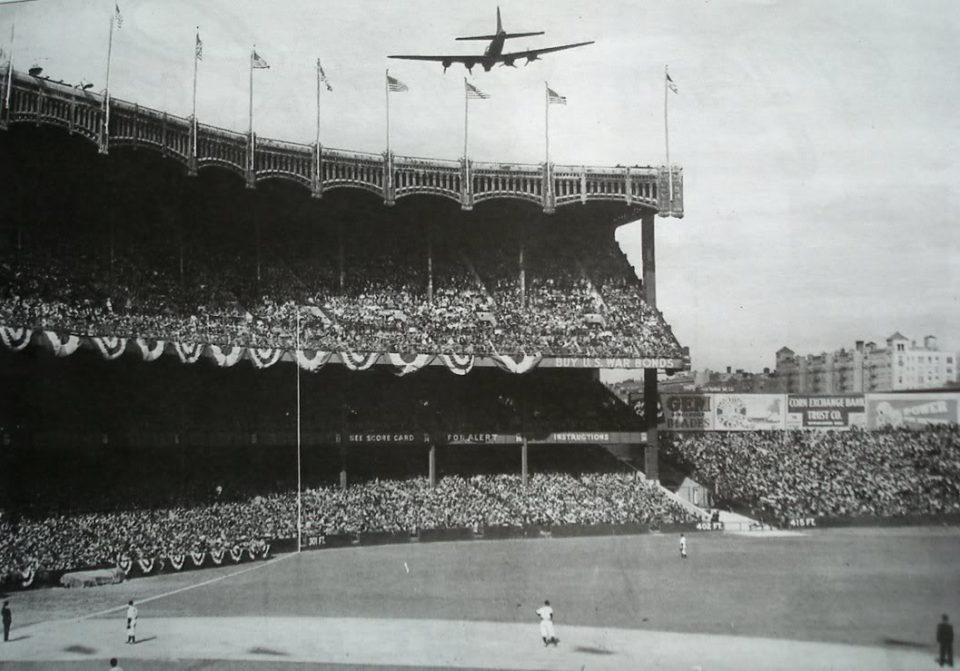
It was at this time that Watson along with three other pilots; 2nd Lts. Robert Sheets, Elmer Young, and Joseph Wheeler, buzzed the World Series game between St. Louis Cardinals and the New York Yankees at the Yankee Stadium, New York. Mayor LaGuardia was so incensed by the action at the time, that he insisted Watson and the others be disciplined, court martial proceedings being instigated as soon as the four landed in Maine*2.

However, it was not to be, the top brass needing every aircraft and crewman they could muster, sent the four on their way with a $75 fine and a stiff telling off!

Although tinged by the sad loss of his crew, the villain of the World Series’ Buzzing, had gone on to prove himself more than a worthy pilot, making history in more ways than one.

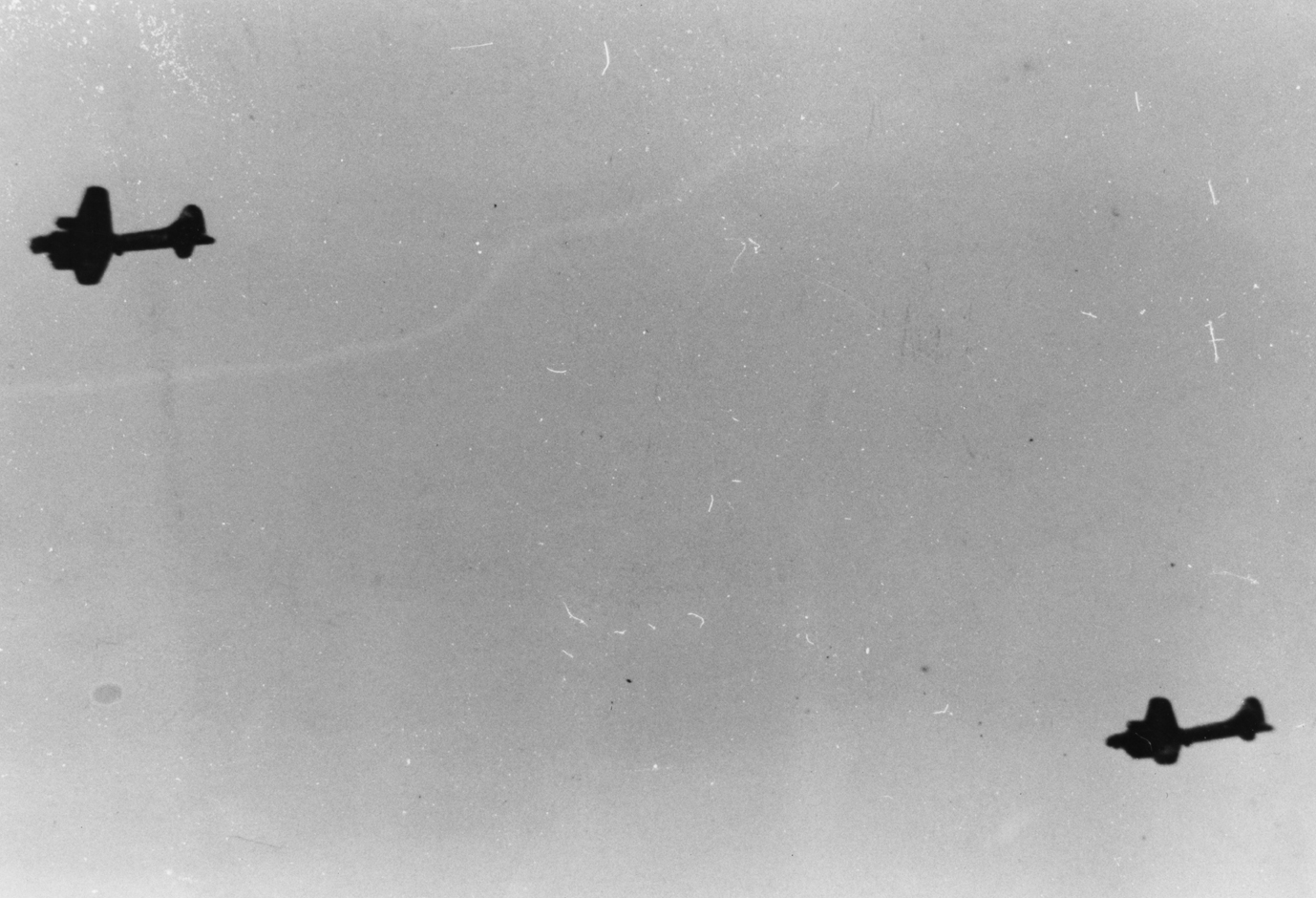
Yankee Stadium, Bronx, NY, October 5, 1943 – B-17 Flying Fortress bombers makes a surprise visit during the first game of the 1943 World Series

A Boeing B-17 ‘buzzes’ the Yankee stadium October 5th 1943. (Author unknown).*3

The crew of ‘Meat Hound‘ were:

Pilot – 2nd Lt. Jack Watson (Returned to Duty)
Co-Pilot – Lt Col. Clayton David (Evaded)
Navigator – 2nd Lt. John Leverton (POW)
Radio Operator –  Stf. Sgt. Harry Romaniec (KIA)
Bombardier – 2nd Lt. Vance Colvin (KIA)
Flight Engineer/Top Turret Gunner – Stf. Sgt. Sam Rowland (POW)
Right Waist Gunner – Sgt. William Fussner (KIA)
Left Waist Gunner – Gene Stewart (POW)
Tail Gunner – Sgt. Roman Kosinski (POW)
Ball Turret Gunner – Sgt. Fred Booth (KIA)

The B-17F, #42-29524, was delivered to Denver 31st December 1942; then assigned to the 423rd BS (306th BG) as ‘RD-D’ at Thurleigh 2nd March 1943. It was later transferred to the  358th BS (303rd BG) as ‘VK-K’ based at Molesworth on 30th July 1943.

For their efforts in this mission, the 303rd Bomb Group were awarded a Distinguished Unit Citation, the only time the entire unit achieved such an accolade.

This and other similar stories appears in Heroic tales of World War 2.

Sources and Further Reading.

Missing Air Crew Report 4269

*1 Herald-Whig Obituaries Website accessed 27/5/19

*2 303rd BG website ‘Outfield Fly’ by Hap Rocketto accessed 27/5/19

*3 Photo appeared in ‘Old-Time Baseball Photos and Essays’, blogsite. accessed 27/5/19

Major George Preddy – 352nd FG – A tragic loss.

In Trail 8, we heard about a number of heroic tales and tragic losses. One of those, was that of one of the highest scoring P-51 pilots, Major George Preddy of the 487th Fighter Squadron (FS), 352nd Fighter Group (FG), based at RAF Bodney (Station 141)

George E. Preddy Jnr (0-430846), from Greensboro, North Carolina, was born on 5th February 1919, and graduated from Greensboro High School at the age of sixteen. Preddy became interested in flying whilst in college and made his first solo flight in 1938 at 19 years of age.

Preddy page

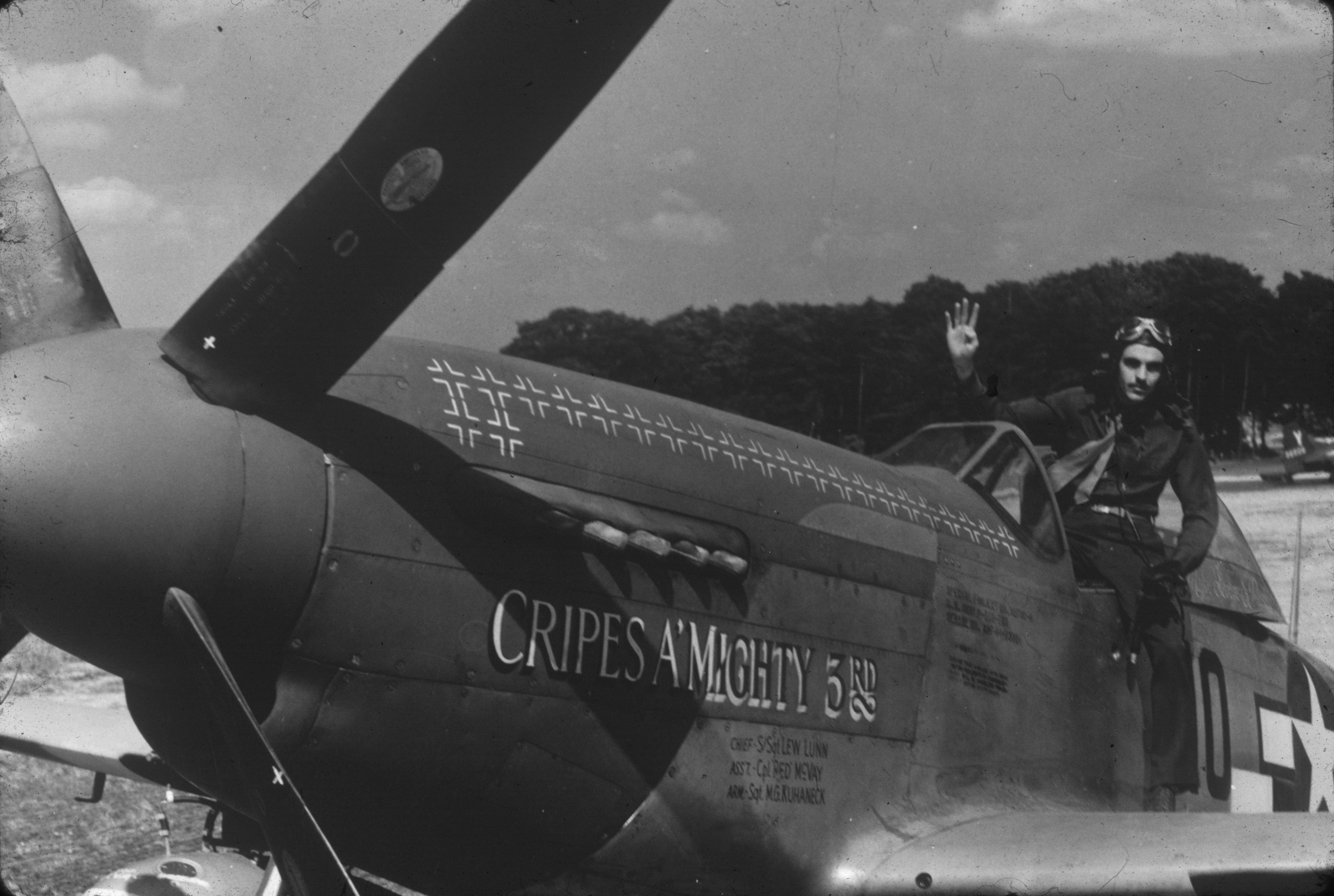
Major George E “Rasty” Preddy Jr in the cockpit of his P-51 Mustang (HO-P), #44-13321 nicknamed “Cripes A’ Mighty 3rd.” (@IWM FRE 006368)

His road to war would take time and effort. His introduction to flying was as a barnstormer which led him to attempting entry into the US Navy no less than three times, each time being rejected on account of his small stature and curved spine. With each rejection came more determination, his love of flying taking him back to Barnstorming, whilst he undertook bodybuilding and stretching exercises to straighten his back. Eventually, in the summer of 1940, he applied to the USAAF and to his delight he passed all the relevant examinations. However, as the US was not yet at war, Preddy’s entrance would take yet more time and so to gain experience and better prepare himself, he joined the Army National Guard, being posted to the 252nd Coast Artillery, which went on to protect the important oil refineries on the islands of Aruba and Curaçao, in the southern Caribbean Sea.

The following year in In April 1941,  Preddy received his orders to report for flying training, from which he graduated on December 12th that same year. December 1941 saw the Japanese attack on Pearl Harbour, an attack that led to the US joining the Second World War, and an attack that led to Preddy, commissioned as a Second Lieutenant, being posted to Australia to the 9th Pursuit Squadron (PS), 49th Pursuit Group (PG) in the defence of northern Australia.

Whilst here, Preddy would fly Curtiss P-40s, he named his first plane, ‘Tarheel‘,
as a tribute to his home state. During his time here, he damaged both a Japanese fighter and a bomber in combat operations. Sadly though, in the summer of 1942, he was involved with a collision with another P-40, an accident that would kill Preddy’s friend and colleague, and leave Preddy seriously ill in hospital for another six months or so.

In the October of 1942, Preddy returned to the US, it was here that he would cross paths once again with Lt. Jack Donalson, a pilot who was also a veteran of the early Pacific theatre, and who was with him on that tragic day in July 1942. The two met at Trumbull Field, Connecticut, on January 15th 1943, where the newly formed 352nd FG were training and forming up. The 352nd would be made up of three squadrons (328th, 486th and 487th), Preddy would initially be assigned to the 487th FS.

The 352nd would continue training, their new P-47 Thunderbolts arriving three days later. With the P-47 being new, there were many accidents and losses, primarily due to a carburettor hose clamp becoming loose. Luckily Preddy avoided all such incidents and by May 1943, he and the 352nd were ready for action.

On the 7th July the 352nd arrived at RAF Bodney (newly named Station 141) a small grassed airfield not far from RAF Watton in Norfolk. With small incursions into enemy territory the first few months were generally event free. Preddy would get his first kill later that year on December 1st 1943, while flying P-47D-5-RE Thunderbolt (HO-P) #42-8500 “Cripes A’Mighty“, a name he gave to all his aircraft, so-called because it was his favourite expression. Whilst escorting bombers back from a mission over occupied Europe, Preddy noticed a formation of German fighters who were focusing their attention on stragglers, easy pickings for the experienced and deadly Bf-109s. Preddy and his squadron dived down, bouncing the Germans, causing his first victim to explode in a flurry of cannon fire.

Preddy’s first year would end with two confirmed kills, a tally that would only grow as time went on. In his second kill, he would sadly lose his wing man, Lt. Richard Grow, but for his action he would receive the Silver Star, one of many achievements Preddy would gain.

On January 29th 1944, Preddy would come close to death for a second time, when after dispatching an FW-190, he was hit by Flak and had to ditch in the sea. After spending a short time in the water he was picked up by an RAF Air Sea Rescue Walrus and returned to Bodney.

Over March and April, the new P-51 Mustangs began to arrive at Bodney, an aircraft that would lead to Preddy achieving ‘Ace’ status. On May 13th, the 487th dived down on around thirty Bf-109s, Preddy accounted for two taking his tally over the magical ‘Five’ Kills and ‘Ace’ status.

During the summer of 1944 Preddy would achieve many more ‘kills’, by now he was well on his way to becoming the leading ace in the European skies. In March he was made Operations Manager of the 487th, and promoted to Captain.

By mid July Preddy has reached 14.5 kills, all a mix of single and twin-engined aircraft, and by the end of the month, this has risen to 21.83 kills, taking him to the top spot and leading ‘Ace’ of the 352nd.

Following an escort mission on the 5th, a further mission, in which Preddy was ordered to lead on the 6th, was scrubbed due to bad weather. With the day free to themselves, the officers mess became the focus of attention and the drinks ran freely

By the time Preddy had got to bed, he was well and truly drunk, and as with many operations of the war, the weather cleared and the operation was on once more, Preddy was woken after only an hours sleep and struggled to get to the briefing. Still reeling under the influence, he took off and lead the group into battle. Worse for wear, he emptied his stomach in the cockpit and headed toward the enemy.

As the bomber and their escorts approached Hamburg, Preddy led the attack on the Luftwaffe fighters.  In the airspace between 30,000 ft and 5,000 ft, Preddy managed to shoot down six Bf-109s, with numerous hits around canopies, wing roots and fuselages. On return he was greeted like a hero, the ground crews and squadron pilots crowding his aircraft. Preddy gave a simple reply to the eager crowd, vowing “Never again” would he fly with a hangover.  Following this mission Preddy was awarded the DSC and sent home to the US for a well-earned rest on a 30 day leave.

Preddy page

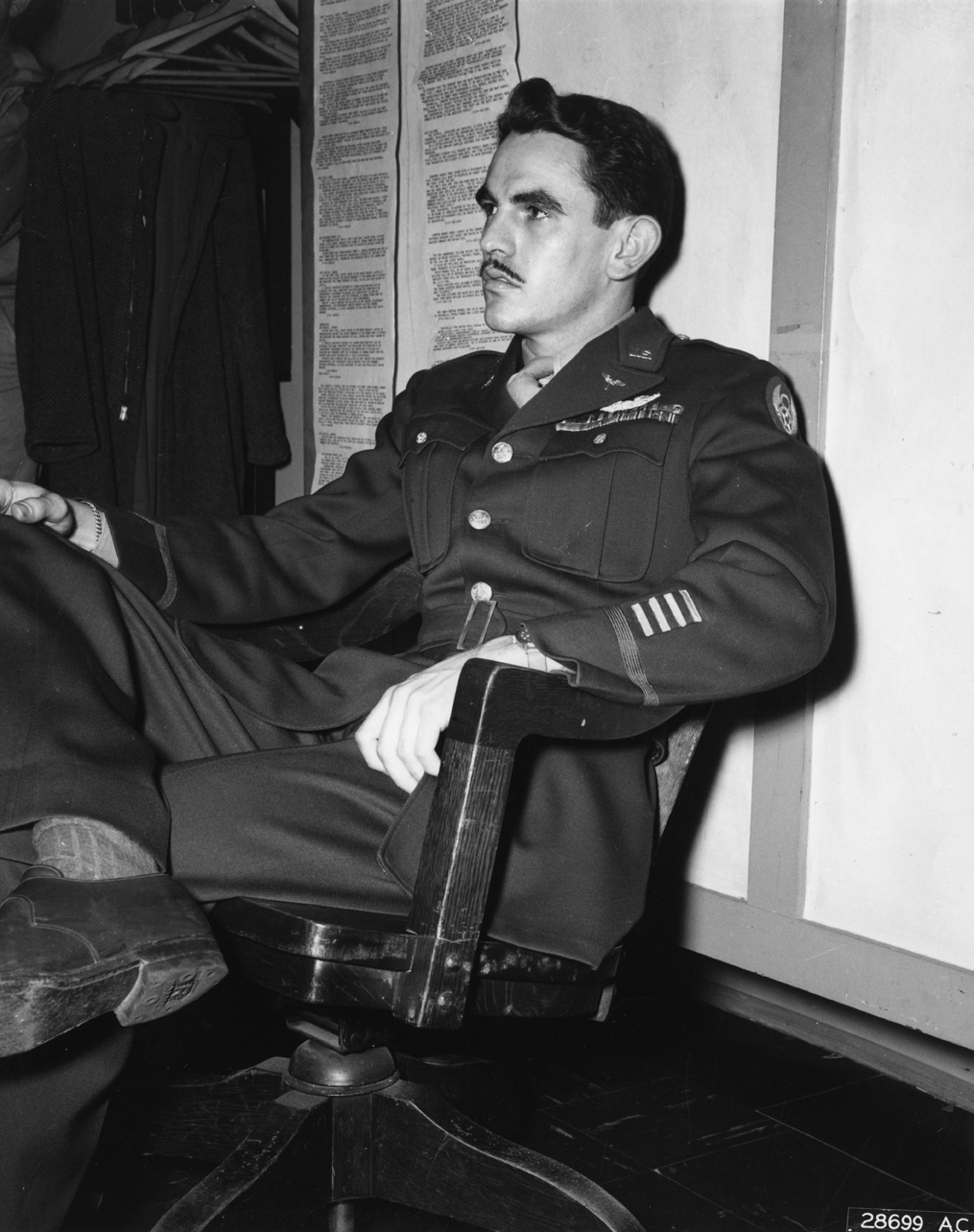
Major George Preddy, during his return to the United States between August & October 1944. Taken at a Press Conference in the Pentagon Building.’ (@IWM FRE 00346)

On his return in October, Preddy was again promoted, this time to Major, whereupon he commenced his second operational tour. His involvement with the 487th would not last long though, as with his promotion came new responsibilities and the command of the 328th FS, taking over from Lt. Col. John Edwards.

The hard winter of 1944-45 tore into the souls of the ground and air forces across Europe. Severe frosts, snow and cold made Bodney a difficult place to be. But the war continued and in the forests of the Ardennes, German forces were gathering. With few flights being carried out due to thick fog and freezing conditions, the German armoured brigades under the control of Field Marshal Gerd von Rundstedt, made a daring breakthrough (Operation Bodenplatte) in what became know as the ‘Battle of the Bulge’. Ground forces made continued calls for air support, but with increasingly bad weather, few flights were able to make it.

The order then came through and on the 22nd December 1944, the 352nd were to move to Belgium and Asch (Y-29) a small grassed airfield near to Genk in the province of Limburg. The 352nd crammed all the cold weather clothing they could into their aircraft and set off. By the end of the day the Group had settled in the cold of Belgium, it was a far cry from the relative warmth of Bodney.

Preddy’s time in Belgium would be short-lived however. As the weather cleared more missions were undertaken. On Christmas Day, the 328th would have one of its finest battles, shooting down eleven enemy aircraft, but it was a victory that would be eclipsed by the loss of perhaps its greatest leader and airman.

On that day there were two missions ordered, Preddy would lead the second of the two, an escort mission into Germany and Koblenz. On the return trip, Preddy was vectored to Liege, and warned of ‘heavy flak’.  Arriving south of the city, Preddy, along with his wingman Lt. Gordon Cartee, and another pilot Lt. James Bouchier of the 479 th FG, spotted an FW-190 and gave chase at tree-top level.

On entering the area, ground forces opened fire, the Anti-Aircraft battery were American, and all three allied aircraft were hit. Lt. Bouchier managed to climb high enough to bail out, landing safely in the British sector, Lt. Cartee, also having been hit, also managed to escape and get home, but not until after he saw Preddy’s P-51, turn and dive into the ground. Major George Preddy died in the crash.

Preddy’s death was devastating for both the group at both Asch and those back home at Bodney. Festivities were subdued to say the least. Preddy’s dashing good looks and character were well-known, his relationship with his own ground crews were one of the best, he always took time out for them and praised their efforts in keeping him flying. At 25 years of age, Major George Preddy was not a born killer, just a young man who loved to fly, and to fly well.

George Preddy had flown 143 combat missions, he had has been credited with shooting down 26.83 enemy aircraft, the highest in the 352nd FG, and destroying 5 enemy aircraft on the ground. His combined total of 31.83 aircraft was just 6 short of the Group’s highest, a total that most certainly isn’t conclusive.

His commanding officer Lt. Col. John C. Meyer, who held the Group’s record and  was the fourth ranking American Air Ace, described Preddy as “the complete fighter pilot”.  A man so brave and dedicated that he would be awarded, amongst others: the Distinguished Service Cross; Silver Star (1 Oak Leaf Cluster); Distinguished Flying Cross (6 Oak Leaf Clusters); Air Medal (6 Oak Leaf Clusters); Croix de Guerre, and the Purple Heart.

In 1968 the city of Greensboro dedicated Preddy Boulevard in honour for both George and his brother. The Preddy Memorial Foundation also created a petition to have Fayetteville’s Pope Air Force Base renamed Pope-Preddy Air Force Base.
George Preddy’s career may have been short, but his influence went far and wide especially amongst those who knew of him.

Major George Preddy is buried in the Lorraine American Cemetery, just outside Saint-Avold,  Moselle, France, alongside his brother, another fighter pilot, in Plot A, Row 21, Grave 43.

Sources and further reading.

RAF Bodney appears in Trail 8.

North Carolina Museum of History website Accessed 23/8/18

Freeman, R.A., “The Mighty Eighth“, Arms and Armour, 1986

The Preddy Memorial Foundation website Accesses 20/8/18

P.O William Davis (Eagle Sqn) – March 18th 1941

RAF Sutton Bridge, was a small airfield on the Norfolk / Lincolnshire border a few miles from the Wash off the north Norfolk coast. Before, during and after the war it served as  training camp for new pilots, training them in the art of gunnery, utilising a firing range that had been in situ since 1926.

Many airmen of the RAF passed through Sutton Bridge, many of these were Commonwealth aircrew, some from Czechoslovakia and a few from the United States.

In the church yard behind the church of St. Matthew in the village, lie almost 60 graves of those who died in the fight for freedom, they are also joined by a German airman, foe united in death.

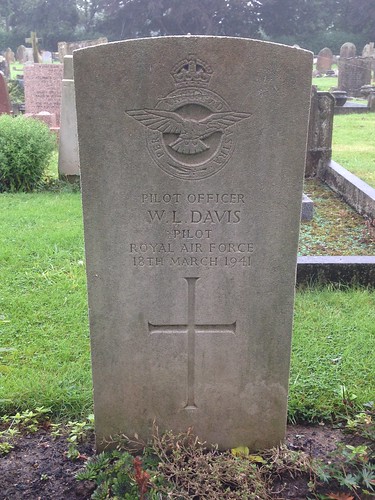
One such airmen is that of American Airman Pilot Officer William Lee Davis s/n: 61459 (RAFVR) who joined as part of the famed ‘Eagle’ Squadron, a group of volunteer American flyers.

P.O. Davis was from St. Louis and graduated at Central High School, before going on to attend Washington University. He was the son of William J. Davis of 4500 Arsenal Street, and a salesman in a cork and insulation firm in the area, when he joined up at the age of 25.

He left his job, signing with the Clayton-Knight Committee, a recruitment company for the Canadian and British Air Forces operating in the United States.  He was initially stationed at Love Field in Dallas, where he received four weeks of intensive training in aerobatics, gunnery and combat flying. After qualifying here, he transferred to Ottawa, where he was commissioned and then sent onto England to further his training. He was the first person from St. Louis to obtain a Commission in the Royal Air Force obtaining a deferment of his draft in doing so. When asked about joining the RAF, he told reporters that it was “a matter of sentiment and heritage” citing his English grandfather’s role as an officer in the Boar war.

P.O. Davis was no stranger to flying, having been a flyer before signing up for the RAFVR, achieving a total of 223 hours flying time, a commercial pilots licence and an advanced CAA Licence.

On arrival on March 5th 1941, these pilots were generally sent to No.3 Personnel Reception Centre at Bournemouth, before posting to No.56 Operational Training Unit (OTU) at Sutton Bridge. Here they completed their training and were then sent onto their respective operational squadrons.

There were something in the region of 156 American Airmen who found their way into 56 OTU, many passed through with little or only minor mishaps. For P.O. Davis though it was to be the end of his dream, in an accident that would take his life.

On March 18th, a week after his arrival at Sutton Bridge, he took off in Hurricane P5195 on a general map reading flight across the Lincolnshire Fens. Whilst on the flight P.O. Davis became lost and decided to put down on farm land at New Leake Fen near Boston. Unfortunately, the ground in the Fens was soft causing the undercarriage to dig in and flip the Hurricane on its back. In the resultant crash, P.O. Davis broke his neck killing him instantly. He was not only the first from St. Louis to die, but the first American from Sutton Bridge to die also.

A citizen of the United States, Pilot Officer William Lee Davis is buried in the Church yard of St. Matthew’s Church, Sutton Bridge, Lincolnshire, Section P, Grave 56.

Pilot Officer William Lee Davis

Pilot Officer (Pilot) William Lee Davis

2nd Lt. Robert E. Femoyer MOH, 711th BS Rattlesden

Robert Femoyer.jpg Robert Femoyer 711th BS, 447BG

Flying from RAF Rattlesden, Suffolk, England, navigator 2nd Lt. Robert E. Femoyer earned the Medal of Honour for action whilst on a mission to Merseburg. During this operation, he showed the highest level of dedication to his crew, performing a selfless act of bravery whilst being severely and fatally wounded.

Born October 31st 1921, Huntington, West  Virginia, USA, he was the eldest child of Edward and Mary Femoyer. and attended Virginia Polytechnic Institute in Blacksburg, Virginia.

On 11th November 1942 Robert Femoyer enlisted and joined the Reserve Corps. He didn’t take up active duty until the following February when he began his basic training at Miami Beach, Florida. He joined the Army Air Corps in that same month and became a cadet at the University of Pittsburgh. He received his commission at the AAF Navigation School at Selman Field, Louisiana in 1943 and graduated, without gaining his wings, in 1944.

With his second lieutenant bars firmly under his belt, Femoyer received his first posting; and in September 1944 he left with the 711th Bomb Squadron as part of the 447th Bomb Group, Eighth Airforce. As a navigator he would determine routes and ensure the safe flight of his aircraft and other crew members to the bomb target and home.

On his fifth and final mission , and only a few days after his 23rd birthday, on November 2, 1944, the 711th attacked an oil refinery at Merseburg, near Leipzig, Germany. The B-17 he was in, was battered, hit several times by flak, and had two of the four engines damaged. The aircraft was difficult to fly and the navigational instruments were left almost useless. Femoyer himself had received shrapnel wounds to his side and back, was bleeding heavily and in a great deal of pain.

The B-17 quickly lost both height and speed and was forced to leave the formation, making it more vulnerable to attack from fighters, but Femoyer was not going let his compatriots down.

Deciding to turn for home the pilot asked for a route.  In response, Femoyer, determined to keep a clear head, refused all medical assistance before planning their escape route home. He insisted he was propped up so he could read his maps, the injury to his body making sitting extremely difficult. Guiding the pilot safely around heavy flak zones, they eventually reached the safety of the English coast, where then, and only then, did Femoyer allow morphine and other medical aid to be administered. The pilot managed to guide the stricken aircraft home where upon landing at RAF Rattlesden, Femoyer was removed from his post, weak and having lost of lot of blood, and taken to hospital where he sadly died about an hour later.

For his valour and courage he was posthumously awarded the Medal of Honour, and his citation read:

“For conspicuous gallantry and intrepidity at the risk of his life above and beyond the call of duty near Merseburg, Germany, on Nov. 2, 1944. While on a mission, the bomber, of which 2d Lt. Femoyer was the navigator, was struck by three enemy antiaircraft shells. The plane suffered serious damage and 2d Lt. Femoyer was severely wounded in the side and back by shell fragments which penetrated his body. In spite of extreme pain and great loss of blood he refused an offered injection of morphine. He was determined to keep his mental faculties clear in order that he might direct his plane out of danger and so save his comrades. Not being able to arise from the floor, he asked to be propped up in order to enable him to see his charts and instruments. He successfully directed the navigation of his lone bomber for 2 1/2 hours so well it avoided enemy flak and returned to the field without further damage. Only when the plane had arrived in the safe area over the English Channel did he feel that he had accomplished his objective; then, and only then, he permitted an injection of a sedative. He died shortly after being removed from the plane. The heroism and self-sacrifice of 2d Lt. Femoyer are in keeping with the highest traditions of the 447th Bomb Group and the U.S. Army Air Corps.”

The body of 2nd Lt. Robert Edward Femoyer was returned to the United States to his adopted Florida home, and was buried in Greenlawn Cemetery in Jacksonville, Florida, Section 8, Lot 2.  Florida historical resources list him as one of their own war heroes. His college, Virginia Tech, named a building the ‘Femoyer Hall’ in his honour in 1949 and in 2001, a stretch of West Virginia Route 152 from the Fifth Street crossing with Interstate 64 to the Huntington city limits, was officially designated Robert Femoyer Boulevard. Numerous air force bases have also named streets in his honour.

Robert Femoyer was the only American navigator to have received the Medal of Honour during service in World War Two and remains a Florida hero to this day.

For other heroic tales click here.

RAF Rattlesdon Today RAF Rattlesden is a light airfield utilising the former runway of the base.

Notes and Further Reading .

Source compiled from U.S. Air Force Office of History.

Few, if any, photos survive of Femoyer, but others of his squadron are at: http://www.447bg.com/Contacts.htm

1st Lt. Raymond Harney and 2nd Lt. Warren French – 349th BS, 100th BG

Lt Raymond Harney (Photo courtesy of Tsymond Harney JR.)*1

A few years ago a story came to light that not only brought home the brutality of war but also the compassion found in war. It was of two American airmen whose World War II story finally come to a close 70 years after their death.

The two airmen, U.S. Army Air Corps 1st Lt. Raymond Harney (s/n O-523208) and U.S. Army Air Corps 2nd Lt. Warren French, (s/n O-2056584) of the 349th BS, 100th BG, were in a B17G (44-6306) over Germany on September 28th 1944, when they were hit by flak whilst on a mission to Merseberg. This would be their eighth and final mission.

Mission 652 involved a total of 342 B-17s which were sent to bomb the Merseburg/Leuna oil refinery and any additional targets of opportunity. During the operation, 10 B-17s were lost, 4 were damaged beyond repair and 251 damaged but repairable. Escort for the mission was provided by 212 P-51s of the USAAF.

B-17 ‘#44-6306’, was delivered to Kearney airbase on 28th June 1944,  then moved to Grenier airbase, New Hampshire on 9th July 1944, for onward transport to the United Kingdom.  It was assigned to the 349th Bomb Squadron, of the 100th Bomb Group, given the code ‘XR-G’, and based at RAF Thorpe Abbotts from the 12th July 1944.

The crew of #44-6306, assigned on the 28th August 1944, was: (Pilot) 1st Lt. Raymond E. Harney (Co-pilot); 2nd Lt. William R. Kimball (Navigator); 2nd Lt. Charles M. Hamrick (Bombardier); 2nd Lt. Warren. M. French (Top Turret/Engineer); Cpl. Thadeus L. Gotz (Radio Operator/Gunner); Cpl. Hubert J. Burleigh,Jr. (Ball Turret); Cpl. Melvin F. Cordray (Waist Gunner); Cpl. Robert C. Minear (Waist Gunner); Cpl James J. Sorenson, and (tail Gunner) Cpl. John H.  Bundner. However, for reasons unknown at this time, for this particular mission, Gotz was not aboard, and instead S/Sgt. Jack D. Francisco flew as tail gunner and Cpl. Robert C. Minear flew as the Flight Engineer.

At 12:10, whilst over the target, the B-17 was hit in the number 2 engine by anti-aircraft flak. As a result, the engine caught fire, the aircraft withdrew from the protection of the formation, joining another formation further back, but began to fall back again when the number 4 engine was also feathered. Harney continued to fly the crippled B-17 for two hours after being hit, before finally deciding enough was enough and he ordered the crew to bail out. Being determined to save his friend and the aircraft, he also decided that he and the injured French, would remain and try to land the aircraft.

Outside of the village of Schwickershausen, to the north of another major target, Schweinfurt, Germany, they attempted a belly landing bringing the aircraft down in a turnip field. The B-17 slid across the ground, ripping off the port wing, causing a tremendous fire. Neither Harney nor French sadly survived the subsequent fireball.

Although he managed to get the crew to leave the aircraft, their safety was not guaranteed and sadly, three were killed by local police in the following days. An event not uncommon in Nazi Germany. Only two of the gunners, Cpl. Melvin F. Cordray, and Cpl. Robert C. Minear, survived as POWs.

What makes this story more significant than usual, is what followed after the crash.

The local people made a wooden cross in remembrance of the crew and they kept it hidden away in the local church for over 70 years.

The cross kept secret for so many years.*2

The large wooden cross, had the words “Hier ruhen in Gott! 2 amer. Flieger,” or “Here rests in God 2 American flyers,” engraved on it, along with details of the aircraft crash. On the 70th anniversary of the crash, 28th September 2014, a memorial service was held in the village of Schwickershausen. Following this, on 5th October, the cross was flown over to England in an American KC-135 Stratotanker from RAF Mildenhall, with two Luftwaffe Tornadoes escorting them over Germany. The cross was donated to the ‘Bloody 100th’ museum at Thorpe Abbots for safe keeping. A certificate was also handed over along with the cross signifying not only the now peaceful and co-operative alliance between the two nations, but the final closing of a chapter of the history of two crew members of the “Bloody Hundredth.”

The cross being transported in the Boom pod of a KC-135 Stratotanker. October 2014.*4

This is a remarkable story, and one that certainly stands out amongst the horrors and heroism of the Second World War.

2Lt Warren M French

Warren French’s memorial stone in Belgium*3

Lt. Raymond E. Harney’s Gravestone is at Ft. Snelling Cemetery in Minnesota, his remains are in the graveyard at Gemeindefriedhof Schwickershausen. Warren French’s headstone is in the Ardennes, Neuville-en-Cond, in Belgium.

Thorpe Abbotts airfield and museum is featured in Trail 12

Sources:

*1 photo the Bloody 100th Foundation.

*2 Photo from RAF Mildenhall news

*3 Photo from ‘Find a Grave

*4 Photo from RAF Mildenhall News

This story first appeared in the RAF Mildenhall News report October 20th 2014.

RAF Sawbridgeworth – Part 4 – The end of an Era.

Continuing on from Part 3

2 (AC) Sqn by now, also had a move away on the cards, and following a meeting on the 28th January the advanced party departed first, followed on the 31st by the ground party. The Mustangs moving to RAF Bottisham, from where they would now operate before being divided and part moving to Fowlmere.  After a short stay at the two sites they returned to the Hertfordshire airfield once more. Their departure had lasted a mere four months.

RAF Sawbridgeworth Emergency generator

The Standby Generator House now a stores for machinery.

Whilst they were away, the airfield was used on a temporary basis by 652 Sqn flying Austers, On arrival, they immediately took over Blount’s Farm and used it for their own personal use. In the short time they were here, they participated in Exercise “Spartan” again in conjunction with the Army, departing the airfield in late  March.

After being spilt between Bottisham and Fowlmere, 2 (AC) Squadron was now reunited and returned to training flights, air to air firing, ground support flights and increased operational activities. A large part of the squadron’s role now included photographic reconnaissance of enemy territory, many of these operations taking place over the Hook of Holland, den Helder, Kijduin, and Ameland. Some of these required the squadron to detach to other stations but the majority of operations flew from Sawbridgeworth, the Mustangs fairing much better than the heavy Typhoons of 182 Squadron earlier on.

In Mid may, disaster struck again for the unit when three aircraft crashed into a hillside after setting off on a photo reconnaissance flight to photograph locomotive movements in northern France in Operation “Asphalt“. On the way out, a bank of sea fog was encountered and the order to climb was given. Unfortunately, flying abreast,  three of the ten Mustangs failed to clear the hill they encountered, and Pt. Off. J. McLeod, Fl. Off. D. Hirst and Fl. Off. N. Miller were all killed. The remaining aircraft then flew to Thruxton where they were detached to,  and a search commenced for the missing airmen. Their bodies were later recovered and funerals held in their respective homes at the end of the month.

Photo reconnaissance flights and attacks on shipping, increased becoming the main role for the squadron.  Sadly during one of these operations, Operation “Lagoon“, Fl. Off. Butt was killed when his Mustang crashed into the ground before he was able to land. The resultant explosion and fire killing him.

July 1943 saw yet another move for the squadron, this time to Gravesend, where they were immediately billeted under canvas and then inspected for fitness to serve overseas. No such move came through though, and after moving around various other local airfields, in November, 2 Sqn returned to the Hertfordshire airfield that had become their semi-permanent home; this time though, they were not unaccompanied, they brought with them the Mustangs of 4 Squadron.

During their absence, Sawbridgeworth had not been deserted, in fact it had been very busy and home to several other squadron detachments. On the 12th November 1943, 63, 168 and 170 Squadrons had all moved in with Mustangs, then on the 30th, both 63 and 168 departed moving back to their parent unit, their short detachment coming to an end; whilst 170 remained here until mid January when they were disbanded.

The return of 2 Sqn and the new Mustang unit that November, saw a continuation of reconnaissance operations  over the continent. 4 Sqn had been dogged by mechanical issues resulting in many unserviceable aircraft and even for the move, only five aircraft were able to make the initial flight. It was these ongoing issues that led to them to begin changing their old models for newer examples, a change that would unfortunately take time to complete.

For much of December the weather played the dominant part, the winter of 1943 – 44 being extremely wet and foggy. For much of the month the airfield was yet again, unserviceable and only top priority operational flying could take place and even that was sporadic.

At nearby Hunsdon, both a Mosquito and a Spitfire along with suitable trainers were made available, and it soon became known that 4 squadron was going to re-equip with both and move to Aston Down.  At last, the older, problematic Mustangs were being replaced by a much needed and higher performing aircraft.

Conversion of the crews would take place at Hunsdon who would transfer across regularly to take flight instructions whenever the weather allowed.  It didn’t come a moment too soon either as serviceability for the Mustangs of both squadrons, remained critically low; at the end of the month, 4 Sqn only had two airworthy aircraft.

In early January 1944, 4 Sqn finally got their departure orders and made the move to Aston Down. The conversion had been successful, and further training flights were carried out once at Aston Down, gradually more and more of the new models arrived bringing the squadron back up to full strength once more. That was not the end of 4 Squadron though, as on March 3rd 1944, they returned to Sawbridgeworth with their new Spitfires and their Mosquitoes, their period of reconnaissance training on the two types now almost complete.

On the 3rd March, two parties left Aston Down, the road party in the morning and then, in the afternoon, the air party, forming the largest ‘Balbo‘ the unit had known for some time. in all, twenty-two aircraft made up of Spitfires, Mosquitoes and Mustangs flew in formation all the way to Sawbridgeworth, their arrival in the late afternoon must have been a magnificent sight for those waiting on the ground.

The squadron was then divided into two flights, ‘A’ Flight flying the Spitfires and ‘B’ Flight the Mosquitoes. During March the ‘A’ Flight Spitfire XIs were used to fly photo reconnaissance sorties over ‘Noball‘ targets – rocket installations in France, the first operational sortie since December 12th. However, and a blow to the squadron, there was 10/10ths cloud over the target area and no photos were taken as a result.

With ‘A’ Flight busy on operational sorties, ‘B’ Flight continued with their Training flights in their Mosquitoes. However, as with the Typhoons earlier, things were not as straight forward and easy and they may have been. It was found that stones and clinker had found its way onto the tracks and these had been thrown up damaging the tail plane of the aircraft rendering all the aircraft used unserviceable.

Poor weather continued to hamper operations as it had done for months, the Mosquitoes now taking part in photographic flights having their flights cancelled and the squadron being stood down on several occasion.

In early April, they were ordered out of Sawbridgeworth and on the 4th, both air and ground parties left for Gatwick, their penultimate stop before moving to the continent where they would stay for many years after the war’s end.

Meanwhile, 2 Sqn had continued operations over enemy territory, carrying out both air-ground attacks and reconnaissance flights over the continent. Yet more detachments away at various airfields including Benson and North Weald, led to them being divided once more. However,  being posted to North Weald caused problems for the resident 268 Sqn who were now forced to leave there and come to Sawbridgeworth, North Weald being too small to accommodate both units. When 2 Sqn returned to Sawbridgeworth on March 26th to continue their operational activities, 268 departed, being transferred to RAF Gailes where the entire squadron undertook a Naval Bombardment course.

During their time here, 268 had been operational flying regular sorties over France. With the impending invasion, they photographed beach defences along the French coast, Radar station at Ostend and carried out “Noball” operations searching for and photographing V1 launch sites.

2 Sqn’s last departure from Sawbridgeworth than came, and on 24th March 1944, they along with 4 squadron shortly after, departed the airfield for Gatwick, never to return to Sawbridgeworth again.

2 Sqn would go on to serve well into the future, taking their Tornadoes to Marham in 1991 after serving in Germany post war. With a long and distinguished history that extends as far back as 1912, they would operative some of the worlds most modern aircraft including: Meteors, Hunters and Jaguars all in front line operations.

With 2 Squadron now departed and not going to return, there was room for other squadrons to utilise the airfield. April saw the arrival of both 80 Squadron on the 24th April followed by 126 Sqn on the 30th; both units flying Spitfires VB and IX respectively.

80 Sqn had been overseas for the last few years and as soon as they arrived at Sawbridgeworth, they were granted leave of up to seven days. Many were disgruntled at such a short period of time and some were given extensions. On return, the squadron then moved immediately to Hornchurch to form a new Wing along with 229 and 274 Squadrons.

Only one other squadron used the airfield after that, 126 Sqn, who, like 80 Squadron, had been abroad and were essentially regrouped here. No flying took place and once settled they were assigned to RAF Culmhead.

After D-Day no other units used the airfield and Sawbridgeworth had had its day. Now redundant it was handed over to the Maintenance Command and placed into care. All flying ceased, military units were pulled out and the airfield gradually wound down.

Its demise was swift, the mesh runways were quickly removed using POWs,  the tower was demolished a year after the cessation of conflict in 1945, and many other buildings were removed or demolished; the land rapidly turned back to agriculture.

Wandering the site today, there is luckily still quite a bit of evidence about. The perimeter track is complete, not in its full width throughout, but a large proportion of it. A number of pill boxes remain scattered around the perimeter of the site and the Battle Headquarters (design 11008/41) can be found with determined searching amongst the brambles and hedgerows.

To the west of the site is a small industrial complex utilising what was a ten-bed sick quarters, dental annex, a twelve bed Barrack hut that doubled as a hospital ward, mortuary and an ambulance shed. An ablutions block is was also located here and the site is more or less complete. Not far from here, is a modern farm, which houses a number of smaller original buildings including a Parachute store (built to drawing 11137/41), fabric store, sub station, main stores and other technical buildings. These are all located on private land and in use by the farmer. There is also a signals block, located nearby to these sites and easily visible from the road.

Across to the east of the airfield, is whats left of the communal site. Here stood 33 buildings in total, incorporating a wide range of supporting units for recreation and general living. The only remaining buildings being the standby generator house and the grocery store. Both are used by local businesses.

A memorial to those who served at Sawbridgeworth stands outside what was the guard house. A recent addition, it is a nice reminder of the dedication of the crews who were stationed here during two world wars.

Sawbridgeworth took years to develop and continually struggled with nature and her elements. Those stationed here struggled with mud and poor weather, undertaking co-operation flights, photographic reconnaissance operations and attacks on enemy targets on the continent. But it never really reached its true, and full potential, languishing in the background with no real direction or planning to see it thrive. Possible loved by many, but loathed by some, it remains today as a reminder of what those dark days of the 1940s were all about.

It is a small well hidden airfield and takes some finding. Hidden by woodland and crops, it was created through luck rather than good planning. The crews and aircraft of Sawbridgeworth played a big part in the Second World War, and all in its short but yet significant life.

Whilst in the area, a third,  very important and still active airfield, can be found not far away at North Weald.

Sources and Further Reading (Sawbridgeworth)

*1 Herts Memories website accessed 30/6/24

*2 National Archives AIR 27/406/1, 39 Squadron Operational Record Book 1916 May 01 – 1930 June 30

*3A Fleeting Peace’ website. visited 1/9/2024.

*4 (a form of gas that is thought to be harmless and used in trials. Mustard Gas would be stored and used in the event of an invasion). National Archives Air/27/19.

*5 National archives AIR 27/1135/1 – 182 Squadron Operational Record Book

National Archives: AIR 27/19/9;  AIR 27/19/13, AIR 27/19/15; AIR 27/19/19;  AIR 27/19/21, AIR-27-2876; AIR 27/19/25; AIR 27/19/30; AIR 27/19/33; AIR 27/19/32; AIR 27/19/36; AIR 27/19/30; AIR 27/1564/5; AIR 27/671/7;

For personal stories and further information see the Wartime Airfields website.

The Hertfordshire Airfields and Memorial Group have further information about the site and the memorial on their website.

The full story can be read in Trail 25.

RAF Sawbridgeworth – Part 3 – P-51s Arrive.

Continuing on from Part 2

With all Tomahawks now airworthy, if not troublesome, exercises away at other airfields were the main order of the day. Courses held here were well attended meaning the airfield would see a range of personnel, including naval staff, residing at the site for short durations, over the coming months.

RAF Sawbridgeworth Perimeter Track

Perimeter track

Personnel spirits were raised once more when Flt. Lt. Houseman and Sqn. Ldr. Eyres visited RAF Duxford in February to see the new American built P-51 ‘Mustang’, it was thought this was to be the new replacement for the Tomahawks which had been nothing but problematic throughout their time at Sawbridgeworth.

Convinced of the Mustang’s superiority, arrangements were quickly made for other personnel to also visit the airfield and see for themselves what the new aircraft was capable of. Then, in April 1942, after some initial training at Bottisham, the first three Mustangs arrived at Sawbridgeworth flown in from Speke, Liverpool. With a further six arriving the next day, the total number of Mustangs at the airfield quickly began to increase.

RAF Mustangs of 2 (Army Cooperation) Sqn.

As with the introduction of the Tomahawk, the introduction of a new aircraft takes time and is rarely trouble free. On April 9th, no less than three Mustangs were either written off or substantially damaged in accidents. The first, ‘AG401’, was on a message dropping flight when it inadvertently hit hidden HT cables severing its pitot head and aerial. With no air speed indicator, the aircraft made a fast landing causing the wheel to slip off the tracking and hit a hole in the ground. The wheel lodged itself in the hole causing the aircraft to flip onto its nose. In the second accident,  as ‘AG403’ piloted by Pt.Off. G. Gosnell, ran down the runway, it struck a second Mustang, ‘AG488’ piloted by Pt. Off. P. Willmett, who was taxiing prior to taking-off. After the impact, ‘AG403’ rose into the air, flipped onto its back and crashed into the ground fatally wounding Pilot Officer Gosnell. Pt. Off. Willmett in the second Mustang was however, uninjured in the collision.

Only ten days later Pt. Off. Willmett was involved in another accident when the Mustang he was flying, this time ‘AG492’, suffered a stalled engine. Unable to restart it, Willmett made a forced landing in a field near to High Wycombe. Neither he nor the aircraft suffered any injury or damage.

In June, further consideration was given to extending the runway once again and more surveys were made of the ground by Captain Storey of C.R.E. Bottisham. But any positive news from this was marred by the two deaths of personnel from Sawbridgeworth. Firstly , P. O. G. Young was killed in an air firing exercise at Stert Point ranges on Fenning Island. The aircraft failed to pull up after the attack and subsequently hit the sea wall completely destroying the aircraft. The cause of the accident remains unknown. The second person to die was LAC Dodds, who accidentally drowned whilst swimming in a river local to the airfield, both tragic accidents that marred an otherwise positive day.

Exercises in July took detachments to both  Snailwell and Wendling. Residing at Shipdham, they carried out forty-six sorties altogether all with excellent results – the Mustang and its crews were performing well. With the official release of the P-51 at the end of the month, the squadron was visited by press officials who were invited to take photos and also meet the crews who would be flying them.

On August 8th, 1942,  one of many support training units that were to operate from the airfield, was created here at Sawbridgeworth. The 1495 (Target Towing) Flight, who like 2 (AC) Sqn early on, was equipped with the Lysander and Martinet. It was a short lived unit though, created to support air-to-air gunnery practice using targets towed behind the aircraft; being absorbed into another unit at Hutton Cranswick merely a year later.

The naval link continued in September when a detachment of No. 809 Sqn Fleet Air Arm, arrived bringing with them Fairey Fulmars. The three aircraft staying here, were practising low level attacks through smoke screens in conjunction with 54 Division Battle School. A further twelve officers and six more aircraft then arrived at the end of the month bringing the total number of naval personnel to nine. These were very quickly supplemented over the next few days, and soon the airfield was awash with staff.

This cooperation between units brought many varied aircraft and personnel to Sawbridgeworth. A detachment of 239 Sqn arrived here for a short stay between 22nd October and 18th November, flying their own Mustang Is in conjunction with those of 2 (AC) Sqn, this move would have considerably increased the number of aircraft using the site and the station would have become increasingly active.

RAF Sawbridgeworth Sick quarters

Former Sick quarters

October 29th would sadly be another black day for the airfield though, with the loss of three more Mustangs during night manoeuvres. Flying in bad weather and unsure of their location, the flight of three descended to lower altitudes to gain visual references. In doing so, the first aircraft, ‘AG605’ flown by Pt. Off. D.  Williams, collided with trees and crashed. The aircraft was destroyed and the pilot was sadly killed. In the second incident, one of the wingmen (AG633), was forced to make a wheels up landing in a field next to the airfield after attempting an overshoot. The pilot, Pt. Off. P. Whittenham luckily escaped without injury. The last of the three, the leader of the flight (AG465), ran out of fuel and baled out leaving the aircraft to crash into hotel grounds at Ludgershall, Buckinghamshire. He landed without further incident.

Further cooperation flights, involved the arrival at the end of November, of sixteen Spitfires from the Norwegian squadron then based at North Weald. The pilots were here to train in Army cooperation, again operating alongside the Mustangs of the now expert 2 (AC) Sqn.

With the principle aircraft now being the Mustang for 2 (AC) Sqn, a few Tomahawks still remained on their books, and it was  one of these that would crash on landing causing minor injuries to the pilot Pt. Off. P. Gordon-Crosby in ‘AK144’. The type had by now though, seen its day and was largely phased out of squadron use by this time.

As 1942 drew to a close, Sawbridgeworth had grown and developed. It had links with squadrons across the country and across different forces, it had also seen a variety of nationalities reside at its grounds. Whilst it was at least now making its mark, conditions at the site were far from perfect, a problem that was to be highlighted when news came in to 182 Squadron based at Martlesham Heath that they were to relocate to Sawbridgeworth. In preparation, the station commander, Sqn. Ldr. T. Pugh and adjutant Flt. Lt. R. Melhuish, set off by road to inspect the airfield, paying particular attention to its  accommodation facilities, hardstands and runways.

It was clear from the outset that the airfield was “going to give everyone a formidable array of difficulties to face, the accommodation is uncompleted, the dispersals are uncompleted and deep in thick, clayey mud, and the larger hangar is only half erected and has no roof, and everywhere is mud, thick and sticky.” *5

These findings were then confirmed by  Flt. Lt. Manak, who returned to Martlesham after landing a Hurricane at Sawbridgeworth. The entry recorded in the ORB *5 reflected Manak’s feelings in just a few words: “He returns with a very dismal face.”

As a result, Sqn. Ldr. Pugh contacted Headquarters 11 Group to express his deepest concerns at the state of the airfield, but promised to try and see if the squadron could operate from it,despite the difficulties they would face. It was a brave attempt that would not last long. That night, in honour or the squadron, a party and competition were held between 132 and 182 Sqns at Martlesham which, as often happens, became a little ‘boisterous’ resulting in the C.O. and Squadron Engineer Officer both being sent to hospital for injuries sustained in the activities.

Then, on the 6th December, the ground party began their move, followed the next day by the air party lead by Flt. Lt. Manak, in which seventeen Typhoons and one Hurricane took off in groups of four, set for Sawbridgeworth. The problems they were going to face became immediately obvious as they were faced with sticky mud as soon as they landed. Undaunted by the challenges ahead, by the evening they are all bedded down ready for the challenges of their new home.

Conditions at the dispersals made flying virtually impossible for the heavier Typhoons, and considerable work was needed to bring them up to any sort of standard, deep “cleyey‘” mud prevailed making movement difficult, even the runways were a challenge despite the fact there was matting lain down.

By the 13th December, a week into their stay things had improved slightly, and flying began with thirteen officers putting in twelve hours thirty-five minutes of patrols.

RAF Sawbridgeworth Signals Block

Former Signals block

But by the 15th, the rain had returned, and the airfield became difficult to fly from once more. Further rain followed and by the 17th it was completely out of commission, a state it remained in for many days thereafter. With flying scaled right back, it was decided to make good use of the time by providing ground lectures covering a wide-range of topics. By the end of the month, little had changed and six aircraft were ordered to disperse as soon as possible to nearby RAF Hunsdon so that some flying could, at least, take place.

It was not until the 29th December that the airfield was in any state to permit flying to take place.  The six aircraft destined for Hunsdon then managed to take off, lead by Sqn. Ldr. Manak. To support them, a ground party also left taking with them supplies and spares to Hunsdon from where they would now operate until further notice.

To combat the continuing mud problem, the north-south runway was eventually relaid, the east-west runway was considered ‘usable’, as long as there was no further rain, and it was therefore left in situ. The slightest amount of rain however, would simply turn the ground into thick mud and slush.

Christmas then passed, and 1943 would see little change in the weather. After a few dry days, adverse weather returned once more, and once again the early days of January saw little flying take place. However, a short break did allow history to be made when, on the 3rd January 1943, the first operational sortie of 182 Squadron was made. Two Typhoons, flown by Flt. Lt. Manak and Sergeant Shields, flew to Martlesham Heath, where they were ‘ bombed up’ with 250lb bombs and then attacked inland port installations at Bruges. Whilst the overall outcome of the operation was not known, it was nevertheless the squadron’s first operation since its inception and there were no losses.

Between then and the 17th, bad weather persisted, it became so bad, that at one point the mud seeped through the mesh and a substantial amount of flying by the squadron, had to be cancelled as a result. However, on the 17th, ten aircraft were able to get airborne and after joining with four of those detached at Hunsdon, they made their way, with two lighter Mustangs from 2 (AC) Sqn, to RAF Snailwell where they would take part in ground support operation with Army Command. Snailwell’s resident 181 Sqn welcomed their sister squadron with open arms, and threw a huge party in their honour. The following day, they all took part in the training exercise “Shatter“, before all aircraft, from both squadrons, returned to Sawbridgeworth and the mud they had left behind. 182 Sqn then made the decision to attempt to operate the all its aircraft from the airfield, but, with mud accumulating along the track, by 23rd the new station commander W. Cdr. Bristow, had had enough and declared the runways unserviceable and the airfield all but closed.

By the 27th, concerns for Sawbridgeworth had reached the higher ranks of the military and the Air Officer Commanding  Army Co-operation Command, Air Marshal Sir Arthur Barratt KCB, CMG, MC, who arrived at the airfield to discuss the future of 182 Squadron with W. Cdr. Pugh. The outcome was that the squadron would have to move elsewhere as training had been held up for far too long, and this must now stop; a move away was on the cards and not a moment too soon either.

By the 30th January, all was set and the squadron managed to get airborne returning to their former station at Martlesham Heath. The following day all ground personnel also left and the squadron settled in at their former airfield, leaving a disastrous stay at Sawbridgeworth well and truly behind.

Part 4 continues with the end of the war and the end of Sawbridgeworth. The full story can be read in Trail 25.

RAF Sawbridgeworth – Part 2 – 1941

Continuing on from Part 1

The New Year 1941, started with good news when Wing Commander Geddes, received an OBE in the New Years Honours list. Celebrations were only slightly marred with two more attacks by German bombers; as before, there was no major damage and there were no casualties as a result.

Winter being what it was in 1941, poor weather very soon made its mark, and as a result, little flying was achieved over the whole of the new month.

It was during 1941, that Wing Commander Geddes and 2 (AC) Sqn would be heavily involved in the secret work of the Special Operations Execute (SOE) who were involved in dropping agents into occupied France. Much of the training of the aircrews for this role took place here at Sawbridgeworth, with practice flights using the famous ‘Black’ Lysanders. Even today, many years later, these operations and the role of the photographic reconnaissance units based here, remain deeply buried in the Archives, hidden from many a prying eye.

Winter lectures and the occasional flights, were interrupted by a three day visit by Colonel L. Kennedy, Air Liaison Officer of the American Armoured Forces. He inspected various aspects of the airfield and met with the airmen on various occasions.

The next few weeks up to spring saw little change, with fog, rain and snow persisting until mid March when warmer weather finally broke. But the persistent heavy rain had rendered the airfield unserviceable for even the Lysander, and so it was out of operation for much of the time. Not only had the rain affected flying, but the huts now being used for personnel had flooded, and as such, were classed as ‘uninhabitable’;  a position they remained in for a good while. Eventually, if only temporarily, routine training flights did resume, working in conjunction with the Army once again, they performed more gas attacks and dive bombing flights, but April’s infamous showers would soon return and play havoc, closing the airfield to flying due to the ground being waterlogged.

At the end of May, there was a hint of changes to come, when radio equipment was sent to Henlow to be fitted to Curtis Tomahawks, suggesting a replacement  aircraft was now on the cards. This, followed by several visits by the Works and Buildings representatives to discuss runway extensions and improvements, further went to affirming the suggestion of another step forward, both new facilities and a new aircraft – hopefully one that could operate in the damper weather now dogging the crews at Sawbridgeworth.

The weather over May then improved significantly, hot dry days helped dry out the previously sodden ground, and just in time too as 170 men from the Aerodrome maintenance company arrived to be housed under canvas for the duration of their week’s stay. Their role, to lay Army Track, the first hard runway used at the airfield.

With fine warm weather now presiding, pilots in groups of three, were sent to Old Sarum, a former WWI airfield, for conversion training to the new Tomahawks. Their return was greeted by a visit from both Marshal Viscount Trenchard CGB, GCVO, DSO, DSL, LLD and Air Marshal Sir Arthur Barrett KCG, CMG, MC. who were here to inspect the squadron and their current facilities.

RAF Sawbridgeworth Pill box

Part of the defence network

By the middle of August 1941, virtually all air crew were transitioned onto the Tomahawk, and were ready to fly the new type, the first of which began arriving from the Cunliffe Aircraft Co. Ltd over the next few weeks. The transition would not go smoothly however, with two aircraft, AH945 and AH928, both ground looping on the 9th and 10th September respectively. In addition, a further Tomahawk, ‘AH940’, was forced to land in a field the following week, when the engine cut out for no apparent reason. Whilst the pilot was unharmed, the aircraft sustained considerable damage to its underside and propellers. An investigation began immediately which revealed that faulty generator drive had been responsible, and so all Tomahawks were grounded until the bevel gears had been inspected by engineers from the Air Ministry.

September would prove to be a dark month for the squadron. Not only were the Tomahawks proving to be troublesome, but a water tanker hit and killed a 15 year old girl (Doris Bird) from the nearby village. An investigation was also held into this and no blame was apportioned to the driver. Doris’s funeral took place a short time later and was well attended by members of the station.

The continual presence of officials from various departments were bolstered by the arrival of representatives of the AMWD (Air Ministry Works Department) on both the 26th September and 10th October 1941, who inspected the runways and perimeter tracks. Within days, on 16th October, Flt.Lt. Hampton brought along revised plans for development of these tracks, taking into account the layout and difficulties that had been suffered, it would go on to change the format of the entire airfield once again.

Two days after this, Mr. Pallott, an electrical engineer from 10 Works Area, met with staff at the airfield to discuss the fitting of the Drem lighting. Development plans were now well in hand and Sawbridgeworth was heading ever closer toward expansion and classification as an airfield in its own right.

The sunny summer weather soon passed and by November ‘fair weather’ was the main description recorded in the operations books. Making best use of what dry weather there was, enabled both photographic and navigational exercises to take place. Then finally, on November 28th 1941, Sawbridgeworth’s day had at last arrived when Flt. Lt. K.K. Horn MC, took over control of the newly named Royal Air Force Sawbridgeworth, the name and title were now official, and the airfield had at last achieved its independence.

Little immediately changed however. The plans for development continued to roll on, as no work had as yet, been carried out, and the Lysanders, still being used, continued to take off for photographic sorties and training exercises;  lectures and ground based training also continued for all personnel, and many of the Tomahawks which were now airworthy again, also took part in exercises such as “Scorch” and “Swift“.

The weather continued to be a mix of high winds, fair days and rain, the weather again cancelling several night flights. Manoeuvres continued in conjunction with the various troop units and gas spraying training flights carried on as usual. During many of these manoeuvres, flights would disperse to other airfields giving the appearance of vacating Sawbridgeworth. These exercises could take days, and so the airfield became quiet for short periods of time whilst ground parties took spares, vehicles and rations to wherever they were being temporarily stationed.

The remaining personnel made good use of the facilities at Hyde Hall, attending ENSA shows and enjoying a christmas meal served by the Officers and NCOs. With spirits high, it was hoped that the new year 1942, would be a year that would bring further changes to both the airfield and those stationed here.

One thing that didn’t change though, was the seemingly continual arrival of ‘guests’, with both Sir Archibald Sinclair, Secretary of State for Air along with Group Captain Sir Louis Greig, looking round the station before enjoying an evenings ENSA entertainment.

In the middle of January, yet more dignitaries arrived, but these were not social visits but more strategic ones. A group made up of Air Commodores, Wing Commanders, Group Captains and Squadron Leaders along with representatives of the Army and the Air Ministry, all arrived to attend a meeting to discuss the future of RAF Sawbridgeworth. The many aspects of its design were discussed including the accommodation facilities, technical blocks, runways and wider airfield development, aspects that had no yet been reflected upon until now.

RAF Sawbridgeworth dispersal pen

The remaining dispersal pen

The meeting had a very positive outcome for Sawbridgeworth, and would see it finally become a fully developed airfield able to operate in its own right. It was unfortunately decided that concrete runways could not be laid down at the current time, and so Sommerfeld tracking would have to be the preferred option. However, it was also decided that a concrete perimeter track could be laid down and that it should be able to marry up with concrete runways in the future when and if, they were to be added. As Army Tracking was already in place, this would need to be replaced, and so it was decided to extend the runways at the same time. With limitations on the length of the runways due to the geographical nature of the site, it was decided to extend them as far as was feasible at that time. With this is mind, it was decided to lengthen the main east / west to 1,750 yards, whilst the north / south runway was to be extended to 1,200 yards, and the the North-east / south-west runway to 1,400 yards, not the full Fighter Command lengths but certainly large enough to take most light aircraft.

The runways here had given considerable problems over the years particularly with the poor weather, and many flights had had to be cancelled, sometimes for days at a time. In order to solve the problem, a number of different materials were trialled, including (as referred to in some resources) ‘coir matting’ an experimental material using coconut fibres formed into a mat (still commonly used today as domestic door mats) and laid down as a runway. However, this was found to be a failure, as it, like grass, soaked up the water causing great difficulty for the aircraft. This type of matting also required a lot of maintenance, and so metal Army track was used. During this latest upgrade the Sommerfeld tracking chosen would see Sawbridgeworth through to the end of the war and no concrete would be laid for runways.

Pieced together using interlocking sections, Sommerfeld Track required a lot less maintenance and was very strong.  With the new runways came the Drem lighting system which was developed at RAF Drem in Scotland, and was fast becoming the standard airfield lighting system. Here at Sawbridgeworth, it was placed alongside the track embedded into concrete blocks as opposed into the runway edges itself.

Now designated a Class ‘C’ aerodrome, Sawbridgeworth would also have concrete dispersals; fighters on the north side with Army Command on the south; both commands would also have dispersals located north of Matham’s Wood. In addition, hangars would be built as well as hardstands, the number of each being initially determined by Fighter Command requirements; six double Blenheim pens; two hardstands and four extra-over blister hangars. With further developments and later upgrades,it would eventually have eleven Dorman Long (4630/42) blister hangers along with one type T2 hangar. Buildings were upgraded and developed too. In the technical area there would be a parachute store; designed to drawing 11137/41, they are easily identifiable by their unique roof structure, designed to accommodate the hanging of parachutes as they dried out in the temperature controlled environment within.

As with many airfields a Battle Headquarters would also be added, (drawing 11008/41) these were sunk or partially sunk, and constructed with 13.5 inch thick walls. Inside was a PBX, an office and a space for messengers. In many cases only the roof and viewing slit was visible from the outside.

Around the perimeter thirteen (and not the original six) ‘Blenheim’ style aircraft pens were added with an additional fifteen (as opposed to two) frying pan style hardstands of 40 ft diameter each. In addition, eight dispersed sites of temporary construction were eventually added to the east of the airfield for accommodation, Hyde Hall accommodation would cease and it would be passed over to the Army for Motor vehicles storage and maintenance. A watch tower, fire tender station, hospital, grocery store, Link trainer, gymnasium and the usual accommodation blocks all added to create a much bigger site than had been previously been designed . At its peak Sawbridgeworth would accommodate 1,000 personnel of mixed rank and gender.

The conditions at the airfield were considered so poor at this time though, that immediate changes had to be made in order to keep it operationally active. The ground and accommodation areas being totally unsuitable for an operational airfield. The new upgrade would take time, so basic changes were made, and all in line with the longer term plans. These would enable Sawbridgeworth to operate both fighter and army Co-operation aircraft, even before the upgrade had taken place. The development was going to require a lot of maintenance and constructions workers to be on site, but rather than move the squadron and all its personnel to another airfield, it was decided to keep them all here and operate in conjunction with the development crews.

Part 3 continues with the development of Sawbridgeworth. The full story can be read in Trail 25.

Trail 32 RAF Nuthampstead – The end of an Era – Part 4

After Part 3 of our journey, we see the US bomber airfield at Nuthampstead finally come to a close. But as the war approaches its conclusion, operations continue to be flown and losses continue to mount.

The US forces would go to Dresden the morning after the RAF had been. 431  B-17s of the entire 1st Bombardment Division, would prepare for take off at 07:00 hrs to be over Dresden at mid-day. With two other Divisions also in the air that day, escort would be from 784 Mustangs, with the 20th FG protecting the leaders the 1st Bombardment Wing, the 398th BG, followed by the 91st and 381st Bomb Groups respectively. In all, in excess of 2,000 American aircraft would fly into the heart of Germany that day.

It was to go disastrously wrong for the Group though, for even as they flew over Holland, they were already off course and now the weather was moving in. With their Gee system being constantly interfered with and throwing up faults, the lead plane of the 389th decided to take the more southerly route to fly around the cloud, taking the formation near to Munster, a city heavily guarded by flak. Although objecting to the move, both the 381st and the 91st followed – a move they would come to regret. The 91st were hit hard; many aircraft were damaged and their crewmen badly injured. Then, another defensive turn took the Wing, some 137 aircraft, a total of fifty miles of course. They were now heading to Schweinfurt, the scene of such devastation in August 1943 where high loses resulted the US temporarily ceasing air operations as a result. Not wanting to relive the experience, the formation then turned south again, taking them, and their escorts, even further off course.

By now, the leader’s Gee system had completely failed, and as the formation approached the target, the deputy’s system also ceased working. Lost and confused, they were gifted with a break in the cloud through which they could see an ancient city with a river running through it. The order was given and bombs were dropped. With little to no flak and no enemy fighters to resist them, the formation unleashed its devastating load onto those below. Unfortunately, it was not Dresden at all, but the Czech capital Prague, they were some eighty miles off course.*5

The 398th flew their final operation on April 25th 1945, a flight that took them to the Skoda Armament Works at Pilsen. The 398th were joined that day by the 91st, 92nd, 303rd, 305th, 379th, 384th, and the 381st Bomb Groups. With simultaneous operations happening elsewhere at Munich and the Me 262 airfield in Prague, 198 aircraft were flew to Pilsen to bomb the Skoda works.

In contrast to their first mission, take off was controlled and in good order. The first aircraft was airborne at 05:20 and the last 35 minutes later. Forming up took place over Debden Buncher (RAF Debden) at 5,000 feet and the Buncher was left at 06:40, when the entire formation headed for the coast. at 07:37, they crossed the French shoreline.*10

The 398th BG were tasked with leading the 1st Combat Bombardment Wing, totalling three Bomb Groups made up of 120 B-17s. In charge was Captain Michael Robinson, Commanding Offcier of the 601st BS. The weather was predicted to be good, so a visual bomb run was planned, however, over the target, this proved not to be the case and 10/10 cloud completely obscured the target. Forced to go round again, the formation made a 360o turn bringing them back in at the rear of the formation. By now flak had become both intense and accurate.

Two aircraft from the 602nd in the high squadron were hit. The first B-17G #42-97266 (K8-G, “Godfathers Inc.“) piloted by 2nd Lt. Allan Ferguson, quickly left the formation spiralling out of control. Three of those on board managed to escape the aircraft as it fell earthward. Of the crew, six were killed whilst two were captured becoming prisoners of war for the last remaining days of action*6*7

The second aircraft that day was that of Lt. Paul Coville, B-17G #43-38652 (K8-V, “Stinker Jr“). After the second bomb run, the aircraft was hit behind the #3 engine, leaving a large hole and a damaged engine. After falling out of formation and feathering the engine, Lt. Coville brought the aircraft back, at which point the engine caught fire. A small explosion then ripped the right wing off outboard of the engine, sending the aircraft spiralling towards the ground. The crew inside, frantically tried to get out, assisting each other with parachutes. All crewmen except the ball turret gunner S. Sgt. Charles Walker, manged to escape the aircraft, managing to find allied troops on the ground and safety.

During their search for safety both Coville and the waist gunner S. Sgt. Harry Overbough, took two prisoners each, Overbough’s ending up being revealed as escaped Jewish prisoners who had donned German army uniforms to help them escape. *7*8

After bombs away, the formation made a right turn and headed as briefed toward home, crossing the English coast at 14:26. The first aircraft touched down at Nuthampstead at 15:02.*10

With the last mission flown, Nuthampstead’s days were now numbered. A handful of ‘Revival’ flights were made transferring POWs from Barth in Germany to airfield A-10 in France. In addition, flights carrying ground crews over Germany also took place. By May 1945 though, the war was over and the exodus of American forces back to the united States began. Over the period May / June,  1945, the 398th would depart Nuthampstead, the ground force returning to the US  from Greenock onboard the Queen Elizabeth, whilst the air personnel flew back between 21st and 27th May. After thirty days of rest and recuperation, the Group assembled at Drew Field, Florida where many officers and enlisted men were discharged from the service. The remaining handful were given duties elsewhere and transferred almost immediately.

A VE day service held at Nuthampstead airbase. (@IWM UPL 35448)

On September 1st 1945, Major Gene Nelson and Major Dean Ashworth, quietly and without ceremony, inactivated the Group – the 398th would be no more.

By the time the war had come to a close, the 398th had completed 6,419 operational sorties (175 missions) dropping some 15,700 tons of bombs. They lost some seventy*10 aircraft in operations. For their determination and outstanding flying over Derben on April 8th, the Group received a Presidential Unit Citation, this came in addition to 2,124 Air Medals, 531 DFCs, 2 Silver Stars, 18 Bronze Stars and 4 Purple Hearts (with others being awarded elsewhere). Whilst their losses were perhaps hugely significant compared to other Groups, they nonetheless performed gallantly and with dedication deserving of any military group.

Returned to RAF ownership a month later the airfield became a store and maintenance station storing ordnance for disposal, and by 1954 the military had no further interest in it, and it closed some 5 years later.

During the 1960s Nuthampstead was in the limelight once more when it was considered as a site for London’s third airport after Heathrow and Gatwick. Being so close to the capital made it an ideal proposition, but the proposal faced huge opposition from those living and working in the area. The decision would eventually favour Stansted, a site not even shortlisted in the initial phase.

The Roskill Commission Inquiry (1968-70), identified seventy-eight initial sites, reducing it to four possibles: Nuthampstead, Thurleigh (Bedford), Cublington (Bucks) and Foulness on the Essex coast, ignoring Stansted on grounds of air traffic, noise and poor road access.

After great debate, Cublington was finally chosen, however, following in-house arguments and disagreements, this was later overturned in favour of Foulness (Maplin Sands),*9 Nuthampstead being rejected on various points including most noise, most agricultural loss and the requirement of a rail link.

With work intending to start in the early 1970s, the plans were eventually shelved due to the 1973 oil crisis and instead a smaller proposal was put forward to build a site at Stansted, itself a former war-time airfield. The build eventually went ahead and today Stansted sees in excess of 15 million passengers, all of which could have been located at Nuthampstead.

With that, Nuthampstead was destined to be become farmland once more. The Forestry Commission planted tress in the former bomb store, itself leading to large quantities of munitions being discovered after the site was abandoned. A small strip was retained for karting and a small crop spraying business utilised part of the airfield. Much of this has now also ceased and whilst parts of the original runway and peri track concrete surfaces still exits, farmland prevails once more over the site.

Built mid war, Nuthampstead had a rather unfortunate start, with many serious problems for the 55th FG and their P-38 Lightnings. The 398th, the Group synonymous with the airfield, were a rookie Group but one that went on to perform 195 operations many over Germany, losing a number of aircraft and crews in the process. They took part in some the the war’s most ferocious battles including Schweinfurt on October 9th, Berlin on several occasions and the US Air Force’s last operation of the war, Pilsen on April 25th 1945.
Transferred back to RAF ownership post war it was  a serious contender for London’s third airport, however, this was not to be and the airfield was largely removed, buildings were demolished and the runways were dug up for hardcore. Little remains of it today, a small private airstrip utilises some of the site, and a thriving museum continues to tell the story of those who served here. A stunning memorial stands outside the local pub frequented once by so many personnel who served here, at Nuthampstead, in those days of the 1940s.
The full history of RAF Nuthampstead can be read in Trail 32.

Sources and further information (Nuthampstead)

*1 Investigation of the US National Defense Program, Part 35. US Government Printing Office Available on Google books

*2 Fooy. F., “One of Thousands – A Navigator in the European Air War.” Lulu Publishing, 2015 Via Google Books

*3 Wilson. K. “Blood and Fears – How America’s Bomber Boys and Girls in England Won their War“. Weidenfeld & Nicholson, 2016 page 390

*4 American Air Museum Website accessed 11/2/24

*5 Taylor, F., “Dresden – Tuesday 13th February 1945“, Bloomsbury, 2004

*6 MACR 14224.

*7  “Hell from Heaven – Ch 35 – Mission 31 – Pilsen, Czechoslovakia,  Our Last Combat Mission – April 25, 1945” published by Leonard Streitfeld, Bombardier, 600th Squadron on the 398th BG Memorial Association Website.

*8 MACR 14220

*9 Banister, D., “Transport Planning In the UK, USA and Europe”  Taylor & Francis, 2003

*10 United States Army Air Forces, “The History of the 398th Bombardment Group (H)” (1945) World War Regimental Histories Book 124.

Missing Air Crew Reports 12214 and 12215

Ethell. J., & Price. A., “Target Berlin – Mission 250: March 6th 1944“. Janes, 1981

A good many photos, official records and personal stories are available on the 398th BG Memorial website. A great resource for those wanting to read more about the history of the 398th BG,