RAF Waterbeach Museum.

Earlier this year I was able to visit the Waterbeach Military Heritage Museum located on the former RAF Waterbeach airfield; creating the museum has been quite an achievement and a very worthy cause. The museum contains many interesting photographs and artefacts relating to life at “the ‘Beach”, from its inception in 1940 right through to its final closure in 2013.

The current Museum was opened after the Army’s departure and the subsequent closure of the barracks. It is currently housed in Building 3 just inside the main entrance next to the former guard-house, and access is strictly controlled, and by prior arrangement only. It was created by the then curator, Oliver Merrington, along with a handful of local people who wanted to secure the future of the museum and keep the memories of Waterbeach alive for future generations. Mr. Merrington has since sadly passed away, but the volunteers continue the good work he put in place.

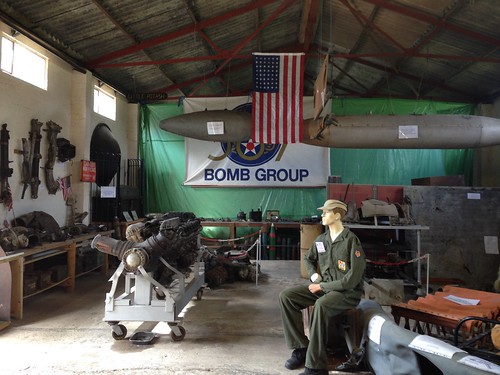
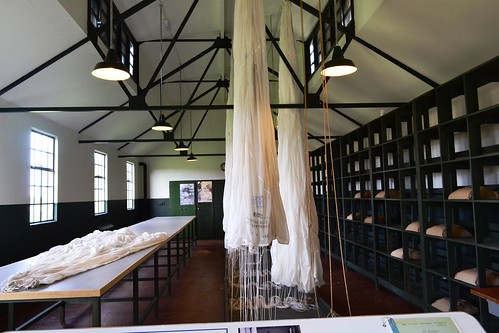
Whilst the museum is currently small, it holds a tremendous amount of information, all  of which is neatly displayed in cabinets and on the walls. Many original photographs are supplemented with official documents, personal stories, newspaper cuttings and artefacts, some of which relate to specific aircraft from Waterbeach’s history.

RAF Waterbeach Museum

Part of one of the many displays in the museum.

Whilst most of the displays reflect life at Waterbeach during the Second World War, various aspects reflect its post war life, both with the RAF and with the Army’s Engineer Regiment – the founders of the original Waterbeach Museum in 1984.

The two rooms of the museum are dedicated to all these people, taking you on a journey through the life of Waterbeach, starting with the sad First World War story of three brothers: Sgt. Jack Day, (1st July 1916), Private Walter Day (1st July 1916) and Private Clifford Day (13th August 1918). Like so many families of the war, their lives were all taken prematurely, two of which occurred on the first day of the first Battle of the Somme. The three brothers, whose ages ranged from 19 to 22 years old, were all local boys to Waterbeach, and like so many, left a family devastated by their loss. Two of the boys remain buried abroad but Walter, like so many other young men, has no known grave and remains missing.

From here the display takes us to Waterbeach in the 1940s, the story of its construction and design are told using photographs taken at that time. Representations of the various bomber squadrons who used the airfield are supported with operational details, personal stories and artefacts relating to individual aircraft that flew from Waterbeach during these early war years.

In the post-war period Waterbeach was transferred to the Transport Command and again photographs and documents show the range of aircraft that flew from here: Liberators, Dakotas, Lancastrians and Avro Yorks.

Into the jet age and we see a flying suit, and a canopy from Gloster Javelin XH871, which ended its days at Bovingdon as a fire fighting air frame. It is particularity significant as it previously served here at RAF Waterbeach in the late 1950s.

RAF Waterbeach Museum

One of the many exhibits on display at the Museum.

After the Royal Air Force departed the base was handed over to the Army, and a small number of exhibits represent their presence here at Waterbeach. The Royal Engineers finally departed the barracks themselves in March 2013.

Other exhibits on display here include: the weather vane from the station church (now demolished), the operations boards, astro-compasses, radios and telephone equipment, all neatly arranged inside glass cabinets. A detailed history of one of the former gate guards, Spitfire LF MK.XIVe ‘TE392’ which now flies with the Lone Star Flight Museum, Galveston, Texas, is also on view.

This is a delightful little museum that has been put together to pay homage to those who served at Waterbeach, either under RAF command or with the Royal Engineers. It is run by volunteers and relies on charitable donations to keep it running. Like many museums, it has limited opening hours, but the range of material is fabulous and it deserves a great deal of public support.

On a final note, my personal thanks go out to Adrian Wright who gave up his own time to open up and show me around the museum.

For details of opening times and other information the curator can be contacted via email at:  waterbeachmilitarymuseum@waterbeach.org

or via Facebook at: https://en-gb.facebook.com/waterbeachmilitaryheritagemuseum/


RAF Debden (Part 3) – The USAAF Arrives.

After Part 1 and Part 2 of the trail, we find that Debden has a new owner, the USAAF. Its fortunes change and it becomes home to one of the most famous Fighter Groups of the Second World War.

121 Sqn, were reformed in 1941 at Kirton-in-Lindsey, initially with the Hurricane MK. I, and then IIBs moving on to the Spitfire IIA and eventually the VB; a model they brought with them to Debden. 71 Squadron had been formed at Church Fenton, and after moving through a series of stations that included Martlesham Heath, they arrived at Debden on 3rd May 1942 also with the Spitfire VB. On September 29th 1942 the two RAF units along a with a third, the 133 Sqn at Great Sampford,  were officially disbanded, but the men of the three units were not dispersed. Instead they absorbed into the USAAF as the 4th Fighter Group (FG). The men of these squadrons were all originally US volunteers who formed the three  American ‘Eagle Squadrons‘ operating within the Royal Air Force.

The 4th FG was specially created to take these three squadrons, they were brought together at Debden where they became the 334th (71 Sqn), 335th (121 Sqn) and 336th (133 Sqn) Fighter Squadrons (FS).  Debden would then be passed from the RAF to the USAAF, the transition of which, would be smooth and relatively uneventful, the units retaining the Spitfires they already had before replacing them with P-47s later in 1943.

A Spitfire Mk. V (QP-V) of the 334th Fighter Squadron, 4th Fighter Group. Handwritten caption on reverse: '1942. 334 FS. 4th FG.'

A Spitfire Mk. V (QP-V) of the 334th Fighter Squadron, 4th Fighter Group. (IWM)

The handover of ownership of Debden took place on the 12th September 1942, with an official ceremony on the 29th to coincide with the disbandment of the RAF units. During this ceremony both Major General Spatz and Brigadier General Hunter were joined by Air Chief Marshal Sir Sholto Douglas of the RAF’s Fighter Command, to see Debden and the aircrews officially joining the ranks of the USAAF. Initially little changed after the handover, the most prominent feature being the removal of the RAF roundels and the application of the US Star on the aircraft’s fuselage and wings. New ground crews were brought in and trained by RAF personnel to maintain the Spitfires, and so RAF crews remained on site until such times as the American were in position to become self-sufficient.

As these crews had been involved in front line operations for some time – the 71st having gathered a total of over half the 73.5 kills recorded by the three squadrons – they were immediately made operational and went on performing in the duties they had been so adept at completing thus far. So proud of their origins were they, that the 4th FG stood out from their fellow Americans both in the way they flew, and the way they behaved.

With their first mission under the ‘Stars and Stripes’ on October 2nd, they would not have to wait long before seeing action once again. The Eagle Squadrons would become famous throughout the war, achieving many records in aerial combat over the next three years. Taking part in the Normandy invasion, aerial battles over Northern France, the Ardennes, the Rhineland, and over Berlin itself; they would not be short of combat experience. Throughout their time the 4th FG would achieve many ‘firsts’. They were the oldest fighter group of the Eighth Air Force, and their combined totals of  enemy aircraft destroyed both in the air and on the ground was the highest of the entire USAAF. They were also the top scoring Allied Fighter Group of the war, destroying 1016 enemy aircraft for a loss of 241 of their own aircraft, many of which were due to flak. They would be the first unit to engage the enemy in air battles over both Paris and Berlin, and they would be the first US Eighth AF Group to penetrate German airspace – a record they established on 28th July 1943. The 4th would also be the first fighter group to be selected to escort the heavy bombers of the USAAF on their first shuttle run, landing in Russia before returning home.

Not only did they undertake many ‘firsts’, but the 4th FG gained an undeniable reputation, between the 5th March and 24th April 1944 they earned a Distinguished Unit Citation when they shot down 189 enemy aircraft whilst destroying 134 on the ground. You cannot mention the 4th without mentioning the name of Donald M. Blakeslee, credited with 16 kills, he was a brilliant fighter pilot who retired from the USAAF as a Colonel. Blakeslee was considered one of finest combat fighter leaders of the Second World War who shunned publicity even refusing to paint ‘kills’ on his aircraft, and he was known, on several occasions, to give kills to rookie airmen. Blakeslee initially flew in 401 Sqn (RCAF) before transferring to 133 Sqn and then the USAAF when they transferred across. He was a remarkable man, a great leader who was looked up to by all those who flew with him, he sadly died in September 2008 leaving a daughter. All-in-all, the 4th achieved quite a remarkable record considering they were initially volunteers of the American air war in Europe.

The 4th FG would remain at Debden thought the war, leaving it only when the RAF required the return of the airfield in July 1945, at which point the whole group packed up and departed for Steeple Morden in Cambridgeshire.

Airmen of the 4th Fighter Group ride in the back of a jeep at Debden air base. A P-47 Thunderbolt is in the background of the shot. Passed by the U.S. Army on 2 October 1943, THUNDERBOLT MISSION. Associated Press photo shows:- Pilots at a U.S. Eighth Air Force station in England are taken by truck from the Dispersal room to their waiting P-47's (Thunderbolts) at the start of a sortie over enemy territory. L-R: Lt. Burt Wyman, Englewood, N.J. ; Lt. Leighton Read, Hillsboro, W.V.; F/O Glen Fiedler, Frederickburg, Tex. AKP/LFS 261022 . 41043bi.' [ caption].' Passed for publication ....1943'. [stamp].

Taken almost a year to the day the US forces moved in, airmen of the 4th FG are taken ot heir P-47s before departing on a mission over enemy territory. The aircrew are: L-R: Lt. Burt Wyman, Englewood, N.J. ; Lt. Leighton Read, Hillsboro, W.V.; F/O Glen Fiedler, Frederickburg, Texas. (FRE 28 – IWM).

As 1943 dawned it would become much quieter in terms of movements at Debden. Now officially a US fighter airfield, the RAF had little to do here. For a short period of a week, 303 Squadron would stop over, the only visitors to make any great use of the airfield for the entire year. With Debden having long concrete runways, it was regularly visited by the lighter bombers, Marauders and Havocs taking refuge here from their own fog bound airfields during poor winter weather. It was during this time in 1943, that The Duchess of Kent, made a royal visit to Debden, taking time out to inspect the aircraft and crews of the 4th Fighter Group, accompanied by General D. Hunter and Colonel Edward Anderson.

With that 1943 faded into 1944, the jet age was dawning and the end of the war nearing sight.  In the July, 616 Squadron appeared with the Meteor, Britain’s first operational Jet aircraft. The squadron detachment stayed here until early 1945 when they moved on to Colerne and eventually the continent.

This move would signify the end of operational flying at Debden. The RAF retained the site reforming the Empire Flying Training School here on 7th March 1946 by merging both 12 and 14 Radio Schools into one. Flying a number of aircraft including Proctors, Tiger Moths, Ansons, Dominie and Lincoln IIs until October 20th 1949 when it was disbanded and Debden became the Royal Air Force Technical College, Signals Division. After a further name change the unit was finally disbanded on April 8th 1960, after it had operated a variety of aircraft including an: Anson, Air Speed Oxford, Spitfire XVI, Lincoln and Varsity.

Between 1963 and October 1973, Vampire F. MK.3 VF301 stood outside Debden’s front gate as guardian, one of several that have been here. It is now sits in the Midland Air Museum at Baginton in the markings of 605 (County of Warwick) Sqn as ‘RAL-G’.

DH Vampire F-1

A former Guardian of Debden now at the Midland Air Museum at Coventry’s Baginton airport.

Although remaining open, the airfield was used for a number of public displays and as a race track, including in 1966, the RAF Debden Motor Gala which featured Donald Campbell’s car, Bluebird CN7, in which Campbell set the land speed record in 1964.  Parts of the site are still used for racing today by the Borough 19 Motor Club*3

In 1975 the airfield officially closed although 614 Gliding School (later 614 Volunteer Gliding School) remained on site using it for flying, until they too departed moving to Wethersfield in 1982.

The army took over the site when the RAF Departed and they remain there to this day.

Debden, because if its post war usage, is a remarkably unique site, but whilst many of the original buildings remain intact, some even being listed as Grade II buildings*4, access is not permitted to the general public and therefore very little can be seen without prior permission. From public roads, high fences and thick hedges obscure most views although from the south, parts of the runway, and several dispersals can be seen quite easily.

RAF Debden

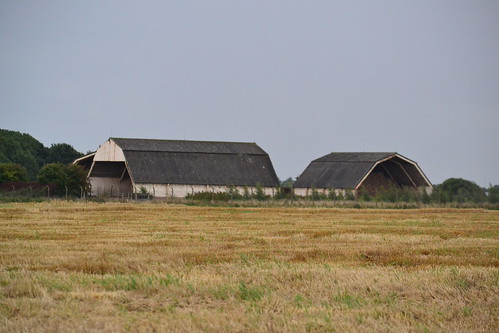
One of the pans now missing its Blister hangar.

By keeping the gate house to your right and passing along the road east to west, you pass the current accommodation area, Guard House and modern buildings used by the current Army owners. Continuing along this road soon brings you to the memorial. Whilst there is no official parking space here, there is a grass verge opposite the memorial where you can safely park your car off the busy main road. Behind the memorial is the north-south runway, still in full width, in which a small section of it can be seen as it rises and dips over the hill. Returning toward the main entrance brings you to a parking area on your right, where public access is permitted to Rowney Wood. Here there are a small number of original buildings still left along with former roads / and taxi ways. During its US occupation, there were five Blister Hangars located here, today only a couple survive, both in current use by local companies.

Like many former airfields and military sites, Debden has been identified as a possible housing location, with the potential for the construction of 55,000 homes. The announcement to close the barracks was made on November 7th 2016, as part of the ‘Better Defence Estate’ strategy, in which 91 MOD sites across the country will close by 2040. Government figures say that the move will save £140 million by closing these sites which also includes the US base at Mildenhall.*5

Considering the history of RAF Debden and the current status of its buildings, the restrictive nature of the site is also its guardian angel. However, with the axe looming heavily overhead, what will become of this site in the future? Its runways will no doubt be dug up, the older non-classified buildings could be demolished, its pathways and taxiways removed. Debden is in danger of disappearing for good leaving only small traces of this once famous airfield that not only took part in the Battle of Britain, but whose airmen defended London in what was very much our darkest hour.

Sources and further reading.

*2 AIR 27/703/17 National Archives

*3 ‘Borough 19 Motor Club’ website has details of their race activities.

*4 One such building is the Sector Operations Block, built in 1938, to the designs of J.H. Binge of the Air Ministry’s Directorate of Works and Buildings (drawing no. 5000/137).

*5 The story was highlighted in the Saffron Walden Reporter website accessed 11th October 2017.

Royal Air Force Police Flights who were at Debden have photos and information on their website.

RAF Debden (Part 2) – The Battle of Britain.

Following on from the first part of this Trail, we see how Debden was thrust into the Battle of Britain and the historic changes that followed.

On August 18th 1940,  at 17:30, the squadron consisting of thirteen aircraft were scrambled to patrol the Skies over Debden. Almost immediately they were diverted to Canterbury and ordered to patrol at 20,000 ft. Five minutes after reaching their designated point, they were ordered into battle attacking ‘raid 51’ who were crossing the coast in the vicinity of Folkestone. Within minutes, the two formations were entwined and the aircraft of 85 squadron set about the 150 – 250 machines of the Luftwaffe.

A mix of J.U. 87s, H.E.111s, J.U. 88s, M.E. 110s and M.E. 109s were staggered in layers between 10,000 feet and 18,000 feet, and as soon as the aircraft of 85 squadron were sighted, the enemy immediately employed tactical defensive manoeuvres with some of the bombers heading seaward whilst other climbed toward their fighter protection.

Hugely lacking in aircraft numbers, the RAF  had little choice but to ‘dive in’, as a result large numbers of individual ‘dog fights’ occurred, resulting in aircraft being strewn across the Essex sky around Foulness Point.  For a while there was complete chaos, aircraft were burning and crews knew little of each other’s whereabouts. In one incident P/O. J. Marshall (Yellow 2) followed his leader into attack. In the melee that followed Marshall flew into a cloud of vapour created by a damaged H.E.111 his wing colliding with the tail of the Heinkel severing it completely and cutting the wing tip-off of his own aircraft. Despite the damage Marshall nursed his crippled aircraft to Debden where he landed safely and unhurt.

During this attack six Me 110s, three Me 109s and one He 111 were confirmed as destroyed, a further He 111, Me 110, Ju 87 and Me 109 were confirmed as probables, whilst four Me 110s and two Do 17s were known to have been damaged.

85 Squadron casualties on the day consisted of one Hurricane destroyed and one damaged. It was during this attack that  Flight Lieutenant Richard H.A. Lee, D.S.O., D.F.C. (s/n 33208), flying as Blue 1, was last seen by Sqn. Ldr. Townsend and F/O. Gowers 10 miles east of Foulness Point chasing 5 Me 109s. He lost contact and failed to return to Debden.  Lee, a veteran with nine victories to his name, was Lord Trenchard’s Godson, and was reported missing that day. *2

On the next day, 19th August 1940, 85 Squadron departed Debden, swapping places with 111 squadron who had previously moved to Croydon. In a signal Air Chief Marshal Sir Cyril Newall, G.C.B., C.M.G., C.B.E., A.M., expressed his thanks to the crews of 85 Sqn, sending his gratitude for “all your hard fighting” in which he added “This is the right spirit for dealing with the enemy.” 85 Squadron went on to continue the fight at Croydon flying in the same determined manner they had shown whilst based at Debden.*2

RAF Debden

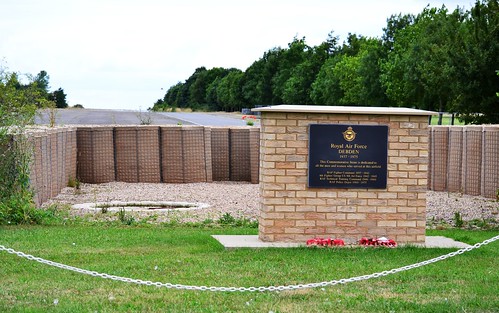
The memorial at Debden sits at the end of the north south runway (seen behind).

It was also during August 1940 that Debden became a focus for attacks by the Luftwaffe. On the 20th, a small reconnaissance mission took German aircraft over the airfield along with other airfields in the region. Six days later, on August 26th, the first attack on Debden would occur, a combined attack that would also involve strikes on Kenley, Biggin Hill, Hornchurch and North Weald airfields.

Whilst 11 Group – whose sector headquarters were at Debden – put up ten squadrons and one flight to intercept the incoming raiders,  a number of bombers did get through and over 100 bombs were dropped on the airfield damaging the landing area; the sergeants mess, NAAFI , a motor transport depot and equipment stores. In addition to this the water and electricity supplies were both cut, and five personnel were killed. The raid was made worse by the inefficient vectoring of protective aircraft from Duxford due to them being unable to obtain the correct radio frequency. This mishap did little to help the ongoing ‘dispute’ between Air Marshal Sir Keith Park and Air Vice-Marshall (later Air Marshal) Sir Trafford Leigh-Mallory, who were both locked in dispute over the defences of 11 Group’s airfields – it was arguably this feud that eventually cost Park his command of 11 Group, and a move as AOC to Malta.

At the end of August, Debden would once again become the focus of Luftwaffe attacks. Shortly after 8:00am on the morning of August 31st 1940, waves of Luftwaffe bombers flew over Kent turning northwards toward North Weald, Duxford and Debden. A formation of Dornier bombers managed to reach Debden again where they dropped over 100 incendiary and high explosive bombs on the airfield. This time the sick quarters and barrack blocks received direct hits whilst other buildings were damaged by blasts.

Further attacks on September 3rd and 15th failed to materialise and Debden was finally left alone to lick its wounds and repair the damage to its fragile infrastructure. It was also during this time (2nd September to the 5th September 1940) that all three resident squadrons: 257, 601 and 111  would depart, leaving Debden behind and heading further south to pastures new.

With the ending of the Battle of Britain, things would become a little quieter at Debden, although movements of man and machine would continue with a perpetual occurrence. The October and November would see more short stays: 25 squadron (8th October for around two and half months); 219 Sqn as a detachment for two months, and 264 Sqn at the end of November for just one month. These changes would lead Debden into the new year and 1941.

During 1941, 85 Squadron would return yet again, and after being bounced around with almost regular occurrence this, their final visit, would be in the night fighter role. Initially using their Hurricanes and then Defiants, they soon replaced these with the Havoc before vacating the site for good and the fields of Hunsdon in May that year.

There were yet more short stays during 1941: 54 Squadron in June (two days), 403 Squadron (25th August  – 3rd October); 258 Squadron (3rd October  – 1st November); 129 Squadron (1st November – 22nd December); 418 squadron (15th November – 15th April 1942); a detachment of 287 Squadron; 157 who were reformed here on 13th December moving to Castle Camps five days later where they would receive their Mosquito II aircraft, and finally 65 Squadron who arrived three days before Christmas and stayed until 14th April 1942.

One of these squadrons, 403 Squadron flying Spitfire VBs, was formed as a result of Article XV of the Riverdale Agreement, in which it was agreed between the British Government and the nations of the commonwealth: Canada, Australia and New Zealand; that their trained military personnel would fly and operate as part of the Royal Air Force. This would mean that both air and ground crews would perform their duties under RAF command. Some 70 squadrons were created as a result of this agreement, and of those seventy, 67 were numbered in the 400 series. Even though they were part of the RCAF, RNZAF and RAAF, they were treated as integral parts of the British Royal Air Force for the duration of the conflict.

Into 1942 and yet more of the same, 350, 41, 124, 232 and 531 Squadrons all following this similar pattern of short stays and placements, thus life at Debden was becoming a constant carousel of ground crews and flying personnel. Two squadrons from here did make a real name for themselves though, that of 71 and 121 Squadrons.

In Part 3, we see Debden take on a new owner, its fortune changes and it becomes home to one of the most famous Fighter Groups of the USAAF – the 4th Fighter Group.

RAF Biggin Hill Vestry demolished.

There has been an ongoing fight against Bromley Council who have made the decision to demolish the Vestry at Biggin Hill airfield, to make room for a new museum.

Concerns are not with the museum itself, in fact there have been calls for one for over 30 years, but they are with the current design of the building which campaigners say,  “is not sympathetic to the original building”.

The Grade 2 listed Chapel was built under instruction from Winston Churchill in 1951 as a dedication to those who fought in the great Battle over southern England.

A petition was recently set up by local people, which so far, has reached nearly 21,000 signatures, and was handed to the Government earlier this month. Protesters also say that once open, visitors to the chapel will not be able to view the existing stained glass window without payment of the museum entry fee, predicted to be £7.50.

Since then, the Vestry, a building of around 70 sq metres and adjoining the Chapel, has been completely demolished at a cost of £25,000.

It is thought that the Chapel itself will be closed to visitors for around a year whilst the new building is erected.

If you want to know more the petition can be found at:

https://you.38degrees.org.uk/petitions/protect-biggin-hill-st-george-s-raf-chapel-of-remembrance

You can also see footage of the news reports though the Downe Village website by scrolling down the front page.

RAF Debden (Part 1) – The Build up to the Battle of Britain.

Not far from Wethersfield, lies the parent airfield of Castle Camps. Now closed to aviation, it currently resides in the hands of the Army as the Carver Barracks. On this next part of this Trail we wind our way through the Essex countryside to the former fighter station that gained notoriety during the early 1940s, and in particular the Battle of Britain. In this, the first part of the visit, we look into the development of the airfield, and the build up that took it into the heart of the Battle. We visit the former RAF Debden.

RAF Debden (Station 356) – Essex

The internet and history books are awash with pictures and information about RAF Debden, and rightly so. It is an airfield with an incredible history, famous for its part in the Battle of Britain and the defence of London, it was home to no less than thirty RAF squadrons at some point; it was used by the U.S. volunteer squadrons the ‘Eagle Squadrons’, and then taken over by USAAF as a fighter airfield following their official entry into the war. It was then used again by the RAF post war up until 1975 when the British Army took over,  those whose hands it remains in today as the Carver Barracks.  Not only is it history long but the site is historically highly significant. According to Historic England, Debden airfield represents “one of the most complete fighter landscapes of the Battle of Britain period“, considered historically important due to its “largely intact defensive perimeter and flying-field with associated blast pens“.*1

Debden is therefore a remarkable site, but as an active military base, access and views are understandably very restricted. However, some buildings can still be seen from public areas, particularly the front as you pass by the main entrance.

RAF Debden

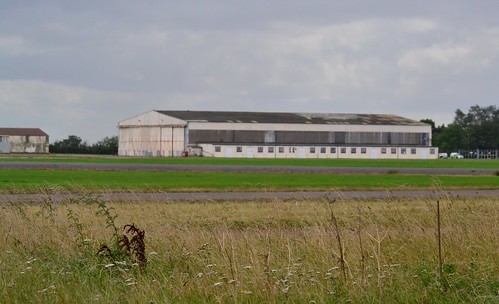
One of 11 Blister Hangars built at Debden.

Debden’s life began in the mid 1930s, it eventually opened in 1937, as part of the expansion programme of the pre-war era, and was classified as a fighter airfield under Scheme ‘C’ of the airfield construction programme. During this period, great consideration was given to the architectural features of airfield buildings, standard designs being finished and positioned aesthetically in line with both the local landscape, stone and environment. Design and construction of these airfields, in this the second part of the expansion phase, was carried out in conjunction with the Royal Fine Arts Commission, whose influence led to an overall improvement in airfield design. During this phase of expansion, over 100 permanent sites were built using these new designs, in fact, according to Historic England, it is these sites that have tended to survive in the best condition to date largely thanks due to their post war and Cold War usage. Even in this pre-war period, aesthetics were as important as operability!

Built by W. L. Fench Limited, Debden wasn’t completed until after it had been opened, thus the first units there were using the site in its unfinished state. The two initial landing surfaces were grass, but as a fighter airfield little more was needed. Even so, and not long after it opened, these were replaced by concrete and tarmac surfaces, giving the airfield much stronger and more adaptable landing surfaces. Being the standard 50 yards wide, these runways were also extended from the initial 1,600 and 1,300 yards to 2,600 and 2,100 yards respectively, allowing for larger and more powerful aircraft to utilise the site.

Debden had a large number of hangars built: three ‘C’ type, one Bellman and eleven blister hangars which were all spread around the perimeter and technical areas of the airfield. Some 80 hardstands were also provided, thus large quantities of aircraft were expected to use the site at one point or another.

Of these thirty operational flying squadrons to pass through Debden, the primary aircraft to see service would be the Spitfires and Hurricanes of Fighter Command. Biplanes such as the Demon and the Gloster Gladiator were also to feature here, as were the twin-engined aircraft the Beaufighter, Havoc/Bostons and the jet engined Meteor in the latter stages of the war. The period 1939 – 1942 though, was by far the busiest period for Debden, the majority of squadrons operating from here during this time.

Upon opening in 1937, Debden would operate the outdated and obsolete biplanes of the Royal Air Force, Hawker’s Fury II of 87 squadron being the first to arrive on 7th June 1937, being replaced shortly after by Gloster’s Gladiator, that famous Biplane that protected Malta as ‘Faith’, ‘Hope’ and ‘Charity’. In the summer of 1938, prior to the outbreak of war, Hurricanes were brought in and the entire squadron moved to airfields in France where they would stay until May 1940, when France was invaded by the German forces. Brought back to England, a short two-day stop over at Debden, would lead to a move north and Yorkshire before returning to the battle, and a night fighter role over Southern England.

Joining 87 Sqn in June 1937 were further Gladiators, those of 80  Squadron who, themselves formed a month earlier, would stay at Debden until departing for the Middle East and Ismailia a year later. A third squadron would arrive during this time, 73 Squadron, who shortly after reforming at nearby Mildenhall, would also replace their Hawker Furys with Gladiators coinciding with their move to Debden. Also moving to France, 73 Sqn would eventually move to the Middle East, where they would remain for the duration of the war, flying from numerous airfields including that of Habbaniyah, one of several places where my father was stationed post-war.

One other squadron would grace the skies over Debden that year, that of 29 Squadron, whose Hawker Demons were adapted to accept a Frazer-Nash turret for defence. A small aircraft, they would be no match for enemy fighters and so were replaced in December 1938 by the far superior aircraft the Blenheim IIF. Coinciding with this, was the movement of a detachment of 29 sqn aircraft to Martlesham Heath, which was followed by a months stay at RAF Drem in the border region before returning to Debden once more. By the end of June though, the entire squadron have been pulled out of Debden and moved to Digby in Lincolnshire and a new role as night fighters.

1938 also saw the reforming of 85 Squadron on the 1st June. 85 sqn, as a unit, had their roots in the First World War, being stationed in France before disbandment in the summer of 1919. But on this occasion, they were reformed out of ‘A’ Flight of 87 squadron prior to them taking on their Hurricanes and imminent move abroad. During the period 1939 – 1940, 85 Sqn would move around almost weekly, with one of their longest permanent stays being between November 1938 and September 1939 whilst here at Debden. Being the parent airfield of Castle Camps, Debden units would often be dispersed there, or in some cases stationed there, whilst also operating out of Debden – 85 Sqn being no exception.

Two other squadrons would fly from Debden during the winter/spring of 1939 – 40, both 17 and 504 operating the Hurricane MK. I. On an almost weekly basis, both units would yo-yo between Debden and Martlesham Heath, an almost continuous spiral of postings saw them using the ‘Heath’ as a forward operating airfield until around May 1940, when both units were moved to France in support of the B.E.F.

Hawker Hurricane Mark Is of No 17 Squadron taxiing at Debden, July 1940. In the foreground is YB-C, that of the CO, Squadron Leader Harold ‘Birdy’ Bird-Wilson, who was shot down on 24th September flying YB-W (P3878) (IWM – HU 54517)

As the fall of France turned into the Battle of Britain, fighter units to defend Britain became top priority. The dawn of 1940 would see the beginning of six more squadrons operate out of Debden, the majority of which would arrive during the height of the Battle. Debden, as the Sector Station responsible for the Thames Estuary and eastern approaches to London, would become a prestige Luftwaffe target during those early days of the Battle. As a result, it along with other Sector stations at Northolt, North Weald, Biggin Hill, Tangmere and Hornchurch, would endure some of the most sustained and prolonged attacks by German bomber formations.

To meet the demand for fighter units, 257 Squadron were reformed and posted to Debden initially flying the Spitfire MK. I. They quickly replaced these with the Hurricane I prior to them becoming operational on July 1st. Four days later they were joined at Debden by both 601 (the ‘Millionaires Squadron’ named so after the men who initially joined it) and 111 Squadron making this one of the largest collections of Hurricanes at that time.

85 Squadron were soon in the thick of the battle. As July 1940 turned to August, patrols would be sent up as regularly as the sun would rise, many of these patrols would result in enemy engagement; the Operational Record Books being testament to the continuing battle for the skies over Britain at that time. At the beginning of August on the 7th, Air Vice-Marshal K.R. Park M.C., D.F.C. visited  Debden, a visit that preceded the transfer of Debden from 12 Group into 11 Group. It was also at this time that the funeral of P/O. Britton of 17 Sqn took place, a young man who lost his life in a flying accident on the 6th whilst carrying out an air test in Hurricane N2456. In poor weather, visibility of only four miles, P/O Britton crashed into Debden Park destroying the aircraft in which he lost his life.

In mid August 1940, both ‘A’ and ‘B’ flights of 85 Sqn were brought back from Martlesham Heath and Castle Camps to Debden, a move that preceded the not only the first but one of the largest attacks by a Debden squadron on enemy aircraft.

In part 2, we see how Debden was affected by the German campaign, the relentless attacks that drew Debden crews into battle. We look at the changes at Debden and how the American made a name for themselves as determined and fearless fighter pilots.

*1 Historic England, Historic Military Aviation Sites – Conservation Guidance, 2016.

389th BG Exhibition at Hethel.

Whilst visiting RAF Hethel (Trail 38), we drop into the exhibition of the of the 389th BG who were stationed here during World War II.

The exhibition is small but it has a lot to offer. Located in the former Chapel/Gymnasium, it has been carefully restored and filled with information and artefacts pertaining to the former airfield and U.S Air Force during the Second World War.  There are also articles from the 466th Bomb Group who were based at nearby RAF Attlebridge, the RAF and stories from local people who befriended the Americans whilst they were here.

The exhibition is located on a working poultry farm and so access is limited, open every second Sunday of each month between April and October, from 10:00 am to 4:00 pm.

The buildings have been painstakingly restored by volunteers, some of whom have had connections with the airfield or Lotus cars, the current owner of the airfield itself. In 2001 the museum opened its doors to the public, after moving a collection of memorabilia from the Lotus site over to their new home here at the 389th exhibition.

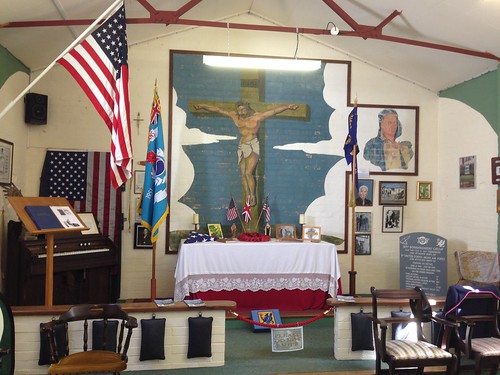
It was during the restoration that two murals were discovered, these are perhaps one of the more stunning aspects of the exhibition. Painted in 1943 by Sgt. Bud Doyle, the then Chaplin’s driver, they are located on one of the walls of the Chapel. One is of Christ on a cross, whilst the other is a portrait of a pilot, both have been restored and remain on display where they were originally painted all those years ago..

389th BG Exhibition Hethel

The restored murals in the Chapel.

Located here, are a number of items many with stories attached. In the Chaplin’s quarters next door, are maps and other documents relating to the groups activities.

Two new Nissen huts have also been built, opened and dedicated in 2014 and 2017, they extend the exhibition further to include uniforms, service records, numerous photographs and more memorabilia.

RAF Hethel, 389th BG Museum

The dedication plaque.

There is also a refreshments bar offering the usual tea and snacks, along with a toilet facilities.

From the museum there are public footpaths into what was one of the accommodation areas of RAF Hethel, here are some of the remains of buildings, shelters primarily, hidden amongst the undergrowth. The footpaths are mainly concrete once you get onto the site.

RAF Hethel, 389th BG Museum

Part of the exhibition inside the former Chapel at RAF Hethel.

A nice little museum it has free entry and welcomes donations to help with the upkeep and maintenance of the site, if in the area, it is well worth a visit and your support .

The 389th website has further details and opening times and information of forthcoming events.

R.A.F. Wethersfield (U.S.A.A.F. Station 170).

After a short journey from Castle Camps we soon arrive at our next port of call. This airfield, although a Second World War airfield, saw little action but was used by both the U.S.A.A.F. and the R.A.F. both during and after the war. Whilst it does not generally have active flying units today, it does house the M.O.D. dog training unit and as such is classed as an active military site.

This part of the trail brings us to the former airfield RAF Wethersfield.

R.A.F. Wethersfield (Station 170).

RAF Wethersfield was originally designed and built as a Class ‘A’ bomber airfield with construction occurring during 1942. During this expansion period materials and labour were both in short supply, which delayed the completion of the airfield until late 1943. During this period, ownership of the airfield passed hands several times, initially belonging to the Eighth Air Force, it was to be loaned to the R.A.F. between December 1942 and May 1943, before returning back to American hands. However, the delay to construction meant that by the time it was completed and opened, it would not be used by the R.A.F. but passed instead directly into the hands of the ‘new’ U.S. Ninth Air Force.

Constituted in 1941, the Ninth had already been fighting in Egypt and Libya, before they were moved to England in late 1943 in preparation for the forthcoming invasion of the continent. Throughout the remainder of the war they would pave the way for the advancing forces from Normandy deep into Germany itself. As an Air force, it would be disbanded in 1945 only to be reborn post war as part of the Tactical Air Command, and latterly the Continental Air Command, at which point it was assigned to Reserve and National Guard duties.

The first units to arrive at Wethersfield did so in the February of 1944, four months before the invasion took place. The first aircraft to arrive were the A-20 ‘Havocs’ of the 416th Bombardment Group (Light). The Group, who was only a year old itself, was made up of the: 668th, 669th, 670th and 671st Bomb Squadrons, and would fall under the control of the IX Bomber Command, Ninth Air Force who had their headquarters at the rather grand stately home Marks Hall in Essex.

A-20 Havocs, including (serial number 43-9701) of the 416th BG. 9701 was salvaged August 18th 1945. IWM (FRE 6403)

A journey that started at Will Rogers Airfield in Oklahoma, would take the men of the 416th from Lake Charles in Louisiana, through Laurel Airfield, Mississippi and onto Wethersfield some 28 miles to the south-east of Cambridge, in Essex.

As a Class A airfield, its three concrete runways would be standard lengths: 1 x 2,000 yards and 2 x 1,400 yards, all the normal 50 yards wide. Scattered around the perimeter were fifty hardstands for aircraft dispersal – all but one being of the spectacle style.

The 2,500 ground and air crews would be allocated standard accommodation, primarily Nissen huts, situated over several sites to the south-west of the main airfield site. Two T2 hangars were provided for aircraft maintenance, one in the technical area also to the south-west, and the second to the east. One notable building at Wethersfield was a Ctesiphon hut. An unusual, and indeed controversial design, it originated in the Middle East when a sergeant, unable to camouflage his tent, had poured concrete over it. As the pole was removed, the structure remained both intact and strong. The commanding officer, Major J.H. De W. Waller took the idea, named it after a 1,600 year old palace at Bagdad, and developed it in the UK, through the Waller Housing Corporation.

The idea behind the building is that a metal frame is constructed, similar in design to Nissen hut ribs, then covered with hessian after which concrete is poured over it. As the concrete hardens, the hessian sags giving added strength through its ‘corrugated’ shape. The ‘scaffolds’ are then removed leaving the hut’s shell standing independently. At Wethersfield there were originally fourteen of these huts built, all within the technical site, it is not currently known whether any of these still exist today, but it is extremely unlikely as most were pulled down post war.

The 416th BG were part of the 97th Combat Wing, and were among the first to receive the new ‘Havocs’, along with the 409th and 410th BG who were also under the control of the 97th. For the short period between the 416th’s arrival (February 1944) and the invasion in June, they carried out sustained training missions transferring their skills from the B-25s they had earlier used, to the new A-20s, which included operational sorties targeting V-weapons sites in northern France starting in March 1944.

During these flights, accidents would happen. A number of aircraft were damaged or written off whilst attempting  landings at Wethersfield: ’43-9203′, (671st BS) piloted by George W. Cowgill crashed on 21st April 1944; ’43-9209′ piloted by Pilot Elizabeth O. Turner, crashed on 13th August 1944, and ’43-9368′ crashed two days earlier on 11th August 1944. Some of these accidents resulted in fatalities, including that of ’43-9223′ (668th BS) which crashed on a routine test flight 1.5 miles north-west of Wethersfield, on 9th May 1944. The pilot Capt. William P. Battersby (the Squadron Operations Officer) and a passenger Private First Class Charles W. Coleman (s/n 32372194) a Parachute Rigger, were both killed in the accident.

In the April, two months after the Americans had moved in, the R.A.F. officially handed over the airfield to the U.S. forces in a ceremony that unusually, saw a large number of civilians take part.

As the invasion neared, the 416th began to attack coastal defences and airfields  that were supporting Luftwaffe forces. During and after the invasion they targeted rail bottlenecks, marshalling yards, road networks, bridges and other strategic targets to prevent the build up of reinforcements and troop movements into Normandy.

As the German forces retreated, the 416th attacked escape routes in the Falaise Gap to the south of Caen, destroying the many bridges that allowed the German armies to leave the encircled area. During the battle, nine aircraft were lost, and all those lucky enough to return suffered flak damage, some of it heavy. For their actions here between the 6th and 9th of August 1944, the 416th earned themselves a Distinguished Unit Citation (D.U.C.) the only one they would receive during the conflict.

By the following September, the Allies had pushed into France and the Ninth began to move across to captured airfields on the continent, the 416th being one of those to go. Leaving the leafy surroundings of Wethersfield for the Advanced Landing Ground (A.L.G.) at Melun, to the south of Paris, it would be a move that would coincide with the change to the new A-26 ‘Invader’; the 416th being the first unit to do so, another first and another distinction. During their seven month stay at Wethersfield the 416th BG would fly 141 operational sorties losing twenty-one aircraft in the process.

A-20 Havocs and A-26 Invaders of the 416th Bomb Group at Wethersfield. This picture was probably taken around the time the 416th were departing Wethersfield for the Landing Ground at Melun, France. FRE 7445 (IWM)

With their departure, Wethersfield was handed back to the R.A.F. and the First Allied Airborne Army. This would see a dramatic change from the light twin-engined A-20s to the mighty four-engined Stirlings MK.IV, the former heavy bombers turned transport and glider tugs, whose nose stood at over 20 feet from the ground.

The two squadrons operating these aircraft at Wethersfield, 196 Sqn and 299 Sqn, would both arrive on the same day, October 9th 1944 and depart within 24 hours of each other on 26th and 25th of January 1945 respectively.

The Stirling, initially a heavy bomber of Bomber Command, was pulled from front line bombing missions due to its high losses, many squadrons replacing them with the newer Lancaster. 196 Sqn however, retained the Stirling and instead transferred from Bomber Command into the Allied Expeditionary Air Force.

The Stirlings proved to be much more suited to their new role supporting resistance and S.O.E. operations in occupied Europe. But the heavy weight of the Stirling took its toll on the runways at Wethersfield, and eventually they began to break up. Now in need of repairs, the two squadrons were pulled out and sent to Shepherds Grove where they would eventually be disbanded at the war’s end.

RAF Wethersfield

One of the original T2 Hangars on the south-eastern side.

A short stay in March of 1945 by the 316th Troop Carrier Group (T.C.G.) allowed them to participate in Operation ‘Varsity‘, transporting paratroops of the British 6th Airborne across the Rhine into Wessel, and on into northern Germany itself. An operation that saw 242 C-47 and C-53 transport aircraft leave bases in England filled with paratroops and their associated hardware. For many of these troops, it was their first drop into enemy territory – a true baptism of fire. During the take offs, paratroopers witnessed a V-1 flying bomb race across the Wethersfield sky, the Germans last-ditch effort to turn the tide that was very much against them. Immediately after the operation the 316th returned to their home station at R.A.F. Cottesmore, a move that signified the operational end of Wethersfield for the Second World War. Now unoccupied the site was put into care and maintenance, a state it remained in for a good number of years.

With the heightening threat of a soviet attack and the suggestion of the Cold War turning ‘hot’, Wethersfield was then given a new lease of life. On the 1st June 1952, the U.S. returned once more with the 20th Fighter Bomber Wing (F.B.W.), the 55th and 77th Fighter Bomber Squadrons (F.B.S.) operating the F-84G ‘Thunderjet’.

To accommodate the new jets, the main runway was extended, the original wartime buildings were removed and replaced with more modern structures. The original control tower was developed and upgraded to meet the new higher standards required of a military airfield. Accommodation and family support was also considered. Like many U.S. bases in the U.K. they had their own shops, bowling complex, basketball centre, Youth club, cinema and school. Wethersfield was to become, for a short period of time, a front line base and a major part of the U.S.’s twenty-two European bases.

Children are shown around RAF Wethersfield as part of cementing American and British relations. 

The F-84G was a Tactical-fighter bomber designed to carry a 2,000 lb nuclear bomb for use on enemy airfields in the event of all out war. Operating as part of the 49th Air Division, 3rd Air Force, they would operate in conjunction with the B-45’s located at nearby R.A.F. Sculthorpe.

In June 1955, the wing, now reformed but utilising the same units, began flying the Republic F-84F ‘Thunderstreak’. The ‘F’ model was essentially a swept-wing version of the ‘G’; designed to be more powerful whilst utilising many of the tooling used by the ‘G’. Gradually the ‘G’ was phased out by the 20th with the ‘F’ becoming the standard flying air frame.

Up grading of the F-84F to the F-100 ‘Super Sabres’ occurred in 1957, during which time the unit was also re-designated the 20th Tactical Fighter Wing after a major reorganisation of the U.S. forces in Europe. The Super Sabres remaining in service here until 1970 when the nearby development of Stansted Airport led to the Wing moving to Upper Heyford in Oxfordshire. Prior to this move Wethersfield would bear witness to the first demonstration of the F-111 in U.K. skies, an aircraft that would become the back-bone of the 20th after its departure to Upper Heyford in June that year.

In 1963, Wethersfield suffered a blow when  an F-100F Super Sabre ’56-3991′ piloted by First Lieutenant Paul Briggs (s/n 69418A) and co-pilot Colonel Wendell Kelley (s/n 7784A) crashed at Gosfield in Essex. The aircraft experienced repeated “severe compressor stalls” and ongoing problems with oil pressure. After disposing of their fuel tanks over the sea, the aircraft was guided back towards Wethersfield. Eventually the crew decided to eject, the co-pilot asked for the canopy to be blown, and believing he had gone, the pilot ejected. It was not until afterwards that the pilot realised the co-pilot was still in the aircraft, and he was killed in the resultant crash in a farmer’s field. To commemorate the tragic accident that took the life of Colonel Kelley, a memorial stands on the village playing field*1.

RAF Wethersfield

Cold War Shelters located on the original hardstands.

With this move in 1970, Wethersfield went back into care and maintenance, used by the airport repair organisation the Rapid Engineer Deployable Heavy Operational Repair Squadron Engineers or RED HORSE for short, who were responsible for the rapid repair of runways and other large airfield structures in times of war. This would also mean the end of operational flying at Wethersfield, and after the departure of the 20th, no further active flying units would return.

As the Americans began their European wind down, the ‘RED HORSE’ unit was also pulled out and the site returned to Ministry of Defence ownership. The R.A.F.’s M.O.D. Police units moved in during 1991, the hands of which it remains in today.

The airfield is still complete, the runways a little worn, its surfaces ‘damaged’ by experimentation with new techniques and repair practices, but it is used by visiting aircraft associated with Police and M.O.D. operations – Police Helicopters and the like. A glider training unit 614  V.G.S. also reside here utilising one of the remaining T2 hangars, keeping the aviation spirit alive if only for a short while longer.

Today it remains an active Military base, and as such access is strictly forbidden. The roads around the airfield do offer some views but these are limited. A public road and footpath is located at the north-eastern end of the site, from here the runway, parts of the perimeter track and hangar can be seen through the fencing. Passing the main entrance, there are a small number of buildings remaining derelict on adjacent farmland, these were part of the original accommodation site and are few and far between. Continuing along this road leads to a dead-end and private dwelling, but it does allow views of the current  accommodation and training buildings on the former technical area, all now very modern.

RAF Wethersfield

There have been many of these post-war additions to the airfield,

Whilst Wethersfield remains an active site, plans were announced in March 2016 to dispose of it as part of the M.O.D.’s plan to sell off many of its sites to raise money and streamline its activities. If planning permission is granted, Wethersfield could see 4,850 homes being built on it and the resident units of the military being moved elsewhere. It is planned to pass Wethersfield over to the Homes and Communities Agency by 2020, for its disposal*2.

Having a short war service and limited cold war history, Wethersfield is one of those airfields that never achieved huge recognition. Despite this, it was nonetheless, one that played its part in major world history. Achieving many ‘firsts’ and seeing many new developments in aviation, it is slowly starting that decline into obscurity. If the Government have their way, Wethersfield will shortly become a housing estate, and its history will sadly become yet another of those condemned to the local library.

After leaving here, we carry on into Essex and yet another airfield that has remained active but not as a flying base. We go to the Carver Barracks and the former R.A.F. Debden.

Sources and further Reading.

*1A website dedicated to the 20th T.F.W. at Wethersfield has a number of pictures of both aircraft and people associated with Wethersfield and the 20th T.F.W.  It also includes a transcript of the discussion between the pilot and the tower prior to the Sabre’s crash. There are also other documents relating to the crash located on the site.

*2 The announcement was highlighted ion the Essex Live website, March 24th 2016.

RAF Castle Camps – A return to Essex.

Bordered by Cambridge and Suffolk to the North, Hertfordshire to the west, London to the south and the North Sea to the east, Essex is a coastal county that boasts a diverse range of landscapes. Primarily commuter belt for London, it has a range of its own industrial giants, electronics and pharmaceuticals being prime employers of the area. It also has a long and diverse aviation history, hosting a number of wartime airfields some of which are still in use today – albeit under a different guise.

Following on from Trail 33 (Essex Pt. 1), we return once more to Essex to its northern borders to visit some of the airfields that can be found among its green fields and idyllic villages. We start off at the former airfield, RAF Castle Camps.

RAF Castle Camps.

Castle Camps lies straddling the borders of Cambridge and Essex, a small unassuming airfield, it was none the less home to thirteen operational units at some point in their wartime career. It was constructed early on in the war, in sight of an ancient Motte and bailey built by Aubrey de Vere, soon after the Norman Conquest. Itself quite a historic monument, there is evidence that dates the site back further to both the Saxons and Romans. This castle itself is known to be the largest Medieval fortress in the county, and dates back to the latter parts of the thirteen century*1. Originally known as Great Camps, and Camps Green, it is after this Castle that both the village and airfield gained their names.

Castle Camps housed a small number of aircraft types: Hurricanes, Beaufighters, Spitfires and Mosquitos all resided here, with some as detachments, but many as full squadrons. Even with increases in Squadron  numbers, only one unit was ever formed here, that of 527 Squadron in 1943. However, that did not mean a posting here was by any means ‘quiet’.

Opening in the summer of 1940, it was designed as a satellite for nearby R.A.F. Debden and as such, both its accommodation and facilities were rudimentary to say the least. A grass airfield, with initially little more than tents for sleeping, it possessed a more ‘informal’ atmosphere than many of the R.A.F.’s other airfields.

No. 85 Squadron – a First World War unit that had only been reformed two years before war broke out – had been stationed in France to face the advancing might of the German army. Badly beaten and continuously moved around the many airfields of France: Merville, Lille, Mons-en-Chaussee and Boulogne, the squadron was completely decimated with only four aircraft from those originally sent out returning. In May 1940, these aircraft were pulled back to Debden to reform and re-equip. With detachments at both Martlesham Heath (A Flight) and Castle Camps (B Flight) they would be led by the soon-to-be-famous, Squadron Leader Peter Townsend, D.F.C.

85 Sqn would  initially take on a regime of coastal patrols many starting in the early dawn sunlight and continuing on through until dusk. These repeated flights were undertaken using many new ‘green’ crews who were eager to get back at the enemy for defeats in France. Whilst those at Martlesham would be thrown into the deep end, the Debden and Castle Camps’ crews would find their time slightly less ‘strenuous’.

The CO of No. 85 Squadron, Sqn Ldr Peter Townsend, jumps down from Hurricane Mk I P3166 ‘VY-Q’ while being refueled at Castle Camps, July 1940. © IWM (HU 104489)

With many airmen arriving with less than 10 hours flying experience, it was vital they learn discipline and extreme vigilance whilst flying, and Townsend saw these flights as a way of achieving that. By the end of June 1940, the flights at Debden and Castle Camps had undertaken 505 hours of flying, of which only 25 had been recorded as ‘operational’.*2

The importance of this training was soon realised when on July 22nd 1940, Hurricane P3895 piloted by Pilot Officer John Laurence Bickerdike (s/n 36266), undershot the runway at Castle Camps. In the resultant crash,  Bickerdike at just 21 years of age, was killed.

On August 13th, ‘B’ Flight departed Castle Camps and returned to Debden joining with ‘A’ Flight from Martlesham Heath. At last the squadron was together again and it wouldn’t be long before they would be moving on to pastures new, this time to Croydon, on the southern outskirts of London.

Other than an almost passing overnight stay in September, 85 Squadron wouldn’t return to Castle Camps until the war’s end in 1945.

Hawker Hurricane P2923 ‘VY-R’ of No. 85 Squadron. The Operational Record Books show this aircraft being flown by F/O R.H.A. Lee, D.S.O., D.F.C., at Castle Camps, August 1940. He was lost on the evening of August 18th 1940. Note the ‘temporary’ wooden airmen huts see note below. © IWM (HU 104510)

Whilst Debden remained busy – 85 Sqn making a straight swap with 111 Sqn – Castle Camps was quiet. The next users would be 73 Squadron in early October 1940.

Moving from the night training duties of Church Fenton, 73 Squadron had themselves been more successful in France than 85 Sqn. Using Hurricanes in this night fighter role though proved to be a costly mistake, as they were wholly unsuited and casualties were high in these early flights. By the end of October into early November, operational sorties has ceased as preparations were made to transfer the entire unit, via HMS Furious, to Heliopolis.

With this departure, Castle Camps fell operationally quiet again, and it was decided to upgrade both the airfield’s accommodation and flying facilities.

Three runways were built all covered with tarmac: the main running south-west to north-east of 1,900 yards, with a secondary and third runway of 1,600 yards and 1,070 yards respectively. Both the main and third runways were later extended, the main to 2,600 yards and the third to a more standard 1,100 yards. Sixteen hardstands were provided for aircraft dispersal as hangars were not yet added, but a Bellman and eight blisters were later erected.

Accommodation would be provided for 1,178 male and 184 female staff, 1,179 of which were ordinary ranks. The original temporary wooden huts (possibly Laing huts) were supplemented with ‘improved’ Ministry of Supply (MoS) huts. These differed in that they had canted sides as opposed to vertical sides normally found in these types of accommodation huts. Three of these huts are believed to survive today in a very much modified condition and used for agricultural purposes, a big change from the time they were used by the W.A.A.F.s of Castle Camps.

Once construction was near complete, operational units would again return. On the 17th December 1941, 157 Squadron (formed at Debden three days earlier) were informed of their immediate  departure to Castle Camps, which would now become a self-serving airfield. The move, which would involve 3 Officers, 34 N.C.O.s and a few airmen, began that day, with ground crews from 3081 Servicing Echelon accompanying them on the next day. A range of other staff began arriving during the course of the closing days of 1941.

However,  the running of the airfield and squadron was badly hampered by the lack of an N.C.O Disciplinarian and Clerk, and by the fact that officers were having to travel back to Debden for accommodation, as it was not available yet here at Castle Camps – the situation was far from ideal.

As Christmas approached, morale began to decline. Influenced by a number of factors it was primarily due to both the lack of work and the isolation of the Castle Camps airfield; the continuing influx of ground personnel also hindered the camp, as by now, it was beginning to put a strain on the lack of completed accommodation. On the 21st, Wing Commander Gordon Slade and Pilot Officer Truscott, his observer, both arrived on posting from 604 Squadron at Middle Wallop. Joining Slade at Castle Camps a month to the day, would be Sqn. Ldr. Rupert Clerke, formerly of No.1 Photographic Reconnaissance Unit (P.R.U.), who flew the first operational Mosquito sortie the previous year on 17th September to Brest. It would be almost a year later on September 30th 1943, that Clerke would fly the first Mosquito day sortie, a flight that resulted in the loss of a Junkers Ju 88 off the Dutch coast.

With little work to do, ‘Normal Squadron Routine‘ was repeatedly entered into the operations records, and so to help boost this flagging morale, the 25th December, was declared a general holiday for all staff who had were said to have a “real good Christmas feed and a good time was had by all“, no doubt a welcome break to the monotony that had preceded the season’s festivities.*3
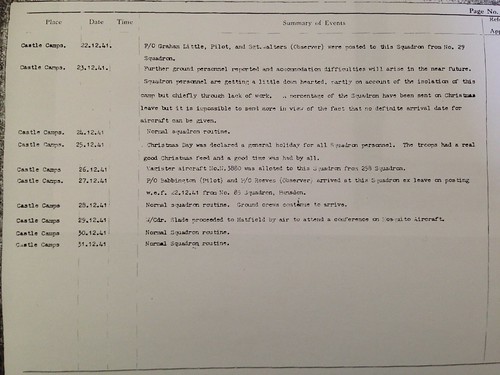
Operations Record Book 157 Sqn

The entries for December reflect the poor morale and the regular Normal Squadron Routine that was becoming ‘routine’. Note the arrival of Sgt. Walters, His name appears in the Roll of Honour – see below. (AIR 27/1045)

Boxing day would see the first aircraft to arrive, bringing new hope to the squadron. A  Magister (N3880) was not what had been hoped for, but at least it was taking the squadron in the right direction.  More ground crews arrived and more “normal squadron routines” occurred. On the 29th, W/Cdr. Slade travelled to Hatfield to attend a conference on the new Mosquito and in the new year, Air Marshal Sir Sholto Douglas (A.O.C. in C. Fighter Command) arrived with the Debden Sector Commander Group Captain Peel. A full inspection of the airfield took place, which coincided with twelve airmen transferring on attachment to 32 Maintenance Unit (M.U.) at St. Athan, where the new Mosquitos were being “fitted and tested”.

A flurry of activity over the next few days saw W/Cdr. Slade travel to both Boscombe Down, and St. Athan – at last things seemed to be happening.

Finally, on the 26th January, 1942 the first Mosquito would land, flown in by W/Cdr. Slade. Slade, who had flown the prototype Mosquito previously at Boscombe Down, brought in a dual control aircraft (W4073) but hopes of more aircraft were soon dashed as this was sadly the only model to arrive for some time.

For the remaining weeks bad weather hampered work on the airfield, and with workshops, decent accommodation and tools still lacking, Castle Camps was rapidly becoming a thorn in the Squadron’s side.

Further ground staff came and went, Mosquitos were ferried between Hatfield and St. Athan by pilots of 157 sqn, for fitting of electronic equipment, W/Cdr. Slade and five officers moved in to dispersed accommodation at a large mansion known as “Walton House” near Ashdon, 3 miles from the airfield.

RAF Castle Camps

The village sign at Castle Camps reflects the ever-present Black Mosquitos of 157 Sqn at the airfield.

On February 22nd, a Beaufighter II arrived, flown by W/Cdr. Ashfield, and by the end of the month more than a dozen Mosquitos had been transferred for modification to St. Athan. There was now a light at the end of the cold, dark tunnel. Staffing was now up to 16 Officers, 12 N.C.Os and 160 other ranks; some of the accommodation site drainage had been sorted, officers showers and baths were now working, and the N.A.A.F.I was at last open and providing entertainment for the staff. The first football match was played between the squadron and the works flight, a resounding thrashing saw the squadron winning 6 – 0.

Over the next few weeks facilities would gradually improve, the weather began to get warmer, and the signs were that more aircraft would soon arrive. On March 9th 1942, the first two operational Mosquitos arrived at Castle Camps, and what a welcome sight it must have been.

The first to arrive were W4087 and W4098, neither were yet fully fitted, but that wouldn’t dishearten the staff at Castle Camps, at least things were now moving. Over the next few days a large number of Mosquitoes would arrive, these NF.IIs were Airborne Interception (AI) equipped night fighters, armed with four .303in Brownings and four 20mm cannon – all very potent weapons of the night war.

By March 29th 1942, 157 squadron had to its name: 14 Mosquitos, 1 Beaufighter (fully equipped), 1 dual Mosquito, 3 not fully equipped Mosquitos, and 2 Magisters. Night flying would now start, but a lack of workshops, sleeping accommodation and fitters meant that not all aircraft could be kept serviceable at this time. By the end of April, training flights had reached their peak, and 157 was now ready for war.

On April 27th 1942, operations would begin. Three patrols would take off followed by four the next day and then three on the 29th. No visuals were recorded from the first two nights but a Do. 217 was identified but subsequently lost in cloud.

At the end of the month F/Lt. Stoneman (Engineer Officer) invented a modification that improved the effectiveness of the Browning’s flash eliminator, an improvement that was so successful, it was quickly adopted by the Air Ministry for other models.

Successes were slow coming to 157 Sqn, problems with the A.I. sets led to frustrations and missed opportunities, but eventually they did come, and the Mosquito proved itself to be a truly outstanding night fighter.
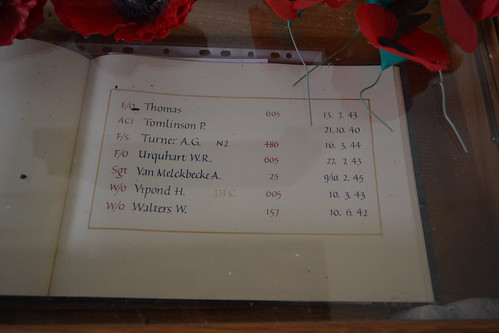
RAF Castle Camps

The Roll of Honour in All Saints Church lists W/O. W. A. C. Walters death as 10th June 1942. Walters (s/n 755538) arrived at Castle Camps on 22nd December 1941 (see above entry in O.R.B), he is currently buried in Nottingham Southern Cemetery, Sec. F.24. Grave 55. He was Son of Arthur and Annie Walters, of West Bridgford, Nottingham, and died at the age of 21.

By  March 1943 a change in command, Wing Commander V. J. Wheeler, M.C., D.F.C. replacing W/Cdr Slade, and then as night defenders turned to intruders, the role of 157 Sqn changed, and they prepared to move to pastures new and R.A.F. Bradwell Bay.

Around this time a small detachment of Mosquitos would share the facilities at Castle Camps, 456 sqn, who were primarily based at Middle Wallop, would have aircraft use the site between March and August 1943 – a month that would take Castle Camps into a new period, and new leadership.

The 15th would be a very busy day for staff at Castle Camps, with the departure of 157 Sqn came the simultaneous arrival of 605 Squadron.
RAF Castle Camps

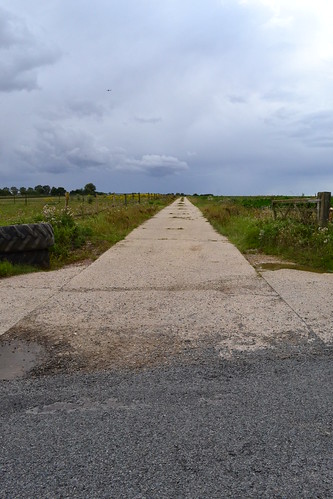
Part of the Perimeter Track that leads away to the airfield.

Led by the then Wing Commander George Lovell “Uncle” Denholm D.F.C., he was himself a Battle of Britain veteran, a Turbinlite advocate and was also famed for his part in the shooting down of the first German bomber on British soil. The famous ‘Humbie Heinkle’ was generally credited to Flight Lieutenant Archie McKellar of 602 Squadron from R.A.F. Drem, but Denholm and his 603 Sqn, played their part in damaging the aircraft before its eventual crash in East Lothian.

With the arrival of 605 Sqn and their Mosquitos, Castle Camps, like the stations at Bradwell Bay and Hunsdon, were quickly becoming synonymous with squadrons of the new type. Also Flying Mosquito IIs, (replaced four months later by the FB.VI) they would eventually depart here also for Bradwell Bay, but not before the ruggedness and reliability of the Mosquito would be put to the test.

On August 17th 1943, Sqn. Ldr. Mack and Flt. Sgt. Harrison, flew Mosquito FB.VI (HJ781) on a night intruder mission to Jagel in the northern most tip of Germany. Whilst on this mission, the aircraft was hit by a cable rocket projectile (Parachute and Cable or P.A.C.) fried from the ground. With a thin cable attached to a parachute they were designed to bring down allied aircraft and could be fired from either multiple or single launchers. HJ781, flew into one such cable which severed around 3 feet off the end of the starboard wing. The Mosquito, suffering considerable damage, managed to return to Castle Camps and was later repaired and returned to flight – such was the strength of the design of the Mosquito.

For the duration of their stay, 605 Sqn would perform almost nightly patrols over the airfields of the low countries and northern Germany, a tit-for-tat game played between the R.A.F. and the Luftwaffe, each aiming to catch returning aircraft as they approached their home airfield. A game that resulted in minor and relatively insignificant attacks on Castle Camps itself.

For eight months from June 1943, Castle Camps would be shared with a new squadron, the only squadron to be formed here, 527 Squadron, who were formed through the combining of both 74 and 75 Wing Calibration Flights from Duxford and Biggin Hill respectively.  Flying a collection of Hurricanes (I & IIB), Blenheim IV and Hornet Moths, they would test the accuracy of Britain’s defence radar systems across southern England and East Anglia.

The October departure of 605 sqn left 527 the only unit operating from Castle Camps, and operationally all was quiet once more. In the December 1943, 410 Sqn, another Hunsdon Mosquito unit arrived, stayed for a short while and then returned to Hunsdon in the April of 1944. A short but active spell saw them victors over a number of German types.

1944  would see another flurry of activity, with units arriving and departing in quick succession, and it would be a few months before another Mosquito would grace the skies over Castle Camps once more. 486 Sqn (RNZAF) , yo-yoed between Castle Camps and Ayr during the month of March, bringing with them yet another potent and deadly weapons platform, the Tempest V; followed by 91 Sqn while they were upgrading their Spitfire XII to XIVs.

Giving a useful indicator of scale, F/O. J. R. Cullen of No. 486 Squadron (RNZAF), poses with his Tempest Mk V at Castle Camps. Cullen became a successful Operation DIVER pilot, shooting down around 16 flying bombs. © IWM (CH 13967)

Between March and June little happened at Castle Camps, 68 Sqn*4 breaking the quiet with their Beaufighter VIFs at the end of June, which were quickly replaced with Mosquito XVIIs and Mosquito XIXs.  68 (Night Fighter) Squadron was primarily an R.A.F. Squadron, but Czechoslovak pilots formed one of its flights. The determination of the Flight’s crews resulted in some high ‘kill’ rates, with twenty-one verified kills, three probable, seven enemy planes damaged  and three V-1 flying bombs to their credit. The flight saw Twenty-three Czechoslovak pilots (twenty-one Czechs and two Slovaks) pass through their doors, culminating in an incredible 1,905 combat sorties covering 4,095 operational hours during the war.*5 By the October 68 Sqn too had departed, replaced by 151 Sqn and 25 Sqn for a short period both with yet another Mosquito model, the MK XXX.

1945 and the close of war saw units slowly begin to disband and wind down, 307 were followed by 85 Sqn who returned in the June and September also with the MK. XXX. A  huge improvement and development from their early Hurricanes of 1939 / 40 and a fitting end to a station that had seen many a brave young man come and go. 25 Sqn also returned, in both the August and October with the Mosquito VI, staying until June 1946, whereupon the airfield closed and returned to agriculture, a state it remains in today.

Castle Camps has little – aviation wise – to offer the visitor these days.  A recently erected memorial stands at the northern end of the airfield, the only visible marker of this once busy site that grew from a cold and windy field with little more than tents for accommodation, to a bustling site with possibly the most advanced and formidable fighters of the Second World War.

It may not appear to be much more than green fields and cattle farming, but sitting in the summer sun, as I did, you can still hear the rumblings of that magnificent engine the Merlin, as the Hurricanes and Mosquitos of the R.A.F. fly over your head transporting you back to those days of 1940s England.

Sources and further reading.

*1 The Castle Camps Village webiste details the history of the Castle.

*2 AIR/27/703/14 National Archives

*3 AIR/27/1045 National Archives

*4 An interesting blog highlighting some of the Czech pilots who flew with 68 Sqn.

*5 Pilot Josef Capka, D.F.M. (a member of the Guinea Pig Club) joined 68 Sqn after they left Castle Camps. His incredible story is told in the Free Czechoslovak Air Force blog and through his book ‘Red Sky at Night‘.
Scotland’s National Museum of Flight – East Fortune (Part 3).

The final public hangar at East Fortune holds what is perhaps its pièce de résistance, an aircraft so ahead of its time that it has never been successfully matched. An aircraft that became simply too expensive to operate but was withdrawn under a cloak of darkness and sadness. In the third public hangar is the story of the Jet Age, a story that tells of the development of the modern jet air liner, from the post war development through to the classics of today. A story that is set around the beautiful aircraft that is of course the B.A.C. Concorde.

The Jet Age Hangar.

The Concorde at the National Museum of Flight (G-BOAA) was the first model Concorde to go into active service in 1976. After flying for a total of 22,768 hours and 56 minutes, in almost 25 years of service, she finally came to rest after what was possibly the most ambitious transportation project ever undertaken. In all her flying time she has visited cities right across the world including: New York, Paris, Bahrain, Miami, Calcutta, Auckland and Barbados. In her life time, G-BOAA has landed over 8,000 times and has flown through almost 7,000 supersonic cycles. She has become an icon, a reflection of what is achievable in civil aviation development.

Concorde was designed and built in agreement between the French Sud Aviation (later Aérospatiale) and Britain’s British Aircraft Corporation (later B.A.E.). Each would make their own prototype, the French (001) flying first on 2nd March 1969, with the British model (002) flying from Fliton a month later on April 9th 1969. At the Paris airshow prospects looked good and over the next few years 65 initial orders were placed by 17 countries with options for many more. However, growing concerns over manufacturing costs, noise, environmental pollution and running costs eventually reduced the orders to just a handful from both British Airways and Air France.

With the price of a return ticket London to New York in excess of £6,500 in 2003, it certainly wasn’t cheap, nor affordable for the average man in the street (but where else can you watch the Mach Meter climb through Mach 2). It was however, a head turner. Wherever Concorde flew crowds gathered to watch in awe of her grace and technological advancement.

Concorde

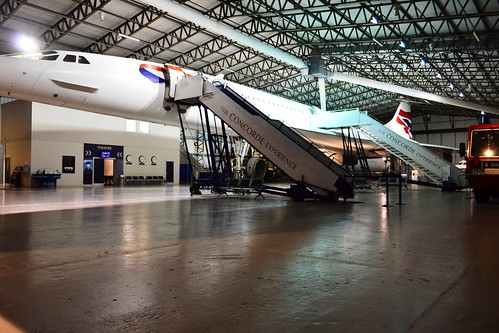
Concorde G-BOAA stands proudly as the centre piece of the Concorde Experience.

Sadly, on July 25th 2000, it all went terribly wrong when taking off from Charles de Gaulle airport, Concorde  F-BTSC ran over a small piece of debris causing the tyre to burst sending shards of rubber at high-speed into the wing of the aircraft. An internal fuel tank ruptured and high-octane fuel poured from the wing igniting as it left. With too little runway to land and insufficient power to fly, it couldn’t fail to miss the Hôtelissimo Les Relais Bleus Hotel and crashed. A terrible tragedy that began the rapid rundown and retirement of the entire Concorde fleet.

Following a slump in air travel due to terrorist activities, rising costs of Concorde and the urgent need for upgrades, by 2003 all Concordes had ceased flying, and the disposal of the air-frames began.

G-BOAA was delivered to East Fortune following a major operation that involved taking it by road to the River Thames, along the Thames by specialist barge and out to sea, around the coast of England and Scotland, and then by road to East Fortune. Roads had to be purposely made cutting through a number of fields in order to get the aircraft to its new home. An operation that took over a week was supported by members of 39 Engineer Regiment’s 53 Field Squadron (Air Support) with a helicopter assistance.

Today Concorde G-BOAA stands as the centre piece of the Jet Age and Concorde Experience Hangar, a proud and open monument to the collaboration and development of the Supersonic passenger age.

But this hangar is not just about Concorde. A cockpit and front cabin portion from a Boeing 707-436 (G-APFJ), and Hawker Siddeley Trident 1C (G-ARPH) cockpit, gives the visitor another insight into life inside another 1960s long haul passenger jet. Outside another two classic passenger aircraft, de Havilland’s Comet 4C (G-BDIX) and the BAC 111-510ED (G-AVMO) further give the visitor an insight into these classic times. A range of jet engines allow you to compare sizes and features, and stories from those who were involved in flying these masters of the sky bring the ‘Golden age of air travel’ to life once more.

East Fortune

Some of the engines on view at East Fortune.

The remainder of the museum is displays and hands on activities. The history of East Fortune, is well portrayed as are the medals of Captain Eric Melrose “Winkle” Brown, CBE, DSC, AFC, Hon FRAeS, RN., and the flying jacket and personal artefacts of Rolf Niehoff, the navigator of the Humbie Heinkel.

East Fortune

Portrait and medals of Captain Eric Melrose “Winkle” Brown, CBE, DSC, AFC, Hon FRAeS, RN

As mentioned earlier, in Post 1 the parachute store has been fully refurbished and is displayed in the way it would have been used during the war years. A unique building, they are easily recognisable by their higher central roof section, or as in some models, offset sloping roofs. Designed to hang and dry parachutes, they are kept at a constant temperature, ideally between 550F and 650F. Wartime parachute stores were built with 4.5 inch thick walls, early designs having a symmetrical two-stage pitched roof as is here at East Fortune. The parachutes were hung from the highest point on a pulley system, so that the silk was kept away from the floor and allowed to dry evenly and cleanly. Once dry, they were lowered to a packing table, inspected, packed away and stored in the store on racks. Each pack was labelled with an inspection date and the person to whom it belonged – each crewman having earlier being measured for his own parachute.

This is possibly the only original parachute store remaining in this condition in the UK and shows the method of drying, packing and storing these vital pieces of equipment extremely well.

East Fortune

The inside of the parachute store clearly shows how they parachutes were dried, packed and stored.

Other exhibits include the RAF’s Matador lorry and a ‘Green Goddess’ fire engine. Made more famous perhaps by the firemen’s strikes of 2002, they were built in the 1950s, and were designed to be used in the event of a nuclear attack. Operated by civilian personnel of the Auxiliary Fire Service (AFS) they would be rushed into cities to extinguish fires and repair water systems. Thankfully, they were never used in this particular role.

East Fortune National Museum of Flight

The RAF’s Matador truck.

The range of exhibits at East Fortune is fabulous. The history of aviation, both civil and military is shown through a range of rare examples, that are restored and maintained in original buildings, purposely restored in line with their original designs and construction. For anyone wanting to see original airfield buildings and beautifully restored aircraft, it is certainly worthy of a trip and is time very well spent.

Sources and Further Reading.

The National Museum of Flight Website has details of tickets, events and features on the various exhibits there.

A list of the aircraft locations at East Fortune.

Flt. Sgt. Arthur L. Aaron, V.C., D.F.M., 218 Sqn, RAF Downham Market

The Second World War produced some incredible heroes, men and women, who in he face of incredible odds, continued to carry out their duties, often going beyond those expected of anyone.

One such man was Arthur Louis Aaron, of 218 Squadron, RAF Downham Market, Norfolk.

Image result for arthur louis aaron

Arthur Louis Aaron (RAFVR) V.C., D.F.M, (source unknown)

Aaron, born 5th March, 1922, in Leeds,  who at the time that war was declared, was training to become an architect at Leeds School of Architecture. On joining the Royal Air Force on December 15th, 1941, he was sent, via Canada, to No.1 British Flying Training School (B.F.T.S.) at Terrell, Texas, where he completed his initial flying training.

Aaron like the other recruits would pass through ten weeks of biplane flying, moving onto monoplane aircraft at which point, if successful, they would receive their wings. Returning back home also via Canada, he was hoping to fly fighters but was disappointed when he was posted to bomber training, and was sent to 6 Advanced Flying Unit at Little Rissington. After further training, he was sent on to 1657 Heavy Conversion Unit (Stradishall) flying Stirling MKIs, and then on 17th April 1943, he was posted to his first operational flying unit, 218 (Gold Coast) Squadron, at RAF Downham Market.  

Whilst here at Downham Market, Aaron continued flying Short Stirling bombers, the large heavy bomber that proved to be both vulnerable to fighters and poor performing. Due to high losses it  was eventually pulled out of front line bombing duties, and used for mine laying, glider towing and parachute operations.

Aaron’s first mission would be the very next day after arriving at Downham Market. He, and his crew, would fly a ‘gardening’ mission laying mines off Biaritz, after which he would be sent on more heavily defended targets within German occupied Europe and Germany itself.

At 21:35 on the night of August 12 – 13th 1943, Flt. Sgt. Aaron and his crew: Sgt. M. M. Mitchem (Flt Eng.); Sgt. A. C. Brennan (RCAF) (Nav.); Flt. Sgt. A. W. Larden (RCAF) (Bomb Aim.); Sgt. T. Guy (Wop/AG); Sgt. J. Richmond (M.U. Gunner) and Sgt. T. M. McCabe (R. Gunner), all took off from Downham Market on their second mission of August to attack Turin, a night that featured several attacks on Italian targets.

This would be Aaron’s 20th and final mission, three as co-pilot and seventeen as pilot. He was a man known for his courage and bravery, only 12 days earlier he had struggled with his aircraft whilst his crew bravely fought fires that had broken out in the fuselage after being hit by incendiaries from aircraft flying above. Using his skill and judgement, he managed to evade both flak and searchlights by corkscrewing his aircraft whilst the crew members put out the fire that resulted from the accident. For his action on this day, he would be awarded the D.F.M.,*1 one of the highest possible awards for non-commissioned officers in the Royal Air Force, but this, like his V.C., would only come posthumously after his death on 13th August 1943.

That night, two of the thirteen 218 Sqn aircraft from RAF Downham Market in Norfolk, would be posted ‘missing’; Stirling HA-Y ‘MZ 263’ piloted by F/O J. McMallister, and that of 21-year-old Arthur Aaron – Stirling III ‘EF452’ HA-O . Whilst in the bomber stream heading toward Turin,  the aircraft was hit by gunfire from another aircraft. The navigator, (Sgt. Brennan s/n R/117605) was killed, Sgt. Mitchem and Flt. Sgt. Larden were both injured. The aircraft, now badly damaged, had been hit in three of the engines resulting in one of them being put out of action. Both front and rear turrets were immobilised, various control lines were broken and the windscreen was shattered. During the attack, Aaron received devastating blows to his face, his jaw being broken and quantities of flesh being blown away. A further bullet struck him in the chest, puncturing his lung. Now in great pain and severely injured, Aaron fell against the control column forcing the aircraft into a dive. After the Flight Engineer regained control, a course was set for North Africa, Aaron was moved to the rear of the plane where he was treated. He remained here for only a short time, insisting on returning to the cockpit where he was placed with his feet on the rudder bars. Wanting to take over, he had simply insufficient strength, and was persuaded to assist rather than fly. He wrote notes with his left hand, guiding the crew toward the airfield at Bone, in Algiers. After four failed attempts at landing, the bomb-aimer finally managed to get the aircraft down, low on fuel and with its undercarriage still raised.

The entry in the Operations Record Book for August 12th 1943, merely states “Landed in Algiers, Sergeant Brennan, Navigator Killed.”*2

At 15:00 on August 13th 1943, Arthur Aaron finally lost his determined battle to survive and died from his terrible injuries. He had fought on, overcoming severe pain and injury to guide his crewmen back to safety. Flt. Sgt. Aaron was buried alongside Sgt. Brennan in Bone War Cemetery, in Algeria.

For their action Flt. Sgt. Larden received the C.G.M., and Sgt Mitcham and Sgt. Guy, both a D.F.M.

Arthur Aaron was awarded not only his D.F.M. from his previous mission, but the V.C., the highest honour for military personnel. His V.C. was announced in the London Gazette on November 5th, 1943*3.

It reads:

Air Ministry, 5th November, 1943.

The King has been graciously pleased to confer the Victoria Cross on the undermentioned airman in recognition of most conspicuous bravery:
1458181 Acting Flight Sergeant Arthur Louis Aaron, D.F.M., Royal Air Force Volunteer Reserve, No. 218 Squadron (deceased).

On the night of 12 August 1943, Flight Sergeant Aaron was captain and pilot of a Stirling aircraft detailed to attack Turin. When approaching to attack, the bomber received devastating bursts of fire from an enemy fighter. Three engines were hit, the windscreen shattered, the front and rear turrets put out of action and the elevator control damaged, causing the aircraft to become unstable and difficult to control. The navigator was killed and other members of the crew were wounded.

A bullet struck Flight Sergeant Aaron in the face, breaking his jaw and tearing away part of his face. He was also wounded in the lung and his right arm was rendered useless. As he fell forward over the control column, the aircraft dived several thousand feet. Control was regained by the flight engineer at 3,000 feet. Unable to speak, Flight Sergeant Aaron urged the bomb aimer by signs to take over the controls. Course was then set southwards in an endeavour to fly the crippled bomber, with one engine out of action, to Sicily or North Africa.

Flight Sergeant Aaron was assisted to the rear of the aircraft and treated with morphia. After resting for some time he rallied and, mindful of his responsibility as captain of aircraft, insisted on returning to the pilot’s cockpit, where he was lifted into his seat and had his feet placed on the rudder bar. Twice he made determined attempts to take control and hold the aircraft to its course but his weakness was evident and with difficulty he was persuaded to desist. Though in great pain and suffering from exhaustion, he continued to help by writing directions with his left hand.

Five hours after leaving the target the petrol began to run low, but soon afterwards the flare path at Bone airfield was sighted. Flight Sergeant Aaron summoned his failing strength to direct the bomb aimer in the hazardous task of landing the damaged aircraft in the darkness with undercarriage retracted. Four attempts were made under his direction; at the fifth Flight Sergeant Aaron was so near to collapsing that he had to be restrained by the crew and the landing was completed by the bomb aimer.

Nine hours after landing, Flight Sergeant Aaron died from exhaustion. Had he been content, when grievously wounded, to lie still and conserve his failing strength, he would probably have recovered, but he saw it as his duty to exert himself to the utmost, if necessary with his last breath, to ensure that his aircraft and crew did not fall into enemy hands. In appalling conditions he showed the greatest qualities of courage, determination and leadership and, though wounded and dying, he set an example of devotion to duty which has seldom been equalled and never surpassed.

A number of memorials exist in honour of Arthur Aaron. On the site of the former accommodation blocks at Bexwell (RAF Downham Market) stands a small plaque in his honour along side that of Squadron Leader Ian Bazalgette, who also won the V.C. whilst at Downham Market.

There is another plaque in the main hall of Roundhay School, Leeds, Aaron’s former school; another commemoration can be found at the AJEX Jewish Military Museum in Hendon, London, and a five-metre bronze sculpture by Graham Ibbeson has been erected on a roundabout to the north of Leeds city centre. Unveiled on 24th March 2001 by the last survivor of the crew, Malcolm Mitchem, it represents the freedom Aaron’s sacrifice helped ensure.

RAF Downham Market

The Memorial Plaque at the former RAF Downham Market.

Sources and Further Reading:

RAF Downham Market appears in Trail 7.

Other Heroic tales appear in Heroic Tales of WW II.

*1 London Gazette, 15th October 1943, page 4620.

*2 Air 27/1351 – National Archives

*3 London Gazette, (supplement) 5th November 5th, 1943, page 4859

No. 218 Gold Coast Squadron, 1936-1945. A blog that has many letters, from Aaron along with the history of 218 Squadron.