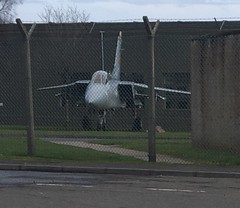
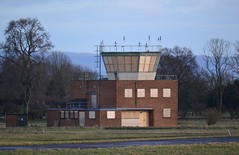
RAF Foulsham – A Leader in Electronic Warfare. (Part 1)

In Norfolk sits an airfield that only had a short wartime life, but it is one that is more than significant. Used in the electronic warfare role, it went on to house a small number of heavy bomber squadrons all crammed with electronics to detect, monitor and interfere with enemy transmissions.

In conjunction with this, it also saw a detachment of two-seat P-38/F-5 Lightnings, a rare aircraft in this country, and possibly the only one to do so. Dogged by bad weather it was identified as a suitable site for ‘FIDO’ the fog dispersal system, and post war it was used in both the scrapping of DH Mosquitoes and as a storage unit.

In Trail 22 we revisit the former RAF Foulsham.

RAF Foulsham

RAF Foulsham, sits approximately 8 miles north-east of the Norfolk town of Dereham. It had a short active life of just three years, lasting between May 1942 and 1945, at which point it was closed to flying and used as a storage site for military hardware. It remained in this lesser state until the 1980s when it was deemed surplus to requirements and finally closed. The land it stood on, was then sold off to local farmers.

Built over the period 1940-41 by the construction company Kirk and Kirk Ltd, RAF Foulsham occupied land some 173 feet above sea level, and opened under the control of 2 Group Bomber Command. Much of the material that was brought in to construct Foulsham came via nearby railways stations, then along local roads through the village, leaving locals facing endless mud and traffic.

As a war-time airfield, Foulsham would have three tar and wood chip runways, one of which would later be equipped with the fog dispersal system ‘FIDO’, a valuable if not bizarre system designed to dissipate fog along airfield runways.

Foulsham’s three runways were 1,900 and 1,350 yards long, with the main runway heading in a north-south direction. By the end of the war it would have thirty-seven heavy bomber hardstands, nine T2 hangars and one B1, and as such, was a formidable size. Personnel numbers were reflected in this, with accommodation spread over several sites to both the south and east, able to accommodate upward of 2,500 personnel of mixed rank and gender. The ever important technical site sat to the east, with the bomb store situated to the south-west of the airfield, just off the end of the main north-south runway.

RAF Foulsham

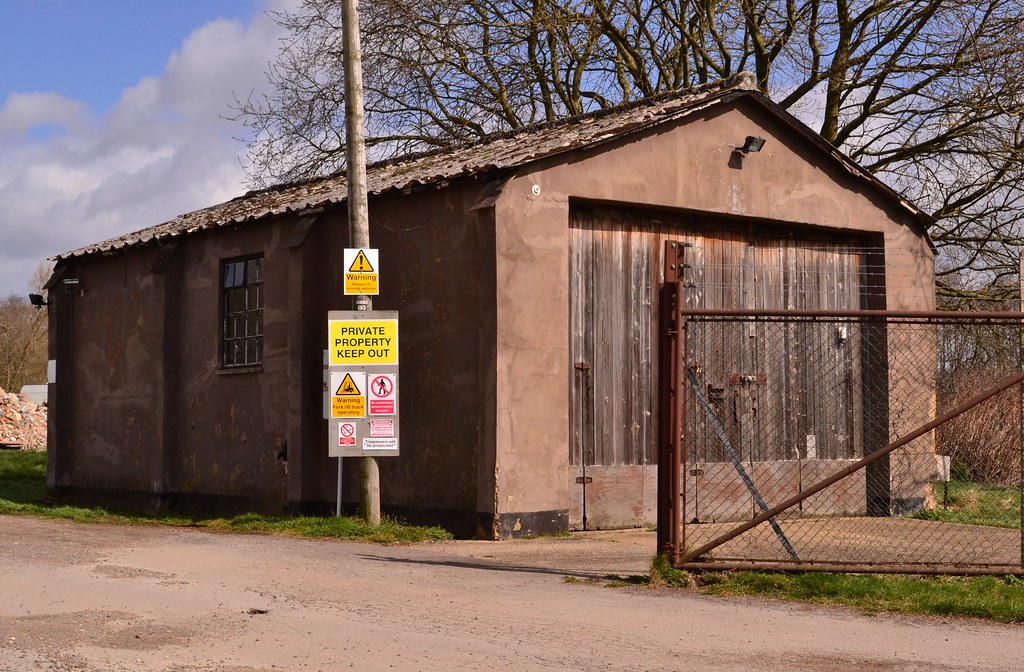
The original Fire Tender shed.

The watch office, now long gone, was built to design 518/40 which included and Meteorological section attached to the building. These designs were a development of earlier models using a new 9 inch rendered brick wall as opposed to timber, although timber was initially required for the floors and ceilings. Due to a shortage in wood at the time though, concrete replaced a large portion of these leaving only the balcony and control room using such material.

Whilst Foulsham opened under 2 Group, it would almost immediately – within a month of opening – be handed over to the US forces of the 8th Air Force and be renamed station B.13. However, this change never evolved into anything  more as no American personnel were stationed here, and by the October it was back in RAF hands, and 2 Group once more. The next few years would see the airfield change hands several more times, and with each change would come new aircraft, new personnel and new roles.

The first units to arrive here were those of the host unit 2 Group. Both 98 and 180 Squadron arrived in mid October 1942 after their reformation/formation at RAF West Raynham. During this time, they both began to receive their aircraft, the American built B-25 ‘Mitchell II’. Their transfer across to Foulsham gave the airfield the honour of being the first station to use the type operationally. Both squadrons would remain active in the light bomber role until 18th August 1943 at which point they would depart and the airfield would change ownership once more.

98 Squadron, a First World War unit, had been operating out of Kaldadarnes in Iceland following a terrible loss of personnel when the Lancastria was sunk in June 1940. Their reformation at West Raynham, and subsequent move to Foulsham, had been quickly met with yet more losses, when one of the Mitchells ‘FL206’, spun killing all four members of the crew on board.

After this, the squadron would be dogged by misfortune, the squadron adjutant noting in the Operational Records that excessive rain had turned the site into a “disgraceful condition”; the weather was one aspect the staff would have to put up with for some time to come. *5

For the first sixteen days of November, all but a handful of days were washed out, the despair of staff being felt through the Operational Records, each day met with ‘Lectures continue, adverse weather for flying‘. However, on the 16th, training flights did manage to take place, but it too was met with more sadness as a second set of fatalities occurred.

During the training flight, Mitchell FL179 suffered a bird strike in the carburettor of the starboard engine, this caused the engine to fail. With only one serviceable engine the pilot, Flt. Sgt. K. Williams (s/n: 1062588), tried to land at nearby RAF Attlebridge, unfortunately the aircraft stalled and went into a spin. The resultant crash killed all three aircrew on board and wrote off the Mitchell.

Things were to not get any better for the squadron either. On the 30th, a third crash took yet four more lives when FL708 collided with high tension cables near to RAF Wendling. The explosion from the collision also killed a local farmer who was ploughing his field at the time of the accident. It had been a terrible start for the fledgling unit.

The poor weather continued relentlessly, hampering the squadron’s progress, both on the ground and in the air, with training flights being cancelled on a regular basis. During the small numbers that were taking place, further problems came to light adding to the frustrations already felt by the crews.  Since taking on the initial batch of nine Mitchells on September 18th, the squadron had been having problems with the aircraft especially the guns and their turrets.

Gunners had found that extended bursts of gunfire were impossible, usually no more than a dozen rounds could be fired at any one time, a situation borne out by Wing Commander Foster, the Group Armament Officer, on the 16th December. In an attempt to remedy the situation, an American gun turret specialist visited the squadron, but by the 18th it was considered that the guns were ‘obsolete’.

RAF Foulsham

A defence ‘pill box’.

January was much the same, snow added to further problems and again the aerodrome was noted as being in a “very bad condition“, all flying being cancelled until the middle of the month when a small number of flights did get airborne.

The first battle order came through on January 21st, but due to a late delivery of bombs, it was also cancelled, meaning the squadrons first operation flight wouldn’t take place until the next day.

Six aircraft were ordered to operations, and whilst all made it to the target, one aircraft, FL693, was hit by flak and disintegrated. All on board were presumed killed.  The first months of 98 squadron had been challenging and difficult for those posted here.

180 Squadron had fared a little better, although after walking into a spinning propeller, L.A.C. J. Aspinall was killed, the only fatality of the squadron during the same period.

On July 26th 1943, an emergency landing was made at Foulsham by a B-17F #42-29802 of the 326th BS, 92nd BG, 8th AF, after a traumatic series of events that earned the co-pilot, John C. Morgan Flight Officer (later 2nd Lt.), the Medal of Honour for his valour and courage in action.

In part 2 we see how Morgan earned this prestigious award and how Foulsham continues to develop.

The entire story of Foulsham can be seen in Trail 22.

June 16th 1942 loss of Stirling LS-X.

On June 16th, 1942, Stirling LS-X #N6088, took off from RAF Waterbeach in Cambridgeshire, on a routine training flight. On board that day were: (Pilot) P/O. M. Scansie (RNZAF); Sgt. E. Morris; Flt/Sgt. J. Tomlinson; Sgt. D. Robinson; Sgt. J. Smith; Sgt. R. Broadbridge; Flt/Sgt. H. Johnson (RCAF) and Sgt. R. Le Blanc.

At 15:25 the aircraft, a Stirling MK.I of ‘C’ Flight 1651 Conversion Unit (CU), left Waterbeach heading north-westerly. It was to be a routine cross country navigation exercise.

Around forty-five minutes later, the aircraft was seen on fire, and falling in a spiral toward the ground with its port wing detached, outside of the outboard engine. The bomber hit the ground on the Great North Road near to Barnby Moor.

The crew flying the aircraft that day were a young crew, the pilot being 24 years of age, whilst Sgt. Ernest Morris was 19, Sgt. David Robinson – 21, Sgt. Roland Broadbridge – 20, Flt/Sgt. Harry Johnson – 26 and Sgt. R. Le Blanc. the oldest at 27 years of age.

What also made this particular accident more significant was that the Stirling, a veteran of European Operations, had flown for nearly 250 hours on twenty-two operational sorties, a remarkable achievement for a Stirling!

The Stirling would prove to be a poor bomber. Designed to Air Ministry Specification B.12/36 (the very reason it was to be poor), it had to have a reduced wingspan to enable it to fit inside the currently available hangars. This reduction gave poor lift qualities, barely able to achieve more than 17,000 feet when fully loaded. Another restrictive feature was the bomb bay design. Being sectioned it could not accommodate the larger bombs being brought into production as the war progressed, thus it underachieved compared to its stable mates the Halifax and Lancaster. The original specification set out such requirements, and so the design was flawed from the start. It did however, have good low altitude handling capabilities, but this wasn’t enough to secure its future as a long term investment in Bomber Command.

As a bomber, casualties in Stirlings were high, and toward the end of the war it was reduced to secondary operations, an area where it more than proved its worth as both a glider tug, mine layer and paratroop transport aircraft.

Apart from Sgt. Robinson, all of the crew are buried at Finningley, St. Oswalds Church. Sgt. Robinson is buried in his home town Bedlay Cemetery, Lanark.

RAF Waterbeach appears in Trail 11.

Sources and Further Reading.

The crew’s interment along with photos of Raymond Le Blanc are available on the Compagnons de la Libération du Havre website.

Chorley. W., “Bomber Command Losses Heavy Conversion Units and Miscellaneous Units 1939-1947 ” Midland Publishing, 2003.


Sgt. James Ward VC.- 75 (NZ) Sqn RAF Feltwell.

We have seen through the many ‘Heroic tales‘, acts of daring and valour that have astounded the average man in the street. Acts of heroism that were completed without forethought or consideration for personal safety, where the lives of fellow crewmen and their aircraft were put far beyond that of their own.

Some of these included flying an aircraft with astonishing injuries, staying with an aircraft until such times as all the crew have either left – or because they have been unable to leave – remaining at the controls to attempt a landing without help or hydraulics. There have even been cases of airmen exiting the aircraft to extinguish external fires whilst both at altitude and at speed. Indeed this is not a solitary occurrence; a number of airmen have been known to have performed such acts, some successfully others less so. But the fact that an airmen is willing to perform such an act of bravery, is in itself, incredible.

One such action occurred in July 1941 and was performed by 2nd Pilot Sgt. James Allen Ward (RNZAF) of 75 (NZ) Sqn, RAF Feltwell.

Sgt. James Allan Ward, 75 (NZ) Squadron RAF, standing in the cockpit of his Vickers Wellington Mark IC, L7818 ‘AA-V’, at Feltwell, Norfolk. (© IWM (CH 2963)

Sgt. Ward, the Son of Mr. Percy Harold Ward and Mrs. Ada May Ward, of Wanganui, Wellington, New Zealand was born on 14th June 1919, and was, following his training, posted to 75 (NZ) Sqn then at RAF Feltwell in Norfolk. The squadron were operating the new Vickers Wellington MK.Ic, or ‘Wimpey‘ as it was affectionately known, on a bombing mission to Munster in Germany.

Take off was at 23.10 on the night of July 7th 1941. On board (aircraft CNF.994/L7818) that night were: Canadian S/L. R. Widdowson (Pilot); Sgts. J. Ward (2nd Pilot); L.A. Lawton (Navigator); Mason (Wireless Op); Evans (Front Gunner) and A. Box (Rear Gunner), as part of a force of ten Wimpeys from Feltwell along with thirty-nine others from nearby bases.

The flight out was uneventful, with no interactions with either flak nor Luftwaffe night fighters. Over the target, bombs were released and several fires were seen to light, although German reports stated that little damage was done and no casualties were incurred.

The return leg took the formation over the Zuider Zee at which point the Wellington was strafed by canon fire from an Me 110 flying beneath it. As shells ripped though the fuselage, the rear gunner was injured in the foot but managed to return fire sending the attacker plummeting to Earth with heavy smoke pouring from the port engine.

Shortly after this, the Wellington’s wing, housing a fuel line damaged in the attack, itself caught fire and with the aircraft having a fabric covering, it was only a matter of time before it would also fall to Earth in a massive fireball.

With S/L Widdowson struggling to control the aircraft, which had had half its rudder shot away, its elevators severely damaged, hydraulics ruptured, flaps inoperable and bomb doors opened and damaged; a decision had to be made as to what to do next.

A bale out appeared to be the only safe and viable option. S/L. Widdowson gave the order and the crew began preparations to depart the stricken aircraft. Almost as a last minute attempt to save it, Widdowson instructed the crew to try and extinguish the fire, and they began ripping away the fabric covering the geodesic framework. Ward, grabbing a fire extinguisher, shot jets of agent through the hole toward the fire. At altitude and speed, the air stream was far too strong and the attempt had little effect on the burning engine.

At this point, and without attention to his own safety, Sgt. Ward decided to climb out and try to smother the fire with a canvas engine cover that had been used to raise S/L. Widdowson’s seat. Much to the dismay and protests of the other crewmen, Ward grabbed a parachute and attached a rope to himself and the Navigator, and began to climb out through the astrodome located between the wings in the fuselage’s ceiling. By punching holes in the aircraft’s fabric, he was able retain a foot and hand hold on to the aircraft, manoeuvring himself tight against the air frame toward the burning wing.

Once out onto the starboard wing, he approached the fire and pushed the canvas into the hole left by the flames. The fire burning furiously by now, was intense, and caused Sgt. Ward great pain forcing him to withdraw his hand several times before the slipstream finally caught the canvas tearing it from the hole and out into the dark night sky.

Being partially successful, there was little left for Sgt. Ward to do, so he began the arduous journey back toward the aircraft’s fuselage and its relative safety. By smothering the fire as he did, Ward’s attempts had made a difference, and shortly afterwards the fire extinguished itself enabling both the aircraft and crew to return to England safely making an emergency landing at RAF Newmarket Heath.

The Wellington with ‘hand-tholes’ after Sgt Ward tried to extinguish the fire.  (A) The hole caused by shell and, afterwards, by fire; (B) The Astro-Hatch through which Sergeant Ward, VC climbed; (1, 2 and 3) Holes kicked in the fabric by Sergeant Ward.(IWM CH3223)

Landing at 04:30, the Wellington came to a stop only after striking a fence on the airfield boundary, its brakes being totally unusable.

For his action, Sgt. James (Jimmy) Ward was awarded the Victoria Cross, the highest honour for bravery and extraordinary courage; he was the first New Zealander to win such an award during the Second World War. S/L. Widdowson for his actions, was awarded an immediate D.F.C. whilst Sgt. Box, the D.F.M.

At the time of the incident Sgt. Ward was only 22 years of age, he would be given his own crew and would go on to complete ten missions in total before, on the eleventh, being shot down and killed in another Wellington of 75 (NZ) Sqn over Hamburg on September 15th 1941.

Sgt Ward’s death brought a severe blow to the crews of 75 (NZ) Sqn, who perhaps thinking him invincible, went on to perform with great pride and determination in the face of great adversity. With over 8,000 sorties flown, the highest of any squadron in 3 Group, came a high cost, 193 aircraft being lost, the second highest of any Bomber Command Squadron of the Second World War.

Sgt Ward’s body was recovered from the crash that killed him, and along with his three comrades was laid to rest in the Ohlsdorf Cemetery in Hamburg, CWCG Plot 5A. A1. 9.

The report of Sgt. Ward’s VC. (Auckland Library Heritage Collection : 13 August 1941 : Item ref # AWNS 19410813-23-1)

Sgt. Ward’s citation appeared in the London Gazette “No. 35238” on 5 August 1941 p. 4515 and reads:

“On the night of 7th July, 1941, Sergeant Ward was second pilot of a Wellington returning from an attack on Munster.

When flying over the Zuider Zee at 13,000 feet, the aircraft was attacked from beneath by a Messerschmitt which secured hits with cannon shell and incendiary bullets. The rear gunner was wounded in the foot but delivered a burst of fire which sent the enemy fighter down, apparently out of control.

Fire then broke out near the starboard engine and, fed by petrol from a split pipe, quickly gained an alarming hold and threatened to spread to the entire wing. The crew forced a hole in the fuselage and made strenuous efforts to reduce the fire with extinguishers, and even the coffee in their vacuum flasks, but without success. They were then warned to be ready to abandon the aircraft.

As a last resort, Sergeant Ward volunteered to make an attempt to smother the fire with an engine cover which happened to be in use as a cushion. At first he proposed to discard his parachute, to reduce wind resistance, but was finally persuaded to take it. A rope from the dingy was tied to him, though this was of little help and might have become a danger had he been blown off the aircraft. With the help of the navigator, he then climbed through the narrow astro-hatch and put on his parachute. The bomber was flying at a reduced speed but the wind pressure must have been sufficient to render the operation one of extreme difficulty.

Breaking the fabric to make hand and foot holds where necessary, and also taking advantage of existing holes in the fabric, Sergeant Ward succeeded in descending three feet to the wing and proceeding another three feet to a position behind the engine, despite the slipstream from the airscrew which nearly blew him off the wing. Lying in this precarious position, he smothered the fire in the wing fabric and tried to push the cover into the hole in the wing and on to the leaking pipe from which the fire came. As soon as he removed his hand, however, the terrific wind blew the cover out and when he tried again it was lost. Tired as he was, he was able with the navigator’s assistance, to make successfully the perilous journey back into the aircraft.

There was now no danger of fire spreading from the petrol pipe, as there was no fabric left nearby, and in due course it burnt itself out. When the aircraft was nearly home some petrol which had collected in the wing blazed up furiously but died down quite suddenly. A safe landing was then made despite the damage sustained by the aircraft.

The flight home had been made possible by the gallant action of Sergeant Ward in extinguishing the fire on the wing in circumstances of the greatest difficulty and at the risk of his life.”

Sources.

National Archives – AIR 27/645/34, AIR 27/645/33

Auckland War Memorial Museum Website.

Sqn. Ldr. Edgar A. Good (RCAF)

On a recent visit to Houghton Hall in Norfolk, I came across a small church in the grounds, which held a number of graves belonging to those who had lived in the nearby village.

One of these was that of a pilot, 29 year old Squadron Leader, Edgar Andrew Good (s/n: C/18640), of 280 Squadron RAF Thornaby, North Yorkshire.

It turns out that Sqn. Ldr. Good was a Canadian, killed whilst undertaking an Air Sea Rescue (ASR) mission on 13th November 1943, whilst flying in a Vickers Warwick.

The Warwick was a Vickers Armstrong aircraft, issued to the squadron in October 1943. The aircraft was originally intended to be a bomber, built to meet specification B.1/35 it would be the largest twin-engined aircraft to serve during World War 2. It had a striking resemblance to the Wellington, utilising Barnes Wallis’s geodetic design. Models operating in the ASR role were capable of carrying Lindholme rescue gear and/or droppable lifeboats.

On 13th November 1943, three crews were briefed at Thornaby and ordered out to perform a search and rescue operation for a missing aircrew. Sqn. Ldr. Good departed at 16:40 and headed toward the Dutch coast where it was thought the aircraft had come down. After searching the area, nothing was seen and so the three aircraft began their return leg to RAF Thornaby across the North Sea.

On approaching the British coastline, the weather deteriorated significantly and the aircraft entered a thunderstorm. Two of the aircraft including Sqn. Ldr. Good’s Warwick (BV336) were struck by lightning, suffering damage to electronic equipment and loss of the radio. Severe turbulence and icing then caused further problems, making the Warwick difficult to control. Over land the weather failed to improve and control of the aircraft appears to have been lost by Sqn. Ldr. Good.

With no communication with the ground, the Warwick then entered a spin diving onto the ground at an area known as Sleights Moor, near Whitby in Yorkshire. There were no survivors.

The crew of Warwick BV336 were:

Squadron Leader Edgar Andrew Good, (pilot) s/n: C/18640
Flying Officer Willis Wylie Coons, (navigator) s/n: J/17250
Flying Officer Dennis Maurice Stewart, (wireless op. and air gunner) s/n: 115344
Flight Sgt. William Vernon Crockett, (wireless op. and air gunner) s/n: R/98771
Flight Sgt. Douglas Allan Payton, (wireless op. and air gunner) s/n: R/105266
Warrant Officer Henry George Richardson, (air gunner) s/n: 1377980

The second Warwick struck by lightning also entered a dive, but he pilot of this aircraft managed to regain control and return to Thornaby without further problems.

Although flying with the Canadian Air Force, Sqn. Ldr. Good was the Son of Nickolai Andreyev and Nina Andreyevna. After hod father died, his mother married Joseph Good (husband of Elaine Blair Good). The family eventually left Russia emigrating to Canada living in Montreal after becoming naturalised Canadians in 1922. After studying in both Canada and the US, Edgar then joined the RAF obtaining his wings in 1937. He was then sent to RAF Bircham Newton, where he would later return to and 280 Sqn.

The inscription on his headstone reads:

All that you hoped for, all you had, you gave to save mankind…”
Air Sea Rescue Service.

He is buried in Houghton (St. Martin) Churchyard (Houghton Hall).

Sqn. Ldr. Edgar Andrew Good

The grave of Squadron Leader, Good.

Sources:

Commonwealth War Graves Commission website.

Aviation-safety website.

RAF Downham Market (Part 1 – The beginning)

In Trail 7, we visited the northern part of Norfolk, not far from the coast where it borders Cambridgeshire to the west and the North Sea to the north and east. In this part of the trail we visit a site that was once one of Norfolk’s most prestigious airfields, where not one, but two VCs were awarded to airmen of the RAF.

Not far from RAF Marham, we return to this once busy airfield to see what is left and take another look at the incredible history that was RAF Downham Market.

RAF Downham Market (Bexwell)

Located in the corner of the A10 and A1122, 10 miles south of Kings Lynn and and 15 miles north east of Ely, RAF Downham Market (known locally as Bexwell) was only open for four years. Yet considering its relatively short life, it created for itself a unique history that was, and remains, unprecedented in military history.

Built by W. & C. French Ltd., it was primarily a bomber station serving initially with 2 Group before transferring to 3 Group and then to 8 PFF (Pathfinder) Group, Bomber Command. Opened as a satellite station to RAF Marham, it eventually became an airfield in its own right, achieving this status on 3rd March 1944, when it became a parent station itself.
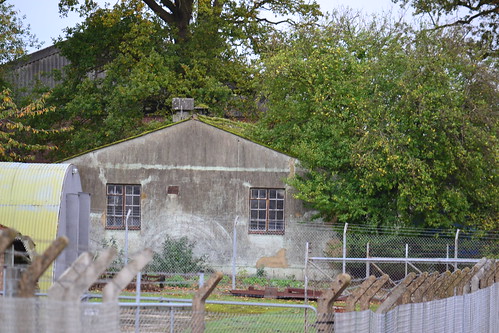
RAF Downham Market

One of the several buildings surviving at Downham Market.

Downham opened in 1942 as a bomber station, a role it performed for the duration of the Second World War. To achieve this, it would require substantial runways and a number of dispersed accommodation sites. As a classic Class ‘A’ airfield, it was spread over a large area incorporating two main sites, the main airfield to the north and the accommodation to the south. It was equipped to accommodate 1,719 male and 326 female personnel at its peak. A network of small roads would link all these dispersed sites together.

Downham would have three concrete runways the main being 1,900 yards long running east-west, whilst the second and third ran north-west to south-east and north-east to south-west, each 1,400 yds long. The classic ‘A’ formed by these runways, was linked by a perimeter track with 36 original pan style hardstands. At its peak, Downham boasted seven hangers, six ‘T2’ and one ‘B1’ which replaced two of the hardstands reducing the number to 34. None of these hangars survive here today. It had the usual bomb store (to the north east), technical area (south side) and eight accommodation areas spread well to the south and south west. As with all these Class ‘A’ stations, the two areas were separated by a public road, the ‘airfield’ to the north and accommodation to the south.

Today, little remains of the actual airfield site, the runways having been removed some considerable time ago. However, on the technical site there are a number of buildings still remaining, and in the accommodation areas further buildings also exist. All of these are either used by local industry or local farmers.

On opening, Downham received its first residents, the Stirling MK.Is of 218 (Gold Coast) Squadron. Arriving on the 8th July 1942, they would retain these aircraft until February 1943, when the new updated Stirling MK.III was brought into squadron service. 218 Sqn had a history that went back to the First World War; disbanded in 1919 they had been reborn in 1936, and were posted to France where their Fairey Battles were decimated by the superior fighters of the Luftwaffe. In November 1940, prior to arriving here at Downham, the squadron joined 3 Group, it remained operational with this Group for the remainder of the war.

On July 6th, they began preparing for their move to Downham, aircraft were stood down and no operational flying took place. On the morning of the 7th, thirteen Stirlings departed RAF Marham, completing the 10 mile straight line flight they arrived at Downham fifteen minutes later. By midnight, the entire squadron had transferred over, and crews were settling into their new quarters. Over the next few days air tests, fighter affiliations and cross country flying were the order of the day, the first operational flight not taking place until the 12th. In Stirling ‘HA-N’ was P.O. Farquharson and in ‘HA-R’ was Sgt. Hartley. A ‘gardening’ mission, only two crews were assigned and briefed but records show that “The vegetables were planted in the allotted positions. 18,000lb of seed were planted during this effort“*1. With that, Downham Market had now entered the war.

Over the next few weeks operations began to build, and targets moved into Germany itself. Lubeck, Vegesack, Duisberg, Hamburg and Saarbrucken were all on the initial list of operations. Apart from early returners due to ice or poor weather, all operations were considered successful and bombing was ‘accurate’.

On 29th July, a royal party visited RAF Downham Market to see how the crews were settling in at the new station. Led by Air Vice Marshall HRH The Duke of Kent, and accompanied by Sir Louis Grieg KBE CBO (ret),  the party were given an official tour of the airfield by Wing Commander P. D. Holder DFC – the Station Commander. After talking to a number of ground crews and watching Stirlings being bombed up, the Royal party then sampled the delights of the officers mess before departing the airfield.

In February 1943, 218 began replacing their Stirling MK.Is with the upgraded MK.IIIs, the last model of the Stirling bomber before they were relegated to other duties. By June, the last of the MK.Is were gone. Although fitted with better engines, the MK.III still remained limited by both its short wingspan and poorly designed bomb-bay.

In the following month a major decision was made to install the still experimental FIDO fog dispersal system here at Downham Market. With RAF Graveley only just having hers installed, the benefits of this system were by now bearing fruits, but despite this, only fifteen British airfields were to have the system installed. FIDO used oil burnt through a series of pipes set alongside the runway. These burners were supplied from large storage tanks, which in Downham’s case, were located to the south-east just off the airfield site. Each tank was filled by road from Kings Lynn, five tankers carrying out two runs each to complete the fill. Oil from these tanks, was then fed into the system – which was installed along the main east-west runway – by large pumps. Once lit, the burners could clear extensive fog or mist in a relatively quick time. The main storage tank site is today a car dealership, all signs of the network of pipes having since been removed.

Downham’s FIDO installation was slow at first, and only covered the initial touchdown area and the first 700 yards of the main east-west runway. A number of burner types were fitted at Downham over a period of time, starting with the MK.III or Haigill burner. These were in turn were replaced y the MK.IV and eventually, when labour became more available, the MK.V which was a sturdier, longer lasting burner capable of withstanding much heavier use.  It wouldn’t be until late 1943/44 that a longer section of the system was installed, now extending to 1,362 yds, almost the entire length of the main runway. The problem with FIDO was always where runways crossed, and here the pipes had to be placed below ground level. Along side the runway they were above ground, and with difficulty in seeing, some aircraft did manage to damage the piping on more than one occasion. With experimental lighting and landings used in the autumn of 1943, the first use of the system was on the night of December 16th/17th that year, when a large number of aircraft returning from Berlin were diverted to Downham due to their own bases being fog bound.

Over 35 aircraft landed at Downham that night, the toll on crews had FIDO not been in existence would certainly have been considerably higher than the terrible price that had already been paid on that disastrous night over Berlin. FIDO with all its counter arguments, had proved its worth in one fell swoop.

The Short Stirling, the first of the heavies for Bomber Command, was liked by many crews, but its short-comings were to become apparent all too soon. One of its problems was its enormous height, created through its huge and weak, undercarriage, which sometimes made landings difficult. Another recurring problem was a significant swing to port when taking off, combine the two features, and you have a difficult aeroplane to control at the best of times, let alone when badly damaged or in very poor weather.

One of the first casualties at Downham occurred on the morning of May 14th 1943, when Stirling ‘BF480’ HA-I piloted by Sgt. W. Carney, swung on touchdown careering off the runway into the Watch Office. No injuries were sustained by those onboard, but two other crewmen on the ground, who had previously landed, were killed in the accident. Coincidentally, another 218 Sqn Stirling, ‘EF367’, HA-G had a similar landing away at RAF Chedburgh at the same time on the same night. Onboard that aircraft there were an American and a New Zealander, all but two of the crewmen were killed, the others  escaping with injuries.

With plans for the invasion of occupied Europe well in hand by mid 1943, movements across Britain were starting to take place. At Downham a number of hangars were used to store Horsa gliders (hence the large number on site) ready for the invasion the following year. Between April 1943 and March 1944 the airfield was awash with stored examples. Accompanying the gliders were No. 14 Heavy Glider Maintenance Section, who maintained and prepared the gliders ready for when they were needed.

In the August 1943, an element of 218 Sqn was extracted to create a new squadron, 623 Sqn, using the MK.III Stirlings already on site. On the very day they were formed, 10th August 1943, four crews were briefed for operations, the target Nuremberg. Unfortunately, once over the target, crews had difficulty in distinguishing any relevant ground detail, and as a result, bombs were scattered over a wide area and the operation was largely unsuccessful. With little opposition all aircraft returned to Downham safely.
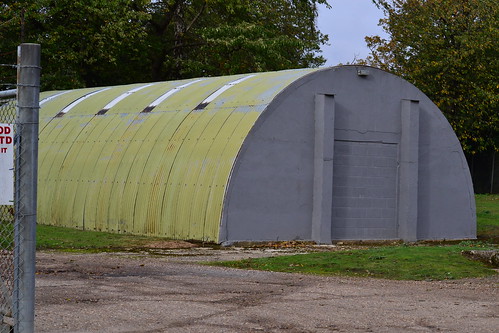
RAF Downham Market

One of the many huts that were left on the airfield.

However, two days after this on the night of August 12th /13th 1943, it was a different matter. It was whilst flying a 218 Sqn Stirling over Turin, that Flight Sergeant Arthur Louis Aaron, would suffer bullet strikes to his head that would break his jaw and tear away a large part of his face. Further bullets damaged his lung and right arm rendering it useless. Aaron still fought on though, despite his severe injuries, managing to assist the bomb-aimer in flying the stricken Stirling away from the enemy. Unable to speak, he communicated instructions to his bomb-aimer by writing with his left hand. Aaron attempted on four occasions to land the plane, but with failing strength, he was persuaded to vacate the cockpit; enabling the bomb-aimer to complete the belly landing on the fifth attempt. Aaron later died from exhaustion, the consequence of his determination and unparalleled allegiance to his crew, his aircraft and his duty. Aaron was the first of two pilots to receive the Victoria Cross whilst at Downham Market – both for extreme bravery in the face of the enemy.

The new squadron 623 Sqn, like many other squadrons however, was to be a short lived one. With high demand for Stirlings in the Conversion Units, it was decided to utilise the aircraft of 623 Sqn for this role, and on December 6th 1943 the unit was officially disbanded. Some crews returned to 218 Sqn but many others were posted out to new units. Flying of a total of 150 sorties in just four months, the squadron would lose ten aircraft, a loss rate of almost 7%.

The void left by 623 Sqn would be soon filled though. Just four days later another unit would transfer in, that of 214 (Federated Malay States) Sqn from RAF Chedburgh also a Stirling MK.III unit. For the majority of December, 214 Sqn would carry out ‘gardening’ missions, dropping mines designated ‘Nectarines‘ or ‘Cinnamon‘. Other operations would see bombs dropped on ‘Special Targets‘ although the Operational Records don’t specify the identity of these targets. 214 Sqn as with 623 Sqn, would be another of these short stay units, on January 17th 1944 they would transfer to RAF Sculthorpe and 100 Group, for RCM (electronic warfare) duties and a new aircraft, the B-17 Flying Fortress or Fortress I. As crews carried out circuits, lectures and training at Sculthorpe, the remainder of the squadron continued operations from Downham. By the 24th January though, all personnel had transferred over and Downham Market was far behind them.

In March 1944, Downham’s long standing unit 218 Sqn was finally ordered out, and on the 7th the entire squadron departed, the operations books simply stating: “218 Sqn moved from Downham Market to Woolfox Lodge by road and air today“. *2 Once at Woolfox Lodge, they would begin disposing of their Stirlings to take on the new heavy bomber – the Avro Lancaster.

The dust wasn’t allowed to settle at Downham however, and before long more personnel and a new Squadron would arrive, ready to fill the skies of Norfolk. This was no ordinary squadron though. With concerns about the poor quality of bombing and the lack of accuracy, it was decided to form a new Group that went much against the wishes of Arthur Harris. Seen as ‘elitist’, Harris vehemently disagreed with the new Group and fought his corner bravely. But with little choice in the matter and lacking his own high level support, he eventually succumbed to the Air Ministry’s demands, putting in command the Australian Group Captain Donald C.T Bennett, CB, CBE, DSO.

The new group would be called 8 Group (PFF) ‘The Pathfinders’, and was designed to use the cream of Bomber Command crews whose record for bombing had been excellent. Aircraft from the Group were to fly ahead of the main bomber force and ‘mark’ the target by various means – coloured flares being the primary and main method. In principle it worked well, but as records show, it was not without its own difficulties or setbacks.

Bennett, an aggressive pilot who didn’t suffer fools gladly, quickly won the admiration of his crews. He was also highly admired by Harris, who once described him as the the “most efficient airman” he had ever met; Harris considered Bennett perfect for the role. In appointing Bennett, Harris dismissed all other possible candidates including Air Chief Marshall Basil Embry, the Air Ministry’s most likely favourite.

The Pathfinders were officially formed on 15th August 1942, with 8 Group coming into official formation in January 1943. With the arrival of the new Squadron, 635 Sqn, Downham would now be playing its part in this role. This change would also mean a change in aircraft type at this Norfolk airfield, out went the now relegated Stirlings and in came Avro’s remarkable four engined heavy, the Lancaster MK.III.
RAF Downham Market

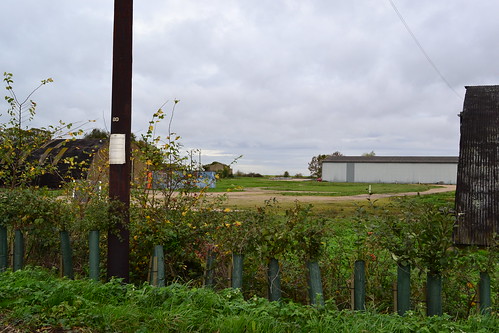
The remains of the Technical site looking toward the airfield.

635 Sqn was created under the command of Wing Commander Alan George Seymour Cousens on March 20th 1944. Using ‘C’ Flight from RAF Graveley’s 35 Sqn and ‘C’ Flight from RAF Bourn’s 97 Sqn. A total of eight aircraft and crews from each flight immediately began the move to Downham. At 09:15 the first of the road crews arrived from Bourn, with further sporadic arrivals until 11:00. The first aircraft to arrive touched down at 12:00, and within the next 20 minutes all aircraft were safely on the ground. Graveley crews began arriving soon after this, their first aircraft, along with a ground party, arriving at 15:05.

The new squadron consisted of 36 Officers, 120 NCOs and 200 ‘other ranks’. They were accommodated in Site ‘J’ whilst 20 NCOs and 40 armourers were accommodated in site ‘B’. A small number of officers were put up in the Rectory just outside the main gate of the airfield*3.

Shortly after the crews had landed, they were quickly briefed for an operation to attack Munich, but by the time the aircraft were prepared and bombs loaded, the operation was cancelled, the crews were then given the chance to settle in to their new homes.

635 Sqn would continue to use the Mk.III Lancaster for the next four months, replacing it with the Lancaster MK.VI  from March onward. This was an unusual model of the famous aircraft as it had neither a nose nor mid-upper turret, instead it was crammed with electronic radar jamming devices. Also replacing the normal three-bladed propellers were four bladed examples, aiming to improve the aircraft’s performance.

A growth in aircraft numbers and the development of Pathfinder methods soon led to a new branch of the Group, the Light Night Striking Force (LNSF) equipped with de Havilland’s ‘Wooden Wonder‘ the Mosquito.  In response to this, 571 Sqn, a new light bomber squadron equipped with the Mosquito XVI, was born here at Downham on April 5th 1944, barely two weeks after 635 Sqn themselves arrived. As a temporary measure it was decided that on April 10th, the squadron would be reduced to one Flight instead of two leaving eight aircraft plus a ‘spare’ at Downham whilst the remainder transferred to RAF Graveley. The idea behind the move was two-fold, firstly to bolster the expansion of 105 Sqn at Graveley, and secondly, to provide experience for the ground crews on the Mosquito.

The move went well, but on the 17th, a new order would come through that would change Downham yet again.

Movement order 21 required the entire 571 squadron to transfer to RAF Oakington, effective by 24th April. With that, preparations began and the advanced party moved from Downham on the 22nd followed by the rear party on the 24th. The entire squadron including the Graveley detachment were, by the end of the day, now at Oakington. Due to the move, there were no operations flown by the squadron from Downham Market during this short period of their history.

This departure left 635 Sqn as the only operational squadron at Downham Market. Whilst somewhat quieter, it is was not to be all plane sailing.

In Part 2, we see how Downham takes part in D-Day, the end of the war approaches but operations continue and Downham remains busy. After the war, the airfield is used for other purposes, and eventually closes. We then see what remains today and ask what does the future hold?

The full Trail appears in Trail 7.
RAF Leuchars – one of Britain’s oldest airfields (Part 5)

After Part 4, in this, the final part of Trail 62, we round off our look at RAF Leuchars. We have seen how to grew from a balloon training ground in the pre-war years to a training station for early flyers. Then on to maritime patrol, the Cold War and QRA status. Now as the years pass, defence cuts rear their heads once gain, Leuchars is once more under threat from politics.

The 1970s would see a return to training here at Leuchars with both the RAF and the Royal Navy embarking on new ventures with the Phantom – McDonnell Douglas’s all round, all-weather, multi-role aircraft. With new models, come new training units, and with the arrival of 111 Sqn the famous ‘Treble One’, in November 1975, also came a training support unit – the Post Operational Conversion Unit (later known as the Phantom Training Flight). The primary role of this unit was to train Fleet Air Arm aircrews for carrier borne models of the Phantom.

A No. 111 Squadron McDonnell Douglas F-4K Phantom FG.1, an aircraft closely associated with RAF Leuchars. (License: GNU Free Documentation License 1.2)

By the early 1970s, the shortcomings of the Lightning were now more than apparent, a lack of range and loitering ability becoming more obvious as the Phantom’s capabilities outshone it. A slower, but far more advanced Phantom, was proving to be more than just a suitable replacement for the now ageing ‘rocket of the skies’.

Whilst the Phantom was phased in and the Lightning phased out, pilots of the Lightnings continued to be wary of its tendency for engine fires, a problem that had  been present for some time. One such incident saw Lightning XS918 catch fire before the pilot (Flying Officer Doidge) manged to eject over the North Sea, West of The Bell Rock, 9 miles East of RAF Leuchars. Unfortunately controversy surrounded several aspects of the pilots kit, after he ejected he became detached from his survival kit, an inquiry highlighting ‘modifications’ to his clothing that may or may not have led to his tragic loss of life. In what appears to have been common practice amongst many airmen, changes were officially made to the kits supplied to aircrew in light of the accident.

The transition between Phantom and Lightning was a smooth if not rapid one. At Leuchars, the final farewell was made at the annual open day in September 1975, when six of 23 Squadron’s Lightnings and and four Phantoms of 43 Sqn formed a flypast. The Lightnings passing over the airfield in dramatic style saying a last farewell to the station where it has performed its duties so well for many years. With their disbandment in October, the baton and well and truly been passed over to a new breed of aircraft.

Between 1972 and 1978, Leuchars saw further sporadic returns of the Royal Navy, with 892 Squadron from HMS Ark Royal utilising the ground space for its operations. By 1978 though, 892 Sqn was disbanded, and their ship – the Ark Royal – decommissioned, bringing an end to this relationship between the navy and Leuchars. However, the FG.1 Phantoms used by 892 were absorbed into 111 Sqn, replacing the FGR.2s they had been operating before.

The end of 892 Sqn was marred by a tragic accident When rehearsing for the final solo display, the aircraft, a McDonnell Douglas Phantom FG 1 ‘XT868’ flown by Cdr. C. C. N. Davies and his navigator/observer Lt J. Gavin, suffered multiple engine failures whilst flying low, downwind along the runway axis. The aircraft entered a tight right hand turn through 180º to fly dead stick back along the runway. The Phantom’s right wing then struck the ground, and with the aircraft now perpendicular to the runway, the pilot ejected followed almost immediately by the observer. In their exits, the pilot was severely injured whilst the observer was sadly killed.

The decision to scrap the angled-decked carriers of the Navy would in turn have an eventual knock on effect at Leuchars. With both naval Buccaneers and Phantoms transferring to the RAF, no new training would take place – the Navy now looking toward the introduction the Harrier. The Phantom Training Flight would for now, remain at Leuchars though its role ‘downgraded’ to performing refresher training, ensuring that a round the clock, carrier based status was maintained in the UK.

It was also at this time that another film crew arrived – this time from the BBC – who used Ark Royal and her on-board flying units, including 892 Sqn, for their documentary ‘Sailor‘. The iconic insight into carrier operations was perhaps made even more famous by its theme tune of a similar name sung by Rod Stewart.

The 1970s saw continuous and increased intrusions into the the northern airspace around the UK, and as a result QRA scrambles became more common place at Leuchars than any other UK station. A massed show of force on Lenin’s centenary provided a massive ‘target’ for the QRA aircraft, with no less than 60 ‘Bears’ and ‘Badgers’ filling the skies on one day alone over the North Sea. A major headache for the QRA crews, it did however provide an excellent photo opportunity even allowing for a Marham Victor to shadow a Soviet Tu-95 ‘Bear’ much to the annoyance of the AOC No.1 Group when he got to hear about it.

With continued use, the runway needed a further resurfacing, and after the Phantoms of 43 Sqn had departed to Kinloss for a ‘Bolthole’ (where Station based aircraft deploy to temporary locations) deployment to carry out QRA operations from there, and those of 111 had left for Coningsby, Leuchars was left to the developers, and for an estimated eight months the airfield was effectively out of front line action.

Now with restricted runway use, the Whirlwind and Wessex helicopters and later Sea Kings, of 22 Sqn, would be the main users of Leuchars; their Air Sea Rescue operations combining with the Scottish Mountain Rescue teams, saving not only downed aircrew but stranded climbers as well . They would also be joined by the University Air Squadrons from nearby St. Andrew’s, Aberdeen and Dundee (later amalgamated to form the  East of Scotland Universities Air Squadron) who would use Leuchars for training with their Scottish Aviation Beagle Bulldogs.

Once completed, a second phase of work was then undertaken, new hardened aircraft shelters (HAS) were to be built. Common place on bases in Germany, these were designed to withstand conventional attacks, providing protection for individual aircraft whilst dispersed around the airfield. In an announcement made by Sir Michael Beetham the Chief of the Air Staff, Leuchars and five other airfields were to receive these ‘new’ shelters. It would take several years though before those at Leuchars were ready with its QRA aircraft safely tucked inside.

As the 1980s turned into the 1990s, the Phantom had now reached the end of its life and the new Multi Role Combat Aircraft (MRCA) the ‘Tornado’ would soon be appearing. The two Leuchars based squadrons, 43 and 111 were both stood down, the Phantoms removed and the Tornadoes brought in. 43 Sqn, who had been based at Leuchars since 1969 being the first to receive the new aircraft, a transition that saw all the Phantoms gone from the Scottish base within a year.

The introduction of the Tornado was not without its own political and military wrangling. Doubts cast upon the ability of the multi-role aircraft to perform as well as those aircraft it was designed to replace were raised by the military. History had shown some dramatic failures on this score whilst others, such as the Mosquito, had shown it more than possible with great success. Politicians however, seemed more drawn between upsetting the Americans who were trying to sell the F-15, and the multi national consortium Panavia Aircraft GmbH,  who collectively built the Tornado.  The decision would be a fine balance.

With the fall of the Berlin Wall, Soviet incursions  around the UK’s airspace would drop, the need for interceptors had now seemingly reduced, and so a review of the RAF’s front line operations was once again on the cards. The withdrawal of both the Phantom and shortly after the Buccaneer, left the Tornado as Britain’s only front line defence aircraft.

With the Gulf War in the 1991, the Tornadoes of Leuchars would play a major part and all eyes would be on them, scrutinising their every move. The gradual phasing out of Buccaneers and Jaguars leaving a lot on the shoulders of Tornado crews.

In 1995 two 43 Sqn Tornadoes from Leuchars were involved in a mid air collision over the North Sea. One of the aircraft ZE210 collided with the second, ZE733, during a joining up manoeuvre at 12,000ft whilst using night vision goggles. The pilot of ZE733 lost control and the two crew (Flt. Lt. McCarry and Flt. Lt. Booth) safely ejected, being rescued by an Air Sea Rescue helicopter from RAF Boulmer.  The second aircraft, ZE210, suffered damage to the hood and electrics, which knocked out the navigational aids. On landing, it took a considerable time to extract the crew due to the damage sustained to the hood. The aircraft was not repaired instead being used for spares before finally being dumped at St. Athan. *8

RAF Leuchars

Tornado ZE967 Gate Guard at Leuchars 2018.

The 2000s saw further upgrades to aircraft and new squadrons arrive. An Operation Conversion Unit for Tornadoes No. 56 (Reserve) Squadron, arrived in 2003. It was designed to upgrade pilots to the new variant Tornado. Absorbed into the long standing 43 Sqn, it remained on site and active until 2009 when it too was disbanded.

Further cut backs to finances meant the final departure of the Jaguars from bases in England. For Leuchars it would see the reforming of the University Air Squadrons into the ESUAS. A single training unit operating in conjunction with the three Scottish Universities .

After 2010 the Tornadoes were replaced by the Typhoons of 1 and 6 Sqns. 1 Sqn was reformed here on 15th September 2012, and joined 6 Sqn who had been reformed here on 6th September 2010, this offered an almost seamless transition from Tornadoes to Typhoons. These modern fighters now formed Britain’s front line of defence against potential aggressors taking over the QRA status for the north.  But in 2014, orders came through to move the RAF out of Leuchars transferring the aircraft, personnel and role to Lossiemouth in Moray. On 31st March 2015 at 12:00 hrs, ownership of Leuchars officially passed over to the Army, Leuchars’ named was changed to Leuchars Station, and its history as an operational airfield had finally come to an end.

Designated an emergency landing ground, (Master Diversion Airfield or MDA) between 2015 and 2016 no fewer than fifteen aircraft used Leuchars for ’emergency’ landings. These included: Tucanoes (Linton-on-Ouse), Tornadoes GR4 (Lossiemouth); Hawks (Leeming); Typhoons (Coningsby) and F15s from Lakenheath in Suffolk.

A minor respite in 2020 saw the QRA Typhoons return briefly as work was carried out on Lossiemouth’s runway. Within a short period of time though, this was completed and the aircraft departed once more leaving Leuchars quiet again.

This move signified the last full use of Leuchars by the Royal Air Force, responsibility of this long standing Scottish airfield being handed over to the the British Army who now based the Royal Scots Dragoon Guards and the Royal Engineers here. Various other non-flying units do serve here including The Military police units and 612 (R) Squadron, a medical unit of the RAF.

Whilst the defence cuts of 2010 indicated the closure of Leuchars, in October 2020, it was confirmed by the Ministry of Defence that they were looking into increasing both civilian and military usage of the airfield at Leuchars. Whilst there remains no intention to retain, or base aircraft here, the installation of fuel facilities does give hope that aviation will return in some form in the future. The indications are that by opening Leuchars to civilian traffic, it could bring revenue in to the hard pressed MOD*7.

Leuchars played a major part in two World conflicts being used primarily by the RAF throughout its life. The Royal Navy (Fleet Air Arm) have also been based here, as have the Army who are now the current main residents of the base. Other users include: the Dutch,  the Norwegians, the Canadians, Australians and New Zealand Air Forces as well as civil aviation organisations and University Air Squadrons.

More recently, with it being located closer to international airspace which is regularly penetrated by Soviet aircraft, the RAF’s Northern QRA aircraft were based here for many years before moving away to Lossiemouth in Moray, someway further north. Leuchars’ history is therefore long and very varied, covering a wide range of users in a multitude of roles.

RAF Leuchars has a history going back over 100 years. It was never upgraded to ‘A’ class status, and has only ever had two runways. Originally built from concrete and wood chip, the surface was upgraded to accommodate the jets of modern warfare, and the infrastructure has been added to as the airfield grew.

It has been home to a considerable number of front line squadrons along with an extensive collection of support flights, training flights and non-flying units. The number of people that have passed through its doors probably uncountable. It performed during the first World War, trained air crew in the inter-war years, and carried out vital work during the Second. Post war, it formed the front line of defence against potential Soviet aggression before returning to training through the University Air Squadrons across Scotland. Now home to the British Army, it is at least for the time being open for business, but as a flying military site, it is all but closed.

Its location has been in many ways its saviour. Operating maritime patrols and clandestine operations into occupied and neutral Europe. The Fleet Air Arm were formed from its units, and the Air Forces of several nations have been based here. It has a history that is so diverse and dynamic that very few other airfields in Britain can match it. As with other airfields across the country, its future hangs in the balance, I hope that this long living and prestigious site remains alive and well to honour all those who over the last 100 years have served from its runways.

Leuchars as an operational military site is not accessible to the general public and views across it are limited. It is thought that two rare First World War Double Royal Flying Corps General Service Aircraft Sheds are among the few original buildings that survive on the site. The accommodation areas have now been sold off to private buyers, but the airfield is intact as it is used as an emergency landing ground and by the ESUAS. With care, opportunities are there to see this historic and fascinating piece of Britain’s aviation history.

The full story of Leuchars can be seen on Trail 62.

Sources and further reading

*1 Fatal Air Accidents website 12th November 1918 – November 1919

*2 Royal Flying Corp Website

*3 An interesting film of 489 Beaufighters with invasion markings appears on the IWM website, it shows the take off and formation flying of the squadron along with some interesting ground shots too.

*4 For additional information and pilot stories about the ‘ball-bearing’ run see the Royal Institute of Navigation Blog.

*5 Thirsk, I. “de Havilland Mosquito – An illustrated History Vol.2“, Crecy 2006

*6 Further details about the BOAC Mosquitoes appear n ‘Mosquitoes on BOAC Service‘.

*7 The Courier.co.uk newspaper website.

*8, 11 Aviation Safety Network Website.

*9 National Archives AIR 27/2612/1

*10 Defence Transformation Volume 531: debated on Monday 18 July 2011 Dr. Liam Fox’s announcement to Parliament. UK Parliament House of Commons.

Gracie’s Guide to British Industrial History website.

Flying Magazine, (August 1972) website.

National Archives: AIR 27/1383

AIR 27/624/29

AIR 27/624/33

BAE Systems Website accessed 6/3/21.

For first hand stories of MRT work see Heavy Whalley’s blog

For a detailed account of life at Leuchars, read “Northern Q – The History of RAF Leuchars” by Ian Smith Watson.

RAF Leuchars – one of Britain’s oldest airfields (Part 4)

As Leuchars emerged from the Second World War in Part 3, it entered a new phase in its long and distinguished life. No longer operating maritime patrols, it was now entering the Cold War, and under a new Command, that of Fighter Command, it would take on a new role with a new breed of aircraft.

Throughout the war Leuchars had been a maritime operations base, with submarine hunts, convoy patrols and anti-shipping flights taking the role of its front line squadrons. But with the last of the long range patrol aircraft being posted out, Leuchars’ role would now change, and a new breed of aircraft would be seen along its runways.

The Cold War brought a new dimension to warfare, nuclear weapons and the arms race were the flavour of the day. With both sides fearing preemptive attacks, fighters and bombers capable of carrying these potent weapons were in great need. Whilst bomber airfields across the length and breadth of Britain were modified to accommodate newer and bigger aircraft, Leuchars physically changed very little. However, being transferred to the control of RAF Fighter Command, Leuchars would be propelled to the forefront of RAF operations, with both day and night fighters soon shattering the quiet of this post war airfield.

This new focus would mean that the 1950s would see Leuchars aircraft participating in a number of high profile exercises ‘Coronet‘, ‘Premraf‘, ‘Kingpin‘, ‘Formulate‘ and ‘Fabulous‘ which often required the deployment of detachments to airfields around the United Kingdom. These exercises, varied in their structure, would often include Leuchars aircraft acting as the enemy trying to attack shipping or other targets at altitudes from very low level up to 50,000 feet. Air-to-air gunnery was also involved as war air-to-ground rocketry.

With this transfer came further changes. The first jet to arrive was the Meteor in the form of the F4. with 222 Sqn in May 1950. After staying for seven years upgrading to the F.8 and then returning back to the F.4, the unit was finally disbanded in 1957 only to re-emerge as a Bloodhound operator at RAF Woodhall Spa in Lincolnshire.

The next squadron to arrive, 43 Sqn, arrived in November 1950, and also brought the Meteor F.8. On 22nd October 1952, one of these aircraft Meteor F8 VZ461 ‘W’ was lost on route from  RAF Acklington to Leuchars as part of  three-ship formation. The aircraft (number two in the formation) suffered problems when its artificial horizon failed. The pilot, Pilot Officer Maurice William Prior, notified the lead pilot who instructed him to make a starboard turn and rejoin the group above the clouds. Unfortunately the Meteor descended instead, and struck the sea near to Coquet Island off Amble, Northumberland. In the accident, which was put down to ‘instrument failure’, the pilot lost his life.*9

THE ROYAL AIR FORCE, 1950-1969

Hunter F.1s of 43 sqn RAF Leuchars, in a vertical climb. © IWM RAF-T 42a

43 Sqn retained their Meteors until 1954, they then replaced them with the Hawker Hunter; flying marks including the: F.1, F.4, F.6 and F.G.A.9 in a front line role. After transferring to Nicosia in 1961 and eventual disbandment, the squadron was reformed here at Leuchars in in 1969 with the McDonnell Douglas Phantom FG.1. An upgrade to the FGR.2 in May 1988 eventually led to the Phantom being replaced by the Panavia Tornado F.3 in 1989. This made 43 Sqn one of the longest standing front line squadrons to reside at Leuchars in its entire history.

1951 would see another long standing resident unit at Leuchars. But the early months were noted for more short stay units. The ‘sister’ of the Meteor, the DH. Vampire, made a presence through 602, 612 and 603 Sqns between April and July that year, each reflecting Leuchars’ war time record and staying for short periods before moving on. For a while over the summer months, Leuchars would be home to no less than six front line squadrons, five of them with Meteors or Vampires with a sixth flying that old favourite the Spitfire.

Then in September 1951, 151 Sqn was reformed, an ex-wartime unit it had its roots firmly in 1918. Initially flying the Vampire NF.10, Meteor NF.11, and then in September 1955, the Venom NF.3, it left for a spell at Turnhouse before returning to Leuchars in 1957 with the Delta Winged Gloster Javelin FAW.5. In September 1961, the squadron disbanded again being reformed a year later at Watton.  During the war it had operated as a night fighter unit, a role it continued here at Leuchars. Donned with the Saltire of St. Andrew, the flag of the patron Saint of Scotland, it would make a good companion for 43 Sqn with whom it had flown with during the Battle of Britain with Hurricanes.

In 1952, a 222 Sqn Meteor from Leuchars took off on a low level training sortie over the Scottish mountains. The aircraft, an F.8 ‘WA882’ piloted by Pilot Officer Brian Lightfoot, departed Leuchars at 9:58am in poor conditions. Snow covered the mountains and frequent snow showers were experienced over the area. At 10:20, a witness reported hearing a crash and seeing black smoke rising from the Scottish mountain Oxen Craig, in the Bennnachie hills, Aberdeenshire. The Meteor had struck the mountain killing the pilot. It took some two weeks to locate the wreckage, most of which was buried at the scene by RAF rescue teams, after which a small memorial was built to commemorate not only the life of P.O. Lightfoot, but also the crew of a Westland Wallace ‘K6028’ which had crashed at the same location in September 1939. The official cause of the pilot’s death was attributed to “poor definition of snow covered mountains in the prevailing conditions”. It was one more loss in the Scottish hills*11.

The 50s saw a more permanent move by some RAF squadrons. 264 Sqn who only stayed for six months in 1952 with Meteors led the way. In 1954 ‘C’ Flight of 275 Sqn arrived, this signified another change in role for Leuchars as it brought the first of the helicopters to the airfield – the Sycamore HR.14. This squadron, formed in 1941 continued to perform its role of Air Sea Rescue (a much needed but over looked service during the war), and the Flight stayed here until the entire squadron was disbanded in 1959. As an Air Sea Rescue unit it understandably had Flights based at a number of sites around the UK, and took on the Whirlwind HAR 2 and 4 prior to disbandment. Working in conjunction with the Mountain Rescue Teams, many civilians as well as aircrew owe them a great deal of gratitude.

1957 then saw Leuchars enter the film industry when a crew arrived to make a film using 43 Sqn as its main squadron. Headlined by Ray Milland (Wing Commander Rudge), Bernard Lee (Flight Sergeant Harris), Leslie Philips (Squadron Leader Blake) and John Le Mesurier as the Commandant, it was about a Commanding Officer of an RAF Training School (Cranwell) who must deal with a difficult cadet. The problem was not the cadet’s behaviour so much as the fact that he reminded the Commandant of himself when he was young. The film included shots of 43 Sqn in low level, gunnery and aerobatic manoeuvres which were filmed until the end of the year when the days were too short to carry on.

The squadron initially identified with the ‘starring role’ was 111 Sqn, who had only that year been recognised as the RAF’s official Fighter Command Aerobatics team, pipping their Leuchars stable mates, 43 Sqn, at the post. ‘Treble One’ took the name of ‘Black Arrows‘ and with their nine ship formation went on to be as famous as the Red Arrows are today. 43 Sqn’s ‘Fighting Cocks‘ were a four ship group and the disappointment of not achieving the status of their Leuchars partners, ended a decade of pageants, displays and European tours where they had been centre stage across many countries.

As the decade drew to a close, so July 1958 would see the arrival of yet more Meteors with 29 Sqn. These NF.12s were operated until replaced by the Javelin, Gloster’s delta wing fighter, before they departed to Nicosia in 1963. This time  would also see the arrival of another Air Sea Rescue detachment, that of ‘C’ Flight from 228 Squadron also with the Sycamore helicopter. Throughout the war they had flown in Sunderland flying boats, including from the Scottish West coast base at Oban in 1941. The detachment had remained here until 1964 when it was renumbered as 202 Sqn.

The next forty years would see more front line jet squadrons, 25 Sqn with Javelins FAW.7s who retained these until their disbandment in 1962. They were followed by 23 Sqn who had disposed of their Javelins in preparation for the mighty Lightning, which they received a year after their arrival here in 1963. For eleven years they flew both the F.3 and the F.6, before they too were disbanded in preparation for yet more modern upgrades.

The arrival of the Lightning also heralded the arrival of the Quick Reaction Alert (QRA) status, the Lightning proving to be a huge step forward in terms of aircraft speed and climb rate compared to its predecessors, was an ideal interceptor; only the appalling fuel consumption and limited armaments of early models prevented it from being the ultimate attack aircraft.

Although QRA’s origins are associated with the Lightning, the Hunters of 43 and 222 Squadrons had previously retained a two minute readiness with aircrew remaining in the cockpit at all times, a rota that kept aircraft at the ready 24 hours a day, 365 days a year. Sitting in the cockpit for many hours, waiting for the chance to intercept a Soviet aircraft, must have been somewhat tedious on occasions – a draining but very necessary part of the job.

Two more units arrived in 1964, 74 (Tiger) Sqn and 202 Sqn. 74 Sqn had had the honour of being the first Lightning squadron in 1960, and for bringing the first Lightning to Leuchars, roaring into the Fife skies in August that year. They remained here for three years whilst another detachment from 202 brought the Whirlwind HAR.10 strengthening Leuchars’ role in Air Sea Rescue. For the next twelve years the helicopters of ‘C’ Flight would operate from here, with other detachments at similar sites including Boulmer and Coltishall.

THE ROYAL AIR FORCE, 1950-1969

Lightning F.6 of No 74 Squadron, RAF Leuchars. Armed with Red Top air-to-air missiles, and carrying over-wing long range fuel tanks.(© IWM RAF-T 6973)

74 Sqn soon took on the upgraded Avon powered Lightning F.3, this proved to be a godsend as the MK.Is were soon becoming worn out, regular faults being difficult to repair meant that flying hours were starting to fall. This upgrade was followed in September 1966 by the F.6. With this new aircraft they, and Leuchars, would participate in the sixth ‘Tiger Meet’, which saw a gathering of NATO ‘Tiger’ units from across the European and American nations. As Leuchars was hosting the gathering, it would mean a range of unusual aircraft types would appear here, if only for a short period of time. For four days in July 1966: F-100D Super Sabres, Super Mystére B2s, F-104G and CF-104 Starfighters along with F-4D Phantom IIs and a range of support aircraft, would all be present in these operations. This brought a multinational collection of pilots and crews from France, the US, Belgium and Germany to this Scottish airfield.

Unfortunately, the event was marred by the death of French pilot Capt. Joel Dancel, whose Armée de l’Air Super Mystère B.2 struck the ground shortly after take off killing him. As a mark of respect the final days solo displays, which he was practising for, went ahead with the flags of all nations at half mast.

Then followed the infamous Labour Government’s decision in 1965 to axe large parts of the defence budget, thus cancelling numerous projects such as TSR.2. This meant that Britain’s future strike capability was seriously weakened. The various separate commands were rapidly becoming no longer viable, and so now the nearly non-existent Bomber Command and Fighter Command were both amalgamated to form the new Strike Command. It was this Command that would take Leuchars on into the 1970s and beyond.

With more Lightnings arriving in April 1967 with the reforming of the fighter squadron 11 Sqn,  a stay of some five years would see the Lightnings continue the role of policing Britain’s North Sea airspace. The RAF’s ongoing interest in Leuchars would also be kept alive and well by the the newly formed 43 Sqn, who joined 11 Sqn in 1967 with the Phantom FG.1. 43 Sqn would remain at Leuchars for over forty years, taking over where the Lightning left off, and  eventually taking on the Tornado in 1989/90.

The end of the 1960s saw what was a first for not only 23 Squadron but perhaps even the RAF, when two Lightnings of the squadron left Leuchars to perform at an airshow in Toronto. The flight, made non-stop with the help of over-wing tanks and no less than six Victors for in-flight refuelling, was made by Sdn. Ldr. Ed Durham and Flg. Off. Geoff Brindle, supported by a VC10 carrying ground crew, supplies and spare pilots. The flight, which had lasted for some seven and a half hours, ended at Toronto in front of a massed crowd of well wishers and press, a real coup for the crews of Leuchars.

Leuchars personnel would also celebrate the 50th anniversary of the RAF in 1968, when it was granted the freedom of St. Andrews. A parade through the town was supported by all makes of aircraft stationed at Leuchars including no less than sixteen Lightnings. Whirlwinds and Chipmunks from both the Air Sea Rescue service and the University Air Squadron also took part, further cementing the strong bond that had existed between Leuchars and its neighbouring town.

The 1960s finally drew to a close, world war had so far been averted but Leuchars remained on the front line, monitoring and intercepting Soviet aircraft over the North Sea, at least for the time being.

In the fifth and final part of this trail, we see how Leuchars is affected by defence cuts. The QRA status is at risk as is the very future of this historic airfield.

The full story of Leuchars can be seen on Trail 62.

Trail 61 – RAF Dishforth – Along the A1 trail (Part 4).

In Part 3 we saw how Dishforth turned from a bomber base to one of training, its role had gone full circle. Now the war was drawing to a close, its future left hanging in the balance. With the dawn of the jet age, opportunities are there but Dishforth gets left out. As Bombers are withdrawn, a new type appears though, and many appear here at Dishforth.

As 1945 dawned, it was becoming clear that the war’s end was in sight. Conversion courses to heavy bombers were being scaled back as losses fell and the need for more crews diminished. On April 6th, the HCU was officially disbanded and the staff posted elsewhere.

1945 would also see the end of 6 (RCAF) Group, the group that had flown almost 40,000 sorties with a loss of 10,000 aircrew from its several Yorkshires bases, Dishforth of course, being one of the first.

Not long after the disposal of the HCU, the 1695 (Bomber) Defence Training Flight, a unit set up to work in conjunction with the HCUs, was also disbanded.  In July 1945, the unit flew its last flight and its Spitfires, Hurricanes, Martinets and Air Speed Oxfords all departed Dishforth. The fighter element had also now gone from this historic base.

For the next couple of years little would happen at Dishforth, the Canadian link was broken, bombers were removed and the airfield remained relatively quiet. However, it was to see the four engined Halifax return once more, albeit very briefly.

1948 was a year of change, with no need for bombers, transport aircraft were to be the new type appearing at Dishforth. Conversion Units continuing on where the HCUs left off. 240 Operational Conversion Unit (OCU) made an appearance with a second, 241 OCU forming on January 5th 1948. Formed out of the renumbering of 1332 Heavy Transport Conversion Unit, they operated  a mix of Halifaxes, Hastings, Yorks and Vallettas all of which had now become the flavour of the day.  With these new units coming in, other units such as No 1381 (Transport) Conversion Unit, were disbanded.

Handley Page Hastings C Mk 1, location unknown. (©IWM ATP 16063D)

Another squadron, 47 Sqn also appeared at Dishforth that year. In September, they transferred in from RAF Fairford, and immediately began replacing their ageing Halifaxes with the Hastings C.1 transport aircraft. They remained at Dishforth for just a year, moving on to nearby Topcliffe in the autumn of 1949. This was mirrored  by 297 Sqn, who also came, swapped their Halifaxes and then also departed to Topcliffe.

240 OCU led Dishforth into the new decade. In April 1951, further changes saw them disband and amalgamate with 240 to form 242 OCU, but still the Vallettas and Hastings were top dog. As time progressed they would convert to Argosys, Beverleys and eventually the Hercules, moving on to eventually disband at RAF Lyneham in 1992.

The mid 50’s saw other changes, with 30 Sqn arriving in April also operating the  Beverley C1 until its departure in 1959, and 215 Sqn in April 1956 with the Pioneer CC1. Originally a First World War Sqn they had operated a range of aircraft including the Virginia, Harrow, Wellington, Liberator (B-24) and Dakota, before disbandment and reformation here. They solely operated from this airfield before again being disbanded and reformed as 230 Sqn here at Dishforth in 1958. By November though they would also go the way of their predecessors and move out, this time to Nicosia, before returning (briefly via Dishforth in April 1959) to Upavon.

Another Dakota unit,  1325 (Transport) Flight operated from here in the August of 1956, before it too departed, eventually disbanding in Singapore in 1960.

By the end of the 50s, all these units had departed and Dishforth’s future was now in the balance. With no RAF Flying there seemed little point in keeping it open.

Small training aircraft from other Yorkshire bases including Leeming, Topcliffe and Linton-On-Ouse, then used the base as a satellite and emergency landing ground. The Jet Provosts of 1 FTS and 3 FTS being frequent users.

With the withdrawal of all RAF personnel, Dishforth was handed over to the Army Air Corp who based a number of helicopter units here during the 1990s and early 2000s. These units primarily: 657 ; 659; 664; 669; 670; 671 and 672 Sqns all operated the Lynx or Gazelle helicopters in a range of roles.

As of 2021, Dishforth remains in the possession of the Army, home to 6 Regiment Royal Logistics Corp, who consist of three squadrons: 62 Squadron and 64 Squadron (both hybrid squadrons made up of Drivers and Logistic Supply Specialists) and 600 HQ Squadron including the Regimental Head Quarters who provide support to the other two task squadrons. Their role is to provide logistic support to 1 UK Division, preparing forces for both fixed and responsive tasks.

With other non military units using the site as well, Dishforth’s future is once again in doubt. A large airfield, with extensive hangar space and ground area, it is ideally located near to the A1 road. The tower has recently been boarded up and parts of the perimeter track are beginning to decay, Dishforth too will soon close (earmarked for closure in 2031) under Government cutbacks, but hopefully its history will live on and the memories of those who passed though its doors will remain alive and well.

Dishforth currently remains an active Military site and as such access is limited. The A168 runs parallel to the main runway between it and the A1. The hangars remain, the tower is also present although in the last two years or so it has been boarded up. Remnants of the Second World War can be found round the perimeter by using the smaller roads around the base, but again these are restricted.

With the recent announcement of the closure of Linton-On-Ouse, both Dishforth and Topcliffe will also close, three more of Britain’s war time bomber airfields will then be gone from Britain’s landscape.

The full page can be seen in Trail 61 – RAF Dishforth – Along the A1 Trail.

Sources and further reading.

*1 ‘Bygone Times‘  – Halifax LK930 remembered and a tale of two Palterton village heroes. by Jack Richards. A web page detailing the crash of LK930 on the night of 21st/22nd March.

National Archives AIR-27-141-1

National Archives AIR-27-660-1

National Archives AIR-27-1837-1

Harris, A., “Bomber Offensive‘ 1998, Greenhill Books.

Millar, G., “The Bruneval Raid – Stealing Hitler’s Radar” 1974, Cassell & Co.

RCAF 425 Alouettes Sqn – a blog honouring 425 Sqn by Pierre Lagacé

Ward. C., “4 Group Bomber Command” 2012, Pen & Sword.

Trail 61 – RAF Dishforth – Along the A1 trail (Part 3).

In Part 2 we saw the first of the Canadian units form at Dishforth, still a new unit, they very quickly become part of the new 6 Group (RCAF).  As they began operations over occupied Europe, they quickly learnt that war brings casualties. We also see that Dishforth soon becomes ‘upgraded’ to a Standard ‘A’ specification airfield, and then the Canadians move out and a new training unit move in. The aircraft now get bigger.

The new year brought new changes both at Dishforth and within the RAF. Expansion of the force saw a new Group born, that of 6 (RCAF) Group, and after some four years of wrangling between the Canadians and the British, all but two of the Canadian squadrons, and their airfields, were transferred over to RAF control. The formation of the Group was with mixed emotions though, the Canadians having no control nor say over its operation, but still paying the bill for the squadrons for the duration of the war – a rather one sided agreement in the eyes of the Canadians. However, the expansion increased Squadron numbers, now some 37% of the RAF’s pilots were from the Dominion and of these, almost two-thirds were Canadian.

On January 1st 1943, 6 (RCAF) Group was therefore officially up and running, and it would be now that 426 Sqn would become operational.

Their start to the war began with an attack on the French port at Lorient on the night of 14th/15th January. 6 Group’s first attack as an operational group, was part of a 122 strong aircraft formation, sending nine Wellingtons and six Halifaxes. Only two aircraft were lost that night, both Wellingtons, one a Polish crew from 300 Sqn and the other a Canadian crew from 426 Sqn.

The aircraft, piloted by 21 year old P.O. George Milne (s/n:J/9355), was lost without trace, presumably crashing into the sea on its way to the target, it was not heard from since leaving Dishforth at 22:37.

Within a month of 6 Group’s inauguration, 426 Sqn would suffer a heavy blow when its Commanding Officer Wing Commander Blanchard would be shot down whilst returning from Germany. The aircraft, a Wellington III ‘X3420’ was shot down by Hauptmann Manfred Meurer near Limburg with the loss of all six crewmen. It was a bitter blow to the fledgling squadron.

The role of commander then passed to Wing Commander Leslie Crooks DFC a non-Canadian, he would lead the squadron into battle on numerous occasions. A brave and determined leader, he would soon add a DSO to his collection, dutifully awarded after surviving an attack from a night fighter, when he nursed the stricken bomber home. Unable to land the aircraft due to its extensive damage, he ordered the crew to bail out leaving the Wellington to its ultimate and final fate.  Crooks, would go on to lead further operational missions with the squadron, but sadly his luck would run out over Peenemunde on the night of August 17th/18th 1943 when he was lost for good.

The time then came to upgrade Dishforth, its now unsuitable surfaces needed replacing and the airfield needed bringing up to ‘modern’ standards. The two Canadian units moved out – 425 Sqn to North Africa in May, and 426 Sqn to Linton-On-Ouse in June. That left the airfield operationally silent. The bulldozers and earth-movers then moved in;  its three concrete and tarmac runways were constructed, and the whole site was upgraded to the Class ‘A’ specification. By November the works were all but complete and it was handed over to No.61 Training Base, 6 (RCAF) Group, led by the transfer in of 1664 Heavy Conversion Unit (HCU) operating the four engined heavy the Halifax Mk.III.

Formed in May 1943 at Croft, they were renamed 1664 (RCAF) ‘Caribou’ HCU on moving to Dishforth and were primarily a training unit converting pilots onto Halifaxes from other aircraft – usually twin engined bombers like the Wellington. One of their first customers was the former Dishforth unit 425 Sqn, who returned from Tunisia with their Wellingtons to convert over to the Halifax over the next month. By mid December they were all done, and they departed for RAF Tholthorpe where they picked up their new aircraft.

RAF Dishforth

A rather sad end to the Watch office.

Converting crews to the four engined types was no easy task, and whilst crews were experienced, accidents did still happen.

The first Dishforth blow came to 1664 (RCAF) HCU two days before Christmas 1943. Halifax V ‘ZU-C’ crashed after getting into difficulties whilst on a night training flight. The aircraft was partially abandoned, but three of the crew were killed and a further two were injured. This tragic accident would not be the last for the Dishforth unit though, and would draw 1943 to a sad close.

Some of these accidents were understandably down to the inexperience of crews on the new type, as the night of January 30th 1944 showed. Halifax V DG308 flown by F.L. J. Bissett DFM along with a student, came into land at Dishforth. The student inadvertently lowered the bomb doors rather than the flaps causing the aircraft to come in too fast. Bissett, in an effort to avert a catastrophe, swung the Halifax off the runway subjecting it to great stresses. As a result of this action, the undercarriage collapsed and the aircraft fell on its belly severely damaging it. But Bisset had done his job, and the student had learnt a valuable lesson.

With two further accidents on the following night, one due to a strong cross wind and the second when the aircraft hit high ground due to excessive drift, the training programmes were proving hard going for the Dishforth unit.

For some crewmen there was even the misfortune of multiple crashes, and for one man in particular, these unfortunate events occurred in the space of just one week.

For Sgt. H. (Ray) Collver, mid March would be his worst week. During a training flight on the 16th, his Halifax swung on landing, badly damaging the undercarriage. Thankfully however, there were no major injuries and all walked away relatively unhurt. But then on the night of 21st/22nd, he was on a night training flight (thought to be a nickle flight), when the port inner engine failed, and refused to feather. The cause of the problem was not clear, but the aircraft began to shake violently as a result. Before coming down in Derbyshire, Sgt. Cullver gave the order to abandon the Halifax, two of the crew escaping through the nose hatch. By then though, the bomber was too low for others to escape, the remainder of the crew were effectively trapped inside. When the aircraft hit the ground, two of the four left on board were killed, the remaining two Sgt. Russ Pym and Sgt. Cullver were injured, Cullver being thrown clear as the Halifax struck a bank aside a road*1.

On many occasions though, pilot error was not a cause, engine faults seeming to have been the primary cause of the aircraft’s demise; problems that either required an engine to be shut down or engines failing, seeming to be high on the list of causes for the squadron’s losses.

During August a Lancaster Finishing Flight was set up within the HCU at Dishforth, its job to polish pilots and crews in their Lancasters before returning them to operational units. Loses here would be far lower.

By the years end, the HCU would have lost some fifty aircraft on training flights, which for a training unit, was a substantial number of heavy aircraft and for the Command.

With the close of the war ahead, changes are in the pipeline for both the Royal Air Force and Dishforth. With the need for bombers diminishing, a new form of aircraft arrives and in good number. In the final part we see Dishforth head in to the jet era but opportunities are missed and sadly it gets left behind, its future then looks bleak.

The full page can be seen in Trail 61 – RAF Dishforth – Along the A1 Trail.

Trail 61 – RAF Dishforth – Along the A1 trail (Part 2).

After seeing Dishforth’s pre-war construction and arrival of its first squadrons in Part 1, we head in to 1941, more trips to Germany and a special mission to Italy.

The beginnings of 1941 were much the same for the two Dishforth units. Trips to Germany were very much the order of the day. But on February 3rd, six Whitleys from 51 Squadron were sent as part of a force to blow up the aqueduct crossing the Tragino river in the Campania province of southern Italy. Code named Operation ‘Colossus‘, it was a daring operation where troops would be parachuted into enemy territory, destroy their target and escape by submarine.

After departing to Mildenhall, the Dishforth aircraft then flew on to Malta, arriving at Luqa airfield after a long, eleven hour flight. On the night of the 11th, the plan was put in place. Two aircraft were to perform a diversionary attack on the marshalling yards at Foggia, whilst the remainder dropped members of ‘X’ Troop in the valleys near to the target. Whilst the aqueduct was successfully blown apart, none of the ground forces, nor the crew of one of the 78 Squadron Whitleys on the diversionary raid, managed to get home. All were unfortunately picked up by Italian forces and placed in POW camps. The raid being a success, had suffered high losses.

That same night, the remaining crews at Dishforth fared little better. On returning to the airfield following a raid on Bremen, they were ordered to divert to RAF Drem in Scotland. Four of the aircraft either misunderstood the instruction, got lost or ran out of fuel, resulting in each of them being abandoned over the British countryside. Unfortunately even abandoning an undamaged aircraft was not entirely safe, as nine of the twenty crewmen suffered injuries whilst doing so. All four of the aircraft were left to their inevitable and catastrophic rendezvous with mother Earth.

A new Bomber Command Directive drove the Group’s Whitleys to Germany night after night. Then a turn of focus to aircraft factories saw a change in operations, and although losses for Bomber Command were high, both the Dishforth units managed to scrape through relatively unscathed.

April saw the departure of 78 Squadron from Dishforth, this time though there would be no return, and their time here had finally come to an end.  Dishforth however, continued on, retaining its one operational squadron, that of 51 Sqn, who continued to soldier bravely on with their Whitley Vs.

Industrial targets were then once again at the forefront of Bomber Command’s agenda. 51 Sqn joining many other units on raids to the German heartland. In early May, they visited Ludwigshafen, followed by Dortmund, Duisburg and Dussledorf losing one aircraft on each operation (P5106, Z6663, Z6657, and Z6563 respectively) with the loss of all but five of the airmen on board.

Whilst 51 Sqn’s losses per operation continued to be relatively light, overall they suffered some of the highest losses for the year, some 43 aircraft being lost on operations throughout 1941. A tally that put them amongst the top five biggest losses of Bomber Command squadrons for the year.

As with many bomber stations, support and training flights also operated from these larger airfields, Dishforth was no different with 1512 Beam Approach Training Flight (formally 12 Blind Approach Training Flight) forming here in October 1941. The unit trained pilots to land in poor visibility using a system designed ironically by the Germans. Previously known as ‘Blind Approach’, it was felt the the use of the word ‘Blind’ was not very reassuring for pilots and so all units were changed to Beam. Also ironic as no beam was actually used, but more a single distorted radio transmission.

The dawn of 1942 saw more of the same for the Bombers of 51 Sqn and 4 Group. With a renewed focus on the German fleet anchored at Brest, Bomber Command would soon pay the price, and it would be Operation ‘Fuller’, that would be the cause.

On the night of February 12th, a determined and combined force of naval vessels and aircraft along with RAF aircraft, would attack the a force of mighty ships including the Scharnhorst, Gneisenau and Prinz Eugen as it made its way through the English Channel to home waters from Brest harbour. For over a year, the ships had been a thorn in the sides of the RAF, being damaged and repaired they could not be put out of action permanently. Patched up but not fit for heavy warfare, the attacks came in poor weather, ideal for a sea escape. The resultant allied losses were a tragedy for both services, and would leave them blooded and badly scarred.

Thankfully though, the fortunes of the Command would soon turn, albeit briefly on the night of the 27th-28th February, bringing a smile to both the faces of the British forces and the population as a whole. February would thankfully close on a good note.

The events began at Thruxton airfield, where twelve Whitley bombers were having holes cut in their floors and special doors added to allow paratroopers to jump through. This small force would be led by 51 Sqn W.C. Charles ‘Percy’ Pickard who, described as a tall, fair haired pipe-smoker, was known as a real character within 51 Sqn. Pickard’s character had been projected well beyond the mess halls of Dishforth though, noticeably after he took a leading part as Squadron Leader Dickson in ‘Target for Tonight‘; the RAF’s 1941 film about a crew on a bombing mission over Germany. Pickard would eventually leave 51 Sqn, transferring to the 2nd Tactical Air Force in Operation ‘Jerrico’, and the attack on the prison at Amiens where he met his death with almost seventy operations to his name.

The February raid was to be carried out by a small force of British Paratroops, which involved them being dropped into enemy territory to capture a secret German radar site. Once established, they were to remove vital components from the radar and bring them back to England for analysis. The raid, whilst not without its hiccups, was a huge success in the war of the electronics, and not only allowed the British to examine the workings of the radar, but also provided them with a prisoner who was one of the operational technicians at the site. The night had been a real coup, and a much needed morale booster for the RAF and the UK’s population. Known as the ‘Bruneval Raid‘, Britain now had a significant insight into the German Wurzburg radar system, and 51 Sqn played a major part in delivering those gallant men to their drop zone. For his part in the operation Pickard was awarded a bar to his DSO.

Charles ‘Percy’ Pickard (believed to be at Lissett, Yorkshire) with his dog ‘Ming’.(© IWM CH 10251)

In May 1942, 51 Sqn received orders to depart Dishforth for the base at Chivenor in Devon. This too would be their final farewell to the Yorkshire base as they would not be returning. By the end of the year they would be replacing their Whitleys with the Halifax, their last Whitley being lost whilst at Dishforth a few days prior to their departure on the night of 23rd/24th April 1942.

A short period of calm then led to further changes. It was during this ‘quiet period’, that the 1472 (Army Co-Operation) Flight formed here at Dishforth. Using only light aircraft: Battles, Tomahawks Hurricanes and Masters, they didn’t require the lengthy runways that heavy bombers needed, and operated in conjunction with land based forces primarily on training operations.

It was after this that a new Canadian unit 425 (Alouette) Sqn RCAF was formed here at Dishforth. The first ever French-Canadian unit formed in the U.K., it was led by W.C. J. St. Pierre, and was part of a Canadian force manned totally by Canadian personnel. It would not be ready and operational though until the October of 1942.  It was also during October that another Canadian squadron would be formed, also here at Dishforth, that of 426 (Thunderbird) Sqn led by W.C. Sedley Blanchard. A third unit, that of 6 Group’s Communication Flight also joined the Canadians here at Dishforth.

Both these squadrons flew the twin-engined Wellington, with its remarkable geodetic design, a sturdy aircraft it would be the main type used by the two squadrons for the next year.

425 Sqn spent the next weeks building up to operational status, training flights both cross country and in the local area being carried out when the weather permitted. It was on one of these flights that the first Wellington was lost from the squadron. During a fighter affiliation exercise, in which cloud ranged from 3/10 to 6/10 at 3,000 ft to 10/10 at higher altitudes, the 403 Sqn Spitfire ‘attacking’ the Wellington collided with the nose turret bringing down both the Spitfire and the Wellington. There were no survivors from the bomber.

Once declared operational, 425 Sqn’s inauguration into the war soon occurred. On the night of October 5th/6th 1942, they took part in a raid on Aachen. 101 Wellingtons, almost half the force, were sent to the town but weather was poor and target markers were way off track, some 17 miles away over the Dutch town of Lutterade. As a result, little significant damage was done to the target, and it was the Dutch who bore the brunt of the force. To make matters worse, 425 Sqn lost one of its aircraft, Wellington III ‘X3943’ KW-G piloted by Sgt. O’Driscoll. The first operational loss for the squadron with the entire crew being killed when the aircraft crashed in Essex on its return home.

In Part 3, we head in to 1943 where we see the official formation of 6 Group (RCAF) – the Canadians officially arrive in Yorkshire and the Group begins operations over occupied Europe. Dishforth plays a big part in those operations.

The full page can be seen in Trail 61 – RAF Dishforth – Along the A1 Trail.