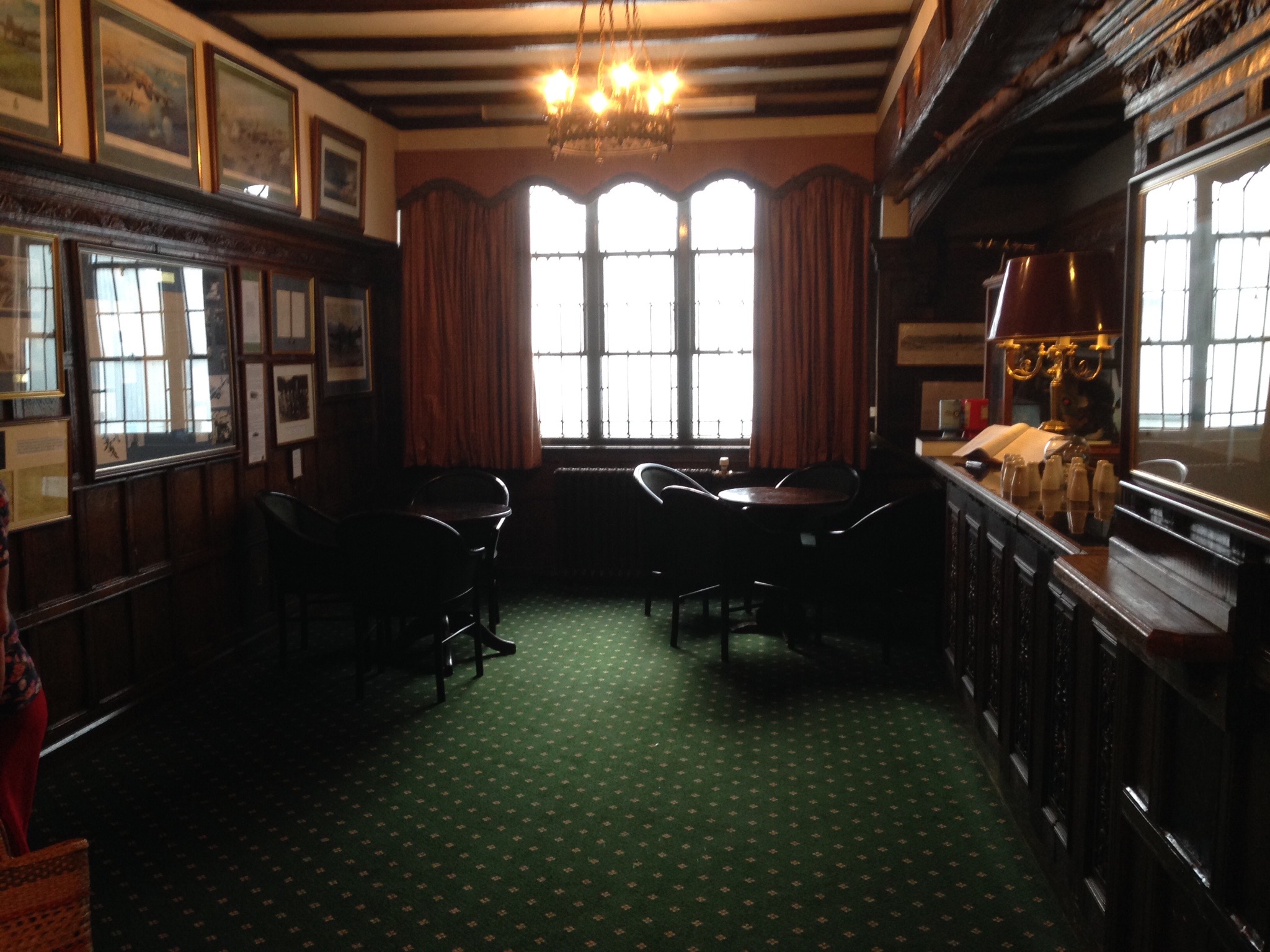
RAF Fersfield – Where history was made – and lost.

After leaving the open expanses of Deopham Green and the roar of Snetterton, we head to a very remote and quiet airfield. Quiet and remote for a very special reason. From here crews would experience top-secret flights, we would see a link to one of America’s greatest and most powerful families and the RAF would strike another blow at the heart of the Gestapo. We head to RAF Fersfield.

RAF Fersfield (Station 140/554)

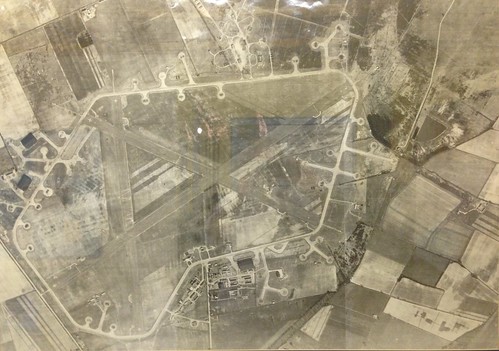
https://upload.wikimedia.org/wikipedia/commons/1/15/RAF_Fersfield_-_29_Aug_1946_Airfield.jpg

29 August 1946. Photograph taken by No. 541 Squadron, sortie number RAF/106G/UK/1707. English Heritage (RAF Photography).*1

Originally built as a satellite for RAF Knettishall, RAF Fersfield, was built-in late 1943. The third Class A airfield on this Trail, its main runway ran along a NE-SW direction, was 2000 yds in length and was constructed of concrete. There was a second and third runway of 1,400 yds running N-S and E-W again of concrete. Fersfield had two T-2 Hangars, one to the north side and one to the south, and 50 loop dispersals for aircraft storage. The bomb dump was located to the north, the technical area to the south and the accommodation blocks to the south and south-west. Fersfield would eventually be able to accommodate up to 2000 mixed personnel.

Initially, the airfield was called Winfarthing and designated station 140, it was then handed over  to the USAAF who would rename it Fersfield Station 554.

Fersfield was specifically chosen for its remote location as, unknown to those who came here, it was going to play a major role in the battle over Europe.

The first residents were a detachment of the 388th Bomb Group (BG) based at Knettishall which consisted of four bomb squadrons: the 560th 561st, 562nd and 563rd. A detachment specifically from the 562nd, were brought here to perform special operations and research into radio controlled bombs using war-weary B-17s and B-24s.

T2

T2 Hangar now a store

Operating as Operation ‘Aphrodite’, the idea was to remove all operational equipment from the aircraft, fill it with around 20,000 lb of ‘Torpex’ and fly it by remote control into a specified target such as ‘V’ weapon sites, submarine pen (Operations Crossbow and Noball) or similar high prestige targets that were otherwise difficult to destroy .

Both the USAAF and USN were carrying out these trials. The Navy, also using Fersfield, called their operations ‘Anvil’ and used the PB4Y (the Navy version of the B-24 ‘Liberator’) as their drone.

The first Aphrodite mission took place on August 4th 1944, and was to set the tone for all future operations. Mission 515, was flown using four B-17 ‘babies’ with four accompanying ‘mothers’ to target ‘V’  weapon sites at : Mimoyecques, Siracourt, Watten, and Wizernes. Escorting them were sixteen P-47s and sixteen P-51s. One of the babies, B-17 (42-39835) ‘Wantta Spa(r)‘ (TU-N), had completed 16 missions between November 18th 1943 and July 6th 1944 with the 351st at Polebrook and was declared to be “war-weary”. It took off and very soon  the crew, Lt J. Fisher and T/Sgt E. Most, realised there was a problem with the altimeter causing it to climb too quickly. Whilst T/Sgt Most bailed out, Lt. Fisher struggled on with the controls until it finally crashed in an almighty fireball in woodlands at Sudbourne, Suffolk creating a crater 100ft wide. The three remaining ‘babies’ carried on but all failed to hit their designated targets. One Mother lost control and the baby hit a Gun Battery at Gravelines, the second overshot and the third B-17F formally (41-24639) “The Careful Virgin”  ‘OR-W’ of the 91st BG (323rd BS), hit short due to controller error.
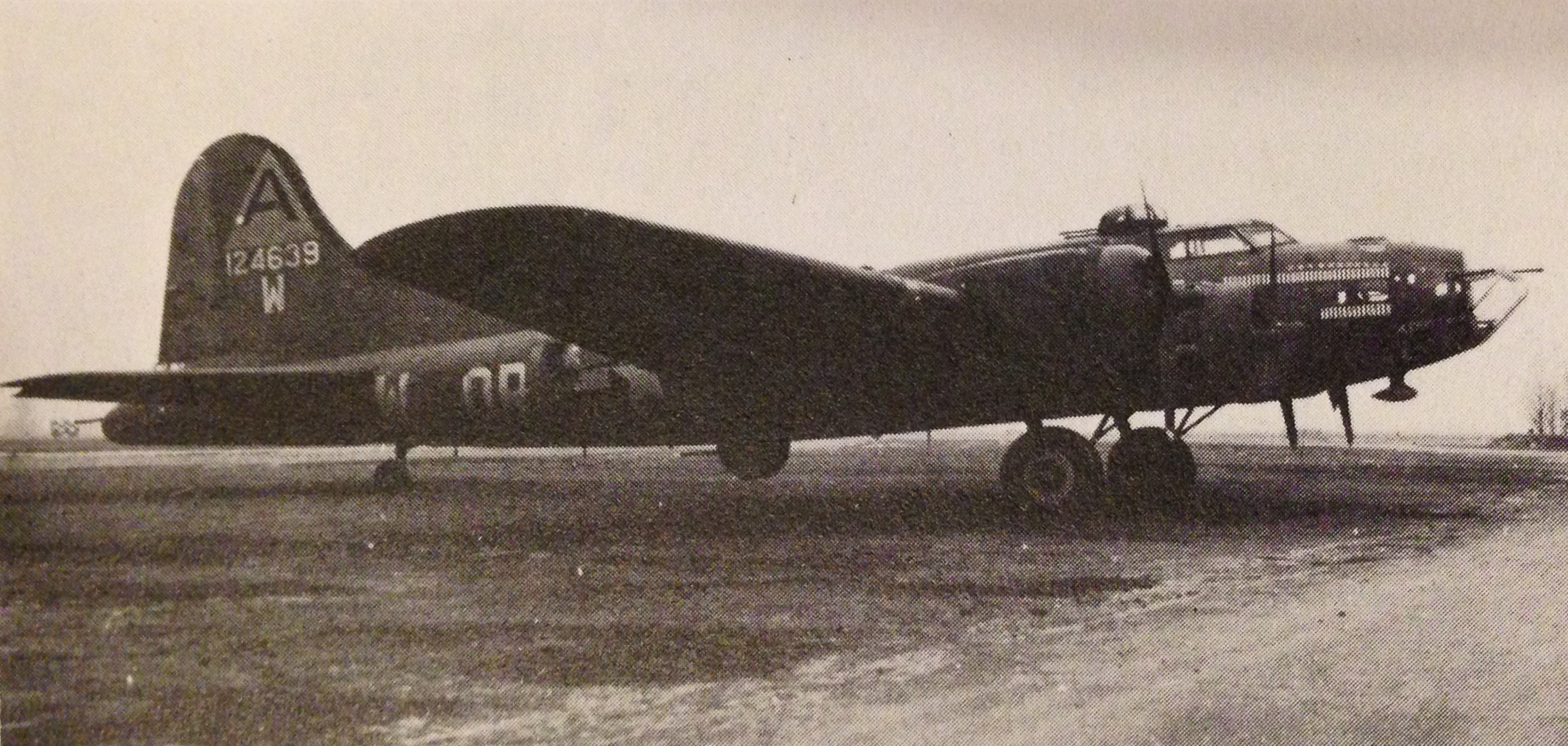
The Careful Virgin 41-24639

B-17F “The Careful Virgin” before modification and whilst in the hands of the 91st BG. (USAF Photo)

Similar results were to follow in another mission only two days later, and then in further operations throughout both the Aphrodite and Anvil projects.

The most famous tragedy of these missions was that of Lieutenant Joseph P Kennedy Jnr, who was killed when his PB4Y unexpectedly blew up over Suffolk killing both him and his co-pilot on 12th August 1944.*2 In all there were 25 drone missions completed but none successfully hit their designated target with either control or accuracy. The missions were all considered failures and the operations were all cancelled soon after.

Operations Block

Former Operations Block south of the Technical site.

Another secret operation taking place from Fersfield, also involved radio controlled bombs. Designated Operation ‘Batty’ it involved GB-4 television controlled bombs being  slung underneath B-17s and guided onto targets using TV. The 563rd BS provided much of the support whilst the others in the 388th BG the crews. In the later part of 1944 a small number of these operations were flown again with little success and this too was abandoned before it could have any significant effect on the war.

All in all, the operations carried out here, were disastrous, killing as many crews and causing as much damage to the UK as it did the enemy. However, it did mean that the Allies had entered into the drone war and set the scene for future military operations.

The Americans left Fersfield late in 1944, and it was handed back to the RAF. A number of units used it for short periods primarily for aircrew training. However, Fersfield was to have one last remarkable mission and a further claim to fame.

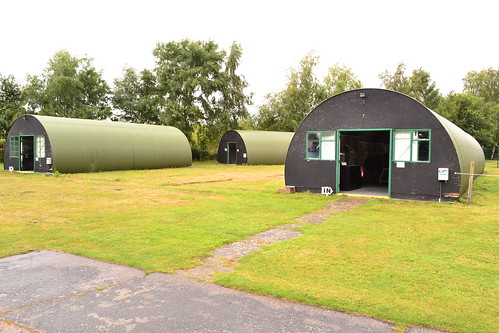
Accomodation Site

Nissan Huts on the former accommodation site.

On March 21st 1945, Mosquito VI units of 21 Sqn (RAF), 464 Sqn (RAAF) and 487 Sqn (RNZAF) all part of 140 Wing, were pulled back from the continent for a special mission to attack the Gestapo Headquarters at Copenhagen. Primarily based at Hunsdon (Trail 25), the mission was Led by Gp. Capt R Bateson and Sqn Ldr E Sismore, who took off in Mosquito RS570 ‘X’ at 08:35 and led a group of Mosquitoes in three waves of 6 aircraft in Operation Carthage.

The Shellhaus building raid gained notoriety for two reasons. Firstly, a large part of the building was bombed and destroyed and important documents set alight thus achieving the overall objective of the mission. A low-level daring raid it was operationally a great success. However, Mosquitoes following the initial wave attacked what they believed to be the building but what was in fact a school masked by fire and smoke. This caused a significant number of casualties including children.

Six aircraft failed to return from the mission, four Mosquitoes (one of which crashed causing the smoke and fire that masked the school) and Two P-51s that were part of a 28 strong fighter escort.

This operation was one of many daring low-level raids that the wing carried out, attacking various buildings including  the Amiens prison.

The wing left Fersfield which signified the end of overseas operations and Fersfield would become a staging post for units prior to disbandment. Between November 1944 and September 1945 a number of units would be located here  which included 98, 107 (one week), 140 (four days), 180 (one week), 226, 605 and 613 Sqns. Operating a number of aircraft types including: Mosquitoes (T.III), Bostons (IIa), Hurricanes (IV), Martinets (TT.III), Mitchells (III) and Anson Is, Fersfield had now had its day. In the following month, December 1945, the site was closed and the land sold off. Fersfield had closed its door for the last time and history had been written.

Post war, Fersfield had a brief spell of motor racing on its tracks and runways, but unlike Snetterton or Podington it wouldn’t last and in 1951 Fersfield became agricultural once more, with many of the buildings being demolished and the remainder left to rot or, some thankfully, used for storage.

Nissen Huts

A few buildings remain on the technical Site.

Today a few buildings still do remain clinging onto life. The T-2 on the south side stores grain, and a number of Nissen huts  that housed the technical aspects of the airfield, are now storage for farm machinery and other associated equipment. All these can be located at the end of a small road from the village and when visiting, I found the workers here only to willing to allow the visitor to wander freely among them. Footpaths cross the southern side of this site and to the north across the field dissecting the airfield. The path is very poorly marked and you are simply wandering across the crops. From here, you can find the last few remains of the accommodation site, further south a short distance away. Latrines and other communal buildings are shrouded in weeds, gradually disappearing beneath the undergrowth. Trees sprout from between the walls where so many walked, before or after a mission. Nissen huts survive further out, now dilapidated and hastily patched, their memories mixed amongst the personal belongings of new owners.

Latrine Block

One of the many Latrines on the communal site.

It is hard to believe that an airfield with such an iconic history as Fersfield never made it to the status of so many others. Surprisingly, it was here at this quiet and remote part of Norfolk that aviation history was made and American politics changed forever.

Mosquito Mk.VIs involved in the Operation Carthage,*3.

No 487 Squadron

RS570 ‘X’ Gp Capt R N Bateson / Sqn Ldr E B Sismore (Raid Leader)
PZ402 ‘A’ Wg Cdr F M Denton / Fg Off A J Coe (damaged, belly landed at base)
PZ462 ‘J’ Flt Lt R J Dempsey / Flt Sgt E J Paige (hit by flak, 1 engine u/s, returned safely)
PZ339 ‘T’ Sqn Ldr W P Kemp / Flt Lt R Peel
SZ985 ‘M’ Fg Off G L Peet / Fg Off L A Graham
NT123 ‘Z’ Flt Lt D V Pattison / Flt Sgt F Pygram (missing)

No 464 Squadron

PZ353 Flt Lt W K Shrimpton RAAF (Pilot) / Fg Off P R Lake RAAF
PZ463 Flt Lt C B Thompson / Sgt H D Carter
PZ309 Flt Lt A J Smith RAAF / Flt Sgt H L Green RAAF
SZ999 Fg Off H G Dawson RAAF / Fg Off P T Murray (missing)
RS609 Fg Off J H Palmer RAAF / 2nd Lt H H Becker RNorAF (missing)
SZ968 Wg Cdr Iredale RAAF / Fg Off Johnson
All aircraft took off at 0840; last back landed 1405.

No 21 Squadron

SZ977 Wg Cdr P A Kleboe / Fg Off K Hall (missing)
PZ306 Sqn Ldr A F Carlisle / Flt Lt N J Ingram
LR388 Sqn Ldr A C Henderson / Flt Lt W A Moore
HR162 Flt Lt M Hetherington / Fg Off J K Bell
No 21 Squadron records list only these four aircraft and crews above as taking part in this operation.
All aircraft took off at 0835; the three which returned did so at 1355.

Sources and further reading.

*1 Photograph in Public Domain, taken from Wikipedia 20/8/15

*2 For a more detailed explanation of the Anvil operation that killed Joseph Kennedy Jnr see  ‘Heroic Tales‘.

*3 Information from The National Archives, 21/8/15

Where Radials have been Replaced by Racing Cars – Snetterton Heath

In the second part of Trail 27 we head further south toward the Suffolk border. We stop off at a world-famous racing circuit where the roar of radial engines has been replaced by the roar of motor racing. With all its development and changes, there are some surprises in stall, as we visit RAF Snetterton Heath.

RAF Snetterton Heath (Station 138)

RAF Snetterton Heath is located to the south-east of Snetterton village, and was built to Class A standard in 1942 for the RAF. It had three concrete runways, the main heading SW – NE of 2000 yds, with a second N-S and third W-E both of 1,400 yds.  There were initially 36 ‘frying pan’ hardstands, and both T2 and blister hangars. In May 1943 it was handed over to the USAAF and designated Station 138. Snetterton was then upgraded,  and the number of dispersals increased to fifty. A further four T2 hangars were constructed to house what was intended to be an air depot, however this never came to fruition and the work was stopped.

The accommodation areas were far to the south-east and east, the technical site to the North East and north and the fuel dump to the south. Snetterton covered a wide area, with little to the northern side because of the main Newmarket to Norwich road.

crew lockers and drying room

Former Crew Lockers and Drying room.

Snetterton was to become the home of the 45th Bombardment Wing, moving from Brampton Grange on 13th September 1943, who stayed at Snetterton until 18th June 1945 when it was disbanded. The 45th included groups at: Great Ashfield, Knettishall, Deopham Green, Great Saling and later Mendlesham.

The first residents were only to have a short stay. The B26 B and C ‘Marauders’ of the 386th BG, which was made up of four squadrons: 552nd, 553rd, 554th and 555th, who would arrive at Snetterton on June 3rd 1943. They would leave here one week later on the 10th June moving to RAF Boxted and then later to RAF Great Dunmow in September that same year. It was during this move that they transferred from the Eighth AF to the Ninth. The idea behind this move was to reduce the number of ‘setbacks’ that has bestowed the Marauders in operational duties, and place them closer to the continent. Whilst here at Snetterton, the 386th flew no operational missions and were soon replaced by the heavier B-17F/Gs of the 96th Bomb Group.

Fabric store

The original fabric store now has an alternative use.

During the conflict, the 96th would operate B-17s in four operational squadrons: 337th (code ‘AW’), 338th (code ‘BX’), 339th (code ‘QJ’), and the 413th (code ‘MZ’); aircraft having two parallel red lines on the wings and tail and a white ‘C’ in a black square. The 96th moved across from Great Saling (Andrews Field/Station 485) after a month of residency and remained at Snetterton from 12th June 1943 to 12th December 1945 whereupon they returned to Camp Kilmer, New Jersey and were disbanded.

The 96th would attack strategic  targets such as shipyards, harbours, railways, oil refineries and aircraft factories across the whole of Europe, including Czechoslovakia, Poland and Hungary. On the 17th August 1943, in the battle over Regensburg, the 96th’s bravery and dedication was rewarded with a Distinguished Unit Citation (DUC) the first of two. The second coming following the raid on Poznan, Poland, on 9th April 1944 when it led the 45th Combat Wing (CW) through poor weather and intense anti-aircraft fire. This was to be their finest mission of the conflict.

Gunnery Trainer

A gunnery Trainer serves as an office today.

However, all was not good for the 96th. Whilst many ‘jinxed’ bomb groups were noted for their high losses and poor success rates, it was in fact the 96th that suffered some of the most devastating losses. In October 1943, they lost seven aircraft over Schweinfurt, then a further 10 over Rostock on April 11th 1944. In fact during this first half of 1944, the 96th lost a total of 100 B-17s, a greater loss rate than any other unit of the Eighth Airforce. This was a tragic loss that was reflected on a later ‘Shuttle mission’ to Poltava, Poland, when seventeen out of the twenty-one B-17s of the 96th BG were lost.

The 96th were to set a number of other ‘records’. They were to have the second highest rate of MIA crews in the Eighth Airforce and they were to lead the first ‘shuttle mission’ (intended to split the Luftwaffe forces by attacking a European target then flying on to Africa or Russia) whilst on a raid to Ragensburg.  It was on one of these shuttle missions though that the 96th was to see the ‘softer’ side of the war when both they and  the 100th BG (also labeled for high losses) both brought back donkeys bought for the sum of 400Ff!

Aug 2015
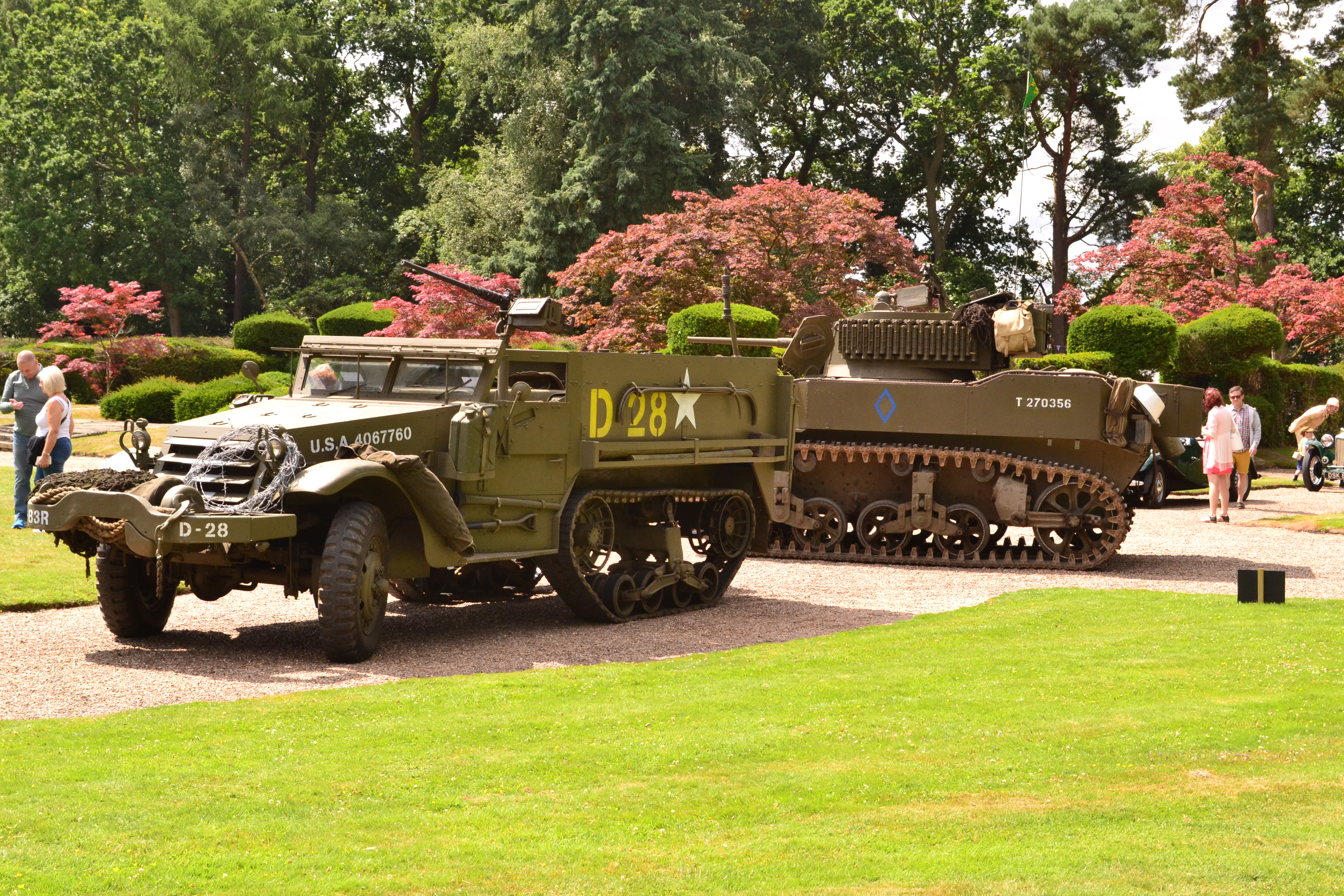
“Lady Moe” looking out of the Waist Gunners position of ‘The Miracle Tribe‘. USAF Photo

The very last operational mission by the 96th was flown on April 21st 1945. However, they continued to fly in humanitarian operations over Europe, dropping food and other supplies to the Dutch, a role they carried out until they finally returned to the United States in December 1945 where they were inactivated for two years.

On the 13th June 1945 the 30th Bomb Wing used Snetterton Heath as its headquarters but had no flying units here; instead they were scattered around other USAAF bases in Norfolk and Suffolk. They pulled out of the UK on August 15th 1945 returning to the US.

Post war, Snetterton Heath was placed in care and maintenance under the watchful eye of the RAF 262 Maintenance Unit (MU) until the end of 1948, whereupon it was sold off.

Today Snetterton is famous for its motor-racing history, much of the track utilising the former runways and perimeter track. Small industrial units use a number of former hangars (reclad) and airfield buildings such as the turret trainer, the standby set house, crew rooms and fabric stores. A few dilapidated Nissen Huts lay decaying in fields, storing farm machinery but their days are all sadly numbered.

The best examples of these wartime buildings are located on the technical site on the eastern side of the airfield. From the main A11 come off and head toward the track, pass the main entrance and the technical site is on your right. A good range of the original buildings are here, reused for modern activities. The Gunnery trainer is neatly masked as an office, but its structure and shape clearly distinguishable from the outside. The crew rooms just a little before this are in a small complex of other former wartime huts.

A former workshop carries out mechanical work and the original admin building is now a small brewery – something that would no doubt have pleased many a young man in the mid 1940s.

Admin buildign and Nissen huts

A small brewery occupies the former admin office, a welcome change for those of the 1940s!

A few other buildings remained scattered around the area, particularly in the woods. With careful searching these can be found but access is very limited and in most cases prevented.

Speech Broadcasting building

Other buildings remain in the wooded areas to the south-east.

A considerable amount of industrial work has been carried out on the Snetterton site, the runways and perimeter being repaired and improved to create a suitable surface for racing. Hardstands and wider sections of runway are storage areas for heavy lorries, racing vehicles and associated equipment.

Public access to this part of the site is free, and this allows you to see the recently built memorial inside the main gate adjacent to what was the main runway, now the entrance to the track. A beautiful memorial that was proposed by the Board of Directors and the members of the 96th Bomb Group Association. Following a competition at the local school, the design was submitted by one of its teachers, Mr. Martin Rance, and depicts a B-17  at the top of four triangular, stainless steel columns. Each of the columns representing one of the four squadrons attached to the group. The B-17 pointing upward as if taking off into the skies above. Beneath is a simple dedication that refers to all the personnel who served with the 96th.

Aug 2015 014

An imposing memorial stands as a reminder of the 96th BG.

Throughout the war, the 96th BG achieved two DUCs, lost 189 crews as missing in action, flew 8,924 sorties dropping over 19,277 tons of bombs. Today the remnants remind us of those crews, the buildings stand as testament to their bravery and dedication, the memorial as a reminder of what once went on here, before the radial engines were lost and to the roar of racing cars.

We leave Snetterton, and head south-easterly toward Diss. As we do, we find the little village of North Lopham. Here is a small memorial dedicated to two crews of B-17s from the 337th and 338th Bomb Squadrons who collided over the village killing all on board on January 29th 1945. *1 The accident happened as the aircraft were forming up on a mission to the Bielefeld Marshalling yards. A small reminder of the perils of flying a large number of heavy bombers in tight formations.

Aug 2015 found in North Lopham

Memorial to two B-17s that collided killing all on board, January 29th 1945.

After a brief stop here, we continue on toward Diss. Here we find an incredible history that not only links us to possibly one of the greatest Americans that ever lived, but a mission that reveled the daring and skill of precision bombing by the RAF.

We go to RAF Fersfield.

Sources and further reading.

*1 Other memorials to the 96th BG can be found at St. Andrew’s Church, Quidenham and at the local school, where a small museum can also be accessed. I shall add these later.

A website dedicated to the 96th Bomb group is limited in detail but has some interesting information.

Wartime memories project have personal artefacts and letters linked to Snetterton and many other bases across East Anglia.

An airfield that holds a tremendous history, yet little exists.

In this revised trip, we go back to Woodhall Spa, and visit the former Bomber Command airfield, famed for its crews, missions and aircraft. Woodhall Spa is a remarkable airfield, yet it is hardly known, or recognisable today.

RAF Woodhall Spa was originally built as a satellite to RAF Coningsby a short distance away, and opened on 1st February 1942. It was built with three concrete runways; two of 1,400 yds (1,353 m) and a third and main runway of 2,000yds all 50yds (46 m) wide. The site like other Standard ‘A’ class airfields had two T2 hangars and one B1, thirty-six pan-style hardstands and numerous support buildings scattered around its perimeter. Accommodation was spread over 7 sites, along with a WAAF, sick quarters and 2 communal sites all located to the south-east. The technical and administrative sites were also to the south-east side of the airfield between the accommodation areas and the main airfield.

A bomb store was well to the north and the main entrance to the north-west. A range of accommodation and technical style huts were used, Laing / Nissen / Seco and a Watch Tower to drawing 15956/40.

aerial photo of RAF Woodhall Spa

An aerial photograph of Woodhall Spa taken post war. The B1 and T2 hangers can be seen to the north-west, a further T2 to the south. The accommodation block are below the frame. (Taken from a photo at the Thorpe Camp museum).

One remarkable features of Woodhall Spa was the installation of six arrester gear units on the runways. These were designed to prevent aircraft overshooting the runway and were installed during the building programme. Some 120 units were manufactured in all but only a handful of sites had them. On October 22nd 1942, the Woodhall Spa units were tested using an Avro Manchester from the Royal Aircraft Establishment and all went well. However, as the war progressed, reservations were registered about such a technique and the units were never used ‘operationally’ in any of the allocated sites.

At the same time that Woodhall Spa opened, the newly equipped Lancaster (Mk I & III) squadron, 97 Sqn, moved from RAF Coningsby into RAF Woodhall Spa and within a month were flying operations from their new home. However, their first operation, mine laying, was to be fatal for three aircraft, cashing on the journey home. This was not to be the general theme for 97 Sqn though. For the next year they would prove themselves more than capable, hitting many targets accurately with bravery and courage.

Lancaster Mk I ‘R5495’ OF-N of 97 Sqn Woodhall Spa, bombs up. This aircraft was shot down over Essen 8th/9th June 1942, the crew were all killed.*4

The following March (1943) the main bulk of 97 Sqn moved to Bourn to form part of the new Pathfinder force, with detachments at Graveley, Gransden Lodge, Oakington and a further section remaining at Woodhall.  On April 18th 1943, 619 Sqn was formed from the Woodhall Spa detachment retaining their Lancaster Is and IIIs. However, their stay was very short; they moved out to Coningsby in January 1944 and were replaced overnight by the famous 617 (Dambusters) Sqn*5.

During their year here, 619 Sqn would prove themselves further in raids over the Ruhr, Düsseldorf, Oberhausen and Krefeld. Casualties were light during these early missions, but in the following August (1943) the RAF a mounted a massive raid consisting of 596 aircraft on the V2 rocket site at Peenemunde. Three of the twelve aircraft sent by 619 Sqn would fail to return.

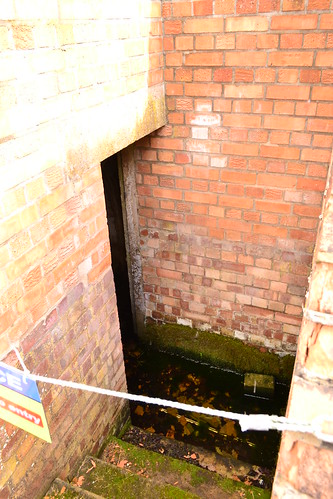
Bomb Shelter now flooded.

The bomb shelter now flooded and inaccessible.

When 619 Sqn moved out, 617 Sqn moved in. Lead by Group Captain Leonard Cheshire, 617 Sqn were the elite of 5 Group, Bomber Command and accordingly were to be assigned some of the most difficult and outright dangerous precision bombing missions.

Throughout 1944, 617 Sqn would have many near misses, and losses, ranging from low-level bird strikes to fighter attacks and flak. Targets varied considerably including those at: Limoge (aircraft engine factory), the Antheor Viaduct, Albert, St. Etienne and Metz (aircraft parts factories); many using the new ‘Tall Boy’ 12,000lb bomb.

On 15th April 1944, 617 Squadron were joined by 627 Sqn and obtained some D.H. Mosquito VIs, using these to good effect in the Pathfinder role while their Lancasters continued with the bombing. In June, they had a small respite from bombing missions and on the day of the Allied Invasion, they were tasked with dropping ‘Window’ over the Pas-de-Calais to fool the Germans into believing the invasion force would strike there.

Nissen Huts

A handful of huts and buildings remain.

Throughout the remainder of 1944, 617 Sqn continued to use ‘conventional’ and Tall Boy  bombs on prestige targets like U-boat pens and the Samur Tunnel. Cheshire found himself handed a P-51, and after having it unpacked and engine tested, he used it to mark a V1 target to which 617 struck a devastating blow.

Further major targets were to befall the wrath of 617 Sqn. Flying 2,100 miles to a forward operating base at Yagodonik with Lancasters from 9 Sqn, they attacked the German main Battleship the ‘Tirpitz’. During the mission, for which they had long-range fuel tanks, of the 38 aircraft that set off, six were to crash on the outward journey, one turn back and one to crash on the return. The Tirpitz however was to remain ‘unsinkable’ for some time. It would take two more return trips by 617 Sqn from Lossiemouth to finally sink the ship, the last being on 12th November 1944, with the loss of 1000 German sailors.

Bombing and pathfinder operations for Woodhall spa crews continued right up to the end of the war. Early that year they would start to use the new ‘Grand Slam’ 22,000lb bomb, with their last operational fatality being on 16th April 1945. That was not the end for Woodhall Spa though. The famous Guy Gibson drove here and ‘borrowed’ a Mosquito of 627 Sqn against a backdrop of changed minds, mishaps and misjudgements, the resulting crash leaving him dead.

DSC_0181

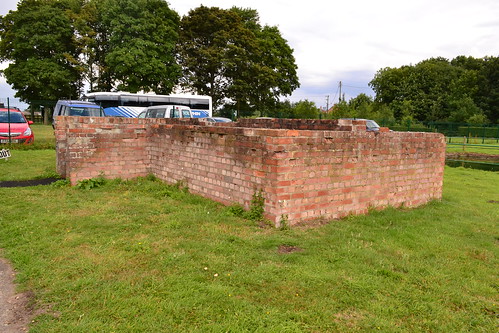
Brick walls outline former structures.

Woodhall closed soon after the war ended, but it was identified as a suitable location for Britain’s air defence missile the ‘Bloodhound’ and on May 1st 1960, Woodhall Spa became the base of 222 Sqn with Bloodhound MkI missiles. These were disbanded in June 1964 and replaced by Bloodhound Mk IIs of 112 Sqn on November 2nd 1964. These stayed until 1st October 1967 when they moved to Episkopi in Cyprus.

After the removal of the Bloodhound squadron, the RAF continued to use a small site near to the main entrance, utilising the 617 Sqn T2 hangar and other ancillary buildings as an engine maintenance and testing facility. This too has since closed and the main use is now as a quarry.

Thorpe Camp (RAF Woodhall Spa)

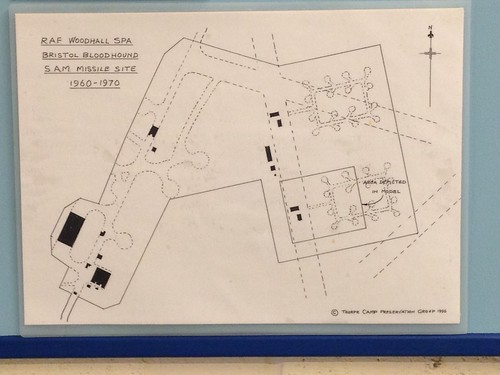
Map showing the location of the Bloodhound Missile Site (Photo of the display at the museum)

A long and distinguished life, Woodhall Spa’s operational losses totalled 91 aircraft, of which 74 were Lancasters and 17 Mosquitoes. Daring and brave crews, they gave their all for freedom and the love of flying.

Today little exists of this former airfield. Being a quarry and partly MOD, much of the  land it is not accessible to the general public. Most of the buildings have long since gone and the runways mostly dug up. A few minor concrete ‘side roads’ are in situ and with searching some evidence can be found. The tower was demolished just after the war as were many of the other buildings and huts. Steps have now been taken to turn whats left into a nature reserve (see post dated 4th July 2015) and a memorial has been placed at the intersection of the runway remains. The best remnants can be seen a little way to the south-east at the former No 1 communal site at Thorpe Camp (see below).

Former NAAFI

The former NAAFI for 469 airmen and 71 officers.

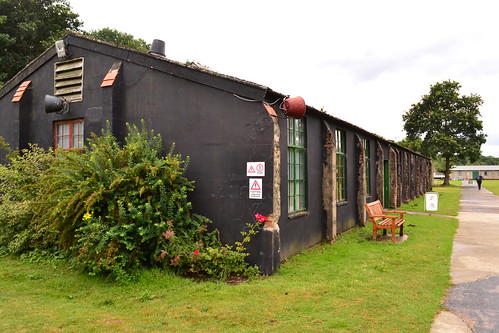
A small number of buildings remain here utilised now as a museum. These include a war-time NAAFI able to accommodate 469 airmen and 71 officers, the ablutions block, ration store and various Nissen huts. A bomb shelter is also here, now flooded and blocked off along with other part brick structures.

In the adjacent woods, the airmen’s quarters and other buildings can be found, now derelict and in a dangerous condition. Odd buildings are scattered about the various sites but these too are few and far between.

Considering the history of Woodhall Spa, the men who flew from here, the operations they undertook, the testing of revolutionary equipment, the new and deadly bombs, it has suffered possibly greater than most and much of this history, if it were not for the Thorpe Camp museum, would now be lost forever. Now it has become a nature reserve in part, then maybe, just maybe, the footsteps of those who were stationed here may once again be walked by others and their memories brought back to life.

Sources and further Reading.

*1 Author unknown, photo from http://www.aircrewremembered.com/hughes-mervyn.html, August 2015

*2 617 Squadron are most famous for the raid on the Ruhr dams in Operation Chastise ‘Operation Chastise’ carried out on 17 May 1943 under the command of Wing Commander Guy Gibson.

This is an updated trail part of Trail 1 Lower Lincolnshire.

Amongst the Rabbit holes and bracken stand the bomb stores of yesteryear.

Trail 13 continued around the western edges of Norfolk, near to Thetford Forest and the heaths of Breckland. Here, not from Thetford, is an airfield left over from the latter parts of the war. Seeing both RAF and USAAF personnel, it was often boggy and wet, but that didn’t deter those brave young men who fought for freedom.

Now an Army training camp, what’s left is being attacked by another enemy. We return to Southern Norfolk to complete an earlier Trail.

RAF East Wretham (Station 133)

Originally built-in the early part of the Second World War and opened in March 1940, East Wretham was designed as a satellite to RAF Honington with an all grass runway running NE/SW, 2 x T2 hangars, various defence pillboxes, support buildings and a number of blister hangars. At Honington, a newly formed 311 (Czech) Sqn was formed (29th July 1940) flying Wellington ICs, and they utilised East Wretham as a dispersal until August that year, when they permanently moved in. 311 Sqn carried out night bombing duties for the duration of the time they were here, but then in 1942, Wretham’s status changed once more. 311 sqn moved out and East Wretham became a satellite for Mildenhall taking in 115 Sqn on the 8th November, with their Wellington IIIs. The following March (1943) these were replaced with the rarer Lancaster MkIIs and these remained here in the night bomber role, until a further change in August 1943 when 115 sqn moved to Little Snoring and the site passed to American hands to become Station 133.

rear-turret-of-Lanc-lost-595x478

Avro Lancaster B Mk II, DS669 ‘KO-L’, of No. 115 Squadron, was hit by bombs from an aircraft flying above. durinhttps://aviationtrails.wordpress.com/wp-admin/post.php?post=1422&action=editg a raid on Cologne on the night of 28/29 June 1943. The tail gun and gunner were both lost. (Author unknown)

Now home to the 359th Fighter Group,  it hosted the big heavy P-47 Thunderbolts of the 368th (code CV), 369th (IV) and 370th (CR latterly CS) Fighter Squadrons and so had to have steel matting runways laid to accommodate their heavy weight on the soft ground. Used primarily for bomber escort, the 359th FG would fly escort to targets in nearby France. However, in April 1944 the P-47s  were replaced with the more agile P-51s which allowed them to penetrate deep into the heart of both Germany and Poland. A task the ‘Mustang’ became famous for. During the Allied invasion of Normandy the 359th attacked bridges, locomotives and supported bombers hitting targets around the invasion area. As the invasion force got a foothold in France, the three squadrons of the 359th returned to long-range bomber escort duties, taking part in raids over Ludwigshafen, Frankfurt, Berlin and Merseburg. During August 1944, the group supported the operations in ‘Market Garden‘ and later that year the Battle of the Bulge in the Ardennes.

Wetmore

Maj. R. Wetmore, of the 370th FS, in front of P-51B (42-106894) ‘CS-P’. on the shoulders of his ground crew*1.

On 11th September 1944, the Green nosed Mustangs of the 359th really made their mark when they shot down 26 enemy fighters; for this, they received the Distinguished Unit Citation (DUC). The determination shown by the 359th resulted in many outstanding pilots. One, Maj. Raymond “X-Ray Eyes” Wetmore became the 359th (370th FS) top ace scoring 21 victories – his last being an Me 163. Flying in P-51 “Daddies Girl” named after his daughter, he received numerous awards and by the end of the conflict had completed 142 missions covering 563 combat hours.

Aug 2015 002

The old part remains cordoned off.

This attitude to the war, gave the 359th a worthy credit of 263 aircraft shot down with over 100 more being destroyed on the ground. In the 346 missions they flew, they lost a total of 106 of their own aircraft.

In November 1945 the USAAF left and no further flying took place at East Wretham . The airfield reverted to 12 Group (RAF) ownership, then in May the following year, it was handed back once more to Bomber Command . Within a month the site was handed over to the Technical Training Command and finally East Wretham became a Polish resettlement camp for those personnel who were unable to return home. When they had all finally be moved on, the majority of the site became what it is today, used by the British Army as part of the massive Stanford Practical Training Area (STANTA ) for manoeuvres and live firing training.

Aug 2015 015

The bombs stores blast walls are still intact – just.

Today most traces of the airfield as it was are gone. A number of buildings notably a T2 hangar and several Nissen huts survive on what is now farmland or in the military camp. The unique Watch Tower was demolished after the war as were many of the other ‘temporary’ buildings. Now used by STANTA, a mix of old and new are intertwined and the majority stands on inaccessible military ground.

Perhaps the best and by far most accessible examples of East Wretham’s past, is the bomb site which forms part of the East Wretham Heath Nature Heritage Trail. Access is to the south of the site just off the main A1075, Thetford Road. A two-mile walk though Heath land, it takes you right through the original bomb store. An area of natural beauty, famed for its wetland and ancient flints, you can easily find the many blast walls and small fusing buildings still there. Also traceable are the tracks that once took bomb loaded trailers to the airfield across the heath. Many now buried under the acidic soil, their existence evident in exposed patches of bare concrete.

Aug 2015 020

The decay is evident throughout the bomb store.

All these stores are being gradually reclaimed by nature, trees and rabbit holes have both played taken their toll, the layout is still discernible and whilst much of the brickwork is intact, the warning signs are there and they are crumbling fast.

A small airfield, East Wretham was never considered the most ‘homely’ of sites. Often wet and boggy, it was one of the less well-known and less famous places to be used. But the courage and determination of those who served here both RAF and USAAF, went a long way to helping defeat the tyranny that stood facing us across the small section of water not so far away.

To see the other sites on this Trail, Old Buckenham and Tibbenham, go to Trail 13.

Sources and further reading:

*1 Photo: 359th Fighter Group Association, accessed at http://www.littlefriends.co.uk/

A Gem of a Museum in the Heart of an Aviation Mecca

I recently updated the original Trail on this site after visiting the Thorpe Camp Museum. A really pleasant little museum, it provides a wealth of information for very little cost. Its history and that of the area, is incredible.

Thorpe camp museum sits on the original  communal site 1 on the former RAF Woodhall Spa and was acquired in 1988 by a group of volunteers (The Thorpe Camp Preservation Group) who have utilised the original buildings and pathways that would have been used by RAF personnel during their stay at Woodhall Spa. Entrance is a nominal fee and worth every penny.

DSC_0152

Original buildings of No. 1 communal site are now a museum.

A number of original huts and buildings display a range of letters, photos, memorabilia and other artefacts that take you through aspects of life both at Woodhall Spa and Lincolnshire life during the Second World War. Specific displays tell you about each of the four squadrons based here (97, 617, 619 (Dambusters) and 627) , the crew members, aircraft and personal stories. A memorial stands at the centre of the site reflecting their dedication.

Extensive work has been done to research the famous dams raid of 617 Squadron, how the bouncing bomb was developed, how it worked and what the aftermath of the operation was.

A small shop provides food and drink, and is a welcome break after a long journey.

DSC_0164

An Allan Williams Turret on the site.

A civilian section shows life ‘at home’. Weddings of the Second World War were scant affairs due to lack of money and rationing, but brides made the most of what they had; examples of these are nicely displayed. The home guard, ARPs, and domestic life are all represented in this atmospheric museum.

Many young men were sent from within the borders of Lincolnshire on major operations such as ‘Market Garden’, these too are represented through displays of uniforms, photos, letters and official documents.

Further buildings, also originals, house well stocked displays of the V1 and V2 development. The terror weapons used by Hitler to break the morale of the British people. Over 3000 of these V2s were used against targets in the UK predominately London and the South East. Models, photographs and documents again show the extent of this development.

Something I had never come across before was the idea of using arrester gear on heavy bombers where runways may have been shorter than ideal. The principle, based upon that used by the navy on their aircraft carriers, was to place one or more steel cables across the runway for a landing bomber to ‘catch’ as it landed. A small number of airfields in the UK has these, Woodhall Spa being one of them, and an original winch has been removed from the airfield and carefully refurbished. This now has pride of place in the museum. It is believed a further example remains on the airfield alongside the remains of the runway. A rather ingenious but ineffective idea, it was not widely used due to mis-landings and the increased weight that the arrested gear added to an already heavy aircraft.

DSC_0170

An Arrester Gear Hub that was used on RAF Woodhall.

Thorpe Camp provides a chance to see inside a Lancaster cockpit. A replica, painstakingly built includes all the detail of an original Lancaster bomber. Other parts, including turrets, dials and engines can also be found in this dedicated exhibition room.

Staff at Woodhall Spa are carrying out renovation projects and have their own workshop to do this. The process can be viewed and makes for an added interest to the visit.

As an aviation enthusiast the trip is topped off with another feature in the form of a BAC Lightning F1A (XM192) in 111 Squadron markings standing proud beside another cold war relic the Bristol Bloodhound missile.

DSC_0153

BAC Lightning of 111 Squadron RAF.

Using a range of original documents, photographs, letters and memorabilia, Thorpe Camp at Woodhall Spa is a delight to wander and a real insight not only into the life of this Second World War airfield but life during those hard times in general.

Thorpe Camp is part of Trail 1, and is located near to RAF Coningsby. It has its own dedicated webpage where you can find further information and details.

A museum with an international flavour

This museum forms Trail 26 of our tour around Britain’s aviation past. It is of particular interest to me, not just because of its aviation heritage, but because it’s not far from where I was brought up. Indeed, I was born in the City of Coventry, a mere three miles or so from here. After about 6 months we moved away to more leafy surroundings but the influence of Coventry was not left behind.

More importantly though, my father, my inspiration and the man who gave me my love of aviation, worked here at Baginton on the Argosy for Armstrong Whitworth, an aviation company long since gone. A dear friend of his, also worked here on some secret aircraft, so secret my father sadly never saw it.

DSC_0105

The main building; the Sir Frank Whittle Heritage Centre.

Of course, this area is steeped in aviation history. The Jet engine was developed around here, Sir Frank Whittle’s name is used in his honour for a number of pubs and industrial sites across the region. I used to live not far from Lutterworth, famed for ‘Bitteswell’ where many test flight were made for AW, modifications were carried out to Britain’s Vulcans, Buccaneers, Gnats and Hawks to name but a few all under the name of British Aerospace. Also not far from my home was Whetstone, which had the first purpose-built jet engine factory. Coventry itself was a main target for the Luftwaffe suffering great casualties and damage during the blitz and the Cathedral ruins now stand as a monument to those who lost their lives during those terrible times. The former Standard (Later British Leyland) Motor works here built over 1000 Mosquitos and a number of other aircraft parts were made in this area. Baginton itself produced heavy bombers such as the Whitley and the Lancaster, Dunlop has a factory here as does Rolls Royce. Coventry and the area around it is steeped in both wartime and aviation history.

So Baginton holds good links to my past, and it has been far too long since I was there. So, whilst in the area, I decided to take a detour and visit the Midland Air Museum, Coventry.

DSC_0028

The cargo hold of the Argosy

The museum is located to the northern side of Baginton (Coventry) Airport and has utilised this site since 1975. It originally had only five exhibits when it opened but has grown  into the enormous collection it is today, holding around 40 airframes and various exhibits including: helicopters, a range of aircraft engines, cockpits, galleries and a vast collection of models. The main building, the ‘Sir Frank Whittle Jet Heritage Centre‘ is not only the main building for the displays and  engines but holds a dedicated exhibition of Sir Frank Whittle’s remarkable work.

In here, are a vast number of photographs, letters and other documents relating to the creation and development of the Jet Engine. It takes you through, step by step, the process of development of the engine, Frank Whittle’s life and the organisations that built and developed this major invention.

July 2015 006

Sir Frank Whittle and the early jet engine

The exhibition is housed in a small hangar crammed with jet engines amongst a small collection of aircraft. A meteor F-4 (and Mk 8 cockpit), a DH Vampire F-1, Saab J-29 and Lockheed’s T-33 being the most prominent. Cockpits other than the Meteor include that of the Harrier and a Canberra from RAF Wyton and some of these the visitor is free to sit in and experience what it was like as a pilot. Upstairs in this building, are displays of Baginton’s links with the air industry and local events of the Second World War. Again, photographs and documents relate the lives of those who lived through the war in the surrounding area. An absolute wealth of information here finished of with a huge range of well made models,

Sadly, most of the airframes are outside, some succumbing to the weather and all that the elements can throw at them. However, this aside, the range and selection of airframes is tremendous. Most models here come from the post war era, remnants of the Cold War. A Meteor night fighter stands next to the modern Tornado, A Gloster Javelin, A.W. Sea Hawk, D.H. Sea Vixen, Fairy Gannet and Harrier represent the great naval traditions of British aviation. From the RAF we have the Canberra, Hunter, Gnat, Percival’s Prentice, D.H. Beaver and two stunning E.E. Lightnings; a Saudi T-55 and a Binbrook F6 retired in 1988.

Many of these aircraft saw development in the years following the Second World War. The Canberra, first flown in 1949, served right up until 2007 and achieved many awards for altitude and performance flights. Used by Air Forces across the world, variants saw action over the Suez Canal, in Vietnam and in the Indo-Pakistan conflict in the late 1960s. Built under licence in the United States with a redesigned cockpit, the B-57 was admired by many. Production of the Canberra and its variants total around 1,500 and filled a number of roles with a variety of Air forces.

DSC_0035

The Boulton Paul P.111A bulit in one piece and designed to explore the aerodynamic properties of the Delta wing.

Baginton is not just limited to RAF types either. The USAF is also represented through several models, there’s the North American F-86A Sabre and F-100D Super Sabre,  McDonnell Douglas F-101B Voodoo and of course the famous McDonnell Douglas F-4c Phantom.

Initially designed as a carrier based aircraft, the Phantom was adopted by numerous air forces across the world including the Royal Air Force and the Royal Navy. First flown in 1958, it was so successful that it would continue to serve into the early 21st century; with production totaling nearly 6,000 – it was a major contribution to aviation history. Like other models here, the Phantom fulfilled a variety of roles, being continually adapted to meet new demands and challenges. Truly a great aircraft.

No Cold War exhibition would be complete without opposing aircraft. A MIL Mi-24D Hind helicopter with its formidable nose mounted cannon and gas turbine engine stands alongside  Russia’s highly proven  warrior, the Mig 21.

DSC_0074

A McDonnell Douglas F-101B Voodoo

The Midland Air Museum has a good international flavour to it. Lockheed’s F-104 Starfighter, dubbed ‘Witwenmacher‘ or ‘Widowmaker’ because of its unforgiving nature, stands in Royal Danish Air Force colours, the Mig 21, East German, the Gnat in Finnish Air force markings and the French represented with Dassault’s Mystere IV.

However, amongst all this hardware, there are two airframes that stand out for me here at Baginton, and not for their size alone, Avro’s B2 Vulcan ‘City of Coventry’ XL 360 which stands in 617 Squadrons colours, a squadron it served with before retirement, and Armstrong Whitworth’s Argosy 650, of which this is the oldest surviving example. To see both, not only remind me of my younger days, but provide a link to my father whose memories are fading as each day goes by.

One of the delights of the Midland Air Museum is that you can sit for free (donations accepted) in many of the cockpits where knowledgable guides will talk you through its history and features, something rarely found elsewhere.

DSC_0036

Avro Vulcan B2 XL360 ‘City of Coventry’

To finish off your walk round, there is a small but clean and pleasant cafe, a shop that is filled to the brim with model kits, books and other mementos of your day. The staff are friendly and helpful, always a blessing.

Whilst some of the airframes are looking a little jaded, there is an extensive collection  to be found here, and for those interested in all things aviation, especially the development of the Jet engine; from the early days of the Sapphire, through to the Olympus, the Avon and the RB199 turbo fans of the Tornado; the Midland Air Museum has them all.

July 2015 021

Sisters sit side-by-side

Coventry Cathedral is about 3 miles from here, and if time permits, is also worthy of a visit.

Details of the museum can be found through their website.

An airfield whose history remains secret.

This is the second airfield of Trail 25 which takes place in the Hertfordshire countryside. Even today, much of what went on here remains secret and little information about the people or its activities exists. However, its role in the both wars was significant.

RAF Sawbridgeworth

RAF Sawbridgeworth was originally constructed as an Advanced Landing Ground (ALG) during April 1916. It was designed to take aircraft from 39 sqn, who were currently based at nearby North Weald. Activated initially to combat the Zeppelins from Germany, 39 sqn are currently based at RAF Waddington flying the MQ-9 Reaper against a much different enemy.

May 2015 044

Part of the Airfield defences.

It wasn’t until the Second World War, that RAF Sawbridgeworth  really came into its own as an operational airfield.

Mathams Wood ALG, as it was known, saw expansion in the early 1940s, more through luck than careful planning. Each of the three runways, were constructed of Summerfield tracking, and measured 1,700 yds, 1,400 yds and 900 yds in length.  The usual Drem lighting was installed adjacent the track rather than embedded as would be the usual case.

A number of buildings were requisitioned as aircraft were dispersed here following France’s fall in 1940. The ALG was expanded through local workers and Mathams Wood ALG took on the unofficial name RAF Sawbridgeworth after the village that stands close by.

The expansion of Sawbridgeworth also included a number of buildings: 16x Dorman Long (4630/42) blister hangars, a T2 hangar, a number of ‘Blenheim’ style aircraft pens and 8 dispersed sites primarily to the East of the airfield. A watch tower, fire tender station, hospital, grocery store, Link trainer, gymnasium and the usual accommodation blocks all added to the much bigger site than had been previously been designed.

grocery store

The former Grocery Store.

The first unit to be based here was that of 2 (AC) sqn flying Westland Lysander II and IIIs in the observational role. Performing primarily in this activity, 2 sqn later on used the Curtis Tomahawk I & II, followed shortly after by the Mustang I and eventually the IA. Other squadrons to be based here included: 4, 63, 80, 126, 168, 170, 182 , 239, 268 and 652 sqns primarily undertaking a PR role whilst here.  A number of other non-flying units performing the evacuation and redeployment of personnel were also stationed here.

2 Sqn were also heavily involved in the secret work of the Special Operations Execute (SOE) involved in dropping agents into occupied France. Much of the training of the aircrews took place at Sawbridgeworth, with practice flights using the famous ‘Black’ Lysanders. Even today, some 75 years later, these operations and the role of the photographic reconnaissance units, remain well hidden operations cloaked in secrecy.

May 2015 041

The perimeter track still remains, in full at some points.

Sawbridgeworth was not devoid of its own enemy attention. On September 19th 1940 a Heinkel III was shot down and crashed in nearby Thorley Wash, one of several crashes close by.

As the war drew to a close, so did the activity at Sawbridgeworth. Following the invasion of Normandy, and the subsequent liberation of Europe, all operational flying ceased in November 1944 and the site went into care and maintenance. The runways were pulled up using P.O.Ws and the tower was demolished a year after the cessation of conflict in 1945. Other buildings were removed or demolished and the land turned back to agriculture.

Wandering the site today, there is luckily still quite a bit of evidence about. The perimeter track is complete, not in its full width throughout, but a large proportion of it. A number of pill boxes remain scattered around the perimeter of the site and the Battle Headquarters (design 11008/41) can be found with determined searching amongst the brambles and hedgerows.

May 2015 037

The former guard block, still largely intact.

To the west of the site is a small industrial complex utilising what was a ten-bed sick quarters, dental annexe, a twelve bed Barrack hut that doubled as a hospital ward, mortuary and an ambulance shed. An ablutions block is was also located here and the site is more or less complete. Not far from here, is a modern farm, which houses a number of smaller original buildings including a Parachute store (built to drawing 11137/41), fabric store, sub station, main stores and other technical buildings. These are all located on private land and in use by the farmer. There is also a signals block, located nearby to these sites and easily visible from the road.

Across to the east of the airfield, is whats left of the communal site. Here stood 33 buildings in total, incorporating a wide range of supporting units for recreation and general living. The only remaining buildings being the standby generator house and the grocery store. Both are used by local businesses.

Emergency generator

The Standby Generator House now a stores for machinery.

A memorial to those who served at Sawbridgeworth stands outside what was the guard block. A recent addition, it is a nice reminder of the dedication of the crews who were stationed here during two world wars.

Sawbridgeworth is a small well hidden airfield and takes some finding. Hidden by woodland and crops, it was created through luck rather than good planning. The crews and aircraft of Sawbridgeworth played a considerable part in the Second World War, and all in its short but yet significant life.

May 2015 005

A memorial stands dedicated to those who served at Sawbridgeworth.

Sawbridgeworth features with its sister station RAF Hunsdon in Trail 25.

1940s revisited

A little more light-hearted look at the 1940s away form the disused airfields of Britain.

These last two years have been significant years in terms of both the First and Second World Wars. With the 100th anniversary  of the start of WWI last year, the 75th anniversary of the Battle of Britain this year, VE-day and of course to come VJ-day commemorations, there has been an understandable increase in interest in all things Second World War.

One thing I have noticed in particular, is the increase in numbers at 1940s weekends, in both participants and visitors.

DSC_0008

Vehicles of all shapes and sizes came for the weekend.

I myself have been to two recently, and at one I got the chance to sit in a Spitfire cockpit. Not something you do every day!

I know these events are not to everyone’s taste and some will groan at the thought of it, but I do think there is an historical value to them. Many of the participants only use genuine clothing or equipment, much of what you see is rare and in all cases they are only too keen to talk about what they have, its history, how and where it was used and in some cases, allow you to hold the articles in question.

DSC_0010

The rumbling of tanks could be heard once more.

From another perspective, and for those of you who know my day job, there are too, a growing number of children attending these events which I believe is a good thing as it brings history to life – something that is very difficult in a school classroom. A gun in school? I can see the headline now!

Two events I recently attended, both for different reasons, were at Woodhall Spa and Baston, two small villages in ‘Bomber country’, Lincolnshire.

Woodhall Spa was the home to the Dambusters, and for one weekend each year the entire village steps back in time to the 1940s. A second invasion occurs. Walking along the high street is like walking along in 1940, uniforms of every description can be seen, from RAF aircrew to British Army, U.S. infantry, Canadian, and even a variety of Russian, Luftwaffe and German infantry. Even the 1940s housewife, ‘spiv’, Firemen, Policeman and Milkman are represented in full 1940s attire. Many of the vehicles that line the numerous side streets are authentic World War II vehicles, half-tracks, trucks, endless jeeps and even the odd small tank driven here on trailers or under their own steam. Owners have taken a lot of time and money to get them rebuilt and keep them going.

DSC_0018

Re-enactors were everywhere

At the Petwood Hotel, used by 617 Squadron as a mess and officers quarters, there are re-enactments, talks and even ‘briefings’ in a 1940s style. The BBMF perform short displays over the grounds of this small village adding to the feel and as always people stop and watch in awe as once again a Spitfire, Hurricane and Dakota fly low over the streets of this small Lincolnshire village.

Inside the Petwood, you can wander the rooms that 617 Sqn once wandered by Guy Gibson and his crews; drink a tea or refreshing beer in the same room they did. The Squadron bar, displays numerous letters, photographs and other memorabilia connected with 617’s stay here. It is a remarkable place to be, knowing you walk the same ground as those special crew members did some 70 years ago.

July 2015 008

The Squadron bar.

Outside in the manicured gardens among the rhododendrons singers perform the many songs that inspired a nation, bolstered our morale and kept us going through those dark days of the Second World War. The feel is very much 1940s.

DSC_0001

Spitfire that is about 80% original.

Baston was very much the same. A large participation of re-enactors, vehicles and uniforms, many rasing money, good money, for War Veterans – a valuable cause I’d say. But it is the most odd feeling to walk amongst uniforms that once fought to the death and that were feared by those who were governed by them. In the summer and autumn of 1940, Britain came so close to being invaded, today an invasion has taken place.

Whether you like them or not, these events do have a place in our ‘living history’ and thankfully now, at least, it is on friendly terms.

Aircrews struck at the Very Heart of the Gestapo

In this trail we head to the south once more, to the west of Harlow and to two wartime airfields, one of which played a major part in striking a blow at the very heart of the Nazi regime.

Hertfordshire is an area rich in commuters to both London and the technological towns of Harlow and Bishops Stortford. Being north of London, it is also close to Stansted airport, another ex World War 2 airfield.

It has some beautiful countryside, delightful little villages and quaint country pubs. It is also an area with a wealth of history.

Our first stop is a small airfield nestled in the heart of the beautiful Hertfordshire countryside behind the village that gives it its name, RAF Hunsdon.

RAF Hunsdon

May 2015 081

The Hunsdon Village sign reflects its history and links to the RAF.

RAF Hunsdon was built between October 1940 and March 1941, it was a constructed with two concrete runways, one N/S initially of 1,250 (extended to 1,450 yds) and the main E/W of 1,450 yds (also extended by a further 300 yds). Aircraft dispersals amounted to 18 hardstands, 16 Blister hangars around the perimeter, a Bellman Hangar, fuel dump and accommodation for up to 440 airmen and about 270 WAAFs, in 8 dispersed sites.

Hunsdon is within a stones throw of London and its main role was that of night fighter operations. A number of operational units (in excess of 25) would pass though it doors during it relatively short life, including: 3, 21, 29, 85, 151, 154, 157, 264, 287, 409 (RCAF), 410 (RCAF), 418 (RCAF), 442, (RCAF), 464 (RAAF), 487 (RNZAF), 488 (RNZAF), 501, 515, 530 (initially 1451 Turbinlite flight), and 611sqn, providing Hunsdon with a multinational mixture of crews.

The first unit to arrive was that of 85 sqn with Douglas Havocs IIs, followed by Mosquitos II, XV and XIIs; other models to be seen at Hunsdon included: Hurricanes, Defiants, Beaufighters, and the Mustang to name but a few. 85 Squadron, which went on to a long and distinguished career, staying for two years from May 1941 to May 1943 before moving to West Malling where it continued its night fighter role. 85 sqn was eventually disbanded in 1990/91.

May 2015 002

The Parachute store now holds farm machinery.

The first DH Mosquito, for which Hunsdon is most commonly known, arrived in 1943 with Mosquito VIs. Around this point, the Air Ministry decided to form a new wing designated 140 Wing RAF. This wing would consist of 21 Squadron (RAF), 464 squadron (RAAF) and 487 squadron (RNZAF) all based at Hunsdon and would be part of the RAF Second Tactical Air Force (2TAF) designed to support troops in the forthcoming invasion.

Between 1944 and 1945 140 Wing would carry out a number of daring low-level bombing raids against key Gestapo buildings and prisons in occupied Europe. These famous raids were designed to free captive resistance fighters and destroy important Gestapo documents. Operation Carthage took place in Denmark and occurred whilst the wing was based at RAF Fersfield in 1945, but the first, Operation Jericho, was whilst they were based at Hunsdon in early 1944.

May 2015 029

Pill boxes of various types, line the perimeter of the airfield.

On February 18th that year, 19 Mosquitos including a photo reconnoissance model, led by Group Captain Percy C. Pickard (DSO and two bars, DFC), took off to attack, breech or destroy the walls and main building of the Amiens prison*1. A famously brave act, it resulted in the death of 3 crew members; G.Capt. Percy C. Pickard, and F. Lt. John A. Broadley, (RNZAF), both in Mosquito HX922, ‘EG-F’;  and F. Lt. Richard W. Samson, (RNZAF) in Mosquito MM404, ‘SB-T’. Samson’s pilot, S. Ldr. A. I. McRitchie survived his crash and was taken as a prisoner of war. Two Typhoons escorting the Mosquitos also failed to return home. Considered a success at the time, evidence has since come to light to suggest that the operation was ‘unnecessary’ and may have failed to achieve anything more than a successful PR role.

A further significant role that Hunsdon was to take part in, was that of the Turbinlite Trials. These were relatively unsuccessful as aircraft operations, and were soon withdrawn as better radar equipped fighters were produced. The idea behind Turbinlite was to adapt an aircraft, initially the Havoc II, or Boston III with the fitting of a large 2,700 million candle searchlight to the front of the aircraft. These would then fly at night, locate enemy bombers whereupon escorting fighters would shoot them down. Several adaptations attempted to improve the ‘kill’ rate but to no avail. At Hunsdon, this unique method of fighter interception was carried out by 530 Sqn (initially 1451 Flight), who were formed on 8th September 1942. As one of ten Turbinlite squadrons,  they did not last and were disbanded only four months later on 25th January 1943.

As the war progressed and the end was in sight, Hunsdon’s role changed to that of long-range fighter escort, all be it for a brief period. P-51 Mustangs would operate escorting bombers deep into enemy territory before the conflict finally ceased in 1945.

Hunsdon then closed to operational activity very quickly, being used to receive returning men and materials up until mid 1946 whereupon it was placed into Care and Maintenance and quickly ran down. The tower was demolished very soon after the war ended, and the site was returned to agriculture. In total, Hunsdon’s crews accounted for over 220 enemy aircraft destroyed or damaged – a remarkable feat in any squadron’s chapter.

May 2015 027

Remnants of the main runway looking West.

Today Hunsdon remains one of the more accessible airfields of Britain. A number of public footpaths criss-cross its boundaries allowing unprecedented access to it. It is still an active site, a small microlight operation exists here and has done since 1997. Using three small grass runways it has brought life, in albeit a small part, back to this old wartime airfield.

The perimeter track and narrow sections of all its runways still exist today and can be walked using a variety of footpaths. Along these paths and off to the sides can still be seen examples of runway lighting, drainage, inspection covers and even a small number of buildings.

The parachute store is one of the most notable of these, used by the farmer for storage, it is located at the north-western side of the airfield near to the former admins site and where the tower would have stood before being torn down. Also near here is the fire tender shed, now home to the local shooting club, a number of latrines \ wash blocks can also be found hidden amongst the trees to the south-east. The battle headquarters rests nestled amongst the crops still watching over the site, and small defence trenches and shelters can be found to the north and again these are visible from public footpaths. A number of airfield defences buildings in the form of pill boxes and an Oakington style pillbox can also be found around the site.

Many of these examples are buried amongst the undergrowth and are most easily seen in winter when the thorns and vegetation are at their lowest. Careful searching will also reveal a number of minor archeological examples but again best in the winter when crops and weeds are minimal.

May 2015 005

An air-raid shelter no longer covered with soil.

To the northern side of the airfield, next to where the microlight site is based, is a memorial to the crews of all nationalities who were based here all those years ago. Formed from a propeller boss of a Mosquito, it was donated to by the former Mosquito Museum (now de Havilland Aircraft Museum – Trail 5), it stands proud looking down what was the length of the secondary runway. A further memorial plaque can also be found on the wall of the village hall.

Hunsdon is a small site with a big history. It played a large part in trials of new innovations, carried out night intruder missions, and attacked with daring at low-level, at the very heart of the Gestapo. Hunsdon and its crews proudly earned their place in the annals of world history.

After walking Hunsdon we travel the short distance to the north-east to the outskirts of Bishop Stortford and a little known about airfield that is all but gone. We go to RAF Sawbridgeworth.

*1 – There is some debate as to the validity of the Amiens raid, one of the French Resistance fighters has now revealed his doubts, and that it may have been some propaganda or diversionary attack. A book has been written by author Simon Parry and historian Dr Jean-Pierre Ducellier entitled ‘The Amiens Raid – Secrets Revealed‘ and is published by Red Kite.

RAF Witchford a revisit to a fascinating airfield.

I originally visited RAF Witchford some time ago but was lucky enough to have an invite to a gathering taking place earlier this month at the site. It was a very memorable day indeed. Trail 11, which this forms part, can be found here.

RAF Witchford

Witchford is found a few miles East of Mepal in the shadows of Ely Cathedral. Now an industrial estate, a large amount of the site is still in existence (and being used) and freely accessible to the general public. This makes it one of the rarer airfields around in terms of visiting.

RAF Witchford Perimeter Track Looking South

RAF Witchford Perimeter Track Looking South, the B1 Hangar is to your right.

A typical triangular Class A airfield, it had two runways of 1,408 and 1,415 yards and a further main runway of 2,010 yards, all concrete and 50 yards in width. The technical site was located on the western side of the airfield behind the long and straight perimeter track. A number of Nissen workshop huts were constructed along with the standard 343/43 Watch Office, Braithwaite water tower and 150 or so supporting buildings. As with all bomber airfields, the bomb store was well away from accommodation and was located to the southern side. Being a large airfield, it had three hangars, two T2 and one B1, and a total of 36 loop-type dispersed hardstandings.

The accommodation sites (14 in total), were spread out well behind the technical site predominately where the village now stands and beyond. The main entrance to the airfield, also to the west, is now a small track leading to housing known as Bedwell Hey Lane. In total Witchford was designed to accommodate 1,502 men and 230 female ranks and it officially became operational in July / August 1943.

Original Stores Hut

Original Nissen Hut now used for stores.

Witchford was served initially by Stirling IIIs of the newly formed 196 sqn RAF, whose first operational flight took place on August 28th that year. But as heavy operational losses built up, it soon became obvious that the large bomber was ‘unsuitable’ for long distance bombing missions and gradually, squadron by squadron, they were replaced by the more superior Lancaster to which the business park gets it’s modern name.  As these Stirlings became obsolete for front line use many were redeployed covering glider towing, mine laying and transport duties.

During September to November 1943 a number of changes were to happen at Witchford. A second squadron, 195 sqn RAF, was reformed at Witchford (October 1st 1943) using elements of 115 sqn, who were at that time, based at Little Snoring (Trail 22) in Norfolk.

IMG_3282

Inside the Nissen Hut.

A further unit, 513 Squadron, also formed at Witchford (15th September) again using the ill-fated Stirlings. However, 513 sqn never became operational, and were disbanded only two months later.

On the night of 26th November 1943, 12 aircraft of 115 Squadron left RAF Little Snoring in Norfolk, to attack the German capital, Berlin. On return, they were to land at their new station RAF Witchford where the ground staff had moved to that very day. Only one aircraft did not make it back that night and this meant that 115 sqn (who in August 1941 had taken part in trials of GEE) were now totally based at Witchford. 115 were still using the Armstrong Whitworth (Bagington) built Lancaster IIs with their Bristol Hercules engines. (My father, the inspiration to my love of aircraft, worked for Armstrong Whitworth at the Bagington site not long after being demobbed). It was with these aircraft that the Squadron dropped the first 8000 lb bomb on Berlin during Air Chief Marshal Harris’s bombing campaign against the German capital.

In March 1944, 115 sqn began replacing its Mk IIs with the Merlin engined Mk I and IIIs, aircraft it flew until hostilities ceased in 1945.

IMG_3287

Currently a stable, the original building will become a Gymnasium.

Enemy intruder missions over Allied Airfields were common place, and Witchford and her neighbour Mepal, were no exception. On the night of April 18th and 19th 1944 an ME 410 joined the circuit over nearby Mepal (see above) and shot down two Lancasters both from 115 sqn. A further intruder mission also occurred on the night of April 2oth / 21st but luckily there were no fatalities and little damaged was caused in this attack.

When 115 sqn’s war finally came to an end, it had one of the finest records in Bomber Command. A total of 678 operations in all, second only to 75(NZ) Sqn at Mepal. But the price was high, 208 aircraft being shot down or lost in action. Witchford as an airfield closed in March 1946 with the withdrawal of all operational units at the end of hostilities.

Today the site is a small business park, located on the western side of the airfield with a wide range of businesses working where the main Technical site of the field once stood. On entering the park, you drive down a long straight road, this is the original perimeter track. On your right is where the main hangars and maintenance area would have been located. The original B1 still stands today, but it is heavily transformed with new cladding and metal work. If you drive the length of this road you come to a security gate. Just to your right are a number of small huts. These are the original stores and in remarkable condition. Used by local businesses they house machinery and other equipment, but their features and layout clearly represent airfield architecture. Tucked away in here, in the foyer of one of the businesses, is a small but significant museum dedicated to the crews and personnel of RAF Witchford and nearby Mepal. It has a fantastic array of photographs, personal items and one of the Bristol Hercules engines from the downed 115 sqn Lancaster II. A free museum, it has a bizarre feeling to it as workers casually walk through between offices while you peruse the items neatly displayed on the walls. Do spend some time here; it is a fascinating insight into life on the base. (Further details are available later in the blog).

RAF Witchford Memorial Looking South

RAF Witchford Memorial Looking South

After leaving the museum, return back up the road taking the first right turn. On your right is the location of the control tower – now long gone. This brings you onto the remains of the main runway. If you drive to the top and turn back, you will see that it has been cut by a hedge that now separates the runway with the field. To the left of the hedge, you can still see the concrete remains of the original track. Continue to the top and turn the corner, then turn right.

RAF Witchford 'Diary'

RAF Witchford ‘Diary’

This is the threshold of the runway and joining perimeter and is marked by a superb memorial dedicated to the crews of the airfield. Also on here, is the remarkable ‘factual diary’ of the squadron and makes for very interesting reading. Look back south from here you have views across the airfield, along the perimeter track and down the runway; you just can sense the roar of lumbering bombers on their way to occupied Europe.

If you now leave the site, and turn left out of the park, follow the road down and turn left. Drive along as far as you can and stop at the gate. This is Bedwell Hey Lane and the original main entrance to the airfield. Vehicle access is only by permission, but a ‘kissing gate’ allows walkers free access and walks across the field. Go through. On your right are the entrances to various works stations, denoted by covered brickworks, further along to your left is the site of the original guard-house. keep going, and on your left you will see the Nissen huts mentioned previously. You finally arrive at the rear of the security gate you were at earlier. There are several occurences of a worker having stood in the wet concrete, these footprints can be found at numerous points around the site, especially here. Turn right and walk through another farm gate and you are on the remainder of the perimeter track. From here you can walk around a large portion of the perimeter track, having great views across the field. In a short distance you join where the threshold of the second runway would have been, it too is now all but gone.

RAF Witchford Holding point and Runway Threshold to the Right

RAF Witchford Holding point and Runway Threshold to the Right

Continue walking round the perimeter track, after a while, you see it narrows, the sides becoming overgrown with weeds, If you look in the adjacent fields, you will find a large quantity of former airfield drainage piping, scattered amongst pieces of building left after demolition. Eventually you arrive at a split in the track. Access straight on is not permitted, but you can take the right fork and in front you will see the low-lying remains of the armoury. Walking down this section will eventually bring you onto the main Ely to Cambridge road. If you look straight ahead and to the right from where you are standing, you will see the location of one of the two type T2 hangars.

RAF Witchford Perimeter Track Looking East - The Bomb Stores are to the Right

Witchford Perimeter Track Looking East – The Bomb Stores are to the Right, the T2 Hangar in Front

To your right and behind, is the bomb store, a significant size in its day, covered in huts and stores, bustling with activity; today there is sadly no remaining evidence of this busy section of the airfield.  However, this part of the perimeter track is well-preserved and shows use by the local farmer who now uses a  majority of the site. But looking across back toward the industrial area, you get a real sense of wartime activity, Lancasters and Stirlings rumbling where you now stand, bomb crews readying aircraft and vehicles hurrying from one aircraft to the next. Take in the atmosphere before walking back the way you came. Keep your eye open to the right. Part way along here, you can see along the length of what remains of the second runway along to the point where you stood earlier by the memorial. The original concrete still evident and witness to the many aircraft that flew from here. A poignant moment indeed. Continue back the way you came taking in views across the filed and the stores area.

RAF Witchford Runway Looking North

Remains of RAF Witchford Runway Looking North

After leaving the site, drive back along the main road away from Ely, you will pass a number of derelict buildings once used by the RAF at Witchford. Indeed one such building is now a small industrial unit, the others overgrown and in a poor state of disrepair. (Photos of both these buildings are available on flckr).

One of the happier stories to emerge from wartime Witchford is that of Sgt. Nicholas Alkemade, who given the choice of staying in his burning Lancaster, to die a terrible death, or jump minus his parachute, to a rather quicker death, opted for the latter. Amazingly for him, jumping from 18,000ft he landed in fir trees and soft snow, surviving with little injury. The Germans, after questioning him, confirmed his story after finding burnt sections of his parachute in the aircraft wreckage. He survived the war and returned to England later marrying his sweetheart. See his story here.

There are few wartime airfields today that exist in any form let alone accessible to the general public. Witchford has a few little gems tucked away in amongst the now busy business park, none more so than the museum and memorial. But walking round the perimeter track, you do so knowing that many years ago, Lancasters and Stirlings also rumbled here, and that many a young man left here never to return again.

On July 12th 2015, I was lucky enough to have been invited to join members of the 115 squadron Memorial project who have painstakingly researched the crash site and details of Lancaster ‘KO-Y’ DS 734, that took off from Witchford and crashed near Pasbrug, Mechelen, Belgium on the night of April 24th/25th, 1944.

Together with Sue Aldridge, one of the Museum founders, we met Dave Howell, son of Aubrey Howell DFC who flew Lancasters whilst at RAF Witchford. We were also given a short tour of the buildings by David Brand of Grovemere Holdings, the current land owners of both Witchford and Mepal sites. To them all I would like to say a huge thank you, It was a most memorable day and a great honour to have met you.

Sue and her husband Barry, have written a book ‘Memories of RAF Witchford’ which includes an enormous number of personal stories, photographs and detail about the life of RAF Witchford and the people who worked here. It is a must for anyone wanting to know more.

115 visit 010

The members of the Belgium memorial Project at Witchford July 2015.

Sources and Links.

‘Memories of RAF Witchford’ can be purchased from Sue, for details click here.

The 115 Squadron Memorial Project website can be found here.