RAF Grafton Underwood – a remarkably important and historical place.

As part of the ‘American Ghosts’ trail around the borders of Northampton and Cambridgeshire, we move away from Kimbolton to an airfield that is synonymous with both the first and last bombing raids of the American Air War in Europe. We travel a few miles north, here we find a truly remarkable memorial and an area rich in history. We go to RAF Grafton Underwood.

RAF Grafton Underwood. (Station 106)

Construction of Grafton Underwood began in 1941, originally part of the RAF’s preparation of the soon to be defunct bomber group to be based in this region. But with the birth of the Eighth Air Force on January 28th 1942, it would become the USAAF’s first bomber base, when the 15th Bomber Squadron arrived after sailing on the SS Cathay from the United States.
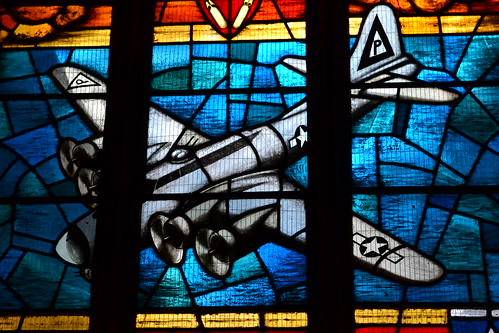
Grafton Underwood

A B-17 of the 384th BG features in the Memorial Window at Grafton Underwood.

The original idea for the ‘Mighty Eighth’ was to house a total of  some 3,500 aircraft of mixed design in 60 combat groups. Four squadrons would reside at each airfield with each group occupying two airfields, this would require 75 airfields for the bomber units alone. This figure was certainly low and it would increase gradually as the war progressed and demand for bomber aircraft grew.

The terrible attack by the Japanese on Pearl Harbour diverted both attention and crews away from the European Theatre, but in April / May 1942 the build up began and American forces started to arrive in the UK.

With ground staff sailing across the Atlantic and aircrews ferrying their aircraft on the northern route via Iceland, the first plain olive drab B-17Es and Fs of the 97th BG set down on July 6th 1942, two squadrons at Polebrook and two at Grafton Underwood.

The sight of American airmen brought a huge change to life in this quiet part of the countryside. Locals would gather at the fence and stand watching the crews as if they were something strange. But as the war progressed, the Americans would become accepted and form part of everyday life at Grafton Underwood.

Eventually the airfield would be complete and although it would go through development stages, it would remain a massive site covering around 500 acres of land.
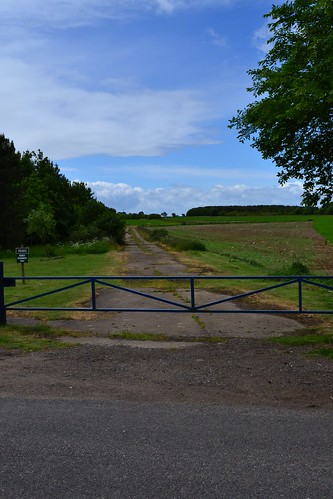
Grafton Underwood

The remains of the main runway looking south.

A total of thirteen separate accommodation and support sites would be built; two communal; seven officers; a WAAF site; a sick quarters and two sewage treatment sites to cope with upward of 3,000 men and women who were to be based here.

The accommodation was based around an octagonal road design, the centre piece being the ‘Foxy’ cinema in Site 3 the main communal site. Roads from here took the crews away to various sites hidden amongst the trees of the wooded area. All theses site were located east of Site 1, the main airfield itself.

Grafton would have three runways; runway 1 (6,000 ft) running north-east / south-west, runway 2 (5,200 ft) running north-west / south-east and runway three (4,200 ft) running north to south, all concrete enabling the airfield to remain active all year round.

42-97948 BK-U,

B-17 ’42-97948′ BK-U, “Hell on Wings” 384th BG, 546th BS. Prior to being lost on 11th October 1944. (IWM UPL 12946)

A large bomb store was located to the north-western side of the airfield, served by two access roads, it had both  ‘ultra heavy’ and ‘light’ fuzing buildings; with a second store to the north just east of the threshold of runway 1. Thirty-seven ‘pan’ style hardstands and three blocks of four ‘spectacle’ hardstands accommodated dispersed aircraft around the perimeter track. Surprisingly only two hangars were built, both T2 (drg 3653/42) one in the technical area to the east and the second to the south-west.

On May 15th 1942, Grafton officially opened with the arrival of its first detachment. The 15th Bombardment Squadron (Light) arrived without aircraft and had to ‘borrow’ RAF Bostons for training and deployment. As yet there was no official directive, and so crews had little to do other than bed in. The 15th BS remained here until June 9th 1942 whereupon they moved to their new base at RAF Molesworth and began operations in their RAF aircraft supported by experienced RAF crews. This move coincided with the arrival of the main body of the Eighth Air Force on UK soil and the vacancy at Grafton was soon filled with B-17s of the 97th BG (Heavy).

Only activated in February that year, the 97th consisted of four Squadrons: at Polebrook were the 340th BS and the 341st BS, whilst at Grafton were the 342nd BS and the 414th BS. Whilst State side they flew submarine patrols along the US coast, but with clear skies and little in the way of realistic action, the ‘rookie’ crews would be ill prepared for what was about to come.

With the parent airfield at RAF Polebrook providing much of the administration for the crews, it was soon realised that gun crews, navigators, pilots and radio operators were poorly trained for combat situations. Quickly thrown together many could not use their equipment – whether a radio or gun – effectively and so a dramatic period of intense training was initiated. The skies around Grafton and Polebrook, quickly filled with the reverberating sound of the multi-engined bombers.

These early days were to be hazardous for the 97th. On August 1st, B-17 “King Condor” would crash on landing at Grafton Underwood. The aircraft’s brakes failed, it overshot the runway, went through a hedge and hit a lorry killing the driver.

B-17 41-9024 ‘King Condor’ Crash landed August 1st, 1942 pilot Lt Claude Lawrence ran off runway, through hedge and hit a truck, killing driver John Jimmison. (IWM UPL 19654)

On August 9th, the atmosphere at Grafton became electric, as orders for the first mission came through. Unfortunately for the keen and now ‘combat ready’ crews, the English weather changed at the last-minute and the mission was scrubbed. This disappointment was to be repeated again only 3 days later, when further orders came through only to find the weather changing again and the mission being scrubbed once more.

In the intervening days the weather was to play another cruel joke on the group claiming the first major victim of the 97th. A 340th BS B-17E ’41-9098′, crashed into the mountainside at Craig Berwyn, Cadair Berwyn, Wales, killing all 11 crew members. A sad start indeed for the youngsters.

Eventually though the weather calmed and on August 17th 1942, at 15:12, twelve aircraft took off from Polebrook and Grafton and headed south-east over the French coast. Not only was it notable for its historical relevance as Mission 1, but on board one of the B-17s was Major Paul Tibbets who later went on to drop the atom bomb on Hiroshima 3 years later. If this wasn’t enough, a further B-17, ’41-9023′, “Yankee Doodle”, also contained the Commanding General of the Eighth, Ira Eaker, – truly a remarkably important and historical flight indeed.

The 97th would go on to attack numerous targets including airfields, marshalling yards, industrial sites and naval installations before transferring to the Twelfth Air Force and moving away from Grafton to the Mediterranean in November 1942.

There then followed a quiet spell, for Grafton. A short spell between September and December 1942 saw the heavy bombers of the 305th BG reside at Grafton before moving off to Chelveston and another short spell for the heavies of the 96th BG in the latter half of April 1943 whilst on their way to Great Saling in Essex. It wouldn’t be until early June 1943 that Grafton would once again see continuous action over occupied Europe.

Activated at the end of 1942, the 384th BG (formed with the 544th, 545th, 546th and 547th BS) would train for combat with B-17Fs and Gs, move to Grafton via Gowen Field, Idaho, and Wendover Field, Utah, and perform as a major strategic bomber force. Focussing their attacks on airfields, industrial sites and heavy industry deep in the heart of Germany, they would receive a Distinguished Unit Citation (D.U.C) for their action on January 11th 1944. Targets included the high prestige works such as: Cologne, Gelsenkirchen, Halberstadt, Magdeburg and Schweinfurt. They would take part in the ‘Big Week’ attacks in February 1944, support the Normandy invasion, the break out at St. Lo, Eindhoven, the Battle of the Bulge and support the allied advance over the Rhine. A further DUC came on 24th April 1944 when the group led the 41st Wing in the attack against Oberpfaffenkofen airfield and factory. Against overwhelming odds, the group suffered heavy losses but took the fight all the way to the Nazis.

A dramatic photo of B-17 Flying Fortress BK-H, (s/n 42-37781) “Silver Dollar” of the 546th BS, 384th BG as it goes down after losing its tail. (IWM FRE1282)

Just as Grafton had played its part in the opening salvo of American bombings, it was to be a part of the last. On April 25th 1945, the last bombing raids took place over south-east Germany and Czechoslovakia. Mission 968 saw 589 bombers and 486 fighters drop the final salvos of bombs of the war on rail, industrial and airfield targets, shooting down a small number of enemy aircraft including an Arado 234 jet. Last ditch efforts by the remnants of the Luftwaffe claimed 6 bombers and 1 fighter, before the fight was over. After this all remaining missions were propaganda leaflets as bombs were replaced by paper.

Two years after their arrival the 384th departed for France, eventually returning to the US in 1949 and disbandment. Their departure left Grafton quiet, it was retained by the RAF under care and maintenance and then finally in 1959 declared surplus to requirements and sold off.

In the short two years of being at Grafton, the 384th had amassed 9,348 operational sorties, in 314 missions. They dropped 22,415 tons of explosives and lost 159 aircraft for the shooting down of 165 enemy aircraft. They received two Distinguished Unit Citations and over 1000 Distinguished Flying Crosses. A remarkable achievement for any bomb group.

Grafton today is very different to how it was in the mid 1940s. But before you go to the airfield, you must visit the local church. Passing through the village you’ll see a signpost for the church, park here and walk up the short path. Approaching the church, roughly from the East, you see a dark window which is difficult to make out. However, enter the church and look back, you will see the most amazing stained glass window ever, – the vibrant colours strike quite hard. This window commemorates the men and women of the 384th Bombardment Group of the Eighth Air Force who were stationed at here at Grafton Underwood.

Next to it, someone has placed a handwritten note with the picture of a very young man 2nd Lt. Thomas K Kohlhaas and details of the crew of B-17 ‘43-37713’ “Sons o’ Fun”. It states that he, along with 3 others of the crew, were murdered by German civilians after their aircraft was downed by flak on 30th November 1944. This is a very moving and personal place to be and a poignant reminder of what these young men were facing all those years ago.

When you leave the church, look on the wall of the porch and you will see two dedications. These list the location and names of trees, dedicated to the personnel of the Mighty Eighth, that have now replaced the runways on the airfield. Unfortunately these are on private land and for some very odd reason, not accessible.

Leave the church, turn left into the village, following the stream and then turn left up the hill. The memorial is on your right. Like most American memorials of the USAAF, it has the two flags aside the memorial which is well-kept. When I visited, ‘the keeper’ (who has since become a good friend of mine) was there and we chatted for ages. The memorial stands on what was the 6000 ft main runway and when you look behind you, you see what is left of it, a small track used for estate business. Other than this and a few inaccessible sections, the remains of the airfield have gone and it is open agriculture once more.
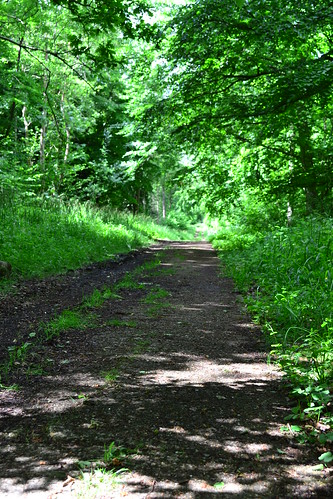
Grafton Underwood

Small tracks remain in the accommodation areas.

Grafton, like Kimbolton, is split by the road. Leaving the memorial drive back to the village, turn left and follow the road. Along on the left is the former technical site, a few small huts still stand here used by the local farmer. Also, a few feet from the roadside would have been the perimeter track and dispersal pans. What is left of the main entrance, now nothing more than a large blue gate, can be seen as you pass. Odd patches of concrete can also be seen through the thick trees but little else. Then a little further along, passed the equine sign, is another blue gate. Park here. This is the entrance to Grafton Park, a public space, and what was the main thoroughfare to the mess, barracks and squadron quarters. Grafton housed some 3000 personnel of which some 1600 never returned. It is immense! Walking along the path, you can just see the Battle Headquarters, poking out of the trees, the site is very overgrown and nature is claiming back what was once hers. The roads remain and are clearly laid out, some having been recovered with tarmac, but careful observations will see the original concrete beneath. Keep on the ‘Broadway’ and you will pass a number of side roads until you come to the hub. This forms a central octagonal star, off from which were the aptly named: ‘Foxy’ cinema, mess clubs and hospitals. Each road taking you from here, site 3, to the various other sites a short distance away. Careful observations and exploring – there are many hidden ditches and pits – will show foundations and the odd brick wall from the various buildings that remain. A nice touch to the hub, is that it is now a grassed area with picnic tables.
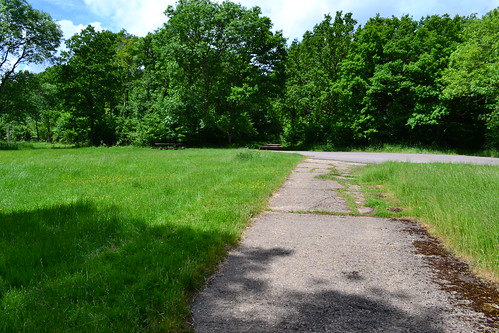
Grafton Underwood

The hub of the accommodation site is now a picnic area.

You do lose a sense of this being an airfield; the trees and vegetation have taken over quite virulently and hidden what little evidence remains. Exploring the area, you will find some evidence, but you have to look hard. Walk back along the Broadway, and take the first turn left. Keep an open to the right, and you will see other small buildings, the officers’ quarters and shelters – this was site 4. Again, very careful footing will allow some exploration, but there is little to gain from this.

Considering the size of Grafton Underwood, and then fact that 3000 men and women lived here, there is little to see for the casual eye. A beautiful place to walk, Grafton’s secrets are well hidden; perhaps too well hidden, but maybe the fact that it is so peaceful is as a result and great service to those that fought in that terrible battle above the skies of Europe directly from here.

There is a superb website dedicated to the crews of  Grafton Underwood and it can be found at: http://384thbombgroup.com

Grafton Underwood was originally visited in 2014, this post has been updated since then. It forms part of Trail 6.

Britain’s Airfields 1944

By the end of the Second World War, there were a substantial number of airfields covering the UK, mainly used by the Royal Air Force, the United States Army Air Force, the Royal Navy and all their associated branches; they were handed back to the RAF at the end of the war as the various forces were pulled out. Some were used as POW or repatriation camps, some were used to store surplus aircraft, vehicles or ordinance; many were put into care and maintenance whilst the RAF decided their ultimate fate.

Thankfully a few have lasted as airfields and are even fulfilling that role today, sadly though, many were dug up, their runways used for hardcore, the buildings demolished and the events that occurred there reserved for the history books.

The scale and pace of development was massive. The size of these sites bigger than many of the villages they took their names from, the populations larger than many towns of the time. Architecturally they changed the landscape dramatically.

Today as they dwindle away, many are mere names, locals have little knowledge of their existence, memorials are being forgotten, and life is moving on.

As a little reminder of those times and to put the scale of development into perspective, here are two maps held by the British Library that show the main Royal Air Force and Royal Navy airfields as of 31st December 1944.

The two maps, divide the UK and show not only the airfields but satellites as well. They also show Royal Air Force and Royal Navy Water Airfields, and Royal Air Force Moorings. There are a number of sites not included on the map such as relief landing grounds, and training schools, but they do give an indication of the number of airfields that covered the UK by the end of the war.

These are both low resolution pictures, and copyright is held by the British Library who have given permission for them to be reproduced here.

Security Released Airfields in the United Kingdom (Sheet 1)
Security Released Airfields in the United Kingdom (Sheet 2)

© The British Library, Maps MOD GSGS Misc. 505 (sheet 1 and Sheet 2)

Britain’s Airfields – What does the future hold?

There has been a recent ‘spate’ of developments with planning applications that affect Britain’s wartime heritage, and in particular the airfields that were used during the Second World War.

With land at a premium, a housing crisis that is growing, these sites are becoming more and more handsome as development opportunities. Many have a ready-made infrastructure, many are open fields and as such, prime agricultural or development land. So what does the future hold for Britain’s heritage?

We have seen applications submitted or at least interest shown, for the former: RAF Kings Cliffe, RAF Downham Market, RAF West Raynham, RAF Denethorpe and RAF Coltishall, further applications have now been seen affecting former RAF Dunsfold, RAF Bourn and RAF Wellesbourne Mountford.

We also know that the USAF have given notice of withdrawal from their major UK base at RAF Mildenhall, the smaller site at RAF Molesworth and the remaining site at RAF Alconbury. The Government has already announced it will be selling these sites for housing after the military withdrawal in 2020-23. These three sites form part of an estimated £500m sell-off that would also include: RAF Barnham (Suffolk), Kneller Hall (Twickenham), Claro and Deverell Barracks (Ripon), Lodge Hill (Kent), Craigiehall (Edinburgh), HMS Nelson Wardroom (Portsmouth), Hullavington Airfield (Wiltshire) and MOD Felton (London). Changes at RAF Lakenheath will also see job losses through streamlining of operations.

It is estimated that the 12 sites could accommodate an estimated 15,000 homes with Alconbury having 5,000 alone.

The former airfield and barracks at RAF Waterbeach is also subject to planning proposals, and the Bassingbourn barracks near Cambridge is also under the development spotlight. The recent closure of Manston (a vital Second World War airfield) has led to speculation of its future both as an airfield (possibly London’s third) and as a development opportunity. These are perhaps just a few of the prime areas of land that are now becoming the focus of planners and developers alike.

There are many variables in this heated and long-lasting debate, in fact far too many to raise and discuss here. Strong feelings exist both toward and against the idea of development and it is certainly not a new one. Employment, jobs, environment, heritage, housing etc, they all create discussion and a strong case for both arguments, but the debate here is not “should we build or not” this is quite frankly, inevitable and in many cases much-needed, no, it’s more how can we meet the needs of an ever-growing population with the needs to preserve historically important sites that form the very thread of today’s society.

We have a dynamic population, and as health care improves, social mobility increases and a growing desire to own our own home increases, the need for more housing, affordable homes and homes for rent also increases. We are an ageing population, care homes, schools for our children and hospitals for the sick are all in much greater need. Where do we build them?

Whilst housing demands have always been with us and the need for more housing an all important one, the recent developments suggest that these old airfields could become prime land to meet these future housing needs.

Many of the current Second World War airfields are now either industrial conurbations or agricultural areas. Most have little or no remnants of their former lives visible, and certainly not widely accessible. Many argue that these sites are scrub, derelict and in need of development, and some indeed are. A proportion of the more recently used sites, are ‘mothballed’ or in part operating aviation related activities. They cover huge areas and have a ready-made infrastructure such were the designs of war and post war airfields. These sites also contain extensive dereliction, primarily due to being left and allowed to decay by their owners. Vandalism and pilfering has left them rotting like carcasses of forgotten wild animals. Where industry has been operating, contaminates have seeped into the soils, damaging flora and fauna growth; some so severe that they are rendered too difficult to reclaim as ‘Green Space’. Certainly on paper, they offer good sources for today’s desperate housing stock.

However, balance this against the historical and cultural importance of these places and the argument becomes a little blurred at the seams. Had it not been for the people who came to this country from all over the world to fight the Nazi tyranny in the war years 1939-45, then Britain and Europe would probably not be the Europe we know today. Many thousands of people gave their lives during those dark days, and for many of them, these airfields were their last homes, cold, often draughty huts on the outskirts of some bleak airfield. Their dedication helped form the very society we live in today, the democracy and freedom of speech we so enjoy and relish, the open spaces where we can walk our dog without fear and in freedom. The fact that we can have this very debate, is in itself, testament to those who came here never to return. The very nature and fabric of our local communities has been built around the ‘friendly invasion’ the acceptance of others into our quaint life and idyllic life-styles. Influences from other nations and cultures grew and developed as a result of those who came here from far and wide to give up their lives.

These sites have become monuments to them, their lives and deaths, many still have no known grave; many simply ‘disappeared’ such was the ferocity of the explosion that killed them. The design of Britain’s airfields are architecturally significant to our heritage, buildings were designed to fulfil a purpose and just like our castles and stately homes, they are monuments to a significant period of not only British, but world history. Our education system, includes this very period as a subject for discussion, debate and analysis. To build over such sites without due regard to them would be a travesty, and one that we would regret in the future. To paraphrase that well-known quote; If we are to learn from our mistakes then we need to remember the past. The Second World War is still, for the moment, in living memory, the veterans and civilians who survived it are dwindling in numbers and very soon their memories will be lost for ever. Each day brings news of a lost veteran or a newly discovered story. If we don’t acknowledge the value of these places, if we don’t plan for their ‘preservation’ then both we and our future generations, will be the ones to regret it.

So where do we go from here? The plans published for RAF West Raynham and RAF Coltishall take into account the nature of these sites, they are sympathetic to their historical value and acknowledge the sacrifices made. West Raynham utilises the very buildings that were created, thus keeping the atmosphere for those who wish to visit. Small museums create a record, first hand experiences and artefacts, all valuable records for the education of future generations. But both of these are unique. Both closed in more recent history, they have retained their structures whereas many older sites have had theirs long since demolished.

It is a delicate balance, and as sad as it would be to see them go, there has to be legislation to create compromise. Sympathetic developments have to be the way forward, acknowledgement of the sacrifice has to be high on the agenda. Many of the airfields I have been too have no museum, no memorial barely even a signpost. Surely this is wrong.

If we are to preserve our fragile heritage, we need to consider the implications of the planning process, to look at the value of these sites as both suitable housing and significant historical areas, the sacrifice of the many needs to be acknowledged and it needs to be done soon.

Sources and Further Reading.

“Laying the Foundations: A Housing Strategy for England ” HM Gov, November 2011

“Stimulating housing supply – Government initiatives (England)” House of Commons Library, 9 December 2014

The “Get Surrey” news report issued on January 5th 2016 relating to Dunsfold can be found here.

Then latest news from “Cambridge News” December 16th 2015 can be found here.

The “Stratford-Upon-Avon Herald” January 6th 2016 front page story about Wellesbourne can be found here. (This may be a limited time link).

The latest news on RAF Mildenhall and Lakenheath published by the BBC, 18th January 2016 can be found here.

B-17 Reveals its Secrets after 73 years.

There are many tragic and sad events associated with the Second World War, a recent discovery is no different. The story of a B-17 and her crew as they left on one of the first missions of the American air war has recently come to light with the discovery of the aircraft off the North Norfolk coast.

The story of this particular aircraft, believed to be B-17F-VE ’42-29752′ is especially sad, not only because it was the first operational mission of the unit and the first casualty, but because of the nature of the loss;  just moments after take off, a month after it and its crews had first arrived in the UK.

The B-17, was built and delivered at  Cheyenne on February 12th 1943. Its journey to the UK would take it through a number of stations, via Walker airbase, Salina, and on to Presque Isle, in the north-eastern sector of Maine, where it arrived on April 8th 1943. It was here that it was allocated to the 338th BS, 96th BG and ferried across the northern route with the air echelon of the 338th, arriving at RAF Grafton Underwood in April 1943, before onward shipment and operational duties.

The 338th BS had only been activated themselves one year earlier in July 1942 and as such were relatively new to the war. Their journey took them through a number of training bases from Salt Lake City, through Utah, Idaho and onto their final station at Pyote AAB Texas. From here, the air and ground echelons went their separate ways, the air echelon travelling north and the ground crews to Camp Kilmer, New Jersey and onward via the Queen Elizabeth to Greenock, Scotland and the European Theatre of Operation. The ground echelons arrived at Great Saling (Andrews Field) in early May 1943 moving to Snetterton Heath a month later where they would join up with the air echelons.

It would be whilst temporarily based here at Grafton Underwood, on May 13th 1943 that the B-17 would end its short life and become an almost forgotten part of history.

The 338th would take part in a 72 aircraft mission to bomb the Longuenesse and Ft. Rouge Airfields at St Omer, France. On the day in question, the aircraft were to form up over the North Norfolk coast, before heading off south. Crews had been briefed about the possibility of being attacked by marauding Luftwaffe aircraft and so many crews had their guns charged as they climbed away from the airfield. It was this very precaution that led to the tragic death of one of the crew members and demise of the B-17.

As the aircraft, piloted by Capt. Derrol Rogers, formed up, a waist gun was accidentally discharged sending high calibre bullets into the stabilizer completely severing it and forcing the aircraft into an uncontrollable climb and potential stall. Fighting with the controls, Capt. Rogers fought to keep it from crashing. Both he and his Co-Pilot: Lt. Norville Gorse, managed to get the aircraft back under control long enough to allow the crew to bail out over land. Once out, they took the aircraft back out over The Wash and jettisoned the bombs. Then as they approached land once more, they tied a rope to the yolk and bailed out themselves.

42-29752 after stabilizer accidently shot off

Aircraft, believed to be 42-29752, after the waist gun was accidentally discharged, severing the stabilizer. (American Air Museum)*1

Lt. Gorse was picked up by an RAF rescue launch and returned to his unit, but unfortunately, Capt. Rogers, being in the sea for some time, didn’t survive. He was the only fatality of the incident, the remaining crew all returning to their base and operational duties.

The B-17 now unmanned and destabilized, plunged into the North Sea where it has laid for the last 70 years. A truly tragic start to a very bitter war.

An engine was initially caught up in a fishing boat net in the 1970s, but no real investigation was made of the wreck. More recently, towards the end of 2015, a small team of divers went back down to photograph the aircraft, and it was then that it was identified and its remarkable story revealed.

The Crew of B-17 ’42-29752′

Capt: Derrol W. Rogers,
Co-pilot: Norville Gorse,
Navigator: Joe Hudson,
Bombardier: George Rawlings,
Flight engineer/top turret gunner: Basil Maxwell,
Radio Operator: Bob Bennett,
Ball turret gunner: Alf Miles,
Waist gunner: Bob Dominick,
Waist gunner: Edwin Wolfkuhle,
Tail gunner: Ed Youngers (injured by discharged bullets)

Capt. D.W. Rogers (s/n O-403737) is listed in the St Paul’s Roll of Honour, (Page 360), he is buried in the Cambridge American Cemetery, Madingley, Plot D, Row 7, Grave 69, he was awarded the DFC and Purple Heart.

*1 Photo from the American Air Museum (IWM) UPL 19232

The story first appeared in the Eastern Daily Press on November 30th 2015.


401st BG, reputedly “The best damned outfit in the USAAF!”

Deenethorpe saw action by 4 squadrons from the 401st Bombardment group, reputedly the “The best damned outfit in the USAAF”. They flew 254 combat missions and received two Distinguished unit Citations. They had the best bombing accuracy of the mighty Eighth and one of the lowest loss ratios of any USAAF unit. However, a local disaster and inauspicious start, did not mean it was all plain sailing.

RAF Deenethorpe (Station 128)

Deenethorpe October 1942, taken by No. 8 OTU (RAF/FNO/166). English Heritage (RAF Photography). The memorial is to the bottom right*1

Constructed in 1942/43 as a Class ‘A’ airfield, it would have three concrete runways, a main of 2,000 yds and two secondary both 1,400 yds. The main runway ran in a north-east to south-west direction whilst the two secondary runways ran north-west to south-east and east-west respectively. The airfield was built adjacent to the (now) main A427 Weldon to Upper Benefield road and had around 50 loop style hardstands for aircraft dispersal.

For maintenance of the heavy bombers, two ‘T2’ hangars were sited on the airfield, one to the south-eastern corner and the second to the west, next to the apex of the ‘A’. Fuel stores were in the southern and northern sections, away form the technical site located to the south-east. Accommodation sites for 421 Officers and 2,473 enlisted men were also to the south-east beyond the road. Initially used by the RAF as a training base, it was quickly adopted by the USAAF and personnel soon moved in.

The main inhabitants of Deenethorpe were the four squadrons of the 401st BG, 94th Combat Wing, 1st Air Division. This Division, operated from nine airfields, in this Peterborough-Cambridge-Northampton triangle with three further fields to the south-east of Cambridge. A small cluster of sites located close together but away from the main 2nd and 3rd Air Divisions of Norfolk and Suffolk.

The 401st were a short-term unit operating until the end of the war; although they did go on to serve post war in the 1950s following reactivation. Originally constituted on March 20th 1943, they moved through various training airfields eventually arriving in England in October/November 1943.

B-17 Flying Fortress SC-O (42-97487) “Hangover Haven” of the 612th BS/401st BG after crash landing at Deenethorpe, 3rd October 1944*2

The four squadrons of the 401st, the 612th, 613th, 614th and 615th, all flew B-17Gs and operated with  the codes ‘SC’, ‘IN’, ‘IW’ and ‘IY’ respectively.  Using a tail code of a white ‘S’ in a black triangle, a yellow band was later added across the fin (prior to September 1943, the tail fin codes were reversed, i.e. black ‘S’ in a white triangle as in the above photo). The ground forces arrived via Greenock sailing on the Queen Mary, whilst the air echelon flew the northern routes via Iceland. Their introduction into the war would be a swift one.

The primary role of the 401st would be to attack strategic targets, such as submarine pens, ship building sites, heavy industrial units, marshalling yards and other vital transport routes. Many of these were heavily defended either by flak or by fighter cover, much of which was very accurate and determined.

On the 26th November 1943 they would fly their first mission – Bremen, headed by their commanding officer Colonel Harold W. Bowman. It was not to be an auspicious start though. With 24 crews briefed, engines started at 08:00, twenty-four B-17s rolled along the perimeter track to their take off positions at the head of the northern end of the main runway.

It was then that B-17 “Penny’s Thunderhead” 42-31098, of the 614th BS, slipped of the perimeter track trapping the following aircraft, commanded by the Station Commander Major Seawell, behind it. Then a further incident occurred where aircraft 42-39873, “Stormy Weather” suffered brake failure and collided into the tail of 42-31091 “Maggie“, severely damaging the tail. Four crews were out of action before the first mission had even starte. Bad luck was not to stop there. Once over the target, cloud obscured vision and whilst on the bomb run “Fancy Nancy“, 42-37838, collided with another B17 from the 388thBG. “Fancy Nancy” was luckily able to return to England, but severely damaged it could only make RAF Detling in Kent where it crash landed. So severe was the damage, that it could only be salvaged for parts and scrap. The mission report for the day shows that the ball turret gunner lost his life in the incident, the turret being cut free from the fuselage. A further gunner was wounded by flak and a third suffered frost injuries to his face.

On their second mission, the 401st were able to claim their first kill. A FW-190 was hit over the target at Solingen and the aircraft destroyed, but their luck was not necessarily about to change.

Within a matter of weeks the 401st were to have yet another set back and it was only due to the quick thinking of the crew that casualties were kept to a minimum. On December 5th 1943, mission 3 for the 401st, target Paris; B-17 42-39825, “Zenobia” crashed on take off coming to rest in nearby Deenethorpe village. The uninjured crew vacated the burning aircraft and warned the villagers of an impending explosion. Fire crews and colleagues rushed to the scene, and the two remaining injured crewmen were safely pulled out. Twenty minutes after the initial crash, the aircraft, full of fuel and bombs, finally exploded destroying a number of properties along with the fire tender. The explosion was so enormous, it was heard nine miles away.

The crew of the B17 which crashed on the village of Deenthorpe. L-R. T/Sgt William D Woodward, (t/t), Sergeant Waldon D Cohen, (b/t), Sergeant Harold J Kelsen, (w/g), Sergeant Robert V Kerr, (t/g), S/Sgt Benjamin C Misser, (r/o), and Lieutenant Walter B Keith, talking to Captain RJ White, who rescued the navigator Lieutenant King. The navigator and bomb-aimer are still in hospital, recovering from injuries. *3

The new year however, brought new luck. During operations in both January and February 1944 against aircraft production facilities, the 401st were awarded two DUCs for their action and as part of the 1st Air Division, they would be awarded a Presidential Citation. The 401st attacked many prestige targets during their time at Deenethorpe including: Schweinfurt, Brunswick, Berlin, Frankfurt, Merseburg and Cologne, achieving an incredible 30 consecutive missions without the loss of a single crew member.

Like many of their counterparts, they would go on to support the Normandy invasion, the break out at St Lo. the Siege of Brest and the airborne assault in Holland. They attacked communication lines in the Battle of the Bulge and went on to support the Allied crossing into Hitler’s homeland over the Rhine.

The 401st performed many operations, 254 in total. Their last being on April 20th 1945 to the Marshalling yards at Brandenburg. During the mission, B17 “Der Grossarschvogel” (The Big Ass Bird) was shot down. Five crew members were killed in the crash and several others, who had managed to escape, were beaten by civilians almost killing two of them. Ironically, they were ‘saved’ by Luftwaffe personnel, and in one case, even freed although the orders had been to shoot him.

These were not to be the last 401st fatalities though. On May 5th 1945, VE day of all days, Sgt G. Kinney was hit by the spinning propeller of a taxying B17 killing him; a devastating end to operational activities at Deenethorpe.

On June 20th, the 401st vacated Deenethorpe, returning via the same route that they came and were  then disbanded in the US. Deenethorpe was returned to RAF ownership and retained until the 1960s when it was sold off. The standard design 12779/41 tower was demolished in 1996 and the remainder of site returned to agriculture. All major buildings have been removed as have two of the three runways. The main one still exists today for light aircraft and microlights, as does most of the perimeter track – but as a mere fraction of its former self.

Whilst there is little to see of this once enormous airfield, best views can be obtained from the main road the A427 Weldon to Upper Benefield road. A few miles along from Weldon on your left is the airfield. Stop at the memorial. The original control tower, now gone, stood proud, visible from here beyond the memorial. The technical site would be to your right, and you would be looking almost straight down the secondary runway to your left. The communal and accommodation sites were directly behind you and traces of these can be seen but only as building footings. In the distance you can see the modern-day hangars used to store the microlights,

Access to this area is restricted, prior permission being needed before entering the site, records show that there have been a number of ‘incidents’ with landowners and users of the airfield. So what little remains is best viewed from here.

The memorial is flanked by two flags, is neat and well cared for. The runway layout is depicted on the memorial stone and it proudly states the achievements of the 401st. I am led to believe the ‘Wheatsheaf’ pub further along was the haunt of many an American airman and has a ‘401 bar’ with photos and memorabilia. I was not able to visit this  unfortunately and cannot therefore verify this. Definitely one for another day!

DSC_0155

Modern activity at Deenethorpe

Deenethorpe is one of those airfields that has quietly slipped away, the passage of time leaving only simple scars on the landscape. This once busy and prestigious airfield now nothing more than rubble and fields with a memorial to mark the brave actions, the death and the sacrifice made by crews of the United States Army Air Force so long ago.

A BBC news report covered the planting of a time capsule in June 2011, when the widow of Tom Parker (the last of the 401st Bombardment Squadron crew, that flew the B-17 plane “Lady Luck” out of Deenethorpe), kept their promise that whoever was last would bring a collection of tankards back to Deenethorpe with their own personal stories.  The tankards were a gift from the pilot of Lady Luck, Lt Bob Kamper who presented them to the crew at a reunion in 1972. Mr Parker, the last member of the crew, sadly died in March 2011.

May their stories live on forever more.

The BBC news report can be found here.

Deenethorpe falls under Northampton County Council, and like Kings Cliffe in the same area, has been the subject of planning applications. It is proposed that the airfield be removed and all flying activity stopped. A Garden Village will be built on the site, and the area landscaped accordingly. The proposal can be found here.

Deenethorpe was originally visited in Trail 6, ‘American Ghosts‘, from here we go onto an airfield that saw action involving a large numbers of paratroopers, we go to Spanhoe Lodge.

Sources and further reading.

*1 Photo from IWM American Air Museum In Britain.

*2 Photo Roger Freeman Collection, from IWM American Air Museum In Britain. FRE 8079

*3 Photo Roger Freeman Collection, from IWM American Air Museum In Britain. FRE 2218

The 401st BG website contain a vast amount of information about crews, aircraft and missions of the 401st. It can be accessed here.

I highly recommend the book, “The B-17 Flying Fortress Story“, by Roger Freeman, published by Arms and Armour, 1998. Some aspects may have been updated, but the detail is incredible and a worthwhile investment for anyone interested in this area.

A Happy New Year!

As 2015 fades away I would like to take this opportunity to thank each and every one of you who has visited, followed, liked, reblogged, commented and generally supported “Aviation Trails” during the last year. Without you, it would not be the site it is today.

It has certainly grown over the last year and taken on a new dimension. Investment in research material has enabled much longer posts and more personal information to be included, something that I know many people like to see. Not only do ‘we’ as enthusiasts, historical ‘writers’, modellers, relations of veterans etc. preserve our common history, but openly promote and educate others through the writing we do.

I believe it is important to remember what went on, the sacrifice and dedication to freedom, and if I can go a small way to helping that then it has all been worthwhile.

I have been inspired to take up old hobbies, learnt about aspects of military and natural history that I had never heard of, found new places in the world and been a part of a group of people who share the desire to learn, educate and inform others. It has been a wonderful year.

The tally of airfields I have visited is now around 75, double what it was this time last year. I have walked in the footsteps of famous people like Guy Gibson, Glenn Miller and Joe Kennedy, stood where important and famous missions have been planned and executed, trodden the very ground where so many young men and women served their country, many thousands giving the ultimate sacrifice.

It has been a most humbling experience.

So to each and every one of you, a heartfelt thank you, and here’s to a happy, peaceful and rewarding 2016.

RAF King’s Cliffe – buildings not recommended for listing.

A recent assessment of the remaining buildings on the former RAF King’s Cliffe airfield, Northamptonshire, has not proven to be as positive as one had hoped for. The result could open the door to future development of the site and ultimately the permanent loss of these buildings as a result.

Oakington Pillbox Kings Cliffe Dec 2014

One of the rarer Oakington Pillboxes deemed not to be of Historical interest.

King’s Cliffe (originally visited in Trail 6) was the station for a number of RAF and USAAF units flying P-38s and P-51s amongst them . They operated as fighter escort for the heavy bombers of the Eighth, seeking out targets of opportunity, particularly enemy locomotives, as enemy fighters reduced in numbers. It was also the site of Glenn Miller’s final hangar concert, for which a memorial has been erected on the base of the hanger structure.

Closed post war, it was returned to agriculture, and the runways removed for hardcore. A few buildings still remain including: aircraft pens, pillboxes, the Battle headquarters and a rather dilapidated watch office. Away from the airfield site, the chapel and other small accommodation buildings survive in modern use. King’s Cliffe has certainly taken its share of post war degradation.

This survey was initiated following the successful planing application made for Jacks Green; the area to the southern side of the airfield around the Glenn Miller Memorial. This application has been granted (see here and the media reports here), and development is due to proceed. This combined with the findings of the survey by Historic England, won’t help the long-term future of King’s Cliffe’s buildings, and it may have further implications for the preservation of the site as a whole.

Historic England,  submitted their report to the Secretary of State who has deemed that the remaining buildings, including those mentioned, are not suitable for classification as “historically significant” and therefore will not be added to the list of  Buildings of Historical interest and so ‘listed’.

 Under the Planning (Listed Buildings and Conservation Areas) Act 1990 Buildings of Special Architectural or Historic interest; buildings that are deemed to be significant in terms of their architecture, historical importance or rarity, can be classified.

The full report can be accessed via the Historical England Website, but the key points they highlight are thus:

1. The Watch Office:

The report highlights the fact that of the 18 different models constructed, there are 220 examples still surviving today,  with many of them surviving in a better condition.

At King’s Cliffe the watch office (type Watch Office for Night Fighter Stations FCW4514) is a windowless shell, with some of its internal walls demolished and its balcony rails missing. There are no internal features. It is a poignant and dramatic ruin, but its condition precludes designation.

2. The Battle Headquarters:

At the time of the survey, the building was flooded and so access was inhibited, but it is thought that it is unlikely to contain anything of historical or architectural significance. Again Historic England state that there are better preserved examples on other sites around the UK.

The report states:

At King’s Cliffe, much of the essential wartime context has been lost with the removal of its runways and hangers. Moreover, the interior of the structure, which is flooded currently and effectively inaccessible, is unlikely to retain fixtures and fittings of interest. Together, these considerations mean that King’s Cliffe’s Battle HQ cannot be recommended as an addition to the List.

3. Fighter Pens:

Built to protect fighters and crews from attack, with soil mounds, brick walls and protectives rifle slits, there are a variety of these structures surviving today around the UK. More significant examples can be found at Battle of Britain airfields for example, and whilst those at King’s Cliffe were important, they are in mixed condition and according to the report, not of significant value.

The report states:

Elsewhere, however, the pens are very degraded or part demolished. The fact that only a proportion of the fighter pens survival relatively well as an ensemble, and that much of the essential wartime context has been lost with the removal of the runways and hangers, means that King’s Cliffe’s fighter pens cannot be recommended as additions to the List.

4. Pillboxes:

There are a small quantity of pillboxes around the airfield site and these represent a minute number of the 28,000 constructed in defence of the UK. Rarer examples are more likely to be selected for listing than the more common examples. Those found at King’s Cliffe are the Oakington style, a rarer model of which only 61 have been recorded by the English Heritage Monuments Protection Programme. Some of these have since been demolished and so an even smaller number exist today. However, “a high degree of selectivity” was used as a basis for the decision.

While the three examples at King’s Cliffe are also of undoubted interest, and generally survive in relatively good condition, a high degree of selectivity must be deployed when assessing structures of this late date. The loss of so many key components of the wartime airfield compromises their historic context and argues against recommending them for designation.

The conclusion of this report, states that the decision not to recommend listing these buildings is down to three primary points:

1. The fact there the buildings are in poor condition,
2. The fact that they are not ‘rare’ and,
3. The fact that because the other major features, (runways and hangars) have been removed, they are not significant in ‘Group Value’.

This decision is not surprising, but the wording suggests that any airfield with no runway or hangars, is not likely to have its buildings listed for preservation unless they are either very rare or in very good condition. After 75 years, that is extremely unlikely.

This outcome means that any decision to demolish the buildings lays with the landowner, and whilst they have been in situ for the last 70 years or so, there is now no need to retain them in any form should they so wish.

Ultimately, these buildings could be removed for land development, or agriculture use, meaning they would then be lost forever. That would leave the two small memorials as the only significant reminders of the King’s Cliffe site.

The full report can be accessed via the link below, which gives a detailed explanation for the decision. The annex of the report will be published on the Heritage Gateway website.

www.historicengland.org.uk case number 1426070

Anyone who wishes to challenge this decision can do so within 28 days with a request that the decision be reviewed in light of further evidence or because of irregularities in the process, full details are available through the link below. A form is available through this link, with appropriate guidance for completion. Both downloadable from the ‘Reviews of Listing Decisions’ page.

https://www.gov.uk/how-to-challenge-our-decision-to-list-or-not-list-a-building

If you are unable to access the website please contact:

The Listing Review Officer
Heritage Protection Branch
Culture Team
Department for Culture Media and Sport
4th Floor
100 Parliament Street
London
SW1A 2BQ

My thanks to Sandra Beale for forwarding this information.

King’s Cliffe planning application gets approval.

Earlier this year, we highlighted the planning application put forward by Philip Ashton-Jones the current land owner of Jack’s Green on the former RAF King’s Cliffe airfield, in Northampton.

An online petition raised over 300 objections to the application. These came  from: supporters of Glenn Miller, aviation enthusiasts, wildlife groups and local people alike, who all highlighted concerns over the proposed development of the site and the impact it may have. At an initial meeting in September this year, the council failed to come to any overall decision as they needed to consider further reports from interested parties.  At a second meeting held on Wednesday 14th October,  after considering all the issues raised, East Northamptonshire Council approved the plans and so 55 holiday homes will now be built on Jack’s Green.

Whilst concerns were raised over the memorial that currently stands on the actual base of the hangar where Glenn Miller performed his last hangar concert, the land owner Philip Ashton-Jones, stated at the meeting that the memorial would remain “exactly as it is today”.

Glenn Miller Memorial RAF Kings Cliffe Dec 2014

The Memorial to Glenn Miller taken in December 2014. Jack’s Green is the area behind.

RAF King’s Cliffe is a large site, which is now primarily agriculture. It still contains a few buildings from the Second World War and a large memorial to those who served here during this time. Jack’s Green, is part of the larger woodland used by walkers, horse riders and nature lovers.

East Northampton’s decision is in line with many decisions being made by local authorities. Land is at a premium, and whilst this is not essential housing by any stretch, it is not a surprising decision in today’s climate.

Let’s hope Mr Ashton-Jones keeps to his word and this historical place is protected.

Links

The BBC report can be accessed here. (This may only be available for a limited time.)

RAF King’s Cliffe was visited in Trail 6

Previous reports can be found here.