RAF East Kirkby – Part 2 – a Relentless Slog.

In Part 1 we saw how East Kirkby came about, how its one main unit was used to create further units and how the war had taken its toll on those stationed here. In this part, we end 1943, but the high hopes of better things are far, far away.

The opening of September 1943, was however, the tip of the iceberg, for on the night of 23rd – 24th, three more aircraft were lost whilst on operations to Mannheim; all but five of the twenty-one men involved being killed, with those surviving five being incarcerated by the German forces. The operation had seen almost 630 aircraft take part in a raid that resulted in huge devastation with over 25,000 people being bombed out of their homes.

With the loss of two further aircraft in the closing days of September, the total dead or captured stood at seven Lancasters (forty-nine crewmen) with only four airmen returning to their Lincolnshire home. It had been a devastating start for the squadron at their new home in Lincolnshire.

October 1943 was much the same, major battles over the German Reich took further tolls with another four Lancasters falling from the skies. Most of these crews were also killed with just a handful surviving to be taken prisoner. The numbers of experienced crews on roll were quickly dwindling and replacements were now urgently needed.

NX611 'Just Jane'

The Lancaster ‘DX-F’ at East Kirkby, paying tribute to all those who flew from the airfield and in Bomber Command.

Then in mid November, 57 Sqn would be split for a second time to form yet another new squadron. This time, ‘B’ Flight were taken out and re-designated 630 Sqn. Initially being given the designation of an auxiliary squadron, it was however, a status that was never achieved. The entire flight consisting of nine crews and 106 ground staff, were led by the American, Sqn. Ldr. Malcom Crocker DFC, who simply moved across the airfield locating to new quarters and new dispersals, thus creating two operational squadrons at the site. Being battle hardened already, it took less than three days to complete the move before operations for them began once again.

November also saw Bomber Command enter its fourth month of the ‘Battle of Berlin‘, a period that saw intense bombing of the German capital with repeated raids on the city by heavy bombers of the RAF. It was also a time when the ill-fated Stirlings were finally pulled out of front line bombing campaigns, their losses becoming insurmountable. The decision to do so however, would put further pressure on the Lancaster and Halifax crews who were then left to complete the job with fewer aircraft and increasingly tired crews.

This period would become one of the RAF’s most testing times, and for the next four and a half months, Bomber Command, led by Sir Arthur Harris,  would continue to pound Berlin and other major cities deep inside Germany. The winter would be harsh, flights would be long, and it would be a gruelling time for the crews of Bomber Command.

The void left by the Stirlings was filled by the Halifaxes, and their loses now also soared. The battle for Berlin was a battle that would quickly diminish the capability of the RAF if loses were to continue at their current pace.

As the war entered 1944, the crews of Bomber Command became weakened and tired. Extensive battles had taken their toll and a rest was much needed. With poor weather dominating January that rest came, as crews were grounded unable to fly in the appalling winter weather.

The new year would see 617 Squadron dominate the way for 5 Group, their fame and successes taking a large chunk of the new reels. However, at East Kirkby, 630 Squadron would take on a new commander with the arrival of Wing Commander Deas in early February, taking over from Wing Commander J. Rollinson. Deas would continue to lead the squadron for the next five months, as it battled its way through the harsh winter period into spring and onto summer.

The pressure was however on Harris. He was now ordered to turn his men away from Berlin and help the Americans with the invasion plans supporting them in Operation Argument, otherwise known as ‘Big Week’. The operation was designed to weaken the German aircraft industry to prevent reinforcements of aircraft in the build up and launch of Operation Overlord.

In one last vain attempt to hit the capital, Harris planned four nights of raids in February, but poor weather curtailed these allowing only one raid to take place that on the night of the 15th – 16th February.

In the raid, which proved to be Bomber Command’s penultimate flight over the city, both 57 and 630 Squadrons would be involved. A mix of almost 900 Halifaxes and Lancasters saw losses amounting to over forty aircraft, one of these coming from 57 Sqn and another from 630 Sqn with the loss of all crewmen.

In order to lower losses, the formations would be concentrated, dropping 2,600 tonnes of bombs in just twenty minutes, a rain-storm of explosives that would see forty-five aircraft bomb every minute.*2

With that the Battle of Berlin came to an end, fizzling out as operations turned to The Rhine and its heavily defended industrial infrastructure.

The first area targeted was Leipzig, on the night of February 19th-20th. Here another 800 plus aircraft flew to Germany and back. They met determined German fighters as soon as they crossed the coast after which ensued a relentless air battle all the way to the target. Once there, it was completely covered in cloud and sky marking by the Pathfinders was the only possible method of identifying the target. In the operation, 630 Sqn put up nineteen aircraft and 57 Sqn, twenty; all but three returned home that night.

The Leipzig attack would prove to be a disaster for Bomber Command, strong winds meaning some bombers had arrived before the Pathfinders, and then had to circle the target for some considerable time before the markers arrived. This resulted in many of them being shot down by flak with some colliding in the dark, night sky. A loss of seventy-five aircraft that night led to the withdrawal of the second of the heavies – the Merlin powered Halifaxes – from front line operations; like the Stirlings before them, their loses had become unsustainable. This move put yet another heavy burden on the Lancasters crews, as it became the main heavy bomber now able to carry the war into Germany,

The night also proved to be an important one for one East Kirkby Pilot, W.O. J. White, whose determination to get the ‘job done’ and come home, led to him receiving the award of a DFM. In the attack, his rear gunner was mortally wounded, and the aircraft badly shot up with both hydraulics and an outer engine rendered unserviceable. Undeterred, W.O. White carried on to the target, dropping the bombs and then returning to England. On arrival, he managed to negotiate  landing the crippled aircraft at an unfamiliar airfield away from home. His courage and determination being more than worthy of the award he received for his actions.

With no break nor time to rest, another operation was ordered the following night, and although the 20th-21st attack on Stuttgart was a clear scoreboard for 57 Sqn, 630 lost another two; one of these ‘ND563’ swinging violently to port after travelling three-quarters of the way along the main runway. After crashing through a boundary fence and crossing a road on its belly, the bomb load exploded before anyone could escape. It was a tragic loss of life for those based at East Kirkby.

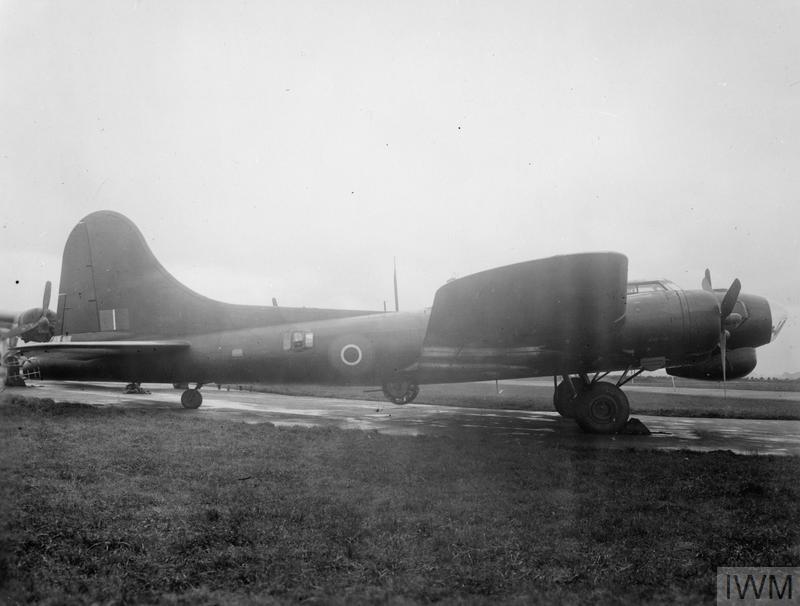
BBC war correspondent Richard North interviews the crew of Lancaster “S -Sugar” of No. 630 Squadron RAF on their return to East Kirkby, after bombing the marshalling yards at Juvisy-sur-Orge, France. IWM (CH 12778)

February closed with operations to Schweinfurt and Augsburg, an enquiry into the crash of ND5663 and the funerals of those who had lost their lives that day. With one squadron each losing a further crew, losses were continuing to mount for the two squadrons.

The early spring months would finally draw to a close over two disastrous nights. The first, on 24th – 25th March, saw Harris send his men back to Berlin one more time. In a last effort to bomb the capital, the RAF sent another 800 plus aircraft to the German capital, it would prove to be one of the worst for 630 Sqn, when three aircraft, including that of W.O. J. White who had just been awarded the DFM, were lost.

It was a dramatic figure that would be repeated on the last night of the month, when almost another 800 aircraft made up of Lancasters, Halifaxes and Mosquitoes were sent to Nuremberg. Weather reports from a Meteorological Mosquito were ignored and whist the operation should have been cancelled, it went ahead. In a moon-filled sky, the  result was carnage.

By the time all aircraft had returned, losses stood at 95 crews, almost 12% of the entire force sent out, and the biggest loss for the Command of the war so far. The weather experienced had caused the biggest problems, not only for the main bomber-stream, but also for the Pathfinders,  with strong winds blowing many aircraft widely off track causing them to bomb Schweinfurt, some 50 miles away,  by mistake. Of those that did bomb the correct target, many reported that they were unable to see it due to heavy cloud, which combined with the strong winds, forced both them and the Pathfinders to mark and bomb the wrong area. As a result, little damage was done to the city, and dropping bombs too early, caused ‘creep back’ to extend for some 10 miles ahead of the target. All-in-all more crews were lost that night then there were casualties on the ground, losses that were totally unsustainable for the command.

The German defences on both nights had been extensive and determined. Tame Boar and Wild Boar tactics along with Schrage Musik, the upward firing cannons, had devastated formations who were scattered far and wide. Harris had gambled with his crews and lost.

The disastrous nights of Berlin and Nuremberg led to a short pause in operations in much the same way as the dreaded raid on Schweinfurt did for the Americans. A new focus would take no chances, and precise bombing became the order of the day.

After devastating operations over the German cities, thoughts turn to the invasion and supporting the ground forces. A choice that did not agree with Harris, but one the crews would take in their stride…

The full page can be read in Trail 1 – Lower Lincolnshire.

RAF East Kirkby – Part 1 – A new Station emerges.

In the heart of Lincolnshire lies a former wartime bomber base that holds a particular and unique item dedicated to those who served in Bomber Command. The airfield where it is housed, was only used for a relatively short period of time, and by two main operational squadrons, yet it was one which saw the greatest number lost in the whole command.

In the next part of the trail, we travel away from Woodhall Spa to a former airfield synonymous with the Lancaster – RAF East Kirkby.

RAF East Kirkby

RAF East Kirkby is one of many Bomber Command airfields located in the Eastern county of Lincolnshire, a region that known as ‘Bomber County’. During its life it was home to two main front line squadrons along with a handful of other support units.

The airfield sits some 4 miles south-west of Spilsby and 12 miles north of Boston, in an area strongly associated with the Romans. Indeed, Lincoln – or Lindum Colonia as the Romans called it – became one of the largest and most influential Roman towns in England. Later, this area was where many invading Vikings settled, providing the local towns with examples of their own Nordic names, many of which can still be seen today. As time passed, both the Normans and the armies of Cromwell played their own part in the development of Lincolnshire, meaning the region has been left littered with several hundred monuments and numerous sites of archaeological and historical interest to offer the visitor.

Being in the lower regions of Lincolnshire, parts of it are only 40 feet above sea level meaning it is an area with a rich agricultural history as well; some areas being used to grow crops and of course tulips, bringing a wealth of colour and a wide range of crop to the area. It is all this that gives Lincolnshire both its beauty and its wide ranging historical interest.

Initially, East Kirkby airfield was built as a decoy site for nearby Coningsby and Manby, the site, complete with decoy wooden Whitley bombers, was decommissioned on June 27th 1941 and the area designated for a class A airfield –  RAF East Kirkby. Following requisition of the farmland in 1942, construction began by the building company John Laing & Sons Ltd., which included, amongst others, the first flushing toilets in the area. The airfield was finally completed in 1943, opening on August 20th that same year under the control of Bomber Command.

Located to the south-east of the village that gave it its name, the apex of the ‘A’, formed by the three standard runways, pointed westward with the main runway approximately north-south and the two subsidiaries west to north-east and west to south-east, each being the standard 2,000 and 1,400 yards in length and 50 yards wide.

As a bomber airfield the much needed runways would be of a concrete construction, and the airfield would boast six T2 hangars and a single B1 for maintenance and storage; a technical area stood to the north-west, with accommodation and the bomb store, spread around the area away from the main airfield site. Dispersals for aircraft storage and preparation consisted of twenty-seven spectacle hardstands along with five loop hardstands, all located around the extensive perimeter track.

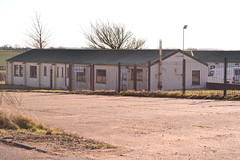
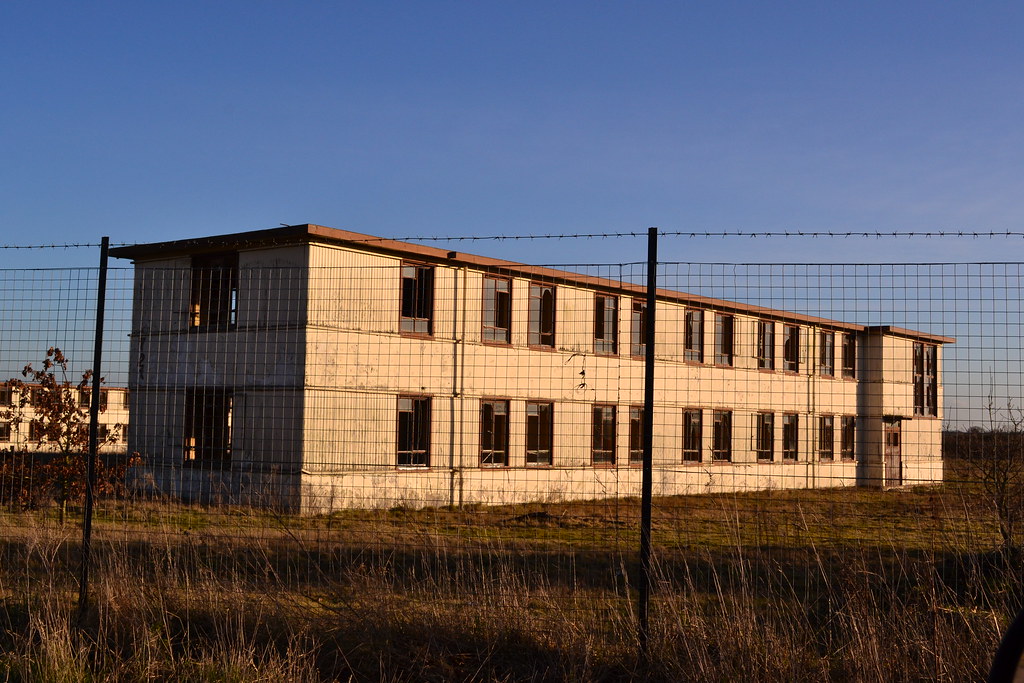
As a decoy site, it had been bombed on several occasions, and having accommodation and high explosives near to the airfield was not a good combination. These accommodation blocks were of  a ‘temporary’ construction, very different to the luxury of Scampton, from where the first residents would come.  At its height RAF East Kirkby could cater for 1,965 RAF personnel with a further 482 WAAFs all of mixed rank.

Initial ownership went to 5 Group Bomber Command, whose headquarters were at the time at Morton Hall near Swinderby, in the North Kesteven district of Lincolnshire, and would operate as 55 Base, the parent station of sub-stations Spilsby and Strubby.

A somewhat posed photo of Flt. Sgt. J Morgan, the rear gunner of a 630 Sqn. Lancaster at East Kirkby. @IWM (CH 12776)

The first resident unit was that of 57 Squadron who took it on immediately upon its opening, bringing both the Lancaster MK.I and MK.III with them.

After forming in 1916, they were, like many other squadrons at that time, disbanded after the war’s end in 1919, but then, as similar events unfolded on the continent once more, they were reformed (in 1931) to run continuously to the end of the Second World War. With further breaks post-war, they would continue to operate up to the current day, flying a wide range of aircraft from Victor tankers in the Falklands to their current model the Prefect T1 trainer at RAF Cranwell.

57’s history goes far deeper than that though, for it was whilst at Scampton, their previous home before East Kirkby, that ‘C’ Flight was separated from the main squadron to form the basis of 617 Squadron, better known as ‘The Dambusters‘; the Flight Commander, Sqn. Ldr. ‘Dinghy’ Young only being appointed to 57 Sqn a matter of weeks before the transfer took place.

However, it was at East Kirkby that 57 Squadron were now based. On August 27th 1943, just after the split, the advanced party arrived at East Kirkby to start what would be three days of moving and settling in. The first section of the main party arrived on the 28th with the remainder joining them on the 29th. During this time all flying operations were understandably cancelled and the time was allocated to the huge task of moving men and equipment over to their new base.

Operations commenced quickly on the 30th, when fourteen aircraft were detailed for operations to Munchen-Gladbach. All aircraft except one, completed the operation in which ground defences were ‘light’ and bombing was recorded as being ‘good’ with a large explosion seen in the target area. The only casualty of the flight being Lancaster MK.III ‘ED655’ which returned early with an engine failure. Thankfully though, there were no injuries nor any further problems incurred.

On the following night another fourteen aircraft were detailed to attack Berlin, the ‘big city’, an operation which brought August to an end and a total of twelve operations (179 sorties) amounting to over 940 hours flying time for the month.

It wouldn’t be long though before the first causalities would arise at the new station. On the night of September 3rd 1943, Lancaster ‘JA914’  DX-O was part of another fourteen flight raid on Berlin. On board that night was Australian Pilot Flt. Sgt. W. Grindley and his crew, which included one other Australian and a New Zealander.

After departing East Kirkby at 19:30 hrs, the aircraft made its way toward the capital. As it neared the target, search lights managed to cone the bomber, allowing a German night fighter (FW190) flown by pilot Unteroffizier Fritz Brinkmann of the Stab/JG 300, to attack the aircraft, bringing it down at Zehrensdorf with the loss of all seven crewmen on board.

Three of the crew were recovered and remained buried in the Berlin 1939-1945 War Cemetery whilst the remaining four were not. They have been commemorated on the Runnymede Memorial.  The remains of the bomber were themselves discovered in a lake, and recovered on September 29th 1997; a large section of wing which is now displayed in the Deutsches Technik Museum, in Berlin.*1

On the 22nd September, a further crew were lost when an intruder, since known to be Major Wolf Dietrich Meister of the Stab V./KG 2, flying an Me 410 A-1 from Schiphol airfield, followed the bomber home and intercepted it near to the airfield. As it fell from the sky both the Flight Engineer and the Bomb Aimer managed to escape the burning wreck, both parachuting to safety, but the other five failed to get out and were killed in the resultant crash and fire.

In Part 2, we continue with the ups and downs of life in Bomber Command, seeing how the airfield continues to develop and how the war affects those based at the Lincolnshire airfield.

The full page can be read in Trail 1 – Lower Lincolnshire.
Trail 32 RAF Nuthampstead – The end of an Era – Part 4

After Part 3 of our journey, we see the US bomber airfield at Nuthampstead finally come to a close. But as the war approaches its conclusion, operations continue to be flown and losses continue to mount.

The US forces would go to Dresden the morning after the RAF had been. 431  B-17s of the entire 1st Bombardment Division, would prepare for take off at 07:00 hrs to be over Dresden at mid-day. With two other Divisions also in the air that day, escort would be from 784 Mustangs, with the 20th FG protecting the leaders the 1st Bombardment Wing, the 398th BG, followed by the 91st and 381st Bomb Groups respectively. In all, in excess of 2,000 American aircraft would fly into the heart of Germany that day.

It was to go disastrously wrong for the Group though, for even as they flew over Holland, they were already off course and now the weather was moving in. With their Gee system being constantly interfered with and throwing up faults, the lead plane of the 389th decided to take the more southerly route to fly around the cloud, taking the formation near to Munster, a city heavily guarded by flak. Although objecting to the move, both the 381st and the 91st followed – a move they would come to regret. The 91st were hit hard; many aircraft were damaged and their crewmen badly injured. Then, another defensive turn took the Wing, some 137 aircraft, a total of fifty miles of course. They were now heading to Schweinfurt, the scene of such devastation in August 1943 where high loses resulted the US temporarily ceasing air operations as a result. Not wanting to relive the experience, the formation then turned south again, taking them, and their escorts, even further off course.

By now, the leader’s Gee system had completely failed, and as the formation approached the target, the deputy’s system also ceased working. Lost and confused, they were gifted with a break in the cloud through which they could see an ancient city with a river running through it. The order was given and bombs were dropped. With little to no flak and no enemy fighters to resist them, the formation unleashed its devastating load onto those below. Unfortunately, it was not Dresden at all, but the Czech capital Prague, they were some eighty miles off course.*5

The 398th flew their final operation on April 25th 1945, a flight that took them to the Skoda Armament Works at Pilsen. The 398th were joined that day by the 91st, 92nd, 303rd, 305th, 379th, 384th, and the 381st Bomb Groups. With simultaneous operations happening elsewhere at Munich and the Me 262 airfield in Prague, 198 aircraft were flew to Pilsen to bomb the Skoda works.

In contrast to their first mission, take off was controlled and in good order. The first aircraft was airborne at 05:20 and the last 35 minutes later. Forming up took place over Debden Buncher (RAF Debden) at 5,000 feet and the Buncher was left at 06:40, when the entire formation headed for the coast. at 07:37, they crossed the French shoreline.*10

The 398th BG were tasked with leading the 1st Combat Bombardment Wing, totalling three Bomb Groups made up of 120 B-17s. In charge was Captain Michael Robinson, Commanding Offcier of the 601st BS. The weather was predicted to be good, so a visual bomb run was planned, however, over the target, this proved not to be the case and 10/10 cloud completely obscured the target. Forced to go round again, the formation made a 360o turn bringing them back in at the rear of the formation. By now flak had become both intense and accurate.

Two aircraft from the 602nd in the high squadron were hit. The first B-17G #42-97266 (K8-G, “Godfathers Inc.“) piloted by 2nd Lt. Allan Ferguson, quickly left the formation spiralling out of control. Three of those on board managed to escape the aircraft as it fell earthward. Of the crew, six were killed whilst two were captured becoming prisoners of war for the last remaining days of action*6*7

The second aircraft that day was that of Lt. Paul Coville, B-17G #43-38652 (K8-V, “Stinker Jr“). After the second bomb run, the aircraft was hit behind the #3 engine, leaving a large hole and a damaged engine. After falling out of formation and feathering the engine, Lt. Coville brought the aircraft back, at which point the engine caught fire. A small explosion then ripped the right wing off outboard of the engine, sending the aircraft spiralling towards the ground. The crew inside, frantically tried to get out, assisting each other with parachutes. All crewmen except the ball turret gunner S. Sgt. Charles Walker, manged to escape the aircraft, managing to find allied troops on the ground and safety.

During their search for safety both Coville and the waist gunner S. Sgt. Harry Overbough, took two prisoners each, Overbough’s ending up being revealed as escaped Jewish prisoners who had donned German army uniforms to help them escape. *7*8

After bombs away, the formation made a right turn and headed as briefed toward home, crossing the English coast at 14:26. The first aircraft touched down at Nuthampstead at 15:02.*10

With the last mission flown, Nuthampstead’s days were now numbered. A handful of ‘Revival’ flights were made transferring POWs from Barth in Germany to airfield A-10 in France. In addition, flights carrying ground crews over Germany also took place. By May 1945 though, the war was over and the exodus of American forces back to the united States began. Over the period May / June,  1945, the 398th would depart Nuthampstead, the ground force returning to the US  from Greenock onboard the Queen Elizabeth, whilst the air personnel flew back between 21st and 27th May. After thirty days of rest and recuperation, the Group assembled at Drew Field, Florida where many officers and enlisted men were discharged from the service. The remaining handful were given duties elsewhere and transferred almost immediately.

A VE day service held at Nuthampstead airbase. (@IWM UPL 35448)

On September 1st 1945, Major Gene Nelson and Major Dean Ashworth, quietly and without ceremony, inactivated the Group – the 398th would be no more.

By the time the war had come to a close, the 398th had completed 6,419 operational sorties (175 missions) dropping some 15,700 tons of bombs. They lost some seventy*10 aircraft in operations. For their determination and outstanding flying over Derben on April 8th, the Group received a Presidential Unit Citation, this came in addition to 2,124 Air Medals, 531 DFCs, 2 Silver Stars, 18 Bronze Stars and 4 Purple Hearts (with others being awarded elsewhere). Whilst their losses were perhaps hugely significant compared to other Groups, they nonetheless performed gallantly and with dedication deserving of any military group.

Returned to RAF ownership a month later the airfield became a store and maintenance station storing ordnance for disposal, and by 1954 the military had no further interest in it, and it closed some 5 years later.

During the 1960s Nuthampstead was in the limelight once more when it was considered as a site for London’s third airport after Heathrow and Gatwick. Being so close to the capital made it an ideal proposition, but the proposal faced huge opposition from those living and working in the area. The decision would eventually favour Stansted, a site not even shortlisted in the initial phase.

The Roskill Commission Inquiry (1968-70), identified seventy-eight initial sites, reducing it to four possibles: Nuthampstead, Thurleigh (Bedford), Cublington (Bucks) and Foulness on the Essex coast, ignoring Stansted on grounds of air traffic, noise and poor road access.

After great debate, Cublington was finally chosen, however, following in-house arguments and disagreements, this was later overturned in favour of Foulness (Maplin Sands),*9 Nuthampstead being rejected on various points including most noise, most agricultural loss and the requirement of a rail link.

With work intending to start in the early 1970s, the plans were eventually shelved due to the 1973 oil crisis and instead a smaller proposal was put forward to build a site at Stansted, itself a former war-time airfield. The build eventually went ahead and today Stansted sees in excess of 15 million passengers, all of which could have been located at Nuthampstead.

With that, Nuthampstead was destined to be become farmland once more. The Forestry Commission planted tress in the former bomb store, itself leading to large quantities of munitions being discovered after the site was abandoned. A small strip was retained for karting and a small crop spraying business utilised part of the airfield. Much of this has now also ceased and whilst parts of the original runway and peri track concrete surfaces still exits, farmland prevails once more over the site.

Built mid war, Nuthampstead had a rather unfortunate start, with many serious problems for the 55th FG and their P-38 Lightnings. The 398th, the Group synonymous with the airfield, were a rookie Group but one that went on to perform 195 operations many over Germany, losing a number of aircraft and crews in the process. They took part in some the the war’s most ferocious battles including Schweinfurt on October 9th, Berlin on several occasions and the US Air Force’s last operation of the war, Pilsen on April 25th 1945.
Transferred back to RAF ownership post war it was  a serious contender for London’s third airport, however, this was not to be and the airfield was largely removed, buildings were demolished and the runways were dug up for hardcore. Little remains of it today, a small private airstrip utilises some of the site, and a thriving museum continues to tell the story of those who served here. A stunning memorial stands outside the local pub frequented once by so many personnel who served here, at Nuthampstead, in those days of the 1940s.
The full history of RAF Nuthampstead can be read in Trail 32.

Sources and further information (Nuthampstead)

*1 Investigation of the US National Defense Program, Part 35. US Government Printing Office Available on Google books

*2 Fooy. F., “One of Thousands – A Navigator in the European Air War.” Lulu Publishing, 2015 Via Google Books

*3 Wilson. K. “Blood and Fears – How America’s Bomber Boys and Girls in England Won their War“. Weidenfeld & Nicholson, 2016 page 390

*4 American Air Museum Website accessed 11/2/24

*5 Taylor, F., “Dresden – Tuesday 13th February 1945“, Bloomsbury, 2004

*6 MACR 14224.

*7  “Hell from Heaven – Ch 35 – Mission 31 – Pilsen, Czechoslovakia,  Our Last Combat Mission – April 25, 1945” published by Leonard Streitfeld, Bombardier, 600th Squadron on the 398th BG Memorial Association Website.

*8 MACR 14220

*9 Banister, D., “Transport Planning In the UK, USA and Europe”  Taylor & Francis, 2003

*10 United States Army Air Forces, “The History of the 398th Bombardment Group (H)” (1945) World War Regimental Histories Book 124.

Missing Air Crew Reports 12214 and 12215

Ethell. J., & Price. A., “Target Berlin – Mission 250: March 6th 1944“. Janes, 1981

A good many photos, official records and personal stories are available on the 398th BG Memorial website. A great resource for those wanting to read more about the history of the 398th BG,

Trail 32 RAF Nuthampstead – The arrival of the 398th – Part 3

In Part 2 of this Trail, we saw how the 55th FG finally departed Nuthampstead having been dogged by mechanical problems. In this part, they are replaced by the 398th BG, a heavy bomber group who brought the B-17 ‘Flying Fortress’ with them. As ‘rookie’ crews though, their start may not have been the start they had wished for.

The new Group was a Heavy Bomber Group, equipped with B-17Gs, and would be the last Fortress Group to join the USAAF. Made up of four squadrons: 600th, 601st, 602nd and 603rd Bomb Squadrons (BS), the first personnel would arrive in Liverpool, on April 21st 1944, sailing on the USS Wakefield from Boston. Once at Nuthampstead, they would begin combat flights in a matter of days, their first mission taking place an May 6th that year.

Their journey to Nuthampstead had been a long one. Being activated on 1st March 1943 with a cadre from the 34th BG at Blythe, California. They trained hard, transferring to Orlando in Florida and then onto Spokane, Washington. In June 143, they transferred once more, this time to Rapid City, South Dakota, each time picking up new staff and crews as they went.

During training in the Autumn of 1943, the monotony of routine was broken when 2nd Lt. Thompson Highfill displayed courage and to assure the safety of his crew. After his B-17 suffered engine failure and complete wing disintegration, he ordered the crew to bale out, holding the aircraft as steady as he could whilst they made their escape. Too low to use his own chute, he made a wheels up landing, for which he was awarded the Distinguished Flying Cross, the first to the unit.

After further moves the unit was eventually war ready, and on March 24th 1944, the advance party began their journey to England. On April 22nd, the ground echelon arrived at Nuthampstead, the same day as the first section of the air echelon.

Having only been activated the year before, the 398th were a novice Group, but that would not prevent them operating against important strategic targets in Germany. These operations would include factories in Berlin, warehouses in Munich, marshalling yards in Saarbrucken, shipping facilities and docks in Kiel, along with oil refineries and aircraft production facilities in Munster. Thus even as a new unit, it would take part in some of the heaviest attacks on German industrial centres.

On May 6th, the 398th went into action for the first time, and like other newbies, it was a disaster. Although these missions were not seen as full missions (flying the full complement of aircraft and crews) they were nevertheless important in the development of the crews, honing their skills and allowing them to begin gelling as a close knit crew.

The morning started badly when breakfast was delayed. The take off as a result was also late with departures being badly timed. Forming up was ‘less than tidy’, with ten of the eighteen aircraft forming up on the wrong formation or in the wrong place. Once over the target, the ‘V’-weapons site at Sottevast, cloud prevented the bombers from seeing the target and so they returned without dropping a single bomb. Their inauguration had been far from successful but looking at it positively, there were no loses and all aircraft returned unharmed.

The rest of May saw the Group fly to Berlin no less than four times, in addition to targets at Kiel, Saarbrucken, Ludwigshafen, Ruhland and Dessau in Germany. They also flew to several targets in both France and Poland meaning there had been no let up for the novice flyers.

During the lead up to D-day, the 398th would attack coastal defences along the Cherbourg peninsula, softening up defences for the invasion forces who were about to land along the Normandy coast. These and other targets in France would dominate the early weeks of June, whilst July saw a return to the homeland and targets deep into Germany once more.

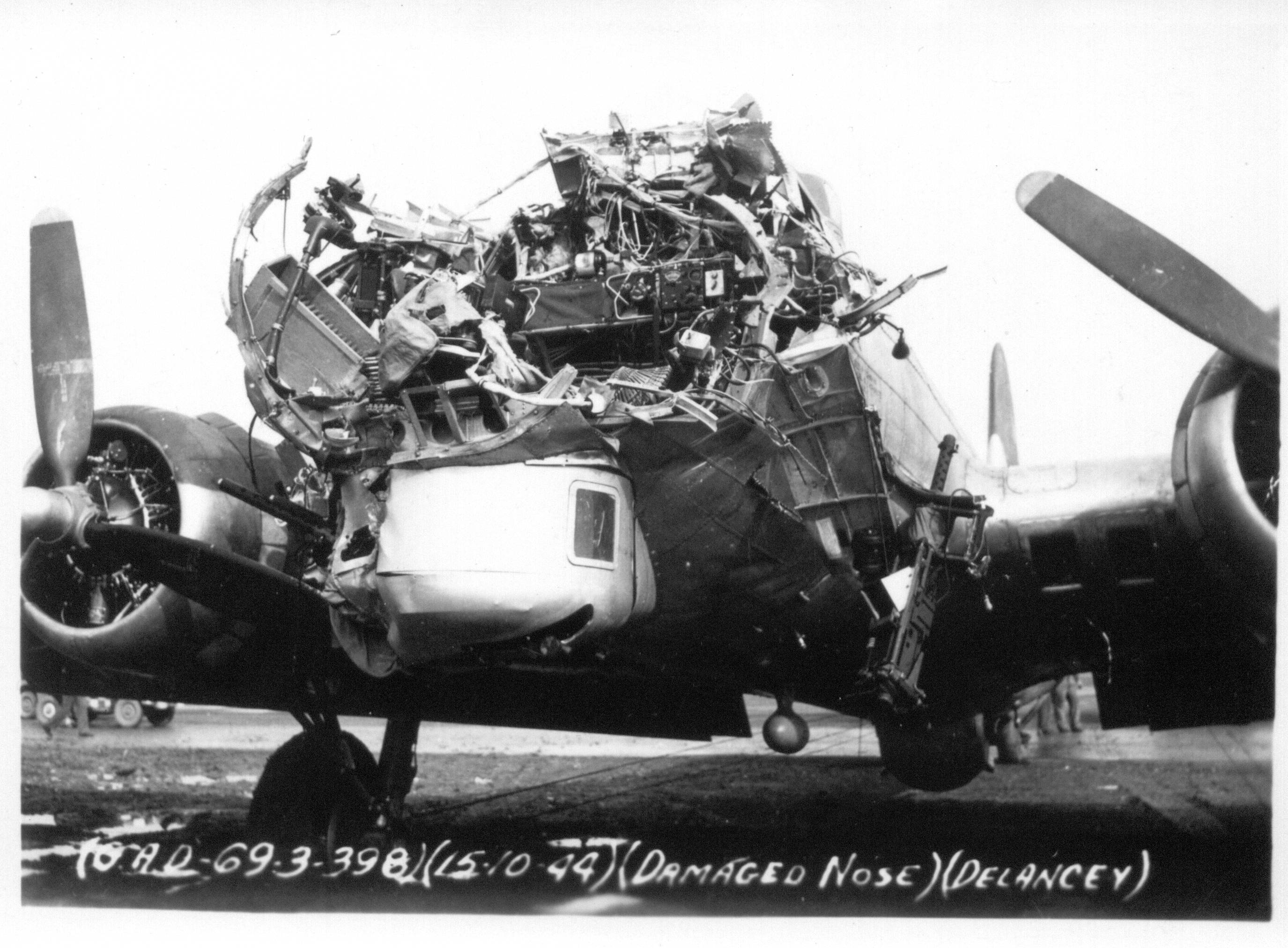
October 15th brought the true realities of war to the Group when a flak shell hit B-17G #43-38172 in the nose exploding inside the aircraft. The Toggler/bombardier,  Sgt George Abbott, was killed outright, and the instruments were all but obliterated. With no oxygen and the nose barely recognisable, the pilot 1st Lt. Lawrence DeLancey, managed to bring the B-17 home thus saving the lives of the other crewmen on board.

B-17G #43-38172 “2 Sad Lovely Julie” hit in the nose by flak, killing the bombardier outright. (@IWM UPL13907)

For his actions, Lawrence De Lancey was awarded the Silver Star, Lt. General Doolittle’s letter citing the “sheer determination and tenacity”  of De Lancey in bringing the aircraft and remaining crew home safely.

Christmas 1944 saw no easing up for the crews. On Christmas Eve, orders came through for every available bomber to be airborne. The winter of 1944-45 being one of the worst saw ground forces take a pounding in the Ardennes by a desperate last attempt at a breakthrough by the German land forces. Taking advantage of the fog and mist that had prevailed, air cover was limited for the allies but as soon as a break occurred, they would return in large numbers. That break occurred momentarily on the 24th.

Over 2,000 bombers of the Eighth Air Force, (which included 500 RAF and number of bombers from the Ninth AF) took to the skies that day, the largest Eighth Air Force operation to assemble over enemy territory in history.

The flyers did not experience mass opposition, in fact it was insufficient to make a difference, and so the operation fulfilled its objective of destroying supply links and disrupting airfield operations. On the way home, the bombers were faced with encroaching haze, many UK airfields becoming closed in and closed to landings. The 1st Air Division (formally 1st Bomb Division) were faced with a thick fog that forced them to land elsewhere, the 398th coming in at Ridgewell along with the 351st and Ridgwell’s normal residents the 381st. Christmas for the crews would be spent away from their England home that year.

On 3rd February 1945, the 1st AD were part of a force attacking Berlin again,  lead by the 91st BG with Lt. Col. Marvin Lord, the group Operations manager who was chalking one up, never having flown to Berlin before, he took over from the normal lead pilot who was on a short pass.

As the formation neared the initial point (IP) over Lehmke, near Gardelegen, the formation began to close up causing extensive turbulence from prop wash. Before the bombardiers took over, aircraft jostled for positions ensuring their safe place in the group. At this point, it took two pilots to control the buffeting aircraft, as they were thrown about the sky within the ever tightening formation. Ninth in line were the 398th BG led by 1st Lt. Perry Powell in B-17G #43-38697, of the 603rd BS.

Affected by this powerful prop-wash, Powell decided to drop back and in doing so he got too close to the low squadron. His automatic reaction was to lift the nose of his heavily laden B-17, a reaction that caused the air-frame to suffer extreme stress, stresses that caused the fuselage to split open around the ball turret, sending the powerful front end into the front of Lt. John McCormick’s B-17 #42-97387 of the 602nd BS. The collision cut away the nose of the second aircraft. With no parachutes or safety straps, the navigator 2nd Lt. Second Lieutenant Bruce Phelps fell to his death.

Now no longer flyable aircraft, both B-17s began to fall, spiralling toward the ground and their inevitable fate – of the two crews, only three were seen to escape that day.

Out of Perry Powell’s aircraft, #43-38697, eight were killed, only the tail gunner S.Sgt. Joe Bancroft survived becoming a prisoner of war. From John McCormick’s B-17, #42-97387, only he and the Bombardier, Bill Logan, survived, seven losing their lives in the tragic accident that marred the operation that day*3, *4.

Later that month, on the 13th, the 398th would take part in the hugely disputed attack on Dresden, a combined force of Allied aircraft that would drop in excess of 4,500 tons of bombs on a city whose conditions led to a firestorm that killed more than 25,000 inhabitants.

In the last part we see how Nuthampstead’s war comes to a close. The airfield no longer required eventually closes, but not before it enters a great debate about its future and possible expansion.

The full history of RAF Nuthampstead can be read in Trail 32.

Trail 32 RAF Nuthampstead – The end of the 55th – Part 2

In Part 1, we looked at the construction of Nuthampstead and were introduced to the 55th FG,  the first residents of the airfield. There had been a good start to their war, but things were about to take a turn for the worst.

Two days later, the 55th were again joined again by elements of the 20th FG, swelling their number into the fifties. A shortage of Lightnings had meant that the bulk of the deliveries had gone to Nuthampstead, leaving the Kings Cliff Group to fly along side the 55th until their own numbers had reached full capacity. However, very soon after take off that day, mechanical problems struck several of the Lightnings and they were forced to return. Forty-seven aircraft then continued on to their rendezvous point, but the Liberators of the 2nd BD were nowhere to be seen. Extremely low temperatures then caused further issues with the Allison engines and several more P-38s were forced to abort the mission and return home empty handed. By the time the bombers were located, the 38th FS were the only ones about, and the sixteen aircraft of the squadron began to protect their bigger friends from a swarm of attacking 109s and 190s.

Once back at Nuthampstead, claims were once again put in with a loss of none of their own. Apart from ongoing mechanical issues, the war was going well for the 55th.

On the 13th however, the gremlins struck again and this time they struck hard. The 55th were ordered to protect the 1st, 2nd and 3rd BD bombers to Bremen. Before they had even reached the bombers, three had to return due to mechanical problems with the engines and yet again, the extremely cold temperatures and humidity made flying difficult and the possibility of further problems more likely. Both engine issues and a determined fighter attack took its toll on the 55th, with seven aircraft failing to return that day, five being shot down and two lost from suspected engine problems that were by now dogging the Group.

These gremlins then reared their ugly heads again on the 29th, and once more it was over Bremen. Flying out over the Dutch coast the flight was attacked by a swarm of FW 190s, with full drop tanks and heavily laden, the Lightnings suffered badly once more with another seven P-38s failing to return to Nuthampstead.

Ongoing losses had meant that by the end of the month a third of the Group’s aircraft had been lost, either on operations or as a result of crashing on their return – the failings of the Lightning were now showing themselves in dramatic style. Poor performance at higher altitudes, where the bombers operated, seriously curtailed the ability of the engines to perform even satisfactorily. Oil turned to sludge and pipelines froze often leading to a catastrophic failure of the engines. Over the winter of 1943-44, over half the P-38 losses experienced were put down to the engine’s inability to cope with the moisture and freezing temperatures of the European skies. Compounding this, poor heating for the pilots led to immense discomfort, and even frost bite for some. Lengthy flights were taking their toll not only on the aircraft’s performance, but also the pilots ability to fight the better equipped enemy.

The new year of 1944 brought new challenges to the 55th. The mechanical problems of the Lightning continued, even with the introduction of the newer ‘J’ model, major engine problems prevented it from becoming the fighter it was designed to be, and as a result, losses continued to grow.

In February, the infamous ‘Big Week’ operation took place, the intended mass destruction of the German industrial region along the Rhine. The 55th offered a supporting role to the bombers but by no means was it a front row seat.

In March, after much speculation, the 8th Air Force turned its attentions to Berlin once more, a target that had been previously planned but scrubbed before take off, raised its head again. An initial flight in the first hours of March led to nothing more than failure after many bombers took too long to form up and subsequently returned low of fuel, those that did get away were forced to return due to cloud. On the 4th, another attempt was equally affected with many aircraft forced to attack targets elsewhere. But even after the recall was given, a small number of bombers did get through dropping the first, but totally ineffective, US bomb on the German capital.  With them, acting as escort, were the P-38s of the 55th FG, Led by Lieutenant-Colonel Jack S. Jenkins, commanding officer, who would become the first US fighter pilot to reach Berlin. Although the operation was a failure, it would nevertheless be a milestone in America’s part in the war.

Lt. Col. Jack S. Jenkins, of Levelland, Texas, in his P-38 “The Texas Ranger.” (#42-67074) Jenkins was the first US fighter pilot to fly over Berlin. (@IWM FRE 2425)

On the way in, Jenkins and his companions in the 38th FS, had received hits from flak, and as usual, were suffering from engine trouble, so much so that only half the 38th made it to the target area. Flying in his later P-38 “Texas Ranger IV” (#42-67825), Jenkins failed to locate the bombers and upon turning for home, had to outrun a number of enemy aircraft at low level. When the story of his achievement hit the headlines it was both big news and a welcome morale booster for not only the 55th, but for the US forces in general.

Sadly, Lt. Col. Jenkins, the ‘hero’ of Berlin, would only fly for a further month following his flight over the capital, being shot down on April 10th, in the same P-38 “Texas Ranger IV” he had flown so well. He survived the incident but was captured and taken prisoner by the Germans, whether they knew of his achievement or not is not known.

On the day following the Berlin operation, March 6th, the USAAF returned to ‘The Big ‘B”. The 55th were again to be a part of the operation, directed to protect the bombers on their return leg of the mission. Once at the rally point north of Berlin, the bombers began their flight home seeking the protection of the forty-seven P-38s that the 55th put up. Once over enemy territory though, the gremlins that had now played almost as big a part in the war as the Group, reared their heads once more and sixteen of the aircraft developed faults forcing them, and an escort for them, to return home. It had been a black time for the 55th.

In the following month, a new model of the P-38 would emerge, the ‘Droopsnoot’ P-38, a fighter bomber version of the Lightning. Both the 20th FG and the 55th FG flew the version on this day, thirty-four of them being from the 55th. But the ‘Droopsnoot’s’ arrival would  also mark the departure of the 55th from Nuthampstead, along with the simultaneous arrival of a new and very different Group.

Their time at Nuthampstead had been mixed. Scores of enemy aircraft had been claimed but many good airmen had been lost, and the aircraft they flew had proven to be less than perfect in the cold, damp European skies. But as the 55th left, the bombers of the 398th Bomb Group (BG) took over operations with the heavy bomber the B-17 Flying Fortress, this would be the aircraft and Group that Nuthampstead would become synonymous with.

Nuthampstead and the 55th FG in particular had suffered badly. Mechanical issues and caused untold damage and many losses in aircrew. Now it was time for them to move on and for a new group tp arrive at this Hertfordshire airfield. With departure of the 55th, came the Heavy Bomber Group the 398th.

In the next part, we travel along with the 398 BG as they take the war to Germany. But as new crews, things do not initially go their way, their first operations being ‘untidy’, a  trait that inevitably leads to losses.

The full history of RAF Nuthampstead can be read in Trail 32.

Trail 32 RAF Nuthampstead (Station 131) – Part 1

Nuthampstead airfield is located in Hertfordshire, 5.5 miles south east of Royston and a short distance from the village that gave it its name. As an American airfield, it was given the designation Station 131, to hide its true location from the enemy, and was controlled mainly by the 8th Air Force’s 398th Bomb Group (BG).

The airfield itself was opened in 1943 with a US investment of over $2 million*1 and was the American’s nearest airfield to London. Built late in the war by construction workers of the 814th and 830th Engineer Battalions of the US Army, it used rubble brought in from the bomb sites of both London and Coventry. Nuthampstead was a Class A airfield with three intersecting runways of standard lengths; one of 2,000 yards, and two of 1,400 yards, and each the standard 50 yards wide. The Pinnacle of the ‘A’ pointed easterly, with the main runway running north-east to south-west, with the second and third runways running roughly north to south and east to west; all three were of a tarmac-covered concrete construction. The surrounding perimeter track contained some 50 spectacle hardstands and linked the airfield to two T2 hangars.

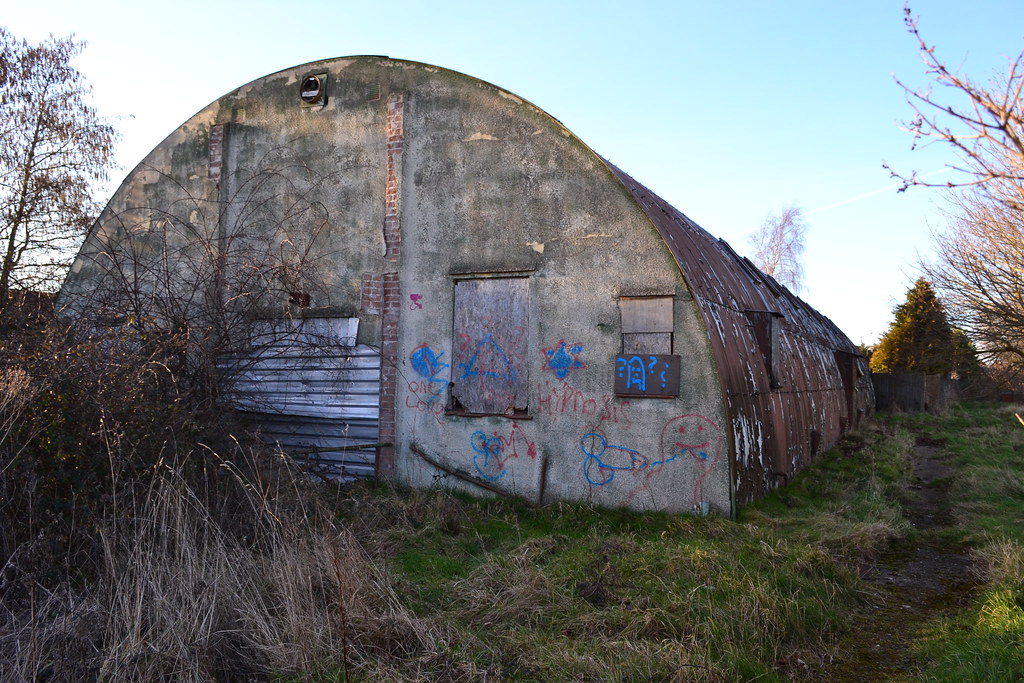
The technical area, located on the western side of the airfield, housed a wide range of technical huts and buildings including the watch office of a 12779/41 brick and reinforced concrete design; AM bombing teacher; photographic block; fuel compound and a Dinghy block along with a collection of typical wartime airfield buildings. Whilst most of these were Nissen huts, there were also both Romney and Seco huts on site as well.

As with all Class A airfields the accommodation sites were dispersed away from the main airfield to protect those on the base from air attack. These covered twelve separate areas capable of holding just short of 3,000 personnel. These sites were also standard designs and included: two communal areas, two WAAF sites, an Officers site, sick quarters, and both an airmen’s and sergeants’ quarters. All accommodation blocks were Nissen design with both ‘Jane’ and Romney hutting also being evident. As was common with all temporary built dwellings they were cold and not very homely.

Perhaps the one saving grace for those stationed here was that the technical site was connected to the accommodation site by a road that passed the Woodman Inn, a 17th Century pub that became very popular with those stationed here. The pub currently contains a number of photos and memorabilia relating to the airfield and a separate excellent museum can be found at the back of the pub’s car park. In addition to the draw of the local pub, personnel stationed here were provided with a baseball field, basketball courts, volleyball courts, a football field and even a rodeo, all of which led to Nuthampstead having the 8th Air Force’s champion basketball team ‘Frank’s Yanks’.*2

The baseball team, captained  by Lt. Irwin Cohen, achieved a total of 34 consecutive wins against teams from the 1st, 2nd and 3rd Air Divisions as well as teams from various Fighter Groups of the 8th. They won the Eighth Air Force Championship on March 4th 1945.

By the time construction was started, gas attacks were seen as a much lower threat than they were at the beginning of the war, and as such, decontamination centres were now being built out of Nissen huts rather than the more sturdy thick walled brick designs used at the start of the war. Nuthampstead featured such an example, designed to drawing number 6517/42, it was an 18 bay Nissen hut combining all the facilities needed for decontamination should a gas attack occur. One of each of these was located at both Site 2 and Site 3.

Primarily a bomber station, Nuthampstead was initially operated by the 55th Fighter Group (FG) between September 1943 and April 1944, who flew the P-38 twin-boomed Lightning and later the P-51 ‘Mustang’.

The 55th were constituted on November 20th, 1940 being fully activated in January the following year. In May of 1942, they were converted from their initial fighters the P-43, to the P-38 whereupon they began training on the new type. A year later, over August and September 1943, they moved to England and were assigned to the US 8th Air Force and Nuthampstead.

The first personnel of three squadrons, the 38th Fighter Squadron (FS), 338th FS and 343rd FS travelled across the Atlantic from McChord Field in Washington, arriving at Nuthampstead in August. Preparations then began for the remainder of the Group and the airfield was re-designated Station 131 under the US naming system.

Their arrival in the Autumn of 1943 marked the arrival of the P-38, a 1939 design that soon gained devastating notoriety in several theatres of war.

The P-38 was a long range fighter that excelled more in the Far East than it did in the European theatre, but with this aircraft, the 55th FG claimed not only the honour of being the first fighter group to fly this long range aircraft, but also the first US fighter to fly over Berlin once long range tanks had been added.

The first of these aircraft, the improved P-38H, arrived in October with two groups, the 55th being one and the 20th FG at Kings Cliffe being the other. Whilst the ‘Lightning’ had previously been based in England in 1942, teething problems and modification work prevented them from actively taking part in any operational flights, being dispatched to North Africa before becoming fully operational in Europe.

Thus the 55th, were the first fully operational group, taking flight on October 15th when they undertook fighter sweeps along the Dutch coast, an uneventful flight it nevertheless marked the first operation of the type in Europe.

Previous problems with the type, notably around the aircraft’s mechanics, had not been fully resolved however, but that didn’t stop operations to the continent taking place. On November 3rd, the 55th performed their first deep penetration flight, escorting B-17s and B-24s of the 1st, 2nd and 3rd Bombardment Divisions in an attack on Wilhelmshaven. In the bomb run, the flight was attacked by Me 109s and FW190s, the 55th immediately joined in and claimed as many as six aircraft destroyed and several damaged. Their second mission had been a success, there had been no losses and several enemy aircraft were claimed as shot down – morale was riding high.

In part 2, we see how the 55th FG’s luck begins to run out, and how ongoing mechanical problems hamper operations. Losses would begin to mount up.

The full history of RAF Nuthampstead can be read in Trail 32.

RAF Glatton Mural

There are many memorials and murals around the world dedicated to those who lost their lives or served on wartime airfields fighting the Nazi tyranny. In the UK these amount to hundreds if not thousands, and every now and again, one springs up and looks stunning.

At Conington, the former RAF Glatton, now a training airfield which utilises one of the three original runways, is one such mural, dedicated to those of the  457th Bomb Group  who served with and flew missions from the airfield between February 21st, 1944, until April 20th, 1945.

Glatton airfield was built in the last months of 1942,  by the 809th and 862nd Engineer Battalion (Aviation) of the U.S. Army, as a class ‘A’ airfield, and would be of a standard size and shape catering for some 3,000 men and women of mixed rank.

The only units to use the airfield were the four bomb squadrons: the 748th, 749th, 750th, and 751st Bomb Squadrons of the 457th Bomb Group, 94th Combat Bombardment Wing of the 1st Bombardment Division. Flying B-17s, they would take part in some of the most horrific battles of the air war, losing some 729 personnel as either killed, missing or taken prisoner, dropping just short of 17,000 tons of bombs in 237 missions.

After training at Rapid City Airfield in South Dakota, the 457th would enter the war with a real baptism of fire. On Monday 21st February 1944, the combined forces of the USAAF and the RAF were involved in the ‘Big Week‘ campaign. Officially known as Operation ‘Argument‘, it was designed to smash the German aircraft industry in one fell swoop. For an entire week the allies pounded the industrial regions of the Rhine, as one of the war’s biggest joint operations, it didn’t nevertheless prove to be as definitive as planned.

They would attack ball bearing plants, aircraft factories and oil refineries. Helped prepare the way for the invasion  and took part in Mission 311, on April 22nd 1944, a mission that became famous for the operation in which US forces lost more aircraft to enemy intruders than at any other time in the war.

They would also attack coastal defences, railways, fuel depots took part in the attacks at St. Lo.

Many special visitors would also be seen at Glatton airfield, including in March 1944, YB-29 #41-36963 ‘Hobo Queen‘*8 which took off from Salina Airbase in Kansas piloted by Colonel Frank Cook, as part of a plan to ferry B-29s to China to bomb Japan from airfields there.

On April 20th 1945, the 457th flew their final operational mission, attacking the marshalling yards at Seddin, to the south of Berlin. With the end of the war just around the corner there was little resistance from either ground forces or the Luftwaffe, none of the 457th aircraft taking hits or suffering any damage, it was virtually a ‘milk run’.

Following VE day, the 457th flew POWs back from Europe to England, then with no further action to undertake, the airfield was handed back to the RAF’s No. 3 Group under the control of Bomber Command operating both the Avro Lancaster and Consolidated B-24 Liberators flying out to the Middle East.

By June the war for the 457th was over. The men and machines were transferred back to the United States with the aircraft leaving Glatton between May 19th and 23rd, and the ground echelons sailing on the Queen Elizabeth from Gourock in Scotland, at the end of June. After arriving at New York there was 30 days rest before the men assembled at Sioux Falls. Here the axe fell and the 457th was no more, the four squadrons being disbanded for good and the Group removed from the Air Forces inventory.

Glatton itself was eventually closed and the site was then sold off in 1948, mostly returning to agriculture.

Since then, a training company has taken over part of the airfield, T6 Harvard Ltd, a small light training company, have operated out of Glatton since 2021 providing flying training for pilots on a variety of aircraft including both Chipmunks and Harvard aircraft.

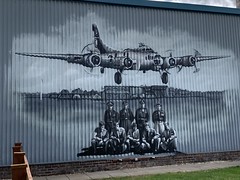
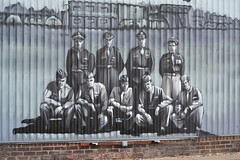
On the side of one of their buildings is a mural, painted  by Nathan Murdock, a Peterborough artist, who created the design as a commission by the company owner Julie Churchill, and depicts a Lockheed/Vega B-17G-70-VE Fortress, #44-8557 of 748th Bombardment Squadron on its 234th mission, April 18, 1945. On board that day and depicted in the painting are: Roy Truba; Craig K Winters; Joseph Taylor; William Thistle; Luther Smith; Louis Domato; John H Taylor; John Miller and Harvey Henkel.

This crew was the last 457th crew to sustain a loss in the war when the aircraft was hit by flak over the marshalling yards in Freising on April 18th, two days before their last mission. Following the strike, the crew safely parachuted from the damaged plane, but Sgt. John T. Miller, the engineer, was killed. The rest of the crew landed safely but were soon captured and taken prisoner by the Germans. All were liberated by allied forces ten days later.

The mural was completed and then dedicated on August 19th, 2021 by the U.S. Air Force Col. Abe Jackson, EUCOM JAC commander, who said “Today symbolises an opportunity for us to recognise the significant contributions of those Airmen who came before us,”*1

The mural can be easily seen behind the clubhouse, which also has a display of photographs and memorabilia relating to the 457th and their time here at Glatton. It is a stunning piece of art work, not least of all becasue it is painted onto corregated metal, and is well worth a visit if you are in the area.

RAF Conongton (Glatton)

The mural depicting the crew and B-17 #44-8557 can be seen behind the clubhouse.

RAF Conongton (Glatton)

457th Bomb Group crew in 1945. Back row left to right: Roy Truba (Bombardier), Craig K Winters (Navigator), Joseph Taylor (Co-Pilot) and William Thistle (Pilot). Front row left to right: Luther Smith (Tail Gunner), Louis Domato (Radio Operator), John H Taylor (Ball Turret Gunner), John Miller (Flight Engineer) and Harvey Henkel (Right Waist Gunner). (Names taken from an original photo on the American Air Museum website).

Sources and further reading.

*1 501st Combat Support Wing Website

T6Harvard Ltd flying details can be found on their website.

The full history of Glatton can be read in Trail 6.

RAF Sculthorpe – The Cold War continues but the end is in sight (4)

In Part 3, Sculthorpe had undertaken reconnaissance flights over Soviet territory risking all out war with the Russians. New bombers were arriving and Sculthorpe had reached its heyday. As the Cold War continued, new aircraft would arrive and mistakes will happen.

Mid 1955 would then see a change leadership at Sculthorpe with the departure of the Station Commander Colonel M. Jones, himself a veteran of the famous Tokyo raid led by General Doolittle. He would be replaced, in time, by another veteran, the former commander of RAF Attlebridge, Brigadier General Joseph Holzapple.

It was during this same year that a further and more serious disaster would strike at the heart of Sculthorpe personnel, when on the 9th December, an F-84F (#52-6692)  of the 55th Fighter-Bomber Sqn/20th Fighter-Bomber Wing,  was flying from Sculthorpe on an instrument training flight. Whilst over the Derbyshire countryside the aircraft flown by Lieutenant Roy Evans, a 24 year old from Polaski, Tennessee, ran low on fuel and suffered an engine flame out. After several attempts to relight the engine, Evans decided it was time to eject as the aircraft was losing height. The tower at RAF Burtonwood, could hear the pilot but he could not hear them, as he informed them that he was leaving the aircraft. At the time of the ejection the jet was said to be at about 2,500 ft and losing height rapidly.

Evans ejected, landing on the moors east of Hathersage injuring his ankle in the process. The aircraft meanwhile, hit the ground at around 300 miles per hour, some six miles away at Lodge Moor Hospital in Sheffield. The Thunderstreak  struck the roof of Ward ‘North Two’ ploughing through Ward ‘North One’ before eventually coming to rest in two parts by the garage and mortuary. One person inside the hospital was killed whilst seven others received minor injuries and shock*8.

One version of The Daily Mirror of 10th December, led with the story with the headline “Pilotless Jet Crashes on Hospital“, and gives details of the incident which could have been much worse as the jet narrowly missed a huge petrol storage tank and ambulance station. Whilst Lieutenant Evans survived this incident, he would later lose his life in another accident this time involving a reconnaissance version of the F-84 the ‘Thunderflash’ (#52-7349) on 21st August 1958 in Morocco.

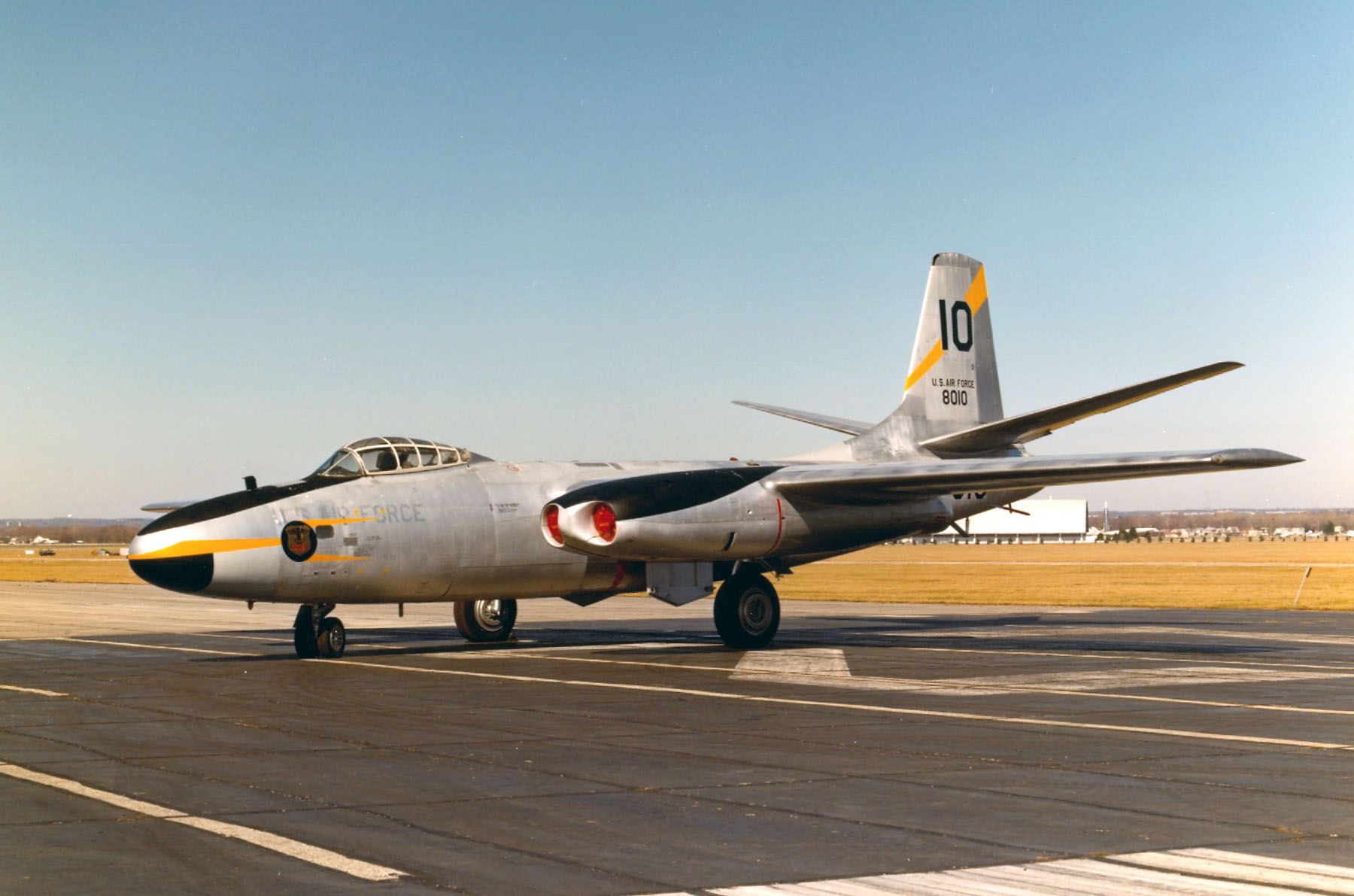
Throughout the closing years of the 1950s, Sculthorpe and the 47th remained at the forefront of the nuclear tactical force. But changes were coming and already the move toward nuclear missile delivery systems was happening. The Tornado was becoming old and outdated yet it remained as the main aircraft with the USAF in Europe. The RB-66A ‘Destroyer’, a Douglas built all weather reconnaissance aircraft was being developed at this time, and would soon be delivered as a direct replacement for the Tornado. The RB-45s had performed well, but their record was not flawless either, a matter borne out in 1953 when between March 9th and 13th May, there were five incidents due to engine fires in RB-45As. In all there were thirty-seven serious mishaps including seven serious engine fires which marred the B-45’s record at Sculthorpe, some of which had resulted in fatalities*9.

File:Douglas RB-66B 54-506 19 TRS Scul BWD 18.05.57 edited-2.jpg

Douglas RB-66B #54-506 Between 1957 and 1959; it flew with the 19th TRS (66th TRW) (wikipedia)

Advances in in-flight refuelling were also made their presence felt. At Sculthorpe three KB-50 tankers joined the KB-29s of the 420th Air Refuelling Squadron bringing the advancement of three point refuelling replacing the single boom as used previously. The change would not be smooth though as on February 2nd 1957, two of the Sculthorpe aircraft collided in poor weather near Morigny, twenty miles from Saint-Lo (Manche), Normandy, thirteen crewmen were killed as a result of the crash.

The arrival of the RB-66A  ‘Destroyer’ in early 1958 was quite a step forward for the crews at Sculthorpe. Training and conversion courses became a priority, and the aircraft was generally liked by those who flew it.

The thought of nuclear weapons being stored locally raised a number of issues. People were naturally concerned about the security and safety of such weapons being located on such an important airbase, and in particular what the consequences of any accidents would be. Their fears were fuelled in 1958 when a weapons technician suffering from mental illness, locked himself in an atomic ‘bunker’ with a pistol for some eight hours.

The US authorities naturally played down the event, not quite reaching the point of denying it ever happened, but local people connected with the base, knew better. The base was put into ‘lock down’ and all staff were confined to quarters. Eventually the crisis was aired in the Commons, but reassurances from the American authorities did little to alleviate the worries of the local people.

By the summer of 1958, the B-45s’ days had finally come to a close and they were replaced by the B-66. But the introduction of any new aircraft can be difficult and the B-66 was no different.

One of the first incidents to befall the type at Sculthorpe was on April 14th 1958, when B-66 #54-0422 of the 19th TRS crashed on approach to Sculthorpe whilst attempting a blind landing. The weather at the time was good, but the aircraft was under instruction from the tower and so operating in ‘blind’ conditions. In the accident, which occurred just four miles from the airfield, all three crewmen were sadly killed.

In other cases, a number of aircrew found themselves without hydraulic fluid due to leaks in the undercarriage system. Unable to lower them by hand, they were faced with a difficult decision, and it would not be long before the first such incident would take place.

On July 3rd 1958, RB-66B #54-433 of the 19th TRS, was approaching Sculthorpe after having ‘gone around’, and was unable to lower the port landing gear. Both the starboard and nose wheels were down but the crew were unable to release the port. Deciding to eject from the aircraft, they set the autopilot to take the aircraft out to sea and then ejected.

Unfortunately, and for whatever reason, the aircraft flew in large circles until running out of fuel some twenty-six minutes later crashing just short of thirty miles from the airfield. There were no injuries in the accident but it would be one of several similar incidents to befall the model.

In all though, the B-66 at Sculthorpe only suffered four fatal accidents during its time in Britain, a rather more favourable record than that of its predecessor*9.

Long range operations of the 47th BW were gradually taken over by other branches of the US Strategic Air Command (SAC), reaching such a point that inevitably, the 47th’s services were no longer required. On June 22nd, 1962 they were officially disbanded and staff posted elsewhere. The designation was removed from the US military inventory and their remarkable achievements condemned to the history books. Cold War tactics now changing with long range bombing being replaced with more short range tactical aircraft and missiles.

Their departure left just two units at Sculthorpe, the 420th refuelling squadron and a detachment of a weather squadron with a handful of WB-50Ds. Any possibility of a nuclear air strike from Sculthorpe was now completely eliminated.

After this, political talks and imposed de-escalation strategies between the Cold War factions, prevented further deployment of large-scale US bombers on European soil, and so further deployments on this scale would not be seen again in the UK.

Gradually, as nuclear deterrents turned to both missiles and naval based platforms, Sculthorpe’s activity began to slow. Speculation then grew as to the future of the airfield. As early as 1961 it was suggested that there was truth in the reports and that the airfield would close in the near future, a rumour that came as a blow for the locals who had developed good relationships with the Americans.

A year later the announcement was made that it would close, and a gradual run down began. The bitter-sweet pill was made worse by the announcement that the US were also ‘phasing down’ Alconbury and Chelveston, whilst also closing RAF Bruntingthorpe in Leicestershire, all ex-wartime airfields extended by the US in the Cold War.

A possible reprieve due to the Cuban Missiles crises led to nothing, and the gradual wind down continued. By March 1964, the number of US personnel on the base stood at around 1,700 plus their dependants, a few civilians and Air Ministry employees*7. The 420th then with their outdated KB-50s also departed, and with no staff to administer, the admin and support group (7375th Combat Support Group) was also disbanded. There would be no more operational units to serve at Sculthorpe.

Then the base was returned to RAF ownership, and quickly placed into care and maintenance once more, held open by only a small detachment of support staff. Sections of the site were then sold off and preparations made for the disposal of the rest of the airfield. Some of the housing was retained however, for use by staff at various other airfields locally, primarily West Raynham and Marham.

For two years the base languished. The usual vandalism and stripping of any useful materials took its toll and the the base quickly fell into disrepair. However, all was not yet lost, two years after its closure in 1966, Sculthorpe saw yet another reprieve, when the USAF returned once more after being given their marching orders by the French. The base would act as both a storage facility and a support airfield for the American units at RAF Lakenheath, but the extensive damage was going to take time to repair and cost a considerable amount of money.

Grand ideas for the future of the base were put forward, even using it to test Concorde, the Anglo-French Supersonic airliner that would eventually end its days following a tragic crash in France. But none of these ideas materialised and Sculthorpe remained a standby base used for dispersing aircraft from other airfields.

This reprieve lasted for the next twenty years, but with minimal staffing and no operational units, it was a shadow of its former self. This change of luck did however, temporarily bring new life back to the airfield, with American F-4 Phantoms, C-130s, Galaxys and A-7 Corsairs appearing regularly. The RAF, needing a similar facility for RAF Bolthole operations (used when other airfield runways were resurfaced) also used Sculthorpe as a temporary base; Coltishall for example, basing their Jaguars here temporarily. As a storage facility it would also be used to store and convert foreign aircraft, F-100s, F-104 ‘Starfighters’ and T-33s from air forces overseas. French Mysteres and North American Sabres were also brought here for scrapping and disposal, first bids going to local museums, a process that went on well into the late 1980s. Sculthorpe became a mecca for plane spotters for at least another few years.

Eventually, with the Cold War ending, all this too ceased and in October 1992, Sculthorpe was officially closed, and the remaining handful of staff were posted out elsewhere.

Airmens huts

‘Hut 380’, a Second World War remnant- the former chapel which was restored in 2023 and occupied by the new Heritage centre.

The enormous accommodation blocks and technical sites were sold off, but these and many of the remaining buildings were left to decay whilst planners gave thought as to what they should be used for. In 2008, the four T2 hangars were demolished, along with eight blister hangars, leaving just one remaining on the east side of the airfield. However, like a phoenix, Sculthorpe returned from the dead yet again, this time part of the enormous STANTA training area, with the RAF, the Army Air Corps and the USAF using it for manoeuvres, seeing such diverse models as the V-22 Osprey tilt wing aircraft using it for paratroops and rehearsals of supply drops over its enormous runways; much of this activity taking place at night. Even up until recently, C-130s had also been seen operating over here, again rehearsing quick ‘stop-‘n’-go’ drops, something that continues in part to this day.

The rise in ‘Soviet Aggression’ and post conflict tensions during the Cold War had secured the immediate post-war future of Sculthorpe. Not only were atomic weapons stored here ready, but a wide range of US aircraft that would otherwise not have been seen on British soil, were also based here. The demise of world peace had been the saviour of Sculthorpe’s future.

Looking at Sculthorpe, it is hard to believe its origins were in the Second World War. Being a real monster of the Cold War, Sculthorpe is clinging on by the skin of its teeth. The accommodation blocks that once housed 10,000 personnel have decayed and are severely vandalised, refurbished areas are now sold off and accommodating local families. A small industrial area has been developed from the technical area, and the local farmer grazes his cattle on the far reaches of the site. Many of the older original buildings have been left to rot and fall down. The MOD still retain ownership of the main part of the site, with a large part of the ancillary areas in private hands, such ownership does prevent some access but a good deal of the site is visible from permissible points.

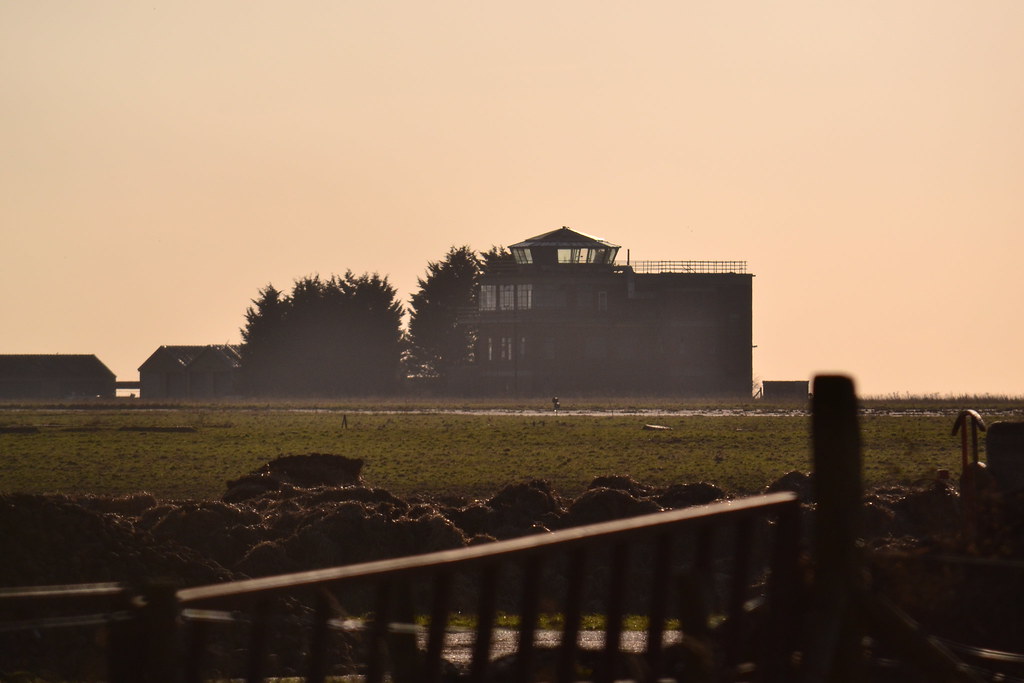
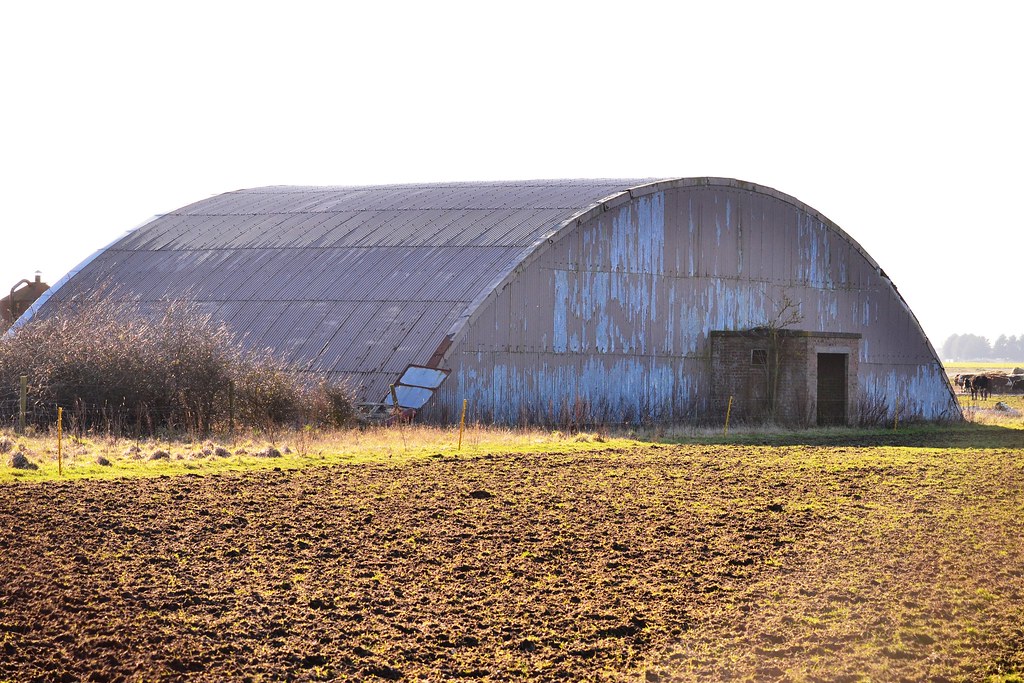
The original guard-house is no longer manned, and a number of other buildings close by are also empty. A small public track that once took eager plane spotters to the rear of the airfield, still allows views across the north of the now quiet site where a blister hangar continues to stand alone. The control tower that was visible in the distance from this point was demolished with little or no warning in 2022, and a number of original Nissan huts and Second World War buildings still remain hiding amongst new buildings and old developments.

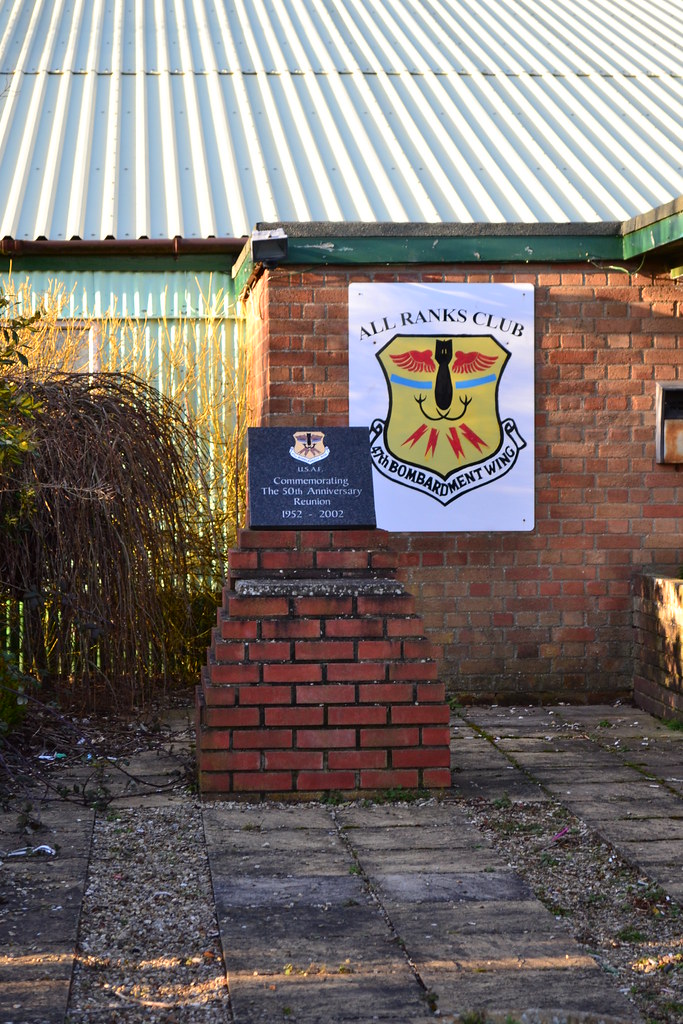
Reunion 'memorial'

In remembrance of the 47th BW, 50th anniversary reunion, 2002.

The post war ‘All Ranks Club’ housed a small exhibition of artefacts and information about Sculthorpe, depicting its post war life, and includes many interesting photos. The exhibition is open at certain times throughout the year allowing visitors to view them and talk to the volunteers some of whom actually served here at the base. In 2023/24, the Heritage Centre moved into the former Chapel after the staff refurbished the premises. The previous accommodation being returned to the public as a club house, its original purpose.

In 2022, a memorial was finally erected by the Airfields of Britain Conservation Trust outside the former main gate, and the original airfield sign was returned to the Heritage centre making its last journey home again.

The original name board returned to Sculthorpe 2023.

The original airfield sign had come back to Sculthorpe.

Sculthorpe was once a bustling airfield, it was home to some of the world’s heaviest bombers, and a mecca for aviation enthusiasts and plane spotters alike. Today, it is a decaying industrial site, a mix of old buildings and new developments; a remnant of the Cold War, it clings on to life by the skin of its teeth, maybe, just maybe, the Phoenix will rise up once more and spring into life once again.

The full story can be read in Trail 21.

Sources and further information (Sculthorpe).

*1 National Archives – AIR 27/1924/17

*2 Gunn, P.B., “Flying Lives – with a Norfolk Theme“, Peter Gunn, 2010

*3, *5 Cahill, W. “The Unseen Fight: USAAF radio counter-measure operations in Europe, 1943 to 1945” Journal of Aeronautical History Paper, 2020/06

*4 21 Sqn ORB Summary of Events 1943 Oct 01 – 1943 Nov 30, AIR 27/264/19

*5 Cahill, W., “The Unseen Fight: USAAF radio counter-measure operations in
Europe, 1943 to 1945” Journal of Aeronautical History, Paper 2020/06

*6 The Spyflight Website which gives considerable detail into the flights.

*7 Gunn., P. “Sculthorpe – Secrecy and Stealth, A Norfolk Airfield in the Cold War.” The History Press, 2014. (An excellent and well researched book that tells the in-depth story of Sculthorpe and the lives of those connected with it. A definite read for those wanting to know more).

*8 Aviation Safety Network Website.

*9 Davies, P. “B/EB-66 Destroyer Units in Combat” Osprey Publishing. 2021

Thirsk, I., “de Havilland Mosquito – an Illustrated Story Vol 2” 2006, Crecy Publishing Limited

National Archives: AIR 27/1924/19; AIR 27/1935/19; AIR 27/1326

Photos of Sculthorpe in its heyday can be seen on the Sculthorpe  Air Base website.

Further information and personal stories can be found on the 214 (Federated Malay States) Squadron website.

RAF Sculthorpe – The age of the Jet Bomber (3)

In Part 2, the war finally came to an end and Sculthorpe closed only to be reopened as a Very Heavy Bomber Base. Reconstruction has taken a number of years and although not fully ready, it starts to accept its new residents.

The first of the aircraft, two of Boeing’s huge B-29s, touched down at Sculthorpe on the 7th February 1949 late in the afternoon. However, six others also deployed to Sculthorpe, had to divert to RAF Lyneham due to the pilots not being able to see the runway in the bad weather. These aircraft would not arrive in Norfolk until later on, and so it was not to be the grand opening that many had wished for.

The deployment of US heavy bombers was seen by some as an extension of the US, and that Britain was becoming a ‘puppet’ of the US Government. The British Government try to make it clear to the public that this was not the case, and that these aircraft were only here on a temporary basis (90 day rotations), and that they were both ‘invited ‘ and did not have a nuclear capability. The Press on the other hand, did not see it quite so clearly.

It didn’t take long before the US 92nd Bomb Group were established at Sculthorpe. A veteran group of the Second World War, the 92nd had a prestigious history and one they would preserve and build upon. Formed of three squadrons, 325th BS, 326th BS and 327th BS, their numbers would swell staffing levels to almost 1,400, including both RAF and US personnel.

Various officials attended Sculthorpe’s many opening events, but the start of a new era was marred by a tragic mishap in late February, when an armourer,  Corporal Turcell, was killed when one of the B-29’s guns he was cleaning  accidentally discharged. It would unfortunately be the first of many tragedies to befall those at Sculthorpe over the coming years.*7

In March the airfield was officially opened with both the Union Flag and the Stars and Stripes being raised simultaneously. Behind the scenes however, construction work continued, with only half of the proposed six ‘Z’ blocks ready to take new residents and only sixty-two of the proposed married quarters being completed, it was far from ready.

Technical site buildings

A large part of Sculthorpe has been left to rot, piece by piece. These are the former RAF HQ and later the USAF Wing HQ.

The work carried on throughout the initial deployment and 90 days quickly passed. The 92nd’s placement at Sculthorpe soon came to an end and no sooner had they arrived then they began their journey back home to the United States. A relatively uneventful opening had come to a close.

The next of the rotations would take little time in coming. The intensity of each deployment getting greater each time, and even though the Berlin Blockade had come to an end, tensions remained very high right across Europe.

As the 92nd pulled out, a further three squadrons of B-29s began to arrive. Having already been in Japan, the three units the 343rd, 344th and 345th BS began by carrying out a number of exercises with the RAF, which included over June and July, the first multinational exercise code named “Foil“. Like many that would follow, this involved mock attacks by US and RAF bombers whilst fighters from the UK, US and Netherlands attempted to intercept them using camera guns. A successful exercise it gave rise to some interesting comparisons between the US and RAF aircraft, with many surprises in store.

As with the first deployment, the arrival of the B-29s did not all go to plan though, as on July 21st 1949, whilst transferring across from the US, one of them #44-62191 ‘suffered problems’ when its number 3 engine caught fire causing it to crash in an orchard at West Walton, 2 miles east of Wisbech in Cambridgeshire. The aircraft, a Boeing B-29A-65-BN, had a crew of twelve on board, and when it became clear that they were not going to make it, they  decided to abandon the aircraft and leave it to its fate.

All twelve of the crew successfully departed the aircraft landing nearby, but in doing so, two of them sustained serious, but not thought to have been life threatening injuries after exiting. The worst, suffered by the pilot, was a possible fractured skull whilst a second crewman suffered a fractured leg; it is believed both airmen made full recoveries. The aircraft itself ultimately crashed, landing in a field east of the small Fenland market town. The remains were quickly retrieved and some parts ended up in the local Fenland and West Norfolk Aviation Museum located in Wisbech. Now sadly closed, they were transferred to the Sculthorpe Heritage Centre located at Sculthorpe.

The 90 day rotations continued unabated. The next deployment bringing two different models; firstly the 63rd BS (43rd BG) with the extended B-29 the B50A ‘Stratobomber’ along with three refuelling aircraft the KB-29M, also a modified version of the B-29 with its turrets removed and refuelling facilities added.

What was perhaps more significant with this move was that the B-29 ‘Lucky Lady II‘ was part of this group. She and her crew had completed a ninety-four hour flight non-stop around the world, being refuelled four times in the air. This achievement sent out a major message to all those would be aggressors, wherever they may be in the world, that they were not beyond the range of the US heavy bombers.

As 1949 drew to a close, one other unit, 19th BS (22nd BG), would complete its rotation at Sculthorpe replacing the 63rd in November. It too brought another version of the B-29 the RB-29, a reconnaissance version of the heavy bomber. In support of this, a further unit would arrive in December, the 23rd Reconnaissance Squadron, bringing yet more versions of the B-29 to the airfield.

Tragedy then struck again in June 1950 when an RB-29A #42-94081, took off on a routine air test and gunnery exercise. During the exercise the outer engine was hit by the aircraft’s own guns setting it on fire. The aircraft was then difficult to  control and the pilot ordered the crew to bale out. As the B-29 hit the sea, three airmen, including the captain were still onboard; he failed to reach the aircraft’s dingy and sadly died as a result. Of the thirteen airmen on board seven lost their lives that day.

Control Tower

The watch office in a setting sun. This was ‘secretly’ demolished at short notice in March 2022.

The east/west crises continued with the war in Korea. The threat of an escalation spilling over into Europe led to a call for all US bases in Europe to be brought to full strength and further sites opened. Sculthorpe began its preparations and as the 301st BG and the 72nd Strategic Reconnaissance Squadron both departed for other UK bases, the site was left ready for the arrival of the 97th Bomb Group  and their B-50Ds.

This move signalled the beginning of a huge influx of men and machinery at Sculthorpe. Anti-aircraft batteries were brought in, along with ground units to defend the site from any possible attack. A range of aircraft support units also arrived boosting staffing considerably. With just over 400 RAF personnel, 1,800 US personnel and in excess of 600 army personnel, the quantity of men and women on the base was now as high as it had been during the Second World War.

With further deployments and new, larger aircraft arriving, not only was the need for further accommodation matched by the need for larger additional hardstands for the new bombers – the B-50 and B-36 ‘Peacemaker’, but the runways had to be extended even further, and an additional 1,200 feet was added calling for yet another diversion of the local road network.

In early 1951, after some friction between the RAF and US staff on the base, Sculthorpe, like both Mildenhall and Lakenheath, was officially handed over to the US forces, and although they all retained their RAF designation, they would be operated and maintained by US personnel; a standard that applies even today. It was a move that finally ensured America had its desired firm and permanent foot hold on UK soil.

The Cold War would then take a more devious turn. The arrival of the 323rd Reconnaissance Squadron (of the 91st Strategic Reconnaissance Wing) began its 90 day rotation with RB-45C ‘Tornados’, a reconnaissance version of the B-45 four engined bomber – the first if its kind to land on British soil. After landing at RAF Manston, the 323rd moved to Sculthorpe, where it would carry out ELINT (Electronic Intelligence Gathering) and mapping operations of western Europe. This intelligence gathering was not new, but since the end of the war, it had become more clandestine and difficult due to the clamp down by the Soviets on western spies.

Sculthorpe had now entered a new world, the Soviets had developed their own atomic bomb, and using a B-29 obtained at the end of the Second World War, reversed engineered it to provide a means by which to deliver it. The West had to find out more, and aerial reconnaissance was the only viable method with which to establish the location and number of such facilities.

There then followed extensive talks between the US and British Governments regarding Soviet ‘overflights’, western aircraft flying through Soviet airspace photographing and recording Soviet ground positions, SAM sites, airfields etc. Whilst not a new tactic, it was certainly a dangerous one, and one that could lead to all out atomic war should it go wrong.

Blister Hangar

Sculthorpe’s last remaining Blister hangar in a low setting sun.

As a result of these talks, the ‘Special Duties Flight Sculthorpe’ was formed, working in conjunction with the various squadrons of the 91st Strategic Reconnaissance Wing. RAF crews consisting of two pilots and a navigator, were flown to America for a period of extensive training on the RB-45. By the end of 1951, the course was complete and they returned to Sculthorpe to continue with further training along side crews of the 91st Wing in Norfolk.

This was a British unit, led by Squadron Leader John Crampton (who replaced the initial choice Sqn. Ldr. Micky Martin of the ‘Dambusters’ fame, as he had failed a high altitude medical examination) and was designed in part, to perform deep penetration flights into Soviet airspace carrying out reconnaissance missions for Britain’s planned ‘V’ Bomber force. It would also supply the Americans with substantial information for their own tactical use.

Four RB-45Cs were converted (including one spare), flown to RAF West Raynham they were stripped of all their American markings (allowing them to deny any knowledge of such activity) before their RAF insignia were applied (The RAF would deny ever having operated these aircraft). They were then returned to Sculthorpe as British aircraft operated by British crews. The flights would be code named Operation ‘Ju-jitsu‘, and would follow the same track that the British ‘V’ bombers would take in the event of all out war.

Initially three routes were chosen, one of which took the aircraft close to Moscow; a second flew to the Baltics and the last to southern Russia. To ‘protect’ crews, they were issued with false papers and maps, and told, if caught, to explain that, rather implausibly, they had simply become incredibly lost! Failure of the mission would therefore require a high degree of gullibility on the part of the Russians.

Only two such flights were ever made, each with three aircraft; the first on 17th/18th April 1952, and the second on 28th/29th April 1954*6.  The first occurred without any Soviet intervention, but they were understandably outraged and an investigation was carried out immediately.

After the first flight, the crews were congratulated by General LeMay, and the unit was then disbanded. However, it was reformed again, also at Sculthorpe, in 1954 (after a second such temporary reformation in September 1952 which was quickly disbanded again) and a second flight was made. This time the Soviets were ready for them. After having evaluated their air defence network they were far better prepared and the RAF crews were at a much greater level of danger than during their initial flights.

Whilst Soviet SAMs (Surface to Air Missiles) were impotent in that they had no guidance system, and it was thought Flak was unable to reach the high flying RB-45s, the trip would still be a dangerous one and strict radio silence was to be maintained by the crews. The flight itself turned out to be relatively uneventful, but Squadron Leader Crampton did witness Flak, and noticing that, whilst generally ineffective, it was indeed exploding at their height. Bursts were sufficiently close to convince the crews on board that a hasty return to the West was the better option, and a halt was called to the flight.

Some time after the operation, it was revealed that Soviet Mig pilots were instructed to ram the RB-45Cs as they had no suitable radar with which to track the intruders. However, no such contact was made and so thankfully the need never arose.

The unit was then again disbanded and all flights by them ceased for good. The consequences and risk of flying over Soviet territory now considered far too high.

1952 was a busy year at Sculthorpe, it went on to see the deployment of the 47th Bomb Wing (formally the 47th BG) of the Strategic Air Command from the United States. This wing consisted of the 84th, 85th, and 86th BS, along with the 420th Refuelling Sqn and the 19th Tactical Reconnaissance Sqn. These units operated a number of aircraft types including both the aforementioned B-45C and RB-45C, along with the B-66, KB-29, and KB-50 aircraft.

The 47th was activated on March 12th 1951, initially as the 47th Bombardment Wing (BW) but with just two squadrons – the 84th and 85th. As a new unit, it had the honour of being not only the first, but the only jet powered medium bomber Wing in the US Air Force. With NATO becoming more established and nuclear weapons arsenals expanding at a great rate of knots, the 47th were posted to Sculthorpe to provide an airborne nuclear strike force in support of NATO forces  who would be operating on the ground in any future conflict.

The B-45 achieved many “firsts.” It was the first US four-engine jet bomber to fly; the first American production jet bomber; the first jet bomber capable of carrying an atomic bomb; and the first multi-jet reconnaissance aircraft to refuel in mid-air. These were based at Sculthorpe between 1952-1958, with the 47th Bomb Wing (Light) along with RB-45Cs from the 19th Tactical Reconnaissance Squadron and Royal Air Force (RAF) Special Duty Flight. These RAF RB-45 crews flew highly classified reconnaissance missions deep into communist territory. (National Museum of the USAF)

A year later, a third squadron would arrive to join the Group, that of the 422nd BS. Within a month or two of its arrival though, the unit was re-designated as the 86th BS a move that brought it in line with its two sister squadrons. For six years the 47th would operate out of Sculthorpe acting as a nuclear support unit for NATO forces in Europe.

The influx of US personnel not only impacted on the immediate and local community, but much further afield as well. In 1953, it cemented strong relations with the people of Norfolk as a whole and in particular those of the coastal town of Hunstanton, when severe floods claimed over 300 lives nationally and 100 locally; some of these were families of those located at the base living in austerity houses near to the seafront.

However, it was more the actions of the personnel at Sculthorpe that led to this unique relationship. When the floods came, staff at Sculthorpe rallied round and attempted rescues of those stranded by the high waters. One such man was 22 year old Airman 2nd Class, Reis Leming of the 67th Air Rescue Squadron, who even as a non-swimmer, braved the freezing waters to rescue no less than twenty-seven people using dinghies from B-29s. His brave and selfless act won him the Soldier’s Medal from the US forces and the British George Medal.

Road sign Hunstanton

Airman 2nd Class, Reis Leming of the 67th Air Rescue Squadron was awarded the George Medal for his brave act on the night of 31st January 1953.

Various other personnel also received awards for their bravery. These included Staff Sergeant Freeman kilpatrick, (George Medal); Airman 1st Class Jimmy Brown  and Technical Sergeant John Germaine (Queen’s Commendation for Brave Conduct); Airman 1st Class Jake Smith (British Empire Medal) and Major Julian Perkinson (Honorary Member of the Order of the British Empire). Both Leming and Kilpatrick have roads in Hunstanton named after them and a plaque dedicated to those who lost their lives stands by the town’s war memorial alongside the Union Flag and the Stars and Stripes*7.

As the 1950s progressed the influx of personnel reached its maximum with some 10,000 personnel being associated with the airfield. The 47th remained the main force located at Sculthorpe but as a division, there would be other, more tactical short range aircraft, also present here. At any time, the 47th could put up between forty and fifty aircraft*7, predominately the B-45, in response to events either in Europe or across the world.

Joint operations continued between the Americans and RAF; including ground forces carrying out training operations ‘attacking’ the airfield to test the defenders in case of war, and training flights assisting gunnery battalions along the north Norfolk coast.

The build up of nuclear weapons also increased, weapon sizes were now more modest although the punch they packed was considerably greater than the original bombs dropped on Hiroshima and Nagasaki. Smaller and faster aircraft could carry these weapons and both were being stored at Sculthorpe. The unfortunate release of this information, soon became media headlines, and quickly became widely known. This plainly identified Sculthorpe as a major site from which any future nuclear attack would come.

The swelling of personnel numbers at Sculthorpe would be further aided by the arrival of the 19th Tactical Reconnaissance Squadron (TRS) and yet more RB-45Cs. Headed by the wartime and Korean veteran Major John Anderson, they would photograph Soviet movements along with installations both along and over the delicate east-west border.

In the final part, Sculthorpe maintains its status as a leading nuclear bomber base, housing US bombers and reconnaissance aircraft on this enormous site. East-West relations deteriorate further but there is hope for the future. In the meantime, bigger and more powerful jet bombers arrive.

The full story can be read in Trail 21.

RAF Sculthorpe – The War ends and the Americans arrive (2)

In Part 1, we saw how Sculthorpe was developed and how it became an airfield in its own right. 2 Group had taken charge and brought in it light bombers, but all would no go to plan.

Meanwhile 464 and 487 Sqn had both been flying operationally, October 9th being the blackest day yet for the New Zealanders, when twelve Mosquitoes were dispatched for the first operations over occupied territory. An attack on Metz was planned but owing to bad weather only one or two aircraft managed to find the target. After dropping their bombs it wasn’t clear whether the target was hit or not, but worse news was yet to come. The formation, which had been dispersed due to poor weather, was being led by Wing Commander Alan G. Wilson DFC along with his navigator F.O. Donald C. F. Bridgman of 487 Sqn. During the attack the formation encountered severe anti-aircraft fire, and Wilson’s aircraft (HX965) was repeatedly hit. The navigator sustained mortal wounds and the aircraft was set on fire. In a desperate attempt to clear the fire, Wing Commander Wilson had to douse the flames with his hands resulting in extensive burns and injury. After fighting the fire, Wilson managed to eject the now smouldering material from the aircraft, but considerable damage had been done. Now flying on his own with his mortally wounded companion beside him, Wilson showed extreme courage and determination, flying the stricken aircraft back to England where he made a successful crash landing at RAF Manston in Kent.

Accomodation blck adjacent to the guard room

Blocks adjacent to the Guard Room.

A second aircraft (HX912), flown by Flt. Lt. Phillip C. C. Kerr and F.O. Bernard J. E. Hannan (464 Sqn) – was less lucky, both pilot and navigator being killed when the aircraft dropped its bombs at low level. It is believed the subsequent explosion also blew up the Mosquito they were flying.

On a separate operation to attack the aircraft engine factory at Woippy in France, Mosquito  HX938 piloted by Sqn. Ldr. Walter F. Wallington DFC and navigator P.O.  James H. Fawdrraf, dropped its bombs by accident and crashed. This time, both airmen managed to bail out, but some thirty people on the ground were killed. Sqn. Ldr. Wallington managed to evade capture but P.O. Fawdrraf was not so lucky and was soon picked up by German ground forces.

The same fate did not befall two more 487 Sqn airmen that day. Flt. Lt. Edgar W. P. Court and Flt. Lt. Jack B. Sands were both killed when their Mosquito (HX937) blew up whilst flying on one engine near to Antwerp. It had been a very sad day for the Wing, and the loss of several ‘good’ men would be deeply felt by both squadrons.

More rain and strong winds eventually turned Sculthorpe into something that resembled a “seaplane base”, by the end of the month, the entire site was waterlogged. The winds were so severe they were reported to have lifted hut roofs off their mountings causing even more problems for those inside.

On the 22nd – 23rd October, the foul weather momentarily broke and allowed for some bombing practice to take place. On return  from the range, one of the 464 Sqn Mosquitoes (HX948) overshot due to an electrical failure with its instruments and crashed onto a hedge at the end of the runway blocking a road as it did so. On the 23rd, in more foul weather, one of 487’s Mosquitoes ‘T’ for Tommy (HX831), did exactly the same thing, coming to rest only feet from the wreck that was previously a Mosquito. As if that was not remarkable enough, a few minutes later one of 21 Sqn’s aircraft (HX956) also overshot, colliding with the 3-ton crane that had been brought in to recover the first aircraft, landing directly on top of the wrecked Mosquito! Miraculously no one was hurt in any of these incidents, but according to 21 Sqn’s ORB “considerable loss of public property sustained“, presumably referring to the pile of wood chippings now sitting at the end of the runway.*4 The fact that no one was hurt was a miracle in itself, and all the cockpits remaining intact was a sight that gave the personnel at Sculthorpe a great belief in the strength of the Wooden Wonder! But the catastrophe would begin a series of events that would eventually lead to 140 Wing leaving Sculthorpe for good.

By October’s end, the crews of all squadrons were now fully conversant with the new Mosquito, and the supporting Conversion Flight was disbanded; specific training units taking on the role elsewhere.

The harsh winter of 1943-44 would see a special visitor come to Sculthorpe. Wing Commander Leonard Cheshire arrived to discuss, with Pickard, the plausibility of dropping food and clothing to his brother in Sagan (Salag Luft III) using the Mosquito. Cheshire knowing Pickard’s vast experience, thought he was the ideal person to speak to. Whether this was a personal effort to provide comfort to his brother or whether Cheshire was considering the Mosquito for low level precision attacks is not known, but the latter befell the Wing not long after Cheshire’s visit.

The December of 1943 would then bring major changes here at Sculthorpe. On New Year’s Eve, two months after the initial three Mosquito accident, the Wing, along with Pickard and all three Mosquito squadrons, would leave the Norfolk site, taking their Mosquito VIs to RAF Hunsdon. A much smaller airfield, where the overcrowding experienced at Sculthorpe must have been considerably worse.

It was from Hunsdon that Pickard would famously make his last flight. A story goes that Pickard had left his dog ‘Ming’ at Sculthorpe to be looked after whilst he was away. On the day he was shot down, 18th February 1944, on the Amien raid, the dog fell gravely ill. Pickard’s wife, Dorothy, went to get him and sensed that Pickard had been killed after seeing the state of the animal. It took months for Ming to recover, and some years later whilst living in Rhodesia, Ming went outside, looked up to the sky as he always did when Pickard was flying, heard a whistle, collapsed and died.*2

The departure of the Wing effectively left Sculthorpe with no operational units, until on January 6th 1944, when a new and very different squadron began to move in.

Crews from 214 (Federated Malay States) Squadron based under 3 Group at Downham Market, arrived in two waves, the initial group coming across in early January 1944, whilst the main body continued  operations flying their Stirling bombers. Those that arrived here quickly settled in, but a lack of decent paths meant that initial training was mixed with the unenviable task of digging and laying of new paths. Whilst attending lectures and link training were the primary tasks for the pilots and Flight Engineers, the gunners and other aircrew were given the more ‘practical’ task of constructing the new paths ready for the remainder of the squadron’s arrival.

Bomb store

Sculthorpe’s bomb store was relocated in the late 1950s and was nuclear capable.

Then on the 25th, the remaining crews and staff of the squadron departed Downham Market, thus ending their link with 3 Group. Once here, flying circuits and more lectures became the order of the day. Additional training on ‘Monica‘ equipment, fighter affiliation tasks and local cross countries then took the squadron to late spring at which point operations began to take place.

The arrival of 214 Sqn heralded more than just a new bomber squadron though, for they would not be flying the Stirling as they had been; instead, they were set up as part of 100 Group, becoming an official member in mid January 1944. Their arrival here would not only see them change Groups but would also see them convert to the American built B-17 ‘Flying Fortress’. Now designated 214 (BS) Sqn,  their arrival would bring another major change to Sculthorpe, a change that would continue for the next five months, but would have repercussions for many years to come.

Operating in the Electronic Warfare role within 100 Group, they would carry out radio jamming operations, an early form of Electronic Counter Measures (ECM). The urgency of the conversion, led to the unit taking on fourteen UK based B17-Fs , their ordered ‘G’ models being used as a trade off*3.

The British B-17 (designated Fortress I, II and III) crews were joined by personnel from various U.S. units. Their role was to train and support the air and ground crews in both flying and maintaining the new aircraft, a role they performed well, right into the early summer of 1944. The set up was so successful that American personnel were soon posted in to fly alongside the RAF crews, thus expanding the influence of the Group.

Flying along side other bomber formations, 214 Squadron would use systems including ‘Monica‘ to track or jam enemy radar, they performed ‘spoof’ missions to entice enemy fighters up to them rather than the main force that was attacking targets elsewhere; a rouse that worked well initially.

Fortress B Mark III, HB796, at Prestwick, after being fitted with radio counter-measures equipment by Scottish Aviation Ltd. It served with No. 214 Squadron from November 1944. Equipment fitted included American AN/APS15 radar in the large radome under the nose, ‘Airborne Cigar’ (ABC) radio-jamming equipment (shown by the large aerial on top of the fuselage), and an ‘Airborne Grocer’ aircraft radar jamming installation, the aerials of which can be seen on either side of the tail turret. HB796 failed to return from a bomber support mission on 9 February 1945. (© IWM ATP 13090E)

Other operations flown by the Group, included: jamming or swamping German radio communications, jamming navigation aids and searching for new signals that may suggest new or improved German radar.*3 The successes of 100 Group, prompted the setting up of the U.S. 803rd (Prov) BS (H) in March that year, a US Group who would learn from, and perform in the same role as 214 Sqn. Initially taking six veteran crews, all having reached 25 missions, from 96th BG at Snetterton Heath combined with those already at Sculthorpe, they would soon build up to a strength of twelve aircraft all based here at the Norfolk airfield. Of these initial six all but one were fitted with Carpet and Mandrel jamming equipment, whilst the sixth (B-17G) had jammers and search equipment in the form of SCR-587 and Hallicrafters S-27 VHF signals intelligence receivers (SIGINT) to track Luftwaffe radar and radio transmissions.*5

However, the initial set up of the unit was seen as ‘messy’ and disorganised with no real focus, a problem that led to delays in preparation, organisation and training. As D-day appeared over the horizon, the U.S. group was distinctly lacking in preparation and action was needed fast. To assist in the training and operations of the Fortress, a further new separate unit was also set up here at Sculthorpe.

From April 24th 1944, 1699 (Fortress Training) Flight who operated each of the Fortress I, II and III, carried out the conversion and training role for these crews, and to speed the process up, they also used the B-24 Liberator along with some smaller examples such as the Avro Anson and Air Speed Oxford. By this time, personnel at Sculthorpe amounted to some 104 RAF Officers, 233 Senior NCOs, 705 airmen, 190 WAAFs of various ranks and 1,073 US Officers, NCOs and airmen*7.

Then, five months after their arrival, both 214 Sqn and the 803rd were both posted out to RAF Oulton, (May 1944), where they continued with their ECM roles. The 803rd, now commanded by Lieutenant Colonel Clayton Scott, began to work on the support of Operation Overlord, and even as late as June 5th, equipment was still being fitted to the aircraft. The Fortress Training Flight moved with the two ECM units and in October it was disbanded and immediately reformed as 1699 (Bomber Support) Conversion Unit, a designation it used for a year before being renamed once more.

The departure of the three squadrons (along with the resident non-flying units) was not a coincidence, for Sculthorpe had been earmarked for redevelopment into a Very Heavy Bomber base (VHB). As soon as the personnel had moved out, it was placed into ‘care and maintenance’ and the workmen from Taylor Woodrow moved in; taking up residence in the now empty nissen huts on Site 3.

Accomodation Block

‘Z’ type Barrack Block (named so due to their shape – many of these are now in serious dilapidation)

The end of the war in 1945, didn’t unfortunately bring an eased peace. Tensions with Russia and a possible threat from the east meant that discussions had already started between the US and UK authorities over staging American heavy bombers on UK soil. This was not a decision taken easily; firstly, it would put Britain firmly on the front line in a war with Russia, and secondly, these bombers would need a significant infrastructure to support them. Runways would need to be extended to a minimum of 8,000 feet long and 200 feet wide with an additional 1,000 feet for any unintended overrun. Specialist buildings would be needed, larger dispersal pans required and hangars able to house the aircraft would also have to be erected.

With all that in mind, a number of sites in Lincolnshire,  Kent and East Anglia were identified as possibles, one such airfield in the eastern region being Sculthorpe. It, like Lakenheath, already had a strong string to its bow, already having sufficient buildings to house the 10,000lb atomic bomb should the need arise. It was also, already a substantial size with good room for extension and further development. These factors essentially saved the life of Sculthorpe and for several decades after the end of the Second World War would see it really come to the fore and become a major player in not only British, but world aviation as a whole.

And so, US development specialist moved in, after which followed a period of sustained redevelopment of the site. This included the removal and reinstatement of longer runways along with the construction of twelve very heavy bomber hardstands. Surrounding public roads were also diverted and further properties were demolished to make way for the airfield’s expansion. New accommodation blocks, ‘Z’ blocks, were built, and new married quarters were created. The whole process took around three to four years to complete during which time the station was basically closed with only an occasional use keeping it alive; one such operator being the 1510 Beam Approach Beacon System Flight (BABS) based at nearby Bircham Newton.

A further deterioration in east-west relations then led to the Berlin crisis and what has famously become known as the Berlin airlift. The political situation in Europe essentially forced the hand of both Governments to make a final decision, one which resulted in the deployment of sixty (2 Bomb Groups) Very Heavy Bombers at various UK airfields. Whilst these deployments were on a temporary basis only, the decision would however, be the first step on the ladder to the US establishing itself officially, on UK soil for many years to come.

The lack of use over the last few years had meant however, that much of the accommodation at Sculthorpe had deteriorated to an unacceptable level. Damp and rot had set in and more work was now needed to bring it back up to standard before further deployments could take place. Even as this was being carried out though, bombs and other supplies along with, in February 1949, an advanced party of US personnel from the 92nd Bomb Group, began to arrive. As they passed through the main gate so began a new page in Sculthorpe’s history,  and soon it would be ready to be an active base once more.

By December 1948,  Sculthorpe, operating as a satellite to RAF Marham, began to prepare for its official opening. A somewhat premature move as reconstruction work was still going on and there was much to do before the airfield would be truly ready for its new residents.

In Part 3, Sculthorpe develops further, it receives its new residents and a new page is turned. As relations with the East becoming difficult, a new age dawns and nuclear weapons become the way forward.

The full story can be read in Trail 21.