RAF Debden (Part 3) – The USAAF Arrives.

After Part 1 and Part 2 of the trail, we find that Debden has a new owner, the USAAF. Its fortunes change and it becomes home to one of the most famous Fighter Groups of the Second World War.

121 Sqn, were reformed in 1941 at Kirton-in-Lindsey, initially with the Hurricane MK. I, and then IIBs moving on to the Spitfire IIA and eventually the VB; a model they brought with them to Debden. 71 Squadron had been formed at Church Fenton, and after moving through a series of stations that included Martlesham Heath, they arrived at Debden on 3rd May 1942 also with the Spitfire VB. On September 29th 1942 the two RAF units along a with a third, the 133 Sqn at Great Sampford,  were officially disbanded, but the men of the three units were not dispersed. Instead they absorbed into the USAAF as the 4th Fighter Group (FG). The men of these squadrons were all originally US volunteers who formed the three  American ‘Eagle Squadrons‘ operating within the Royal Air Force.

The 4th FG was specially created to take these three squadrons, they were brought together at Debden where they became the 334th (71 Sqn), 335th (121 Sqn) and 336th (133 Sqn) Fighter Squadrons (FS).  Debden would then be passed from the RAF to the USAAF, the transition of which, would be smooth and relatively uneventful, the units retaining the Spitfires they already had before replacing them with P-47s later in 1943.

A Spitfire Mk. V (QP-V) of the 334th Fighter Squadron, 4th Fighter Group. Handwritten caption on reverse: '1942. 334 FS. 4th FG.'

A Spitfire Mk. V (QP-V) of the 334th Fighter Squadron, 4th Fighter Group. (IWM)

The handover of ownership of Debden took place on the 12th September 1942, with an official ceremony on the 29th to coincide with the disbandment of the RAF units. During this ceremony both Major General Spatz and Brigadier General Hunter were joined by Air Chief Marshal Sir Sholto Douglas of the RAF’s Fighter Command, to see Debden and the aircrews officially joining the ranks of the USAAF. Initially little changed after the handover, the most prominent feature being the removal of the RAF roundels and the application of the US Star on the aircraft’s fuselage and wings. New ground crews were brought in and trained by RAF personnel to maintain the Spitfires, and so RAF crews remained on site until such times as the American were in position to become self-sufficient.

As these crews had been involved in front line operations for some time – the 71st having gathered a total of over half the 73.5 kills recorded by the three squadrons – they were immediately made operational and went on performing in the duties they had been so adept at completing thus far. So proud of their origins were they, that the 4th FG stood out from their fellow Americans both in the way they flew, and the way they behaved.

With their first mission under the ‘Stars and Stripes’ on October 2nd, they would not have to wait long before seeing action once again. The Eagle Squadrons would become famous throughout the war, achieving many records in aerial combat over the next three years. Taking part in the Normandy invasion, aerial battles over Northern France, the Ardennes, the Rhineland, and over Berlin itself; they would not be short of combat experience. Throughout their time the 4th FG would achieve many ‘firsts’. They were the oldest fighter group of the Eighth Air Force, and their combined totals of  enemy aircraft destroyed both in the air and on the ground was the highest of the entire USAAF. They were also the top scoring Allied Fighter Group of the war, destroying 1016 enemy aircraft for a loss of 241 of their own aircraft, many of which were due to flak. They would be the first unit to engage the enemy in air battles over both Paris and Berlin, and they would be the first US Eighth AF Group to penetrate German airspace – a record they established on 28th July 1943. The 4th would also be the first fighter group to be selected to escort the heavy bombers of the USAAF on their first shuttle run, landing in Russia before returning home.

Not only did they undertake many ‘firsts’, but the 4th FG gained an undeniable reputation, between the 5th March and 24th April 1944 they earned a Distinguished Unit Citation when they shot down 189 enemy aircraft whilst destroying 134 on the ground. You cannot mention the 4th without mentioning the name of Donald M. Blakeslee, credited with 16 kills, he was a brilliant fighter pilot who retired from the USAAF as a Colonel. Blakeslee was considered one of finest combat fighter leaders of the Second World War who shunned publicity even refusing to paint ‘kills’ on his aircraft, and he was known, on several occasions, to give kills to rookie airmen. Blakeslee initially flew in 401 Sqn (RCAF) before transferring to 133 Sqn and then the USAAF when they transferred across. He was a remarkable man, a great leader who was looked up to by all those who flew with him, he sadly died in September 2008 leaving a daughter. All-in-all, the 4th achieved quite a remarkable record considering they were initially volunteers of the American air war in Europe.

The 4th FG would remain at Debden thought the war, leaving it only when the RAF required the return of the airfield in July 1945, at which point the whole group packed up and departed for Steeple Morden in Cambridgeshire.

Airmen of the 4th Fighter Group ride in the back of a jeep at Debden air base. A P-47 Thunderbolt is in the background of the shot. Passed by the U.S. Army on 2 October 1943, THUNDERBOLT MISSION. Associated Press photo shows:- Pilots at a U.S. Eighth Air Force station in England are taken by truck from the Dispersal room to their waiting P-47's (Thunderbolts) at the start of a sortie over enemy territory. L-R: Lt. Burt Wyman, Englewood, N.J. ; Lt. Leighton Read, Hillsboro, W.V.; F/O Glen Fiedler, Frederickburg, Tex. AKP/LFS 261022 . 41043bi.' [ caption].' Passed for publication ....1943'. [stamp].

Taken almost a year to the day the US forces moved in, airmen of the 4th FG are taken ot heir P-47s before departing on a mission over enemy territory. The aircrew are: L-R: Lt. Burt Wyman, Englewood, N.J. ; Lt. Leighton Read, Hillsboro, W.V.; F/O Glen Fiedler, Frederickburg, Texas. (FRE 28 – IWM).

As 1943 dawned it would become much quieter in terms of movements at Debden. Now officially a US fighter airfield, the RAF had little to do here. For a short period of a week, 303 Squadron would stop over, the only visitors to make any great use of the airfield for the entire year. With Debden having long concrete runways, it was regularly visited by the lighter bombers, Marauders and Havocs taking refuge here from their own fog bound airfields during poor winter weather. It was during this time in 1943, that The Duchess of Kent, made a royal visit to Debden, taking time out to inspect the aircraft and crews of the 4th Fighter Group, accompanied by General D. Hunter and Colonel Edward Anderson.

With that 1943 faded into 1944, the jet age was dawning and the end of the war nearing sight.  In the July, 616 Squadron appeared with the Meteor, Britain’s first operational Jet aircraft. The squadron detachment stayed here until early 1945 when they moved on to Colerne and eventually the continent.

This move would signify the end of operational flying at Debden. The RAF retained the site reforming the Empire Flying Training School here on 7th March 1946 by merging both 12 and 14 Radio Schools into one. Flying a number of aircraft including Proctors, Tiger Moths, Ansons, Dominie and Lincoln IIs until October 20th 1949 when it was disbanded and Debden became the Royal Air Force Technical College, Signals Division. After a further name change the unit was finally disbanded on April 8th 1960, after it had operated a variety of aircraft including an: Anson, Air Speed Oxford, Spitfire XVI, Lincoln and Varsity.

Between 1963 and October 1973, Vampire F. MK.3 VF301 stood outside Debden’s front gate as guardian, one of several that have been here. It is now sits in the Midland Air Museum at Baginton in the markings of 605 (County of Warwick) Sqn as ‘RAL-G’.

DH Vampire F-1

A former Guardian of Debden now at the Midland Air Museum at Coventry’s Baginton airport.

Although remaining open, the airfield was used for a number of public displays and as a race track, including in 1966, the RAF Debden Motor Gala which featured Donald Campbell’s car, Bluebird CN7, in which Campbell set the land speed record in 1964.  Parts of the site are still used for racing today by the Borough 19 Motor Club*3

In 1975 the airfield officially closed although 614 Gliding School (later 614 Volunteer Gliding School) remained on site using it for flying, until they too departed moving to Wethersfield in 1982.

The army took over the site when the RAF Departed and they remain there to this day.

Debden, because if its post war usage, is a remarkably unique site, but whilst many of the original buildings remain intact, some even being listed as Grade II buildings*4, access is not permitted to the general public and therefore very little can be seen without prior permission. From public roads, high fences and thick hedges obscure most views although from the south, parts of the runway, and several dispersals can be seen quite easily.
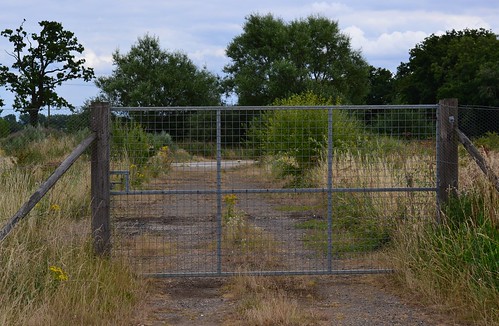
RAF Debden

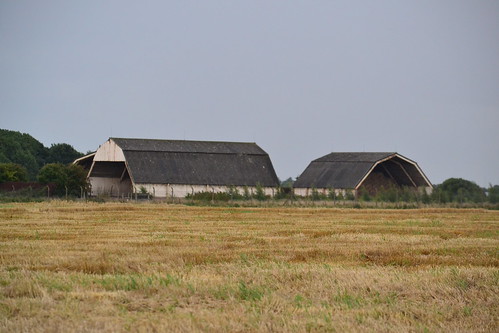
One of the pans now missing its Blister hangar.

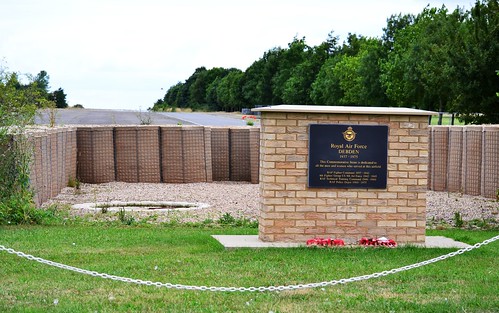
By keeping the gate house to your right and passing along the road east to west, you pass the current accommodation area, Guard House and modern buildings used by the current Army owners. Continuing along this road soon brings you to the memorial. Whilst there is no official parking space here, there is a grass verge opposite the memorial where you can safely park your car off the busy main road. Behind the memorial is the north-south runway, still in full width, in which a small section of it can be seen as it rises and dips over the hill. Returning toward the main entrance brings you to a parking area on your right, where public access is permitted to Rowney Wood. Here there are a small number of original buildings still left along with former roads / and taxi ways. During its US occupation, there were five Blister Hangars located here, today only a couple survive, both in current use by local companies.

Like many former airfields and military sites, Debden has been identified as a possible housing location, with the potential for the construction of 55,000 homes. The announcement to close the barracks was made on November 7th 2016, as part of the ‘Better Defence Estate’ strategy, in which 91 MOD sites across the country will close by 2040. Government figures say that the move will save £140 million by closing these sites which also includes the US base at Mildenhall.*5

Considering the history of RAF Debden and the current status of its buildings, the restrictive nature of the site is also its guardian angel. However, with the axe looming heavily overhead, what will become of this site in the future? Its runways will no doubt be dug up, the older non-classified buildings could be demolished, its pathways and taxiways removed. Debden is in danger of disappearing for good leaving only small traces of this once famous airfield that not only took part in the Battle of Britain, but whose airmen defended London in what was very much our darkest hour.

Sources and further reading.

*2 AIR 27/703/17 National Archives

*3 ‘Borough 19 Motor Club’ website has details of their race activities.

*4 One such building is the Sector Operations Block, built in 1938, to the designs of J.H. Binge of the Air Ministry’s Directorate of Works and Buildings (drawing no. 5000/137).

*5 The story was highlighted in the Saffron Walden Reporter website accessed 11th October 2017.

Royal Air Force Police Flights who were at Debden have photos and information on their website.
RAF Debden (Part 2) – The Battle of Britain.

Following on from the first part of this Trail, we see how Debden was thrust into the Battle of Britain and the historic changes that followed.

On August 18th 1940,  at 17:30, the squadron consisting of thirteen aircraft were scrambled to patrol the Skies over Debden. Almost immediately they were diverted to Canterbury and ordered to patrol at 20,000 ft. Five minutes after reaching their designated point, they were ordered into battle attacking ‘raid 51’ who were crossing the coast in the vicinity of Folkestone. Within minutes, the two formations were entwined and the aircraft of 85 squadron set about the 150 – 250 machines of the Luftwaffe.

A mix of J.U. 87s, H.E.111s, J.U. 88s, M.E. 110s and M.E. 109s were staggered in layers between 10,000 feet and 18,000 feet, and as soon as the aircraft of 85 squadron were sighted, the enemy immediately employed tactical defensive manoeuvres with some of the bombers heading seaward whilst other climbed toward their fighter protection.

Hugely lacking in aircraft numbers, the RAF  had little choice but to ‘dive in’, as a result large numbers of individual ‘dog fights’ occurred, resulting in aircraft being strewn across the Essex sky around Foulness Point.  For a while there was complete chaos, aircraft were burning and crews knew little of each other’s whereabouts. In one incident P/O. J. Marshall (Yellow 2) followed his leader into attack. In the melee that followed Marshall flew into a cloud of vapour created by a damaged H.E.111 his wing colliding with the tail of the Heinkel severing it completely and cutting the wing tip-off of his own aircraft. Despite the damage Marshall nursed his crippled aircraft to Debden where he landed safely and unhurt.

During this attack six Me 110s, three Me 109s and one He 111 were confirmed as destroyed, a further He 111, Me 110, Ju 87 and Me 109 were confirmed as probables, whilst four Me 110s and two Do 17s were known to have been damaged.

85 Squadron casualties on the day consisted of one Hurricane destroyed and one damaged. It was during this attack that  Flight Lieutenant Richard H.A. Lee, D.S.O., D.F.C. (s/n 33208), flying as Blue 1, was last seen by Sqn. Ldr. Townsend and F/O. Gowers 10 miles east of Foulness Point chasing 5 Me 109s. He lost contact and failed to return to Debden.  Lee, a veteran with nine victories to his name, was Lord Trenchard’s Godson, and was reported missing that day. *2

On the next day, 19th August 1940, 85 Squadron departed Debden, swapping places with 111 squadron who had previously moved to Croydon. In a signal Air Chief Marshal Sir Cyril Newall, G.C.B., C.M.G., C.B.E., A.M., expressed his thanks to the crews of 85 Sqn, sending his gratitude for “all your hard fighting” in which he added “This is the right spirit for dealing with the enemy.” 85 Squadron went on to continue the fight at Croydon flying in the same determined manner they had shown whilst based at Debden.*2

RAF Debden

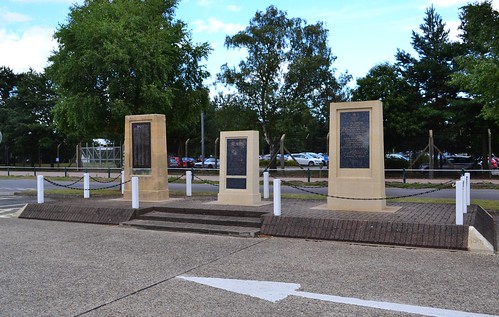
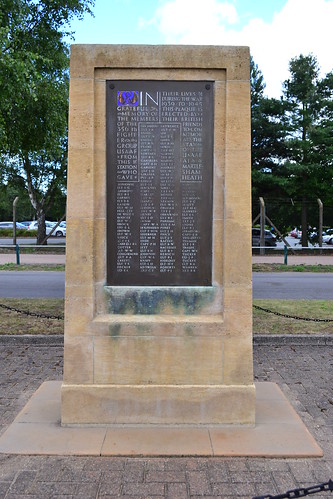
The memorial at Debden sits at the end of the north south runway (seen behind).

It was also during August 1940 that Debden became a focus for attacks by the Luftwaffe. On the 20th, a small reconnaissance mission took German aircraft over the airfield along with other airfields in the region. Six days later, on August 26th, the first attack on Debden would occur, a combined attack that would also involve strikes on Kenley, Biggin Hill, Hornchurch and North Weald airfields.

Whilst 11 Group – whose sector headquarters were at Debden – put up ten squadrons and one flight to intercept the incoming raiders,  a number of bombers did get through and over 100 bombs were dropped on the airfield damaging the landing area; the sergeants mess, NAAFI , a motor transport depot and equipment stores. In addition to this the water and electricity supplies were both cut, and five personnel were killed. The raid was made worse by the inefficient vectoring of protective aircraft from Duxford due to them being unable to obtain the correct radio frequency. This mishap did little to help the ongoing ‘dispute’ between Air Marshal Sir Keith Park and Air Vice-Marshall (later Air Marshal) Sir Trafford Leigh-Mallory, who were both locked in dispute over the defences of 11 Group’s airfields – it was arguably this feud that eventually cost Park his command of 11 Group, and a move as AOC to Malta.

At the end of August, Debden would once again become the focus of Luftwaffe attacks. Shortly after 8:00am on the morning of August 31st 1940, waves of Luftwaffe bombers flew over Kent turning northwards toward North Weald, Duxford and Debden. A formation of Dornier bombers managed to reach Debden again where they dropped over 100 incendiary and high explosive bombs on the airfield. This time the sick quarters and barrack blocks received direct hits whilst other buildings were damaged by blasts.

Further attacks on September 3rd and 15th failed to materialise and Debden was finally left alone to lick its wounds and repair the damage to its fragile infrastructure. It was also during this time (2nd September to the 5th September 1940) that all three resident squadrons: 257, 601 and 111  would depart, leaving Debden behind and heading further south to pastures new.

With the ending of the Battle of Britain, things would become a little quieter at Debden, although movements of man and machine would continue with a perpetual occurrence. The October and November would see more short stays: 25 squadron (8th October for around two and half months); 219 Sqn as a detachment for two months, and 264 Sqn at the end of November for just one month. These changes would lead Debden into the new year and 1941.

During 1941, 85 Squadron would return yet again, and after being bounced around with almost regular occurrence this, their final visit, would be in the night fighter role. Initially using their Hurricanes and then Defiants, they soon replaced these with the Havoc before vacating the site for good and the fields of Hunsdon in May that year.

There were yet more short stays during 1941: 54 Squadron in June (two days), 403 Squadron (25th August  – 3rd October); 258 Squadron (3rd October  – 1st November); 129 Squadron (1st November – 22nd December); 418 squadron (15th November – 15th April 1942); a detachment of 287 Squadron; 157 who were reformed here on 13th December moving to Castle Camps five days later where they would receive their Mosquito II aircraft, and finally 65 Squadron who arrived three days before Christmas and stayed until 14th April 1942.

One of these squadrons, 403 Squadron flying Spitfire VBs, was formed as a result of Article XV of the Riverdale Agreement, in which it was agreed between the British Government and the nations of the commonwealth: Canada, Australia and New Zealand; that their trained military personnel would fly and operate as part of the Royal Air Force. This would mean that both air and ground crews would perform their duties under RAF command. Some 70 squadrons were created as a result of this agreement, and of those seventy, 67 were numbered in the 400 series. Even though they were part of the RCAF, RNZAF and RAAF, they were treated as integral parts of the British Royal Air Force for the duration of the conflict.

Into 1942 and yet more of the same, 350, 41, 124, 232 and 531 Squadrons all following this similar pattern of short stays and placements, thus life at Debden was becoming a constant carousel of ground crews and flying personnel. Two squadrons from here did make a real name for themselves though, that of 71 and 121 Squadrons.

In Part 3, we see Debden take on a new owner, its fortune changes and it becomes home to one of the most famous Fighter Groups of the USAAF – the 4th Fighter Group.

RAF Debden (Part 1) – The Build up to the Battle of Britain.

Not far from Wethersfield, lies the parent airfield of Castle Camps. Now closed to aviation, it currently resides in the hands of the Army as the Carver Barracks. On this next part of this Trail we wind our way through the Essex countryside to the former fighter station that gained notoriety during the early 1940s, and in particular the Battle of Britain. In this, the first part of the visit, we look into the development of the airfield, and the build up that took it into the heart of the Battle. We visit the former RAF Debden.

RAF Debden (Station 356) – Essex

The internet and history books are awash with pictures and information about RAF Debden, and rightly so. It is an airfield with an incredible history, famous for its part in the Battle of Britain and the defence of London, it was home to no less than thirty RAF squadrons at some point; it was used by the U.S. volunteer squadrons the ‘Eagle Squadrons’, and then taken over by USAAF as a fighter airfield following their official entry into the war. It was then used again by the RAF post war up until 1975 when the British Army took over,  those whose hands it remains in today as the Carver Barracks.  Not only is it history long but the site is historically highly significant. According to Historic England, Debden airfield represents “one of the most complete fighter landscapes of the Battle of Britain period“, considered historically important due to its “largely intact defensive perimeter and flying-field with associated blast pens“.*1

Debden is therefore a remarkable site, but as an active military base, access and views are understandably very restricted. However, some buildings can still be seen from public areas, particularly the front as you pass by the main entrance.

RAF Debden

One of 11 Blister Hangars built at Debden.

Debden’s life began in the mid 1930s, it eventually opened in 1937, as part of the expansion programme of the pre-war era, and was classified as a fighter airfield under Scheme ‘C’ of the airfield construction programme. During this period, great consideration was given to the architectural features of airfield buildings, standard designs being finished and positioned aesthetically in line with both the local landscape, stone and environment. Design and construction of these airfields, in this the second part of the expansion phase, was carried out in conjunction with the Royal Fine Arts Commission, whose influence led to an overall improvement in airfield design. During this phase of expansion, over 100 permanent sites were built using these new designs, in fact, according to Historic England, it is these sites that have tended to survive in the best condition to date largely thanks due to their post war and Cold War usage. Even in this pre-war period, aesthetics were as important as operability!

Built by W. L. Fench Limited, Debden wasn’t completed until after it had been opened, thus the first units there were using the site in its unfinished state. The two initial landing surfaces were grass, but as a fighter airfield little more was needed. Even so, and not long after it opened, these were replaced by concrete and tarmac surfaces, giving the airfield much stronger and more adaptable landing surfaces. Being the standard 50 yards wide, these runways were also extended from the initial 1,600 and 1,300 yards to 2,600 and 2,100 yards respectively, allowing for larger and more powerful aircraft to utilise the site.

Debden had a large number of hangars built: three ‘C’ type, one Bellman and eleven blister hangars which were all spread around the perimeter and technical areas of the airfield. Some 80 hardstands were also provided, thus large quantities of aircraft were expected to use the site at one point or another.

Of these thirty operational flying squadrons to pass through Debden, the primary aircraft to see service would be the Spitfires and Hurricanes of Fighter Command. Biplanes such as the Demon and the Gloster Gladiator were also to feature here, as were the twin-engined aircraft the Beaufighter, Havoc/Bostons and the jet engined Meteor in the latter stages of the war. The period 1939 – 1942 though, was by far the busiest period for Debden, the majority of squadrons operating from here during this time.

Upon opening in 1937, Debden would operate the outdated and obsolete biplanes of the Royal Air Force, Hawker’s Fury II of 87 squadron being the first to arrive on 7th June 1937, being replaced shortly after by Gloster’s Gladiator, that famous Biplane that protected Malta as ‘Faith’, ‘Hope’ and ‘Charity’. In the summer of 1938, prior to the outbreak of war, Hurricanes were brought in and the entire squadron moved to airfields in France where they would stay until May 1940, when France was invaded by the German forces. Brought back to England, a short two-day stop over at Debden, would lead to a move north and Yorkshire before returning to the battle, and a night fighter role over Southern England.

Joining 87 Sqn in June 1937 were further Gladiators, those of 80  Squadron who, themselves formed a month earlier, would stay at Debden until departing for the Middle East and Ismailia a year later. A third squadron would arrive during this time, 73 Squadron, who shortly after reforming at nearby Mildenhall, would also replace their Hawker Furys with Gladiators coinciding with their move to Debden. Also moving to France, 73 Sqn would eventually move to the Middle East, where they would remain for the duration of the war, flying from numerous airfields including that of Habbaniyah, one of several places where my father was stationed post-war.

One other squadron would grace the skies over Debden that year, that of 29 Squadron, whose Hawker Demons were adapted to accept a Frazer-Nash turret for defence. A small aircraft, they would be no match for enemy fighters and so were replaced in December 1938 by the far superior aircraft the Blenheim IIF. Coinciding with this, was the movement of a detachment of 29 sqn aircraft to Martlesham Heath, which was followed by a months stay at RAF Drem in the border region before returning to Debden once more. By the end of June though, the entire squadron have been pulled out of Debden and moved to Digby in Lincolnshire and a new role as night fighters.

1938 also saw the reforming of 85 Squadron on the 1st June. 85 sqn, as a unit, had their roots in the First World War, being stationed in France before disbandment in the summer of 1919. But on this occasion, they were reformed out of ‘A’ Flight of 87 squadron prior to them taking on their Hurricanes and imminent move abroad. During the period 1939 – 1940, 85 Sqn would move around almost weekly, with one of their longest permanent stays being between November 1938 and September 1939 whilst here at Debden. Being the parent airfield of Castle Camps, Debden units would often be dispersed there, or in some cases stationed there, whilst also operating out of Debden – 85 Sqn being no exception.

Two other squadrons would fly from Debden during the winter/spring of 1939 – 40, both 17 and 504 operating the Hurricane MK. I. On an almost weekly basis, both units would yo-yo between Debden and Martlesham Heath, an almost continuous spiral of postings saw them using the ‘Heath’ as a forward operating airfield until around May 1940, when both units were moved to France in support of the B.E.F.

Hawker Hurricane Mark Is of No 17 Squadron taxiing at Debden, July 1940. In the foreground is YB-C, that of the CO, Squadron Leader Harold ‘Birdy’ Bird-Wilson, who was shot down on 24th September flying YB-W (P3878) (IWM – HU 54517)

As the fall of France turned into the Battle of Britain, fighter units to defend Britain became top priority. The dawn of 1940 would see the beginning of six more squadrons operate out of Debden, the majority of which would arrive during the height of the Battle. Debden, as the Sector Station responsible for the Thames Estuary and eastern approaches to London, would become a prestige Luftwaffe target during those early days of the Battle. As a result, it along with other Sector stations at Northolt, North Weald, Biggin Hill, Tangmere and Hornchurch, would endure some of the most sustained and prolonged attacks by German bomber formations.

To meet the demand for fighter units, 257 Squadron were reformed and posted to Debden initially flying the Spitfire MK. I. They quickly replaced these with the Hurricane I prior to them becoming operational on July 1st. Four days later they were joined at Debden by both 601 (the ‘Millionaires Squadron’ named so after the men who initially joined it) and 111 Squadron making this one of the largest collections of Hurricanes at that time.

85 Squadron were soon in the thick of the battle. As July 1940 turned to August, patrols would be sent up as regularly as the sun would rise, many of these patrols would result in enemy engagement; the Operational Record Books being testament to the continuing battle for the skies over Britain at that time. At the beginning of August on the 7th, Air Vice-Marshal K.R. Park M.C., D.F.C. visited  Debden, a visit that preceded the transfer of Debden from 12 Group into 11 Group. It was also at this time that the funeral of P/O. Britton of 17 Sqn took place, a young man who lost his life in a flying accident on the 6th whilst carrying out an air test in Hurricane N2456. In poor weather, visibility of only four miles, P/O Britton crashed into Debden Park destroying the aircraft in which he lost his life.

In mid August 1940, both ‘A’ and ‘B’ flights of 85 Sqn were brought back from Martlesham Heath and Castle Camps to Debden, a move that preceded the not only the first but one of the largest attacks by a Debden squadron on enemy aircraft.

In part 2, we see how Debden was affected by the German campaign, the relentless attacks that drew Debden crews into battle. We look at the changes at Debden and how the American made a name for themselves as determined and fearless fighter pilots.

*1 Historic England, Historic Military Aviation Sites – Conservation Guidance, 2016.

389th BG Exhibition at Hethel.

Whilst visiting RAF Hethel (Trail 38), we drop into the exhibition of the of the 389th BG who were stationed here during World War II.

The exhibition is small but it has a lot to offer. Located in the former Chapel/Gymnasium, it has been carefully restored and filled with information and artefacts pertaining to the former airfield and U.S Air Force during the Second World War.  There are also articles from the 466th Bomb Group who were based at nearby RAF Attlebridge, the RAF and stories from local people who befriended the Americans whilst they were here.

The exhibition is located on a working poultry farm and so access is limited, open every second Sunday of each month between April and October, from 10:00 am to 4:00 pm.

The buildings have been painstakingly restored by volunteers, some of whom have had connections with the airfield or Lotus cars, the current owner of the airfield itself. In 2001 the museum opened its doors to the public, after moving a collection of memorabilia from the Lotus site over to their new home here at the 389th exhibition.

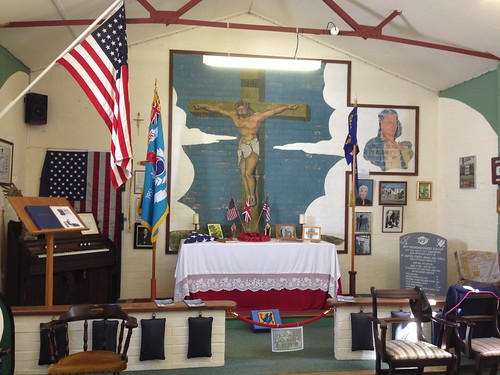
It was during the restoration that two murals were discovered, these are perhaps one of the more stunning aspects of the exhibition. Painted in 1943 by Sgt. Bud Doyle, the then Chaplin’s driver, they are located on one of the walls of the Chapel. One is of Christ on a cross, whilst the other is a portrait of a pilot, both have been restored and remain on display where they were originally painted all those years ago..

389th BG Exhibition Hethel

The restored murals in the Chapel.

Located here, are a number of items many with stories attached. In the Chaplin’s quarters next door, are maps and other documents relating to the groups activities.

Two new Nissen huts have also been built, opened and dedicated in 2014 and 2017, they extend the exhibition further to include uniforms, service records, numerous photographs and more memorabilia.

RAF Hethel, 389th BG Museum

The dedication plaque.

There is also a refreshments bar offering the usual tea and snacks, along with a toilet facilities.

From the museum there are public footpaths into what was one of the accommodation areas of RAF Hethel, here are some of the remains of buildings, shelters primarily, hidden amongst the undergrowth. The footpaths are mainly concrete once you get onto the site.

RAF Hethel, 389th BG Museum

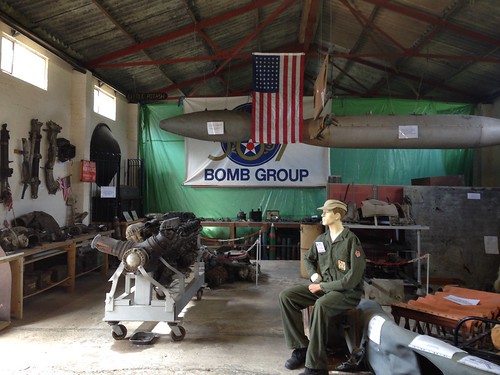
Part of the exhibition inside the former Chapel at RAF Hethel.

A nice little museum it has free entry and welcomes donations to help with the upkeep and maintenance of the site, if in the area, it is well worth a visit and your support .

The 389th website has further details and opening times and information of forthcoming events.

R.A.F. Wethersfield (U.S.A.A.F. Station 170).

After a short journey from Castle Camps we soon arrive at our next port of call. This airfield, although a Second World War airfield, saw little action but was used by both the U.S.A.A.F. and the R.A.F. both during and after the war. Whilst it does not generally have active flying units today, it does house the M.O.D. dog training unit and as such is classed as an active military site.

This part of the trail brings us to the former airfield RAF Wethersfield.

R.A.F. Wethersfield (Station 170).

RAF Wethersfield was originally designed and built as a Class ‘A’ bomber airfield with construction occurring during 1942. During this expansion period materials and labour were both in short supply, which delayed the completion of the airfield until late 1943. During this period, ownership of the airfield passed hands several times, initially belonging to the Eighth Air Force, it was to be loaned to the R.A.F. between December 1942 and May 1943, before returning back to American hands. However, the delay to construction meant that by the time it was completed and opened, it would not be used by the R.A.F. but passed instead directly into the hands of the ‘new’ U.S. Ninth Air Force.

Constituted in 1941, the Ninth had already been fighting in Egypt and Libya, before they were moved to England in late 1943 in preparation for the forthcoming invasion of the continent. Throughout the remainder of the war they would pave the way for the advancing forces from Normandy deep into Germany itself. As an Air force, it would be disbanded in 1945 only to be reborn post war as part of the Tactical Air Command, and latterly the Continental Air Command, at which point it was assigned to Reserve and National Guard duties.

The first units to arrive at Wethersfield did so in the February of 1944, four months before the invasion took place. The first aircraft to arrive were the A-20 ‘Havocs’ of the 416th Bombardment Group (Light). The Group, who was only a year old itself, was made up of the: 668th, 669th, 670th and 671st Bomb Squadrons, and would fall under the control of the IX Bomber Command, Ninth Air Force who had their headquarters at the rather grand stately home Marks Hall in Essex.

A-20 Havocs, including (serial number 43-9701) of the 416th BG. 9701 was salvaged August 18th 1945. IWM (FRE 6403)

A journey that started at Will Rogers Airfield in Oklahoma, would take the men of the 416th from Lake Charles in Louisiana, through Laurel Airfield, Mississippi and onto Wethersfield some 28 miles to the south-east of Cambridge, in Essex.

As a Class A airfield, its three concrete runways would be standard lengths: 1 x 2,000 yards and 2 x 1,400 yards, all the normal 50 yards wide. Scattered around the perimeter were fifty hardstands for aircraft dispersal – all but one being of the spectacle style.

The 2,500 ground and air crews would be allocated standard accommodation, primarily Nissen huts, situated over several sites to the south-west of the main airfield site. Two T2 hangars were provided for aircraft maintenance, one in the technical area also to the south-west, and the second to the east. One notable building at Wethersfield was a Ctesiphon hut. An unusual, and indeed controversial design, it originated in the Middle East when a sergeant, unable to camouflage his tent, had poured concrete over it. As the pole was removed, the structure remained both intact and strong. The commanding officer, Major J.H. De W. Waller took the idea, named it after a 1,600 year old palace at Bagdad, and developed it in the UK, through the Waller Housing Corporation.

The idea behind the building is that a metal frame is constructed, similar in design to Nissen hut ribs, then covered with hessian after which concrete is poured over it. As the concrete hardens, the hessian sags giving added strength through its ‘corrugated’ shape. The ‘scaffolds’ are then removed leaving the hut’s shell standing independently. At Wethersfield there were originally fourteen of these huts built, all within the technical site, it is not currently known whether any of these still exist today, but it is extremely unlikely as most were pulled down post war.

The 416th BG were part of the 97th Combat Wing, and were among the first to receive the new ‘Havocs’, along with the 409th and 410th BG who were also under the control of the 97th. For the short period between the 416th’s arrival (February 1944) and the invasion in June, they carried out sustained training missions transferring their skills from the B-25s they had earlier used, to the new A-20s, which included operational sorties targeting V-weapons sites in northern France starting in March 1944.

During these flights, accidents would happen. A number of aircraft were damaged or written off whilst attempting  landings at Wethersfield: ’43-9203′, (671st BS) piloted by George W. Cowgill crashed on 21st April 1944; ’43-9209′ piloted by Pilot Elizabeth O. Turner, crashed on 13th August 1944, and ’43-9368′ crashed two days earlier on 11th August 1944. Some of these accidents resulted in fatalities, including that of ’43-9223′ (668th BS) which crashed on a routine test flight 1.5 miles north-west of Wethersfield, on 9th May 1944. The pilot Capt. William P. Battersby (the Squadron Operations Officer) and a passenger Private First Class Charles W. Coleman (s/n 32372194) a Parachute Rigger, were both killed in the accident.

In the April, two months after the Americans had moved in, the R.A.F. officially handed over the airfield to the U.S. forces in a ceremony that unusually, saw a large number of civilians take part.

As the invasion neared, the 416th began to attack coastal defences and airfields  that were supporting Luftwaffe forces. During and after the invasion they targeted rail bottlenecks, marshalling yards, road networks, bridges and other strategic targets to prevent the build up of reinforcements and troop movements into Normandy.

As the German forces retreated, the 416th attacked escape routes in the Falaise Gap to the south of Caen, destroying the many bridges that allowed the German armies to leave the encircled area. During the battle, nine aircraft were lost, and all those lucky enough to return suffered flak damage, some of it heavy. For their actions here between the 6th and 9th of August 1944, the 416th earned themselves a Distinguished Unit Citation (D.U.C.) the only one they would receive during the conflict.

By the following September, the Allies had pushed into France and the Ninth began to move across to captured airfields on the continent, the 416th being one of those to go. Leaving the leafy surroundings of Wethersfield for the Advanced Landing Ground (A.L.G.) at Melun, to the south of Paris, it would be a move that would coincide with the change to the new A-26 ‘Invader’; the 416th being the first unit to do so, another first and another distinction. During their seven month stay at Wethersfield the 416th BG would fly 141 operational sorties losing twenty-one aircraft in the process.

A-20 Havocs and A-26 Invaders of the 416th Bomb Group at Wethersfield. This picture was probably taken around the time the 416th were departing Wethersfield for the Landing Ground at Melun, France. FRE 7445 (IWM)

With their departure, Wethersfield was handed back to the R.A.F. and the First Allied Airborne Army. This would see a dramatic change from the light twin-engined A-20s to the mighty four-engined Stirlings MK.IV, the former heavy bombers turned transport and glider tugs, whose nose stood at over 20 feet from the ground.

The two squadrons operating these aircraft at Wethersfield, 196 Sqn and 299 Sqn, would both arrive on the same day, October 9th 1944 and depart within 24 hours of each other on 26th and 25th of January 1945 respectively.

The Stirling, initially a heavy bomber of Bomber Command, was pulled from front line bombing missions due to its high losses, many squadrons replacing them with the newer Lancaster. 196 Sqn however, retained the Stirling and instead transferred from Bomber Command into the Allied Expeditionary Air Force.

The Stirlings proved to be much more suited to their new role supporting resistance and S.O.E. operations in occupied Europe. But the heavy weight of the Stirling took its toll on the runways at Wethersfield, and eventually they began to break up. Now in need of repairs, the two squadrons were pulled out and sent to Shepherds Grove where they would eventually be disbanded at the war’s end.

RAF Wethersfield

One of the original T2 Hangars on the south-eastern side.

A short stay in March of 1945 by the 316th Troop Carrier Group (T.C.G.) allowed them to participate in Operation ‘Varsity‘, transporting paratroops of the British 6th Airborne across the Rhine into Wessel, and on into northern Germany itself. An operation that saw 242 C-47 and C-53 transport aircraft leave bases in England filled with paratroops and their associated hardware. For many of these troops, it was their first drop into enemy territory – a true baptism of fire. During the take offs, paratroopers witnessed a V-1 flying bomb race across the Wethersfield sky, the Germans last-ditch effort to turn the tide that was very much against them. Immediately after the operation the 316th returned to their home station at R.A.F. Cottesmore, a move that signified the operational end of Wethersfield for the Second World War. Now unoccupied the site was put into care and maintenance, a state it remained in for a good number of years.

With the heightening threat of a soviet attack and the suggestion of the Cold War turning ‘hot’, Wethersfield was then given a new lease of life. On the 1st June 1952, the U.S. returned once more with the 20th Fighter Bomber Wing (F.B.W.), the 55th and 77th Fighter Bomber Squadrons (F.B.S.) operating the F-84G ‘Thunderjet’.

To accommodate the new jets, the main runway was extended, the original wartime buildings were removed and replaced with more modern structures. The original control tower was developed and upgraded to meet the new higher standards required of a military airfield. Accommodation and family support was also considered. Like many U.S. bases in the U.K. they had their own shops, bowling complex, basketball centre, Youth club, cinema and school. Wethersfield was to become, for a short period of time, a front line base and a major part of the U.S.’s twenty-two European bases.

Children are shown around RAF Wethersfield as part of cementing American and British relations. 

The F-84G was a Tactical-fighter bomber designed to carry a 2,000 lb nuclear bomb for use on enemy airfields in the event of all out war. Operating as part of the 49th Air Division, 3rd Air Force, they would operate in conjunction with the B-45’s located at nearby R.A.F. Sculthorpe.

In June 1955, the wing, now reformed but utilising the same units, began flying the Republic F-84F ‘Thunderstreak’. The ‘F’ model was essentially a swept-wing version of the ‘G’; designed to be more powerful whilst utilising many of the tooling used by the ‘G’. Gradually the ‘G’ was phased out by the 20th with the ‘F’ becoming the standard flying air frame.

Up grading of the F-84F to the F-100 ‘Super Sabres’ occurred in 1957, during which time the unit was also re-designated the 20th Tactical Fighter Wing after a major reorganisation of the U.S. forces in Europe. The Super Sabres remaining in service here until 1970 when the nearby development of Stansted Airport led to the Wing moving to Upper Heyford in Oxfordshire. Prior to this move Wethersfield would bear witness to the first demonstration of the F-111 in U.K. skies, an aircraft that would become the back-bone of the 20th after its departure to Upper Heyford in June that year.

In 1963, Wethersfield suffered a blow when  an F-100F Super Sabre ’56-3991′ piloted by First Lieutenant Paul Briggs (s/n 69418A) and co-pilot Colonel Wendell Kelley (s/n 7784A) crashed at Gosfield in Essex. The aircraft experienced repeated “severe compressor stalls” and ongoing problems with oil pressure. After disposing of their fuel tanks over the sea, the aircraft was guided back towards Wethersfield. Eventually the crew decided to eject, the co-pilot asked for the canopy to be blown, and believing he had gone, the pilot ejected. It was not until afterwards that the pilot realised the co-pilot was still in the aircraft, and he was killed in the resultant crash in a farmer’s field. To commemorate the tragic accident that took the life of Colonel Kelley, a memorial stands on the village playing field*1.

RAF Wethersfield

Cold War Shelters located on the original hardstands.

With this move in 1970, Wethersfield went back into care and maintenance, used by the airport repair organisation the Rapid Engineer Deployable Heavy Operational Repair Squadron Engineers or RED HORSE for short, who were responsible for the rapid repair of runways and other large airfield structures in times of war. This would also mean the end of operational flying at Wethersfield, and after the departure of the 20th, no further active flying units would return.

As the Americans began their European wind down, the ‘RED HORSE’ unit was also pulled out and the site returned to Ministry of Defence ownership. The R.A.F.’s M.O.D. Police units moved in during 1991, the hands of which it remains in today.

The airfield is still complete, the runways a little worn, its surfaces ‘damaged’ by experimentation with new techniques and repair practices, but it is used by visiting aircraft associated with Police and M.O.D. operations – Police Helicopters and the like. A glider training unit 614  V.G.S. also reside here utilising one of the remaining T2 hangars, keeping the aviation spirit alive if only for a short while longer.

Today it remains an active Military base, and as such access is strictly forbidden. The roads around the airfield do offer some views but these are limited. A public road and footpath is located at the north-eastern end of the site, from here the runway, parts of the perimeter track and hangar can be seen through the fencing. Passing the main entrance, there are a small number of buildings remaining derelict on adjacent farmland, these were part of the original accommodation site and are few and far between. Continuing along this road leads to a dead-end and private dwelling, but it does allow views of the current  accommodation and training buildings on the former technical area, all now very modern.

RAF Wethersfield

There have been many of these post-war additions to the airfield,

Whilst Wethersfield remains an active site, plans were announced in March 2016 to dispose of it as part of the M.O.D.’s plan to sell off many of its sites to raise money and streamline its activities. If planning permission is granted, Wethersfield could see 4,850 homes being built on it and the resident units of the military being moved elsewhere. It is planned to pass Wethersfield over to the Homes and Communities Agency by 2020, for its disposal*2.

Having a short war service and limited cold war history, Wethersfield is one of those airfields that never achieved huge recognition. Despite this, it was nonetheless, one that played its part in major world history. Achieving many ‘firsts’ and seeing many new developments in aviation, it is slowly starting that decline into obscurity. If the Government have their way, Wethersfield will shortly become a housing estate, and its history will sadly become yet another of those condemned to the local library.

After leaving here, we carry on into Essex and yet another airfield that has remained active but not as a flying base. We go to the Carver Barracks and the former R.A.F. Debden.

Sources and further Reading.

*1A website dedicated to the 20th T.F.W. at Wethersfield has a number of pictures of both aircraft and people associated with Wethersfield and the 20th T.F.W.  It also includes a transcript of the discussion between the pilot and the tower prior to the Sabre’s crash. There are also other documents relating to the crash located on the site.

*2 The announcement was highlighted ion the Essex Live website, March 24th 2016.

July 11th 1945 – Last B-24 leaves the U.K.

As the war drew to a close, encircled German troops, took to flooding the fields of western Holland, forcing the local Dutch people down to starvation levels. In an attempt to help them, Allied operational bombing missions turned to mercy missions. Operations  ‘Manna‘  and ‘Chow Hound’  involved Allied bombers flying low-level to drop supplies of food and other provisions to these people.  They would fly aircraft along mutually agreed routes  to dropping points at the Hague and other sites around Rotterdam.

The first of these RAF operations occurred at the end of April into the early days of May, followed by the USAAF between the 1st and 8th of May 1945. On this first operation, 396 B-17s flew from their bases in East Anglia to unload some 700 tons of provisions over the affected area. Over the next few days similar flights would also take place, which would in total provide some 11,000 tons of food to the starving population. During one of these missions on May 7th, B-17G  #44- 8640 of the 95th BG, 334th BS, was believed to have been hit by ground fire over Ijmuiden,  The aircraft, engine ablaze, ditched in the North Sea. Rescue efforts were mounted to recover the crewmen and observers, but only two survived – eleven were lost. It is believed to be last combat casualty of 8th Air Force in World War 2.

Also during this time, ‘Trolley runs‘ began in which around 10,000 ground crew and other personnel, were given the opportunity to see first hand, the destruction caused by the relentless allied bombing campaign of the previous years. Many were shocked to see the extent of the damage having lived in the relative safety of their airfields back home.

Whilst some crews enjoyed the ‘sight seeing tours’ others were involved in ‘Revival‘ flights, bringing home the many thousands of Allied prisoners of war and displaced persons interned in camps as far away as Austria.

Gradually even these missions began to slow. Squadrons and airfields were wound down, and eyes began to turn to the Pacific. An American force consisting of three P-51 and nine B-17 groups would remain in Europe, the rest of the Eighth  Air force would return home for rest or training and eventual posting to the Pacific.

In the third week of May 1945, the huge operation began, the first B-24 left the U.K. for American shores, a flight that would begin seven weeks of flights across the Atlantic routes. In total some 41,500 men and 2,118 aircraft would depart the U.K. for home, most through either Prestwick in Scotland, or Valley in Wales.

Valley airfield became known as “Happy Valley”, and would see about 90% of the returning aircraft leave from here. Each of the aircraft leaving would carry its crew and 10 passengers, along with sacks of mail for home.

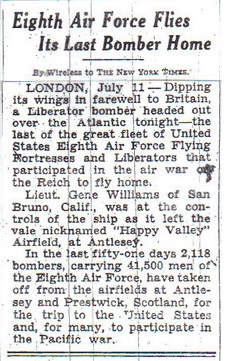
On July 11th 1945, 1st Lt. Gean (or Gene) Williams climbed aboard his B-24, started its engines and pulled off the runway at Valley; the last B-24 the leave the U.K, and with it began the slow demise of Britain’s wartime airfields.

The ‘New York Times’ Published a report on the last Liberator to leave the U.K. on July 12th 1945.

RAF Goxhill Watch Office moved to the States.

As many of our airfields and their associated buildings disappear, or fall into disrepair, its good to hear when one has been saved, refurbished or at least reused in a way that preserves its history and heritage.

Watch Offices of the Second World War are few and far between, many of those that do still remain are either derelict, business offices or thankfully museums detailing the history of the units, men and machines that once graced their surroundings.

In The Virginian Pilot magazine, it was revealed that former RAF Goxhill’s Watch Office has been dismantled brick by brick and shipped over to the Pungo area of Virginia Beach in the United States.

The founder of the Military Aviation Museum at the site, Jerry Yagen, wanted to relocate the Watch Office in a project that has taken eight years to complete.

After demolishing the building, it was removed and taken to its new home where it was painstakingly rebuilt and repainted in its original colours and design. Mike Potter, the museum’s director, explained how the project we set up and managed, and how once the outside is completed, the interior will be rebuilt using original photographs and where possible, original equipment.

RAF Goxhill, which was designated Station 345 by the Americans, was opened in 1941 and acted primarily as a training of combat crew and crew replacement centre. At its peak it held 1709 active personnel of which 190 were officers. Its runways (initially 1 x 1,600 ft and 2 x 1,100 ft) were extended later to 1,600, 1,500 and 2,000 feet, and covered in Tarmac.

Many new units that arrived on the U.K. from the United States would arrive at Goxhill and then be instructed in operational procedure and sent to their respective bases throughout the U.K. The first aircraft to arrive were the P-38s of the 1st Fighter Group, the oldest and most distinguished fighter group in the USAAF, having its origins in World War I. On July 9th, 1942, two of the Groups squadrons arrived, and the airfield was officially handed over to the Americans shortly after in August. It was at this time that the 52nd FG arrived here bringing Sptifire Vs, one of the few British built aircraft to operate under the Stars and Stripes of the United States Army Air Force.

Both the 1st FG and later the 71st Fighter Squadron operated out of Goxhill, and were joined in December 1942, by more P-38s of the 78th Fighter Group. In the following June, P-47s of the 353rd FG arrived before moving off to Metfield a month later.

Toward the end of the war, bomber pilots who had completed their tours of duty were sent to Goxhill to retrain as Fighter Pilots, the idea being to fly fighters ahead of the bomber formations and report back both weather reports and keep at bay any loitering Luftwaffe aircraft.

Eventually closed in 1953, Goxhill was perhaps more synonymous with the 496 Fighter Training Group, operating both the 554th and 555th Fighter Training Squadrons, serving both the Eighth and Ninth Air Forces. Also attached to this unit was the 2nd Gunnery and Tow Target Flight providing targets for gunnery practice by those crews passing through Goxhill’s doors.

Once open, the Watch Office will be open to the public explains Mike Potter, “this is as authentic as it gets”, he goes on to say, as warbirds from the Second world War taxi past in a moment that takes you back to the 1940s and the darkest days of the Second World War.

The story appeared in The Virginian – Pilot online May 10th 2017.

RAF Martlesham Heath (part 2) – A long and distinguished history.

In part two of this Trail, we continue looking at the history of RAF Martlesham Heath.

RAF Martlesham Heath (Station 369).

On August 15th 1944, two P-47s flying more than 200 miles off course mistakenly attacked the Ninth Air Force headquarters near to Laval. In the attack, ground gun crews managed to bring down one of the aircraft killing its pilot. The second aircraft managed to avoid the anti-aircraft fire and returned home safely.

For three days in September, the 356th attacked enemy gun emplacements at Arnhem, earning themselves a DUC for their actions. These aircraft had the unenviable task of attacking the gun emplacements defending the allied drop zones. In order to neutralise the guns, the pilots first had to find them, a move that involved presenting themselves as bait. They proved their worth, bombing and strafing with 260lb fragmentation bombs, destroying all but two of the guns.

Former RAF Martlesham Heath

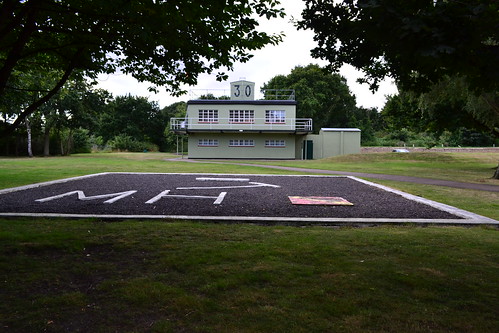
Martlesham Heath’s Watch Office now a museum surrounded by housing.

In November 1944 the P-47s were replaced by the P-51 ‘Mustangs’, the delight of the USAAF Fighter Groups. Early successes were good, even though they were tainted with repeated and wide-spread gun jamming.

The winter of 1944-45 was notoriously bad, one of the worst on record and many flights were cancelled at the last-minute. Maintenance on open airfields was incredibly difficult and accidents increased because of cloud, ice and snow. In mid January, five P-51s were lost, crashing on snow packed runways, being lost in cloud or suffering from taxiing accidents. By now though the war had turned and the blue and red chequered nosed fighters of the USAAF had turned to hunters and were eager for blood.

By now, Luftwaffe jets had now been in service for some time, harassing bombing formations, diving in amongst them, firing and then fleeing. Three P-51s of the 356th had the good fortune to catch an Arado-234 in the Bielefield area. After the pilot bailed out, they flew along side photographing the aircraft before finally shooting it down. It was one of a number that day that were lost to American airmen.

As the war ended the 356th had seen only eighteen months of active service, a short time that had allowed them to amass 276.5 kills in the air. Whilst being the lowest ‘score’ in the US Air Force, it doesn’t detract from the determination nor the skill of the brave pilots who flew with the 356th.

After the war’s end, the Americans departed and in November 1945, Martlesham Heath was returned to RAF ownership.

In 1946, experimental units returned with the forming of the Armament and Instrument Experimental Unit. Over the next few years they would go through several changes of name , but in essence retained their primary role. During this period, they would operate a small number of aircraft including amongst them: Mosquito NF38 (VT654); Meteor F4 (VW308); Lincoln B1 (RE242); Canberra T4 (WE189) and Comet 3B (XP915).

On November 1st 1949, the Bomb Ballistic Unit (formed May 1944 at Woodbridge) and Blind Landing Experimental Units (formed October 1945 also at Woodbridge) were amalgamated, forming one complete unit (the Bomb Ballistic and Blind Landing Experimental Unit) here at Martlesham Heath. They each operated a number of twin and four engined aircraft that would be absorbed into the Armament and Instrument Experimental Unit 15 days later. On November 1st 1955 RAF control of the unit ceased, and it was re-branded Armament and Instrument Experimental Establishment, whereupon it ran until 1st July 1957, when it was disbanded and absorbed into the Royal Aircraft Establishment.

Former RAF Martlesham Heath

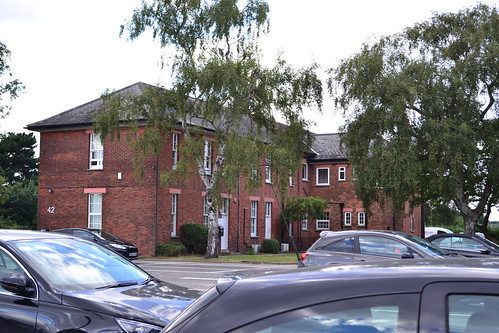
A number of the ‘H’ blocks have been given a new lease of life as office blocks. The parade ground, the car park.

With little operationally occurring at Martlesham, its decline was inevitable. Between 15th April 1958, and New Years Eve 1960, 11 Group Communications Flight operated: two Ansons (TX193 & WB453); a Devon (VP974); a Meteor T7 (WL378) and Chipmunk T.10 (WG465). Following their disbandment the only other flying units to use Martlesham were the then Hurricane and four Spitfires of the Battle of Britain Flight (now the legendary Battle of Britain Memorial Flight based at RAF Coningsby) between 1958 and 1961. The 612 Glider School also used the site between September 1952 and May 1963, whereupon they disbanded and the airfield then closed. Remaining intact, the airfield would continue to be used but for light private flying only, until this also finally ceased in 1979.

Following its closure, Martlesham Heath’s 600 acres were handed over to the Bradford Property Trust following the reversion of the lease from the Air Ministry, and because of its location to both the larger town of Ipswich and the major sea port at Felixstowe, it was destined for development. It was declared by the new owners that Martlesham would become a ‘village’, rather than a traditional ‘housing estate’ in which the concept of small groups of housing would be built, often around a cul-de-sac rather than in rows, thus promoting a ‘community spirit’ within each segment of the development. Planning permission was granted in 1973, ten years after the Ministry sold it off, the development was finally completed in 1990.*2

On its completion Martlesham was designated a village, and since then the original 3,500 population has grown, in 2011, the Martlesham Neighbourhood Development Plan stated the population of the Parish at 5,478.

Today Martlesham Heath is a thriving mix of private housing, industrial and retail units, reflecting this ‘Garden Village’ design. Two major employers soon moved in: the British Telecom Research Centre and Suffolk County Police – forming their headquarters on this and the adjacent land.

Beneath all this development though, elements of the ‘Heath’ do still exist, largely due to the good foresight of the developers. The parade ground (now a car park), the barrack ’H’ blocks (like West Malling are office blocks), the watch office, messes, hangars and RAF workshops all transformed into light industrial units which remain in use today.

In 1982, local people set on preserving the heritage of Martlesham Heath created the Martlesham Heath Aviation Society, and were allowed to set up their home in the former watch office. After raising funds, the office was refurbished and turned into a museum displaying many artefacts, stories and photographs of Martlesham’s history. The museum finally opened in 2000 and remains there today encircled by housing on all four sides. The spirit of Martlesham Heath also lives on in the road names. Even the Douglas Bader pub has a tenuous link to this historic place.

Former RAF Martlesham Heath

The memorials to those who served at Martlesham Heath during its long and distinguished career.

Viewing the airfield remains are relatively easy as most are visible and accessible from the public highway. Finding them is another matter. The design of the streets are such that there are many paths and small side streets and ‘getting lost’ is quite easy for the visitor. The main A12 road through Martlesham dissects the airfield site in two. The museum is to the west off Eagles way, surrounded by housing – an odd remnant of a bygone era. What little remains of the runway can be seen further south off Dobbs lane, in an area of heath and scrub – a lingering reminder of this once historic airfield, how long I wonder, before this too is removed.

The hangars and barrack blocks are to the eastern side, mostly among the retail park. The three memorials are located on Barrack Road opposite the BT building and alongside the former parade ground and ‘H’ blocks.

Now listed locally and with Suffolk Coastal District Council, many of the remaining but obscure remnants (airfield markers, hangar foundations, revetments, and the last remains of the runway) all lie dormant amongst the footpaths, cycle tracks and parks of the huge Martlesham Heath conurbation that was once RAF Martlesham Heath.

Notes and further reading

*2 Ward, S.V., The Garden City, past, Present and Future,  1992, Spon Press

RAF Martlesham Heath (Part 1) – a long and distinguished history.

On the outskirts of Ipswich close to the former Cold War bases at Woodbridge and Bentwaters, is what is perhaps a model of the future, of many of our wartime airfields. Built upon with town housing hidden in the ‘Village’ idea, it is a place with major industry and retail parks, where the few remains that exist are hidden amongst the pathways and roads of this large conurbation. However, not all is lost, a museum and modern use of many of its original structures ensure the history of this once busy airfield are not lost forever.  In Trail 40 we head to the southern reaches of East Anglia, to the the outskirts of Ipswich and the former site that was once RAF Martlesham Heath.

RAF Martlesham Heath (Station 369).

Martlesham Heath was opened in 1917, and until it closed in 1963, was the home to a very large number of military units. It was also used by a number of aircraft experimental units, each one investigating the various aspects of aircraft and weapons designs needed in a modern air force. These investigations were carried out initially by the RFC Aeroplane Experimental Station and latterly the Aircraft and Armament Experimental Establishment (A&AEE). Also present at Martlesham were the Armament & Instrument Experimental Unit, the Air Sea Rescue units, and the Battle of Britain Flight (now the Battle of Britain Memorial Flight based at RAF Coningsby). In addition, a Gunnery flight was also based here, as were gliders and numerous squadrons flown by a whole range of Nationalities including: Belgian, Czech, Polish, Australian, Canadian, New Zealand and American airmen. With all these units came a broad and diverse range of aircraft types. Its history is certainly long and very, very distinguished.

The dawn of aviation happened at Martlesham Heath when it officially opened on January 16th, 1917.  During that year, the Aircraft Testing Squadron would arrive here from its base at Upavon to be joined on March 16th 1920 by the Armament Experimental Station from Orfordness. The amalgamation of these two aircraft experimental units would set the foundations for Britain’s future research and development organisation. This marriage, forged the name the Aeroplane Experimental Establishment (Home) until 24th March 1924, when it disbanded to become the better known Aircraft and Armament Experimental Establishment (A&AEE), who carried out their work here, at Martlesham Heath, until the outbreak of war in 1939. 

A number of both civilian and military aircraft were tested here, one of the most notable being the enormous all-metal tri-engined transport, the Beardmore Inflexible. Designed by William Beardmore, it had a wing span of 157 feet – 16 feet longer than Boeing B-29. Other aircraft included the 4.F1 ‘Taper Wing’ Camel, a sole example was produced with simplified wing-struts in an attempt to reduce drag and improve the Camel’s performance.  Amongst others featuring at Martlesham, were the Bristol Blenheim, various Auto Gyros and the Bristol Bombay. The A&AEE would be joined in July 1923 by the reformed 22 Sqn who would undertake armament testing investigations; and then, a year later, by the reformed 15 Sqn who would carry out performance and handling trials. Both these units operated solely as trials units, flying  a notional number of aircraft including a: Boulton Paul Bugle II, Fairy Ferret, Gloster Gamecock, Vickers 161 and Hawker Horsley aircraft.

INTER WAR BRITISH AIRCRAFT

The prototype Bristol Blenheim at Martlesham Heath under evaluation. (IWM)

With the outbreak of war, all sections of the A&AEE, with one exception, was moved for its own protection, to its new base at Boscombe Down. Here its history has become renowned, and many weapons and aircraft developments have taken place since. The exception to the move, was ‘D’ Flight of the A&AEE’s Performance Testing section, who moved to Perth where it became the Royal Air Force Detachment, Perth.

Over the next few years Martlesham Heath would become a major player in the war. Some 60 or so RAF squadrons would pass through here, either permanently based here or as detachments away from their parent bases. The first of these was 64 Sqn RAF flying Hawker Demons. After a short spell abroad, they would return in 1941 with Spitfire IIAs – the first permanently based unit. Other sqn’s that would pass through in these early years included:  29 and 151 Sqn (December 1938); 110 Sqn (June 1939); 25 and 56 Sqn (October 1939);  604 Sqn (September 1939) and 236 Sqn (December 1939).

With the evacuation of the BEF and the subsequent Battle of Britain, Martlesham would become increasingly busy. During 1940 five squadrons would be based here, whilst in 1941, thirteen squadrons would pass through. This would increase to sixteen in 1942; nine in 1943 and only two in 1944; thus the number of units using Martlesham would reflect both the level of the German threat and direction that the war was moving.

Being close to London, Martlesham would play its part in the Battle of Britain. A number of gritty and determined fighter pilots would serve here, including both Group Captain Douglas Bader and Squadron Leader Bob Stanford Tuck.

Squadron Leader Stanford Tuck poses with a group of pilots of 257 Squadron, RAF © IWM (CH 1674)

On September 19th 1940, 71 Sqn was reformed at RAF Church Fenton moving to Martlesham in the following April. Made of volunteer U.S. pilots it was to be one of three ‘Eagle Squadrons’ destined to become famous before the U.S. officially entered the conflict in December 1941. (Also during this time, ‘A’ Flight of the Special Duties Flight would reside here whilst the main parent unit was located at St. Athan, until replaced by the various Radio Servicing Sections).

71 Squadron were initially provided with Brewster Buffalo MKIs, so disappointed with them were they, that it was rumoured the commanding officer ‘instructed’ his pilots to deliberately damage them so that more ‘appropriate’ aircraft would be issued*1. By the time 71 Sqn arrived at Martlesham Heath in early April 1941, these Buffaloes had been replaced and 71 Sqn  was equipped with the much superior Hurricane MKIs, followed soon afterwards, by the Hurricane MKIIA. 71 Squadron then left Martlesham in June 1941 only to return in December that year with Spitfire VBs. They finally departed in May 1942 thus ending their presence  at the ‘Heath’ for good. It wasn’t the last of the Eagle squadrons though, for a very short period of about eight days, 133 Squadron graced the grounds of this Suffolk airfield before departing to Biggin Hill and eventual amalgamation into the USAAF.

Primarily a grass stripped fighter base, Spitfires and Hurricanes were the most commonly seen aircraft here. Exceptions being the very brief visit of Tomahawks of No. 2 Sqn, Mustang MkIs of 26 and 239 Sqns, Typhoons of 198 and 182 Sqns (who were formed here in August 1942) ; Defiants of 264 Sqn; Lysander IIIA of the Air Sea Rescue Flight (formed here May 1941 and latterly 277 Sqn) and a detachment of Lysander IIs of 613 Sqn in September 1940. Thus a wide range of aircraft were to pass through Martlesham adding to the variety and diversity of its aviation history.

Many of those units to use Martlesham’s facilities were short stays, often passing through to other stations either in the U.K. or abroad. Some consisted of days whilst others were perhaps weeks.

In 1942, the airfield was designated as a U.S. Fighter base and the first real permanently stationed units would soon arrive. Following testing, they created two soil-stabilised, oil and tar mixture runways, linked together by steel pierced planking.  Also known as ‘Marston Matting’ or Perforated Steel Planking (PSP), these were strips of metal slotted together that meant no heavy excavations were needed and the tracks could be laid very quickly by small engineering teams. Once work had been undertaken, Martlesham Heath would receive the P-47s and latterly P-51s, of the 356th Fighter Group.

Former RAF Martlesham Heath

Memorial to the 356th FG based at Martlesham Heath.

By the time the airfield had been developed it covered a wide area, and because of it long history, it would consist of multitude of architectural features. Many of these dated back to the First World War and included aeroplane sheds (damaged in attacks) built to various drawings (e.g. 146/16-149/16, 110/16 and 1656/18); Type A aeroplane sheds (based on 19a/24 designs); aeroplane Type B ‘Goliath’ shed (1455/27); blacksmiths and welders workshops; a range of barrack blocks; married and single officers quarters; separate RAF and USAAF latrines; workshops; blister hangars; squadron offices and a wide range of associated buildings.

Around 70 aircraft dispersals were also laid using a mix of both an unusual square, and the more common pan style hardstands.

The 356th FG, arrived here in October 1943, after a 10 month journey that began at Westover Field, Massachusetts. They arrived in England in  August 1943 transiting from Goxhill to Martlesham Heath over the following weeks. Consisting of three squadrons: the 359th, 360th and 361st FS, they would initially be equipped with P-47D ‘Thunderbolts’ lovingly referred to as ‘Jugs‘.

The main duties of the 356th FG was as fighter escort covering the heavy bombers of the American Eighth Air Force as they penetrated occupied Europe. After initial engine difficulties, the P-47 proved to be a reliable and agile workhorse, much against the stereotyped view reflected by its resemblance to a ‘flying brick’. One of the first missions the 356th carried out was to escort a mix of P-47 ‘Thunderbolts’ of the 56th FG fitted with bombs flying in conjunction with B-24 ‘Mitchells’. This new strategy became known as ‘drop-on-leader’ whereby the B-24s would sight the target, and drop their bombs as a signal to the P-47s to drop theirs. The first mission to St. Omer was to produce poor results however, the B-24 bombing mechanisms jamming which resulted in all the bombs overshooting the target.

The 356th would be active throughout the remainder of the war, initially supporting bombers until January 1944 when they took on the role of ground attack, strafing targets such as U-Boat installations, Marshalling yards, Locomotives, airfield flak units and German radar installations. In June 1944 they supported the Normandy invasion going on to assist in the allied push through France,  the low countries and on into Germany itself. With ground attack and fighter aircraft being given almost free-reign, anything that moved became a target. Avoiding civilian areas and civilian traffic was a high priority and the perceived threat of friendly fire on troops below, a distant thought in the minds of the crews. However, not everything went according to plan.

Part 2 will follow next week.


Notes and further reading

*1 Imperial War Museum Website

The 392nd – The Highest Degree of Bombs on Target.

In the northern reaches of Norfolk lies an airfield that was the most northerly American base of the Second World War in East Anglia. Of all its crews that flew on the first mission, only four were still around to fly on the 200th a year or so later. This airfield was home to only one operational flying group, a group that was cited for its incredible bombing accuracy over occupied Europe. In this trip, we visit Station 118, otherwise known as RAF Wendling.

 RAF Wendling (Station 118)

On 15th January 1943, a new bomb Group was formed at Davis-Monthan Field in Arizona, it would be the 392nd BG and would consist of four squadrons: the 576th, 577th, 578th and 579th Bomb Squadrons. On completion of its training, the 392nd would leave the United States, and fly across the Atlantic to their new base in England. These four squadrons would be the first to operate the newly updated B-24 ‘H’ model ‘Liberators’; an improvement of the previous variants by the addition of a motorised front turret, improved waist gun positions and a new retractable belly turret. The supporting ground echelons had left the United States, sailing on the Queen Elizabeth from New York, much earlier, and before the group had received these newer models. As a result, they had neither received any training, or gained any experience with these new updated variants. The arrival of these new aircraft would therefore be met with some surprise, followed by a steep learning curve supported by additional training programmes.

The first B-24s of the 392nd arrived at Wendling, Norfolk, on 15th August 1943, and would soon be joined by the 44th at nearby Shipdham, the 389th at Hethel and the 93rd at Hardwick; four Groups that would be combined to form the Second Bombardment Wing (later 2nd Bombardment Division)*1. Battle hardened from fighting in the Mediterranean Theatre, these other three groups knew only too well the dangers of bombing missions, all having suffered some heavy losses themselves already.

Wendling’s Watch office before it was modified (see below) (IWM FRE 1670).

During September 1943,  the 392nd joined with these other three units flying missions under Operation ‘Starkey‘; probing German defences and gauging their responses to massed allied attacks on coastal regions. Largely uneventful they went on to undertake diversionary missions over the North Sea, the first three being escorted by fighters, and without incident. On the fourth however, the fighters were withheld and the bombers struck out alone.

On this particular flight, 4th October, 1943, the 392nd would gain their first real taste of war, and it would be an initiation they would rather forget. During the battle over thirty Luftwaffe fighters would shoot down four B-24s with the loss of forty-three crew members. A further eleven were injured in the remaining bombers that managed to continue flying and return home – it was not a good start for the 392nd.

Licking its wounds, they would then be combined with more experienced units, flying multiple missions as far as the Baltic regions before returning to diversionary raids again later that month. Viewed with some misgivings by crews, these ‘H’ model Liberators were soon found to be heavier, slower and less responsive at the higher altitudes these deeper missions were flown at.

The 392nd would take part in many of the Second World War’s fiercest operations; oil refineries at Gelsenkirchen, Osnabruck’s marshalling yards and factories at both Brunswick and Kassel were just some targets on the long list that entered the 392nd’s operations records book.

RAF Wendling (Beeston)

Wendling’s runway looking West.

The massive effort of ‘Big Week’ of February 20 – 25th saw the 392nd in action over Gotha, in an operation that won them a DUC for their part. Upon entering enemy airspace, the formation was relentlessly attacked by Fw-190s, Me 110s and Ju 88s using a mix of gun, rockets, air-to-air bombing and even trailing bombs to disrupt and destroy the groups. Ironically it was the very same twin-engined aircraft and component factory that was the intended target that day; a focus of the Second Bomb Division in an operation that saw the lead section, headed by aircraft of the 2nd Combat Wing, bomb in error due to the bombardier collapsing onto his bomb release as a result of oxygen starvation. Unrelenting the 392nd carried on. They realised and ignored the major error, and flew on to drop 98% of their bombs within 2,000 feet of the intended target. This highly accurate bombing came at a high cost though, Missing Air Crew Reports  (MACR) indicate seven aircraft were lost, with another thirteen sustaining battle damage.

The 392nd would carry on, with further battles taking their deadly toll on both crews and aircraft. In March that same year, the 392nd would turn their attention to Friedrichshafen – a target that would claim further lives and be the most costly yet.

Even before entering into enemy territory, losses would be incurred. Flying in close formation, two B-24s flew too close – one through the prop wash of another – which caused them to collide bringing both aircraft down.  One of those B-24s #42-109824 ‘Late Date II‘, lost half of its crew.

Despite good weather over the target the attack on Friedrichshafen in southern Germany, would have to be led by pathfinders. In an attempt to foil the attackers, the Germans released enormous quantities of smoke, enveloping the town and concealing it from the prying eyes high above. Of the forty-three bombers to fall that day, half were from the 14th Combat Wing of which fourteen came from the 392nd. Despite losses elsewhere, this would prove to be the worst mission for the 392nd, in all some 150 crew men were lost that day.

Bombing targets in Europe was never straight forward and bombs often fell well away from the intended site. On one rather unfortunate occasion at the end of March, the 392nd joined the 44th BG in mistakenly bombing Schaffhausen, a town in neutral Switzerland. The event that not only deeply upset the Swiss, but heavily fed the Nazi’s determined propaganda machine.

Eventually March, and its terrible statistics, was behind them. The 392nd would then spend the reminder of 1944 supporting ground troops, bombing coastal defences in the lead up to D-day (their 100th mission), airfields and V-weapons sites in ‘NOBALL‘ operations. Like many of their counterparts they would support the St. Lo breakout, and hit transport and supply routes during the cold weeks of the Battle of the Bulge.

It was during this time, on 12th August 1944 that heroic pilot, 2nd Lt. John D. Ellis, flying B-24H #42-95023, would manage to steer his stricken aircraft away from a residential area at Cheshunt, some 15 miles north of London,  crashing the aircraft near to what is now the A10 road. Sadly all on board were killed in the incident but undoubtedly the lives of many civilians were saved, and a memorial in their memory lies in the nearby library at Cheshunt and on the wall at Madingley, the American War Cemetery, Cambridge.

DSC_0572

The Memorial Plaque at the American War Cemetery, Madingley, Cambridgeshire.

This was not to be the only accident that the 392nd (nor any other B-24 unit) were to suffer. Crews were finding that these heavier machines were difficult to get out of if hit by flak or attacking fighters. Ferocious fires in the wing tanks and fuselage were leading to many losses, and in particular, the pilots who after fighting to keep aircraft stable long enough for crewmen to jump out, were then finding it viciously spinning the moment they let go of the controls.

On February 16th 1945 Liberator #42-95031 ‘Mary Louise‘ flown by 1st Lt. Albert J. Novik, was hit by falling bombs from another aircraft flying above him. After wrestling for some four and half hours to keep the aircraft flying, he ordered the crew out and then attempted to leave the aircraft himself. This event occurred only a month after a similar incident where he had managed to dive through the open bomb bay to safety. In this instance though, Novik was pinned to the roof as the bomber, half its tail plane missing, spun violently towards the Norfolk landscape beneath. Eventually, after a 7,000 ft fall, he was released from this centrifugal grip by a change in the aircraft’s direction. He managed to crawl down from his position and throw himself out through the bomb bay just seconds before the aircraft exploded, sending burning aircraft parts tumbling all around him. For his actions Novik was awarded the DFC, but many others were not quite so lucky, and perished in these huge lumbering giants of the sky.

On April 25th 1945, Mission 285, the 392nd BG prepared for what would be their last mission of the war. The Target, Hallein Austria. Not only would it end the 392nd’s aerial campaign, but that of the Eighth Air Force, bringing the air war in Europe to an end for the American units based in England.

By then, the 392nd had conducted some 285 missions with a high rate of loss, some 184 aircraft in total, with over 800 young men killed in action. They had dropped around 17,500 tons of bombs on some of the highest prestige targets in the German heartland. The group was cited by Major General James Hodges for its degree of accuracy for bombs on target – higher than any other unit of the 2nd Air Division over 100 consecutive missions. Operations had ranged from Norway to southern France and as far as the Baltic and advancing Russian armies at Swinemunde. Over 9,000 decorations were handed out to both air and ground crews for bravery and dedication.

Bomb dump buildings

One of several bomb dump buildings now a nature reserve.

After flying food supply missions to the starving Dutch, the 392nd departed Wendling and the site closed down, remaining dormant until it’s disposal in 1963/4.

RAF Wendling, otherwise known as Beeston from the nearby village, was classified as Station 118 by the Americans. Initially intended as an RAF Bomber base it was updated during the winter of 1942/43 opening in the summer of 1943. It would have 3 concrete runways of class ‘A’ specification, one of 2000 yards and two of 1,400 yards. The bomb dump which survives today as a nature reserve, was to the south-east, whilst the technical area is to the north-west. Two T2 hangars were located near to these sites and the watch office (drawing 5852/41) seems to have been modified in 1943 with the addition of what may have been a Uni-Seco control room (1200/43). Originally built with an adjoining Nissen hut (operations / briefing room) this is now encompassed within another more modern building, and is not visible from the outside.

Around the perimeter were a mix of ‘pan’ (28) and ‘spectacle’ (26) style hardstands, all of which have since been removed or built upon. The technical area, housing a range of: stores, workshops, huts and associated buildings, were to the north-west also. Interestingly, Wendling used Orlit huts, built by the Orlit Company of West Drayton, a mix of panel and concrete posts they were more economical than the British Concrete Foundation (BCF) huts initially ordered by the Ministry of Works.

Today, parts of two of the main runways still survive, housing turkey farms these buildings synonymous with Norfolk. The third was removed and the perimeter track has been reduced to a path. The bomb dump is part of a local nature reserve which has very limited parking, but access to the remaining buildings there is straight forward. Many of the buildings from the remaining twelve accommodation sites have been removed, however a number are still believed to be standing bound in heavy undergrowth, or used by local businesses. One currently retains a huge mural covering an entire wall, with evidence of others also within the same building.

DSC_0114

A stunning memorial now stands in memory of those who served.

Unfortunately when I visited Wendling, daylight ran out forcing me to make a retreat and head for home – a return visit is certainly planned for later. Like many other airfields in this part of the country, losses were high, and the toll on human life dramatic, both here, ‘back home’ and of course, beneath the many thousands of tons of high explosives that were dropped over occupied Europe. Now a high number of these sites house turkey farms, small industrial units or have simply been dug up, and forgotten. I hope, that we never forget and that they all get the honour and respect they deserve.

On a last note, there is a remarkable memorial in the Village of Beeston to the west of the airfield site. This is in itself worth a visit. Not only does it mention the 392nd, but all the auxiliary units stationed on the base, something we often forget when considering the Second World War. A nice and moving end to the trip.

DSC_0117

Memorial to the 392nd BG at Wendling.

Notes and further reading.

Wendling forms part of Trail 10.

*1 September 1943 saw a reorganisation of the US Eighth Air Force, and in September, the ‘Wings’ designation was changed to ‘Divisions’. Then in early 1944, a further reorganisation led to further strategic changes of the Air Force, one of which, saw the 44th and 392nd join with the 492nd to form the 14th Combat Wing, 2nd Bomb Division. Both  the 389th and the 93rd became part of the 2nd and 20th Combat Wings respectively.

A detailed website covering every mission, aircraft and most crew members offers a good deal of information and supporting photographs. It is well worth a visit for further more detailed information .