RAF West Raynham – a well Preserved Segment of Britian’s Aviation History.

From the first site of this trail, RAF Sculthorpe, we travel a few miles south, a stones throw, to its sister station and another post war relic – RAF West Raynham.

RAF West Raynham

Nestled away in the heart of Norfolk is a real hidden gem. West Raynham remains an incredibly intact airfield, complete virtually in its entirety. But don’t get over excited, the diggers, cranes and bulldozers are there and already casting their blows.

Built in 1939 it had four runways, all of grass with 36 pan type dispersals, an accommodation block, ‘C’ type hangars and all the associated support buildings of a wartime airfield. Used by bomber command, it would see a range of twin-engined aircraft operate from within.

C Type Hangar

West Raynham’s hangars will be holiday flats.

Opened in May 1939, it was typical of its time. The first squadron to be based here was 101 squadron RAF, equipped with Bristol Blenheim IVs and later Vickers Wellington 1cs. 101 sqn began the war with daylight attacks on oil supplies in the port areas, communication lines and enemy airfields. A duty that later changed to the more successful night fighter role. 101 eventually left West Raynham, being replaced by further Blenheims of 114 squadron. Other squadrons to arrive included: 2 Grp TT flight, 76, 139, 18, 90 (with B17c ‘Fortresses’), 614, 18 and 1482 squadrons. A variety of aircraft came with them, including: Lysanders, Defiants, Bostons, Hampdens and Fairy Battles giving West Raynham a real diverse range of types.

In September 1942, two more squadrons arrived at West Raynham, 98 and 180 operating the North American B25 ‘Mitchells’. In the following year, Between May and November 1943, the grass runways were removed and replaced with concrete runways, one 2,000 yards (1,800 m) long and the other 1,400 yards (1,300 m) long. To coincide with this, the accommodation area was also expanded to allow for the influx of new personnel. West Raynham was now able to accommodate up to 2,456 men and 658 WAAFs.

West Raynham 042

The Officers mess is destined for other uses.

Night intruder attacks from West Raynham increased. De Havilland’s ‘Wooden Wonder’, the Mosquito II, FB, VI and NF 30s of 141 and 239 squadrons taking over this role. A number of switching between nearby Sculthorpe and Great Massingham, led to regular changes in residency, indeed as the war closed and the jet age beckoned, West Raynham would be the home to many types of modern fighter and their squadrons. Fighter trials became the order of the day, Tempests, Spitfires, Firebrands, Sea Mosquitos (see here), Sea Venoms, Sea Hawks Meteors, Javelins and Canberras to name but a few. The Royal Navy based many of their types here for various trials and research projects. The last piston examples to fly from West Raynham were the Fireflys and Hellcats of 746 sqn RN as part of Naval Fighter development Unit.

Further fighter trials and development units continued into the jet age, and the last aircraft to grace the skies over West Raynham were the Hunters and Canberras of 45, 85 and 100 squadrons. Then the roar of the jet engine was replaced by the Bloodhound missile and West Raynham began its decline into closure. In the 1994 West Raynham finally closed its hangar doors and its personnel moved out, the airfield itself remaining in MOD hands. Sadly the housing lay empty and it quickly became derelict, targeted by the vandals, the accommodation blocks were damaged and windows smashed.

Long debates and scornful banter over the housing shortage boiled over in parliament and sites such as West Raynham were seen as Prime land, with a huge infrastructure already in place, they were half way to meeting the needs of a growing community. The MOD eventually gave in, agreed to the sale and the site was handed over.

Control Tower

The Tower stands in the late sun shrouded in scaffolding. A sign of new life?

Initial attempts at obtaining a Grade II listing to a large number of the airfield’s buildings was made by the English Heritage but sadly, this was later withdrawn and no follow-up made. A number of planning applications have been passed over a period of years and as a result, the number of developments designated for this site have increased. Luckily, many of the original homes will and have been refurbished and sold off, thankfully retaining their original style and layout.  The Hangars remain and will be turned in to Holiday apartments. How much of the other airfield architecture will remain in its original design is yet to be seen, but much of the north end of the runway and Bloodhound sites have already gone, being replaced by the beginnings of what is reputed to be, Britain’s largest Solar Park.

The control tower remains along with a wide range of smaller ancillary buildings, shrouded in scaffolding maybe it will become a cafe or other ‘social centre’. The Rapier Training dome still stands as does the elaborate Officers Mess. The adjacent tennis courts have now been reclaimed by trees and like the mess, will no doubt will find a new lease of life in some other guise.

various 005

The Rapier training dome resembles the gunnery trainers found at other older airfields.

If you drive round the airfield, to the east side, you can still obtain good views across to the hangars. The original Battle headquarters remains buried and pill boxes for the airfields defence can also be found.

A memorial to the crews of West Raynham has been erected in what is now the centre of a new housing area that utilises the old accommodation blocks. Around it remain fences and grazing sheep, the buildings behind them yet to see their fate.

West Raynham’s lasting legacy may be down to Flight Lieutenant Alan Pollock, flight commander of No 1 Squadron, who around midday on 5th April 1968 flew a Hawker Hunter FGA.9 (XF442) between the two spans of Tower Bridge in London. This stunt, a protest by Pollock at Government defence cutbacks, resulted in Pollock being invalided out of the RAF on ‘medical’ grounds, the alternative being a rather more embarrassing court-martial.

West Raynham remains today an incredibly well ‘preserved’ airfield, complete in its entirety. Its history is well documented in its walls and architecture. The layout, even as private housing is clearly that of an airfield, with the feel of an airfield, but what of its future? What will eventually become of this grand and large segment of British History? Only time will tell.

various 002

West Raynham’s memorial stands in the centre of the refurbished housing development.

Just a few minutes drive from West Raynham to the west is another wartime airfield and our last for today. Whilst the majority of the infrastructure has gone, all is not lost as it is a private airfield open to landings and with access in part via a footpath, a real delight to end the trail. We visit the picturesque village of Great Massingham.

RAF Sculthorpe – a relic of the Cold War.

In this second part of the Norfolk Trails, we visit three more of Norfolk’s treasures. Deep in the heart of Norfolk, two of them are very much complete, but the third is all but gone. However, all is not lost as it still an active private airfield, and some of its features have luckily survived.

The first of these three jewels on this trail is RAF Sculthorpe.

RAF Sculthorpe 

Located to the west of Norwich, Sculthorpe has its origins in the Second World War, but it has a larger claim to fame that it still retains to this day.

A once busy shop

A once busy shop now derelict and forgotten.

Designed initially as a heavy bomber site, and satellite to RAF West Raynham, Sculthorpe now has three runways one of 12,000ft and two of 6,000ft, all concrete. With its enormous technical and administration sites that housed up to 10,000 personnel, Sculthorpe was one of the biggest bases in Europe, an honour it retains to this day.

Sculthorpe had a limited Second World War life, being opened quite late in the war in January 1943. Following a years development and growth, it initially housed Mosquitos of 464 (RAAF) and 487 (RNZAF) squadrons.  Originally based at Methwold, the Mosquito FB.VIs replaced the earlier and slower twin-engined Venturas. At Sculthorpe, these two units were joined by 21 Sqn who stayed until the following December, before moving on. Then the much heavier B-17s of 214 sqn moved in thus changing the role of RAF Sculthorpe. The B-17s were redesigned and adapted to assist in radio jamming trials, the early form of Electronic Counter Measures (ECM), the B-17 crews would also be joined by other personnel from the United States, who stayed carrying out this role, until just prior to the end of hostilities.

Accomodation Block

Barrack Block

It was really at this time that Sculthorpe came into its own. With the influx of crews from the States, more accommodation would be needed and quickly. A sustained period of redevelopment, improving of runways and hardstandings, saw Sculthorpe gain the designation of Very Heavy Bomber base. It was anticipated that the enormous Boeing B-29s would be stationed here, but when the war in Europe came to an end, further deployment at Sculthorpe ceased and the B29s never arrived. However, the rise in ‘Soviet Aggression’ and post conflict tensions during the Cold War and Berlin airlift, secured the immediate future of Sculthorpe. Atomic weapons were stored here ready, when the North American B-45 Tornado found itself becoming the front-line four engined bomber designed to attack Soviet targets from the UK. During 1952, the 47th Bomb Wing of the Strategic Air Command were redeployed here from the United States. This wing consisted of the 84th, 85th, and 86th BS, along with the 420th Refueling Sqn and the 19th Tactical Reconnaissance sqn. These units operated a number of types including the: B-45, B-66, KB-29, KB-50, and RB-45C aircraft.

Control Tower

The Control Tower in a setting sun.

Ninety day duty rotations saw aircraft like the mighty B-36 ‘Peacemaker’ fill the skies over Sculthorpe, until finally, political agreements and imposed de-escalation strategies between the Cold War factions, prevented further deployment of large-scale US bombers on European soil.

Gradually, as nuclear deterrents turned to missiles and naval based platforms, Sculthorpe’s activity began to slow. Being returned to RAF ownership in 1964, it was placed in care and maintenance, and held by only a small detachment of support staff. Then in the late 60s, the USAF returned once more, needing a base from which to operate its aircraft whilst other airfields were redeveloped and runways resurfaced. This brought new life to Sculthorpe, American F-4 Phantoms and C-130s were based here, along with other aircraft types from the RAF operating under similar circumstances. This process went on well into the late 1980s and Sculthorpe became a mecca for plane spotters for at least another few years.

Airmens huts

‘Hut 380’, a Second World War remnant.

This was not to last however, and Sculthorpe finally closed its doors in 1992, the enormous accommodation blocks and technical sites were sold off. Both these and many of the remaining buildings were left to decay, whilst planners gae thought to what they should be used for. However, like a phoenix, Sculthorpe returned from the dead yet again. The RAF, Army Air Corps and USAF using it for manoeuvres, with tilt wing aircraft, paratroops and rehearsals of supply drops over its enormous runways; much of this activity taking place at night. Even up until recently, C-130s have also been seen landing here, again rehearsing quick ‘stop-‘n’-go’ drops.

Looking at Sculthorpe, it is hard to believe its origins were in the Second World War. Being a real monster of the Cold War, Sculthorpe is clinging on by the skin of its teeth. The accommodation blocks that once housed 10,000 personnel are decaying and vandalised, refurbished areas are now sold off and accommodating local families. A small industrial area has been developed from the technical area, and the local farmer grazes his cows on the far reaches of the site. Many of the older orignal buildings have been left to rot and fall down. The American authorities still retain some ownership of the site, whilst a large part of it is in private hands.

Technical site buildings

A large part of Sculthorpe has been left to rot, piece by piece.

The original guard-house is no longer manned, and a number of other buildings close by are also empty. A small public track that once took eager plane spotters to the rear of the airfield, still allows views across the north of the now quiet site where a blister hangar continues to stand alone. The control tower is still intact visible in the distance from this point, as are a number of original Nissan huts and Second World War buildings hidden amongst new buildings and old developments.

Reunion 'memorial'

In remembrance of the 47th BW, 50th anniversary reunion, 2002.

Sculthorpe was once a bustling airfield, home to some of the world’s heaviest bombers, a mecca for aviation enthusiasts and plane spotters alike. Today, it is a decaying industrial site, a mix of old buildings and new developments, a remnant of the Cold War, it clings on to life by the skin of its teeth, maybe, just maybe, the Phoenix will rise up once more and spring into life again.

Blister Hangar

Sculthorpe’s remaining Blister hangar in a low setting sun.

From Sculthorpe, we travel a few miles south, a stones throw, to its sister station and another post war relic – RAF West Raynham.

Gloucester – RAF Stoke Orchard

DSC_0014

An original Bellman Hangar, rusty but in use.

It’s always good to receive comments and have interaction with readers on trails. Contact from such a reader promoted a good discussion around the state of many of these airfield and the changes seen in relatively short periods of time. It surprised both of us how much had changed and not for the better!

A fellow enthusiast and reader, Steve Darnell, kindly offered to share his photos with me and take me to a local but little known about airfield within a few minutes of his home near Gloucester – RAF Stoke Orchard.

RAF Stoke Orchard

There is little information available about Stoke Orchard, but it is known that a small number of units were based here between September 1941 and January 1945: No 3 GTS, (Glider Training School), No 5 MU, (Maintenance Unit) , No 10 EFTS, (Elementary Flying Training School)  along with a WAAF Officers’ School all utilised the site during this time.

Having a relief landing ground at Northleach, Stoke Orchard airfield was built with four grass runways: N/S – 1,090 yds, NE/SW – 1,160 yds, E/W – 1,160 yds, and NW/SE – 1,125 yds. It had a number of hangars: 4 Bellman, 8 double Blisters, 1 treble Blister and four single blisters. Accommodation was provided for 645 RAF personnel and 201 WAAFs. Other buildings on the site included the accommodation blocks, technical buildings, hospital, AA defences and a wooden Control Tower.

As a training station, there were around 50 Tiger Moths based here, which were later replaced by gliders.

DSC_0015

Bellman Hangar door runners.

After the war, the site quickly closed, and Stoke Orchard fell into disrepair. However, the Gloster run factory across the road at the northern side of the site, continued to use the airfield to ferry aircraft away from the site. The aircraft were maneuvered over the road and through a gate onto the airfield; the gate now a gap in the hedge and the factory used for research into coal.

Several parts of the perimeter track still remain today, now used by farmers, they mark the extent of the site which for its origin and purpose, is quite large. The four Bellman hangars are also still in situ, three of them having been substantially reinforced and refurbished, the fourth being in its original shell. Even with the refurbished covers, the internal structures are evident as are racking points, evidence of additional work being carried out on them during their original use.

The Hangar door rails can also be seen embedded in the concrete floor, and a large concrete area, to the front of the sites is where the control tower stood along with other technical buildings.

DSC_0017

Part of the Perimeter Track.

Part of the site is now a waste disposal site and along this road can be found examples of both a Cold War relic, the Royal Observer Post, and a bunker, a rare type called a ‘Seagull Trench’ due to its shape. These trenches were used for airfield defence in the case of attack or invasion. Both are intact, but the bunker has had several fires lit inside it severely damaging the internal structures.

A number of brick mounds are also embedded in the hedgerows, bits of pottery and other remnants can also be found for those wishing to get in amongst the thorns and delve deeply.

Little else survives of the airfield, and little is known or recorded about its activities. There are mentions of ex-POWs using it as a ‘squat’ post war and families living in its accommodation blocks, but it appears that Stoke Orchard is another site that has quietly disappeared leaving only small relics behind to remind us of this once active airfield.

My sincerest gratitude goes to Steve and Michelle for their generous hospitality, and for opening their home up to me. I would also like to thank Steve for the loan of the books, CDs and for giving me the many photos for safe keeping.  A real gent.

Stoke Orchard is also very close to the Jet Age Museum based in the corner of Gloucester Airport, formally Staverton, and is open on certain days in the summer.

DSC_0005

A Seagull trench used for Airfield defence.


RAF Bircham Newton.

Trail 20 is a Trail that takes us round northern Norfolk. Our first stop is RAF Docking. After Docking, we travel to Bircham Newton.

Bircham Newton has it origins in the First World War prior to the birth of the Royal Air Force. Its distinguished career, saw action in both World Wars and post war right up to 1965 when it finally closed.

Guard House

The former Guard House now stands as a shop.

Opened in 1916, its first operational use was as a fighter gunnery School in 1918. Its runways were grass and early residents included: DH4, DH5 and the DH9, amongst others. There then followed a period of expansion and development where larger buildings and accommodation blocks were built. Its first and possibly its most significant early aircraft, were the Handley Page V/1500 bombers. An enormous 4 engined aircraft, it was designed to hit Germany hard, targeting Berlin from airfields in East Anglia.

During expansion, a number of squadrons were based here: 7, 11, 166, 167 and 274 to name but a few. Primarily a bomber base during this period, it was soon passed to Coastal Command, who would also take charge of a number of other airfields around this area, including both satellites at RAF Docking and RAF Langham. Many of the original buildings were demolished and those we see today built instead.

Armoury and Photographic building

Former armoury and photographic building.

New residents for Bircham featured heavier twin-engined aircraft such as the Lockheed Hudson, Bristol Beaufighter and Vickers Wellington, for which steel matting was laid to prevent sinking in the soft earth.

The majority of missions from here were anti-shipping activities, mine laying and Air-Sea rescue. Like its satellite, Docking, it saw a large number of squadrons pass through it gates, too many to give the required credit to here.

As the second World War drew to a close, Bircham’s activity began to dwindle and its role lessened. From Anti Shipping activities to Flying Training, Transport Command and finally to a Technical Training unit, training the Officers of the future. Flying reduced, and Chipmunks became the order of the day. The most notable ‘resident’ of Bircham being HRH The Duke of Edinburgh, who made several landings here as part of his flying training in the early 1950s.

DSC_0242

One of the former technical buildings no longer used.

Finally, in 1962, Bircham Newton closed its doors to aviation, but it was not to be the end of the story. In 1965, with the development of the Kestrel, Hawker Siddeley’s VTOL baby, Bircham came to life once more, albeit briefly, with the sound of the jet engine.

A year later, Bircham was sold to the National Construction College and the pathways are adorned with young building apprentices, diggers and cranes of varying sizes. Being a busy building college, many of the original buildings hae been restored but the runways, flying areas and sadly the Control Tower, removed. Whilst private, the airfield retains that particular feel associated with an airfield.

Main Stores

The main stores with two of the C-type hangars in the background.

Luckily, the main road passes through the centre of Bircham. A memorial project has been set up to remember those that served at the airfield with photos and exhibits from days long gone. A memorial has also been erected and stands outside the original Station Commanders house, just off the main road and is well sign posted. The original accommodation blocks, technical buildings and supporting blocks are still visible even from the road. The 1923 guard-house, is now a shop and the operations block, the reception centre.
Squash courts

The original squash courts are still used as they were intended.

Reputedly haunted, the squash courts (built-in 1918) continue to serve their original purpose, and most significantly, the three large C-type hangers and 2 Bellman sheds are still there – all visible from the public highway.

RAF Bircham Newton, stands as a well-preserved model one of Britain’s wartime airfields. Although Private now, the buildings reflect the once time bustling activities of a busy centre of aviation.

RAF Memorial and Station Commanders house

The recently added RAF Memorial and behind, the Station Commanders house

The memorial project at RAF Bircham Newton has a website and can be found here. Norfolk Heritage Explorer also has more details here.

Trail 20 – RAF Docking, a satellite that became an airfield in its own right.

RAF Docking

RAF Docking (also known as RAF Sunderland after the farm it took over) was originally built as a satellite for nearby RAF Bircham Newton. As one of many dummy airfields in this area, it saw an unusually high level of activity.

Looking across and along what would have been runway 3 at Docking.

Looking across and along what would have been runway 3 at Docking.

Docking had 3 grass runways one each of 1,730 yds, 1,400 yds and 1,100 yds (all extendable) it also had 8 blister hangars, 1 x A1 hangar and accommodation for 789 RAF personnel and 92 WAAFs.

Located to the East of Docking village, it was a ‘K’ site during the day and a ‘Q’ site at night. Dummy aircraft and false buildings would be used along with flarepath lighting to guide enemy bombers away from major nearby targets; it was quite successful in this role being bombed on a number of occasions.

Northern Peri Track

The northern side of the peri track. The bomb store is behind and slightly to the south.

Docking became a dispersal site for RAF Bircham Newton, and often took aircraft returning during the hours of darkness. They would remain here and then be transferred home the following day. As it grew, it took more and more aircraft, eventually becoming an airfield in its own right to the point that it had its own satellite which became RAF North Creake.

Many of the airfields in this area, participated in the anti-shipping role under the control of Coastal Command.  A small number of larger aircraft based with RAF squadrons, having with their longer range and larger bomb loads, were also based here and used to attack targets in Holland. A wide range of aircraft both visited and were stationed here at Docking, Avro Ansons, Lockheed Hudson and even Gloster’s Gladiators graced the grass field. In fact the range was so vast, (ranging from the iconic biplanes, Swordfish and Albacore to the larger Wellingtons, Whitley and Hampdens to the more modern Spitfire and Mosquito) that there are simply too many to mention with any real accuracy.

Movements in and out of Docking were frequent, but, many units were here at some point officially, these included: 53, 143, 221, 235, 241, 254, 268, 288, 304, 407, 415, 502, 521 and 524 RAF squadrons. With so many movements, it is hard to believe so little exists about its history or photographs of its activity.

Crew quarters

One of the crew huts now a storage unit, once housed pilots and latterly, local families.

Undoubtedly, the most significant contribution by Docking was that of meteorological reconnaissance, preparing weather reports for returning bombers and reports for forthcoming mission and the like. Many of these operations involved flying up to altitudes as high as 40,000 ft, taking measurements every 5,000 ft and reporting back. They would fly in set zones around the UK, Docking’s aircraft focussing on an area between Norfolk and Wick in Scotland. These sorties were codenamed ‘RHOMBUS‘, some from the west coast flying out deep into the Atlantic and some as far north as Iceland. Later on, these flights codenamed ‘PAMPA’ would involve flying deep into enemy territory to ascertain weather conditions over the target area in advance of a forthcoming bombing raid. Performed by Spitfires and latterly Mosquitos, these were often very dangerous with many crews failing to return.

Docking had its fair share of accidents. One such unfortunate incident on 10th october 1943, saw a Docking based Handley Page Hampden crash on take off, three of the crew members being killed in the ensuing fireball, whilst two others escaped – Sgt. J. Alloway and Flying Officer J. Maxwell. Alloway was severely burned and became one of ‘McIndoe’s’ army later known as the ‘Guinea Pig Club‘.

feathestone cropped

F.O. H Featherstone was killed when the HP Hampden he was in crashed.

A number of other crashes, many in extremely poor weather, paid a toll on the crews, these are all talked about in detail in David Jacklin’s book so I won’t dwell here. One that is worth a mention is that of Flying Officer H.E.M. Featherstone (41275), 206 Sqdn., Royal Air Force who died on 1st January 1941, Age 27 when the aircraft he was in crashed killing him and seven other crew members. Featherstone’s grave is found in the nearby war cemetery at Great Bircham.
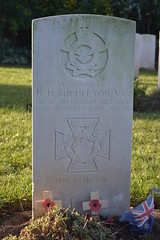
Another ‘noteworthy’ mention is that of Pilot Officer A.L. Kippen (407 Sqn RCAF) who was killed on 16th May 1942. Kippen, (J/7208), an Air observer, was killed when the badly damaged Lockheed Hudson he was in, crashed on its approach to Docking hitting an anti-aircraft gun pit killing the occupants. He too is buried in the nearby church. What makes Kippen’s death so significant, is that just eight days earlier, his sister had sent him a poem, this poem now stands beside the headstone on a plaque.

PO Kippen killed at RAF Docking

P/O A Kippen, Whose Poem from his sister sits at the foot of his headstone.

Meteorological reconnaissance was not the only role played by Docking. Air Sea rescue were responsible for saving a number of downed crews, mine laying, anti-submarine missions and attacks by the Polish 304 Sqn RAF in the ‘1000 Bomber’ raid on Breman all form part of its rich tapestry. Even though it was a grass airfield, it became a refuge for many returning ‘heavies’, Lancasters, Halifaxes and even Stirlings found Docking a safe haven. On one day alone, 17th January 1944, a total of five Lancasters who had run out of fuel managed to land safely on its grass tracks. A number of B-17s also tried to land at Docking, but believing it to be a much longer runway, they ran off the end forcing their undercarriage to collapse in an adjacent ploughed field.

Toward the end of the war, Docking was used less and less operationally and eventually became a ‘demob’ centre for crews. Many faces were to pass through, including Richard Burton and Mick Misell (aka Warren Mitchell/Alf Garnet for those who watched British TV!). Robert Hardy (All Creatures Great and Small) another British TV actor was also here with Burton, as was Danny Blanchflower (Tottenham and Norther Ireland footballer). With little to do, these particular crew members were often in trouble, fights, vandalism and fraternization with the locals led to many a run in with the law.

Gas Decontimination building

A gas decontamination building.

After the war had ended, Docking was used as emergency housing for the locals, many stories are told by David in his book and indeed he was one of those souls who had to brave the cold and ‘misery’ of a Nissan hut in winter.

With such a ‘distinguished’ history, RAF Docking is one of those airfields that has managed to fade into the past. Little now remains of its existence. Being grass, there are no runway remains or even an indication of a runway. The perimeters being concrete now form the eastern road that pass along side the site, being single track it is considerably smaller today then it was in the 1940s. At the top of this road, where the track swings west, is the former bomb site. Now a ploughed field, its wartime existence totally masked.

The new Docking memorial.

The new Docking memorial.

To the West of the site, the main road (B1154) passes through what was the admin and technical sites. A single crew hut stands in a field marking the location of the airmen barracks. Further along, the road forks, and to the left would be a further domestic site housing crews in more Nissan huts. The triangular coppice that stands in the middle of this fork, still retains, in a very dilapidated state, the gas decontamination centre and the emergency electrical supply, the stand-by set house. Both these are in a very poor state and now house disused agricultural machinery. Careful observations amongst the bracken and undergrowth reveals entrances to underground shelters, four entrances in total. These have been blocked and partially filled by the farmer to prevent access. Further along the right fork, would have been to the left, the WAAF site, to the right, the water tower along with further domestic units. All traces of these are now sadly gone.

Original watch tower

The original watch tower watches over crops rather than departing aircraft.

Newly created on this fork, is a memorial to those who flew from Docking, beautifully crafted in black, it over looks the airfield to the east. From here, a small pill-box can be seen amongst the hedgerow, and with permission, it may be accessible and could be one that was damaged when hit by an HP Hampden.

The entrance to the rebuilt Sunderland farm is also along here. This led to the A1 hangar, again now gone, and on through to the centre of the airfield to where the watch office still sits. Used for storage, again with permission it may be accessible. A number of smaller buildings are still evident here too and many can just be seen between the hedgerows, from the public highway.

pill box

A Pill Box remains hidden in the hedgerow.

When visiting Docking, it is strongly recommended that you visit the War Cemetery at St. Mary’s Church, Great Bircham, which includes 11 German war graves and a Cross of Sacrifice unveiled by King George VI on the 14th July 1946. These graves highlight the sacrifice of these men who flew in poor weather for the benefit of their more famous counterparts, the bomber crews. The high number of graves here and the stories that can be told, all reveal a rich tapestry of valour, bravery, sadness and loss that for a decoy station certainly earned its place in history.

War Graves Cemetery - St Mary's Great Bircham

War Graves Cemetery – St Mary’s Church, Great Bircham, includes 12 german graves.

Trail 20, takes a tour round North Norfolk, an area of natural beauty, where many of its airfields are remain intact, but are slowly succumbing to the bulldozer.

Please see Trail 20 for further reading and references.

Royal Air Force Memorial, Embankment, London

London has many stunning memorials and monuments scattered about its streets and gardens. The Royal Air Force memorial is just one of many visited over recent months.

London Feb 2015 024

The Royal Air Force memorial stands on the Embankment overlooking the Thames.

The Royal Air Force memorial is located on the banks of London’s River Thames, between Embankment and Westminster tube stations.

Overlooking the river, it was designed by Sir Reginald Blomfield, sculpted by William Reid Dick, and  completed on 13th July 1923.

The memorial consists of a bronze globe on which stands a gilded eagle with its wings spread as if about to take off. The main tapering column is of Portland stone and this forms the official Royal Air Force memorial.

The initial idea for a memorial was raised by Maj.Gen.J.M.Salmond, in a letter to the Air Ministry on 27th November 1918. Following this a committee was set up and discussions continued around the raising of funds and more importantly, how it should be spent. The leads in this committee were Air Chief Marshal Sir Hugh Trenchard and Lord Hugh Cecil. Eventually, on 21st January 1920, an appeal was launched with an article in the Times newspaper and the money gradually gathered.

There then followed many discussions about a suitable location for the memorial and eventually, the current location was agreed and permission given for its erection. The Architect, Sir Reginald Blomfield, decided upon William Reid Dick as the sculptor, plans were drawn up and building work started.

London Feb 2015 003

A Bronze gilded Eagle stands as if about to fly.

It wasn’t until 16th July 1923, that the memorial would be both finished and unveiled. In the presence of Sir Hugh Trenchard, and many other dignitaries, the Prince of Wales gave a moving speech highlighting the sacrifice of those who gave their lives in this new form of warfare.

Following the Second World War, further inscriptions were added and the updated memorial unveiled by Lord Trenchard on Battle of Britain Sunday, 15th September 1946. The tradition of placing a pilot’s brevet shaped wreath at its base has continued ever since.

There are a number of inscriptions around the column and base, each one referring to the dedication and loss of the men and women from the entire British commonwealth who gave their lives in both World Wars.

Even on a wet winters day, this is a stunning memorial and a beautiful tribute to those brave people.

London Feb 2015 028

The Eagle looks across the Thames to the London Eye,

For more information about its history go to the RAF Benevolent Fund website here. A pdf is available.

Other major memorials appear in the blog here and for specific airfield memorials here.

RAF Polebrook (USAAF Station 110)

In April / May 1943, Station 110 once more resounded with American voices, the arrival of the 351st Bomb Group. Assigned to the 94th Combat Wing, (1st bombardment Division) they flew B-17s of the: 508th, 509th, 510th and 511th Bomb squadrons. These aircraft would be distinguished by a Triangular ‘J’ on the tail.

The 351st were only activated in the previous October, and were, as ‘rookies’, to take part in some of the most severe aerial battles of the Second World War.

Primary targets they would attack included: Schweinfurt, Mayen, Koblenz, Hannover, Berlin, Cologne, Mannheim and Hamburg. The 351st would later go on to attack submarine pens, harbours and ‘V’ weapons sites. Ground support was also provided for the Normandy invasion, the Battle of the Bulge and other major European ground battles.

foundations

Stone Foundations Poke Through the Undergrowth

In October 1943, the 351st received the first of its two Distinguished Unit Citations, with highly accurate bombing in very challenging conditions raising the standing of this new group. A second DUC was to follow in January 1944 for action deep in the heart of Germany. During an attack on Leipzig in the ‘big week’ campaign of 20th-25th February 1944, two crewmen of the 510th, 2nd Lt Walter Truemper (Navigator) and Sgt. Archibald Mathies (Flt. Engineer), both received Medals of Honour for taking over their stricken aircraft when both Pilot and Co-Pilot were injured / killed.  On attempting to land the aircraft, the B-17 crashed between Glatton (Trail 6) and Polebrook, exploding it killed all three remaining crew members.

It was during this time that (Cp.) Clark Gable was stationed at RAF Polebrook, initially to make recruitment films for air gunners. He only flew five combat missions in all, taking a film crew on each one. The first of these missions was on 4th May 1943 and his last on 23rd September that same year. He was initially awarded the Air Medal, and later the Distinguished Flying Cross, finally leaving Polebrook with over 50,000 feet of film on 5th November 1943. In 1944, the film ‘Combat America’, narrated by Gable himself, was shown in theaters around the United States.

A memorial looks over the remnants of the main runway.

A memorial looks over the remnants of the main runway.

The 351st remained at Polebrook until shortly after VE day, returning to the US and becoming deactivated on August 28th 1945. Polebrook became quiet once more being put under care and maintenance until its final closure in 1948.

During the three years the 351st were at Polebrook, they flew a total of 279 B-17s on 9,075 sorties with 7,945 of them dropping 20,778 tons of bombs. Air gunners on these aircraft were credited with 303 enemy aircraft destroyed. In all they flew 311 credited missions losing 124 B-17s in all.

The story of RAF Polebrook,  how it looks today and the story behind the men can be found here.


Australian Flt. Sgt. Rawdon H. Middleton VC (RAAF) 149 Sqn RAF

100641

Pilot Officer Rawdon Middleton (RAAF)*1

Middleton (s/n: 402745) was born on 22nd July 1916 in Waverley, New South Wales, Australia. Son of Francis and Faith Middleton, he was educated at Dubbo Hugh School. Nicknamed ‘Ron’ by his friends, he was a keen sportsman excelling at many sports particularly cricket and football. After leaving school, he worked as a ‘Jackaroo’ (cattle handler) until joining the Royal Australian Air Force on the 14th October 1940 under the Empire Air Training Scheme. He learnt to fly at Narromine, New South Wales and then was sent to Canada for further training in preparation for his posting to the UK. He finally arrived in Britain in September 1941, as a second pilot, and his first operational squadron was No. 149 Squadron RAF, who were flying Short Stirling bombers out of both Lakenheath and nearby Mildenhall in Suffolk.

P01019.003

Five student pilots from No. 7 Empire Air Training Scheme (EATS) course at No. 5 Elementary Flying Training School (5 EFTS) Narromine. They are left to right: Aircraftman (AC) Gordon Orchard; AC Douglas Scott; Leonard Reid; Pilot Officer (PO) Douglas Wilberforce Spooner (DFM); PO Rawdon Hume Middleton*2

Middleton’s first experience of operations, was in a Short Stirling over the Rhur, the industrial heartland of Nazi Germany. After spending a short time with 149 squadron he moved temporarily to No. 7 Squadron (RAF).

In July 1942, as first pilot, he was given his own aircraft and crew, it was also around this time that he returned to 149 squadron.

Their first mission together would be on July 31st, to bomb the strategic and heavily defended target, Düsseldorf. Middleton and his crew would continue to fly together and took part in other prestigious missions; namely Genoa on the 7th of November and his 28th mission, Turin on the 20th November. His 29th and final mission, would take place on the night of 28/29th November 1942.

In the early evening of the 28th he took off in Stirling BF372 coded ‘OJ-H’ as part of the raid on the Fiat works in Torino, Italy, along with 227 other aircraft which included – 117 Avro Lancasters, 46 Short Stirlings, 45 Handley Page Halifaxes, and 19 Vickers Wellingtons.

Middleton’s crew consisted of: Ft.Sgt. Leslie Anderson Hyder, Ft. Eng: Sgt. James Ernest Jeffrey, Bomb Aimer F.O. G. R. Royde, Wireless Operator: Sgt. John William Mackie; Gunners: P.O. N. E. Skinner, Sgt. D. Cameron and Sgt. H. W. Gough. Three of these had already completed their tour of 30 operations and could have left. However, their dedication to Middleton kept them together.

The mission would take the aircraft over the Alps and the Stirling, laden with bombs and fuel combined with having a notoriously poor ceiling, had to negotiate through the mountains rather than fly over them. A factor that often resulted in a high number of casualties.
Once over the target area, OJ-H was subjected to an extreme flak barrage. With poor visibility, Middleton had to make three passes over the target area to enable his crew to positively identify it. It was on the third pass that a shell burst hit the cockpit. The resulting damage was severe, and fragments had hit Middleton’s head badly injuring him. His right eye was lost and his skull exposed. There were further hits on the aircraft’s fuselage causing considerable damage to the control systems and airframe. Knocked unconscious by the blast, Middleton lost control and the aircraft plummeted through the skies to an altitude of around 800ft. The second pilot, Fl.Sgt. Hyder eventually managed to take the controls, release the bombs over the target and then pull the aircraft into a climb, safely reaching 1,500ft.

With his aircraft severely damaged, Middleton had a choice, get his crew to bail out over occupied France and certain capture, fly to Africa or head back to England; a journey that would last over 4 hours and put the aircraft at risk of attack and the crew in danger. Wanting to give them a fighting chance of getting home, he opted for the latter, and set a course for England.

SUK10501

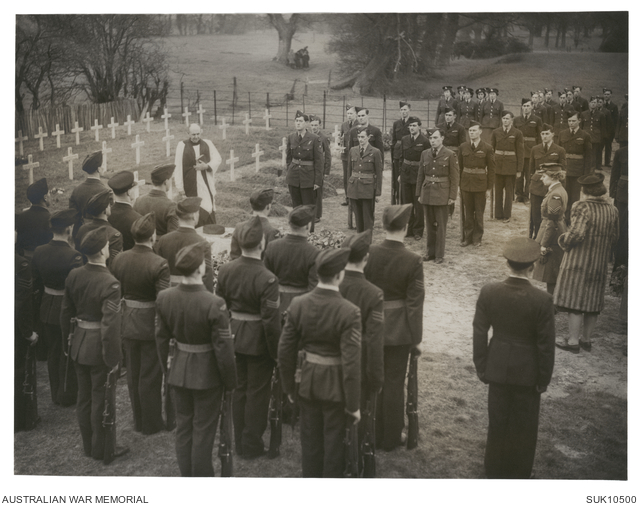
Middleton was buried with full military honours at St. Johns Church, Beck Row. Suffolk.*3

The aircraft experienced a number of attacks as they crossed occupied France, but Middleton, fighting for survival, kept reassuring the crew that he would get them home. Eventually, and against all the odds, they made the English coast, and once over land Middleton ordered the crew to bail out. Five crewmen left the stricken aircraft whilst the other two remained to help him control it. Turning for the Channel, Middleton ordered the two remaining crew members to bail out, whilst he stayed at the controls, steadying the aircraft.

By now the Stirling was very low on fuel and it finally gave up the fight and crashed at 03:00 on the morning of November 29th 1942. Middleton, too injured and too weak to escape the wreckage, drowned within the aircraft fuselage. His two crew members, Sgt. James Ernest Jeffrey (576050) age 19 and Wireless Operator Sgt. John William Mackie (994362) age 30, despite escaping, also drowned. Both the bodies of Sgt Mackie and Sgt. Jeffrey were washed ashore later that day on the 29th.

Middleton’s body remained in the aircraft, but was eventually freed from the wreckage by the action of the sea, and was washed ashore on Shakespeare Beach, Dover, in February 1943. His remains were taken to RAF Lakenheath and he was buried in St John’s churchyard, Beck Row, within sight of his airfield in Suffolk, with full military honours. Middleton was only 26 and only one mission away from ending his tour and returning home.

For his action, dedication and bravery, Flt. Sgt. Middleton was posthumously awarded the Victoria Cross, the first to any serving member of the R.A.A.F in World War II. He was also posthumously awarded a commission as Pilot Officer, backdated to mid November before his sortie to Turin. Thirty years later, in 1978, Middleton’s V.C. was presented to the Australian War Memorial, in Canberra for safe keeping and preservation.

For their actions, the other crew members received three DFMs and two DFCs. Fl.Sgt. Leslie Hyder (DFM) was injured, P.Officer. N. Skinner (DFC) was also injured, along with Sgt. H. W. Gough (DFM). F.O. G. R. Royde (DFC) and Sgt. D. Cameron (DFM) escaped unhurt.

The London Gazette published a report on 12th January 1943. It said:

“Fl. Sgt. Middleton was captain and first pilot of a Stirling aircraft detailed to attack the Fiat Works in Turin one night in November, 1942. Very difficult flying conditions, necessitating three low altitude flights to identify the target, led to excessive petrol consumption, leaving barely sufficient fuel for the return journey. Before the bombs could be released the aircraft was damaged by anti-aircraft fire and a splinter from a shell which burst in the cockpit wounded both the pilots and the wireless officer. Fl. Sgt. Middleton’s right eye was destroyed and the bone above it exposed. He became unconscious and the aircraft dived to 800 ft. before control was regained by the second pilot, who took the aircraft up to 1,500 ft. releasing the bombs, the aircraft meanwhile being hit many times by light flack. On recovering consciousness Fl. Sgt. Middleton again took the controls and expressed his intention of trying to make the English coast, so that his crew could leave the aircraft by parachute. After four hours the badly damaged aircraft reached the French coast and there was once more engaged and hit by anti-aircraft fire. After crossing the Channel Fl. Sgt. Middleton ordered the crew to abandon the aircraft. Five left safely, but the front gunner and the flight engineer remained to assist the pilot, and perished with him when the aircraft crashed into the sea”.

Funeral service for 402745 Flight Sergeant Rawdon Hume Middleton, the RAAF’s first VC winner. He was buried with full military honours in a country churchyard near his station. Air Vice Marshal H. N. Wrigley represented the High Commissioner for Australia (Mr S. M. Bruce) and the RAAF. The graveside service was conducted by Squadron Leader H. C. Thrush of Prospect, SA, RAAF Chaplain. (Australian War Memorial Public Domain)

Middleton’s citation read:

“Flight Sergeant Middleton was determined to attack the target regardless of the consequences and not to allow his crew to fall into enemy hands. While all the crew displayed heroism of a high order, the urge to do so came from Flight Sergeant Middleton, whose fortitude and strength of will made possible the completion of the mission. His devotion to duty in the face of overwhelming odds is unsurpassed in the annals of the Royal Air Force”.

In honour of Middleton’s bravery, Number 1 RAAF Recruit Training Unit at RAAF Base Wagga has renamed the club in his name, the “Middleton VC Club”, and he also appeared on one of the 1995 Australian 45c stamps. The dining hall located at the nearby (now American) base at RAF Mildenhall in Suffolk, has also been named in his honour.

St. John's Church Beck Row, Mildenhall Fl. Sgt. Rawdon Hume Middleton, VC (RAAF) 149 Sqn RAF, St. John’s Church, Beck Row, Suffolk.

Middleton was a brave and dedicated young man who gave his life to save those of his crew. Each and every one of them acted with the highest dedication, sadly for some, it cost them dearly.

Sources

*1 photo courtesy of Australian War Memorial, image 100641, Public domain.

*2 photo courtesy of Australian War Memorial, image P01019.003, Public domain.

*3 Photo courtesy of Australian War Memorial, Image SUK10501, Public domain

*4 Photo courtesy of Australian War Memorial, Image SUK10500, Public domain

What the Luftwaffe failed to do, the local council have finally managed.

Many of Britain’s airfields have hung on desperately to a small corner of history. Hawkinge is sadly one of those that has been buried deep beneath housing, schools and shops. Sadly, one of England’s most historic airfields, has finally been defeated not by Goring’s Luftwaffe, but by local planners.

Hawkinge was at the forefront of the Battle of Britain, it was repeatedly attacked by the bombers of the Luftwaffe. Because of its location, just minutes from France, crews would often have little warning and would have to take to the sky unprepared. Many returning aircraft would use its runways as a safe haven returning battle damaged and weary; Hawkinge fire crews were some of the busiest Britain was to have. It was used as a transport depot in the First World War, became a mecca for international pilots, saw some of the first ‘drones’ and was used in the filming of the 1969 film ‘The Battle of Britain’.

Today a small museum, utilises what’s left of the original buildings whilst housing creeps like poison ivy, ever further across the airfield.

The nearby cemetery is home to not only RAF pilots but also fallen Luftwaffe crews, ironically remaining in the land they tried to take all those years ago.

As part of a second aviation trail around historic Kent, Hawkinge is a must for any follower of history, aviation or the Battle Of Britain.

See the full story and Kent’s second trail here.
lady cropped 2 B&W


Eisenhower stopped off at Lashenden

It was during this time, on July 4th 1944, that General Eisenhower stopped off at Lashenden following one of his many flights over the German lines in Normandy. His pilot, Brig. Gen. Elwood R. Quesada, veteran of 90 sorties, was berated by his superiors for such a ‘foolish’ act. In response he said, “When a five-star general says ‘Go,’ you go!”

Lashenden, also known as Headcorn, was an advanced landing ground, built initially for the RAF, it was taken over by the US Ninth Airforce who used to to fly P-51s and P-47s out over France.

Today it is a thriving airfield, whose annual reenactments bring back the nostalgia of 1940s Britain. Find out more about Lashenden’s history and other airfields in Kent. Click on this link.

lady cropped 2 B&W

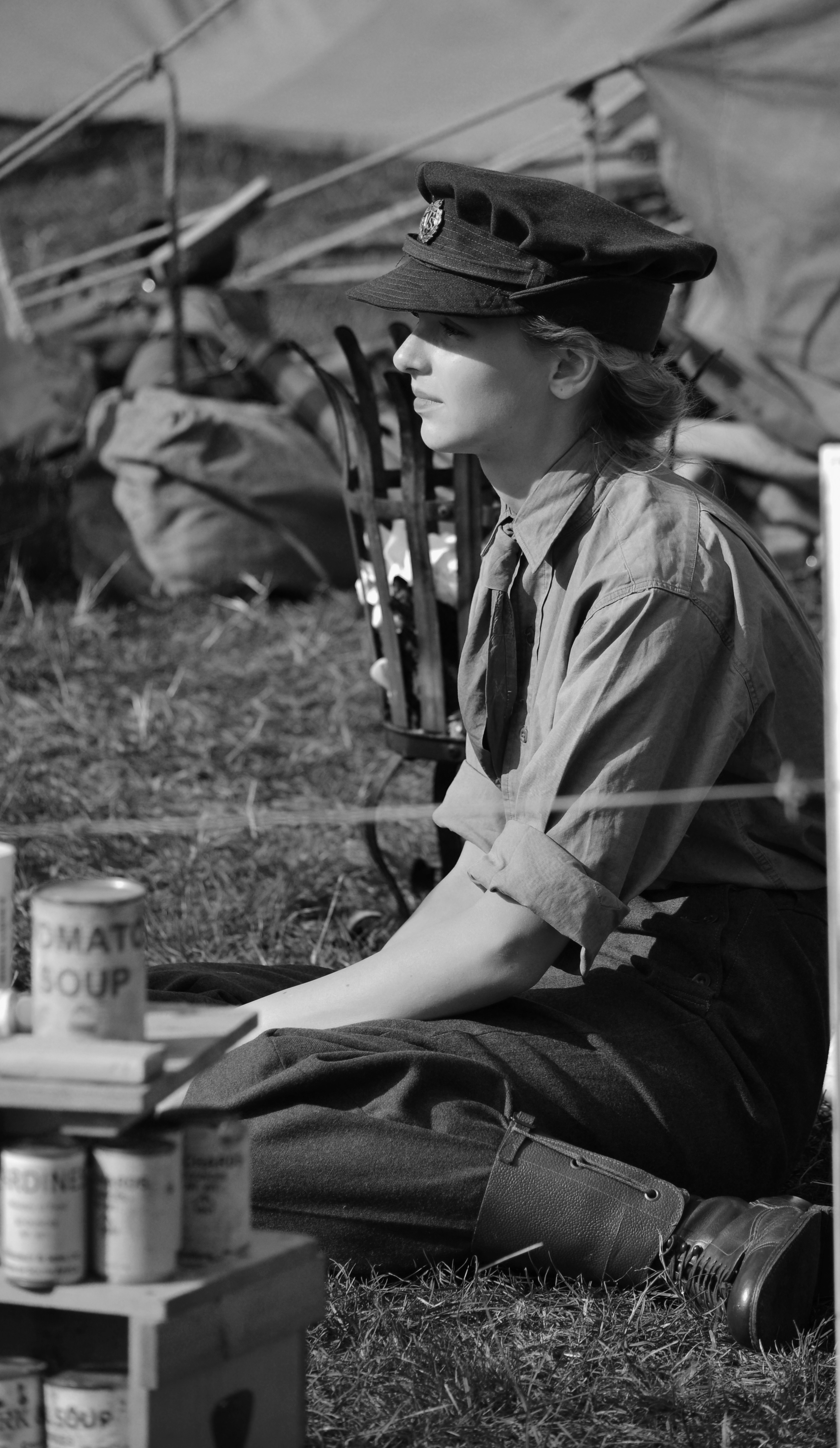
1940s Britain is reenacted on the Former Lashenden Advanced Landing Ground used by the Ninth Air Force.