466th Bomb Group – a Disastrous start to the War.

The area around Attlebridge is steeped in historical value, archaeological finds have dated inhabitants of the area going back as far as prehistoric times; the Romans, Anglo Saxons and Normans have all left their remnants and marks. So too, has more modern man.

RAF Attlebridge (Station 120)

Initially built as a satellite for Swanton Morley, Attlebridge would eventually pass into the hands of the USAAF, receiving the designation Station 120 . As a satellite it was built with less ‘quality’ features than standard ‘A’ Class airfields, but this would not prevent its development or use by a range of single, twin and four engined aircraft of both the RAF and USAAF.

RAF Attlebridge, which became the home airfield of the 466th Bomb Group, earlier in the war when the RAF still owned the station. The control tower is to the left of the windsock. Handwritten caption on image:

RAF Attlebridge Watch Office with Ops Room, the photo is believed to have been taken before the USAAF moved in. The office is a Type ‘A’ design (17821/40). and would have later additions to bring it up to improved standards.   (IWM)

Opened in 1941, initial occupants were the dispersed Blenheim IVs of 105 Sqn from the parent airfield RAF Swanton Morley. Operating anti-shipping roles, they were originally state-of-the-art aircraft but were quickly left behind in the development stakes as the war progressed. Their failings were soon revealed in front line operations and so activities were reduced to low-level attacks on shipping and coastal targets.

No. 88 Sqn (RAF) were the first permanent residents of Attlebridge. Having replaced their Blenheim IVs for Bostons IIIs in the previous July, they brought these new and updated American built aircraft to Attlebridge to continue the low-level attacks on the European continent. 88 Sqn would operate various model s of the Boston right up until their departure the following year and then subsequent disbandment later in 1945.

These were infant years for Attlebridge, and it was soon realised that upgrading was going to be needed if it was to be a serious contender. So reconstruction work began and the site was upgraded with new concrete runways, improved perimeters tracks and dispersal points.

Across the Atlantic, the American’s began their immense build-up, and in the Autumn of 1942, Martin’s controversial B-26 ‘Marauders‘ were flown in via the northern Atlantic route. Both Attlebridge and nearby-by Horsham St. Faith received the new crews. A period of training was undertaken that consisted of low-level flights across the English countryside, but Attlebridge remained a back-seat airfield, acting as a staging post before the Marauders along with the Twelfth Air Force, moved on to the Mediterranean Theatre.
USAAF Station 120

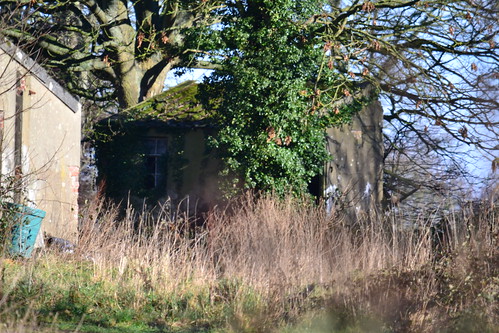
One of the many structures that remain swamped by undergrowth.

Little happened following their departure; the construction work was completed and the RAF returned with another American built model, the B-25 ‘Mitchell II’. 320 Sqn (one of three Dutch squadrons) brought these with them from RAF Methwold in the western regions of Norfolk; they stayed here until August 1943 undertaking a small number of operations in low-level raids.

A spate of Luftwaffe attacks on the East Anglian coast instigated a short stay by Typhoons of 247 Sqn (RAF) which saw them use Attlebridge as a stepping stone, moving through 12 airfields in as many months, a pattern that would continue well into 1947.

At this point, Attlebridge was assigned to the Eighth Air Force and further reconstruction of the airfield began. Improvements to the runways were made, new perimeter tracks, dispersals and technical areas were all added. The three original runways of 1,220, 1,120 and 1,080 yards, were by now increased to the standard 2,000 and two of 1,400 yards accordingly, each being 50 yards wide.

To accommodate the expected influx of 3000 crews and support staff, the accommodation sites would be increased to a total of 11: two communal; a WAAF site; sick quarters; a mix of officers, sergeants and enlisted airmen quarters and a sewage treatments works. Aircraft would be dispersed around a mix of both original and new ‘spectacle’ and ‘pan style’ hard stands, over 60 in total, with two T2 hangars and a blister hanger providing maintenance shelters. A larger bomb store – located to the east, would also accommodate the huge tonnage of bombs that was going to be required in the forthcoming onslaught over occupied Europe.

The scene was set and in February 1944, the Skies over Norfolk would reverberate with the sound of America’s most-produced, four-engined ‘heavy’ bomber.
USAAF Station 120

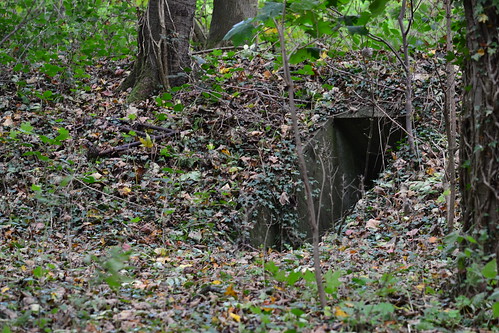
One of the many air-raid shelters that can be seen around the area.

The only major Group to be stationed at Attlebridge was the 466th Bomb Group, 96th Combat Wing, 2nd Air Division, who arrived in early 1944.

The 466th BG were constituted on 19th May 1943, being activated in August that year. They flew Consolidated’s B-24 ‘Liberator‘ in the ‘H’, ‘J’, ‘L’ and ‘M’ models, and was made of four Bomb Squadrons: the 784th BS (code T9), the 785th BS (code 2U), the 786th BS (code U8) and the 787th BS (code 6L). The 466th would be nicknamed “The Flying Deck” and they would operate solely from Attlebridge.

In February-March 1944 the 466th moved in. The air echelon transferred via the southern ferry route to England, the ground echelon taking the Queen Mary to Greenock. They were new, inexperienced in combat, and as ‘rookies’ this would be a major factor in their disastrous start to the war.
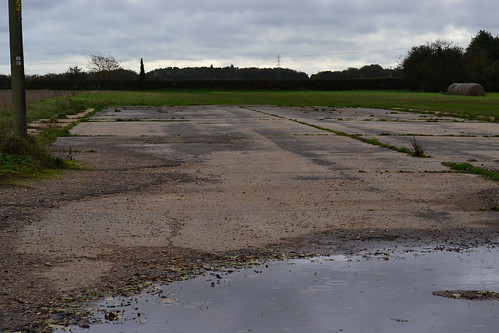
USAAF Station 120

Many parts of the runways and dispersals remain in full width.

Their maiden operation, a mission to Berlin, on March 22nd 1944 would very quickly bring home the dangers of aerial warfare and close formation flying. Even though fighter attacks were non-existent, two B-24s were to collide with the loss of 13 of the two crews. B-24H ’41-29434′ “Terry and the Pirates” collided with B-24H ’41-29416 “Rebel Yell” after “Rebel Yell” was hit by flak. The resultant collision caused both aircraft to fall from the sky and crash West of Oranienburg, in Germany.

On the second operation, the following day, two more B-24s collided over Osterburg, and again heavy casualties were incurred. Onboard one of the aircraft, – B-24H ’41-29466 ‘Dark Rhapsody‘ – were three replacement crew members: Robert A. Gum (C/P), Bogan Radich (R/O) and Aleck A. Amich (TG), it was Amich’s first and only mission – suffering from his injuries, he died three days later in hospital. The two B-24s crashed into or near the Zuiderzee, in the north-west of Holland, where fuselage parts of ‘Dark Rhapsody‘ were later recovered in 1981. Only three of either crew survived taken as prisoners of war.
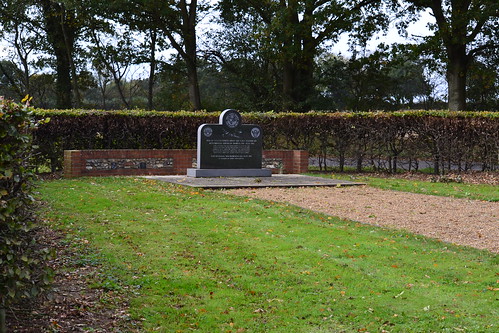
USAF Station 120

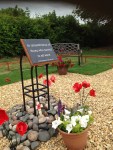
A memorial stands to the south-west overlooking the former technical site.

Then a third collision on the 27th March meant that six aircraft had been lost in five days with little or no enemy intervention. It was not a good start for the freshman of the 466th!

In an attempt to reduce these collisions, which occurred throughout the war, war-weary B24s were stripped of their armaments, painted bright colours and patterns, and lit up so formating aircraft could identify their correct path and position in the formation. Known as ‘Forming Ships’, ‘Circus Leaders’, ‘Judas Goats’ or more commonly ‘Assembly Ships’; they were painted in bizarre patterns and carried a huge quantity of pyrotechnics, that itself being a danger to the operating crews. Many units operated their own assembly ships for this purpose, the 466th using a former 44th BG B-24 ’41-24109′ painted entirely in red zigzags.

The 466th BG would recover from this terrible start and go on to operate in a strategic bombing role, attacking targets such as: Liege; Brunswick; the Bohlen oil refineries; Kempten aircraft plants; Hamburg; Saarbrucken; Misburg and airfields at St. Trond. They supported the Normandy landings, the St. Lo breakout, hit communication and transport links during the Battle of the Bulge, and supported the Rhine Crossing. They would fly their last mission on April 25th 1945.

The 466th BG would not suffer as badly as many of the other groups did. Their initial entrance in the war marred by losses, would soon fade away. By the war’s end they would complete a total 232 missions, a remarkable achievement in just over one year. A total of 5,762 operational sorties would see 12,914 tons of bombs dropped on enemy positions. They would lose ‘only’ 47 aircraft in action with a further 24 others being lost as ‘other’ loses. The 785th BS had the enviable record of 55 consecutive missions without loss, but the 466th were to also suffer the last aircrew casualties of the entire Eighth Air Force.

last crew shot down 21 apr 45 10kia

The last crew to be shot down over Germany, taken 21st April 1945, 10 of the crew were killed. Standing Left to Right: John C. Murphy (RN), John A. Perella (N), John A. Regan (CP), Richard J. Farrington (P), George E. Noe (PN), Chris Manners (B) Kneeling Left to Right: Robert E. Peterson (TG), John C. Brennan (WG), Jerome Barrett (FE), Howard G. Goodner (R/O), Albert Seraydarian (G) Only Manners and Seraydarian were able to bail out. .(IWM.)

After the USAAF pulled out, Attlebridge was returned to RAF ownership, it was put under care and maintenance and retained until sold off in 1959.  It is now owned by the Bernard Matthews company and as with many of the airfields that adorn Norfolk, they are now used to house Turkey sheds.

DSC_0064

Views along one of the runways

The main runways and perimeter track of the airfield are very much evident and in a good state. As this is private ground, access is not permitted, but good views across the tracks can be gained from the local road. There were minimal visible signs of standing buildings, but the control tower was extended and is used by the management of the site.  More careful probing will reveal signs of buildings and  the bomb shelters laying waste amongst the trees. It is possible to drive round the entire site, being only feet from the perimeter track at any one time. Amongst these trees evidence can be seen of the airfields perimeter track. Odd derelict buildings lay swamped by vegetation and trees. At entrances to the site, good views along the runways give a perspective of the size of the place. Hard standings and concrete dispersal pens lay on either side of the road, now used to store sugar beet and other produce cultivated by the local farmers.

The accommodation sites, widely spread to the south-east, have little in the way of visible structures, although some huts are still used by small businesses and remain in reasonable condition.

The blister hanger still stands, although it is now showing signs of wear and its life may well be limited. Whilst large parts of the airfield have survived and survived well, many of the spectacle dispersals have been reduced, in some areas completely removed, presumably for hardcore, and only the tracks through the bomb store remain through the trees.

The western end of the main runway, perimeter track and connected dispersals have all been removed, the public road (Breck Road) now cutting through what was the main technical area. It is the only part that utilises any of the original perimeter track.

It is along this road, only feet from one of the dispersals, that there is a memorial dedicated to the crews of the airfield who served here.  A well-kept memorial, it portrays a Liberator of the 466th, 2nd Division, 8th Air force, ‘The Flying Deck’ and the badges of each of the four bombardment squadrons. It tells of the combat missions over Normandy, France, the Rhineland and the Ardennes. Dedicated in 1992, 50 years after the end of hostilities, it serves as a little reminder of those brave souls, who gave their all from this small part of Norfolk.

Attlebridge had the dubious honour of having the last crew to be shot down over Germany fly from it. As with other sites, its easy to picture a bustling base, aircraft rumbling along preparing to take off on what may be their last flight. Where man once stood, turkeys now breed.
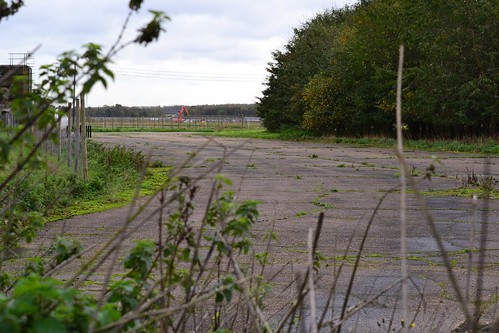
USAAF Station 120

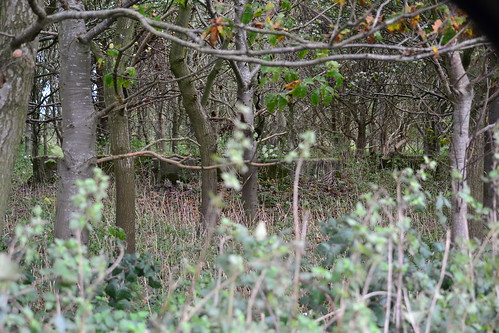
One of the Dispersal pans at Attlebridge.

Whilst visiting Attlebridge, it is worth taking a short journey westward to Hockering Wood, a site of Special Scientific Interest and one that is also steeped in history. More recently, it served as a massive bomb store, and evidence of its activities still remain.

(Attlebridge was visited in 2014 this page has been revised.)

Attlebridge forms a Trail taking in a number of airfields in this region all of which are covered in Trail 7.
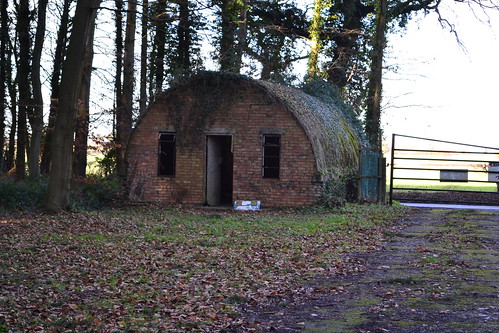
 

Hockering Wood Bomb Store, Norfolk

With the increase in airfield construction and the demand for greater quantities of munitions, additional bomb storage became a problem during the Second World War. Bomb sites needed to be close enough to the airfields so that stores could be transferred quickly, but far enough away so as to not cause problems should an attack happen at either the airfield or at the store.

Apart from the major underground stores bought and secured in the 1930s, the War Office planned an additional nine above ground ‘Ammunition Parks’ at the outbreak of war*1. They were to add a further two more once the war had started and following the realisation that nine would not be sufficient to meet the demands of the air war over Europe.

Each of these parks were initially designed to hold a total of 1,000 tons of ordnance, but it was quickly realised that this too was not going to be anyway near sufficient and the capacity was soon raised to 10,000 tons.

Any store, needless to say, had to be safe, secure and well hidden from prying eyes, all of which presented the War Office with numerous problems. The initial pre-war sites relied upon the strength of the design to protect them but it was then thought better to use concealment as a way of protecting them and so the latter two sites did just this.

About one mile from RAF Attlebridge (Station 120) in Norfolk, stands one of these two sites. Located in Hockering Wood, now a site of Special Scientific Interest, it not only houses some of the rarest plants and animals in Norfolk but across the country as well.

Hockering Wood is one of the largest ancient, semi-natural woodlands in Norfolk, its ponds provide habitats for the protected Great Crested Newt, and a rare mix of soils support an ecological range that is remarkably unusual for Norfolk. It also contains a moated site believed to date as far back as the middle ages.

Yet with all this fauna and flora thriving, it is hard to believe that during the Second World War, this was an enormous bomb store capable of accommodating 8,400 tons of High Explosive (H.E.) bombs and 840 tons of incendiary bombs. A number of hardstandings, huts, component stores, staffing blocks and open sites, were spread out across the site, each linked by 9 foot (18 foot by adjoining H.E. groups) tar sprayed, metal roads that followed the natural contours of the wood. Whilst the general layout and design of each of these sites were similar, each construction team would have a certain amount of autonomy in the decision-making depending upon the conditions at each site. At Hockering, this would take into account the drainage, natural ditches, tree cover and natural barriers that existed there at the time. The requirement being that all natural features were to be retained as much as possible.

The H.E. bombs and ordinary small arms ammunition (S.A.A.) would be stored on hardstands, with the S.A.A. sited between the H.E. in the wooded area. The incendiaries, components stores and pyrotechnics would be stored in 36′ x 16′ Nissen huts, with some of the incendiaries on open land. The original plan was for the pyrotechnics to be grouped together in 6 huts per group, whilst the component stores would be in pairs. This provided a total of 17,000ft of storage for small arms, and over 20,000ft for pyrotechnics. Tail units, not fitted to the bombs until arming, were stored in an area covering 36,750ft.  In addition to this at Hockering, there were two extra accommodation sites also planned in just beyond the perimeter fence should there be an overspill at nearby Attlebridge.

Access to the site was limited and controlled. Three public roads were closed off and entrance along these roads was by pass only – security was understandably high.

The site designed in the early 1940s, and designated as a ‘Forward Ammunition Depot’, was originally built to supply RAF units of 2 Group Bomber Command, and was under the control of No. 231 Maintenance Unit. It was built in the latter part of 1942, opening in early 1943 closing in 1945 at the end of the war. At its height it is thought to have served both USAAF and RAF units.

The tracks that led around the store are still there today, hidden beneath years of vegetation and soil build up. Foundations from many of the huts are still evident and even the odd building still stands as a reminder of the work that took place here all those years ago.

As with many of these historic sites though, mother nature has a way of claiming them back. Careful ecological management ensures the public get to enjoy the site whilst protecting the rare species that continue to thrive there.

A quiet and unassuming site today, it was once a hive of activity that supplied the bombs and bullets that brought death and destruction upon our enemy. It is somewhat reassuring to know that we can once again enjoy the peace and tranquillity that it now brings.

Hockering Wood Bomb Store

One of the more complete huts on the edge of Hockering Wood.

Sources and further reading
*1 Wikipedia has a full list of all the designated ammunition parks.

The technical information was obtained from the plan drawing MC/97/42 Sheet B.

Mosquitoes abound – RAF Swannington

This airfield forms another in a short trail through this part of north Norfolk. An area littered with the remnants of war and aviation history.  As we continue south through the narrow lanes of the Norfolk countryside, we find the almost forgotten airfield at Swannington.

RAF Swannington

Swannington was one of the last airfields to be opened during the Second World War, hence very few units were permanently based here. This considered, an appreciable amount of it remains visible even today.

Also known as Haveringland, construction was started as early as 1942, but it didn’t actually open until 1944. It utilised much of the forests of nearby Haveringland Hall along with large parts of its estate. The hall itself, a rather large and grand building, was blown up at the end of the war following requisition damage and then being classed as ‘surplus to requirements’ by the MOD!

Once the forest area had been removed, work could begin, and a number of accommodation sites were erected. Haveringland Hall itself became the Officers mess, with various accommodation sites constructed all around it, all located to the east of the airfield. In 1944 there were 154 Officers (of both RAF and WAAF ranks) along with 1239 other ranks stationed here although accommodation was provided for around 2,500.

RAF Swannington

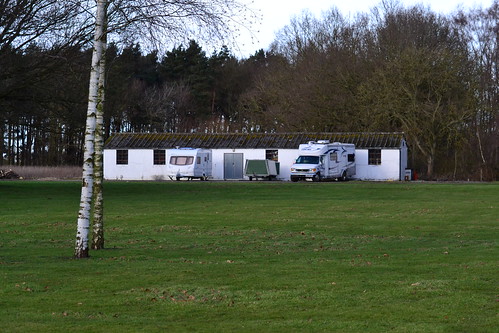
Former Sergeants Mess in use Today

Designated a class ‘A’ airfield, Swannington would have two T2 hangars and one B1, three runways (1 x 2000 yds and 2 x 1,400 yds) and 36 loop style hardstands.

100 Group became the immediate owners of Swannington and instantly placed two squadrons of de Havilland’s Mosquito at the base – No. 85 and 157 Squadrons. 100 Group were formed in November 1943 to investigate and oppose the electronic warfare operations being conducted by the Luftwaffe. To counter this threat, a number of airfields in this area were utilised, Swannington being one of them.

Using a range of new devises and tactics, 100 Group operated a range of different aircraft, predominately the heavier bombers: B-24s, Lancasters, B-17s, Halifaxes, Wellingtons along with the smaller and more agile, Mosquito.

On May 1st 1944, following a successful tour at West Malling*1 , the first Mosquito XVIIs of 85 Squadron arrived at Swannington.

Having a history that extended back to the First World War, 85 Sqn had been in France to support the B.E.F then, re-equipped, they participated in the opening skirmishes of the Battle of Britain. After taking on a new role as a night fighter squadron and moving to Yorkshire, they transferred to 100 group with their move to Swannington. Here they began supporting bombing missions, seeking out enemy night fighters before they attacked the bombers and then loitering over their airfields as they returned.

The Mosquitoes had proven so successful in all operations that 85 Sqn were moved back to West Malling for a short period to combat the increasing threat from the V-1 ‘Doodlebugs’. Their stay in Kent ended in the following August, at which point they returned to Swannington upgrading to the Mosquito XXX before moving off again, to RAF Castle Camps.

157 Squadron joined 85 at Swannington on May 7th 1944 with the Mosquito XIX, later upgrading to the NF.30 with its superchargers and a new radar. 157 had been the first squadron to receive the NF.IIs earlier in March 1942 with the delivery of both W4087 and W4098*2 .

157 Sqn’s arrival would not be the best. Three days after their arrival, Flight Lieutenants Tweedale and Cunningham would take off for an Airborne Interception (AI) training sortie in their Mosquito XVII. On their return, the aircraft would crash, losing its starboard undercarriage, and whilst neither officer was injured, it would be the first ‘casualty’ of 157 Squadron whilst based at Swannington. A very successful fighting unit, they would not be immune from further incidents, some to the embarrassment of their crews.

Whilst on patrol on November 21st 1944, Mosquito MM629 ‘RS-Y’ piloted by Flying Officers A Mackinnon and G Waddell, were shot down in error by another Mosquito of the same squadron, who believed them to be a Ju 88! Both crew members parachuted safely into enemy territory but managed to evade capture returning home within 12 hours.

RAF Swannington

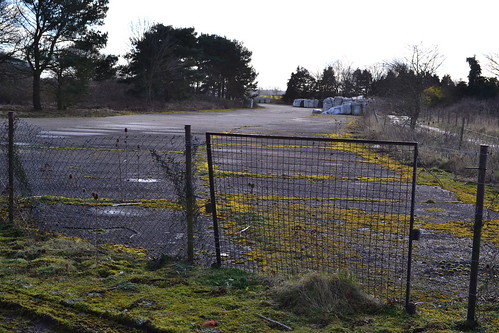
Portions of concrete remain in the Technical Area.

157 Sqn would also transfer with 85 Sqn to West Malling, undertaking ‘anti-diver’ or ‘Doodlebug’ sorties; operations that saw 157 Sqn claim a total of 36.5 flying bombs, whilst 85 claimed some 18.

157 Sqn then returned to Swannington with 85 Sqn at the end of August 1944 and as with 85 Sqn, they upgraded to the MK XXX Mosquito. They, unlike 85 Sqn however, remained at Swannington until disbandment on 16th August 1945. By the end of operations at Swannington, both 85 Sqn and 157 Sqn had completed a touch under 2000 sorties between them, with 108 enemy aircraft destroyed and 19 damaged.

Toward the end of 1944 and early 1945, four other fighter squadrons would visit Swannington. 229 and 451 (Australian) Squadrons came first in the November of 1944; in a move initiated by poor weather, they would come from nearby waterlogged Matlask. 229 brought Spitfire IXs which within a month they would replace with LF XVIEs. This was followed by a swift departure to nearby Coltishall where they were disbanded and renumbered 603 (Auxiliary) Sqn in the following January.

It was a similar story for both 453 (Australian) Sqn with their Spitfire LF XVI, and 602 Sqn with their Spitfire XVI, both swinging like a pendulum between Matlask and Swannington and Swannington and Coltishall. 453 Sqn then transferred to Kent and eventually the continent whilst 602 Sqn followed 229 to Coltishall where they were disbanded on May 15th 1945. These late model Spitfires were now escorting daylight bombing raids such was the strength and superiority of the Allied Air Force over Europe.

RAF Swannington

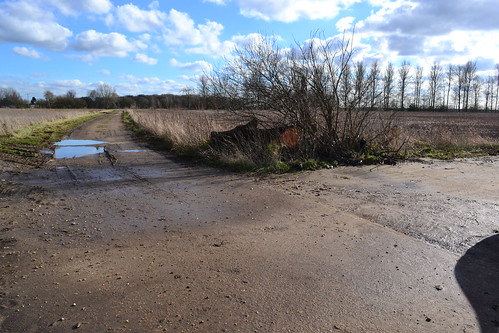
Portions of the Perimeter track remain, some of it in full width.

These four squadrons, 602, 229, 453 and 451, were to join forces with 124 and 303 to tackle the new V-2 rocket, strafing and bombing the launch and control sites. It was on the 14th February 1945, that 602 Sqn pilot Sgt. T “Cupid” Love fired upon a rising V-2, the first (and only) record of any such incident occurring. An account of the event appears in Raymond Baxter’s log, and he explains how it was fortunate that the shots missed, for had he hit the rocket, it would no doubt have exploded ending the lives of himself and his fellow crews.

As the war came to a close and German forces were thought to be amassing troops at Kiel for a final assault on Norway, Mosquitoes from 157 Sqn were sent along with those from 8 Group to attack airfields in the area. These were to be some of the last attacks carried out by RAF aircraft in the European Theatre.

Their final departures signalled the end of operational duties for Swannington. The site was used for storage of surplus materials, mothballed Mosquitoes and numerous Merlin Engines until the RAF finally pulled out in 1947. Future plans for an upgrade to the airfield were abandoned, and the site was then sold off, it has since become a mix of agriculture and forestry.

DSC_0220

Swannington’s Stand By Set House is used for storage.

The majority of Swannington airfield is best seen from the eastern side. Approaching from the north, you first come across the former technical site that marks the top right corner of the site. Turn right here and you will see the location of one of the T2s, a farm building now stands here and behind it the location of the tower and a small number of ancillary buildings. These are today shrouded in trees and large bushes, which prevents any real sighting of them. Sadly the current condition, which is believed to be quite poor, is difficult to verify from this point on the roadside. Large portions of concrete denote the perimeter track and access routes to the technical area. Across the road from here, other buildings do still remain and are easily seen from the roadside. A small portion of the north-east / south-west runway also remains here, virtually full in its width.

Turning back on yourself, turn right and drive past the technical area to your right. Poultry sheds and farm buildings now stand here, but the shape of the hardstands are easily recognisable. On your left are more concrete structures and piles of rubble from former buildings. After a sort distance you arrive at the perimeter track, this crosses the road and is full width at this junction. A gate to your left allows access to the distant church, and by driving along here you traverse the actual perimeter where many Mosquitoes would  have moved on those night missions in 1944/45. The distant round-towered Church was so close to the perimeter that aircraft were often parked next to  the church yard, a rather eerie and stark reminder to those crews boarding the aircraft at this point. Stopping at the church the enormous size of the track can again be seen,  virtually full in its width, photos exist of a Mosquito also standing here in this very same position.

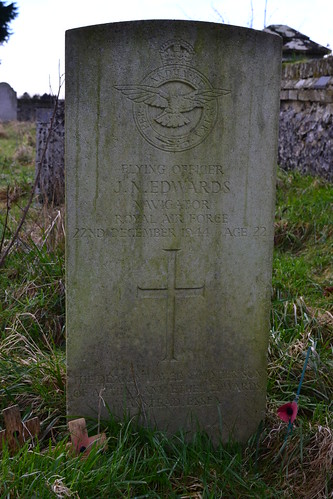
Outside this church, is a memorial dedicated by the ‘Airfields of Britain Conservation Trust’, the only ‘official’ memorial on the site. The church itself is locked, but two graves within the church yard and a bench dedicated to two members of the same family can be found here. The bench, dedicated to Lt. Cdr. M. Auckland and Flt. Lt. W. Auckland, both Harrier Pilots stands near the gate, whilst the older graves, F.O J. Edwards (Navigator) and Corporal C. Mace, can be found behind the church.

Flying Officer Edwards (s/n) 172240) was killed when his Mosquito TA392 ‘RS-K’ developed trouble whilst returning from an intruder mission. The aircraft crashed close to the airfield and both he and his pilot, Flt. Lt. W. Taylor, lost their lives. *3

Before returning, look across to the north to the small wooded area and you will see the Squash courts, standing in  what was the Haveringland Hall estate. Now return back to the road, and turn left, follow the road south. You will cross, a short distance away, the remains of the east-west runway, followed shortly by the returning perimeter track. Carry on to Clay Lane, and turn right. To your left is a small farm and a track that leads away over private land. This is the entrance to the bomb store, it circles round and rejoins the road further along, both now narrow and restricted to farm traffic only.

RAF Swannington

The Grave of F.O. J Edwards, Killed 22nd December 1944, age 22.

From here it is best to retrace your tracks, go back along Clay Lane, turn left and head north. On your right is a turn into the Haveringland Hall Holiday Park. A number of buildings remain here, the squash court, former sergeants mess and standby set house and most in good condition. The woods around here also contain many derelict remains and foundations of former structures. Some visible others shrouded by growth, many are too dangerous to explore.

Swannington had a short life, and many of the crews that passed though here went on to achieve great things. Swannington though wasn’t without its drama. Because of the nature of the operations carried out from here, losses were incurred, many fatal. The later part of 1944 saw a particularly high number of accidents and crew losses, many of these young men never being found.

The remaining buildings at Swannington stand as a silent reminder of the activities of 100 Group. Along with the brave Mosquito and Spitfire crews are all those who fought a long and hard battle against Hitler and his terror weapons. Whilst the Griffons and Merlins have gone, their memories have not.

Sources and further reading.

*1 85 Squadron was previously commanded by Wing Commander ‘Cats Eyes’ Cunningham, who became famous for downing 20 enemy aircraft during hostilities. He later went on to be a test Pilot for de Havilland, testing the DH Comet – the worlds first jet airliner. He received a number of awards and achieved a number of aviation firsts, He died in 2002.

*2 de Havilland Mosquito, An Illustrated History Vol 2, Ian Thirsk, Crecy Publications.

**3RAF Bomber Command Losses of the Second World War, W.R. Chorley, Midland.

Spitfire Dive-Bombers versus the V-2, Volume 2, Bill Simpson, Pen and Sword Books, has a good account of the V-2 war by the RAF Squadrons.

Britain’s Airfields 1944

By the end of the Second World War, there were a substantial number of airfields covering the UK, mainly used by the Royal Air Force, the United States Army Air Force, the Royal Navy and all their associated branches; they were handed back to the RAF at the end of the war as the various forces were pulled out. Some were used as POW or repatriation camps, some were used to store surplus aircraft, vehicles or ordinance; many were put into care and maintenance whilst the RAF decided their ultimate fate.

Thankfully a few have lasted as airfields and are even fulfilling that role today, sadly though, many were dug up, their runways used for hardcore, the buildings demolished and the events that occurred there reserved for the history books.

The scale and pace of development was massive. The size of these sites bigger than many of the villages they took their names from, the populations larger than many towns of the time. Architecturally they changed the landscape dramatically.

Today as they dwindle away, many are mere names, locals have little knowledge of their existence, memorials are being forgotten, and life is moving on.

As a little reminder of those times and to put the scale of development into perspective, here are two maps held by the British Library that show the main Royal Air Force and Royal Navy airfields as of 31st December 1944.

The two maps, divide the UK and show not only the airfields but satellites as well. They also show Royal Air Force and Royal Navy Water Airfields, and Royal Air Force Moorings. There are a number of sites not included on the map such as relief landing grounds, and training schools, but they do give an indication of the number of airfields that covered the UK by the end of the war.

These are both low resolution pictures, and copyright is held by the British Library who have given permission for them to be reproduced here.

Security Released Airfields in the United Kingdom (Sheet 1)
Security Released Airfields in the United Kingdom (Sheet 2)

© The British Library, Maps MOD GSGS Misc. 505 (sheet 1 and Sheet 2)

RAF Matlask, a Windy Corner of Norfolk with Hurricanes, Whirlwinds and Typhoons

In this, the 34th trail, we go back to the northern area of Norfolk, not far from the North Sea coast, and then head south. We end up near to RAF Attlebridge found in Trail 7, west of the city of Norwich.

Our first stop was a quite unassuming airfield, but one that played an important role during the Second World War. British readers will remember the distinct voice of one Raymond Baxter OBE,  the voice behind so many thrilling air show commentaries, the TV programme ‘Tomorrow’s World‘ and a wide range of outside commentaries that brought the wonders of science and technology into our homes. Baxter himself served in 602 Sqn RAF, and was stationed at the airfield in the latter stages of the war.  We are of course at RAF Matlask.

RAF Matlask (Station 178)

Documented on airfield site plans and other RAF Documents as  Matlask, as opposed to Matlaske the name of the village, it was a large grassed airfield hidden well into the Norfolk countryside.

The village of Matlaske separates the main airfield from the  four airmen sites and sewage disposal site, which were widely spread away to the north; only site 2 (communal and WAAF area) and site 7 (Sick Quarters), were located in the village itself.

RAF Matlaske

One of the few remaining buildings at Matlask. This being the former Site 3.

Accommodation was substantial, even taking over the large and rather grand Barningham Hall for the Officer’s Mess. The current building dates back to 1612 and stands in 150 Hectares of garden, park and lakes, a rather ‘up market’ dwelling, that is closed off to public access.

Other accommodation included a range of the usual huts, ‘Nissen’ and ‘Laing’ being the most prominent, with brick and timber featuring most.

The airfield itself stands to the south of the village, with the main entrance way off to the western side. A guard hut would have marked the main gate where a number of brick buildings would have been used for storage, technical activities, fuel storage and the like. A small road took you onto the concrete perimeter track that led all the way round the site. Dispersal was provided by 21 concrete hardstands, although a further 21 temporary hardstands were planned. One single T2 hangar was located  next to the technical area, with a further 5 Blister hangers (design 12512/41) spread around the perimeter. Aircraft dispersal was also provided by the standard 6 Type B protected dispersal pens, (7151/41) with built-in air raid shelters; each shelter having a crew entrance and emergency exit. Matlask initially had one watch tower to the north of the site next to the technical area. This was later modified to a two storey design and then a further example was built slightly to the south, this being of the more common two storey ‘standard’. wartime design (343/43).

Matlask although tucked away in the Norfolk countryside would not be devoid of activity. Some 22 RAF squadrons, an Air Sea Rescue unit and an American Fighter Group would all use it at some point.

Designed initially as a satellite for Coltishall, it was dogged with drainage problems, and surprisingly never seem to warrant any form of hard runway. It was opened in 1940 as part of 12 group, destined for fighter defence of the Midlands.

In 1937, 72 Sqn (RAF) was reformed. they moved around a variety of bases eventually ending up at Matlask’s parent base, RAF Coltishall. When Coltishall was attacked in late October 1940, it was decided to move the Spitfire squadron to Matlask for protection. This merely brought the war to Matlask for on the 29th, five Dorniers attacked the airfield, inflicting damage on several dispersed aircraft and injuring a number of personnel.

DSC_0149

The village sign in Matlaske village.

After this attack, the first of two, the Spitfires would leave and Matlask would revert back to a satellite having no permanent residents of its own. This situation continued until May/June 1941, when Spitfires IIbs would arrive also from RAF Coltishall (Trail 7) . 222 Sqn (RAF) only stayed until the following July, moving south to the large fighter base at RAF Manston, in Kent.

This would then set the tone for Matlask, a large number of short stays, most for no more than a month or so. But whilst their stays were short, the diversity of aircraft they used was not. Spitfire Is, IIbs, IX, XVI, Hurricane II, Airacobra I, Walrus, Lysanders, Westland Whirlwind, Typhoon Ia and Ib, P-47 ‘Thunderbolts’, Miles Master, Martinets, Hawker’s Henley, Tempest Vs and Mustang IIIs would all grace the skies over this region of Norfolk.

Perhaps one of the more notable examples to fly here, was the American Airacobra. 601 Sqn (RAF) moved from RAF Manston to Matlask at the end of June 1941, bringing Hurricanes with them. These were replaced by the distinctive tricycle undercarriaged P-39 ‘Airacobra‘ a short time after. The first auxiliary squadron, 601 was known as the “Millionaires’ Squadron” and said to have been created by Lord Grosvenor at the gentlemen’s club “White’s“. Membership was initially very restricted, and boasted a unique initiation into the ‘club’. Whilst a determined and very professional unit in the air, they acquired a reputation for flamboyance and bravado on the ground.

In looking for a new fighter, the RAF turned to the Americans. The Airacobra was trialled and whilst found to have a number of advantages over its adversaries, it was considered too poor at heights over 15,000ft. Used in only a small number of raids it was deemed inadequate and soon replaced, with many supplied models being sent on to Russia and the Far East. 601 would use these partly at Matlask and then back at the Fighter Development Unit at Duxford where they moved to on August 16th 1941.

On that same day, Spitfires arrived with 19 Sqn (RAF). They changed their Mk.IIs for Vbs before moving off to RAF Ludham in December. It was during this stay though that a change was to take place for Matlask.

On October 1st 1941, 278 Sqn would be formed out of 3 Air Sea Rescue (ASR) Flight, operating Lysander IIIs. These, whilst successful in SOE missions, were considered the weak link in the Air Sea Rescue Role.  Operating initially as a spotter, it would fly to the last reported position of the downed aircraft, carry out a search, drop whatever aids it could, and then pass the information on to a Walrus which would collect the airman. In theory this worked well, but due to its poor capacity (supplies were limited to what could be fitted on the bomb racks), slow speed and vulnerability, it was limited to flying no further than 40 miles from the coast. As a result, and almost immediately, the Lysanders were replaced by the Walrus, an aircraft 278 Sqn operated for some time. Performing in this vital role, they were eventually moved in April 1942 to RAF Coltishall leaving Matlask firmly behind.

Around the time 19 Sqn departed Matlask, 137 Sqn moved in. They were to be perhaps the longest-serving squadron at Matlask and perhaps also one of the most notable.

Operating in the Coastal patrol and fighter role, they brought with them the Westland Whirlwind. Potentially thought be a world-beater, they would be liked by their crews, perform well at low altitude and have a punch that matched anything in the European Theatre at that time. However, having a poor combat range, and production problems with their engines, they were only built-in limited numbers and were restricted to ground attack, anti-shipping duties and low-level sorties. As such, they were only supplied to 2 operational squadrons, 137 Sqn and 263 Sqn; 137 Sqn being the second. Operations by the Whirlwind were mixed. Some great successes were reported, its concentrated fire power proving devastating not only to enemy aircraft but more heavily armoured targets including locomotives.

Despite this however, 137 Sqn was to suffer a major blow in February 1942. Whilst escorting British destroyers, they were unaware of the presence of the two German warships Scharnhorst and Gneisenau. On diving to investigate, they were attacked from above by escorting Bf-109s and of the six Whirlwinds sent out, four were shot down and lost.  Despite its good performance, it was never to enter full production and soon the Whirlwind would be declared obsolete and be destined to fall into aviation obscurity.

ROYAL AIR FORCE FIGHTER COMMAND, 1939-1945.

Typhoon IB of 56 Squadron runs up its engine in a revetment at Matlask, before taking off on a ‘Rhubarb’ mission over Holland. © IWM (CH 9250)

137 Sqn would leave Matlask in August 1942 only to return 10 days later before departing again to RAF Snailwell at the end of the month. Almost as a direct replacement, Typhoons from Snailwell’s 56 Sqn and Coltishall’s 266 Sqn took their place. 56 Sqn stayed here for almost a year, moving to Manston in July 1943 whilst 266 Sqn moved to Duxford that same month. One of the last fatalities of 56 Sqn was Flight Sergeant R.G. Gravett (s/n 1268706), flying a ‘Rhubarb’ mission in his Typhoon JP392, who was killed when his aircraft was hit by Flak whilst attacking a locomotive at Leiden train station. The resultant crash, which hit 5 homes in Leiden, also killed one civilian and wounded five others.*1

After 56 Sqn’s departure the airfield was allocated to the Eighth Air Force and given the designation Station 178. Sadly though, it was only used for small detachments of the 56th FG flying P-47 ‘Thunderbolts’, and plans to expand the station to three runways were not carried out.

Apart from target towing activities, the early summer of 1943 was relatively quiet at Matlask; Lysanders returned along with the more unusual Masters, Henleys and Martinets of 1489 Flt.

Then came a flurry of fighter activity. The July of that year would see Matlask become a fighter base once again, with Spitfires, Tempest and Mustangs all being stationed here. Some 11 squadrons: 611, 195, 609, 3, 486, 65, 122, 229, 453, 602 and 451 all brought their own variety of fighter with them over the next year.

January 1944 would bring two more ‘unusual’ visitors to Matlask, although neither would be particularly graceful. On the 11th, B-17G (s/n 42-31090) ‘Nasty Habit‘ was instructed to land at Matlask, because of poor weather at its own station, RAF Deenethorpe (Trail 6). The B17 overshot and crashed through the boundary hedges and onto the road. Flying with the 613 BS, 401 BG, it was salvaged ten days later.

A B-17 Flying Fortress (IN-L, serial number 42-31090) nicknamed

B-17G (s/n 42-31090) ‘Nasty Habit’ *2

Then at the end of that month, whilst returning from a mission to Berlin, Halifax III, HX239*3 ‘HD-G’ of 466 Sqn RAF Leconfield, attempted a landing at Matlask due to low fuel. On touchdown the pilot, P.O. D. Graham realised he was on a  collision course for a group of workmen. In averting what could have been a major catastrophe, he ground looped and hit a partially built building, injuring three of the crew members. For the crew, a mix of Canadians and Australians, it was not the most comfortable of landings!

Almost as quickly as it all started, aircrews left and Matlask fell silent. The war came to an end and the RAF pulled out. 451 Squadron leapfrogged between here and nearby RAF Swannington, finally leaving on April 6th 1945 to RAF Lympne in Kent. The end had arrived for Matlask. A short spell as a POW camp and then it began its rapid return to agriculture and its present day form.

Matlask airfield today is very different from its heyday of the 1940s. The perimeter track is all but gone, only a small section remains as a simple farm track that leads across what was the northern section of the airfield. Half way across this part of the airfield lay the remains of the base of the T2 hanger. Today its holds farm machinery, waste and other products. On the north-western side would have been the main gate and the technical area. The two towers have left no remnants and even the last fighter pen is all but indistinguishable. Having grass runways, means the site is flat and unrecognisable as having any notable history. A memorial erected by the Airfields of Britain Conservation Trust stands on what was the north-eastern section of the airfield just south of the village. From the village, heading south past this memorial takes you parallel to the airfield, the former perimeter tracks only feet from where you are driving.

In the village of Matlaske itself, you can find the former sick quarters – site 7, its distinctive roadway still evident but housing small homes and Bungalows now rather than sick bays of the 1940s. To the west there are a small number of buildings remaining on private land, shrouded in vegetation and trees, they are barely visible from the roadside. This would have been the former site 3, the location of six airmen’s barracks, five latrines, an ablutions block, drying room, fuel compound and a picket post. A small community in its own right.

Many of the accommodation sites are located within the grounds of Barningham Hall and the roadways that once took weary crews to and from the airfield now gone. Driving down the western side past the technical site, presents no sign of wartime activity. The former huts have all been removed, and even the battle headquarters, often one of the last few buildings to survive, has been removed.

Matlask has all but gone. When I visited early in 2016 it was a foggy, cold morning. The Norfolk wind has replaced the piston engines, the Merlin’s no longer resonate across the open expanse. The village is quiet. A public defibrillator in an old phone box perhaps a metaphorical gesture. The village sign acknowledges the history, a lone aircraft flying low over the village. As the fog lifts on this winter morning it reveals a wide open expanse that was once the busy and historic RAF Matlask.

Raymond Baxter commentates on some British Classics at RAF St. Athan.

After leaving Matlask airfield, we head south, a short distance to the former base at Swannington.

sources

*1 Air War WW2 database V4.1, Jan Nieuwenhuis, Netherlands

*Photo IWM, Roger Freeman Collection. FRE 8078

*3 Aircrew Remembered website, accessed 4/3/16

*Bomber Command Losses of the Second World War, W.R.Chorley, 1944, Midland Publishing


80 Years Of A True Legend Of The Skies

March 5th 2016 marks an incredible 80 years since the first flight of the Supermarine Spitfire. The first prototype, K5054, designed by Reginald J. Mitchell, took off from Eastleigh Aerodrome on March 5th 1936 and while it may have looked a little rough around the edges it was unmistakably a Spit’ with its beautiful wing shape and […]

https://defenceoftherealm.wordpress.com/2016/03/05/80-years-of-a-true-legend-of-the-skies/

Is this the missing Stirling LJ850?

A recent report has identified what is believed to be the wreckage of Stirling LJ850 ‘QS-Y’ of 620 Squadron (RAF), that crashed whilst on a mission to drop paratroopers behind German lines.

Crew of Missing Stirling LJ850

The crew of LJ850 *1

The aircraft was part of a three ship formation and disappeared on the night of 17th / 18th June 1944, with a number of RAF personnel and the 1st SAS Regiment servicemen on board, – there were no survivors*2.

There has been considerable speculation about the fate of this aircraft and a number of theories as to what happened to it.

It was last heard from whilst over the English Channel, and initial thoughts were that it crashed into the sea. Other reports state it crashed into high ground on the run-in to the drop zone in the Morvan Mountains area near Les Valottes. A further report states it crashed 100 miles off course in the Savoy Hills, but there were never any reports by the German authorities at the time and no substantial wreckage has as yet been found.

Fragments form this particular wreckage may have been located a few miles inland of what was Omaha Beach, a possible location if LJ850 did come down shortly after its last transmission.

It is known that there were very few heavy bomber activities that night, and no bomber casualties were reported. Early indications are that the wreckage is of a Stirling bomber, so could this be the wreck of LJ850?

Before any investigations can proceed, a permit is required, but French officials are refusing to grant permission for any detailed search of the site, as the site is a “war grave”. They also quite rightly raise concerns over the conservation of the site, safety issues, and also jurisdictional considerations. So, for now, the story and final closure of LJ850 looks set to continue for some time yet.

620 Squadron was formed on 17th June 1943 at Chedburgh, and were initially involved in night bombing duties. In November 1943, they converted to airborne operations, dropping supplies, Paratroops and performing glider tug operations. Between March 18th 1944 and 18th October 1944, they operated from RAF Fairford, Gloucestershire, before moving to Great Dunmow and subsequently to the Middle East at the end of the war.

The crew of the Stirling were:

Wing Commander R.W. Crane  RAAF (s/n 413535) (Pilot)
Fgt. Sgt. F.N. Johnson  RAFVR (s/n 1395038) (Nav.)
W.O. II J.P. Clasper RCAF (s/n R159971) (B/A)
Sgt. D.W. Evans RAFVR (s/n 1407968) (Flt. Eng)
Flt. Sgt. G.W. Stopford RAFVR (s/n 657479) (W/O – A/G)
Flt. Sgt. B.J. Profit RCAF (s/n R189226)  (A/G)
Sgt. P. Wilding RAFVR (s/n 1345156) (Parachutist Dispatcher)*2.

The crew are represented on the Runnymede memorial.

Included on that flight when it crashed was Sgt. Reginald Wortley, (s/n 4863732) of the 1st Special Air Service Regiment. Wortley was one of the founder members of the SAS.

The names of the paratroops appear on the Bayeux Memorial.

The reported story can be found here.

*1 photo from CBC News website.

*In Dennis Williams’ book “Stirlings in Action with the Airborne Forces“, the crew list omits Wilding, the dispatcher, and lists 15 SAS troops killed on the night. Many thanks go to reader Darren Sladden for the further information and book recommendation, which I too recommend to anyone with an interest in this area of aviation. The Book was published by Pen and Sword Books, 2008, ISBN 184415648-6,

Britain’s Airfields – What does the future hold?

There has been a recent ‘spate’ of developments with planning applications that affect Britain’s wartime heritage, and in particular the airfields that were used during the Second World War.

With land at a premium, a housing crisis that is growing, these sites are becoming more and more handsome as development opportunities. Many have a ready-made infrastructure, many are open fields and as such, prime agricultural or development land. So what does the future hold for Britain’s heritage?

We have seen applications submitted or at least interest shown, for the former: RAF Kings Cliffe, RAF Downham Market, RAF West Raynham, RAF Denethorpe and RAF Coltishall, further applications have now been seen affecting former RAF Dunsfold, RAF Bourn and RAF Wellesbourne Mountford.

We also know that the USAF have given notice of withdrawal from their major UK base at RAF Mildenhall, the smaller site at RAF Molesworth and the remaining site at RAF Alconbury. The Government has already announced it will be selling these sites for housing after the military withdrawal in 2020-23. These three sites form part of an estimated £500m sell-off that would also include: RAF Barnham (Suffolk), Kneller Hall (Twickenham), Claro and Deverell Barracks (Ripon), Lodge Hill (Kent), Craigiehall (Edinburgh), HMS Nelson Wardroom (Portsmouth), Hullavington Airfield (Wiltshire) and MOD Felton (London). Changes at RAF Lakenheath will also see job losses through streamlining of operations.

It is estimated that the 12 sites could accommodate an estimated 15,000 homes with Alconbury having 5,000 alone.

The former airfield and barracks at RAF Waterbeach is also subject to planning proposals, and the Bassingbourn barracks near Cambridge is also under the development spotlight. The recent closure of Manston (a vital Second World War airfield) has led to speculation of its future both as an airfield (possibly London’s third) and as a development opportunity. These are perhaps just a few of the prime areas of land that are now becoming the focus of planners and developers alike.

There are many variables in this heated and long-lasting debate, in fact far too many to raise and discuss here. Strong feelings exist both toward and against the idea of development and it is certainly not a new one. Employment, jobs, environment, heritage, housing etc, they all create discussion and a strong case for both arguments, but the debate here is not “should we build or not” this is quite frankly, inevitable and in many cases much-needed, no, it’s more how can we meet the needs of an ever-growing population with the needs to preserve historically important sites that form the very thread of today’s society.

We have a dynamic population, and as health care improves, social mobility increases and a growing desire to own our own home increases, the need for more housing, affordable homes and homes for rent also increases. We are an ageing population, care homes, schools for our children and hospitals for the sick are all in much greater need. Where do we build them?

Whilst housing demands have always been with us and the need for more housing an all important one, the recent developments suggest that these old airfields could become prime land to meet these future housing needs.

Many of the current Second World War airfields are now either industrial conurbations or agricultural areas. Most have little or no remnants of their former lives visible, and certainly not widely accessible. Many argue that these sites are scrub, derelict and in need of development, and some indeed are. A proportion of the more recently used sites, are ‘mothballed’ or in part operating aviation related activities. They cover huge areas and have a ready-made infrastructure such were the designs of war and post war airfields. These sites also contain extensive dereliction, primarily due to being left and allowed to decay by their owners. Vandalism and pilfering has left them rotting like carcasses of forgotten wild animals. Where industry has been operating, contaminates have seeped into the soils, damaging flora and fauna growth; some so severe that they are rendered too difficult to reclaim as ‘Green Space’. Certainly on paper, they offer good sources for today’s desperate housing stock.

However, balance this against the historical and cultural importance of these places and the argument becomes a little blurred at the seams. Had it not been for the people who came to this country from all over the world to fight the Nazi tyranny in the war years 1939-45, then Britain and Europe would probably not be the Europe we know today. Many thousands of people gave their lives during those dark days, and for many of them, these airfields were their last homes, cold, often draughty huts on the outskirts of some bleak airfield. Their dedication helped form the very society we live in today, the democracy and freedom of speech we so enjoy and relish, the open spaces where we can walk our dog without fear and in freedom. The fact that we can have this very debate, is in itself, testament to those who came here never to return. The very nature and fabric of our local communities has been built around the ‘friendly invasion’ the acceptance of others into our quaint life and idyllic life-styles. Influences from other nations and cultures grew and developed as a result of those who came here from far and wide to give up their lives.

These sites have become monuments to them, their lives and deaths, many still have no known grave; many simply ‘disappeared’ such was the ferocity of the explosion that killed them. The design of Britain’s airfields are architecturally significant to our heritage, buildings were designed to fulfil a purpose and just like our castles and stately homes, they are monuments to a significant period of not only British, but world history. Our education system, includes this very period as a subject for discussion, debate and analysis. To build over such sites without due regard to them would be a travesty, and one that we would regret in the future. To paraphrase that well-known quote; If we are to learn from our mistakes then we need to remember the past. The Second World War is still, for the moment, in living memory, the veterans and civilians who survived it are dwindling in numbers and very soon their memories will be lost for ever. Each day brings news of a lost veteran or a newly discovered story. If we don’t acknowledge the value of these places, if we don’t plan for their ‘preservation’ then both we and our future generations, will be the ones to regret it.

So where do we go from here? The plans published for RAF West Raynham and RAF Coltishall take into account the nature of these sites, they are sympathetic to their historical value and acknowledge the sacrifices made. West Raynham utilises the very buildings that were created, thus keeping the atmosphere for those who wish to visit. Small museums create a record, first hand experiences and artefacts, all valuable records for the education of future generations. But both of these are unique. Both closed in more recent history, they have retained their structures whereas many older sites have had theirs long since demolished.

It is a delicate balance, and as sad as it would be to see them go, there has to be legislation to create compromise. Sympathetic developments have to be the way forward, acknowledgement of the sacrifice has to be high on the agenda. Many of the airfields I have been too have no museum, no memorial barely even a signpost. Surely this is wrong.

If we are to preserve our fragile heritage, we need to consider the implications of the planning process, to look at the value of these sites as both suitable housing and significant historical areas, the sacrifice of the many needs to be acknowledged and it needs to be done soon.

Sources and Further Reading.

Laying the Foundations: A Housing Strategy for England ” HM Gov, November 2011

Stimulating housing supply – Government initiatives (England)” House of Commons Library, 9 December 2014

The “Get Surrey” news report issued on January 5th 2016 relating to Dunsfold can be found here.

Then latest news from “Cambridge News” December 16th 2015 can be found here.

The “Stratford-Upon-Avon Herald” January 6th 2016 front page story about Wellesbourne can be found here. (This may be a limited time link).

The latest news on RAF Mildenhall and Lakenheath published by the BBC, 18th January 2016 can be found here.

RAF Gransden Lodge aircraft revealed.

A recent article published by the Royal Canadian Air Force, tells the story of the fate and eventual discovery of, RCAF 405 “Vancouver” Sqn Halifax II, LQ-B.

LQ-B, s/n HR871, was based at RAF Gransden Lodge as part of 8 Group, Pathfinder Force from April 19th 1943 and was flown by Sgt. John Philips with his six crew members.

On the night in question, August 2/3 1943, they were part of a 740 strong force consisting of a mix of heavy and light bombers, who were despatched to Hamburg as part of the ongoing operation “Gomorrah”, to destroy Hamburg through blanket bombing. A combined operation by the RAF and USAAF would see continuous bombing both day and night from the end of July to the beginning of August whereupon they turned their attention to Nuremberg, Milan and then Peenemunde. In this short period some one hundred RAF aircraft were lost, many flown by Canadian, Australian and New Zealand crews, all fighting a war a very long way from home.

LQ-B set off with the other aircraft on the night of August 2nd and it was during this leg of the trip that they would encounter a terrific thunderstorm, in which lightning would strike the aircraft knocking out the two inboard engines, damaging a number of instruments and the radio.

With the aircraft difficult to control Philips made the decision to head north toward Sweden where the crew were eventually ordered to bail out. All the crew escaped the aircraft safely and were interned by the Swedish authorities until January 1944, when they were repatriated.

LQ-B went on to crash into waters just off shore of the Swedish coast where it has recently been discovered in 17 metres of water broken up and partially submerged in the silt. It is hoped to recover the aircraft in the near future.

During this same night 405 Sqn also lost the aircraft and crews of Halifaxes, LQ-E (HR849) and LQ-G (HR917) most of whom have no known grave.

Gransden Lodge, located on the Bedfordshire / Cambridgeshire border, can be seen in Trail 31, whilst the Royal Canadian Air force article can be found through this link.

A Happy New Year!

As 2015 fades away I would like to take this opportunity to thank each and every one of you who has visited, followed, liked, reblogged, commented and generally supported “Aviation Trails” during the last year. Without you, it would not be the site it is today.

It has certainly grown over the last year and taken on a new dimension. Investment in research material has enabled much longer posts and more personal information to be included, something that I know many people like to see. Not only do ‘we’ as enthusiasts, historical ‘writers’, modellers, relations of veterans etc. preserve our common history, but openly promote and educate others through the writing we do.

I believe it is important to remember what went on, the sacrifice and dedication to freedom, and if I can go a small way to helping that then it has all been worthwhile.

I have been inspired to take up old hobbies, learnt about aspects of military and natural history that I had never heard of, found new places in the world and been a part of a group of people who share the desire to learn, educate and inform others. It has been a wonderful year.

The tally of airfields I have visited is now around 75, double what it was this time last year. I have walked in the footsteps of famous people like Guy Gibson, Glenn Miller and Joe Kennedy, stood where important and famous missions have been planned and executed, trodden the very ground where so many young men and women served their country, many thousands giving the ultimate sacrifice.

It has been a most humbling experience.

So to each and every one of you, a heartfelt thank you, and here’s to a happy, peaceful and rewarding 2016.