The Development of Britain’s Airfields (Part 5).

Once the airfield had been built (Part 4), it was occupied by ground and later air forces, and became operational. However, the process by which it was developed, was not haphazard, nor was the architecture of its buildings. Designed to meet specific needs, the airfields of Britain were built using local knowledge, materials and in many cases architectural design.

Airfield Architecture

Any of these airfield developments had to be in line with guidelines laid down by both the Royal Fine Arts Commission and the Society for the Preservation of Rural England, hardly what you’d want in such difficult times! These restrictions however, would initiate a building design that would initially be both functional and aesthetically pleasing, with standard designs varying only through local conditions (suppliers of local brick for example). In the early schemes a ‘Georgian’ style of architecture was chosen for all permanent brick buildings, distinguished by their pillars and ornate archways, often seen on the entrances to Officers Quarters.
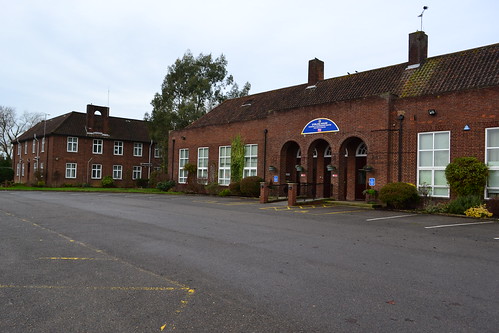
RAF Stradishall

The Officers Quarters at RAF Stradishall were reflective of the types built during war-time under Scheme A
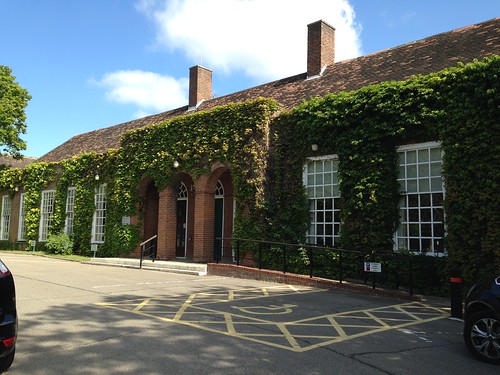
Officer's Quarters now called 'The Gibson Building'.

Standard designs allowed for replication across numerous airfields, the idea being an officer could lift his room from one site and drop it directly on another. RAF West Malling, (built under Scheme M), reflecting this with Stradishall, (Scheme A), above.

All buildings were constructed from brick with roofing tiles chosen accordingly for the local conditions. As the schemes progressed and brick became scarce, concrete was used as a cheap and strong substitute, certainly for technical buildings but less so for administration and domestic structures.

As each scheme was replaced, any previous buildings would have remained (some modified to the new standard), thus some sites will have had a range of building types, often leading to confusion and a mix of architectural styles. The accommodation areas themselves changed too. In the early war years and as the awareness of air attack increased, accommodation was built away from the main airfield site and outside of the airfield perimeter. Classed as either ‘dispersed’ or ‘non-dispersed’, they were identified by the location of these domestic sites, where ‘non-dispersed’ were within the perimeter, and dispersed were beyond the main perimeter area of the airfield.
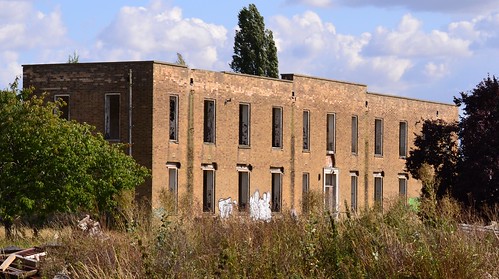
Barrack block Type Q (RAF Upwood)

The changing face of Barrack Blocks. A Type Q Barrack block at RAF Upwood, built to design 444/36, to accommodate 3 NCOs and 68 aircraftsmen. Compare this flat-roofed, expansion period building to the later Nissen hut.

In these early stages little consideration was given to air attack, and so ‘non-dispersed’ sites were still being constructed at the beginning of the war. The benefit of these sites being that all personnel were in close proximity, general accommodation buildings often being built around the parade ground, and with all the amenities under one roof. These sites also saw the segregation between officers, sergeants and other ranks along with separate married (many with servants quarters) and single quarters. However, with the outbreak of war and as a result of austerity measures, the building of separate married quarters ceased. Examples of these early non-dispersed designs include: StradishallMarham, Tern Hill, Waddington and Feltwell.
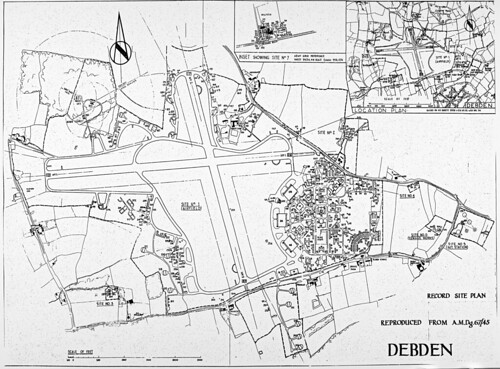
RAF Debden

RAF Debden, a non-dispersed site where accommodation and administrative areas were collectively close to the main airfield site within the outer perimeter (IWM17560).

The layout of these barrack blocks, took on the familiar ‘H’ shape, a design that replaced the initial ‘T’ shape of the post First World War and inter-war years. The ‘H’ Block became the standard design and gave a distinct shape to accommodation blocks on these prewar non dispersed airfields.

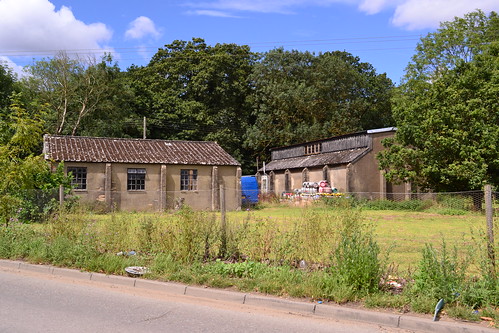
As the awareness of the dangers of non-dispersed designs became all too apparent, dispersed sites became the norm, where domestic areas were located a good distance from the main airfield site. Dispersed accommodation could have many sites, depending largely upon the nature of the airfield (Bomber, Fighter etc), when it  was built and whether it was operated by the RAF or USAAF. In these later dispersed schemes, domestic sites became more temporary in nature, whilst some remained as brick, many were built as prefabricated units often as Nissen or Quonset style huts, often due in part to the shortage of brick for building and the speed at which they could be erected.

With the changes in dispersing accommodation blocks away from the main airfield, safety increased but both administrative and operational effectiveness noticeably dropped. It was going to be a fine balance between keeping a safe distance and achieving maximum effectiveness.
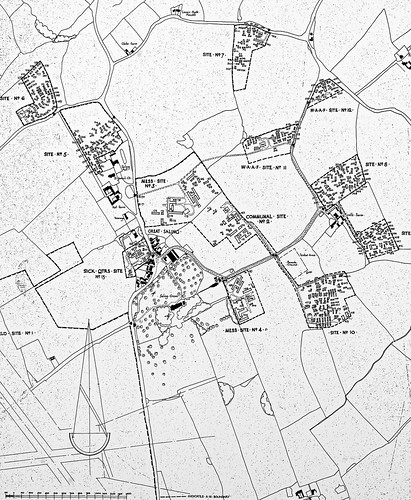
Andrewsfield Accommodation site

A typical dispersed site showing the accommodation areas dispersed well away from the main airfield (bottom left). RAF Andrews Field (IWM UPL17532)

Depending upon local topography, these domestic areas could be situated as much as two miles from the airfield site, wooded areas being utilised where possible to hide the location of huts; blocks were randomised in their position to break up the appearance of housing, and pathways weaved their way round the sites to reduce their visual impact. In most later airfields, a public road would separate the technical and accommodation sites, with as many as thirteen or fourteen sites becoming common place.

The separation of WAAFs from RAF communal quarters also ceased, men and women now allowed to mix rather than having the separate sites for each. As a result many post 1942 sites had fewer dispersed sites then those of pre 1942.

The design of the technical areas also took on a new look. The prewar practice of squadrons offices being attached to the hangar was dropped, these also being placed away from the main technical site, dispersals for ground crew or waiting pilots were spread about the perimeter so airmen could be closer to the aircraft but far away enough to be safe in the case of attack. This led to a number of buildings appearing on the outer reaches of the airfield, along perimeter tracks and near to hardstands, often these were brick, small and square, others more temporary.

Further changes occurred with the reduction in available materials. These changes have given rise to a wide variation in building design, again many airfields having a variety of buildings using different materials.

Initially, buildings built of brick were strong and commonplace, but as this became both scarce and time-consuming to build, alternative forms were found. Timber followed on, but it too proved to be time-consuming to manufacture, and by 1940 acutely rare also.

A range of materials were looked into, using a mix of timber and concrete, plasterboard and concrete, but they were all below the Air Ministry standard. Even so, many were accepted as design alternatives and used in temporary building construction.

1940 saw the return of the 1916 designed Nissen hut, a curved hut that bolted together in widths of 16, 24 or 30 feet. A cold but effective hut it was commonplace on many airfields as both accommodation huts and technical huts, many being sold post war, and ending up in farmer’s fields many miles from the nearest airfield. With the arrival of the USAAF in 1942-3, they brought with them the Quonset hut, bigger in design than the Nissen, they are mainly distinguishable by their curvatures, the Quonset being semi-circular to the ground whilst the Nissen gave a 210o curvature. This extra curvature gave greater use of ground space, but lacked in overall space compared to it US counterpart.
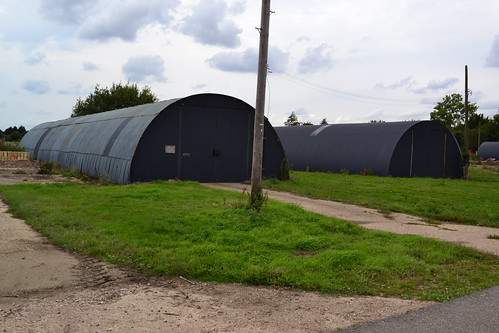
RAF Matching Green

A Quonset hut at Matching Green. Note the curvature at ground level.

Nissen Hut on Acc. Site

The Nissen hut had a larger curvature giving greater ground space – RAF Fersfield.

Even this material became in short supply, metal being scare and urgently required for the building of military hardware. In 1942 the Ministry of Works took over control of hut design, manufacture and supply, and various new designs were brought into play. Asbestos became popular again, with the US being able to supply large quantities of the material. Uni-Seco Ltd, Turners Asbestos and Universal Handcraft being examples introduced at this time.

The final design to be used, was that of the Orlit, a reinforced concrete panel and post design that slots together to form the walls and roof. Also know as the British Concrete Federation (BCF) design they were quick to erect and lasted from many years. This type of design was used for emergency housing in the post war period and has since proven to be degrading to the point that some of these properties have been condemned.

Thus the architecture of airfield buildings took on many guises, from permanent brick designs, through timber, timber and plasterboard mixes, various metal design, asbestos and finally concrete, all of which gave a change in shape and design examples of which could appear on many airfields. The most common surviving examples today being the Nissen hut.

In the next section we shall look at the runway, the very heart of the airfield and often the defining factor in its designation.
The Development of Britain’s Airfields (Part 4).

In Part 4 of the Development of Britain’s Airfields, we take a short look at the construction process and the numerous companies that were involved in building the airfield. Once a site was found in Part 3, compulsory purchase was made and the developers moved in.

Building the airfield.

The creation of airfields was set, each plan was studied, trees, shrubs and hedges were removed, ditches filled and the land leveled to a maximum gradient of 1:60.

First of all to reduce the risk of machinery being bogged down, perimeter tracks were built. This allowed the delivery of heavy loads to any part of the site, and so were originally designed to carry support vehicles rather than aircraft. One reason why so many grassed airfields had hard perimeter tracks.

With such a big workforce being drafted in, accommodation for the workers would be needed, these would generally be the huts that would be used for the aircrews and other personnel on the base once active. Drainage and dry storage was needed as a matter of urgency, and were usually a priority even before the accommodation areas.

RAF Bury St Edmunds (Rougham)

Buildings would be built using a range of materials.

Hiding these enormous excavations was going to a headache for the authorities. How do you hide a building site covering many acres? (Average grassed stations covered 200 – 400 acres whilst those with runways were around 500 acres extending to over 1,000 by the war’s end).  Numerous strategies were tried from painting the ground to covering it with coal dust, even adding wood chip to the concrete surfaces was used all with little real impact. Any spy or reconnaissance pilot worth his salt would have spotted the works and reported back immediately.

Gradually the airfield developed. Workers worked in shifts covering a 24 hour working day, seven days a week, this meant that the construction period was relatively short and the completion rapid. By the end of the war some £200 million worth of work had been carried out involving somewhere in the region of 130,000 individuals including engineering workers, and building sub-contractors.

As the site neared completion, RAF staff would begin moving in. The stores officer or ‘Equipment manager’ would often be first, ordering the necessary supplies to accommodate the forthcoming personnel. He would usually be followed by a NAFFI and a medical officer who would officially declare the site ready for occupation. Once this had been given the ground crews would be brought in, followed by aircrews and the aircraft. Even with a newly opened site, it was rare that it was ever fully finished, often accommodation was rudimentary or cooking facilities limited. In some cases tents were the order of the day until construction was completed. Great emphasis was placed on getting the site open and operational rather than ready. In some cases ground crews, who were otherwise waiting for aircraft to arrive, would take to shovels and picks to complete or improve upon work that had been started on site.

Also the airfield needed naming. Names were usually taken from the nearest village or town, and where confusion might arise from a similar name, it could then be taken from an alternative nearby village. This is why some airfields appear to be quite distant from their respective named locations. Alternatives to this would be geographical features or alternatively local farms e.g RAF Twinwood Farm. The Americans used the system of numbering partly because (a) the American airmen were unable to pronounce accurately some of the English names and were often found getting confused by them, and (b) the American administration system made it easier to use numbers rather than names.

By now the airfield was built, or at least open, the first unit would arrive and airfield defences would be set up. Military personnel would become established and operations would soon begin. All this could occur within months, it was a massive undertaking achieved in very little time.

In the next section we look at the architecture of British airfields, how the idea of replication in design led to architectural developments, and how the demand for materials led to changes in airfield buildings.

The Development of Britain’s Airfields (Part 3).

In Part 3 of this series, we turn from the political scene of Part 2 and look at how airfields were identified, The process and methodology of airfield selection.

Choosing a site.

Choosing an airfield site during these prewar periods was especially difficult as there were many ‘unknown’ factors to predict, a factor in itself that helped determine the needs of each of the various schemes mentioned previously. However, there were a number of airfields already in situ, some used by the military and some used by civilian aviation. As remnants of the First World War, many military sites were inadequate or inappropriate for the growing future needs of the RAF, but with some work, they could be developed into workable sites as the basic infrastructure was already there in place.

As well as these RAF sites, there were also civilian airfields, which the Government considered as potential military airfields. Because civil aviation had grown amongst the wealthier members of society, although not exclusively, this meant that in the pre-war period, there were some 90 airfields*4 owned either by local councils or under private ownership. Many of these were requisitioned by the authorities, but because many were small or located very close to built-up areas, (in 1928 the Air Ministry ‘encouraged’ towns of 20,000+ inhabitants to have a municipal airport), they were not suitable for modern fighter or bomber aircraft. As a result, many of these became training or maintenance sites, some linked to aircraft production facilities, but none were ‘operational’ for fighting units.

A further group of airfields in use at this time, were those of the AA (Automobile Association – better known as a motoring organisation). The AA Landing Grounds were often ex First World War sites located near to hotels and other places of interest to the motorist. Fuel was usually supplied at, or near to, each site, and each one was ‘tested’ by an aircraft on behalf of the AA before it was granted AA status. As these sites were registered, their locations were readily available to the Germans and so they were closed and rendered unsuitable for aircraft. However, land in close proximity was occasionally used, and so a new site would be created in a similar location.

With all these sites available, one would imagine choosing a site and developing it, would be relatively straight forward, but this is far from the truth. Many of these sites were inadequate, and the process of repairing/upgrading or rectifying it was simply not going to be sufficient. Therefore, many new sites were going to be required and the process by which a site was identified, acquired and then subsequently developed was not at all straightforward. In each case the Air Ministry Directorate (AMDGW) and Air Ministries Aerodromes Board would work in very close conjunction with numerous other Government departments and interested public bodies. These would include local Electricity Boards, Drainage Boards, the Geological Survey Department and the local War Agricultural Committee, who were concerned about flooding caused by run-off from the sudden building of large expanses of concrete.

In the first instance, using an ordnance survey map, areas that were below 50 feet above sea level or above 650 feet were generally ignored, the former being prone to flooding whilst the latter suffering high levels of low cloud or hill fog. Next a circle with a radius of 1,100 yards was marked off, this had to be flat with minimal rise in the ground layer. It also had to be free from obstructions and ideally at least three miles away from any other flying location. Next officers from the Air Ministries Aerodromes Board would walk the site, field by field, recording maximum landing distances, and noting any unidentified obstacles, trees, hedges, ditches or more permanent structures that would need removal.

By September 1939, board officials had identified, examined and recorded around 4,000 possible sites in the U.K. Many would be simply filed away never to see aviation of any kind, whilst others would become famous for years to come.

Once a suitable site had been identified and examined, the local geology had to be established where possible. In the pre-war years, no consideration was given to hard runways, they didn’t exist in any real form and were not seen as needed as any aircraft of that time could happily take off from a grass strip. However, in order to prevent aircraft wheels from bogging down, or flooding closing an airfield, well-drained soils were absolutely paramount.

Once the site had been accepted, the land was requisitioned, forcibly purchased using new powers created under the Emergency Powers (Defence) Act 1939. This gave virtually immediate access and ownership of the land – with little notice to the land owner – to the Government. These powers also saw their way to reducing the ‘NIMBY*5 effect, protests against developments being side-lined through political clout.

The next stage in the process was to put the job out to tender. The difficulty here was that secrecy was of the utmost importance, and so little of the detail was released other than an approximate location. As the war progressed, the number of construction companies involved became fewer, and those that were involved more established, prime contractors being Wimpey, Laing, Taylor-Woodrow and McAlpine – all of whom went on to be major construction companies post war. That said, no major airfield would generally be completed by one single contractor, as the whole process required a wide range of skills based operations. As one completed their task, another would come in, sometimes dual operations would be carried out simultaneously. For example taxiways and access roads may have been built by Tarmac, whereas the runway may have been built by McAlpine. Accommodation areas often used ‘Nissen’, or in many USAAF cases, ‘Quonset’ huts, many of these and other ‘standard’ buildings were erected by buildings contractors whereas other more substantial buildings may have been built by John Laing and Co.

By the outbreak of war, 100 sites had been purchased, as the number was relatively small, the board were able to be ‘particular’ in their choice, something that was quickly disregarded as the war progressed.

Airfields are highly labour intensive projects requiring an enormous workforce and extensive heavy machinery, little of which were available in the early 1940s. Irish labour provided the backbone of the initial workforce, whilst heavy plant came in from the United States. At its peak there were some 60,000 men employed on airfield construction, all of whom were unable to spend their time rebuilding the devastated towns and cities of the UK.

As the war progressed, the Royal Air Force Airfield Construction Service began taking a greater role in airfield construction, diversifying away from their original role as repairers of damaged airfields sites. There would be an initial 20 squadrons created to carry out these tasks, with a further 6 being formed later in the war. With squadron numbers ranging from 5001 to 5026, they would be initially involved in the updating of older sites and the creation of ALGs, eventually taking on a much greater responsibility of airfield construction. These squadrons, were of course given great assistance by the well established Royal Engineers.

In 1942, the United States joined the European theatre sending their own Engineer Aviation Battalions to the U.K. Their task was to support these British squadrons by building their own airfields ready for the huge influx of men and machines that was about to arrive. The first site completed by the Americans and opened in 1943, was Great Saling (later renamed Andrews Field) by the 819th engineer Aviation Battalion. Not being experienced in U.K. soils, it was a steep learning curve fraught with a number of initial problems.

Former RAF Andrewsfield

RAF Andrews Field memorial to the 819th Engineer Aviation Battalion.

In 1939 there were only 60 military airfields in the UK, by 1940 this had increased to 280, almost tripling to over 720 by 1945. Between 1939 and 1945 444 airfields*2,4 new airfields were built by these organisations – an amazing feat by any standard. Using almost a third of Britain’s total construction labour force, they were often open and manned within a matter of months rather than years. Building Britain’s wartime airfields was not cheap. Many, like Debach the last USAAF airfield to be constructed, cost almost £1,000,000 to construct.  A small amount compared to the £645, 000,000 it cost to build all 250 US airfields in the UK*5a

This whole process however was not fool-proof. In a number of situations sites were identified and requisitioned, but not developed. In several cases they were partly built, and in others like RAF Cottam, they were completely built but then never occupied. Some airfields were identified for USAAF use, only to be declined and then handed over to their RAF counterparts. Some US bases were never actually started but remained named and therefore official sites even though they remained as farmers fields!

The lead up to war led to a massive change in the British landscape. Keeping airfields secret led to many being built in remote areas and away from major towns. Little did the inhabitants of these quiet little villages know, but their population was about to increase, in some cases by thousands.

In the next section we look at how the airfield was built, the process of construction and the difficulties faced during this phase.

Sources and further reading. 

*2 Smith, D.J., “Britain’s Military Airfields 1939-1945“, Patrick Stephens Limited, 1989

*4 Francis, P., et al, “Nine Thousand Miles of Concrete, Historic England in Conjunction with the Airfield Research Group (ARG). pdf document Published 15/1/16 via website accessed 2/1/18

*5 NIMBY – Acronym used to describe the objections of local planning projects. (Not In My Back Yard).

*5a Wilson. K., “Blood and Fears – How America’s Bomber Boys and Girls in England Won Their War.”, Weiden & Nicolson. (2016)

50 Aviation Trails Reached!

I am pleased to announce that since starting Aviation Trails four years ago, I have now reached that magic number of 50 Trails around Britain’s wartime airfields, a feat I never thought would happen.

Each Trail covers two or more sites, in some cases six, many three, covering in total, over 100 former RAF and USAAF airfields and museums around Britain.

I can honestly say its been a terrific four years, in which I have learnt a lot about Britain’s wartime past, the men and machines that flew from these places and the tragedies that occurred at so many. The development of these airfields was staggering, the process of construction, and the subsequent decay just as eye-opening. These sites and the people who used them, have changed both the British and world landscape, leaving in many cases scars that may never heal. The buildings and stretches of concrete that remain are monuments to human endurance and sacrifice, a sacrifice that we hope may never have to be repeated.

RAF Tibenham Perimeter track

The perimeter track at the former RAF Tibbenham.

During these four years there have been several changes at many of these sites, hangars and other buildings have gone, runways are continuing to be dug up as they become prime land for development. As we speak there are numerous sites under planning proposals, whilst others are waiting in the wings to hear what their fate will be.

To compile these trails I have personally visited each and every one of these sites, even a field has a certain something when you know who stood there before you.

To all those who have visited, commented and followed me on this journey, I thank you, I hope you have enjoyed the journey back in time as much as I have writing it. I hope that through these trails, the memories of those who gave their all may live on so that future generations may know who they were and what they did, so that we may enjoy the peace we do today.

Here’s to the next 50!

Andy.

RAF Andrews Field – (Great Saling/Station 485) – Trail 33: Essex Part 1.

RAF Attlebridge  (Station 120) – Trail 7: Northwest Norfolk.

RAF Barton BendishTrail 7: Northwest Norfolk.

RAF Biggin Hill (Westersham) (Station 343) – Trail 4: Kent Part 1.

RAF Bircham NewtonTrail 20: North Norfolk (Part 1).

RAF Bodney (Station 141) – Trail 8: Swaffham and Her Neighbours (Part 1 of 3).

RAF BournTrail 31: Southern Cambridgeshire (Part 2).

RAF Brenzett (ALG) – Trail 18: Kent Part 2.

RAF BruntonTrail 47: Northumberland.

RAF Bungay (Flixton) (Station 125) – Trail 14:  Central Suffolk (Part 1).

RAF Bury St. Edmunds (Rougham) (Station 468) – Trail 16: West Suffolk (part 1).

RAF Castle CampsTrail 45: Essex (Part 2).

RAF Caxton GibbetTrail 29: Southern Cambridge (Part 1).

RAF Charterhall Trail 41: The Borders of Scotland and England.

RAF ChedburghTrail 49: Bomber Command – Bury St. Edmunds to Haverhill

RAF Collyweston Trail 37: The Northern Reaches of Cambridgeshire.

RAF Coltishall – Trail 7: Northwest Norfolk.

RAF ConingsbyTrail 1: Lower Lincolnshire.

RAF CottamTrail 40: Yorkshire (East Riding).

RAF CranwellTrail 2: Lincoln Borders and Newark.

RAF Debach (Station 152) – Trail 39: Suffolk around Ipswich (Part 1).

RAF Debden (Station 356) – Trail 46: Essex Part 3,

RAF Deenethorpe (Station 128) – Trail 6: American Ghosts.

RAF Deopham Green (Station 142) – Trail 27: Southern Norfolk (Part 3).

RAF Digby (Scopwick) – Trail 1: Lower Lincolnshire.

RAF Docking – Trail 20: North Norfolk (Part 1).

RAF Downham Market (Bexwell) – Trail 7: Northwest Norfolk.

RAF Drem – Trail 42: Edinburgh’s Neighbours.

RAF East Fortune – Trail 42: Edinburgh’s Neighbours.

RAF East Kirkby Trail 1: Lower Lincolnshire.

RAF East Wretham (Station 133) – Trail 13: Southern Norfolk around Diss (Part 2).

RAF Eye (Brome) (Station 134) – Trail 14: Central Suffolk (Part 1).

RAF Fersfield – (Station 130) – Trail 28: Southern Norfolk (Part 4).

RAF FoulshamTrail 22North Norfolk (Part 3).

RAF FowlmereTrail 32Southern Cambridgeshire (Part 3).

RAF Framlingham (Parham) (Station 153)Trail 39: Suffolk around Ipswich (Part 1).

RAF Glatton (Station 130) – Trail 6: American Ghosts.

RAF Gransden Lodge – Trail 31: Southern Cambridgeshire (Part 2).

RAF Graveley – Trail 29: Southern Cambridge (Part 1).

RAF Grafton Underwood (Station 106) – Trail 6: American Ghosts.

RAF Great Dunmow (Station 164)- Trail 33: Essex (Part 1).

RAF Great MassinghamTrail 21: North Norfolk (Part 2).

RAF Great Sampford (Station 359) – Trail 50: Haverhill’s neighbours – Wratting Common and Great Sampford.

RAF Hardwick (Station 104) – Trail 12: Southern Norfolk around Diss (Part 1).

RAF Hawkinge – Trail 18: Kent Part 2.

RAF Hethel – Trail 38: To the West of Norwich.

RFC HinghamTrail 38: To the West of Norwich.

RAF Hunsdon – Trail 25: Hertfordshire.

RAF Kimbolton (Station 117) – Trail 6: American Ghosts.

RAF King’s Cliffe (Station 367) – Trail 6: American Ghosts.

RAF LanghamTrail 23: North Norfolk (Part 4).

RAF Lashenden (Headcorn) – Trail 18: Kent Part 2.

RAF Lavenham (Station 137) – Trail coming soon.

RAF Little Snoring – – Trail 22North Norfolk (Part 3).

RAF MarhamTrail 7: Northwest Norfolk.

RAF Martlesham HeathTrail 48: Suffolk around Ipswich (Part 2).

RAF Matching (Station 166) – Trail 33: Essex Part 1.

RAF Matlask (Station 178) – Trail 34: North Norfolk (Part 5).

RAF MattishallTrail 36: North Norfolk (Part 6).

RAF Mendlesham (Station 156) – Trail 15: Central Suffolk (Part 2).

RAF MepalTrail 11: Around Ely.

RAF Methwold – Trail 8: Swaffham and Her Neighbours (Part 1).

RAF Millfield –  Trail 47: Northumberland.

RAF Narborough (Narborough Aerodrome)- Trail 7: Northwest Norfolk.

RAF North CreakeTrail 23: North Norfolk (Part 4).

RAF North Pickenham (Station 143) – Trail 9: Swaffham and Her Neighbours (Part 2).

RAF North WealdTrail 25: Hertfordshire.

RAF North Witham (Station 479) – Trail 3: Gone But Not Forgotten.

RAF Old Buckenham (Station 144) – Trail 13: Southern Norfolk around Diss (Part 2).

RAF Oulton – Trail 34: North Norfolk (Part 5).

RAF Polebrook (Station 110) – Trail 19: Northamptonshire American Ghosts II.

RAF Rattlesden (Station 126) – Trail 15: (Central Suffolk (Part 2).

RAF SawbridgeworthTrail 25: Hertfordshire.

RAF ScamptonTrail 30: Scampton and the Heritage Centre.

RAF SculthorpeTrail 21: North Norfolk Part 2.

RAF Shipdham (Station 115) – Trail 10: Swaffham and Her Neighbours (Part 3).

RAF Snetterton Heath – (Station 138) – Trail 27: Southern Norfolk (Part 3).

RAF Spanhoe Lodge (Station 493) – Trail 6: American Ghosts.

RAF Steeple Morden – Trail 32: Southern Cambridgeshire (Part 3).

RAF Stoke OrchardTrail 24: Gloucestershire.

RAF Stradishall- Trail 49: Bomber Command – Bury St. Edmunds to Haverhill

RAF Sutton BridgeTrail 3: Gone But Not Forgotten.

RAF Swannington – Trail 36: North Norfolk (Part 6) 

RAF Swanton Morley – Trail 38: To the West of Norwich.

RAF Thorpe Abbotts (Station 139) – Trail 12: Southern Norfolk around Diss (Part 1).

RAF Tibenham (Station 124) – Trail 13: Southern Norfolk around Diss (Part 2).

RAF Tuddenham – Trail 16: West Suffolk (Part 1).

RAF Tydd St. Mary – Trail 37: The Northern Reaches of Cambridgeshire.

RAF Upwood – Trail 17: The Pathfinders.

RAF Warboys – Trail 17: The Pathfinders.

RAF Watton (Station 376/Station 505) – Trail 9: Swaffham & Her Neighbours (Part 2).

RAF Wendling (Station 118) – Trail 10: Swaffham and Her Neighbours (Part 3).

RAF West Malling Trail 4: Kent Part 1.

RAF West RaynhamTrail 21: North Norfolk Part 2.

RAF WethersfieldTrail 45: Essex (Part 2).

RAF Westley – Trail 16: West Suffolk (part 1).

RAF WinfieldTrail 41: The Borders of Scotland and England.

RAF Winthorpe Trail 2: Lincoln Borders and Newark.

RAF WitchfordTrail 11: Around Ely.

RAF Wittering  – Trail 37: The Northern Reaches of Cambridgeshire.

RAF Woodall SpaTrail 1: Lower Lincolnshire.

RAF Wratting CommonTrail 50 – Haverhill’s neighbours – Wratting Common and Great Sampford.


2017 – A Look Back Over The Last Three Years.

As 2017 draws to a close and another year passes, I’d like to look back at some of the highlights of the blog so far.

Since starting the site, way back in 2014, I have learned a lot about Britain’s airfields, their design and construction, and the men and machines that flew from them. What started as a record of memories has turned into a passion of history and hopefully, a dedication to all those who served, fought and died at these places. I have also seen how gradually, over time, many of these historic sites have sadly disappeared, beaten by the onslaught of time, the developers pen, and the ploughs of the industrial farmer evermore determined to draw out more crops from his expanding domain.

What were once massive military sites covering a vast acreage of land, homes to several thousand people who were all doing ‘their bit’ for the war effort; who came from all four corners of the world to fight, are now mere ruins or a collection of derelict and decaying buildings. In many cases they are merely small patches of concrete often covered with the waste of farm practices, or as in some cases, completely gone.

Since starting I have managed to visit over 100 different airfields, stretching from the southern most county of Kent to Edinburgh in Scotland; from Gloucestershire in the west to the East Anglian counties in the East. This has resulted in just short of 50 Trails around the country, but even this has barely scratched the surface of what is still out there waiting to be found. There are many, many more to go, so I thought at this point of the year, I’d share some of the posts that I’ve enjoyed, and also those examples that highlight the extent of this massive war-time development. With this, I hope to show a selection of the examples of features that have (so far) survived and the evidence of them that can be seen today. I hope you enjoy them and may I take this time to wish all followers, family and friends a very merry Christmas and a happy and safe New Year.

With the forming of the Royal Flying Corps, Britain needed and built a number of small airfields all with grass runways, wooden sheds for workshops and accommodation sites using tents. Examples of these places include the likes of Collyweston, (absorbed into modern-day RAF Wittering), Tydd St Mary (Attacked by Zeppelins) and Narborough (Norfolk’s very first airfield) to name but a few. Such little evidence of these sites now exists – many were absorbed into later airfields or they were returned to agriculture – that some, such as Hingham and Westley, we don’t even know the precise location of.

We saw  with the expansion of Britain’s airfields in the 1930s, how buildings changed dramatically from wooden construction – such as RAF Castle Camps – to more permanent (although classed as temporary) brick buildings, many examples of which survive in a preserved state at RAF Bircham Newton.

Technical buildings in use today. At the former RAF Snetterton Heath, technical buildings have survived as small industrial units.

We saw the development of the hangar, one of the most recognisable and distinguishing features of an airfield, from early wooden sheds through canvas doored Bessoneaux hangars, to metal hangars of over 150 feet in length. Many of these buildings still exist today, absorbed into farms or used for storage. Examples are thankfully still relatively common with some found at RAF East Fortune (now a museum), RAF Methwold (farmland), RAF Little Snoring (a light airfield) and RAF North Creake.

RAF Waterbeach 'J' Hangar RAF Waterbeach’s ‘J’ type hangar with a ‘T2’ behind. Waterbeach like so many, is an airfield embroiled in the planning process.

Runways to allow bigger and heavier aircraft to use them, grew from short grass strips to those of wood chip, tarmac and concrete of 2,000 yards in length and 50 yards wide. Some of these even exceeded a massive 3,000 yards in length. Many of these pathways continue to exist today in some form or other, RAF Eye (industrial), RAF Cottam (built and never used), RAF Debden (currently an army barracks), RAF Deopham Green (farmland) and RAF North Witham (an open and public space) are some of the better examples we can find today.

RAF Great Dunmow RAF Great Dunmow typifies the state of many of the better examples of these massive runways today.

The Watch Office, another distinguishing feature, lay central to the operations of a wartime airfield. Again its development was rapid and complex. Some thankfully have been restored as museums such as those at RAF Framlingham (Parham), RAF Debach, RAF East Kirkby, and RAF Martlesham Heath. Some are now derelict, decaying memorials to those who served. Examples found at RAF Winfield, and RAF North Pickenham, are particularly severe, whilst many are used for other purposes such as RAF Matching Green (radio); RAF Attlebridge (offices) and RAF Rattlesden (a glider club).

RAF Bury St Edmunds (Rougham) At Bury St. Edmunds (Rougham) the watch office is now restored and forms the main part of the museum.

There are numerous examples of other buildings on some of these sites, many are now part of small industrial complexes, workshops that were once used to repair aircraft parts now repair cars or other small items. Their original features often hidden by new cladding, overgrown weeds or a change in frontage. Slowly, but surely, they are gradually disappearing from our skyline.

The purpose of theses places was to wage war. In doing so many lives were lost, both military and civilian – on both sides. As a result, many heroic acts of bravery and self-sacrifice took place. The VC, the highest award given to members of the British armed forces for gallantry “in the face of the enemy”, was awarded to two pilots: Flt. Sgt. Arthur Louis Aaron, V.C., D.F.M. and Sqn. Ldr. Ian Willoughby Bazalgette (RAFVR) VC., both flying from RAF Downham Market. The American S.Sgt. Archibald Mathies, USAAF, 510th BS, 351st BG, was one of many Americans awarded the Medal Of Honour for his valour in combat whilst flying from RAF Polebrook, another was 2nd Lt. Robert E. Femoyer MOH, 711th BS of RAF Rattlesden, for his actions over Meresberg.

Losses were high both in combat and also during training. This year, I managed to visit several training stations of which two RAF Chaterhall and RAF Milfield had high losses of trainee pilots. Many are those are buried locally, and one delightful small church I visited at Fogo, had almost as many war dead as it did living inhabitants!

Fogo Church The church yard at Fogo has 16 war dead, most from the nearby training airfield RAF Chaterhall.

All in all its been a fascinating journey, I have entered the lives of many people who fought for what they believed in. I have read their stories, visited the very places they served at, and in many cases, the graves in which they now lie.  These decaying sites are the true monuments to their sacrifice. The buildings that once housed these young men stand as a lasting tribute to them, I hope that their memories never fade away in the way that many of these sites now have.

I’d like to thank you for taking the time to join me on this journey, I hope you have enjoyed reading about them as much as I have enjoyed visiting, researching and writing about them. I look forward to you joining me next year as we travel on many more trails around Britain’s disused airfields.

A Merry Christmas and a Happy New Year to all!

Andy.

RAF Debden (Part 3) – The USAAF Arrives.

After Part 1 and Part 2 of the trail, we find that Debden has a new owner, the USAAF. Its fortunes change and it becomes home to one of the most famous Fighter Groups of the Second World War.

121 Sqn, were reformed in 1941 at Kirton-in-Lindsey, initially with the Hurricane MK. I, and then IIBs moving on to the Spitfire IIA and eventually the VB; a model they brought with them to Debden. 71 Squadron had been formed at Church Fenton, and after moving through a series of stations that included Martlesham Heath, they arrived at Debden on 3rd May 1942 also with the Spitfire VB. On September 29th 1942 the two RAF units along a with a third, the 133 Sqn at Great Sampford,  were officially disbanded, but the men of the three units were not dispersed. Instead they absorbed into the USAAF as the 4th Fighter Group (FG). The men of these squadrons were all originally US volunteers who formed the three  American ‘Eagle Squadrons‘ operating within the Royal Air Force.

The 4th FG was specially created to take these three squadrons, they were brought together at Debden where they became the 334th (71 Sqn), 335th (121 Sqn) and 336th (133 Sqn) Fighter Squadrons (FS).  Debden would then be passed from the RAF to the USAAF, the transition of which, would be smooth and relatively uneventful, the units retaining the Spitfires they already had before replacing them with P-47s later in 1943.

A Spitfire Mk. V (QP-V) of the 334th Fighter Squadron, 4th Fighter Group. Handwritten caption on reverse: '1942. 334 FS. 4th FG.'

A Spitfire Mk. V (QP-V) of the 334th Fighter Squadron, 4th Fighter Group. (IWM)

The handover of ownership of Debden took place on the 12th September 1942, with an official ceremony on the 29th to coincide with the disbandment of the RAF units. During this ceremony both Major General Spatz and Brigadier General Hunter were joined by Air Chief Marshal Sir Sholto Douglas of the RAF’s Fighter Command, to see Debden and the aircrews officially joining the ranks of the USAAF. Initially little changed after the handover, the most prominent feature being the removal of the RAF roundels and the application of the US Star on the aircraft’s fuselage and wings. New ground crews were brought in and trained by RAF personnel to maintain the Spitfires, and so RAF crews remained on site until such times as the American were in position to become self-sufficient.

As these crews had been involved in front line operations for some time – the 71st having gathered a total of over half the 73.5 kills recorded by the three squadrons – they were immediately made operational and went on performing in the duties they had been so adept at completing thus far. So proud of their origins were they, that the 4th FG stood out from their fellow Americans both in the way they flew, and the way they behaved.

With their first mission under the ‘Stars and Stripes’ on October 2nd, they would not have to wait long before seeing action once again. The Eagle Squadrons would become famous throughout the war, achieving many records in aerial combat over the next three years. Taking part in the Normandy invasion, aerial battles over Northern France, the Ardennes, the Rhineland, and over Berlin itself; they would not be short of combat experience. Throughout their time the 4th FG would achieve many ‘firsts’. They were the oldest fighter group of the Eighth Air Force, and their combined totals of  enemy aircraft destroyed both in the air and on the ground was the highest of the entire USAAF. They were also the top scoring Allied Fighter Group of the war, destroying 1016 enemy aircraft for a loss of 241 of their own aircraft, many of which were due to flak. They would be the first unit to engage the enemy in air battles over both Paris and Berlin, and they would be the first US Eighth AF Group to penetrate German airspace – a record they established on 28th July 1943. The 4th would also be the first fighter group to be selected to escort the heavy bombers of the USAAF on their first shuttle run, landing in Russia before returning home.

Not only did they undertake many ‘firsts’, but the 4th FG gained an undeniable reputation, between the 5th March and 24th April 1944 they earned a Distinguished Unit Citation when they shot down 189 enemy aircraft whilst destroying 134 on the ground. You cannot mention the 4th without mentioning the name of Donald M. Blakeslee, credited with 16 kills, he was a brilliant fighter pilot who retired from the USAAF as a Colonel. Blakeslee was considered one of finest combat fighter leaders of the Second World War who shunned publicity even refusing to paint ‘kills’ on his aircraft, and he was known, on several occasions, to give kills to rookie airmen. Blakeslee initially flew in 401 Sqn (RCAF) before transferring to 133 Sqn and then the USAAF when they transferred across. He was a remarkable man, a great leader who was looked up to by all those who flew with him, he sadly died in September 2008 leaving a daughter. All-in-all, the 4th achieved quite a remarkable record considering they were initially volunteers of the American air war in Europe.

The 4th FG would remain at Debden thought the war, leaving it only when the RAF required the return of the airfield in July 1945, at which point the whole group packed up and departed for Steeple Morden in Cambridgeshire.

Airmen of the 4th Fighter Group ride in the back of a jeep at Debden air base. A P-47 Thunderbolt is in the background of the shot. Passed by the U.S. Army on 2 October 1943, THUNDERBOLT MISSION. Associated Press photo shows:- Pilots at a U.S. Eighth Air Force station in England are taken by truck from the Dispersal room to their waiting P-47's (Thunderbolts) at the start of a sortie over enemy territory. L-R: Lt. Burt Wyman, Englewood, N.J. ; Lt. Leighton Read, Hillsboro, W.V.; F/O Glen Fiedler, Frederickburg, Tex. AKP/LFS 261022 . 41043bi.' [ caption].' Passed for publication ....1943'. [stamp].

Taken almost a year to the day the US forces moved in, airmen of the 4th FG are taken ot heir P-47s before departing on a mission over enemy territory. The aircrew are: L-R: Lt. Burt Wyman, Englewood, N.J. ; Lt. Leighton Read, Hillsboro, W.V.; F/O Glen Fiedler, Frederickburg, Texas. (FRE 28 – IWM).

As 1943 dawned it would become much quieter in terms of movements at Debden. Now officially a US fighter airfield, the RAF had little to do here. For a short period of a week, 303 Squadron would stop over, the only visitors to make any great use of the airfield for the entire year. With Debden having long concrete runways, it was regularly visited by the lighter bombers, Marauders and Havocs taking refuge here from their own fog bound airfields during poor winter weather. It was during this time in 1943, that The Duchess of Kent, made a royal visit to Debden, taking time out to inspect the aircraft and crews of the 4th Fighter Group, accompanied by General D. Hunter and Colonel Edward Anderson.

With that 1943 faded into 1944, the jet age was dawning and the end of the war nearing sight.  In the July, 616 Squadron appeared with the Meteor, Britain’s first operational Jet aircraft. The squadron detachment stayed here until early 1945 when they moved on to Colerne and eventually the continent.

This move would signify the end of operational flying at Debden. The RAF retained the site reforming the Empire Flying Training School here on 7th March 1946 by merging both 12 and 14 Radio Schools into one. Flying a number of aircraft including Proctors, Tiger Moths, Ansons, Dominie and Lincoln IIs until October 20th 1949 when it was disbanded and Debden became the Royal Air Force Technical College, Signals Division. After a further name change the unit was finally disbanded on April 8th 1960, after it had operated a variety of aircraft including an: Anson, Air Speed Oxford, Spitfire XVI, Lincoln and Varsity.

Between 1963 and October 1973, Vampire F. MK.3 VF301 stood outside Debden’s front gate as guardian, one of several that have been here. It is now sits in the Midland Air Museum at Baginton in the markings of 605 (County of Warwick) Sqn as ‘RAL-G’.

DH Vampire F-1

A former Guardian of Debden now at the Midland Air Museum at Coventry’s Baginton airport.

Although remaining open, the airfield was used for a number of public displays and as a race track, including in 1966, the RAF Debden Motor Gala which featured Donald Campbell’s car, Bluebird CN7, in which Campbell set the land speed record in 1964.  Parts of the site are still used for racing today by the Borough 19 Motor Club*3

In 1975 the airfield officially closed although 614 Gliding School (later 614 Volunteer Gliding School) remained on site using it for flying, until they too departed moving to Wethersfield in 1982.

The army took over the site when the RAF Departed and they remain there to this day.

Debden, because if its post war usage, is a remarkably unique site, but whilst many of the original buildings remain intact, some even being listed as Grade II buildings*4, access is not permitted to the general public and therefore very little can be seen without prior permission. From public roads, high fences and thick hedges obscure most views although from the south, parts of the runway, and several dispersals can be seen quite easily.

RAF Debden

One of the pans now missing its Blister hangar.

By keeping the gate house to your right and passing along the road east to west, you pass the current accommodation area, Guard House and modern buildings used by the current Army owners. Continuing along this road soon brings you to the memorial. Whilst there is no official parking space here, there is a grass verge opposite the memorial where you can safely park your car off the busy main road. Behind the memorial is the north-south runway, still in full width, in which a small section of it can be seen as it rises and dips over the hill. Returning toward the main entrance brings you to a parking area on your right, where public access is permitted to Rowney Wood. Here there are a small number of original buildings still left along with former roads / and taxi ways. During its US occupation, there were five Blister Hangars located here, today only a couple survive, both in current use by local companies.

Like many former airfields and military sites, Debden has been identified as a possible housing location, with the potential for the construction of 55,000 homes. The announcement to close the barracks was made on November 7th 2016, as part of the ‘Better Defence Estate’ strategy, in which 91 MOD sites across the country will close by 2040. Government figures say that the move will save £140 million by closing these sites which also includes the US base at Mildenhall.*5

Considering the history of RAF Debden and the current status of its buildings, the restrictive nature of the site is also its guardian angel. However, with the axe looming heavily overhead, what will become of this site in the future? Its runways will no doubt be dug up, the older non-classified buildings could be demolished, its pathways and taxiways removed. Debden is in danger of disappearing for good leaving only small traces of this once famous airfield that not only took part in the Battle of Britain, but whose airmen defended London in what was very much our darkest hour.

Sources and further reading.

*2 AIR 27/703/17 National Archives

*3 ‘Borough 19 Motor Club’ website has details of their race activities.

*4 One such building is the Sector Operations Block, built in 1938, to the designs of J.H. Binge of the Air Ministry’s Directorate of Works and Buildings (drawing no. 5000/137).

*5 The story was highlighted in the Saffron Walden Reporter website accessed 11th October 2017.

Royal Air Force Police Flights who were at Debden have photos and information on their website.

RAF Debden (Part 2) – The Battle of Britain.

Following on from the first part of this Trail, we see how Debden was thrust into the Battle of Britain and the historic changes that followed.

On August 18th 1940,  at 17:30, the squadron consisting of thirteen aircraft were scrambled to patrol the Skies over Debden. Almost immediately they were diverted to Canterbury and ordered to patrol at 20,000 ft. Five minutes after reaching their designated point, they were ordered into battle attacking ‘raid 51’ who were crossing the coast in the vicinity of Folkestone. Within minutes, the two formations were entwined and the aircraft of 85 squadron set about the 150 – 250 machines of the Luftwaffe.

A mix of J.U. 87s, H.E.111s, J.U. 88s, M.E. 110s and M.E. 109s were staggered in layers between 10,000 feet and 18,000 feet, and as soon as the aircraft of 85 squadron were sighted, the enemy immediately employed tactical defensive manoeuvres with some of the bombers heading seaward whilst other climbed toward their fighter protection.

Hugely lacking in aircraft numbers, the RAF  had little choice but to ‘dive in’, as a result large numbers of individual ‘dog fights’ occurred, resulting in aircraft being strewn across the Essex sky around Foulness Point.  For a while there was complete chaos, aircraft were burning and crews knew little of each other’s whereabouts. In one incident P/O. J. Marshall (Yellow 2) followed his leader into attack. In the melee that followed Marshall flew into a cloud of vapour created by a damaged H.E.111 his wing colliding with the tail of the Heinkel severing it completely and cutting the wing tip-off of his own aircraft. Despite the damage Marshall nursed his crippled aircraft to Debden where he landed safely and unhurt.

During this attack six Me 110s, three Me 109s and one He 111 were confirmed as destroyed, a further He 111, Me 110, Ju 87 and Me 109 were confirmed as probables, whilst four Me 110s and two Do 17s were known to have been damaged.

85 Squadron casualties on the day consisted of one Hurricane destroyed and one damaged. It was during this attack that  Flight Lieutenant Richard H.A. Lee, D.S.O., D.F.C. (s/n 33208), flying as Blue 1, was last seen by Sqn. Ldr. Townsend and F/O. Gowers 10 miles east of Foulness Point chasing 5 Me 109s. He lost contact and failed to return to Debden.  Lee, a veteran with nine victories to his name, was Lord Trenchard’s Godson, and was reported missing that day. *2

On the next day, 19th August 1940, 85 Squadron departed Debden, swapping places with 111 squadron who had previously moved to Croydon. In a signal Air Chief Marshal Sir Cyril Newall, G.C.B., C.M.G., C.B.E., A.M., expressed his thanks to the crews of 85 Sqn, sending his gratitude for “all your hard fighting” in which he added “This is the right spirit for dealing with the enemy.” 85 Squadron went on to continue the fight at Croydon flying in the same determined manner they had shown whilst based at Debden.*2

RAF Debden

The memorial at Debden sits at the end of the north south runway (seen behind).

It was also during August 1940 that Debden became a focus for attacks by the Luftwaffe. On the 20th, a small reconnaissance mission took German aircraft over the airfield along with other airfields in the region. Six days later, on August 26th, the first attack on Debden would occur, a combined attack that would also involve strikes on Kenley, Biggin Hill, Hornchurch and North Weald airfields.

Whilst 11 Group – whose sector headquarters were at Debden – put up ten squadrons and one flight to intercept the incoming raiders,  a number of bombers did get through and over 100 bombs were dropped on the airfield damaging the landing area; the sergeants mess, NAAFI , a motor transport depot and equipment stores. In addition to this the water and electricity supplies were both cut, and five personnel were killed. The raid was made worse by the inefficient vectoring of protective aircraft from Duxford due to them being unable to obtain the correct radio frequency. This mishap did little to help the ongoing ‘dispute’ between Air Marshal Sir Keith Park and Air Vice-Marshall (later Air Marshal) Sir Trafford Leigh-Mallory, who were both locked in dispute over the defences of 11 Group’s airfields – it was arguably this feud that eventually cost Park his command of 11 Group, and a move as AOC to Malta.

At the end of August, Debden would once again become the focus of Luftwaffe attacks. Shortly after 8:00am on the morning of August 31st 1940, waves of Luftwaffe bombers flew over Kent turning northwards toward North Weald, Duxford and Debden. A formation of Dornier bombers managed to reach Debden again where they dropped over 100 incendiary and high explosive bombs on the airfield. This time the sick quarters and barrack blocks received direct hits whilst other buildings were damaged by blasts.

Further attacks on September 3rd and 15th failed to materialise and Debden was finally left alone to lick its wounds and repair the damage to its fragile infrastructure. It was also during this time (2nd September to the 5th September 1940) that all three resident squadrons: 257, 601 and 111  would depart, leaving Debden behind and heading further south to pastures new.

With the ending of the Battle of Britain, things would become a little quieter at Debden, although movements of man and machine would continue with a perpetual occurrence. The October and November would see more short stays: 25 squadron (8th October for around two and half months); 219 Sqn as a detachment for two months, and 264 Sqn at the end of November for just one month. These changes would lead Debden into the new year and 1941.

During 1941, 85 Squadron would return yet again, and after being bounced around with almost regular occurrence this, their final visit, would be in the night fighter role. Initially using their Hurricanes and then Defiants, they soon replaced these with the Havoc before vacating the site for good and the fields of Hunsdon in May that year.

There were yet more short stays during 1941: 54 Squadron in June (two days), 403 Squadron (25th August  – 3rd October); 258 Squadron (3rd October  – 1st November); 129 Squadron (1st November – 22nd December); 418 squadron (15th November – 15th April 1942); a detachment of 287 Squadron; 157 who were reformed here on 13th December moving to Castle Camps five days later where they would receive their Mosquito II aircraft, and finally 65 Squadron who arrived three days before Christmas and stayed until 14th April 1942.

One of these squadrons, 403 Squadron flying Spitfire VBs, was formed as a result of Article XV of the Riverdale Agreement, in which it was agreed between the British Government and the nations of the commonwealth: Canada, Australia and New Zealand; that their trained military personnel would fly and operate as part of the Royal Air Force. This would mean that both air and ground crews would perform their duties under RAF command. Some 70 squadrons were created as a result of this agreement, and of those seventy, 67 were numbered in the 400 series. Even though they were part of the RCAF, RNZAF and RAAF, they were treated as integral parts of the British Royal Air Force for the duration of the conflict.

Into 1942 and yet more of the same, 350, 41, 124, 232 and 531 Squadrons all following this similar pattern of short stays and placements, thus life at Debden was becoming a constant carousel of ground crews and flying personnel. Two squadrons from here did make a real name for themselves though, that of 71 and 121 Squadrons.

In Part 3, we see Debden take on a new owner, its fortune changes and it becomes home to one of the most famous Fighter Groups of the USAAF – the 4th Fighter Group.

1945 World Air Speed Record – Herne Bay.

Before leaving Herne Bay in Trail 44, take a look out to sea and imagine yourself watching a Gloster Meteor flash by. On November 7th 1945, this very event occurred during which a new World Air Speed record was set.

On that day, two Meteor aircraft were prepared in which two pilots, both flying for different groups, would attempt to set a new World Air Speed record over a set course along Herne Bay’s seafront. The first aircraft was piloted by Group Captain Hugh Joseph Wilson, CBE, AFC (the Commandant of the Empire Test Pilots’ School, Cranfield); and the second by Mr. Eric Stanley Greenwood O.B.E., Gloster’s own chief test pilot. In a few hours time both men would have the chance to have their names entered in the history books of aviation by breaking through the 600mph air speed barrier.

The event was run in line with the Fédération Aéronautique Internationale‘s rules, covering in total, an 8 mile course flown at, or below, 250 feet. For the attempt, there would be four runs in total by each pilot, two east-to-west and two west-to-east.

With good but not ideal weather, Wilson’s aircraft took off from the former RAF Manston, circling over Thanet before lining his aircraft up for the run in. Following red balloon markers along the shoreline, Wilson flew along the 8 mile course at 250 feet between Reculver Point and  Herne Bay Pier toward the Isle of Sheppey. Above Sheppey, (and below 1,300 ft) Wilson would turn his aircraft and line up for the next run, again at 250ft.

Initial results showed Greenwood achieving the higher speeds, and these were eagerly flashed around the world. However, after confirmation from more sophisticated timing equipment, it was later confirmed that the higher speed was in fact achieved by Wilson, whose recorded speeds were: 604mph, 608mph, 602mph and 611mph, giving an average speed of just over 606mph. Eric Greenwood’s flights were also confirmed, but slightly slower at:  599mph, 608mph, 598mph and 607mph, giving an overall average speed of 603mph. The actual confirmed and awarded speed over the four runs was 606.38mph by Wilson*1.

The event was big news around the world, a reporter for ‘The Argus*2‘ – a Melbourne newspaper – described how both pilots used only two-thirds of their permitted power, and how they both wanted permission to push the air speed even higher, but both were denied at the time.

In the following day’s report*3, Greenwood described what it was like flying at over 600 mph for the very first time.

As I shot across the course of three kilometres (one mile seven furlongs), my principal  worry was to keep my eye on the light on the pier, for it was the best guiding beacon there was. On my first run I hit a bump, got a wing down, and my nose slewed off a bit, but I got back on the course. Below the sea appeared to be rushing past like an out-of-focus picture.

I could not see the Isle of Sheppey, toward which I was heading, because visibility was not all that I wanted.

At 600mph it is a matter of seconds before you are there. It came up just where I  expected it. In the cockpit I was wearing a tropical helmet, grey flannel bags, a white silk shirt, and ordinary shoes. The ride was quite comfortable, and not as bumpy as some practice runs. I did not have time to pay much attention to the gauges and meters, but I could see that my air speed indicator was bobbing round the 600mph mark.

On the first run I only glanced at the altimeter on the turns, so that I should not go too high. My right hand was kept pretty busy on the stick (control column), and my left hand was. throbbing on the two throttle levers.

Greenwood went on to describe how it took four attempts to start the upgraded engines, delaying his attempt by an hour…

I had to get in and out of the cockpit four times before the engines finally started. A technical hitch delayed me for about an hour, and all the time I was getting colder and colder. At last I got away round about 11.30am. 

He described in some detail the first and second runs…

On the first run I had a fleeting glance at the blurred coast, and saw quite a crowd of onlookers on the cliffs. I remembered that my wife was watching me, and I found that there was time to wonder what she was thinking. I knew that she would be more worried than I was, and it struck me that the sooner I could get the thing over the sooner her fears would be put at rest.

On my first turn toward the Isle of Sheppey I was well lined up for passing over the Eastchurch airfield, where visibility was poor for this high-speed type of flying. The horizon had completely disappeared, and I turned by looking down at the ground and hoping that, on coming out of the bank, I would be pointing at two balloons on the pier 12 miles ahead. They were not visible at first.

All this time my air speed indicator had not dropped below 560 mph, in spite of my back-throttling slightly. Then the guiding light flashed from the pier, and in a moment I saw the balloons, so I knew that I was all right for that.

On the return run of my first circuit the cockpit began to get hot. It was for all the world like a tropical-summer day. Perspiration began to collect on my forehead. I did not want it to cloud my eyes, so for the fraction of a second I took my hands off the controls and wiped the sweat off with the back of my gloved hand. I had decided not to wear goggles, as the cockpit was completely sealed. I had taken the precaution, however, of leaving my oxygen turned on, because I thought that it was just that little extra care that might prevent my getting the feeling of “Don’t fence me in.”

Normally I don’t suffer from a feeling of being cooked up in an aircraft, but the Meteor’s cockpit was so completely sealed up that I was not certain how I should feel. As all had gone well, and I had got half-way through the course I checked up my fuel content gauges to be sure that I had plenty of paraffin to complete the job.

I passed over Manston airfield on the second run rather farther east than I had hoped, so my turn took me farther out to sea than I had budgeted for. But I managed to line up again quite satisfactorily, and I opened up just as I was approaching Margate pier at a height of 800 feet. My speed was then 560 mph.

Whilst the first run was smooth, the second he said, “Shook the base of his spine”.

This second run was not so smooth, for I hit a few bumps, which shook the base of my spine. Hitting air bumps at 600 mph is like falling down stone steps—a series of nasty jars. But the biffs were not bad enough to make me back-throttle, and I passed over the line without incident, except that I felt extremely hot and clammy.

After he had completed his four attempts, Greenwood described how he had difficulty in lowering his airspeed to enable him to land safely…

At the end of my effort I came to one of the most difficult jobs of the lot. It was to lose speed after having travelled at 600 mph. I started back-throttling immediately after I had finished my final run, but I had to circuit Manston airfield three times before I got my speed down to 200mph.

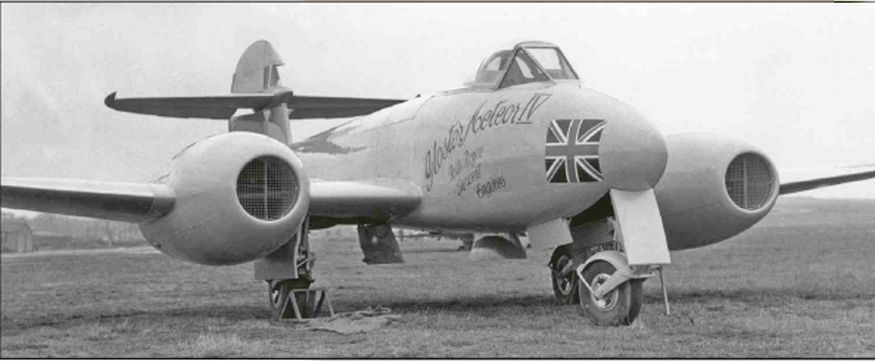
The two Meteor aircraft were especially modified for the event. Both originally built as MK.III aircraft – ‘EE454’ (Britannia ) and ‘EE455’ (Yellow Peril) – they had the original engines replaced with Derwent Mk.V turbojets (a scaled-down version of the RB.41 Nene) increasing the thrust to a maximum of 4,000 lbs at sea level – for the runs though, this would be limited to 3,600 lbs each. Other modifications included: reducing and strengthening the canopy; lightening the air frames by removal of all weaponry; smoothing of all flying surfaces; sealing of trim tabs, along with shortening and reshaping of the wings – all of which would go toward making the aircraft as streamlined as possible.

Related image

EE455 ‘Yellow Peril’ was painted in an all yellow scheme (with silver outer wings) to make itself more visible for recording cameras.*4

An official application for the record was submitted to the International Aeronautical Federation for world recognition. As it was announced, Air-Marshal Sir William Coryton (former commander of 5 Group) said that: “Britain had hoped to go farther, but minor defects had developed in ‘Britannia’. There was no sign of damage to the other machine“, he went on to say.

Wilson, born at Westminster, London, England, 28th May 1908, initially received a short service commission, after which he rose through the ranks of the Royal Air Force eventually being placed on the Reserves Officers list. With the outbreak of war, Flt. Lt. Wilson was recalled and assigned as Commanding Officer to the Aerodynamic Flight, R.A.E. Farnborough. A year after promotion to the rank of Squadron Leader in 1940, he was appointed chief test pilot at the Royal Aircraft Establishment (R.A.E.) who were then testing captured enemy aircraft. He was promoted to Wing Commander, 20th August 1945, retiring on 20th June 1948 as a Group Captain.

Eric Greenwood, Gloster’s Chief Test Pilot, was credited with the first pilot to exceed 600 miles per hour in level flight, and was awarded the O.B.E. on 13th June 1946.

His career started straight from school, learning to fly at No. 5 F.T.S. at Sealand in 1928. He was then posted to 3 Sqn. at Upavon flying Hawker Woodcocks and Bristol Bulldogs before taking an instructors course, a role he continued in until the end of his commission. After leaving the R.A.F., Greenwood joined up with Lord Malcolm Douglas Hamilton (later Group Captain), performing barnstorming flying and private charter flights in Scotland.

Greenwood then flew to the far East to help set up the Malayan Air Force under the guise of the Penang Flying Club. His time here was adventurous, flying some 2,000 hours in adapted Tiger Moths. His eventual return to England saw him flying for the Armstrong Whitworth, Hawker and Gloster companies, before being sent as chief test pilot to the Air Service Training (A.S.T.) at Hamble in 1941. Here he would test modified U.S. built aircraft such as the Airocobra, until the summer of 1944 when he moved back to Gloster’s – again as test pilot.

It was whilst here at Gloster’s that Greenwood would break two world air speed records, both within two weeks of each other. Pushing a Meteor passed both the 500mph and 600mph barriers meant that the R.A.F. had a fighter that could not only match many of its counterparts but one that had taken aviation to new record speeds.

During the trials for the Meteor, Greenwood and Wilson were joined by Captain Eric ‘Winkle’ Brown, who between them tested the slimmed-down and ‘lacquered until it shone’ machine, comparing  drag coefficients with standard machines. Every inch of power had to be squeezed from the engine as reheats were still in their infancy and much too dangerous to use in such trials.

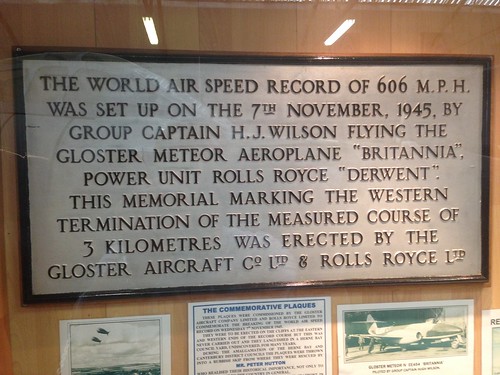
To mark this historic event, two plaques were made, but never, it would seem, displayed. Reputed to have been saved from a council skip, they were initially thought to have been placed in a local cafe, after the cliffs – where they were meant to be displayed – collapsed. The plaques were however left in the council’s possession, until saved by an eagle-eyed employee. Today, they are located in the RAF Manston History Museum where they remain on public display.

RAF Manston History Museum

One of the two plaques now on display at the RAF Manston History Museum.

To mark the place in Herne Bay where this historic event took place, an information board has been added, going some small way to paying tribute to the men and machines who set the world alight with a new World Air Speed record only a few hundred feet from where it stands.

Part of the Herne Bay Tribute to the World Air Speed Record set by Group Captain H.J. Wilson (note the incorrect speed given).

From Herne Bay, we continue on to another trail of aviation history, eastward toward the coastal towns of Margate and Ramsgate, to the now closed Manston airport. Formerly RAF Manston, it is another airfield that is rich in aviation history, and one that closed with huge controversy causing a great deal of ill feeling amongst many people in both the local area and the aviation fraternity.

Sources and Further Reading.

*1 Guinness World Records website accessed 22/8/17.

*2 The Argus News report, Thursday November 8th 1945 (website) (Recorded readings quoted in this issue were incorrect, the correct records were given in the following day’s issue).

*3 The Argus News report, Thursday November 9th 1945 (website)

*4 Photo from Special Hobby website.

The RAF Manston History Museum website has details of opening times and location.

The Manston Spitfire and Hurricane Memorial museum website has details of opening times and location.

Scotland’s National Museum of Flight – East Fortune (Part 3).

The final public hangar at East Fortune holds what is perhaps its pièce de résistance, an aircraft so ahead of its time that it has never been successfully matched. An aircraft that became simply too expensive to operate but was withdrawn under a cloak of darkness and sadness. In the third public hangar is the story of the Jet Age, a story that tells of the development of the modern jet air liner, from the post war development through to the classics of today. A story that is set around the beautiful aircraft that is of course the B.A.C. Concorde.

The Jet Age Hangar.

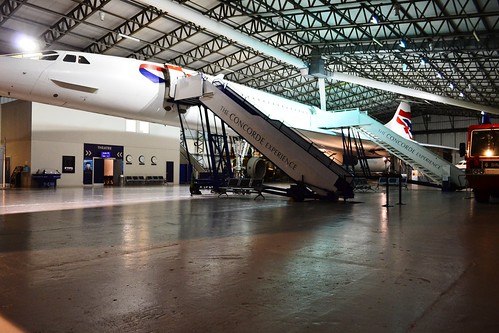
The Concorde at the National Museum of Flight (G-BOAA) was the first model Concorde to go into active service in 1976. After flying for a total of 22,768 hours and 56 minutes, in almost 25 years of service, she finally came to rest after what was possibly the most ambitious transportation project ever undertaken. In all her flying time she has visited cities right across the world including: New York, Paris, Bahrain, Miami, Calcutta, Auckland and Barbados. In her life time, G-BOAA has landed over 8,000 times and has flown through almost 7,000 supersonic cycles. She has become an icon, a reflection of what is achievable in civil aviation development.

Concorde was designed and built in agreement between the French Sud Aviation (later Aérospatiale) and Britain’s British Aircraft Corporation (later B.A.E.). Each would make their own prototype, the French (001) flying first on 2nd March 1969, with the British model (002) flying from Fliton a month later on April 9th 1969. At the Paris airshow prospects looked good and over the next few years 65 initial orders were placed by 17 countries with options for many more. However, growing concerns over manufacturing costs, noise, environmental pollution and running costs eventually reduced the orders to just a handful from both British Airways and Air France.

With the price of a return ticket London to New York in excess of £6,500 in 2003, it certainly wasn’t cheap, nor affordable for the average man in the street (but where else can you watch the Mach Meter climb through Mach 2). It was however, a head turner. Wherever Concorde flew crowds gathered to watch in awe of her grace and technological advancement.

Concorde

Concorde G-BOAA stands proudly as the centre piece of the Concorde Experience.

Sadly, on July 25th 2000, it all went terribly wrong when taking off from Charles de Gaulle airport, Concorde  F-BTSC ran over a small piece of debris causing the tyre to burst sending shards of rubber at high-speed into the wing of the aircraft. An internal fuel tank ruptured and high-octane fuel poured from the wing igniting as it left. With too little runway to land and insufficient power to fly, it couldn’t fail to miss the Hôtelissimo Les Relais Bleus Hotel and crashed. A terrible tragedy that began the rapid rundown and retirement of the entire Concorde fleet.

Following a slump in air travel due to terrorist activities, rising costs of Concorde and the urgent need for upgrades, by 2003 all Concordes had ceased flying, and the disposal of the air-frames began.

G-BOAA was delivered to East Fortune following a major operation that involved taking it by road to the River Thames, along the Thames by specialist barge and out to sea, around the coast of England and Scotland, and then by road to East Fortune. Roads had to be purposely made cutting through a number of fields in order to get the aircraft to its new home. An operation that took over a week was supported by members of 39 Engineer Regiment’s 53 Field Squadron (Air Support) with a helicopter assistance.

Today Concorde G-BOAA stands as the centre piece of the Jet Age and Concorde Experience Hangar, a proud and open monument to the collaboration and development of the Supersonic passenger age.

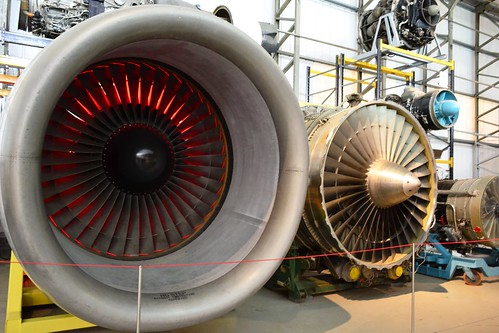
But this hangar is not just about Concorde. A cockpit and front cabin portion from a Boeing 707-436 (G-APFJ), and Hawker Siddeley Trident 1C (G-ARPH) cockpit, gives the visitor another insight into life inside another 1960s long haul passenger jet. Outside another two classic passenger aircraft, de Havilland’s Comet 4C (G-BDIX) and the BAC 111-510ED (G-AVMO) further give the visitor an insight into these classic times. A range of jet engines allow you to compare sizes and features, and stories from those who were involved in flying these masters of the sky bring the ‘Golden age of air travel’ to life once more.

East Fortune

Some of the engines on view at East Fortune.

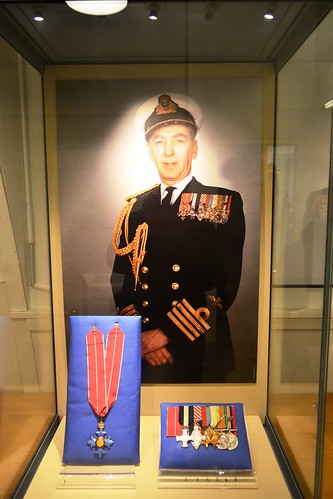
The remainder of the museum is displays and hands on activities. The history of East Fortune, is well portrayed as are the medals of Captain Eric Melrose “Winkle” Brown, CBE, DSC, AFC, Hon FRAeS, RN., and the flying jacket and personal artefacts of Rolf Niehoff, the navigator of the Humbie Heinkel.

East Fortune

Portrait and medals of Captain Eric Melrose “Winkle” Brown, CBE, DSC, AFC, Hon FRAeS, RN

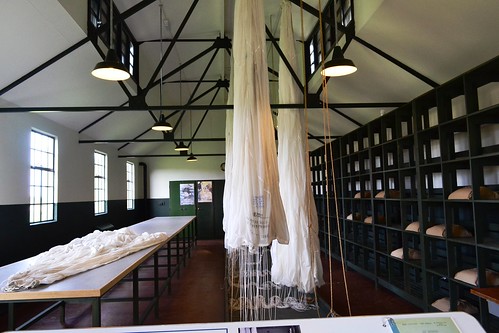
As mentioned earlier, in Post 1 the parachute store has been fully refurbished and is displayed in the way it would have been used during the war years. A unique building, they are easily recognisable by their higher central roof section, or as in some models, offset sloping roofs. Designed to hang and dry parachutes, they are kept at a constant temperature, ideally between 550F and 650F. Wartime parachute stores were built with 4.5 inch thick walls, early designs having a symmetrical two-stage pitched roof as is here at East Fortune. The parachutes were hung from the highest point on a pulley system, so that the silk was kept away from the floor and allowed to dry evenly and cleanly. Once dry, they were lowered to a packing table, inspected, packed away and stored in the store on racks. Each pack was labelled with an inspection date and the person to whom it belonged – each crewman having earlier being measured for his own parachute.

This is possibly the only original parachute store remaining in this condition in the UK and shows the method of drying, packing and storing these vital pieces of equipment extremely well.

East Fortune

The inside of the parachute store clearly shows how they parachutes were dried, packed and stored.

Other exhibits include the RAF’s Matador lorry and a ‘Green Goddess’ fire engine. Made more famous perhaps by the firemen’s strikes of 2002, they were built in the 1950s, and were designed to be used in the event of a nuclear attack. Operated by civilian personnel of the Auxiliary Fire Service (AFS) they would be rushed into cities to extinguish fires and repair water systems. Thankfully, they were never used in this particular role.

East Fortune National Museum of Flight

The RAF’s Matador truck.

The range of exhibits at East Fortune is fabulous. The history of aviation, both civil and military is shown through a range of rare examples, that are restored and maintained in original buildings, purposely restored in line with their original designs and construction. For anyone wanting to see original airfield buildings and beautifully restored aircraft, it is certainly worthy of a trip and is time very well spent.

Sources and Further Reading.

The National Museum of Flight Website has details of tickets, events and features on the various exhibits there.

A list of the aircraft locations at East Fortune.

July 2nd 1919, H.M.A. R.34 Sets A World Record Flight.

On July 2nd 1919 at 01:42, airship R.34 lifted off from the airfield at East Fortune, east of Edinburgh, to make an epic voyage – the first crossing of the Atlantic Ocean east to west by a powered aircraft.

R.34 possibly at East Fortune. (author unknown)

Conceived as early as 1916, R.34 was built at the works of William Beardmore and Co. Ltd. of Inchinnan near Glasgow. At 634 feet in length with a top speed of 62 mph, she would have five 270 hp Sunbeam ‘Maori’ engines, and would cost £350,000 to build. Her massive size gave her an impressive 1,950,000 cubic feet for gas storage, and she would be equivalent in size to a Dreadnought battleship. A major step forward in airship design, her aerodynamic shape reduced total air resistance to that of just 7% of an equivalently sized flat disc.

As she was designed under war specifications, R.34 would be built to carry twenty 100 lb and four 550 lb bombs, a range of Pom-Pom guns, Lewis machine guns and a small number of two-pounder quick-firing guns; but as she wasn’t finished until after the war, none of these were ever fitted, nor was she ever flown in anger.

Completed in early 1919, she just missed out on achieving the record of the first Atlantic crossing, being laid up by damage caused by poor handling, and thus beaten to the record now held by Alcock and Brown.

In May, she arrived at East Fortune airfield, a major airship station in East Lothian, from where she carried out a number of test flights including an endurance flight across the Scandinavian countries. In July she was set to make the first  Atlantic crossing, east to west.

In preparation for the flight, eight engineers were sent to the United States to train ground crews in the safe handling of the airship. The Admiralty provided two  warships, the Renown and Tiger, as surface supply vessels, and should R.34 have got into difficulty, she could have been taken in tow by one, or both of the two vessels.

On the evening of 1st July 1919 the ship was fueled to capacity (some 6,000 gallons), and in the early hours of the morning she was moved out of her shed and prepared for the flight. Her captain, Major G. H. Scott, gave the order to release early, and at 1.42 am (GMT) R.34 lifted slowly in to the Scottish sky.

After battling strong winds and Atlantic storms, R.34 finally arrived at Mineola. Huge crowds had turned out to greet her and her crew, a grandstand had been erected, parks and public spaces were packed with onlookers. Major J. Pritchard (The Special Duties Officer) put on a parachute and jumped from the airship to become the first man to arrive in America by air. He helped organise ground staff and prepared the way for R.34 to safely dock. As she settled on her moorings, she had not only become the fist aircraft to fly the Atlantic East to West, but broke the current endurance record previously held by the North Sea Airship NS 11, also based at East Fortune.

A record was made, R.34 had put British Airship designs and East Fortune firmly on the map. After 108 hours and 12 minutes flying time, R.34, her crew and two stowaways: William Ballantyne and a small tabby kitten called “Whoopsie”, had landed at Mineola, Long Island, New York.

After a 3 day stay in which the crew were treated like the heroes they were, R.34 was prepared for the homeward journey. On Wednesday July 10th 1919, at 23:54 she lifted off and set sail for home.

With prevailing winds carrying her eastward, she made an astonishing 90 mph, giving the opportunity to cut some of the engines and preserve fuel. This gave the crew a chance to divert over London, but due to a mechanical breakdown, this was cancelled and R.34 continued on her original route. Poor weather at East Fortune meant that she was ordered to divert to Pulham Air Station, Norfolk, but even after clarification that the weather had improved, her return to East Fortune was denied and she had to continue to Pulham – much to the disgust of the crew on board. At Pulham, the reception was quiet, RAF personnel greeted her and secured her moorings. She has covered almost 7,500 miles at an average speed of 43 mph.

Eventually after a major refit at East Fortune, R.34 left for the return to Pulham. After six weeks of static mooring, R.34 was sent to Yorkshire, to Howden Airship Station. Here she was used to train American crews, was modified for mast mooring and used for general training duties. During one such training mission, she was badly damaged in strong winds, and after sustaining further damage whilst trying to moor and secure her, she began to buckle. Falling to the ground, she broke up and was damaged beyond repair. R.34 was then stripped of all useful materials and the remainder of her enormous structure sold for scrap – a rather ungainly ending to an incredible and historical machine.

H.M.A. R.34 and her crew had become the first to cross the Atlantic east to west, they had achieved the  longest endurance flight, and become the first aircraft to complete a double-crossing of the Atlantic.

East Fortune

The memorial stone at East Fortune airfield commemorating the epic flight of R.34.

The Flight Crew for the Atlantic journey were:

Major G. H. Scott A.F.C – Captain
Captain G. S. Greenland – Second Officer
Second Lt. H. F. Luck- Third Officer
Second Lt. J. D. Shotter – Engineering Officer
Major G. G. H. Cooke DSC – Navigator
Major J. E. M. Pritchard O.B.E. – Special Duties
Lt. G. Harris – Meteorological Officer Second
Lt. R. F. Durrant – Wireless Officer
Lt. Commander Z. Lansdowne – Representative U S Navy
Brigadier General E. M. Maitland – Special Duties
Warrant Officer W. R. Mayes – First Coxswain
Flight Sergeant W. J. Robinson – Second Coxswain

Sergeant H. M. Watson – Rigger
Corporal R. J. Burgess – Rigger
Corporal F. Smith – Rigger
F. P. Browdie – Rigger
J. Forteath – Rigger Corporal

H. R. Powell – Wireless Telegraphy
W. J. Edwards – Wireless Telegraphy

W. R. Gent – Engineer
R. W. Ripley – Engineer
N. A. Scull – Engineer
G. Evenden – Engineer
J. Thirlwall – Engineer
E. P. Cross – Engineer
J. H. Gray – Engineer
G. Graham – Engineer
J. S. Mort – Engineer
J. Northeast – Engineer
R. Parker – Engineer

W. Ballantyne – Stowaway
“Whoopsie” – a small tabby kitten and stowaway

The crew of R.34 Crew – with the crew pets.

East Fortune airfield appears in Trail 42.