The Korean War Memorial, London

On July 27th 1953, the Korean War, a very much ‘forgotten’ war, came to an end. For over 50 years, the 81,084 British Troops who were sent there feel they have had little official recognition from the authorities or public.

The Memorial stands overlooking the Thames.

However, on the 3rd December 2014,  320 veterans and 180 other guests, watched as HRH the Duke of Gloucester unveiled a new memorial on the Embankment next to the Royal Air Force, Fleet Air Arm and Battle of Britain memorials.

The memorial, which was a gift from the Republic of Korea in honour of the British Troops sent there, stands six metres high and was carved by Philip Jackson – famed for carvings of Sports personalities, artists and the Gurkha Memorial. It shows a Bronze statue of a soldier, head bowed, standing on a base of Welsh Slate in front of an obelisk of Portland Stone. Dressed in winter wear, the statue reflects the tiredness of constant rain, and the never-ending battle against both a determined enemy and the elements.

Behind the weary soldier are several carvings, including a mountainous landscape representing Korea’s environment, along with a number of inscriptions. On the base, to the front, reads (in both English and Korean)

“With gratitude for the sacrifice made by the British Armed Forces in defence of freedom and democracy in the Republic of Korea.”

To the North side of the memorial is a further inscription:

“The Korean War was the first UN action against aggression. The UN forces that fought the North Korean invasion were drawn from 21 countries. Although exhausted and impoverished after the Second World War, Britain responded immediately by providing strong naval, army and air forces and became the second largest contributor after the United States. A distant obligation honourably discharged.”

On the south side of the obelisk, below the Union Flag, it reads:

“In this fierce and brutal conflict those who fought included many Second World War veterans reinforced by reservists and young national servicemen. The land battle was fought against numerically superior communist forces, the terrain was mountainous and the weather extreme. 81,084 British servicemen served in the theatre of operations. 1,106 were killed in action, thousands were wounded and 1,060 suffered as prisoners of war.”

The Korean War was the first UN action and took troops from 21 different countries, many of whom had only just started to recover from the Second World War. For their action, two British Soldiers were awarded the highest military honour – the Victoria Cross – but yet despite this, it still remains very much a ‘forgotten war’.

HMS Triumph

HMS Triumph as she appeared in my father’s photo album on return from Korea.

Much of the fighting took place around the 38th Parallel, a point that once stabilised, became not only the border between North and South Korea, but the Russians and the West in what would be a long and at times trying Cold War.

The memorial stands facing the Thames, amongst a number of other memorials outside the Ministry of Defence building on the north embankment and forms a group of Korean memorials. These include a plaque in the crypt of St Paul’s, and two other memorials in the National Arboretum in Staffordshire and in Bathgate, Scotland.

This memorial stands as a reminder of a short war, but for those who took part, it is a timely reminder of the sacrifice that they and their colleagues made.

The unveiling of the memorial.


A website dedicated to the Korean War Veterans can be found here.

Other major memorials can be found here and RAF / USAAF memorials here.

Battle of Britain Memorial, London

In this the 75th anniversary year of the Battle of Britain, it is rather apt to include a mention of a further part of a Trail of major memorials. Another found in London outside the Ministry of Defence Building on the Northern Embankment, is that of the Battle of Britain.


Even on a cold and wet winters day it is an inspiring memorial placed near the busy junction at Westminster Bridge.

Sculpted by Paul Day, work on the site began in February 2005 with erection of a 82ft long granite base, in two parts, on which to stand the bronze sculpture. Created initially in wax, the sculptures were cast in bronze by Morrris Singer in sections, each section depicting a scene relating to the Battle. The memorial was finally opened by HRH the Prince of Wales on 18th September 2005.


The main and most significant section shows pilots as they ‘scramble’ to their waiting aircraft. Around this, are scenes referring to the women who helped not only in the factories and munitions works, but those who ferried the vital aircraft to their airfields. Other scenes depict: workers in a slit trench watching the battle rage overhead, the gunners defending the airfield, a dogfight, observers, mechanics and fitters all of whom worked tireless to keep the damaged aircraft flying. Further depictions show pilots at rest, drinking tea and relaxing telling tales of heroism and narrow escapes. A prominent picture that came out of the battle and the following blitz, was that of Saint Paul’s Cathedral standing proud of the smoke as all London burns around it. This too has been immortalised in bronze on another of the 14 scenes.

The detail of each panel is incredible. The emotion behind the eyes of those depicted grabs the passer-by and holds them, captured momentarily in time.


The entire battle is described through these characters, the romantic idea of the battle as seen by the farm workers, the joy of a victory from returning  crews, the tiredness after yet another sortie, and the fear as they run not knowing if this were to be a one way journey.

Around the scenes are the 2,937 names of the airmen who took part in Battle. As many records from the day were inaccurate, mislaid or destroyed it had to be decided upon what criteria  would be set in order to ‘qualify’ for a listing. This was that the pilot had to have flown between 10th July and 31st October 1940 and to have been awarded the Battle of Britain Clasp after flying at least one operational sortie in one of the recognised squadrons. A daunting task that took many hours of reading and research but was eventually completed and finalised as the 2,937 that appear today.  

There are 15 countries listed, covering 544 pilots who died during the battle and 795 who were to die by the end of the war. Interestingly, there is no Israeli mention, yet in the 1969 film made famous by its incredible cast, an Israeli pilot is mentioned. Perhaps this is due to the criteria used or inaccuracies in records used by the film.

Winston Churchill’s immortalised words ‘Never in the field of human conflict was so much owed by so many to so few’ are etched into the  base of the memorial bringing the entire structure to life.

The detail on this memorial is incredible, just glance and you’ll miss it. The way each scene is depicted in great detail even down to the ruffles in the clothing, the emotion behind the eyes and the position of the various people, it is an awe-inspiring memorial that proudly and aptly reflects those who gave so much for so many.

The memorial is found on the Victoria Embankment opposite the London Eye to the East of Westminster Bridge.

Other major memorials can be found here.

Memorial Garden Opening 

Mixing my day job with my hobby is not usual but I felt this was more than worthy of a post.

For some time now I have been toying with the idea of a Memorial Garden at school tied in with the various topic work that we have been doing, which is linked to both the World War I and VE-day commemorations.

The idea really came to fruition in sort early last year when I approached the head of the school and put the idea to her. With enthusiasm the go ahead was given and the children were approached with the idea as an after school club. A small group volunteered to help and we began planning.

On June 18th 2015 the plan finally came together.

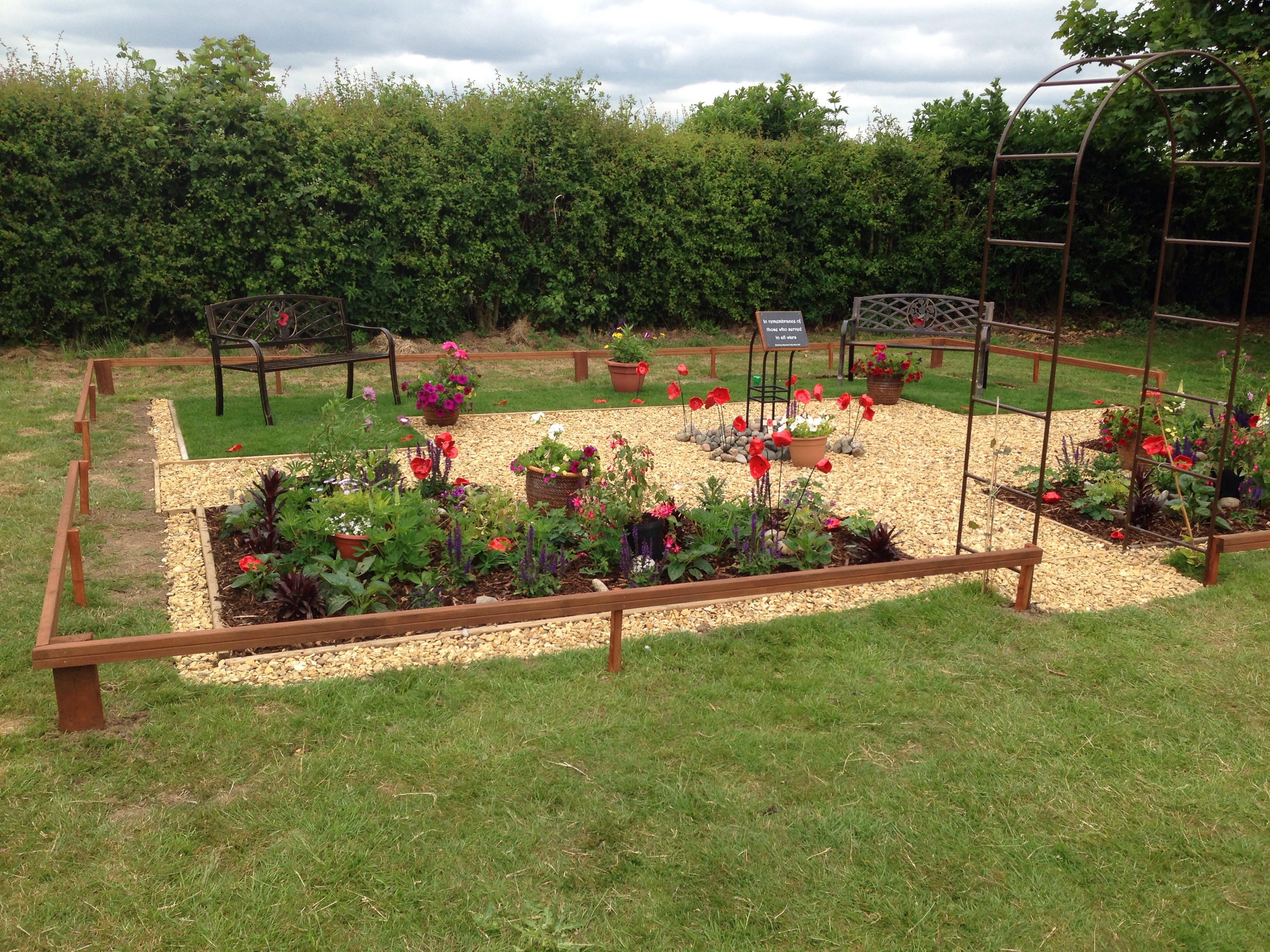
The Memorial at the Centre of the Garden.

As people arrived they were greeted with refreshments and displays of work, photos of family members along with artefacts gathered or brought in by friends and parents. My good friend Kevin Fleckner brought four original uniform and bits from a crashed B-17 for us to show.

At 17:15 two RAF Tornado jets from RAF Marham flew overhead. The first low and slow, the second 15 seconds behind, higher and much faster with her wings swept. Over the school, she banked and the crowd waved. The event had opened.

The head then read a short introduction and it was my turn. I have to tell you that public speaking is not my forte and whilst I had been a little nervous I stood at the podium and the nerves vanished. My speech went thus:

June 18th 2015 is a special day. Not just because we’re opening this beautiful space, but for several iconic reasons. 200 years ago today the British and French forces were locked in arms at the Battle of Waterloo. 75 years ago today Winston Churchill made his famous “this was their finest hour” speech. Two dates that will go down in history as both important and momentous.

But these ae not the only significant dates in history.

100 years ago last year in 1914 young men in their thousands signed up with excitement for what they thought would be the war to end all wars. However, the war they thought would be over by Christmas went on for four long years. In the killing fields of Flanders, young men, many barely older than 16 or 17 were slaughtered in their thousands, living in mud and rat infested trenches very few were to survive. If not killed by the constant shelling, sniper fire or the slow march through no man’s land, many would suffer shell shock, a brutal psychological illness that would eat away at the very heart and soul of the young men. Eventually, in 1918 the First World War ended, the guns fell silent and Europe could finally begin rebuilding once more.

Sadly man’s inhumanity to man was to raise its ugly head again. In 1939, Europe was plunged once more into war with the German invasion of Poland. As The mighty Nazi war machine blitzkrieged its way across Europe, the British Armed Forces once more fought bravely in the name of freedom and democracy.

From the beaches of Dunkirk to the defence of Britain in the skies over Kent, the landing grounds of Normandy, to the battles in the Ardennes, Arnhem, over the Rhine and eventually the battle for Berlin itself, the brutality of war would once more be seen again.

The civilian population of Europe was to suffer greatly too. The blitz of our cities and the bombing of European targets that killed thousands upon thousands as bombs rained down from the sky. The concentration camps, death camps and prisoners of war camps saw a brutality on a scale that was and still is, incomprehensible.

From the hot deserts of Africa through the warm seas of the Mediterranean to the freezing conditions of the Arctic convoys, young men would bravely fight without question many paying the ultimate and final sacrifice.

Eventually, on 8th May 1945, the war in Europe finally ended and Peace reigned once more. However, the killing went on in the Far East. On the Pacific Islands of Okinawa, Saipan, Iwo Jima and Guadalcanal, The fighting continued in some of the most brutal conditions known to man. Eventually on August 15th 1945. UK time, following the Americans dropping the world’s most devastating and horrific bombs on Hiroshima and Nagasaki, war was declared finally over. The world has now entered the atomic age and six years of war had left it scars across Europe, the Middle East, The Far East, in the waters of the Atlantic and Pacific Oceans and across both the northern and Southern Hemispheres. Across the world millions lay dead, injured, homeless or orphaned. In the words of our distinguished guests here today “There are no winners in war.”

If there is one thing that history can teach us, it is that man is unable to live at peace with his fellow-man. Whether it be disputes over territory, natural resources or religious ideologies, War has continued to be fought and young men and women have continued to die.

In post-World War 2, the world lived on a knife-edge; the Cuban missile crisis being the ultimate stand-off between the east and west. From Korea and Vietnam to the Falkland Islands, the Middle Eastern countries of Iraq and Afghanistan, Britain and her allies have continued to fight for peace and democracy something we here take very much for granted.

It is in the name of these young men and women that we have built this memorial garden, so that their memories and their sacrifice may live on in the hearts and minds of future generations. It is so that we can pay homage and remember the dedication, bravery and self-sacrifice that they have shown so that we may live today without fear and in freedom.

It is to these people that I say thank you. Thank you for willing to lay down your life so we may freely speak out against injustice. To those who never came home, who paid the ultimate sacrifice, may you forever rest in peace. Thank you

Next one of the children read what the garden meant to him. Un-nerved by the occasion, he told how his father passed on his grandfathers tales of the war, how it means he can enjoy the peace and tranquility and he made a remarkably moving speech from the heart.

We then had a young lady from the group read in full the Robert Lawrence Binyon poem ‘For the fallen’. Short gasps from some of the audience told me they didn’t realise where the Remembrance Day words came from as it appears in the middle of the poem. She too read fluently and without falter, quite an achievement. Both these children were only just 10/11 years old.

A blessing by the vicar led us into the last post and a two minutes silence for those who had paid the ultimate sacrifice. A number of visiting Vets saluted, the Air Training Cadets lowered the colours and all went silent. Not a sound bar the cool wind in the adjacent trees.

My Good Friends Baz and Helen, whom helped enormously, John and Tony the Veterans and Kevin, who brought a number of uniforms and bits for us to display.

After the reveille the colours were raised and the two veterans invited to open the memorial officially. One Tony, a Normandy D-day+1 vet and the other John, who fought from Africa against Rommel’s Tigers, through Italy up into the continent, stood either side. As they lifted the flag, John declared the garden open to applause from the gathered audience. The children then sang unaccompanied Vera Lynn’s “We’ll meet again”; many from the audience joined in. The event closed and photos were taken around the memorial.

I estimated around 150 people, which for a small school of 68 children is remarkable. We had veterans from Cambridge a good hour and half away,  visitors from Northampton another similar distance and a large number of folk from the village turn up.

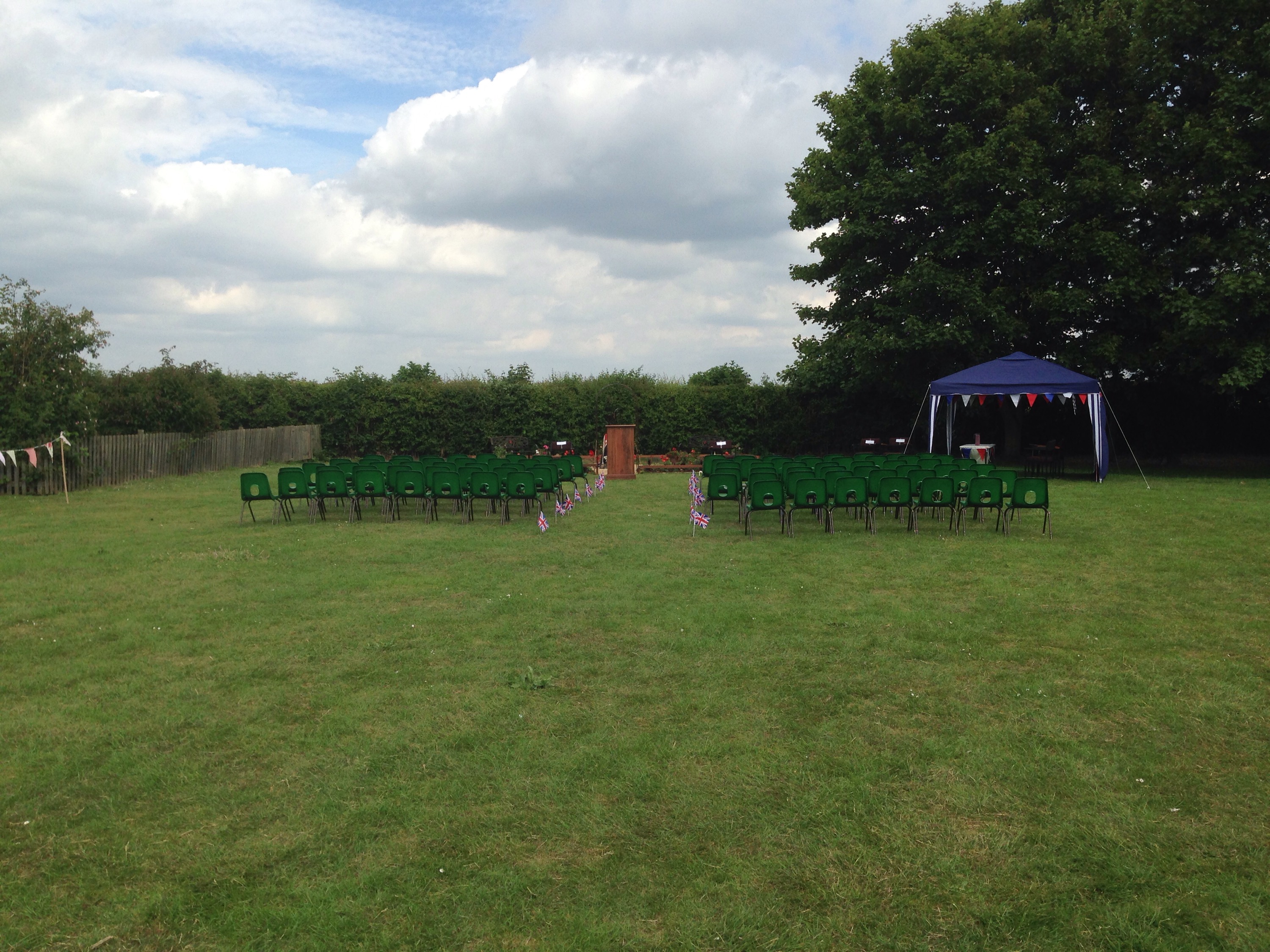
The seating before people started to arrive. There were many more standing, being a small school. we simply didn’t have enough chairs!

The feedback from visitors was superb and everyone was buzzing.

A real team effort, the long evenings, the hard work and recent battle against moles had all been worth while.

We had texts and emails from those who were there praising the efforts. It all worked out far better than even I had envisaged.

We shall miss it. We had great fun, even the odd beer or two, but it has been a real bonding exercise, we have become a little ‘family’ and are really proud of our achievements.

I passed on the good wishes to the children whom I think are quite overwhelmed themselves. They did a fantastic job and were superb role models for others to follow.

The Garden as it is today. We shall seed the outside, and continue the fight with the moles. An area for relaxation and thought.

We shall continue to nurture and maintain the Garden and watch it grow. The children use it already and do enjoy it. The rose in the crown were the poppies. Made out of clay, they are all handmade by the children mounted on metal rods and bunched in groups of 3 or 4. They do look superb.

There were small stumbling blocks along the way, and these caused delays but none so great we couldn’t deal with them. All in all it went beautifully, far, far better than I ever imagined and the finished product, I hope you’ll agree, is stunning.

An article appeared in the paper on the following day, Saturday here’s a link.

A Total Success or a Human Tragedy – Operation Carthage

The Shell House attack.

Whilst researching a recent trip I came across this interesting film detailing the attack by 140 Wing (RAF) on the Gestapo Headquarters in Copenhagen, Denmark in 1945. Codenamed ‘Operation Carthage’. Technically it was 100% successful, the building was destroyed, the papers burned and resistance fighters escaped, but the attack resulted in the loss of 10 crew members 13 civilians and 86 children.

On March 21st 1945, 18 Mosquitos from 140 Wing (RAF) consisting of 3 waves of 6 from 487 Squadron, 464 Squadron and 21 Squadron  and two supporting photographic Mosquitos, took off from RAF Fersfield to attack and destroy the Gestapo Headquarters in Copenhagen, Denmark.

Leaving just before 9:00am, so they would arrive over the target when it was at its busiest, they headed out over the north sea on a direct line to Denmark.

Attacking at roof top height, they struck a blow at the heart of the Gestapo, killing 151 Gestapo officers and allowing for the escape of 30 Danish resistance fighters.

Sadly in the attack, a Mosquito s/n SZ977, flown by Wg. Cdr. Peter A Kleboe and Fg.Off. K Hall, struck a building causing it to crash and burst into flames. Following aircraft blinded by the smoke, believed this to be the target and bombed it, hitting a school killing 86 children inside.

Some argue the loss of those civilians was not sufficient to justify the attack whilst others claim the success of the mission outweighs the tragic loss of civilian life. The Debate goes on!

Aircraft involved in the attack

(Mosquito Mk.VI)

No 487 Squadron

RS570 ‘X’ Gp Capt R N Bateson / Sqn Ldr E B Sismore (Raid Leader)
PZ402 ‘A’ Wg Cdr F M Denton / Fg Off A J Coe (damaged, belly landed at base)
PZ462 ‘J’ Flt Lt R J Dempsey / Flt Sgt E J Paige (hit by flak, 1 engine u/s, returned safely)
PZ339 ‘T’ Sqn Ldr W P Kemp / Flt Lt R Peel
SZ985 ‘M’ Fg Off G L Peet / Fg Off L A Graham
NT123 ‘Z’ Flt Lt D V Pattison / Flt Sgt F Pygram (missing)

No 464 Squadron

PZ353 Flt Lt W K Shrimpton RAAF (Pilot) / Fg Off P R Lake RAAF
PZ463 Flt Lt C B Thompson / Sgt H D Carter
PZ309 Flt Lt A J Smith RAAF / Flt Sgt H L Green RAAF
SZ999 Fg Off H G Dawson RAAF / Fg Off P T Murray (missing)
RS609 Fg Off J H Palmer RAAF / 2nd Lt H H Becker RNorAF (missing)
SZ968 Wg Cdr Iredale RAAF / Fg Off Johnson
All aircraft took off at 0840; last back landed 1405.

No 21 Squadron

SZ977 Wg Cdr P A Kleboe / Fg Off K Hall (missing)
PZ306 Sqn Ldr A F Carlisle / Flt Lt N J Ingram
LR388 Sqn Ldr A C Henderson / Flt Lt W A Moore
HR162 Flt Lt M Hetherington / Fg Off J K Bell
No 21 Squadron records list only these four aircraft and crews above as taking part in this operation.
All aircraft took off at 0835; the three which returned did so at 1355.

Sources:National Archives, June 14th 2015.


Engines roar over Grafton Underwood once more. 

The ‘updated’ memorial at the former American Airbase,  RAF Grafton Underwood (Station 106), has been revealed with the help of Europe’s only flying B17 – ‘Sally B‘.

A large crowd gathered at the Memorial On Friday 29th May 2015, to hear speakers and see the beautiful ‘Sally B‘ perform a number of flypasts over the skies of Station 106 once more.

I sadly could not go due to work commitments, but have been informed that it was a resounding success and that it was very well attended by well wishers and members of the public alike.

This updating, has been in the pipeline for a while now and all the hard work has finally paid off. A new parking area and flag poles have been added and the site generally improved for visitors.

I have obtained and attached a short ‘You Tube’ video taken by one of the visitors to the event for you to see.

A lovely end to a remarkable tail.

My thanks go to Kevin for all his hard work and dedication keeping the memorial in such great condition and the memories of the 384th BG (H) well and truly alive.

The video of the event was kindly sent to me,  I don’t know who took it but all credit goes to them. I will try to find their name and attach it when I can.

Grafton Underwood appears in Trail 6.

Battle of Britain Memorial Capel-le-Ferne, Kent.

A recent revisit took me back to the Battle of Britain memorial at Capel-le-Ferne between Folkestone and Dover, in Kent. It sits high on the cliff-top, in a windy corner, a stones throw from the international docks at Dover, and the Battle of Britain airfield at Hawkinge. A ‘recent’ addition to the range of memorials, it is a poignant reminder of the young men who, from many nationalities, gave their lives in the name of freedom and the defence of this country.

Last time I was here, work was starting on the new visitor centre and the two replica aircraft, a Spitfire and Hurricane, had both been removed.

The replica Hurricane.

This week, on May 25th 2015, I went back to see what had been done.

The new centre is superb. First of all it has a good car park with ample space for a large number of cars.

The visitors centre itself has a bright open reception area and a small shop for souvenirs (I had to buy a book!) and upstairs a new cafe with a balcony overlooking the monument and across  the English Channel to France.

The Visitors center behind the ‘Wall of Honour’.

Entrance to the memorial is still free, but there is the option to try the ‘scramble’ experience, which I believe costs £6.00.

The Spitfire and Hurricane are both back, admittedly both are metal replicas but up here it gets very windy and the weather can change dramatically in seconds, so it’s probably for the best. They are certainly good replicas. 

The carved Pilot, sitting in the centre of a three-bladed propeller, gazes patiently out to sea, watching for his missing friends. Designed by Harry Gray of the Carving Workshop, Cambridge, the pilot is surrounded by the creats of those squadrons who took part in the famous battle in the Kent skies.

To either side, two large mounds, signify the locations of anti-aircraft batteries, now silent and filled in, perhaps two replica emplacements might add to the ‘feel’ of the site, although sometimes less is more.

As before, the monument is a quiet and moving place to sit; to read the names of those who gave their lives for us, and to absorb yourself in the battle through the numerous information panels around the site. From here you begin to imagine the vapour and smoke trails high above you and to think that Hitler and his invasion forces, stood not more than 30 miles away in the distant haze on the coast of France.

A big improvement to a very moving place.

A memorial for three aircraft that crashed close by.

Trail 22 takes us to an area of Norfolk that is filled with narrow lanes, and ‘chocolate box’ villages with duck filled streams and babbling brooks running through the middle. An ideal and welcome break from the horrors of what was witnessed in the skies of occupied Europe all those years ago.

Travelling away from Great Massingham and West Raynham, we carry on east, toward Norwich and then take a left turn and head north. Cutting through the delights of Norfolk, we take in the last few sites that offer good examples of airfield architecture. Before reaching our first site however, turn off the main road at Weasenham St. Peter, for here is a small reminder of the terrible tragedies of war.

Nestled in the village is a small but poignant reminder of the dangers faced by the young men who flew in our skies. Once over friendly territory, crews would often feel safe knowing that ‘home’ was but a few miles away. However, for many the danger was not over yet.

A pyramid memorial in this quiet and almost insignificant village, identifies the crews of not one but three aircraft that crashed close by killing all onboard. From this point you can see the hangars of West Raynham dominating the skyline, an indication of how close to home these young men were.

Blenheim L8800, of 114 sqn RAF, crashed on 5th June 1942. On board were: Sg. F. Cooke, Sgt. J Wallbridge (VR) and Sgt. E. Kitcher (VR) all of whom lost their lives. On 17th October that year, a B25 Mitchell,  FL206 of 98 sqn RAF, crashed killing the crew: Flt. Sgt. D. Tanner, Sgt. E. Boreham, Sgt. L. Horton and LAC F Barnett all of RAF(VR). Finally on May 22nd 1943, close to his spot a Douglas Boston III, AL285 of 342 ‘Lorraine’ Sqn.  crashed killing all her crew, who were part of the Free French Airforce: Lt. M. Le Bivic, Lt. R. Jacquinot, Sgt. L. Cohen and Cpl. J. Desertlaux. All three aircraft were based at nearby West Raynham when the tragedies struck.

various 003

The memorial at Weasenham St. Peter. Behind you, are the not so distant hangars of RAF West Raynham.

A sad and terrible loss of life. When leaving here, return to the main road and head east to our first stop at RAF Foulsham.

Death of a Ball Turret Gunner – Randall Jarrell.

ball

A Ball Turret, the home to many young men.1

There have been many poems written around the theme of death and dying in the line of duty. Some have become ‘classics’ known and used world-wide. Others have remained unknown but to those who wrote them.

Often written by young men, they reflect the horror of war , the conditions in which they served and lived , the sense of hopelessness and never-ending feeling of not knowing if today would be your last. Written in the latter stages of the Second World War and published in 1945, ‘The Death of the Ball Turret Gunner‘ is a short poem by Randall Jarrell. Jarrell, too old to serve as a Combat Pilot himself, served as an instructor and wrote many works around the theme of war. He reflects in this piece about the ‘matter-of-factness’ of war and death and how men (or boys) are slaughtered with little thought or remorse.

‘Death of a Ball Turret Gunner’ is about the death of a gunner in the underbelly of an American bomber.

“From my mother’s sleep I fell into the State,
And I hunched in its belly till my wet fur froze.
Six miles from earth, loosed from its dream of life,
I woke to black flak and the nightmare fighters.
When I died they washed me out of the turret with a hose.”

Jarrell, added his own explanation, describing how the ball turret resembled a mother’s womb and the “short small man”, the gunner within, a foetus.

As a ball gunner, you were exposed to exploding cannon shells. Spinning round and round contoured into all sorts of positions. Your only companion being the two .50 calibre machine guns that rattled their violent disgust. Many have analysed the work, it has been the inspiration for a play, published with illustrations and referred to in many literature works.

To me. It’s more simple. The work of a young man whose life was turned upside down, taken from the safety of his home, put into a killing machine and then discarded with little thought when life is extinguished.

The poem appears in many publications and websites, I found this copy on Wikipedia at:

http://en.m.wikipedia.org/wiki/The_Death_of_the_Ball_Turret_Gunner

A biographical account of Jarrell can be found here.

1 Photo courtesy of Marcella.

Other poems can be found here.

Fleet Air Arm Memorial, London

The Fleet Air Arm memorial, on the banks of the Thames, is one of many that stand together at this spot. The Battle of Britain, the Korean War and Royal Air Force memorials all being in very close proximity, outside the Ministry of Defence building in Victoria Embankment Gardens.

Forming one of many Fleet Air Arm memorials across the country, it joins others such as those at that the National Memorial Arboretum and Lee on Solent.

A more modest memorial, this one was designed by the architect James Butler RA, who has created a number of other statues and monuments in and around London. 

Initially, the figure looks like an angel, but is thought to resemble Daedalus, the Greek inventor –  father to Icarus, who flew too close to the sun and fell to his death.

The statue, which was unveiled on the 1st of June 2000 by his Royal Highness The Prince of Wales, stands looking down, perhaps Daedalus watching his son fall from the skies. Crafted with a pilot’s body and flying suit, but with the bare arms of a ‘God’, it wears a fallen oxygen mask that reveals a face with a look of horror, as if witnessing some awful event beneath.

The winged guardian stands on a single stone column that protrudes from a boat-like base, around which are engraved the names of the many conflicts and battles that the Fleet Air Arm have been involved in. Ranging from 1914 right up to modern conflicts such as the Falklands and the Gulf War, it shows how important the Fleet Air Arm has been to both the safety of this nation and world peace in general.

There are further inscriptions around the other sides of the base. On the front, in gilded letters, are the words ‘Fleet Air Arm’, with the crested insignia, and to the side the words:

‘To the everlasting memory of all the men and women from the United Kingdom the British Commonwealth and the many Allied Nations who have given their lives whilst serving in the Royal Naval Air Service and the Fleet Air Arm’.

Also on the base is a quote from Psalm 18:10, “He rode upon a cherub and did fly yea he did fly upon the wings of the wind”.

One of many memorials standing at this location, the Fleet Air Arm winged  guardian, watches closely over the crowds below, standing as a tribute to those who gave their lives and whose bodies now rest in the deep waters of the worlds oceans.

London Feb 2015 026

The Fleet Air Arm Memorial on a wet and windy day in February.

Other ‘major’ memorials can be found here, with specific airfield memorials here.

Trail 20 – RAF Docking, a satellite that became an airfield in its own right.

RAF Docking

RAF Docking (also known as RAF Sunderland after the farm it took over) was originally built as a satellite for nearby RAF Bircham Newton. As one of many dummy airfields in this area, it saw an unusually high level of activity.

Looking across and along what would have been runway 3 at Docking.

Looking across and along what would have been runway 3 at Docking.

Docking had 3 grass runways one each of 1,730 yds, 1,400 yds and 1,100 yds (all extendable) it also had 8 blister hangars, 1 x A1 hangar and accommodation for 789 RAF personnel and 92 WAAFs.

Located to the East of Docking village, it was a ‘K’ site during the day and a ‘Q’ site at night. Dummy aircraft and false buildings would be used along with flarepath lighting to guide enemy bombers away from major nearby targets; it was quite successful in this role being bombed on a number of occasions.

Northern Peri Track

The northern side of the peri track. The bomb store is behind and slightly to the south.

Docking became a dispersal site for RAF Bircham Newton, and often took aircraft returning during the hours of darkness. They would remain here and then be transferred home the following day. As it grew, it took more and more aircraft, eventually becoming an airfield in its own right to the point that it had its own satellite which became RAF North Creake.

Many of the airfields in this area, participated in the anti-shipping role under the control of Coastal Command.  A small number of larger aircraft based with RAF squadrons, having with their longer range and larger bomb loads, were also based here and used to attack targets in Holland. A wide range of aircraft both visited and were stationed here at Docking, Avro Ansons, Lockheed Hudson and even Gloster’s Gladiators graced the grass field. In fact the range was so vast, (ranging from the iconic biplanes, Swordfish and Albacore to the larger Wellingtons, Whitley and Hampdens to the more modern Spitfire and Mosquito) that there are simply too many to mention with any real accuracy.

Movements in and out of Docking were frequent, but, many units were here at some point officially, these included: 53, 143, 221, 235, 241, 254, 268, 288, 304, 407, 415, 502, 521 and 524 RAF squadrons. With so many movements, it is hard to believe so little exists about its history or photographs of its activity.

Crew quarters

One of the crew huts now a storage unit, once housed pilots and latterly, local families.

Undoubtedly, the most significant contribution by Docking was that of meteorological reconnaissance, preparing weather reports for returning bombers and reports for forthcoming mission and the like. Many of these operations involved flying up to altitudes as high as 40,000 ft, taking measurements every 5,000 ft and reporting back. They would fly in set zones around the UK, Docking’s aircraft focussing on an area between Norfolk and Wick in Scotland. These sorties were codenamed ‘RHOMBUS‘, some from the west coast flying out deep into the Atlantic and some as far north as Iceland. Later on, these flights codenamed ‘PAMPA’ would involve flying deep into enemy territory to ascertain weather conditions over the target area in advance of a forthcoming bombing raid. Performed by Spitfires and latterly Mosquitos, these were often very dangerous with many crews failing to return.

Docking had its fair share of accidents. One such unfortunate incident on 10th october 1943, saw a Docking based Handley Page Hampden crash on take off, three of the crew members being killed in the ensuing fireball, whilst two others escaped – Sgt. J. Alloway and Flying Officer J. Maxwell. Alloway was severely burned and became one of ‘McIndoe’s’ army later known as the ‘Guinea Pig Club‘.

feathestone cropped

F.O. H Featherstone was killed when the HP Hampden he was in crashed.

A number of other crashes, many in extremely poor weather, paid a toll on the crews, these are all talked about in detail in David Jacklin’s book so I won’t dwell here. One that is worth a mention is that of Flying Officer H.E.M. Featherstone (41275), 206 Sqdn., Royal Air Force who died on 1st January 1941, Age 27 when the aircraft he was in crashed killing him and seven other crew members. Featherstone’s grave is found in the nearby war cemetery at Great Bircham.

Another ‘noteworthy’ mention is that of Pilot Officer A.L. Kippen (407 Sqn RCAF) who was killed on 16th May 1942. Kippen, (J/7208), an Air observer, was killed when the badly damaged Lockheed Hudson he was in, crashed on its approach to Docking hitting an anti-aircraft gun pit killing the occupants. He too is buried in the nearby church. What makes Kippen’s death so significant, is that just eight days earlier, his sister had sent him a poem, this poem now stands beside the headstone on a plaque.

PO Kippen killed at RAF Docking

P/O A Kippen, Whose Poem from his sister sits at the foot of his headstone.

Meteorological reconnaissance was not the only role played by Docking. Air Sea rescue were responsible for saving a number of downed crews, mine laying, anti-submarine missions and attacks by the Polish 304 Sqn RAF in the ‘1000 Bomber’ raid on Breman all form part of its rich tapestry. Even though it was a grass airfield, it became a refuge for many returning ‘heavies’, Lancasters, Halifaxes and even Stirlings found Docking a safe haven. On one day alone, 17th January 1944, a total of five Lancasters who had run out of fuel managed to land safely on its grass tracks. A number of B-17s also tried to land at Docking, but believing it to be a much longer runway, they ran off the end forcing their undercarriage to collapse in an adjacent ploughed field.

Toward the end of the war, Docking was used less and less operationally and eventually became a ‘demob’ centre for crews. Many faces were to pass through, including Richard Burton and Mick Misell (aka Warren Mitchell/Alf Garnet for those who watched British TV!). Robert Hardy (All Creatures Great and Small) another British TV actor was also here with Burton, as was Danny Blanchflower (Tottenham and Norther Ireland footballer). With little to do, these particular crew members were often in trouble, fights, vandalism and fraternization with the locals led to many a run in with the law.

Gas Decontimination building

A gas decontamination building.

After the war had ended, Docking was used as emergency housing for the locals, many stories are told by David in his book and indeed he was one of those souls who had to brave the cold and ‘misery’ of a Nissan hut in winter.

With such a ‘distinguished’ history, RAF Docking is one of those airfields that has managed to fade into the past. Little now remains of its existence. Being grass, there are no runway remains or even an indication of a runway. The perimeters being concrete now form the eastern road that pass along side the site, being single track it is considerably smaller today then it was in the 1940s. At the top of this road, where the track swings west, is the former bomb site. Now a ploughed field, its wartime existence totally masked.

The new Docking memorial.

The new Docking memorial.

To the West of the site, the main road (B1154) passes through what was the admin and technical sites. A single crew hut stands in a field marking the location of the airmen barracks. Further along, the road forks, and to the left would be a further domestic site housing crews in more Nissan huts. The triangular coppice that stands in the middle of this fork, still retains, in a very dilapidated state, the gas decontamination centre and the emergency electrical supply, the stand-by set house. Both these are in a very poor state and now house disused agricultural machinery. Careful observations amongst the bracken and undergrowth reveals entrances to underground shelters, four entrances in total. These have been blocked and partially filled by the farmer to prevent access. Further along the right fork, would have been to the left, the WAAF site, to the right, the water tower along with further domestic units. All traces of these are now sadly gone.

Original watch tower

The original watch tower watches over crops rather than departing aircraft.

Newly created on this fork, is a memorial to those who flew from Docking, beautifully crafted in black, it over looks the airfield to the east. From here, a small pill-box can be seen amongst the hedgerow, and with permission, it may be accessible and could be one that was damaged when hit by an HP Hampden.

The entrance to the rebuilt Sunderland farm is also along here. This led to the A1 hangar, again now gone, and on through to the centre of the airfield to where the watch office still sits. Used for storage, again with permission it may be accessible. A number of smaller buildings are still evident here too and many can just be seen between the hedgerows, from the public highway.

pill box

A Pill Box remains hidden in the hedgerow.

When visiting Docking, it is strongly recommended that you visit the War Cemetery at St. Mary’s Church, Great Bircham, which includes 11 German war graves and a Cross of Sacrifice unveiled by King George VI on the 14th July 1946. These graves highlight the sacrifice of these men who flew in poor weather for the benefit of their more famous counterparts, the bomber crews. The high number of graves here and the stories that can be told, all reveal a rich tapestry of valour, bravery, sadness and loss that for a decoy station certainly earned its place in history.

War Graves Cemetery - St Mary's Great Bircham

War Graves Cemetery – St Mary’s Church, Great Bircham, includes 12 german graves.

Trail 20, takes a tour round North Norfolk, an area of natural beauty, where many of its airfields are remain intact, but are slowly succumbing to the bulldozer.

Please see Trail 20 for further reading and references.