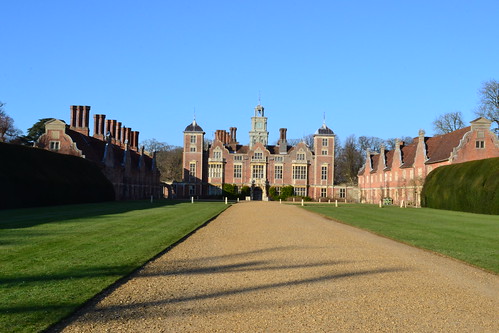
RAF Oulton Museum, Blickling Hall.

If visiting the airfields of North Norfolk, then a stop at the grand 17th Century Blickling Hall is a must. Here, not only do we have a house that dates back some 400 years, but an estate that goes back even further to the 15th Century, and once belonged to the Boleyn family. A mix of Jacobean architecture, grand paintings and tapestries complement a library that contains one of the most historically significant collections of manuscripts and books in England. Walks that take you through a 4,800 acre estate of gardens, wild meadows and woodland, are brimming with wildlife. Even on busy days, you cannot fail to enjoy the peace and tranquillity, the inviting waters of the lake and views over the Norfolk countryside.

But equally important, you have a house that once belonged to Philip Kerr, 11th Marquis of Lothian, Britain’s Ambassador to the United States. Lord Lothian, played a major part in Britain’s war, convincing Churchill to write to Roosevelt, explaining the consequences of a Nazi victory in Europe and the poor defensive position Britain lay in at that time.  A letter that began a chain of events including Lord Lothian’s speech to the American people, that eventually led to the ‘Lend-Lease’ programme being initiated and arms allowed to flow into Britain.

Blickling Hall Blickling Hall, the Museum can be found in the buildings to the right hand side.

A few miles from Blickling, is the airfield RAF Oulton, part of 100 Group commanded by Air Commodore Addison, whom the farm at RAF Foulsham is named after. Oulton utilised much of the house and grounds of Blickling, billeting officers in its ‘wings’ and other ranks in Nissen huts within its grounds. The lake was regularly used for dingy training, the upper floors allowed for bathing in baths – a real luxury for aircrews in the Second World War.

Housed within one of the ‘wings’, is a small museum, the RAF Oulton Museum.

The museum itself is situated in the upper floors on the eastern side, utilising one of the former barrack blocks used by the RAF. The original paintwork still colours the walls and a ‘mock’ billet has been recreated using original furniture sourced from local shops, auctions and through donations.

The museum holds a unique collection of photographs, personal letters and stories gathered over a number of years accumulating into a fascinating record of life at RAF Oulton only a few miles away.  The winter of 1944-45 was one of the worst on record and many of the photographs show crew members relaxing in the snow on and around the base.

Letters tell of the local people, their connections with the base, the pub outside the main gate formerly the ‘Bird in Hand’, (now a private residence) and the Buckinghamshire Arms next to Blickling Hall, (still a pub) where crews would spend their evenings and ‘free’ time.

Log books and uniforms from those stationed at Oulton, along with a mix of original artefacts and replica newspapers, all help to recreate the atmosphere of an RAF billet. It is packed with historical and personal information – a real gem for those interested in history and life on the RAF base.

A great little museum, it is certainly worth a visit.

More information about Blickling Hall and the RAF Museum can be found on the National Trust Website.

Britain’s Airfields 1944

By the end of the Second World War, there were a substantial number of airfields covering the UK, mainly used by the Royal Air Force, the United States Army Air Force, the Royal Navy and all their associated branches; they were handed back to the RAF at the end of the war as the various forces were pulled out. Some were used as POW or repatriation camps, some were used to store surplus aircraft, vehicles or ordinance; many were put into care and maintenance whilst the RAF decided their ultimate fate.

Thankfully a few have lasted as airfields and are even fulfilling that role today, sadly though, many were dug up, their runways used for hardcore, the buildings demolished and the events that occurred there reserved for the history books.

The scale and pace of development was massive. The size of these sites bigger than many of the villages they took their names from, the populations larger than many towns of the time. Architecturally they changed the landscape dramatically.

Today as they dwindle away, many are mere names, locals have little knowledge of their existence, memorials are being forgotten, and life is moving on.

As a little reminder of those times and to put the scale of development into perspective, here are two maps held by the British Library that show the main Royal Air Force and Royal Navy airfields as of 31st December 1944.

The two maps, divide the UK and show not only the airfields but satellites as well. They also show Royal Air Force and Royal Navy Water Airfields, and Royal Air Force Moorings. There are a number of sites not included on the map such as relief landing grounds, and training schools, but they do give an indication of the number of airfields that covered the UK by the end of the war.

These are both low resolution pictures, and copyright is held by the British Library who have given permission for them to be reproduced here.

Security Released Airfields in the United Kingdom (Sheet 1)
Security Released Airfields in the United Kingdom (Sheet 2)

© The British Library, Maps MOD GSGS Misc. 505 (sheet 1 and Sheet 2)

Andrews Field where records were made.

This airfield forms the second stop on our Essex trail and is an airfield that is probably unique in that it was named after a General. After leaving Matching Green, we travel a short distance away and stop at the former base Andrews Field.

RAF Andrews Field

Andrews Field (officially Great Saling or Station 485) can be found nestled in the Essex countryside, not far from Stansted airport, about 3 miles west of Braintree. It has the unique honour, among many, to have been the first airfield designed and built for the USAAF in England.

Construction began in the summer of 1942 as a bomber station for the then fledging Eighth Air Force. Units from the 96th BG would start to arrive mid 1943 and their first operational duty would come in the middle of that same year. Heavy bombers of the 96th would go on to perform a strategic bombing role for the remainder of the Second World War, although not from Andrews Field.

Great Saling was renamed Andrews Field in honour of Lieut. Gen. Frank M. Andrews, who was killed when his B-24 crash-landed in Iceland on 3rd May 1943. Andrews was the eighth American general to lose his life (or to be reported missing in action) since the war began, and was known as a ‘doer’, once quoted in the New York Times as saying: “I don’t want to be one of those generals who die in bed.”*3

The airfield was built as a Class A airfield, with accommodation situated to the north-eastern side of the airfield. A communal site, two mess sites, six airmen accommodation sites, two WAAF sites, a sick quarters and a sewage works would accommodate upward of 3,000 officers, airmen, WAAFs and ground crews.  The airfield, with the pinnacle of the ‘A’ pointing north, had three hard runways, the main (2,000yds) running east-west and two secondary (1,400 yd) running north-west to south-east and north-east to south-west respectively. A perimeter track with 50 hardstands joined the three runways together. Further storage and maintenance ‘sheds’ were provided by two T2 hangars, one to the south and one to the east. A bomb store, for small bombs, incendiaries and fusing, was also to the south next to Boxted Woods. The main administrative area was to the east, where the main entrance led out of the site to the accommodation areas. The technical aspects of Great Saling were widely spread and in comparison to many other airfields of this nature, quite thinly catered for. With the majority of the work being undertaken on this side of the airfield, the western side was left primarily for aircraft dispersal.

A B-26 Marauder (serial number 43-34132) nicknamed

B-26 Marauder (s/n 43-34132) “Patricia Ann” of the 450th BS undergoing an engine test at Andrews Field. The aircraft collided with another B-26 (42-96279) over Beauville Airfield, it suffered damage but was able to return*1.

The first but not primary residents, were the heavy B-17s of the 96th BG, 4th BW, Eighth Air Force. Activated in July 1942 at Salt Lake City Utah, they trained on B-17s from the start of their inception. Moving to the United Kingdom in the following May, they would stay at Andrews Field for only one month before moving on to nearby Snetterton Heath on 12th June 1943. The 96th would operate four squadrons (337th, 338th, 339th and 413rd BS), attacking targets such as shipyards, harbours, aircraft factories, and major industrial targets across occupied Europe. Later in the war, they would receive a Distinguished Unit Citation before their return to the United States post war.

With their departure, Andrews Field would be passed over to a new unit, the 332nd BG, who were to be the largest and most major operational unit to serve at Andrews Field for the duration of the hostilities.

The USAAF was not generally associated with medium bombers, and the introduction of the Martin B-26 Marauder, would bring a whole host of issues. Rushed into service, it was to gain notoriety for poor handling, regular engine failures, weak undercarriage and high stall speeds that led to a string of accidents and crew deaths. The aircraft soon gained a collection of unsavoury names; ‘Widow Maker‘, ‘Baltimore Whore‘ and ‘Flying Prostitute‘, reasons for which were born out in its early days of flying.

B-26 Marauder (s/n 41-18276) “Pickled Dilly” of the 322nd BG. Later shot down 13km south of Abbeville, by Bf-109G-6 (JG301/1), July 8, 1944. 3 KIA 4 POW*2

The 322nd BG, activated at MacDill, Florida, trained with this particular aircraft and Marauder Squadrons soon found themselves transferring across the Atlantic to bases in both Suffolk and Norfolk as part of Eaker’s Eighth Air Force.

General Eaker however, soon decided that the low flying, medium bombers were adding little to his strategic bombing campaign, and so placed all the Marauder units under the control of the VIII Air Support Command, very much a back seat of the mighty Eighth’s activities. Coinciding with this move, was the decision to move all Marauder units of the 3rd Wing south so as to be within easy reach of the continent and more able to support the impending invasion.  The first units to be affected were the 386th (to Boxted), the 322nd (from Rougham to Andrews Field) and the 323rd (to Earls Colne). The headquarters for these also moved south, taking up new residency at the less luxurious Marks Hall, an Elizabethan mansion!

After a series of disasters at Rougham, the 322nd, arrived at Andrews Field on June 12th 1943. The four squadrons (449th, 450th451st and 452nd BS) all returned to action in the July, following a series of intense low-level training duties. Better successes followed, and this led to a growing belief in the Marauder’s capability in proven hands; the future began to look brighter for the aircraft. The 322nd went on to use their new skills, attacking targets that included airfields across the lowlands, power stations, shipyards and the rail networks. Success flourished and the 322nd would eventually earn themselves both notoriety and a DUC for their high performance; if nothing else it was a reputation that stopped the Marauder crews being on the wrong end of B-17 crew jokes.

Former RAF Andrewsfield

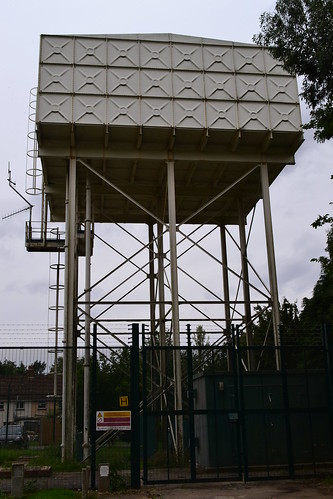
The 80,000 gl Braithwaite Water Tower at Andrews Field

On October 6th, 1943, the four units of the  VIII Air Support Command flew their last mission as part of the Eighth. Now there was a new control, the Ninth Air Force had moved to England. A new focus and more low-level strikes against the enemy led the preparation for the invasion. Coastal defences were hit and airfields in the northern area of France were targeted as part of operation STARKEY, the allied plan to fool the Germans into thinking a full-scale attack would take place around the channel ports.

Following the June invasion, for which the 322nd played a major part, they went on to continue supporting Allied ground movements. Battles at Caen and St. Lo helped the Allied forces advance through France: bridges, railway junctions, defensive positions and ordnance depots all came under the focus of the 322nd.

As the Allies moved further in land toward Germany, so too did the Marauders. In September 1944, the 322nd left Andrews Field and moved to Beauvais in France. They continued to support the Allies into the German Heartland performing their last mission on April 24th 1945, before commencing inventory duties in Germany and then returning to the US for disbandment on 15th December 1945.

By the end of their tour, the 322nd had performed remarkably. The Marauder had gone from one of the most despised aircraft to the perhaps one of the most respected. Its ability to perform in good hands, and its sturdy airframe, reflected its remarkably low loss rate, 0.3 %, 13 losses in only 4000 sorties.

After their departure, Andrews Field was passed to RAF control and a considerable number of fighter units would pass through here. First came the Mustang IIIs of 316 Sqn, who arrived in August 1944, staying until September 1945. The October of 1944, saw yet more Mustangs arrive, with 19, 122, 129, 315 and 316 sqns again all with the Mark IIIs. By now Andrews Field was a very busy base, and even more units were to pass through. In December, 309 Sqn arrived staying until August 1945, and it was during this year (1945) that 65 Sqn brought the updated Mustang IV as did 303 Sqn later in the August. A monopoly of American hardware was only broken for two months (June to August 1945) by the Spitfires of 276 Sqn.

Then as the jet age dawned and Meteors began to arrive, two squadrons would operate the aircraft from Andrews Field; both 616 Sqn and 504 Sqn (albeit for a short period only) would fly the MK.III, transforming the sound from piston engines to jet engines. As December 1945 came so did the departure of the 303 Sqn and the last remaining Mustangs, a move that signalled the end of military action at Andrews Field. Following this, the airfield was mothballed and finally put into care and maintenance.

Andrews Field was to produce some remarkable records during its operational time. The first by B-26 ‘Mild and Bitter‘ s/n 41-31819, of the 450th BS, was the first Allied bomber to pass 100 operational missions (in Europe). A second,  ‘Flak Bait‘, s/n 41-31773, became the first to surpass 200 missions – both remarkable feats when at that time few pilots relished the thought of flying just one mission let alone two hundred.

Post war, the airfield was used for a multitude of roles, eventually having much of its infrastructure removed and returning to a primarily agricultural role. However, aviation grew from the ashes and flying thrives once again through light aviation as Andrews Field Aviation. Offering a range of flying lessons, they keep the spirit of Andrews Field alive long after the last military aircraft departed on its final journey. Using a grass runway that follows the line of the original, it is one of the few reminders that an airfield existed here many years ago.

Andrews Field (Station 485)

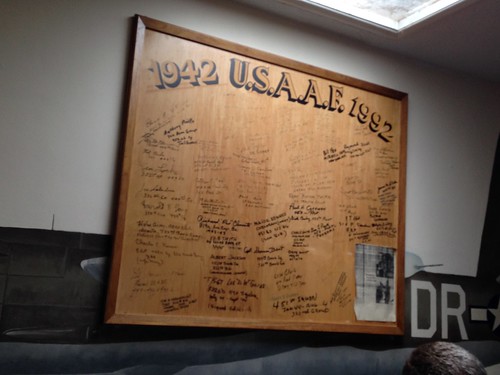
A memorial board in the airfield clubhouse

Visiting Andrews Field today, there is little of its former life left. The runways, buildings and perimeter tracks have all but been removed. Much of the evidence of its existence lies in the nearby village of Great Saling. The 80,000 gl high level water tower (Braithwaite built to design 16305/41) stands on the former Site 3, now a playing field, and a defensive pill-box hints at the area’s historical use. The main accommodation areas are now either all built upon with small housing estates or ploughed up for agricultural purposes. The original entrance from the main road is today the entrance to a small quarry.

Driving away from the village to the rear of the airfield takes you along the former north-western perimeter track. Down here almost buried under the hedgerow are the steep banks of the firing butt. The road continues round to the southern side of the site, again utilising part of the original perimeter track. Entering the site, takes you alongside the runway to the clubhouse and parking areas. From here one of the remaining two T2s can still be seen, lurking in amongst the tress, as if defiant to development.

A rather unusual addition to the site is a somewhat forlorn Dassault Mystere IVA jet, gradually decaying in the British weather. It certainly has seen better days, and maybe one day it too will rise from the ashes and become a thing of aviation beauty once more.

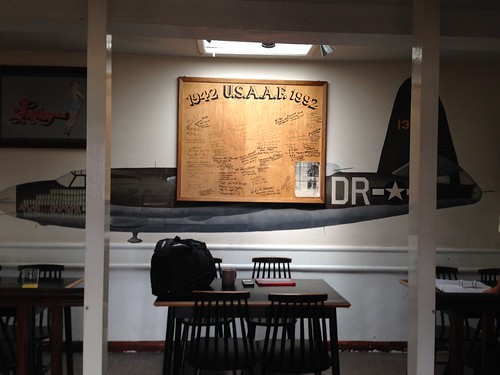
A memorial to those who built the airfield can be found where the entrance to the sick quarters were, and a further memorial can be seen along the road linking Great Saling and the A120 in memory of the crews of the 322nd BG. Inside the clubhouse is a mural and photos of the airfield whilst under construction.

Andrews Field (Station 485)

The mural painted to commemorate the crews of the 322nd.

Andrews Field is an airfield that has clung onto its heritage, but whilst much of its former life has gone, the sound of small piston engined aircraft provides something of a reminder of the mighty engines that once relentlessly throbbed on this amazingly historical site.

After leaving Andrews Field, we travel a few miles west back again toward Stansted Airport. We stop at Great Dunmow and the neighbouring church at Little Easton.

Sources and further reading

1 Photo Roger Freeman Collection, IWM, FRE4482
*2 Photo Roger Freeman Collection, IWM, FRE1187
*3 New York Times published May 5th 1943 (accessed May 26th 2018)
The Mighty Eighth“, (1970), Roger Freeman, Arms and Armour,
RAF Squadrons“, (1998) CG Jefford, Airlife

A number of detailed and remarkable websites exist around the B-26, each is worthy of a visit.

http://www.billsb-26marauder.org/
http://www.markstyling.com/b26s.01.htm (art work)

Britain’s Airfields – What does the future hold?

There has been a recent ‘spate’ of developments with planning applications that affect Britain’s wartime heritage, and in particular the airfields that were used during the Second World War.

With land at a premium, a housing crisis that is growing, these sites are becoming more and more handsome as development opportunities. Many have a ready-made infrastructure, many are open fields and as such, prime agricultural or development land. So what does the future hold for Britain’s heritage?

We have seen applications submitted or at least interest shown, for the former: RAF Kings Cliffe, RAF Downham Market, RAF West Raynham, RAF Denethorpe and RAF Coltishall, further applications have now been seen affecting former RAF Dunsfold, RAF Bourn and RAF Wellesbourne Mountford.

We also know that the USAF have given notice of withdrawal from their major UK base at RAF Mildenhall, the smaller site at RAF Molesworth and the remaining site at RAF Alconbury. The Government has already announced it will be selling these sites for housing after the military withdrawal in 2020-23. These three sites form part of an estimated £500m sell-off that would also include: RAF Barnham (Suffolk), Kneller Hall (Twickenham), Claro and Deverell Barracks (Ripon), Lodge Hill (Kent), Craigiehall (Edinburgh), HMS Nelson Wardroom (Portsmouth), Hullavington Airfield (Wiltshire) and MOD Felton (London). Changes at RAF Lakenheath will also see job losses through streamlining of operations.

It is estimated that the 12 sites could accommodate an estimated 15,000 homes with Alconbury having 5,000 alone.

The former airfield and barracks at RAF Waterbeach is also subject to planning proposals, and the Bassingbourn barracks near Cambridge is also under the development spotlight. The recent closure of Manston (a vital Second World War airfield) has led to speculation of its future both as an airfield (possibly London’s third) and as a development opportunity. These are perhaps just a few of the prime areas of land that are now becoming the focus of planners and developers alike.

There are many variables in this heated and long-lasting debate, in fact far too many to raise and discuss here. Strong feelings exist both toward and against the idea of development and it is certainly not a new one. Employment, jobs, environment, heritage, housing etc, they all create discussion and a strong case for both arguments, but the debate here is not “should we build or not” this is quite frankly, inevitable and in many cases much-needed, no, it’s more how can we meet the needs of an ever-growing population with the needs to preserve historically important sites that form the very thread of today’s society.

We have a dynamic population, and as health care improves, social mobility increases and a growing desire to own our own home increases, the need for more housing, affordable homes and homes for rent also increases. We are an ageing population, care homes, schools for our children and hospitals for the sick are all in much greater need. Where do we build them?

Whilst housing demands have always been with us and the need for more housing an all important one, the recent developments suggest that these old airfields could become prime land to meet these future housing needs.

Many of the current Second World War airfields are now either industrial conurbations or agricultural areas. Most have little or no remnants of their former lives visible, and certainly not widely accessible. Many argue that these sites are scrub, derelict and in need of development, and some indeed are. A proportion of the more recently used sites, are ‘mothballed’ or in part operating aviation related activities. They cover huge areas and have a ready-made infrastructure such were the designs of war and post war airfields. These sites also contain extensive dereliction, primarily due to being left and allowed to decay by their owners. Vandalism and pilfering has left them rotting like carcasses of forgotten wild animals. Where industry has been operating, contaminates have seeped into the soils, damaging flora and fauna growth; some so severe that they are rendered too difficult to reclaim as ‘Green Space’. Certainly on paper, they offer good sources for today’s desperate housing stock.

However, balance this against the historical and cultural importance of these places and the argument becomes a little blurred at the seams. Had it not been for the people who came to this country from all over the world to fight the Nazi tyranny in the war years 1939-45, then Britain and Europe would probably not be the Europe we know today. Many thousands of people gave their lives during those dark days, and for many of them, these airfields were their last homes, cold, often draughty huts on the outskirts of some bleak airfield. Their dedication helped form the very society we live in today, the democracy and freedom of speech we so enjoy and relish, the open spaces where we can walk our dog without fear and in freedom. The fact that we can have this very debate, is in itself, testament to those who came here never to return. The very nature and fabric of our local communities has been built around the ‘friendly invasion’ the acceptance of others into our quaint life and idyllic life-styles. Influences from other nations and cultures grew and developed as a result of those who came here from far and wide to give up their lives.

These sites have become monuments to them, their lives and deaths, many still have no known grave; many simply ‘disappeared’ such was the ferocity of the explosion that killed them. The design of Britain’s airfields are architecturally significant to our heritage, buildings were designed to fulfil a purpose and just like our castles and stately homes, they are monuments to a significant period of not only British, but world history. Our education system, includes this very period as a subject for discussion, debate and analysis. To build over such sites without due regard to them would be a travesty, and one that we would regret in the future. To paraphrase that well-known quote; If we are to learn from our mistakes then we need to remember the past. The Second World War is still, for the moment, in living memory, the veterans and civilians who survived it are dwindling in numbers and very soon their memories will be lost for ever. Each day brings news of a lost veteran or a newly discovered story. If we don’t acknowledge the value of these places, if we don’t plan for their ‘preservation’ then both we and our future generations, will be the ones to regret it.

So where do we go from here? The plans published for RAF West Raynham and RAF Coltishall take into account the nature of these sites, they are sympathetic to their historical value and acknowledge the sacrifices made. West Raynham utilises the very buildings that were created, thus keeping the atmosphere for those who wish to visit. Small museums create a record, first hand experiences and artefacts, all valuable records for the education of future generations. But both of these are unique. Both closed in more recent history, they have retained their structures whereas many older sites have had theirs long since demolished.

It is a delicate balance, and as sad as it would be to see them go, there has to be legislation to create compromise. Sympathetic developments have to be the way forward, acknowledgement of the sacrifice has to be high on the agenda. Many of the airfields I have been too have no museum, no memorial barely even a signpost. Surely this is wrong.

If we are to preserve our fragile heritage, we need to consider the implications of the planning process, to look at the value of these sites as both suitable housing and significant historical areas, the sacrifice of the many needs to be acknowledged and it needs to be done soon.

Sources and Further Reading.

Laying the Foundations: A Housing Strategy for England ” HM Gov, November 2011

Stimulating housing supply – Government initiatives (England)” House of Commons Library, 9 December 2014

The “Get Surrey” news report issued on January 5th 2016 relating to Dunsfold can be found here.

Then latest news from “Cambridge News” December 16th 2015 can be found here.

The “Stratford-Upon-Avon Herald” January 6th 2016 front page story about Wellesbourne can be found here. (This may be a limited time link).

The latest news on RAF Mildenhall and Lakenheath published by the BBC, 18th January 2016 can be found here.

401st BG, reputedly “The best damned outfit in the USAAF!”

Deenethorpe saw action by 4 squadrons from the 401st Bombardment group, reputedly the “The best damned outfit in the USAAF”. They flew 254 combat missions and received two Distinguished unit Citations. They had the best bombing accuracy of the mighty Eighth and one of the lowest loss ratios of any USAAF unit. However, a local disaster and inauspicious start, did not mean it was all plain sailing.

RAF Deenethorpe (Station 128)

Deenethorpe October 1942, taken by No. 8 OTU (RAF/FNO/166). English Heritage (RAF Photography). The memorial is to the bottom right*1

Constructed in 1942/43 as a Class ‘A’ airfield, it would have three concrete runways, a main of 2,000 yds and two secondary both 1,400 yds. The main runway ran in a north-east to south-west direction whilst the two secondary runways ran north-west to south-east and east-west respectively. The airfield was built adjacent to the (now) main A427 Weldon to Upper Benefield road and had around 50 loop style hardstands for aircraft dispersal.

For maintenance of the heavy bombers, two ‘T2’ hangars were sited on the airfield, one to the south-eastern corner and the second to the west, next to the apex of the ‘A’. Fuel stores were in the southern and northern sections, away form the technical site located to the south-east. Accommodation sites for 421 Officers and 2,473 enlisted men were also to the south-east beyond the road. Initially used by the RAF as a training base, it was quickly adopted by the USAAF and personnel soon moved in.

The main inhabitants of Deenethorpe were the four squadrons of the 401st BG, 94th Combat Wing, 1st Air Division. This Division, operated from nine airfields, in this Peterborough-Cambridge-Northampton triangle with three further fields to the south-east of Cambridge. A small cluster of sites located close together but away from the main 2nd and 3rd Air Divisions of Norfolk and Suffolk.

The 401st were a short-term unit operating until the end of the war; although they did go on to serve post war in the 1950s following reactivation. Originally constituted on March 20th 1943, they moved through various training airfields eventually arriving in England in October/November 1943.

B-17 Flying Fortress SC-O (42-97487) “Hangover Haven” of the 612th BS/401st BG after crash landing at Deenethorpe, 3rd October 1944*2

The four squadrons of the 401st, the 612th, 613th, 614th and 615th, all flew B-17Gs and operated with  the codes ‘SC’, ‘IN’, ‘IW’ and ‘IY’ respectively.  Using a tail code of a white ‘S’ in a black triangle, a yellow band was later added across the fin (prior to September 1943, the tail fin codes were reversed, i.e. black ‘S’ in a white triangle as in the above photo). The ground forces arrived via Greenock sailing on the Queen Mary, whilst the air echelon flew the northern routes via Iceland. Their introduction into the war would be a swift one.

The primary role of the 401st would be to attack strategic targets, such as submarine pens, ship building sites, heavy industrial units, marshalling yards and other vital transport routes. Many of these were heavily defended either by flak or by fighter cover, much of which was very accurate and determined.

On the 26th November 1943 they would fly their first mission – Bremen, headed by their commanding officer Colonel Harold W. Bowman. It was not to be an auspicious start though. With 24 crews briefed, engines started at 08:00, twenty-four B-17s rolled along the perimeter track to their take off positions at the head of the northern end of the main runway.

It was then that B-17 “Penny’s Thunderhead” 42-31098, of the 614th BS, slipped of the perimeter track trapping the following aircraft, commanded by the Station Commander Major Seawell, behind it. Then a further incident occurred where aircraft 42-39873, “Stormy Weather” suffered brake failure and collided into the tail of 42-31091 “Maggie“, severely damaging the tail. Four crews were out of action before the first mission had even starte. Bad luck was not to stop there. Once over the target, cloud obscured vision and whilst on the bomb run “Fancy Nancy“, 42-37838, collided with another B17 from the 388thBG. “Fancy Nancy” was luckily able to return to England, but severely damaged it could only make RAF Detling in Kent where it crash landed. So severe was the damage, that it could only be salvaged for parts and scrap. The mission report for the day shows that the ball turret gunner lost his life in the incident, the turret being cut free from the fuselage. A further gunner was wounded by flak and a third suffered frost injuries to his face.

On their second mission, the 401st were able to claim their first kill. A FW-190 was hit over the target at Solingen and the aircraft destroyed, but their luck was not necessarily about to change.

Within a matter of weeks the 401st were to have yet another set back and it was only due to the quick thinking of the crew that casualties were kept to a minimum. On December 5th 1943, mission 3 for the 401st, target Paris; B-17 42-39825, “Zenobia” crashed on take off coming to rest in nearby Deenethorpe village. The uninjured crew vacated the burning aircraft and warned the villagers of an impending explosion. Fire crews and colleagues rushed to the scene, and the two remaining injured crewmen were safely pulled out. Twenty minutes after the initial crash, the aircraft, full of fuel and bombs, finally exploded destroying a number of properties along with the fire tender. The explosion was so enormous, it was heard nine miles away.

The crew of the B17 which crashed on the village of Deenthorpe. L-R. T/Sgt William D Woodward, (t/t), Sergeant Waldon D Cohen, (b/t), Sergeant Harold J Kelsen, (w/g), Sergeant Robert V Kerr, (t/g), S/Sgt Benjamin C Misser, (r/o), and Lieutenant Walter B Keith, talking to Captain RJ White, who rescued the navigator Lieutenant King. The navigator and bomb-aimer are still in hospital, recovering from injuries. *3

The new year however, brought new luck. During operations in both January and February 1944 against aircraft production facilities, the 401st were awarded two DUCs for their action and as part of the 1st Air Division, they would be awarded a Presidential Citation. The 401st attacked many prestige targets during their time at Deenethorpe including: Schweinfurt, Brunswick, Berlin, Frankfurt, Merseburg and Cologne, achieving an incredible 30 consecutive missions without the loss of a single crew member.

Like many of their counterparts, they would go on to support the Normandy invasion, the break out at St Lo. the Siege of Brest and the airborne assault in Holland. They attacked communication lines in the Battle of the Bulge and went on to support the Allied crossing into Hitler’s homeland over the Rhine.

The 401st performed many operations, 254 in total. Their last being on April 20th 1945 to the Marshalling yards at Brandenburg. During the mission, B17 “Der Grossarschvogel” (The Big Ass Bird) was shot down. Five crew members were killed in the crash and several others, who had managed to escape, were beaten by civilians almost killing two of them. Ironically, they were ‘saved’ by Luftwaffe personnel, and in one case, even freed although the orders had been to shoot him.

These were not to be the last 401st fatalities though. On May 5th 1945, VE day of all days, Sgt G. Kinney was hit by the spinning propeller of a taxying B17 killing him; a devastating end to operational activities at Deenethorpe.

On June 20th, the 401st vacated Deenethorpe, returning via the same route that they came and were  then disbanded in the US. Deenethorpe was returned to RAF ownership and retained until the 1960s when it was sold off. The standard design 12779/41 tower was demolished in 1996 and the remainder of site returned to agriculture. All major buildings have been removed as have two of the three runways. The main one still exists today for light aircraft and microlights, as does most of the perimeter track – but as a mere fraction of its former self.

Whilst there is little to see of this once enormous airfield, best views can be obtained from the main road the A427 Weldon to Upper Benefield road. A few miles along from Weldon on your left is the airfield. Stop at the memorial. The original control tower, now gone, stood proud, visible from here beyond the memorial. The technical site would be to your right, and you would be looking almost straight down the secondary runway to your left. The communal and accommodation sites were directly behind you and traces of these can be seen but only as building footings. In the distance you can see the modern-day hangars used to store the microlights,

Access to this area is restricted, prior permission being needed before entering the site, records show that there have been a number of ‘incidents’ with landowners and users of the airfield. So what little remains is best viewed from here.

The memorial is flanked by two flags, is neat and well cared for. The runway layout is depicted on the memorial stone and it proudly states the achievements of the 401st. I am led to believe the ‘Wheatsheaf’ pub further along was the haunt of many an American airman and has a ‘401 bar’ with photos and memorabilia. I was not able to visit this  unfortunately and cannot therefore verify this. Definitely one for another day!

DSC_0155

Modern activity at Deenethorpe

Deenethorpe is one of those airfields that has quietly slipped away, the passage of time leaving only simple scars on the landscape. This once busy and prestigious airfield now nothing more than rubble and fields with a memorial to mark the brave actions, the death and the sacrifice made by crews of the United States Army Air Force so long ago.

A BBC news report covered the planting of a time capsule in June 2011, when the widow of Tom Parker (the last of the 401st Bombardment Squadron crew, that flew the B-17 plane “Lady Luck” out of Deenethorpe), kept their promise that whoever was last would bring a collection of tankards back to Deenethorpe with their own personal stories.  The tankards were a gift from the pilot of Lady Luck, Lt Bob Kamper who presented them to the crew at a reunion in 1972. Mr Parker, the last member of the crew, sadly died in March 2011.

May their stories live on forever more.

The BBC news report can be found here.

Deenethorpe falls under Northampton County Council, and like Kings Cliffe in the same area, has been the subject of planning applications. It is proposed that the airfield be removed and all flying activity stopped. A Garden Village will be built on the site, and the area landscaped accordingly. The proposal can be found here.

Deenethorpe was originally visited in Trail 6, ‘American Ghosts‘, from here we go onto an airfield that saw action involving a large numbers of paratroopers, we go to Spanhoe Lodge.

Sources and further reading.

*1 Photo from IWM American Air Museum In Britain.

*2 Photo Roger Freeman Collection, from IWM American Air Museum In Britain. FRE 8079

*3 Photo Roger Freeman Collection, from IWM American Air Museum In Britain. FRE 2218

The 401st BG website contain a vast amount of information about crews, aircraft and missions of the 401st. It can be accessed here.

I highly recommend the book, “The B-17 Flying Fortress Story“, by Roger Freeman, published by Arms and Armour, 1998. Some aspects may have been updated, but the detail is incredible and a worthwhile investment for anyone interested in this area.

RAF King’s Cliffe – buildings not recommended for listing.

A recent assessment of the remaining buildings on the former RAF King’s Cliffe airfield, Northamptonshire, has not proven to be as positive as one had hoped for. The result could open the door to future development of the site and ultimately the permanent loss of these buildings as a result.

Oakington Pillbox Kings Cliffe Dec 2014

One of the rarer Oakington Pillboxes deemed not to be of Historical interest.

King’s Cliffe (originally visited in Trail 6) was the station for a number of RAF and USAAF units flying P-38s and P-51s amongst them . They operated as fighter escort for the heavy bombers of the Eighth, seeking out targets of opportunity, particularly enemy locomotives, as enemy fighters reduced in numbers. It was also the site of Glenn Miller’s final hangar concert, for which a memorial has been erected on the base of the hanger structure.

Closed post war, it was returned to agriculture, and the runways removed for hardcore. A few buildings still remain including: aircraft pens, pillboxes, the Battle headquarters and a rather dilapidated watch office. Away from the airfield site, the chapel and other small accommodation buildings survive in modern use. King’s Cliffe has certainly taken its share of post war degradation.

This survey was initiated following the successful planing application made for Jacks Green; the area to the southern side of the airfield around the Glenn Miller Memorial. This application has been granted (see here and the media reports here), and development is due to proceed. This combined with the findings of the survey by Historic England, won’t help the long-term future of King’s Cliffe’s buildings, and it may have further implications for the preservation of the site as a whole.

Historic England,  submitted their report to the Secretary of State who has deemed that the remaining buildings, including those mentioned, are not suitable for classification as “historically significant” and therefore will not be added to the list of  Buildings of Historical interest and so ‘listed’.

 Under the Planning (Listed Buildings and Conservation Areas) Act 1990 Buildings of Special Architectural or Historic interest; buildings that are deemed to be significant in terms of their architecture, historical importance or rarity, can be classified.

The full report can be accessed via the Historical England Website, but the key points they highlight are thus:

1. The Watch Office:

The report highlights the fact that of the 18 different models constructed, there are 220 examples still surviving today,  with many of them surviving in a better condition.

At King’s Cliffe the watch office (type Watch Office for Night Fighter Stations FCW4514) is a windowless shell, with some of its internal walls demolished and its balcony rails missing. There are no internal features. It is a poignant and dramatic ruin, but its condition precludes designation.

2. The Battle Headquarters:

At the time of the survey, the building was flooded and so access was inhibited, but it is thought that it is unlikely to contain anything of historical or architectural significance. Again Historic England state that there are better preserved examples on other sites around the UK.

The report states:

At King’s Cliffe, much of the essential wartime context has been lost with the removal of its runways and hangers. Moreover, the interior of the structure, which is flooded currently and effectively inaccessible, is unlikely to retain fixtures and fittings of interest. Together, these considerations mean that King’s Cliffe’s Battle HQ cannot be recommended as an addition to the List.

3. Fighter Pens:

Built to protect fighters and crews from attack, with soil mounds, brick walls and protectives rifle slits, there are a variety of these structures surviving today around the UK. More significant examples can be found at Battle of Britain airfields for example, and whilst those at King’s Cliffe were important, they are in mixed condition and according to the report, not of significant value.

The report states:

Elsewhere, however, the pens are very degraded or part demolished. The fact that only a proportion of the fighter pens survival relatively well as an ensemble, and that much of the essential wartime context has been lost with the removal of the runways and hangers, means that King’s Cliffe’s fighter pens cannot be recommended as additions to the List.

4. Pillboxes:

There are a small quantity of pillboxes around the airfield site and these represent a minute number of the 28,000 constructed in defence of the UK. Rarer examples are more likely to be selected for listing than the more common examples. Those found at King’s Cliffe are the Oakington style, a rarer model of which only 61 have been recorded by the English Heritage Monuments Protection Programme. Some of these have since been demolished and so an even smaller number exist today. However, “a high degree of selectivity” was used as a basis for the decision.

While the three examples at King’s Cliffe are also of undoubted interest, and generally survive in relatively good condition, a high degree of selectivity must be deployed when assessing structures of this late date. The loss of so many key components of the wartime airfield compromises their historic context and argues against recommending them for designation.

The conclusion of this report, states that the decision not to recommend listing these buildings is down to three primary points:

1. The fact there the buildings are in poor condition,
2. The fact that they are not ‘rare’ and,
3. The fact that because the other major features, (runways and hangars) have been removed, they are not significant in ‘Group Value’.

This decision is not surprising, but the wording suggests that any airfield with no runway or hangars, is not likely to have its buildings listed for preservation unless they are either very rare or in very good condition. After 75 years, that is extremely unlikely.

This outcome means that any decision to demolish the buildings lays with the landowner, and whilst they have been in situ for the last 70 years or so, there is now no need to retain them in any form should they so wish.

Ultimately, these buildings could be removed for land development, or agriculture use, meaning they would then be lost forever. That would leave the two small memorials as the only significant reminders of the King’s Cliffe site.

The full report can be accessed via the link below, which gives a detailed explanation for the decision. The annex of the report will be published on the Heritage Gateway website.

www.historicengland.org.uk case number 1426070

Anyone who wishes to challenge this decision can do so within 28 days with a request that the decision be reviewed in light of further evidence or because of irregularities in the process, full details are available through the link below. A form is available through this link, with appropriate guidance for completion. Both downloadable from the ‘Reviews of Listing Decisions’ page.

https://www.gov.uk/how-to-challenge-our-decision-to-list-or-not-list-a-building

If you are unable to access the website please contact:

The Listing Review Officer
Heritage Protection Branch
Culture Team
Department for Culture Media and Sport
4th Floor
100 Parliament Street
London
SW1A 2BQ

My thanks to Sandra Beale for forwarding this information.

Development News for Britain’s Airfields (3).

A third proposal for airfield development had been released in this last week. The first two, RAF Downham Market and RAF West Raynham have been highlighted in previous posts. The third, is possibly the most significant so far and one that like RAF West Raynham, sets a standard by which future developments could proceed. This site is that of RAF Coltishall.

RAF Coltishall – The Future

RAF Coltishall was home to around 56 RAF Squadrons throughout its life, these included the Jaguars of 6, 41 and 54 Squadrons along with a wide range of  aircraft from both the Second World War, Cold War era and the Gulf War.  It is a large site that accommodated around  1,500 people at its height, with four hangars, a single runway and both extensive accommodation and technical sites.

Vacated by the RAF  in 2006, it has been the subject of a public consultation since 2013. Questions were asked about the possible future use of the site which included light aviation with air displays, a change to affordable housing, industrial use and site redevelopment. Norfolk County Council took the future of the site very seriously, knowing how much it meant to both the local people of Norfolk and Britain’s aviation heritage. The results of this consultation have now been released and can be accessed through the link at the base of the page.

DSC_0095

The Control Tower at Coltishall may be part of a Heritage Trail

As with West Raynham, a site like Coltishall, that is complete, offers a unique opportunity to develop the buildings and structures whilst retaining and highlighting the heritage value that it represents. The buildings and infrastructure are ideal for a small self-contained ‘village’ that encourages links with both the local and wider community as a whole.

Norfolk County Council have recognised the importance of this site in particular, and as a result, much of it is now listed as ‘ancient monuments’ or locally listed buildings. These include: the World War 2 dispersals, Cold War blast walls, hangars, tower and communal buildings. It survives today in its entirety, primarily because the entire airfield is designated a Conservation Area by Norfolk County Council. This status gives protection against some of the more virile development and ensures in part, the preservation of the site for future generations.

Norfolk County Council have now released their proposed plans for the site, which include a harmonic development of both the main technical and accommodation areas utilising the buildings in situ where they can.

These plans may mean the sad loss of the main runway and grassed areas, probably both being returned to agriculture or open green space. It would also suggest a loss of much of the perimeter track as well.  However, their plans do include creating a public heritage trail, viewing platform and sign-age to promote and explain the uses of Coltishall, as it was throughout its aviation life. There are also suggestion of ‘interpretations’ of both cold war and second world war aircraft in their respective pens.

Just this week however, a private enterprise (led by a cycle shop owner) put forward a proposal to use the three-mile perimeter track as a cycle track for recreational and competition cycling opportunities. Further proposals include  a £300,000 development of the former operations room into a cafe and cycle workshop.  Landscaping would also be included making it a hub for recreational activities linked by cycles paths to Norwich, Hoveton and Aylsham.

Financial support has not yet been granted for this particular part of the proposal, but it is hoped that the site will be open mid 2016.

Norfolk County Council are considering the plans in line with their own heritage and development ideas. If it all goes ahead, then once developed, RAF Coltishall is likely to be the best preserved airfield in the UK that has not only been developed but opened to the public. Furthermore, if these proposals are to come to fruition, it could become a model for future development of Britain’s old wartime relics.

Details of the Council’s proposal can be found here.

The overall plan can be found here.

RAF Coltishall appears in Trail 7.

Development Proposals could make RAF West Raynham Unique.

The second airfield that has recently seen proposals for new development is the large and complete site on Norfolk’s western side. It is RAF West Raynham. If these proceed, then West Raynham could be a unique development.

RAF West Raynham.

RAF West Raynham is a large airfield that operated well beyond the Second World War. It was home to some 20 squadrons and saw a range of aircraft including: Blenheims, Bostons, Tomahawks, Beaufighters, B-25 Mitchells, Mosquitos, B-17 Flying Fortresses, Canberras, Javelins and Bloodhound Missiles to name but a few.

It currently stands complete although a large part of it has been the focus of development since the RAF’s departure. Much of the former RAF housing has already been refurbished and sold off to private families; a solar park has also been built along the runway line and the accommodation sites developed sympathetically with the airfields history in mind.

Control Tower

The Grade II Listed Control Tower at West Raynham.

A recent report identified this site as being of “heritage value” and that whilst some of the buildings are “at risk” there is a strong desire to reuse buildings wherever possible. The only ‘listed’ building is the Control Tower (which is Grade II listed) which, along with the majority of the main buildings: Guard House, Station Headquarters, Chapel, Water Tower, District Heating Control Centre, four Hangers and the Training Dome, is in relatively good condition. A large majority of the remaining buildings were temporary or will require renovations to make them usable once again. The report states that:

“It is important that the character areas described keep their identity. The approach taken for existing buildings will vary according to the character area and the qualities of the specific buildings”.

The report also highlights the benefits of the MOD property, and that it provides suitable low-cost housing that would meet the Council’s housing target. It also states that the former technical area provides suitable accommodation for small industrial units or “start-up” businesses.

In essence, the survey illustrates the need to develop the site to fulfil the council’s need for housing whilst identifying the site as an important heritage site, and that the development should reflect this:

“The vision is to re-use and reinvigorate the site in a way that respects and celebrates the historic and architectural heritage of the site.”

The infrastructure of former RAF bases lend themselves to new villages; the layout, transport networks and available buildings, are perfectly suitable for the Garden Village idea. Open spaces intertwined with affordable accommodation and recreational facilities are all there. If this development goes ahead, then RAF West Raynham could become a well-preserved yet appropriately developed site that in the large part, reflects it historical importance and valued contribution to Britain’s defence network.

The full development brief can be found here from where the quotes were sourced.

West Raynham appeared in Trail 21.

West Raynham 042

Inside the Former officers Mess.

Development News for Britain’s Airfields.

Plans have been released this week for the development of three former RAF airfields in Norfolk. On the face of it, these represent steps forward in preservation whilst allowing a sympathetic development of these historical sites in at least two of them, and development and part preservation in a third. These proposals will not only revitalise the decaying structures, but will also allow public access to the very infrastructure of the sites that once protected our skies. In part, they offer a model for future development and preservation of Britain’s aviation heritage, whilst highlighting the sacrifice of the crews who flew from them.

The first of these is that of RAF Downham Market.

RAF Downham Market (RAF Bexwell)

Proposals were put to the government on Monday for a new multi-million pound technology park on the former RAF base at Downham Market. It is proposed that the site will create 4,600 jobs and become a centre of excellence for technology comparable to those already at Cambridge.

The £300m project will include a major campus dealing with data and data handling. This will include a research centre for both under and post-graduate students, a hotel, leisure and tourist facilities.

Whilst the proposals have only just been put forward, consultations have already started, and so final planning proposals are hoped to be revealed early in the new year. Local residents are raising objections due to the losing of the ‘green space’, along with increased pressure on the local infrastructure, which according to some, is already stretched.

According to reports, the plans also include restoring some of the few remaining buildings, creating a bronze statue and a museum to commemorate the work of Downham Market crews; something that is long overdue.

Downham Market airfield was the home of: 218 and 623 Sqns both flying Short Stirlings, 571 Sqn and 608 Sqn, both flying Mosquitos in the Pathfinder role and 635 Sqn who flew Lancasters between March 1944 and September 1945.  It is where Flt. Sgt. Arthur Aaron and Sqn. Ldr. Ian Bazalgette were both awarded VCs for their bravery and heroic acts whilst on missions over Europe. It is from where the last Mosquito mission took place which was also the last RAF operation of the war.

Whilst the runways and perimeter track are long gone, a few buildings still do remain in current use. There is no official memorial at Downham Market, although there is a memorial to both Aaron and Bazalgette outside the local church.

These plans are very much in the early stages, but a number of parties have shown an interest in the proposition and development is likely in the near future.

The government material can be accessed here.

Downham Market was originally visited in Trail 7.

Home to the P-51s with a Reputation for Success. RAF Steeple Morden

In the final section of these Cambridgeshire Trails, we end with two fighter stations, both of which played a vital part in the defence of Britain and subsequently taking the war to Germany. Our first stop, boasts probably one of the best memorials in the area if not the country. It is that of RAF Steeple Morden.

RAF Steeple Morden (Station 122)

RAF Steeple Morden has been on my list of places to go for quite some time. Since seeing the photos taken by my friend, and reader, Steve Darnell,  I have wanted to know much more about it. After driving for a short distance from our previous site at Gransden Lodge, we arrive at the site of this former base.

The wide open expanses reveal little of its former life, the travesties , the bravery nor even the mundane hustle and bustle of a busy fighter airfield.

FRE_002932 aerial view

Steeple Morden, 11 May 1945*1.

Construction of Steeple Morden began in 1939 with its opening the following year. Initially, a satellite for nearby RAF Bassingbourn, its early existence would be fairly low-key, housing Wellington MK.1s of 11 Operational Training Unit (OTU) who were based at nearby RAF Bassingbourn. 11 OTU as a training flight, used the airfield primarily for navigation, landing and other training operations. This wasn’t to say that Steeple Morden was to be all quiet though. The first and probably most talked about event of this time, was the mistaken landing by a Junkers Ju 88 after the crew became disoriented following a raid in the midlands. The aircraft crashed as it landed and was written off, but enough of it was salvageable to  be used for assessment purposes. Shortly after this, at least two attacks occurred by the Luftwaffe rendering a number of Wellingtons damaged. Whilst some damage was inflicted upon the airfield, little overall disruption occurred.

Being a training unit, accidents were inevitable. Following a tragedy filled inception, the OTUs generally were to lose a number of crews or aircraft through lack of experience or mechanical failures. 11 OTU was no exception. On April 5th 1941 Wellington L4216 careered off the flare path causing its undercarriage to collapse. Luckily no one was injured in this instance, but it would set the scene for further tragic incidents. Wellington L4302 stalled on the night of 18th April, killing both pilots as the aircraft plunged into the ground at Abington Pigotts and on 8th June 1941, Wellington Ic, R1728, mysteriously crashed into the sea killing all six crew members. It is believed they were bounced by enemy aircraft and shot down. Steeple Morden’s crews were not as unfortunate though as those at nearby Bassingbourn, whose loss rates were even higher, – but they would certainly not get away lightly.

Aug 2015 002

The Village Sign at Steeple Morden Reflects its Aviation Links.

Following runway upgrades at Bassingbourn in the Autumn of 1941, further aircrews would find themselves based here and the pace of life would increase. During 1942 11 OTU would take part in the 1000 bomber raids over Germany, and attacks on prestige targets such as Bremen, Düsseldorf, Essen and Koln. On the night of 25th/26th June 1942, Wellington Ics DV778, ‘KJ-A’; R1078, ‘TX-Q’ and X2313, ‘KJ-L’; would all fail to return from Bremen. These high prestige  targets would claim further: Australian, New Zealand, Canadian and British lives from 11 OTU.

In September 1942, Steeple Morden was handed over to the US Eighth Airforce, and 11 OTU would move on to their new base at RAF Westcott in Buckinghamshire, to carry on training activity there. Earmarked for a new bomber station, it was given the designation Station 122, and would undergo a huge structural transformation.

Three concrete runways were built, the main running NE-SW, and two secondary running E-W and NW-SE. A large concrete perimeter track linked each one with some 55 pan style hardstands, 9 blister hangars and a T2 hangar. The main dispersals were to the south-east and south-west, with the technical and administration areas to the north behind the watch office. There were seven crew sites, two further WAAF sites, two communal sites and a sick quarters, enough for over 2000 personnel. These were all situated to the north-east beyond the end of the main runway. The bomb store, capable of holding 100 tons of bombs, was to the south-east.

The first units to arrive were the: 5th, 12th, 13th and 14th Photographic Squadrons of the 3rd photographic Group, Eighth Airforce, who would remain here between 26th October and November 1942, whilst on their way to the Mediterranean Theatre of Operations and the Twelfth Air Force. Led by Colonel Elliot Roosevelt, the son of the US President, they would go on to achieve a Distinguished Unit Citation for their part in action over southern France.

FRE_000443

P-51 Mustangs of the 355th Fighter Group break formation, ready for landing, over the ground support vehicles and control tower of Steeple Morden Airfield. *2

For a short period between the departure of the Americans and January the following year, Steeple Morden would remain calm and quiet. The next residents being a return to training and 17 OTU (RAF), bringing with them Blenhheims, who wold also only stay for a very short period before moving off again to RAF Silverstone to the west.

The sound over Steeple Morden would then change for good. In came the mighty P-47 ‘Thunderbolts’ nicknamed ‘Jugs’ of the newly formed 355th Fighter Group (FG). No longer seen as suitable for a bomber station, Steeple Morden would be designated a fighter base and this would become its sole use for the remainder of the war.

The 355th FG was made up of 354th (Sqn code WR), 357th (OS) and 358th (YF) Fighter Squadrons, having white noses with red, blue and yellow rudders respectively. Their initiation into war would be slow, lack of supplies and aircraft restricting their ability to perform operationally. With a gentle start, they covered short-range bomber escort duties and low-level sweeps over Belgium, their first operational sortie being on 14th September 1943. Subsequent escort duties though, would take them deep into the heart of Germany. Using the American 75 gallon drop tanks as a substitute for slow delivered 108 gallon British paper tanks, they could reach Germany itself and support the beleaguered bombers of the Eighth Air force all the way to the target and back – a god send to the crews of the B-17s and B-24s.

The 355th would take part in some of Europe’s fiercest air battles, covering targets such as: Berlin, Karlsruhe, Misburg and Gelsenkirchen. But for such dramatic missions, ‘kill’ rates would remain remarkably low.

With the introduction of the new P-51 ‘Mustang’ the 355th’s fortune would turn. Now turning to strafing and low-level bombing runs, they would focus their attention on destroying the Luftwaffe on the ground. They would attack German airfields and earn themselves the apt name ‘The Steeple Morden Strafers‘. A DUC would follow on April 5th 1944 for an attack in a snow storm on the Luftwaffe airfield at Oberfaffenhofen and five other military bases. The 355th claiming to have destroyed 43 aircraft, damaging a further 81 and achieving 8 ‘kills’. From here the numbers continued to climb, both kill rates and the numbers of aircraft destroyed. They had certainly earned their reputation and their name.
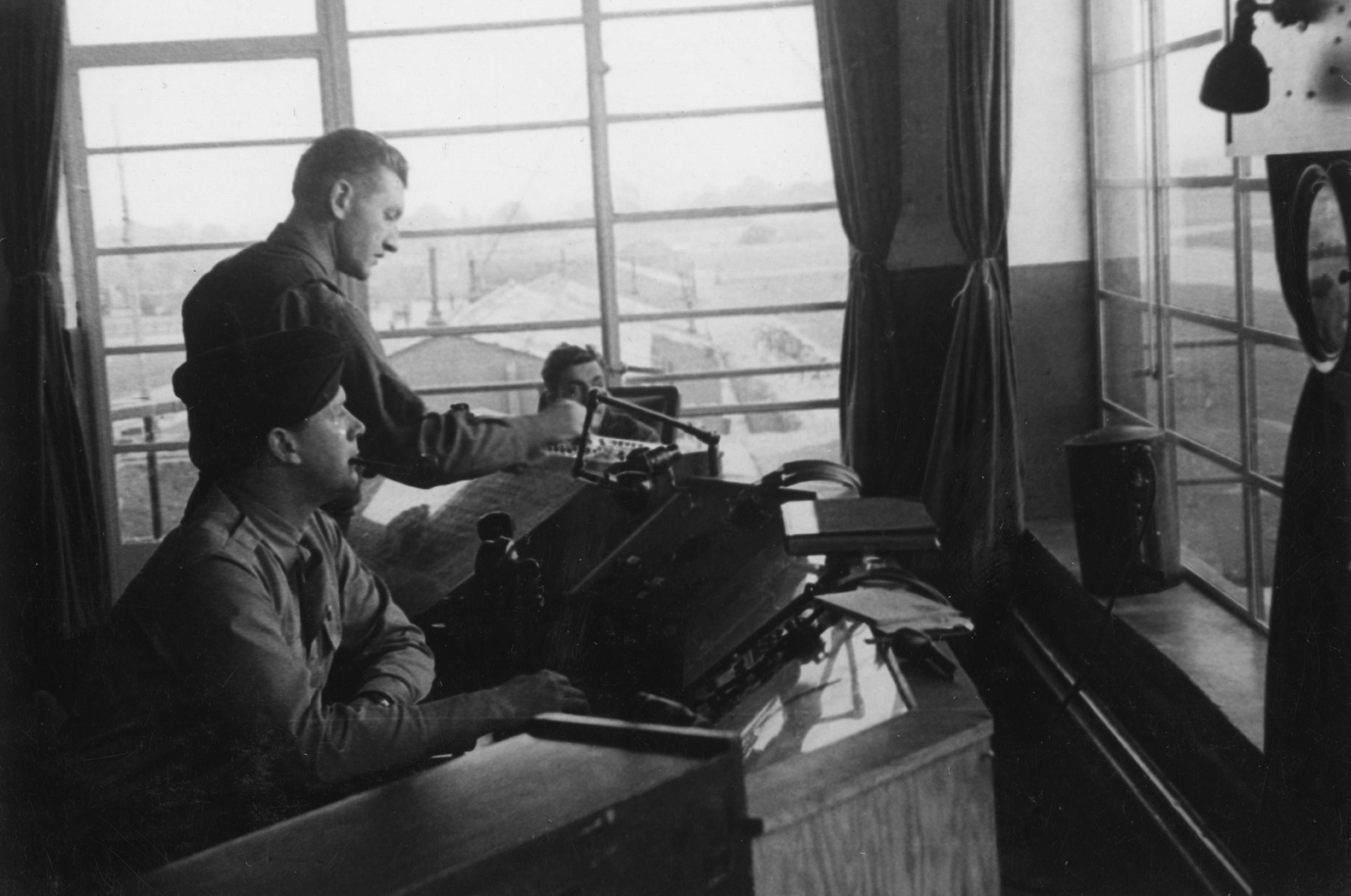
FRE_000441 tower

Men of the 355th Fighter Group Survey the Airfield from Inside Steeple Morden Control Tower.*3

Further operations would take the 355th as far away as Politz in Poland, a remarkable achievement for a fighter aircraft, made possible by the addition of the larger drop tanks. The Normandy landings and the St Lo breakthrough were also covered by the 355th, supporting ground troops, strafing supply lines and enemy ground forces. Confidence and determination were high and a short visit by Glenn Miller would only go to increase the joys of the 355th’s successes – morale would be good.

Then Steeple Morden would take a blow. Early on January 1st 1945, B-17 ’42-37911′, “Heat’s on“, of the 401st BS, 91st BG, RAF Bassingbourn, would crash in the dispersal at Steeple Morden killing all crew members and injuring a number of staff on the ground. At least two P51-Ds, 44-14374, ‘WR-A‘ and 44-14498, ‘YF-S‘ were destoyed*4. Such were the fortunes of war.

“We started off the New Year of 1945 with a scheduled flight to the oil refineries at Merseburg on January 1st, but diverted to Kassel when we found Merseburg clouded over. No. 911, “Heats On”, of the 401st Squadron, on her 92nd mission and flown by 1Lt Earl J. Jeffers, had an engine fail on take-off. Lt Jeffers tried to put her down on the nearby 355th Fighter Group base at Steeple Morden, the main runway of which was directly in the flight path from runway 25 at Bassingbourn. Back on the 6th of March 1944, 2Lt Walter Wildinson in No. 761, “Blue Dreams”, had made a similar emergency landing at Steeple Morden. Although the crew forgot to lower the landing gear and completely wrecked the aircraft, no one in “Blue Dreams” or on the ground was injured. But, as “Heats On” touched down, for some unknown reason she careened into a P-51 dispersal area, striking parked aircraft and exploded, killing all 9 of the crew aboard. There are all sorts of ways to die in an air war. Several of the fighter base ground crew members were seriously injured, but none was killed. For us the mission was uneventful.”*5

As the war drew to a close, the 355th continued to strafe ground targets. Their final operation taking place on 25th April 1945. Their final tally would rise to over 860 ‘kills’ with 500 being as a result of ground strafing – one of the highest of any Eighth Air Force unit. Withdrawing Germans left airfields empty and allowed the allies to move to France and eventually into Germany itself. The 355th would go on to form part of the occupying Allied force leaving Steeple Morden for Gamblingen airfield on July 3rd 1945, and then onto Schweinfurt in April 1946, itself a former target for the Eighth Air Force. Eventually in August 1946 the 355th would return to the US without any equipment to be disbanded in the following November.

The departure of the 355th left Steeple Morden quiet. The 4th FG moved in with the 334th, 335th, and 336th FS before they too moved back to the US in November 1945 and temporary disbandment. Formed around a nucleus of former RAF ‘Eagle’ Squadron members, they came here from RAF Debden with a record of success that exceeded most other units. This departure signified the end for Steeple Morden and the airfield was finally closed. The land was sold off back to its original three owners in the early 1960s and it was returned to agriculture, having the majority of its infrastructure demolished or removed.
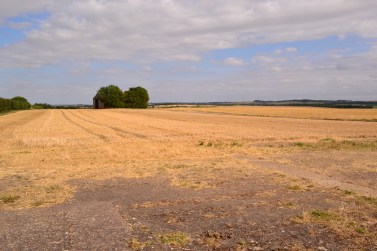
Aug 2015 018

Steeple Morden Technical Site today. The Watch Office would be to the Right in This Picture.

The only significant remnants of this historic airfield, now stand high on the hill-top, a few huts, odd buildings but a remarkable and formidable memorial, that are in tune with the success and bravery of all Steeple Morden’s Allied crews.

With Steeple Morden it is best to start in the village at the village sign, which signifies the links between the community and the base. Located at the village centre, the  sign depicts both an RAF Wellington and a P-51 flying low of the countryside.  A timely reminder that both RAF and USAAF services operated from  here. Take the main road east out of the village, and the airfield and memorial are on your right hand side. A small parking space, once a concrete road that led away from the main part of the airfield and housed general purpose huts, allows you to leave your car and view the memorial without causing a problem to the speeding traffic that uses this road.

Aug 2015 011

The Impressive Memorial to the Crews Who Served at RAF Steeple Morden, both USAAF and RAF.

A grand three-part concrete memorial, its centrepiece the propeller Bose of a P-51 Mustang, overlooks the airfield. To the right and left side are the inscriptions and dedications to the crews of both the RAF and the USAAF. A polished granite stone, all that is left of the watch tower, sits beneath the memorial and three former Nissen huts remain behind giving an atmospheric feel to this site. The fields beyond now completely agriculture this little part of the airfield virtually all that remains. Small sections of concrete, show where the technical site once stood, primarily to your left, with the dispersals and main airfield to your front. The watch office (drawing 13726/40) now long gone, would have been to your left and in front. The entire technical area in which you are standing is now soil, returned to agriculture once more. There are three small huts behind the memorial, these were the crew lockers and drying room, which stood in front of crews tennis courts, suitable for a much-needed recreation break. Along the hedgerow beside the road, would have been 5 further Nissen huts housing the defence crew quarters, again they have all gone.

Aug 2015 010

Crew Locker and Drying Rooms are Virtually the only buildings left.

On a warm summers day, the views from here are stunning. I can imagine a cold winter would transform this place to a freezing, inhospitable airfield with little protection from the elements. A dramatic change indeed.

If you leave here and continue east away from the village, you pass on your left the original operations block designed to drawing 228/43. It contained the crew briefing room, interrogation block and office annex. Still intact, the surrounding buildings mere piles of rubble. Continue on from here and you arrive at the village of Litlington. The church of St. Catherine’s is on your right and this is a ‘must stop’.

Aug 2015 025

The Airfield Operations Room, Whilst Standing, is in Poor Condition.

Before entering the church, look around, the houses opposite, and most of those making up Litlington, are on six of the former accommodation sites. Now mainly bungalows and family homes, there is virtually nothing left visible to show that this was once a vibrant military area.

Once inside the church you will see a beautiful stained glass window that commemorates the 355th FG. A P-47 and P-51, stand aside the eagle of the U.S. Air Force, with the 355th’s sword insignia at the centre of the crest; its detail and stunning blue colours enhanced in the summer light.

A specially commissioned painting can also be seen here. Created by Spencer Trickett, it depicts a P-51D “Miss Steve” as flown by Lt. William Cullerton of the 357th FS, 355th FG, at RAF Steeple Morden. His story is a remarkable one. Shot down by ground fire on April 8th 1945, he was captured by the SS, shot and left for dead. A Jewish doctor and German farmer found him and saved his life. He was then taken to a German hospital from where he escaped and was found by advancing American forces.

Cullerton was the fourth highest scoring ace of the group and the 29th of the entire Eighth Air Force. He was awarded: a Presidential Citation; the Victory in Europe Medal; the Air Medal with Clusters; the Distinguished Flying Cross with Clusters; the Purple Hear; Silver Star with Clusters and the Distinguished Service Cross. His aircraft, “Miss Steve” was named after his girlfriend whom he later married, and is depicted flying low over the church; a landmark used by Steeple Morden crews as it stands directly in line with the main runway.

Aug 2015 029

The Memorial Window at St. Catherine’s Church.

Whilst the majority of Steeple Morden has gone, there are thankfully strong community links with the Eighth and the veterans of the 355th. Whilst predominately American in ‘flavour’, the church window provides a fitting end to a fruitful trail, and what is surely one of the most prestigious memorials on any airfield today. For other photos of this and other memorials, click this link to the memorial page.

From here we go on to conclude this part of our trip with a visit to the RAF base at Fowlmere.

Notes and sources:

*1 Photo from IWM, Roger Freeman Collection, FRE2932,

*2 Photo from IWM, Roger Freeman Collection, FRE000443

*3 Photo from IWM, Roger Freeman Collection, FRE441

*4 Information from ‘Little Friendswebsite accessed 30/10/15

*5 Extract from “Mary Ruth Memories of Mobile…We Still Remember” Ch1- Another Time, Another Place–Lady Lois, Little Jean, published on 91st Bomb Group Website.