August 23, 1944 The worst aircraft accident in the UK during WW2.

During the Second World War, Britain’s landscape changed forever. The friendly invasion brought  new life, new music, rationed items became sought after bounties and they were plentiful – if you knew an American.  But this dramatic change in the British way of life could also be explosive and deadly.

Anyone living near to a wartime airfield knew only too well the risks of such a life. Aircraft could ground loop, collide in the air or suffer a major mechanical failure on take off, all of which could result in a massive explosion in a fully laden bomber. There are numerous recordings of such accidents occurring, and the brave attempts of crewmen trying to avoid local housing. One such crash was that of B-17 #42-39825, “Zenobia” which crashed on take off coming to rest in the nearby village of Deenethorpe. Luckily, the crew were able to escape and warn the locals of the impending danger, thus averting a catastrophe when the aircraft, fully laden with bombs and fuel, exploded twenty minutes later. The explosion was so fierce that it was heard nine miles away!

However, not everyone was as lucky, and on August 23rd 1944, Wartime Britain experienced what is considered its worst wartime air disaster. A disaster in which sixty-one people lost their lives when a USAAF aircraft from BAD2 at RAF Warton crashed into the adjacent village of Freckleton in Lancashire.

Warton, or BAD2 (Base Air Depot No. 2), was responsible for the modification and overhaul of US aircraft and engines when they arrived fresh from the United States. They were assembled, modified and transferred from here to front line operational airfields across the UK. A massive operation that began even before the United States had even entered the War.

Initially, Warton was built as a satellite for the RAF Coastal Command station at Blackpool, known at the time as Squires Gate Airfield, an airfield with a history going as far back as 1909. With many pleasure flights, air pageants and civil flights, it was eventually taken over and used for fighters and bombers of Coastal Command.

With many aircraft being shipped into the UK via the Atlantic during the early years of the war, the need for a site to build and then maintain them became evermore apparent and urgent. It was not long after the outbreak of war, that four such sites were earmarked for use by the USAAF as Air Depots, each one dealing solely with aircraft maintenance and refurbishment. The proposal, initiated by Lord Beaverbrook as early as October 1939, which then progressed through discussions between the American and the British Governments in 1941 , specified that these bases would need to be able to deal with large quantities of aircraft and be able to handle aircraft modifications at any stage of the assembly process. In October, these bases were identified by a consortium of American and British representatives, who selected: Warton, Little Staughton (Bedford), Burtonwood (Warrington) and Langford Lodge in Neagh, Northern Ireland, as the most suitable sites.

Warton would be massive, housing almost 16,000 people in over ten accommodation sites, which when compared to a normal Class A airfield of some 3,000 people, was an enormous conurbation. To be adaptable, the runway was strengthened and extended to match that of any wartime airfield, at almost 2,000 yards long, it could take any aircraft brought over from the United States. Along side this were a wide range of ancillary buildings: stores,  maintenance sheds, office blocks, hangars, engine test sheds and fifty dispersal points. As the war progressed, Warton was extended further with the largest European storage shed and further hangars being added in 1944.

The entire site was completed in just nine months, using a combination of construction groups led by Frank Thomas; this included both Alfred McAlpine, and Wimpey, two of the largest airfield contractors at that time.

Station 582 of the US Eighth Air Force was opened August 1942, housing a small contingent of USAAF personnel. Officially handed over to the USAAF a year later, it now had some 5,000 personnel on its books already, all specially trained to handle the unique American aircraft being brought over from the United States.

Each base would specialise, Burtonwood in radial engines and the B-17, whilst Warton concentrated on in-line engines and B-24s. However, that did not mean that this was a ‘closed door’ operation, Warton would, over the period of the war, see every example of US built aircraft pass though its doors, and at its peek, held over 800 aircraft within its grounds.

Living near such a large and active base would bring many benefits, 700, children were given a Christmas party that lasted for a week, the locals were well provided for and money poured into the local economy. However being so close also brought it dangers. There were numerous accidents with parked aircraft being hit as other aircraft taxied past. There were also several crashes, including a North American P-51D-5-NA Mustang #44-13403 that crashed on June 12th, 1944, killing its pilot. The accident being caused by a catastrophic structural failure of the wing assembly. Another P-51D #44-14608 (310th Ferry Squadron, 27th Aircraft Transport Group) was involved in a landing accident at Warton, on October 5th, 1944. The pilot survived, but the aircraft was destroyed in the crash.

Then there was the P-51B-5 #43-6623 that crashed after taking off from Liverpool’s Speke airport, it was was subsequently taken to Warton where it was combined with other parts of P-51Bs that had been dropped on delivery. The new aircraft, aptly named ‘Spare parts‘, would then be used as an unarmed two-seater ferrying VIPs around, delivering small spare parts to the other airfields and collecting supplies of of whiskey from a distillery in Glasgow. The aircraft itself was lost in late 1944 when it experienced engine failure. The two crew bailed out and survived but the aircraft crashed coming to a rest at the bottom of the Irish Sea.

One of the more terrible accidents at Warton involved the collision of two Douglas A-26B-10-DT Invaders, on November 29th 1944, when #43-22298 collided in midair with #43-22336 over Warton Marsh. The crews’ bodies were removed from the site, but the aircraft remained buried in the silt until excavation in 2004. Both aircraft were then transferred to the RAF Millom Museum at Haverigg, Cumbria where they remained until its closure on 1st September 2010. With many of it exhibits being ‘on loan’, they were returned to their original owners whilst the rest were publicly auctioned off in January 2011. The fate of the two Invaders is unknown at the time of writing.

However, it was on Wednesday, August 23rd 1944, that Warton would be shocked by Britain’s worst wartime air disaster and the terrible events that would unfold that day.

Everything appeared normal that day as the workers at BAD 2 and the surrounding area awoke. The news was generally good, the war was heading in the right direction and victory for the allies appeared to be on the cards. There were high pressure zones to the east and west and low pressure to the north. The first 2 weeks of August were generally dry and  warm with spells of sunshine. There had been  a spell of warm weather that continued into the third week, with temperatures reaching as high as 28°C in the south. On the 23rd, early sunshine was expected to change to light rain later on, nothing that should have caused any significant problems to the experienced crews at Warton.

Early on that day, two routine test flights were booked by experienced pilots on newly refurbished Consolidated B-24 Liberators  before they were sent out out to the 2nd Bomb Division. The first, piloted by First Lieutenant John Bloemendal, ‘Classy Chassis II‘, and the second piloted by First Lieutenant Peter Manassero.

After a delayed start, First Lt. Bloemendal and his two crewmen boarded the B-24, ran their ground checks and started the engines. They then departed on was was a routine test flight. Meanwhile, the second B-24 piloted by First Lt. Manassero also departed and both aircraft headed out from Warton. During this time a weather warning was passed to Warton tower informing them of an impending storm, the likes of which even the British had rarely seen. The notorious British weather had played a cruel joke.  In seconds, the summer sky had turned jet black. Daylight had been all but wiped out, Heavy rain lashed the landscape, localised flash floods and unprecedented strong winds battered the Warton skyline. Locals reported seeing trees being uprooted and buildings being damaged such was the strength of the wind and lashing rain.

The tower issued an immediate warning to land the two aircraft. B-24 #42-50291 “Classy Chassis II“,  was given clearance first, the second flown by First Lieutenant  Manassero was to come in next. With visibility down to some 500 yards, the two aircraft approached the airfield in close formation, simply to keep in visual contact. Bloemendal  lowered his undercarriage followed by Manassero. Bloemendal  then began his approach, suddenly retracting his undercarriage informing Manassero he was going round again for another try. But by now, the weather had deteriorated so much that the tower was extremely concerned, and issued an order, to both aircraft, to withdraw from the circuit and abort landings, telling them to fly to the north to avoid the storm. Bloemendal never received the message.

By now contact had been lost between the two pilots, Manassero headed out of the circuit and flew out of harms way, Bloemendal on the other hand had already hit the ground, a massive fireball ensued. Eye witness accounts differed as to what the cause of the crash was, one witness said she saw  lightning strike the aircraft at the wing root, “splitting the aircraft in two“, others say they saw the wings in a near vertical position as if the pilot was banking steeply to turn away.

The aircraft came down across Lytham Road, after hitting the ‘Sad Sack Snack Bar’, purposefully built for the American servicemen of BAD 2. It demolished three houses and the infant section of Freckleton’s Holy Trinity School, which at the time, was full of children between the ages of 4 and 6 who, along with their teachers, were going about their daily routine. The resultant crash led to a fireball, one that eventually took the lives of sixty-one people. Eighteen in the cafe, forty in the school and the three crewmen aboard “Classy Chassis II“.  Many of these dying in the days that followed from severe burns as burning petrol engulfed the school before flowing into the street .

The crash was so devastating that at the inquest, only the School’s register could be used to identify some of the missing children whilst others were identified merely by parts of their clothing painfully presented to grieving parents. First Lieutenant John Bloemendal was only identified by the remains of his dog tags and wedding ring, the only married man aboard the aircraft.

The US servicemen from BAD2 were highly praised in the days that followed for their quick and brave response to the crash. Pulling away debris while the aircraft still burned, attempting to put out the fire and fighting to save whomever they could from the burning wreck that was once Freckleton village school.

The papers understandably ran the story for months and even years afterwards, as more and more information came to light. Some of the injured were so severely burned, they were read their last rights, whilst many had to have long term skin grafts, including some as part of McIndoe’s Guinea Pig Club.

From Lytham St. Annes, to London and New York, the story of Britain’s worst air disaster spread, putting good news from the front line into painful perspective. Whilst convalescing, young survivors were visited by Bing Crosby, who diverted from his tour of American airfields across the UK, to pay his respects. A small gesture to avert the grieving now felt across both sides of the ocean.

A mass funeral service took place in Freckleton on August 26th, the streets were lined with mourners as service personnel carried the many tiny coffins along in one mass parade. Afterwards, a fund was set up by the USAAF, and an area of land was developed into a playground as a lasting memorial to those lost in the accident. A tablet laid at the playground reads:  “This playground presented to the children of Freckleton by their neighbours of Base Air Depot No. 2 USAAF in recognition and remembrance of their common loss in the disaster of August 23rd 1944”.

The inquest into the crash could not prove conclusively as to the cause of the crash. It states:

“The cause of this accident is unknown. It is the opinion of the Accident Investigating Committee that the crash resulted from pilot’s error in the judgement of the violence of the storm. The extent of the thunder-head was not great and he could have flown in perfect safety to the North and East of the field”.

It also states that a possible “rough air structural failure occurred“, although verification of this was impossible due to the total destruction of the aircraft’s structure.

freckleton 28 Aug 1944 funeral procession Photo Ralph Scott

Crowds line the street as US Servicemen carry the many coffins at Freckleton (Photo Ralph Scott, BAD2)

What did arise from the crash was that US service personnel who were trained in the bright blue skies of America, were unaccustomed to the changeable and fierce British weather. Many, like First Lieutenant Bloemenda, often under-estimating the dangers of these thunderstorms and as a result, training was amended to include warnings about such events.

With the eventual withdrawal of US forces from Warton, the memories of that day linger on, regular services are held at Frekleton in remembrance of those sixty-one lives who were all innocent victims of Britain’s worst air disaster of World War Two.

Sources and Further reading

There are many sites that cover this story, in particular I refer you to:

British Newspaper Archive website.

The Lancashire Aircraft Investigation Team Website which has many photographs pertaining to the crash and is well worth a visit.

BAD2 Blog 

The Book “The Freckleton, England, Air Disaster” by James R. Hedtke, details the accident in depth giving eyewitness accounts, background details and transcripts of the conversations between pilots and the tower. It served as a valuable source of information for this post and is worth buying if interested in reading about this further.

Also, the book ‘Blood and Fears‘ by Kevin Wilson, (Weidenfeld & Nicolson) also briefly mentions accounts of the event. Again a good book should you wish to read further.
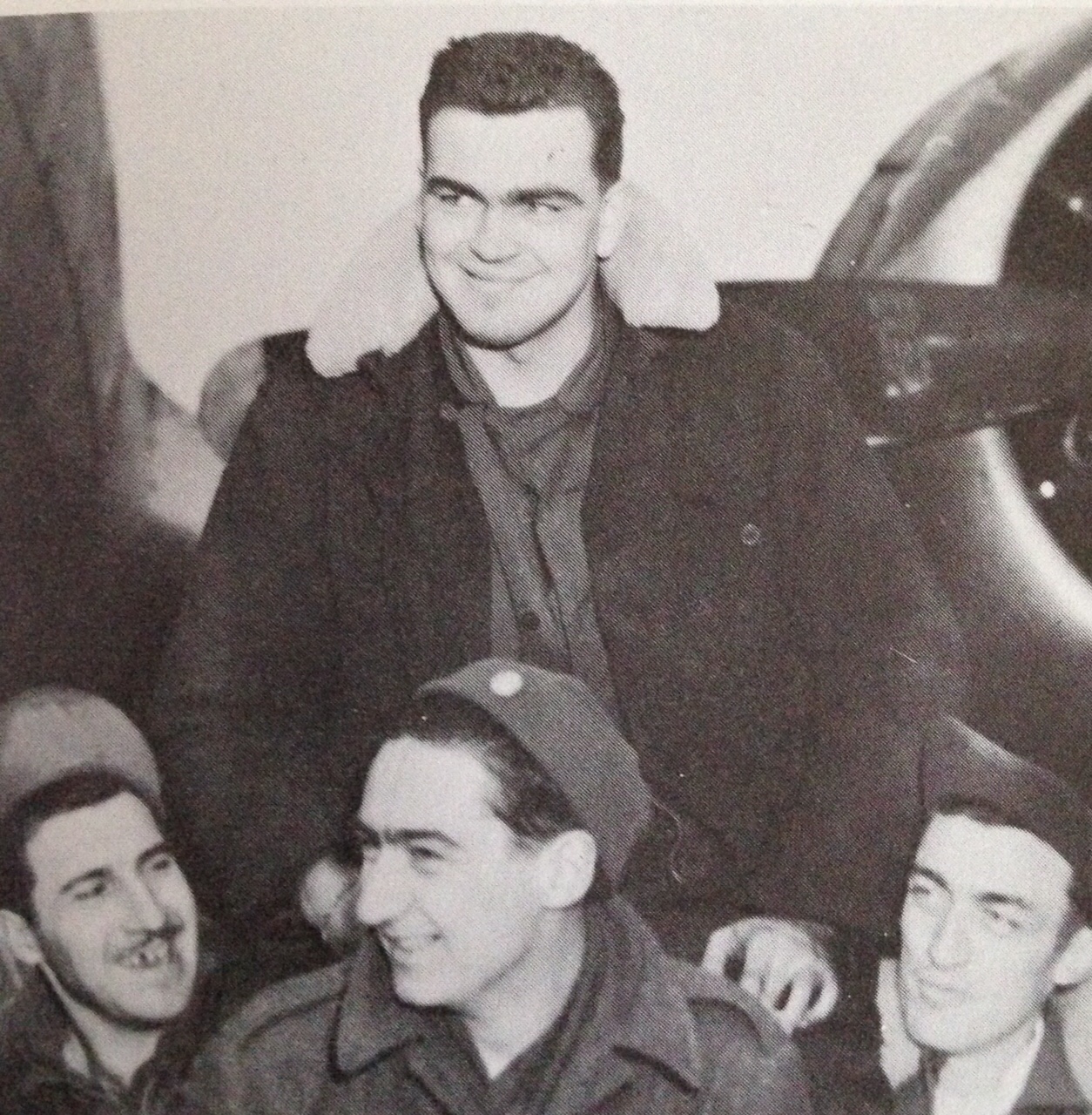
M/Sgt. Hewitt Dunn – Flew 104 missions.

RAF Framlingham (Parham) otherwise known as Station 153, achieved a remarkable record, or rather one man in particular did. His name was Hewitt Dunn, a Master Sergeant in the U.S.A.A.F and later the U.S.A.F.

Known as “Buck” he would achieve the remarkable record of completing 104 missions with the 390th Bombardment Group (Heavy) – a record that astounded many as life expectancy in a heavy bomber was short, and few survived beyond one tour of 30 missions.

Hewitt Tomlinson Dunn (s/n 13065206) was born on July 14th 1920. He progressed through school to join the Air Corps where he was assigned to the 390th Bombardment Group (Heavy), 13th Combat Wing, 3rd Air Division, Eighth Air Force, as a gunner in December 1943.

His first mission was with the 569th Bombardment Squadron in the following January. He completed his first gruelling tour of 30 missions by April that year, upon which he immediately applied for a further tour that he would complete by the summer of 1944. His attitude of ‘its not over until its won’, would see him accept a further remarkable third tour, virtually unheard of for a heavy bomber crew member.

On Friday, April 6th 1945, mission 930, an armada of aircraft of the U.S.A.A.F would strike at the marshalling yards in Leipzig, Germany. Inside B-17 #43-38663, ‘The Great McGinty‘, was Hewitt Dunn.

After the mission Dunn described how earlier at the morning briefing, he, like so many of his colleagues, had been a little ‘nervous’. Then, when the curtain was pulled back, their nervousness was justified, Leipzig – the 390th had been there before.

Many crews in that briefing would look to Dunn for signs of anguish, if he remained steady and relaxed, they knew it would be ‘easy’, if he sat forward, then it was going to be a difficult one. The atmosphere must have been tense.

Luckily, unlike other missions into the German heartland, this one turned out to be ‘just another mission’ a ‘milk run’. Much to the huge relief of those in command of the 390th, all aircraft returned safely.

On his arrival back at Framlingham, Dunn was greeted by cheering crowds, ground crews lifted him high in their air carrying him triumphantly away from his aircraft, it was a heroes welcome.

By the time the war had finished, Dunn had flown in 104 missions, he had been a tail gunner on twenty-six missions, twice a top-turret gunner, a waist gunner and the remainder as togglier (Bombardier). He had flown over Berlin nine times, he claimed a FW-190 shot down and had amassed an impressive array of medals for his bravery and actions, and all at just 24 years old.

Post war, he continued to fly as an Instructor Gunner for B-52s in the 328th Bomb Squadron, 93rd Strategic Bomb Wing, at Castle Air Force Base in California. Here he was described as “quiet and reserved” and never talked about his war experiences. He was “handsome man with black hair”, and only when he wore his dress uniform, did others realise how well decorated he was.

Dunn was considered a rock by those who knew him and perhaps immortal, but he was not, and on June 15th , 1961 after flying for a further 64 flights, he was killed. Details of his death are sketchy, but the man who had flown in more missions than any other person in the Eighth Air Force and had gone to train others in that very role, was highly decorated. He was looked up to and liked by those who knew him.

Following his death a service was held in Merced, California, his body was then taken to Arlington National Cemetery in Washington D.C. where he was finally laid to rest in grave number 3675, section 28.

For a man who achieved so much in his fighting career, little exists about him or his achievements. Maybe, by the end of the war, records were no longer needed, tales of dedication and bravery were no longer useful propaganda. Whatever the reason, Hewitt Dunn’s name should be heavily embossed in the history books of the Second World War.

hewiit-dunn

Hewitt Dunn on return from his 100th mission, April 1945 (IWM)

Hewitt Dunn’s medal tally:

– Air Force Longevity Service Award with 3 oak leaf clusters
– Air Medal with 13 oak leaf clusters (2 silver, 3 bronze)
– Air Medal with 7 oak leaf clusters (1 silver, 2 bronze)
– American Campaign Medal
– Distinguished Flying Cross with 1 oak leaf cluster
– Good Conduct Medal
– National Defence Service Medal
– Silver Star
– World War II Victory Medal
– European-African-Middle Eastern Campaign Medal with 1 bronze star
– European-African-Middle Eastern Campaign Medal with 1 silver star

Hewitt Dunn’s story is one of many featured in Heroic Tales.

Lt. Col. Leon Vance 489th BG – Medal of Honour.

Leon vance.jpgThe story of Leon Vance is one of  the saddest stories to emerge from the Second World War. He was a young American, who through his bravery and dedication, saved the lives of his colleagues and prevented their heavily stricken aircraft from crashing into populated areas of southern England. Following a mission over France, his was very severely injured, but miraculously fought on.

Leon Robert Vance, Jr. known as ‘Bob’ to his family and friends, was born in Enid, Oklahoma, on August 11th, 1916. He graduated from high school in 1933 after receiving many honours and being singled out as a high performing athlete. He went on, after University, to the prestigious Training College at West Point in 1935, staying until his graduation four years later in 1939. It was here, at West Point, he would meet and marry his wife Georgette Brown. He and Georgette would later have a daughter, after whom Vance would name his own aircraft ‘The Sharon D’.

Vance would become an aircrew instructor, and would have various postings around the United States. He became great friends with a Texan, Lieutenant Horace S. Carswell, with whom he would leave the Air Corps training program to fly combat missions in B-24 Liberators. They became great friends but would go on to fight in different theatres.

Prior to receiving his posting, Vance undertook training on Consolidated B-24s. Then, in October 1943, as a Lieutenant Colonel, he was posted to Europe with the newly formed 489th Bombardment Group (Heavy), as the Deputy Group Commander. One of the last groups to be assigned to the European theatre, they formed part of the 95th Combat Bombardment Wing (2nd Bomb Division),  Eighth Air Force, and were sent to RAF Halesworth (RAF Holton) designated Station 365 by the USAAF.

The group left their initial base at Wendover Field, Utah in April / May 1944 and their first mission would be that same month on May 30th, 1944, as part of a combined attack on communication sites, rail yards and airfields. A total of 364 B-24s were to attack the Luftwaffe bases at Oldenburg, Rotenburg and Zwischenahn, along with other targets of opportunity far to the north in the German homeland. With only 1 aircraft lost and 38 damaged, it was considered a success and a good start to the 489th’s campaign.

As the build up to Normandy developed, Vance and the 489th would be assigned to bombing targets in northern France in support of the Normandy invasion about to take place further to the south. An area the unit would concentrate on, prior to the Allied beach invasion on June 6th that year.

The day before D-day, the 489th would fly to Wimereaux, in the Pas-de-Calais region of northern France. This would be Leon Vance’s final mission.

File:846bs-b24-42-94860--halesworth.jpg

B-24H Liberator of the 489thBG, RAF Halesworth*2

The group, (Mission 392),  consisted of 423 B-17s and 203 B-24s and were to hit German coastal defences including: Le Havre, Caen, Boulogne and Cherbourg areas as  a precursor to the Normandy invasion. Some 127 P-47s and 245 P-51s would support the attacks. The 489th would assemble at 22,500 feet on the morning of June 5th, proceed to the south of Wimereaux, fly over dropping their payload, and then return to England. On the run in to the target, Vance was stationed behind the pilot and copilot.  The lead plane encountered a problem and bombs failed to jettison. Vance ordered a second run, and it was on this run that his plane, Missouri Sue, took several devastating hits.

Four of the crew members, including the pilot were killed and Vance himself was severely injured. His foot became lodged in the metal work behind the co-pilots seat. There were frantic calls over the intercom and the situation looked bad for those remaining on board. To further exacerbate the problems, one of the 500lb bombs had remained inside the bomb bay armed and in a deadly state, three of the four engines were disabled, and fuel spewed from ruptured lines inside the fuselage.

Losing height rapidly, the co-pilot put the aircraft into a dive to increase airspeed. The radio operator, placed a makeshift tourniquet around Vance’s leg, and the fourth engine was feathered.  They would then glide toward the English coast.

The aircraft was too damaged to control safely, so once over English soil, Vance ordered those who could, to bail out. He then turned the aircraft himself out to the English Channel to attempt a belly landing on the water. A dangerous operation in any aircraft, let alone a heavy bomber with an armed bomb and no power.

Still trapped by the remains of his foot, laying on the floor and using only aileron and elevators, he ensured the remaining crew left before the aircraft struck the sea. The impact caused the upper turret to collapse, effectively trapping Vance inside the cockpit. By sheer luck, an explosion occurred that threw Vance out of the sinking wreckage,  his foot now severed.  He remained in the sea searching for whom he believed to be the radio operator, until picked up by the RAF’s Air Sea Rescue units.

Vance was alive, but severely injured. He would spend a number of weeks, recuperating in hospital, writing home and gradually regaining his strength. Disappointed that his flying career was over, he looked forward to seeing his wife and young child once more. However, on a recuperation trip to London, Vance met a young boy, who innocently, and without thought, told him he wouldn’t miss his foot. The emotional, impact of this comment was devastating to Vance and he fell into depression. Then, news of his father’s death pushed him down even further.

Eventually, on July 26th, 1944 Vance was given the all clear to return home and he joined other wounded troops on-board a C-54, bound for the US. It was never to arrive there.

The aircraft disappeared somewhere between Iceland and Newfoundland. It has never been found nor has the body of Leon Vance or any of the others on board that day. Vance’s recommendations for the Medal of Honour came through in the following  January (4th), but at the request of his wife, was delayed until October 11th 1946, so his daughter could be presented the medal in her father’s name.

The citation for Leon Vance reads:

For conspicuous gallantry and intrepidity above and beyond the call of duty on 5 June 1944, when he led a Heavy Bombardment Group, in an attack against defended enemy coastal positions in the vicinity of Wimereaux, France. Approaching the target, his aircraft was hit repeatedly by antiaircraft fire which seriously crippled the ship, killed the pilot, and wounded several members of the crew, including Lt. Col. Vance, whose right foot was practically severed. In spite of his injury, and with 3 engines lost to the flak, he led his formation over the target, bombing it successfully. After applying a tourniquet to his leg with the aid of the radar operator, Lt. Col. Vance, realizing that the ship was approaching a stall altitude with the 1 remaining engine failing, struggled to a semi-upright position beside the copilot and took over control of the ship. Cutting the power and feathering the last engine he put the aircraft in glide sufficiently steep to maintain his airspeed. Gradually losing altitude, he at last reached the English coast, whereupon he ordered all members of the crew to bail out as he knew they would all safely make land. But he received a message over the interphone system which led him to believe 1 of the crew members was unable to jump due to injuries; so he made the decision to ditch the ship in the channel, thereby giving this man a chance for life. To add further to the danger of ditching the ship in his crippled condition, there was a 500-pound bomb hung up in the bomb bay. Unable to climb into the seat vacated by the copilot, since his foot, hanging on to his leg by a few tendons, had become lodged behind the copilot’s seat, he nevertheless made a successful ditching while lying on the floor using only aileron and elevators for control and the side window of the cockpit for visual reference. On coming to rest in the water the aircraft commenced to sink rapidly with Lt. Col. Vance pinned in the cockpit by the upper turret which had crashed in during the landing. As it was settling beneath the waves an explosion occurred which threw Lt. Col. Vance clear of the wreckage. After clinging to a piece of floating wreckage until he could muster enough strength to inflate his life vest he began searching for the crew member whom he believed to be aboard. Failing to find anyone he began swimming and was found approximately 50 minutes later by an Air-Sea Rescue craft. By his extraordinary flying skill and gallant leadership, despite his grave injury, Lt. Col. Vance led his formation to a successful bombing of the assigned target and returned the crew to a point where they could bail out with safety. His gallant and valorous decision to ditch the aircraft in order to give the crew member he believed to be aboard a chance for life exemplifies the highest traditions of the U.S. Armed Forces”*2

Leon Vance’s actions would be remembered. His local base in Oklahoma was renamed ‘Vance Air Force Base’ on July 9th, 1949. The gate at Tinker Air Force Base, Oklahoma was also later named after him on May 9th, 1997, and his name appears on the ‘Wall of the Missing’ at Madingley American War Cemetery in Cambridge, England.

DSC_0582

The American War Cemetery, Madingley. Leon Vance’s Name Appears on the wall of the missing (to the left of the picture).

Leon Robert Vance, Jr. (August 11th, 1916 – July 26th, 1944)

For other personal tales, see the Heroic Tales Page.

Sources.

* Photo public domain via Wikipedia

*1 “Medal of Honor recipients – website World War II”.

*2 Photo Public Domain via Wikipedia.

B-17 Pilot 1st Lt.D. J. Gott and 2nd. Lt W. E. Metzger

War makes men do terrible things to their fellow mankind. But through all the horror and sometimes insurmountable odds, courage and bravery shine through. Two gallant young men both in the same B-17 were awarded the Medal of Honour for acts of extreme bravery in the face of certain death.

Born on 3 June  1923, Arnett. Oklahoma, Donald Joseph Gott, began his air force career at the local base in 1943. By the end of the first year he had achieved the rank of First Lieutenant in the US Army Air Corps. Posted with the 729th. Bomber Squadron, 452nd Bombardment Group to Deopham Green, Norfolk, England, he was to fly a B-17 (42-97904) ‘Lady Jeannette’ along with his crew and co-pilot  William E. Metzger.

Metzger was born February  9, 1922 – Lima, Ohio and by the time he was 22 he was a 2nd Lieutenant. He was to meet Gott at Deopham Green, Norfolk and together they would fly a number of missions over occupied Europe bombing strategic targets.

On the 9th November 1944, they took off with their crew on a mission that would take them into the German heartland to bomb the marshalling yards at Saarbrucken.

On this run, the aircraft, was badly hit by flak, three of the engines caught fire and were inoperable, the fires were so fierce that they were reaching the tail of the stricken aircraft.

Further fires within the fuselage started when flares were ignited, and this rapidly caught a hold. Hydraulic lines were severed and the liquid from within was jettisoned onto the burning fuselage.  With communication lines cut and unable to contact the crew, both Gott and Metzger had some difficult decisions to make. They had not yet reached the target, the aircraft still held its bomb load and they were deep into occupied territory.

The crew too had suffered badly at the hands of the anti-aircraft fire. The engineer was wounded in the leg and the radio operators  arm was severed below the elbow causing great pain and loss of blood. He would die very quickly if medical help was not found. Despite the quick thinking and application of  tourniquet by fellow crew members, he soon passed out and fell unconscious.

Gott and Metzger decided that jettisoning the injured radio operator  would not result in his receiving medical help and so they would drop the bombs and head for the nearest friendly territory where they could crash-land. Doing this, would risk not only the life of the operator, but that of the crew and themselves should the stricken aircraft explode.

Over the target, they released their bombs and flew alone toward allied territory. Flying low over the village of Hattonville, the aircraft was seen to swerve avoiding a church and homes. At this point, Metzger personally crawled through the aircraft and instructed the crew to bail out. Three chutes were seen by local people, two fell to earth and the third became entangled on the stabiliser and was trapped. A further three were seen moments later, all these escaped. Metzger decided to remain with Gott and try to land the aircraft with the radio operator on board. With only one working engine, Gott and Metzger brought the aircraft down through a series of tight turns and at only 100 feet from safety the aircraft banked and exploded. Crashing to earth it again suffered a second explosion and disintegrated killing all three crew members on board and the crew member still attached to the tail.

1st Lieutenant Gott and his co-pilot 2nd Lieutenant Metzger had shown great courage and determination to complete their mission, and to save their crew from certain death. They had shown the greatest of  valour in what was to be the final act of their short lives.

Both men were killed on that day, November 4th 1944 aged 21 and 22 respectively. They were both posthumously awarded the Medal of Honour on the 16th May 1945.

Gott’s remains were returned to the United States and he was buried at the Harmon Cemetery, in Harmon, Ellis County, Oklahoma, USA. Metzger, was returned to his home town and was buried at Woodlawn Cemetery, Lima, Ohio.

Along with Gott and Metzger, crew members who did not survive were:  T/Sgt Robert A, Dunlap and S/Sgt T.G. Herman B, Krimminger. The survivors were picked up by a a local field hospital and treated for their injuries: 2nd lt John A, Harland ; 2nd lt Joseph F, Harms ; S/Sgt B.T. James O, Fross ; S/Sgt R.W. William R, Robbins and T/Sg T.T. Russell W Gustafson.

A memorial now stands close to the site of the crash site.

metzger

2nd Lieutenant William Metzger (@IWM UPL 16264)

gott

1st Lieutenant Donald Gott (@IWM UPL 16265)


Secrets Of The (Not So) Deep.

By Mitch Peeke.

This latest chapter in the story of B17 44-6133, which crashed in shallow water at Allhallows, Kent, in June of 1944, came about during a visit I made to The Kent Battle Of Britain Museum at Hawkinge; which ordinarily, is not perhaps the sort of of venue one might expect to find anything related to The Mighty Eighth.

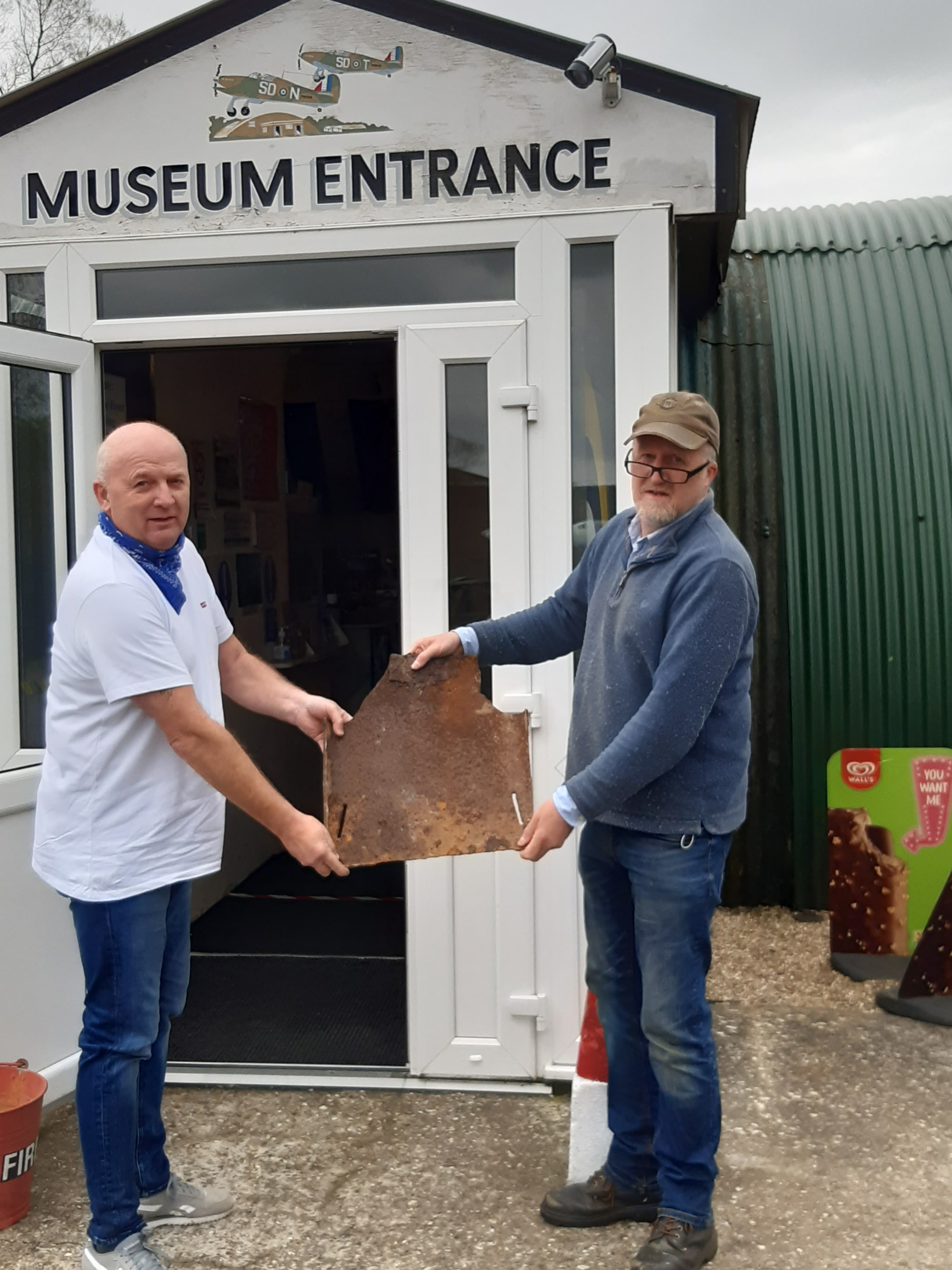
I have been to this excellent museum a few times. They very graciously stocked the promotional leaflets for my own Battle Of Britain E-Book; 1940: The Battles To Stop Hitler when it came out in 2015. Four years later, in the Summer of 2019, I had organized the creation of a memorial at Allhallows, commemorating the lost crew of B17 44-6133 and later that same Summer, there I was, talking to Dave Brocklehurst MBE, Curator of the museum at Hawkinge, about my project, the memorial day we’d just held there and how there was going to be a new museum at nearby Slough Fort, which would include a display relating to the crash. The Fort has a small piece of wreckage from the B17 that had washed up on the beach front at Allhallows. It was then that Dave told me that he also had a genuine piece of that B17 in storage and he offered it to me, for inclusion in the Fort’s display. It is a fair-sized but broken piece of armour plate, thought to be a section of armour from either of the Pilots’ chairs, though Dave was by no means certain of that. We arranged for him to retrieve it from his storage section and for me to return to the museum to collect it. Then came the Covid pandemic of course!

Successive lockdowns meant I couldn’t collect it. Dave was kept extremely busy, not only with the general upkeep but also the museum’s newest acquisition; a Spanish-built Heinkel 111 that had been used in the 1969 film The Battle Of Britain, which of course had seen Hawkinge used as a filming location. Each time we made our arrangements, another lockdown put paid to our plans, then finally, we were able to make a definite date, in May of 2021, nearly two years after first discussing the idea, for me to collect the B17 artefact.

Dave Brocklehurst MBE, (right) Curator of The Kent Battle Of Britain Museum at Hawkinge, Presents Mitch Peeke with the salvaged armour plate. (Photo: Mitch Peeke.)

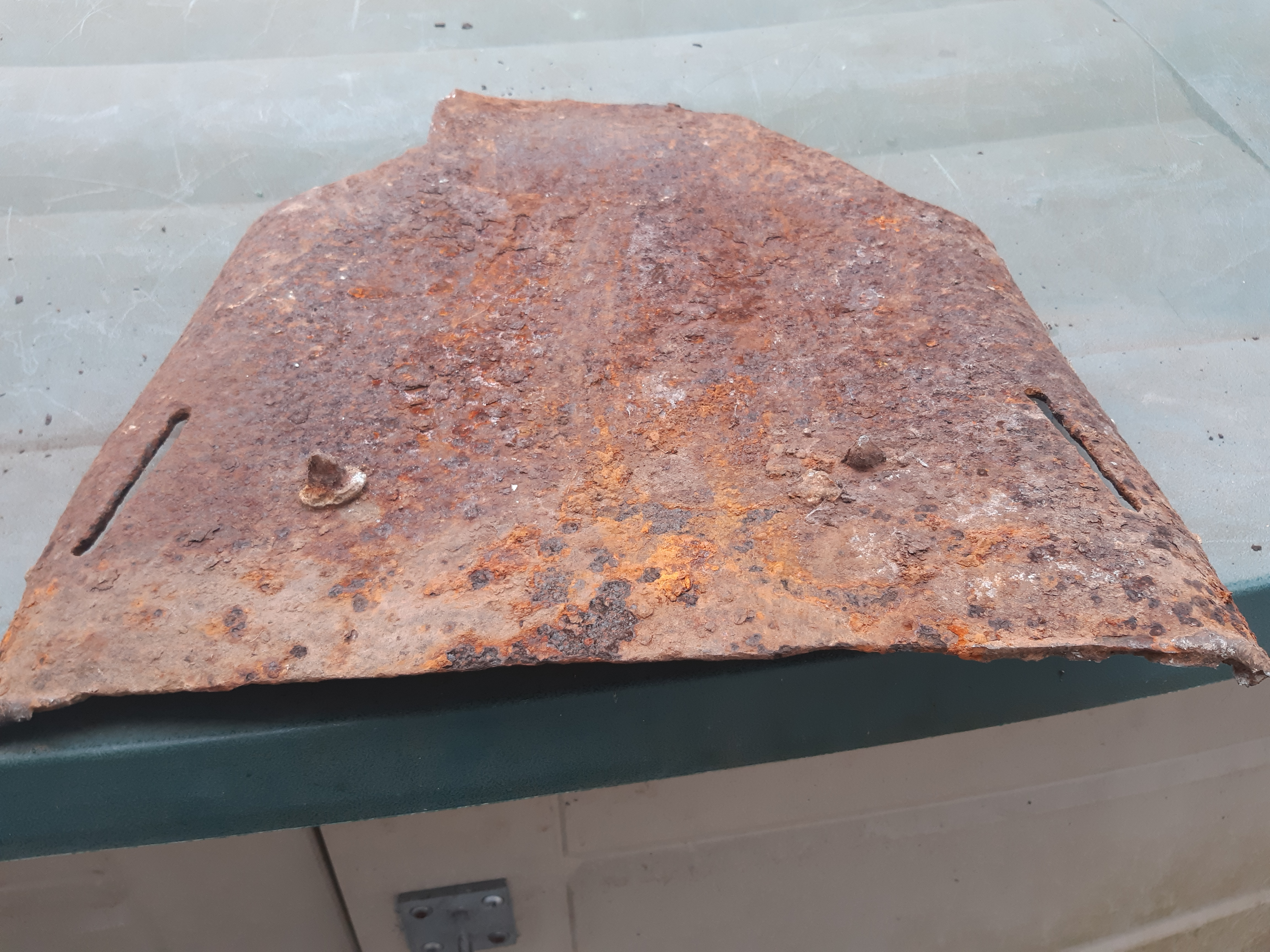
The first thing that struck me when Dave handed the plate to me, was the sheer weight of it. The plate measures a mere 17 by 19 inches. It is a quarter of an inch thick, but it weighs an incredible 22.6 pounds: 10 kg. No wonder Dave told me not to come to collect it on my Harley! I used my wife’s SUV instead.

Once I got it safely home, I photographed it from several angles and set about the task of trying to positively identify it. To that end, I emailed the Museum of aviation at Robins Air Force Base in America, as they are currently in the process of restoring a B17 to its former glory. Their Curator, a former US Air Force officer by the name of Arthur Sullivan, replied to my enquiry with 24 hours, expressing a great interest in the the plate and the story behind it. Despite casting their expert eyes over the photos I sent them, we are still not 100% certain; but it would seem likely, given its curved edges and obvious mounting bolts underneath, that it is seat base armour from either of the Pilot’s seats; the two angled slots most likely to have been for the lap straps to pass through.

Underside of the plate, showing the mounting bolts and possible Lap Strap slots. (Photo: Mitch Peeke.)

The plate was salvaged from the wreck site, a muddy, watery crater some 500 yards off the beach at Allhallows, in the late 1970’s. By then, some nefarious low tide salvage attempts had already been made, most notably by slightly drunk members of the Allhallows Yacht Club. One such foray had resulted in the Police being called to the club when the returning “Trophy Hunters” had brought a quantity of .50 caliber machine gun bullets back with them and decided to try “firing” them from a vice on a workbench, using a hammer and the pointed end of a six inch nail. Luckily for those concerned, the bullets had deteriorated to such an extent after laying on the muddy bottom of the Thames Estuary for 32 years, that they merely fizzled and smoked. The Police confiscated them. The Trophy Hunters had also retrieved one of the bombers Browning machine guns, probably one of the waist guns, but that had been hidden from the Police. That gun was apparently later taken apart and smuggled into Canada. To discourage any further foolhardy amateur salvage operations, the Royal Engineers were called in to demolish the wreck with explosives. Nobody seemed to consider the possibility of that wreck being a War Grave. The body of Staff Sergeant Cecil Tognazzini, the bomber’s Flight Engineer/Top Turret Gunner, has never been found. He is the only member of 44-6133’s crew who is still unaccounted for.

Today, the crater is still visible at low tide, as are the fragmented remains of the B17. The tidal mud holds a lot of the wreckage in suspension, so every now and again, more of it becomes visible, sticking up out of the muddy floor of the crater, when the tide goes out. Tempting though it still is for some to venture out there, the oozing mud makes such an expedition a dangerously foolish pursuit. Letting that sleeping B17 rest in peace is a far more noble and worthy aim.

In the meantime, we do now have two tangible pieces of 44-6133; one is the small piece of wreckage that washed ashore in 2017 and the other is the newly re-discovered armour plate. Both are now on display in the Slough Fort Museum. Thanks to Jeanne Cronis-Campbell, we also now have photographs of some of 44-6133’s young crew, taken by her late Father, Teddy; who was the plane’s Bombardier and the sole survivor of 6133’s crew, which I added to the memorial last year. And of course, we finally have that permanent memorial to those men, overlooking the place where they fell. We will, remember them.

My thanks to Mitch for the update.

The full story of 44-6133 can be found in ‘A Long way from Home‘,

Help Wanted – RAF King’s Cliffe!

In 2014, I published Trail 6 – ‘American Ghosts’ a trail around six American bases from the Second World War, one of these, RAF King’s Cliffe, was, at the time, under threat of development.

In 2015, objections from over 300 people were received which included supporters of Glenn Miller, aviation enthusiasts, wildlife groups and local people alike, who all highlighted concerns over the proposed development of the site and the impact it may have.

At an initial meeting in September that year, the council failed to come to any overall decision as they needed to consider further reports from different interested parties.  At a second meeting held on Wednesday 14th October,  after considering all the issues raised, East Northamptonshire Council approved the plans and so planning for 55 holiday homes were passed on an area known as Jack’s Green.

This area includes a memorial to the late Glenn Miller, who performed his last ever hangar concert here at King’s Cliffe before being lost over the sea. Assurances from the land owner at that time, were that the development would be in keeping with the area and that the memorial would remain “exactly as it was”.

I have not been able to return to Jack’s Green, nor King’s Cliffe airfield to see how this development has affected the area, and was wanting to know if anyone had photos of the development taken since the development started or more so, in the years following. As it would directly affect the memorial and adjoining public footpath, I was interested in the Jack’s Green area especially. I know that many geocachers use this path as do horse riders, walkers and enthusiasts alike, and am hoping someone may have a small collection of photos I could see.

Any photos you are willing to share would be very much appreciated.

My sincere thanks.

Andy

Links

The BBC report can be accessed here.

RAF King’s Cliffe was visited in Trail 6

Previous reports can be found here.

Glenn Miller Memorial RAF Kings Cliffe Dec 2014

Glenn Miller Memorial RAF Kings Cliffe Dec 2014

RAF Watton – The origins of ECM (Part 2)

In part 1 we saw how Watton had been built as a pre-war expansion period airfield and how the Blenheims that were stationed here were decimated in the face of a superior enemy. Eventually begin withdrawn, they were simply outclassed.

Eventually, the airfield like so many in this area, was handed over to the Americans. It was re-designated and would take on a different role. Watton would now grow and develop.

The USAAF renamed the airfield Station 376, they redeveloped the accommodation blocks, added more hardstands and laid a steel mat runway. The original hangars were added to so that there were now not only the original ‘C’ types, but also the more modern ‘B1’ and ‘T2’ types, along with three smaller blisters hangars. In 1944, the steel matting was removed and a concrete runway built in its place. The airfield’s history would now become a little more complex as it officially became two sites utilising the same single runway.

The main airfield itself would house aircraft of the 802nd Reconnaissance Group (Provisional), who were later renamed the 25th Bomb Group (Reconnaissance). Whilst on the southern edge of the site, a new complex was built for the repair and refurbishment depot the 3rd Strategic Air Depot (SAD). This complex grew so large that it became a site in its own right, gaining the designation Neaton (Station 505). The name has been somewhat confusing however, as the site was actually closer to the village of Griston that it was to Neaton.

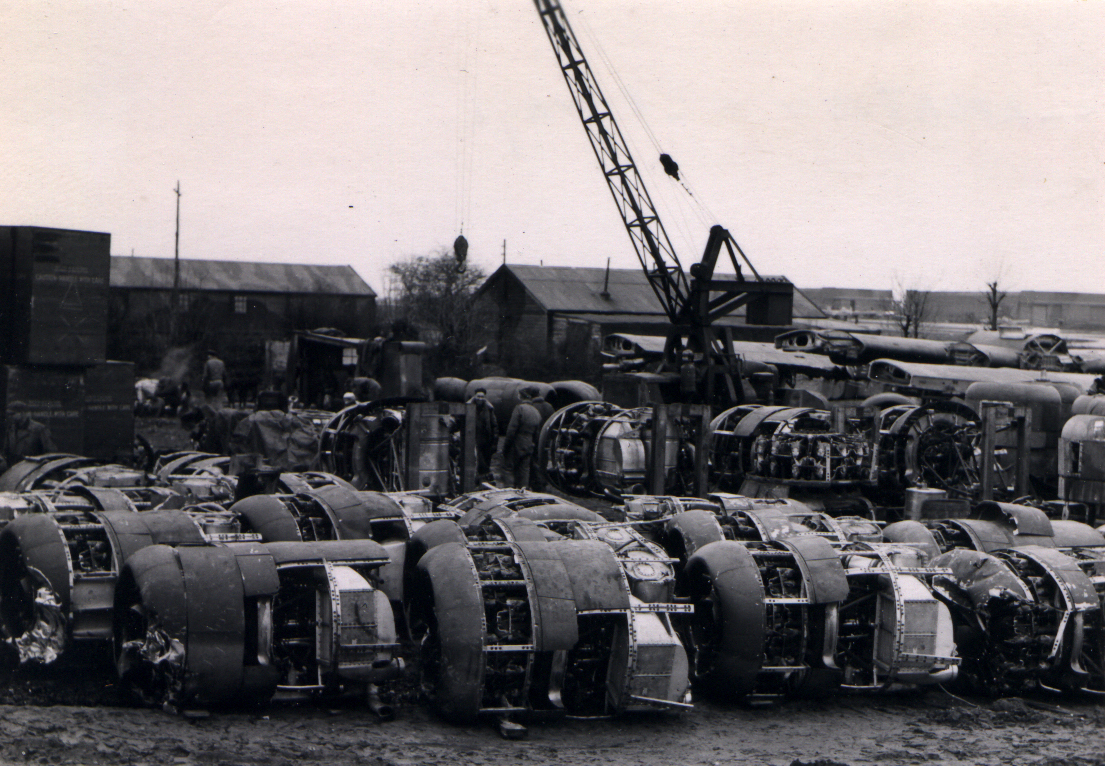
A collection of B-24 engines removed from their mounts. (IWM UPL 5385)

The role of the 3rd SAD was to maintain and repair the battle damaged B-24s of the 2nd Air Division, that had by now, flooded into the UK from the United States. This unenviable task required the recovery of the heavy bombers, washing them out and  perhaps removing the remains of airmen before returning them to flyable condition once more. Whilst not designed to be so, the acronym SAD certainly reflected the role perfectly.

Neaton consisted of a number of sites, 4 accommodation sites, a communal site, a sick quarters, two motor sites, a ‘miscellaneous’ site housing a Steam Jenny and then a 9AD site with tool sheds and other maintenance related buildings. The majority of these accommodation sites incorporated either the more common Laing or Nissen huts.

Watton itself would now become synonymous with reconnaissance, surveillance and electronic countermeasures (ECM). A new unit, 25th Bomb Group (Reconnaissance), it was constituted on 17th July 1944, and activated in England on 9th August that year. They would only serve from one UK airfield, that of Watton, where they would stay until VE day serving under the umbrella of the 8th Air Force. A visit by the famous ‘Carpetbaggers‘ (the special operations group designed to support French resistance operations) also saw the black Liberator’s fly regular missions from here during this time.

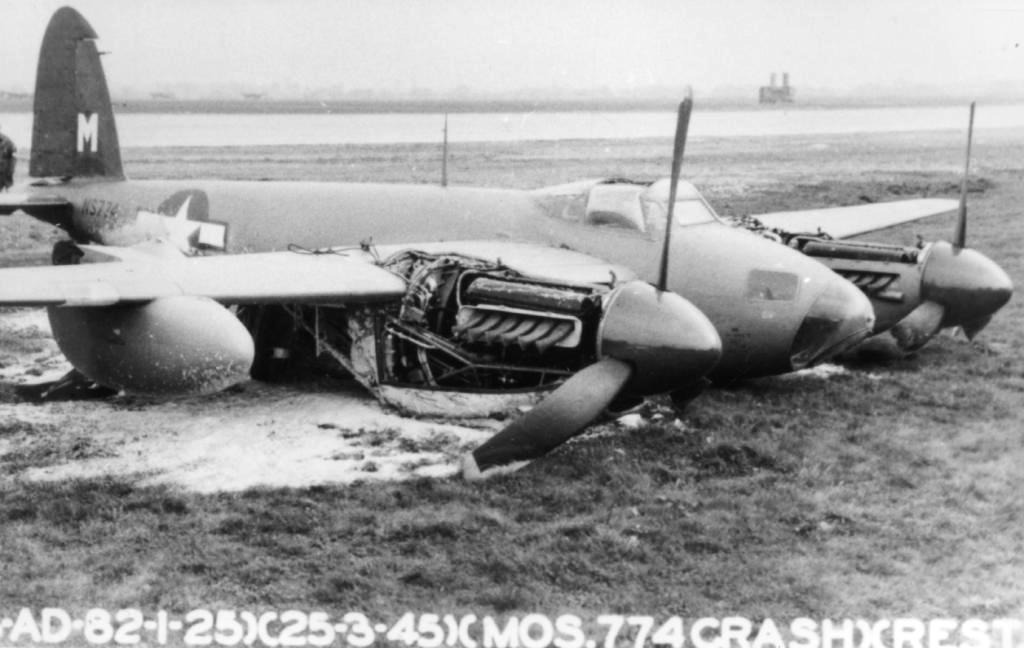
The end of Mosquito PR Mk XVI “M” NS774 of the 25th BG after crashing at RAF Watton (Station 376) 25th March 1943. (IWM UPL 6964)

The role of the Watton Group was to carryout reconnaissance missions over the seas around Britain and the Azores, gathering meteorological data. Combined with flights over the continent, the information they would gather, would help in the preparation of bombing missions. They would also carryout aerial mapping and photo reconnaissance missions, identifying German troop movements both at night and during the day.  Many of these operations involved major battles, including northern France, the Rhineland and the Ardennes. Additional tasks included electronic countermeasures using ‘chaff’, and flying ahead of large formations to ascertain last minute weather reports. A varied and dangerous collections of roles, they used a number of aircraft types including: B-17s, B-24s, B-25s, B-26s and P-38 Lightnings.

When VE day did finally arrive, the American unit departed returning to Drew Field in Florida. The August of that year must have been quite surreal, as the Americans left, flying was reduced and Watton was returned back to RAF ownership.

With the war now over, flying units began to return to the UK, many being disbanded not long after. One such unit was 527 Sqn who arrived here in the November, only to be disbanded in the April of 1946.

The next four years saw no other front line ‘operational’ flying units here at Watton, but the 1950s would bring a number of units back through its gates. With the introduction of the jet engine at the end of the war, piston engines fighters were soon being replaced by newer designs.

RAF Watton

One of Watton’s many accommodation blocks in modern use.

The ECM activity initiated at Watton by the 25th Bomb Group, would continue on in these early post-war years. For some twenty years or so in fact, through a variety of aircraft including: the Mosquito, Wellington, Domine, Lincoln, Anson, Proctor, Canberra, Meteor, Sea Fury, Firefly, Venom and many others. Each of these would not only play a vital part in the development and use of ECM, but radio research and training as well. Warfare had taken on a very new twist.

This move would see Watton becoming a hub for ECM activity. A number of RAF and Naval squadrons would operate from here undertaking such tasks. At the end of the war, Watton had become home to the Radio Warfare Establishment (RWE), renamed in 1946 to  the Central Signals Establishment (CSE). It was only one of five such units operating jointly between the military and National Air Traffic Services Organisation (NATS).  The Navy and RAF would jointly use Watton at this time, albeit for only a short period of time between March and September 1947, when the Naval Air Warfare Radio Unit moved in under the disguise of 751 NAS.

The role of the CSE was very complex, for too complex to discuss here, but with a number of squadrons operating under different roles whilst at Watton, it would culminate in 1948 in the forming of three un-numbered units: a Signals Research Squadron, a Monitoring Squadron and a Radio Countermeasures (RCM) Squadron. In essence, their role was to monitor and jam Soviet electronic communications and defence systems – it was an total airborne electronic warfare operation.*1

But the use of un-numbered squadrons was short lived, by the end of the decade the CSE had reverted to using numbered squadrons once more, their role to probe the air defences along the Soviet borders. British aircraft combined with ground stations, would monitor the reaction and activity of Soviet communications, seeing how they responded to intrusions into their airspace. By knowing this detail,  countermeasures could be put in place to jam or scramble these communications, ideally rendering them useless or at least temporarily incapacitated. The first of these numbered squadrons were 192 and 199, who were originally  the calibration and training units of the CSE.

Reformed here in July 1951 flying Mosquitoes, Lincoln B.2s and then the enormous Washington (B-29), 192 Sqn would not receive their first jet until January 1953 when the Canberra B.2 arrived. 192 Sqn would also fly the Varsity and the Comet C.2 before being disbanded and renumbered as 51 Sqn in August 1958.

199 Squadron (reformed on the same day) flew both the Lincoln B.2 and the Mosquito NF.36, in the same role as 192; their stay lasting until April 1952, at which point they moved to Hemswell in Lincolnshire where they picked up their first jet engined aircraft.

The August of 1952 saw a number of other units reform, disband or pass through Watton. 116 Sqn were reformed on the 1st, another ex Calibration flight of the CSE, it stayed until August 1958 when it was disbanded and reformed as 115 Sqn. A battle hardened squadron from Bomber Command, they had since themselves been disbanded. No longer flying operational bombers, the Varsitys 115 Sqn would operate would be the new form of transport, as they were reformed and moved on within days of their inception in that August.

On that same day in late August 1958, 245 Sqn would reform, also from the renumbering of another squadron – 527 Sqn. Flying Canberras they too were gone within days of their reformation.

As 1959 began to close and 1960 dawned, Watton would become the home of a new unit, 263 Sqn, who were operating Bloodhound missiles, the RAF’s ground to air missile used to defend Britain’s airfield against attacking aircraft. The operational use of these giant weapons lasted here until June 1963.

The 1960s saw the last of the flyers, lasting only between January 1962 and May 1963, 151 Sqn operated from here as the Signals Development Squadron, bringing back the props of the Hastings, Lincoln and Varsity before being renumbered again and subsequently disbanded.

Other units at Watton included 97 Sqn from 1963 – 1967; 98 Sqn (1/10/63 – 17/4/69), 360 Sqn (1/10/63 – 17/4/69) and 361 Sqn (2/1/67 – 14/7/67) two of which were both reformed and disbanded at Watton.

As can be expected, there were a large number of subsidiary and support units based at Watton, many of these attached to the Radio Warfare Establishment, along with SAM Training units, a range of flight units and other various regiments.

RAF Watton

Part of the disused Eastern Radar complex.

By the 1970s all flying had ceased leaving Eastern, and latterly Border Radar, the only ‘operational’ activity on the site. Eventually of course, even these were moved in the early 1990s, signalling the demise of the airfield as an active base. Watton was then handed over to the British Army.

A few years later the Army also reduced it use of Watton and the accommodation areas were sold off for private housing; a move that helped retain that airfield ‘feel’ that it still maintains today. More of the site was then sold later and new housing estates were built on the land where this previously stood; the entire feel of this has now since gone, replaced instead by a rabbit warren of roads with boxes for houses. The last remaining parts of the main airfield were sold off in 2012, the runway and peri-track being retained by the farmer and used for agricultural purposes.

Neaton too was sold off and has now been replaced by HMP Wayland, a prison holding category ‘C’ prisoners at her majesty’s pleasure.  One gruesome part of history being replaced by another.

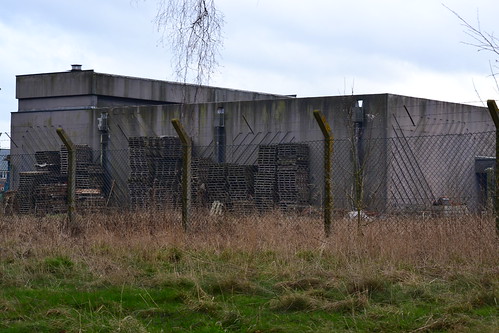
Today, the perimeter tracks, runways and hard standings support nothing more than housing. A proportion of the perimeter track remains with a small wire fence being the only defence to the continued onslaught of development. The original 4 “C” type hangars were all demolished as were the two control towers, one of which was built to support the new jet-era. Some minor buildings continue to remain surrounded by the original RAF housing, but these are few and far between, and even their future is uncertain.

Almost as lip service, many roads are named after an aircraft, Liberator, Marauder, etc., those aircraft synonymous with the operations of Watton and Neaton. Various concrete remains poke through the undergrowth and make this part of the site rather untidy. How long is it before they too disappear?

The site is split by the main road with some of the former administration buildings remaining on one side with the airfield and accommodation on the other. Some of these buildings are still in use with civilian operators and as such, have been well-preserved; others such as the technical site, have not been so fortunate and have become very rundown and in high states of disrepair.

RAF Watton

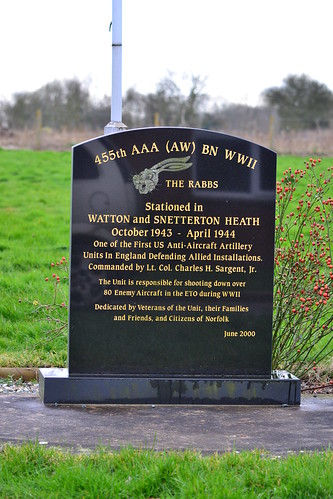
Memorial to the 455th AAA ‘The Rabbs’ located on the airfield site.

As for the airfield itself, two small memorials ‘guard’ the entrance to the new development. On the one side is the bent propeller recovered from a crashed Blenheim (R3800) shot down in the loss of eleven aircraft over Aalborg on 13th August 1940; on the other side a memorial that commemorates the 25th Bomb group USAAF. On the original housing site itself, a further memorial commemorates the 455th AAA ‘The Rabbs‘ who were given the task of defending Britain’s airfields against the Luftwaffe.  Owned by Stanford Training Area (STANTA) for a period of time and used for air mobile training, the odd Hercules or Army helicopter might have been seen here. However, this has now ceased and housing is creeping ever closer. I’m sure it won’t be long before many of these remaining remnants are lost to the developer’s digger.

Sources and Further Reading.

*1 Flintham, V., “High Stakes: Britain’s Air Arms in Action 1945-1990Pen and Sword, Oct 2008.

National Archives AIR 27/263/1: AIR 27/263/2

A website dedicated to RAF Watton has an extensive range of personal stories and information about life at Watton. It also has a video of the retrieval of Blenheim R3821 being recovered from Aalborg airport.

Further Pictures of the remains at these sites can be seen on Flckr.

NB: There is a museum commemorating the lives of the Watton personnel, open on limited days only, details can be found on their website.

Watton can be found on Trail 9.

Brigadier General Frederick W. Castle – Heartbreak on Christmas Eve, 1944

On the morning of December 24th, 1944, Brigadier General  Frederick W. Castle (s/n 0-319375), woke to the greet the day, and like most pilots facing perilous missions, he probably wondered if it would be his last. However, knowing what I know about Castle from my research, he was a calm, confident and highly competent pilot, so most likely he had every reason to believe in the success of his next mission. Sadly though, that was not to be the case. Castle never made it back that night. On Christmas Eve of 1944, this brave pilot lost his 30th and final battle.

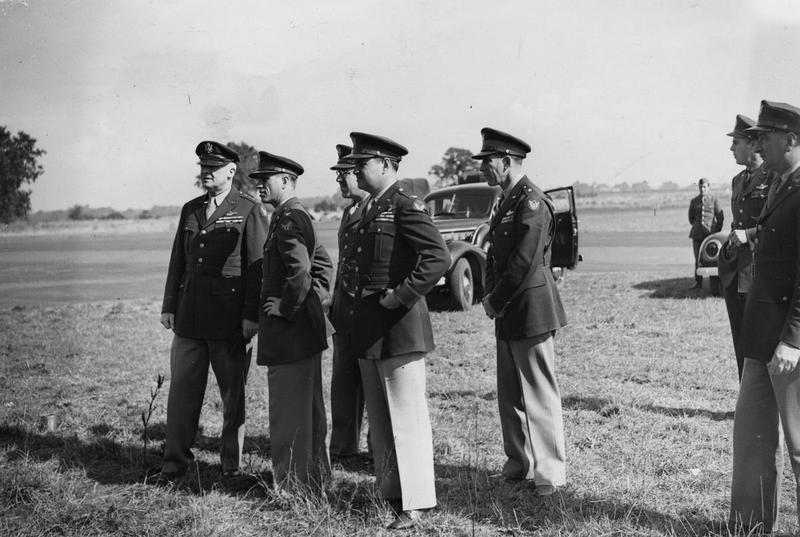
Lieutenant Colonel Elliott Vandevanter of the 385th Bomb Group with Colonel Frederick W Castle (centre) of the 487th Bomb Group and Brigadier General Curtis A LeMay. *1

Frederick W. Castle was born on October 14th, 1908 at Fort McKinley in Manila, the Philippines. He came from an active military family and was the son of Col. Benjamin Frederick Castle. Following the end of World War 1, he was to settle in the United States in Mountain Lakes, New Jersey.

From a young age, Castle was destined to follow in his fathers footsteps, groomed for a life of military service. He attended Boonton High School and Storm King Military Academy before moving on to the US Military Academy from where he graduated in June 1930.

His first service was with the New Jersey National Guard, where he stayed for two years  transferring to the Air Corps, March Field, California, then onto Kelly Field in Texas. Castle gaining his wings in October 1931.

Serving as a pilot with the 17th Pursuit Squadron for 3 years, he eventually left the forces returning to civilian life but holding a reserve status. With the entry of the United States into the Second World War, Castle would be called upon by his good Friend Ira Eaker, returning to the fold in January 1942, and being promoted within two months to Major. By the following September, Castle had been promoted yet again, he was now a Lieutenant Colonel.

With the forming of the Eighth Air Force in England, headed by General Ira Eaker, Castle was one of seven high-ranking officers selected to fly with him on the dangerous route over the Bay of Biscay, eventually arriving at Hendon wearing their civilian clothes. Joining Eaker on February 20th 1943 in the DC-3 from Lisbon were: Lt Colonel Frank Armstrong Jnr, Major Peter Beasley, Captain Beirne Lay Jnr, Lt. Harris Hull and Lt. William Cowart Jnr.

Castle desired a combat role, and this desire would lead to him taking over the command of the ailing 94th Bomb Group. His methods of command were initially considered weak, but in the face of low morale and apprehension, he personally took the 94th to some of the furthest targets yet, his first being Oschersleben in the heart of Germany; a mission that went on to inspire the film “12 o’clock High“.  Castle went on to fly in many combat missions including numerous high prestige targets, a role that took him on to Brigadier General and command of 4th Combat Wing.

On Christmas Eve 1944, following a week of poor weather, orders came though for a maximum effort mission, involving every available B-17 and B-24 in support of the troops in the Ardennes. Airfields, supply lines and troop movements were to be attacked, and following weeks of poor weather, a break was at last predicted.

As a joint effort, this would be the largest single attack to date involving 500 RAF and Ninth Air force bombers, 800 fighters and just short of 2,050 Eighth Air Force bombers. Such was the demand for aircraft, that even ‘war weary’ examples, were hastily armed and prepared, many unfit for more than assembly or training duties. Truly an armada of incredible proportions.

General Arnold with Colonel Frederick W Castle, Brigadier General Curtis LeMay, General Williams and General Anderson during a visit to RAF Rougham, home of the 379th BG. *2

Taking lead position, Frederick Castle, was in B-17G-VE, ’44-8444′ “Treble Four“, an aircraft that had itself seen battle experience. Assigned to the 836BS, 487BG, and at RAF Lavenham, it was previously damaged in a raid over Darmstadt. The aircraft was  later salvaged in January 1945.

A veteran of 29 missions, Castle was a more than a competent leader. They set off, the weather was as predicted but with a haze that restricted ground level visibility. It was this haze prevented the fighters from leaving causing an all important delay in the escorts. This delay was not considered a major problem at the time however, as the escorts being faster, would soon catchup and overtake the heavily laden bombers. The Luftwaffe, in an unprecedented move, brought forward fighters into the Liege area to meet the oncoming bombers before any escorts could reach them. In the first few minutes of the battle, four of the 487th BG’s aircraft were downed and a further five forced to land in Belgium.

Castle’s lead plane, suffering problems with one of its engines (possibly due to previous battle damage) was attacked by the first wave of fighters, action was taken to leave the flight and join a formation further back. It was then attacked again, the aircraft catching fire, and the navigator being wounded.

Castle took control, and even though still being attacked, refused to jettison the bombs for fear of killing civilians or allied troops below. Further attacks led to both engines on the starboard wing catching fire, which ultimately led to the fuel tank exploding sending the aircraft into an uncontrollable spin.

Through Castle’s actions, seven of the crewmen were able to leave the aircraft, sadly  though not all survived.

Frederick Castle died in the crash, his body is now buried in Henri-Chapelle American Cemetery, Liege, Belgium, Plot D, Row 13, Grave 53.

His citation reads:

“He was air commander and leader of more than 2,000 heavy bombers in a strike against German airfields on 24 December 1944. En route to the target, the failure of 1 engine forced him to relinquish his place at the head of the formation. In order not to endanger friendly troops on the ground below, he refused to jettison his bombs to gain speed maneuverability. His lagging, unescorted aircraft became the target of numerous enemy fighters which ripped the left wing with cannon shells. set the oxygen system afire, and wounded 2 members of the crew. Repeated attacks started fires in 2 engines, leaving the Flying Fortress in imminent danger of exploding. Realizing the hopelessness of the situation, the bail-out order was given. Without regard for his personal safety he gallantly remained alone at the controls to afford all other crewmembers an opportunity to escape. Still another attack exploded gasoline tanks in the right wing, and the bomber plunged earthward. carrying Gen. Castle to his death. His intrepidity and willing sacrifice of his life to save members of the crew were in keeping with the highest traditions of the military service*3.”

For his action, Frederick W. Castle was awarded the Medal of Honour posthumously. In 1946, the Castle Air Force Base, in the heart of California’s San Joaquin Valley, was dedicated in his name, and on June 20th, 1981, the Castle Air Museum was officially opened on the now closed base, for the purpose of preserving the Air Force and Castle heritage. Museum details can be found on their website. His  name is also on a plaque in the Memorial Park, in Mountain Lakes, New Jersey.

The awarding of the Medal of Honour, reflected the determination and personality of one of Eakers “Original Seven”, who chose to leave a safe position for a combat role, taking on the demoralised 94th, and leading them into some of the Second World War’s most ferocious air battles.

Sources and further reading.

*1 Photo from Roger Freeman Collection, IWM, FRE9833

*2 Photo from Roger Freeman Collection, IWM, FRE9879

*3 Congregational Medal of Honour SocietyWebsite, accessed 22/12/15

Mountain Lakes Library, Website, accessed 22/12/15

“The B-17 Flying Fortress Story”, Roger A Freeman, Arms and Armour, 1997.

Air Forces Historical Support, Division,  Website, accessed 22/12/15

“The Mighty Eighth”, Roger Freeman, Arms and Armour, 1986.

September 26th 1942, a near tragedy for three RAF Squadrons.

The Eagle Squadrons were three RAF Squadrons made up of American volunteers, their achievements and records are well-known and well documented, however, it was not all plain sailing for these determined and courageous flyers. For one Squadron in particular, 133 Squadron, September 26th 1942 would be a disaster, a disaster that would almost wipe out the entire flight of twelve airmen.

133 Squadron had been on the front line serving at RAF Biggin Hill and RAF Martlesham Heath before arriving at RAF Great Sampford, a satellite for RAF Debden. The ground crews were predominately British, assisting and training the US ground crews in aircraft maintenance and support. All the pilots however, were US volunteers, formed into three separate squadrons but under RAF control.

1st Lt Dominic 'Don' Gentile and Spitfire BL255 'Buckeye-Don', 336th FS, 4th FG, 8th AF.

1st Lt Dominic ‘Don’ Gentile and Spitfire BL255 ‘Buckeye-Don’. The photo was taken after 133 Squadron RAF was disbanded and absorbed into the USAAF as the, 336th FS, 4th FG, 8th AF. (@IWM)

133 Squadron would arrive at RAF Great Sampford on September 23rd 1942, the same day as 616 Sqn RAF departed, they would be the last operational unit to fully use the airfield before its eventual closure.

Initially flying the Spitfire VBs, they soon replaced them with the MK.IX, a Spitfire that was essentially a MK.V with an updated engine. Having a higher ceiling than the FW-190 and being marginally faster, its improved performance took the Luftwaffe by complete surprise. It was so new and improved, that it remained on the secret list until after this particular operational flight.

On that fateful day, September 26th 1942, fourteen Spitfires of 133 Sqn took off from RAF Great Sampford in Essex, piloting those Spitfires were:

BS313 – F/Lt. Edward Gordon Brettell DFC (61053) The only British pilot and leader
BS275 – P/O. Leonard T. Ryerson (O-885137)
BS446 – P/O. William H. Baker Jr (O-885113)
BS137 – P/O. Dennis D. Smith (O-885128)
BR638 – P/O. G.B. Sperry (O-885112)
BS445 – P/O. Dominic “Buckeye-Don” S. Gentile (O-885109)
BS138 – P/O. Gilbert G. Wright (?)
BS279 – F/Lt. Marion E. Jackson (O-885117)
BS447 – P/O. R.E. Smith (O-885110)
BR640 – P/O. C.A. Cook (O-885112)
BS148 – P/O. Richard “Bob” N. Beaty (?)
BS301 – P/O. G.H. Middleton Jr (O-885127)
BS140 – P/O. Gene P. Neville (O-885129)
Unknown  – P/O. Ervin “Dusty” Miller (O-885138) (not listed but known to have been on the flight).

They were to fly to RAF Bolt Head in Devon, where they would meet with 401 Squadron (RCAF) and 64 Squadron RAF, refuel and be briefed for the mission. A mission that was supposed to be straight forward and relatively uneventful.

The aim of the mission was to escort US bombers to Morlaix on the Brest peninsula. The usual commander of 133 Sqn, Red McColpin, was not placed in charge that day, instead he had been posted, and a British Pilot, F/Lt. Edward Gordon Brettell DFC, was issued with the task.

McColpin was a strict disciplinarian and his leadership was admired by those who followed him. Without this leadership, 133’s preparation was slack and they ultimately paid the price for this.

After landing at 12:30 hours, they realised there were no facilities at Bolt Head for refuelling, and they would have to go with what they had. This would kick-start a catalogue of errors that would ultimately seal the fate of the flight. Following a briefing in which Wing Commander Kingcombe DFC and all but two of 133 Sqn pilots had failed to show up for, the flight (which included the sixteen 401 (RCAF) Squadron Spitfire IXs from RAF Kenley) took off at 13:50 hours. Of the fourteen 133 Sqn Spitfires sent to Bolt Head, only twelve would be needed, and two pilots were instructed to remain at Bolt Head, they were P/O. Ervin Miller, and P/O. Don “Buckeye-Don” S. Gentile, they would be the luckiest two men of the squadron that day.

The briefing, a very vague and rushed one, instructed the flight to carry out a ‘Circus‘ mission escorting seventy-five B-17 Flying Fortresses from the 92nd BG, 97th BG and the 301st BG, who were bombing Cherbourg and the airfields at Maupertus and Morlaix in Brittany. When the squadron took off the weather was clear, and winds were predicted to be 35 mph at 24,000 feet, but 5 miles off the English coast, they encountered 10/10th cumulus cloud cover at 7,000 feet, and so had to climb above it so that they could locate the bombers more easily.

The take of was a mess, disorganised and lacking both radio information and in many cases maps, the aircraft were lucky not to collide with each other.

Of the three RAF squadrons involved in the mission, 401 would take the high position, 133 the middle and 64 Squadron, the lower. They were to form up over Bolt Head at 2,000 feet and then head at 200o at 180 mph to overtake the bombers before they arrived at the target. If they could not locate the bombers, the flight was to circle the target for three minutes and then depart.

As the flight approached the rendezvous area, one 133 Squadron Spitfire had to drop out of formation and return home, as he had encountered engine problems; this problem was thought to be due to his low fuel. The remainder of the flight  scanned the skies for any sign of the bomber formation, and after searching for some 45 minutes, they spotted the bombers, some 50 miles south of Brest. The bombers had in fact already turned for home after having discarded their bombs near to the Pyrenees.

By now the 301st BG had been recalled, as their fighter escort failed to materialise, whilst the 97th BG had continued on. However, due to the heavy cloud cover over the target area, they had been ineffective as no bombing of the target had taken place. The American bombers, who were only three months into their European air war, had inadvertently miscalculated a tail wind putting them off track well away from the Bay of Biscay.

1st Lt George H Middleton Jr 336FS, 4FG, 8AF USAAF. Former Eagle Sqn Spitfire pilot.

P/O. G.H. Middleton Jr of 133 Squadron RAF was shot down and taken Prisoner of War (@IWM).

The three squadrons formed up on the bombers at just after 16:45 hours, with 64 Squadron on the port side, 401 Squadron on the starboard and 133 Squadron behind. The whole formation then flew north for 30 minutes, at which point it became evident that the wind speed was in fact over 100 mph, and not the 35 mph as stated by the Meteorological Office, or at the briefing! It has since been revealed that this information was known to those in authority, but it had not been passed down the chain of command and the pilots were never informed.

The formation then spotted land, the bombers thought they were over Falmouth and turned right. 64 and 401 Squadron broke away maintaining height, but 133 Squadron dropped down below the cloud base and prepared to land.

133 Squadron then began to search for the airfield, and after searching in vain, they found a large town, this they hoped would give them the vital fix they desperately needed. Flying low over the houses they realised they were not over England at all but in fact still over France. The flight, uninformed of the 100 mph north-easterly wind at their altitude, had also been blown wildly off course, and after 1.5 hours flying time, the situation had suddenly become very severe indeed.

The Squadron flight Leader, Flight Lieutenant E.G. Brettell, wanting to ascertain his exact position, called up a ground direction finding station who provided a  bearing and heading – 100 miles off the English coast with a homing vector of 020o. It was at this point they suddenly realised they were over the port of Brest, one of the most heavily defended ports under German occupation.

Immediately, the sky filled with flak and small arms anti-aircraft fire. The pilot in the number 2 position, Pilot Officer Gene Neville (O-885129) in Spitfire #BS140, took a direct and fatal hit, he was killed instantly. Three other aircraft were to be shot down in the melee that followed: Pilot Officer William H Baker Jr (O-885113) in Spitfire #BS446; Pilot Officer Leonard Ryerson (O-885137) in Spitfire #BS275 and Pilot Officer Dennis Smith (O-885128) in Spitfire #BS294 – all four were killed, and all four were awarded the Purple Heart.

2nd Lt. Gene P. Neville 133 (Eagle) Sqn RAF, stands before his MK. IX Spitfire at Great Sampford. He was Killed during the Morlaix disaster. (@IWM UPL 18912)

The remainder of 133 Squadron struggling to defend themselves, they scattered and were forced to land out of fuel, either on the island of Ouissant or on the French mainland.

Of the seven 133 squadron pilots who crash landed on French soil, five were known to have been captured immediately and taken prisoner: P/O. G.B. Sperry; F/Lt.  Edward Brettell; F/Lt. M.E. Jackson; P/O. C.A. Cook and P/O. G.H. Middleton Jr., with a sixth, P/O. G.G. Wright, evading the Germans for several days before being captured later on.

Of these initial five, F/Lt. Jackson was injured in his crash and hospitalised for eight weeks. He was then taken to Stalag Luft III from where he was able to escape for about ten days by jumping from the roof of his cell house into a lorry load of evergreen branches that were being taken away from the camp.

Another Pilot, F/Lt.  Edward Brettell  DFC. was executed for his part in the Great Escape from the same prison camp, Stalag Luft III, whilst P/O. Robert E. Smith, the last remaining pilot, managed to abandon his aircraft evading capture, eventually returning to England on 18th January 1943.

The pilot who turned back early due to his own engine problems,  P/O. Robert Beatty,  crash landed his Spitfire at Kingsbridge in Devon after he too ran out of fuel over the Channel. During the crash he sustained severe injuries but luckily survived his ordeal and was able to give an account of the mission through what he heard over the radio.

Several of the 401 Squadron pilots,  who had continued on, also reported being low on fuel and gave their intention to bail out before land was finally sighted. One of these, P/O. Junius L. Hokan (s/n: J/6833), did have to bail out over the sea, he was last seen in a gradual dive, his aircraft heading seaward. His body was never recovered. Others in the flight that day only just made land fall, one crashed and was taken to hospital where he recovered from his injuries, the others just managed to reach either RAF Bolt Head or RAF Harrowbeer. The Operational Record Books for 401 Squadron state that “many casualties were avoided by the clear thinking and cool behaviour of all members of our Squadron“.

A full report of the days tragic events was issued to Fighter Command Headquarters by Wing Commander Kingcombe DFC, Squadron Leader Gaze and Squadron leader K. Hodson DFC.

S/L Gordon Brettell 133 Eagle Squadron

S/L Gordon Brettell, 133 Eagle Squadron, executed for his part in the Great Escape breakout at Stalag Luft III  (@IWM UPL 25574)

The effect on those left behind in 133 Squadron was devastating. The result of poor preparation, inadequate briefings and sub-standard communication between the Met. Office and Fighter Command had cost many lives, and very nearly many, many more. A number of postings to the Far East soon followed, and many lessons weren’t that day that led to improvements preventing such a tragedy ever happening again.

133 Squadron would continue to operate after this, transferring over to the USAAF being renumbered as 336th FS, 4th FG, three days later as planned, leaving both RAF Great Sampford and the sad memories of that very tragic day far behind.

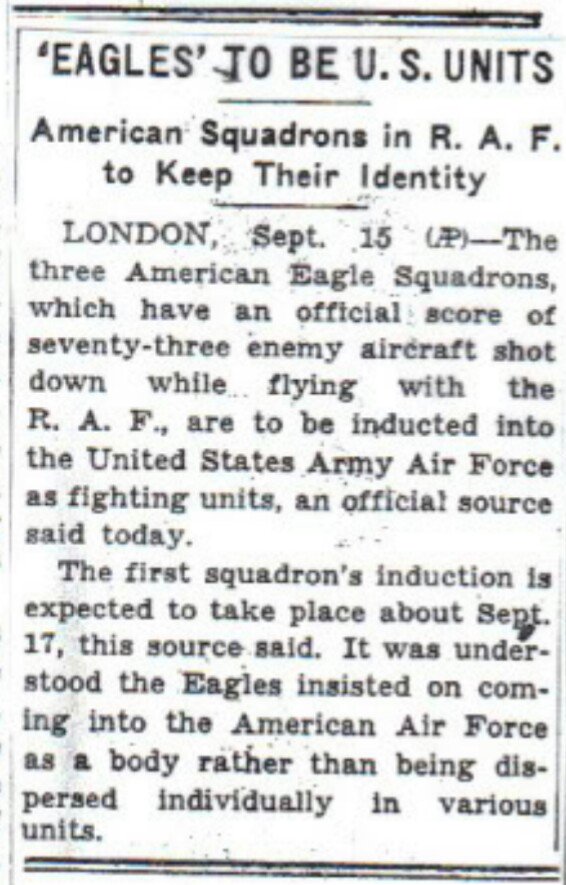
New York Times September 16 1942.

Sources and further reading.

Great Sampford appears in Trail 50.

National Archives: Operational Record Book 133 Sqn – AIR 27/945/2

National Archives: Operational Record Book 401 Sqn – AIR 27/1772/17

National Archives: Operational record Book 64 Sqn – AIR 27/590/41

*3 Price. A., “Spitfire – A Complete Fighting History“, Promotional Reprint Company,  (1974).

RFC/RAF Allhallows – Kent.

Many of you will be aware of Mitch Peeke, a friend of mine and author, who has contributed several articles to Aviation Trails. He also organised the building of a memorial to the crew of B-17 #44-6133 which crashed after colliding with another B-17 over the Thames Estuary.  Mitch has now written about the former RAF/RFC site at Allhallows, located not far from the memorial, which is a long abandoned airfield, now totally agriculture, located on the northern coast of Kent on the Hoo Peninsula.

It has been included in Trail 44, as an addition to the Barnes Wallis memorial statue, the Herne Bay / Reculver Air Speed Record and the Amy Johnson statue. 

My thanks to Mitch.

RFC/RAF Allhallows. (1916-1935).

The operational life of this little known Kent airfield began in the October of 1916, a little over two years into World War 1. Situated just outside the Western boundary of Allhallows Village, the airfield was bounded to the North by the Ratcliffe Highway and to the East by Stoke Road. Normally used for agriculture, the land was earmarked for military use in response to a direct threat from Germany.

​Toward the end of 1915 and into 1916, German Zeppelin airships had begun raiding London and targets in the South-east by night. At a height of 11,000 feet, with a favourable wind from the East, these cigar-shaped monsters could switch off their engines and drift silently up the Thames corridor, to drop their bombs on the unsuspecting people of the city below, with what appeared to be impunity. 

Not surprisingly, these raids caused a considerable public outcry. To counter the threat, street lights were dimmed and heavier guns and powerful searchlights were brought in and Zeppelin spotters were mobilised. Soon, some RFC and Royal Naval Air Service squadrons were recalled from France and other, specifically Home Defence squadrons, were quickly formed as the defence strategy switched from the sole reliance on searchlights and anti-aircraft guns, to now include the use of aeroplanes. Incendiary bullets for use in aircraft were quickly developed, in the hope of any hits igniting the Zeppelins’ highly flammable lifting gas and thus bringing down these terrifying Hydrogen-filled German airships.

No. 50 Squadron RFC, was founded at Dover on 15 May 1916. Quickly formed in response to the Zeppelin threat, they were hastily equipped with a mixture of aircraft, including Royal Aircraft Factory BE2’s and BE12’s in their newly created home defence role. The squadron was literally spread about trying to cover the Northern side of the county, having flights based at various airfields around Kent. The squadron flew its first combat mission in August 1916, when one of its aircraft found and attacked a Zeppelin. Though the intruder was not brought down, it was deterred by the attack; the Zeppelin commander evidently preferred to flee back across the Channel, rather than press on to his target.

At the beginning of October 1916, elements of 50 Squadron moved into Throwley, a grass airfield at Cadman’s Farm, just outside of Faversham. This was to become the parent airfield for a Flight that was now to move into another, newly acquired grass airfield closer to London; namely, Allhallows. On 7 July 1917 a 50 Squadron Armstrong-Whitworth FK8 successfully shot down one of the  big German Gotha bombers off the North Foreland, Kent. 

Former RAF Allhallows Main Entrance

The main entrance of the former airfield (photo Mitch Peeke)

In February 1918, 50 Squadron finally discarded its strange assortment of mostly unsuitable aircraft, to be totally re-equipped with the far more suitable Sopwith Camel. 50 Squadron continued to defend Kent, with Camels still based at Throwley and Allhallows.  It was during this time that the squadron started using their running dogs motif on their aircraft, a tradition which continued until 1984. The design arose from the squadron’s Home Defence code name; Dingo.  

Also formed at Throwley in February of 1918, was a whole new squadron; No. 143, equipped with Camels. After a working-up period at Throwley, the complete new squadron took up residence at Allhallows that summer, the remnants of 50 Squadron now moving out. 

RFC Allhallows had undergone some changes since 1916. When first opened, it was literally just a mown grass field used for take-off and landing. Tents provided accommodation for mechanics and such staff, till buildings began to appear in 1917. The first buildings were workshops and stores huts, mostly on the Eastern side of the field, on the other side of Stoke Road from the gates. The airfield itself was never really developed, though. No Tarmac runway, no vast Hangars or other such military airfield infrastructure was ever built. 

On 1st April, 1918, the RFC and the RNAS were merged to become the RAF. 143 Squadron and their redoubtable Camels continued their residence at what was now RAF Allhallows even after the Armistice. In 1919, they re-equipped with the Sopwith Snipe, but with the war well and truly over, the writing was on the wall. They left Allhallows at the end of that summer and on October 31st, 1919; 143 Squadron was disbanded.

Their predecessors at Allhallows, 50 Squadron, were disbanded on 13th June 1919. An interesting aside is that the last CO of the squadron before their disbandment, was a certain Major Arthur Harris; later to become AOC-in-C of RAF Bomber Command during World War 2.

ABCT memorial Allhallows

The Allhallows was presented by the Airfields of Britain Conservation Trust. The former airfield lies beyond the trees. (Photo by Mitch Peeke).

Now minus its fighters, RAF Allhallows was put into care and maintenance. It was still an RAF station, but it no longer had a purpose. The great depression did nothing to enhance the airfield’s future, either. But it was still there. 

In 1935, a new airport at Southend, across the Thames Estuary in Essex, opened. A company based there called Southend-On-Sea Air Services Ltd began operating an hourly air service between this new airport and Rochester, here in Kent. They sought and were granted, permission to use the former RAF Allhallows as an intermediate stop on this shuttle service. Operating the new twin engined Short Scion monoplane passenger aircraft, each flight cost five shillings per passenger. Boasting a new railway terminus, a zoo and now a passenger air service, Allhallows was back on the map! 

Alas, the new air service was rather short-lived. The service was in fact run by Short Bros. and was used purely as a one-season only, testing ground for their new passenger plane, the Scion. At the end of that summer, the service was withdrawn. As the newly re-organised RAF no longer had a use for the station either, it was formally closed. Well, sort of. 

The land reverted to its original, agricultural use. But then, four years later, came World War 2. The former RAF station was now a declared emergency landing ground. In 1940, the RAF’s Hurricanes and Spitfires fought daily battles with the German Luftwaffe in the skies over Allhallows, as the might of Germany was turned on England once again, in an attempt at a German invasion. That planned hostile invasion never came to fruition thankfully, but in 1942/43 came another, this time, friendly invasion. America had entered the war and it wasn’t long before the skies over Allhallows reverberated to the sound of American heavy bombers from “The Mighty Eighth.” It wasn’t long before the sight of those same bombers returning in a battle-damaged state became all too familiar in the skies above Allhallows, either.

On 1st December 1943, an American B 17 heavy bomber, serial number 42-39808, code letters GD-F, from the 534th Bomb Squadron of the 381st Bombardment Group; was returning from a raid over Germany. She was heading for her base at Ridgewell in Essex, but the bomber had suffered a lot of battle damage over the target. Three of her crew were wounded, including the Pilot; Harold Hytinen, the Co-Pilot; Bill Cronin and the Navigator; Rich Maustead.

B-17 42-39808 of the 534BS/381BG [GD-F] based at RAF Ridgewell, crashed landed at Allhallows following a mission to Leverkusen on 1st December 1943 . The aircraft was salvaged at Watton, all crew returned to duty. (@IWM UPL 16678)

Tired from the long flight, fighting the pain from his wounds and struggling to keep the stricken bomber in the air, Hytinen chose to crash-land his aircraft at the former RAF station, Allhallows. Coming in roughly from the South-east, he brought her in low over the Rose and Crown pub, turned slightly to Port and set her down in a wheels-up landing along the longest part of the old airfield. All ten crew members survived and later returned to duty. The USAAF later salvaged their wrecked aircraft.

That incident was the last aviation related happening at the former airfield. In 2019, the Airfields of Britain Conservation Trust erected a memorial to the former RAF station, in the car park of the Village Hall. No visible trace of the airfield remains today, as the land has long since reverted to agriculture, but the uniform badge of the nearby Primary School, features a Sopwith Camel as part of the design of the school emblem. 

RAF Allhallows is yet another part of the UK’s disappearing heritage, but although it has long gone, it will be long remembered; at least in the village whose name it once bore.

By Mitch Peeke.

Editors Note: Allhallows, or to be more precise ‘Egypt Bay’ also on the Hoo Peninsula and a few miles west of Allhallows, was the location of the death of Geoffrey de Havilland Jnr., when on 27th September 1946 he flew a D.H. 108, in a rehearsal for his attempt the next day, on the World Air Speed record. He took the aircraft up for a test, aiming to push it to Mach: 0.87 to test it ‘controllability’. In a dive, the aircraft broke up, some say after breaking the sound barrier, whereupon the pilot was killed. The body of Geoffrey de Havilland Jnr. was days later, washed up some 25 miles away at Whitstable, not far from another air speed record site at Herne Bay – his neck was broken.

Sources and further Reading:

Airfields of Britain Conservation Trust website

​ Southend Timeline website

American Air Museum website

 Imperial War Museum website

Village Voices Magazine

Allhallows Life Magazine