Australian Flt. Sgt. Rawdon H. Middleton VC (RAAF) 149 Sqn RAF

100641

Pilot Officer Rawdon Middleton (RAAF)*1

Middleton (s/n: 402745) was born on 22nd July 1916 in Waverley, New South Wales, Australia. Son of Francis and Faith Middleton, he was educated at Dubbo Hugh School. Nicknamed ‘Ron’ by his friends, he was a keen sportsman excelling at many sports particularly cricket and football. After leaving school, he worked as a ‘Jackaroo’ (cattle handler) until joining the Royal Australian Air Force on the 14th October 1940 under the Empire Air Training Scheme. He learnt to fly at Narromine, New South Wales and then was sent to Canada for further training in preparation for his posting to the UK. He finally arrived in Britain in September 1941, as a second pilot, and his first operational squadron was No. 149 Squadron RAF, who were flying Short Stirling bombers out of both Lakenheath and nearby Mildenhall in Suffolk.

P01019.003

Five student pilots from No. 7 Empire Air Training Scheme (EATS) course at No. 5 Elementary Flying Training School (5 EFTS) Narromine. They are left to right: Aircraftman (AC) Gordon Orchard; AC Douglas Scott; Leonard Reid; Pilot Officer (PO) Douglas Wilberforce Spooner (DFM); PO Rawdon Hume Middleton*2

Middleton’s first experience of operations, was in a Short Stirling over the Rhur, the industrial heartland of Nazi Germany. After spending a short time with 149 squadron he moved temporarily to No. 7 Squadron (RAF).

In July 1942, as first pilot, he was given his own aircraft and crew, it was also around this time that he returned to 149 squadron.

Their first mission together would be on July 31st, to bomb the strategic and heavily defended target, Düsseldorf. Middleton and his crew would continue to fly together and took part in other prestigious missions; namely Genoa on the 7th of November and his 28th mission, Turin on the 20th November. His 29th and final mission, would take place on the night of 28/29th November 1942.

In the early evening of the 28th he took off in Stirling BF372 coded ‘OJ-H’ as part of the raid on the Fiat works in Torino, Italy, along with 227 other aircraft which included – 117 Avro Lancasters, 46 Short Stirlings, 45 Handley Page Halifaxes, and 19 Vickers Wellingtons.

Middleton’s crew consisted of: Ft.Sgt. Leslie Anderson Hyder, Ft. Eng: Sgt. James Ernest Jeffrey, Bomb Aimer F.O. G. R. Royde, Wireless Operator: Sgt. John William Mackie; Gunners: P.O. N. E. Skinner, Sgt. D. Cameron and Sgt. H. W. Gough. Three of these had already completed their tour of 30 operations and could have left. However, their dedication to Middleton kept them together.

The mission would take the aircraft over the Alps and the Stirling, laden with bombs and fuel combined with having a notoriously poor ceiling, had to negotiate through the mountains rather than fly over them. A factor that often resulted in a high number of casualties.

Once over the target area, OJ-H was subjected to an extreme flak barrage. With poor visibility, Middleton had to make three passes over the target area to enable his crew to positively identify it. It was on the third pass that a shell burst hit the cockpit. The resulting damage was severe, and fragments had hit Middleton’s head badly injuring him. His right eye was lost and his skull exposed. There were further hits on the aircraft’s fuselage causing considerable damage to the control systems and airframe. Knocked unconscious by the blast, Middleton lost control and the aircraft plummeted through the skies to an altitude of around 800ft. The second pilot, Fl.Sgt. Hyder eventually managed to take the controls, release the bombs over the target and then pull the aircraft into a climb, safely reaching 1,500ft.

With his aircraft severely damaged, Middleton had a choice, get his crew to bail out over occupied France and certain capture, fly to Africa or head back to England; a journey that would last over 4 hours and put the aircraft at risk of attack and the crew in danger. Wanting to give them a fighting chance of getting home, he opted for the latter, and set a course for England.

SUK10501

Middleton was buried with full military honours at St. Johns Church, Beck Row. Suffolk.*3

The aircraft experienced a number of attacks as they crossed occupied France, but Middleton, fighting for survival, kept reassuring the crew that he would get them home. Eventually, and against all the odds, they made the English coast, and once over land Middleton ordered the crew to bail out. Five crewmen left the stricken aircraft whilst the other two remained to help him control it. Turning for the Channel, Middleton ordered the two remaining crew members to bail out, whilst he stayed at the controls, steadying the aircraft.

By now the Stirling was very low on fuel and it finally gave up the fight and crashed at 03:00 on the morning of November 29th 1942. Middleton, too injured and too weak to escape the wreckage, drowned within the aircraft fuselage. His two crew members, Sgt. James Ernest Jeffrey (576050) age 19 and Wireless Operator Sgt. John William Mackie (994362) age 30, despite escaping, also drowned. Both the bodies of Sgt Mackie and Sgt. Jeffrey were washed ashore later that day on the 29th.

Middleton’s body remained in the aircraft, but was eventually freed from the wreckage by the action of the sea, and was washed ashore on Shakespeare Beach, Dover, in February 1943. His remains were taken to RAF Lakenheath and he was buried in St John’s churchyard, Beck Row, within sight of his airfield in Suffolk, with full military honours. Middleton was only 26 and only one mission away from ending his tour and returning home.

For his action, dedication and bravery, Flt. Sgt. Middleton was posthumously awarded the Victoria Cross, the first to any serving member of the R.A.A.F in World War II. He was also posthumously awarded a commission as Pilot Officer, backdated to mid November before his sortie to Turin. Thirty years later, in 1978, Middleton’s V.C. was presented to the Australian War Memorial, in Canberra for safe keeping and preservation.

For their actions, the other crew members received three DFMs and two DFCs. Fl.Sgt. Leslie Hyder (DFM) was injured, P.Officer. N. Skinner (DFC) was also injured, along with Sgt. H. W. Gough (DFM). F.O. G. R. Royde (DFC) and Sgt. D. Cameron (DFM) escaped unhurt.

The London Gazette published a report on 12th January 1943. It said:

“Fl. Sgt. Middleton was captain and first pilot of a Stirling aircraft detailed to attack the Fiat Works in Turin one night in November, 1942. Very difficult flying conditions, necessitating three low altitude flights to identify the target, led to excessive petrol consumption, leaving barely sufficient fuel for the return journey. Before the bombs could be released the aircraft was damaged by anti-aircraft fire and a splinter from a shell which burst in the cockpit wounded both the pilots and the wireless officer. Fl. Sgt. Middleton’s right eye was destroyed and the bone above it exposed. He became unconscious and the aircraft dived to 800 ft. before control was regained by the second pilot, who took the aircraft up to 1,500 ft. releasing the bombs, the aircraft meanwhile being hit many times by light flack. On recovering consciousness Fl. Sgt. Middleton again took the controls and expressed his intention of trying to make the English coast, so that his crew could leave the aircraft by parachute. After four hours the badly damaged aircraft reached the French coast and there was once more engaged and hit by anti-aircraft fire. After crossing the Channel Fl. Sgt. Middleton ordered the crew to abandon the aircraft. Five left safely, but the front gunner and the flight engineer remained to assist the pilot, and perished with him when the aircraft crashed into the sea”.
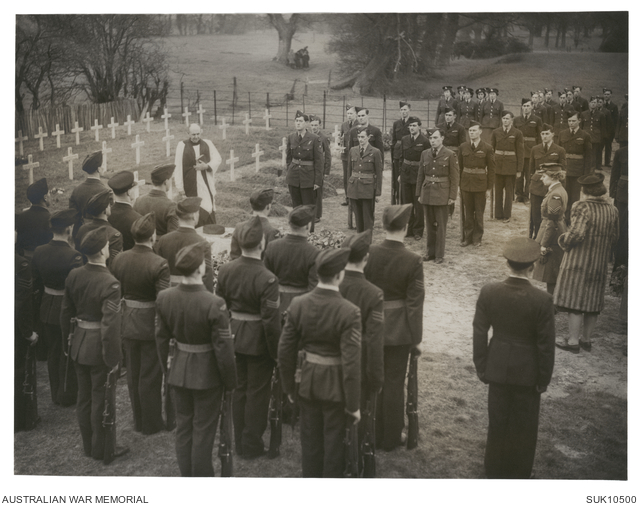
Funeral service for 402745 Flight Sergeant Rawdon Hume Middleton, the RAAF’s first VC winner. He was buried with full military honours in a country churchyard near his station. Air Vice Marshal H. N. Wrigley represented the High Commissioner for Australia (Mr S. M. Bruce) and the RAAF. The graveside service was conducted by Squadron Leader H. C. Thrush of Prospect, SA, RAAF Chaplain. (Australian War Memorial Public Domain)

Middleton’s citation read:

“Flight Sergeant Middleton was determined to attack the target regardless of the consequences and not to allow his crew to fall into enemy hands. While all the crew displayed heroism of a high order, the urge to do so came from Flight Sergeant Middleton, whose fortitude and strength of will made possible the completion of the mission. His devotion to duty in the face of overwhelming odds is unsurpassed in the annals of the Royal Air Force”.

In honour of Middleton’s bravery, Number 1 RAAF Recruit Training Unit at RAAF Base Wagga has renamed the club in his name, the “Middleton VC Club”, and he also appeared on one of the 1995 Australian 45c stamps. The dining hall located at the nearby (now American) base at RAF Mildenhall in Suffolk, has also been named in his honour.
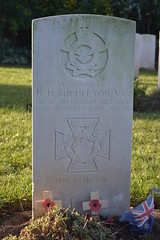
St. John's Church Beck Row, Mildenhall Fl. Sgt. Rawdon Hume Middleton, VC (RAAF) 149 Sqn RAF, St. John’s Church, Beck Row, Suffolk.

Middleton was a brave and dedicated young man who gave his life to save those of his crew. Each and every one of them acted with the highest dedication, sadly for some, it cost them dearly.

Sources

*1 photo courtesy of Australian War Memorial, image 100641, Public domain.

*2 photo courtesy of Australian War Memorial, image P01019.003, Public domain.

*3 Photo courtesy of Australian War Memorial, Image SUK10501, Public domain

*4 Photo courtesy of Australian War Memorial, Image SUK10500, Public domain
What Now for 2015?

Now that Christmas and the New Year celebrations are over, it’s time to take stock and consider where we go next with the blog.

Since starting this site last April, the blog has grown and developed in ways I never thought possible. I’ve visited over 40 different airfields and written trails about each one. As each trail has been written, I’ve found some amazing stories of heroism, bravery and heartache. The more I delve, the more I find, to the point where it has now become quite factual in its basis but the original idea of a nostalgic trip is still strong and evident in each and every article.

I have now of course, had a great deal of help from Marcella, whom I met on ‘Twitter’, spent Christmas 2013 with and have developed an amazing long distance relationship with. With her living in the United States and me in England, we have learnt to live with 3,500 miles and a time difference of 5 hours. Not easy at times!

She has an incredible eye for detail and a determination to find and check every detail, researching many of the additional facts and pieces of information that I wouldn’t necessarily have the time to do. She has also brought new ideas to the blog and has played a large part in its overall development.

As a result of this partnership, the blog has diversified from a range of trails around Britain’s old disused airfields, themselves a record of historical events, to include poetry and personal tales of bravery and heroism. It has also given me the chance to talk at length with my father, to learn about his time in the RAF, to know some of the stories behind his photos. We have learned about the structure of the USAAF, individual squadrons of the RAF and the ‘friendly invasion’ that affected so many lives both here in Britain and in the United States.

The blog following has grown too. Traffic to the site has grown steadily, readership is on the increase and a ‘family’ of friends has developed through a shared interest. I met in person, people through the blog who have shared their own pictures and stories. I personally have learned so much from others. It has truly been a terrific year.

So what now, where do we go? Certainly more trails, they are the backbone of the blog and tell the tale of events in World War Two. More heroic tales too, to highlight the sacrifices these young men (boys in many cases) made in the name of freedom and democracy. Perhaps too a new look, a revamp of the style. More factual information to back up the trails, and perhaps some revisits to old sites to update them and see what has happened since I was last there.

We would also like to share our trails with more people, raise the awareness of the state of these sites, and maybe encourage others to follow the trails around Britain’s disused airfields. Now is a fantastic time (if you are brave enough to withstand a little wintry weather), to go out and have a look round. The winter provides excellent views of buildings and other remnants of history that remain on these airfields, that in the summer, are obscured by trees and other greenery.

We welcome guest posts too, encouraging readers to add and share their own trails or stories. The more trails, the better the record we have! These posts need not necessarily be about a trail. We would love to share stories of those who served during this tumultuous time in history.

Finally, as always, we greatly appreciate your feedback and thoughts in the comments sections.

With a readership that is growing world-wide, ‘Aviation Trails‘ has truly taken off and is climbing. Here’s to 2015, new trails and new friends!

Andy and Marcella

What the Luftwaffe failed to do, the local council have finally managed.

Many of Britain’s airfields have hung on desperately to a small corner of history. Hawkinge is sadly one of those that has been buried deep beneath housing, schools and shops. Sadly, one of England’s most historic airfields, has finally been defeated not by Goring’s Luftwaffe, but by local planners.

Hawkinge was at the forefront of the Battle of Britain, it was repeatedly attacked by the bombers of the Luftwaffe. Because of its location, just minutes from France, crews would often have little warning and would have to take to the sky unprepared. Many returning aircraft would use its runways as a safe haven returning battle damaged and weary; Hawkinge fire crews were some of the busiest Britain was to have. It was used as a transport depot in the First World War, became a mecca for international pilots, saw some of the first ‘drones’ and was used in the filming of the 1969 film ‘The Battle of Britain’.

Today a small museum, utilises what’s left of the original buildings whilst housing creeps like poison ivy, ever further across the airfield.

The nearby cemetery is home to not only RAF pilots but also fallen Luftwaffe crews, ironically remaining in the land they tried to take all those years ago.

As part of a second aviation trail around historic Kent, Hawkinge is a must for any follower of history, aviation or the Battle Of Britain.

See the full story and Kent’s second trail here.
lady cropped 2 B&W


Eisenhower stopped off at Lashenden

It was during this time, on July 4th 1944, that General Eisenhower stopped off at Lashenden following one of his many flights over the German lines in Normandy. His pilot, Brig. Gen. Elwood R. Quesada, veteran of 90 sorties, was berated by his superiors for such a ‘foolish’ act. In response he said, “When a five-star general says ‘Go,’ you go!”

Lashenden, also known as Headcorn, was an advanced landing ground, built initially for the RAF, it was taken over by the US Ninth Airforce who used to to fly P-51s and P-47s out over France.

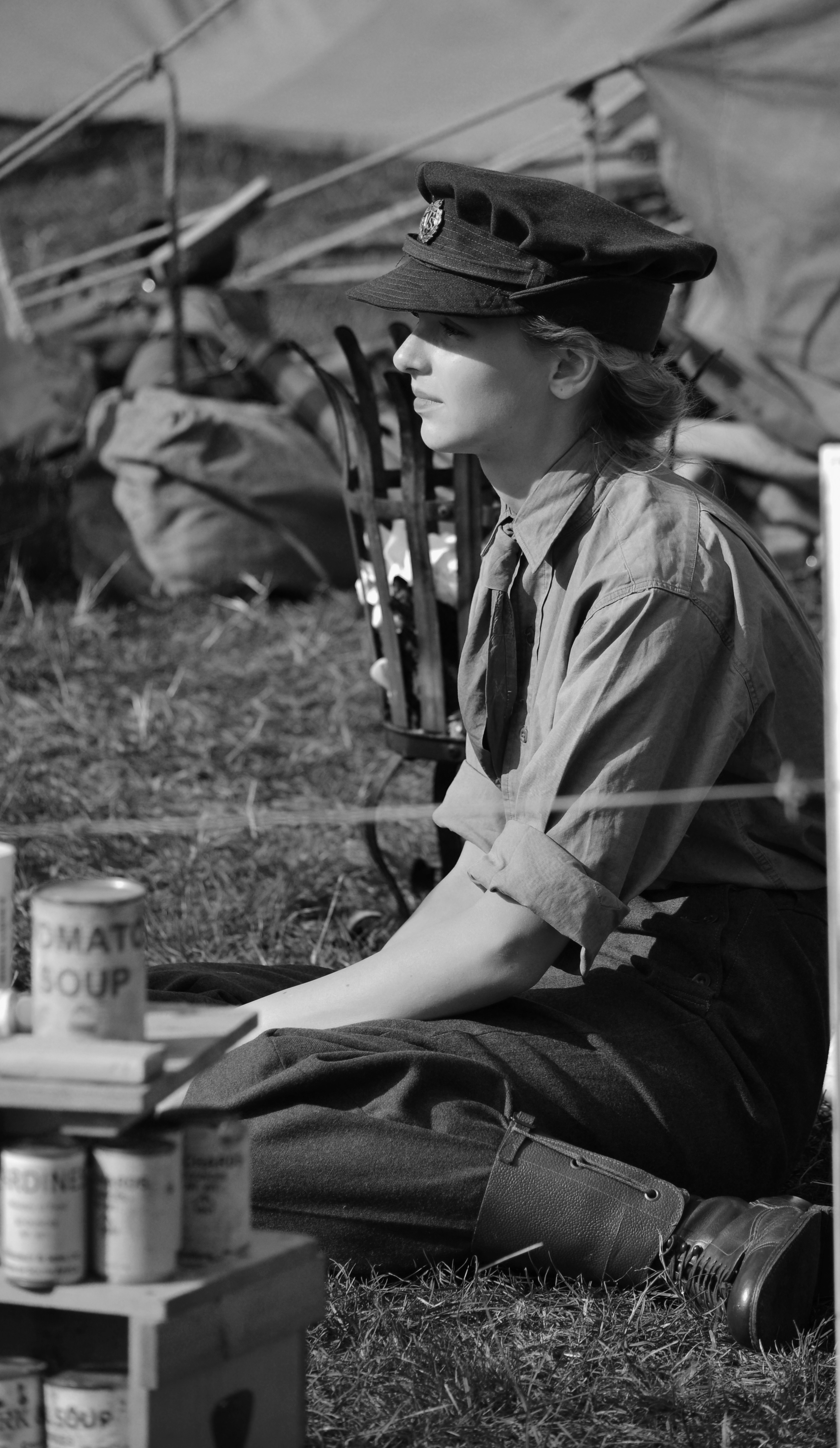
Today it is a thriving airfield, whose annual reenactments bring back the nostalgia of 1940s Britain. Find out more about Lashenden’s history and other airfields in Kent. Click on this link.

lady cropped 2 B&W

1940s Britain is reenacted on the Former Lashenden Advanced Landing Ground used by the Ninth Air Force.


Polish Fighter Ace Turned a V1 on its back.

The first V1 for 315 sqn was shot down by Flt Sgt Jankowski at 13:10 on July 11th. There were three more the following day and several others would meet similar fates. Shooting down a V1 was dangerous, many aircraft being caught in the subsequent blast. Other, less conventional methods would include tipping the wing of the V1 destabilising the gyroscopic guidance system within, sending it tumbling to the ground. On one occasion, WO Tadeusz Szymanski managed to completely turn a V1 onto its back using such a method.

Brenzett, was an advanced landing ground, built to be temporary, but even so, it produced some remarkable stories.

As part of a second trail around Kent, we visit three more of Britain’s airfields, Hawkinge, Brenzett and Lashenden. Each with its own story to tell. Want to know more? click here to go back to 1940s England and then see what has happened to these historic places.

Brenzett village sign

Brenzett Village Sign Depicts its Aviation History


They shall grow not old, as we that are left grow old: …

Originally posted on the anniversary of the publication of his poem, For the Fallen, 21st September 2014, Laurence Binyon’s poem has become synonymous with remembrance services across the country. This week is remembrance Weekend (and Veteran’s day in the United States) on which we remember the fallen: those who gave the greatest sacrifice, so we could live in peace.

I thought it appropriate to repost this during Thai special week so we know a little more about the poem and the history behind it.

‘Lest we forget’

“To all those who went before, (Robert) Laurence Binyon’s 1914 poem is widely used in remembrance services across the world. Laurence Binyon wrote his For the Fallen, with its Ode of Remembrance, while Binyon was visiting the cliffs of North Cornwall between Pentire Point and The Rumps.

Today, if you visit, there is a stone plaque at the spot to commemorate his poem, which reads: For the Fallen Composed on these cliffs 1914″. There is also a second plaque located on the beehive monument on the East Cliff above Portreath in central North Cornwall. There, you will find a plaque on a statue inscribed with the same words. Laurence Binyon’s poem, For the Fallen, was published in The Times newspaper, following heightened public sentiment due to the recent Battle of Marne (5-12 September 1914) on 21st September 1914, 100 years ago today. http://wp.me/P4xjD9-8u

For the Fallen

With proud thanksgiving, a mother for her children,
England mourns for her dead across the sea.
Flesh of her flesh they were, spirit of her spirit,
Fallen in the cause of the free.

Solemn the drums thrill: Death august and royal
Sings sorrow up into immortal spheres.
There is music in the midst of desolation
And a glory that shines upon our tears.

They went with songs to the battle, they were young,
Straight of limb, true of eye, steady and aglow.
They were staunch to the end against odds uncounted;
They fell with their faces to the foe.

They shall grow not old, as we that are left grow old:
Age shall not weary them, nor the years condemn.
At the going down of the sun and in the morning
We will remember them.

They mingle not with their laughing comrades again;
They sit no more at familiar tables of home;
They have no lot in our labour of the day-time;
They sleep beyond England’s foam.

But where our desires are and our hopes profound,
Felt as a well-spring that is hidden from sight,
To the innermost heart of their own land they are known
As the stars are known to the Night;

As the stars that shall be bright when we are dust,
Moving in marches upon the heavenly plain,
As the stars that are starry in the time of our darkness,
To the end, to the end, they remain.

(Published in The Times newspaper, 21st September 1914).

Thanks to Marcella who contributed to the writing of the original post.”

DSC_0097

 For the Fallen – Laurence Binyon (1869-1943)

In Honour of the 55,573 Young Men Who Never Returned

RAF Bomber Command – Green Park,

London

The Bomber Command memorial was erected in honour of the 55,573 crew members of the RAF Bomber Command who died during the Second World War. It stands as a reminder of the young men, whose average age was only 22, and who never returned to their beloved homes. It was unveiled by the Queen, on June 28th 2012, when a Lancaster bomber of the BBMF flew over dropping thousands of poppies.

RAF Bomber Command Memorial

RAF Bomber Command Memorial

The monument can be found in London adjacent to Green Park. It stands proudly watching over the grassed picnic area where picnickers, shoppers and tourists sit. The main part of the monument is a bronze sculpture consisting of seven members of a typical bomber command aircrew.

Perhaps not obviously noticed, some of the crew are looking to the sky, some with hands to shield from the morning sun, as if looking for missing friends. Others are looking downward, perhaps in despair or fear for those not yet home. The stance of the statues suggests a crew recently returned from a mission who have just disembarked from their damaged aircraft. Tired, bewildered and overwhelmed by what they have witnessed, they have been created in precise and superb detail.

The Pilot stands central and to the rear of the group; the navigator to the left, followed by the flight engineer, mid-upper gunner, bomb aimer, rear gunner and then the wireless operator to the right. Their faces reflecting the feelings and emotions that these young men felt. The base of the statues were ‘littered’ with photos of loved ones and messages from around the world. A moving tribute.

RAF Bomber Command Crest "Strike hard, Strike Sure"

RAF Bomber Command Crest “Strike Hard, Strike Sure”

Outside and on the walls of the memorial, are two crests; on the left, the RAF crest “Per Ardua ad Astra” meaning “Through adversity to the Stars“. The crest has its origins going back to August 1st 1918 and has been the symbol of the RAF ever since. On the right, is the crest of Bomber Command whose motto is “Strike Hard, Strike Sure“. Both beautifully carved into the undoubtedly beautiful Portland Stone.

A number of quotes, including one from Winston Churchill, “The Fighters are our salvation, but the bombers alone provide the means of victory” surround the memorial giving  it strength. A further quote, to the rear of the memorial reflects the losses of all nations, who on the ground, lost lives as a result of bombing campaigns on both sides – a reflection of reconciliation and peaceful times ahead.

The roof above the memorial is open. This allows you to see the figures against a backdrop of sky, whether at day or night, rather than the bustling city behind.  A view more representative of the times they lived and flew in.

The remainder of the roof is similar to the kriss cross design of the Vickers Wellington, one of the RAF’s bombers during World War II. The design is both eye-catching and unique, not only to the memorial but the Wellington from which it came.

The building of the memorial, which is truly a mix of emotion, international representation, and a build that reflects the lives of those affected by the war, is considered as closure for many; a symbol of what the young crews had to endure on long missions over occupied Europe. It also serves to act as a lesson to the those who were too young to know what the war meant to those who fought and died in it. It is A beautiful place to sit and give thanks to those 55,573 brave young men who never lived to experience peacetime again.

IMG_0426

RAF Bomber Command Memorial – Note the Roof Design.

The official Bomber Command Memorial website is here. An app is also available for a small fee that goes part way to supporting the maintenance of the memorial, it gives greater detail to the construction and design of the memorial, along with an audio script and stories from survivors of Bomber Command.

A history of the RAF Crest and its derivations can be found by clicking here.

By clicking here, you can see and hear some stories of those to whom the monument is honouring.

  “The Fighters are our salvation, but the bombers alone provide the means of victory

Winston Churchill, 1940

To see more memorials from airfields around the country please click here

Ode to the Fallen.

As we approach Remembrance day (and Veteran’s day in America), Aviation Trails will be publishing a mix of poetry and aviation material in remembrance of those brave and courageous young men and women, who, from all nationalities, gave the ultimate sacrifice in war.

The numbers are staggering; during World War 1, there were some 37 million* deaths, (of which around 7 million were civilian). Thankfully, because the war was quite stationary, it did not create as many of the civilian casualties that were found in the Second World War. The higher number here being primarily military and serving personal. Defined as the ‘War to end all Wars’, it brought a devastating blow to societies across the European countries and their allies, as men flocked to the front and the mass slaughter that prevailed.

World War 2 on the other hand, due to the much faster, greater technological advancement that war brings, saw a much higher casuality rate. Over 60 million people died which amounted to approximately 2.5% of the world’s population*1. This is currently about the size of Nigeria, the world’s seventh largest country*2. The war was so widespread and devastating, that the actual number of casualties will never be known. A new type of war, it spread death and destruction to a much wider audience.

Subsequent wars, have also taken their toll, both in military and civilian terms. Continuing conflicts are, and will account for further deaths, and it is a sad reflection of the world we live in today.

So on this special weekend, during the 100th anniversary of the First World War, we remember those who have given so much so that the rest of us can live peacefully.

Memorials visited during the making of ‘Aviation Trails‘ can be seen here.

Ypres 007

Tyne Cot Cemetery, Belgium


Sources:

Whilst not official, Wikipedia gives some detailed accounts of countries and their casualties.

* Wikipedia, World War 1 Casualties;  http://en.wikipedia.org/wiki/World_War_I_casualties

*1 Wikipedia, World War 2 casualties; http://en.wikipedia.org/wiki/World_War_II_casualties

*2 Wikipedia, list of countries by population; http://en.wikipedia.org/wiki/List_of_countries_by_population

20:45 – A tragic time for Mosquito KB 364

On this night 70 years ago (November 6th 1944), twelve RAF Mosquitoes from 608 Squadron, RAF Downham Market (Bexwell), took off on a raid to attack Gelsenkirchen, Germany.

Whilst the raid itself was a success, that night was to be the last for the two crew members of Mosquito KB 364. Pilot Officer James McLean (26) and Sergeant Mervyn Lambert Tansley (21) of the RAF(VR) were to die tragically on approach to Downham Market.

On the return journey, cold air and icy conditions are thought to have caused icing on the controls and wings of KB 364 making it difficult to control and lose height. What happened next was to be tragic, both for the crew members and the village of Bawdeswell.

To see the full story of that night and what happened at 20:45, November 6th 1944, click here

DSCF1168

DH Mosquito at the DH Heritage Centre

The de Havilland Sea Mosquito

The de Havilland Mosquito was undoubtedly one of the Second World War’s most famous and prestigious aircraft, achieving fame alongside models like the Lancaster, Spitfire and Hurricane.

During recent conversations I’ve had with friends, I was intrigued to know more about the different variants, and in particular, the Sea Mosquito – one I had very little knowledge of.

Built in a hangar (disguised as a barn) on the estate of Salisbury Hall near Hatfield, the Mosquito, or  ‘Mossie‘, was a unique aircraft of wooden construction. This design feature eventually gave birth to its nickname the ‘Wooden Wonder‘.

Taking its first flight on November 20th 1940, prototype E0234 (later designated W4050 by the Air Ministry), flew with Pilot Geoffrey de Havilland Jnr at the controls. Its potential as a military aircraft was quickly realised, especially by those who were in opposition of the original idea, and further development trials were organised.

IMG_0343

Prototype E0234 (later designated W4050) under restoration at the de Havilland Museum.

The Mosquito went on through various design modifications and variants (41 in all), including fighter-bomber, reconnaissance, target tug and trainer. It also served with numerous air forces across the world, some as far afield as China and Israel. Postwar it obtained notoriety as a film star, the most famous being ‘633 Squadron‘ in which a squadron of ‘Mossies’ attacked the V2 fuel production plant in Norway by bombing an overhanging rock. Film stars such as Cliff Robertson, David McCallum and Gregory Peck have all graced our screens alongside the Mosquito.

With the sad crash of G-ASKH on July 21st, 1996 and the death of both pilot and co-pilot, there is no longer a Mosquito flying in the U.K. On September 27th 2012, Mosquito KA114, restored in New Zealand, took to the skies for the first time making it the only flying example in existence at that time.

Plans to build a U.K. flying example are afoot with ‘The People’s Mosquito’ who are raising money as we speak. It is hoped to get the aircraft built and operational, within a few years.

Undoubtedly a success, the Mosquito was a devastatingly potent aircraft, its speed and agility unmatched by most other aircraft of its time. It is a beautiful aircraft and one that was loved not only by those who made, flew and worked with it, but those who, like me, stood in awe and watched it fly. The sound of its two Merlin engines something to behold.

The Mosquito was a great success in a number of operational configurations, and in different theatres, however, one of the lesser well-known variants, and less successful, was the Sea Mosquito.

Impressed with the performance of the aircraft, the Admiralty showed an interest in obtaining a carrier-based version. The de Havilland Aircraft Company put forward the idea of a redesigned model based on the FB.VI – the concept was soon accepted. Trials began soon after in which Mosquito LR359 was adapted, the body strengthened to take the strain of arrester hook landings; its weight was reduced and the Merlin power plants improved.  These tests proved successful, and the first carrier landing completed in late March 1944 by Lt Cdr Eric ‘Winkle’ Brown onboard HMS Indefatigable.

This was a major achievement in many ways, not only for the Navy, but it was the first time any twin-engined aircraft had landed on a sea-based carrier. Further tests followed, and a second Mosquito, also adapted for naval use, joined LR359 in trials onboard naval carriers.

The scene had been set and the Admiralty put forward a specification for a full production naval version, which deHavilland would designate the TR.33.

As with all naval carriers, space was of a premium and so the new version had wing modifications that allowed them to fold. A new and improved landing gear was also needed for the heavy landings that a carrier-based aircraft would be subjected to. Radar was also installed with later adaptations giving the aircraft an odd ‘thimble-shaped’ nose. In addition, attachments for torpedoes were added to the belly of the aircraft giving it greater anti-shipping capabilities.

Image

Modified from a MK.VI, LR387 became a TR.33 Sea Mosquito and appeared on the front of ‘Life Magazine’.

The first production model, TW227, left the factory in late 1945, but orders came through too late to meet the Japanese threat. Of the initial 100 ordered, only 50 were ever completed. Further trials were undertaken, and the TR.33 would be modified to form the TR.37. This had armament modifications and an upgraded radar system. Again, as with the TR.33, only a few ever made it out of the factory, with only 6 of the original order being completed.

Mosquitoes, whilst being outstanding aircraft, only ever made it to one frontline naval service, 811 squadron of the Fleet Air Arm. Most that were produced were operated from land-based stations and were involved in various trials around munitions development and investigations into naval capabilities. Of those that were made, many of them, in particular the TR.33s, were modified back to regular models and sold off to other air forces, notably the Israeli Air Force.

No further seaworthy variants were made and production concentrated on the land-based models.

The hangar used to build the Mosquito is now the home of the de Havilland Aircraft Museum, (previously the Mosquito Museum) and its main exhibits include, amongst others, the original prototype  Mosquito (W4050) under restoration. Dedicated to de Havilland aircraft, it has a range of models showcasing de Havilland aircraft production from its early days of the 1920s right up to the later modern production fighters and airliners of the 1960s.

Their website can be found here. I visited them a while ago, and my trail can be found here.

More details on 633 squadron can be found on Wikipedia using this link.

Details of Lt Cdr Eric Brown and his achievements can be found through this link.

A remarkable and detailed book illustrating the development of the Mosquito can be purchased from the de Havilland shop. It gives some amazing photos and development history of the aircraft from its conception to cessation of production, detailing production models, uses and variants; it is a worthy book to anyone’s collection.

de Havilland Mosquito – An Illustrated History Vol 2, Ian Thirsk, Crecy Publishing, 2006.

The People’s Mosquito can be found on WordPress or through ‘Aviation Trails’, alternatively on Facebook and Twitter (@peoplesmosquito).