Here lay the names of 150,000 RAF Personnel.

If you are in London, maybe taking in a show or visiting one of the many museums London has to offer, perhaps visiting the RAF Museum at Hendon or as I was, the Imperial War Museum in Lambeth, this is an ideal place to stop off and take time out. Its stained outer walls and hectic surroundings hint at nothing inside this remarkable building.

St. Clement Danes Church – London

St. Clement Danes church stands almost oddly in the centre of London in the Strand, surrounded on all sides by traffic; like an island it offers sanctuary and peace yet its history is far from peaceful.

St. Clement Danes - Church of the RAF

The view toward the Altar. The floor contains nearly 900 Squadron badges of the Royal Air Force.

It reputedly dates back to the Ninth Century AD following the expulsion of the Danes from the City of London, in the late 870s, by King Alfred. As a gesture, he allowed Danes who had English wives to remain nearby, allowing them to dedicate the local church to St. Clement of the Danes. Ever since this time, a church has remained, albeit in part, on this very site.

August 2016 009

The ‘Rosette’ of Commonwealth Air Force Badges embedded into the floor.

In the 1300s and then again in the late 1600s it was rebuilt, the second time influenced by the great Sir Christopher Wren – notable for his designs of buildings both in and outside of London. Regarded as being Britain’s most influential architect of all time, he designed many famous buildings such as the Library at Trinity College and the Royal Hospital at Chelsea. Wren also redesigned both Kensington and Hampton Court Palaces – his influences stretched far and wide.

Of course Wren’s ultimate master-piece was St. Paul’s Cathedral in London, a structure that reflected both his skill, vision and personality.

During the Great Fire of London in 1666, eighty-seven churches were destroyed in London, but only fifty-two were subsequently rebuilt. Whilst not directly damaged by the fire, St. Clement Danes was included in that list due to its very poor condition and Wren was invited to undertake the huge task.

St. Clement Danes - Church of the RAF

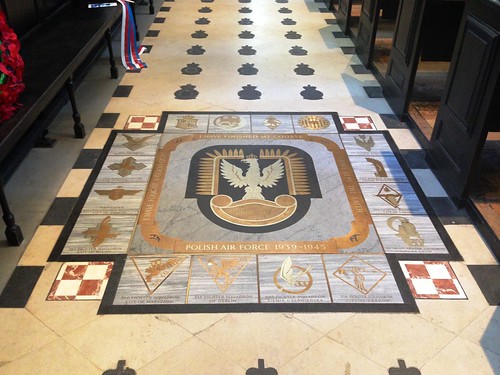
The Memorial to all the Polish airmen who served with the Royal Air Force during World War II.

It then stood just short of 300 years before incendiary bombs of the Luftwaffe destroyed it in May 1941. Leaving nothing but a few walls and the tower, Wren’s design had been reduced to ashes and rubble.

For over ten years it lay in ruins, until it was decided to raise funds and rebuild it. In 1958, following a national appeal by the Royal Air Force, St. Clement Danes was officially opened and dedicated as the Central Church of the Royal Air Force in memory of all those who fought and died whilst in RAF service, and to ‘serve as a perpetual shrine of remembrance’ to them all.

In completing the restoration, every branch of the RAF was included. At the entrance of the church, is the rosette of the Commonwealth made up of all the Air Forces badges of the Commonwealth countries, each of which flew with RAF crews during the conflicts. Beyond the rosette, the floor from the north aisle to the south aisle of the Nave contains nearly 900 squadron badges each one made in Welsh Slate and embedded into the floor.

Around the walls of the church, four on each side and two to the front, are ten Books of Remembrance from 1915 to the present day, in which are listed 150,000 names of those who died whilst in RAF service. A further book on the west wall, contains a further 16,000 names of USAAF personnel killed whilst based in the United Kingdom during the Second World War.

St. Clement Danes - Church of the RAF

Ten Books of Remembrance contain 150,000 names of those who died in RAF Service 1915 – the present day. A further book contains 16,000 names of USAAF airmen who were killed.

On either side of the Altar, are boards and badges dedicated to every branch of the RAF. Two boards list the names of those who were awarded the Victoria Cross and others the George Cross. Other slate badges represent the various units to serve and support the main fighter and bomber groups, including: RAF Training units, Fighter Control units, Maintenance units, University Air Squadrons, Medical units, Communication squadrons, Groups, Colleges and Sectors.

In the North Aisle, a further memorial, also embedded into the floor, remembers those who escaped the Nazi tyranny in Poland and joined the RAF to carry on the fight during World War II. Each Polish Squadron is represented in a beautifully designed memorial around which is written:

“I have fought a good fight, I have finished my course’ I have kept the faith”

Smaller dedications can also be found around the church, such as the Mosquito Aircrew Association, dedicated to both air and ground crews of the mighty ‘Wooden-Wonder’. Some of these memorials are in the form of gifts of thanks many of which come from other nations as their own tribute to those who came from so far away to give their lives in the name of freedom and democracy.

So next time you’re in London, take time out from the hustle and bustle of the West-end, make your way to the Strand ( a fifteen minute bus journey from the IWM) and visit this peaceful retreat.

St. Clement Danes is open every day to the public, so that those who gave the ultimate sacrifice may live on for eternity.

RAF Great Dunmow – In the shadow of Stansted Airport.

In Trail 33, we continue to explore the county of Essex. Touching the outskirts of London to the south and Suffolk to the north, it has an aviation history that has lasted over two world wars.

After visiting both Matching Green and Andrews Field, we travel a few miles west back again toward Stansted Airport.

Our next stop is Great Dunmow.

RAF Great Dunmow (Station 164)

Great Dunmow is another former airfield that sits in the shadow of nearby Stansted airport, itself a former World War 2 airfield. Dunmow was home to only two RAF units, 190 Squadron (RAF) and 620 Squadron (RAF) operating Stirling IVs and latterly the Halifax III and VII. It was also used by the USAAF flying B26 Marauders under the 386th BG.

Great Dunmow, had a multitude of names: Little Easton,  Easton Lodge and Great Easton due to its close proximity to all three locations. It was designated Station 164 by the Americans but became more commonly known as Great Dunmow.
RAF Great Dunmow

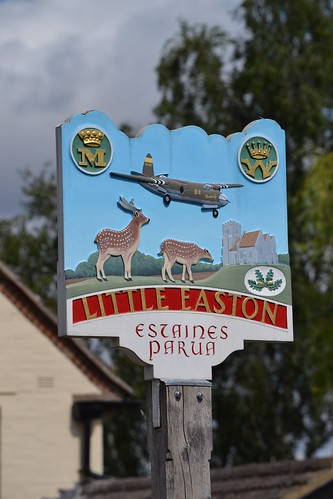
The Village sign depicts its wartime heritage.

Not built until mid-way through the war (1942-43) by the US Army’s 818th Engineer Battalion (Aviation), the American units of the 386thBG were the first to move in.

It would have three runways (concrete and wood chip), with the main one running north-west / south-east and 6,000ft in length. The second and third runways ran east-west and north-east \ south-west and were both 4,200 ft in length. The main technical and administrative areas were to the north side in which one of the airfield’s two T2 hangars were located. A bomb store was situated to the east and was capable of storing in excess of 800 tons of bombs. Dispersals consisted of 50 loop style hardstands around the concrete perimeter track. The staff accommodation sites were dispersed over 12 sites all to the north around the Easton Lodge, referred to by crews as ‘The Big House’*1. Two Mess sites, two WAAF sites, a sick quarters, an officers and four airmen sites housed a huge number of personnel – even parts of the house itself were used. A communal site provided a number of small shops selling local produce and groceries.
RAF Great Dunmow

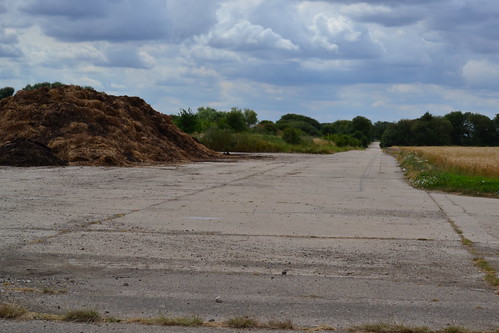
The secondary runway (N/E-S/W) disappears into the distance. This section is the only part in full width. The tree line marks the third E-W runway.

The 386th BG (M) were activated mid-war, on December 1st 1942 at MacDill Field, Florida, and arrived in England with their olive and grey B-26s in the following June. Their journey to Great Dunmow would take them via both RAF Snetterton Heath and RAF Boxted. For four months they would operate under the control of the Eighth Air Force, swapping in October 1943, to the 99th Combat Wing of the Ninth Air Force. Consisting of four Medium Bomb Squadrons: 552nd (code RG), 553rd (AN), 554th (RU) and 555th (YA), they would focus their attention on airfields, marshalling yards and gun batteries. Over the winter of 1943-44 they targeted V weapon sites, along France’s coast, and attacked enemy airfields during the ‘Big-Week’ campaign of February 1944.

During the Normandy invasion, they targeted bridges and Luftwaffe airfields, coastal batteries, fuel and munitions supplies, they preceded the allied forces as they moved inland; supported ground troops at Caen and St. Lo in July 1944, earning themselves a Distinguished Unit Citation (DUC) for their actions. As the allies moved deeper into France, they were then free to move to the continent allowing them to reach further afield and support the advance toward and into Germany itself.

A crashed B-26 Marauder (AN-J, serial number 41-31585) nicknamed

B-26 Marauder ‘AN-J’, (s/n 41-31585) nicknamed “Blazing Heat” of the 553rd BS, 386th BG, 23rd June 1944.  balances on its nose after making a crash landing at Great Dunmow. (IWM)

In total, the 386th would fly 257 missions from Dunmow, operating between 24th September 1943 and 2nd October 1944, in an aircraft that earned itself a rather distasteful name for being unreliable and difficult to fly. Later versions having both larger wingspans and flying surfaces, partly cured this problem, but in the hands of a good crew, they were deemed no more ‘dangerous’ than any other bomber of that time. In fact, a number of Marauders were known to return home in an incredible condition, after taking a substantial beating at the hands of both flak and fighter attention.

After the 386th left Dunmow, it was handed over to the RAF and the first unit to arrive was 190 Squadron (RAF) with the Stirling IV. Pulled out of bomber squadrons for its ‘poor’ record, they were used by various units for both mine laying activities and glider-tug operations. Arriving from Fairford they stayed here until July 1946 whereupon 190 Sqn was disbanded. During this time they also flew the Halifax III and later the Halifax VII – an aircraft that was proven in combat and also as a transport machine. With a history that extended back to the First World War, 190 Sqn operated as a Glider-tug unit taking Horsa gliders to a number of prestige targets;  both Normandy, during the D-Day invasion, and Arnhem during the ill-fated Rhine crossing of Operation Market Garden. They flew fuel and supplies to advancing troops and carried out a number of transport duties as the war drew to a close.

The changeover between the exiting Americans and the arriving British was seen as an ideal opportunity to gather ‘supplies’ by the locals. Many tins of rationed food and other ‘luxuries’ left by the U.S. airmen were deemed ‘fair-game’ and ‘removed’ in the intervening days. Dennis Williams*2 book ‘Stirlings in Action with the Airborne Forces’ describes in detail how the incoming airmen were surprised by the extent of the items left by the Americans.

Four days after 190’s arrival, 620 Sqn also arrived at Dunmow, along with all their respective Echelons. Like their partners, they also came from RAF Fairford flying the Stirling IV. A former bomber squadron, they cut their teeth at RAF Chedburgh, then in November 1943 they transferred across to the Airborne Forces. Also flying glider operations, they too swapped their Stirlings for Halifax A.VIIs in July 1945 before moving off to the Middle East post war. Similarly, 620 Sqn flew troops into some of the most dangerous war zones, losing a number of crews and aircraft along the way.

Both 620 and 190 Sqn returned to operations soon after their arrival, flying SOE operations, glider training sorties across the UK and dropping equipment into occupied territory. As can be imagined these dangerous operations were not without their problems. A number of aircraft were lost and even during training flights, losses were still incurred.

On the 21st November 1944, Stirling LK276 crashed killing all seven crew members. It was initially thought that the pilot either failed to read his altimeter correctly causing the aircraft to strike trees and power lines, or he took his attention away from the instruments in front. Subsequent reports however, show eye witnesses claiming to have seen a following night fighter. Again contradictions in statements were not helpful and no conclusive decision could be reached. The court of enquiry ruled that it was an accident and so the case was closed. Whatever the cause was, it was a major blow to the crews at Great Dunmow.

RAF Great Dunmow

The Administrative site is now used by the local farmer and small ‘industrial’ units. The crew briefing room (front) stands in front of the intelligence block. The main Operations block has gone but the station offices are still here.

Being so far south, Great Dunmow offered a safe haven for some returning bombers. On November 5th 1944, whilst on their return from mission 166 over Frankfurt, the 401st were diverted to the Great Dunmow as bad weather had closed in over Deenethorpe. An eye-witness account describes two B-17s ‘colliding’ on the runway, whilst other records suggest the two B-17s crash landed both suffering from extensive flak damage.  Records show one of them as B-17G ’42-102674′ flown by 2nd Lt. William F. Grimm  and the other as B-17 ’42-31662′ flown by 1st Lt. Leland R. Hayes. However this particular aircraft (42-31662) was known to be ‘Fancy Nancy IV‘ flown by Walter Cox which did not crash at Dunmow, going on to serve to the war’s end. As with many war records, it can be difficult ascertain total accuracy and an anomaly has occurred here somewhere.*3

Both 190 and 620 Sqns continued on in SOE operations, including their first to Norway on the night of November 6th/7th 1944.  Both operations were seen as failures but it would highlight the difficulties of flying for four hours to often heavily fog-laden environments and back again.

Poor weather dogged this part of the country especially in the early 1940s. The airfield was in a poor condition and a great deal of work had to be carried out to assist operations. Lighting, repairs to the runways and drainage were all severe problems and all needed urgent and immediate attention. Conditions therefore were not good. Successive cold winters and the continual mud, left some with very ‘unsavoury’ memories. Working in bitter cold weather outside certainly became a challenge for hard pressed ground-crews.

A number of operations involved Dunmow aircraft over the next few months, but they were mainly confined to practice flights towing Horsa gliders. Then in late March 1945, Operation ‘Varsity’ began. The drive into Germany required 21,000 troops, 1,800 transport aircraft and over 1,300 gliders. The base was sealed off from the outside world, only air-tests and spoof flights were scheduled, and then on the morning of the 24th March 1945 60 aircraft were lined up along the runways ready to go.

Anti-aircraft fire was heavy and conditions poor over the drop zone, but all 190 Sqn and 620 Sqn aircraft returned – some with damage. They seem to fair far better than the gliders though of which some 80% were damaged by flak – many severely.

Toward the end of the war, both squadrons dropped supplies and recovered POWs from the now free Europe. It was an emotional time for all but accidents and losses still occurred and crews still died.

In July 1945 620 Sqn received the Halifax A.VII and finally in January 1946 it would be all change for Great Dunmow. 620 Sqn were posted to Aqir in Palestine; 190 Squadron was disbanded and the unit renumbered as 295 Squadron and sent to Tarrant Rushton – this was the end for Great Dunmow. The airfield was used as a vehicle storage unit until 1948, at which point it was closed for good. The tower and major buildings were demolished, the concrete dug up for hardcore for the new road, and the remainder returned to agriculture, a state it survives in today.

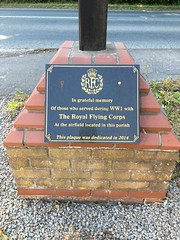
As with many airfields today, there is little left to see in the way of buildings and infrastructure at Dunmow airfield. A memorial stands alongside the B1256 road a few miles to the south side of the airfield site and an adjacent footpath takes you through what was the bomb store on to the airfield itself.  By driving from here to the village of Little Easton, you can more easily access the site from the northern side, by far the better option. Drive through the small village of little Easton, past the quaint village duck pond and on toward Little Easton Manor. Much of the grounds of the Manor were the accommodation areas and now as an estate once more, is (at the time of writing) up for sale for a cool £5,000,000.

Before arriving at the manor – which shows little of its aviation history – there is a small tourist sign and access to the adjacent fields. Stop here. The footpath to your left crosses the airfield utilising  much of the remaining perimeter track. This path is an old access road to the airfield and takes you up to the threshold of the former second runway (N/E-S/W).  It is a short walk but once there the full width of the runway can be seen, and when looking on, so to can the length (albeit cut short). The only part that is full width, the enormity of these tracks is staggering. The path then leads off to the west through the field strangely enough only feet from the usable but broken and much narrower perimeter track. At the end of this path, you arrive at the threshold of the third (E-W) runway. Now only a single farm track; the length is in its entirety but again standing at this point you can see how long the runways were. The path then crosses over the southern half of the airfield away to the south but there is little to be gained from taking this route, other than to know you have walked where many crews would have spent their time.  The dispersals that once stood here are now long gone and no trace remains of their existence.

If you continue east the path splits again and the one turning south takes you through the former bomb store and onto the afore-mentioned memorial. Now a quarry, the store is supplied by the perimeter track which is used by lorries to transport materials. Turning back on yourself it is possible to walk along the perimeter track back to your starting point. Along these paths are signs of the concrete that once carried the B-26s, Stirlings and Halifaxes, much narrower now, their significance little more than a farm track. Away to your right, was the former ‘dump’ or Marauder graveyard, where scrapped B-26s were left to rot.

Return to the road and walk from here west toward the lodge. After a few minutes you arrive at the former airfield entrance. The airfield sub-station marks the entrance and a footpath takes you along the road onto the airfield site. The technical area would be to your left and right, with one of the T2 hangars to your left. Follow the path as it crosses the field and you arrive where the tower once stood. There is no sign of it now, but the path takes you right though the spot where so many decisions were made and aircraft counted back. The path then leads on through the airfield and  joins the third (E-W) runway at its centre. largely overgrown with trees, the line is clearly evident, but again evidence of the concrete structure lay  scattered along the edges of this once gigantic pathway.
RAF Great Dunmow

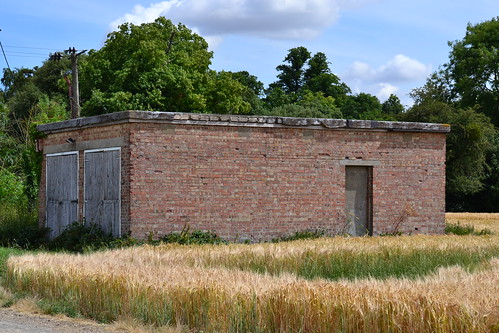
The airfield substation marks the airfield entrance.

Turn back again and through the technical area. Hovering over the tress to your left you will be able to see the current control tower and landing aircraft at Stansted airport – a mere stones throw away. Also to your left are a small group of farm buildings , amongst them a blister hangar that appears to have been moved here after the war. Beyond these and accessible from the roadway, a small collection of administrative buildings remain now used by the local farmer and as small industrial units. By walking along the road these are accessible and perfectly visible from the roadway.

The road from here continues on and takes you into where the  main accommodation sites once stood. Much of this is private land but traversed in places by small bridal ways and footpaths. Immediately opposite was the mess site 4 and further along the road the sick quarters. The remaining accommodation sites were to the north of here amongst the now dense forests that have replaced them. To the north of these woods was the sewage plant that once served the airfield. It has now been replaced by a more a modern unit but its location is still precise.   Various tracks lead into private land from here, but they are the original tracks for the various accommodation sites that once housed the crews and staff of this once busy base.

Return to your car and drive back to Little Easton stopping at the church  (St. Mary the Virgin). Inside at the back of the church on the north wall are two beautiful widows that commemorate the service of those stationed here at Great Dunmow – both RAF and USAAF. Primarily focusing on the USAAF, they depict a number of scenes – each reflecting the daily lives of the airmen. Some show them holding hands with the civilian children, others preparing for and returning from flight; Marauders in the ‘Missing man’ formation, and two hands clasped together as a sign of American and British unity – each one is beautifully presented and well maintained. One of the windows depicts ‘peace and tranquillity’, whilst the other called “The Window of the Crusaders”; depicts the role played by the 386th. Plaques, rolls of honour and information boards give great detail about the lives of those who were stationed here for those short periods during the Second World War.

August 2015 007

One of two stained glass windows in Little Easton church.

Great Dunmow served an important role during the Second World War. Today its historical significance is in no way played down. Whilst the majority of the airfield is now crops, ‘free access’ allows you to revisit those days of the Second World War, to walk in the footsteps of heroes, to experience the sight of a welcome runway as a returning bomber would. The huts and church windows stand as reminders of those who, whilst so young, gave their all in the name of freedom and democracy.

Notes and further reading

*1The Big House, was the former Estate of Frances, Countess of Warwick, who was regularly visited by the Prince of Wales, who later became King Edward VII. A railway halt was built outside the house to accommodate these visits.

*2 Williams Dennis, Stirlings in Action with the Airborne Forces, Pen and Sword Aviation, 2008 – this book provides an in-depth look at life within both 620 Squadron and 190 Squadron whilst at RAF Great Dunmow. It is highly recommended as a follow-up to the activities of these two units whilst here and abroad.

*3 See the 401st BG website for details of these aircraft and missions, including the original mission reports.

RAF Mattishall Airfield – Part of Trail 36

Following on from previous posts about Tydd St. Mary and Narborough airfields, RAF Mattishall was used by the same squadron, 51 (HD) Sqn to combat the threat from Zeppelin airships over the eastern counties of England. Now long gone and sadly relegated to the history books, we visit another airfield that played a role in the defeat of these once mighty airships.

RAF Mattishall.

Close by to RAF Swannington is the former RAF/RFC airfield at Mattishall, a few miles to the south beyond Attlebridge and its huge USAAF base. Closed at the end of the First World War, Mattishall saw detachments of 51 Squadron during the First World War. 51 (HD – Home Defence) Squadron had its headquarters at Thetford, with other flights at Harling Road, Narborough and Tydd St Mary. Flying a range of models, including both the BE2 and BE12 models; 51 (HD) Sqn had a mix spread across these airfields taking on the FE2b in both single and two variants later on in the war.

Intrusions by Zeppelins were more common in the earlier stages of the war, and the Home Defence Squadrons were created to counter-act them. Poor performance initially led to poor successes against these airships but that didn’t stop the determined young crews of the RFC and latterly the RAF. Toward the end of the war in 1918, home defence had been scaled back. However, as the newer Zeppelins, Gotha and Zeppelin-Staaken were able to fly at much higher altitudes, home defence squadrons needed a more able aircraft to combat them. In poured numbers of Sopwith Camels, SE5 and DH4s, but it was all a bit ‘too-little, too-late’ for the mighty airships that once ruled the skies.

During the last Zeppelin raid of the war on the night of August 5th/6th, 1918, RAF DH4s and Sopwith Camels attacked a small fleet of airships of the Norfolk coast. Inland the home defence squadrons were alerted and scrambled but the group of Zeppelins never made it in-land and flights from 51 Squadron at Mattishall were to play no part in their eventual downfall. Sadly Lt. Drummond from Mattishall flying in FE2b ‘A5732’ had to make a forced landing at Skegness, presumably as a result of engine trouble. This was to bring the night fighter operations to an end and with it the end of both 51 Sqn and RAF Mattishall.

The airfield was built close to Toll House Farm and had a range of facilities common to First World War airfields. A few wooden huts and two hangars were erected on-site and these proved to be the limit of accommodation on the 80 acre site. Post war, these were all sold off to local businesses and farms and the land returned to the farmer.

Now completely agricultural, Mattishall was once a hive of flying activity for a short period of the war, where flying bravely in open cockpits and without parachutes was common place. Sadly, Mattishall’s existence has disappeared into the history books and it is no more.

A short history of Mattishall along with some personal accounts can be found here.

Mattishall is can be found in Trail 36 – North Norfolk (Part 6).

RAF Tydd St. Mary

Just over the Cambridge border into the area known today as South Holland in Lincolnshire, is a field that was a small airfield during the First World War. Designed for home defence, it was used for attacking marauding Zeppelin airships approaching England across the North Sea. Larger towns and cities such as Norwich and Lincoln were prime targets, although most designated targets were much further north for example Manchester and Liverpool. To protect themselves, the crews of these mighty airships flew at night and at altitude, but navigation skills were poor and crews were generally unaware of their actual location. As a result, they rarely made it beyond the eastern counties or the Fens of Cambridge and Lincolnshire. Because of poor weather and inexperienced pilots flying against these ships, some Zeppelins were able to wander – at the will of the weather – for as much as 10 hours unabated, randomly dropping bombs on what they considered to be ‘prime targets’.

A major turning point in this air-war, was the night of January 31st 1916 when nine Zeppelins of the German Navy attacked what they believed to be the industrial north-west. In fact they had barely got beyond the lower regions of Lincolnshire before dropping their ordnance. These attacks resulted in the loss of sixty-one people and whilst no British fighter was known to have engaged the airships, a number of Royal Flying Corps (R.F.C) crews were lost due to bad weather.

This disastrous night led to major changes in the Home Defence Squadrons of the R.F.C and R.N.A.S (Royal Naval Air Service), a process that would take a considerable time to complete.

As a part of these changes, an airfield was developed just south of the South Holland Drain a mile or so north of the village of Tydd St. Mary.

RAF Tydd St. Mary

Designed as a class 1 landing ground, Tydd St. Mary covered 125 acres by the time it closed in 1919. Development of the site began in mid 1916 following the re-organisation of the home defence force, but the first units didn’t arrive until the autumn of 1917. Not much more than a field, it did eventually have a small number of  Bessonneau*1 hangars and a small selection of crew huts.

The main unit to use Tydd St. Mary was 51 Home Defence (HD) Squadron whose main flight was based at Thetford. Formed from the nucleus of 9 Reserve Squadron (RS) on 15th May 1916, they moved to Hingham with flights dispersed at Harling Road, Norwich (‘A’ Flight), Mattishall (‘B’ Flight), ) and Narborough (‘C’ Flight). Initially they were equipped with the BE2c, which were soon replaced by the BE12 and subsequently the FE2b aircraft and then the BE2e in December 1916.

For a short while Zeppelin intruder flights were rare and this breather allowed for extensive practice flights by both 51 (HD) Sqn and their partner unit 38 (HD) Sqn who were based a little further to the north.

This lull in movements ceased in the autumn of 1916, when a large formation of Zeppelins gathered over the wash and headed for London. Badly hindered by fog and bad weather, they were eventually scattered across the southern and eastern regions of England where they dropped their bombs on remote farmland. This attack caused no damage to property, nor were the Zeppelins challenged in any major way – the marauders had little to worry about other than poor weather. Patrols by 51 and 38 (HD) Sqn’s were in vain, a pattern that was to continue for the large part, for the duration of the war.

At the end of 1916, Tydd St. Mary was re-designated a Night Landing Ground (NLG) following the renaming of R.F.C Home Defence Stations. 51 (HD) Squadron would soon fly from here in the defence of the eastern counties.

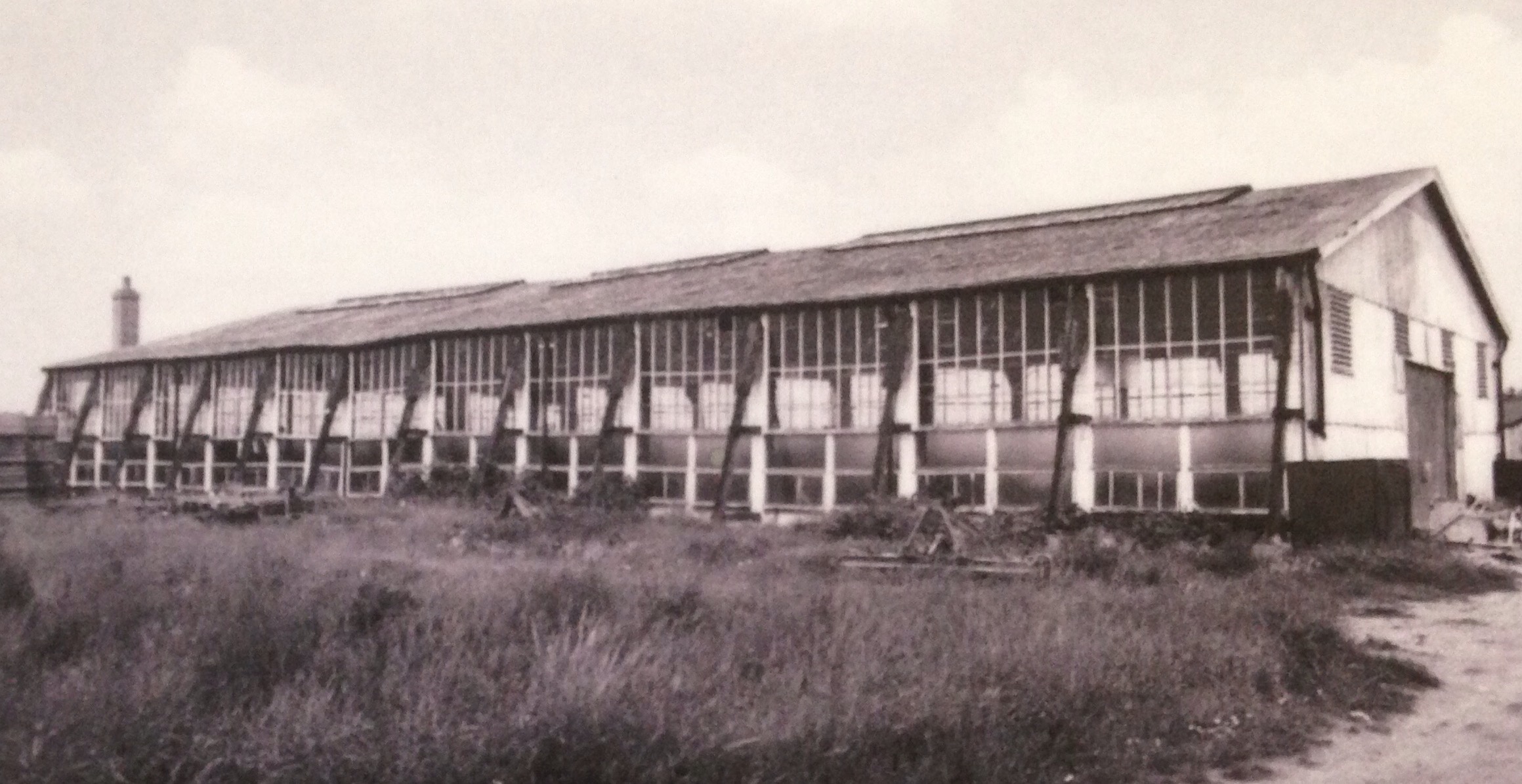
51(HD) Sqn aircraft hangar modified for agricultural use post war.*2

The Zeppelins main advantage over the British was the poor performance of the aircraft types the R.F.C used.  Whilst capable of operating at the 8,000 – 10,000 ft altitude used by the Zeppelins, many aircraft simply took too long to get there and thus could not reach the airship in time to attack it.

As performance improved along with the development of the explosive ammunition that would ignite the airship’s gases, the odds were a little more balanced and larger numbers of airships were being brought down over the eastern region. The tide was turning and pilots of 51 (HD) Sqn were playing a large part in this.

In the early part of 1917  cuts to the Home Defence units were announced based on the increasing gains made by units of the Norfolk / Cambridge / Lincoln squadrons. But the Germans had not given up yet. Reductions in weight enabled new Zeppelins to reach greater altitudes. Now capable of 16,000 – 20,000 feet, few British defences could reach them.

As the tide was turning in France, attacks became fewer and fewer. These high altitude flyers were more at the mercy of the bitter cold and poor weather than defending aircraft.

In August 1917 51 (HD) Sqn moved their headquarters to Marham, and ‘A’ Flight arrived at Tydd St. Mary and 51 (HD) Sqn began replacing their BE2e aircraft with the Martinsyde G.100 ‘Elephants’ – so-called because of their size and poor manoeuvrability.

A large contingent of airships gathered once more on the night of October 19th 1917, requiring extensive sorties by 51 (HD) Sqn at Tydd St. Mary and her counterparts. Whilst a determined effort was made by the R.F.C crews, they had little or no impact, and the gathered airships made off only to be badly beaten by bad weather and anti-aircraft fire over France.

Further changes to R.F.C Squadron designations  in the latter parts of 1917/18, dropped the title ‘Home Defence’ and Tydd St. Mary became the base for 51 Sqn ‘A’ Flight in Eastern Command. Aircraft by now were primarily Royal Aircraft Factory FE2bs, although 51 Sqn were now replacing some of their ‘Elephants’ with BE12b variants which they kept until the autumn of that year. Further changes in February 1918 meant that ‘A’ Flight moved to Mattishall, whilst ‘B’ Flight took their place at Tydd St. Mary.

As the R.F.C turned into the R.A.F on April 1st 1918, Tydd St. Mary would once again become significant. On the night of April 12th 1918, Zeppelin L62 was sighted close by and aircraft took off to intercept. As it was dark at 22:00 the flare path was lit to assist the now R.A.F crews, which openly guided L62 directly onto the airfield. Gliding above the site, L62 dropped a small number of incendiary bombs onto the aerodrome in an attempt to damage or destroy aircraft on the ground. Fortunately the bombs fell well away from parked aircraft and caused no damage to either buildings or aircraft. Pursuit was made by Lt. F. Sergeant in FE2b ‘A5753’, but to no avail and he returned to base empty-handed. Other pilots also tried to catch L62, some crashing due to engine failure, but many simply weren’t able to catch-up with the intruder. Eventually L62 reached the coast and made a break for it across the sea under the protection of yet more bad weather.

By November 1918 the final FE2bs had been relinquished and for the remainder of the year and into May 1919, 51 Sqn operated Sopwith Camels. A move by ‘B’ Flight in May to Suttons Farm (RAF Hornchurch) not only signified the end of the Camels (replaced by Sopwith Snipes) but the end of 51 Squadron who were disbanded in June. This departure also meant the end of Tydd St. Mary and in November 1919 notice of closure was given and the site finally closed in January 1920.

Tydd Gote Village sign

The village sign at Tydd Gote, remembers the RFC from the airfield at Tydd St Mary.

At its height Tydd St. Mary covered an area of 125 acres, and contained two Home Defence flight sheds as single units (believed to measure 130 x 60 ft). These were utilised by local farmers and business and lasted for many years. Other buildings were also utilised, the last, believed to be the Flight Office, is thought to have been demolished as late as 2009.

Not a major player in the war and never to return to aviation, Tydd St. Mary is a notable site and perhaps when passing, a second thought for those who flew from here in defence of the Eastern counties, should be offered.

Tydd St. Mary forms part of Trail 37.

Sources and Further Reading

*1 Early Bessonneau hangars were constructed of wood covered in canvas. Various types were made and were designed to be erected by small trained groups of men. Later models replaced wood with metal and were more permanent.

*2 Photo on display at Thorpe camp, Woodhall Spa.

Goodrum, A. ‘No Place For Chivalry: RAF Night Fighters Defend the East of England Against the German Air Force in Two World Wars‘. 2005, Grub Street

The Great War Forum – website 

RAF Narborough – Norfolk’s first Airfield.

Resting not more than a mile or so from the boundary of RAF Marham, is an airfield that never made it beyond the First World War – but it played such a major part, it should never be forgotten. Opened originally as a satellite by the Royal Naval Air Service, it became the biggest First World War airfield and led the way for the aviators of today’s Royal Air Force.

RAF Narborough

Built as the largest, aircraft based, World War One aerodrome, Narborough was known under a range of different names. The most common, ‘The Great Government Aerodrome’ reflected not only its size but also its multi-national stature and its achievements in aviation history. Used by both the Royal Naval Air Service (RNAS) and the Royal Flying Corps (RFC) it would also have names that reflected both these fledgling services.

Designed to counteract the threat of the German Zeppelin and Schütte-Lanz airships, Narborough was initially used by the RNAS as a satellite station to RNAS Great Yarmouth. No crews were permanently stationed here, but ‘on-duty’ crews would fly in and await the call to arms should a raid take place over East Anglia.

The first recorded arrival was in August 1915; an event that would keep the site in use by the RNAS for the next ten months before being designated as surplus to requirements, and handed over to the RFC in June 1916.

Used as a training ground, accommodation was basic to say the least, being described as a “desolate God-forsaken place”*1 buildings needed to be erected for accommodation, training and maintenance. A total of seven Boulton and Paul hangars and up to 150 buildings would be built on the site over the next two years. By the end of the war, some 1,000 personnel would be based at Narborough – a number comparable with any modest Second World War airfield.

As the First World War raged on the European continent, the use of aircraft was seen as a new way to monitor, kill and record enemy troop movements; it would develop into a lethal weapon and a very potent reconnaissance vehicle. Training programmes were rushed into place, and Narborough would become a preparation ground for new recruits. With training considered basic by today’s standards, recruits had to pass a series of tests before being sent to the France. Written examinations followed up by twenty hours solo flying, cross-country flights and two successful landings, were followed by flying for fifteen minutes at 8,000 feet and landing with a cut engine. These daring young men, many who were considered dashing heroes by the locals, would display their skills for all who lined the local roads awe-inspired by their antics.

Life was not always ‘fun’ though. Accident rates were high and survival from a crash was rare. Some 15 graves lay in the local church  at Narborough, all young men who never made it through the training and on to the battle in France.

The occurrences of these accidents were so frequent, that one instructor, W.E. Johns, creator of ‘Biggles’ cited spies as the cause of many ‘accidents’ – tampering with machines causing the deaths of the crews on board. Johns, himself having written of many machines, believed Americans with German sounding names were to blame for aircraft breaking up in mid-air or crashing at the bottom of loops. More likely, the fault lay with over exuberant or poorly trained recruits.

Narborough as a training station would operate a wide range of aircraft. The French designed Henry Farman F.20, a military reconnaissance trainer, would operate with 35 Squadron from June 1916 until October when they were replaced by the Armstrong Whitworth FK8; 35 Sqn moving to France with these aircraft in January 1917.

The first full squadron to be formed here was 59 Sqn on 21st June 1916. Born out of 35 Sqn, they would operate Avro’s 504K followed by the second French design, the Maurice Farman Shorthorn; named so because of the length of the skids designed to prevent recruits overturning the aircraft on landing. After these came the BE2c, BE12 and RE8s, before the squadron moved to St-Omer in February 1917.

It was during this year that 83 Squadron would be born out of 18 Reserve Squadron (RS) operating various aircraft in the training role. They arrived at Narborough during December that year with FE2bs before they themselves moved to St-Omer in March 1918.

As the war drew to a close, one further squadron was formed at Narborough; 121 Squadron on New Year’s Day 1918. Whilst originally formed to fly the DH9, they actually used a variety of aircraft before being moved to Fliton and eventual disbandment on 17th August 1918.

Three other units would pass through Narborough before it closed. Now part of the Royal Air Force, 56, 60 and 64 Sqns would all come here as cadres in February 1919. 64 Sqn disbanded here in the following year, whilst both 56 and 60 Sqn moved to Bircham Newton and onto disbandment.

The end of the war saw the closure of Narborough. But unlike its sister station RAF Marham a mile or so away, it would remain closed. The buildings were all sold off in what was considered to be one of the biggest auctions in Norfolk, with some of them going to local farmers, small industrial units, schools and the like. Some of these buildings still exist at various places around the local area today but many have long since succumbed to age and inevitable deterioration.

Narborough itself having no hard runways or perimeter tracks has long since gone. A small memorial has been erected by a local group aiming to promote and preserve the memory of Narborough, a memorial plaque also marks the fifteen graves of those who never made it to France; and the small Narborough Museum & Heritage Centre holds exhibits of 59 Squadron in the local church.

Significant not only in size, but in its history, Narborough has now been relegated to the history books. But with the dedication and determination of a few people the importance and historical significance of this site will hopefully continue to influence not only the aviators of tomorrow, but also the public of today.

The memorial to those who served at Narborough.

Sources, Links and Further Reading.

*1 letter from 2/AM C. V. Williams from 59squadronraf.org.uk

C.G. Jefford, RAF Squadrons, Airlife Publishing limited, 2001

The Narborough History Society cane be visited through their website.

The Narborough Airfield Research Group tell the history of 59 Squadron at Narborough, this includes personal notes and details of the Narborough airfield.

Air Crew Memorials – Sgt R. C. Land (RAFVR)

Young men who died in service for their country, may their memories last forever.

On February 4th 1943, Lancaster III, ED496, ‘WS-P’ of No. 9 Squadron (RAF) took off from its base at RAF Waddington, Lincolnshire. On board were the crew members: Sgts Land, Packer, Gullery, Levesque (RCAF) and McGonigal all of the RAF (VR). This was to be a routine test flight for the crew, but it would end tragically for all those on board.

February 1943 was one of the mildest on record, experiencing low snowfalls and warmer temperatures across the country. However, on the fourth, particularly low temperatures were recorded, and during the night many aircraft on operations turned back due to associated icing problems. During that month there was a very low seasonal rainfall, particularly around Lincoln and the east coast area; with prevailing south-westerly winds, the weather was considered to be ‘fair’.

Lancaster WS-P took off on a routine air test, it was to undertake a number of circuits carrying out practice landings testing on-board equipment aiding such manoeuvres. At 16:00, the aircraft dived in to the ground crashing at Scopwick, north of Sleaford, Lincolnshire. With all its four engines still running when the aircraft struck the ground, the resultant crash led to an inevitable explosion and fire killing all on board. Whilst Sgt Land’s body was thrown clear, the remaining crew members were not and they remained trapped inside. The force of the crash buried the aircraft  deep in to the peaty Lincolnshire soil, rendering any recovery virtually impossible.

The crash was investigated by the Air Investigation Branch and their findings summarised in report W1458; but whilst no firm conclusions were drawn, it is believed that ‘structural failure’ of the air frame was to blame for the accident.

The aircraft and bodies remain in the ground to this day and a small monument has been erected in their honour. Sgt Land’s body was taken to Weston Longville, Norfolk, where he was buried in the grounds of All Saints Church. His companions are all honoured at the Runnymede Cemetery, Surrey.

The crew of Lancaster WS-P were:

Sgt Charles Richard Land, (s/n 1332099)
Ronald Jack Packer (s/n 901009) (Panel 160)
Sgt  Hugh Francis Gullery, (s/n 1378136) (Panel 151)
Sgt Joseph Thomas Levesque (RCAF) (s/n R/55503) (Panel 183)
Sgt Francis Victor McGonigal, (s/n 1554452) (Panel 157)

Sgt. CR Land,

Sgt Land is buried in the grounds of All Saints Church, Weston Longville, Norfolk.

Do you know about 455 Sqn – A Request For Information

Hello everybody, I was recently asked to help research the details surrounding the death of a reader’s grandparent lost during World War II while flying operationally. The operation in question concerns No.455 Squadron Royal Australian Air Force attached to RAF Coastal Command flying Hampden TB.Is and took place on January 11th 1943. The information I […]

https://defenceoftherealm.wordpress.com/2016/07/01/a-request-for-information/

F/O. Edwin C. Gardner, RAF Hemswell, 61 Squadron

One of many young men killed in the Second World War whose stories deserve to be told.

F/O E Gardner

Flying Officer E. Gardner, RAF(VR)

Flying Officer Edwin Charles. Gardner (s/n 72558) was stationed at RAF Hemswell with 61 Squadron flying Hampden Mk.I bombers. He was part of the RAF(VR) and was killed 17th October 1940 age 24.

61 Sqn (RAF), a former World War I unit,  was re-formed on March 8th 1937 at RAF Hemswell as a bomber squadron flying Audax aircraft. Over the next two years they would transition through a number of makes – Anson Mk I and Blenheim Mk I eventually equipping with the Handley Page Hampden in February 1939. They were formed as part of No. 5 Group, Bomber Command, and would take part in several prestige operations. During the early part of the war they would carry out the very first attack on a German land target, (Hornum, 19th/20th March 1940), the first major bombing raid on the German mainland (Monchengladbach, 11th/12th May 1940), and take part in the first RAF bombing raid on Berlin on the night of August 25th/26th 1940.

It was two months after this, that Flying Officer Gardner would lose his life at the age of 24.

Gardner’s aircraft, X-2979, QR-? took off around 18:00 to attack the German city of Merseburg. They would form part of a 73  strong formation made up of both Wellington and Hampden aircraft, attacking a number of targets at: Bremen, Kiel, Bordeaux and the Harz Forest, intending to set it alight with incendiaries. The force included aircraft from a number of squadrons that night.

With F/O Gardner were the Pilot – Pilot Officer William Herbert Clemenson (s/n 81027), Wireless Operator – Sgt William Hutchinson Hewitt (s/n 822581) and Sgt Dominick Flanagan (s/n 532927), the air gunner on board the aircraft.

The force attacked their designated targets successfully, returning home to the respective bases after having suffered very lightly (3 aircraft in total) over the target areas. On the return trip however, they encountered dense fog which, combined with technical problems with a number of aircraft, caused 10 Hampdens and 4 Wellingtons to crash, many with loss of life.

Reports show that Gardner’s aircraft contacted Hemswell twice in the early hours of the Thursday Morning to gain fixes on their positions. Possibly out of fuel, the aircraft finally came down at Sporle, a few miles west of Norwich, killing all four crew, members.

Flying Officer Gardner was laid to rest at All Saints Church Tacolneston, Norfolk a few miles west of Norwich. His companions were returned to their respective parishes. His grave stands alone in a quiet corner of this 13th Century church. May he rest in peace.

‘Death is Swallowed up in Victory’

Sources

Chorley. W.R., Bomber Command Losses Vol I, 1939-40, Classic Publication, 1992.

Church Memorial Honours 28 Airmen

The skies of East Anglia were once busy and alive with the throbbing of radial and piston engines. The dangers of war were constant, and until aircraft were safely on the ground,  danger and risk were always present. This is no more evident than in the large All Saints Church, Carleton Rode, Norfolk.

Although not strictly speaking in Carleton Rode, All Saints Church houses a plaque that is dedicated to the crews of  four aircraft that collided in two separate collisions over the parish during the Second World War.

The Church itself is a historic building dating back to the 13th Century. It was modified in the 19th Century following a collapse of the tall tower. This restoration work gives the visitor the impression that this large church was a built with an unnatural small tower, but this was not so.

All Saints Carelton Rode

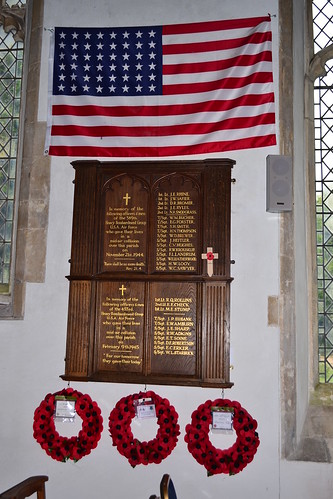
The memorial board at All Saints Church, Carleton Rode, gives the names of those who died in the two collisions. The top board contain the names of the 389th BG; the bottom, those of the 453rd BG.

The memorial itself hangs on the north wall inside All Saints, along with wreaths presented by local organisations including representations from the American base at RAF Alconbury.

The two collisions occurred on separate occasions and involved aircraft from both nearby RAF Hethel and RAF Old Buckenham.

Both incidents involved crews of the 2nd Air Division, Eighth Air Force. The first took place on November 21st 1944, followed a few months later, on February 9th 1945, by the second. The casualties of the first, were from the 566th BS, (389th BG) flying from RAF Hethel, and the second involved crews from the 734th BS, (453rd BG (H)) flying from RAF Old Buckenham. In all 28 airmen lost their lives in these two very tragic accidents.

The 566th BS were activated Christmas Eve 1942, and were assigned to the 389th BG, Second Air Division, Eighth Air Force. On arrival in England they were sent to RAF Hethel (Station 114) in Norfolk where they would participate in the air campaign over occupied Europe.

On November 21st 1944, the 389th were preparing for a mission to bomb the oil plants at Hamburg, Germany. Liberator B-24J, s/n 42-50452  ‘Earthquake McGoon’*1, piloted by Lt. Alfred Brooks took off to formate high above the Norfolk countryside. A second Liberator, B-24J, s/n 44-10513, piloted by 1st Lt. J. E. Rhine took off to join the same formation. The entire raid would involve a colossal 366 B-24 ‘Liberators’, along with 177 fighter-escorts involving both P-47 ‘Thunderbolts’ and P-51 ‘Mustangs’ – a formidable number of aircraft to have in the sky at any one time.

As the aircraft were joining the formation, the two B-24s collided, resulting in both aircraft crashing to the ground. Brooks was the only survivor from his aircraft, whilst there were only two survivors from ‘10513’. In total seventeen of the aircrew died that day in the resultant crash.

The crew who lost their lives that day were:

1st Lt James E. Rhine, s/n: 0-820824, *
1st Lt J.W.  Safier.
2nd Lt D.R. Bromer.
2nd Lt J.E. Ryles.
2nd Lt. N.R. Snodgrass
Tech/Sgt. William M. Bucher, s/n: 36814876, *
Tech/Sgt. E.G. Forester
Tech/Sgt. Stanley H. Smith, s/n: 11082353, *
Tech/Sgt. Harold M. Thompson, s/n: 39092072, *
Staff/Sgt. Walter D. Brewer, s/n: 34872455, *
Staff/Sgt. Julius Heitler, s/n: 42041178, *
Staff/Sgt. Carl V. Hughes, s/n: 34021953,*
Staff/Sgt. R.W. Krouskup
Staff/Sgt. F.L. Landrum
Staff/Sgt.  W.E. Leatherwood
Staff/Sgt. H.W. Looy
Staff/Sgt. W.C.Sawyer

*Seven of these men are buried in the Cambridge American Cemetery, five of whom were presented the Purple Heart.

All Saints Carelton Rode

A small window also remembers the 17 men killed in November 1944.

The second incident occurred on February 9th 1945, and involved two aircraft from RAF Old Buckenham.

The 734th BS flew as part of the 453 BG, 2nd Air Division, Eighth Air Force. They were activated on 1st June 1943, moving to England during the December of that year. Their trip took them from Wendover Field, Utah, to Idaho, California and onto Old Buckenham. Throughout the war they would operate as  a strategic bomber group attacking many high prestige targets across Germany.

On February 9th 1945, two B-24s, 42-95102, ‘Spirit Of Notre Dame‘ and 42-50703 ‘Worry Bird‘ took off as part of a 313 strong force of B-24s to attack the Rothensee oil plant at Magdeburg, along with any targets of opportunity. Escorted by 151 P-51 ‘Mustangs’, they successfully bombed the target using H2X and returned home.

As the bombers were approaching Old Buckenham, the two aircraft collided and ‘Worry Bird‘ crashed in a fire-ball, within a mere hundred yards of the runway. ‘Spirit Of Notre Dame‘ on the other hand recovered from the collision making a safe landing at Old Buckenham. In the resultant crash, all 11 crews members of ‘Worry Bird‘ tragically lost their lives.

The crew of ‘Worry Bird‘ were:

1st Lt. RQ.Rollins
2nd Lt. Earl E. Check, s/n: 2005832, *
1st Lt. Max E. Stump, s/n: 0-718979, *
Tech/Sgt. J.P. Eubank
Tech/Sgt. E.W.Amburn
Staff/Sgt.J.E.Sharp
Staff/Sgt.R.W.Adkins
Staff/Sgt. E.T Soine
Staff/Sgt. D.E.Robertson
Staff/Sgt. E.C.Erker
Staff/Sgt. W.L. Starbuck

*Two of these men are buried in the Cambridge American Cemetery, one of whom was presented the Purple Heart.

This memorial reminds us of the dangers faced on a daily basis by young crews of the armed Air Forces during the Second World War. On these two days, 28 young men lost their lives in tragic accidents, that left a lasting scar on not only their bases, but their families and the local communities as well.

Notes:

All the crew members who lost their lives are remembered in the Saint Paul’s Cathedral Roll of Honour.

*1 in some references the aircraft name is given as ‘Earthquake Magoon‘.

Small but significant – RAF Collyweston

This airfield is the most northerly one in Cambridgeshire. It borders two counties and has its origins as far back as World War I. It was a small airfield, but one that played a major part in both the First and Second World Wars. It sat only a short distance from its parent airfield, an airfield that became so big it absorbed it. Today we visit the airfield that was RAF Collyweston.

RAF Collyweston

Throughout their lives, both airfields would go through a number of dramatic changes, especially as new ideas, concepts or advancements in technology were made. The biggest initial change may have been as a result of Major Smith-Barry of 60 Sqn (RFC), when he came up with the ‘revolutionary’ idea of teaching people to fly rather than allowing them to prove it! Widely accepted and quickly adopted, it led to the creation of a series of new and unique RFC Training Depot Stations (TDS). The idea behind these TDSs, was to train new pilots from the initial stage right the way through to gaining their ‘wings’ – all in one single unit; a philosophy that would change the way the Air Force would operate for a very long time.

Initially the two airfields ran independently from each other, Stamford airfield (later RAF Wittering) opened in 1916 operating as a Royal Flying Corps base for No 38 Home Defence Sqn’s anti-Zeppelin unit. It operated both the BE2C and BE12 fighters. The following year in 1917, it changed to the No 1 Training Depot Station (Stamford), then as a result of the formation of the Royal Air Force on 1st April 1918, it was finally re-named RAF Wittering.

RAF Collyweston was located to the western end of Wittering, and opened on 24th September 1917, as No 5 Training Depot Station under the name of Easton-on-the-Hill. It operated a number of training aircraft including: DH6s, Sopwith Camels, RE8s and Avro’s 504. It was also renamed with the formation of the RAF and became known as RAF Collyweston. It continued in the training role until after the war when the squadron was disbanded and the airfield was closed.

Photograph of Wittering airfield looking east, taken 9th May 1944. Collyweston can just be seen at the bottom end of the main runway. (USAAF Photography).

Two years after the outbreak of World War II, Collyweston was re-opened as a grass airfield, a satellite to its rather larger parent station RAF Wittering. By the end of 1944 it would have a total of 4 blister hangars and would be used by a wide range of aircraft.

On May 14th 1940, the first aircraft would arrive, not permanent residents, but a detachment of Spitfire Is of 266 (Rhodesia) Squadron whose main units were based at RAF Wittering. They would stay here only temporarily but return in 1941 for a full month with Spitfire VBs.

Later that month on the 31st of May 1940, the first permanent residents did arrive, Blenheim IFs of 23 Squadron, who would share the night-fighter role with Beaufighters from RAF Wittering. These Beaufighters were using the new and updated AI MK IV radar, a new model that was so heavy and cumbersome, few aircraft could accommodate it. The new radar was introduced in conjunction with Ground Controlled Interception Techniques (CGI) aimed at locating and ‘eliminating’ enemy aircraft at night. The Blenheims – considered too poor for daylight fighter duties – and Beaufighters would prove their worth operating across the Midland and Eastern regions, eventually flying over to the continent later on in the war. After three months of operations from Collyweston, 23 Squadron would completely move across to Wittering leaving Collyweston empty once more.

Then on 28th September 1941 the infamous 133 ‘Eagle‘ Squadron manned by American volunteers arrived with their newly acquired Hurricane IIBs. Armed with four potent 20mm canons, they were a force to be reckoned with. This was however, only a short one week stay at Collyweston, and the ‘Eagles’ moved on to RAF Fowlmere leaving their indomitable mark on this quiet Cambridgeshire airfield.

At the end of September 1942, Spitfire VBs of 152 (Hyderabad) Squadron would pass though, staying for three days whilst on their way to Wittering, then North Africa and eventually Malaya. Battle hardened from the Battle of Britain where they had been covering the English Channel and the south coast, they were now non-operational as they began preparing for their move overseas.

Embry (right) was to devise a plan to join RAF Wittering and RAF Collyweston. (Photo Wikipedia)

There then followed a period of change. 288 squadron flying Spitfire VB and IXs would yo-yo around a number of different airfields whilst keeping a detachment at Collyweston. Initially based at Digby, they would be spread over six different airfields (Church Fenton, Duxford, Wittering, Coltishall, Bottisham and Collyweston) creating what must have been a logistical nightmare. The Spitfire would perhaps be their most potent and graceful aircraft which they operated from January to March 1943, before replacing them with Airspeed Oxfords and then Martinets. Moving the main section to Coleby Grange and then Digby, a detachment would remain at Collyweston until the main squadron arrived here in January 1944 – still spread across 6 airfields. In March 1944, 288 Sqn replaced the Martinets with Beaufighter VIs which in turn were replaced with the Vultee Vengence MK IVs in May 1945. After this the squadron moved on and to eventual disbandment in 1946. Throughout their time as an operational unit, they provided anti-aircraft co-operation duties for gunners, flying across the north-eastern regions of England.

It was during 1943 that 349 (Belgium) Squadron would reform at Wittering, with Spitfire VAs. They had previously covered ‘defensive duties’ in North Africa using the American built ‘Tomahawk’ , a role that lasted for a short five month period. In June 1943 they reformed, moved from Wittering to Collyweston and then on to nearby RAF Kings Cliffe.

After concerns were raised by the then Group Captain Basil Embry DSO, DFC, AFC, about the high number of accidents at Wittering, a proposal was put forward, and agreed, to merge the Collyweston and Wittering grass runways. A remarkable feat that was accomplished not by the Ministry but under the direction of Embry himself.   By the time the work was completed, Wittering had a much longer 3 mile, well-lit, runway capable of taking crippled heavy bombers. This move was to really signal the end of Collyweston as an airfield in its own right and apart from a short detachment of Austers belonging to 658 Sqn, all major operational activity ceased.

Collyweston would however have one last ‘claim to fame’. The 1426 (Enemy Aircraft) Flight,  would operate captured Luftwaffe aircraft in RAF markings. Once new models were found and evaluated, they would be passed on to the flight to be paraded around the country giving ground and flying demonstrations to allied aircrews. Whilst perhaps considered a ‘glamorous’ role, this was fraught with danger, many aircraft crashing with fatal results. On 10th November 1943, Heinkel He111 H-1 ‘1H+EN’ crashed  at the Northampton airfield, RAF Polebrook, killing the pilot and four passengers, and injuring four others.  1426 Flight ceased operations at Collyweston on January 17th 1945, being reformed later that year at Tangmere.  Some of these Luftwaffe aircraft were later scrapped whilst some like Ju 88 R1 ‘PJ876’, have thankfully found their way into museums  such as the Imperial War Museum at Hendon.

With the disbandment of 1426 Flight, Collyweston’s fate had been sealed and it was now officially closed becoming fully absorbed into RAF Wittering.

A captured RAF Messerschmitt Bf 109 (serial number NN 644) with a B-17 Flying Fortress of the 379th Bomb Group at Kimbolton, 8 January 1944. Passed for publication 8 Jan 1944. Handwritten caption on reverse: 'USAAF 36.' Printed caption on reverse: 'Strange Bedfellows. Associated Press Photo Shows:- Rivals in the air battles over Europe, a B-17 Flying Fortress and a German Me109, are here seen together at a U.S. Heavy Bomber Base

A captured RAF Messerschmitt Bf 109 (serial number NN 644) with a B-17 Flying Fortress of the 379th Bomb Group at Kimbolton, 8 January 1944. (IWM)

Remnants of Collyweston have all but disappeared. The original site now forms part of what was Wittering’s huge bomb store. No longer used, it has been the venue for many illegal raves, vandalism is rife and the site has been stripped of cabling and other materials. Whilst there are various ‘urban explorer’ videos on You-Tube, it is completely private land and kept behind locked gates. All other traces are well within the boundary and high fences of Wittering airfield, whilst not openly guarded at this point, it still remains an active military site.

Collyweston’s life had been short but notable. A variety of aircraft had graced its runways; it played a major part in the training of crews of the once fledging Royal Air Force, and had been the new home for numerous captured enemy aircraft. A range of multi-national units passed through its gates, either on their way locally or to foreign lands. It fought bravely, competing against its larger more prominent parent station, it was never really likely to survive, but perhaps, and even though Wittering has ceased operational flying activities, the legacy of Collyweston might fight for a little while yet.