Spitfires Galore! – RAF Ludham (Part 2)

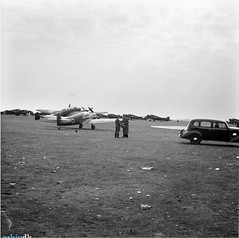
In Part 1 we saw how Ludham began its life and how things got off to a slow but steady start, the period April to August 1942 being  pretty much along similar lines, routine patrols, shipping reconnaissances and scrambles. But the autumn signifies the beginning of many changes here at this Norfolk airfield. First however, the resident Spitfire squadron, 610 Sqn, would take part in one of the Second World War’s more famous failures.

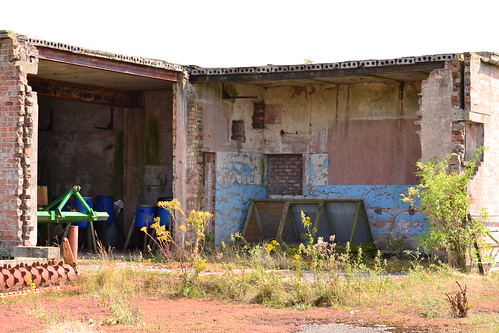
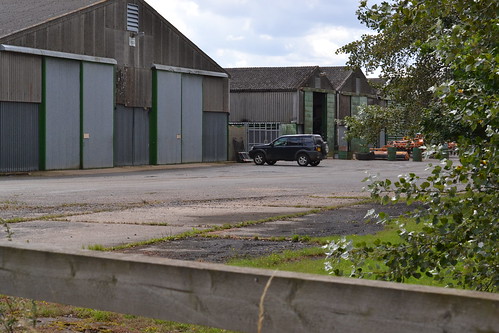
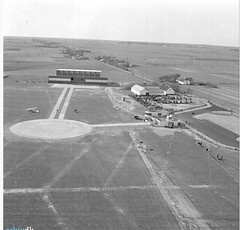
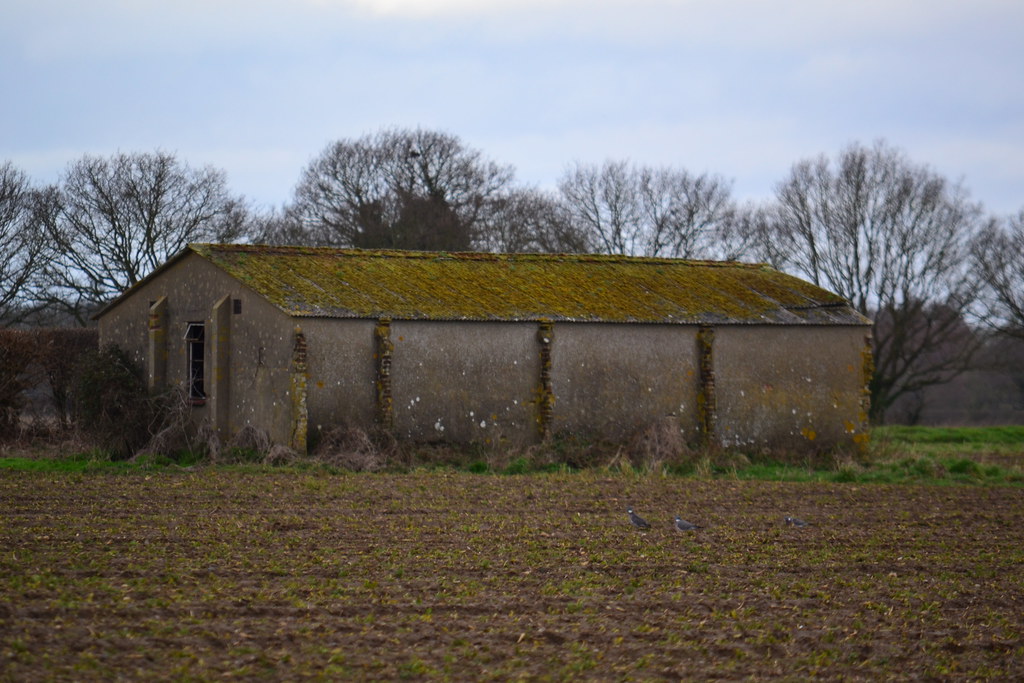
Ludham airfield

One of several buildings located around the perimeter of the airfield.

On August 16th, a need arose for fighters to bolster 11 Group for ‘Operation Jubilee‘ –  the raid on Dieppe by allied forces, primarily Canadian. The raid was supposed to achieve a number of objectives, but only one was successful, the main force being held on the beach where vehicles became bogged down in the shingle. 610 Sqn formed part of the aerial umbrella, along with 411 Sqn and 485 Sqn who all jointly formed the 12 Group wing flying from a temporary base at RAF West Malling. On the previous night to the raid, the 19th, ground crews were busy at West Malling fitting long range drop tanks to the Spitfires which according to the ORB, “proved their worth on this occasion“. During the air battle, which raged between the Spitfires, Typhoons and around fifty Me 109s and FW 190s, 610 Sqn claimed two 109s along with one FW 190 as destroyed and two FW 190s as damaged.  Three of 610 Sqn’s aircraft went down, one of the pilots Flt. Sgt. Creagh, being picked up from the sea. Interestingly enough, during this skirmish, pilots noted seeing FW 190s in Italian markings! By 09:30 hrs the squadron had returned to West Malling.
The flight then returned to the skies over Dieppe three further times that day, taking off at 11:20 hrs and then again at 14:00 hrs, each time to cover the withdrawal of shipping. The last evening sortie took off at 17:35 hrs. On the 20th, 610 Sqn flew out to France once again, this time though it was to escort  US bombers returning from the continent, perhaps seeing the carnage left by the disastrous raid the day before.

By the 21st it was all over, and the sixteen aircraft returned to Ludham where they would receive a message of thanks from the AOC 11 Group – Leigh Mallory.

As the squadron were returning to Ludham, so too came a new delivery, the squadron’s first batch of Spitfire Mk.VCs, with three arriving on the 21st and one further aircraft arriving on the 22nd. These were gradually absorbed into flying duties as the squadron returned to normal patrols and escort duties from Ludham. 610’s tally for the month stood at 123 enemy aircraft destroyed and 41.5 probables.

Over September, flights were pretty much routine once more, then October arrived and Ludham became frantic again. On the 8th, a road party was sent as advanced party to Biggin Hill with a view to taking part in a “Hush-Hush” operation. Unfortunately the operation was cancelled just prior to the party’s arrival, and they had to return to Ludham somewhat disappointed; road and rail transport being provided for the next morning.

That day also saw 610 Sqn Spitfires provide withdrawal cover for “over 100 Fortresses”, which at the time was a “headline” mission, this being the largest daylight raid of the war so far. The incredible sight of this massed formation would be dwarfed in comparison by the wars end with formations consisting of 1,000 aircraft or more, in a stream that lasted for what must have seemed forever.  Whilst enemy aircraft were seen in this first momentous occasion, there were no claims of ‘kills’ or ‘probables’ made by pilots of Ludham’s 610 Sqn.

By now, rumours of another move were circulating widely, hopes for a move south nearer to the action were dashed, when signal O2OB, dated 11.10.42, came through instructing the squadron to move to Castletown, near Caithness in Scotland – the opposite end of the country to where they wanted to be.

The move was to take place on the 14th October, and would be a direct swap with 167 (Gold Coast) Sqn, yet another Spitfire VC squadron. The airlift of 167 Sqn was late in arriving, meaning that many men were left ‘Kicking their heels” at Ludham, so a number headed to Norwich and a little light entertainment at the cinema. The transfer then happened on the next day, the 15th, with many of the pilots suffering sickness on the way up, thought to be due to the poor weather. Now 610’s link to this small Norfolk airfield was broken, and a new link in Ludham’s chain of history would be forged – a new squadron had arrived.

167 Sqn stayed at Ludham for five months, after which they took part in exercise ‘Spartan‘, a twelve day posting first at Kidlington and then Fowlmere, before returning to Ludham on March 13th, 1943. Exercise Spartan was a prelude to D-day, a huge military exercise that took place in southern England as a practise for the allied offensive across Europe in June 1944. Like Operation Jubilee, it consisted heavily of Canadian units, and also like Operation Jubilee, there were many shortcomings, the result of which was the loss of Command for three Canadian Generals.

A further short two month stay at Ludham then saw 167 Sqn depart in May for good. This left the Norfolk airfield to the only Typhoon squadron to use the base – 195 Sqn.

Formed in November 1942, 195 Sqn had formed at Duxford, transferring to Hutton Cranswick where they were assigned their Typhoons. A further move to Woodvale then brought them to Ludham where they would stay until 31st July 1943.

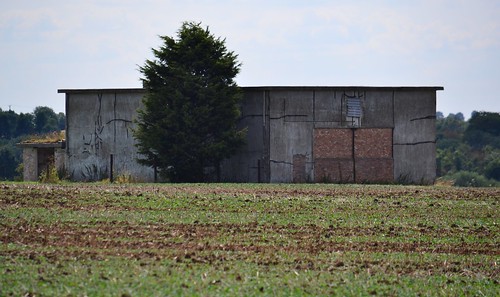
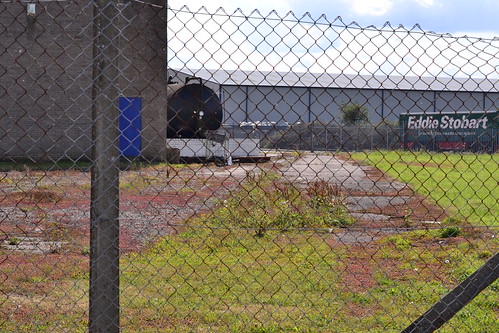
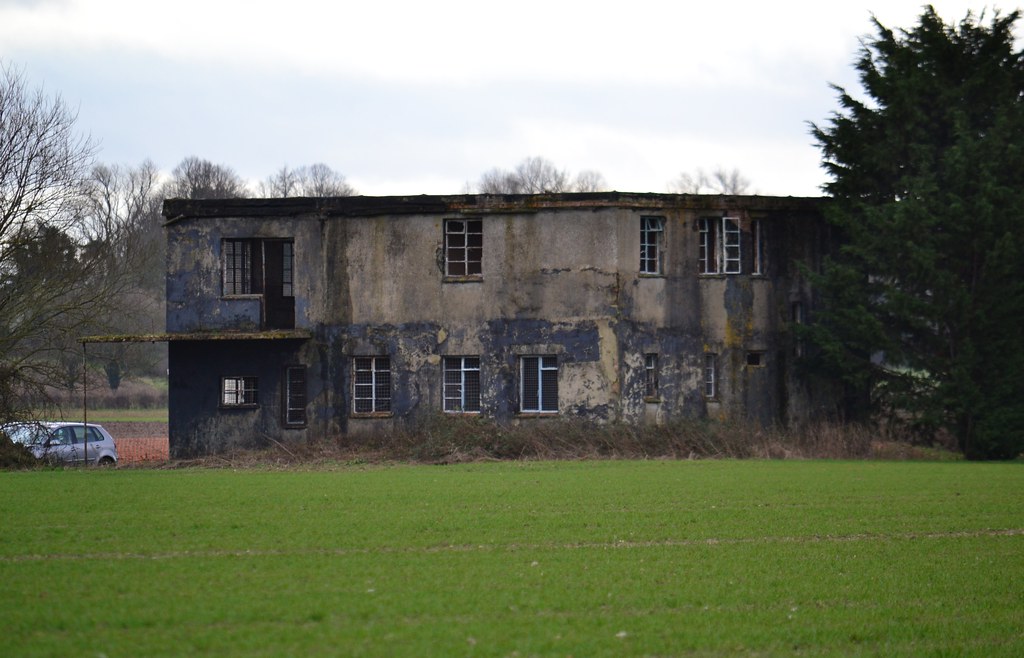
Ludham airfield

The second Watch Office also in a very poor state of disrepair.

On arrival at Ludham the squadron was immediately confirmed as operational, and on the 15th May 1943, the very day the operational  notice came through, Sgt. R.A. Hough spotted an Me 109f bombing Southwold. He engaged the enemy shooting him down into the sea, the squadrons first confirmed kill of the war.

With four more Typhoons arriving on the 20th, the squadron was in good spirits and eager to get on. But like their predecessors before them, their month consisted of patrols, practice scrambles and training flights some of which included the squadron’s Hurricane (7778) and Tiger Moth (209). By the end of the month, the Ludham unit had made 362 flights, most as patrols or as training flights. June was similar, the lack of contact frustrating the pilots; a note in the ORB saying “Patrols carried out dawn to dusk, 12 operational sorties being flown, but the Hun wouldn’t play“. The highlight of the day was perhaps the darts match against the local Home Guard, the Home Guard winning that night! As the month progressed, the squadron began to venture further afield taking on trains and oil storage facilities on the continent, scoring many hits and receiving flak damage as a result. On the 8th July the squadron suffered its first Ludham fatality when Flt. Sgt. F. Vause hit the ground in a low flying exercise. A talk by Sqn. Ldr. Taylor reflected the sentiments of the unit when he said they had lost a “Damn good pilot”. He went on to stress the low flying rules.

The end of July came and notification to depart Ludham for Matalsk, and a share of the airfield with 609 Sqn. There was some regret withe the more ‘romantic’ types of the squadron and due honours were paid to Ludham on that last night of the 30th July.

The last Spitfire squadron before Ludham left RAF control was 611 Sqn, with their Spitfire LF VBs. This was a short stay lasting only until August 4th, when they were told to move to Coltishall as Ludham was being closed down in preparation for transference to the USAAF. After one sortie at Ludham the move went ahead on the 4th, but it was not overly welcomed as Coltishall was already busy and accommodation was cramped.

With that, Ludham was closed, and the airfield was taken over by the Air Ministry (Works) whereupon construction work began on three new concrete and tarmac runways, a project that would take a year to complete. During this time new hardstands were installed – a mix of (17) double and (18) single types using pierced steel, some of these were located outside of the perimeter, and a small maintenance unit took care of the running of the airfield. A new two storey watch office was built with the original being re-purposed.

Designated Station 177, Ludham was never actually occupied by the Americans though, even though all the upgrade work had been completed, it remained firmly deserted apart from a small maintenance unit who oversaw its use.

Instead, it was decided to use Ludham as a dummy airfield and emergency landing ground for returning aircraft. A decision that was partly made for them as heavy bombers returning from daylight missions over occupied Europe would often come in over this part of East Anglia, and Ludham was the first airfield they would come across. Because of this, Ludham would see some eight B-17s, a B-24, one P-47, and a P-38 aircraft have to either crash or make emergency landings at Ludham or in the immediate vicinity.

The first to make use of the airfield in this way occurred on October 8th, 1943 barely a month into the airfield’s upgrading. A B-17F #42-3393  “Just-A-Snappin” was badly damaged over Bremen. The aircraft, piloted by Capt. Everett Blakely, made it back to England crossing the Norfolk coast east of Ludham. The aircraft had sustained severe damage from flak, the Number 4 engine, the hydraulics and the brakes all being put out of action. The aircraft made an emergency landing at Ludham crashing into a large tree causing further damage to the air frame. It was salvaged a few days later. This particular aircraft had only been assigned to the 418th BS at Thorpe Abbots, part of the Bloody Hundredth, in the July. It also went under the name of  “Blakely’s Provisional Group” and ”Did You Say Ten Cents?“, the multitude of names causing confusion in a number of references.

Part of a door cover from P-38 Lightning named

Part of door cover retrieved from wreckage of P-38H5LO #42-67053 ‘CY-L’, flown by Lt. Goudelock on December 13th 1943. The aircraft crashed in Ludham after flying for 375 miles on one engine (IWM FRE 158)

A second aircraft would attempt to use Ludham as a safe haven not long after this. On the 13th December, 1943 P-38H #42-67503 of the 55th FG, 343rd FS, “Vivacious Vera” piloted by First Lt. Hugh J. Goudelock, sustained damage to one engine whilst escorting bombers also over Bremen. After nursing the aircraft back to Britain he attempted a landing at Ludham when, suddenly, the second engine gave out. This left the P-38 powerless, causing it to crash in Ludham, the pilot sustaining only minor injuries. The strength of the P-38 having brought the pilot back for 375 miles on a single engine,

A similar story was repeated on December 23rd when B-17F #42-3273 “Impatient Virgin” crashed at Potter Heigham, another village only a stones throw from the airfield, while attempting to land at Ludham following damage it received over Munster. A sudden loss of power meant the aircraft had to put down in a field rather than on the airfield, all ten crewmen luckily returned to duty and the aircraft was salvaged.

B-17F “Impatient Virgin” #42-3273 of the 95th Bomb after crashing at Potter Heigham near to Ludham airfield. (IWM FRE 3903)

December had certainly been a busy month for Ludham, even though officially it was closed to flying, it had more than proved its worth as an emergency landing ground.

The work continued at Ludham and eventually, in August 1944, it was complete. By then though the US forces had decided against using Ludham and it was handed over to the Royal Navy (RN).

In the concluding part we saw how the Royal Navy fared at Ludham and how eventually Spitfire squadrons return. The V2 becomes a menace to be dealt with and then the war comes to a close and Ludham’s future is decided.

The full story of RAF Ludham appears in Trail 58.

A Dogfight That Ended At The Movies.

Another guest post by Mitch Peeke.

Toward the end of the Battle of Britain, Reichsmarschall Herman Goring chose to blame his hitherto beloved fighter pilots for the devastating losses the German bomber squadrons had suffered that summer. He decided that if the fighters couldn’t protect the bombers, then the fighters could carry the bombs to London themselves! On his direct orders, about one third of the Luftwaffe’s fighter force was swiftly converted to carry a single bomb slung under the belly of their Me109’s. Flying at high altitude, these Jagd-Bomber aircraft, or Jabos as they were now called, were then to be heavily escorted by the regular fighters, in an attempt to draw the RAF’s fighters into battle, where they could be annihilated by the superior German numbers. It didn’t matter to the Germans where the bombs fell as the hapless Jabos were simply the bait.

On the morning of Sunday, October 20th 1940, the high-flying Jabos were making daylight attacks on south-east England and London again. They came over in five waves, heavily escorted as per Goring’s orders, from about 09:30 till approximately 14:00. Part of the fighter escort for one of the later raids was provided by 6/JG52, based at Peuplingues, in France and one of the escort pilots from this unit was Oberfeldwebel Albert Friedemann.

The inbound raiders and their escorts had already been fighting their way across Kent when they reached Central London at around 13:35. Having dropped their burdensome bombs, the Jabo pilots could now accelerate to fighting speed and engage the defending RAF fighters on equal terms, though ever with a cautious eye on the fuel gauge.

One of the RAF squadrons sent to deal with these raiders that day was 41 Squadron, up from Hornchurch in Essex. High over the City of London area, 41 Squadron’s Flying Officer Peter Brown in his Spitfire, was in combat with a yellow-nosed Messerschmitt 109, that flown by Friedemann.  During the combat, Brown succeeded in gaining the advantage over his opponent and scored several decisive hits on the nose of Friedemann’s Messerschmitt, which started to belch brownish-black smoke from its now mortally wounded Daimler-Benz engine.

Flying Officer Peter Brown in combat with Oberfeldwebel Albert Friedemann over London on Sunday 20th October 1940.

Flying Officer Peter Brown in combat with Oberfeldwebel Albert Friedemann over London on Sunday 20th October 1940 (Painting by Geoff Nutkins of Shoreham aircraft Museum, by kind permission).

The crippled Messerschmitt began to lose speed and height as it flew over Tower Bridge, crossing the Thames in a roughly East-south-easterly direction, towards Shooters Hill. Brown flew his Spitfire alongside his vanquished foe as the German pilot jettisoned his cockpit canopy and raised himself out of the seat. Having no choice in the matter, Friedemann baled out of his doomed fighter over the Plumstead/Welling area of South London and as it transpired, his exit was not a moment too soon. Seconds after Friedemann had jumped, the Messerschmitt’s fuel tank exploded in mid-air. The time was almost exactly 13:45.

On the ground at Welling, was fifteen year-old Ennis Mowe. Though still at school, Ennis was the sort of girl who hated the fact that she was considered too young to take any active part in the war effort. She badly wanted to “do something” and even though it was she who had done the Lion’s share of the work involved in constructing the family’s Anderson shelter, it simply wasn’t enough for her to be content with; an attitude that had lead to several arguments with her father recently.

Not feeling inclined to enjoy the dubious comforts of the public air-raid shelter in Bellegrove Road that Sunday, Ennis was making her way home, on foot, half-watching the vapour trails of yet another aerial battle that was obviously taking place at altitude over London again. Suddenly, she heard a loud “boom” high above her. Stopping, she quickly looked up in time to see a fireball and a fighter aircraft breaking apart as another fighter turned rapidly away. The tail section of the stricken aeroplane disintegrated, but the front section was coming straight down, dropping like a stone.

A good many people on the ground, including young Ennis, also saw something else falling away from the doomed aircraft, flailing and tumbling through the air as it came down. It was Oberfeldwebel Albert Friedemann, who was now condemned to realise a horrible end to his young life, by the fact that his parachute had failed to open.

The Messerschmitt’s largely intact front section landed with a very loud thud, upside-down in a front garden in Wickham Street, Welling, just across the road from the gate of Gibson’s Farm. The impact forced the Messerschmitt’s undercarriage to spring partially from the wheel-bays. Albert Friedemann fell to his terrifying death a short distance away across the farm, whilst pieces of his Messerschmitt’s tail section fluttered down over a wide area.

The wreck of Oberfeldwebel Albert Friedemann’s Messerschmitt 109 where it fell, opposite Gibson’s Farm in Wickham Street, Welling, on October 20th 1940. The aircraft exploded in mid-air shortly after Friedemann baled out of it following combat with Flying Officer Peter Brown of 41 Squadron. Friedemann fell to his death when his parachute failed to open. The fence in the background is the perimeter fence to the farmhouse garden of Gibson’s Farm, across the road. Photo: Bexley Local Studies and Archive Centre, by kind permission.

Meanwhile, in Wickham Street, there was already a small crowd around the wreckage; the fallen Messerschmitt having miraculously missed the houses. The hot metal of the fighter’s engine was still ticking as it cooled, but there was no fire. The Messerschmitt’s remaining fuel had been burnt off in the mid-air explosion, some twelve thousand feet ago. People seemed to be looking at the vanquished aircraft with a mixture of curiosity and awe, as if it were something from outer space.

The authorities were soon on the scene and gradually the crowd dwindled as the Police sent the sightseers away. Later, the RAF posted a guard over the wreck to prevent any possible souvenir hunting, for the wreck rapidly became a spectator attraction. The authorities quickly removed Albert Friedemann’s shattered and lifeless body from Gibson’s Farm, but the wreck of his aircraft stayed in Welling for another three weeks. Removed from its crash site, it was put on display outside the local cinema and fifteen year-old Ennis Mowe stood proudly beside it nightly, in all weathers, for just over a fortnight. She was collecting donations from the queue of cinema-goers, in aid of the district Spitfire Fund.

This is the site of Oberfeldwebel Albert Friedemann’s crash as it is today. Wickham Street has been widened since the war, but as near as I can place it, the wreck of Friedemann’s Messerschmitt landed roughly where the van is parked, with the propeller hub facing across the road. The entrance to Gibson’s Farm is just to the left of the picture, out of shot, and about ten feet or so toward the camera from the position of the traffic island. Photo: Mitch Peeke.

At the end of each collection, she gave her collecting tin to the cinema manager, who counted the money she’d collected, paid it into the Post Office on her behalf and posted a notice showing the Post Office receipt for the amount raised. Ennis felt proud that she was at last doing her bit for the war effort, while her father simply shook his head in quiet capitulation. However, this episode proved to be just the beginning of a long, long history of young Ennis “doing her bit”.

Following her successful spell of fundraising beside the wreck of Albert Friedemann’s Messerschmitt outside the cinema; Ennis Mowe, in late 1941, blatantly lied about her age, falsely obtained a driving licence, and joined the London Ambulance Service. She soon became Britain’s youngest-ever Ambulance Driver, a fact not realised till long afterwards, when she confessed to her “crime” at her official retirement! Her father had by then long given up the unequal paternal struggle with his fiercely independent daughter. Ennis eventually married, becoming Ennis Smith, and she carried on “doing her bit” in just about every conflict that has involved British servicemen ever since. Her last such activities were based around the organisation and distribution of Christmas parcels to British troops stationed in Bosnia. Throughout her life, Ennis never once allowed her age to be a deterrent to her determination.

OberFeldwebel Albert Friedemann was 26 at the time of his death. His body was interred at the German Military Cemetery in Cannock Chase, Suffolk; there to rest with many of his comrades. Details of his grave can be found using the ‘Find a Grave’ Website.

Flying Officer Peter Brown, the RAF Spitfire pilot who had shot Friedemann down, finished his RAF career as a Squadron Leader. Like Ennis, he went on to a life of helping others. Peter was also a lifelong friend of The Shoreham Aircraft Museum in Kent. He passed away in 2011 and the museum has posted a fine tribute to him, which can be found using the link below.

http://www.shoreham-aircraft-museum.co.uk/news/2011/02/02/remembering-squadron-leader-peter-brown/

by Mitch Peeke

My sincere thanks go to Mitch for this article.

Spitfires Galore! – RAF Ludham (Part 1)

In this second part of Trail 58, we leave Rackheath behind and head east towards the coast of East Anglia, and an area known as the ‘Broads’. A few miles across this flat and wetland we come across a small airfield, currently used by crop sprayers and small light aircraft. This private field, almost indistinguishable from the farming land around it, just hints at its past, with two rundown towers, a blister hangar and a small collection of pathways, its history is fast disappearing.

In this the last part of Trail 58 we visit the former RAF Ludham.

RAF Ludham (Station 177, H.M.S. Flycatcher, RNAS Ludham).

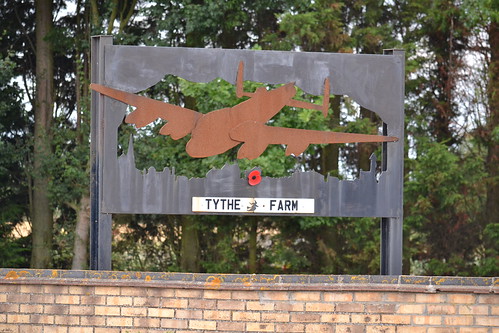
Ludham is a small airfield that has been in existence since September 1941, when it opened as a satellite for RAF Coltishall located a few miles to the north-west. It would change hands on more than one occasion over the next few years, being assigned to the RAF, the USAAF and the Royal Navy before returning to RAF ownership once more.

Throughout this time, it would operate as a fighter airfield seeing  range of Spitfire Marks along with a Typhoon Squadron. A number of B-17s would crash here as would a P-38 lightning and several other USAAF aircraft; part of Ludham’s history being that of an emergency landing strip for returning aircraft.

At its inception, Ludham was a grassed airfield, with a hardened perimeter track linking a number of dispersals. Being a fighter airfield the perimeter was only 40 feet wide but of concrete construction, thus it was not designed for the larger, medium or heavy bombers of the allied air forces.

Furthermore, as a satellite, Ludham lacked the design features of a major airfield, and so the accommodation and technical facilities were not up to the same standard of those found on other sites. The accommodation huts were scattered around the north-western side of the airfield, and an initial single storey watch office was also built to the west. A standard wartime design for satellite airfields (design 3156/41), it was a single-roomed structure with a pyrotechnic cupboard and limited views. A switch room was then added to the building (design 1536/42) in early 1942, before the entire building was abandoned and a new twin storey watch office built. As with most airfields of this type, the twin storey building was constructed in conjunction with the addition of the concrete runways. This new office  (design 12779/41) with lower front windows (343/43) would have many benefits over the original not least better views across the airfield site.

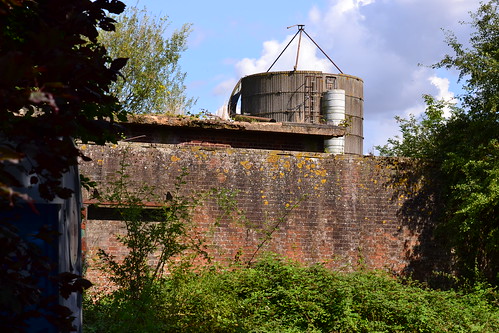
Ludham airfield

The much dilapidated original Watch Office.

Another interesting, but not unique feature of Ludham, was a Modified Hunt Range, a structure designed to teach aircraft recognition. The structure, built inside a Laing Hut, saw the trainee sat in front of an enormous mirror. A moving model was then placed behind the student on an elaborate turntable that could not only move in the horizontal plane, but both turn and bank. A selection of lights and a cyclorama added to the realism, with the model reflected in the mirror in front of the student. The combination of all these features provided the students with life-like conditions, thus recreating the same difficulties they were likely to find in combat situations.

For much of its early life, Ludham was used as a satellite of Coltishall, although many of its squadrons were based here from the outset. The primary aircraft seen here was Supermarine’s magnificent Spitfire, the first of which was the MK.VB of 19 Squadron.

19 Sqn had only had this mark of Spitfire since October, previously operating the MK.IIA at RAF Matlask not far from here on the north Norfolk coast. The Mk V was the most produced Spitfire of all 24 marks (and their sub variants) and was armed with a combination of machine gun and canon depending upon which wing configuration was used. The link between the Spitfire, Matlask and Ludham would be a long one, with units moving from one to the other. forging a bond that would last the entire war.

Arriving in the opening days of December 1941, 19 Sqn immediately began carrying out patrols and bomber escort duties over the North Sea, a duty they had been undertaking whilst at Matlask. On several occasions they would fly out to meet incoming Beauforts and their escorts, after they had completed their anti-shipping missions along the Dutch coast. Daily flights would take: Red, Green, Yellow, White, Black or Blue section, each containing two aircraft, over Lowestoft and Great Yarmouth and around the coastal regions of the Norfolk / Suffolk coastline.

However, most of these encounters produced little in the way of contact – even when pilots were directed onto the enemy aircraft. On the 9th, P.O. Halford and Sgt. Turner were vectored onto an intruder, but neither aircraft saw, nor encountered the ‘bandit’, and they returned empty handed. Another two scrambles that same day by ‘Green’ and ‘Black’ sections also proved fruitless, although ‘Black’ section did manage to locate the aircraft which turned out to be a friendly.

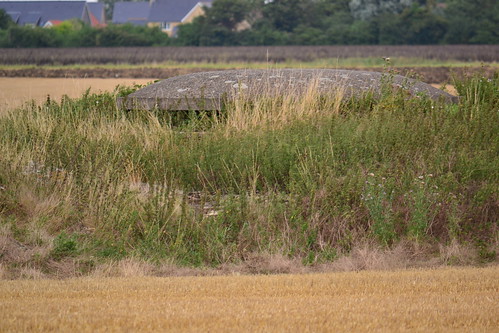
Ludham airfield

An original Blister hangar now located on the former runway.

Other duties carried out by 19 Sqn included shipping reconnaissance flights, shadowing and monitoring shipping movements across the North Sea, particularly along the Dutch coast. Taking off at 11:20 on December 18th, F.O. Edwards and P.O. Brooker flew at zero feet across the Sea to Scheveningen where they spotted a convoy of 11 ships. One of these was identified as a flak ship protecting the convoy as it left for open waters. The pair then turned north and flew along the coast to Yumiden where they encountered three more ships. No enemy aircraft were encountered and the pair returned to Ludham to file their report.

Then on Christmas Eve, P.O.s Vernon and Hindley in ‘Blue‘ Section were tasked with a ‘Rhubarb‘ mission to attack the aerodrome at Katwyk. On route, they came across a convoy and two Me. 109Es, who were acting as escort / cover for the ships. The two Spitfires engaged the 109s, Blue 1 getting a two second canon and machine gun strike on one of them at 300 yards range. Black smoke was seen coming from the fighter which dived to the sea only to pull up at the last minute and head for home. Blue 2  engaged the other enemy aircraft, but no strikes were seen and the German pilot broke off also setting a course for home. The two Spitfires then engaged the convoy attacking a number of vessels, each pilot recording strikes on the ships, claiming some as ‘damaged’. After the attack they returned home, this leg of the flight being uneventful.

These events set a general pattern for the next four months, and one that would become synonymous with Ludham. Then, on April 4th 1942, 19 Sqn would move to RAF Hutton Cranswick, in the East Riding of Yorkshire, a direct swap with 610 Sqn who had been stationed there since the January.

Also during this time a supporting squadron had also been at Ludham, 1489 (Fighter) Gunnery Flight, (formerly 1489 (Target Towing) Flight) which had moved in to help prepare fighter pilots for air-to-air combat. Around the time that 19 Sqn departed Ludham, 1489 Flt also departed, also going to Hutton Cranswick with 19 Sqn where they were disbanded in 1943.

610 Sqn were another Spitfire squadron also operating the MK.VB at this time. They too got straight back into action carrying out the patrols undertaken by 19 squadron before them. No engagements were recorded until the 8th, when what were thought to be two ‘E’ boats were sighted but not engaged.

The remainder of April was much the same, several convoy escorts, reconnaissance missions along the Dutch coast and scrambles that led to very little. On the 27th two Spitfires did encounter and Ju 88 which they shot down, the crew from the Ju 88 were not seen after the aircraft hit the water. On the next day, ten Spitfires took off between midnight and 01:05 hrs to patrol the Norwich area. Here they saw green parachute flares, and flew to intercept. Sticks of bombs were then seen exploding in the streets of the city, and various pilots engaged with Do 217 bombers. Strikes were recorded on the enemy aircraft, but they were lost in smoke and they could not be confirmed as ‘kills’. Further attacks occurred again on the 29th and again strikes were seen by the RAF pilots on the enemy intruders.

The period April to August was pretty much along similar lines, routine patrols, shipping reconnaissances and scrambles.  Then in mid August, 610 Sqn would take part in one of the Second World War’s more famous failures.

Ludham had a mainly uneventful entry to the war, sporadic scrambles, intermittent contacts and many hours of training, its future looked secure. But, there were many changes ahead and many events that would put it firmly on the map of history.

In Part 2 we see how these changes affect Ludham and its future.

The full story of RAF Ludham appears in Trail 58.

Flt. Lt. William Devaux Woodruff Hilton (RCAF) – Berwickshire.

In the graveyard at Duns, in Berwickshire, not far from the village and former airfield RAF Charterhall (Trail 41), are two graves of nationals a long way from home.

Both airmen died in service whilst flying from RAF Charterhall, an Operational Training Unit airfield that prepared night fighter crews before posting to relevant night fighter squadrons.

The first grave is that of Flt. Lt. William Devaux Woodruff Hilton (RCAF)  who died on 23rd July 1942.

Flt. Lt. Hilton (Duns Cemetery)

Flt. Lt. William Devaux Woodruff Hilton

Flt. Lt. William Hilton (s/n: C/1626) was born on May 17th 1916, to D’Arcy Hilton (himself an ex pilot of the US Army Flying Corps in the First World War) and Gladys Woodruff, in Chicago, Illinois. He signed up for a flying career joining the RCAF as the United States were not at that time at war and therefore he was unable to train with the US forces.

Flt. Lt. Hilton reached the rank of Pilot Officer on 29th January 1940 after completing further training at RAF Twinwood Farm in Bedfordshire and RAF Acklington in Northumberland. On completion of this training, he was posted to RAF Charterhall and 54 Operational Training Unit (OTU), where he would fly Beaufighters.

The summer of 1942 suffered from poor weather, so poor in fact, that there were many restrictions on flying time, July only having 2,104 hours in total. This bad weather was to be responsible for many flying accidents and deaths that year, of which Flt. Lt. Hilton would be one.

On July 23rd 1942, he was tasked with flying a model new to him, the Bristol Beaufighter, and was taken by an instructor on several circuits to better acquaint himself with the various controls and idiosyncrasies of the aircraft. After several successful landings and take offs, the instructor passed Flt. Lt. Hilton to fly solo, and handed the controls of  Beaufighter #R2440 over to him. His instruction to Hilton was to stay within the circuit of the airfield, sound advice as one of Scotland’s summer storms was rapidly approaching.

Hilton duly carried out the order and took off to perform various solo flight tasks. An experienced pilot, Flt. Lt. Hilton found no problem landing or taking off himself and completed one full circuit before things went wrong.

On the second  circuit of the airfield, Flt. Lt. Hilton somehow got lost, whether through an aircraft malfunction or pilot error, it is not known, but after entering bad weather, the aircraft was instructed to climb to a safe height which it failed to do. Moments later, the Beaufighter was heard circling over the nearby town of Duns before ploughing into low-lying ground, one mile south-east of the town. At the time of the accident the aircraft’s undercarriage was in the down position. The crash killed Flt. Lt. Hilton instantly, the aircraft being torn apart by hedges and the subsequent slide along the ground. A board of enquiry was set up and investigations carried out, but no blame was apportioned to Hilton and the case was closed.

Flt. Lt. Hilton, an experienced pilot, somehow got into trouble, and that combined with the bad weather he was in, resulted in the loss of his life at the young age of just 26. To this day the cause of the crash is not known and Flt. Lt. Hilton remains buried in Scotland not far from the crash site, he is however, many thousand miles from home.

Flt. Lt. Hilton is buried in Duns graveyard in Sec. R. Grave 2.

The second airman’s grave in the graveyard at Duns, is that of Sgt. Thomas Alan Rutherford s/n 406626 (RAAF) who died on 14th August 1942, age just 20.

Sgt. Rutherford (Duns Cemetery)

Sgt. Thomas Rutherford

Sgt. Thomas Rutherford, born to Stamford Roy Rutherford and Laura May Rutherford, of Cottesloe, Western Australia, came from an aviation family, his father Stamford Rutherford RAAF (296635) and older brother Sgt Bernard Rinian Roy Rutherford RAAF (406540), were also serving Air Force members. As with many families who had siblings serving in the forces at this time, Sgt. Rutherford’s brother was also killed in an air accident, earlier that same year.

Sgt. Rutherford was born 3rd August 1922 at Brampton, England but enlisted in Perth Western Australia, on 3rd February 1941.

After completing his training, he also transferred to 54 OTU at RAF Charterhall in the Scottish borders.

August 1942 was, like July before it, a particularly bad month weather wise, which saw only 1,538 hours of flying carried out by 54 OTU. Only a small portion of these, just short of 400, were by night, the remainder being daylight flights. As a night fighter training station, this would be difficult for trainers and trainees alike, but undeterred they flew as many sorties as they could.

On August 14th, Sgt. Thomas Rutherford climbed aboard Blenheim Mk. V #BA192 along with is observer Sgt. James Clifford Kidd (s/n: 1417331). They dutifully carried out their pre-flight checks and lined the aircraft up ready for take off from one of Charterhall’s runways. After lifting off the Blenheim struck a tree causing it to crash. Both Sgt. Rutherford and Sgt. Kidd were killed instantly in the accident.

It is not known what caused the aircraft to strike the tree, whether it be pilot error or aircraft malfunction, but it was an accident that resulted in the loss of two young men far too early in their lives.

Sgt Rutherford is buried at Sec. R. Grave 3 next to Flt. Lt. Hilton.

Further reading.

McMaster University Alumni has further details of Flt/ Lt. Hilton’s life and career.

Commonwealth War Graves Commission website

National Archives of Australia website

Squadron Leader Emile Fayolle: A Free, French Pilot.

June 1940: Britain’s last remaining European ally, France; was now hors de combat, and the French people began to face the gruelling prospect of an indeterminate period of time in the shadow of the Swastika, under German occupation.

As news of the ignominious armistice and the new collaborationist Vichy government under Marshal Petain spread, there were many brave and defiant French servicemen who refused to acknowledge it. Some went underground, founding the Maquis; the French Resistance movement, whilst quite a number decided to get to England, by any available means, following their chosen leader: Brigadier-General Charles de Gaulle. Once in England, they formed themselves into La France Libre, the Free French Forces, with General de Gaulle as their commanding officer.

One such Frenchman was a nearly 24 year-old, qualified Pilote de Chasse, (fighter pilot) who was then serving overseas in the Armee de l’Air at Oran in French Algeria. He was Sergeant Emile “Francois” Fayolle.

Battle of Britain London Monument - ADJ EFM FAYOLLE

Sgt. Emile “Francois” Fayolle (Photo: © Friends of the Battle of Britain Monument)

Born on 8th September 1916, at Issoire, in Central France, Emile’s father was an Admiral in the French Navy and his Grandfather was none other than Marshal Marie Emile Fayolle, the legendary French Army commander of the First World War. With such ancestry, it was little wonder that Emile refused to acknowledge the humiliating armistice of Compiegne. After much discussion, and despite the warnings of dire consequences from their Station Commander, Emile, his good friend and squadron-mate Francois De Labouchere and two other like-minded pilots, stole two of the station’s aircraft and flew to the British base at Gibraltar. There all four took ship to England, arriving in Liverpool in mid July. Emile Fayolle and his close friend Francois De Labouchere strengthened their already inseparable partnership throughout their RAF training and even made sure they were posted to the same fighter squadron later.

On August 18th 1940, at the height of the Battle of Britain, Emile and Francois were posted to 5 OTU, (Operational Training Unit) at Aston Down. Both men were by now commissioned as Pilot Officers and at 5 OTU, they would be learning to fly and fight with the Hurricane. Pilot Officers Fayolle and De Labouchere would join 85 Squadron, commanded by Squadron Leader Peter Townsend at Church Fenton, on September 13th 1940, flying Hurricanes. They would both soon start making their presence felt with the Luftwaffe.

Emile stayed with 85 Squadron for nearly three months, being posted to 145 Squadron on December 3rd. He stayed with 145 Squadron till April 26th 1941, when he was then posted to Douglas Bader’s 242 Squadron. Although the Battle of Britain was over by then and the German night Blitz on Britain’s major towns and cities had largely petered out, every now and again the Luftwaffe could, and would, still mount a really big raid, such as the one they made on London during the night of May 10th 1941. Exactly one year to the day since they’d started the whole ball rolling by attacking the Low Countries and France, this raid would prove to be pretty much the Luftwaffe’s swansong; their final, despairing fling. Making use of the full moon in a cloudless night sky, the Luftwaffe, in that one night, seemed to drop a month’s worth of bombs and incendiaries on the British Capital. The damage they inflicted was widespread and severe.

It was on this night, during a late evening patrol, that Pilot Officer Emile Fayolle scored his first confirmed ‘kill’. Emile’s victory was one of three that night; all Heinkel 111 bombers and all scored by French pilots. Pilot Officer Demozay of 1 Squadron shot his down over East London, whilst Pilot Officer Scitivaux and Pilot Officer Emile Fayolle, both of whom were serving with 242 Squadron, had their encounters over the London Docks. All three ‘kills’ were confirmed.

On October 14th 1941, Emile was posted to 611 Squadron, flying the Hurri-bomber: a cannon-armed, bomb carrying, fighter-bomber version of the Mk IIc Hurricane. It wasn’t long before he personally took a heavy toll on enemy shipping. Despite being there for only three weeks, Emile seemed to take particularly well to 611 Squadron’s role, becoming something of a specialist in the rather risky art of fast and accurate low-level attacks. He was posted to a very special unit; 340 Squadron, at Turnhouse.

When the RAF formed 340 Squadron, it was the first, all-Free French, squadron. It was formed as part of the Ile de France fighter group and Emile, as well as his great friend Francois de Labouchere, naturally joined the unit. Promotion, as well as confirmed ‘kills’, swiftly followed. As well as the Heinkel 111 he’d shot down on 10th May 1941, he also had confirmed a FW 190 on 3rd May 1942 and a JU88 shot down into the sea on 11th May 1942. His tally of enemy shipping stood at an impressive 25 sunk by then. At the end of July 1942, Emile was further promoted; to the rank of Squadron Leader, and given command of 174 Squadron at Warmwell.

On the Dieppe operation of 19th August 1942, his first one as Commanding Officer, his Hurricane took a hit from defending German anti-aircraft fire after he’d led his squadron of Hurri-bombers fast and low into the attack. His battle-damaged aircraft lost height and crashed in the Channel on the way back to England, not far from Worthing.  Emile was still in the cockpit.

But that is not quite the end of this extraordinary Frenchman’s story. By the strange vagaries of the English Channel’s currents, Emile’s body was eventually washed ashore in his native France. The Germans recovered it and given that he was wearing what remained of the uniform of an RAF Squadron Leader, but with some French insignia, they presumed him to have been a Canadian. Emile’s body had been in the water for some time and was in no real state to be positively identified, so the Germans buried him in a grave marked “Unknown RAF Squadron Leader”.

It wasn’t till 1998, after much laborious research had been done, that Emile finally got a headstone of his own. He is buried at Hautot-sur-Mer (Dieppe Canadian) Cemetery and he is also commemorated on the London Battle of Britain memorial; with all the other gallant countrymen of his who had flown and fought with the RAF in the Battle of Britain. His fighting prowess had earned him a total of four medals, including the DFC and the Croix de Guerre. At the time of his death; the remarkable, Squadron Leader Emile Fayolle, had been just two weeks and six days short of his 26th birthday.

By Mitch Peeke

My thanks to Mitch for this story.

RAF Rackheath – The 467th BG, the highest bombing accuracy (pt2).

In Part 1 we saw how Rackheath had been developed, and how the 467th BG, the resident group had been subjected to a fierce introduction to the war.

Now, in part 2, we continue our visit to Rackheath and the bizarre event of December 1944.

On December 24th,  B-24 #42-50675 “Bold Venture III” piloted by 1st. Lt. P. Ehrlich, was one of sixty-two B-24s from the 467th taking part in a maximum effort attack on a range of targets in Germany. Hit by flak over the target, five of the  crew, including the pilot, bailed out fearing the aircraft was lost. All five were subsequently captured and incarcerated as prisoners of war. The fires in the engines then extinguished themselves allowing the remaining crew to engage the auto-pilot, taking the aircraft homeward and over allied territory. Once over France, they too bailed out as they were unable to land the heavy bomber, each of these men being safely picked up by allied forces. The plane then continued on, unmanned across the Channel, until it ran out of fuel.

RAF Rackheath

The former hangar has been completely refurbished.

At this point, the story becomes confused. Some say it landed / crashed  in a field near to  Lower House Farm, Vowchurch Common in Herefordshire. The wreck being salvaged the following day. However, there is little evidence of this event, and other sources (Freeman “The Mighty Eighth“) have it landing in a Welsh marsh a little further west. Whatever the truth is, its a remarkable, but not unique, story of  a crewless bomber flying ‘home’ coming to rest safely on British soil.

Also on that Christmas Eve, another Rackheath B-24, #42-95220, piloted by First Lieutenant William W. Truxes Jr , was hit over Pruen. The aircraft then exploded over Rettigny in Belgium, killing Sgt. Walter Walinski (TG); Sgt. Stanley P. Koly (LWG); Fl. Off. David J. Countey (Nav); Sgt. Roland L. Morehouse (BA); St. Sgt. Peter Hardick Jr (TTG); St. Sgt. John N. Ellefson (Radio Op) and Sgt. Alek Onischuk (RWG). Only the Nose Gunner St. Sgt. Robert J. Ball Jr. returned to duty the remainder being taken prisoners of war.

On the 29th the continuing appalling weather caused the loss of two more B-24s, both crashing attempting to take off from a foggy Rackheath (#42- 95115 and #42-51572). A third (#42-94881) was then abandoned over the sea, and a forth (#44- 10607) crashed at Attlebridge also after sustaining damage on its take off. The  visibility was so poor that day that the crews couldn’t even make out the edge of the runway. As a result of these crashes, the mission to Prum, was finally scrubbed, but by then fifteen airmen had already been lost.

The dawn of 1945 saw the Ardennes offensive continuing, and at Rackheath B-24 ‘Witchcraft‘ was approaching its 100th Mission an achievement it made on January 14th 1945. In just 140 days since arriving, it had reached its 70th mission an average of one mission every two days, but what made this particular achievement so remarkable was not this incredible average, but the fact that the aircraft had been mechanically sound throughout, not having to turn back from any sortie it had undertaken. A remarkable achievement, and a solid testament to the dedication of the ground crews who kept her in the air.

The Witch“, as she affectionately became known, would go on to complete a total of 130 missions without a single abort nor injury to any crewman. She became one of the most celebrated aircraft in the 8th Air force’s history. This total would surpass all other B-24s in the whole of the European theatre of operations. Like many though, ‘The Witch‘ eventually returned to the US where she was unceremoniously taken apart at Altus, Oklahoma. In memory of the aircraft, her achievements and the crews who were lost flying B-24s, she is now represented by the world’s last flying Liberator, currently owned and operated by the Collings Foundation, Massachusetts.

Ground crew of the 467th BG B-24 “Witchcraft“. Standing Crew Chief Joe Ramirez, Chamberlin. Front Row Walter Elliot, Geo Dong, Joe Vetter, Ray Betcher.’ (IWM FRE 1979)

As 1945 progressed the end of the war was near. Attempts by the Luftwaffe to curtail bomber intrusions into German airspace were becoming desperate. The introduction of the Me 262 was too little, too late, to make a major difference. But so determined to stop the bombers were the Luftwaffe pilots that many still got through and they were finding the bombers.

Other fighters more determined to bring down the enemy began ramming them. A specialist squadron the ‘Sonderkommando Elbe‘  was set up using volunteer pilots. They were instructed to strike the fuselage of the bomber between the wing and tail thus cutting the aircraft in two, a tactic that would  allow the German pilot to bail out of his aircraft whilst taking down the bomber.

On April 7th, the unit was put into action in its one and only recorded attack, as over 1,000 heavies flew towards German airfields, oil storage facilities and factories in north-west Germany. From the 2nd AD, 340 B-24s headed for Krummel, Duneburg and Neumunster. As the force approached they were targeted by a mix of over 100 Luftwaffe fighters including 109s, 190s and 262s. In this mix was the Sonderkommando Elbe. Whilst the tactic would prove to be more devastating to the rammer than the target, one of Rackheath’s B-24s #42-94931 ‘Sack Time‘ was hit in the tail severing the starboard stabiliser. The B-24’s pilot, Lt. Robert Winger, managed to keep the aircraft flying but with little control, he ordered the crew to abandon the aircraft once over allied territory. The B-24 then crewless, fell from the sky.

It is not known whether the attack was a deliberate act by the Sonderkommando Elbe, or as a result of the tail gunner Robert (Bob) Perkins’s action. Perkins in his attempt to defend the B-24, fired desperately at the attacker, Heinrich Henkel, striking the aircraft several times.

Then for three days in mid April, the heavies of the USAAF turned their attention to the gun batteries around Royan. These German strong holds were hindering the allied plans to use the port at Bordeaux, they had to be ousted.

During one of the missions, on April 15th, the 467th would make history again when three of the four squadrons released all their 2,000lb bombs within 1,000 ft of the mean point of impact, half of these being within 500 ft – a record that would not be beaten by any other USAAF unit. This was the ‘icing on the cake’ for the 467th who were building a strong reputation for consistent and accurate bombing.  So determined were the Americans to remove the defenders on the ground, that they used Napalm in 500 lb tanks, a rather horrific weapon used to great effect during the Vietnam war.

By the end of April the war was all but over, and at bases all around the UK, air and ground crews eagerly awaited the notice to cease operations. Some units were already being stood down, and very soon operations would begin to drop food rather than bombs. As the end of hostilities was announced, the figures began to be totted up. The 379th BG at Kimbolton were recorded as dropping the greatest number of bombs on a target, with the 467th BG at Rackheath achieving the greatest accuracy. This Rackheath record was due, in part, to the dedication, support and drive of its Commander, Colonel Albert Shower.

On April 25th 1945, the 467th completed its last mission, a total that amounted to 212 (5,538 sorties credited), dropping 13,333 tons of bombs. With 29 aircraft classed as ‘missing’, and a further 19 lost on operations, the war had not been cheap.

RAF Rackheath

The former runway looking north-east.

On May 13th, the 467th were to lead the Victory Flypast over High Wycombe, the headquarters of the Eighth Air Force operations, the choice of a B-24 as lead fuelling the ‘ill-feeling’ between B-24 and B-17 crews even further.

Over the next month, the aircraft and men of the 467th would return to the US, the majority of aircraft departing Rackheath on June 12th, whilst the ground echelons left via the Queen Mary from Greenock, the same port they had arrived at just over a year earlier. Eventually the 467th would be disbanded, renamed the 301st, but for Rackheath it was the end, and within a year much of the airfield was already being ripped up, the runways were disappearing and many of the accommodation buildings had been torn down. The entire site measuring just short of 4 km2  was already beginning to disappear.

Gradually agriculture has taken over, much of the main airfield site are now fields. The technical area has since been developed into an industrial estate with many of the original buildings being re clad, redeveloped, modernised or pulled down. The watch office has thankfully been refurbished and from the outside resembles a watch office typical of the time. Inside it is now offices. The one surviving T2 hangar, has had brickwork added to it, other buildings are almost indistinguishable from their modern counterparts. A memorial, dedicated to the men and Women of the 467th was unveiled on 29th July 1990, by the then 80 year old Colonel Albert J. Shower, returning for one last time to the place he had built up a reputation for hard graft whilst appreciating the need for recreation.

If approaching from the south, take the A1270 from Norwich heading north, leave at the roundabout with Salhouse Road turning right. The Holy Trinity Church is a few hundred yards along this road. Here you will find the village sign, memorial benches and numerous plaques in memory of the 467th. The two wrought iron gates at the entrance of the church were donated by the Coffey crew. Inside here (the church was closed on my visit) a collection of photographs and letters bring the Rackheath to life once more.

RAF Rackheath

The memorial gates donated by the Coffey crew.

When leaving the church, go back but turn right along Green Lane West. This takes you past the remaining hardstands and along to the industrial estate. Enter by Wendover Road, named after Wendover Field in Utah. Turning into Bidwell Road, (following the signs) you will find the main memorial on the the corner of Bidwell Road and Liberator Close.

Coming back again, turn left, follow Wendover Road to the corner with Witchcraft Way, a small road to your left. Here you will see the Watch Office. Also along here are Ramirez Road, Albert Shower Road, the T2 and other buildings of interest. A real rabbit warren, it is best explored to really discover the many buildings and plaques that remain.

The main accommodation areas were located back across the from the entrance of Wendover Road. Today a new road has been cut through this wooded area but within these woods, remains of huts still exist, some with etchings on the walls. All on private land, they are also gradually disappearing from view.

Rackheath was a short lived base, operating for just a short part of the war. But its contribution and the contribution of its crews, was nonetheless immense. With high accuracy and the determination to win, they took the war into the heart of Germany itself. The names of these young men now live on, in the road names and plaques that adorn many of the building and streets around this beautiful and now peaceful area of Norfolk.

After departing Rackheath we head a few miles east, toward the coast. Not far away, is another airfield, this time a former RAF site. Long gone it continues to use part of the original runway, two watch offices remain, and a smattering of wartime buildings lay dormant in the corner of now agricultural fields. In part 2 of Trail 58 we visit RAF Ludham.

Sources and further reading RAF Rackheath

For more detail on Mission 311 see: McLachlan, I., “Night of the Intruders” Pen and Sword (1994).

Sgt. William Stannard – 487 Sqn RAF – Miraculous Escape

There have been many instances of incredible acts of bravery and bizarre cases of survival that would normally seem impossible. Flt. Sgt. Nicholas Alkemade falling from 18,000ft without a parachute is just one of very many.

Another such remarkable event occurred on May 3rd 1943, when twelve Lockheed Venturas attacked a Dutch Power Station near Amsterdam. The ‘Ramrod‘ mission involved twelve Venturas from 487 Squadron from RAF Methwold, an airfield located between Downham Market and Thetford, on the edge of Thetford Forest.

This mission, ‘Ramrod 16‘, turned out to be a total disaster for the Venturas, an aircraft converted from a passenger aircraft  for war. With its fat body and poor handling, the Ventura earned itself the unsavoury name the “Flying Pig”.

On May 3rd, twelve aircraft, all Ventura MK.Is, departed RAF Methwold, heading for Amsterdam as part of a much larger force involving aircraft from both 12 Group (the main force) and 11 Group who were flying a diversionary sweep.

One Ventura from Methwold would turn back shortly after takeoff when the crew hatch broke off, leaving eleven to proceed: AE684 (EG-B); AE713 (T); AE716 (U); AE731 (O); AE780 (S); AE798 (D); AE916 (C); AE956 (H); AJ200 (G); AJ209 (V) and AJ487 (A). On board each of those aircraft were four crewmen including one Squadron Leader Leonard H. Trent V.C.  whose bravery saw the attack through to the bitter end and the awarding of the Victoria Cross for his actions.

The carefully planned attack went horribly wrong though, after aircraft on ‘Rodeo 212′ from 11 Group entered the Vlissingen area thirty minutes ahead of schedule, alerting both the ground and air defences. By the time the Venturas of 487 Sqn arrived, the defenders were well and truly ready.

The crew of  ‘EG-B’ Sgt George Sparkes 2nd from the right – others F/O S. Coshall, F/O R.A. North & Sgt W. Stannard *1

On board another one of the other Venturas AE684, (EG-B) that day,  was Sgt. William Stannard (s/n: 1253660) and crew. As they approached the target area, Sgt. Stannard’s aircraft was attacked by the alerted Luftwaffe fighters, the Ventura being shot down at 17:45 over Bennebroek, a few miles from Haarlem, in Holland. As a result of the attack, the Ventura broke in half, the tail section – in which Sgt. Stannard was located – breaking away from the main fuselage. The main body of the aircraft – now out of control, burning and failing to Earth – would crash killing both the Pilot F.O. Stanley Coshall (s/n: 46911) and Sgt. George Henry Sparkes (s/n: 1392394). The forth crewman, F.O. Rupert A. North, luckily survived the ordeal, bailing out before the aircraft crashed, being captured and taken prisoner. Sgt. North would be reunited for a short while with Sgt. Stannard before being transferred to Stalag Luft Sagan and Belaria.

Sgt. Stannard, still trapped in the tail, remained there until it too hit the ground – its descent slowed by the flying qualities of the tail becoming an impromptu glider. The whole section coming to Earth where it  collided with a tree knocking Sgt. Stannard unconscious. When he came to, Sgt. Stannard was in a Dutch Manor House surrounded by astonished German officials who were waiting to interrogate him before taking him into custody!

Sgt. Stannard, alive and well, was imprisoned at Stalag Kopernikus for the duration of the war. He miraculously survived the fall trapped  inside the rear section of the Ventura which managed to glide to Earth before striking the tree.

Sources.

*1 Photo (Courtesy Pat McGuigan via Paul Garland –  RAF Feltwell – Personnel – memorial pages).

Sgt. North’s story can be read on the RAF Feltwell – Personnel – memorial pages website along with further crew photos.

RAF Methwold appears in Trail 8 and Sqn. Ldr. Leonard Trent’s story appears in Heroic tales.

RAF Rackheath – The 467th BG, the highest bombing accuracy (Pt1).

In Trail 58 we head to the east of Norwich into an area known as the Norfolk Broads; an area created through turf extraction in medieval times. The large, shear sided pits were later flooded giving more navigable inland waterways than both Venice and Amsterdam.

Today, it attracts a wide range of wildlife, and offers a range of boating, bird watching and fishing holidays. The shear size and scope of the Broads attracting some 7 million visitors per year to enjoy the rich nature and peace of the Broads.

But in this area during the Second World War, life was very different. Overhead, the drone of aircraft engines was a constant reminder of a war being fought both across the sea and here in East Anglia.

Between Norwich and the East Anglian coast we visit two airfields, one USAAF and one RAF, both now long closed, they each played a vital part in the destruction of the Nazi tyranny across the sea in Europe.

Our first stop is a former bomber base. Now a huge industrial estate where many of the original wartime buildings have been demolished. But some still remain, refurbished, re-clad and in many cases almost indistinguishable from their original design. A memorial, located in the heart of the estate, denotes the technical area of the former base, and a local church displays a collection of wartime photographs.

Our first stop on this trail is the former US bomber base RAF Rackheath (Station 145).

Rackheath (Station 145)

Rackheath airfield lies approximately 5 miles north-east of Norwich, bordered to the east by the  East Norfolk Railway Line, and to the west by the (modern) A1270.

RAF Rackheath

Rackheath village sign denotes its history and links to the base.

Built over the period 1942-43, it was built as a Class A airfield incorporating three runways: one of  2,000 yds and two of 1,400 yds in length, each 50 yds wide and each covered with concrete.

A large number of hardstands lined the perimeter track, some 50 altogether, all being of the spectacle type; with  a bomb store to the north of the main airfield site, sitting surprisingly close to the majority of the hardstands and nearby Rackheath village.

A wide range of technical buildings, supported by two T2 hangars for aircraft maintenance, allowed for repairs and crew preparation: crew rooms, parachute stores, dingy stores, armouries, photographic blocks and so on. The watch office (design 12779/41) stood proud of the technical area located to the south-west of the site. All personnel areas – eleven accommodation and three ancillary sites – lay to the west of the airfield, dispersed around Rackheath Hall, an early 19 Century listed building with its notable architectural features and its own turbulent history. These sites, hidden amongst the woodland, were both extensive and well serviced by concrete roads that led to the main airfield site.

Rackheath was initially designed as a bomber airfield, but during the construction phase, it was re-designated as a fighter airfield. However, delays in the construction process, led to it never being operated as a fighter station, instead it was manned by the Eighth Air Force’s 467th Bombardment Group (BG) and B-24 Liberators.

The 467th BG consisted of the 788th, 789th, 790th and 791st Bomb Squadrons (BS), each flying Consolidated’s heavy bomber the B-24 Liberator. The group’s long journey to Rackheath started on 19th May 1943 at Wendover Field in Utah. After being activated on August 1st, they moved to Mountain Home Army Airfield in Idaho, then back to Utah and Kearns, from there onto Wendover Field again where they remained for fifteen weeks undertaking intensive training. On 12th February the ground echelons made their way, by train, to Camp Shanks, New York where they boarded the US ship Frederick Lykes. Their Atlantic journey brought them, like so many before them, to Greenock, a major port on the Clyde on Scotland’s west coast. From here, they boarded trains and made their way to Rackheath.

The air echelon in the meantime flew the southern route, tragically en route, they lost one of their B-24s (#42-52554 “Rangoon Rambler“) with all its crew, over the Atlas mountains in North Africa. The remainder of the group finally arrived here at Rackheath combining with the ground echelons in late March 1944, where they began to prepare for their first operation on April 10th.

Operating initially within the 2nd Bombardment Division (later the 2nd Air Division) 96th Combat Wing (CBW), they flew Liberator ‘H’, ‘J’, ‘L’ and ‘M’ models under the command of Colonel Albert J. Shower, the only US group commander to have brought and remained with the same group until the end of hostilities.

The 467th’s first mission was to bomb Bourges airfield, a relatively light target in which 730 bombers pounded aviation targets across the low countries. On the next day, they formed part of a even larger force of over 900 heavies attacking aircraft production factories in Germany, their honeymoon was well and truly over in one fell swoop.

But the first major event of the war for the 467th was to occur shortly after this on April 22nd 1944, on a day that has since become infamous in American aviation history. Mission 311, was an attack by 803 heavy bombers of the 1st, 2nd and 3rd Bombardment Divisions on targets at Hamm, Soest and Koblenz along with targets of opportunity. The Massed formation, escorted by 859 fighters, were led by the 445th BG, 2nd Air Division from Tibbenham. The 96th CBW portion was led  by the 458th BG from Horsham St Faith, with the 466th BG from Attlebridge on the low left, and the 467th ‘The Rackheath Aggies‘  on the high right.

As teleprinters rattled across the East Anglian area, B-24s were bombed up, fuelled and checked over by mechanics who meticulously prepared their machines for war. Maps were drawn up, meteorological reports were read out and orders were strict – ‘avoid the Ruhr!’

Once in the air, brightly coloured assembly ships gathered their flocks together in tight formations, and then it was time to set off for Germany. On route, technical problems dogged the lead plane, which led to inaccurate navigation, and ultimately brought the entire force into Ruhr Valley – exactly where they did not want to be.

Dividing up, the massed formations hit a range of targets, Hamm being the focus of the 467th. Surprisingly though, results were good, especially considering the many problems the formation had suffered flying over to Germany. Pleased with their results, the 467th set course for home, blissfully unaware of the dangers that were lurking not far away as they made the return leg of their journey.

The whole operation had been meticulously planned, but it meant that many of the bombers would be arriving home in the dark, an environment alien to many American crews. Experience had told them that Luftwaffe fighters lurked in the dark, unseen and dangerously accurate in their attacks.

When approaching from the east, Rackheath and Nearby Horsham St. Faith were the first two large airfields available, a distance of just some 4 miles separating them. With navigation lights and landing lights illuminating the aircraft, airfields were lit up like christmas trees, each one inviting their bombers home to safety. These lights were also a beacon for the as yet unknown, marauding Luftwaffe night fighters. As the first Rackheath Liberator approached, the air filled with requests for landing  permission, fuel now getting critically low and crews tired from the long flight. Gun places were vacated and crews began preparing to land, everyone was starting to relax – they were home.

It was this point that all hell was unleashed over Rackheath. Canon shells ripped in to the wings and fuselage of 1st Lt. Stalie Reid’s B-24 #42-52445, setting both starboard engines on fire.  The lead Luftwaffe pilot Staffelkapitaen Hauptmann Dieter Puttfarken of II/KG51, taking his companions, in their mix of night fighters, right into the heart of the flight path of the returning bombers. Here they waited, unseen, until the moment the bombers were at their most vulnerable.

RAF Rackheath

The former Watch Office has been refurbished and used as offices.

As the Liberator began to fall uncontrollably out of the sky, four of the crewmen manged to don their parachutes and escape, the remaining six failing to vacate the aircraft in time. All six were lost in the ensuing crash when the aircraft hit the Earth near to Barsham in Suffolk. For Sgt. Edward Hoke, one of those lucky enough to escape, his troubles were not yet over, for somehow, he was pulled from his parachute, and without a means to slow his descent, he too  fell to his death. It was only the third mission of the war for the crew.

Meanwhile, other aircraft began to line up desperate to land. Near misses were now becoming a risk, aircraft suddenly appearing out of the darkness within feet of each other. Then a second B-24 went down –  struck by the terror of the night. B-24 #42-52536 piloted by 2nd Lt. James A. Roden was hit by canon fire. So severe and so accurate were the strikes, that it severed the tail of the Liberator from the fuselage. Now split in two, the aircraft went into a spin and eventual fireball. The entire crew were lost that night.

Not content with picking aircraft off in the air, the Luftwaffe night fighters then began to attack, with bombs and guns, the main airfield site, strafing ground targets almost at will. By now crews were starting to panic, some withdrew from the landing pattern and headed off away from the airfield only to run the gauntlet of friendly Anti-Aircraft guns who were not expecting to see heavy American bombers at night.  By now it was becoming clear what had happened, and to protect the airfield all lights were extinguished. Aircraft were unable to see the runways, parts of which were now only illuminated by fires of wrecks and bombs. Waiting patiently, or diverting to other bases, B-24s light on fuel, circled frantically the field trying to find some sign that it lay below. The confusion that night, repeated across numerous US airbases, tore a hole in the hearts of the American flyers as numbers of those lost across East Anglia began to filter through.

April 22nd would go down in history as the worst loss in one night to intruders alone, made even worse by the fact that once over home territory, you consider yourself to be ‘safe’. Some American gunners were able to retaliate and there are records of intruders being shot down, but the statistics clearly fell heavily in favour of the intruders.

With that, the 467th had finally cut their teeth, their war was real, and it was having an effect.

On D-Day, the 467th were assigned to bombing shore installations and bridges near to Cherbourg, then as the allies progressed through France they supported them by attacking supply lines at Montreuil. A few days after the D-Day landings, a 467th BG Liberator became the first four engined bomber to land on a beach-head airstrip. The B-24 #42-95237, ‘Normandy Queen‘ piloted by 1st Lt. Charles Grace was hit by flak and badly damaged. Unable to make the crossing back home, he ordered the crew to bail out whilst he and his co-pilot brought the aircraft down onto an allied fighter airstrip, luckily without further mishap. All the crew that day survived to tell the tale.

B-24 Liberator (4Z-U, #42-95237) 791st BS, 467th BG parked on the grass in a field in Normandy – the first four engined heavy to do so. (IWM FRE 8431)

By now the allied onslaught of occupied Europe was well under way. Continual flying began to make its mark on both air and ground crews. The summer months seeing over 28,000 sorties being flown, meaning that many crews were reaching their quotas of missions in a very short space of time.

In early August a reshuffle of command within the Eighth saw several changes at the highest levels. Lower down, in the front line units, further reshuffles saw crews and squadrons move from one unit to another. The 788th BS, who had been taken to form the 801st Group to perform ‘Carpetbagger‘ operations in the lead up to D-Day, now rejoined their original Group back at Rackheath.

The long, cold winter of 1944-45 was known for its persistent fog, snow and ice that hampered air operations, and all just as the German army was about to make its one last push through the Ardennes forest. Christmas 1944 would be sombre time for the US forces, with the loss of both Brigadier General Frederick W. Castle and the fighter ace Major George Preddy who was inadvertently shot down by friendly fire and killed.

For the 467th BG it would also be a period of misery, a period that started with one of the most bizarre events in their history. We shall revisit Rackheath again in Part 2.

 An Unknown Airman; No longer

A Guest Post by Mitch Peeke.

At 10:30 on the morning of Tuesday 3rd September, over the Kent village of Chart Sutton, near Maidstone, the then usual sounds of cannon and machine gun fire, from yet another dogfight high in the heavens, were heard. Then came the other sound; a high-pitched screaming, as a blazing Hurricane plunged toward the earth out of the summer sky, with a long plume of black smoke marking its descent. Farm workers and others watched in horror; the stricken fighter looked set to crash onto the village school, where classes of local children were in attendance. But at almost the last moment, the doomed fighter was seen to veer sharply away to Port and to then crash in flames on the edge of the apple orchard at nearby Parkhouse Farm. The unfortunate pilot was obviously still at the controls.

The force of the crash was so great that identification of the pilot and aircraft seemed virtually impossible at the time, though in typically British fashion, a sharp-eyed local Police Officer watching the events unfold, had managed to note the aircraft’s serial number and the crash was reported to the Hollingbourne district ARP office. Despite this, it would be another forty-five years before the identity of this self-sacrificing pilot would even be guessed at, and a further five years before it was even remotely confirmed. Until then, he would simply be one of the increasing number of unsung heroes; young pilots who were simply posted as “Missing, presumed Killed In Action” as the Weald of Kent continued to be both a witness to, and a graveyard of, the great aerial struggle that was known as The Battle Of Britain.

Yet what this tiny piece of the huge Battle of Britain jigsaw vividly illustrates, is precisely the reason that this period of our island’s history is so dear to us.

As I said; the identity of the gallant pilot, who had stayed with his blazing aircraft and steered it away from the village school, remained a mystery for years. In 1989, I’d just moved to that area and was intrigued when one Sunday afternoon, I saw a Hurricane and a Spitfire, obviously from the RAF’s Battle of Britain Memorial Flight, performing a display over a nearby farm. My curiosity was of course aroused, as I knew the BBMF do not spare the engine hours of their aircraft lightly; so I asked around locally the following day and started to piece together the story, which ultimately turned into a full page article for the local newspaper, commemorating the 50th anniversary of the battle.

During the course of my research in 1989, I came across the following reports in the Kent County Archive at Maidstone:

Tuesday 3rd September 1940, Hollingbourne District A.R.P. Office: 

10:42.  A British Fighter has crashed in flames on Parkhouse Farm, Chart Sutton. Map reference 21/73.

11:12.  The aircraft is still burning fiercely and its ammunition is now exploding. There is no news of the pilot yet.

I also found out, thanks to the helpful locals, that even then, 49 years on from the crash, there is in fact a memorial to this unknown pilot, very close to where the aircraft crashed. It is a peaceful, beautifully kept garden, with a simple wooden cross bearing the inscription “RAF PILOT 3rd September 1940”. It was above this little memorial garden that the RAF had been performing their display.

The memorial lies hidden in a shady copse beside an apple orchard, on a south-facing slope that overlooks the one of the most beautiful parts of the county: the Weald of Kent. It is only open to the public once a year, and few people outside of the local Royal Air Force Association’s Headcorn branch and the people of Chart Sutton village, know its location. The whole thing, even now, is still a rather private affair between the local people, the RAF and the memory of the fallen pilot.

In 1970, the overgrown crash site was cleared and a formal garden constructed. There has been a memorial service every year at Chart Sutton Church ever since, which is usually followed by a display from either a lone fighter, or a pair of fighters, from the RAF’s Battle of Britain Memorial Flight. Tuesday, 3rd September 1940, is a date that Chart Sutton, and the RAF, have never forgotten.

Despite the fact that a local Police Officer had actually witnessed the crash and managed to log the involved aircraft’s number, confusion arose at the time because two more British fighters crashed in close proximity to the first very soon afterwards; one the next day in fact, at neighbouring Amberfield Farm and one ten days later on 14th September, almost unbelievably at Parkhouse Farm again.

The RAF sent a recovery squad to Chart Sutton on September 26th 1940, to clear the wreckage from all three crash sites. Although a local constabulary report to the RAF cited Hurricane P3782 as having been cleared from Parkhouse Farm, along with the fragmented remains of its pilot, plus the remains of the other pilot who’d crashed there on the 14th, that single piece of seemingly unimportant paper then got buried, lost in the general Police archives for years. It didn’t come to light again till the early to mid-nineteen eighties, probably during a clearout. It was then reproduced in that epic book, “The Battle of Britain Then & Now”.

Meanwhile, the removed remains of both pilots were interred at Sittingbourne & Milton Cemetery, in graves marked “unknown British airman”. The fighter that crashed at Amberfield Farm had left very little in its wake, having gone straight into the ground, so it is easy to see now, how the confusion over the identification of the three pilots subsequently arose, as aircraft crashes in Kent were of course quite commonplace during that long hot summer of 1940.

That was pretty much how things remained, till in 1980 a museum group excavated the site of the second Parkhouse Farm crash. Forty years to the very day since he’d crashed, Sergeant Pilot J.J. Brimble of 73 Squadron and his Hurricane, were exhumed from the Kent soil and positively identified. Also excavated at sometime soon afterwards, was the site of the Amberfield Farm crash, which was then positively identified as being that of Flying Officer Cutts of 222 Squadron, and his Spitfire. This left the last of the three “unknown airmen” and Hurricane P3782, the number from the now rediscovered police report.

Hurricane P3782 belonged to No. l Squadron, whose records show that on 3rd September 1940, it was allocated to Pilot Officer R.H. Shaw. The squadron log posts both Shaw and Hurricane P3782 as: “Missing, failed to return from a standing patrol” on the morning of Tuesday September 3rd 1940.

There can be little doubt now as to whom the Chart Sutton memorial belongs, but as the engine and cockpit of Shaw’s Hurricane are still deeply buried where they fell, there is nothing to base any official identification upon. Despite this, and the fact that the RAF removed what human remains they could find at the time, it has always been regarded locally as the last resting place of this gallant young airman.

Pilot Officer Robert Henry Shaw of 1 Squadron. By kind permission of Winston G. Ramsay, via Mitch Peeke.

Robert Henry Shaw was born on 28th July 1916, in Bolton to a family in the textile Business. He was commissioned as a Pilot Officer in the RAF on February 1st 1940 and posted to 11 Group, Fighter Command. On March 11th, he joined No.1 Squadron in France, as part of the force attempting to stem the German advance. The squadron was withdrawn to Tangmere, in Hampshire just before Dunkerque. It was at this time that Robert was inadvertently shot down by the pilot of another British fighter, who had evidently mistaken Robert’s Hurricane for a Messerschmitt 109. However, Robert managed to land his damaged Hurricane back at Tangmere and was himself unhurt.

I had the pleasure of meeting Robert’s brother when we were introduced to each other at the annual memorial service the year after the local newspaper ran my original story. Unbeknown to me, the paper had traced and contacted Robert’s family. His brother, who was completely unaware that Robert’s memory had been honoured annually in Chart Sutton for the previous nineteen years, travelled down for the 1991 service. At our meeting, he told me that Robert, in connection with the family’s textile business, had been a frequent visitor to Germany before the war and was at first mightily impressed by Hitler’s regime. However, during what turned out to be his final visit in 1937, Robert was witness to a public incident that dispelled any illusions he had formed of Hitler’s new Germany. Robert never did say exactly what it was that he’d witnessed, but though obviously tight of lip, he was decidedly firm of jaw. Robert came straight home and joined the RAF Volunteer Reserve, immediately.

The exact circumstances of Robert’s death have never been established, but it seems likely that he and his flight commander, Flight Lieutenant Hillcoat, probably encountered a pack of “Free hunting” Messerschmitt 109’s; ironically, one of the last such hunting pack operations before Goring unwisely tied his fighters to the bomber formations as a close escort. Robert was by then a seasoned and experienced fighter pilot, but the ensuing dogfight would have been anything but equal. Despite the odds being heavily against them, the pair did not shrink from the fight. Flight Lieutenant Hillcoat was also killed.

Pilot Officer Robert Henry Shaw of 1 Squadron Chart Sutton, Maidstone (photo Mitch Peeke)

The Chart Sutton memorial is the village’s way of honouring that last great courageous deed of Robert’s in steering his blazing and doomed Hurricane away from the village school. It was his final, desperate act of pure self-sacrifice that has justly made twenty-four year-old Pilot Officer Robert H. Shaw an immortal part of that Kent village.

Since I first penned this, some evidence has now emerged in the form of an engine plate that was apparently dug up at the site as long ago as 1987, which has now at last been brought out into the light of day. One is left to wonder just how many such artefacts, souvenired at some point in the past, still lie undiscovered in people’s houses!

My thanks go to Mitch for bringing this story to us.

RAF Leeming – The Great North Road (Pt 4).

In this, the last part of Trail 57 – The Great North Road (pt 2) we see how Leeming progressed from the late 1960s to the present day. From the modest little Jet Provost to the Tornado and on to the Hawk trainer. Leeming’s long history was far from over, but it is now very different to those dark days of World War 2 and the four-engined heavy bombers of the Canadian Air Force. At this point in time it was now home to No. 3 Flying Training School (F.T.S.)

The Flying Training School would remain at Leeming for twenty-three years, before being disbanded for a few years, in 1984. It  had a long history extending as far back as 1920, morphing into different guises but performing basically the same role each time.

Here at Leeming, 3 F.T.S. would use the Jet Provost T.3, a design that was based on the piston-engined P.56 Provost, using a new fuselage mated to the original wing structure, it would become a popular design, seeing many years of service both in the Royal Air Force and Air Forces abroad. Designed and built by Hunting Percival Aircraft Limited, who were based at Luton Airport, it would go through few design changes (most were technical e.g. ejection seats, upgraded engines etc) between its initial flight and final model the T.5. In 1967 it would become the Strikemaster, when the British Aircraft Corporation (B.A.C) took over, but the initial design would go on to serve well into the 1990s performing well in the training role it was designed to do.

The Provost was designed for a straight through or ‘Ab Initio‘ (‘from the beginning’) role, taking the trainee pilot from the piston engined stage through to obtaining his ‘wings’ before advanced flying training as a qualified pilot.

Bruntingthorpe May 2016 079 Hunting Jet Provost T.3A at Bruntingthorpe. This was previously flown by 1 FTS.

Initial arrivals were slow, but courses ran on time and very soon Leeming would be welcoming cadets and trainees from across the globe. Over the next 20 years or so, further upgrades would be made to the airfield site, repairs and modifications made to the perimeters and hardstands. Leeming was to operate on a 24 hours basis allowing for emergency landings of visitors  both civil and military. It would take part in NATO exercises, hosting as it does today, aircraft from around the country and the globe when the need arose.

The mid 60s saw the return of female personnel to Leeming. An absence of almost twenty years with little pomp or ceremony, but it was nevertheless a milestone in Leeming’s long and distinguished history.

Another major event in Leeming’s history was the arrival of the Central Flying School (C.F.S.) in 1976-77. This addition to Leeming’s pans had been slowly coming with aircraft being dispersed here since the previous year. The C.F.S. was another long standing and dynamic unit that had gone through many changes and many moves, here at Leeming though, its arrival was heralded with a display by the ‘Vintage Pair’ a Vampire T.11 (XH304) and Meteor T.7 (WF791) seen at many airfields around the country until the flight was disbanded in May 1986.

The C.F.S.’s history is far too detailed to be looked at here, but in essence the first arrivals were the Scottish Aviation Bulldogs, a small single engined aircraft with side-by-side seating. These were joined not long after by the Headquarters, Groundschool and Jet Provosts of the C.F.S. from RAF Cranwell in September 1977.

More upgrades to hangars and aprons in the late 70s and early 80s saw further changes with arrivals and departures of other units, and a rather important cadet arrived in the form of HRH Prince Andrew, amid much public interest. 1982 also saw the arrival of an American unit, the USAF’s 131st Tactical Fighter Wing (T.F.W.), with 12 Phantom F-4s, followed not long after by C130s and C141s.

In 1984, a four year reconstruction programme amounting to some £148m was implemented to prepare Leeming for the arrival of the latest version of the Multi Role Combat Aircraft the Tornado. In this case the F2 Air Defence Variant (A.D.V.). It was during this time (1984) that Leeming would join 11 Group Strike Command, the old Fighter and Bomber Commands having been amalgamated in 1968. To facilitate the upgrade, the remaining units, both the C.F.S. and 3 F.T.S. would cease operations here. The C.F.S. departing to Scampton and  3 F.T.S. being disbanded for another five years.

The move of the C.F.S. to Scampton, saw the Jet Provosts and Bulldogs depart Leeming in a grand final farewell. Flying in formation, nine bulldogs took off an hour before a second formation of Jet Provosts led in a Vampire by Air Commodore Kip Kemball. In addition to the Bulldogs were sixteen Jet Provosts, an equal mix of Mk.3s and MK.5s, two Meteors and the Vampire. After flying over several of Yorkshire’s airfields, they arrived simultaneously at Scampton and their new home.

In July 1988 the rebuilding programme had been completed and RAF Leeming reopened with the arrival of No XI(Fighter) Sqn – on July 1st 1988. Following not far behind was No 23(Fighter) Sqn on 1st November that same year. The third squadron to arrive, No XXV(Fighter) Sqn, landed on 1st October 1989; all being reformed here and all operating the F3 Variant Tornado. The F3 would perform its duties for 20 years at Leeming, ending with the final disbandment of XXV(F) Sqn in April 2008.

XI (F) Squadron, had been in operation since 1915 with an almost unbroken service record. XXV (F) Sqn had been operating as a Bloodhound SAM unit since the early 1960s. In 1989 they returned to manned aircraft, taking on the Tornado, operating in a range of military operations during Gulf War 1, the former Yugoslavia and the Baltic States.

In 1989 a tragic accident marred the almost unblemished record of modern Leeming, when on Friday 21st July a Tornado of 23 Sqn ZE833, crashed into the sea off Tynemouth whilst on a training flight. The Pilot, Fl. Lt. Stephen Moir,  was leading a pair of ‘target’ aircraft, when after an initial field intercept he pulled the aircraft up to 4,000ft, before initiating a 20o-25o nose down dive. At 3 – 400 ft the navigator gave a verbal warning just as the on board low warning indicator, set at 200 ft, activated. Within moments the aircraft hit the calm sea, a fireball engulfing the aircraft, at which point the crew ejected. The co-pilot passed through the fireball sustaining minor burns but the pilot suffered major head injuries rendering him unconscious. After 40 minutes the co-pilot was recovered by a Sea King helicopter from RAF Boulmer, but the pilot had been unable to initiate any recovery action and sadly drowned*10.

An inquiry could not establish any direct cause of the crash, other than suggesting the pilot had not taken into account the lack of lift with wings set back at 67o and the smooth sea not providing visual cues as to his height. By the time the navigator gave his warning it may well have been too late to recover.

A second, but less serious accident occurred for XI (F) Sqn five years later on June 7th 1994. On this occasion, whilst performing a high speed, low-level (1,300ft) pass over the sea 45 miles north-east of Scarborough, the labyrinth seal around the high pressure shaft failed causing a massive fire, major component failure and eventual failure of the right engine. The aircraft, now uncontrollable, became engulfed in flames. The two crew ejected safely and the aircraft crashed into the sea. As a result, a speed restriction was put on all Tornado aircraft until the RB199 engine seal had been investigated.

Further reviews of the armed forces led to the Tornado F3 squadrons being cut. This was to aid the phasing in of its replacement the Eurofighter Typhoon. The first of these to go was 23 Sqn, who had previously occupied Port Stanley airfield following the Falklands War. After being reduced to just four aircraft the unit was disbanded only to reform here at Leeming in 1988. As a result of this review, on February 26th 1994, 23 Sqn was disbanded not reemerging again until 1996 at Waddington with Sentry AEW 1s.

Another review of the military (2003 Defence White Paper, “Delivering Security in a Changing World”) saw further reductions of the Tornado squadrons, notably the demise of XI (F) Squadron in October 2005. This reduction left just one Tornado F3 unit XXV (F) at Leeming. They remained here until 4th April 2008 when they too were disbanded.

The next big step in Leeming’s history occurred in 1995, with the arrival of 100 Squadron. 100 Sqn had a history extending back to World War 1, they had an extensive World War 2 history, culminating in the humanitarian operations ‘Manna’ and ‘Exodus’.

The role of 100 Sqn at Leeming was a far cry from the activities of the previous years. Equipped with the BAe Hawk T MK.1 – a fully aerobatic, low-wing, transonic, two-seat training aircraft, it fulfils an  ‘aggressor’ role simulating enemy forces and providing essential training to the RAF front-line units. The Hawk T1 is equipped to ‘operational standards’, capable of being armed with AIM-9L Sidewinder air-to-air missiles and up to eight 3Kg practice bombs.

A final and tragic loss occurred at Leeming on 22nd October 1999 with the loss of Hawk T.1A ‘XX193’ just outside the village of Shap in Cumbria. The flight incorporated a three ship formation flying in the aggressor role, where one aircraft attempts to intercept the remaining two, who then take defensive action. After performing two such ‘attacks’ the aggressor, flown by Sqn Ldr Mike Andrews, flew north along the M6 corridor. During a slow turn, XX193, struck two trees and a brick outbuilding causing extensive damage to the property and destroying the aircraft. Neither of the two crew managed to eject resulting in both their deaths.

The assessment of the crash ruled that the aircraft was well maintained and serviceable, and that the Hawk pilot may have been distracted by other close aircraft taking his concentration off the low height. They also sited pilot fatigue as possible factor *11

RAF Leeming Hawk T1s of 100 Sqn line up for take off at RAF Leeming.

A number of other squadrons continue to use Leeming, in April 1996, 34 Squadron RAF Regiment arrived in North Yorkshire after serving for forty years in Cyprus. Now part of No. 2 RAF Force Protection Wing, their role is to provide air force protection capabilities. In 2007 – 90 Signals Unit arrived from RAF Brize Norton, they now form the largest contingency at Leeming,  half of the airfields population, providing communication services to operations both within the UK and by supporting operations world wide.

Whilst not flying units these nonetheless provide important services and support to the Royal Air Force operations, forming a large part of Leeming’s presence in this small Yorkshire village.

In 2014, history repeated itself with the return of 405 (R.C.A.F.) Sqn who flew into Leeming to take part in operation ‘Joint Warrior’. Now flying CP-140 Auroras, it was the first time the squadron had been at Leeming since it departed in World War 2. The full story appeared in ‘The Northern Echo’ newspaper.

Currently the RAF operate both the Hawk and the 120TP Prefect at Leeming. With its history extending far back to the origins of the Second World War, its links with the Canadian bomber group and a wide range of aircraft types and personnel, its history for the moment looks secure. In an ever changing world though who knows what the future holds, but for now, Leeming plays a major role in the training of Britain’s front line fighter pilots striving to keep the World’s air spaces free from terror.

Being an active base access to Leeming is restricted. A Tornado currently resides as the Gate Guard reminding us of the links with the former work horse of the RAF’s front line squadrons. The A1 main road by passes Leeming and access to the site has to be by exiting this road and turning on to the old Leeming road into the village. The road along side the airfield does offer excellent views, and a public viewing area has been provided by the base, for those who wish to watch the flying safely and virtually unrestricted.

Leeming has along and varied history, used by many nationals and operating a wide range of aircraft types, it is has been, and continues to be, a major player in Britain’s  air defence.

RAF Leeming 120TP PREFECT

Sources and further reading.

*1 National Archives Operational Record Book AIR 27/98/1

*2 National Archives Operational Record Book AIR 27/379/4

*3 National Archives Operational Record Book AIR 27/1796/28

*4 To avoid confusion with renumbering, Air Force Order 324/40, dated 7th June 1940, stated: “In order to avoid confusion in matters pertaining to similarly numbered units of the RAF and the RCAF, all units of the RCAF, after embarkation for overseas, are to be identified by use of the word “Canada” as a suffix immediately after the Squadron number, e.g., No. 110 Canadian (AC) Squadron.” However, this order was cancelled on 4th June 1943 by Air Force Routine Order 1077/43.

*5 AIR 27/1848

*6 Emmanuel College Roll of Honour website.

*7 Coupland, P. “Straight and True –  A History of RAF Leeming” Leo Cooper 1997.

*8  The London Gazette on 23rd October 1951 (Issue: 39366, Page: 5509)

*9 Buttler, T., “The 1957 Defence White Paper – The Cancelled Projects”. Journal of Aeronautical History, Paper No. 2018/03

*10 Ministry of Defence Military Aircraft Accident Summaries 7/90 6th June 1990

*11 Ministry of Defence Military Accident Summaries January 2001.

AIR 27/141/24

The Bomber Command Museum of Canada Website.

The Canadian Warplane Heritage Museum website

RAF Leeming – Royal Air Force Website.

Ward. C., “4 Group Bomber Command: An Operational Record“. 2012 Pen and Sword.

A detailed history of RAF Leeming can be found in: Peter Coupland’s book “Straight & True  – A History of RAF Leeming“, published in 1997 by Pen and Sword.

The full Trail can be seen in Trail 57.