In this trail we head to the south once more, to the west of Harlow, and to two wartime airfields; one of which played a major part in striking a blow at the very heart of the Nazi regime.
The county of Hertfordshire is an area popular with commuters to both London and the technological towns of Harlow and Bishops Stortford. Being north of London, it is also close to Stansted airport, itself an ex World War II airfield. Hertfordshire has some beautiful countryside, delightful little villages and quaint country pubs. It is also an area with a wealth of history.
Our first stop is a small airfield nestled in the heart of this beautiful countryside. It is situated north-east of the village that gives it its name, RAF Hunsdon.
RAF Hunsdon
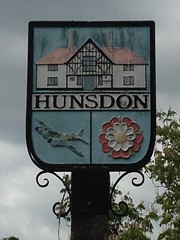
The Hunsdon Village sign reflects its history and links to the RAF.
Even before Hunsdon was built, it is referenced in some areas that the site was being used for a detachment of 107 Squadron Blenheims, then based at RAF Wattisham and later Leuchars. This may have been part of the ‘Scatter’ directive given to squadrons in the immediate period before war was officially declared, and was thought to occur between May 1939 and March 1941. However, there are no references to this in the official squadron files and so this action is doubted. However, if this were the case, then it would certainly suggest an early use of the site before it was developed into a fully operational airfield, and it may have been an indication that an airfield was on its way in the near future.
The site was earmarked for development in 1940, with construction occurring over the period October 1940 to March 1941, after which the first squadron moved in. It was built by various construction companies and incorporated two asphalt runways; the main running east-west reaching 1,750 yards in length after its later extension, with a second running north-east to south-west extended to 1,450 yards; both were built to the standard 50 yard width. Aircraft dispersals, maintenance and storage buildings consisted of eighteen ‘twin-engined’ hardstands; sixteen blister hangars (a mix of ‘Over’ (4) and ‘Extra Over’ (12)) and a Bellman hangar. There was also a fuel dump and accommodation buildings for up to 2,240 airmen and some 276 WAAFs, all located across eight dispersed sites.
A large number of operational units, (in excess of twenty-five) would pass through its doors throughout its relatively short life, providing Hunsdon with a multinational mixture of crews and a number of aircraft types.
The airfield itself lies within a stone’s throw of London and so its initial role was that of night fighter operations covering London and the south / east area.
The first recognised squadron to make its mark at Hunsdon was 85 Squadron on May 3rd 1941, transferring across from RAF Debden flying Defiants and Havoc MK.Is. The move across on the 3rd went smoothly with personnel and equipment being transferred across in lorries and 32 seat busses, the majority of personnel arriving later that day.
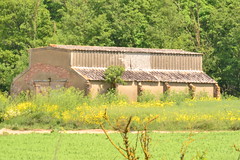
The Parachute store now holds farm machinery.
On arrival at Hunsdon, personnel of ‘A’ Flight were immediately billeted on the aerodrome close to their dispersals, whilst those of ‘B’ Flight were housed on Number 2 Site, located about a mile or so from the main airfield area. Personnel of both the Headquarters Flight and the servicing Echelon were billeted even further away, about four miles in fact, at Gilstone Park. The officers meanwhile, had the better accommodation, being billeted in a house called ‘Boningtons’ believed to be the former home of “Mr. Brooke Bond” the family of the P.G. Tea empire. It is thought that the family purchased the house in 1940, moving out of their London residency to avoid the blitz. Unfortunately, it was rather a short lived purchase as the property was requisitioned by the RAF not long after!
By the end of the 4th, all 85 Sqn personnel were in and unpacked at Hunsdon, and so night flying duties could commence straight away with patrols taking place over the Felixstowe area. Immediately, a Heinkel He.111 was vectored onto, and a skirmish took place in which both aircraft both gave and received machine gun fire. The Luftwaffe bomber came off worst though, and was last seen diving into cloud firing a white verey pistol, either as a resignation of the fight or possibly as a distress signal to any would be rescuers.
Over the next few nights further contacts were made and several Ju. 88s were either confirmed or claimed as shot down. The squadron was performing well, morale was high and all was looking good.
The night of the 13th could have been different for some though. On his return from a patrol, Fly. Off. Hemingway’s instruments failed and with little choice, he gave the order to bale out. After his operator, Sgt. Bailey, had departed the Havoc, Hemingway followed, both men landing in close proximity to each other in the grounds of Much Hadam Hall (a grade 1 listed building built in the early 1700s). Whilst both airmen were safe, Hemingway’s was not the model jump, as he came to rest in a tree in the grounds of the hall. Bailey fared little better, landing rather ungainly on a bucket not too far away. This was Hemingway’s third successful bale out of a stricken aircraft, his previous two both occurring during the Battle of Britain.
On May 17th, Wg. Cdr. Peter Townsend, now with a DSO, flew to Great Massingham, Flt. Lt. Marshall flew to Odiham to test the runway and Flt. Lt. Rabone flew to Heston from where he collected a special and secret Havoc which was to be tested by the squadron. The first flight of this new variant occurred on May 23rd, and was quickly followed by a second aircraft on the 28th, After this, they would then begin testing both aircraft as a new night flying platform.
This particular type of aircraft was the forerunner of what became known as the Turbinlite Havoc, a new design that was the brainchild of one Sidney Cotton,*3 (who was also the mastermind behind aerial photography, and who as a maverick, was later discarded by the RAF*8).
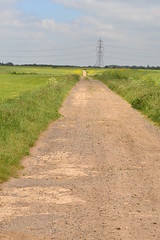
The main runway has been reduced to a track.
With the help of William Helmore, Cotton took out two patents; GB 574970 and GB 574118, each one relating to this new idea. It would be Helmore (an Air Commodore) who would then develop the idea further turning it into what would become commonly known as the Turbinlite system.
Originally designated Air Target Illumination, Cotton’s idea was passed to the Alan Muntz Company, who in conjunction with G.E.C., developed it into what was at the time, the most powerful searchlight in the world, and one that would fit neatly into the nose of a Douglas Havoc, or Boston as it was known in the RAF.
The light was so powerful that it would require a staggering forty-eight batteries each stored in the bomb bay of the aircraft, adding an additional weight to the aircraft just short of 2,000lbs. The light was so strong (1,400 amps) that it would discharge in less than 12 seconds meaning its use was limited to short searches only.

Havoc Mark I (Turbinlite), AW400, on the ground at Burtonwood, Lancashire. This aircraft served with Nos. 1422 and 1454 (Turbinlite) Flights, and with 1459 (Turbinlite) Flight/538 Squadron RAF, before transfer to the USAAF in April 1943. (© IWM ATP 10654C)
The first full prototype Turbinlite aircraft fitted with the unit was Boston W8254 and was flown by Acting Squadron Leader A. Clouston of 1422 (Night Fighter) Flight formed at Heston on May 12th 1941. The Flight would then operate a number of these aircraft, along with several other types which included the only Turbinlite Mosquito; along with a Defiant, Wellington and Hurricane.
Heston was the home of Airwork, an aviation company set up by two ex-Cambridge students and soldiers of the great war, Sir Henry Nigel Norman and Alan Muntz. Their vision, was to create the best aerodrome near London, a dream that would cost Norman his life and Muntz to lose his son. Airwork would go through many changes during its life, taking on several Government contracts including a range of flying schools to train RAF pilots throughout the Second World War. These included RAF Digby, RAF Grangemouth, RAF Scone (Perth) and RAF Linton-on-Ouse.
Airwork would themselves modify a further four Bostons, with a further sixteen being modified by the Heston Aircraft Company. A third batch was then developed at RAF Burtonwood, giving a total of nine flights for training and ten operational squadrons comprising just short of 100 aircraft in all.
It was soon realised however, that the Bostons lacked firepower and so the company began to look at the Mosquito as a possible replacement aircraft. Only one Mosquito was modified (W4087, a Hatfield built F.II) at Heston, but this idea, unlike the Boston, failed to progress any further than the prototype stage, and no other aircraft were converted.

The Only Mosquito converted to carry the Turbinlite.*5
The Turbinlite project quickly gained pace, but the units wouldn’t be raised to squadron status until September of the following year. In preparation, ten special Havoc flights were created to train crews to operate the aircraft. The first of two, formed at Hunsdon (and the first of the ten) was 1451 (Fighter) Flight on May 22nd 1941. The Flight used several examples that included both Boston IIIs (AL469 and Z2280) and Havoc Is (AE470 and AW405). It also utilised a Cygnet and Tiger Moth for pilot training. By the end of the month, 85 Sqn had flown a total of 505 hours, 482 of them undertaken in Havocs, with 213 of these being on night flights.
On August 9th 1941, 85 Sqn were joined here at Hunsdon by 3 Sqn, one of the original three squadrons to have been formed by the Royal Flying Corp. Created on May 13th 1912, when the Air Battalion of the Royal Engineers was absorbed in to the month old Royal Flying Corps, 3 Sqn joined both 1 and 2 Squadrons as the oldest units to have operated in the RFC. As such, its history is long and very distinguished.
After taking on Hurricanes IIB/C at Martlesham Heath in April, 3 Squadron arrived at Hunsdon from Stapleford Tawney, and like 85 Sqn, would remain here until mid May 1943, when it took its Mosquitoes to West Malling.
Pilots and aircraft of 3 Sqn would make their first appearance at Hunsdon on the 2nd August 1941 when twelve pilots arrived to practice formation flying with crews of the special Havoc Flight created earlier in May. These initial twelve would be followed by another twelve on the third, and then ten more crews on the sixth. The two squadrons would perform practice night flights together, formation flying and ‘dog fighting’ tactics with drogues. By the 10th, the bulk of the squadron had moved over leaving only detachments both at Manston and Shoreham, where crews undertook both dawn and dusk patrols over southern England and over enemy airfields looking for bombers either landing or taking off.
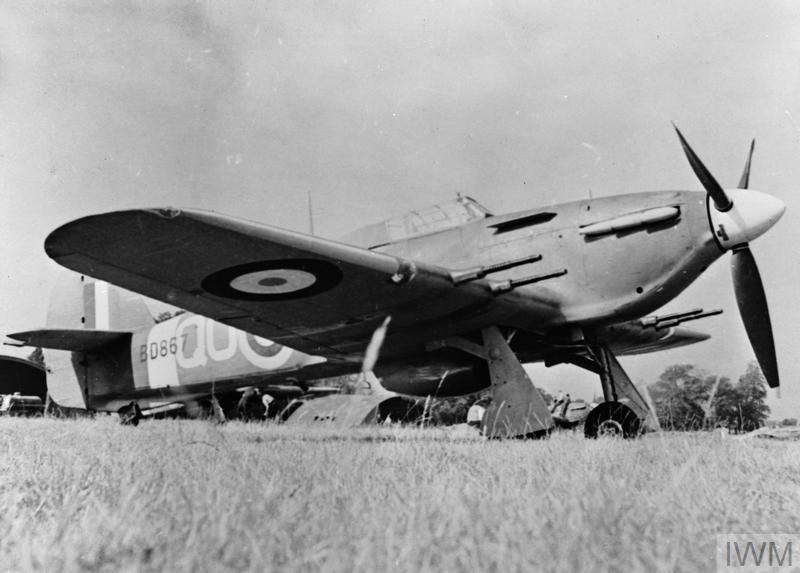
Hurricane IIC, BD867 QO-Y, 3 Sqn, at Hunsdon. The exhausts have shields over them to help prevent them being seen whilst on night fighter operations. (@IWM CH 3509)
The combined practice flights would take Hunsdon’s 3 Sqn and the Turbinlite Flights aircrew well into the summer and autumn of the following year, progress being marred by continuing poor weather. GCI (Ground Control Intercept) training and formation flying between the two units took up the majority of the time whilst they were here, however, both dusk and dawn patrols in their Hurricanes gave the pilots of 3 Sqn a little respite from the routine of formation flying with the two Special Flights.
September 1941 then brought the second of the two Special Flights to Hunsdon. On the 20th, 1459 (Fighter) Flight, the penultimate of the ten, was formed here also operating both Havoc Is and Boston IIs, Fs and IIIs. The last of the Flights to make up the ten units would follow just after, being based in northern England at RAF Acklington.
It was quickly found though, that the Turbinlites not only lacked firepower, but speed as well, so they were soon demoted to being used solely as a searchlight platform with 3 Squadron’s Hurricanes taking over the main role of interceptor.
With the formation of a new squadron at Croydon, 287 Sqn would have detachments spread far and wide including one here at Hunsdon. Staying here for virtually the entire war, they would fly a range of aircraft including: Blenheims, Hudsons; Lysanders; Hurricanes; Masters; Defiants; Martinets and Spitfires. Even as a detachment flying support flights, they were the longest resident at Hunsdon but never achieved the same status as many of those that were to be based here.
After the turbulence of 1941, 1942 would initially bring a much calmer time at Hunsdon, with less movements in or out of the airfield, although staff changes did cause problems for some units. Changes were initially relatively small, the first of which wouldn’t come until the July of 1942, when a small detachment of 605 Sqn Bostons arrived. After being reformed the month before, at RAF Ford, the small group remained here until mid March 1943, when after taking on the Mosquito, they transferred to Castle Camps in Essex.
Ford’s link with Hunsdon would be a strong one, with 3 Sqn having moved here from there, they once again joined with Ford’s 23 squadron escorting their Havocs and Bostons on night intruder missions over enemy territory. Being joined shortly after by Debden’s 418 Sqn, they became a formidable force in the night sky over Europe.
605 had previously been posted to Batavia where the majority of ground personnel had been captured by enemy forces. Those that were left were posted to various units and the squadron disbanded. Its reformation at Ford would be a slow process, but gradually it would receive both men and aircraft, accepting machines from 23 Squadron as it also eventually took on the Mosquito.
Whilst based here at Hunsdon, they would primarily carry out training, performing cross country flights, searchlight co-operation flights and gunnery practice. Navigation also came under scrutiny with logs being examined by the squadron’s navigation officer. By the end of August though, all was well and the personnel returned to Ford thus reuniting the entire squadron once more.
As was the case with many other airfields, training and support flights also used the same airfields, training pilots in new and more modern ways to fly. Hunsdon was no different, and in August a new Flight fulfilling this role was created here at Hunsdon. 1530 Beam Approach Training (BAT) Flight, who were formed specifically to train pilots to land in the dark, or poor weather, using a ‘beam’ (formally blind approach) or radio system. They remained here for some time eventually moving to Wittering where they were disbanded later in 1944.
It would also be in August 1942, that Hunsdon’s resident 85 Sqn would take on the Mosquito, the MK.IIs being a major change from the Havocs previously used. It would only be a trickle of aircraft at first, with just a small number of the ‘Wooden Wonders’ being received by the month’s end.
The trickle continued into September as did the nightly Havoc patrols. On the 7th, Sgt. McCormick sighted what he believed to be a Ju. 88, and closed in for the attack. After following the aircraft he managed to close to 150 feet at which point he opened fire on the starboard engine which quickly caught fire. The aircraft fell from the sky and was later seen burning on the sea below. It was confirmed not as a Ju. 88 but as an He.111 distinguished by its fixed rear-firing machine gun in the extreme end of the fuselage.
September 1942 then brought yet more change. At this point it was decided to raise all ten Turbinlite squadrons to squadron status. The date decided upon was September 2nd 1942. However, due to administration problems, only five could be raised on that date, the remaining five being raised six days later on the 8th of the month. By then, all ten Turbinlite training Flights had been disbanded and reformed as operational squadrons.
With that, 1451 became 530 Sqn on September 8th and continued to operate from Hunsdon, whilst 1459 became 538 Sqn and was relocated to Hibaldstow.
The reformation meant that flights were initially curtailed for 530 Sqn. The poor September weather then added to the issue meaning that flying was at best sporadic. Two further support Hurricanes soon arrived for the squadron taking the total available to four. But their arrival did not ease the situation, the poor weather and other factors continuing to dominate operations to the point that little operational flying took place at all.
October fared little better. More poor weather combined with the fact that three of their four Hurricane pilots (all American), were transferred to the US Army Air Corps, meant that 530 Sqn was unable to progress the way it had hoped. It had been a very poor start for the operational Turbinlites.
By November there were a total of eight Hurricane pilots, some of which had transferred in from O.T.Us, but all were lacking night flying experience. As a result, they were rushed through a night flying course at Hunsdon and were passed as ‘operational’ by the month’s end. However, the problems did not end there. Formation flying in good weather was considered difficult and in visibility of 2,000 ft or less, impossible. This meant that the required number of night flights were not being made which held back all operational flights. Compounding this, continuing bad weather had by now turned the ground very soft and a number of aircraft were getting bogged down in the mud. In addition, whilst aircraft serviceability was generally good, a few had experienced wrinkling of the skin over the air frame and were now awaiting an inspection before being allowed to fly. By now, the crews must have been wanting 1942 to draw to a very quick close.
And to a close it came. December brought rumours of the demise of the Turbinlite squadrons causing uncertainty amongst the personnel. Continuing bad weather had curtailed all but the most urgent of flights. Lectures prevailed bringing escape tactics and Luftwaffe organisation information up to date. A new Havoc was brought in for testing with a new windscreen deicing system, unfortunately this was found unsatisfactory, so a new hot air method was suggested by the squadron and tested under the same conditions. This proved much more successful.
Christmas celebrations then kept the personnel occupied and were ‘livelier than expected’ primarily due to the inclement weather. Crews in the meantime being kept on standby in case the weather turned and operations became necessary again.
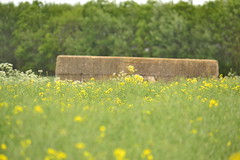
The battle headquarters.
With New Year 1943, came the news that the Turbinlites were indeed being disbanded. Of the ten squadrons formed, only five made successful enemy intercepts – Turbinlite was not a great success and as a result, on the 25th January, 530 Squadron along with all other units, ceased to exist and all personnel were scattered amongst other squadrons.
The Havocs themselves, were then take to The Airwork General Trading facility located on the former racecourse at Derby Road, Loughborough in Leicestershire. Here, Havocs (Bostons) were either modified or repaired after sustaining serious damage through a maintenance contract with the Ministry of Aircraft Production. As these Turbinlites arrived, they were stripped of all the mechanisms and parts needed for the Turbinlite operations, and converted back to other uses ready for RAF service.
The end of the Turbinlites meant that Hunsdon only had two operational units at this point, both 85 and 3 Sqn continuing to fly from the airfield when they could. The early part of the year, brought considerable fog and cold weather, the fog preventing flying on many occasions, which hampered test flights for 3 Sqn on their new Typhoons when they arrived in February.
By mid May though, both these units were to depart also, 3 Squadron transferring to West Malling, with the Mosquitoes of 85 Sqn joining them soon after, but not until after a very important ceremony.
On May 5th, the unit would officially receive its squadron badge, although it was a former World War One Squadron, it had never been officially presented with its badge. With the whole squadron lined up outside the Bellman Hangar, A.O.C. 11 Group, Air Vice Marshall H.W. Saunders, C.B.E., M.C., D.F.C., M.M., gave a speech highlighting how well the squadron had performed; shooting down ninety enemy aircraft in France, fifty in the Battle of Britain and a further twenty in night operations whilst at Hunsdon. He went on to highlight the number of decorations its crews had been awarded: four D.S.Os; seventeen D.F.Cs; three D.F.Ms, and Bars to both the D.F.Cs. and D.F.Ms. He then presented the station badge to the Commanding Officer Wing Commander Cunningham. At this point it was announced that the squadron would be moving south to West Malling in Kent and he wished the squadron good luck.
With just a few more days left before departure, operations continued and on the 8th, three more JU. 88s were spotted but intercepted by Spitfires from other squadrons before the Mosquitoes could get to them. It was not to be the glorious ending 85 Sqn had hoped for.
After a farewell dinner for both 85 and 3 squadrons in the officer’s mess, preparations began for the move. Three Harrows arrived to collect personal belongings and equipment, and then, on the 13th, 85 Squadron departed, all ten aircrews performing individual flypasts over the watch office to show their respect and thanks to those who had worked along side them, it was a sad day for Hunsdon. The Harrows once loaded, departed shortly after with the main ground party departing by train soon after that.
The dispersals and accommodation did not remain vacant for long though, they were immediately taken over by a new squadron, 157 Squadron along with their servicing wing 3081 Servicing Echelon.
The new squadron was also a Mosquito Squadron, transferring in from Bradwell Bay. Night patrols had been the order of the day and these continued, and even as the squadron moved into their new home a Do. 17 was intercepted and shot down near Felixstowe.
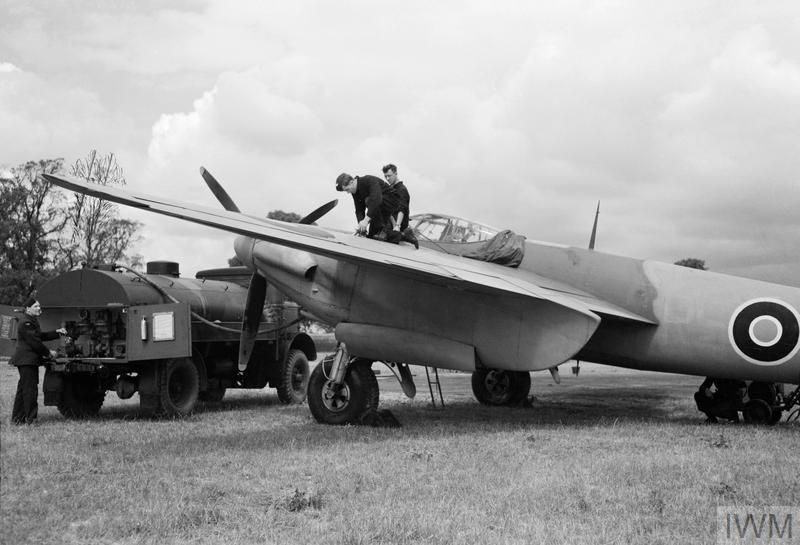
Mosquito II of 157 Sqn being refuelled at Hunsdon, 16 June 1943. (©IWM CH 10312)
During the day, personnel took to painting and refurbishing the dispersals, whilst at night patrols continued on, an F.W. 190 falling victim to Flt. Lt. H. Tappin DFC and Fly. Off. I. Thomas in Mosquito S.727
The remainder of the month and into June involved further night patrols, many being cancelled due to poor weather, whilst on the ground yet more decorating took place, with all crews taking part.
June then saw the temporary arrival of 515 Sqn with Defiants moving in from Heston. On June 1st, all aircraft had been received at Hunsdon with the rear party arriving later by road. As soon as 11 Group Headquarters had been notified of the squadron’s readiness, the order came though to move sections to forward bases ready for night operations. Eight aircraft immediately took off from Hunsdon but poor weather curtailed any further flights and they all returned the next day without taking part. This routine pretty much set the scene the remainder of the month. Shortly after arriving here 515 would start to accept the Beaufighter, a remarkable step up from the Defiant and an aircraft they would take when they left Hunsdon for Little Snoring in December that year.
Then in July, a new version Mosquito began to arrive with 157 Sqn – the MK.VI. ‘Ranger‘ patrols became a priority, attacking freight locos across the enemy network. On the 19th August, the Sqn claimed their 100th victim, a landmark number that was acknowledged by Sector Commander Group Captain Harris.
The next few months were a mix of sporadic contacts but few engagements, ‘uneventful’ patrols and cancelled flights due to poor weather. The arrival of a Lancaster out of fuel in early October, a Wellington damaged by flak and a lost B-17 possibly heightening the excitement on the airfield. A large portion of this time was taken with sports including shooting until finally ‘discouraged’ by local landlords.

Remains of the latrines and drying rooms.
157 Sqn however, wouldn’t remain at Hunsdon for much longer, departing with their Mosquitoes for Predannack in November that same year. A relatively uneventful stay at Hunsdon had finally come to an end.
Movements into and out of Hunsdon would continue in November, with the arrival of yet another Mosquito unit, 410 (Royal Canadian Air Force) Squadron. The unit would stay here on three separate occasions throughout 1943 and 1944, each time being for a short period only before moving on again elsewhere. Each stay would bring a new model Mosquito: MK. VI, MK.XIII, and finally the MK.XXX before moving off to the continent in 1944 and their eventual disbandment in June 1945. Whilst the squadron was primarily Canadian (seventy-two personnel), it also consisted of sixteen RAF personnel and four Americans, making it a multinational mix of aircrew, officers and ground crews.
It was whilst at their previous station, West Malling, that they would make the first ‘kill’ of 11 Group, when on the 5th November, a Mosquito piloted by Flg. Off. Green and his navigator Pt. Off. Goodhew, intercepted an Me. 410 and shot it down approximately 15 miles from Dungeoness. Three days later they would arrive at Hunsdon, where a turn in the weather prevented any further kills for the unit for the remainder of the month.
Training flights were managed on the odd occasion, intercepting friendly bombers with camera guns along with several Mahmoud exercises. On the 26th November tragedy struck when on one of these flights Flg. Off. J.J. Blanchfield in Mosquito DD669 struck the target Mosquito DZ259 flown by W.Off. C. James and his navigator Flt. Sgt. T. Levine. Both crews reported that they were bailing out, but both Blanchfield and his navigator Flg. Off. K. Cox, were killed in the accident.
The squadron’s remaining time at Hunsdon was much similar, training flights, the odd operational scramble and bad weather persisted to the end of the year. But in December, one Mosquito flown by Flg. Off. “Joe” Schultz and Flg. Off. Williams manged to shoot down no less than three Dornier 217s in an epic air battle in which they themselves narrowly missed being the victim.
After vectoring onto the initial target, Schultz managed to shoot it down even though the Dornier tried to evade the attack by both attempting to fly into cloud and carrying out violent evasive movements. After dispatching this aircraft, Schultz pursued a second aircraft which exploded some 50 feet ahead of him, causing his own aircraft to jolt as it passed through the debris. A third Dornier gave a more difficult challenge, and even though both its engines were hit, the crew continued to return fire whilst the pilot made aggressive and violent defensive movements. The Mosquito in return, had its instruments put out of action and both engines hit, causing a fire in one. Luckily, this extinguished itself, but the second engine then failed altogether. Schultz managed to safely land the aircraft at Bradwell Bay using the single damaged engine, a remarkable feat considering the damage to the Mosquito and its components.
During the month, yet another new version Mosquito began to arrive at the squadron in addition to those already on station. By the end of the December, when they finally departed Hunsdon for Castle Camps, they had on their books: two Mosquito MK.IIs, one MK.III, one XII and seventeen XIIIs. A squadron Magister was also registered, but the Oxford they had, had struck a hill severely injuring the pilot, Flt. Lt. M.A. Cybulski DFC at Winter Hill, Belmont near Bolton. Flt. Lt. Cybulski had completed his tour of duty and was transferring to 9 Group when the accident happened.
New years eve 1944 would undoubtedly bring the most significant of the RAF units to Hunsdon and the one for which it is most famous. The arrival of 21 Sqn, 464 Sqn and 487 Sqn combined together to form 140 Wing, would see a number of dare-devil raids against German targets which, like the dams raid of 617 Sqn, would be forever discussed by historians.
The new wing, previously formed at Sculthorpe, would consist of the three multinational squadrons, a ‘British’, Australian and New Zealand unit, and all would be based at Hunsdon as part of the RAF’s Second Tactical Air Force (2TAF) designed to support troops in the forthcoming invasion.
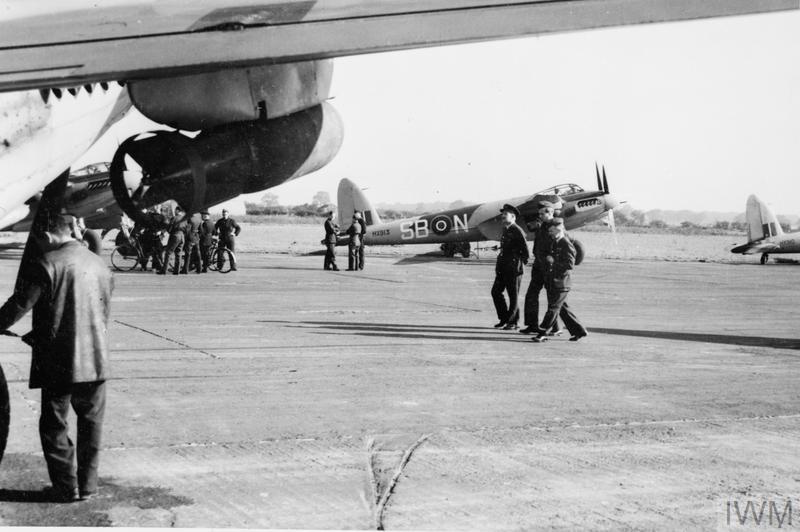
Group Captain P C “Pick” Pickard (centre), Commander No. 140 Wing, flanked by Wing Commander I G E “Daddy” Dale, Commanding Officer of No. 21 Squadron RAF (to Pickard’s right), and Wing Commander A G “Willie” Wilson, Commanding Officer of No. 487 Squadron RNZAF, visit No. 464 Squadron RAAF at Hunsdon, prior to a daylight raid against flying-bomb sites in the Pas-de-Calais. 464’s Mosquitoes (FB Mk VIs) have been loaded with 250-lb MC bombs for the operation: HX913 ‘SB-N’ can be seen in the background (@IWM HU 81335).
Between 1944 and 1945, 140 Wing would carry out many daring low-level bombing raids against V weapons targets, along with a key Gestapo building and a prison in occupied Europe. These particular raids were designed to both free captive resistance fighters and destroy important Gestapo documents. Operation Carthage took place in Denmark and occurred whilst the wing was based at RAF Fersfield in 1945, but the first, Ramrod 564 or ‘Operation Jericho’ as it has since become known, took place whilst they were based here at Hunsdon in early 1944.
There is a lot of speculation around Ramrod 564, many of the official records are missing, inaccurate or even vague. The operational record books for the four squadrons involved (three Mosquito and a Typhoon) are recorded as ‘secret’ and contain no details other than aircraft, times and dates.
However, we do know that the Operation, formulated by Air Vice Marshal Basil Embry, would be critical, even the amount of explosive itself had fine limits. Time was also of the essence, as several prisoners were thought to be destined for execution and so a time limit was placed on when it needed to be done by. The exact time of day was also critical, they needed as many guards to be in one place as possible, and the prisoners needed to be safely gathered together out of harms way. So, a time of 12:00 pm precisely on a date between 10th and 19th February was chosen, as both the guards and prisoners would be having lunch at this time. In the attack, six Mosquitoes would breach the outer wall in two places, whilst a further six would bomb the main prison buildings allowing the prisoners to escape whilst killing as many guards as possible.
Embry elected himself to lead the attack, but this was blocked by those higher up, As a result, and much against his wishes, Embry therefore had to choose a successor. Group Captain Percy C. Pickard (D.S.O. and two bars, D.F.C.) was chosen, but even though he was known as an expert pilot and leader, Embry was not convinced of Pickard’s ability to complete the job at such low level. Despite his reservations though, Embry duly informed Pickard of the decision and preparations for the operation began in earnest.
On February 18th that year, a day after the initial planned attack and in extremely poor weather, 19 Mosquitoes including a photo reconnaissance MK.VI (from the Operational Film Production Unit (OFPU) for propaganda purposes), took off to attack, breech and destroy the walls and main building of the Amiens prison. A famously brave act, it resulted in the death of 3 crew members; Gp. Capt. Percy C. Pickard, and Flt. Lt. John A. Broadley, (RNZAF), both in Mosquito HX922, ‘EG-F’ and Flt. Lt. Richard W. Samson, (RNZAF) in Mosquito MM404 ‘SB-T’. Samson’s pilot, Sqn. Ldr. A. I. McRitchie survived his crash and was taken as a prisoner of war. Two Typhoons from 198 Sqn escorting the Mosquitoes are also thought to have failed to return (the ORBs don’t confirm this). Considered a success at the time, evidence has since come to light to suggest that the operation was ‘unnecessary’, and may have failed to achieve anything more than a successful PR role (see end note). *1
(A better quality version is available on the Pathe News website.)
All that aside, the raid took place at very low level and in poor weather, with bombs dropped against the wall with delayed fuses. There was little resistance on the flight in and Typhoons provided higher cover when it was needed.
The route would take the Mosquitoes from Hunsdon to Littlehampton – then via appropriate lattice to Tocqueville – Senarpont – Bourdon – then one mile South Doullens – Bouzincourt – two miles west-south-west to Albert – Target – Turn right – St. Saveur – Senarpont – Tocqueville – Hastings and back to Hunsdon.
During the flight out, four Mosquitoes and three Typhoons of 198 Sqn became lost in swirling snow and were forced to turn back as they had now lost contact with their main formations. The remaining crews flew on, but whilst over France a fifth Mosquito, flown by Flt. B. Hanafin, suffered engine problems and was also forced to turn back. On his return journey his was attacked by Flak from which he was seriously injured. Helped by his navigator the two were able to land back at RAF Ford where he was given medical treatment for his injuries.
Just three minutes behind schedule, the first wave of three aircraft followed the main road toward the prison’s eastern wall at tree top height. The second wave would attack the northern wall. Wg. Cdr. I. Smith 487 Sqn went in first dropping the bombs with 11 second fuses against the wall.

Wing Commander I Smith, Commanding Officer of No. 487 Squadron RNZAF, at Hunsdon (©IWM CH 12649)
The third and fourth waves attacked the south-eastern main building and north-western end respectively. Chaos then ensued inside the prison, as over running bombs had caused some damage inside and some prisoners were injured or struggled to escape.
Noting now that the walls and prison had been breached, the signal to abort was issued over the VHF radio probably by both Pickard and the OFPU Mosquito flown by Flt. Wickham (both the code word “Red, Red, Red” and who sent it are also disputed) instructing the four aircraft of the 21 Sqn Flight not to bomb. The message was heard by the flight, when they were between 2 and 4 miles out from the target, and so returned to base without dropping their payload.
During all this time, FW.190s continued to swarm and various dogfights took place between them and the Typhoons, but not before they had attacked some of the fleeing Mosquitoes who also returned fire.
It is unclear at what point in the attack that Pickard was shot down, but a Focke Wulf 190 flown by the ace Feldwebel Wilhelm Mayer, severed his tail sending his aircraft to the ground near to Saint Gratien. The resultant crash killing both occupants.
The story goes that Pickard had left his dog ‘Ming’ at RAF Sculthorpe, their previous airfield, to be looked after whilst he was away. On the day he was shot down, 18th February 1944, the dog fell gravely ill. Pickard’s wife, Dorothy, went to get him and sensed, that after seeing the state of the animal, that Pickard had been killed . It took months for Ming to recover, and some years later whilst living in Rhodesia, Ming went outside, looked up to the sky as he always did when Pickard was flying, heard a whistle, collapsed and died.*6
Of the 700 prisoners detained inside the prison that day, 258 of them escaped,102 were killed and 74 were wounded*7, but the success remained secret from the public for a further eight months. With so much speculation surrounding the attack, it will no doubt remain one of the mysteries of war, but it was without doubt, an incredibly brave and daring mission that cost the lives of three superb young airmen.
A podcast using eyewitness accounts from the Imperial war museum can be heard through their website.
The Amiens raid was not the only daring low level raid carried out by the wing whilst at Hunsdon however. Airfields along with the Hazmeyer electrical equipment factory at Hengels in Belgium, were also attacked at low level. On this particular operation Mosquito MM482 was hit by intense flak setting the starboard engine on fire. As a result, the aircraft flown by Canadian Sqn. Ldr. A. W. Sugden with navigator Fl. Off. A. Bridger, was lost and both men were listed as missing. Having been with the squadron since 1942 they were considered ‘old timers’ by the others and were sorely missed.
The three squadrons of 140 Wing would soon depart Hunsdon though, leaving the joy of success and the turmoil of a thousand questions behind them. 464 went first on March 25th whilst 21 and 487 Sqns would both leave mid April, both moving to RAF Gravesend in Kent.
However, a month before the wing moved away, another Mosquito squadron would move in temporarily, meaning the airfield was awash with the aircraft of varying types. 409 (RCAF) Sqn’s time would be short, remaining here for just over a month before departing mid May, but they would return in June that same year staying for a further two months. Their final departure on the 25th August 1944, would end their association with Hunsdon for good, a move that took them to the continent and forward bases across the low countries.
Between June and the end of 1944, no less than six squadrons would come and go, most of them moving to the continent as the allied advanced progressed toward Germany. Each of these units would bring further Mosquitoes with them, with marks ranging from the MK.II and VI (418 Sqn); to the XIII with 29, 264 and 48 Squadrons, on to the XXX with 219 and 151 squadrons.
The longest to stay of these six units would be the first, 29 Squadron. Formed in 1915, they have operated almost continuously ever since, with just a short break between the wars and some reformation post war. Today they are based at Coningsby in Lincolnshire and are the southern most QRA Squadron currently flying Typhoons. They were in 1987, the first operational squadron to be equipped with the Tornado F3.
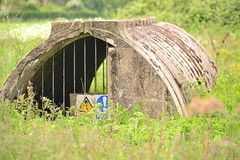
An air raid shelter now exposed.
At Hunsdon in 1944 though, the move would come as a surprise and with some reservations, but once here, it was considered to be an ‘improvement’ on West Malling. 29 Squadron would fly the NF. XIII Mosquito, arriving here on June 19th that year. The NF.XIII was the first variant night fighter to have the strengthened wing of the FB.VI, with increased fuel load and Merlin 23 engines. One such example, HK428 ‘RO-K’built at Leavesden, joined 29 Sqn at RAF Ford in early 1944.
On October 24th that year, during a flight test at Hunsdon, the aircraft suffered an overheating starboard engine and inactive flaps whilst in poor visibility. As a result the aircraft overshot the runway and crashed into a hedge causing the starboard undercarriage to collapse further damaging the aircraft. HK428 was subsequently repaired and passed to the Gunnery School at Catfoss in early 1945. It was eventually one of many that met the scrap man’s axe in 1946.*4
The Squadron would carry out patrols and intruder operations and whilst many of these were ‘uneventful’, several enemy aircraft were shot down including both Ju. 88s and Me. 110s. The last months of the war though were not all plane sailing. On July 1st, an accident during a flying test resulted in the loss of two good airmen and friends, Flt. Lt. John Barry and Fly. Off. Guy Hopkins. A second Mosquito was hit by light flak at 500 feet on the 5th. Flying home on one engine, the aircraft made and emergency landing at RAF Ford, but somersaulted on the ground writing the aircraft off. Thankfully, and remarkably, in this instance neither crewman sustained any injury.
As the allies advanced more intruder missions took place. On some days the squadron was “let loose” to pick and locate their own targets, many choosing road or rail stock, damaging many trains as a result. The rest of the year and into 1945 would be the same. Intruder missions, ‘Flower‘ Operations (attacks against German night fighters at their airfield) brought some results. Then almost as quickly as they arrived they were given notice to move once more, and a huge party on the night of February 22nd 1945 preceded their departure to Colerne
Two other units arrived at Hunsdon after 29 Sqn, those of 418 (25th August, 1944) and 219 (29th August 1944) Squadrons. With all these Mosquitoes there must have been little room for any more aircraft as Hunsdon quickly filled up with the type. 219 Sqn would quickly move out though, leaving what little space there was for a new unit, 488 Squadron who moved in the day prior to 219’s departure. The last of this group of units to arrive that year was 151 Squadron. All but 151 transferred to the various airfields on the continent whilst 151 remained in the UK, leaving Hunsdon on March 1st 1945. It had certainly been a busy period at this Hertfordshire airfield.
1945 would be a reflection of the hectic movements of 1944. However, it would also bring a greater variety of aircraft as detachments arrived posted away from their main unit. It would also bring a slight change of role, as the range of twin engined Mosquitoes departed, single engined fighters came in.
The first would be a small detachment of 285 Sqn Hurricanes who resided here between January and June, followed in the beginning of March by 154 Sqn with Mustangs and Spitfires. 154 Sqn time here would be very short though, sadly ending their days here, just eighteen days later.
Almost at the same time, these units would be joined by 501 Sqn and 611 Sqn, 501 also ending their days of active duty here with their Tempest Vs, whilst 611 would swap their Spitfire VII for Mustang IVs before moving off to Peterhead and disbandment also. Both these units would however rise again the following year being reborn as the jet age dawned, to live on for a few more years.
442 Sqn, another Canadian unit, ended the flurry of units arriving in March that year when they brought Spitfire IXEs back for a spell from the continent, being stationed recently at B80 (Volkel) and B88 (Heesch), they had seen action first hand before arriving here. They soon replaced these aircraft with Mustangs though, moving on to RAF Digby in May as the war ended. 442 were also a short lived squadron, only being formed at Digby in February 1944. Their operational life had lasted just eighteen months.
Whilst at Hunsdon, both 611 and 442 Squadrons (part of the ‘Hunsdon Wing’) would escort eighteen Lancasters of 617 Sqn during their attack on the German pocket battleship, The Lützow, then anchored at Swinemünde, now part of Poland. The Lützow, was sunk, hit by a single ‘Tallboy’ bomb, and one Lancaster was lost, that of Sqn. Ldr. J. Powell DFC, MID. Although reports were made of a parachute, no one survived and all are buried in Poland, The aircraft, ‘KC-V’ was hit by flak taking off its port wing and sending it spiralling down into a wooded area. A memorial now stands at the site utilising part of the Lancaster’s tail.
What makes this operation more unique was that after the attack, the Mustangs of 442 and 611 Squadrons headed toward Berlin on a fighter sweep. Being so close to the war’s end, the chances of meeting Soviet allies was now higher than ever and it was on this flight that such an event occurred for the very first time.
After being aware of Soviet talk over the radio, the Mustangs encountered the Soviet aircraft, two Ilyushin Il-2 Sturmoviks and a group of Yak-9s as escort, whereupon they passed waves and greetings. Pleased with their encounter, the Mustangs headed off whereupon they then came across a number of FW190s over an airfield holding Me 262s.
In the ensuing battle, a number of enemy aircraft were shot down or damaged, with no loss to themselves. It would be a significant end to 442 and 611’s war, celebrated in the usual manner when they returned to Hunsdon later that evening.
April and May saw the last of the front line squadrons arrive at Hunsdon. The closing days of April saw 441 Sqn with Spitfires and 287 Sqn with a detachment of Tempest Vs. Both these units would move on elsewhere before they too saw the curtain fall, and their days as operational units cease. Like its sister squadron, 441 had only been operational for eighteen months, being formed in unison. In fact, their entire operational record matched to the day, even when they moved abroad.
Hunsdon then closed to operational activity, being used to receive returning men and materials up until mid 1946 whereupon it was placed into Care and Maintenance and allowed to run down. The tower was demolished very soon after the war ended, and the site was returned to agriculture. In total, Hunsdon’s crews accounted for over 220 enemy aircraft destroyed or damaged – a remarkable feat in any airfield’s chapter.

One of the original dispersal pans.
Today Hunsdon remains one of the more accessible airfields of Britain. A number of public footpaths criss-cross its boundaries allowing unprecedented access to it. It is still an active site, albeit much reduced – a small microlight operation exists here and has done since 1997. Using three small grass runways it has brought life, in albeit a small part, back to this old wartime airfield.
The perimeter track and narrow sections of all its runways still exist today and can be walked using a variety of footpaths. Along these paths and off to the sides can still be seen examples of runway lighting, drainage, inspection covers and even a small number of buildings.
The parachute store is one of the most notable of these, used by the farmer for storage, it is located at the north-western side of the airfield near to the former admins site and where the tower would have stood before being torn down. Also near here is the fire tender shed, now home to the local shooting club, a number of latrines \ wash blocks can also be found hidden amongst the trees to the south-east. The battle headquarters rests nestled amongst the crops still watching over the site, and small defence trenches and shelters can be found to the north and again these are visible from public footpaths. A number of airfield defences buildings in the form of pill boxes and an Oakington style pillbox can also be found around the site.
Many of these examples are buried amongst the undergrowth and are most easily seen in winter when the thorns and vegetation are at their lowest. Careful searching will also reveal a number of minor archaeological examples but again best in the winter when crops and weeds are minimal.
To the northern side of the airfield, next to where the microlight site is based, is a memorial to the crews of all nationalities who were based here all those years ago. Formed from a propeller boss of a Mosquito, it was donated to by the former Mosquito Museum (now de Havilland Aircraft Museum), it stands proud looking down what was the length of the secondary runway. A further memorial plaque can also be found on the wall of the village hall.
Hunsdon is a small site with a big history. It played a large part in trials of new innovations, carried out night intruder missions, and attacked with daring at low-level, at the very heart of the Gestapo. Hunsdon and its crews proudly earned their place in the annals of world history.
After walking Hunsdon we travel the short distance to the north-east to the outskirts of Bishop Stortford and a little known about airfield that is all but gone. We go to RAF Sawbridgeworth.
RAF Sawbridgeworth
RAF Sawbridgeworth, also known as Mathams Wood and RFC Sawbridgeworth, was originally constructed as a second-class night landing ground during April 1916. After considering three sites in the area, Sawbridgeworth, a 31 acre site to the west of Shingle Hall was chosen, the reason being it had good approaches, was flat and had a main public road running alongside it.
Facilities at the ground were limited however; there were no hangars and only a small wooden hut with an occasional tent was provided in cases of bad weather. Any aircraft landing due to difficulties or damage, could have minor repairs carried out, but little more than that. As a result, staffing at the site was also minimal, manned by just one RFC officer and a handful of civilians who would carry out repairs and maintenance to any aircraft using the site. Whilst based here, the primary role of the RFC Officer was merely to provide signals to landing aircraft by using flares laid out in the form of an ‘L’ with the longer leg pointing downwind.*1
Sawbridgeworth was small, only being intended to take aircraft from 39 Sqn, a home defence unit who were currently based at nearby North Weald and were activated to combat the Zeppelins flying in from Germany to bomb targets in southern and eastern England.
It was one of these squadron’s pilots, Lt. William Leefe Robinson, who attacked and shot down the first Zeppelin over British Territory on 2nd September 1916. Called the ‘Cuffley Zeppelin’ after the village near to where it crashed, Robinson was immediately awarded the Victoria Cross for his action on that night, an honour not bestowed lightly.
The attack occurred in the early hours of the morning, when Robinson, flying a Be2C, made contact with airship. He attacked the craft three times, and on the third pass it caught fire and burst into flames, killing those onboard.

Wreck of the German Zeppelin L 21 at Cuffley, Hertfordshire (IWM Q73672).
The squadron was initially formed with its headquarters at Hounslow, and had two Flights – one based at Hainhault Farm, and the other at Sutton’s Farm (later Hornchurch) – both part of the Home Defence force, and were directed to protect London from Zeppelin attacks from the north-east coming across the Wash and down through East Anglia.
In August, the Headquarters were transferred to Woodford in Essex and a third Flight established at North Weald Bassett. The three Flights were then merged to form 39 Sqn RFC. The squadron would indeed primarily attack Zeppelins, but records show they also attacked a number of German Gothas also used to attack the capital.*2
For almost 20 years the site remained in this form, until 1928, when a small gliding club was formed at nearby Shingle Hall Farm. It would turn out to be a short -lived venture however, ceasing to operate within a year or so. But despite this, all was not lost, and in 1933, a ‘Great Air Pagent’ took place in which fifteen aircraft paraded past a growing crowd who had come to experience the thrills and spills of flying. The Pagent itself, was part of a wider programme designed to tour the country raising money for local hospitals, and successfully visited 180 towns and cities across the country, being seen by over one million spectators. *3
Led by Mr. Charles W. A. Scott, AFC, the famous airman who held the world record for his flight from England to Australia, the event was to specifically raise money for a new wing at the Bishops Stortford Hospital, and would showcase a range of daring flying stunts to amaze the gathered crowd. The event was a great success, and a new wing was indeed opened at the hospital as a result. Also taking part was one of the more notable aviators, Pauline Gower, who would later go on set up the Women’s Section of the Air Transport Auxiliary in 1939.
However, there was no further flying activity at the site after the pageant, and no further aviation interest was shown in the area, until after 1934 when a beacon was located on the south side of the field.
Then, with tensions rising on the continent, it was decided to begin training troops in preparation for what may lie ahead, and in order to do this, a new landing ground was needed in the vicinity. However, due to developments in aircraft design, size and power, the site at Shingles Farm was determined too small and not able to accommodate the new types of aircraft coming through. To remedy the problem another area just a short distance away, was then chosen as the new site. *1
The new site lay between Shingle Hall Farm and a wooded area known as Matham’s Wood, (seen on 1/4 inch map sheet 9, Ref:L 9137) located to the north-west of the farm, and was larger in area then the previous site used. The Ministry obtained it in 1937, and it was passed directly to the control of Army Co-Operation (AC) Squadrons, commanded by the 22nd Army Co-Operation Command. It would immediately become an Advanced Landing Ground (ALG).
Designated Matham’s Wood ALG, Army Co-Operation units, in particular, 2 (AC) Squadron, would operate with Army units, under operational conditions, simulating what it would be like for the troops to perform in times of war. These training operations would later become fundamental in the training of SOE agents who would be transported into occupied Europe to work with numerous groups including the French Resistance. Whilst the site was only used intermittently, it nevertheless set the seeds for the growth of the site into the what would become Sawbridgeworth airfield.

The former Grocery store.
2 (AC) would remain the primary user of Matham’s Wood arriving in June 1940 after their retreat from France earlier in May. Whilst on the continent, they were attacked on many occasions by the advancing Germany forces, receiving as many as 75 bombs in one attack alone. In support of the Allied retreat to Dunkirk, they carried out sorties both over the town itself and over the advancing German front lines; eventually being forced to pull back to England and Bekesbourne in Kent, where they initially made their new home.
On June 15th 1940, Matham’s Wood ALG officially opened with its first ‘resident’ units, and was referred to as Sawbridgeworth Advanced Landing Ground for the first time. Flt Lt. P. Edinger was the Officer in Charge, who would oversee two Flights on rotation in conjunction with a third Flight then based at Hatfield. With them, were the associate section 5 A.I.L and a photographic section with their trailer. In support of operations, a range of appropriate night flying equipment was also transported over to the airfield.
The move would also see the requisition of Blounts Farm on the southern side of the airfield – this would be used as the Flight Office. Crew accommodation however, would once again be rudimentary at best – initially tents being the main form of accommodation for anyone stationed here.
Over the next few months various tactical flights would take place in conjunction with numerous Army Units, many of these involving the Lysanders of 2 (AC) Sqn ‘dive bombing’ the ground troops or performing mock gas spraying attacks. This rather deadly weapon was kept stored at various airfields around the country including Macmerry in Scotland and were a back up to thwart any invasion attempt made by the Germans.
Later, at the end of July, the bulk of 2 (AC) Sqn was divided, one Flight moving from Hatfield to Cambridge, leaving the other two Flights at Sawbridgeworth. This meant that ‘C’ Flight, now at at Cambridge, would operate under HQ 2 Corps, whilst ‘A’ and ‘B’ Flights left at Sawbridgeworth, would operate under XI Corps. This move, whilst minor in itself, was the next step forward in establishing an airfield here at Sawbridgeworth. For the next few years 2 (AC) Sqn would operate out of Sawbridgeworth, spending in some cases days or even weeks at a time at other airfields as part of their operational role. This would be a regular occurrence until mid 1944 when they finally departed and moved onto the continent following D-day.
Following the defeat of the Allied forces in France and their retreat from Dunkirk, the fear of invasion was now high, and tactical reconnaissance sorties were flown daily over the coast and inland water ways looking for intruders. Lysanders of the two units based at Sawbridgeworth carried out many of these flights, photographing areas of coastline stretching from The Wash in Norfolk, to the Thames Estuary in the south.
Fearing that Lysanders were no match for enemy fighters, Wing Commander Geddes of 2 (AC) Sqn, put in a request for fighter aircraft for the Squadron to support any action that may be needed. The Boulton-Paul Defiant was identified as a possible model, and so flight trials began, trials which continued well into September.
The crews at Sawbridgeworth, still residing in temporary accommodation, were given a ray of hope on September 11th, 1940, when the Great Hyde Hall, a 15th Century Manor House, was requisitioned for the billeting of 2 (AC) Sqn personnel; because of its size and location though, it would be destined to become a temporary Station Headquarters and the Officer’s Mess.
With this increasing use, Sawbridgeworth ALG was gradually growing and developing into an airfield in its own right. This was largely through luck more than careful planning, and was mainly due to the efforts of the Commanding Officer of 2 (AC) Squadron, Wing Commander A. W. Geddes.
It was Geddes who made another step forward when he met with the Section Officer, No. 10 Works, on September 20th, 1940 to discuss further improvements to Sawbridgeworth. These talks were very fruitful and the future of the site began to look more promising.
During all this, operations continued with co-operation and reconnaissance flights occurring regularly. The use of gas in these training sessions was a high priority as there was a fear that the Germans would use such a weapon themselves, or that if the invasion came, the Lysanders would be ordered to use it as well. To meet the demand for training, supplies of “S3D” gas were constantly forthcoming, with 650 Gallons of the type arriving at Sawbridgeworth at this time*4
October 1940 began with a parade and the awarding of the DFC to Sgt. J. Clark by Air Vice Marshal C.H.B. Blount CB, OBE, MC; after the parade, the AOC went on to inspect the ‘airfield’ including the Great Hyde Hall, to see how it was being used following its requisitioning earlier on. On the same day, Brigadier Withington of XI Corps also visited Sawbridgeworth, examining the few huts now on site to check their suitability for a possible aerodrome guard, a cookhouse and possible accommodation blocks. These visits were all seen as positive steps for the airfield.

Remains of a building located in Mathams Wood.
By now, the airfield had gained the attention of the Luftwaffe, firstly when a Ju 88 crashed nearby at Bishops Stortford church, exploding on impact, and secondly, a few days later on 8th October 1940, when two parachute mines were dropped in the grounds of Hyde Hall causing damage to the windows, but thankfully without causing any casualties.
Another major move then came on October 9th, when the first permanent members of 2 (AC) Sqn moved in, a move that was followed five days later, when nearby Townsend House was taken over by the Equipment Section, and immediately turned it into a stores block.
On the 20th, nine more bombs fell, this time they hit the cricket field of Great Hyde Hall, but with little overall effect except perhaps, to disrupt the challenge of playing matches. In all these attacks, no one was hurt nor any major damage sustained, but each bomb brought the front line that little bit closer to home once more.
December came and Christmas approached adding a little merriment to the routines of airfield life. It was a worrying time for the cooks though, as the cook house located in the Assembly Hall in Sawbridgeworth itself, burnt down. A new cookhouse was quickly set up within the Great Hyde Hall, and was duly opened on December 24th just in time for a much welcomed Christmas dinner the following day.
The New Year 1941, started with good news when Wing Commander Geddes, received an OBE in the New Years Honours list. Celebrations were only slightly marred with two more attacks by German bombers; as before, there was no major damage and there were no casualties as a result.
Winter being what it was in 1941, poor weather very soon made its mark, and as a result, little flying was achieved over the whole of the new month.
It was during 1941, that Wing Commander Geddes and 2 (AC) Sqn would be heavily involved in the secret work of the Special Operations Execute (SOE) who were involved in dropping agents into occupied France. Much of the training of the aircrews for this role took place here at Sawbridgeworth, with practice flights using the famous ‘Black’ Lysanders. Even today, many years later, these operations and the role of the photographic reconnaissance units based here, remain deeply buried in the Archives, hidden from many a prying eye.
Winter lectures and the occasional flights, were interrupted by a three day visit by Colonel L. Kennedy, Air Liaison Officer of the American Armoured Forces. He inspected various aspects of the airfield and met with the airmen on various occasions.
The next few weeks up to spring saw little change, with fog, rain and snow persisting until mid March when warmer weather finally broke. But the persistent heavy rain had rendered the airfield unserviceable for even the Lysander, and so it was out of operation for much of the time. Not only had the rain affected flying, but the huts now being used for personnel had flooded, and as such, were classed as ‘uninhabitable’; a position they remained in for a good while. Eventually, if only temporarily, routine training flights did resume, working in conjunction with the Army once again, they performed more gas attacks and dive bombing flights, but April’s infamous showers would soon return and play havoc, closing the airfield to flying due to the ground being waterlogged.
At the end of May, there was a hint of changes to come, when radio equipment was sent to Henlow to be fitted to Curtis Tomahawks, suggesting a replacement aircraft was now on the cards. This, followed by several visits by the Works and Buildings representatives to discuss runway extensions and improvements, further went to affirming the suggestion of another step forward, both new facilities and a new aircraft – hopefully one that could operate in the damper weather now dogging the crews at Sawbridgeworth.
The weather over May then improved significantly, hot dry days helped dry out the previously sodden ground, and just in time too as 170 men from the Aerodrome maintenance company arrived to be housed under canvas for the duration of their week’s stay. Their role, to lay Army Track, the first hard runway used at the airfield.
With fine warm weather now presiding, pilots in groups of three, were sent to Old Sarum, a former WWI airfield, for conversion training to the new Tomahawks. Their return was greeted by a visit from both Marshal Viscount Trenchard CGB, GCVO, DSO, DSL, LLD and Air Marshal Sir Arthur Barrett KCG, CMG, MC. who were here to inspect the squadron and their current facilities.

Part of the defence network
By the middle of August 1941, virtually all air crew were transitioned onto the Tomahawk, and were ready to fly the new type, the first of which began arriving from the Cunliffe Aircraft Co. Ltd over the next few weeks. The transition would not go smoothly however, with two aircraft, AH945 and AH928, both ground looping on the 9th and 10th September respectively. In addition, a further Tomahawk, ‘AH940’, was forced to land in a field the following week, when the engine cut out for no apparent reason. Whilst the pilot was unharmed, the aircraft sustained considerable damage to its underside and propellers. An investigation began immediately which revealed that faulty generator drive had been responsible, and so all Tomahawks were grounded until the bevel gears had been inspected by engineers from the Air Ministry.
September would prove to be a dark month for the squadron. Not only were the Tomahawks proving to be troublesome, but a water tanker hit and killed a 15 year old girl (Doris Bird) from the nearby village. An investigation was also held into this and no blame was apportioned to the driver. Doris’s funeral took place a short time later and was well attended by members of the station.
The continual presence of officials from various departments were bolstered by the arrival of representatives of the AMWD (Air Ministry Works Department) on both the 26th September and 10th October 1941, who inspected the runways and perimeter tracks. Within days, on 16th October, Flt.Lt. Hampton brought along revised plans for development of these tracks, taking into account the layout and difficulties that had been suffered, it would go on to change the format of the entire airfield once again.
Two days after this, Mr. Pallott, an electrical engineer from 10 Works Area, met with staff at the airfield to discuss the fitting of the Drem lighting. Development plans were now well in hand and Sawbridgeworth was heading ever closer toward expansion and classification as an airfield in its own right.
The sunny summer weather soon passed and by November ‘fair weather’ was the main description recorded in the operations books. Making best use of what dry weather there was, enabled both photographic and navigational exercises to take place. Then finally, on November 28th 1941, Sawbridgeworth’s day had at last arrived when Flt. Lt. K.K. Horn MC, took over control of the newly named Royal Air Force Sawbridgeworth, the name and title were now official, and the airfield had at last achieved its independence.
Little immediately changed however. The plans for development continued to roll on, as no work had as yet, been carried out, and the Lysanders, still being used, continued to take off for photographic sorties and training exercises; lectures and ground based training also continued for all personnel, and many of the Tomahawks which were now airworthy again, also took part in exercises such as “Scorch” and “Swift“.
The weather continued to be a mix of high winds, fair days and rain, the weather again cancelling several night flights. Manoeuvres continued in conjunction with the various troop units and gas spraying training flights carried on as usual. During many of these manoeuvres, flights would disperse to other airfields giving the appearance of vacating Sawbridgeworth. These exercises could take days, and so the airfield became quiet for short periods of time whilst ground parties took spares, vehicles and rations to wherever they were being temporarily stationed.
The remaining personnel made good use of the facilities at Hyde Hall, attending ENSA shows and enjoying a christmas meal served by the Officers and NCOs. With spirits high, it was hoped that the new year 1942, would be a year that would bring further changes to both the airfield and those stationed here.
One thing that didn’t change though, was the seemingly continual arrival of ‘guests’, with both Sir Archibald Sinclair, Secretary of State for Air along with Group Captain Sir Louis Greig, looking round the station before enjoying an evenings ENSA entertainment.
In the middle of January, yet more dignitaries arrived, but these were not social visits but more strategic ones. A group made up of Air Commodores, Wing Commanders, Group Captains and Squadron Leaders along with representatives of the Army and the Air Ministry, all arrived to attend a meeting to discuss the future of RAF Sawbridgeworth. The many aspects of its design were discussed including the accommodation facilities, technical blocks, runways and wider airfield development, aspects that had no yet been reflected upon until now.

The remaining dispersal pen
The meeting had a very positive outcome for Sawbridgeworth, and would see it finally become a fully developed airfield able to operate in its own right. It was unfortunately decided that concrete runways could not be laid down at the current time, and so Sommerfeld tracking would have to be the preferred option. However, it was also decided that a concrete perimeter track could be laid down and that it should be able to marry up with concrete runways in the future when and if, they were to be added. As Army Tracking was already in place, this would need to be replaced, and so it was decided to extend the runways at the same time. With limitations on the length of the runways due to the geographical nature of the site, it was decided to extend them as far as was feasible at that time. With this is mind, it was decided to lengthen the main east / west to 1,750 yards, whilst the north / south runway was to be extended to 1,200 yards, and the the North-east / south-west runway to 1,400 yards, not the full Fighter Command lengths but certainly large enough to take most light aircraft.
The runways here had given considerable problems over the years particularly with the poor weather, and many flights had had to be cancelled, sometimes for days at a time. In order to solve the problem, a number of different materials were trialled, including (as referred to in some resources) ‘coir matting’ an experimental material using coconut fibres formed into a mat (still commonly used today as domestic door mats) and laid down as a runway. However, this was found to be a failure, as it, like grass, soaked up the water causing great difficulty for the aircraft. This type of matting also required a lot of maintenance, and so metal Army track was used. During this latest upgrade the Sommerfeld tracking chosen would see Sawbridgeworth through to the end of the war and no concrete would be laid for runways.
Pieced together using interlocking sections, Sommerfeld Track required a lot less maintenance and was very strong. With the new runways came the Drem lighting system which was developed at RAF Drem in Scotland, and was fast becoming the standard airfield lighting system. Here at Sawbridgeworth, it was placed alongside the track embedded into concrete blocks as opposed into the runway edges itself.
Now designated a Class ‘C’ aerodrome, Sawbridgeworth would also have concrete dispersals; fighters on the north side with Army Command on the south; both commands would also have dispersals located north of Matham’s Wood. In addition, hangars would be built as well as hardstands, the number of each being initially determined by Fighter Command requirements; six double Blenheim pens; two hardstands and four extra-over blister hangars. With further developments and later upgrades,it would eventually have eleven Dorman Long (4630/42) blister hangers along with one type T2 hangar. Buildings were upgraded and developed too. In the technical area there would be a parachute store; designed to drawing 11137/41, they are easily identifiable by their unique roof structure, designed to accommodate the hanging of parachutes as they dried out in the temperature controlled environment within.
As with many airfields a Battle Headquarters would also be added, (drawing 11008/41) these were sunk or partially sunk, and constructed with 13.5 inch thick walls. Inside was a PBX, an office and a space for messengers. In many cases only the roof and viewing slit was visible from the outside.
Around the perimeter thirteen (and not the original six) ‘Blenheim’ style aircraft pens were added with an additional fifteen (as opposed to two) frying pan style hardstands of 40 ft diameter each. In addition, eight dispersed sites of temporary construction were eventually added to the east of the airfield for accommodation, Hyde Hall accommodation would cease and it would be passed over to the Army for Motor vehicles storage and maintenance. A watch tower, fire tender station, hospital, grocery store, Link trainer, gymnasium and the usual accommodation blocks all added to create a much bigger site than had been previously been designed . At its peak Sawbridgeworth would accommodate 1,000 personnel of mixed rank and gender.
The conditions at the airfield were considered so poor at this time though, that immediate changes had to be made in order to keep it operationally active. The ground and accommodation areas being totally unsuitable for an operational airfield. The new upgrade would take time, so basic changes were made, and all in line with the longer term plans. These would enable Sawbridgeworth to operate both fighter and army Co-operation aircraft, even before the upgrade had taken place. The development was going to require a lot of maintenance and constructions workers to be on site, but rather than move the squadron and all its personnel to another airfield, it was decided to keep them all here and operate in conjunction with the development crews.
With all Tomahawks now airworthy, if not troublesome, exercises away at other airfields were the main order of the day. Courses held here were well attended meaning the airfield would see a range of personnel, including naval staff, residing at the site for short durations, over the coming months.

Perimeter track
Personnel spirits were raised once more when Flt. Lt. Houseman and Sqn. Ldr. Eyres visited RAF Duxford in February to see the new American built P-51 ‘Mustang’, it was thought this was to be the new replacement for the Tomahawks which had been nothing but problematic throughout their time at Sawbridgeworth.
Convinced of the Mustang’s superiority, arrangements were quickly made for other personnel to also visit the airfield and see for themselves what the new aircraft was capable of. Then, in April 1942, after some initial training at Bottisham, the first three Mustangs arrived at Sawbridgeworth flown in from Speke, Liverpool. With a further six arriving the next day, the total number of Mustangs at the airfield quickly began to increase.
RAF Mustangs of 2 (Army Cooperation) Sqn.
As with the introduction of the Tomahawk, the introduction of a new aircraft takes time and is rarely trouble free. On April 9th, no less than three Mustangs were either written off or substantially damaged in accidents. The first, ‘AG401’, was on a message dropping flight when it inadvertently hit hidden HT cables severing its pitot head and aerial. With no air speed indicator, the aircraft made a fast landing causing the wheel to slip off the tracking and hit a hole in the ground. The wheel lodged itself in the hole causing the aircraft to flip onto its nose. In the second accident, as ‘AG403’ piloted by Pt.Off. G. Gosnell, ran down the runway, it struck a second Mustang, ‘AG488’ piloted by Pt. Off. P. Willmett, who was taxiing prior to taking-off. After the impact, ‘AG403’ rose into the air, flipped onto its back and crashed into the ground fatally wounding Pilot Officer Gosnell. Pt. Off. Willmett in the second Mustang was however, uninjured in the collision.
Only ten days later Pt. Off. Willmett was involved in another accident when the Mustang he was flying, this time ‘AG492’, suffered a stalled engine. Unable to restart it, Willmett made a forced landing in a field near to High Wycombe. Neither he nor the aircraft suffered any injury or damage.
In June, further consideration was given to extending the runway once again and more surveys were made of the ground by Captain Storey of C.R.E. Bottisham. But any positive news from this was marred by the two deaths of personnel from Sawbridgeworth. Firstly , P. O. G. Young was killed in an air firing exercise at Stert Point ranges on Fenning Island. The aircraft failed to pull up after the attack and subsequently hit the sea wall completely destroying the aircraft. The cause of the accident remains unknown. The second person to die was LAC Dodds, who accidentally drowned whilst swimming in a river local to the airfield, both tragic accidents that marred an otherwise positive day.
Exercises in July took detachments to both Snailwell and Wendling. Residing at Shipdham, they carried out forty-six sorties altogether all with excellent results – the Mustang and its crews were performing well. With the official release of the P-51 at the end of the month, the squadron was visited by press officials who were invited to take photos and also meet the crews who would be flying them.
On August 8th, 1942, one of many support training units that were to operate from the airfield, was created here at Sawbridgeworth. The 1495 (Target Towing) Flight, who like 2 (AC) Sqn early on, was equipped with the Lysander and Martinet. It was a short lived unit though, created to support air-to-air gunnery practice using targets towed behind the aircraft; being absorbed into another unit at Hutton Cranswick merely a year later.
The naval link continued in September when a detachment of No. 809 Sqn Fleet Air Arm, arrived bringing with them Fairey Fulmars. The three aircraft staying here, were practising low level attacks through smoke screens in conjunction with 54 Division Battle School. A further twelve officers and six more aircraft then arrived at the end of the month bringing the total number of naval personnel to nine. These were very quickly supplemented over the next few days, and soon the airfield was awash with staff.
This cooperation between units brought many varied aircraft and personnel to Sawbridgeworth. A detachment of 239 Sqn arrived here for a short stay between 22nd October and 18th November, flying their own Mustang Is in conjunction with those of 2 (AC) Sqn, this move would have considerably increased the number of aircraft using the site and the station would have become increasingly active.

Former Sick quarters
October 29th would sadly be another black day for the airfield though, with the loss of three more Mustangs during night manoeuvres. Flying in bad weather and unsure of their location, the flight of three descended to lower altitudes to gain visual references. In doing so, the first aircraft, ‘AG605’ flown by Pt. Off. D. Williams, collided with trees and crashed. The aircraft was destroyed and the pilot was sadly killed. In the second incident, one of the wingmen (AG633), was forced to make a wheels up landing in a field next to the airfield after attempting an overshoot. The pilot, Pt. Off. P. Whittenham luckily escaped without injury. The last of the three, the leader of the flight (AG465), ran out of fuel and baled out leaving the aircraft to crash into hotel grounds at Ludgershall, Buckinghamshire. He landed without further incident.
Further cooperation flights, involved the arrival at the end of November, of sixteen Spitfires from the Norwegian squadron then based at North Weald. The pilots were here to train in Army cooperation, again operating alongside the Mustangs of the now expert 2 (AC) Sqn.
With the principle aircraft now being the Mustang for 2 (AC) Sqn, a few Tomahawks still remained on their books, and it was one of these that would crash on landing causing minor injuries to the pilot Pt. Off. P. Gordon-Crosby in ‘AK144’. The type had by now though, seen its day and was largely phased out of squadron use by this time.
As 1942 drew to a close, Sawbridgeworth had grown and developed. It had links with squadrons across the country and across different forces, it had also seen a variety of nationalities reside at its grounds. Whilst it was at least now making its mark, conditions at the site were far from perfect, a problem that was to be highlighted when news came in to 182 Squadron based at Martlesham Heath that they were to relocate to Sawbridgeworth. In preparation, the station commander, Sqn. Ldr. T. Pugh and adjutant Flt. Lt. R. Melhuish, set off by road to inspect the airfield, paying particular attention to its accommodation facilities, hardstands and runways.
It was clear from the outset that the airfield was “going to give everyone a formidable array of difficulties to face, the accommodation is uncompleted, the dispersals are uncompleted and deep in thick, clayey mud, and the larger hangar is only half erected and has no roof, and everywhere is mud, thick and sticky.” *5
These findings were then confirmed by Flt. Lt. Manak, who returned to Martlesham after landing a Hurricane at Sawbridgeworth. The entry recorded in the ORB *5 reflected Manak’s feelings in just a few words: “He returns with a very dismal face.”
As a result, Sqn. Ldr. Pugh contacted Headquarters 11 Group to express his deepest concerns at the state of the airfield, but promised to try and see if the squadron could operate from it,despite the difficulties they would face. It was a brave attempt that would not last long. That night, in honour or the squadron, a party and competition were held between 132 and 182 Sqns at Martlesham which, as often happens, became a little ‘boisterous’ resulting in the C.O. and Squadron Engineer Officer both being sent to hospital for injuries sustained in the activities.
Then, on the 6th December, the ground party began their move, followed the next day by the air party lead by Flt. Lt. Manak, in which seventeen Typhoons and one Hurricane took off in groups of four, set for Sawbridgeworth. The problems they were going to face became immediately obvious as they were faced with sticky mud as soon as they landed. Undaunted by the challenges ahead, by the evening they are all bedded down ready for the challenges of their new home.
Conditions at the dispersals made flying virtually impossible for the heavier Typhoons, and considerable work was needed to bring them up to any sort of standard, deep “cleyey‘” mud prevailed making movement difficult, even the runways were a challenge despite the fact there was matting lain down.
By the 13th December, a week into their stay things had improved slightly, and flying began with thirteen officers putting in twelve hours thirty-five minutes of patrols.

Former Signals block
But by the 15th, the rain had returned, and the airfield became difficult to fly from once more. Further rain followed and by the 17th it was completely out of commission, a state it remained in for many days thereafter. With flying scaled right back, it was decided to make good use of the time by providing ground lectures covering a wide-range of topics. By the end of the month, little had changed and six aircraft were ordered to disperse as soon as possible to nearby RAF Hunsdon so that some flying could, at least, take place.
It was not until the 29th December that the airfield was in any state to permit flying to take place. The six aircraft destined for Hunsdon then managed to take off, lead by Sqn. Ldr. Manak. To support them, a ground party also left taking with them supplies and spares to Hunsdon from where they would now operate until further notice.
To combat the continuing mud problem, the north-south runway was eventually relaid, the east-west runway was considered ‘usable’, as long as there was no further rain, and it was therefore left in situ. The slightest amount of rain however, would simply turn the ground into thick mud and slush.
Christmas then passed, and 1943 would see little change in the weather. After a few dry days, adverse weather returned once more, and once again the early days of January saw little flying take place. However, a short break did allow history to be made when, on the 3rd January 1943, the first operational sortie of 182 Squadron was made. Two Typhoons, flown by Flt. Lt. Manak and Sergeant Shields, flew to Martlesham Heath, where they were ‘ bombed up’ with 250lb bombs and then attacked inland port installations at Bruges. Whilst the overall outcome of the operation was not known, it was nevertheless the squadron’s first operation since its inception and there were no losses.
Between then and the 17th, bad weather persisted, it became so bad, that at one point the mud seeped through the mesh and a substantial amount of flying by the squadron, had to be cancelled as a result. However, on the 17th, ten aircraft were able to get airborne and after joining with four of those detached at Hunsdon, they made their way, with two lighter Mustangs from 2 (AC) Sqn, to RAF Snailwell where they would take part in ground support operation with Army Command. Snailwell’s resident 181 Sqn welcomed their sister squadron with open arms, and threw a huge party in their honour. The following day, they all took part in the training exercise “Shatter“, before all aircraft, from both squadrons, returned to Sawbridgeworth and the mud they had left behind. 182 Sqn then made the decision to attempt to operate the all its aircraft from the airfield, but, with mud accumulating along the track, by 23rd the new station commander W. Cdr. Bristow, had had enough and declared the runways unserviceable and the airfield all but closed.
By the 27th, concerns for Sawbridgeworth had reached the higher ranks of the military and the Air Officer Commanding Army Co-operation Command, Air Marshal Sir Arthur Barratt KCB, CMG, MC, who arrived at the airfield to discuss the future of 182 Squadron with W. Cdr. Pugh. The outcome was that the squadron would have to move elsewhere as training had been held up for far too long, and this must now stop; a move away was on the cards and not a moment too soon either.
By the 30th January, all was set and the squadron managed to get airborne returning to their former station at Martlesham Heath. The following day all ground personnel also left and the squadron settled in at their former airfield, leaving a disastrous stay at Sawbridgeworth well and truly behind.
2 (AC) Sqn by now, also had a move away on the cards, and following a meeting on the 28th January the advanced party departed first, followed on the 31st by the ground party. The Mustangs moving to RAF Bottisham, from where they would now operate before being divided and part moving to Fowlmere. After a short stay at the two sites they returned to the Hertfordshire airfield once more. Their departure had lasted a mere four months.

The Standby Generator House now a stores for machinery.
Whilst they were away, the airfield was used on a temporary basis by 652 Sqn flying Austers, On arrival, they immediately took over Blount’s Farm and used it for their own personal use. In the short time they were here, they participated in Exercise “Spartan” again in conjunction with the Army, departing the airfield in late March.
After being spilt between Bottisham and Fowlmere, 2 (AC) Squadron was now reunited and returned to training flights, air to air firing, ground support flights and increased operational activities. A large part of the squadron’s role now included photographic reconnaissance of enemy territory, many of these operations taking place over the Hook of Holland, den Helder, Kijduin, and Ameland. Some of these required the squadron to detach to other stations but the majority of operations flew from Sawbridgeworth, the Mustangs fairing much better than the heavy Typhoons of 182 Squadron earlier on.
In Mid may, disaster struck again for the unit when three aircraft crashed into a hillside after setting off on a photo reconnaissance flight to photograph locomotive movements in northern France in Operation “Asphalt“. On the way out, a bank of sea fog was encountered and the order to climb was given. Unfortunately, flying abreast, three of the ten Mustangs failed to clear the hill they encountered, and Pt. Off. J. McLeod, Fl. Off. D. Hirst and Fl. Off. N. Miller were all killed. The remaining aircraft then flew to Thruxton where they were detached to, and a search commenced for the missing airmen. Their bodies were later recovered and funerals held in their respective homes at the end of the month.
Photo reconnaissance flights and attacks on shipping, increased becoming the main role for the squadron. Sadly during one of these operations, Operation “Lagoon“, Fl. Off. Butt was killed when his Mustang crashed into the ground before he was able to land. The resultant explosion and fire killing him.
July 1943 saw yet another move for the squadron, this time to Gravesend, where they were immediately billeted under canvas and then inspected for fitness to serve overseas. No such move came through though, and after moving around various other local airfields, in November, 2 Sqn returned to the Hertfordshire airfield that had become their semi-permanent home; this time though, they were not unaccompanied, they brought with them the Mustangs of 4 Squadron.
During their absence, Sawbridgeworth had not been deserted, in fact it had been very busy and home to several other squadron detachments. On the 12th November 1943, 63, 168 and 170 Squadrons had all moved in with Mustangs, then on the 30th, both 63 and 168 departed moving back to their parent unit, their short detachment coming to an end; whilst 170 remained here until mid January when they were disbanded.
The return of 2 Sqn and the new Mustang unit that November, saw a continuation of reconnaissance operations over the continent. 4 Sqn had been dogged by mechanical issues resulting in many unserviceable aircraft and even for the move, only five aircraft were able to make the initial flight. It was these ongoing issues that led to them to begin changing their old models for newer examples, a change that would unfortunately take time to complete.
For much of December the weather played the dominant part, the winter of 1943 – 44 being extremely wet and foggy. For much of the month the airfield was yet again, unserviceable and only top priority operational flying could take place and even that was sporadic.
At nearby Hunsdon, both a Mosquito and a Spitfire along with suitable trainers were made available, and it soon became known that 4 squadron was going to re-equip with both and move to Aston Down. At last, the older, problematic Mustangs were being replaced by a much needed and higher performing aircraft.
Conversion of the crews would take place at Hunsdon who would transfer across regularly to take flight instructions whenever the weather allowed. It didn’t come a moment too soon either as serviceability for the Mustangs of both squadrons, remained critically low; at the end of the month, 4 Sqn only had two airworthy aircraft.
In early January 1944, 4 Sqn finally got their departure orders and made the move to Aston Down. The conversion had been successful, and further training flights were carried out once at Aston Down, gradually more and more of the new models arrived bringing the squadron back up to full strength once more. That was not the end of 4 Squadron though, as on March 3rd 1944, they returned to Sawbridgeworth with their new Spitfires and their Mosquitoes, their period of reconnaissance training on the two types now almost complete.
On the 3rd March, two parties left Aston Down, the road party in the morning and then, in the afternoon, the air party, forming the largest ‘Balbo‘ the unit had known for some time. in all, twenty-two aircraft made up of Spitfires, Mosquitoes and Mustangs flew in formation all the way to Sawbridgeworth, their arrival in the late afternoon must have been a magnificent sight for those waiting on the ground.
The squadron was then divided into two flights, ‘A’ Flight flying the Spitfires and ‘B’ Flight the Mosquitoes. During March the ‘A’ Flight Spitfire XIs were used to fly photo reconnaissance sorties over ‘Noball‘ targets – rocket installations in France, the first operational sortie since December 12th. However, and a blow to the squadron, there was 10/10ths cloud over the target area and no photos were taken as a result.
With ‘A’ Flight busy on operational sorties, ‘B’ Flight continued with their Training flights in their Mosquitoes. However, as with the Typhoons earlier, things were not as straight forward and easy and they may have been. It was found that stones and clinker had found its way onto the tracks and these had been thrown up damaging the tail plane of the aircraft rendering all the aircraft used unserviceable.
Poor weather continued to hamper operations as it had done for months, the Mosquitoes now taking part in photographic flights having their flights cancelled and the squadron being stood down on several occasion.
In early April, they were ordered out of Sawbridgeworth and on the 4th, both air and ground parties left for Gatwick, their penultimate stop before moving to the continent where they would stay for many years after the war’s end.
Meanwhile, 2 Sqn had continued operations over enemy territory, carrying out both air-ground attacks and reconnaissance flights over the continent. Yet more detachments away at various airfields including Benson and North Weald, led to them being divided once more. However, being posted to North Weald caused problems for the resident 268 Sqn who were now forced to leave there and come to Sawbridgeworth, North Weald being too small to accommodate both units. When 2 Sqn returned to Sawbridgeworth on March 26th to continue their operational activities, 268 departed, being transferred to RAF Gailes where the entire squadron undertook a Naval Bombardment course.
During their time here, 268 had been operational flying regular sorties over France. With the impending invasion, they photographed beach defences along the French coast, Radar station at Ostend and carried out “Noball” operations searching for and photographing V1 launch sites.
2 Sqn’s last departure from Sawbridgeworth than came, and on 24th March 1944, they along with 4 squadron shortly after, departed the airfield for Gatwick, never to return to Sawbridgeworth again.
2 Sqn would go on to serve well into the future, taking their Tornadoes to Marham in 1991 after serving in Germany post war. With a long and distinguished history that extends as far back as 1912, they would operative some of the worlds most modern aircraft including: Meteors, Hunters and Jaguars all in front line operations.
With 2 Squadron now departed and not going to return, there was room for other squadrons to utilise the airfield. April saw the arrival of both 80 Squadron on the 24th April followed by 126 Sqn on the 30th; both units flying Spitfires VB and IX respectively.
80 Sqn had been overseas for the last few years and as soon as they arrived at Sawbridgeworth, they were granted leave of up to seven days. Many were disgruntled at such a short period of time and some were given extensions. On return, the squadron then moved immediately to Hornchurch to form a new Wing along with 229 and 274 Squadrons.
Only one other squadron used the airfield after that, 126 Sqn, who, like 80 Squadron, had been abroad and were essentially regrouped here. No flying took place and once settled they were assigned to RAF Culmhead.
After D-Day no other units used the airfield and Sawbridgeworth had had its day. Now redundant it was handed over to the Maintenance Command and placed into care. All flying ceased, military units were pulled out and the airfield gradually wound down.
Its demise was swift, the mesh runways were quickly removed using POWs, the tower was demolished a year after the cessation of conflict in 1945, and many other buildings were removed or demolished; the land rapidly turned back to agriculture.
Wandering the site today, there is luckily still quite a bit of evidence about. The perimeter track is complete, not in its full width throughout, but a large proportion of it. A number of pill boxes remain scattered around the perimeter of the site and the Battle Headquarters (design 11008/41) can be found with determined searching amongst the brambles and hedgerows.
To the west of the site is a small industrial complex utilising what was a ten-bed sick quarters, dental annex, a twelve bed Barrack hut that doubled as a hospital ward, mortuary and an ambulance shed. An ablutions block is was also located here and the site is more or less complete. Not far from here, is a modern farm, which houses a number of smaller original buildings including a Parachute store (built to drawing 11137/41), fabric store, sub station, main stores and other technical buildings. These are all located on private land and in use by the farmer. There is also a signals block, located nearby to these sites and easily visible from the road.
Across to the east of the airfield, is whats left of the communal site. Here stood 33 buildings in total, incorporating a wide range of supporting units for recreation and general living. The only remaining buildings being the standby generator house and the grocery store. Both are used by local businesses.
A memorial to those who served at Sawbridgeworth stands outside what was the guard house. A recent addition, it is a nice reminder of the dedication of the crews who were stationed here during two world wars.
Sawbridgeworth took years to develop and continually struggled with nature and her elements. Those stationed here struggled with mud and poor weather, undertaking co-operation flights, photographic reconnaissance operations and attacks on enemy targets on the continent. But it never really reached its true, and full potential, languishing in the background with no real direction or planning to see it thrive. Possible loved by many, but loathed by some, it remains today as a reminder of what those dark days of the 1940s were all about.
It is a small well hidden airfield and takes some finding. Hidden by woodland and crops, it was created through luck rather than good planning. The crews and aircraft of Sawbridgeworth played a big part in the Second World War, and all in its short but yet significant life.
Whilst in the area, a third, very important and still active airfield, can be found not far away at North Weald.
North Weald (Essex)
An ex Second World War airfield, it has a delightful memorial and Museum housed in one of the original buildings. I won’t say too much about North Weald at this stage but the museum and airfield are both well worth a visit.
The museum at the former entrance to the airfield, houses a range of memorabilia, photos and information about the history of the airfield and those who flew from it. It is small, but packed with information and the staff are very friendly, I cannot recommend it enough. The displays take you through the history of the airfield up until its closure and, gives information of each period within that time. It includes, uniforms, parts of aircraft, documents, photographs and personal items including both Don Bennett and ‘Hamish’ Mahaddie’s wings and medals.

The memorial window inside the museum.
However, North Weald itself is home to a number of aircraft that regularly perform at airshows around the country, and visits here can often lead to sightings of these aircraft on or around the airfield. A Number of hangars store these aircraft many of which are visible from the surrounding roads and on the airfield itself. Obviously as an active airfield there are restrictions to access, but the public are permitted to drive round the perimeter track to a cafe on the far side of the airfield. This gives unprecedented views of the aircraft and the airfield, especially in the sunnier months when flying and special events are more abundant.
For information about the museum, opening times etc check their website.

Workshops attached to the Hangar.
Further Reading and Sources (RAF Hunsdon)
*1 – The Amiens raid is one that has become embedded in history and is beyond doubt an incredible and daring low-level raid that succeeded in its aim. However, official records seem to have many errors, anomalies or missing details that it is very difficult to ascertain the accuracy of these historical ‘facts’.
The ORBs for each of the four squadrons give no details other than an ‘operation to France’, some crew names and aircraft numbers. There is no record of the use of the word ‘Jericho‘ but there are two sides to this story.
Some authors including Rowland White “Mosquito” and John Laffin “Raiders – Great Exploits of the Second World War“, both cite Basil Embry as the creator of the name ‘Jericho‘ before the missions took place, whilst Robert Lyman “The Jail Busters” cites a French film, made in 1946, as the author of creator of the name. Some believe the name was created by various media outlets since then whilst others say that Embry created the name after the operation had been carried out. It is however, widely considered that it was a post-war name as the original operation was ‘Ramrod 564‘ and none of the ORBs use the name ‘Jericho‘. To further add mystery, the use of the title ‘Renovate‘ has also cited, but records in the National Archives show this as the secret VHF code word to be used by aircraft on the operation and not the Operation title.
The name aside, and more recently, one of the French Resistance fighters revealed his doubts about the operation, and considers that it may have been nothing more than a propaganda operation or a diversionary attack linked to D-Day. One book (one amongst many) on the subject has been written by author Simon Parry and historian Dr Jean-Pierre Ducellier entitled ‘The Amiens Raid – Secrets Revealed‘ and is published by Red Kite. It goes into the details of the raid and possible reasons behind it.
There have also been theories that it was an MI6 operation but due to the nature and secrecy of the mission, little evidence is publicly available to substantiate this.
Of those who lost their lives, both Pickard and Broadley are buried in St. Pierre Cemetery, Amiens, whilst Sampson is buried in the Poix-de-Picardie cemetery in the Somme region.
*2 There is further information and personal stories about Tubinlite operations on RAF 23 Squadron, and they can be found on the 23 Squadron Blog site (1) and (2). All ten were raised to squadron status on 2nd September 1942, but due to administration problems, five were not established until 8th September 1942)
*3 McCloskey, K., “Airwork – A History“. The History Press, 2013 (An excellent account of Airworks and their part in the Turbinlite project).
*4 Thirsk, I., “de Havilland Mosquito – an Illustrated Story Vol 2” 2006, Crecy Publishing Limited.
*5 Photo from vintage wings website.
*6 Gunn, P.B., “Flying Lives – with a Norfolk Theme“, Peter Gunn, 2010
*7 National Archives, archived documents available via the old website
*8 Downing, T., “Spies in the Sky” Abacus, 2011
McCloskey, K., “Airwork – A History” History Press, 2013
National Archives: AIR 27/704/9; AIR 27/2001/1 – 19; AIR 27/33/21; AIR 27/704/39; AIR 27/704/11; AIR 27/1045/27; AIR 27/1045/33; AIR 27/1045/37; AIR 27/1802/55; AIR 27/1802/57; AIR 27/342/11
Vintage Wings of Canada Website
Sources and Further Reading (Sawbridgeworth)
*1 Herts Memories website accessed 30/6/24
*2 National Archives AIR 27/406/1, 39 Squadron Operational Record Book 1916 May 01 – 1930 June 30
*3 ‘A Fleeting Peace’ website. visited 1/9/2024.
*4 (a form of gas that is thought to be harmless and used in trials. Mustard Gas would be stored and used in the event of an invasion). National Archives Air/27/19.
*5 National archives AIR 27/1135/1 – 182 Squadron Operational Record Book
National Archives: AIR 27/19/9; AIR 27/19/13, AIR 27/19/15; AIR 27/19/19; AIR 27/19/21, AIR-27-2876; AIR 27/19/25; AIR 27/19/30; AIR 27/19/33; AIR 27/19/32; AIR 27/19/36; AIR 27/19/30; AIR 27/1564/5; AIR 27/671/7;
For personal stories and further information of these sites see the Wartime Airfields website.
The Hertfordshire Airfields and Memorial Group have further information about the site and the memorial on their website.
 Aviation Trails
Pingback: The Amiens Prison Raid – February 18th 1945 | Aviation Trails
Pingback: RAF Sawbridgeworth – Part 4 – The end of an Era. | Aviation Trails
Pingback: RAF Sawbridgeworth – Part 3 – P-51s Arrive. | Aviation Trails
Pingback: RAF Sawbridgeworth – Part 2 – 1941 | Aviation Trails
Pingback: RAF Sawbridgeworth – Humble Beginnings. | Aviation Trails
Pingback: RAF Fersfield – where history was changed forever. | Aviation Trails
Pingback: RAF Hunsdon – The Mosquito Bites (Part 4) | Aviation Trails
Pingback: RAF Hunsdon – The Arrival of the Mosquito (Part 3) | Aviation Trails
Pingback: RAF Hunsdon – The end of the Turbinlite (Part 2) | Aviation Trails
Pingback: RAF Hunsdon – The beginnings of Turbinlite (Part 1) | Aviation Trails
Pingback: RAF Sculthorpe – The War ends and the Americans arrive (2) | Aviation Trails
Pingback: Little Snoring hardly the quietest of airfields! (Part 2) | Aviation Trails
Pingback: RAF Sculthorpe – A relic of the Cold War (Part 3) | Aviation Trails
Pingback: RAF Bottisham – A small airfield that became a big player (P2) | Aviation Trails
Pingback: A Happy Christmas! | Aviation Trails
Pingback: RAF Snailwell – Where life was far from Slow (Pt2) | Aviation Trails
Pingback: The Development of Britain’s Airfields (Part 7). | Aviation Trails
Pingback: The Development of Britain’s Airfields (Part 6). | Aviation Trails
Pingback: The Development of Britain’s Airfields (Part 2). | Aviation Trails
Pingback: 50 Aviation Trails Reached! | Aviation Trails
Pingback: RAF Brunton – A little known about airfield. | Aviation Trails
Pingback: RAF Debden (Part 2) – The Battle of Britain. | Aviation Trails
Pingback: Georges Nadon – Spitfire pilot, flew 277 sorties | Aviation Trails
Pingback: RAF Wittering – a history rooted deep in the First World War. | Aviation Trails
Pingback: RAF Fersfield – Where history was made – and lost. | Aviation Trails
Wonderful article and extremely informative. Thank you.
LikeLiked by 1 person
Thank you – they are two quite historic yet relatively unknown places.
LikeLike