Trail 66 – RAF Chelveston – Part 7 – 2 Medals of Honour

In Part 6, the 305th Bomb Group faced some of the most intense and costly operations of the war, including record-setting large formations and the brutal Schweinfurt raids, which inflicted heavy losses on the group. Crews endured extreme physical and mental strain, yet displayed remarkable heroism, earning multiple medals and citations while innovating new tactics and night operations. By late 1943 and early 1944, the group began to benefit from improved technology, navigation systems, and experience, setting the stage for record-breaking missions that would push both men and machines to their limits.

The formation was to cross to the continent where it would  split, each branch finding their predetermined targets, bomb and then reform for the long journey home. Although the weather was poor, fighter escorts did get airborne and they managed to stave off many of the attacks aimed at the bomber stream. For one 305th aircraft though, it would be a major struggle and an heroic one.

In B-17 42-38109 – ‘Cabin in the Sky’ – was pilot 1st Lt. William Robert Lawley Jr, flying only his tenth mission since joining the 364th BS, less than a year previously.
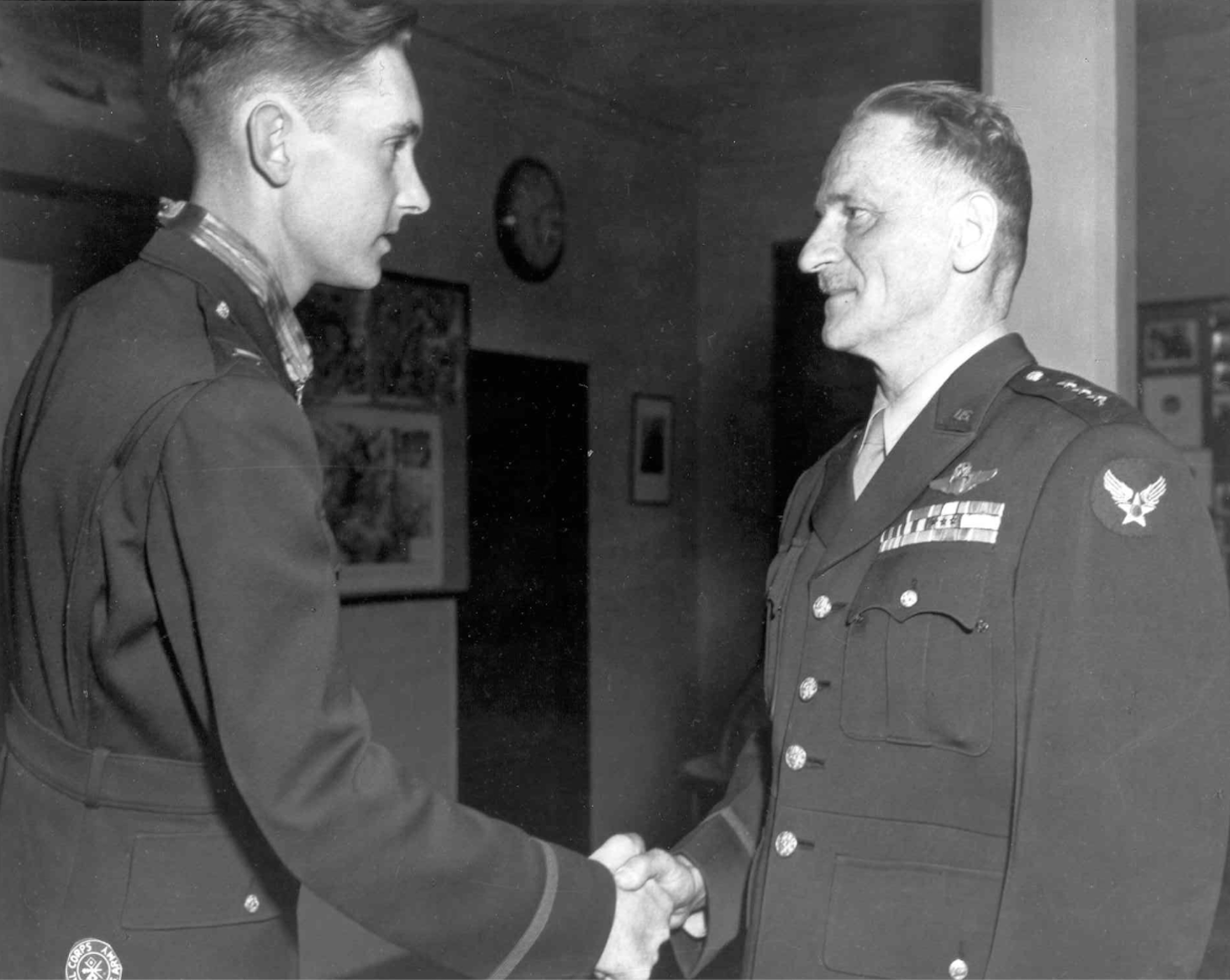
First Lieutenant William R. Lawley, Jr., is congratulated by Lieutenant General Carl Spaatz on the award of the Medal of Honour, 8th August 1944. (IWM UPL 55737)

The aircraft, a B-17G-30-DL (WF-P) was departing the target area with its bomb load intact due to a frozen mechanism, when it suffered a full frontal attack by enemy fighters. Suddenly, a canon shell ripped into the cockpit  killing the co-pilot, Paul Murphy, and striking Lawley in the face severely wounding him.

The attack by around twenty enemy fighters, also wounded every other crewman, in addition to setting an engine on fire. The attack caused the B-17 to enter a dive which could well have been uncontrollable had Lawley not fought back the pain and forced the co-pilot’s hands off the controls with one hand, whilst fighting the aircraft with the other. With a hole in the blood soaked windscreen, cold air forced its way in, adding to the cockpit’s terrible conditions and to the extreme pain Lawley was already feeling.

In fear of an explosion, resulting in total destruction of the aircraft and its crew, Lawley gave the order to bale out, but no one did. Some were simply too injured to do so, and those that were able to, did not want to leave their buddies behind to what must have seemed to be an inevitable fate.

Even whilst enduring further attacks, the engine fire was somehow extinguished, only to be replaced by another in a different engine. Then, a glimmer of hope came over the intercom, the bombardier had managed to free the bombs, thus lightening the load. This allowed the badly injured Lawley to perform incredible evasive action.

But by now, Lawley was exhausted, and was suffering from huge blood loss. Acutely aware of the situation, Mason, the bombardier, took over until Lawley was able to regain his strength and take back the B-17’s controls. With two engines out, a new threat appeared – lack of fuel. Another engine suddenly stopped running, leaving just one to keep the heavy bomber aloft. Somehow, the aircraft managed to not only reach England, but pass over its coastline. Feeling somewhat relieved, but acutely aware of the ever present danger, the crew scoured the horizon for a safe place to land. Redhill suddenly came into view, and just in time, as the B-17 was now losing height, and fire was spreading across the wings.

In great pain, Lawley managed to bring the aircraft down to Earth, performing an amazingly controlled crash landing. Nine of the ten onboard survived to return to duty, Paul Murphy being the only casualty. For his determination to get home, Lawley was awarded the Medal of Honour, the US’s highest award for bravery.

This dramatic event was mirrored by a B-17 of the 351st, then based at  RAF Polebrook. Sadly though, this one ended in the loss of the three crewmen left on board, after the aircraft crashed in a field. For his action, Sgt. Archibald Mathies also received the Medal of Honour.
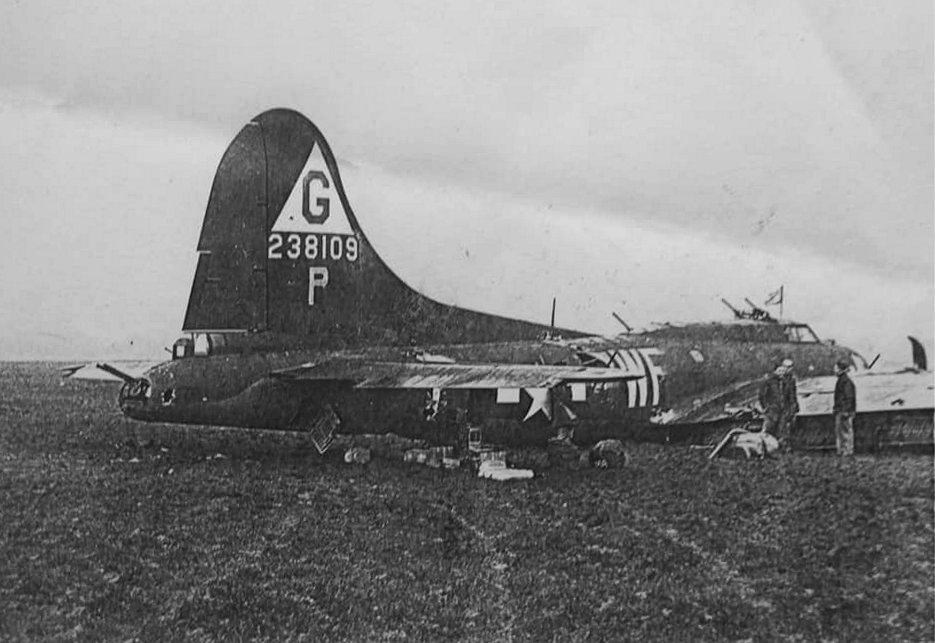
B-17 42-38109 ‘Cabin in the Sky‘, after crash landing at RAF Redhill. (IWM UPL 55733)

This would not be a solitary awarding of the prestigious Medal of Honour, for it would be repeated just two months later, highlighting the bravery shown by many crewmen during those dark days of World War II.

On April 11th 1944, the Germans yet again made a ferocious attack from the front, a tactic they had devised early on in the American’s war in Europe.

In this instance, 1st Lt. Edward S. Michael was piloting B-17G  ‘Bertie Lee’ 42-37931, as part of the 364th BS on operations to bomb various  targets in Germany, including the Focke-Wulf plant at Sorau. Other targets for the 341 B-17s of the 1st BD, included Cottbus, Dobberphel, Stettin and Trechel.

The aircraft, a Douglas-Long Beach B-17G-20-DL Fortress (WF*D), was flying in formation toward Stettin when it became the focus of a determined enemy attack. To the crew, German fighters appeared to single them out, pressing home repeated assaults, despite escorting fighters and heavy defensive fire from the bomber.

The ferocious attack shattered the cockpit, both pilot and co-pilot (2nd Lt. Franklin Westberg) were wounded, instruments failed, oil covered the windscreen and the aircraft fell into a 3,000 foot spin from which survival seemed over. With skill and strength however, 1st Lt. Michael managed to pull the aircraft out of the dive, only to discover that the bomb bay, still full of incendiaries, was on fire – the result of yet another attack. With damage to the release equipment, the crew were unable to jettison  the bombs – the situation was getting worse.
The only way they could survive now was to bale out, and so Michael gave the order. On doing so, he was greeted by the horrendous sight of the top turret gunner, Jewel Philips, holding his eye in his hand and blood gushing from a severe head wound.

Giving initial aid to the gunner, Michael, himself injured, helped him to the door and out of the aircraft, He was one of seven who made it away.

With the co-pilot and injured bombardier, Lt. Leiber,  still on board, Michael decided he was going to try a crash landing.  Working hard to save the ship for as long as they could, the bombardier managed to finally free the burning incendiaries, and by performing dramatic evasive manoeuvres, Michael managed to  shake off pursuing enemy aircraft; eventually reaching the relative safety of cloud cover.

Now being targeted by flak, he decided to get the aircraft down as low as he could, and flying at almost treetop level, he headed towards England. The aircraft continued to respond well considering the extensive damage it had received, and so they flew on for as long and as far as they could. Miraculously, they reached the English coast, but Michael was exhausted from both his continued efforts and a severe thigh wound, The bombardier took over, circling the aircraft in a holding pattern until Michael had the strength to bring the stricken aircraft down. With no hydraulics, the ball turret jammed down, the undercarriage locked up and the bomb bay doors locked open, it was not going to be an easy ride and the odds of survival were stacked heavily against them.

As if the gods were on their side though, Michael retook control and brought ‘Bertie Lee’ down, its metalwork crunching and groaning as it careered along the grass at RAF Waltham near to Grimsby in Lincolnshire.

For his incredible actions and determination to get home, 1st Lt. Michael received the unit’s second, highest level award, the Medal of Honour.
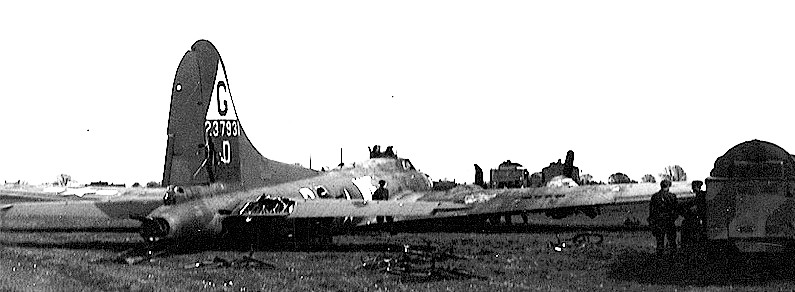
Extensively damaged, ‘Bertie Lee’ after crash landing at RAF Waltham (IWM UPL 40113).

1st. Lt. Michael’s citation*15 read:

For conspicuous gallantry and intrepidity above and beyond the call of duty while serving as pilot of a B-17 aircraft on a heavy-bombardment mission to Germany, 11 April 1944.

The group in which 1st Lt. Michael was flying was attacked by a swarm of fighters. His plane was singled out and the fighters pressed their attacks home recklessly, completely disregarding the Allied fighter escort and their own intensive flak. His plane was riddled from nose to tail with exploding cannon shells and knocked out of formation, with a large number of fighters following it down, blasting it with cannon fire as it descended.

A cannon shell exploded in the cockpit, wounded the co-pilot, wrecked the instruments, and blew out the side window. First Lt. Michael was seriously and painfully wounded in the right thigh. Hydraulic fluid filmed over the windshield making visibility impossible, and smoke filled the cockpit. The controls failed to respond and 3,000 feet were lost before he succeeded in levelling off.

The radio operator informed him that the whole bomb bay was in flames as a result of the explosion of three cannon shells, which had ignited the incendiaries. With a full load of incendiaries in the bomb bay and a considerable gas load in the tanks, the danger of fire enveloping the plane and the tanks exploding seemed imminent. When the emergency release lever failed to function, 1st Lt. Michael at once gave the order to bail out and seven of the crew left the plane.

Seeing the bombardier firing the navigator’s gun at the enemy planes, 1st Lt. Michael ordered him to bail out as the plane was liable to explode any minute. When the bombardier looked for his parachute he found that it had been riddled with 20-mm fragments and was useless. First Lt. Michael, seeing the ruined parachute, realized that if the plane was abandoned the bombardier would perish and decided that the only chance would be a crash landing.

Completely disregarding his own painful and profusely bleeding wounds, but thinking only of the safety of the remaining crewmembers, he gallantly evaded the enemy using violent evasive action despite the battered condition of his plane. After the plane had been under sustained enemy attack for fully 45 minutes, 1st Lt. Michael finally lost the persistent fighters in a cloud bank.

Upon emerging, an accurate barrage of flak caused him to come down to treetop level where flak towers poured a continuous rain of fire on the plane. He continued into France, realizing that at any moment a crash landing might have to be attempted, but trying to get as far as possible to increase the escape possibilities if a safe landing could be achieved.

First Lt. Michael flew the plane until he became exhausted from loss of blood, which had formed on the floor in pools, and he lost consciousness. The co-pilot succeeded in reaching England and sighted an RAF field near the coast. First Lt. Michael finally regained consciousness and insisted upon taking over the controls to land the plane.

The undercarriage was useless; the bomb bay doors were jammed open; the hydraulic system and altimeter were shot out. In addition, there was no airspeed indicator, the ball turret was jammed with the guns pointing downward, and the flaps would not respond. Despite these apparently insurmountable obstacles, he landed the plane without mishap.

Heroic actions like this, were widely mirrored across the beaches, seas and skies of Normandy that June, when vast numbers of ground, naval and air force personnel combined to carryout the greatest invasion ever known. With operations beginning in the early hours of June 6th 1944, Chelveston’s aircraft would again be involved, dropping leaflets to the French people warning them of the impending allied invasion. It would be a day that would go down in history.

Many of those involved in D-day looked forward to the day they would return home, but returning home was never a guarantee of safety. In December whilst on a mission to bomb the railway marshalling yards at Kassel in Germany, B-17 43-38973 received extensive damage with one engine put out of action. As the aircraft made its way home, it began to lose height and to make matters worse, England was shrouded in fog cutting visibility to near zero.

In an attempt to find a landmark, the pilot took the aircraft lower and lower, a risk that ended in tragedy when it struck a Gee mast at Borough Hill in Northamptonshire. All nine on board were killed in the collision.

337 Missions to Victory: The 305th’s Final Campaigns

The winter of 1944–45 descended with a familiar severity. Snow and ice gripped the airfields, while dense fog rolled across much of Europe, grounding aircraft and testing the endurance of even the most seasoned crews. Yet amid the bitter cold came decisive movement on the ground. Following the Allied breakthrough in the Ardennes, advancing forces pressed steadily into Germany itself. The war’s end was now clearly in sight, but its closing chapter would be anything but quiet. The months that followed brought an intense tempo of operations, as bomber formations crossed the Rhine with increasing confidence. With the Luftwaffe offering only sporadic and weakening resistance, B-17s and B-24s were able to penetrate deep into German territory with far less opposition than in previous years. Mission counts climbed rapidly. Many groups reached the formidable milestone of one hundred operations, and several of the original contingents went well beyond it, their longevity a testament to both endurance and experience.

Gradually, as allied forces made their way across Europe,  the heavy bombers of the allied forces pounded German cities. By March, the 305th had completed its 300th operation, having endured a long and demanding campaign since being amongst one of the first groups to deploy to the UK. In celebration, they were once again given the lead position in an attack on Böhlen-Rötha, Leipzig. Thirty-six aircraft set off that day to find near perfect weather over the target and so bombing was considered highly accurate despite heavy and accurate flak. Of the thirty-six, aircraft despatched, two B-17s were lost from the 305th, one of which carried the command crew – led by Lt. Col. Howell G. Crank in 44-8141. The aircraft was hit by flak and one of its engines knocked out. It then turned over and dived into the ground killing ten of those on board with one taken as a prisoner of war.

A month later on April 25th, 1945, shortly before the war’s end, the 305th would make their final bombing flight bringing Chelveston’s war in Europe to an end. The 305th had achieved an eye-watering 337 combat missions (480 including other types), dropping over 22,000 tons of bombs and over 70 tons of propaganda leaflets. During their time in Britain they had lost in the region of 154 aircraft, received two Distinguished Unit Citations and two airmen had both been awarded a Medal of Honour. In just three short months, on July 25th, they would leave England, heading for a new base at  St. Trond, Belgium (Army Airfield A-92). Their final departure leaving no operational front line units at Chelveston and little prospect of any arriving in the future.

After the defeat of Japan and the formal declaration of world peace in September 1945, the group was posted to Germany where the four squadrons were dispersed to various airfields, prior to their deactivation in the following December. The reason for the move was – and included the 306th from Thurleigh – to photograph two million square miles of land, ranging from Iceland in the north, through Europe to the Soviet frontier in the east, and on to north and west Africa in the south. By splitting the groups, it meant that flying time was reduced and coverage increased.*16

Following that, the 305th Bombardment Group returned to the United States. Crews were demobilised and dispersed, and the aircraft that had endured the rigours of combat over Europe were largely scrapped. The group would then briefly re-emerge in 1947 and again in 1951, each time for only a short period. After another short reprieve in 1994, it was reborn as the 305th Air Mobility Wing, a title under which it continues to operate today. The wartime service of the 305th at RAF Chelveston remains a key part of this lineage; the group’s achievements with the Eighth Air Force between 1942 and 1945 established the reputation of what became known as the “Can-Do Wing.” Chelveston is still recorded in U.S. Air Force historical archives as one of the stations from which the unit first earned its combat distinction, and with it, the legacy of the 305th  continues on.

As peace settled over Europe, Britain faced a daunting challenge: what to do with nearly 700 surplus wartime airfields, many hastily built and suddenly redundant. While some were dismantled or repurposed for civilian use, others – including Chelveston – were quietly retained, waiting for a world that was rapidly becoming uncertain once more. By the early 1950s, the rise of the Cold War, nuclear weapons, and jet bombers would transform these dormant relics into strategic strongholds, setting the stage for a dramatic new chapter in both British and American air power.

The whole story of Chelveston can be read in Trail 66. Northants and Bedfordshire (Part 2)
Trail 66 – RAF Chelveston – Part 6 – Records, Heroism and Morale

In Part 5, the 305th endured some of the harshest early missions of 1943, suffering heavy losses over the U-boat pens and German targets while crews faced flak, fighters, and extreme winter conditions. Individual acts of courage and ingenuity, from surviving ditchings to improving bomber defences, highlighted both the bravery and inexperience of the fledgling unit. By April, Chelveston was officially transferred to full American control, and the 305th began taking the lead in major operations, earning their first Distinguished Unit Citation for precision bombing and determined action under fire.

April–May 1943: Record Flights, Heroism, and Morale Boosts

Being so new to the war, and with only the four B-17 groups still forming the bulk of the air force, operational records were regularly set and broken. The month of April saw another such record set, with the largest formation of US aircraft taking part. The flight, consisting of 115 B-17s from the four Groups, flew in a new configuration. The 305th formed the rear box, in a new arrangement that only permitted 3,000 ft separation between the low and high boxes.

The four groups from Thurleigh, Bassingbourn, Molesworth and Chelveston had led the way for the 8th Air Force, and by April  they were all becoming very tired and fatigued, and in desperate need of replacements. Although short in coming, replacements and new squadrons were eventually to arrive, helping to bolster both the strength and size of the still small but determined Air Force.

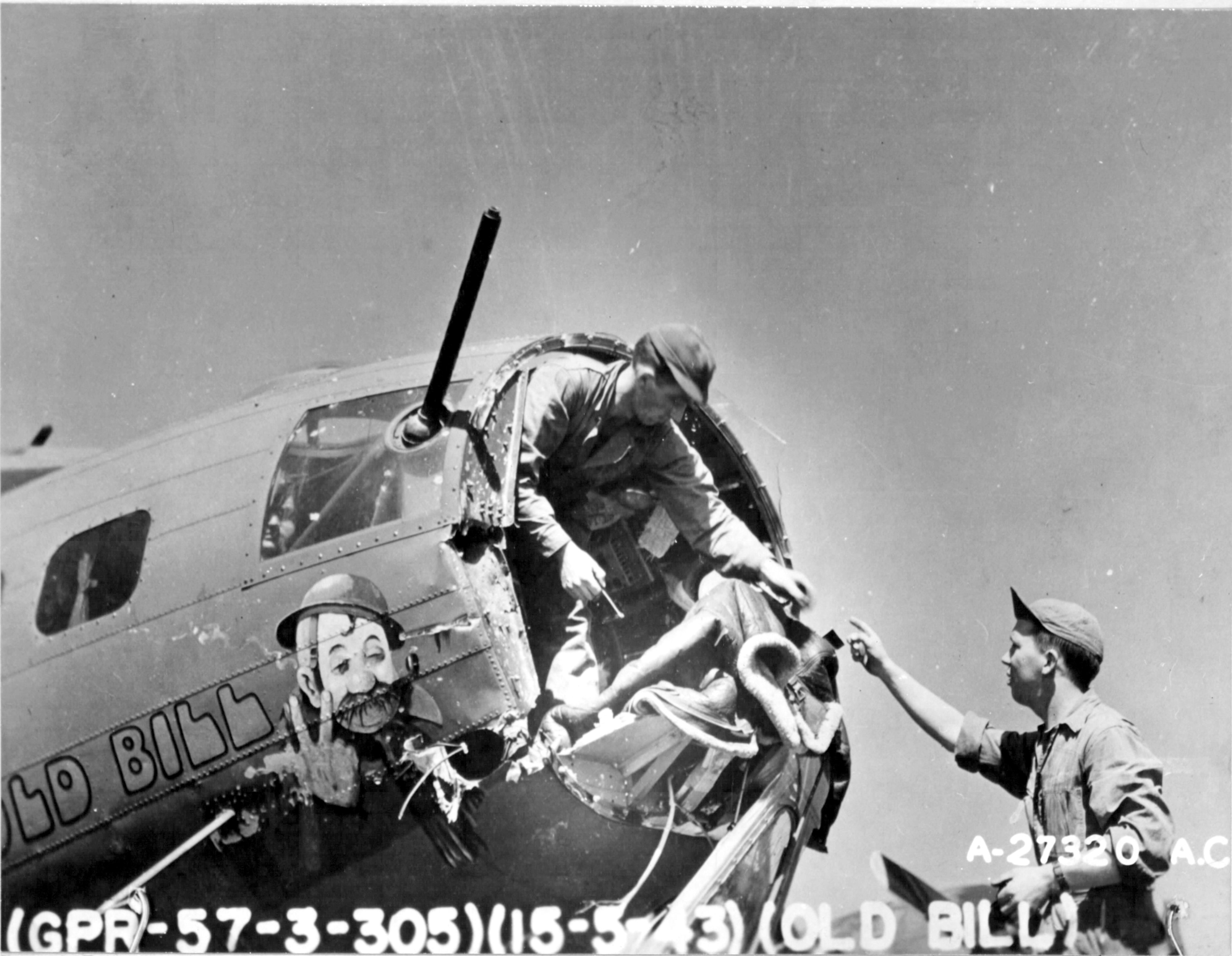
This newly reinforced air force was employed for the first time on 13th May 1943, and again on the 14th and 15th. On this last mission, the 305th were again on the receiving end of the Luftwaffe’s fury, as they hit hard head-on to the formation. In one of these B-17s, every member of the crew, except the tail and right-waist gunner, suffered severe injuries. Such was the crew’s  determination in getting back to Chelveston though, that two DSCs, eight Silver Stars and seven Purple Hearts were awarded to them that day. Those on-board ‘Old Bill’ being the most decorated crew of the 305th by the war’s end.

B-17 42-29673 ‘Old Bill’ 422nd BS, damaged on Wangerooge 15th May 1943.  Featured ground crew: Cpl Willis Todd (inside) and Cpl Zimmerman (outside), (IWM UPL 30085).

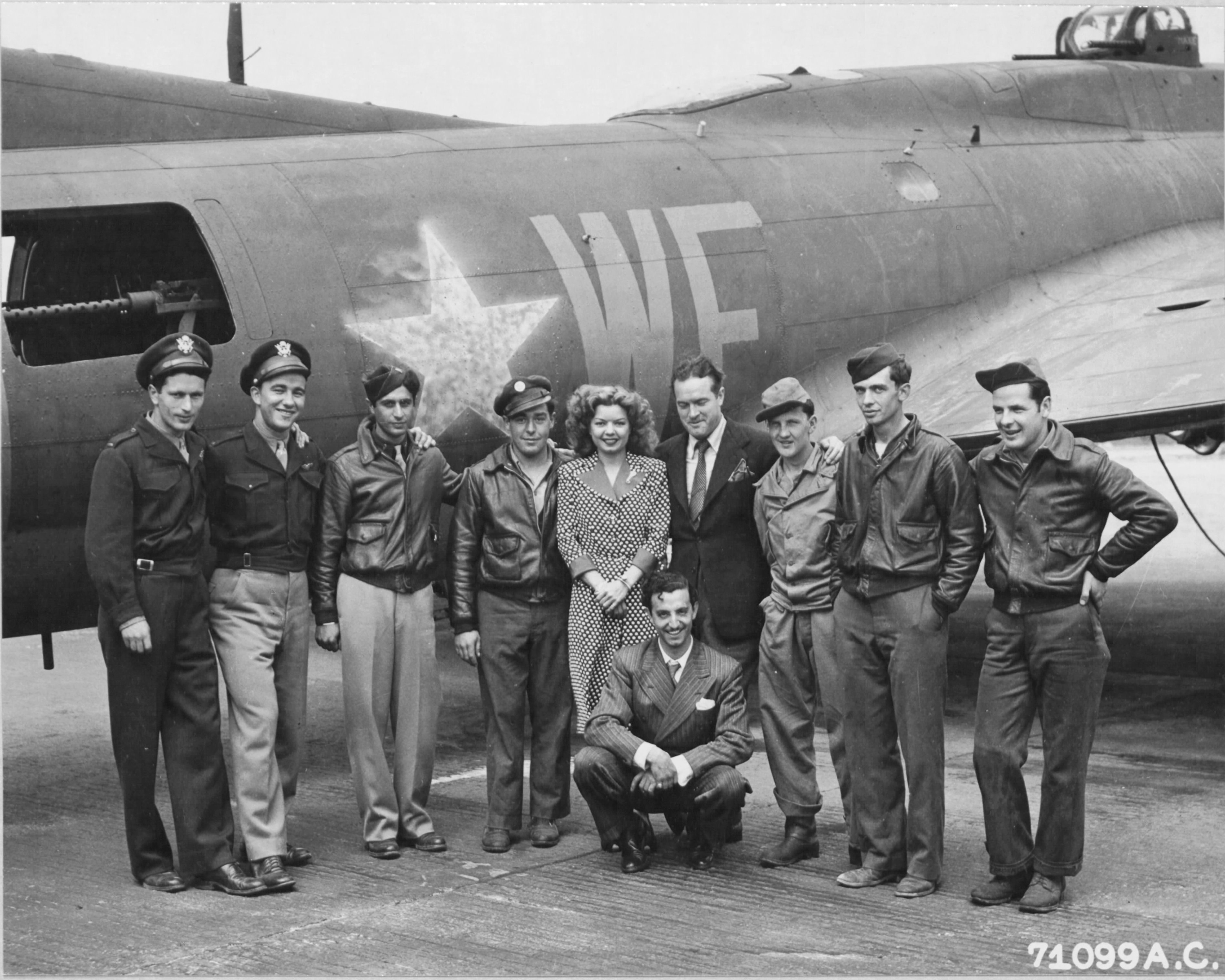
The morale of airmen, who faced death on an almost daily basis, was always a problem. To keep spirits up, various visits were arranged, some of which included top entertainers from ‘back home,’ who toured the various airfields and bases in Britain. On July 5th 1943, Frances Langford, Bob Hope and Tony Romano all arrived at Chelveston. Posing for photo shoots, meeting the crews and performing for the personnel were just one way of keeping spirits high.

“Frances Langford, Bob Hope and Tony Romano pose with the crew of the Boeing B-17 ‘Lallah VIII‘ (A/C 242) 5th July 1943. L to R: (P) Lt. Sam Johnstone, (CP) Lt. Elsworth Kenyon, (N) Lt. Martin Licursi, (B/T) Sgt. Arthur Englehardt, Frances Langford, Tony Romano, Bob Hope, (E) Sgt. Donald Baer, (WG) Sgt Richard Lewis, (TG) Sgt. Homer Bagby.(IWM UPL 35399).

August 1943: Schweinfurt, Night Raids, and the Toll of War

But amid these rare glimpses of happiness and momentary reprieves from fear, the war would endure, and the ever-present face of death would soon turn toward them once more.

Whilst Berlin became a name to dread, one other target drove an even sharper stake into the hearts of US airmen, that of Schweinfurt.

Schweinfurt, was a major centre for ball-bearing production. Located north-west of Nuremberg, it was one of Germany’s most prolific suppliers of this vital component. Although it did not produce all of the ball-bearings required by the German war economy, allied strategists believed that by destroying the Schweinfurt plants, they would severely disrupt supplies. By doing so, they would undermine Germany’s ability to sustain the war and bring it to a rapid conclusion.

The first attack, on 1st August 1943, saw the 1st Bombardment Wing (BW) send out 230 bombers in two waves; one of 116 aircraft and the second 114. Of these, thirty-six were lost in the battle; the 382nd and the lead Group the 91st BG, taking the brunt of the attack. The 305th from Chelveston lost ‘only’ two, but a further fourteen were classed as damaged but fortunately  repairable. The initial figures for the overall losses would soon grow though as the full extent of the damage became apparent. The final count neared sixty-three aircraft that were deemed  irreparable and lost. The total loss of aircraft from the operation, rose to in excess of 90, an unsustainable loss for any raid and one that brought home the severity of what the American airmen were facing.

Despite these losses, the raid was considered a success. In Schweinfurt itself, as the last B-17 left the target, a cloud of smoke and fire could be seen, its ferocity engulfing the town. What had been a two hundred year old conurbation of peace and serenity burned ferociously after receiving in excess of 400 tons of bombs – a mix of high explosives, incendiaries and general purpose types. The tranquil, but productive coastal town was in ruins – but the cost in American airman had been high. *11,*12

That same day, the 4th BW sent another 146 of their heavy bombers to Regensburg. Like the Schweinfurt mission, it suffered heavy casualties, with the loss of twenty-four aircraft. All-in-all, August 1st had been a terrible day for the Americans, and despite delivering a devastating blow, the war was clearly far from over.

During September and into October 1943, the 422nd Bomb Squadron of the 305th Bomb Group was withdrawn from daylight flights and retrained for night bombing operations, becoming the first US Army Air Force unit to undertake such activities. During this period, the squadron flew eight night sorties, dropping approximately sixty-eight tons of bombs, along with the unit’s first ‘Nickel’ mission on the night of 7th/8th  October 1943.

‘Nickel’ operations were carried out in cooperation with the RAF, and involved the dropping of propaganda leaflets over occupied Europe. In total, the squadron dispersed around seventy-three tons of leaflets, many of these being thrown out by hand, a slow and exhausting process. To speed things up, crews soon began to push entire boxes from the aircraft in the hope they would burst open in mid-air. A relatively unsuccessful method, it was eventually replaced by an ingenious purpose-built ‘leaflet bomb’. This aerial device was designed to open at a set altitude – often around 1,500 feet – scattering more than 80,000 leaflets in a single drop.

During these operations the squadron worked alongside Radio Counter Measure units as well as the ‘Carpetbaggers’ who were based at RAF Harrington. A common feature of these clandestine organisations was their use of black-painted, often war-weary B-24 Liberators, each one especially adapted for night operations and special duties.*13

Return to Schweinfurt: Catastrophe in the Autumn Skies

The disaster of Schweinfurt would never be far away though. In October, the city would raise its head once more, and once again losses for the Eighth would be high.

The morning of the 14th was cold and foggy, and many hoped that the day’s mission would be cancelled. Unfortunately, no such call came, and as crews sat in their briefing rooms, a hush fell as the curtain was drawn all the way back to reveal Schweinfurt. Gasps and groans filled the various briefing rooms as the details of the operation were read out.

At take off, the 305th were late, by about six minutes, meaning  that they had to catch up with the formation who were gradually pulling away from them. As a result, they were out of their place as they left the English coast, and desperate to catchup for the protection that the formation gave. After flying around trying to locate their place, the lead pilot Major Charles Normand, decided to slot in to the 1st Combat Wing’s low position, replacing the also late 381st.

Shortly after 13:00 hrs, the fighter escort withdrew, leaving the bombers to fend for themselves and allowing the waiting Luftwaffe to make their move. Single and twin-engined fighters now attacked the formation from every direction. Stukas, dropped timed bombs from above, and from around the sides rockets, canons and machine guns were emptied into the formation. The 305th in the vulnerable low position, took the initial brunt. Gunners were frantic in their attempts to defend themselves, using up ammunition at an incredible rate.

As the formation approached Duren, a number of B-17s began to smoke and fall back. Single-engined fighters attacked head on, diving away at the last minute whilst twin-engined aircraft fired rockets from the rear. One of the 305th’s B-17s was hit by one of these rockets, its wing folding and the fuselage opening up revealing badly injured crewmen inside. With no parachutes they simply fell from the sky. The Pilot fought to keep what little of the B-17 was left together, a fruitless task that ended in an dramatic and final fireball.

Further attacks continued to focus on those aircraft of the 305th, the 92nd and Kimbolton’s 379th. Aircraft after aircraft began smoking, slowly falling out of formation with cut engines or damaged control surfaces. No longer able to keep up, they became sitting ducks.

Over the target, Luftwaffe fighters were joined by flak. A barrage of accurate and intense 88mm bursts welcomed the bombers whose numbers were by now depleted.

Still in the low squadron position, the 305th’s Major Normand now led only three aircraft, twelve of the original fifteen sent out had gone –  shot down by enemy fighters. Determined to do their job, they declined a move to a safer position and made their own bomb run into the target.

The mayhem wreaked havoc on the formation. By the time they reached the target the 305th were further out of position, and the lead bombardier requested a second try. Knowing how dangerous that would be and how it would put them in a lonely situation, Normand refused and told Lt. Pellegrini to ‘do his best’. As they left the city, another B-17 from Chelveston went down, and after 100 minutes of continuous attack, the 305th were down to just two aircraft.

On return to England, many aircraft became lost in thick cloud and were abandoned, left to fall out of the sky as crews parachuted out. Those that did find land tried to locate any airfield they could and get down whilst they still had fuel in their tanks. It had been a costly operation. 600 airmen were lost that day, 130 of them from Chelveston. The Mighty Eighth had taken another beating and it would almost end their aerial warfare campaign. The only saving grace being that one of the crews who went down, had manged to get to Switzerland where they were interned.*14

The losses suffered by the 305th that day were the highest of all groups who took part. It had been a devastating blow leaving Chelveston depleted of many young airmen who were by now experienced and battle hardened veterans – many still in their twenties. As a consolation for the group, when allied troops overran the city in April 1945, the captured Nazi flag that proudly flew for so long over the city, was handed to the 305th as a souvenir.

As for Schweinfurt, 500 tons of bombs had dealt another devastating blow to the historic town. Flak batteries had decimated the American formation, and fighters had given their all, but still the American’s determination got them through. Schweinfurt would go down in history. It would forever be remembered on American bases as the battle that took so many lives and the one that nearly killed off the Eighth Air Force.

The terrible losses that day would never be repeated by the Chelveston crews. As they approached the year’s end, they hoped for better and they got it. Unbeknown to them at the time, December 20th 1943, would be the start of a record fifty-six missions without loss for the 365th BS of the Chelveston group. – a run that took them almost to D-Day, 6th June 1944.

Against All Odds: Two Medals of Honour in the Winter of 1944

The early months of 1944, saw the first use of ‘Gee’ by American Pathfinders. A pioneering system that used radio navigation to significantly improve bombing accuracy by timing the gap between two radio signals from ground stations. Hardwick’s 329th, who were part of the 93rd BG, had been trialling the new system since 1942, and it was finally deemed ready for operations. In these early stages, missions focussed on ‘No ball’ targets – V1 launch sites – where Gee could be tested to the limit. Such was the desire to perfect the system that almost half of the 29 missions carried out in January and February, used it.

January would also see another major award for the Chelveston Group. On the 11th following a raid on the aircraft factory at Halberstadt, the 1st Bomb Division, (formerly 1st Bomb Wing), were awarded the Distinguished Unit Citation; for the 305th, it was their second of two such awards.

A month later, on 20th February 1944, a combined force of over one thousand American aircraft of the 1st, 2nd and 3rd Bomb Divisions (BD) took part in operations. The 305th, as part of the 1st BD, were ordered to hit targets at Leipzig, Heiterblick, Abtnaundorf, Bernburg, Oschersleben. Failing that, they were to hit any target that presented itself as an opportunity.

The sky over Europe had become a crucible, where bravery, skill, and sheer willpower were tested to their absolute limits. For the crews of the 305th, every mission brought them face-to-face with death, yet time and again they defied the odds, fighting through blazing cockpits, flaming engines, and relentless enemy attacks. As they pushed ever deeper into the heart of Nazi territory, every flight carried the weight of a nation – and the question hung in the air: who would make it home, and who would not?

The whole story of Chelveston can be read in Trail 66. Northants and Bedfordshire (Part 2)
Trail 66 – RAF Chelveston – Part 5 – Cinematic Fame

In Part 4, we saw how the arrival of the 305th Bombardment Group under Col. Curtis LeMay transformed Chelveston into a hub of innovation and determination. LeMay’s leadership and forward-thinking tactics shaped the group’s early operations, pioneering formation flying and lead-bomber bombing methods that would improve accuracy and survivability. Despite harsh conditions and a steep learning curve, the 305th quickly developed into a highly effective unit, setting the standard for future B-17 operations and laying the groundwork for its critical role in the air war over Europe.

Crews, Combat, and Cinematic Fame: Chelveston in 1943

Back in the United States, interest in joining the Army Air Forces remained high, fuelled in part by carefully crafted propaganda films designed to sustain public support and encourage enlistment. During the winter of 1942–43, both Bassingbourn and Chelveston became film locations for director William Wyler, who was already renowned for Mrs Miniver. His documentary-style productions would immortalise one particular B-17 – ‘Memphis Belle’, securing her place as perhaps the most famous Flying Fortress of them all.

Despite all these ventures back home, the USAAF remained an infant unit, who faced  an ever increasing number and ferocity of air battles as 1943 dawned.  The cold of January 3rd would see the 305th leading yet another attack on the submarine pens at St. Nazaire, which had so far proven indestructible. Not only were there heavy and accurate flak batteries protecting them, but the pen’s walls, over 9m thick, were impenetrable by any current weapon in the military arsenal.

For the bombers, the long, straight run in to the target seemed like running a gauntlet, met with a well-planned barrage placed in front of the bombers, it was a daunting sight for any crew to face. It was so fierce, that of the eighty-five aircraft sent out that day, seven were classified as missing, whilst more than half of those remaining suffered flak damage of varying degrees.

Carrying 1,000 lb General Purpose bombs, some 171 tonnes were released, a mere drop in the ocean compared to figures achieved later in the war – and it barely scratched the surface of the pens.

Although seen as a successful operation, it had seen the highest loss of the 8th Air Force’s war so far, and with two aircraft crash landing on return after getting lost – the lack of experience of these fledging crews was becoming evermore evident.

Despite the losses and cold though, there was no let up for the crews of the 305th. On the 27th January, they were once again in the winter skies. This time it would be Germany itself, and the 8th Air Force’s first venture in the Nazi airspace.

The target for the day was Vegesack on the Wesser river, seen as a priority target for air operations. However, once over the  continent, the bombers were faced with thick cloud and little chance of finding the target, let alone bombing it. Turning to their secondary target, they headed for Wilhelmshaven, where they  found only moderate flak and light fighter cover.

As a result, loses were light that day, three aircraft went down, one of which was a Chelveston bomber 41-24637 (KY-F), and even though many bombs fell harmlessly away from the target area, the mission was still widely celebrated and praised by the press.

The loss of the B-17 brought home the brutality of what they were facing. Although some of the crew managed to bail out (five were taken as POWs) another five were killed; the ball turret gunner Sgt. Roy Whitney and tail gunner S. Sgt. Robert Ames were killed in the attack. The other three, were attacked by fighters as they parachuted through the sky, two of whom, T.Sgt. Bernice Farmer and S. Sgt. Jerome Kissleheff were killed. The last crewman, S. Sgt. Le Roy Mason, died after hitting the ground, his parachute shot to pieces.*9

Trial by Fire: The 305th’s Gruelling February Raids

Typically, the opening days of February were marked by persistent poor weather, which resulted in several planned missions being abandoned, some even after the Fortresses had departed England. On 4th February, however, the 305th did manage to get airborne, dispatching eighteen aircraft toward Hamm. Although faced with adverse weather, the formation were undeterred, instead diverting to their secondary target – Emden.

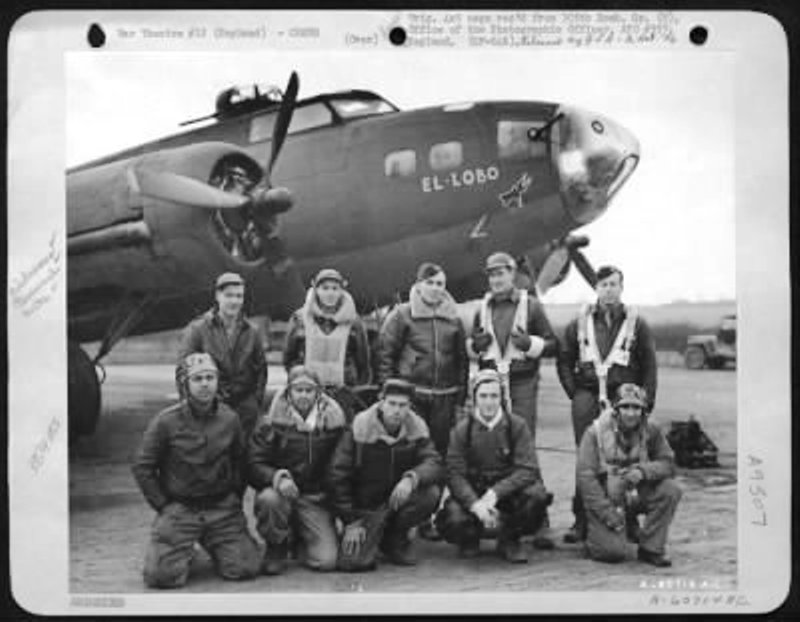
Despite their determination and ‘Can do’ attitude, none of the 305th’s aircraft succeeded in bombing the target. What’s worse, the mission also proved costly, as one aircraft 41-24593 (WF-G) ‘El Lobo’, collided head-on with a FW-109 after it was hit by flak. Another B-17 was shot down by a twin-engined fighter – the likes of which had not been seen in the skies before.

‘El. Lobo’ and her crew before being lost over Hamm (IWM UPL 13288).

Later in the month, on 26th February, the 305th took part in another operation to Germany. The primary objective here was the Focke-Wulf factory at Bremen, with orders to divert to the submarine pens at Wilhelmshaven should weather conditions once again prevent an effective attack.

After briefing for Bremen, twenty B-17s of the 305th joined with  other B-17s of the 91st, (20), 303rd (19) and 306th (17), and seventeen B-24s of the 44th and 93rd BGs. Forming up over the Norfolk coast, the whole formation was led by the 305th.

Heading toward the target, they quickly became weakened. In the first one hundred miles, some twenty aircraft turned back, either through mechanical issues or personnel problems. As a result, the protective firepower of the group was significantly reduced, and those who were left faced a greater risk from attack.

On reaching Baltyrum Island, the formation began its descent toward the target. At this point, they were attacked by a lone fighter, an FW-190, only to be replaced minutes later by others from 12./JG1. Continuing on, the formation reached Oldenburg , albeit relatively unscathed. Here the formation experienced cloud cover, and the decision was made by Major J. Preston, the formation commander, to turn 1800 north, and head to the secondary target Wilhelmshaven.

Due to various reasons, the normally faster B-24s were unable to keep up with the B-17s, and three aircraft from the 44th, began to lag behind. Being vulnerable away from the protective firepower of the bigger formation, they were immediately attacked by enemy fighters, with two being brought down.

Over the next forty minutes or so, seven aircraft were shot down during a blistering attack by a mix of Me-109s, FW-190s, Ju-88s and Me-110s, who were not only firing canons into the formation, but dropping aerial bombs as well. Two of those lost during the melee were from the 305th whilst others from the same group were severely damaged.

On board one of those B-17s was 2nd. Lt. James Moberly, in 41-24617 ‘Southern Comfort’, but Moberly’s story is one of luck more than good judgement. Increasing crew injuries had led to them being advised to wear steel helmets, which were proving to be cumbersome and awkward in the heat of battle, many choosing not to wear them. Moberly had decided that day to wear his, a decision that would save his life.

Whilst firing one of the nose guns, a cannon shell struck the aircraft exploding just above his head, the force knocking him down so hard, he cracked the navigator table. After looking at the rather large hole in the fuselage, he examined his helmet to find several large dents caused by the shell that would otherwise have probably killed or at best, severely wounded him. From then on, he was convinced of the helmet’s benefits and it always went with him.

The plane was so badly damaged by flak in the attack, that one engine was knocked out, discharging oil over the wing. Furthermore, a four-foot hole had been blown in the rudder and the aircraft was riddled from nose to tail by bullets and canon fire. On setting a  hopeful course for home, the pilot asked those aboard to pray, a last ditch effort to save the aircraft and its crew. Whether through God’s help, or pure determination and will power, they reached Chelveston, and the pilot placed the aircraft down on the runway. Once news got out about their exploits, they became known as the crew that ‘prayed’ their aircraft back.

In another one of these aircraft B-17F 41-24604 ‘Arkie’ [KY:D], was pilot Everett E. Tribbett who, after baling out, was captured and sent to Frankfurt before ending up at Stalag Luft III. Once inside, his skills were quickly put to good use, becoming involved in clandestine radios within the camp – an activity that would have had severe consequences if discovered. The aircraft meanwhile, named after Tribbett’s  wife, came down at Hookseil, ten miles north of Wilhelmshaven.

In a third B-17, 41-24623, the ball turret gunner, S. Sgt. Lee ‘Shorty’ Gordon was captured after baling out of his stricken aircraft. His determination to ‘get home’, though, led to him escaping no less than a reported five times, even using his diminutive size to pose as a child in one failed attempt.

Gordon’s story was initially told in the Air Force’s Service Journal just after he was reported missing in action; followed in 1944 by the boy’s comic True Comic. It was later recalled in both The Writing 69th by Jim Hamilton (1999) and Air Gunner by Andy Rooney & Bud Hutton. As the first US airman to escape and make his way home, Gordon was awarded the Silver Star.*10

Gordon was only one of five survivors from the downed plane, each one of them being located in the mid and rear sections of the stricken aircraft.

Whilst the formation had taken a beating, the 303rd BG from Molesworth reported no damage at all. By contrast, Chelveston’s 305th reported fourteen aircraft damaged, from flak, cannon fire, or even falling shell cases from nearby aircraft.

Several enemy aircraft were claimed as either ‘kills’ or ‘damaged’ that day, but as with many of these early claims, the numbers of actual enemy aircraft shot down, was for various reasons, hugely exaggerated. It is now known that only one enemy aircraft was lost that day, a considerable difference, but an understandable one at that. Of the ninety-three bombers that took off on that mission, only sixty-five managed to bomb the target. It had been a difficult day for the Eighth, and one the 305th was relieved to leave behind.

Spring 1943: Hardship, Heroism, and American Takeover

But the winter had taken its toll. By the time spring arrived, the 305th had lost nearly half its crews, whilst the other fledgling groups were down to almost a fifth of their original number. Men on sick leave, or in hospital beds were ordered back into their aircraft, reports of fights, random gunfire in dormitories and aggressive behaviour were becoming commonplace. The mental state of some had deteriorated to new levels, resulting in temporary blindness, extreme behaviours and mental stress that  affected many. In fear of being labelled as cowards, many hid their true feelings lashing out at those closest to them. The air force’s answer was swift, to demote, move or even discharge these men before they ‘infected’ those around them.

With an aim to boost morale and lift falling spirits, the personnel of Chelveston were treated to a little bit of joy. On April 19th 1943 the airfield was officially handed over, by the RAF, to full American control. In a short, but simple ceremony, in which the Stars and Stripes were hoisted, Flt. Lt. H. W. Davies RAF handed over control to Brig-Gen Fredrick Lewis Anderson, of the 1st Bombardment Group USAAF. Chelveston was at last now officially an American base and would be known as Station 105.

Despite losses and misgivings though, the 305th were beginning to take centre stage in the air war. April’s first operation, on the 4th, saw them the lead group once more. After departing Chelveston in the late morning, they joined with the three other B-17 groups in the UK: the 91st, 303rd and 306th, taking an incredible three hours to form up and achieve cruising altitude. The escort of Spitfires that had joined them, had little to do on the way to the target, as the Luftwaffe were strangely no where to be seen.

Of the entire formation, the 305th achieved the most accurate bombing results, with a high proportion of their bombs falling on the target itself. This accuracy resulted in damage to a number of the Renault factory buildings, reputedly putting them out of action for several months afterwards.

On the flight home however, the 305th once again learned what it meant to be the lead group, when a large formation of enemy fighters struck head-on in a fierce, determined attack. It was here that three of the 305th’s B-17s went down and a forth would be forced to land away with wounded onboard at Dunsfold airfield.

Although the Chelveston group had taken a beating, they had also set a record. The gunners of ‘Dry Martini 4th’ claiming an unprecedented ten enemy aircraft shot down, half of those claimed that day by the entire 305th. For this and for showing great determination in leading the formation, on return, the 305th received its first Distinguished Unit Citation (DUC).

In Part 6, the 305th, still a relatively new and thinly stretched force, faced unprecedented challenges as the Eighth Air Force began flying ever-larger formations into increasingly hostile skies. From record-setting mass raids in May to the punishing assaults over Schweinfurt, Chelveston’s crews were pushed to the limits of endurance, bravery, and ingenuity, earning medals and accolades even as friends and aircraft were lost around them. As winter 1944 approached, with new navigation technology and record-breaking missions on the horizon, the 305th were about to step into a phase of the air war that would test everything they had learned – and threaten to change the course of the Eighth Air Force forever.

The whole story of Chelveston can be read in Trail 66. Northants and Bedfordshire (Part 2)
Trail 66 – RAF Chelveston – Part 4 – The ‘Can-Do’ Group

We saw in Part 3 how the USAAF’s 301st Bombardment Group transformed Chelveston into an operational heavy-bomber station, launching their first combat missions over Europe. Early operations brought the group face-to-face with enemy fighters, resulting in casualties and dramatic incidents, including a heavily damaged B-17 returning to RAF Gatwick and another ditching in the Channel. By late November, the 301st had departed for North Africa, leaving Chelveston ready to welcome its next unit, the 305th Bombardment Group.

These early battles gave great hope for the men of the 8th Air Force, with low losses they were perhaps, lured into a false sense of security and feelings of an easy battle ahead. But all that was to be washed away, when over the coming months, the 8th would become battle hardened and severely scarred.

Forging the ‘Can-Do’ Group: Col. Curtis LeMay and the 305th Bombardment Group

The 305th, who arrived here in early December 1942, were led by the tough and innovative Col. Curtis LeMay whose drive and leadership led to the rookie 305th, being known as the ‘Can do’ Group.

LeMay was a very quiet man, but commanded respect from those beneath him. He was slightly forgiving, but he would not tolerate being lied to. LeMay, never having been in battle himself, forged his career in the United States where he learnt every detail of the B-17, the bomber he was about to take to war. LeMay looked to the likes of Col. Armstrong for guidance, asking him question after question about his experiences and tactics, absorbing his advise like a sponge. Many of Armstrong’s answers he took strictly at face value, however, only to realise later, that perhaps Armstrong was not the man LeMay thought he was.

Through his leadership style, LeMay earned the title of ‘Iron Ass’, a grudging respect from those who followed him. The 305th, led by LeMay, would be a forward thinking group, one who would go on to develop pioneering methods of aerial bombing and battle formation flying.

The heavy armament of the B-17 gave the highest level of protection when in a tight formation, each gun covering a wide arc thus protecting all the others in the group. By forming a ‘box’, this level of protection was at its highest, a style developed by the 305th. With bombing accuracy becoming a major issue for the USAAF, the idea of a lead crew, was another idea stemming from the experiences of the 305th and LeMay. By having a single lead upon whom the whole formation would bomb, accuracy was improved and concentrations of bombs in the target area increased. Both these methods became standard operating procedures throughout the 8th Air Force during the Second World War.

The 305th like the 301st before them, and now their sister squadron the 306th at Thurleigh, were amongst the first few units to arrive in the UK, and as newbies with no battle experience, they faced an incredibly long and steep learning curve.

The 305th arrived in the UK forming initially at RAF Grafton Underwood around September 12th, 1942, bringing together both the ground and air echelons as they prepared to commence operations over Europe. The mud and cold that greeted them would quickly become their bed-partner, remaining with them for the duration of their wartime lives.

The conditions at Grafton were appalling and the airfield was totally unfit for a bomber unit. It would take an enormous amount of upgrading and huge renovations to improve it. This would mean the newly arrived 305th would have to move out, a move that signalled the beginning of their time at Chelveston. Over the Period 6th to 11th December, they transferred across, a temporary measure that quickly became permanent lasting the duration of the war.

Their journey to Chelveston began back at Salt Lake City where they were activated on March 1st 1942. They spent a large part of their training at Muroc Lake Air base (now Edwards Air Force base) before the ground echelon sailed on Queen Mary in early September, arriving at Greenock on 12th. The air echelon meanwhile didn’t leave until October, advanced flight training taking place at Syracuse, New York, in the weeks prior to their departure. Flying the usual northern route they brought their B-17Fs via Presque Isle, Gander and Prestwick, before routing to Grafton underwood.

Following Roosevelt’s controversial slimming down of the Eighth, the 305th, together with the 91st, 303rd and 306th, formed the only B-17 groups remaining in the command, while the 44th and 93rd were its sole B-24 units. Collectively, they constituted the backbone of an Eighth Air Force, stripped to little more than this handful of operational groups – a striking force reduced to a shadow of its intended strength. But then, even that would be cut back, with elements of the B-24s being sent to North Africa as well, and not returning to the UK until the following summer after which time, the B-17s had ‘flown the US’s flag’ over occupied Europe.

Fearing that heavy losses would catastrophically reduce the remaining groups to a handful of aircraft and crews, Spatz and Eaker mounted relatively ‘safe’ operations, those featuring little penetration into the European stronghold. However, the chances of loses, even at those short distances, continued to remain high.

Tactics and Innovation: The 305th’s Early Combat Lessons

The 305th’s first mission would happen a month after their arrival at Grafton on 17th November 1942 against the U-boat pens at St. Nazaire.  It was during these early missions that the Luftwaffe pilots worked out that a full frontal attack on a B-17 would target it’s weakest point – a blind spot in the gunners forward arc. Here, the fighters had both a better chance of survival and the ability to cripple an aircraft by killing both its pilot and co-pilot in a well aimed attack.

To combat this weakness. two innovative Thurleigh ground crew  devised a method by which the nose guns could be moved and supported thus filling the gap in the arc. After developing and trialling the new fixture, the system quickly became standard fittings on later B-17s across the air force.

For the 305th, the otherwise fierce attack of 17th November proved a rare exception: they returned without a single casualty – one of only a handful of units to do so – despite nearly a quarter of the dispatched aircraft sustaining damage from concentrated machine-gun and cannon fire.

These early battles highlighted a stark reality: losses and damage were disproportionately high when set against the relatively small numbers of aircraft taking part. LeMay, latched onto this, and quickly became the driving force behind efforts to improve both survival and bombing effectiveness.

After being told by Armstrong never to fly straight and level for more than a few seconds on the bomb run, LeMay did exactly the opposite, leading his group for some 4 minutes toward the target. Whilst this tactic was indeed a gamble, the 305th’s bombing record was soon to be far in excess of other groups especially those who followed the Armstrong doctrine.

LeMay, encouraged by these successes, also began experimenting with new combat formations, seeking a balance between maximising defensive firepower and reducing the risk of bombers damaging one another in the chaos of fighter attacks. His solution was the development of the staggered ‘box’ formation, arranged both vertically and horizontally. To preserve bombing accuracy and avoid aircraft jostling for position, all bombers would release their loads simultaneously on the lead aircraft’s command. These methods proved to be so effective that they were also quickly adopted as standard practice throughout the entire Eighth Air Force.

In the next part of Chelveston’s history, we see the 305th pushed to the limits of courage and endurance, facing punishing winter raids over the U-boat pens and the heart of Germany. Crews battled flak, fighters, freezing conditions, and the strain of inexperienced personnel, while stories of survival, heroism, and narrow escapes emerged from each mission. Just as morale teetered under the weight of losses, the airfield itself was officially handed over to full American control – yet even this milestone could not prepare them for the next series of deadly operations that would test the 305th like never before.

The whole story of Chelveston can be read in Trail 66. Northants and Bedfordshire (Part 2)