RAF Rackheath – The 467th BG, the highest bombing accuracy (Pt1).

In Trail 58 we head to the east of Norwich into an area known as the Norfolk Broads; an area created through turf extraction in medieval times. The large, shear sided pits were later flooded giving more navigable inland waterways than both Venice and Amsterdam.

Today, it attracts a wide range of wildlife, and offers a range of boating, bird watching and fishing holidays. The shear size and scope of the Broads attracting some 7 million visitors per year to enjoy the rich nature and peace of the Broads.

But in this area during the Second World War, life was very different. Overhead, the drone of aircraft engines was a constant reminder of a war being fought both across the sea and here in East Anglia.

Between Norwich and the East Anglian coast we visit two airfields, one USAAF and one RAF, both now long closed, they each played a vital part in the destruction of the Nazi tyranny across the sea in Europe.

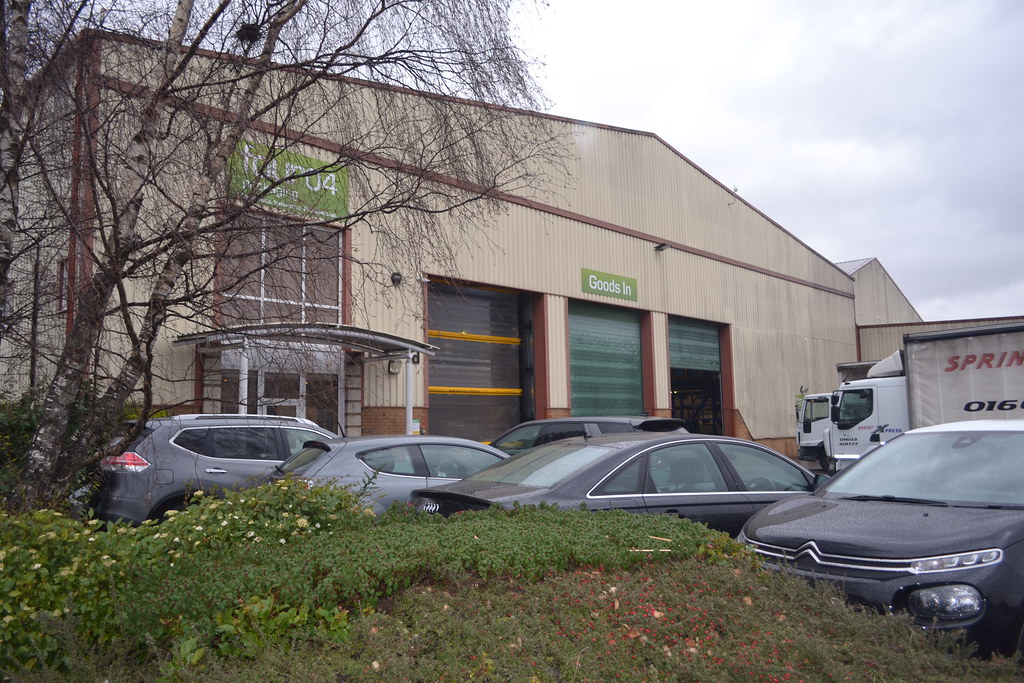
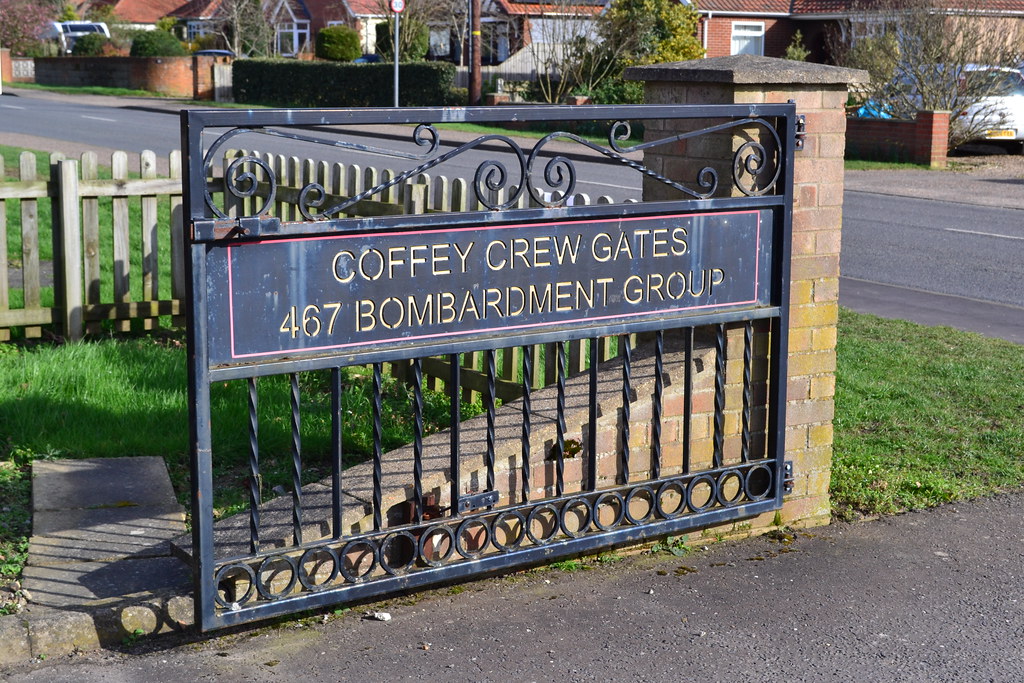
Our first stop is a former bomber base. Now a huge industrial estate where many of the original wartime buildings have been demolished. But some still remain, refurbished, re-clad and in many cases almost indistinguishable from their original design. A memorial, located in the heart of the estate, denotes the technical area of the former base, and a local church displays a collection of wartime photographs.

Our first stop on this trail is the former US bomber base RAF Rackheath (Station 145).

Rackheath (Station 145)

Rackheath airfield lies approximately 5 miles north-east of Norwich, bordered to the east by the  East Norfolk Railway Line, and to the west by the (modern) A1270.

RAF Rackheath

Rackheath village sign denotes its history and links to the base.

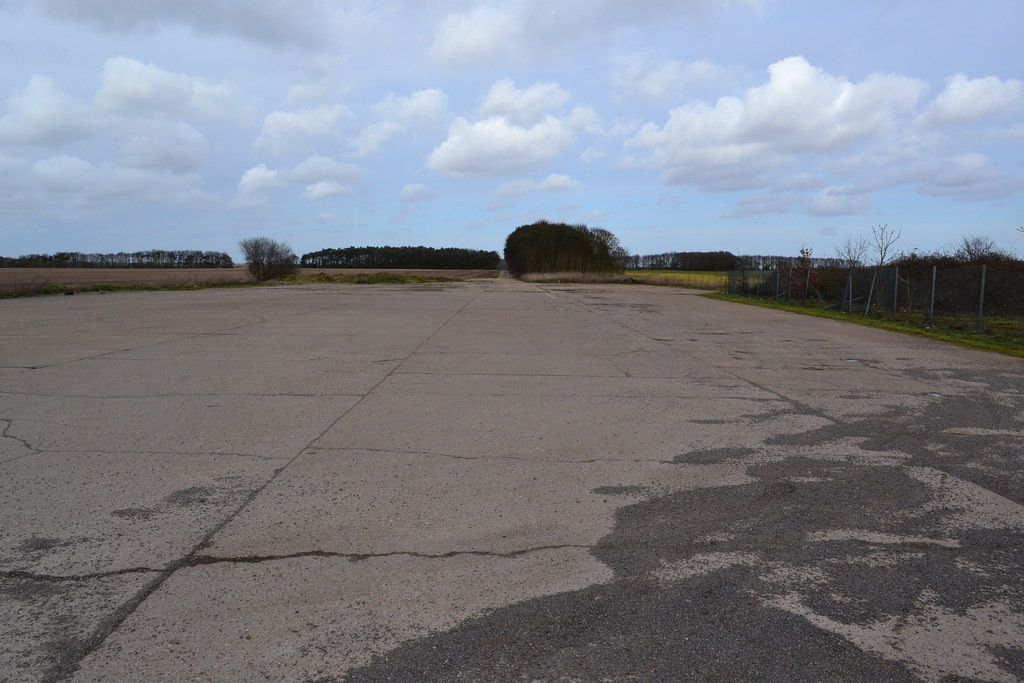
Built over the period 1942-43, it was built as a Class A airfield incorporating three runways: one of  2,000 yds and two of 1,400 yds in length, each 50 yds wide and each covered with concrete.

A large number of hardstands lined the perimeter track, some 50 altogether, all being of the spectacle type; with  a bomb store to the north of the main airfield site, sitting surprisingly close to the majority of the hardstands and nearby Rackheath village.

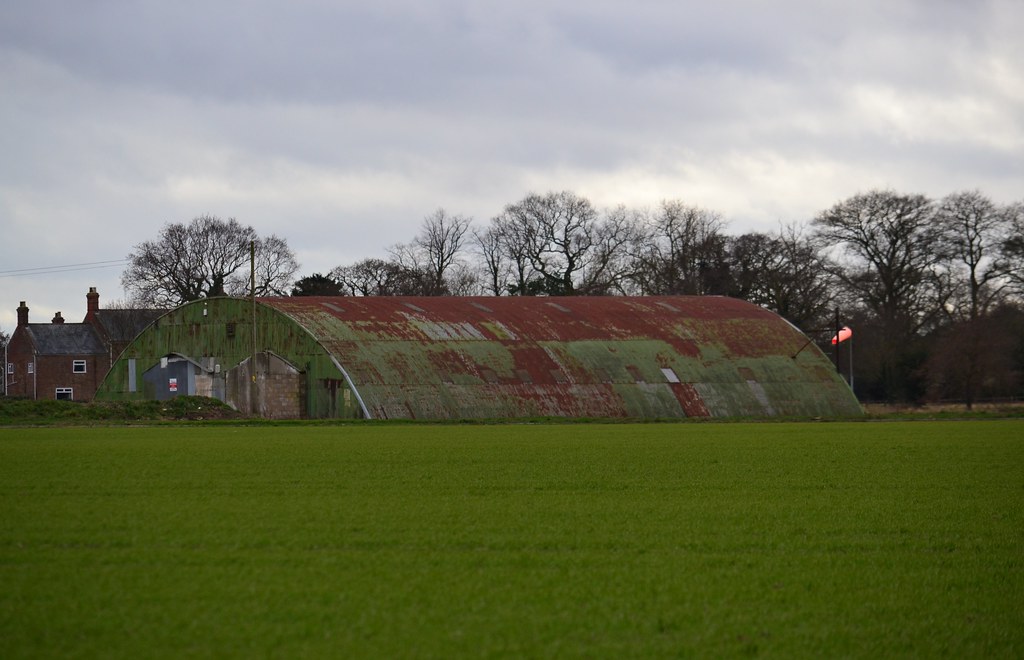
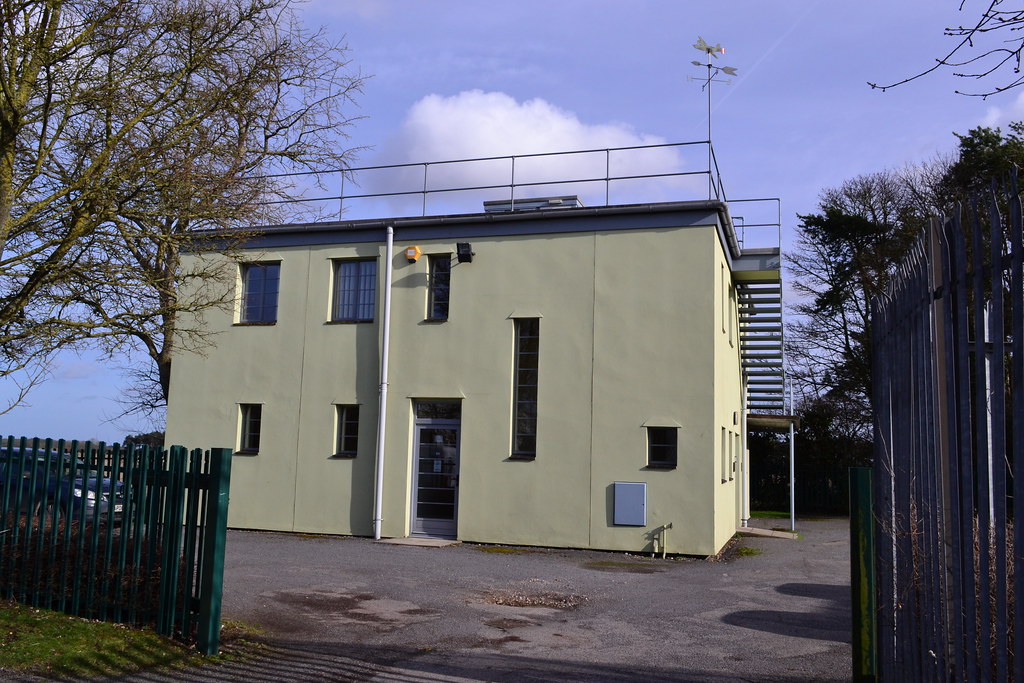
A wide range of technical buildings, supported by two T2 hangars for aircraft maintenance, allowed for repairs and crew preparation: crew rooms, parachute stores, dingy stores, armouries, photographic blocks and so on. The watch office (design 12779/41) stood proud of the technical area located to the south-west of the site. All personnel areas – eleven accommodation and three ancillary sites – lay to the west of the airfield, dispersed around Rackheath Hall, an early 19 Century listed building with its notable architectural features and its own turbulent history. These sites, hidden amongst the woodland, were both extensive and well serviced by concrete roads that led to the main airfield site.

Rackheath was initially designed as a bomber airfield, but during the construction phase, it was re-designated as a fighter airfield. However, delays in the construction process, led to it never being operated as a fighter station, instead it was manned by the Eighth Air Force’s 467th Bombardment Group (BG) and B-24 Liberators.

The 467th BG consisted of the 788th, 789th, 790th and 791st Bomb Squadrons (BS), each flying Consolidated’s heavy bomber the B-24 Liberator. The group’s long journey to Rackheath started on 19th May 1943 at Wendover Field in Utah. After being activated on August 1st, they moved to Mountain Home Army Airfield in Idaho, then back to Utah and Kearns, from there onto Wendover Field again where they remained for fifteen weeks undertaking intensive training. On 12th February the ground echelons made their way, by train, to Camp Shanks, New York where they boarded the US ship Frederick Lykes. Their Atlantic journey brought them, like so many before them, to Greenock, a major port on the Clyde on Scotland’s west coast. From here, they boarded trains and made their way to Rackheath.

The air echelon in the meantime flew the southern route, tragically en route, they lost one of their B-24s (#42-52554 “Rangoon Rambler“) with all its crew, over the Atlas mountains in North Africa. The remainder of the group finally arrived here at Rackheath combining with the ground echelons in late March 1944, where they began to prepare for their first operation on April 10th.

Operating initially within the 2nd Bombardment Division (later the 2nd Air Division) 96th Combat Wing (CBW), they flew Liberator ‘H’, ‘J’, ‘L’ and ‘M’ models under the command of Colonel Albert J. Shower, the only US group commander to have brought and remained with the same group until the end of hostilities.

The 467th’s first mission was to bomb Bourges airfield, a relatively light target in which 730 bombers pounded aviation targets across the low countries. On the next day, they formed part of a even larger force of over 900 heavies attacking aircraft production factories in Germany, their honeymoon was well and truly over in one fell swoop.

But the first major event of the war for the 467th was to occur shortly after this on April 22nd 1944, on a day that has since become infamous in American aviation history. Mission 311, was an attack by 803 heavy bombers of the 1st, 2nd and 3rd Bombardment Divisions on targets at Hamm, Soest and Koblenz along with targets of opportunity. The Massed formation, escorted by 859 fighters, were led by the 445th BG, 2nd Air Division from Tibbenham. The 96th CBW portion was led  by the 458th BG from Horsham St Faith, with the 466th BG from Attlebridge on the low left, and the 467th ‘The Rackheath Aggies‘  on the high right.

As teleprinters rattled across the East Anglian area, B-24s were bombed up, fuelled and checked over by mechanics who meticulously prepared their machines for war. Maps were drawn up, meteorological reports were read out and orders were strict – ‘avoid the Ruhr!’

Once in the air, brightly coloured assembly ships gathered their flocks together in tight formations, and then it was time to set off for Germany. On route, technical problems dogged the lead plane, which led to inaccurate navigation, and ultimately brought the entire force into Ruhr Valley – exactly where they did not want to be.

Dividing up, the massed formations hit a range of targets, Hamm being the focus of the 467th. Surprisingly though, results were good, especially considering the many problems the formation had suffered flying over to Germany. Pleased with their results, the 467th set course for home, blissfully unaware of the dangers that were lurking not far away as they made the return leg of their journey.

The whole operation had been meticulously planned, but it meant that many of the bombers would be arriving home in the dark, an environment alien to many American crews. Experience had told them that Luftwaffe fighters lurked in the dark, unseen and dangerously accurate in their attacks.

When approaching from the east, Rackheath and Nearby Horsham St. Faith were the first two large airfields available, a distance of just some 4 miles separating them. With navigation lights and landing lights illuminating the aircraft, airfields were lit up like christmas trees, each one inviting their bombers home to safety. These lights were also a beacon for the as yet unknown, marauding Luftwaffe night fighters. As the first Rackheath Liberator approached, the air filled with requests for landing  permission, fuel now getting critically low and crews tired from the long flight. Gun places were vacated and crews began preparing to land, everyone was starting to relax – they were home.

It was this point that all hell was unleashed over Rackheath. Canon shells ripped in to the wings and fuselage of 1st Lt. Stalie Reid’s B-24 #42-52445, setting both starboard engines on fire.  The lead Luftwaffe pilot Staffelkapitaen Hauptmann Dieter Puttfarken of II/KG51, taking his companions, in their mix of night fighters, right into the heart of the flight path of the returning bombers. Here they waited, unseen, until the moment the bombers were at their most vulnerable.

RAF Rackheath

The former Watch Office has been refurbished and used as offices.

As the Liberator began to fall uncontrollably out of the sky, four of the crewmen manged to don their parachutes and escape, the remaining six failing to vacate the aircraft in time. All six were lost in the ensuing crash when the aircraft hit the Earth near to Barsham in Suffolk. For Sgt. Edward Hoke, one of those lucky enough to escape, his troubles were not yet over, for somehow, he was pulled from his parachute, and without a means to slow his descent, he too  fell to his death. It was only the third mission of the war for the crew.

Meanwhile, other aircraft began to line up desperate to land. Near misses were now becoming a risk, aircraft suddenly appearing out of the darkness within feet of each other. Then a second B-24 went down –  struck by the terror of the night. B-24 #42-52536 piloted by 2nd Lt. James A. Roden was hit by canon fire. So severe and so accurate were the strikes, that it severed the tail of the Liberator from the fuselage. Now split in two, the aircraft went into a spin and eventual fireball. The entire crew were lost that night.

Not content with picking aircraft off in the air, the Luftwaffe night fighters then began to attack, with bombs and guns, the main airfield site, strafing ground targets almost at will. By now crews were starting to panic, some withdrew from the landing pattern and headed off away from the airfield only to run the gauntlet of friendly Anti-Aircraft guns who were not expecting to see heavy American bombers at night.  By now it was becoming clear what had happened, and to protect the airfield all lights were extinguished. Aircraft were unable to see the runways, parts of which were now only illuminated by fires of wrecks and bombs. Waiting patiently, or diverting to other bases, B-24s light on fuel, circled frantically the field trying to find some sign that it lay below. The confusion that night, repeated across numerous US airbases, tore a hole in the hearts of the American flyers as numbers of those lost across East Anglia began to filter through.

April 22nd would go down in history as the worst loss in one night to intruders alone, made even worse by the fact that once over home territory, you consider yourself to be ‘safe’. Some American gunners were able to retaliate and there are records of intruders being shot down, but the statistics clearly fell heavily in favour of the intruders.

With that, the 467th had finally cut their teeth, their war was real, and it was having an effect.

On D-Day, the 467th were assigned to bombing shore installations and bridges near to Cherbourg, then as the allies progressed through France they supported them by attacking supply lines at Montreuil. A few days after the D-Day landings, a 467th BG Liberator became the first four engined bomber to land on a beach-head airstrip. The B-24 #42-95237, ‘Normandy Queen‘ piloted by 1st Lt. Charles Grace was hit by flak and badly damaged. Unable to make the crossing back home, he ordered the crew to bail out whilst he and his co-pilot brought the aircraft down onto an allied fighter airstrip, luckily without further mishap. All the crew that day survived to tell the tale.

B-24 Liberator (4Z-U, #42-95237) 791st BS, 467th BG parked on the grass in a field in Normandy – the first four engined heavy to do so. (IWM FRE 8431)

By now the allied onslaught of occupied Europe was well under way. Continual flying began to make its mark on both air and ground crews. The summer months seeing over 28,000 sorties being flown, meaning that many crews were reaching their quotas of missions in a very short space of time.

In early August a reshuffle of command within the Eighth saw several changes at the highest levels. Lower down, in the front line units, further reshuffles saw crews and squadrons move from one unit to another. The 788th BS, who had been taken to form the 801st Group to perform ‘Carpetbagger‘ operations in the lead up to D-Day, now rejoined their original Group back at Rackheath.

The long, cold winter of 1944-45 was known for its persistent fog, snow and ice that hampered air operations, and all just as the German army was about to make its one last push through the Ardennes forest. Christmas 1944 would be sombre time for the US forces, with the loss of both Brigadier General Frederick W. Castle and the fighter ace Major George Preddy who was inadvertently shot down by friendly fire and killed.

For the 467th BG it would also be a period of misery, a period that started with one of the most bizarre events in their history. We shall revisit Rackheath again in Part 2.

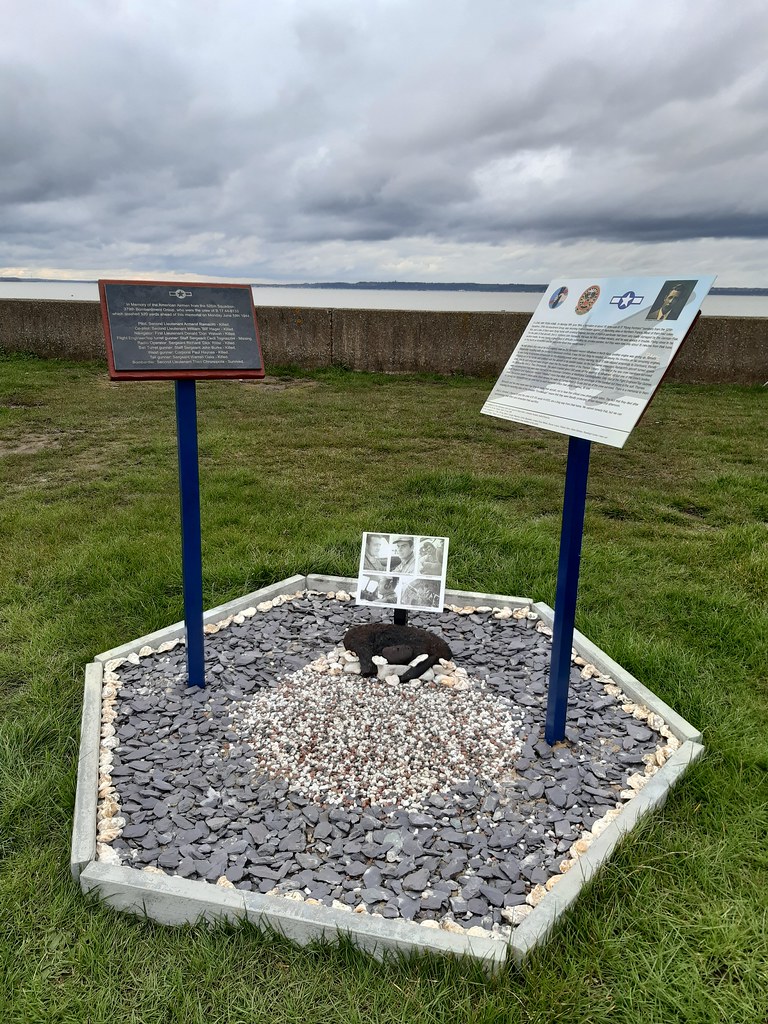
An update to the Allhallows 379th BG Memorial.

A note kindly sent in by Mitch Peeke regarding an update of the Allhallows memorial – 379th BG after its winter ‘clean up’.

I had taken the plaque and the storyboard down for the winter, after I got out of hospital (that’s another story!). The storms we’d had plus the unprecedented amount of rain, had inflicted some damage to the base work. Paul Hare and his Grounds keeping team at the Holiday Park once again stepped in. They installed a third, lower stand for me and then carefully removed the decorative stones so they could concrete the entire base, putting the stones back on the setting concrete so that the whole thing is now set and solid. I came back and repainted the original stands.

I then re-installed the original plaque and storyboard, the backboards of which I had re-varnished. On the third, lower stand is a new plate I had made, bearing the only known photos of some of the crew members. The pictures had been taken by Teddy Chronopolis during a training flight in Texas. His daughter, Jeanne, very kindly let me have copies, which I took to the signmakers. Having done that, I went down onto the beach and gathered up loads of Oyster shells and some driftwood. I laid the driftwood at the base of the lower stand with some of the Oyster shells, then used the rest of the shells to lay a complete border around the inner perimeter of the memorial base. The driftwood and shells are to symbolize the aircraft’s final resting place.I then took a photo, which I sent to both Jeanne and Noel. They were both touched by this “Mk II” memorial!

The memorial has now been formally inducted into the Allhallows Village Heritage Trail. The first guided Heritage walk was held on the second weekend in March and was well attended. Unfortunately of course, the Coronavirus restrictions have curtailed such activities at the moment and the Holiday Park is closed to holidaymakers too. But people do still exercise their dogs and themselves along the seafront. Hopefully, things will return to some kind of normality before this summer is done!

Allhallows Memorial update

Photo by Mitch Peeke 14/3/20

My thanks to Mitch for the update and photo, the memorial is looking splendid!

The original story was told in ‘A Long Way From Home‘.

The unveiling took place on June 22nd 2019.

Colonel Thomas J.J. Christian Jnr. 361st FG RAF Bottisham.


Colonel Thomas J.J. Christian Jnr. (s/n: O-21782) (IWM UPL 18211)

Born Thomas Jonathan Jackson Christian, jr., on November 19th 1915 in San Francisco, Colonel Christian would become known as ‘Jack’ and would have a distinguished military career.

He was the great-grandson of “Stonewall” Jackson, an outstanding commander of the Confederate army in the American Civil War, and he was the son of a Brigadier-General – the military ethos ran thick through his veins.

Christian graduated from Chicago University High School in 1933 after which he went on to University where he studied for a further two years.

After graduating, he then went on to West Point, where in 1939, he chose to follow in his father’s footsteps into Field Artillery. Here he was appointed as a Second Lieutenant. Not long after though he changed his mind, being drawn to the idea of flying, and the Army Air Corps.

He studied initially at the Texas Air Corps Flying School in Love Field, Dallas, transferring to the the Air Training Corps Centre at Randolph Field, Texas. From here, he progressed to the Air Corps Advanced Flying School based at Kelly Field located in San Antonio. By 1940, he had passed and was assigned as an instructor back at Randolph Field.

His first overseas posting came in March 1941, when he was sent to the 19th BG at Clark Field in the Philippines. Here he flew the heavy bomber the B-17 Flying Fortress until the Outbreak of war, and the Bombing of Pearl Harbour and its surrounding airfields by the Japanese. He was then reassigned to Australia via a posting at Bataan. His job here was to ferry P-40 fighters.

It was during one these flights that he was shot down and declared missing. Protected and guided by the natives of the Timor Coast, he managed to find his way back to base.

In 1942, Christian was reassigned again, this time to fly fighters with the 67th Pursuit Squadron. operating out of Henderson Field, he achieved the Silver Star for his gallantry flying over 60 hours of combat flights in a Bell P-400.

In Early 1943, Christian returned to the United States, where he married Marjorie Lou Ashcroft, a woman he had met in Dallas. It was here that the now Major Christian, would join the 361st FG, becoming their first Commanding Officer. The 361st were constituted on January 28th, being activated just two weeks later. Assigned to the Eighth Air Force, it would be the last of twelve Fighter Groups to fly the P-47 Thunderbolt.

The unit trained and transited from Richmond AAB in Virginia, through Langley Field, Millville New Jersey, back to Richmond and then, via the Queen Elizabeth, on to Bottisham in England. At Bottisham, Christian flew with his men, leading them on their first operational mission on January 21st 1944, eleven months after they had been formed. It was during this very month, that Christian would become a father, his daughter being named Lou Ellen.

His first aircraft at Bottisham was P-47 ’42-75494′ coded E2-C, and he called it ‘Lou‘ after his baby girl. He had a picture of a crawling baby painted on its nose, a tribute to the baby he hadn’t yet seen.  Throughout his flying career with the 361st, Colonel Christian would fly three aircraft (successively named Lou, Lou III and Lou IV). The second aircraft 42-106787 and third 44-13410 were both P-51 Mustangs.

In March 1944, he was promoted to Colonel, he was still just 28 years of age. Whilst leading the 361st, Christian would fly over seventy combat missions his final and fatal one being on August 12th 1944.

On that day, Colonel Christian was flying his latest aircraft, P-51 ‘Lou IV’ 44-13410 in a ground attack role against the marshalling yards at Boisleux-au-Mont in France. Over the target area, accurate and heavy ground fire made flying difficult, and it was probably this that brought down his plane causing it to crash. Colonel Christian never survived and was killed in the crash, he was just twenty-eight years old.

During this military career Colonel Christian would be awarded the: American Defence Medal: Asiatic-Pacific Campaign Medal; Philippine Defence Ribbon; European-African-Middle Eastern Campaign Medal; Distinguished Flying Cross with 1 Oak Leaf Cluster; Air Medal with 3 Oak Leaf Clusters; World War II Victory Medal; Croix de Guerre; Silver Star and the Purple Heart.

Just weeks before the crash, Christian had taken part in a photo shoot with three other P-51s from Bottisham, which affectionately became  known as the ‘Bottisham Four’, the group appearing numerous times. The photo since became a tribute to Christian, and all that he had achieved.

At Bottisham, on what was one of the former accommodation sites, is a further tribute to Colonel Christian, a Lych Gate style memorial, it is sadly now missing its top, but was unveiled on 10th October 1955 by his daughter.

RAF Bottisham

A tribute at Bottisham to Colonel Thomas Christian.

Thomas Christian appears in the Tablets of the Missing in the Ardennes American Cemetery and on the Memorial at Neuville-en-Condroz Liège in Belgium. He also has several cenotaph memorials in the Texas State Cemetery, Austin Travis County, Texas and also in the Stonewall Jackson Memorial Cemetery, Lexington, Virginia. Christian’s body has never been recovered.

Marjorie Lou, Thomas’s wife died in 1984 aged 66, whilst his daughter Lou Ellen died in 2011 aged 67.

RAF Bottisham appears in Trail 55 – Around Newmarket.

Sources.

Find a grave website.

American Air Museum Website

Lt. Col. Leon Vance 489th BG – Medal of Honour.

Leon vance.jpgThe story of Leon Vance is one of  the saddest stories to emerge from the Second World War. He was a young American, who through his bravery and dedication, saved the lives of his colleagues and prevented their heavily stricken aircraft from crashing into populated areas of southern England. Following a mission over France, his was very severely injured, but miraculously fought on.

Leon Robert Vance, Jr. known as ‘Bob’ to his family and friends, was born in Enid, Oklahoma, on August 11th, 1916. He graduated from high school in 1933 after receiving many honours and being singled out as a high performing athlete. He went on, after University, to the prestigious Training College at West Point in 1935, staying until his graduation four years later in 1939. It was here, at West Point, he would meet and marry his wife Georgette Brown. He and Georgette would later have a daughter, after whom Vance would name his own aircraft ‘The Sharon D’.

Vance would become an aircrew instructor, and would have various postings around the United States. He became great friends with a Texan, Lieutenant Horace S. Carswell, with whom he would leave the Air Corps training program to fly combat missions in B-24 Liberators. They became great friends but would go on to fight in different theatres.

Prior to receiving his posting, Vance undertook training on Consolidated B-24s. Then, in October 1943, as a Lieutenant Colonel, he was posted to Europe with the newly formed 489th Bombardment Group (Heavy), as the Deputy Group Commander. One of the last groups to be assigned to the European theatre, they formed part of the 95th Combat Bombardment Wing (2nd Bomb Division),  Eighth Air Force, and were sent to RAF Halesworth (RAF Holton) designated Station 365 by the USAAF.

The group left their initial base at Wendover Field, Utah in April / May 1944 and their first mission would be that same month on May 30th, 1944, as part of a combined attack on communication sites, rail yards and airfields. A total of 364 B-24s were to attack the Luftwaffe bases at Oldenburg, Rotenburg and Zwischenahn, along with other targets of opportunity far to the north in the German homeland. With only 1 aircraft lost and 38 damaged, it was considered a success and a good start to the 489th’s campaign.

As the build up to Normandy developed, Vance and the 489th would be assigned to bombing targets in northern France in support of the Normandy invasion about to take place further to the south. An area the unit would concentrate on, prior to the Allied beach invasion on June 6th that year.

The day before D-day, the 489th would fly to Wimereaux, in the Pas-de-Calais region of northern France. This would be Leon Vance’s final mission.

File:846bs-b24-42-94860--halesworth.jpg

B-24H Liberator of the 489thBG, RAF Halesworth*2

The group, (Mission 392),  consisted of 423 B-17s and 203 B-24s and were to hit German coastal defences including: Le Havre, Caen, Boulogne and Cherbourg areas as  a precursor to the Normandy invasion. Some 127 P-47s and 245 P-51s would support the attacks. The 489th would assemble at 22,500 feet on the morning of June 5th, proceed to the south of Wimereaux, fly over dropping their payload, and then return to England. On the run in to the target, Vance was stationed behind the pilot and copilot.  The lead plane encountered a problem and bombs failed to jettison. Vance ordered a second run, and it was on this run that his plane, Missouri Sue, took several devastating hits.

Four of the crew members, including the pilot were killed and Vance himself was severely injured. His foot became lodged in the metal work behind the co-pilots seat. There were frantic calls over the intercom and the situation looked bad for those remaining on board. To further exacerbate the problems, one of the 500lb bombs had remained inside the bomb bay armed and in a deadly state, three of the four engines were disabled, and fuel spewed from ruptured lines inside the fuselage.

Losing height rapidly, the co-pilot put the aircraft into a dive to increase airspeed. The radio operator, placed a makeshift tourniquet around Vance’s leg, and the fourth engine was feathered.  They would then glide toward the English coast.

The aircraft was too damaged to control safely, so once over English soil, Vance ordered those who could, to bail out. He then turned the aircraft himself out to the English Channel to attempt a belly landing on the water. A dangerous operation in any aircraft, let alone a heavy bomber with an armed bomb and no power.

Still trapped by the remains of his foot, laying on the floor and using only aileron and elevators, he ensured the remaining crew left before the aircraft struck the sea. The impact caused the upper turret to collapse, effectively trapping Vance inside the cockpit. By sheer luck, an explosion occurred that threw Vance out of the sinking wreckage,  his foot now severed.  He remained in the sea searching for whom he believed to be the radio operator, until picked up by the RAF’s Air Sea Rescue units.

Vance was alive, but severely injured. He would spend a number of weeks, recuperating in hospital, writing home and gradually regaining his strength. Disappointed that his flying career was over, he looked forward to seeing his wife and young child once more. However, on a recuperation trip to London, Vance met a young boy, who innocently, and without thought, told him he wouldn’t miss his foot. The emotional, impact of this comment was devastating to Vance and he fell into depression. Then, news of his father’s death pushed him down even further.

Eventually, on July 26th, 1944 Vance was given the all clear to return home and he joined other wounded troops on-board a C-54, bound for the US. It was never to arrive there.

The aircraft disappeared somewhere between Iceland and Newfoundland. It has never been found nor has the body of Leon Vance or any of the others on board that day. Vance’s recommendations for the Medal of Honour came through in the following  January (4th), but at the request of his wife, was delayed until October 11th 1946, so his daughter could be presented the medal in her father’s name.

The citation for Leon Vance reads:

For conspicuous gallantry and intrepidity above and beyond the call of duty on 5 June 1944, when he led a Heavy Bombardment Group, in an attack against defended enemy coastal positions in the vicinity of Wimereaux, France. Approaching the target, his aircraft was hit repeatedly by antiaircraft fire which seriously crippled the ship, killed the pilot, and wounded several members of the crew, including Lt. Col. Vance, whose right foot was practically severed. In spite of his injury, and with 3 engines lost to the flak, he led his formation over the target, bombing it successfully. After applying a tourniquet to his leg with the aid of the radar operator, Lt. Col. Vance, realizing that the ship was approaching a stall altitude with the 1 remaining engine failing, struggled to a semi-upright position beside the copilot and took over control of the ship. Cutting the power and feathering the last engine he put the aircraft in glide sufficiently steep to maintain his airspeed. Gradually losing altitude, he at last reached the English coast, whereupon he ordered all members of the crew to bail out as he knew they would all safely make land. But he received a message over the interphone system which led him to believe 1 of the crew members was unable to jump due to injuries; so he made the decision to ditch the ship in the channel, thereby giving this man a chance for life. To add further to the danger of ditching the ship in his crippled condition, there was a 500-pound bomb hung up in the bomb bay. Unable to climb into the seat vacated by the copilot, since his foot, hanging on to his leg by a few tendons, had become lodged behind the copilot’s seat, he nevertheless made a successful ditching while lying on the floor using only aileron and elevators for control and the side window of the cockpit for visual reference. On coming to rest in the water the aircraft commenced to sink rapidly with Lt. Col. Vance pinned in the cockpit by the upper turret which had crashed in during the landing. As it was settling beneath the waves an explosion occurred which threw Lt. Col. Vance clear of the wreckage. After clinging to a piece of floating wreckage until he could muster enough strength to inflate his life vest he began searching for the crew member whom he believed to be aboard. Failing to find anyone he began swimming and was found approximately 50 minutes later by an Air-Sea Rescue craft. By his extraordinary flying skill and gallant leadership, despite his grave injury, Lt. Col. Vance led his formation to a successful bombing of the assigned target and returned the crew to a point where they could bail out with safety. His gallant and valorous decision to ditch the aircraft in order to give the crew member he believed to be aboard a chance for life exemplifies the highest traditions of the U.S. Armed Forces”*2

Leon Vance’s actions would be remembered. His local base in Oklahoma was renamed ‘Vance Air Force Base’ on July 9th, 1949. The gate at Tinker Air Force Base, Oklahoma was also later named after him on May 9th, 1997, and his name appears on the ‘Wall of the Missing’ at Madingley American War Cemetery in Cambridge, England.

DSC_0582

The American War Cemetery, Madingley. Leon Vance’s Name Appears on the wall of the missing (to the left of the picture).

Leon Robert Vance, Jr. (August 11th, 1916 – July 26th, 1944)

For other personal tales, see the Heroic Tales Page.

Sources.

* Photo public domain via Wikipedia

*1 “Medal of Honor recipients – website World War II”.

*2 Photo Public Domain via Wikipedia.

RAF Bottisham – A small airfield that became a big player (P2)

In Part 1 of RAF Bottisham, we saw how the airfield was opened as a satellite and how it was underused for the first part of its life. With numerous short stay or training squadrons it never really  attained the level of prestige it wanted.

In part 2 we see how this struggle continued in 1943, but in 1944 things would change, and Bottisham would become a major front line airfield with a record breaking Fighter Group.

RAF Bottisham (Station 374).

Between January and mid March, 2 Squadron were stationed here, albeit briefly, after receiving their own Mustangs in the preceding April. With their parent airfield Sawbridgeworth being unusable, they needed a new place to stay. The advanced party departing, led by F.Lt. Fletcher, on the 30 January, with the main party leaving the following day. Using these Mustangs 2 Sqn would fly long range reconnaissance flights over to Holland, where they would photograph military compounds and enemy shipping.

After that, in March, came another four short-stay units; 268 Squadron who stayed for a mere 4 days; 613 Sqn who stayed for twelve days; 169 Sqn for two days and 4 Sqn who stayed here for a little longer at four months. 4 Sqn were another unit who had previously used both the Lysander and Tomahawk before converting over to the Mustang.

Their departure in July signified the end of RAF operations from Bottisham airfield, the site being all but empty for the next six months. At this point the US Eighth Air Force took over the airfield, poured engineers into it, developed the technical site and  improved the accommodation blocks. After renaming the airfield Station 374, they began to bring in a new unit and Bottisham would finally become the airfield it was so struggling to be.

At the end of November, the twelfth and last Fighter Group to fly P-47s joined the VIII Air Force here at Bottisham. The 361st FG had only been active for eleven months when they entered combat in January 1944. Their journey had taken them from Richmond AAB in Virginia, through Langley Field, Millville New Jersey, back to Richmond and then, via the Queen Elizabeth, on to Bottisham their first European stop. Here the three squadrons: 374th FS, 375th FS and 376th FS flew P-47D ‘Thunderbolts’ or ‘Jugs’ as they were affectionately known, under the command of Colonel Thomas J.J. Christian Jnr, a high ranking officer who was killed in action in August 1944.

‘The Bottisham Four’, 26th July 1944, Leader is Col. Thomas J. J. Christian Jr. Second plane ‘E2-S’ flown by Lt. Urban L. Drew; third is Major Roswell Freedman’s E2-A and the fourth is P-51B E2-H ‘Suzy G’ flown by Lt. Francis Glankler. None of these aircraft survived the war (IWM UPL 18209)

Colonel Christian led the 361st on their first combat sortie on January 21st 1944, as part of an escort of over 600 fighters, to the Pas de Calais and Cherbourg areas. Here, almost 800 B-17s and B-24s from the First, Second and Third Bomb Groups attacked thirty-six ‘V’ weapons sites, thirty-four in the Pas de Calais and two at Cherbourg. As the formation split, the 361st went to Calais, where poor weather hampered the bomb runs. However, allied air superiority meant there were little pickings for the fighters and few enemy aircraft were engaged or shot down. The group returned to Bottisham yet to draw their first blood.

Over the next few weeks, the Group would take part in further escort duties, covering bombers to Frankfurt, Watton, Wilhelmshaven and Gilze-Rijen. February saw them participate in the ‘Big Week’ campaign with further missions to Germany.

On April 27th, the Eighth Air Force undertook two missions, No. 322 and 323, both targeting areas in France and Belgium. On one of these missions was Capt. Charles H. Feller who took off with the 375th FS to escort the bombers. His P-47, ’42-75447′ was the only aircraft lost on that mission, a loss made worse by the fact that his brother Cpl. Jack Feller, was waiting to meet him at the main gate. Cpl. Feller, was informed that his brother was missing in action, and at the time his whereabouts weren’t known. It later transpired that he was killed whilst attacking the former French Air base Etampes-Mondesir which had been taken over by the Luftwaffe*1.

Back at Bottisham, the heavy weight of the Thunderbolt was playing havoc with the Sommerfeld tracking, forcing it to be replaced with Pierced Steel Planking (PSP), a feat that was achieved in a matter of just three days.

As the winter of 1944 passed and spring arrived, the 361st were told that their P-47s were to be replaced by Mustangs, the P-51 would be returning to Bottisham once more, but in a far Superior form than its original one.

In May, the first of these more agile and more powerful P-51s arrived, and under the guidance of General Arnold’s New Year message, “Destroy the enemy Air Force where ever you find them, in the air, on the ground and in the factories” they performed well achieving many high scores. Operating over the Normandy landscape during May, they attacked targets such as airfields, marshalling yards and transport systems, taking out 23 Locomotives in one day, a quarter of the entire day’s total. After Normandy, the 361st  would go on to  cover the breakout at St. Lo, and the failed airborne operation ‘Market Garden‘ in the autumn of 1944.

In late September 1944, the 361st transferred to Little Walden in Essex, but even with their belongings packed and furniture in transit, they would still be willing to perform their duty. On the 26th, they escorted over 1,100 heavy bombers to a range of targets in Germany. Whilst approaching Hamm, one of the pilots 1st Lt. Urban Drew (one of the Bottisham Four), spotted an Me 262 beneath him. After giving chase, diving at incredible speeds to catch the jet, he finally lost him, but not until after he had expelled over 1,300 rounds of ammunition, in a chase that took him from 20,000 ft to 0 ft, in a matter of minutes. The frustration of the pilots in catching these new aircraft clear in their reports back at base.

On the next day, as the move was progressing, another call came out. This time it would be a good day for the pilots of the 361st. Escorting almost 1,200 bombers to Germany again, the group spotted large numbers of enemy fighters attacking the bomber formation in a ‘company front’ attack. The P-51s dived in, splitting the 109s and 190s sending them wayward. ‘Heading for the deck’, a flight of four P-51s lead by Lt. William Beyer gave chase, and in what turned out to be a disastrous day for the Tibbenham based 455th BG (losing 25 aircraft the highest of any mission), the 361st managed to achieve the highest recorded number of kills for any fighter group to date.

After Kassel, Sept. 27, 1944: Lt. William Beyer (left), and Lt. Bocquin (right) prepare their reports. While Bocquin downed three enemy planes, Beyer got five– becoming an “Ace in a Day.” .(IWM UPL 29364)

With eighteen confirmed kills, five for Beyer who was an ‘Ace in a day’, and three for the Squadron Leader 1st. Lt. Victor Bocquin, it was an amazing achievement for the 361st, and as their last operation from Bottisham, it gave cause for great celebration.

Their time at Bottisham had now come to an end and they never returned to the airfield where they had cut their teeth. The move, instigated by a reshuffling of the Air Force’s organisation, meant that the 361st would be closer to the Bomb Groups they were to be attached to. It also signalled the end of Bottisham as an active front line airfield.

By the time the ‘Yellow Jackets‘ as they were known, had completed their tours, they had completed 441 missions, claiming 226 enemy aircraft destroyed in the air and 105 on the ground.

With the departure of the 361st, Bottisham fell operationally quiet. In the following June 1945, it was passed back to RAF control and linked once more to Snailwell, who used it as a relief airfield for Belgian pilots of the RAF (Belgian) Initial Training School. In the October, its status was reduced to satellite and the Belgian’s partially moved in. Using primarily Tiger Moths, the Belgians used Bottisham for a mere ten months, disbanding as a Royal Air Force unit in April 1946 and passing over to the Belgian Air Force. With that, Bottisham closed on May 1st, and stood empty until sold for agricultural use in October 1958.

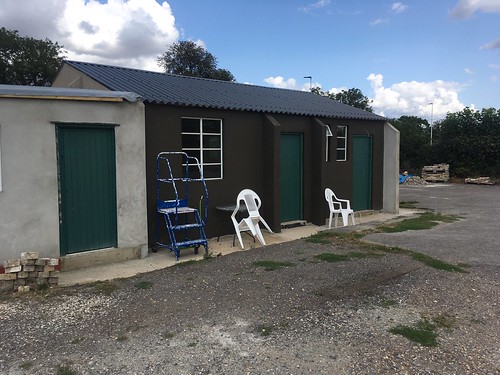
Since then, the runways have been pulled up, the buildings on the airfield have been removed and the accommodation blocks have all been built up expanding the village that played such a great part in its life. On the corner of the airfield site a small cluster of buildings still stand, these include the former squadron offices (themselves former crew rooms), a sleeping shelter, and general purpose huts. These have been purchased and are being restored to house a small museum dedicated to those who served at the airfield.

RAF Bottisham

The former Sleeping Shelter.

The airfield itself is now cut by the main A14 dual carriageway. But by leaving this road and turning along the A1303,  you can access both the museum and the airfield quite easily. The museum sits on the corner of the A1303 and Wilbraham Road, along which, if you turn right, cuts across the airfield and the remains of the former runway. As with many former airfields the runway line has been planted with trees giving a good indication of both its location and size. Parts of the perimeter track are also visible from this road to the north end, but otherwise there is little left to see other than a small selection of concrete patches. The village has a memorial in both the British Legion club and in the village with the Thomas Christian memorial. Sadly, little else of this small but once busy airfield exists today.

Bottisham airfield was generally speaking, a minor airfield housing a number of units in its early years. However, once it became fully fledged, it became not only significant, but a leader in the stakes of war. Now all but gone, the memories of those who served here are firmly embedded in the streets of Bottisham along with a few buildings that survive to tell their story.

My sincere thanks go to the members of the Bottisham Airfield Museum who so kindly stopped their work to give me a personal guided tour of the site when I visited. I wish them luck in their venture.

Sources and Further Reading.

The full story of Bottisham can be read in Trail 55 – Around Newmarket.

The full story of Colonel Thomas Christian appears in Heroic Tales. 

National Archives – AIR 27/1465/10

National Archives – AIR 27/19/25

National Archives – AIR 27/2170/1

Bottisham Airfield Museum website.

*1 Wilson, K., “Blood and Fears – How America’s Bomber Boys and Girls in England Won Their War” Orion Books, 2016.

RAF Bottisham – A small airfield that became a big player (P1)

In Trail 55 we travel from Snailwell to Cambridge passing through Newmarket and the former bomber airfield that has become the famous horse racing circuit. From here, we continue west where we find a small airfield that has all but gone, the last remnants now a small museum that utilises a mix of original and non-original buildings.

This particular airfield was home to a number of RAF units but is perhaps more noted for its American links, and in particular the fighters of the 361st Fighter Group. On our third stop around Newmarket, we visit the former airfield RAF Bottisham.

RAF Bottisham (Station 374).

Located about 5.5 miles east of Cambridge between the villages of Little Wilbraham and Bottisham village, Bottisham airfield was initially opened in 1940 as a satellite for the new bomber base at Waterbeach, a few miles to the north of nearby Cambridge. Although designed as a satellite, it would later become a fighter airfield in its own right, with its own resident unit.

At first, the runways were grass and there were only two. However, later on, a third runway was ‘constructed’ and each of the three were then strengthened, using initially Sommerfeld Track and then Pierced Planking, both similar and both temporary methods of construction that were easy and quick to lay. Around the concrete perimeter track were fifteen concrete hardstands and a further 48 hardstands constructed with the steel matting. This gave a vast number of areas to safely disperse parked aircraft.

The longest runway was 1,435 yards long, whilst the shortest was some 300 yards shorter. The Watch office, designed to drawing 15371/41, was of brick construction with concrete slabs for the roof, which was the most common design used on World War Two airfields. Demolished in 1948, it was an off-shoot of design 12779/41 which allowed for smaller windows at the front of the tower, more commonly found where night flying regularly took place such as bomber airfields.

RAF Bottisham

On site, there were eight Blister hangars (9392/42), a fourteen bay T2 Hangar (3635/42) and a range of stores, fire tender shelters, workshops and offices, mostly brick or steel framed buildings of standard airfield designs.

Accommodation was eventually erected over ten sites both WAAF and enlisted men/officers, many of which were located in and around the village of Bottisham itself.  This huge increase would eventually lead to a massive explosion in the village’s population.

For the first seven months of its existence, from March to October 1940, Bottisham saw little activity, and as the land was little more than a field, it was totally unsuitable for anything larger than a small aircraft. As a result it was barely used, and little development occurred on the site. The only visitors being seen were the occasional Tiger Moth of the 22 Elementary Flying School (EFTS), from nearby Cambridge. 22 EFTS was set up, at Cambridge, on the declaration of war in 1939, and they used a range of small light trainers: Miles Magisters, Proctors, Tiger Moths and Hawker Demons.

For the next year or so, Bottisham airfield remained in this state, barely used and under-developed until, in July 1941, it was handed over to the Army Co-operation Command and 241 Squadron.

After being disbanded at the end of 1919, 241 Squadron was reformed in 1940 by merging two ‘A’ Flights from other units. They initially used Lysander IIs replacing them with Blackburn Rocs, a model they replaced again with Lysander IIIs before moving to Bury St. Edmunds. After that, they moved here to Bottisham, on July 1st 1941. After a matter of only weeks, the Lysanders were replaced with Tomahawk IIA (the British named P-40) which was intended to be a fighter escort aircraft for the RAF. However, its poor performance led to it being used instead for pilot training and Army cooperation work. Something that would become significant over the next year or so. Over the next few weeks, the new aircraft were collected and ‘normal flying training’ flights were the order of the day.

RAF Bottisham

The runway, marked by the treeline looking south-west.

The British saw the Tomahawk as a possible fighter aircraft during the 1940s supplementing the Spitfires and Hurricanes provided by British aircraft manufacturers. However, production problems of the P-40 led to the British seeking alternative suppliers. Realising there was a niche for a new model, the North American Company offered to design their own fighter, one which they designed, built and tested within 100 days. This new model, whilst not perfect, its Allison engine performing badly at altitude, would eventually go on to supply the American Air force and become one of the most famous aircraft ever built – the P-51 Mustang.

With detachments of aircraft based at Snailwell, Macmerry, Henlow and Docking, 241 Squadron would be spread far and wide, but continued to pursue their duties as an Army Cooperation flight. However, their job was not easy, the new Tomahawks and the poor British weather over the winter 1941-42, proved to be a major challenge for both air and ground crews here at Bottisham. The Operational Record Books for the period showing that the month of January in particular was ‘not satisfactory’, with crews struggling to keep aircraft serviceable in the poor weather. On the 20th, a new structure for the Air Force and a new section for the Squadron were brought into being. This did not however, alleviate the difficulties the crews were having. The main issue seemed to be down to generator drive problems in the P-40s, which combined with an accident in the squadron’s  Airocobra, meant flying was very much restricted to the last remaining Lysanders.

On March 15th 1942, things would begin to change. In now fine weather, the first four of the new P-51 Mustangs arrived, flown down from Speke (now Liverpool airport) by P/Os Kirkus, Clarke, Harrup and F/Lt. Coe. During the next few weeks as more P-51s arrived, the old Tomahawks were gratefully handed over to other Training units and Squadrons, and probably without a tear being shed.  Then on May 1st 1942, 241 Squadron began its departure for pastures new and Ayr in Scotland. On that day, the road party left Bottisham in 21 vehicles at 09.00hrs, whilst the rail party left in the evening at 20:00hrs. By the next day, the rail party had arrived but it would be a further 24 hours before the road party would find their new home.

Throughout the war Bottisham would develop a strong relationship with nearby RAF Snailwell, being only a few miles apart, the two frequently used each other to store and operate their aircraft. The next two squadrons to arrive were just that, both Snailwell based units that moved in to Bottisham. Bottisham was never considered a good posting in these early stages of the war, its accommodation at this point was considered primitive, cold and damp, it was certainly not the most hospitable airfield to have to stay at.

RAF Bottisham

A pot Belly stove stand now in the museum.

Some two weeks after 241’s departure the first of these squadrons arrived – 652 squadron. 652 was part of the Air Observation Post (AOP) and like all the units 651 – 666 they were manned partly by Army (pilots) and RAF (maintenance crews) personnel, they were noted for persistent and regular moves sometimes even daily. Noted as being at Bottisham between June and August 1942, 652 Sqn operated Tiger Moths in the observation role, spotting gun shots off the Hunstanton coast for field artillery units. At the end of their stay here at Bottisham they departed moving to Westley in Suffolk.

The second squadron to arrive at this time was another Tomahawk squadron, 168 Squadron, who were formed at Snailwell on 15th June 1942, moving across to Bottisham in mid July after receiving their Tomahawk IIs. Operating from Bottisham in these early days preceded a move to the fighter station at Tangmere and a more glamorous role with Mustangs and later Typhoons.

The transfer occurred in the afternoon of July 13th, with four flights amounting to twelve aircraft flying in formation across to Bottisham. The flights were led by W/Cdr. Watson-Smyth, who on their arrival realised that the AOP squadron were still using the accommodation blocks, and as the new ones were not yet finished, ‘A’ flight had to share until theirs was suitably completed. There was also insufficient room for the officers, who had to sleep in tents in the grounds around the Mess, whilst ground crews were billeted in three huts in the grounds of Bottisham Hall.

On July 19th, the squadron used the new north-south runway for the first time, it was noted that it was rather more “bumpy” and “shorter” than the east-west runway  but was considered “satisfactory” for their use.

During their stay here, 168 Sqn performed many cross country navigation and fighter affiliation exercises. However, a lack of Allison engine tool kits meant many aircraft were unserviceable for long periods. This became a frustration with the flights, restricting their flying time to a minimum. Then on 31st July, a large quantity of the specialist tool kits finally arrived, and the aircraft were able to be repaired and normal flying duties continued.

The dawn of 1943 would bring little change to Bottisham. More short stay units would mean life was a little more hectic, but Bottisham was still not the major front line airfield it so wanted to be.

In part two we see how Bottisham struggled on in the next year. But January 1944 would see big changes and a renewed impetus that would propel Bottisham to the forefront of Fighter aviation.

A Happy Christmas!

I would just like to take this opportunity to wish all those of you who have followed, read or commented on the blog, a very merry Christmas and a very happy and safe New Year.

A extra big thanks goes out to those of you who have stuck around for so long, we’re now approaching our seventh year of the blog and have managed to visit over 125 airfields, 105 memorials and 40 museums. These have stretched from Perth in Scotland to the South coast of England, Suffolk in the east to Gloucestershire in the west. The range of these airfields is enormous, and they continue to vanish, with many in a worse state now than they were when I visited at the beginning of the journey.

Very soon many of these will be gone, lets hope the memories of those who served are not also gone with them.

A very happy Christmas one and all!

RAF Andrews Field – (Great Saling/Station 485) – Trail 33: Essex Part 1.

RAF Attlebridge  (Station 120) – Trail 7: Northwest Norfolk.

RAF Barkston Heath (Station 483) – Trail 2: Lincoln Borders and Newark

RAF Barton BendishTrail 7: Northwest Norfolk.

RAF Biggin Hill (Westersham) (Station 343) – Trail 4: Kent Part 1.

RAF Bircham NewtonTrail 20: North Norfolk (Part 1).

RAF Bodney (Station 141) – Trail 8: Swaffham and Her Neighbours (Part 1 of 3).

RAF Bottesford (Station 481) – Trail 52: Leicestershire’ Borders.

RAF Bottisham (Station 374) – Trail 55: Around Newmarket

RAF Boulmer – Trail 47: Northumberland.

RAF BournTrail 31: Southern Cambridgeshire (Part 2).

RAF Brenzett (ALG) – Trail 18: Kent Part 2.

RAF BruntonTrail 47: Northumberland.

RAF Bungay (Flixton) (Station 125) – Trail 14:  Central Suffolk (Part 1).

RAF Bury St. Edmunds (Rougham) (Station 468) – Trail 16: West Suffolk (part 1).

RAF Castle CampsTrail 45: Essex (Part 2).

RAF Caxton GibbetTrail 29: Southern Cambridge (Part 1).

RAF Charterhall Trail 41: The Borders of Scotland and England.

RAF ChedburghTrail 49: Bomber Command – Bury St. Edmunds to Haverhill

RAF Collyweston Trail 37: The Northern Reaches of Cambridgeshire.

RAF Coltishall – Trail 7: Northwest Norfolk.

RAF ConingsbyTrail 1: Lower Lincolnshire.

RAF CottamTrail 40: Yorkshire (East Riding).

RNAS CrailTrail 53: Scotland’s East Coast – Fife

RAF CranwellTrail 2: Lincoln Borders and Newark.

RAF Debach (Station 152) – Trail 39: Suffolk around Ipswich (Part 1).

RAF Debden (Station 356) – Trail 46: Essex Part 3.

RAF Deenethorpe (Station 128) – Trail 6: American Ghosts.

RAF Deopham Green (Station 142) – Trail 27: Southern Norfolk (Part 3).

RAF Digby (Scopwick) – Trail 1: Lower Lincolnshire.

RAF Docking – Trail 20: North Norfolk (Part 1).

RAF Downham Market (Bexwell) – Trail 7: Northwest Norfolk.

RAF Drem – Trail 42: Edinburgh’s Neighbours.

RAF Dunino –  Trail 53: Scotland’s East Coast – Fife.

RAF East Fortune – Trail 42: Edinburgh’s Neighbours.

RAF East Kirkby Trail 1: Lower Lincolnshire.

RAF East Wretham (Station 133) – Trail 13: Southern Norfolk around Diss (Part 2).

RAF Eye (Brome) (Station 134) – Trail 14: Central Suffolk (Part 1).

RAF Fersfield – (Station 130) – Trail 28: Southern Norfolk (Part 4).

RAF FoulshamTrail 22North Norfolk (Part 3).

RAF FowlmereTrail 32Southern Cambridgeshire (Part 3).

RAF Framlingham (Parham) (Station 153)Trail 39: Suffolk around Ipswich (Part 1).

RAF GamstonTrail 54: The Great North Road.

RAF Glatton (Station 130) – Trail 6: American Ghosts.

RAF Gransden Lodge – Trail 31: Southern Cambridgeshire (Part 2).

RAF Graveley – Trail 29: Southern Cambridge (Part 1).

RAF Grafton Underwood (Station 106) – Trail 6: American Ghosts.

RAF Great Dunmow (Station 164)- Trail 33: Essex (Part 1).

RAF Great MassinghamTrail 21: North Norfolk (Part 2).

RAF Great Sampford (Station 359) – Trail 50: Haverhill’s neighbours – Wratting Common and Great Sampford.

RAF Hardwick (Station 104) – Trail 12: Southern Norfolk around Diss (Part 1).

RAF Hawkinge – Trail 18: Kent Part 2.

RAF Hethel – Trail 38: To the West of Norwich.

RFC HinghamTrail 38: To the West of Norwich.

RAF Holme on Spalding Moor Trail 40: Yorkshire (East Riding).

RAF Hunsdon – Trail 25: Hertfordshire.

RAF Kimbolton (Station 117) – Trail 6: American Ghosts.

RAF King’s Cliffe (Station 367) – Trail 6: American Ghosts.

RAF LanghamTrail 23: North Norfolk (Part 4).

RAF Lashenden (Headcorn) – Trail 18: Kent Part 2.

RAF Lavenham (Station 137) – Trail coming soon.

RAF Leuchars – Trail 53: Scotland’s East Coast – Fife.

RAF Little SnoringTrail 22North Norfolk (Part 3).

RAF Little Walden – – Trail 46: Essex Part 3.

RAF Macmerry Trail 51: Southern Scotland

RAF MarhamTrail 7: Northwest Norfolk.

RAF Martlesham HeathTrail 48: Suffolk around Ipswich (Part 2).

RAF Matching (Station 166) – Trail 33: Essex Part 1.

RAF Matlaske (Station 178) – Trail 34: North Norfolk (Part 5).

RAF MattishallTrail 36: North Norfolk (Part 6).

RAF Mendlesham (Station 156) – Trail 15: Central Suffolk (Part 2).

RAF MepalTrail 11: Around Ely.

RAF MetheringhamTrail 1: Lower Lincolnshire.

RAF Methwold – Trail 8: Swaffham and Her Neighbours (Part 1).

RAF Milfield –  Trail 47: Northumberland.

RAF Narborough (Narborough Aerodrome)- Trail 7: Northwest Norfolk.

RAF Newmarket Heath – Trail 55: Around Newmarket

RAF North CreakeTrail 23: North Norfolk (Part 4).

RAF North Pickenham (Station 143) – Trail 9: Swaffham and Her Neighbours (Part 2).

RAF North WealdTrail 25: Hertfordshire.

RAF North Witham (Station 479) – Trail 3: Gone But Not Forgotten.

RAF Old Buckenham (Station 144) – Trail 13: Southern Norfolk around Diss (Part 2).

RAF Oulton – Trail 34: North Norfolk (Part 5).

RAF Polebrook (Station 110) – Trail 19: Northamptonshire American Ghosts II.

RAF Rattlesden (Station 126) – Trail 15: (Central Suffolk (Part 2).

RAF SawbridgeworthTrail 25: Hertfordshire.

RAF ScamptonTrail 30: Scampton and the Heritage Centre.

RAF SconeTrail 56: Perthshire.

RAF SculthorpeTrail 21: North Norfolk Part 2.

RAF Sedgeford – Trail 20: North Norfolk (Part 1).

RAF Shipdham (Station 115) – Trail 10: Swaffham and Her Neighbours (Part 3).

RAF Snailwell (Station 361) – Trail 55: Around Newmarket

RAF Snetterton Heath – (Station 138) – Trail 27: Southern Norfolk (Part 3).

RAF Spanhoe Lodge (Station 493) – Trail 6: American Ghosts.

RAF Steeple Morden – Trail 32: Southern Cambridgeshire (Part 3).

RAF Stoke OrchardTrail 24: Gloucestershire.

RAF Stradishall- Trail 49: Bomber Command – Bury St. Edmunds to Haverhill

RAF Sutton BridgeTrail 3: Gone But Not Forgotten.

RAF Swannington – Trail 36: North Norfolk (Part 6) 

RAF Swanton Morley – Trail 38: To the West of Norwich.

RAF Thorpe Abbotts (Station 139) – Trail 12: Southern Norfolk around Diss (Part 1).

RAF Tibenham (Station 124) – Trail 13: Southern Norfolk around Diss (Part 2).

RAF Tuddenham – Trail 16: West Suffolk (Part 1).

RAF Tydd St. Mary – Trail 37: The Northern Reaches of Cambridgeshire.

RAF Upwood – Trail 17: The Pathfinders.

RAF Warboys – Trail 17: The Pathfinders.

RAF WaterbeachTrail 11: Around Ely.

RAF Watton (Station 376/Station 505) – Trail 9: Swaffham & Her Neighbours (Part 2).

RAF Wendling (Station 118) – Trail 10: Swaffham and Her Neighbours (Part 3).

RAF West Malling Trail 4: Kent Part 1.

RAF West RaynhamTrail 21: North Norfolk Part 2.

RAF WethersfieldTrail 45: Essex (Part 2).

RAF Westley – Trail 16: West Suffolk (part 1).

RAF WinfieldTrail 41: The Borders of Scotland and England.

RAF Winthorpe Trail 2: Lincoln Borders and Newark.

RAF WitchfordTrail 11: Around Ely.

RAF Wittering  – Trail 37: The Northern Reaches of Cambridgeshire.

RAF Woodall SpaTrail 1: Lower Lincolnshire.

RAF Wratting CommonTrail 50 – Haverhill’s neighbours – Wratting Common and Great Sampford.

William G. Rueckert, 93BG, 409BS, RAF Hardwick

This post has been updated since I was contacted by William’s son. Click on the title below for the full story.

1st. Lt. William G. Rueckert, 93BG, 409BS, RAF Hardwick

rueckert

William Rueckert with his wife, Dee*1

William G. Rueckert (service Number: 0 -420521) was born September 9th 1920, in Moline, Illinois. At school, he became a model student, achieving high grades throughout his school life. Upon leaving, he won a place at Illinois University where he wanted to study Law. Rueckert had a passion for reading, particularly the classics like Shakespeare and Proust and was known for his hard work and dedication.

It was at University that he met, on a blind date, he wife to be, ‘Dee’. The meeting almost never took place due to a faulty car, but as a lover of dancing, they turned out to be the perfect match and his lateness was forgiven.

Inseparable as a couple, Rueckert and Dee were married only a year later, in 1940, when Rueckert was just 19 years old.

War came even closer, and Rueckert decided he had to do his part and joined up with the Army, on July 15th 1941. Based at Pine Camp, New York, he was part of the 4th Armoured Division, and his hard work and dedication was very quickly realised; he soon won himself an award on the firing range. Constant passionate letters home cemented the love between Rueckert and Dee, in one letter he said; “My life, my love and all my hope all lie in my wife Dee!”

Rueckert’s life then changed and he joined the USAAC. As a trainee pilot, he moved from New York, to California and then onto New Mexico where he gained the qualification of Pilot instructor on October 28th 1943.

Whilst flying here at New Mexico, the plane Rueckert was in, a B-24, collided with a small training aircraft killing its pilot. Rueckert managed to land his own B-24 and following his actions, was credited with saving the lives of the crewmen on board.

Finally, the draw of the war led Rueckert to requesting a post overseas. He was sent to RAF Hardwick, Norfolk to join the 409th BS, 93rd BG, 20th Combat Wing, Eighth Airforce, in April 1944. Formed only two years earlier on 22nd April 1942, the 409th was to be Rueckert’s only operational squadron. Having won three DUCs already for operations over Europe including; the raid on the Romanian oil fields at Ploesti, and the enormous raid of February 1944 ‘Big Week’, the 93rd were a battle hardened group.

“Ted’s Flying Circus” as they were to be known, took part in the preparations for D-Day, completing much of their bombing missions over the Normandy area, cutting supply lines and communication routes across France.

Rueckert’s first and only mission, was on May 1st 1944. It was to be a night flight. He joined his best friend along with his assigned pilot Second Lieutenant Albert Schreiner (0-805532) on B-24 ‘Joy Ride‘ #42-7621, leaving his regular crew behind at Hardwick.

The aircraft, began its roll down the runway, as it neared the take off point, it is thought the undercarriage collapsed causing a catastrophic crash in which seven bombs exploded. The aircraft was completely destroyed and five of the crew killed including the pilot and Lt. Rueckert. The crash was so intense, it closed one of the three enormous runways for five days.

Dee, Rueckert’s wife, found out by telegraph that her husband had been killed. She was understandably devastated as were the two young children, Billy and Dianne.

Rueckert’s body was initially buried at Madingley Cemetery, Cambridge, but later he was repatriated and buried in the family plot in Illinois. His purple Heart, awarded earlier, has since been donated by his son Billy, to the church at Topcroft, where Rueckert prayed the night before that fatal flight. A plaque also sits in the wall in remembrance of the 668 men who never returned to Hardwick. Rueckert’s name appears in the St Paul’s Cathedral Roll of Honour, on page 365.

Hardwick appears in Trail 12

https://i0.wp.com/media.iwm.org.uk/iwm/mediaLib/rfc/FRE_003762.jpg

A B-24 Liberator (YM-H, serial number 42-95258) of the 409th Bomb Squadron, 93rd Bomb Group (IWM FRE 3762)

Sources and further reading.

*1 Photo from The purpleheart.com author unknown.

This story recently appeared in the Eastern Daily Press, December 13th 2014, and contains more photos and personal details.

RAF Snailwell – Where life was far from Slow (Pt2)

After part 1, we return to  Snailwell, to see how the American influence played its part at Snailwell and how the build- up to D-day affected life at this small grassed airfield.

The squadron was assigned to the 350th Fighter Group (FG) who would eventually transfer to the Middle East. It would be the 347th’s sister squadron the 346th who would later convert Hurricane Mk I #LB640 target tug into a two-seat liaison plane.

Hurricane Mk I LB640, which was being operated as a target-tug with the P-39-equipped 346th Fighter Squadron, 350th Fighter Group, 12th AF USAAF in Sardinia in early 1944. It was field converted into a two-seater as a liaison plane by the unit's ground crew.

Hurricane Mk I #LB640 after being converted into a two-seat liaison plane.  IWM (UPL 17052)

As they were a new squadron the 347th would initially have no ground echelon, they were still being formed and prepared for transportation over the Atlantic from their base at Harding Field, Louisiana. They would arrive in the UK in the November and after a short period at Snailwell, the entire squadron would move out to RAF Kings Cliffe in Northamptonshire, before moving away to the warmer climate of the Middle East.

The winter of 1942/43 saw further detachments being based here at Snailwell. In conjunction with the US forces were 170 Sqn, who remained here from the end of October through the winter until February 1943. After a short spell away they made a brief one day stop over before being moved to RAF Odiham.

The January of 1943 saw yet more short stays. On the 17th 182 Sqn arrived with Typhoon IBs. Based at RAF Sawbridgeworth in Hertfordshire, 182 Sqn were finding it hard to get in any flying at all, as the heavy winter rains had clogged up the metal PSP runways with thick mud preventing the aircraft from taking off.

Two days earlier 70 ground personnel had been dispatched from Sawbridgeworth to Snailwell in preparation for the forthcoming training operation. Operation “Shatter” as it was designated, would be a mock attack on gun emplacements on the outskirts of Thetford Forest. On the 17th, the ten aircraft were sent from RAF Sawbridgeworth led by Sqn. Ldr Pugh along with a further four from the detachment at RAF Hunsdon. On arrival they found their sister squadron, 181 Sqn also with Typhoons, already here for the Army Cooperation training operation. A large party was given that night in honour of the new 182 Sqn crews. The next day, a preliminary attack was made on the target by eleven 182 Sqn aircraft, who made runs over both the dummy and real guns in a “full frontal attack”. The following day, a complete squadron attack was made with the aircraft having to be airborne in under 4.5 minutes. For the first time since forming, all the canons on the Typhoons are fully loaded with live ammunition and a full squadron scramble was undertaken.

Aerial photograph of Snailwell airfield looking south, 26 July 1942 (IWM RAF_FNO_67_V_6032)

In the afternoon a four ship formation was loaded up with 2 x 250 lb bombs and a further attack was made. This attack ended the training session for 182 Sqn and the next day they return to the muddy runways of Sawbridgeworth.

Two months later on March 8th 1943, 181 Sqn was reunited with her other sister squadron 183 Sqn here at Snailwell. After a number of short training flights covering just four days, 183 Sqn departed the Cambridgeshire airfield leaving 181 Sqn here until the end of the month.

Throughout 1943 much of the same was to happen, short stays for training missions were the order of the day.  309 Sqn flew the Mustang MK.I and Hurricane VIs. The Polish squadron became renowned amongst the Allies when F/Lt Janusz Lewkowicz flew a Mustang I to Norway and back strafing targets at Stavanger just to prove the point that the Mustang had the range!

Another squadron, 613 Sqn also brought their Mustangs along in July, and 184 Sqn arrived with Hurricanes. 247 Sqn brought back the mighty Typhoon, each of these squadrons carrying out training flights, some for as little as two days others for more prolonged periods.

As the end of 1943 drew a line under the busy ebb and flow of visiting squadrons, 1944 would see a rather more settled year. After a single RAF squadron, 527 Sqn, moved in and then out two months later, the  build up to D-day would see big changes at Snailwell.

The invasion of Europe was destined to be the largest invasion build up the world had ever seen, and southern England was to be the primary area in which this build up would take place. With the creation of the Ninth Air Force, whose primary purpose was to provide assistance to the forth coming Normandy landings, more and more airfields were going to be required. Whilst front line units would be directly involved in operations over the Normandy coast, there would need to be a major service and maintenance support network, if the invasion were to succeed. This service was to be carried out by a series of  six Tactical Air Depots (TAD) all falling under the command of the IX Air Force Service Command, via two Advanced Air Depot Areas (AADA).

One of these depots, the 3rd Tactical Air Depot based at RAF Grove some 55 miles from London, were responsible for the maintenance and repair of Douglas A-20 ‘Havocs’ and P-61 ‘Black Widows’. Because of the increasing demand for maintenance facilities, the 3rd TAD took over the facilities at RAF Snailwell, moving in two Mobile Repair and Maintenance Squadrons, the 33rd and 41st, in preparation for maintenance operations. Their primary role was to make field modifications to the aircraft in preparation for operational roles, as a result of which the A-20s became a regular feature around the airfield. After only a short time though it was realised that the 41st would not be required here, and so they returned to RAF Grove. To replace them, a specialist team were brought in – the 51st Service Squadron. By the time D-day had passed, the pressure at Grove had subsided and so both units were able to return home from Snailwell. With that, the American connection with Snailwell ended.

As the war drew to a close so too did both operational flying and training flights. The RAF (Belgian) Initial Training School used the airfield sharing it with nearby RAF Bottisham. In March 1946, the Belgians pulled out returning to their own country now free from the Nazi tyranny that had dominated it for so long.

Snailwell then closed, standing empty and gradually returning to agricultural use. Many of the buildings were pulled down but some hung on for several years being used for agricultural purposes. The Blister hanger, sheds and training buildings remained for a number of years, certainly until the mid 1990s, but gradually even these were removed with little evidence of their existence being left today. The airfield was then dissected by a major road development in 1975, remaining parts being bought up by the British Horse Racing School who now own a large portion of the former airfield. High hedges and gated access restrict most access to the former site, (the Icknield Way long-distance route does pass along side these tracks and borders the former airfield from which remnants can be seen) leaving the last few sections of concrete hanging on as reminders of the airfields once proud and hectic existence.

With a mix of repair and maintenance units added to the pot, the war years for Snailwell were far from slow. The regular ebb and flow of detached units for training flights, and the occasional permanent flying unit, saw a wide range of aircraft types and nationalities grace the skies of this small area of Eastern Cambridgeshire. With little evidence of its existence left today, Snailwell, and its proud history, would seem to have been lost, replaced by Horse racing and the desire for the high stakes demanded by the equestrian market.

From Snailwell, we head west, deeper in to the area owned by the Horse racing fraternity. Here we see on every street corner evidence of this now popular sport, well groomed bushes that surround neatly cut turfs, on what now remains of Britain’s wartime heritage. Our next stop on Trail 55, is the pinnacle of these activities, the former RAF Newmarket Heath.

Sources and Further Reading.

*1 Official Directorate of Works drawing (WA7/395/41) IWM UPL 17710

British History Online (Snailwell) website.

National Archives AIR 27/1563/9

National Archives AIR 27/954/6

National Archives AIR 27/1135/1

Niall Corduroy. “Whirlwind: Westland’s Enigmatic FighterFonthill Media, 2017.

RAF Snailwell – Where life was far from Slow (Pt 1).

In the latest Trail around Britain’s airfields, we visit four airfields so close that as the crow flys, they are a mere 12.5 km from the first to the last.  It is an area to the east of Cambridge, a large University City that now dwarfs the River Cam the narrow waterway that gave the city its name. The final airfield we visit lies on the outskirts of the city itself, and is probably more famous for its more recent operations under Marshalls of Cambridge, the Aerospace and Defence Group.

Our first stop though takes us through prime horse racing land, through the home of the Jockey Club and an area divided into studs and stabling, not for live stock, but for horses.

Our first stop in Trail 55 is the former RAF Snailwell, a small airfield where life was far from slow!

RAF Snailwell (USAAF Station 361).

Snailwell lies  just outside of the town of Newmarket in the county of Cambridgeshire now infinitely famous for its horse racing. The village of Snailwell from which the airfield takes its name, lies on the northern edge of the former airfield which is now  owned, as is much of this area, by the British Racing School who vehemently protect it from prying eyes.

Sitting to the north of the Bury St. Edmunds railway line, the airfield opened in the Spring of 1941, after the levelling of ten Bronze age Barrows (ancient burial grounds) as a satellite for RAF Duxford located to the south-west. The airfield would go through an ever changing number of roles including: Army Co-Operation, training, and as a fighter base performing low-level attacks on shipping and land based targets. It would also see a wide range of aircraft types from the small trainer to the powerful tank-buster the Typhoon. Opened as a technical training airfield, it passed to the control of 28 (Technical Training) Group whose headquarters were located in London. It fell under the command of Air Commodore John Charles ‘Paddy’  Quinnell, an avid lover of sailing who had a distinguished military history that extended back to 1914, first with the Royal Artillery and then with the Royal Flying Corps.

As a small grass airfield, Snailwell was by no means insignificant. It had three grass runways the largest being just short of 1,700 yards long, whilst the second and third were 1,400 yards in length. The main runway crossed the airfield on a south-west to north-east direction protruding out of the main airfield area. Aircraft were dispersed on concrete hardstands, a mix of twelve ‘Fighter’ style Type B hardstands (capable of holding two aircraft side by side but separated by a bank) along with two 50 ft diameter ‘frying pan’ style stands. They also had the use of a Bellman hangar, and ten blister hangars for servicing and maintenance of aircraft*1.

To the north, hidden amongst the trees was a bomb store, with separate fusing buildings, tail stores, incendiary and component stores, access to the site being via a 12 ft wide concrete road.

In all, there were only a few permanent personnel at the airfield, accommodation was only erected for around 1,100 officers and enlisted men in Nissen huts over just two sites; Dormitory site 1 and 2, which were supplemented with a mess site and sick quarters. It is known that later users were camped in tents around the airfield perimeter – not ideal accommodation by any means. Unusually, the technical area was widely spread with many buildings being away from the airfield hub. The watch office, at the centre of this hub, was designed to 12779/41 and had an adjoining meteorological office attached, an unusual addition for this type. There was also a wide range of buildings, AMT trainer, two Link trainers, flight offices, sleeping shelters, parachute stores, fire tender huts and numerous associated maintenance stores and sheds.

During construction of the airfield a local road was closed, and a lodge, built at the turn of the century, utilised as a guard room for the airfield. This building later passed to the Jockey Club for use by its employees.

The initial users of the airfield were the Army Co-operation Squadron  268 Sqn RAF, who arrived at Snailwell with Lysander IIIs on April 1st 1941. Being a slow aircraft it was ideal as a reconnaissance aircraft, flying patrols along the coast of East Anglia, looking for any sign of an invasion force. After arriving at Snailwell from Bury St. Edmunds, the three Echelons immediately began training, three photographic sorties taking place on the very day they arrived. In the days that followed, combined Army and Air Force exercises were the order of the day, after which the squadron took part in intensive gas training along with routine flying. However, 268 Sqn would not settle here, yo-yoing between Snailwell and numerous other stations no less than eleven times between their first arrival, and their last departure to RAF Odiham on May 31st 1943.

Duxford Battle of Britain Airshow

A Lysander at Duxford’s Battle of Britain Airshow 2019.

In the May of 1941, 268 Sqn would swap their ‘Lizzies’ (as they were affectionately known) for the Tomahawk IIA, an aircraft they kept until changing again to the better performing Mustang I a year later. These Tomahawks would perform a range of duties including – whilst based at RAF Barton Bendish in Norfolk – early morning ‘attacks’ on Snailwell as part of a Station Defence Exercise. These involved mock gas and parachute attacks along with low-level strafing runs. Being little more than a field, Barton Bendish provided no accommodation for visitors, and so the aircrews slept in tents overnight.

During the August of 1941 the first of Snailwell’s many short stay squadrons would arrive. 152 Squadron would use Snailwell for a period of just one week whilst transiting to nearby RAF Swanton Morley. Operating the sleek Spitfire IIA, the brain child of R.J. Mitchell, they would perform fighter sweeps, along with convoy and bomber escort duties. Arriving on the 25th, the only major event occurred on the 28th when the squadron escorted seventeen Blenheims to Rotterdam, Sgt. Savage being the only 152 Sqn pilot to be lost during the mission. The next day, ‘A’ flight searched for signs of him, but sadly found no wreckage nor any sign of Sgt. Savage.

Being a small airfield Snailwell was often home to detachments of squadrons, usually whilst on training. One such unit arriving on November 31st when 137 Sqn posted a detachment here whilst the main body of the squadron stayed at RAF Matlaske further north in Norfolk.  Operating the heavily armed escort fighter the Westland Whirlwind, they would perform escort duties for Lysanders, searches for downed aircraft and ‘X’ raid interception duties. Many of their patrols covered Great Yarmouth on the East Anglian coast in an area to the east of the airfield.

Designed in 1937, the Whirlwind had many teething problems with the engines proving to be a particular issue. After purchasing only 112 examples of the model, 137 would be one of only two squadrons who would use it in any operational role. After moving to Matlaske, 137 began a series of training operations, posting a detachment of aircraft to Snailwell whilst preparing to commence anti-shipping operations in the North Sea.  Once operationally ready, the unit moved north to RAF Drem (August 1942) before returning once more to Matlaske where further training would take place; ‘B’ Flight replaced ‘A’ Flight at Snailwell until both were reunited at Snailwell in late August. Anti shipping operations continued from Matlaske, with their final sortie occurring on August 20th in which an enemy Ju 88 was intercepted – the aircraft evading its pursuers in bad weather. Moving across to reunite the squadron on the 24th, 137 would perform their first operational sortie from Snailwell in early September, a feint attack against Lille. Designed to attract the Luftwaffe fighters into a trap, the twelve Whirlwinds and their fighter escorts failed to sight one enemy plane and all returned to their respective bases not having fired a shot. After this, the Whirlwinds were fitted with bombs and further training followed, but by mid September, they had left Snailwell and were heading for RAF Manston in Kent.

The summer of 1942 would be a busy period for Snailwell, with several squadrons utilising the airfield. At the end of March 56 (Punjab) Squadron would bring  the Hawker Typhoon MK.IA, a model they would begin replacing virtually immediately with the MK.IB. The April of that year was mainly taken up with practice formation flying and aircraft interception flights, before the squadron also moved to Manston in Kent. 56 Sqn would return briefly to Snailwell over the June / August period, but this would be short and they would then depart the airfield for good.

On June 15th 1942, a new squadron would be formed here at Snailwell. Under the command of Sqn. Ldr. F.G. Watson-Smyth, it would have two flights ‘A’ and ‘B’, each led by a Flight Lieutenant. 168 Sqn, initially flying the Curtiss Tomahawk II, was formed from the nucleus of 268 Sqn, and would remain here only until their aircraft and equipment had arrived. Being allocated RAF Bottisham as their main station, they would stay at Snailwell for a mere month. During this time aircraft would have their squadron numbers painted on, and Sqn, Ldr. Spear would give dual flying training to all pilots in a Fairy Battle.

Toward the end of June Sqn. Ldrs. Watson-Smyth and Bowen would visit Bottisham to discuss and prepare the accommodation arrangements for the squadron’s forthcoming arrival. Further deliveries of supplies took place and by the 26th there were seven Tomahawks on charge. On the 13th July, at 14:35 hrs, twelve Tomahawks took off from Snailwell and flew in formation to their new base at Bottisham, a mere stones throw from their current location. The move had begun and 168 Sqn would leave Snailwell for good.

In the August, whilst transiting to North Africa, 614 Sqn would place a detachment of their Blenheim Vs here, a further detachment being placed at Weston Zoyland with the main body of the squadron at Odiham. Coinciding with this was also a detachment of 239 Sqn with Mustang Is, making  Snailwell a very diverse station indeed.

With the arrival of autumn in the October of 1942, Snailwell took a very different turn, being handed over to the US Ninth Air Force Service Command who brought in the Airacobra, one of the few wartime fighters to use a tricycle undercarriage. Transferring across from Duxford, the parent airfield of Snailwell, the 347th Fighter Squadron (FS) were a brand new squadron, only being activated that very same month.

In part two we see the early American influence, and how this small grass airfield played its part in the build up to D-day.

The full page can be seen on Trail 55 – Around Newmarket.