Throughout Part 7 the 305th Bomb Group continued to demonstrate extraordinary courage, with crews surviving horrific damage to their B-17s and earning multiple Medals of Honour for their heroism. By the final months of the war in Europe, they had flown 337 combat missions, dropped over 22,000 tons of bombs, and contributed to both strategic bombing and propaganda efforts. After Germany’s defeat, the group returned to the United States, later reactivating briefly in 1947, 1951, and 1994, leaving a lasting legacy as the “Can-Do Wing.”
From Wartime Urgency to Cold War Necessity
The immediate post-war years then presented the Government with a formidable practical and financial problem. At the end of 1945 there were close to 700 surplus military airfields scattered across the United Kingdom, many of them constructed hurriedly for a wartime need that now suddenly became redundant. Pressure for their disposal came swiftly. Farmers demanded the return of requisitioned land, local authorities saw opportunities for civil airports or industrial development, and the Treasury was keen to reduce the heavy burden of maintenance costs. At the same time, the Air Ministry argued that a proportion should be retained against future uncertainty, either as reserves or for storage and technical purposes.
Across the country the fate of these sites varied. On some airfields, huts and temporary accommodation sites were converted into short-term housing for displaced families during the acute post-war shortage. Elsewhere, hardstands and runways were broken up to provide much-needed hardcore for reconstruction projects. Yet a minority of airfields were kept within the RAF’s control, Chelveston being one of them. Returned to the RAF after the war, it passed to Maintenance Command and was designated as a satellite of No. 25 Maintenance Unit, although this arrangement remained brief. Thereafter, the station entered a period of care and maintenance, a quiet, role that lasted until September 1952.
Despite a rapid post war airfield closure programme, by the early 1950s the pace of reductions had slowed as the international climate dramatically shifted. The emerging Cold War, marked by the formation of the North Atlantic Treaty Organisation (NATO) in 1949 and intensified by conflicts such as the Korean War, prompted a reassessment of Britain’s defensive position. Air power, particularly with the advent of jets and the nuclear dimension, regained its strategic significance. Selected airfields across Britain saw their runways lengthened, surfaces strengthened, and dispersal areas improved to accommodate modern aircraft. The 1956 Suez Crisis further strengthened the need for an operational readiness and an overseas capability.
Domestic policy was also playing its part. The National Service Act 1948, which introduced peacetime conscription, kick-started a steady flow of manpower into the armed forces throughout the 1950s. Although costly, and partly due to massed post war demobilisation, National Service enabled the RAF to sustain a larger trained strength than would otherwise have been possible; this made it important to retain, and in some cases reactivate, selected stations for training, reserve or operational activities.
On a wider scale, Anglo-American defence cooperation deepened. Several East Anglian airfields – including RAF Lakenheath, RAF Woodbridge, and RAF Bentwaters – were all developed or upgraded for US Air Force use, while strategic bomber bases such as RAF Wittering were adapted to meet the RAF’s demands in the nuclear era. Disposal of wartime airfields therefore continued, but more selectively: stations once considered redundant suddenly acquired a renewed military value, serving as insurance against an increasingly uncertain international environment.
From Wartime Relic to Strategic Stronghold
In light of these changes, in 1952, a detachment of the 7503rd Air Support Wing (later redesignated the 7253rd ASW) arrived at Chelveston to assess and prepare the station for reactivation, laying the groundwork for construction teams from the 817th Engineer Aviation Battalion (EAB), who began major redevelopment work just two months later. This followed the February 1951 launch of a major US construction programme across twenty-six UK airfields, driven by rising Cold War tensions.
The deployment of American aircraft on British soil was a direct response to the growing Soviet threat seen in both Korea and Eastern Europe. Stationing bombers in the UK significantly reduced flight times to potential targets, thus enhancing both rapid strike capability and strengthening the credibility of Western deterrence. Wartime stations that had lain largely dormant since 1945 were once again recognised as strategically valuable, reflecting the pressures of the emerging jet age and the rapidly evolving political-military situation in Europe.
These physical upgrades coincided with a decisive reorganisation of American air power in the UK. On 20th March 1951, the Strategic Air Command (SAC) activated the 7th Air Division to assume direct control of its strategic bomber forces in Britain; a move that separated nuclear strike responsibilities from the broader command. Weeks later, on 1st May 1951, the Third Air Division was replaced by the Third Air Force, which under NATO, managed tactical air operations, logistics, and support for U.S. units stationed in the UK.
Expanded, modernised, and re-equipped, these airfields were adapted to accommodate the new generation of SAC jet bombers – larger, faster, and more capable than any that had previously operated from British soil. Together, the redevelopment of Britain’s wartime airfields and the restructuring of command reflected the growing permanence of the United States’ commitment to Western Europe’s defence – a position that would endure throughout the Cold War.
This extensive refurbishment work would include new runways, updated or replacement accommodation blocks, secure nuclear-capable bomb stores (or ‘igloos’), larger fuel stores, and a range of technical buildings – and all rapidly constructed.
Chelveston, already being a large site with a long runway, was earmarked for such development. However, its wartime runway had deteriorated and was too short for the new jets. A new, longer, and stronger runway – 12,000 ft in length, among the longest in the UK – was therefore constructed, a task undertaken by the 817th Engineer Aviation Battalion.*17
From Stratojets to Silence
After nearly four years of development that saw the construction of not only the new runway, but additional hardstands, servicing platforms and a technically superior watch office (Type 5589/58 Tower with a visual control room mounted on top of a skeletal frame)*18, the site was transformed. It was then that the 3914th Air Base Squadron (ABS) of the 7th Air Division, SAC, took up residence.
As operators of the airfield, the 3914th ABS would complete any further modifications needed allowing for, in May 1956, the first jet bomber’s arrival. Boeing B-47E-65-LM Stratojet, 53-1881 was flown in by the base Commander Colonel Maynard E. White. On arrival, he was greeted by his deputy commander along with local civic leaders and American families who were now living on the new base. This moment marked the beginning of a new era in Chelveston’s history.*19
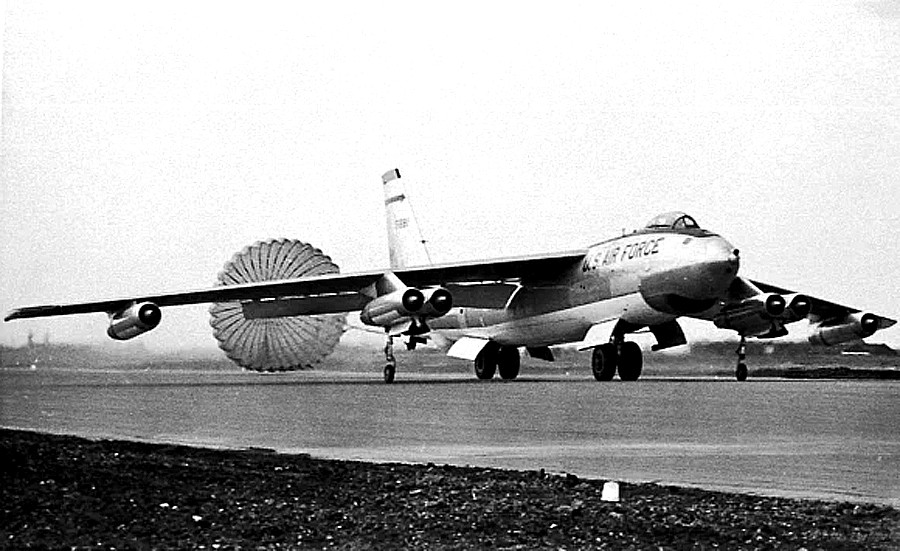
Believed to be the first B-47 Stratojet 53-1881 landing at Chelveston. (Public domain via Chelveston-cum-Caldecott Parish Council).
For a the next three years or so, Chelveston would house a small number of B-47s, all nuclear capable. But continual economic changes in the US defence network, meant that many were now placed on ninety day rotations instead of permanent postings.
The airfield became part of a chain of bases housing large bombers of the Strategic Air Command as part of a ‘Reflex Alert’ force. Kept armed and ready, they remained manned on a permanent 15 minute alert basis ready to respond to any Soviet threat that may have come.
With these rotas changing approximately every three months, families were moved about from base to base, a process that carried on for almost eighteen months until mid 1959.
A further change in the global political and strategic field in the last few months of this period, saw a change in aircraft too. The bomber era was now drawing to a close, and at Chelveston, this led to the arrival of the 301st Reconnaissance Wing (RW) equipped with RB-47s – a reconnaissance version of the B-47.
By now, intermediate-range ballistic missiles (IRBM) were being increasingly used more, and several UK bases now had them deployed as an alternative to the heavy bombers. With ranges of up to 5,500km, they were the catalyst for an arms race, one that would see newer and more powerful weapons propel the world toward the edge of destruction.
As the story of Chelveston draws to a close IRBMs take centre stage, reshaping the balance of power and casting a long shadow over airfield. As these new weapons promise unprecedented reach and destructive potential, the once-bustling bomber base faces an uncertain future. What would become of Chelveston in this rapidly changing landscape – an abandoned relic, secret stronghold, or something else entirely? The final chapter will reveal a story few could have predicted.
The whole story of Chelveston can be read in Trail 66. Northants and Bedfordshire (Part 2)
 Aviation Trails