February 13th, Birthday of a Young Hero.

Today, 13th February, marks the birthday of an American airman who like so many, died at the young age of just 21, in the early morning of D-Day, 1944.

He was a gallant and brave young man, whose tragedy perhaps led to the success of his fellow airmen, and whose sacrifice is still remembered today.

As the world’s largest amphibious assault force assembled along the South Coast of England, thousands of aircrew prepared for what was to be the most incredible night of their lives.

Across the Midland Counties, American ground crews prepared their fighters and paratrooper aircraft. Along southern England, the same scene was being played out. RAF crews too prepared their aircraft; fighter groups were briefed and paratroopers readied their gear. The invasion was on!

Flying an operation of this magnitude was going to require guts, daring and precision flying. There was little room for error.

In the lead up to June 6th, the RAF and USAAF had been bombing prime targets across Northern France to soften up the defending Germans. Supply lines were severed and gun emplacements destroyed. Beachhead bunkers had been heavily targeted, and supporting artillery further inland, hit hard.

In the air, fighters had been downing the Luftwaffe in an effort to gain vital air superiority over the drop zones. At home, huge attempts were made to keep the plans and preparations as secret as possible. An intricate operation of deception was being played out; dummy airfields were built, camps and troop movements were hidden under cover and concealed in forests.

At an airfield in Norfolk, the day was to begin very badly for one particular young pilot. He was 1st Lt. Robert C. Frascotti of Milford, Massachusetts.

In the days leading up to D-Day at RAF Bodney (USAAF Station 141), the 352nd FG had been flying intruder missions over France, attacking ground targets and completing air superiority missions. P-51s were rapidly being prepared, and the growth of black and white stripes adorning aircraft, hinted of an imminent invasion.

In the late hours of June 5th, the P-51s were being fueled up and armed, ready for an early morning takeoff.  The weather was not at its best and a low mist shrouded the airfield reducing visibility. The mission ahead was to support the troops landing on the Normandy beaches.

At 02:30, the pilots climbed in, fastened their belts and awaited the signal to launch D-Day. First to leave were the 486th FS. To help with the takeoff, temporary lights were placed along the runway, guiding the aircraft safely out of harm’s way into the night sky. One of these aircraft, unfortunately struck the lights knocking them out and plunging the airfield into darkness once more. Lining up behind them were the second flight of the 486th, including Frascotti’s P-51.

When lining up, the flight were unaware that they were off centre. Frascotti and his wingman, Lt. Carlton “Bud” Fuhrman, accelerated away and raced down the runway. Fuhrman watched Frascotti to his left when suddenly there was a massive fireball. Thinking someone had dropped their external fuel tanks, Fuhrman pulled up sharply and pushed on through the flames hoping his engine would not falter resulting in him crashing into the raging fire below. Momentarily blinded by the now total darkness, Fuhrman, pushed the stick forward and fought against the impending stall. Eventually his sight returned and he was able to read his instruments once more. Looking back, he could see Frascotti’s fully fueled plane engulfed in fire with no hope of an escape. Frascotti died instantly.

The accident report filed after Frascotti’s death stated that an inadequately lit tower along with poor weather and high levels of traffic had caused him to inadvertently strike the unfinished control tower at Bodney resulting in the ignition of his fuel. Tragically, Frascotti died instantly, and the aircraft was a total loss.

Frascotti’s plane, a blue nosed P-51B-5 Mustang, 43-6685 was named ‘Umbriago‘. In Italian, ‘umbriago’ means ‘drunk’. Frascotti could have named his plane for that reason, but it could also be he was referring to the World War II-era song of 1944, “Umbriago”by Jimmy Durante about a fabled friend of the same name. The song lyrics end with, “So when you feel low, better send for my friend, Umbriago.”

At a mere 21 years of age, 1st Lt. Robert C. Frascotti had many tributes written about him. There was one benefit of his tragic accident: the following aircraft now had a ‘guiding light’ by which they could safely takeoff and leave for Normandy.

Frascotti was born on February 13th, 1923 into a very close-knit and patriotic family in Milford, Massachusetts. (His father fought in World War I where he was gassed). Frascotti was awarded his pilot wings in Marianna, Florida on March 25, 1943, then completed advanced fighter training before deploying to England in March 1944. He joined the 486th FS of the 352nd FG, otherwise known as ‘The Blue Nosed Bastards of Bodney”. 1st Lt. Donald “Red” Whinnem of Hartford, Connecticut, was best friends with Frascotti since the early days of flight school. On D-Day at Bodney, “Red” took off without incident and flew for sixteen hours, returning to discover the tragedy that had occurred. “Red” says of his friend;

“Bob was the nicest guy you would ever want to know, and a great athlete as well. He could stir up laughter anywhere he went, and he was great fun to be with. Bob would sing a song or tell a story and cheer everyone up. You couldn’t ask for a better friend, and he was closer than a brother to me.”

During his service, Frascotti was credited with the destruction of two enemy aircraft on the ground whilst strafing enemy airfields. On D-Day, he departed for his 89th mission. This was to be his last mission of the war as he was due to return to the States leaving conflict behind him. Sadly, he never made that journey home to Massachusetts until many years later.

Initially, Frascotti was buried in England. His remains were eventually taken back to Massachusetts in 1948 after his next of kin had his body exhumed, and he now lies in the Sacred Heart Cemetery, in Milford. Lt. Robert C. Frascotti VFW Post 1544 in his hometown, now bears his name, and on December 6th, 2013, as part of the annual “Wreaths Across the Worcester and Norfolk District”, a group of local veterans, families and friends, laid a holiday wreath at Calzone Park in Milford to remember the fallen veterans of the area, including Frascotti. Since the war, every year until his death in 1998, 1st Lt. Donald “Red” Whinnem traveled to Frascotti’s grave in Milford to pay his respects and remember his wartime friend.

Fly pasts and tributes continue to be paid for Frascotti, in both the United States and here at RAF Bodney, Norfolk. 1st Lt. Robert C. Frascotti will long be remembered for his brave sacrifice, and we that are here, are honored to continue to tell his story.

As for RAF Bodney, the airfield is now an Army training camp and part of the Stanford Training Area (STANTA) in Thetford Forest. Little remains of the airfield today but the history held within its decaying walls will long live on.

RAF Bodney can be visited in Trail 8 – Swaffham and her Neighbours (Part 1).

IMG_2210

Robert Frascotti next to his P-51B, 43-6685, named ‘Umbriago’ . At 21 years of age he was killed on his final mission before returning home. (Photo – Marc Hamel)

I came across this video on You Tube, published on May 27th 2013, it shows the control tower at Bodney airfield.

(The Frascotti page was originally posted on June 6th 2014)

B-17 Reveals its Secrets after 73 years.

There are many tragic and sad events associated with the Second World War, a recent discovery is no different. The story of a B-17 and her crew as they left on one of the first missions of the American air war has recently come to light with the discovery of the aircraft off the North Norfolk coast.

The story of this particular aircraft, believed to be B-17F-VE ’42-29752′ is especially sad, not only because it was the first operational mission of the unit and the first casualty, but because of the nature of the loss;  just moments after take off, a month after it and its crews had first arrived in the UK.

The B-17, was built and delivered at  Cheyenne on February 12th 1943. Its journey to the UK would take it through a number of stations, via Walker airbase, Salina, and on to Presque Isle, in the north-eastern sector of Maine, where it arrived on April 8th 1943. It was here that it was allocated to the 338th BS, 96th BG and ferried across the northern route with the air echelon of the 338th, arriving at RAF Grafton Underwood in April 1943, before onward shipment and operational duties.

The 338th BS had only been activated themselves one year earlier in July 1942 and as such were relatively new to the war. Their journey took them through a number of training bases from Salt Lake City, through Utah, Idaho and onto their final station at Pyote AAB Texas. From here, the air and ground echelons went their separate ways, the air echelon travelling north and the ground crews to Camp Kilmer, New Jersey and onward via the Queen Elizabeth to Greenock, Scotland and the European Theatre of Operation. The ground echelons arrived at Great Saling (Andrews Field) in early May 1943 moving to Snetterton Heath a month later where they would join up with the air echelons.

It would be whilst temporarily based here at Grafton Underwood, on May 13th 1943 that the B-17 would end its short life and become an almost forgotten part of history.

The 338th would take part in a 72 aircraft mission to bomb the Longuenesse and Ft. Rouge Airfields at St Omer, France. On the day in question, the aircraft were to form up over the North Norfolk coast, before heading off south. Crews had been briefed about the possibility of being attacked by marauding Luftwaffe aircraft and so many crews had their guns charged as they climbed away from the airfield. It was this very precaution that led to the tragic death of one of the crew members and demise of the B-17.

As the aircraft, piloted by Capt. Derrol Rogers, formed up, a waist gun was accidentally discharged sending high calibre bullets into the stabilizer completely severing it and forcing the aircraft into an uncontrollable climb and potential stall. Fighting with the controls, Capt. Rogers fought to keep it from crashing. Both he and his Co-Pilot: Lt. Norville Gorse, managed to get the aircraft back under control long enough to allow the crew to bail out over land. Once out, they took the aircraft back out over The Wash and jettisoned the bombs. Then as they approached land once more, they tied a rope to the yolk and bailed out themselves.

42-29752 after stabilizer accidently shot off

Aircraft, believed to be 42-29752, after the waist gun was accidentally discharged, severing the stabilizer. (American Air Museum)*1

Lt. Gorse was picked up by an RAF rescue launch and returned to his unit, but unfortunately, Capt. Rogers, being in the sea for some time, didn’t survive. He was the only fatality of the incident, the remaining crew all returning to their base and operational duties.

The B-17 now unmanned and destabilized, plunged into the North Sea where it has laid for the last 70 years. A truly tragic start to a very bitter war.

An engine was initially caught up in a fishing boat net in the 1970s, but no real investigation was made of the wreck. More recently, towards the end of 2015, a small team of divers went back down to photograph the aircraft, and it was then that it was identified and its remarkable story revealed.

The Crew of B-17 ’42-29752′

Capt: Derrol W. Rogers,
Co-pilot: Norville Gorse,
Navigator: Joe Hudson,
Bombardier: George Rawlings,
Flight engineer/top turret gunner: Basil Maxwell,
Radio Operator: Bob Bennett,
Ball turret gunner: Alf Miles,
Waist gunner: Bob Dominick,
Waist gunner: Edwin Wolfkuhle,
Tail gunner: Ed Youngers (injured by discharged bullets)

Capt. D.W. Rogers (s/n O-403737) is listed in the St Paul’s Roll of Honour, (Page 360), he is buried in the Cambridge American Cemetery, Madingley, Plot D, Row 7, Grave 69, he was awarded the DFC and Purple Heart.

*1 Photo from the American Air Museum (IWM) UPL 19232

The story first appeared in the Eastern Daily Press on November 30th 2015.


‘Black Thursday’ took the lives of many crews – RAF Bourn.

In Trail 31 we continue our trip around the historic countryside of Southern Cambridgeshire. Moving on from the open expanses of Graveley and Caxton Gibbet, we visit two more airfields both of which continue for now, to uphold their aviation heritage. Our first stop is the current small airfield on the former RAF Bourn.

RAF Bourn.

Bourn sits between the towns of Cambourne to the west and Hardwick to the east and is confined by the new dual carriageway cutting across its northern side. Both the immediate eastern and western sides are heavily built upon and with further developments under proposal, the future of this historic airfield remains in the balance.

RAF Bourn was built-in 1940 /41 initially as a satellite for nearby RAF Oakington. With growing pressure from Bomber Command it would eventually become a bomber station  in its own right and come under the control of Air Commodore Donald Bennett’s 8 Group operating the elite Pathfinder Force (PFF). Accommodation would be suitable for 1,805 males and 276 females making it a relatively large airfield. Its three ‘A’ style concrete runways, would be extended later in 1942 to accommodate the heavier aircraft that were to use Bourn thus raising its profile as a bomber base. By the end of the war, Bourn squadrons would lose 135 aircraft in total accounting for: 60 Lancasters, 32 Short Stirlings, 24 Mosquitos and 19 Wellingtons – a considerable number of lives.

runway

Views along one of Bourn’s enormous runway.

Bourn would serve a number of RAF squadrons during its short wartime life: 15, 97, 101, 105, 162 and 609 would all play a part in its rich wartime tapestry. The first to arrive were the Wellington ICs of 101 Squadron (RAF). They arrived at Bourn very soon after the runways were constructed on February 11th 1942. During this time 101 were going through the process of updating their Wellingtons with the new Mk III. One of the first casualties of Bourne would be one of these models. Wellington ‘X3656’  SR-L, was lost on the night of March 8th/9th 1942, on a mission to Essen. Flight Sgt. S. Brown, P.O. C. Luin and Sergeants L. Calderhead, R. Lawrence and C. Parry were all lost in the attack; the aircraft missing in action and the crew presumed dead. Their names are now inscribed  on the wall of remembrance at Runneymede Cemetery.

101 sqn would continue the fight staying at Bourn until the 11th August that same year. They would then move on to Stradishall and Holme-on-Spalding Moor where they took on the Lancaster.

As 101 left, 15 Sqn (RAF) moved in, bringing the much heavier Short Stirling MkI. Having a rather checkered history behind them, 15 Sqn would operate the MkIs until the following January when the MK IIIs came into operation. Built by Short Brothers, the Stirling was a massive aircraft, dwarfing many of its counterparts with a cockpit height of some 22 feet. A forbidding aircraft, it was cumbersome on the ground but was said to be very agile in the air, some would say it could out-turn a Spitfire! Sadly though, it was a slow aircraft and whilst heavily defended, loses were to be high leading to its eventual withdrawal from front line operations .

A few miles away at Cambridge, an industrial unit of some  six / seven hangars were built by Short Sebro Ltd who manufactured the Stirling parts. Final assembly and air testing was then carried out at Bourn, the wings being transported by ‘Queen Mary’ trailers and the fuselage on specially made carriers pulled by tractors. To help, three large hangars would be built away to the east of the airfield to accommodate both these and battle damaged bombers for repair.

ROYAL AIR FORCE BOMBER COMMAND, 1942-1945.

The crew of the Short Stirling Mk I, N3669 ‘LS-H’, of No. 15 Squadron after their 62nd mission. © IWM (CH 7747)

It was here at Bourn that a record would be set by a 15 Squadron crew. Stirling Mk I, N3669 ‘LS-H’,  would go on to complete 67 operations, a record for the type. N3669 would eventually be reduced to an instructional airframe in February 1943.

A short spell of conversion proceeded 15 Sqn moving to their new base at RAF Mildenhall on April 14th 1943, where they would eventually take on the new and more successful Lancaster I. It was here that LL806 “J-Jig”, would become one of the most famous Lancasters in Bomber Command, flying 134 sorties accumulating 765 hours in the air. Two incredible records were now set by 15 squadron aircraft and their crews.

Bourn would then have just another short spell visitor, 609 Sqn. Battled hardened from covering the BEF withdrawal at Dunkirk and defending Britain in the Battle of Britain, 609 Sqn moved in on 26th August 1942, with the potent Typhoon IB. Accustom as they were to moving around, their stay at Bourn would last only 4 days.

It was at this time that Bourn really came into its own as a bomber base. 97 squadron (RAF) arrived on April 18th 1943 with their Lancaster Is and IIIs. With small detachments at nearby Graveley, Gransden Lodge and Oakington, they would stay here until moving on to Coningsby a year to the day later. Whilst at Bourn, they became a ‘marker’ squadron as part of the PFF  Group.  Notable target’s were both the  Zeppelin works at Friedrichshafen in June 1943 and the Italian naval base at Spezia in April 1944; an event that became to be the first RAF “shuttle-bombing” raid. The introduction of Lancasters at Bourn greatly reduced the number of crews being lost. However, 97 Sqn were to suffer one of the worst nights on Bomber Command record, and not through enemy action either. During the night of December 16th /17th 1943, a large number of aircraft left from some 20 squadrons*1 to attack Berlin. Casualties to and from the target were on the whole low but for 97 Squadron it was arriving home that their troubles were to begin. This night would become known as ‘Black Thursday’.*2.

Aug 2015 014

A Nissen huts survives in modern use.

As they approached Cambridgeshire, they were informed that the weather had closed in on Bourn and landing would be very difficult if not impossible. In an effort to get the bombers down safely, all manner of tactics were used to move the fog and illuminate the runways.  Some aircraft managed to divert to other bases in Lincolnshire and Norfolk where FIDO was in operation, but many tried to wait it out. The result was a critical loss of fuel and subsequently several aircraft crashed in the dense fog. The loss that night was devastating for 97 Sqn: JB531 ‘OF-Y’; JA963 ‘Q’; JB243 ‘P’; JB482 ‘S’; JB219 ‘R’; JB117 ‘C’; JB119 ‘F’ and JB176 ‘K’ were all lost crashing in the vicinity of the airfield with many of the crews being killed.*3

It was during these last few weeks of 97 Sqn’s stay that Bourn would start to accept new residents. The smaller and much more agile Mosquito IX of 105 Squadron arrived to continue the pathfinder operations. Noted for their unusual black paint work, they would carry out many notable operations from here, especially in the lead up to D-day in June 1944, identifying and marking coastal batteries for the heavier bombers to attack in preparation for the invasion. One of these aircraft, MM237, would sadly fall victim to ‘friendly fire’. On crossing the coast on its way home, on March 6th 1945, it was shot down by a British night fighter. The crew luckily managed to bale out moments before the aircraft struck the ground.

105 would stay at Bourn for the duration of the war, taking on a new model Mosquito XVI in March 1944. They would mark high-profile targets such as: oil refineries, road and rail junctions, marshalling yards and coastal batteries. Many targets were as far afield as the German heartland; 105’s  final operational sorties would take  4 Mosquitos to Eggebeck on the night of 2nd/3rd May 1945, a month before they left Bourn for Upwood and final disbandment.

In December 1944, the last residents of Bourn would arrive and join 105 Sqn. Being reformed here on December 16th, 162 Squadron (RAF), would fly the Mosquito XXV until February the following year when they would replace them with the Mosquito Mk XX. As part of the light-bomber unit of the Light Night Striking Force, 162 would quickly establish their effectiveness, striking hard at the heart of Germany, Berlin, in 36 consecutive raids.  162 would eventually leave Bourn on July 10th 1945 to go to RAF Blackbushe and their disbandment. Even though they were only here at Bourn for a short period, they would amass 4,037 flying hours in 913 operational sorties. Their loss rate would reflect the effectiveness of the Mosquito as a fighter, a bomber and a PFF weapon, losing only four aircraft in operational missions.

The departure of 162 Sqn would leave Bourn both desolate and very quiet.

Aug 2015 012

One of the few derelict buildings that still survive.

Post war, Bourn lay idle, the nearby hangars were used by Marshalls of Cambridge for vehicle repairs but eventually these were sold at auction, leaving the  site empty. It was completely closed down three years later. The land was sold off in the early 1960s and development has gradually encroached ever since. One small saving grace for Bourn is that a small flying club operated by the Rural Flying Corps is utilising a small part of the field including sections of two of the original runways. It is hoped that this will continue and keep the history of Bourn airfield alive.

Recently affected by the building of extensive housing developments and a new dual carriageway, Bourn has had much of its original infrastructure removed. The runways were cut slightly short and much of the accommodation and technical site redeveloped. However, a small gain from this is that the dual carriage way offers some interesting views along the remains of its enormous stretches of runway.

If approaching from Caxton Gibbet to the west, leave the dual carriageway and pull on to the smaller Saint Neots road that runs parallel. From the bank you can see along the runway taking in its enormous width. Other views of this, can be seen from the bridge that takes you back over the A428 toward the village of Bourn to the south.

It is also along this road that the fire tender station can be found, now utilised by a small industrial company it is one of the few original buildings surviving in good condition today.

Aug 2015 016

The fire tender shed, now a small business unit.

Many tracks can also be seen along here, pathways that would have led to the admin and accommodation areas of Bourn, the road now separating the two areas. There are a couple of Nissen huts here too, again used by small industrial companies, whilst other buildings stand derelict and in grave danger of demolition by weather or developer.

Whilst the runways are intact, large parts are used for storage and a section is used for motorcycle training. A lone windsock flies over the flying club.

Recent archeological investigations have revealed late prehistoric and Roman connections around the site, including a Roman burial site within the grounds of the airfield. Great crested Newts are also known to inhabit the area, perhaps history and nature will prevail. With continued development and further proposed housing, the future of Bourn is very uncertain and should these plans go ahead, Bourn like many other airfields of Britain will most likely cease to exist.

After leaving Bourn, we travel a stones throw south-west to a small airfield now more commonly seen with sedate gliders than fearsome fighters of the Second World War. We stop at Gransden Lodge.

Notes:

*1 loses were recorded from 7, 9, 12, 44, 57, 97, 100, 101, 103, 156, 166, 207, 405, 408, 426, 432, 460, 576, 619, 625 squadrons all Lancasters.

*2 a website dedicated to 97 Squadron gives detailed information into ‘Black Thursday’ including personal accounts, the unit, men and operations.

*3 records from aircrew remembered

1940s revisited

A little more light-hearted look at the 1940s away form the disused airfields of Britain.

These last two years have been significant years in terms of both the First and Second World Wars. With the 100th anniversary  of the start of WWI last year, the 75th anniversary of the Battle of Britain this year, VE-day and of course to come VJ-day commemorations, there has been an understandable increase in interest in all things Second World War.

One thing I have noticed in particular, is the increase in numbers at 1940s weekends, in both participants and visitors.

DSC_0008

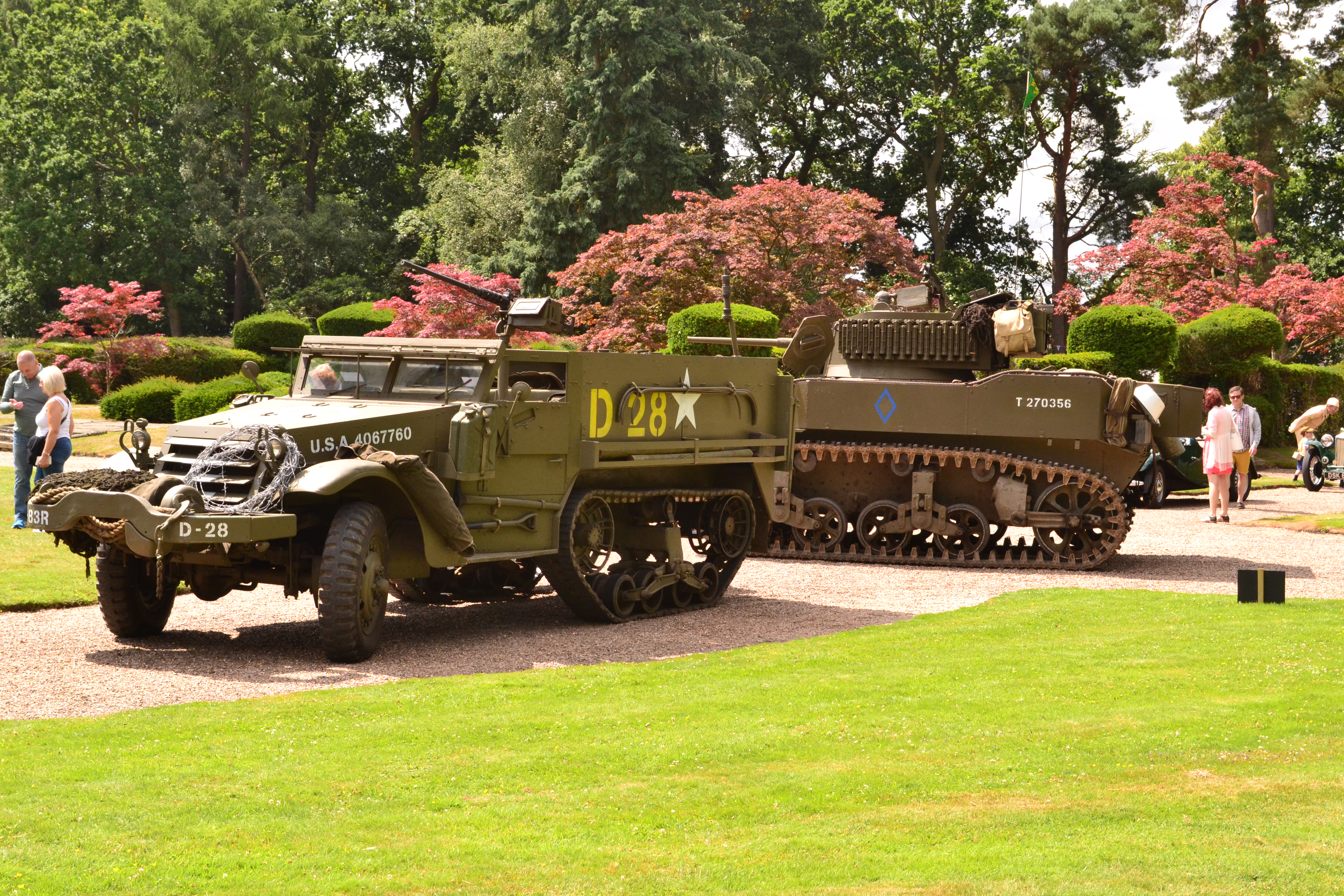
Vehicles of all shapes and sizes came for the weekend.

I myself have been to two recently, and at one I got the chance to sit in a Spitfire cockpit. Not something you do every day!

I know these events are not to everyone’s taste and some will groan at the thought of it, but I do think there is an historical value to them. Many of the participants only use genuine clothing or equipment, much of what you see is rare and in all cases they are only too keen to talk about what they have, its history, how and where it was used and in some cases, allow you to hold the articles in question.

DSC_0010

The rumbling of tanks could be heard once more.

From another perspective, and for those of you who know my day job, there are too, a growing number of children attending these events which I believe is a good thing as it brings history to life – something that is very difficult in a school classroom. A gun in school? I can see the headline now!

Two events I recently attended, both for different reasons, were at Woodhall Spa and Baston, two small villages in ‘Bomber country’, Lincolnshire.

Woodhall Spa was the home to the Dambusters, and for one weekend each year the entire village steps back in time to the 1940s. A second invasion occurs. Walking along the high street is like walking along in 1940, uniforms of every description can be seen, from RAF aircrew to British Army, U.S. infantry, Canadian, and even a variety of Russian, Luftwaffe and German infantry. Even the 1940s housewife, ‘spiv’, Firemen, Policeman and Milkman are represented in full 1940s attire. Many of the vehicles that line the numerous side streets are authentic World War II vehicles, half-tracks, trucks, endless jeeps and even the odd small tank driven here on trailers or under their own steam. Owners have taken a lot of time and money to get them rebuilt and keep them going.

DSC_0018

Re-enactors were everywhere

At the Petwood Hotel, used by 617 Squadron as a mess and officers quarters, there are re-enactments, talks and even ‘briefings’ in a 1940s style. The BBMF perform short displays over the grounds of this small village adding to the feel and as always people stop and watch in awe as once again a Spitfire, Hurricane and Dakota fly low over the streets of this small Lincolnshire village.

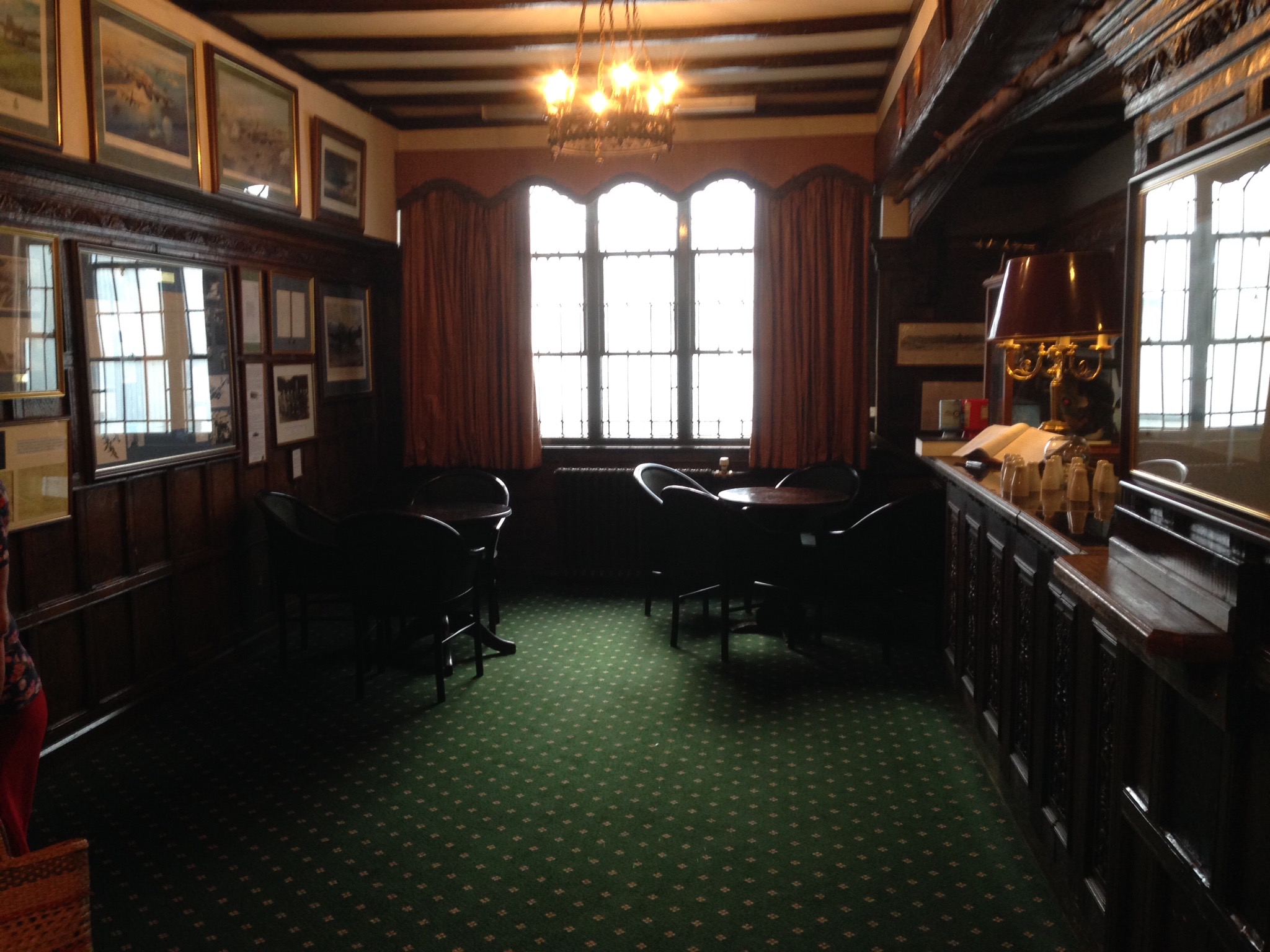
Inside the Petwood, you can wander the rooms that 617 Sqn once wandered by Guy Gibson and his crews; drink a tea or refreshing beer in the same room they did. The Squadron bar, displays numerous letters, photographs and other memorabilia connected with 617’s stay here. It is a remarkable place to be, knowing you walk the same ground as those special crew members did some 70 years ago.

July 2015 008

The Squadron bar.

Outside in the manicured gardens among the rhododendrons singers perform the many songs that inspired a nation, bolstered our morale and kept us going through those dark days of the Second World War. The feel is very much 1940s.

DSC_0001

Spitfire that is about 80% original.

Baston was very much the same. A large participation of re-enactors, vehicles and uniforms, many rasing money, good money, for War Veterans – a valuable cause I’d say. But it is the most odd feeling to walk amongst uniforms that once fought to the death and that were feared by those who were governed by them. In the summer and autumn of 1940, Britain came so close to being invaded, today an invasion has taken place.

Whether you like them or not, these events do have a place in our ‘living history’ and thankfully now, at least, it is on friendly terms.

The Korean War Memorial, London

On July 27th 1953, the Korean War, a very much ‘forgotten’ war, came to an end. For over 50 years, the 81,084 British Troops who were sent there feel they have had little official recognition from the authorities or public.

The Memorial stands overlooking the Thames.

However, on the 3rd December 2014,  320 veterans and 180 other guests, watched as HRH the Duke of Gloucester unveiled a new memorial on the Embankment next to the Royal Air Force, Fleet Air Arm and Battle of Britain memorials.

The memorial, which was a gift from the Republic of Korea in honour of the British Troops sent there, stands six metres high and was carved by Philip Jackson – famed for carvings of Sports personalities, artists and the Gurkha Memorial. It shows a Bronze statue of a soldier, head bowed, standing on a base of Welsh Slate in front of an obelisk of Portland Stone. Dressed in winter wear, the statue reflects the tiredness of constant rain, and the never-ending battle against both a determined enemy and the elements.

Behind the weary soldier are several carvings, including a mountainous landscape representing Korea’s environment, along with a number of inscriptions. On the base, to the front, reads (in both English and Korean)

“With gratitude for the sacrifice made by the British Armed Forces in defence of freedom and democracy in the Republic of Korea.”

To the North side of the memorial is a further inscription:

“The Korean War was the first UN action against aggression. The UN forces that fought the North Korean invasion were drawn from 21 countries. Although exhausted and impoverished after the Second World War, Britain responded immediately by providing strong naval, army and air forces and became the second largest contributor after the United States. A distant obligation honourably discharged.”

On the south side of the obelisk, below the Union Flag, it reads:

“In this fierce and brutal conflict those who fought included many Second World War veterans reinforced by reservists and young national servicemen. The land battle was fought against numerically superior communist forces, the terrain was mountainous and the weather extreme. 81,084 British servicemen served in the theatre of operations. 1,106 were killed in action, thousands were wounded and 1,060 suffered as prisoners of war.”

The Korean War was the first UN action and took troops from 21 different countries, many of whom had only just started to recover from the Second World War. For their action, two British Soldiers were awarded the highest military honour – the Victoria Cross – but yet despite this, it still remains very much a ‘forgotten war’.

HMS Triumph

HMS Triumph as she appeared in my father’s photo album on return from Korea.

Much of the fighting took place around the 38th Parallel, a point that once stabilised, became not only the border between North and South Korea, but the Russians and the West in what would be a long and at times trying Cold War.

The memorial stands facing the Thames, amongst a number of other memorials outside the Ministry of Defence building on the north embankment and forms a group of Korean memorials. These include a plaque in the crypt of St Paul’s, and two other memorials in the National Arboretum in Staffordshire and in Bathgate, Scotland.

This memorial stands as a reminder of a short war, but for those who took part, it is a timely reminder of the sacrifice that they and their colleagues made.

The unveiling of the memorial.


A website dedicated to the Korean War Veterans can be found here.

Other major memorials can be found here and RAF / USAAF memorials here.

Battle of Britain Memorial, London

In this the 75th anniversary year of the Battle of Britain, it is rather apt to include a mention of a further part of a Trail of major memorials. Another found in London outside the Ministry of Defence Building on the Northern Embankment, is that of the Battle of Britain.


Even on a cold and wet winters day it is an inspiring memorial placed near the busy junction at Westminster Bridge.

Sculpted by Paul Day, work on the site began in February 2005 with erection of a 82ft long granite base, in two parts, on which to stand the bronze sculpture. Created initially in wax, the sculptures were cast in bronze by Morrris Singer in sections, each section depicting a scene relating to the Battle. The memorial was finally opened by HRH the Prince of Wales on 18th September 2005.


The main and most significant section shows pilots as they ‘scramble’ to their waiting aircraft. Around this, are scenes referring to the women who helped not only in the factories and munitions works, but those who ferried the vital aircraft to their airfields. Other scenes depict: workers in a slit trench watching the battle rage overhead, the gunners defending the airfield, a dogfight, observers, mechanics and fitters all of whom worked tireless to keep the damaged aircraft flying. Further depictions show pilots at rest, drinking tea and relaxing telling tales of heroism and narrow escapes. A prominent picture that came out of the battle and the following blitz, was that of Saint Paul’s Cathedral standing proud of the smoke as all London burns around it. This too has been immortalised in bronze on another of the 14 scenes.

The detail of each panel is incredible. The emotion behind the eyes of those depicted grabs the passer-by and holds them, captured momentarily in time.


The entire battle is described through these characters, the romantic idea of the battle as seen by the farm workers, the joy of a victory from returning  crews, the tiredness after yet another sortie, and the fear as they run not knowing if this were to be a one way journey.

Around the scenes are the 2,937 names of the airmen who took part in Battle. As many records from the day were inaccurate, mislaid or destroyed it had to be decided upon what criteria  would be set in order to ‘qualify’ for a listing. This was that the pilot had to have flown between 10th July and 31st October 1940 and to have been awarded the Battle of Britain Clasp after flying at least one operational sortie in one of the recognised squadrons. A daunting task that took many hours of reading and research but was eventually completed and finalised as the 2,937 that appear today.  

There are 15 countries listed, covering 544 pilots who died during the battle and 795 who were to die by the end of the war. Interestingly, there is no Israeli mention, yet in the 1969 film made famous by its incredible cast, an Israeli pilot is mentioned. Perhaps this is due to the criteria used or inaccuracies in records used by the film.

Winston Churchill’s immortalised words ‘Never in the field of human conflict was so much owed by so many to so few’ are etched into the  base of the memorial bringing the entire structure to life.

The detail on this memorial is incredible, just glance and you’ll miss it. The way each scene is depicted in great detail even down to the ruffles in the clothing, the emotion behind the eyes and the position of the various people, it is an awe-inspiring memorial that proudly and aptly reflects those who gave so much for so many.

The memorial is found on the Victoria Embankment opposite the London Eye to the East of Westminster Bridge.

Other major memorials can be found here.

Memorial Garden Opening 

Mixing my day job with my hobby is not usual but I felt this was more than worthy of a post.

For some time now I have been toying with the idea of a Memorial Garden at school tied in with the various topic work that we have been doing, which is linked to both the World War I and VE-day commemorations.

The idea really came to fruition in sort early last year when I approached the head of the school and put the idea to her. With enthusiasm the go ahead was given and the children were approached with the idea as an after school club. A small group volunteered to help and we began planning.

On June 18th 2015 the plan finally came together.

The Memorial at the Centre of the Garden.

As people arrived they were greeted with refreshments and displays of work, photos of family members along with artefacts gathered or brought in by friends and parents. My good friend Kevin Fleckner brought four original uniform and bits from a crashed B-17 for us to show.

At 17:15 two RAF Tornado jets from RAF Marham flew overhead. The first low and slow, the second 15 seconds behind, higher and much faster with her wings swept. Over the school, she banked and the crowd waved. The event had opened.

The head then read a short introduction and it was my turn. I have to tell you that public speaking is not my forte and whilst I had been a little nervous I stood at the podium and the nerves vanished. My speech went thus:

June 18th 2015 is a special day. Not just because we’re opening this beautiful space, but for several iconic reasons. 200 years ago today the British and French forces were locked in arms at the Battle of Waterloo. 75 years ago today Winston Churchill made his famous “this was their finest hour” speech. Two dates that will go down in history as both important and momentous.

But these ae not the only significant dates in history.

100 years ago last year in 1914 young men in their thousands signed up with excitement for what they thought would be the war to end all wars. However, the war they thought would be over by Christmas went on for four long years. In the killing fields of Flanders, young men, many barely older than 16 or 17 were slaughtered in their thousands, living in mud and rat infested trenches very few were to survive. If not killed by the constant shelling, sniper fire or the slow march through no man’s land, many would suffer shell shock, a brutal psychological illness that would eat away at the very heart and soul of the young men. Eventually, in 1918 the First World War ended, the guns fell silent and Europe could finally begin rebuilding once more.

Sadly man’s inhumanity to man was to raise its ugly head again. In 1939, Europe was plunged once more into war with the German invasion of Poland. As The mighty Nazi war machine blitzkrieged its way across Europe, the British Armed Forces once more fought bravely in the name of freedom and democracy.

From the beaches of Dunkirk to the defence of Britain in the skies over Kent, the landing grounds of Normandy, to the battles in the Ardennes, Arnhem, over the Rhine and eventually the battle for Berlin itself, the brutality of war would once more be seen again.

The civilian population of Europe was to suffer greatly too. The blitz of our cities and the bombing of European targets that killed thousands upon thousands as bombs rained down from the sky. The concentration camps, death camps and prisoners of war camps saw a brutality on a scale that was and still is, incomprehensible.

From the hot deserts of Africa through the warm seas of the Mediterranean to the freezing conditions of the Arctic convoys, young men would bravely fight without question many paying the ultimate and final sacrifice.

Eventually, on 8th May 1945, the war in Europe finally ended and Peace reigned once more. However, the killing went on in the Far East. On the Pacific Islands of Okinawa, Saipan, Iwo Jima and Guadalcanal, The fighting continued in some of the most brutal conditions known to man. Eventually on August 15th 1945. UK time, following the Americans dropping the world’s most devastating and horrific bombs on Hiroshima and Nagasaki, war was declared finally over. The world has now entered the atomic age and six years of war had left it scars across Europe, the Middle East, The Far East, in the waters of the Atlantic and Pacific Oceans and across both the northern and Southern Hemispheres. Across the world millions lay dead, injured, homeless or orphaned. In the words of our distinguished guests here today “There are no winners in war.”

If there is one thing that history can teach us, it is that man is unable to live at peace with his fellow-man. Whether it be disputes over territory, natural resources or religious ideologies, War has continued to be fought and young men and women have continued to die.

In post-World War 2, the world lived on a knife-edge; the Cuban missile crisis being the ultimate stand-off between the east and west. From Korea and Vietnam to the Falkland Islands, the Middle Eastern countries of Iraq and Afghanistan, Britain and her allies have continued to fight for peace and democracy something we here take very much for granted.

It is in the name of these young men and women that we have built this memorial garden, so that their memories and their sacrifice may live on in the hearts and minds of future generations. It is so that we can pay homage and remember the dedication, bravery and self-sacrifice that they have shown so that we may live today without fear and in freedom.

It is to these people that I say thank you. Thank you for willing to lay down your life so we may freely speak out against injustice. To those who never came home, who paid the ultimate sacrifice, may you forever rest in peace. Thank you

Next one of the children read what the garden meant to him. Un-nerved by the occasion, he told how his father passed on his grandfathers tales of the war, how it means he can enjoy the peace and tranquility and he made a remarkably moving speech from the heart.

We then had a young lady from the group read in full the Robert Lawrence Binyon poem ‘For the fallen’. Short gasps from some of the audience told me they didn’t realise where the Remembrance Day words came from as it appears in the middle of the poem. She too read fluently and without falter, quite an achievement. Both these children were only just 10/11 years old.

A blessing by the vicar led us into the last post and a two minutes silence for those who had paid the ultimate sacrifice. A number of visiting Vets saluted, the Air Training Cadets lowered the colours and all went silent. Not a sound bar the cool wind in the adjacent trees.

My Good Friends Baz and Helen, whom helped enormously, John and Tony the Veterans and Kevin, who brought a number of uniforms and bits for us to display.

After the reveille the colours were raised and the two veterans invited to open the memorial officially. One Tony, a Normandy D-day+1 vet and the other John, who fought from Africa against Rommel’s Tigers, through Italy up into the continent, stood either side. As they lifted the flag, John declared the garden open to applause from the gathered audience. The children then sang unaccompanied Vera Lynn’s “We’ll meet again”; many from the audience joined in. The event closed and photos were taken around the memorial.

I estimated around 150 people, which for a small school of 68 children is remarkable. We had veterans from Cambridge a good hour and half away,  visitors from Northampton another similar distance and a large number of folk from the village turn up.

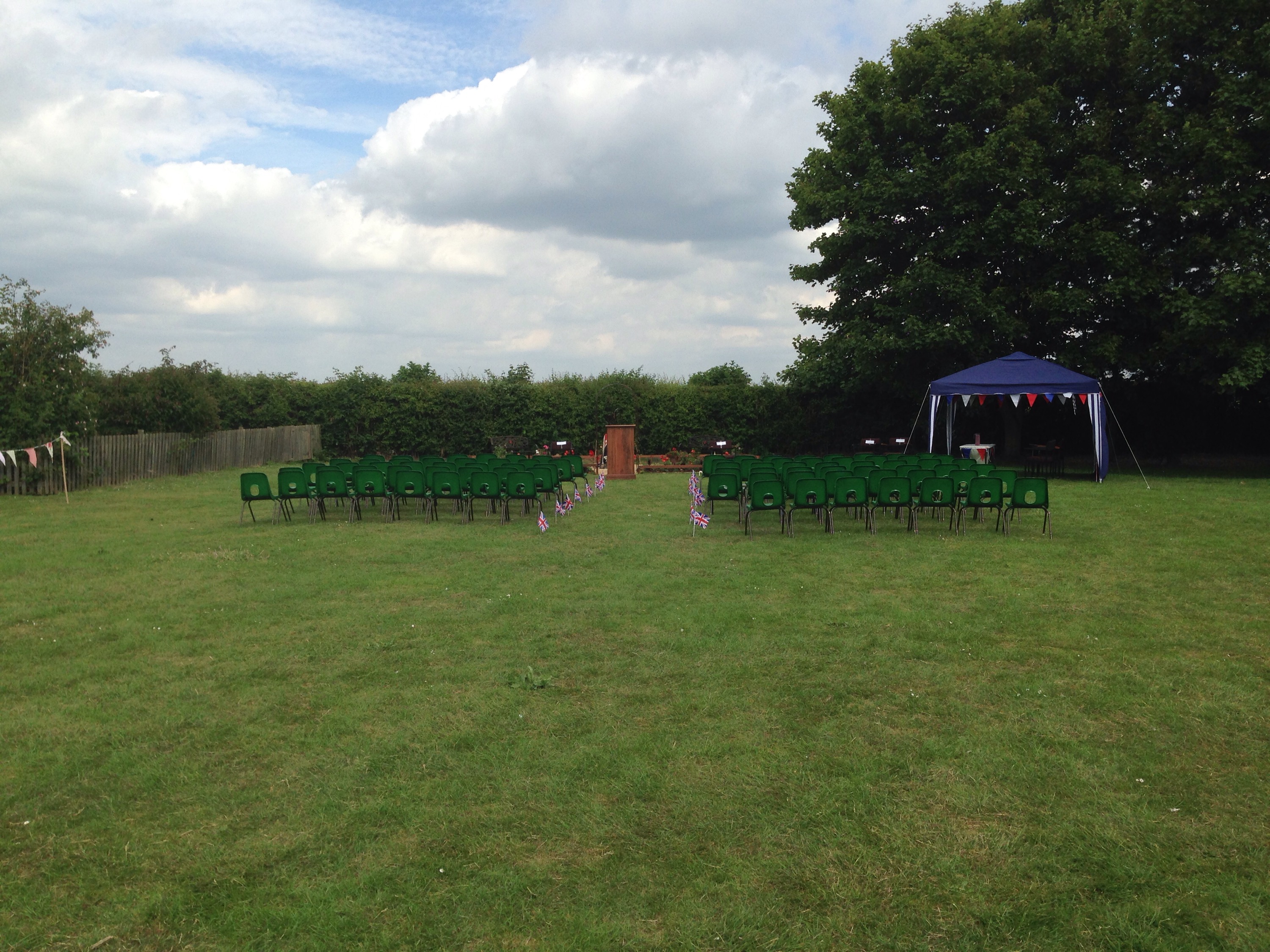
The seating before people started to arrive. There were many more standing, being a small school. we simply didn’t have enough chairs!

The feedback from visitors was superb and everyone was buzzing.

A real team effort, the long evenings, the hard work and recent battle against moles had all been worth while.

We had texts and emails from those who were there praising the efforts. It all worked out far better than even I had envisaged.

We shall miss it. We had great fun, even the odd beer or two, but it has been a real bonding exercise, we have become a little ‘family’ and are really proud of our achievements.

I passed on the good wishes to the children whom I think are quite overwhelmed themselves. They did a fantastic job and were superb role models for others to follow.

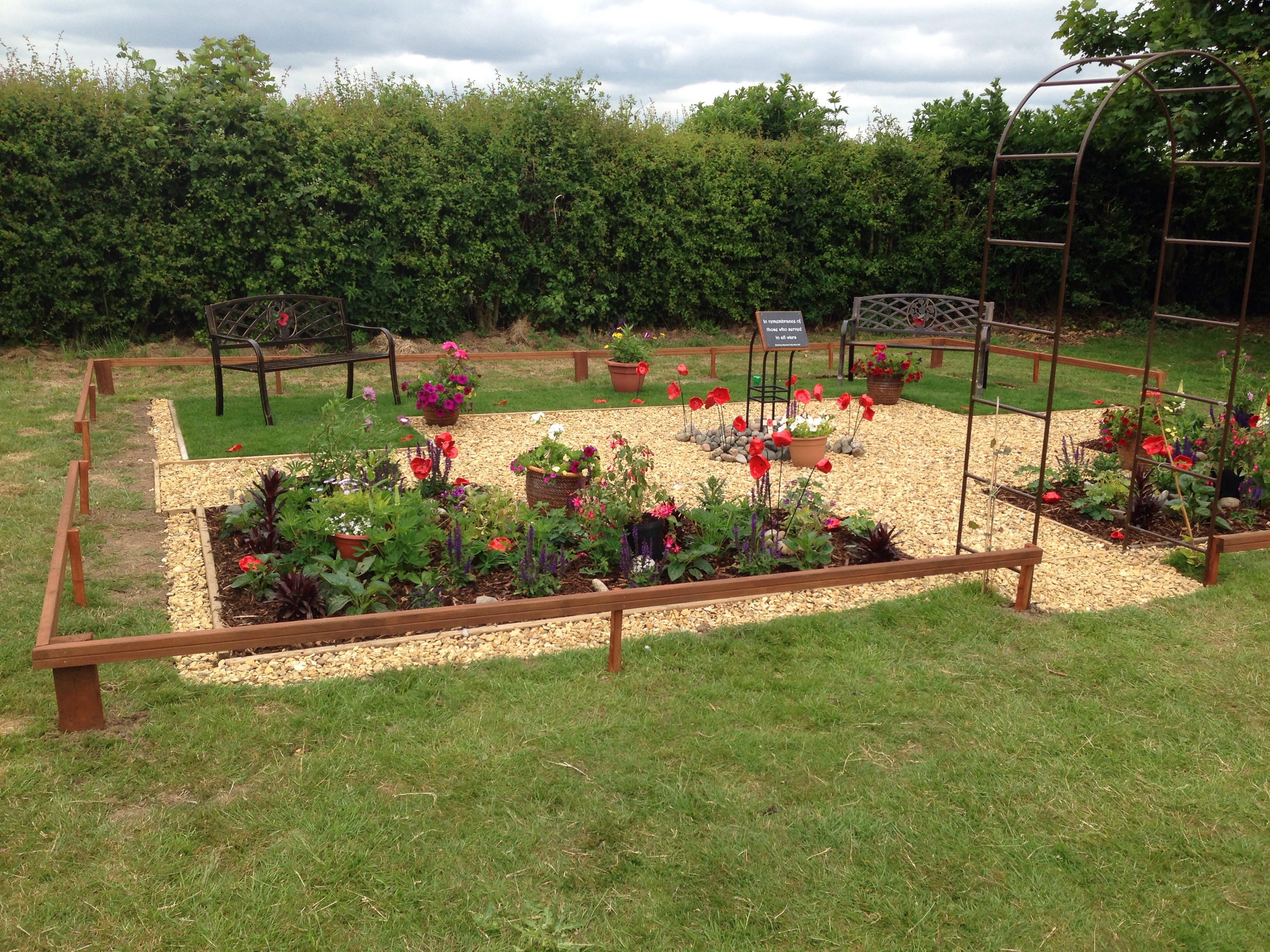
The Garden as it is today. We shall seed the outside, and continue the fight with the moles. An area for relaxation and thought.

We shall continue to nurture and maintain the Garden and watch it grow. The children use it already and do enjoy it. The rose in the crown were the poppies. Made out of clay, they are all handmade by the children mounted on metal rods and bunched in groups of 3 or 4. They do look superb.

There were small stumbling blocks along the way, and these caused delays but none so great we couldn’t deal with them. All in all it went beautifully, far, far better than I ever imagined and the finished product, I hope you’ll agree, is stunning.

An article appeared in the paper on the following day, Saturday here’s a link.

A Total Success or a Human Tragedy – Operation Carthage

The Shell House attack.

Whilst researching a recent trip I came across this interesting film detailing the attack by 140 Wing (RAF) on the Gestapo Headquarters in Copenhagen, Denmark in 1945. Codenamed ‘Operation Carthage’. Technically it was 100% successful, the building was destroyed, the papers burned and resistance fighters escaped, but the attack resulted in the loss of 10 crew members 13 civilians and 86 children.

On March 21st 1945, 18 Mosquitos from 140 Wing (RAF) consisting of 3 waves of 6 from 487 Squadron, 464 Squadron and 21 Squadron  and two supporting photographic Mosquitos, took off from RAF Fersfield to attack and destroy the Gestapo Headquarters in Copenhagen, Denmark.

Leaving just before 9:00am, so they would arrive over the target when it was at its busiest, they headed out over the north sea on a direct line to Denmark.

Attacking at roof top height, they struck a blow at the heart of the Gestapo, killing 151 Gestapo officers and allowing for the escape of 30 Danish resistance fighters.

Sadly in the attack, a Mosquito s/n SZ977, flown by Wg. Cdr. Peter A Kleboe and Fg.Off. K Hall, struck a building causing it to crash and burst into flames. Following aircraft blinded by the smoke, believed this to be the target and bombed it, hitting a school killing 86 children inside.

Some argue the loss of those civilians was not sufficient to justify the attack whilst others claim the success of the mission outweighs the tragic loss of civilian life. The Debate goes on!

Aircraft involved in the attack

(Mosquito Mk.VI)

No 487 Squadron

RS570 ‘X’ Gp Capt R N Bateson / Sqn Ldr E B Sismore (Raid Leader)
PZ402 ‘A’ Wg Cdr F M Denton / Fg Off A J Coe (damaged, belly landed at base)
PZ462 ‘J’ Flt Lt R J Dempsey / Flt Sgt E J Paige (hit by flak, 1 engine u/s, returned safely)
PZ339 ‘T’ Sqn Ldr W P Kemp / Flt Lt R Peel
SZ985 ‘M’ Fg Off G L Peet / Fg Off L A Graham
NT123 ‘Z’ Flt Lt D V Pattison / Flt Sgt F Pygram (missing)

No 464 Squadron

PZ353 Flt Lt W K Shrimpton RAAF (Pilot) / Fg Off P R Lake RAAF
PZ463 Flt Lt C B Thompson / Sgt H D Carter
PZ309 Flt Lt A J Smith RAAF / Flt Sgt H L Green RAAF
SZ999 Fg Off H G Dawson RAAF / Fg Off P T Murray (missing)
RS609 Fg Off J H Palmer RAAF / 2nd Lt H H Becker RNorAF (missing)
SZ968 Wg Cdr Iredale RAAF / Fg Off Johnson
All aircraft took off at 0840; last back landed 1405.

No 21 Squadron

SZ977 Wg Cdr P A Kleboe / Fg Off K Hall (missing)
PZ306 Sqn Ldr A F Carlisle / Flt Lt N J Ingram
LR388 Sqn Ldr A C Henderson / Flt Lt W A Moore
HR162 Flt Lt M Hetherington / Fg Off J K Bell
No 21 Squadron records list only these four aircraft and crews above as taking part in this operation.
All aircraft took off at 0835; the three which returned did so at 1355.

Sources:National Archives, June 14th 2015.


Engines roar over Grafton Underwood once more. 

The ‘updated’ memorial at the former American Airbase,  RAF Grafton Underwood (Station 106), has been revealed with the help of Europe’s only flying B17 – ‘Sally B‘.

A large crowd gathered at the Memorial On Friday 29th May 2015, to hear speakers and see the beautiful ‘Sally B‘ perform a number of flypasts over the skies of Station 106 once more.

I sadly could not go due to work commitments, but have been informed that it was a resounding success and that it was very well attended by well wishers and members of the public alike.

This updating, has been in the pipeline for a while now and all the hard work has finally paid off. A new parking area and flag poles have been added and the site generally improved for visitors.

I have obtained and attached a short ‘You Tube’ video taken by one of the visitors to the event for you to see.

A lovely end to a remarkable tail.

My thanks go to Kevin for all his hard work and dedication keeping the memorial in such great condition and the memories of the 384th BG (H) well and truly alive.

The video of the event was kindly sent to me,  I don’t know who took it but all credit goes to them. I will try to find their name and attach it when I can.

Grafton Underwood appears in Trail 6.

Battle of Britain Memorial Capel-le-Ferne, Kent.

A recent revisit took me back to the Battle of Britain memorial at Capel-le-Ferne between Folkestone and Dover, in Kent. It sits high on the cliff-top, in a windy corner, a stones throw from the international docks at Dover, and the Battle of Britain airfield at Hawkinge. A ‘recent’ addition to the range of memorials, it is a poignant reminder of the young men who, from many nationalities, gave their lives in the name of freedom and the defence of this country.

Last time I was here, work was starting on the new visitor centre and the two replica aircraft, a Spitfire and Hurricane, had both been removed.

The replica Hurricane.

This week, on May 25th 2015, I went back to see what had been done.

The new centre is superb. First of all it has a good car park with ample space for a large number of cars.

The visitors centre itself has a bright open reception area and a small shop for souvenirs (I had to buy a book!) and upstairs a new cafe with a balcony overlooking the monument and across  the English Channel to France.

The Visitors center behind the ‘Wall of Honour’.

Entrance to the memorial is still free, but there is the option to try the ‘scramble’ experience, which I believe costs £6.00.

The Spitfire and Hurricane are both back, admittedly both are metal replicas but up here it gets very windy and the weather can change dramatically in seconds, so it’s probably for the best. They are certainly good replicas. 

The carved Pilot, sitting in the centre of a three-bladed propeller, gazes patiently out to sea, watching for his missing friends. Designed by Harry Gray of the Carving Workshop, Cambridge, the pilot is surrounded by the creats of those squadrons who took part in the famous battle in the Kent skies.

To either side, two large mounds, signify the locations of anti-aircraft batteries, now silent and filled in, perhaps two replica emplacements might add to the ‘feel’ of the site, although sometimes less is more.

As before, the monument is a quiet and moving place to sit; to read the names of those who gave their lives for us, and to absorb yourself in the battle through the numerous information panels around the site. From here you begin to imagine the vapour and smoke trails high above you and to think that Hitler and his invasion forces, stood not more than 30 miles away in the distant haze on the coast of France.

A big improvement to a very moving place.