Remembrance Sunday – In Honour of 150,000 RAF Personnel.

On Armistice day we pay tribute to all Service men and women who served and died in the defence of freedom. This year we pay particular homage to those of the RAF through a visit to the remarkable St. Clement Danes Church in London.

St. Clement Danes Church – London

St. Clement Danes church stands almost oddly in the centre of London in the Strand, surrounded on all sides by traffic; like an island it offers sanctuary and peace yet its history is far from peaceful.

St. Clement Danes - Church of the RAF

The view toward the Altar. The floor contains nearly 900 Squadron badges of the Royal Air Force.

It reputedly dates back to the Ninth Century AD following the expulsion of the Danes from the City of London, in the late 870s, by King Alfred. As a gesture, he allowed Danes who had English wives to remain nearby, allowing them to dedicate the local church to St. Clement of the Danes. Ever since this time, a church has remained, albeit in part, on this very site.

St. Clement Danes - Church of the RAF

The ‘Rosette’ of Commonwealth Air Force Badges embedded into the floor.

In the 1300s and then again in the late 1600s it was rebuilt, the second time influenced by the great Sir Christopher Wren – notable for his designs of buildings both in and outside of London. Regarded as being Britain’s most influential architect of all time, he designed many famous buildings such as the Library at Trinity College and the Royal Hospital at Chelsea. Wren also redesigned both Kensington and Hampton Court Palaces – his influences stretched far and wide.

Of course Wren’s ultimate master-piece was St. Paul’s Cathedral in London, a structure that reflected both his skill, vision and personality.

During the Great Fire of London in 1666, eighty-seven churches were destroyed in London, but only fifty-two were subsequently rebuilt. Whilst not directly damaged by the fire, St. Clement Danes was included in that list due to its very poor condition and Wren was invited to undertake the huge task.

St. Clement Danes - Church of the RAF

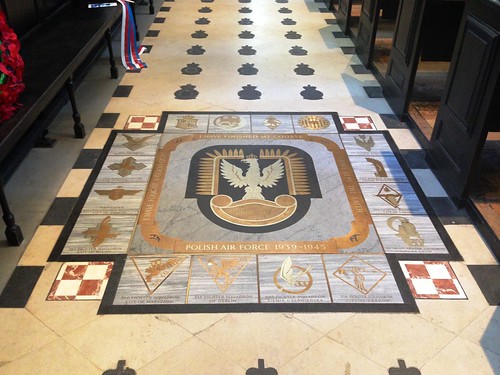
The Memorial to all the Polish airmen who served with the Royal Air Force during World War II.

It then stood just short of 300 years before incendiary bombs of the Luftwaffe destroyed it in May 1941. Leaving nothing but a few walls and the tower, Wren’s design had been reduced to ashes and rubble.

For over ten years it lay in ruins, until it was decided to raise funds and rebuild it. In 1958, following a national appeal by the Royal Air Force, St. Clement Danes was officially opened and dedicated as the Central Church of the Royal Air Force in memory of all those who fought and died whilst in RAF service, and to ‘serve as a perpetual shrine of remembrance’ to them all.

In completing the restoration, every branch of the RAF was included. At the entrance of the church, is the rosette of the Commonwealth made up of all the Air Forces badges of the Commonwealth countries, each of which flew with RAF crews during the conflicts. Beyond the rosette, the floor from the north aisle to the south aisle of the Nave contains nearly 900 squadron badges each one made in Welsh Slate and embedded into the floor.

Around the walls of the church, four on each side and two to the front, are ten Books of Remembrance from 1915 to the present day, in which are listed 150,000 names of those who died whilst in RAF service. A further book on the west wall, contains a further 16,000 names of USAAF personnel killed whilst based in the United Kingdom during the Second World War.

St. Clement Danes - Church of the RAF

Ten Books of Remembrance contain 150,000 names of those who died in RAF Service 1915 – the present day. A further book contains 16,000 names of USAAF airmen who were killed.

On either side of the Altar, are boards and badges dedicated to every branch of the RAF. Two boards list the names of those who were awarded the Victoria Cross and others the George Cross. Other slate badges represent the various units to serve and support the main fighter and bomber groups, including: RAF Training units, Fighter Control units, Maintenance units, University Air Squadrons, Medical units, Communication squadrons, Groups, Colleges and Sectors.

In the North Aisle, a further memorial, also embedded into the floor, remembers those who escaped the Nazi tyranny in Poland and joined the RAF to carry on the fight during World War II. Each Polish Squadron is represented in a beautifully designed memorial around which is written:

“I have fought a good fight, I have finished my course’ I have kept the faith”

Smaller dedications can also be found around the church, such as the Mosquito Aircrew Association, dedicated to both air and ground crews of the mighty ‘Wooden-Wonder’. Some of these memorials are in the form of gifts of thanks many of which come from other nations as their own tribute to those who came from so far away to give their lives in the name of freedom and democracy.


At the going down of the sun and in the morning
We will remember them.

Why not support the British Legion through their website

Trail 60 – Scotland’s West Coast (Part 2).

In the second part of this Trail we continue at Oban (Karrera) off the west coast of Scotland.

In Part 1 we saw how Oban developed into a major Flying Boat base utilising the long stretches of water between Karrera and Oban and how Patrols were being sent out to search for the German Battleship Bismark.

The arrival of the Catalinas not only brought a new aircraft, but new accents to this part of Scotland too. A number of Americans had now joined the Air Force and it was one of these who flew the first Bismark Patrol in May 1941. Taking off at 09:20 in AH531 was F.Lt Van der Kiste D.S.O. and Lt. Maulsby, an American, who together carried out cross over patrols for twelve hours before returning to Oban empty handed. The first attempt to locate Bismark was unsuccessful.

For the next three days, aircraft of 210 Sqn from Oban and Reykjavik searched tirelessly for the Battleship, and on the 26th their efforts paid off. Catalina W8416, flown by F.Lt Hatfield and Lt. Rinehart (another US flyer), took off at 12:23 searching for the rest of the day. At 23:40 Bismark was sighted, without her escort. The Catalina remained on site, shadowing the Battleship for the remainder of the night. Some twenty-seven hours later the aircraft returned to Oban, the endurance of both the aircraft and crew being truly remarkable*2.

For the remainder of the year regular patrols intercepted both Condor reconnaissance aircraft and marauding U-boats, attacking mainly with depth charges, some of these proving highly successful.

When February 1942 arrived, the squadron began to transfer to Sullom Voe, Catalinas transferring large numbers of crewmen whilst Handly Page Harrows transferred ground personnel via the airfield on the mainland at Prestwick.

Within a month though, the Sunderland would return to Oban with the arrival of another new squadron, 228 Squadron. Their move coinciding with the replacement of the Mk.IIs they currently possessed with the updated Mk. IIIs, these remaining here until December of that same year.

Two months after 228’s arrival, another Sunderland squadron arrived at Oban. Being formed on 18th May 1942, 423 Sqn brought yet more Sunderland MK. IIs, and shortly after MK.IIIs. The summer of 1942  was becoming a very busy time in the waters between Kerrera and Oban.

For the first few days, organisational matters were the priority for 423 Sqn. New staff were brought in and rooms were allocated for operations. Two buildings on Kerrera were handed over to the Canadians for their use, one of which was immediately utilised by the Signals Section. Control of 423 Sqn was initially taken over by Sqn. Ldr J.D.E. Hughes DFC, who transferred from 4 OTU at Stranraer. He immediately took the role of Flight Commander. The headquarters were set up in the navigation room, and within days of each other, an adjutant, navigation officer, Medical Officer, Signals Officer and a handful of ground personnel had all arrived. Sqn. Ldr. Hughes then detached to Pembroke Dock so he could oversee the transfer of aircrew, ground personnel and aircraft to Oban.

RAF Oban (Kerrera)
The Slip way on Kerrera. There are buildings to the right and behind.

By July 1st there were twelve Officers and sixty-two ‘other ranks’, but as yet no aircraft had arrived. In addition to this, the development of the site was being hampered by lack of supplies, difficulties in getting suitable building materials preventing the construction of appropriate offices.

At last on the 16th the first aircraft arrived, a MK.II Sunderland ‘W6001’, flown in by Sqn. Ldr. Hughes himself. This momentous moment was followed two days later by the second aircraft, ‘W6000’, being flown by Flt.Lt Lindsay DFC. By the end of the month the Canadian squadron in Oban consisted of twenty-six officers and 160 ‘other ranks’, but still only two aircraft. However, it did mean that at last training flights could now commence*3.

In August 1942, the quiet island of Kerrera and its neighbouring town of Oban, were struck by tragedy. The loss of not only almost an entire crew, but a very special dignitary as well. The tragedy would bring home sharply the dangers that crews faced when flying from coastal bases.

On the 23rd, Sunderland W4026, ‘DQ-M’ of 228 Sqn, with F.Lt. Goyen, W.C. Moseley, P.O Smith and P.O Saunders onboard, took off on a transit flight to the large flying boat base at Invergordon on Scotland’s East Coast. Also on board that day was Sgt. W. Sweet,  Flt.Sgt. W. Jones, Flt.Sgt. E. Hewerdine, Sgt. E. Blacklock, Sgt. A. Catt, Flt.Sgt. A. Jack and Flt.Sgt. C. Lewis. They arrived at Invergordon at 16:30 and began to prepare for their visitor.

Two days later, the aircraft with all eleven crew onboard, along with their special guest  H.R.H. Prince George, The Duke of Kent, and three members of his party, took off for a transit flight to Iceland. At approximately 14:00, the aircraft crashed at Eagles Mount near Dunbeath in poor visibility killing all onboard except the rear gunner Sgt. Andrew Jack. The board of enquiry carried out an investigation and concluded that a navigational error had caused the crash, in which the aircraft, full of fuel, exploded. The flight was on an official flight to Reykjavik, and it is believed that the crew didn’t account for strong winds blowing in off the sea. This it is thought, caused the aircraft to drift. When altering course, the aircraft didn’t have sufficient altitude to clear the high ground in front. Thirteen of the fourteen occupants were instantly killed. At the time, it was recorded as the worst Short Sunderland accident, and Britain’s third worst air accident.*4

By November 1942, it was time for change once again at Oban, as one Canadian squadron swapped with another. The departure of 423 Sqn signalled the arrival of 422 Sqn, one Sunderland squadron replacing another.

Since their inception in April 1942, 422 Sqn had operated two aircraft, the Lerwick and the Catalina IB. On Arrival at Oban, they immediately began to receive the Sunderland III. With four aircraft on roll by December, the squadron had settled in well, and crew training was well underway. However, none of the airmen had any experience of the Sunderland, and so training was going to be long. The bitter cold of the Scottish winter began to bite, which in conjunction with early problems with the towing tractors, hampered training. Gusts and swell in the sea prevented many take offs and crews often had to resort to sleeping on board their aircraft.

RAF Oban (Kerrera)
Kerrera. Is this the same house that appeared behind the Saro Lerwick?

Four months later tragedy would strike again at Kerrera. On the 19th December 1942, 422 Sqn suffered a tragic loss when Sunderland W6029 crashed in the Firth of Lorne, the body of water between Kerrera and the Island of Mull beyond. The aircraft, a MK.III, was returning from a flight to Sullom Voe, picking up a new crew and other passengers. On its return, the weather and sea conditions at Oban were deemed to be unsuitable for landing, but radio contact with the aircraft had been lost. Unaware that they were to divert to Invergordon, the crew attempted to land, and at 16:41 lives were lost. As the aircraft touched down, a swell in the sea caused the front of the aircraft to collapse, severely damaging it, causing the aircraft to overturn and sink.

Killed that day were: F.O. David Mclean Cameron (s/n: 113530); F.O. James Kemp Potter (s/n: J/10323); F.O. Harold Francis Burt-Gerrans (s/n: J/16744); Sgt. Alun Griffiths Rees (s/n: 405084); Sgt. John Luke (s/n: 639582) and LAC William Arthur Allan (s/n: R/118882). Also killed was Intelligence Officer Major John Cox (Black Watch). A further three were seriously injured and the remainder suffered minor injuries, including the pilot Flt. Lt. John D. Reed. In all, over twenty personnel were killed or injured that day, in an accident that shook the lives of those living in the area. Many survivors were taken to the Highland Cottage hospital at Oban, where they thankfully recovered from their injuries.*5

By the end of December there were seven Sunderlands on charge and 109 hours of flying training had been achieved. No operations had as yet been carried out, and despite the recent tragic accidents both aircrew and ground crew were getting to grips with their new aircraft.

The dawn of 1943 saw more patrols and escort duties. Another international squadron would arrive bringing the Catalina with them. 330 (Norwegian) Sqn were a Reykjavik based unit who moved to Oban whilst continuing to operate a detachment out of Reykjavik. Within a month, they would begin to replace their aircraft with Sunderland MK.IIIs, then a year later with MK.IIs before departing to Sullom Voe in July 1943.

The eventual departure of 330 Sqn allowed for their space to be taken a few days later, on July 15th, by 302 Ferry Training Unit (FTU). The unit, which had formed in the previous September at Loch Erne, was set up to train ferry crews specifically for the long range Catalinas and Sunderlands. Overseas operations were now in need of the flying boats and crews were needed to transport them there. The unit remained active at Oban until the war’s end, transferring to Killadeas in mid 1945, prior to disbanding a year later.

In December 1943, a new squadron was formed at Oban, 524 Squadron, although this time it would not be the Sunderland nor the Catalina, but a new model would appear on the water. The Mariner was another US designed aircraft constructed by Martin, Lockheed’s competitor.

A large, deep hulled, twin engined aircraft its distinctive gull wing and angled twin-tail, made it easily recognisable. The squadron was set up under the Command of 15 Group, with a view to gaining operational experience on the new type of aircraft. Initially six Mariners were ordered, and modified to the minimum required for operational purposes. The long term view was that 524 Sqn would transfer overseas once the operational trials were completed.

The initial squadron set up was with 43 Officers, 111 Senior NCOs, 118 Corporals and A.C.s and 15 WAAFs. This combination would allow for the initial establishment of 14 aircrew.

The first aircraft (JX.100, JX.105, JX.106 and JX.110) were received on October 25th, after modification by Saunders-Roe, ready for operational flying. During the time with 524 Sqn, there was great difficulty in obtaining both spares and manuals and the Mariners did not become popular. The situation became so bad that by December the squadron was wound down and disbanded. All aircraft were given a 40 hour inspection and then prepared for disposal. The majority of the squadron staff were retained at Oban in the two training units 302 FTU and 131 OTU, whilst others were dispersed to new squadrons.

Martin (PBM-3B) Mariner I JX103 of No 524 Squadron at Oban, October 1943. © IWM MH 5097

By the end of January 1944 all four Mariners had gone with no more than 90 hours flying time having been completed.

In the lead up to D-day, Oban and the waters around Karrera were utilised for construction of the Mulbury harbour, a floating harbour than enabled men and machinery to be transferred from ship to shore quickly. At Oban Blockships were assembled, these would be used as the outer breakwater for the Mulberry harbours once at Normandy.

Blockships in the waters around Karerra used as the outer breakwater for the Mulberry harbours assembled at Oban. © IWM A 27070

After that, little operational flying took place from Kerrera. As the war began to wind down the Atlantic arena demanded fewer Maritime patrols, the numbers of U-boats at sea now declining below 100. The training units continued to operate for a short time, and then by April 1945 the site was put into care and maintenance. By early 1946, the RAF’s connection had all but ceased and the base was closed.

The Hotels used by the aircrew are still in use today, The Dungallen House Hotel (the former headquarters) being outside of Oban, whilst the Regent Hotel (the sergeants mess) stands on the waterfront.

The slip way on Kerrera and a handful are buildings are known to still survive, these can just about be seen from Oban. Whilst there is a good sized granite memorial and original slipway at Ganavan Sands, there is no official memorial in Oban town, and a return is definitely on the cards to visit these.

The Island of Kerrera is accessible by ferry. It is a small island with a few houses and businesses. The bay used for maintenance now accommodates small boats, the slipway, still present, is visible from Oban. A few buildings still remain on the island and some of these are also visible (with a decent telephoto lens or binoculars) from Oban. The museum which houses a display of memorabilia relating to Oban’s wartime history was closed at this time due to Government restrictions, but I am reliably informed that it has a good range of photographs of Oban’s Sunderlands and Catalinas.

The museum boasts two models, the first a 1/8 scale radio controlled Sunderland, the model being that of the 228 Sqn aircraft that operated from Oban in 1942 and the one that was lost with H.R.H. Prince George, The Duke of Kent onboard. A further and smaller model of a Catalina is also on show, it also having been lost whilst on operations.

The waters around Oban were indeed very busy in the early 1940s. With long range patrols and escort duties being performed, many of Britain’s merchant vessels were protected by these aircraft. The history of Oban has never been forgotten though, with a museum and several hotels boasting displays, the remnants on Kererra have been given new life which tell the story of life at RAF Oban.

Sources and Further Reading.

*1 National Archives AIR 27/1292/4

*2 National Archives AIR-27-1299-9

*3 National Archives AIR 27/1832/1

*4 Aviation Safety Network website.

*5 National Archives AIR/271831

National Archives AIR 27/1415/15

National Archives AIR 27/1415/16

The U-Boat War website. An excellent resource covering all aspects of the U-boat war.

The War and Peace Museum Oban website.

BBC Website “WW2 People’s War” – a record of personal stories.

“Dive Oban And Argyll” website has video / still of aircraft wrecks around Oban.

Trail 60 – Scotland’s West Coast (Part 1).

In this Trail we head to Scotland’s stunning west coast, passing the beautiful Lochs and mountains of the Trossachs to an area known as the ‘Gateway to the Isles’. With the Inner and Outer Hebrides only a short boat trip away, it is, according to the Office of National Statistics, the UK’s 50th most popular tourist destination.

Now no longer a military aviation site, it was during the Second World War, a prime location for those sub-hunters and convoy escorts the Flying Boat. With open seas not far away, U-boats could hide in its hidden bays, sheltered by the many small islands and deep waters.

In Trail 60, we continue with the Flying Boat theme and head to the former RAF base at Oban.

RAF Oban (Kerrera).

The Flying boat base at Oban was actually located across the bay from the town on a small island called Kerrera, although personnel were billeted in the many hotels along Oban’s waterfront. With a further maintenance site a few miles north at Ganavan Sands, Oban, and the surrounding area, made a major contribution to coastal operations during the Second World War.

The calm waters of the Sound of Kerrera, the stretch of water between the island and the mainland,  provided both good shelter and mooring facilities, as well as a long straight run for both take-off and landings.

However, it was not all plain sailing for those based at Oban. Whilst Kerrera sheltered the bay from the prevailing Atlantic winds, it did cause problems for some, as the wind direction could be unpredictable with swirls often being encountered during these crucial times. Another problem that the pilots frequently encountered were the many small boats that frequented the small bay. Strict guidelines were therefore issued to crews with extreme care and caution being the order of the day.

RAF Oban (Kerrera)
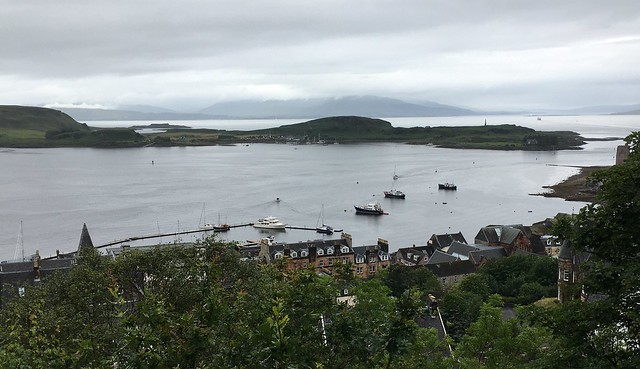
Oban bay and Kerrera. The slip way is directly in front.

The RAF arrived in force in 1939, although it is believed that there was some use of the area in the years prior to this, notably from 201 Squadron who flew Supermarine Southamptons.

The first squadron to be posted here was that of 209 Squadron, operating another Supermarine model, the Stranraer. 209 Sqn had a long history, going back as far as World War One, and although it was disbanded in June 1919, it was reformed later in June 1930.

For the next nine years, the squadron would fly a whole range of aircraft types including the: Blackburn Iris III and V, Saunders Roe (Saro) A.7, Supermarine Southampton and Short’s Singapore II and III. All these before taking on the Stranraer in December 1938. Their diversity in aircraft was only matched by the range of bases from which they served. Reformed at Mount Batten in Plymouth, they transferred to half a dozen different bases ‘yo-yoing’ between them and Felixstowe in Suffolk, a place they would become familiar with.

The summer of 1939 was a particularly busy time for 209 Sqn, moving from Stranraer to Felixstowe, from Felixstowe to Invergordon then back once again to Felixstowe. From here, they would make one more move back to Invergordon before finally arriving at Oban on October 7th 1939. This last posting must have provided some light relief for the squadron personnel as they remained here until the end of July 1940. At this point, the squadron would move once again, this time to the major flying boat base at Pembroke Dock. Throughout this hectic and dynamic time, a small detachment of the squadron remained at the base in the Cornish Town of Falmouth.

With no flying in the days preceding the move to Oban, the 7th October saw the first aircraft, Stranraer K7292, depart Invergordon at 14:35. An hour later it arrived at the base at Kerrera, triggering a chain of events that would begin Oban’s aviation history.*1

Over the next few days the number of aircraft transiting to Oban increased and the quantity of Stanraers moored in the bay began to build up.

With local flights, air tests and gunnery practice taking precedence over other flying activities, the first patrols wouldn’t begin until the 18th October. From then on, routine searches would take aircraft around the local islands including Mull, the adjacent island, and out to the Skerrymore Light which was located on the Isle of Tiree.

From then on patrols were carried out mainly between the areas known as Little Minch and North Minch (a stretch of water between the islands), offering a continuous anti-submarine patrol in conjunction with aircraft from 269 Sqn. Any submarines sighted were to be reported rather than attacked, possibly as British Submarines were also operating in the area at that time.

On the 24th October, orders were given to escort the ship SS Hesterus, performing a watch until the Skerrymore Light was reached. At that point the aircraft was ordered to leave the area and return to Oban. The Minch became a submarine hot spot, with new orders coming through on the 25th to now bomb any enemy submarine now seen in this location. German U-boats were now known to lurk in these deep waters waiting for unsuspecting merchant vessels to appear, before they transited to the open sea. With a number of sightings toward the month’s end the war was beginning to heat up.

In December 1939, it was decided to replace the Stranraers with Lerwick Is, a Saunders Roe built aircraft capable of carrying a crew of seven: two pilots, one Air Observer, two Aircrew, one Flight Mechanic and one Flight Rigger. There were some doubts as to the suitability of the Lerwick to operate from Oban’s waters, the rough sea and high terrain surrounding Oban presenting a great risk. It was also advised that night flying and flying in poor weather was also too dangerous, the Stranraer being far more suited to such flights. However, following a study by Wing Commander C.G. Wigglesworth of 209 Sqn, which compared the Lerwick to the Stranraer, he concluded that with a reduction in the overall weight as he prescribed, the Lerwick could be successfully flown from Oban. As a result, four were initially ordered, which would operate in conjunction with the Stranraers until crews became fully acquainted with the new type.

Saro Lerwick L7257 ‘WQ-F’ of 209 Squadron at Oban, August 1940. Note retractable dorsal turret, is this the same house that appears in the modern picture below? © IWM CH 864

On 25th December, a fuel test combined with an anti submarine patrol was carried out. The speed of the Lerwick (L7255) and duration of its flight returned a usage of 85 gallons per hour, a figure which the Station Commander considered good and in line with what Messers Bristols suggested; albeit at a less economical 100 gallons per hour for the Hercules engine.

In 1940, the patrols continued on, and in June one of these patrols spotted  the 3000 ton Finnish vessel “Reculus Suom” . The aircraft contacted the British warship HMS Devonshire, directing her to the vessel’s location. The partnership between the RAF and Navy serving well off the Scottish coast.

Other ships identified on these patrols included Icelandic vessels along with HMS Hood, HMS Ark Royal and HMS Hesperus. With one submarine attacked, patrols and escorts became the primary role of 209 Sqn.

Then on 20th June 1940, aircraft C / 20G was ordered to the position of A.M.C. “Scotstoon”, which had been torpedoed and sunk. On arrival, the aircraft saw 8 lifeboats, along with a considerable amount of oil and wreckage. The pilot contacted a British destroyer which preceded at full speed to pick up the survivors. Whilst the destroyer remained on site, the aircraft patrolled looking for any signs of a U-boat that might be waiting to attack the rescuer. Once all the survivors were gathered, the aircraft returned home to Oban.

Many of these escort duties ran in conjunction with Sunderlands from 15 Group. Some of these would land at Oban, gather fuel and return to their own bases elsewhere. It would soon become a sight that would become the norm.

In July 1940, the Lerwicks of 209 Sqn departed Oban’s waters, heading to Pembroke Dock, allowing space for another squadron, 210 Squadron, flying the larger four engined Short’s aircraft, the Sunderland. In a virtual swap, the Sunderland squadron began arriving two days after 209’s departure.

A Sunderland Mark I, L2163 ‘DA-G’, of 210 Squadron escorting Convoy 6 (TC.6), to Greenock. © IWM CH 832

The Sunderland (detailed in Trail 59) was a big aircraft built and designed like a boat, from the keel up. With its massive fuselage it could maintain flight for some 13 hours covering a range of 1,700 miles. With many comforts built in for crewmen, it was an ideal sub hunter and maritime patrol aircraft.

To give an even greater coverage the squadron had detachments based at Reykjavik (Iceland), Sullom Voe (a major deep water harbour on the Shetland Islands) and Stranrear. It was from Sullom Voe that 210 Sqn Flying Officer John Cruickshank, earned himself the Victoria Cross for his action against a heavily armed German U-boat. During the attack, Cruickshank and four other crewmen were severely injured, his navigator was killed and the aircraft badly damaged. He continued to fly his aircraft (Catalina Mark IVA, JV928 ‘Y) before relinquishing control to his second pilot. But knowing he couldn’t land the aircraft, Cruickshank refused morphine, circling over the base until daylight which allowed him to supervise the landing of the Catalina by the Second Pilot. His actions that night undoubtedly went a long way to saving his crew and his aircraft.

210 Squadron remained at Oban for the next two years replacing their Sunderlands with Catalina Is in April 1941. In February 1942 they finally departed, heading for the deep water base at Sullom Voe.

The main role of the Sunderland here at Oban was to carry out convoy escort and anti-submarine patrols in the Atlantic, especially in the waters off western Ireland. Some U-boats were spotted and engaged by the aircraft, but contacts were infrequent, fog often preventing crews from locating the convoy let alone the U-boats.

On the 5th and 6th January 1941, two 210 Sqn Sunderlands (P9623 and L5798) from Oban located and attacked U-Boats, one of which was recorded as believed sunk. On the 29th, a Luftwaffe Condor, the German long-range reconnaissance aircraft, attacked one of the Sunderlands before departing the area. No damage was recorded by the Sunderland and it too returned to base.

Routine maintenance was carried out whilst aircraft were moored the in water. Note the turret withdrawn for mooring. Short Sunderland Mark I of 210 Squadron. © IWM CH 855

By April, the American built Catalina began to make an appearance, but its introduction seemed to be dogged with compass problems; several aircraft returning from flights with these instruments being faulty. With this corrected, May brought a buzz of activity as the Bismark was thought to be in the area. Regular patrols were put out to find both her and her escorts, with the first flight being on the 23rd.

In Part 2 we see how 210 Sqn began searching the wide open expanses of the Atlantic for the German Battleship. Two major tragedies and what happened as the war finally drew to a close.

September 26th 1942, a near tragedy for three RAF Squadrons.

The Eagle Squadrons were three RAF Squadrons made up of American volunteers, their achievements and records are well-known and well documented, however, it was not all plain sailing for these determined and courageous flyers. For one Squadron in particular, 133 Squadron, September 26th 1942 would be a disaster, a disaster that would almost wipe out the entire flight of twelve airmen.

133 Squadron had been on the front line serving at RAF Biggin Hill and RAF Martlesham Heath before arriving at RAF Great Sampford, a satellite for RAF Debden. The ground crews were predominately British, assisting and training the US ground crews in aircraft maintenance and support. All the pilots however, were US volunteers, formed into three separate squadrons but under RAF control.

1st Lt Dominic 'Don' Gentile and Spitfire BL255 'Buckeye-Don', 336th FS, 4th FG, 8th AF.

1st Lt Dominic ‘Don’ Gentile and Spitfire BL255 ‘Buckeye-Don’. The photo was taken after 133 Squadron RAF was disbanded and absorbed into the USAAF as the, 336th FS, 4th FG, 8th AF. (@IWM)

133 Squadron would arrive at RAF Great Sampford on September 23rd 1942, the same day as 616 Sqn RAF departed, they would be the last operational unit to fully use the airfield before its eventual closure.

Initially flying the Spitfire VBs, they soon replaced them with the MK.IX, a Spitfire that was essentially a MK.V with an updated engine. Having a higher ceiling than the FW-190 and being marginally faster, its improved performance took the Luftwaffe by complete surprise. It was so new and improved, that it remained on the secret list until after this particular operational flight.

On that fateful day, September 26th 1942, fourteen Spitfires of 133 Sqn took off from RAF Great Sampford in Essex, piloting those Spitfires were:

BS313 – F/Lt. Edward Gordon Brettell DFC (61053) The only British pilot and leader
BS275 – P/O. Leonard T. Ryerson (O-885137)
BS446 – P/O. William H. Baker Jr (O-885113)
BS137 – P/O. Dennis D. Smith (O-885128)
BR638 – P/O. G.B. Sperry (O-885112)
BS445 – P/O. Dominic “Buckeye-Don” S. Gentile (O-885109)
BS138 – P/O. Gilbert G. Wright (?)
BS279 – F/Lt. Marion E. Jackson (O-885117)
BS447 – P/O. R.E. Smith (O-885110)
BR640 – P/O. C.A. Cook (O-885112)
BS148 – P/O. Richard “Bob” N. Beaty (?)
BS301 – P/O. G.H. Middleton Jr (O-885127)
BS140 – P/O. Gene P. Neville (O-885129)
Unknown  – P/O. Ervin “Dusty” Miller (O-885138) (not listed but known to have been on the flight).

They were to fly to RAF Bolt Head in Devon, where they would meet with 401 Squadron (RCAF) and 64 Squadron RAF, refuel and be briefed for the mission. A mission that was supposed to be straight forward and relatively uneventful.

The aim of the mission was to escort US bombers to Morlaix on the Brest peninsula. The usual commander of 133 Sqn, Red McColpin, was not placed in charge that day, instead he had been posted, and a British Pilot, F/Lt. Edward Gordon Brettell DFC, was issued with the task.

McColpin was a strict disciplinarian and his leadership was admired by those who followed him. Without this leadership, 133’s preparation was slack and they ultimately paid the price for this.

After landing at 12:30 hours, they realised there were no facilities at Bolt Head for refuelling, and they would have to go with what they had. This would kick-start a catalogue of errors that would ultimately seal the fate of the flight. Following a briefing in which Wing Commander Kingcombe DFC and all but two of 133 Sqn pilots had failed to show up for, the flight (which included the sixteen 401 (RCAF) Squadron Spitfire IXs from RAF Kenley) took off at 13:50 hours. Of the fourteen 133 Sqn Spitfires sent to Bolt Head, only twelve would be needed, and two pilots were instructed to remain at Bolt Head, they were P/O. Ervin Miller, and P/O. Don “Buckeye-Don” S. Gentile, they would be the luckiest two men of the squadron that day.

The briefing, a very vague and rushed one, instructed the flight to carry out a ‘Circus‘ mission escorting seventy-five B-17 Flying Fortresses from the 92nd BG, 97th BG and the 301st BG, who were bombing Cherbourg and the airfields at Maupertus and Morlaix in Brittany. When the squadron took off the weather was clear, and winds were predicted to be 35 mph at 24,000 feet, but 5 miles off the English coast, they encountered 10/10th cumulus cloud cover at 7,000 feet, and so had to climb above it so that they could locate the bombers more easily.

The take of was a mess, disorganised and lacking both radio information and in many cases maps, the aircraft were lucky not to collide with each other.

Of the three RAF squadrons involved in the mission, 401 would take the high position, 133 the middle and 64 Squadron, the lower. They were to form up over Bolt Head at 2,000 feet and then head at 200o at 180 mph to overtake the bombers before they arrived at the target. If they could not locate the bombers, the flight was to circle the target for three minutes and then depart.

As the flight approached the rendezvous area, one 133 Squadron Spitfire had to drop out of formation and return home, as he had encountered engine problems; this problem was thought to be due to his low fuel. The remainder of the flight  scanned the skies for any sign of the bomber formation, and after searching for some 45 minutes, they spotted the bombers, some 50 miles south of Brest. The bombers had in fact already turned for home after having discarded their bombs near to the Pyrenees.

By now the 301st BG had been recalled, as their fighter escort failed to materialise, whilst the 97th BG had continued on. However, due to the heavy cloud cover over the target area, they had been ineffective as no bombing of the target had taken place. The American bombers, who were only three months into their European air war, had inadvertently miscalculated a tail wind putting them off track well away from the Bay of Biscay.

1st Lt George H Middleton Jr 336FS, 4FG, 8AF USAAF. Former Eagle Sqn Spitfire pilot.

P/O. G.H. Middleton Jr of 133 Squadron RAF was shot down and taken Prisoner of War (@IWM).

The three squadrons formed up on the bombers at just after 16:45 hours, with 64 Squadron on the port side, 401 Squadron on the starboard and 133 Squadron behind. The whole formation then flew north for 30 minutes, at which point it became evident that the wind speed was in fact over 100 mph, and not the 35 mph as stated by the Meteorological Office, or at the briefing! It has since been revealed that this information was known to those in authority, but it had not been passed down the chain of command and the pilots were never informed.

The formation then spotted land, the bombers thought they were over Falmouth and turned right. 64 and 401 Squadron broke away maintaining height, but 133 Squadron dropped down below the cloud base and prepared to land.

133 Squadron then began to search for the airfield, and after searching in vain, they found a large town, this they hoped would give them the vital fix they desperately needed. Flying low over the houses they realised they were not over England at all but in fact still over France. The flight, uninformed of the 100 mph north-easterly wind at their altitude, had also been blown wildly off course, and after 1.5 hours flying time, the situation had suddenly become very severe indeed.

The Squadron flight Leader, Flight Lieutenant E.G. Brettell, wanting to ascertain his exact position, called up a ground direction finding station who provided a  bearing and heading – 100 miles off the English coast with a homing vector of 020o. It was at this point they suddenly realised they were over the port of Brest, one of the most heavily defended ports under German occupation.

Immediately, the sky filled with flak and small arms anti-aircraft fire. The pilot in the number 2 position, Pilot Officer Gene Neville (O-885129) in Spitfire #BS140, took a direct and fatal hit, he was killed instantly. Three other aircraft were to be shot down in the melee that followed: Pilot Officer William H Baker Jr (O-885113) in Spitfire #BS446; Pilot Officer Leonard Ryerson (O-885137) in Spitfire #BS275 and Pilot Officer Dennis Smith (O-885128) in Spitfire #BS294 – all four were killed, and all four were awarded the Purple Heart.

2nd Lt. Gene P. Neville 133 (Eagle) Sqn RAF, stands before his MK. IX Spitfire at Great Sampford. He was Killed during the Morlaix disaster. (@IWM UPL 18912)

The remainder of 133 Squadron struggling to defend themselves, they scattered and were forced to land out of fuel, either on the island of Ouissant or on the French mainland.

Of the seven 133 squadron pilots who crash landed on French soil, five were known to have been captured immediately and taken prisoner: P/O. G.B. Sperry; F/Lt.  Edward Brettell; F/Lt. M.E. Jackson; P/O. C.A. Cook and P/O. G.H. Middleton Jr., with a sixth, P/O. G.G. Wright, evading the Germans for several days before being captured later on.

Of these initial five, F/Lt. Jackson was injured in his crash and hospitalised for eight weeks. He was then taken to Stalag Luft III from where he was able to escape for about ten days by jumping from the roof of his cell house into a lorry load of evergreen branches that were being taken away from the camp.

Another Pilot, F/Lt.  Edward Brettell  DFC. was executed for his part in the Great Escape from the same prison camp, Stalag Luft III, whilst P/O. Robert E. Smith, the last remaining pilot, managed to abandon his aircraft evading capture, eventually returning to England on 18th January 1943.

The pilot who turned back early due to his own engine problems,  P/O. Robert Beatty,  crash landed his Spitfire at Kingsbridge in Devon after he too ran out of fuel over the Channel. During the crash he sustained severe injuries but luckily survived his ordeal and was able to give an account of the mission through what he heard over the radio.

Several of the 401 Squadron pilots,  who had continued on, also reported being low on fuel and gave their intention to bail out before land was finally sighted. One of these, P/O. Junius L. Hokan (s/n: J/6833), did have to bail out over the sea, he was last seen in a gradual dive, his aircraft heading seaward. His body was never recovered. Others in the flight that day only just made land fall, one crashed and was taken to hospital where he recovered from his injuries, the others just managed to reach either RAF Bolt Head or RAF Harrowbeer. The Operational Record Books for 401 Squadron state that “many casualties were avoided by the clear thinking and cool behaviour of all members of our Squadron“.

A full report of the days tragic events was issued to Fighter Command Headquarters by Wing Commander Kingcombe DFC, Squadron Leader Gaze and Squadron leader K. Hodson DFC.

S/L Gordon Brettell 133 Eagle Squadron

S/L Gordon Brettell, 133 Eagle Squadron, executed for his part in the Great Escape breakout at Stalag Luft III  (@IWM UPL 25574)

The effect on those left behind in 133 Squadron was devastating. The result of poor preparation, inadequate briefings and sub-standard communication between the Met. Office and Fighter Command had cost many lives, and very nearly many, many more. A number of postings to the Far East soon followed, and many lessons weren’t that day that led to improvements preventing such a tragedy ever happening again.

133 Squadron would continue to operate after this, transferring over to the USAAF being renumbered as 336th FS, 4th FG, three days later as planned, leaving both RAF Great Sampford and the sad memories of that very tragic day far behind.

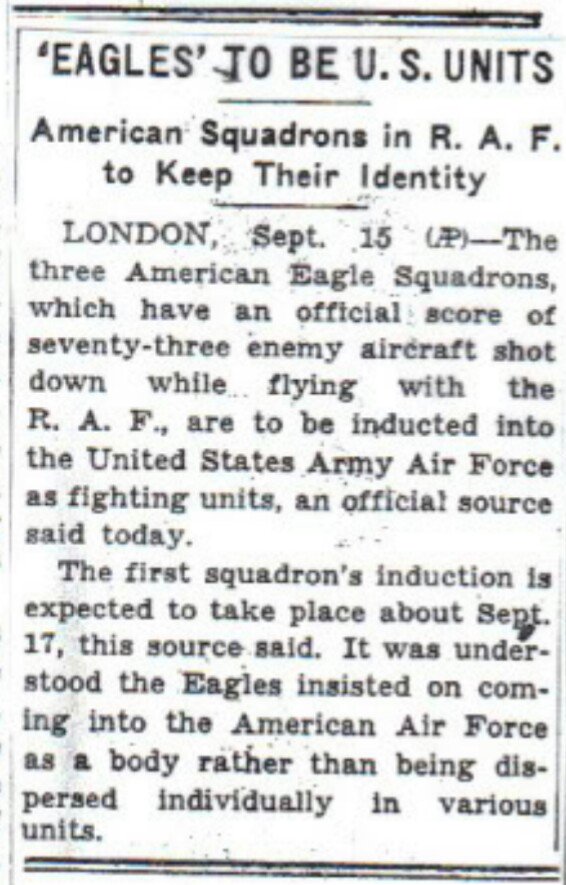
New York Times September 16 1942.

Sources and further reading.

Great Sampford appears in Trail 50.

National Archives: Operational Record Book 133 Sqn – AIR 27/945/2

National Archives: Operational Record Book 401 Sqn – AIR 27/1772/17

National Archives: Operational record Book 64 Sqn – AIR 27/590/41

*3 Price. A., “Spitfire – A Complete Fighting History“, Promotional Reprint Company,  (1974).

July 30th 1944 – Loss of Lancaster PB304 – 106 Squadron.

On Sunday July 30th 1944, Lancaster PB304 from 106 Squadron RAF Metheringham in Lincolnshire, crashed with the loss of all on board, along with two civilians, in Salford Greater Manchester.

Lancaster PB304, was a MK.III Lancaster based at RAF Metheringham in Lincolnshire, flying under the squadron code ZN-S. It was tasked to attack enemy strong points at Cahagnes in the Normandy battle zone following the Allied invasion in June.

The early briefing at 04:00 was not a welcome one, many men having been out the night before following a stand down order due to bad weather and heavy rain over the last two days. On board that day was: F/L. Peter Lines (Pilot); Sgt. Raymond Barnes (Flt. Eng.); F/O. Harry Reid RCAF (Nav.); F/O. John Harvey Steel (Air Bomber); Sgt. Arthur William Young (W.O/Gunner); Sgt. John Bruce Thornley Davenport (Mid-Upper Gunner) and Sgt. Mohand Singh (Rear Gunner)*1.

The operation, code-named Operation Bluecoat, would involve attacking six specific targets, each one identified to assist a forthcoming offensive by British land forces in the Normandy area.

After all the ground checks were completed and the signal given to depart, PB304 began the long taxi to the runway, take off was recorded as 05:55, but it is thought that this was ten minutes early with the first aircraft (ND682) departing at 06:05. Once in the air, the aircraft formed up alongside twenty other 106 Sqn aircraft,  meeting with a smaller formation from 83 Sqn at Coningsby before joining the main formation.

The weather remained poor with heavy cloud blanketing the sky between 5,000 and 10,000 feet, as the 183 Lancasters from No. 5 Group and one Mosquito headed south toward the Normandy coast.

With further poor weather ahead, signals were beginning to come through to abandon the mission and return to base, but communication between aircraft was garbled and difficult to understand, it may have been as a result of German interference broadcasting messages over that of the master bomber. The order to abort finally came through just after 08:00 even though some of the formation had released bombs on target indicators (TI) dropped by the Pathfinders. Smoke was by now mixing with the low cloud causing more confusion and difficulty in identifying the primary targets. Not all aircraft understood the message however, and many continued circling in the skies above Cahagnes. To make a difficult situation even worse, there was by now, an  approaching formation of over 450 American A-20s and B-26s along with just short of 260 P-51 and P-47 escorts on their way to France; the sky was full of aircraft in thick cloud and was an accident waiting to happen.

Difficult communication continued, some aircraft were seen disposing of their bomb loads over the Channel, whilst others retained them. Various courses were set for home, but with many airfields closed in by low cloud, alternatives were gong to be needed and alternative courses were issued to the returning bombers of each squadron.

106 Sqn were ordered to fly north along the western coast, passing over Pershore and on to Harwarden near Chester, before turning for home. The messages coming through continued to be misheard or misunderstood with several aircraft landing at either Pershore, Harwarden or Squires Gate at Blackpool. Gradually all aircraft managed to land, whether at home at Metheringham or at away airfields. Patiently the Metheringham staff waited, nothing had been heard from PB304 and they could not be contacted on the radio, something was wrong.

Precise details of the accident are sketchy, but an aircraft was seen flying low and in some difficulty. It passed low over Prestwich on the northern edges of Manchester, where it was later seen engulfed in flames. It twice passed over a playing field, where some suspect F/L. Lines was trying to make a crash landing, but this has not been confirmed. At some time around 10:10 -10:15 the aircraft came down resulting in a massive explosion, a full bomb load and fuel reserves igniting on impact. Many houses were damaged in the explosion with one being completely demolished.

As a result of the accident, all seven of the crew were killed along with two civilians, Lucy Bamford and George Morris, as well as, what is believed to be, over 100 others being injured all to varying degrees.

PB304 was the only aircraft lost that night, in a mission that perhaps with hindsight, should not have taken place. The poor weather and difficult communication playing their own part in the terrible accident in Salford on July 30th 1944.

RAF Metheringham

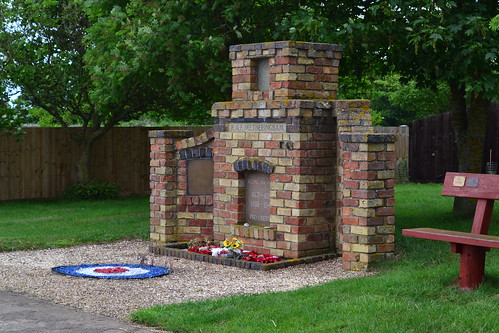
The Memorial at Metheringham pays tribute to all those who flew with 106 Sqn.

Notes and Further Reading.

*1 Operational Record Book AIR 27/834/14 notes Sgt. Young as Sgt. A.L. Young.

A book written by Joseph Bamford the Grandson of Lucy who was killed that night, was published in 1996. “The Salford Lancaster” gives excellent details of the crew, the mission and the aftermath of the accident, published by Pen and Sword, it is certainly worth a read for those interested in knowing more about the incident.

Carter. K.C., & Mueller. R., “Combat Chronology 1941-1945“, Centre for Air Force History, Washington D.C.

Freeman. R., “Mighty Eighth War Diary“, Jane’s Publishing. 1980

RAF Warboys – Home to the Pathfinders (Part 2)

In the early years at Warboys, the Pathfinders had had a difficult start. High loses and poor results were compounded by poor weather. But in early 1943 the Lancaster began to arrive, and the old Wellingtons began to be phased out. The weather however,  takes no account of this and for the early part of January 1943, it continued to envelop the country preventing flights from Warboys going much further afield than Wyton, a stones throw away from their base. Even so, on the 13th, the Pathfinders took another major step forward, being formed into a new and unique Group of their own, No. 8 (PFF) Group, with Don Bennett (now an Air Commodore) remaining at the helm.

On the 26th, the squadron were able to use the new Lancasters for the first time on operations, a bombing raid to Lorient in which 4 Lancasters from Warboys took part; ‘ED474’, ‘ED485’, ‘W4851’ and ‘W4853’. On the 27th the same four aircraft, with different crews, went to Dussledorf, an operation that saw the use of Oboe Mosquitoes for the first time, and a mission that was followed on the 30th by Hamburg. All aircraft returned safely from each of these early operations – 1943 was beginning to look better already.

This run of ‘good luck’ ran well into April, with a relatively low loss rate per operation. This included on  April 16th, the death of Sgt. Patrick Brougham-Faddy (S/N: 577758) and the crew of both Lancasters ‘W4854’  and ‘W4930’. What perhaps makes this incident more notable, was the fact that Sgt. Brougham-Faddy was only 18 years of age, making him amongst the youngest to lose their life in Bomber Command operations. With him lost on that mission was also: his pilot P/O. Harald Andersen DFC; P/O. Kenneth Bordycott DFC, DFM and P/O. Frederick Smith DFM along with ten other experienced aircrew. These losses were a major blow to both the Warboy’s crews and the Pathfinders.

In June 1943, the Navigation Training Unit, a Lancaster based unit formed at RAF Gransden Lodge began its move, taking residency at both Upwood and here at Warboys. The split was not be in everyone’s favour, running a unit on two different sites initially caused some difficulty as the idea of the unit was to train crews in navigation techniques ready for postings to Pathfinder squadrons.

By the time 1943 drew to a close, fifty-seven aircraft had been lost from Warboys, a mix of both Lancaster MK.Is and MK.IIIs, the Wellington now having been replaced entirely within the squadron.

RAF Warboys

Buildings mark the edge of the bomb site.

The cold winter months of 1943 – 44 signified another major event in Bomber Command’s history – the air campaign against Berlin.

For almost 5 months, November to March, Bomber Command would attack Berlin relentlessly in pursuit of Harris’s doctrine of area bombing. The Short Stirling would be withdrawn as the losses mounting were unsustainable, a similar fate that began to land on the door of the Halifax. Some compared the Lancaster to the Halifax, similar to comparing a  “sports car and family saloon”*4. The handling of the Lancaster being far superior to that of the Halifax. As a result, the Lancaster squadrons would bear the brunt of the campaign, and Warboys crews would be in the thick of it. The Pathfinders using an updated version of H2S, would operate outside the range of Oboe, the land based navigation system introduced operationally a year before.

The cold of January 1944, did nothing to dampen the flights nor reduce the combat fatalities. Raids on Berlin, Brunswick, Munich and Frankfurt saw heavy losses (seventeen alone failed to return to Warboys in January, all experienced crews) and numerous aircraft returning early. For 156 Sqn this was disastrous, the squadron began to get a name for itself being referred to as the ‘chop’ squadron and consequently morale fell. With high losses the survival rate fell to an estimated 15%, *3 an unsustainable level of loss for any squadron. For the last fourteen days of January the squadron was effectively reduced to non-operational flights, and in a desperate attempt to bolster the men’s spirits and raise morale, a royal visit was arranged for the King and Queen. Both their majesty’s arrived on February 9th, where they talked to aircrew and took lunch in the Officer’s Mess. After a short stay they departed Warboys going on to visit other Pathfinder airfields in the area.

A widely used photo showing King George VI & Queen Elizabeth talking to ground crew of No 156 Squadron at Warboys(IWM CH 12153)

By the end of February 1944, 156 Sqn were prepared to leave Warboys, maybe a new start would give a new impetus. This move would be a direct swap with the remaining Lancasters of the Pathfinder’s Navigation Training Unit (NTU) based there. Perhaps ending the operating of the unit on two sites had been seen as an ideal opportunity to ‘kill two birds with one stone’, moving 156 and reuniting the NTU.  Whatever the reason the transfer began with a small advanced party taking the short drive to RAF Upwood.

By mid March the move was complete, and Warboys settled into its new role with a full complement of the NTU, hopefully now, the harrowing tales of loss were a thing of the past. With courses of generally three to five crews every few days, turnover was rapid.

With the Mosquito taking  a greater role in the Pathfinders, more crews were needing training in its operation. The 1655 (MTU) Mosquito Training Unit (formerly the 1655 Mosquito Conversion unit) originally formed at Horsham St. Faith in 1942, moved across from RAF Marham in Norfolk; Warboys was now awash with twin and four engined aircraft.

The Training unit would only stay at Warboys until December, at which point it moved to Upper Heyford where it would disband at the end of the year, being renumbered 16 Operational Training Unit (OTU). However, for that short time at Warboys, it grew extensively, gaining five flights including a mix of aircraft for training purposes. Whilst pilots were taught how to fly the Mosquito, the navigators were taught Pathfinder navigation & marking techniques, all prior to joining as a new crew for final training and ultimately postings to a Pathfinder squadron.

RAF Warboys

Further buildings survive near the bomb site.

Many of the aircraft delivered to Warboys were veteran aircraft themselves, having served with other numerous squadrons. Mosquito DZ606 which initially arrived in April 1944, had already flown at least nineteen operational sorties before arriving here. It was then passed on to another unit (139 Sqn) before returning with a further twenty-nine sorties under its belt. The dedication of ground crews, ease of repair and the reliability of the Mosquito enabled it to complete thirty-seven more operations with other units before the year was out.  It was eventually struck off charge in 1945 after being badly damaged.

One other notable example that appeared at Warboys with 1655 MTU, was W4053 which had been the Mosquito Turret Fighter Prototype in 1941. The (bizarre) idea of this was the fitting of a four gunned Bristol turret behind the cockpit, rather like a Boulton Paul Defiant. On tests though, the turret seized when turned to the front effectively trapping the occupant inside. After running further tests with the same results, the project was abandoned and no one was allowed to fly in it again – even though some did try! The aircraft had its turret removed and served with both 151 and 264 Squadrons before passing to 1655 MTU here at Warboys. In November 1944 it was damaged in a landing accident, repaired and then reused by the unit when it was renumbered as 16 OTU at Upper Heyford, where the Mosquito was destroyed in a crash.

With the Mosquito training unit moving away, the Navigation unit remained the sole user of Warboys, but years of use by heavy bombers had had a toll on the runway, their surfaces beginning to break up and cause problems. Warboys was going to need considerable repair work carried out. However, the Navigation unit remained here until the war’s end. On the 18th June 1945 a communique came through from Bomber Command and 8 (PFF) Group, announcing the disbandment  of the Navigation Training Unit., Staff began postings elsewhere, the last courses were completed and ‘Cooks’ tours (tours taking ground crews over Germany to see the devastation) were wound down.

Before the closure of Warboys though, two more squadrons would arrive, 128 Sqn and 571 Sqn, both Mosquito Pathfinder squadrons. 571 was disbanded here on September 20th, whilst 128 Sqn transferred out to B58/Melsbroek, then Wahn where it was disbanded in 1946.

After the training units were disbanded all flying ceased. The RAF did return briefly with Bloodhound missiles in 1960 staying for 4 years until the airfield was finally closed and sold off.

With that, Warboys was gone, and its remarkable history now a distant memory. But these memories were not to be forgotten forever. The local village commemorated the loss of one particular pilot who on the 10th April 1944, lost his life whilst flying a Lancaster over the Welsh countryside.

Flt. Lt. John L. Sloper DFC and Bar, was a veteran of 156 Sqn who had transferred out of operational duties to the Training Unit after completing his tour of duty on December 29th 1943. His last mission being a bombing raid to Berlin in Lancaster JB476. Flt. Lt. Sloper had achieved his quota in just seven months. He joined the Mosquito unit to pass on his skills to others, his personality, knowledge and determination making him very popular with the other crews.

RAF Warboys

A plaque dedicated to the memory of both Flt. Lt. Sloper and those who served with 156 Squadron.

Flt Lt. Sloper (S/N: 147214) was killed in Lancaster ‘JB 471’ during a cross country navigation flight near the village of LLanwrtyd Wells in Breconshire. The aircraft crashed after entering cloud, the ensuing fireball killing all those inside. Flt. Lt. Sloper’s remains were buried at Haycombe Cemetery and Crematorium, Bath.

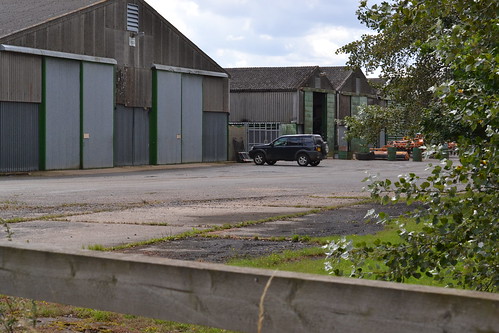
The site today houses small industrial units, but it is primarily farmland. Only a small section of the main runway exist, and this has farm buildings upon it. This section, has been cut by the original A141 now a ‘B’ road, and evidence of the runway can still be seen either side of the road.

RAF Warboys

Pathfinder long distance walk.

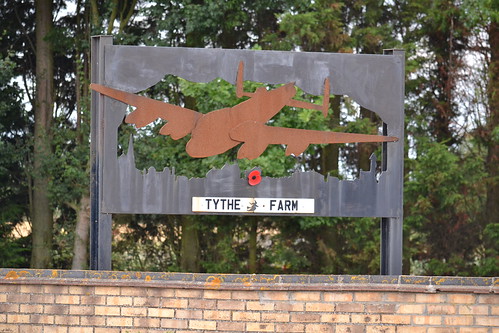
The farm entrance has a large sign with a Lancaster modelled out of metal. Two memorials on the gate posts mark the runway (since my original visit the sign and one of the memorial plaques appears to have been removed, though I have yet to verify this). Across the road from here, you can see the extension to the runway and the remains of a small building, but probably not war-time due to its location.

There is luckily a footpath that circumnavigates the field called ‘The Pathfinder Long distance Walk’, and uses that iconic aircraft, the Mosquito, as its icon. This path allows views across the airfield and access to some of the remaining buildings.

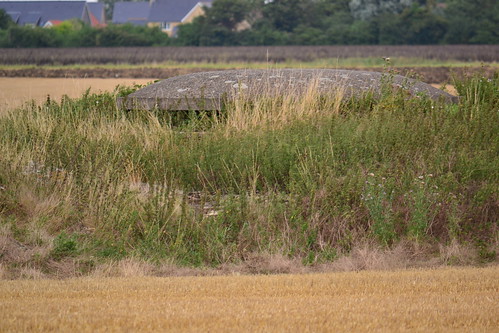
Entry to the path is toward the village, a gated path that is actually part of the perimeter track. As you work your way round, to your right can be found one of the few Air Ministry designed pill boxes. The manufacturer of these mushroom defences being F. C. Construction, they were designed in such a way as to allow machine gun fire through a 360 degree turn. Often referred to as ‘Oakington’ pill boxes, there are only a few remaining today.

Also, deeply shrouded in hedges and undergrowth, another structure possibly a second pill box or the battle headquarters. With permission from the farmer, you may be able to access these, but they look in a rather dangerous condition.

Further along to your right is where one of the T2 hangars would have stood before its demolition. Tracks lead away from here, and there is what appears to be further examples of airfield architecture buried amongst the trees.

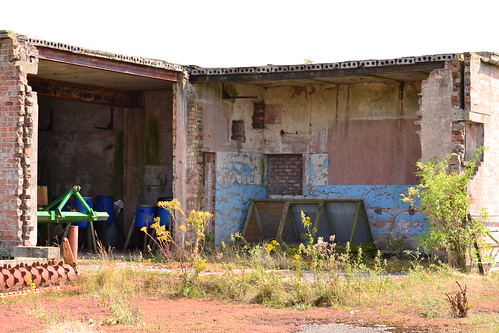
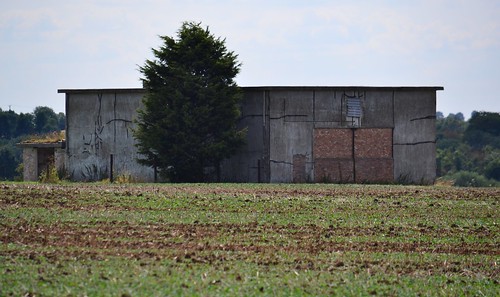
The perimeter track takes you around the rear of the airfield across the threshold of the main runway and round the perimeter track. A local model flying club now uses this part of the site between the runway and perimeter track. To your right would have been the bomb store, now open fields laden with crops rather than bombs. There are a few buildings here marking the boundary of the store, now used for chickens and extensively ‘modified’ by the farmer. They house farm machinery, a far cry from what would have been here many years ago.

The track then takes you away from the site and out across the Cambridgeshire countryside.

RAF Warboys

The remains of the Ground Control Interceptor (GCI) Radar Station.

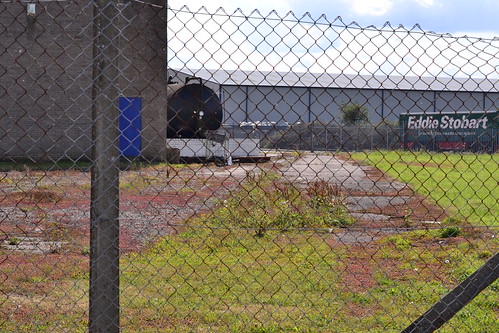
Returning back to the road, we go in the opposite direction from the village and come to the entrance of the industrial site. These buildings stand on the perimeter track marking the western corner of the airfield.

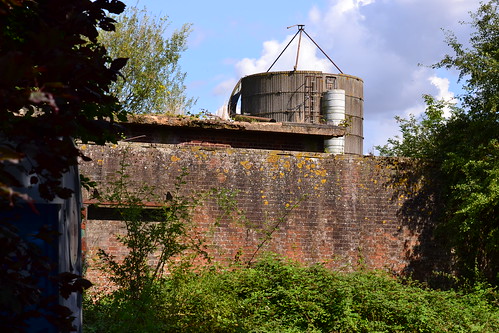
Next to this part of the site, is a large telecommunications transmitter, apparently the origins of the site being 1941. Whilst its use and history is somewhat difficult to locate or verify, it is known that this was a Ground Control Interceptor (GCI) Radar Station used to lock fighters onto incoming enemy aircraft. Later, there was a high-powered transmitter here used by RAF Mildenhall and RAF Wyton. It was also used to communicate with the V bombers on long-range flights. The mast believed to be original, has been updated and refurbished for telecommunications purposes, but the block house remains behind high fencing with very strong padlocks!

The majority of the admin sites are located along the A141 toward Wyton, some evidence exists here but the majority have long gone. Return toward the village and find the church; located just on the outskirts of the village.

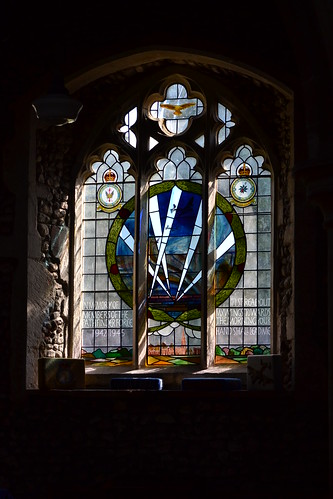
A superb memorial window and roll of honour can be found here, and it is well worth the effort. In Huntingdon town is the former Headquarters building of the Pathfinders, Castle Hill House, which now belongs to the local council. A blue plaque describes the historical significance of the building.

Pathfinders

Castle Hill House, Huntingdon. The Headquarters of the Pathfinders. (Photo courtesy Paul Cannon)

Designed initially as a satellite airfield, Warboys went on to be a pioneering airfield for a new and dedicated team of bombing experts. With 156 Squadron it took the war deep into the heart of Nazi Germany. As a result it suffered great losses, but without  doubt it performed one of the most vital roles in the latter parts of the war and it’s a role that should not be forgotten beneath waving crops and developing industry. The name of Warboys should be remembered as a Pathfinder icon.

After we leave Warboys, we head to her sister station to the west, and an airfield with a history going back to World War I. This airfield saw a spy caught and hanged; the making of a film using Lancasters, and more recently the site of a hospital for the treatment of victims of a nuclear war. We of course go to RAF Upwood.

Sources and further reading (RAF Warboys).

*1  A good blog  describes the life of Wing Co. T G ‘Jeff’ Jefferson, DSO AFC AE who served part of his life as a Pathfinder at RAF Upwood. It is well worth a read.

*3 Smith, G. “Cambridgeshire airfields in the Second World War“. Countryside Books (1997)

*4 Flying Officer J Catford DFC “View from a Birdcage“Tucaan Books (2005) Pg 51

National Archive: AIR 27/203/18
National Archive: AIR 27/1041/13
National Archive: AIR 27/1041/14
National Archive: AIR 27/1041/16
National Archive: AIR 27/1041/24

For more details of the Pathfinders see the excellent RAF Pathfinders Archive Website.

A website detailing crews, missions, aircraft and other information about 156 squadron is also well worth visiting for more specific and detailed information.

Warboys was originally visited in 2014 in Trail 17.

RAF Warboys – Home to the Pathfinders (Part 1)

In the south-western corner of Cambridgeshire, are a group of airfields that are synonymous with the Second World War’s target marking units, the Pathfinders. This is an area rich in aviation history, and an area that played a major part in not only the European Theatre of Operations of World War Two, but military operations long into the Cold war and beyond. Within a short distance of each other are the airfields at Wyton, Warboys, Upwood and Alconbury to name but a few, and it is two of these we visit in Trail 17.

Our first stop is the former RAF Warboys, once home to the Pathfinders.

RAF Warboys.

Warboys village is an ancient village with records of inhabitants going back to 7,000BC, it also has links to the Bronze age, the Romans, Vikings and the Doomsday book. Even further back, some 350 million years, there was an active volcano in the area, not far from where we start today.

RAF Warboys

The farm sign reminds us of the aviation link (it would appear that this sign may have recently been removed).

The airfield itself was initially constructed as a satellite for RAF Upwood, with a requirement for three 50 yards wide tarmac runways; one of 2,000 yards, another measuring 1,400 yards and the last 1,350 yards. There were initially twenty-four frying pan hardstands, two of which were then used as hangar bases, with a further eighteen loop style hardstands added after. This gave a total of forty dispersal points available for aircraft, and they would certainly be needed.

As with many airfields of this time there were two type ‘T2’ hangars, one each side of the airfield, supplemented with a ‘B1’ hangar. A well developed bomb store lay to the west of the airfield, and eleven domestic sites lay to the eastern side of the A141 to the south of the main airfield. These would accommodate up to 1,959 men and 291 women. Even before its completion, Warboys would undergo further development, an order coming through to extend two of the runways to 2,097 yards and 1,447 yards, its was a sign perhaps, of things to come. This extension work meant altering the perimeter track layout and diverting the main road around the airfield as it would be dissected by the new extension (the original road was reinstated post war, the end of the main runway being cut off as a result).

Construction began in 1940 with the airfield opening in September 1941, initially as a satellite bomber station. Whilst intended for Upwood, it was first of all used by Short Stirling’s from XV Squadron as an overflow from nearby RAF Wyton. As a satellite, Warboys was never far from the war when not long after the first Wyton aircraft landed, the Commanding officer of XV Squadron,  Wing Commander P. Ogilvie, crashed the Stirling he was piloting (W7439) here in bad weather. Luckily he and his crew escaped major injury but unfortunately the aircraft was written off completely. This crash would signify a run of accidents occurring at the airfield whilst XV squadron used Warboys.

However, XV Sqn’s stay was short-lived, and they soon departed the site their vacant place being taken by the Blenheims of ‘D’ Flight, 17 OTU (Operational Training Unit).*1

The Training unit was expanding, and their base at RAF Upwood was becoming crowded. Their move over to Warboys on 15th December 1941, was a part of this expansion, and led to four flights being created, each with a range of aircraft including: Lysanders, Ansons, Blenheims and even the odd Hurricane and Spitfire.

In August 1942, the OTU would receive orders moving the unit elsewhere, whilst over at RAF Alconbury, a few miles to the south-west, instructions came through to 156 Squadron to relocate here to RAF Warboys. The instruction specified that the move was to take place on the 5th and be completed by the 7th, it would involve the ferrying of large numbers of crews and their aircraft. On the 5th the first aircraft was brought across, and then on the 6th a further six aircraft were transferred. This was followed by another seven on the 7th.

Following the move the squadron was put straight onto operations, but many of these were cancelled because of the poor autumn weather. One of the first, occurring on August 11th, saw ten aircraft detailed for operations, and whilst all of them managed to take off,  three of them X37998 (Flt.Sgt. F. Harker); Z1595 (Sqn. Ldr. J. Beavis) and BJ603 (P/O. C. Taylor) would fail to return. All but three of the sixteen aircrew onboard would perish – the squadron’s first fatalities whilst at Warboys.

RAF Warboys

The remnants of the main runway are used for buildings.

On the night of 15th August 1942, eight more Wellingtons took off from Warboys for Dusseldorf, of these, three returned early with a forth being lost. The Operational Record Book simply stating “This aircraft failed to return” – a rather unembellished statement that became so common in operational records. Reports about the raid later highlighted the poor visibility and scattered bombing, with little or no industrial damage being done as a result.

Whilst August 1942 was not proving to be in anyway remarkable for 156 Sqn, it would prove to be a very historic month for Bomber Command. On the same day as the Dusseldorf raid, the Pathfinders – an elite force designed to locate and mark targets for the main bomber stream –  officially came into being. This idea had long been on the minds of the Air Ministry, causing a prolonged and difficult relationship between Sir Arthur Harris and Group Captain Sidney Bufton (Director of Bomber Operations at the Air Ministry). The fallout culminated in the intervention of the Chief of Air Staff, Sir Charles Portal, who came down on the side of Group Captain Bufton. He disagreed with Harris’s arguments, announcing that the Pathfinders were going to go ahead as planned.

This did not meet with Harris’s approval, he feared the Pathfinders would ‘skim off’ the cream of his bomber force, creating a corps d’elite, whilst Bufton was adamant it would vastly improve Bomber Commands accuracy, something that desperately needed to be done.

Harris gained the backing of his Group Commanders, explaining that removing individual crews from squadrons would be bad for morale within the groups and be divisive amongst the squadrons. He and his Commanders preferred a target marking unit within each Group, thus retaining these elite crews keeping the unity of the squadrons and the skills they possessed together. However, the long fight between Harris and Bufton came to a climax with the intervention of Sir Charles Portal, and an ultimatum was given to Harris, ‘accept the new Pathfinders or leave’.

The job of organising this new command fell to the then Group Captain Don Bennett D.S.O., an experienced pilot himself who advocated the use of target marking to improve bombing accuracy; something Bennett had indeed tried himself. However, it was not going to be an easy ride for the Group Captain, for the squadrons chosen all operated different aircraft types: Wellingtons, Stirlings, Halifaxes and Lancasters. The Wellingtons were becoming outdated and the Stirlings, whilst liked, had their own set of problems. Added to the mix the fact that German defences were improving and electronic counter measures (ECM) were on the increase, difficult times were definitely ahead.

RAF Warboys

Industry marks the south-western perimeter.

As a new force, only four squadrons were initially used, although more were considered and earmarked: 7 (No. 3 Group), 35 (No. 4 Group), 83 (No. 5 Group) and 156 (No. 1 Group), but it would take time for the new crews to settle and for improvements in bombing accuracy to shine through. All the while Pathfinder crews were operating, the remainder of the squadrons continued in their normal duties, this would allow the Pathfinder force to steadily grow.

For the large part, target marking in the latter part of 1942 would be by visual means only – a ‘Finder‘ and an ‘Illuminator‘ using flares and incendiaries respectively. This would prove to be an unsatisfactory method, the markers often being ‘lost’ amongst the fires that followed, or they were simply too difficult to see. However, photos taken after these early bombing raids showed that the number of bombs falling within 3 miles of the aiming point, post August, had in fact risen to 37% from 32%; those falling within 3 miles of the centre of concentration rising to 50% from 35%.*2 Whilst these figures were quite small, and bombing was still relatively inaccurate, it was at least a step in the right direction, and a boost to those who supported both Bufton and Bennett.

So, on the 15th August 1942, Bomber Command operations changed for good, the four squadrons moved to their respective airfields and the Pathfinders began preparations for a new battle. 156 Sqn at Warboys, would be a major part of this. Being one of the four pioneering airfields, Warboys would be joined by Graveley, Oakington and Wyton, as initial homes for the new force.

On the night of the 18th -19th August 1942, the Pathfinders would be put to the test for the first time, and two Wellingtons from 156 squadron were to be a part of it. The raid to Flensburg would not be successful though, one aircraft having great difficulty in locating the target through the haze, and the second having to ditch its flares five miles from the airfield after one ignited inside the aircraft. Of those that did get to mark, it proved to be inaccurate, and one Pathfinder aircraft, from 35 Sqn, was lost.

RAF Warboys

Airfield defence in the form of an ‘Oakington’ pill box.

The day after this, Group Captain Bennett visited Warboys to give a lecture on the Pathfinder Force and to promote its use; he must have made a good impression for after the lecture six Warboy’s crews volunteered for Pathfinder duties.

Further operations were carried out on the night of  27th – 28th August to Kassel. A good night for visual marking meant that bombing was accurate, and as a result all of the Henschel factories were damaged. However, the cost to the Pathfinders was very high. It was on this operation that the Pathfinders suffered one of their greatest losses. Thirty-one aircraft were missing of which fourteen were Wellingtons and three were from 156 Sqn. The next day, the mess hall was devoid of three crews, those from: ‘X3367’, ‘Z1613’ and ‘DF667’, and unbeknown to those sitting around the mess, there were no survivors. A fourth bomber (BJ883) returned to Warboys after the pilot, Sgt. E. Bowker, suffered severe head pains and was unable to carry on.

Not all operations were as bad. On the night of 19th – 20th September following action over Saarbrucken, a flare became lodged in the bomb bay of one of the 156 Sqn Wellingtons. Whilst sitting there it ignited causing a fire in the aircraft’s belly. The Pilot,  New Zealander Sqn. Ldr. A. Ashworth, instructed his crew to bail out, after which the fire extinguished itself allowing him to fly the aircraft back single-handedly, landing at the fighter station RAF West Malling in Kent. The operation itself, undertaken by 118 aircraft, was otherwise uneventful, although haze proved to be an obstacle for the markers.

The last 156 Sqn Wellington raid for 1942 occurred on December 21st and took the squadron to Munich as part of a force of 137 aircraft. The loss of ‘BK386’ crewed entirely by Canadians brought 1942 to a close, and a loss of 15 aircraft this year. To add insult to injury, whilst the majority of the bombers claimed to have hit the city starting large fires, photographs showed that in fact most bombs had fallen outside of the city in open countryside, possibly as a result of a successful decoy employed by the Germans. It had not been the most auspicious of starts for the Pathfinders, nor 156 Squadron at Warboys.

However, by early January, a new aircraft type was starting to arrive at Warboys – Avro’s mighty four engined heavy, the Lancaster MK.I. Created out of the under-performing Manchester, the Lancaster would go on to be one of the most iconic aircraft of the Second World War. Perhaps now the tide of misery would turn and Warboys crews would begin a new era in aviation history.

RAF Warboys

The beautiful Memorial window dedicated to the Pathfinders.

The full trail appears in Trail 17

Flt. Lt. William Devaux Woodruff Hilton (RCAF) – Berwickshire.

In the graveyard at Duns, in Berwickshire, not far from the village and former airfield RAF Charterhall (Trail 41), are two graves of nationals a long way from home.

Both airmen died in service whilst flying from RAF Charterhall, an Operational Training Unit airfield that prepared night fighter crews before posting to relevant night fighter squadrons.

The first grave is that of Flt. Lt. William Devaux Woodruff Hilton (RCAF)  who died on 23rd July 1942.

Flt. Lt. Hilton (Duns Cemetery)

Flt. Lt. William Devaux Woodruff Hilton

Flt. Lt. William Hilton (s/n: C/1626) was born on May 17th 1916, to D’Arcy Hilton (himself an ex pilot of the US Army Flying Corps in the First World War) and Gladys Woodruff, in Chicago, Illinois. He signed up for a flying career joining the RCAF as the United States were not at that time at war and therefore he was unable to train with the US forces.

Flt. Lt. Hilton reached the rank of Pilot Officer on 29th January 1940 after completing further training at RAF Twinwood Farm in Bedfordshire and RAF Acklington in Northumberland. On completion of this training, he was posted to RAF Charterhall and 54 Operational Training Unit (OTU), where he would fly Beaufighters.

The summer of 1942 suffered from poor weather, so poor in fact, that there were many restrictions on flying time, July only having 2,104 hours in total. This bad weather was to be responsible for many flying accidents and deaths that year, of which Flt. Lt. Hilton would be one.

On July 23rd 1942, he was tasked with flying a model new to him, the Bristol Beaufighter, and was taken by an instructor on several circuits to better acquaint himself with the various controls and idiosyncrasies of the aircraft. After several successful landings and take offs, the instructor passed Flt. Lt. Hilton to fly solo, and handed the controls of  Beaufighter #R2440 over to him. His instruction to Hilton was to stay within the circuit of the airfield, sound advice as one of Scotland’s summer storms was rapidly approaching.

Hilton duly carried out the order and took off to perform various solo flight tasks. An experienced pilot, Flt. Lt. Hilton found no problem landing or taking off himself and completed one full circuit before things went wrong.

On the second  circuit of the airfield, Flt. Lt. Hilton somehow got lost, whether through an aircraft malfunction or pilot error, it is not known, but after entering bad weather, the aircraft was instructed to climb to a safe height which it failed to do. Moments later, the Beaufighter was heard circling over the nearby town of Duns before ploughing into low-lying ground, one mile south-east of the town. At the time of the accident the aircraft’s undercarriage was in the down position. The crash killed Flt. Lt. Hilton instantly, the aircraft being torn apart by hedges and the subsequent slide along the ground. A board of enquiry was set up and investigations carried out, but no blame was apportioned to Hilton and the case was closed.

Flt. Lt. Hilton, an experienced pilot, somehow got into trouble, and that combined with the bad weather he was in, resulted in the loss of his life at the young age of just 26. To this day the cause of the crash is not known and Flt. Lt. Hilton remains buried in Scotland not far from the crash site, he is however, many thousand miles from home.

Flt. Lt. Hilton is buried in Duns graveyard in Sec. R. Grave 2.

The second airman’s grave in the graveyard at Duns, is that of Sgt. Thomas Alan Rutherford s/n 406626 (RAAF) who died on 14th August 1942, age just 20.

Sgt. Rutherford (Duns Cemetery)

Sgt. Thomas Rutherford

Sgt. Thomas Rutherford, born to Stamford Roy Rutherford and Laura May Rutherford, of Cottesloe, Western Australia, came from an aviation family, his father Stamford Rutherford RAAF (296635) and older brother Sgt Bernard Rinian Roy Rutherford RAAF (406540), were also serving Air Force members. As with many families who had siblings serving in the forces at this time, Sgt. Rutherford’s brother was also killed in an air accident, earlier that same year.

Sgt. Rutherford was born 3rd August 1922 at Brampton, England but enlisted in Perth Western Australia, on 3rd February 1941.

After completing his training, he also transferred to 54 OTU at RAF Charterhall in the Scottish borders.

August 1942 was, like July before it, a particularly bad month weather wise, which saw only 1,538 hours of flying carried out by 54 OTU. Only a small portion of these, just short of 400, were by night, the remainder being daylight flights. As a night fighter training station, this would be difficult for trainers and trainees alike, but undeterred they flew as many sorties as they could.

On August 14th, Sgt. Thomas Rutherford climbed aboard Blenheim Mk. V #BA192 along with is observer Sgt. James Clifford Kidd (s/n: 1417331). They dutifully carried out their pre-flight checks and lined the aircraft up ready for take off from one of Charterhall’s runways. After lifting off the Blenheim struck a tree causing it to crash. Both Sgt. Rutherford and Sgt. Kidd were killed instantly in the accident.

It is not known what caused the aircraft to strike the tree, whether it be pilot error or aircraft malfunction, but it was an accident that resulted in the loss of two young men far too early in their lives.

Sgt Rutherford is buried at Sec. R. Grave 3 next to Flt. Lt. Hilton.

Further reading.

McMaster University Alumni has further details of Flt/ Lt. Hilton’s life and career.

Commonwealth War Graves Commission website

National Archives of Australia website

RAF Leeming – The Great North Road (Pt 4).

In this, the last part of Trail 57 – The Great North Road (pt 2) we see how Leeming progressed from the late 1960s to the present day. From the modest little Jet Provost to the Tornado and on to the Hawk trainer. Leeming’s long history was far from over, but it is now very different to those dark days of World War 2 and the four-engined heavy bombers of the Canadian Air Force. At this point in time it was now home to No. 3 Flying Training School (F.T.S.)

The Flying Training School would remain at Leeming for twenty-three years, before being disbanded for a few years, in 1984. It  had a long history extending as far back as 1920, morphing into different guises but performing basically the same role each time.

Here at Leeming, 3 F.T.S. would use the Jet Provost T.3, a design that was based on the piston-engined P.56 Provost, using a new fuselage mated to the original wing structure, it would become a popular design, seeing many years of service both in the Royal Air Force and Air Forces abroad. Designed and built by Hunting Percival Aircraft Limited, who were based at Luton Airport, it would go through few design changes (most were technical e.g. ejection seats, upgraded engines etc) between its initial flight and final model the T.5. In 1967 it would become the Strikemaster, when the British Aircraft Corporation (B.A.C) took over, but the initial design would go on to serve well into the 1990s performing well in the training role it was designed to do.

The Provost was designed for a straight through or ‘Ab Initio‘ (‘from the beginning’) role, taking the trainee pilot from the piston engined stage through to obtaining his ‘wings’ before advanced flying training as a qualified pilot.

Bruntingthorpe May 2016 079 Hunting Jet Provost T.3A at Bruntingthorpe. This was previously flown by 1 FTS.

Initial arrivals were slow, but courses ran on time and very soon Leeming would be welcoming cadets and trainees from across the globe. Over the next 20 years or so, further upgrades would be made to the airfield site, repairs and modifications made to the perimeters and hardstands. Leeming was to operate on a 24 hours basis allowing for emergency landings of visitors  both civil and military. It would take part in NATO exercises, hosting as it does today, aircraft from around the country and the globe when the need arose.

The mid 60s saw the return of female personnel to Leeming. An absence of almost twenty years with little pomp or ceremony, but it was nevertheless a milestone in Leeming’s long and distinguished history.

Another major event in Leeming’s history was the arrival of the Central Flying School (C.F.S.) in 1976-77. This addition to Leeming’s pans had been slowly coming with aircraft being dispersed here since the previous year. The C.F.S. was another long standing and dynamic unit that had gone through many changes and many moves, here at Leeming though, its arrival was heralded with a display by the ‘Vintage Pair’ a Vampire T.11 (XH304) and Meteor T.7 (WF791) seen at many airfields around the country until the flight was disbanded in May 1986.

The C.F.S.’s history is far too detailed to be looked at here, but in essence the first arrivals were the Scottish Aviation Bulldogs, a small single engined aircraft with side-by-side seating. These were joined not long after by the Headquarters, Groundschool and Jet Provosts of the C.F.S. from RAF Cranwell in September 1977.

More upgrades to hangars and aprons in the late 70s and early 80s saw further changes with arrivals and departures of other units, and a rather important cadet arrived in the form of HRH Prince Andrew, amid much public interest. 1982 also saw the arrival of an American unit, the USAF’s 131st Tactical Fighter Wing (T.F.W.), with 12 Phantom F-4s, followed not long after by C130s and C141s.

In 1984, a four year reconstruction programme amounting to some £148m was implemented to prepare Leeming for the arrival of the latest version of the Multi Role Combat Aircraft the Tornado. In this case the F2 Air Defence Variant (A.D.V.). It was during this time (1984) that Leeming would join 11 Group Strike Command, the old Fighter and Bomber Commands having been amalgamated in 1968. To facilitate the upgrade, the remaining units, both the C.F.S. and 3 F.T.S. would cease operations here. The C.F.S. departing to Scampton and  3 F.T.S. being disbanded for another five years.

The move of the C.F.S. to Scampton, saw the Jet Provosts and Bulldogs depart Leeming in a grand final farewell. Flying in formation, nine bulldogs took off an hour before a second formation of Jet Provosts led in a Vampire by Air Commodore Kip Kemball. In addition to the Bulldogs were sixteen Jet Provosts, an equal mix of Mk.3s and MK.5s, two Meteors and the Vampire. After flying over several of Yorkshire’s airfields, they arrived simultaneously at Scampton and their new home.

In July 1988 the rebuilding programme had been completed and RAF Leeming reopened with the arrival of No XI(Fighter) Sqn – on July 1st 1988. Following not far behind was No 23(Fighter) Sqn on 1st November that same year. The third squadron to arrive, No XXV(Fighter) Sqn, landed on 1st October 1989; all being reformed here and all operating the F3 Variant Tornado. The F3 would perform its duties for 20 years at Leeming, ending with the final disbandment of XXV(F) Sqn in April 2008.

XI (F) Squadron, had been in operation since 1915 with an almost unbroken service record. XXV (F) Sqn had been operating as a Bloodhound SAM unit since the early 1960s. In 1989 they returned to manned aircraft, taking on the Tornado, operating in a range of military operations during Gulf War 1, the former Yugoslavia and the Baltic States.

In 1989 a tragic accident marred the almost unblemished record of modern Leeming, when on Friday 21st July a Tornado of 23 Sqn ZE833, crashed into the sea off Tynemouth whilst on a training flight. The Pilot, Fl. Lt. Stephen Moir,  was leading a pair of ‘target’ aircraft, when after an initial field intercept he pulled the aircraft up to 4,000ft, before initiating a 20o-25o nose down dive. At 3 – 400 ft the navigator gave a verbal warning just as the on board low warning indicator, set at 200 ft, activated. Within moments the aircraft hit the calm sea, a fireball engulfing the aircraft, at which point the crew ejected. The co-pilot passed through the fireball sustaining minor burns but the pilot suffered major head injuries rendering him unconscious. After 40 minutes the co-pilot was recovered by a Sea King helicopter from RAF Boulmer, but the pilot had been unable to initiate any recovery action and sadly drowned*10.

An inquiry could not establish any direct cause of the crash, other than suggesting the pilot had not taken into account the lack of lift with wings set back at 67o and the smooth sea not providing visual cues as to his height. By the time the navigator gave his warning it may well have been too late to recover.

A second, but less serious accident occurred for XI (F) Sqn five years later on June 7th 1994. On this occasion, whilst performing a high speed, low-level (1,300ft) pass over the sea 45 miles north-east of Scarborough, the labyrinth seal around the high pressure shaft failed causing a massive fire, major component failure and eventual failure of the right engine. The aircraft, now uncontrollable, became engulfed in flames. The two crew ejected safely and the aircraft crashed into the sea. As a result, a speed restriction was put on all Tornado aircraft until the RB199 engine seal had been investigated.

Further reviews of the armed forces led to the Tornado F3 squadrons being cut. This was to aid the phasing in of its replacement the Eurofighter Typhoon. The first of these to go was 23 Sqn, who had previously occupied Port Stanley airfield following the Falklands War. After being reduced to just four aircraft the unit was disbanded only to reform here at Leeming in 1988. As a result of this review, on February 26th 1994, 23 Sqn was disbanded not reemerging again until 1996 at Waddington with Sentry AEW 1s.

Another review of the military (2003 Defence White Paper, “Delivering Security in a Changing World”) saw further reductions of the Tornado squadrons, notably the demise of XI (F) Squadron in October 2005. This reduction left just one Tornado F3 unit XXV (F) at Leeming. They remained here until 4th April 2008 when they too were disbanded.

The next big step in Leeming’s history occurred in 1995, with the arrival of 100 Squadron. 100 Sqn had a history extending back to World War 1, they had an extensive World War 2 history, culminating in the humanitarian operations ‘Manna’ and ‘Exodus’.

The role of 100 Sqn at Leeming was a far cry from the activities of the previous years. Equipped with the BAe Hawk T MK.1 – a fully aerobatic, low-wing, transonic, two-seat training aircraft, it fulfils an  ‘aggressor’ role simulating enemy forces and providing essential training to the RAF front-line units. The Hawk T1 is equipped to ‘operational standards’, capable of being armed with AIM-9L Sidewinder air-to-air missiles and up to eight 3Kg practice bombs.

A final and tragic loss occurred at Leeming on 22nd October 1999 with the loss of Hawk T.1A ‘XX193’ just outside the village of Shap in Cumbria. The flight incorporated a three ship formation flying in the aggressor role, where one aircraft attempts to intercept the remaining two, who then take defensive action. After performing two such ‘attacks’ the aggressor, flown by Sqn Ldr Mike Andrews, flew north along the M6 corridor. During a slow turn, XX193, struck two trees and a brick outbuilding causing extensive damage to the property and destroying the aircraft. Neither of the two crew managed to eject resulting in both their deaths.

The assessment of the crash ruled that the aircraft was well maintained and serviceable, and that the Hawk pilot may have been distracted by other close aircraft taking his concentration off the low height. They also sited pilot fatigue as possible factor *11

RAF Leeming Hawk T1s of 100 Sqn line up for take off at RAF Leeming.

A number of other squadrons continue to use Leeming, in April 1996, 34 Squadron RAF Regiment arrived in North Yorkshire after serving for forty years in Cyprus. Now part of No. 2 RAF Force Protection Wing, their role is to provide air force protection capabilities. In 2007 – 90 Signals Unit arrived from RAF Brize Norton, they now form the largest contingency at Leeming,  half of the airfields population, providing communication services to operations both within the UK and by supporting operations world wide.

Whilst not flying units these nonetheless provide important services and support to the Royal Air Force operations, forming a large part of Leeming’s presence in this small Yorkshire village.

In 2014, history repeated itself with the return of 405 (R.C.A.F.) Sqn who flew into Leeming to take part in operation ‘Joint Warrior’. Now flying CP-140 Auroras, it was the first time the squadron had been at Leeming since it departed in World War 2. The full story appeared in ‘The Northern Echo’ newspaper.

Currently the RAF operate both the Hawk and the 120TP Prefect at Leeming. With its history extending far back to the origins of the Second World War, its links with the Canadian bomber group and a wide range of aircraft types and personnel, its history for the moment looks secure. In an ever changing world though who knows what the future holds, but for now, Leeming plays a major role in the training of Britain’s front line fighter pilots striving to keep the World’s air spaces free from terror.

Being an active base access to Leeming is restricted. A Tornado currently resides as the Gate Guard reminding us of the links with the former work horse of the RAF’s front line squadrons. The A1 main road by passes Leeming and access to the site has to be by exiting this road and turning on to the old Leeming road into the village. The road along side the airfield does offer excellent views, and a public viewing area has been provided by the base, for those who wish to watch the flying safely and virtually unrestricted.

Leeming has along and varied history, used by many nationals and operating a wide range of aircraft types, it is has been, and continues to be, a major player in Britain’s  air defence.

RAF Leeming 120TP PREFECT

Sources and further reading.

*1 National Archives Operational Record Book AIR 27/98/1

*2 National Archives Operational Record Book AIR 27/379/4

*3 National Archives Operational Record Book AIR 27/1796/28

*4 To avoid confusion with renumbering, Air Force Order 324/40, dated 7th June 1940, stated: “In order to avoid confusion in matters pertaining to similarly numbered units of the RAF and the RCAF, all units of the RCAF, after embarkation for overseas, are to be identified by use of the word “Canada” as a suffix immediately after the Squadron number, e.g., No. 110 Canadian (AC) Squadron.” However, this order was cancelled on 4th June 1943 by Air Force Routine Order 1077/43.

*5 AIR 27/1848

*6 Emmanuel College Roll of Honour website.

*7 Coupland, P. “Straight and True –  A History of RAF Leeming” Leo Cooper 1997.

*8  The London Gazette on 23rd October 1951 (Issue: 39366, Page: 5509)

*9 Buttler, T., “The 1957 Defence White Paper – The Cancelled Projects”. Journal of Aeronautical History, Paper No. 2018/03

*10 Ministry of Defence Military Aircraft Accident Summaries 7/90 6th June 1990

*11 Ministry of Defence Military Accident Summaries January 2001.

AIR 27/141/24

The Bomber Command Museum of Canada Website.

The Canadian Warplane Heritage Museum website

RAF Leeming – Royal Air Force Website.

Ward. C., “4 Group Bomber Command: An Operational Record“. 2012 Pen and Sword.

A detailed history of RAF Leeming can be found in: Peter Coupland’s book “Straight & True  – A History of RAF Leeming“, published in 1997 by Pen and Sword.

The full Trail can be seen in Trail 57.

RAF Leeming – The Great North Road (Pt 3).

In the next part of this trail, Leeming enters the jet age, its future still in the balance as many of Britain’s airfields are closed and sold off. But with new aircraft coming on line and a new threat looming from the east, Leeming survives and takes on a new role.

The end of World War 2 saw a Europe devastated by war. The Eastern countries liberated by the Russians had survived the tyranny of the Nazi regime, only to be embroiled in Communist hardship and doctrines. A new threat was emerging as mistrust grew between the Eastern Bloc and the Western Allies. A new Europe would emerge hanging delicately by a fine thread of peace: the Cold War was approaching.

Immediately though, there was little need for many of Britain’s extensive range of wartime airfields, and many were either put in to ‘Care and Maintenance’, sold off or simply closed and left to decay. But this new threat would see some of Britain’s wartime airfields remain open, some turning into missile bases, and some continuing in the air defence or strategic bombing role. For Leeming, this was perhaps, its saviour.

Within a month of the Canadian’s departure, a new unit would arrive at Leeming, not a front line fighter squadron nor a heavy bomber squadron, but a training unit, 54 Operational Training Unit (O.T.U.), which had been operational throughout the war. Flying a range of aircraft types, they were a far cry from the heavies that had preceded them over the last two years or so.

Their arrival in June was heralded by the ferrying in of a number of aircraft types, ranging from Tiger Moths to  Martinets and Wellingtons. Fighters such as the Tempest and Mosquito were also brought in during these early days of post war Leeming. The purpose of 54 O.T.U. was as a night fighter training unit, using ‘modern’ radar sets whose development had started during the war.

But years of neglect and a lack of funding, had meant that many of Britain’s airfields – to which Leeming was no exception – were in a poor state of repair, and much work was urgently needed to bring them up to a good standard. Over the next year or so, major repairs would be carried out. As a priority, the wartime accommodation buildings and now outdated water system were targeted first. Help in doing this was enlisted from German P.O.W.s who were yet to be repatriated, billeting them in the former accommodation blocks within the airfield grounds.

The immediate post war era saw a massive demobbing of forces personnel, this led to a  decline in service manpower, a move that resulted in the 1949 National Service Act. As a result of this act, adults between 17 and 21, were required, by law, to perform 18 months National Service.  This draft led to an influx of untrained personnel, who were brought in to fill gaps in important trades, but short service lengths meant the training was inadequate for many, and so a number of unskilled or poorly skilled personnel were placed in prime engineering positions. This lack of skilled personnel may well have contributed to a number of the many minor and major mishaps that occurred in the R.A.F. in the immediate years following the war.

Training new pilots was a risky business in these post war days, and on November 8th 1946, Pilot – Sqn. Ldr. Noel Dan Halifax R.A.F. (s/n: 33404), and his navigator F.O. Roy Edward Chater R.A.F.V.R. (s/n: 194286) were both killed whilst undertaking a training flight out of Leeming airfield. Chater was one of many young men who had come from the Emanuel College, Cambridge and was 21 years of age at the time of his death*6; his pilot was 27.

On that fateful day, the Mosquito, an NF30  serial number ‘NT266’, departed Leeming  in the late morning on a cross country training flight. Part of this flight took the Mosquito across the moors to the east of Leeming airfield. Whilst over the moors, the aircraft entered thick cloud which may have caused ice to form on the wings and / or control surfaces of the aircraft. The pilot, whilst a veteran of the Second World War and a Colditz inmate, had been in a P.O.W. camp for many years and was possibly inexperienced in both the aircraft type, and the weather conditions in which they were flying. After entering the cloud, the aircraft was then seen by a local farmer to dive in to the ground at Pockley Moor – killing both crewmen outright – the aircraft digging itself into the soft Moorland, where parts of it remain today. The Mosquito, a Leavesden aircraft built under contract 1/576 had only been at Leeming since the July, and was struck off charge as a result of the crash.

On May 1st the following year (1947), following the disbandment and subsequent merging of 54 O.T.U. with 13 O.T.U., a new unit, 228 Operational Conversion Unit (O.C.U.) was formed at Leeming. Flying a mix of piston engined and jet aircraft, it would eventually disband in 1961 before being reformed at Leuchars in Scotland in 1965.

One of the many types operated by the O.C.U. included the Meteor NF.36, a night fighter version of the Meteor that would be fitted with American built radar units. A delay  in supply of these models though meant that their presence would be limited, resulting in the reintroduction of the MK.XXX – a previous version of the aircraft. With a mix of aircraft types and a new influx of engineers, Leeming would soon see a return of the problems experienced by the Canadians only months before during the war.

Specialist tooling, experience in different aircraft and new parts were all once again in short supply, and in early 1948, this combination may well have led to the loss of a second Mosquito along with its pilot. In fact, as the 1940s drew to their close, pilot error and engine problems were commonly recorded as the causes of such accidents.

The O.C.U. would provide the opportunity for crews to convert from one aircraft type to another. The rise in tension in the Middle East (of which my father was to be a part of) saw the introduction firstly of the Brigand conversion course, and later the Mosquito light bomber course. These were then joined by both the Beaufighter and Meteor 7 courses. But these courses were dogged by delays, primarily due to the high number of unserviceable aircraft, created as a result of these aforementioned issues.

The early 1950s saw further changes to the R.A.F.’s training programmes, as squadrons were disbanded crews were posted elsewhere, and the aircraft they had been operating were moved about or scrapped. With much of this occurring at Leeming, the airfield would become a hive of activity. The silver lining on this rather dark cloud though, meant that the older outdated piston engines were disposed of, and more jets were brought in. The R.A.F.’s modernisation could at last perhaps begin.
RAF Leeming

A mix of old and new at Leeming.

On August 13th 1951, one of the most tragic of post war accidents was to happen to two Leeming aircraft – a Wellington and a Martinet both operated by 228 O.C.U. 

The two aircraft were carrying out air interception flights, the Wellington being used to train aircrew in the use of the interception radar, and the Martinet playing the part of the ‘target’. This was seen as an opportunity to give good experience to a group of Air Cadets who were visiting Leeming, both to see how these flights were carried out, and to give them experience in flying – it was meant to be a joyful day, but it sadly turned very sour with no warning.

With Cadets taking turns in each type, the two aircraft departed Leeming, and headed out over the Yorkshire countryside, the Martinet hiding amongst the cloud whilst the Wellington tried to track it.

The MK.XVIII Wellington (PG367) was flying over Husdwell in North Yorkshire with a crew of seven on  board that included one Air Cadet. The Martinet had a crew of two, again one was an Air Cadet gaining flying experience in the aircraft.

All of a sudden, the Martinet appeared of of the clouds colliding with the Wellington who had ironically failed to see him. The two aircraft struck each other, the collision causing the Martinet to immediately fall groundward killing instantly both the Cadet and the pilot. The Wellington meanwhile began to spin and break apart. The tail section, holding the parachutes, broke away leaving the crew stranded in the main fuselage. An experienced member of the crew, Ft. Lt John Alan Quinton (R.A.F.) G.C., D.F.C. managed to locate one parachute, strapped it onto the young cadet before he either fell, or was pushed  out, through the hole left by the now missing tail. 

With no further means of escape, the crew could do nothing but await their fate, one that came within moments and with the inevitable fatal consequences.

Of the nine people on board the two aircraft that day, only one, the cadet, sixteen year old Derek Coates A.T.C., survived, the remaining eight all being killed when the two aircraft hit the ground.

As a result of his actions, Flt. Lt. Quinton was awarded the George Cross posthumously, details being published in the London Gazette on 23rd October 1951:*8

CENTRAL CHANCERY OF THE ORDERS OF KNIGHTHOOD.
St. James’s Palace, S.W.I.
23rd October. 1951.

The KING has been graciously pleased to approve the posthumous award of the GEORGE CROSS to: —

Flight Lieutenant John Alan QUINTON, D.F.C. (115714), Royal Air Force, No. 228  Operational Conversion Unit.

On August the 13th, 1951, Flight Lieutenant Quinton was a Navigator under instruction in a Wellington aircraft which was involved in a midair collision. The sole survivor from the crash was an Air Training Corps Cadet who was a passenger in the aircraft, and he has established the fact that his life was saved by a supreme act of gallantry displayed by Flight Lieutenant Quinton, who in consequence sacrificed his own life. Both Flight Lieutenant Quinton and the cadet were in the rear compartment of the aircraft when the collision occurred. The force of the impact caused the aircraft to break up, and as it was plunging towards the earth out of control, Flight Lieutenant Quinton picked up the only parachute within reach, and clipped it on to the cadet’s harness. He pointed to the rip cord and a gaping hole in the aircraft, thereby indicating that the cadet should jump. At that moment a further portion of the aircraft was torn away and the cadet was flung through the side of the aircraft clutching his rip cord, which he subsequently pulled and landed safely. Flight Lieutenant Quinton acted with superhuman speed, displaying the most commendable courage and self-sacrifice as he well knew that in giving up the only parachute within reach, he was forfeiting any chance of saving his own life. Such an act of heroism and humanity ranks with the very highest traditions of the Royal Air Force, besides establishing him as a very gallant and courageous officer who, by his action, displayed the most conspicuous heroism.

Since then, a memorial has been dedicated to those who died, so their names may live on and so that the tragic accident may never be forgotten.

It was during this early part of the 1950s, that it was decided to upgrade Leeming to accept more jets, a new perimeter track and an extension to the runway was needed, better radio networks and accommodation blocks were required. Work began over the winter of 1951/52 which caused major disruption for those stationed at the base; so to allow flying to continue, it was decided to transfer the O.C.U. to RAF Coltishall. To add insult to injury, the snow and bad weather of 1951/52 further delayed the transfer of the O.C.U., the process not being completed until February at the earliest. By the summer though, work was almost completed and the O.C.U. returned now having in excess of 40 Meteors on its books. Leeming had now properly entered the jet age.

The increase in world tensions and improvements to the Air Force’s readiness, saw many reviews of the training programmes. Leeming’s wing was divided into three squadrons, each one focusing on a different aspect of flying training. Students would pass though each section before being allocated to an operational unit.

During the mid 50’s yet more work was carried at Leeming, including resurfacing of runways, a new airfield lighting system and further extensions to the accommodation areas. A new Vampire also emerged, the T.II, and new a Meteor, the NF.12.

1956 would see the jet age take a step further, with more new models arriving at Leeming destined for the O.C.U., that of Gloster’s Delta winged Javelin F.A.W.5.  To deal with the lack of trained crews required by the increase in numbers of squadrons waiting to transfer over to the Javelin, a ground training section was created within 228 O.C.U. – that of the Javelin Mobile Training Unit (J.M.T.U.) in early 1957.

Set up using simulators and radar equipment in caravans, a flying classroom was provided in one of two Vickers Valletas, a twin engined aircraft used to replace the Dakotas used in wartime. Gradually over time, a dedicated trainer version of the Javelin was brought in, the T.3, which meant that by 1959, the J.M.T.U. was no longer required, and it was disbanded.

The Javelin’s ingress into squadron life was slow,  until the September of 1957, when 33 Squadron (reformed following the disbandment of 264 Sqn) arrived at Leeming. Initially bringing more Meteors, they transitioned over to the Javelin F.A.W. 7 in the summer of the following year. Based on a design requirement F.44/46 for a twin-seat all weather / night fighter, the Javelin was developed into over ten different marks before its production was finally curtailed.

33 Sqn would not stay long though, apart from a short revisit it departed Leeming a year later, moving to Middleton St. George, now Durham Tees Valley Airport.

The transference to the Javelin was now happening in earnest, and with so many front line squadrons converting to the Javelin, it was imperative that training was increased. However, politics would play their part in the downfall of 228 O.C.U. and its eventual, but temporary, demise. With somewhere in the region of over eighty aircraft operated by the squadron, Duncan Sandy’s 1957 Defence White Paper would see RAF units cut back once more as numbers were reduced in light of perceived changes in the style and nature of any future nuclear war. The O.C.U. was therefore, disbanded in 1962 after it had moved to Middleton St George, its role ceasing after many years of active and all but unbroken duty since 1929.

The White Paper of 1957 is often considered as one of aviation’s greatest scythes cutting five major aircraft projects and two engine development programmes.  The first of these, the Avro 730 was followed by, the Saunders-Roe SR.177, the Short Seamew (a small lightweight anti-submarine aircraft), the Fairey Delta 3 Long Range Interceptor and the The Hawker P.1121. The Lightning was also hit hard but survived the cull to fill the gap between manned interceptors and ground to air missiles. Whilst cancelling these projects others did survive, the thin Wing Javelin (cancelled post White paper), the Hunter, and of course the Harrier, a remarkable leap in aviation*9.

A number of visiting units stopped by at Leeming during this turbulent time of the late 1950s / early 1960s. This brought a lot of aircraft and a lot of personnel, which Leeming, as an already cramped base, could not ideally hold. But the extensive range of aircraft must have made for excellent viewing for those interested in aviation.

Following the departure of 228 O.C.U., Leeming would immediately be occupied by another unit. The arrival of No. 3 Flying Training School (F.T.S.), under the control of 23 Group Flying Training Command.

In the last part of this trail, we see how Leeming became a front line operational station, giving up the training role to accommodate the R.A.F.’s modern front line fighter of the time the Tornado.

The full Trail can be seen in Trail 57.