2017 – A Look Back Over The Last Three Years.

As 2017 draws to a close and another year passes, I’d like to look back at some of the highlights of the blog so far.

Since starting the site, way back in 2014, I have learned a lot about Britain’s airfields, their design and construction, and the men and machines that flew from them. What started as a record of memories has turned into a passion of history and hopefully, a dedication to all those who served, fought and died at these places. I have also seen how gradually, over time, many of these historic sites have sadly disappeared, beaten by the onslaught of time, the developers pen, and the ploughs of the industrial farmer evermore determined to draw out more crops from his expanding domain.

What were once massive military sites covering a vast acreage of land, homes to several thousand people who were all doing ‘their bit’ for the war effort; who came from all four corners of the world to fight, are now mere ruins or a collection of derelict and decaying buildings. In many cases they are merely small patches of concrete often covered with the waste of farm practices, or as in some cases, completely gone.

Since starting I have managed to visit over 100 different airfields, stretching from the southern most county of Kent to Edinburgh in Scotland; from Gloucestershire in the west to the East Anglian counties in the East. This has resulted in just short of 50 Trails around the country, but even this has barely scratched the surface of what is still out there waiting to be found. There are many, many more to go, so I thought at this point of the year, I’d share some of the posts that I’ve enjoyed, and also those examples that highlight the extent of this massive war-time development. With this, I hope to show a selection of the examples of features that have (so far) survived and the evidence of them that can be seen today. I hope you enjoy them and may I take this time to wish all followers, family and friends a very merry Christmas and a happy and safe New Year.

With the forming of the Royal Flying Corps, Britain needed and built a number of small airfields all with grass runways, wooden sheds for workshops and accommodation sites using tents. Examples of these places include the likes of Collyweston, (absorbed into modern-day RAF Wittering), Tydd St Mary (Attacked by Zeppelins) and Narborough (Norfolk’s very first airfield) to name but a few. Such little evidence of these sites now exists – many were absorbed into later airfields or they were returned to agriculture – that some, such as Hingham and Westley, we don’t even know the precise location of.

We saw  with the expansion of Britain’s airfields in the 1930s, how buildings changed dramatically from wooden construction – such as RAF Castle Camps – to more permanent (although classed as temporary) brick buildings, many examples of which survive in a preserved state at RAF Bircham Newton.

Technical buildings in use today. At the former RAF Snetterton Heath, technical buildings have survived as small industrial units.

We saw the development of the hangar, one of the most recognisable and distinguishing features of an airfield, from early wooden sheds through canvas doored Bessoneaux hangars, to metal hangars of over 150 feet in length. Many of these buildings still exist today, absorbed into farms or used for storage. Examples are thankfully still relatively common with some found at RAF East Fortune (now a museum), RAF Methwold (farmland), RAF Little Snoring (a light airfield) and RAF North Creake.

RAF Waterbeach 'J' Hangar RAF Waterbeach’s ‘J’ type hangar with a ‘T2’ behind. Waterbeach like so many, is an airfield embroiled in the planning process.

Runways to allow bigger and heavier aircraft to use them, grew from short grass strips to those of wood chip, tarmac and concrete of 2,000 yards in length and 50 yards wide. Some of these even exceeded a massive 3,000 yards in length. Many of these pathways continue to exist today in some form or other, RAF Eye (industrial), RAF Cottam (built and never used), RAF Debden (currently an army barracks), RAF Deopham Green (farmland) and RAF North Witham (an open and public space) are some of the better examples we can find today.

RAF Great Dunmow RAF Great Dunmow typifies the state of many of the better examples of these massive runways today.

The Watch Office, another distinguishing feature, lay central to the operations of a wartime airfield. Again its development was rapid and complex. Some thankfully have been restored as museums such as those at RAF Framlingham (Parham), RAF Debach, RAF East Kirkby, and RAF Martlesham Heath. Some are now derelict, decaying memorials to those who served. Examples found at RAF Winfield, and RAF North Pickenham, are particularly severe, whilst many are used for other purposes such as RAF Matching Green (radio); RAF Attlebridge (offices) and RAF Rattlesden (a glider club).
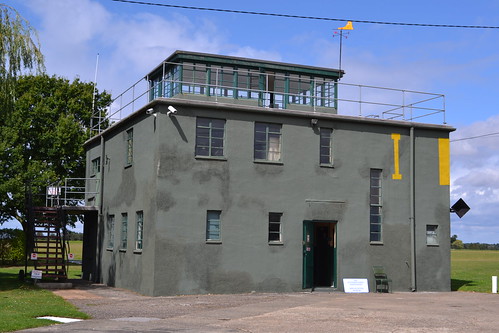
RAF Bury St Edmunds (Rougham) At Bury St. Edmunds (Rougham) the watch office is now restored and forms the main part of the museum.

There are numerous examples of other buildings on some of these sites, many are now part of small industrial complexes, workshops that were once used to repair aircraft parts now repair cars or other small items. Their original features often hidden by new cladding, overgrown weeds or a change in frontage. Slowly, but surely, they are gradually disappearing from our skyline.

The purpose of theses places was to wage war. In doing so many lives were lost, both military and civilian – on both sides. As a result, many heroic acts of bravery and self-sacrifice took place. The VC, the highest award given to members of the British armed forces for gallantry “in the face of the enemy”, was awarded to two pilots: Flt. Sgt. Arthur Louis Aaron, V.C., D.F.M. and Sqn. Ldr. Ian Willoughby Bazalgette (RAFVR) VC., both flying from RAF Downham Market. The American S.Sgt. Archibald Mathies, USAAF, 510th BS, 351st BG, was one of many Americans awarded the Medal Of Honour for his valour in combat whilst flying from RAF Polebrook, another was 2nd Lt. Robert E. Femoyer MOH, 711th BS of RAF Rattlesden, for his actions over Meresberg.

Losses were high both in combat and also during training. This year, I managed to visit several training stations of which two RAF Chaterhall and RAF Milfield had high losses of trainee pilots. Many are those are buried locally, and one delightful small church I visited at Fogo, had almost as many war dead as it did living inhabitants!
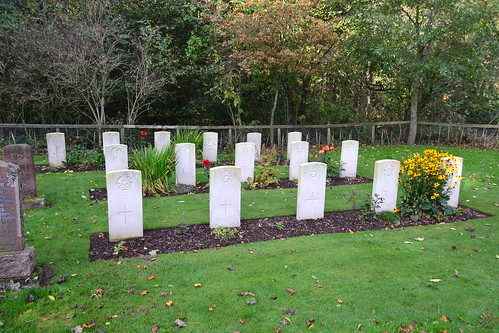
Fogo Church The church yard at Fogo has 16 war dead, most from the nearby training airfield RAF Chaterhall.

All in all its been a fascinating journey, I have entered the lives of many people who fought for what they believed in. I have read their stories, visited the very places they served at, and in many cases, the graves in which they now lie.  These decaying sites are the true monuments to their sacrifice. The buildings that once housed these young men stand as a lasting tribute to them, I hope that their memories never fade away in the way that many of these sites now have.

I’d like to thank you for taking the time to join me on this journey, I hope you have enjoyed reading about them as much as I have enjoyed visiting, researching and writing about them. I look forward to you joining me next year as we travel on many more trails around Britain’s disused airfields.

A Merry Christmas and a Happy New Year to all!

Andy.
RAF Brunton – A little known about airfield.

In this the second stop on our trip to Northumberland, we travel close to the North Sea coast not far from the eastern borders of England and Scotland. A small airfield, this was the satellite to RAF Milfield, and performed an important role in the Second World War. You cannot mention Milfield without reference to this airfield, and vice versa. Here we stop off at that little known about site RAF Brunton.

RAF Brunton.

Brunton is located some 3.5 miles to the south-east of Seahouses, a short distance from the Northumbrian coast. The village it takes its name from sits alongside the airfield, and is made up of a handful of buildings – primarily farmhouses. It is an open and flat area ideal for an airfield, and only a short flying distance away from its parent airfield RAF Milfield.

Brunton was designed as a satellite, and even though it was not a major airfield, it more than fulfilled the role of one. A constantly busy site, it somehow managed to ward off the high numbers of tragedies, losses and accidents that dogged Milfield and many other aircrew training facilities.

Brunton was conceived during the development of Milfield, when the need for another site was soon realised. The land on which Brunton stands was requisitioned in 1941, opening for business in early 1942. With its three runways forming an almost perfect equilateral triangle at its centre, it had a 50 yard perimeter track and twenty-five hardstands of the frying pan style. The longest of the three runways ran slightly off north-south, and was originally built to a length of 1,600 yards – it was later extended to 2,000 yards. The second and third runways, intersecting almost at their centre, were both 1,100 yards and were also extended but to 1,400 and 2,000 yards respectively.

RAF Brunton

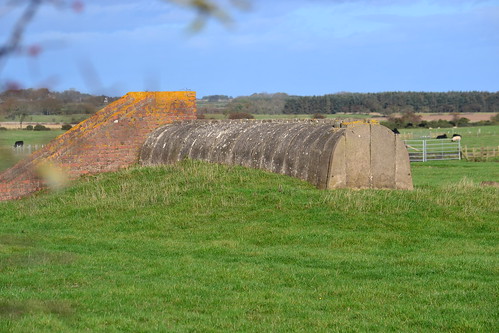
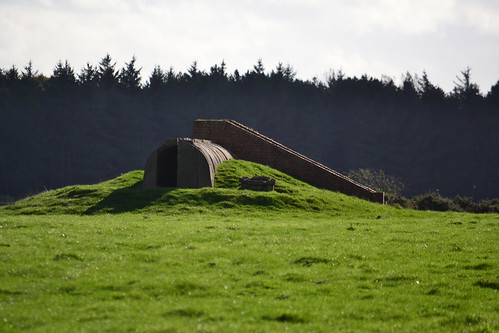
One of several exposed shelters at RAF Brunton.

Unusually, the accommodation areas were all closely tied together, a rare feature that placed them to the south of the airfield straddling the local railway (now the East Coast main line from which views can be seen as you pass by). Being a satellite, Brunton was only designed to accommodate small numbers of personnel, upward of some 750 men and women of mixed ranks.

As a satellite, there were no permanent hangars built, but four blister hangars were erected around the site, and used to maintain the aircraft. These Blister hangars (a name given to cover a wide range of arched aircraft shelters initially designed by architects and engineers, Norman & Dawbarn and William C. Inman of Miskins and Sons) were known as Dorman Long hangars, and were built to design 4630/42. At slightly under 72 feet in length they were 45 feet wide with a height of over 20 feet. Dorman Long hangars differed in design to other hangars by being constructed of four sections each held together by three RSJ type ribs, and ‘I’ shaped Purlins along the roof. These hangars were also bolted to foundations rather than staked to the ground like the more conventional blister hangars in use at that time. A similar hangar was used at RAF Sawbridgeworth in Hertfordshire – none of which survive today.

As a satellite, Brunton would work closely with its parent. It would be used in the second part of the 9-10 week pilot’s course to train pilots in formation flying, ground attack and strafing techniques. In the ground attack role, pilots would use a mix of rockets, bombs and cannon to destroy dummy convoys and strongholds. There were a number of ranges in the region providing targets for this particular role; Brunton aircraft predominately using the gunnery range at Goswick Dunes on which numerous ex-army vehicles, including Churchill Tanks, were placed.

Even before Brunton officially opened, it would witness a tragic accident in which it became the final resting place of one Whitley bomber, and three of its four crew. On November 6/7th 1941, whilst on a training flight, the MK. V Whitley (Z6932) of 10 Sqn, RAF Leeming, became lost in poor weather due to a failure of its navigation equipment. After landing on the partially built site, the Whitley took off again, heading south in an effort to locate its home base. As it lifted off, it struck a steam roller causing the aircraft to jolt and strike live high tension cables. The aircraft burst into flames and subsequently crashed. The Wireless Operator/Rear Gunner Sgt. Robert Whitlock, RAFVR (s/n: 163028) was pulled free by a crew from the local search light battery, but the remainder of the crew: Pilot F/Sgt. William Stuart RCAF, (s/n: R/60298) P/O. Richard. S. Austin, RNZAF, (s/n: 403785) and Observer Sgt. P. Bryant, RAFVR, (s/n: 976876), all perished. Bryant was a mere 23 years of age whilst Stuart and Austin were both just 21 years old.

Brunton’s opening in the summer of 1942, coincided with the start of operations at RAF Milfield, Brunton’s first residents would be 59 Operational Training Unit, a unit set up to train pilots for Fighter Command.

59 OTU operated the Hurricane, many of which were themselves veterans of the Battle of Britain. War-weary and battle-scarred, they were joined by a number of other aircraft types including Magisters and Fairy Battles. These flights would take the now adept pilots and train them to fly in formation and at low-level. A speciality would be to fly across the sea, at low-level, turn toward land and then strike at land based targets with bombs and canon or later rockets.

During the Spring of 1942 it was decided to allocate reserve squadron numbers to Operational Training Units, these numbers being in the range 551 – 566. The idea behind this plan – code name ‘Saracen‘ – was to create a series of squadrons that could be mobilised at a moments notice to counteract an imminent German invasion threat. The plans were later revised under the codename ‘Banquet‘ but would remain, in essence, in its original form well into 1944 before being seen as unnecessary, and so  withdrawn. At Brunton, 559 Sqn was allocated, (500 was generally added to the OTU number to create the reserve number) but the pilots of 31 Course, like many others, were never officially mobilised. However, Brunton was run as if it were a fully fledged operational squadron, the same rules and regulations, with two flights ‘E’ and ‘F’ both operating the Hurricane MK.I.

Flying with old and war-weary aircraft was difficult. Many would suffer engine fires, oil leaks or complete engine failures – some whilst in flight – and they rarely flew without the need for excessive trimming or constant adjustments to flying controls. These continuing problems would hound the pilots and ground crews for months, but undeterred they carried on, and morale remained particularly high.

RAF Brunton

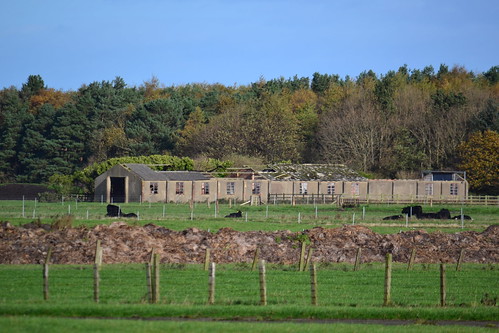
A very small number of buildings exist dotted about the former airfield. Thought to be the former flight offices, these examples are the largest.

On October 13th 1942, one of these Hurricanes would suffer from such a problem and its engine would fail causing the pilot to crash-land. A MK.I  Hurricane (P3524) it would be forced to land in a field not far from Alnwick, the county town a few miles to the south-west of the airfield. The aircraft was slightly damaged in the incident but fortunately the pilot, Sgt. C. Tidy (s/n 1042890), would walk away unhurt. In carrying out the controlled crash, Sgt. Tidy would steer his aircraft down missing a nearby school, but as he exited the aircraft, the documents he was carrying were scattered to the four winds. Wanting to do their bit, a local school master organised a search party with the boys in his care, and the documents were all gathered up and retrieved successfully. *1

Brunton, like Milfield, would have a high turnover of visiting aircraft. Many would come from Milfield, but some from much further afield to practice landings at night or as pilots transferred from one aerodrome to another. Some aircraft were also using Brunton as a safe haven, getting down after getting in trouble in the air. In March 1943 a Hurricane MK. I (W9121) of 59 OTU based at Milfield  crashed whilst on final approach at night to Brunton airfield. The pilot, Sgt. Cullener was very sadly killed in an event that was repeated in early 1944, when another Milfield 59 OTU Hurricane MK.I (P3104) also crashed on its approach to Brunton.

The dawn of 1944 saw 59 OTU along with the Specialised Low Attack Instructors School  (SLAIS) (also formed in 1942 at Milfield) disband, being replaced by a specialised unit the Fighter Leader School. The FLS was a unit designed solely to train pilots in the ground attack role and was set up primarily in preparation for the forthcoming Allied Invasion of Normandy. With this change so came a change of aircraft type, the Spitfire VB and MK IX now becoming the main aircraft operated in place of the Hurricane. The FLS would make great use of Brunton, training many pilots until it moved to Wittering at the end of 1944.

But not all staff would vacate Brunton in this move. A small detachment remained behind to give support to the build up of the newly reformed 56 Operational Training Unit who were brought together, both here and at Milfield, in place of the vacating FLS. This meant that the two sites would continue to operate very closely, but now using the heavier radial engined Tempests and Typhoons still in the ground attack role rather than the previous Spitfires and the now vulnerable Hurricanes of before.

The Typhoons came in with a number of teething troubles, one such attribute was the propensity to lose its tail plane during mid-flight, or the engine suffering a blow-back resulting in a fire in the engine or worse still in the cockpit. These issues were soon dealt with  though, and the Typhoon went on to become renowned as a ground attack aircraft, with its bombs or rockets proving devastating weapons in the role.

Av Typhoon IB JP853/SA-K of No 486 Squadron (Tangmere) (IWM CH 11578)

Brunton continued its close relationship with Milfield, supporting its 140 aircraft. Course No. 1 would begin in that January of 1945 and through it a large number of pilots would pass on their way to new roles in the European campaign.

Even as the war drew to a close accidents were still to happen and Brunton was no exception. In early January 1945, whilst being ferried from Milfield to Brunton Typhoon IB. (RB343) developed engine failure on take of at Milfield causing it to lose height and ultimately crash into the ground. The pilot, Canadian born P/O Nelson I. Gordon (J88818) was killed. Then just a month before the end of the war on April 9th, Tempest MK. V (EJ845) swung on take off at Brunton colliding with a wind sock. The accident took the life of another Canadian pilot, 32-years-old F/Lt. Ivan W. Smith (J22244) RCAF; he remains buried at Harrogate (Stonefall) Cemetery in Yorkshire along with over 1,000 other war dead.

Gradually though, the need for ground attack pilots diminished and Brunton, no longer required, was earmarked for closure. The war finally came to a close, and on February 14th 1946, 56 OTU were disbanded and the RAF pulled out of Brunton almost immediately. The airfield was now all but deserted.

After the war, for around 20 years, the Borders Parachute Centre occupied Brunton, until the land was sold, and the owner gave them notice to quit. Their lease ran out in 2004 and the club closed on the site. During this time a small contingent of RAF personnel were brought in when a radar facility was set up on the eastern side of the site. This too eventually closed though, and the personnel were pulled out. A small number of private pilots used the airfield to store and fly their aircraft from, it is believed they too have had to vacate the site, although this is not certain.

A large portion of the airfield still exists and in very good condition today. If travelling toward Brunton village you pass beneath the main East Coast main line railway, and on into the village. This road was the original entrance to the airfield, with the main technical area to your left. Now only farm buildings stand here, but the concrete pathway is still visible as it leads away to the main airfield site. Views across the airfield from this point offer little advantage, so turning back and driving along side the railway  down a single track, will lead you along the western side of the airfield and toward the back of the site. This is another original road and provides much better, but still limited, views of the site. The runways and perimeter track are present and many air raid shelters are also present along this western side. The remainder of the buildings from these various sites are now gone.

The small radar / monitoring dome is also still present but on the eastern side of the airfield, and although information about this is scarce, it was linked to nearby RAF Boulmer, and manned by RAF personnel. Boulmer which is currently the home of the Air Surveillance and Control System (ASACS) plays a key role in the home defence of the United Kingdom. Boulmer is linked to a number of monitoring stations around the British Isles and monitors, around the clock, an area of over one million square miles of airspace. This airspace stretches from the northern tip of Norway to as far out as Iceland and beyond, and encompasses the whole of the United Kingdom. With links direct to the QRA sites at RAF Coningsby, it monitors and tracks all aircraft activity around British Airspace, and in particular Soviet intrusions into this Airspace.

RAF Brunton

Another of the exposed shelters to along the western boundary. The taxiway of a short distance from here.

Brunton, whilst only a satellite, proved its worth during the Second World War. It trained numerous pilots in the art of ground attack techniques, and was pivotal in both the Normandy invasion and the drive on through occupied Europe. Visited by many commonwealth pilots, it was more ‘relaxed’ than other wartime airfields, but always maintained the highest of standards, operating as strictly and smoothly as any operational airfield of the Second World War.

Sources and further Reading.

*1 Article appeared in “The Northumbrian Times – No. 28” and was quoted in Walton, D. (1999), Northumberland Aviation Diary, Norav Publications.

The death of the Robson Children, 1st December 1943.

It was on Wednesday 1st December 1943, that a 75 Squadron Stirling MK.III (EH880)  piloted by F/S J. S. Kerr (s/n 1558163) would be diverted from RAF Mepal and instructed to land at RAF Acklington in Northumbria. On the final approach it undershot striking a family home in Togston near Amble. Inside the house, Cliff House Farmhouse, was the Robson family. The five children, ranging in ages from 19 months to 9 years of age, were all killed, whilst the parents who were playing cards downstairs, escaped with varying injuries. All but one of the Stirling’s crew were killed, the mid upper gunner Sgt K Hook, was pulled from the burning wreckage his burning clothes being extinguished by the local butcher, Jim Rowell.

This crash was the greatest civilian loss of life in the district,

The crew of Stirling EH880 ‘AA-J’ were:

F/S George John Stewart Kerr, RAFVR (s/n 1558163) – Pilot.
Sgt. Donald Frank Wort, RAFVR (s/n 1585034) – Navigator.
Sgt. Ronald Smith, RAFVR (s/n 1239376) – Air Bomber.
Sgt. Derek Arthur Holt, RAFVR (s/n 1217087) – Wireless Operator.
Sgt. Leonard George Copsey, RAFVR (s/n 1691471) – Flight Engineer.
Sgt. Kenneth Gordon Hook, RAFVR (s/n 1335989) – Mid Upper Gunner.
Sgt. George William Thomas Lucas, RAFVR (s/n 1250557) – Rear Gunner.

The Robson children were:

Sheila (19 months)
William (3 Years)
Margery (5 Years)
Ethel (7 Years)
Sylvia (9 Years)

The ‘Times’ Newspaper, published the story of 3rd December 1943:

Aircraft Crash on Farmhouse. Family of five young children killed.

Five children – all their family – of Mr and Mrs W. Robson were killed when an Aircraft crashed into Cliff House, a small dairy farm near Amble, Northumberland, on Wednesday night. The children’s ages ranged from one to nine years. They were sleeping in an upstairs room.

The mother and father, who with two friends Mr. and Mrs Rowell of Dilston [Terrace] Amble, were sitting in a downstairs room, were injured but not seriously. One of the crew of the aircraft, a gunner, was saved by Mr. Rowell.

Mr Rowell said last night: “We did not realise what had happened until the house collapsed above our heads. We managed to stand up, bruised and badly dazed, and, looking upward we saw the sky. Mrs Robson tried to make her way towards the stairs, which had been blown away. My wife called my attention to a burning object outside which was moving about.  We rushed over and found it was a gunner with his clothes alight. Mr Rowell rolled the airman on the ground to extinguish the burning clothes. Although badly burned, the gunner was alive.

The children’s partly charred bodies were recovered later.

Five streets on a housing estate near to the crash site in Amble have since been named after each of the Robson children. The crew are remembered on a plaque in St. John the Divine, the official church of RAF Acklington St. John.

RAF Waterbeach Museum.

Earlier this year I was able to visit the Waterbeach Military Heritage Museum located on the former RAF Waterbeach airfield; creating the museum has been quite an achievement and a very worthy cause. The museum contains many interesting photographs and artefacts relating to life at “the ‘Beach”, from its inception in 1940 right through to its final closure in 2013.

The current Museum was opened after the Army’s departure and the subsequent closure of the barracks. It is currently housed in Building 3 just inside the main entrance next to the former guard-house, and access is strictly controlled, and by prior arrangement only. It was created by the then curator, Oliver Merrington, along with a handful of local people who wanted to secure the future of the museum and keep the memories of Waterbeach alive for future generations. Mr. Merrington has since sadly passed away, but the volunteers continue the good work he put in place.

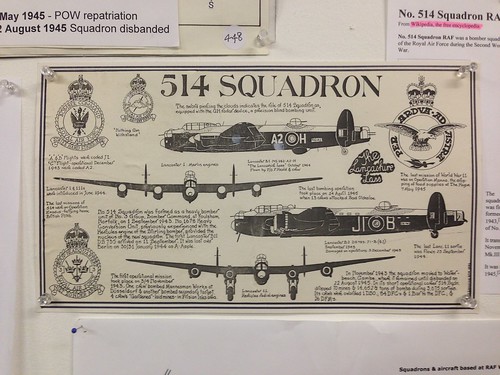
Whilst the museum is currently small, it holds a tremendous amount of information, all  of which is neatly displayed in cabinets and on the walls. Many original photographs are supplemented with official documents, personal stories, newspaper cuttings and artefacts, some of which relate to specific aircraft from Waterbeach’s history.

RAF Waterbeach Museum

Part of one of the many displays in the museum.

Whilst most of the displays reflect life at Waterbeach during the Second World War, various aspects reflect its post war life, both with the RAF and with the Army’s Engineer Regiment – the founders of the original Waterbeach Museum in 1984.

The two rooms of the museum are dedicated to all these people, taking you on a journey through the life of Waterbeach, starting with the sad First World War story of three brothers: Sgt. Jack Day, (1st July 1916), Private Walter Day (1st July 1916) and Private Clifford Day (13th August 1918). Like so many families of the war, their lives were all taken prematurely, two of which occurred on the first day of the first Battle of the Somme. The three brothers, whose ages ranged from 19 to 22 years old, were all local boys to Waterbeach, and like so many, left a family devastated by their loss. Two of the boys remain buried abroad but Walter, like so many other young men, has no known grave and remains missing.

From here the display takes us to Waterbeach in the 1940s, the story of its construction and design are told using photographs taken at that time. Representations of the various bomber squadrons who used the airfield are supported with operational details, personal stories and artefacts relating to individual aircraft that flew from Waterbeach during these early war years.

In the post-war period Waterbeach was transferred to the Transport Command and again photographs and documents show the range of aircraft that flew from here: Liberators, Dakotas, Lancastrians and Avro Yorks.

Into the jet age and we see a flying suit, and a canopy from Gloster Javelin XH871, which ended its days at Bovingdon as a fire fighting air frame. It is particularity significant as it previously served here at RAF Waterbeach in the late 1950s.

RAF Waterbeach Museum

One of the many exhibits on display at the Museum.

After the Royal Air Force departed the base was handed over to the Army, and a small number of exhibits represent their presence here at Waterbeach. The Royal Engineers finally departed the barracks themselves in March 2013.

Other exhibits on display here include: the weather vane from the station church (now demolished), the operations boards, astro-compasses, radios and telephone equipment, all neatly arranged inside glass cabinets. A detailed history of one of the former gate guards, Spitfire LF MK.XIVe ‘TE392’ which now flies with the Lone Star Flight Museum, Galveston, Texas, is also on view.

This is a delightful little museum that has been put together to pay homage to those who served at Waterbeach, either under RAF command or with the Royal Engineers. It is run by volunteers and relies on charitable donations to keep it running. Like many museums, it has limited opening hours, but the range of material is fabulous and it deserves a great deal of public support.

On a final note, my personal thanks go out to Adrian Wright who gave up his own time to open up and show me around the museum.

For details of opening times and other information the curator can be contacted via email at:  waterbeachmilitarymuseum@waterbeach.org

or via Facebook at: https://en-gb.facebook.com/waterbeachmilitaryheritagemuseum/


RAF Goxhill Watch Office moved to the States.

As many of our airfields and their associated buildings disappear, or fall into disrepair, its good to hear when one has been saved, refurbished or at least reused in a way that preserves its history and heritage.

Watch Offices of the Second World War are few and far between, many of those that do still remain are either derelict, business offices or thankfully museums detailing the history of the units, men and machines that once graced their surroundings.

In The Virginian Pilot magazine, it was revealed that former RAF Goxhill’s Watch Office has been dismantled brick by brick and shipped over to the Pungo area of Virginia Beach in the United States.

The founder of the Military Aviation Museum at the site, Jerry Yagen, wanted to relocate the Watch Office in a project that has taken eight years to complete.

After demolishing the building, it was removed and taken to its new home where it was painstakingly rebuilt and repainted in its original colours and design. Mike Potter, the museum’s director, explained how the project we set up and managed, and how once the outside is completed, the interior will be rebuilt using original photographs and where possible, original equipment.

RAF Goxhill, which was designated Station 345 by the Americans, was opened in 1941 and acted primarily as a training of combat crew and crew replacement centre. At its peak it held 1709 active personnel of which 190 were officers. Its runways (initially 1 x 1,600 ft and 2 x 1,100 ft) were extended later to 1,600, 1,500 and 2,000 feet, and covered in Tarmac.

Many new units that arrived on the U.K. from the United States would arrive at Goxhill and then be instructed in operational procedure and sent to their respective bases throughout the U.K. The first aircraft to arrive were the P-38s of the 1st Fighter Group, the oldest and most distinguished fighter group in the USAAF, having its origins in World War I. On July 9th, 1942, two of the Groups squadrons arrived, and the airfield was officially handed over to the Americans shortly after in August. It was at this time that the 52nd FG arrived here bringing Sptifire Vs, one of the few British built aircraft to operate under the Stars and Stripes of the United States Army Air Force.

Both the 1st FG and later the 71st Fighter Squadron operated out of Goxhill, and were joined in December 1942, by more P-38s of the 78th Fighter Group. In the following June, P-47s of the 353rd FG arrived before moving off to Metfield a month later.

Toward the end of the war, bomber pilots who had completed their tours of duty were sent to Goxhill to retrain as Fighter Pilots, the idea being to fly fighters ahead of the bomber formations and report back both weather reports and keep at bay any loitering Luftwaffe aircraft.

Eventually closed in 1953, Goxhill was perhaps more synonymous with the 496 Fighter Training Group, operating both the 554th and 555th Fighter Training Squadrons, serving both the Eighth and Ninth Air Forces. Also attached to this unit was the 2nd Gunnery and Tow Target Flight providing targets for gunnery practice by those crews passing through Goxhill’s doors.

Once open, the Watch Office will be open to the public explains Mike Potter, “this is as authentic as it gets”, he goes on to say, as warbirds from the Second world War taxi past in a moment that takes you back to the 1940s and the darkest days of the Second World War.

The story appeared in The Virginian – Pilot online May 10th 2017.

Australian Flt. Sgt. Rawdon H. Middleton VC (RAAF) 149 Sqn RAF

100641

Pilot Officer Rawdon Middleton (RAAF)*1

Middleton (s/n: 402745) was born on 22nd July 1916 in Waverley, New South Wales, Australia. Son of Francis and Faith Middleton, he was educated at Dubbo Hugh School. Nicknamed ‘Ron’ by his friends, he was a keen sportsman excelling at many sports particularly cricket and football. After leaving school, he worked as a ‘Jackaroo’ (cattle handler) until joining the Royal Australian Air Force on the 14th October 1940 under the Empire Air Training Scheme. He learnt to fly at Narromine, New South Wales and then was sent to Canada for further training in preparation for his posting to the UK. He finally arrived in Britain in September 1941, as a second pilot, and his first operational squadron was No. 149 Squadron RAF, who were flying Short Stirling bombers out of both Lakenheath and nearby Mildenhall in Suffolk.

P01019.003

Five student pilots from No. 7 Empire Air Training Scheme (EATS) course at No. 5 Elementary Flying Training School (5 EFTS) Narromine. They are left to right: Aircraftman (AC) Gordon Orchard; AC Douglas Scott; Leonard Reid; Pilot Officer (PO) Douglas Wilberforce Spooner (DFM); PO Rawdon Hume Middleton*2

Middleton’s first experience of operations, was in a Short Stirling over the Rhur, the industrial heartland of Nazi Germany. After spending a short time with 149 squadron he moved temporarily to No. 7 Squadron (RAF).

In July 1942, as first pilot, he was given his own aircraft and crew, it was also around this time that he returned to 149 squadron.

Their first mission together would be on July 31st, to bomb the strategic and heavily defended target, Düsseldorf. Middleton and his crew would continue to fly together and took part in other prestigious missions; namely Genoa on the 7th of November and his 28th mission, Turin on the 20th November. His 29th and final mission, would take place on the night of 28/29th November 1942.

In the early evening of the 28th he took off in Stirling BF372 coded ‘OJ-H’ as part of the raid on the Fiat works in Torino, Italy, along with 227 other aircraft which included – 117 Avro Lancasters, 46 Short Stirlings, 45 Handley Page Halifaxes, and 19 Vickers Wellingtons.

Middleton’s crew consisted of: Ft.Sgt. Leslie Anderson Hyder, Ft. Eng: Sgt. James Ernest Jeffrey, Bomb Aimer F.O. G. R. Royde, Wireless Operator: Sgt. John William Mackie; Gunners: P.O. N. E. Skinner, Sgt. D. Cameron and Sgt. H. W. Gough. Three of these had already completed their tour of 30 operations and could have left. However, their dedication to Middleton kept them together.

The mission would take the aircraft over the Alps and the Stirling, laden with bombs and fuel combined with having a notoriously poor ceiling, had to negotiate through the mountains rather than fly over them. A factor that often resulted in a high number of casualties.

Once over the target area, OJ-H was subjected to an extreme flak barrage. With poor visibility, Middleton had to make three passes over the target area to enable his crew to positively identify it. It was on the third pass that a shell burst hit the cockpit. The resulting damage was severe, and fragments had hit Middleton’s head badly injuring him. His right eye was lost and his skull exposed. There were further hits on the aircraft’s fuselage causing considerable damage to the control systems and airframe. Knocked unconscious by the blast, Middleton lost control and the aircraft plummeted through the skies to an altitude of around 800ft. The second pilot, Fl.Sgt. Hyder eventually managed to take the controls, release the bombs over the target and then pull the aircraft into a climb, safely reaching 1,500ft.

With his aircraft severely damaged, Middleton had a choice, get his crew to bail out over occupied France and certain capture, fly to Africa or head back to England; a journey that would last over 4 hours and put the aircraft at risk of attack and the crew in danger. Wanting to give them a fighting chance of getting home, he opted for the latter, and set a course for England.

SUK10501

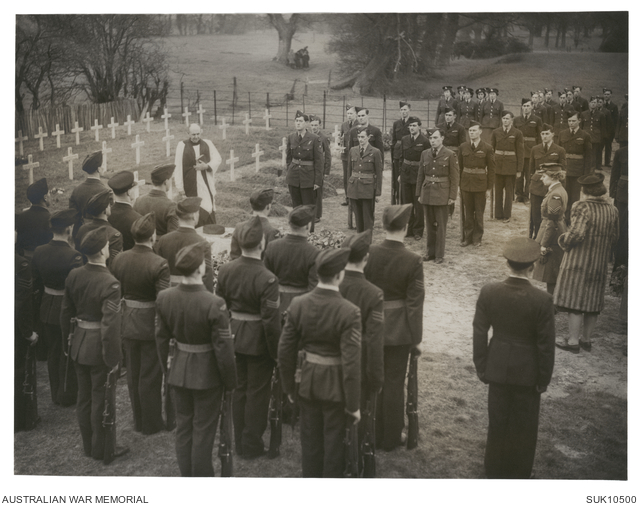
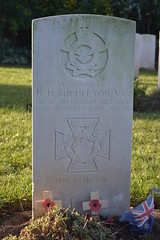
Middleton was buried with full military honours at St. Johns Church, Beck Row. Suffolk.*3

The aircraft experienced a number of attacks as they crossed occupied France, but Middleton, fighting for survival, kept reassuring the crew that he would get them home. Eventually, and against all the odds, they made the English coast, and once over land Middleton ordered the crew to bail out. Five crewmen left the stricken aircraft whilst the other two remained to help him control it. Turning for the Channel, Middleton ordered the two remaining crew members to bail out, whilst he stayed at the controls, steadying the aircraft.

By now the Stirling was very low on fuel and it finally gave up the fight and crashed at 03:00 on the morning of November 29th 1942. Middleton, too injured and too weak to escape the wreckage, drowned within the aircraft fuselage. His two crew members, Sgt. James Ernest Jeffrey (576050) age 19 and Wireless Operator Sgt. John William Mackie (994362) age 30, despite escaping, also drowned. Both the bodies of Sgt Mackie and Sgt. Jeffrey were washed ashore later that day on the 29th.

Middleton’s body remained in the aircraft, but was eventually freed from the wreckage by the action of the sea, and was washed ashore on Shakespeare Beach, Dover, in February 1943. His remains were taken to RAF Lakenheath and he was buried in St John’s churchyard, Beck Row, within sight of his airfield in Suffolk, with full military honours. Middleton was only 26 and only one mission away from ending his tour and returning home.

For his action, dedication and bravery, Flt. Sgt. Middleton was posthumously awarded the Victoria Cross, the first to any serving member of the R.A.A.F in World War II. He was also posthumously awarded a commission as Pilot Officer, backdated to mid November before his sortie to Turin. Thirty years later, in 1978, Middleton’s V.C. was presented to the Australian War Memorial, in Canberra for safe keeping and preservation.

For their actions, the other crew members received three DFMs and two DFCs. Fl.Sgt. Leslie Hyder (DFM) was injured, P.Officer. N. Skinner (DFC) was also injured, along with Sgt. H. W. Gough (DFM). F.O. G. R. Royde (DFC) and Sgt. D. Cameron (DFM) escaped unhurt.

The London Gazette published a report on 12th January 1943. It said:

“Fl. Sgt. Middleton was captain and first pilot of a Stirling aircraft detailed to attack the Fiat Works in Turin one night in November, 1942. Very difficult flying conditions, necessitating three low altitude flights to identify the target, led to excessive petrol consumption, leaving barely sufficient fuel for the return journey. Before the bombs could be released the aircraft was damaged by anti-aircraft fire and a splinter from a shell which burst in the cockpit wounded both the pilots and the wireless officer. Fl. Sgt. Middleton’s right eye was destroyed and the bone above it exposed. He became unconscious and the aircraft dived to 800 ft. before control was regained by the second pilot, who took the aircraft up to 1,500 ft. releasing the bombs, the aircraft meanwhile being hit many times by light flack. On recovering consciousness Fl. Sgt. Middleton again took the controls and expressed his intention of trying to make the English coast, so that his crew could leave the aircraft by parachute. After four hours the badly damaged aircraft reached the French coast and there was once more engaged and hit by anti-aircraft fire. After crossing the Channel Fl. Sgt. Middleton ordered the crew to abandon the aircraft. Five left safely, but the front gunner and the flight engineer remained to assist the pilot, and perished with him when the aircraft crashed into the sea”.

Funeral service for 402745 Flight Sergeant Rawdon Hume Middleton, the RAAF’s first VC winner. He was buried with full military honours in a country churchyard near his station. Air Vice Marshal H. N. Wrigley represented the High Commissioner for Australia (Mr S. M. Bruce) and the RAAF. The graveside service was conducted by Squadron Leader H. C. Thrush of Prospect, SA, RAAF Chaplain. (Australian War Memorial Public Domain)

Middleton’s citation read:

“Flight Sergeant Middleton was determined to attack the target regardless of the consequences and not to allow his crew to fall into enemy hands. While all the crew displayed heroism of a high order, the urge to do so came from Flight Sergeant Middleton, whose fortitude and strength of will made possible the completion of the mission. His devotion to duty in the face of overwhelming odds is unsurpassed in the annals of the Royal Air Force”.

In honour of Middleton’s bravery, Number 1 RAAF Recruit Training Unit at RAAF Base Wagga has renamed the club in his name, the “Middleton VC Club”, and he also appeared on one of the 1995 Australian 45c stamps. The dining hall located at the nearby (now American) base at RAF Mildenhall in Suffolk, has also been named in his honour.

St. John's Church Beck Row, Mildenhall Fl. Sgt. Rawdon Hume Middleton, VC (RAAF) 149 Sqn RAF, St. John’s Church, Beck Row, Suffolk.

Middleton was a brave and dedicated young man who gave his life to save those of his crew. Each and every one of them acted with the highest dedication, sadly for some, it cost them dearly.

Sources

*1 photo courtesy of Australian War Memorial, image 100641, Public domain.

*2 photo courtesy of Australian War Memorial, image P01019.003, Public domain.

*3 Photo courtesy of Australian War Memorial, Image SUK10501, Public domain

*4 Photo courtesy of Australian War Memorial, Image SUK10500, Public domain