Great Sampford – A disaster for the U.S. “Eagles”.

After leaving RAF Wratting Common, we turn south and head back past Haverhill towards Finchingfield. Reputedly one of the most photographed villages in England, it has a ‘chocolate box’ appeal, its quaint houses, old tea shops and village pond, reminiscent of Britain’s long and distant past. Finchingfield and this trail, are also close to the airfield at Wethersfield, and a short detour to the east, is an added bonus and a worthy addition to the trail.

This next airfield, a small satellite airfield, lies one and a half miles to the west of Great Sampford village, and five miles south-east of Saffron Walden. It is actually quite remote, with no public roads close to the site. Footpaths do cross parts of the former airfield, which is all now  completely agricultural.

As we head south we stop  off at the former airfield RAF Great Sampford.

RAF Great Sampford (Station 359)

RAF Great Sampford was a short-lived airfield, built initially as a satellite for RAF Debden, it would be used primarily by RAF Fighter Command, and later by the US Eighth Air Force. It was also used by 38 Group for paratroop training, and by the Balloon Command.

Being a satellite it was a rudimentary airfield, and accommodation was basic; utilising wooden huts as opposed to the more pleasant brick dwellings found at its parent station RAF Debden. It was very much the poorer of the airfields in the area, although by the war’s end a wooden hut would no doubt have been preferential to a cold, metal Nissen hut!

As a satellite it would be used by a small number of squadrons, No. 65 RAF, No. 133 (Eagle Squadron) RAF and No. 616 Squadron RAF. The famous Eagle Squadrons being manned by American volunteers, 133 Sqn was later renamed 336th Fighter Squadron (FS), 4th Fighter Group (FG), after their absorption into the US Army Air Force.

There were two runways at Great Sampford, one of grass and one of steel matting (Sommerfeld track), a steel mat designed by Austrian Expatriate, Kurt Sommerfeld. The tracking was adapted from a First World War idea, and was a steel mat that when arrived, was rolled up in rolls 3.25 m (10 ft 8 in) wide by 23 m (75 ft 6 in) long. It was so well designed that a full track could be laid, by an unskilled force, in a matter of hours. Each section could be replaced easily if damaged, and the entire track could be lifted and transported by lorry, aeroplane or boat to another location and then reused.

Sommerfeld track (along with a handful of other track types) were common on fighter, training and satellite airfields, especially in the early part of the war. It was also used extensively on forward landing grounds in Kent and later France after the Allied invasion of Normandy.

Tracking had to be robust, it had to be able to withstand heavy landings and be non-conspicuous from the air. Sommerfeld track met both of these, and other stringent criteria very well, although it wasn’t without its problems. Crews often complained of a build up of mud after heavy rain, and concerns over both tyre and undercarriage damage were also extensively voiced. Some records report tail wheels being ripped off after catching in the track lattice.

At Great Sampford the steel matting was 1600 yards long, extended later to 2,000 yards, the grass strip being much shorter at just over 1,000 yards. A concrete perimeter track circumnavigated the airfield, and due to the nature of the area the airfield took on a very odd shape indeed. With many corners and little in the way of straight sections, it may have suited the longer noses of the RAF’s Spitfires well, avoiding the need to weave continuously to see passed the long engine. However, because it was small and uneven, it caused numerous problems for pilots taking off, the hedges and trees proving difficult obstacles to clear without stalling the aircraft in an attempt to get above them.

Hangars and maintenance huts were also sparse, but four blister hangars were provided as the main structures for aircraft repair and maintenance.

Opened on 14th April 1942, the first unit to use the site was No. 65 (East India) Squadron RAF who arrived the same day that it was opened. No. 65 Sqn, being veterans of both Dunkirk and the Battle of Britain, had been moved about to regroup and refit, upgrading its aircraft numerous times before settling with the Spitfire.

The Spitfire VB of 65 Sqn (who were previously based at Debden) was a modified MK.V,  the first production version of the Spitfire to have clipped wingtips, a modification that reduced the wingspan down to 32 ft but increased the roll rate and airspeed at much lower altitudes. No. 65 Squadron, would use their Spitfire VBs for low-level fighter sweeps and bomber escort duties, something that suited the clipped wing version well.

Between April and July 1942, 65 Squadron would move between Debden, Martlesham Heath and Hawkinge with short spells in between at Great Sampford. They would then have a longer spell in Kent before leaving for RAF Drem in Southern Scotland. These repeated moves were largely in response to the threat of renewed Luftwaffe attacks on the airfields of southern England, and were part of a much larger plan put into place to protect the front line squadrons.
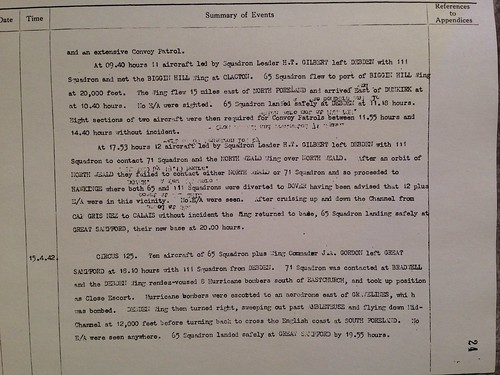
65 Squadron ORB Great Sampford

The entry in the Operational Record Book for April 14th shows the first landing of Spitfires at Great Sampford. (AIR 27/594/4)

On April 14th, the move took place, a move that was achieved under some difficulty as the squadron was called upon to participate in two Rodeo (fighter sweeps) operations. After extensive searching between Cap Gris Nez and Calais, no enemy aircraft were sighted, and so the wing returned to their various bases. At 20:00 hrs, the first 65 Sqn aircraft touched down at Great Sampford – the base was now open and operational.

The next mission would be the very next day – there was no let up for the busy flyers! “Circus 125” led by Wing Commander J. Gordon, consisted of ten aircraft from Great Sampford, who after taking off at 18:10, met with the bomber formation and escorted them to an airfield target near Gravelines. The entire mission was uneventful and the aircraft arrived safely back at Great Sampford at 19:55 hrs.

This mission pretty much set the standard for the remainder of the month. Numerous Rodeo and Circus operations saw 65 Sqn repeatedly penetrate French airspace with various sighting of, but little contact with, enemy aircraft. The first real skirmish took place on the 25th, when the Boston formation they were escorting was attacked by fourteen FW-190s. One of the Bostons was hit and subsequently crashed into the sea. Flt. Sgt. Stillwell (Red 3) of 65 Sqn threw his own dingy out to the downed crewman who seemed to make no effort to reach it – he was then assumed to be already dead.

On the April 27th, “Circus 142” took place, the escort of eight Hurricane bombers who were attacking St. Omer aerodrome. Three sections ‘Red’, ‘White’ and ‘Blue’ made up 65 Squadron’s section of the Wing, and consisted of both Rhodesian, Czech and British airmen. The Wing flew across the Channel at 15,000 ft, and when on approach to the target, they were attacked by 50-60 FW-190s. In the ensuing dogfight F/O. D. Davies, in Spitfire #W3461; P/O. Tom Grantham (s/n: 80281) flying Spitfire #BL442, and P/O. Frederick Haslett (s/n: 80143) in Spitfire #AB401, were all reported missing presumed dead. It was thought that both F/O. Davies and P/O. Grantham may have collided as they were together when they went down, P/O. Grantham was just 19 years of age.

There were no further losses that month although operations continued up until the last day. In all, 21 operations had been flown in which 2 enemy aircraft were destroyed, 1 was a probable and 1 was damaged. April proved to be a record month in terms of operational flying hours for every pilot below the rank of Squadron Leader, the successes of which though, were marred by the sad events of the 27th and the loss of three colleagues.

On the 28th, their last day of this, the first of several stays at Great Sampford, a congratulatory message came though from the Air Officer Commanding No. 11 Group, “Well done the Debden Wing”, which went some way to lighten the atmosphere before the new month set in.*1
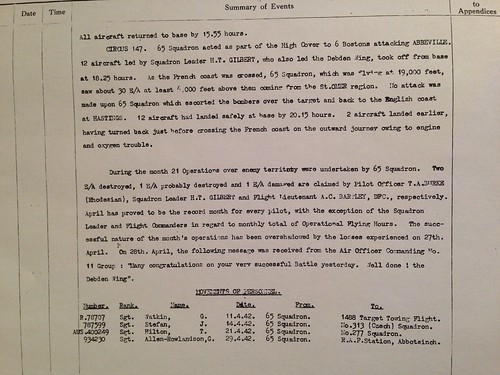
65 Squadron ORB Great Sampford

The Operational Record Book for 65 Squadron. A message of congratulations from the Air Officer Commanding No. 11 Group. (AIR 27/594/4)

It was three months later on July 29th 1942, that 65 Squadron would depart Great Sampford for the last time, and the next squadron would arrive, the Spitfire VIs of No. 616 Squadron RAF.

No. 616 Sqn were formed prior to the declaration of war in November 1938. An Auxiliary Air Force Unit, it too took part in supporting both the Dunkirk evacuation and the early days of the Battle of Britain. Now, at Great Sampford, it had been given the high altitude Spitfire, the MK. Vl, an attempt by Supermarine to tackle the Luftwaffe’s high altitude bombers, and quite the opposite to the VBs of 65 Sqn – these Spitfires had extended wingtips!

616 Squadron would, like 65 Sqn before them, spend July to September yo-yoing between Great Sampford and the airfields further south, Ipswich and Hawkinge, before departing Great Sampford for the final time on September 23rd 1942 for RAF Tangmere. Whilst here at Great Sampford, they would perform fighter sweeps, bomber escort and air patrols over northern France, engaging with the enemy on numerous occasions.

On the same day as 616 Sqn departed, the last operational unit would arrive at Great Sampford, the U.S. volunteer squadron, 133 Squadron known as one of the ‘Eagle Squadrons’. Being one of three squadrons manned totally by American crews, it had been on the front line serving at RAF Biggin Hill and RAF Martlesham Heath before arriving here at Great Sampford. Whilst some British RAF ground crews helped servicing and maintenance, the aircrew were entirely US, and crews were regularly changed as losses were incurred or crews were transferred out.

Many of these new recruits came in from other units. Ground crews coming into Great Sampford would have to get the train to Saffron Walden where they were met by a small truck who would take them to RAF Debden for a meal and freshen up. Afterwards they were transferred, again by truck, the few miles here to Great Sampford, the transformation was astonishing! In the words of many of those who were stationed here, “there was nothing ‘great’ about Great Sampford!”*2 Also flying Spitfire VBs, they were to quickly replace them with the MK.IX, a Spitfire that was essentially a MK.V with an updated engine. Having a higher ceiling than the FW-190 and being marginally faster, its improved performance took the Luftwaffe by complete surprise.

It would be a short-lived stay at Great Sampford though, as 133 Sqn RAF were disbanded on the 29th September, being renumbered as 336th FS, 4th FG, USAAF, and officially becoming US Air Force personnel. They were no longer volunteers of the Royal Air Force.

Just three days before this final transfer, on September 26th 1942, 133 Sqn would suffer a major disaster, and one that almost wiped out the entire squadron.

A small force of seventy-five B-17s from the 92nd BG, 97th BG and the 301st BG, were to mount raids on Cherbourg and the airfields at Maupertus and Morlaix, when the weather closed in. The 301st BG were recalled as their fighter escort failed to materialise, and the 97th BG were ineffective as cloud had prevented bombing to take place. The RAF’s 133 (Eagle) Sqn were to provide twelve aircraft (plus two spares) to escort the bombers on these raids. After refuelling and a rather vague briefing at RAF Bolt Head in Devon, they set off. Unbeknown to them at the time, the two pilots instructed to stay behind, P/O. Don Gentile and P/O. Erwin Miller, had a guardian angel watching over them that day.

During talks with P/O. Beaty, it was ascertained that the Spitfires had flown out above 10/10th cloud cover and so were unable to see any ground features, thus not being able to gain a true understanding of where they were. Added to that, a 100 mph north-easterly wind blew the aircraft far off course into the bay of Biscay. Finding the bombers after 45 minutes of searching, the flight set for home and reduced their altitude to below the cloud for bearings. Being over land they searched for the airfield, all the time getting low on fuel. Instead of being over Cornwall however, where they thought they were, they were in fact over Brest, a heavily defended port, and in the words of 2nd Lt. Erwin Miller – “all Hell broke loose.” *3

In the subsequent battle, all but one of 133 Sqn aircraft were lost, with four pilots being killed.  P/O. William H. Baker Jr (O-885113) in Spitfire #BS446; P/O. Gene Neville (O-885129) in Spitfire #BS140 – Millers replacement; P/O. Leonard Ryerson (O-885137) in Spitfire #BS275 and P/O. Dennis Smith (O-885128) in Spitfire #BS294.

Only one pilot managed to return, P/O. Robert ‘Bob’ Beatty,  who crash landing his Spitfire at Kingsbridge in Devon after he too ran out of fuel. During the crash he sustained severe injuries but luckily survived his ordeal. From his debriefing it was thought that several others managed to land either on the island of Ouissant or on the French mainland. Of these, six were known to have been captured and taken prisoners of war, one of whom, F/Lt. Edward Brettell  DFC was executed for his part in the Great Escape from Stalag Luft III. A full report of the events of that day are available in an additional page.

There would be no further operational flying take place for the rest of the month for 133 Sqn – all in all it was a disastrous end for them, and to their spell as RAF aircrew.*4

Pilot Officer Gene P. Neville 133 (Eagle) Sqn RAF, stands before his MK. IX Spitfire at Great Sampford. He was Killed during the Morlaix disaster. (@IWM UPL 18912)

Because these marks of Spitfire were in short supply, the remainder of the Squadron were re-equipped with the former MK.VBs, a model they retained into 1943 before replacing them with the bigger and heavier Republic P-47 ‘Thunderbolts’.

As a result of the losses, the dynamics of the group would change. The cohesive nature of the men who had been together for so long, was now broken and the base took on a very different atmosphere.

The effect on those left behind was devastating, morale slumped, and in an attempt to raise it, Donald ‘Don’ Blakeslee ordered the remaining pilots to line up along the eastern perimeter track and take off in formation; something that had been considered virtually impossible due to its short length, uneven surface and rather awkwardly placed trees along its boundary. Blakeslee, who became a legendary fighter pilot with both 133 Sqn and later the 4th Fighter Group (FG), led the group in true American Style, getting all the aircraft off the ground without any mishaps. Heading for Debden, they formed up, and flew directly over the station at below 500 feet, shaking windows and impressing those on the ground with precision flying that took as much out of the pilots as did air to air combat.

That night, the mess hall at Debden, was awash with celebrations as 133 Squadron pilots enjoyed the limelight they had for so long deserved.

On the next day, September 29th, the crews packed their personal belongings and departed Great Sampford for the comforts of Debden, where an official handover took place. General Carl Spaatz and Air Chief Marshal Sir Sholto Douglas, witnessing the official transfer of the three Eagle Squadrons to the United States Air Eighth Air Force, a move that on the whole, pleased the American airmen.

From then on, Great Sampford would remain under control of the USAAF, being used as a satellite for the 4th FG at Debden, but without any permanent residents. The occasional flight of Spitfires or P-47s would land here whilst on detachment or away pending a Luftwaffe attack. In the early stages of 1943, the Americans decided that Great Sampford (renamed Station 359 as per US designations) was no longer suitable for their needs as it wouldn’t accommodate either the  P-38s or the P-47s due to its awkward size and shape. By February 1943 they had pulled out, and Great Sampford was returned to RAF ownership. By March 1943 the airfield now surplus to flying requirements, was closed, used only by a large selection of RAF Regiments training in airfield defence, Guard of Honour duties and VIP Security. The station eventually closed in August 1944.

Airmen of the 336th Fighter Squadron, 4th Fighter Group with a clipped wing Spitfire Mk. Vb (MD-A), 1943. Handwritten caption on reverse: '19A. KP. Fall, 1942. Great Sampford Satellite Field. 336th crew by 336th Spit Mk. Vb. Wings clipped by sawing off wing & pounding in board then carving and painting it. MD-A, red/blue wheel. Source -Bill Chick, Megura.'

Airmen of the 336th Fighter Squadron, 4th Fighter Group with a clipped wing Spitfire Mk. Vb (MD-A), 1943. at Great Sampford. (@IWM – FRE3230)

However, this closure was not the end for Great Sampford. With paratroop operations progressing in Europe, the airfield was put back into use on 6th December 1944 by 620 Sqn in Operation ‘Vigour‘.

No. 38 Group, in need of practice areas, had acquired the airfield, and were dropping SAS paratroops into the site. This flight preceded another similar activity the following day where Horsa gliders pulled by 620 Sqn Stirlings, took part in Operation ‘Recurrent‘; a cross-country flight from RAF Dunmow in Essex. This flight culminated with the Horsas being released and landing here at Great Sampford. These activities continued throughout the appalling winter of 1944 / 45, and into the following months. In March, in the lead up to Operation ‘Varsity‘ the allied crossing of the Rhine, there was further activity in the skies of this small grass strip. Operation ‘Riff Raff‘  saw yet more paratroops and gliders at Great Sampford, whilst in November 1945, after the war’s end, Operation ‘Share-Out‘ saw the final use of Great Sampford by the paratroops. No. 620 Squadron, who had been based at RAF Dunmow, were now winding down themselves and their use of Great Sampford ceased virtually overnight.

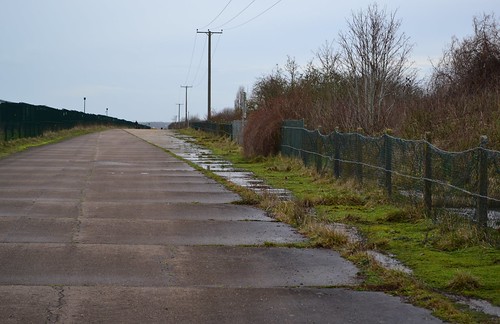
Since then, Great Sampford has become completely agricultural, the perimeter track virtually all that remains of this small but rather interesting site. It lies in a remote area, fed only by farm tracks and small footpaths. The tracks, now a fraction of their original size, still weave their way around the airfield as they did for that short, but busy time, in the mid 1940s.

Regretfully the airfield and its unique history has all but passed into the history books, and rather sadly, no memorial marks the airfield, even though many airmen were lost during  the many sorties in those dark days of the war-torn years of the 1940s.

We depart Great Sampford heading off once more, the airfields of Essex and East Anglia beckoning. As we move off, we spare a thought for those for whom this was the last view they had of ‘home’, and of those who never came back to this quiet and remote part of the world.

Sources and further reading

*1 National Archives: AIR 27/594/4 .

*2 Goodson. J,. “Tumult in the clouds” Penguin UK, (2009) 

*3 Price. A., “Spitfire – A Complete Fighting History“, Promotional Reprint Company,  (1974).

*4 National Archives: AIR 27/945/26

National Archives: AIR 27/945/25

The “Slightly-out-of-Focuswebsite has details of a photo essay documenting the planning and execution of an airborne exercise prior to Operation Varsity. It’s a detailed document which includes gliders of 38 Group RAF landing at Great Sampford.

Operation ‘Fuller’ – “The Channel Dash”.

On 12th February 1942, 18 young men took off on a daring mission from RAF Manston, in outdated and out gunned biplanes, to attack the German fleet sailing through the English Channel.

Leaving Brest harbour, a force of mighty ships including the Scharnhorst, Gneisenau and Prinz Eugen, attempted a break out, supported by sixty-six surface vessels and 250 aircraft, they were to head north through the Channel out into the North Sea and homeward to Germany where they could receive valuable repairs.

For many weeks the British had been monitoring the vessels awaiting some movement out to sea. Then,  German transmitting stations based at both Calais and Cherbourg, began a cat and mouse game transmitting false readings to interfere with British radar sets on the south coast. In mid February, the Luftwaffe organised themselves over northern France and the radars went wild with false readings and interference. Temporarily blinded by these measures, the British were unable to ‘see’ the mighty armada slip out into the Channel waters. Their escape had been a success.

The British, fearing such an attempt, had prepared six Fairy Swordfish of 825 Naval Air Squadron at nearby RAF Manston in readiness for the breakout. Ageing biplanes, they were no match for the Luftwaffe’s fast and more dominant fighters, nor the defensive guns of the mighty German fleet they were hoping to attack.

In front of their Swordfish, Lieut Cdr E Esmonde, RN, (2nd Left) on board HMS Ark Royal, October 1941. This photo was taken after the attack on the Bismark, and includes the various aircrew who received decorations as a result of that daring attack. (Left to right: Lieut P D Gick, RN, awarded DSC; Lieut Cdr E Esmonde, RN, awarded DSO; Sub Lieut V K Norfolk, RN, awarded DSC; A/PO Air L D Sayer. awarded DSM; A/ Ldg Air A L Johnson, awarded DSM). (© IWM A 5828)

In the cold winter of 1942, the Swordfish were kept ready, engines warmed and torpedoes armed, when suddenly and unexpectedly, at 12:25 on the 12th February, the fleet was sighted. They could no longer wait, and instead of attacking as planned at night, they would have to attack during the day, and so the order was given. The crews started their engines and set off on their daring and suicidal mission.

Shortly after take off, the escort arrived, merely ten Spitfires from No. 72 Squadron RAF, led by Squadron Leader Brian Kingcombe, and not the five Spitfire squadrons promised. The six Swordfish, led by  Lt. Cdr. Eugene Esmonde, dived to 50 feet and began their attack. Hoping to fly below the level of the anti-aircraft guns each of the six Swordfish flew gallantly toward their targets. Eventually hit and badly damaged, they pressed home their attacks, but they were out-gunned, and out performed, and just twenty minutes after the attack began, all six had fallen victim to the German guns. No torpedoes had struck home.

Of the eighteen men who took off that day, only five were to survive.

Leading the attack, Lt. Cdr. Esmonde was warded the V.C. Posthumously, he had previously been awarded the Distinguished Service Order for his part in the attack on the Battleship Bismark; an award that also went to: S/Lt. B Rose, S/Lt. E Lee, S/Lt. C Kingsmill, and S/Lt. R Samples. Flying with them, L/A. D. Bunce was awarded the Conspicuous Gallantry Medal and twelve of the airmen were mentioned in dispatches.

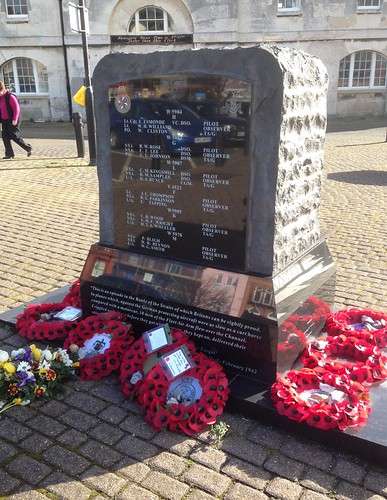
In their honour and to commemorate the brave attempt to hit the German fleet that day, a memorial was erected in Ramsgate Harbour, the names of the eighteen men are listed where their story is inscribed for eternity.

Operation 'Fuller'

The memorial stands in Ramsgate Harbour.

Operation 'Fuller'

The names of the 18 airmen and the Swordfish they flew.

January 1st 1945 – Loss of Mosquito PZ340

On the afternoon of January 1st 1945, Mosquito FB.VI #PZ340, ‘HB-Z’ took off from RAF West Raynham, according to the Operational Record Book it was assigned to a “high level bomber support” sortie over Heligoland, unusual as these Mosquitoes were not pressurised models. The pilot, F/O Ian George Walker (s/n: 156104) and navigator/wireless operator F/O. Joseph Ridley Watkins (s/n: 152875), had only just been brought together, F/O Watkins, from Wanstead in Essex, normally being based with 141 Squadron, but on attachment to 239 Squadron, when the flight took place.

On return, from the mission, the aircraft crashed near to Narford Hall, an Eighteenth Century stately home located a short distance to the north-east of RAF Marham in Norfolk. Whilst not confirmed, it is thought the crash was caused by an instrument failure, a crash that resulted in both airmen being killed.

Following the accident, F/O. Walker was returned to his home town and was buried in St. Michael’s Cemetery in Dumfries. F/O Watkins however, was buried locally, in nearby St. Andrew’s Church, Little Massingham not far from RAF Great Massingham. Both airmen were only 21 years of age.

The Mosquito, a Hatfield manufactured aircraft, was produced under contract 555/C.23(a), and was an aircraft designed for ‘intruder’ strike missions, it was the most commonly used variant of all Mosquitoes.  239 Squadron was in the process of replacing these examples with the MK. XXX before its disbandment on July 1st 1945.

Little Massingham St. Andrew's Church

F/O Watkins died on January 1st 1945 after the Mosquito he was in crashed near to RAF Marham, Norfolk. He rests in St. Andrew’s Church yard, Little Massingham.


Trail 50 – RAF Wratting Common – One of the best records of No. 3 Group.

In this next Trail, the 50th trail around Britain’s Wartime airfields, we continue looking at Bomber Command’s airfields around the Cambridge / Suffolk borders. Being a bomber base, this is another that operated both the ill-fated Stirling, and then later the famous Lancaster; it is also a base that had some of the best survival records of 3 Group, but it also paid the price that came with the Stirling.

Turning north-west from Haverhill toward the metropolis of Cambridge, we visit an airfield that is on one of the highest points in the eastern region, at just below 400 feet above sea level, it was cold and inhospitable in winter, but it was one whose pride and significant contribution shall live on. Here we visit the former Bomber Command base RAF Wratting Common.

RAF Wratting Common (West Wickham)

Wratting Common airfield opened in the latter part of the war, May 1943. It was initially named after the local village, West Wickham, which lies a couple of miles to the west. However, due to confusion with another airfield, it was renamed in the August, becoming known as Wratting Common, the name it retained, and used, for the remainder of the war.

Operating under No. 3 Group the losses from Wratting Common would be high, 260 personnel would lose their lives here, equating to almost eleven every month for the duration of its short two-year life. Many of these crews would be Short Stirling crews, the enormous bomber that would take an incredible amount of punishment, but suffered with a limited service ceiling and a weak undercarriage that led to numerous accidents whilst landing or taking off.

Wratting Common was opened in May 1943, under the Class A specification. Three concrete and wood chip runways were built to 2,000 yards and 1,400 yards respectively. A perimeter track joined the three runways and housed 36 spectacle hardstands for aircraft dispersal. Repairs were carried out in one of five hangars, four T2s and one B1, mainly located to the north and west of the airfield. To the south lay the bomb store, and the site had the usual range of standard design buildings. The watch office was of the 12279/41 design, a design adopted by all major airfields by the end of 1943.

RAF Wratting Common

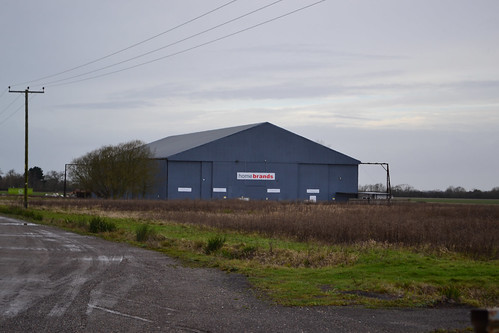
The only B1 hangar built at Wratting Common still survives today.

Designed to take just over 2,000 males and 348 female staff, it had 10 domestic sites  spread about the northern side, these would receive in the region  of 2,500 males of various ranks and 486 females, numbers fluctuating as crews invariably failed to return home and units came and went.

As it was a short-lived airfield, it would have only two operational front line squadrons, No. 90 and No. 195, although other units did use the airfield including: No. 24 Heavy Glider Maintenance Section, No. 273 Maintenance Unit, No. 1552 Radio Aids Training (RAT) Flight (No 2 Section) and No. 1651 Heavy Conversion Unit (HCU).

The opening of the airfield was preceded by the arrival of S/Ldr. W. K. Young , who took early control of the site and oversaw the final preparations for the forthcoming crews. Between April and May, construction was completed, defences were set up, and by the end of May the first operational aircraft began arriving. A handover saw a new and permanent Station Commander take over, a change that saw operational sorties begin within a matter of days.

No 90 Sqn, a first World War squadron, had been absorbed by 17 OTU in 1940, and then reformed again in May 1941. They served for almost a year being the only RAF unit at that time to fly the B-17 before being disbanded once more. This pattern of reforming and disbanding was one that 90 Sqn would perform almost perpetually.

Reforming again in November 1942 at RAF Bottesford, they began operations with the Stirling MK.I, transferring to RAF Ridgewell in December where they began to receive the MK.III. Arriving here at Wratting Common, in the last days of May 1943, they would remain here until the October that year before moving off to RAF Tuddenham,

During these five months 90 Sqn would lose 185 aircrew, a figure testament to the problems with the Stirling but also to the dedication of the crews to ‘get the job done’.

The first sortie took place on the night of 3rd/4th June 1943, when ten aircraft carried out a mine-laying mission off the Biscay ports. A rather uneventful mission, it would be one of the few where all aircraft returned safely.

With Bomber Command’s Battle of the Ruhr approaching its final chapter, 90 Sqn would suffer their first casualties on the night of June 21st/22nd, 1943. It was a mission to Krefield, a mission that saw 705 aircraft drop 2,306 tons of bombs on the town destroying almost half of it. It was the largest area of devastation so far of any mission and was preceded by an almost perfect marking from the RAF’s Pathfinders. The night was marred by high losses though, just over 6% of the force being lost, many as a result of night-fighter action. Of these, 90 Sqn got off lightly losing only one aircraft, Stirling MK.III ‘WP-T’ with the loss of all seven crewmen, a crew that included both an Australian and a Canadian airman.

RAF Wratting Common

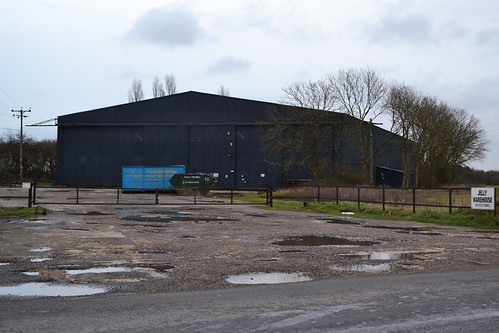
One of the remaining five T2 Hangars still in use at Wratting Common.

By the 26th, just four days later, another five aircraft had been lost with only four survivors; a hefty blow that took the lives of thirty-one airmen whilst in their prime.

A new month proved little better, on the night of 3rd/4th July, three more aircraft would be lost, one ‘WP-F’ returning beaten up overshot the runway without thankfully, loss of life. The remaining two aircraft were lost over Belgium and Germany, with only one crewman surviving, captured by ground forces and surviving as a POW.

July would see a both further losses and 90 Sqn returning to Hamburg no less than three times before the month was over. Bomber Command’s tactic of area bombing would now turn from the industrial heartland to the city of Hamburg, and its enormous ship building works. Hamburg would of course become well-known for a number of reasons, the destructive firestorms that would devastate the town, the first joint efforts of the USAAF and RAF, and the use of ‘Window‘ for the first time.

Surprisingly during these raids, 90 squadron would have a rather uniquely ‘clean bill of health’, especially considering the nature of the target. Hamburg would not be easy, attacking at heights of around 13 – 16,000 feet, they would be dropping a mix of high explosive and incendiary bombs, well below the height of other squadrons. On the first night 24th/25th July, all 90 squadron aircraft would return to base, a night that was followed by the loss of one aircraft (Stirling ‘WP-S’) to Essen, before they returned to Hamburg on the 27th/28th.

The loss of this Stirling ‘S-Sugar’ was significant in that it was piloted by the Squadron Leader, S/L. Joseph Dugdale DFC, (s/n 39071). Presumed lost over the sea, the aircraft also had two New Zealanders and an Australian on board, one of which was washed up on the Norfolk coast along with two other members of the crew.

After attacking Hamburg, and damaged by flak, Stirling BK693 ‘WP-A’  would limp back to England landing at nearby RAF Stradishall, where it swung off the runway hitting another Stirling parked at a dispersal. The only 90 Sqn loss that night, it would set a precedent for the third and final attack of the month. Returning the next night, 777 aircraft would fly in from the north of the city, attacking areas so far not damaged by allied bombing. This raid would not be considered one of the RAF’s most ‘successful’ though, the bombing ‘creeping back’ some four miles into residential areas with huge loss of civilian life. Of the 119 Stirlings sent out that night, only four were lost, the only casualty of 90 squadron being ‘WP-F’ which took off at 22:00 hrs, crashing out of control without loss just after.

These light casualties, gave 90 Sqn one of the best records of No. 3 Group, a record that continued to the end of July and the closure of the Battle of the Ruhr.

At the end of July, Wratting Common was visited by an American airman. In rather less than ideal circumstances, Major William Julian of the 83rd FS, 78th FG, based at  Duxford, made a  wheels up landing in his battle damaged P-47 #41-6628, ‘HL-R’. The aircraft would eventually be recovered and repaired only to suffer a similar fate later on. July had been a busy month at Wratting Common!

August 1943 brought the change of name to the airfield, but no change in operations. Missions included Nuremberg, another return to Hamburg, Turin (famous for the VC awarded to Flt. Sgt. Arthur Aaron), and now for the first time, the rocket research establishment at Peenemunde. It was also a time when Sir Arthur Harris turned his attention to Berlin, the heart of the German Reich. A city heavily defended and a long way into occupied Europe, it was going to be difficult for Bomber Crews, and 90 Squadron’s run of luck could be about to falter.

During the short period of late August and early September 1943, 1,600 sorties would be flown to Berlin, and if the German’s determination to survive was going to be seen anywhere, it was going to be in their fearless defence of the capital.

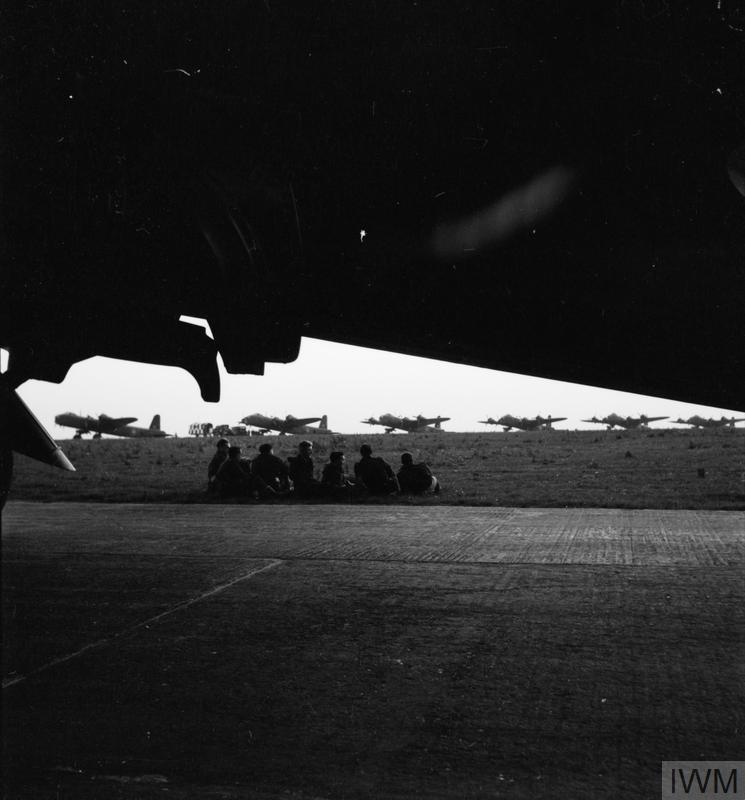
The crew of a Short Stirling Mk III, No. 90 Squadron by their aircraft on a hard stand north of the main runway at Wratting Common, watch as other Stirlings of the Squadron prepare for the night’s operation, a raid on Berlin. (@IWM CH10900)

On the first night of August 23rd/24th 1943, two 90 Squadron aircraft were lost, one ditching in the sea just off the coast near Cuxhaven north-west of Hamburg. After spending 7 days, 16 hours and 10 minutes in their dingy, three of the crew were rescued, the remaining four having been killed*1.

A second Stirling, EH937 ‘WP-S’ was also lost that night. Piloted by Flt. Sgt. Kenneth Longmore, (s/n 413622) an Australian and hairdresser by trade, it crashed in the Ilsselmeer, a stretch of water north of Amsterdam. The aircraft, along with all its crew, were lost at 20:37, three being killed and four classified as ‘missing’.

The path to Berlin was lit by Pathfinders, and of the 727 aircraft sent, 124 were Stirlings, the loss rate for the mission being just short of 8% in total.

The crew of a Stirling are debriefed by an intelligence officer after the costly night raid on Berlin, 23/24 August 1943. © IWM (CH 10804) Can you identify any of these men?

A further loss of a single aircraft on the night of 27th/28th August led to a return to Berlin, and another night of heavy losses for Bomber Command. The Stirling loss rate alone being 16% of the force. Luckily 90 Squadron themselves came off ‘lightly’ once more, losing only one aircraft that night, Stirling MK. III ‘WP-Q’ piloted by W/O. Martin P. Callaway RAFVR, (s/n: 155479), who was only 20 years old.

A third raid to Berlin, saw the withdrawal of both Stirlings and Halifaxes from these duties, their losses being too high compared to those of the Lancaster. The Germans now employing a range of tactics to illuminate the night sky, allowing the night fighters to pick the bombers off almost at will.

There then followed a period of relative calm, until at the end of September, when on the night of 22nd/23rd, 90 Sqn returned to Hannover. A raid that would perhaps be recorded as one of their worst. Between 18:50 and 18:54, three aircraft would depart Wratting Common, one ‘WP-K’ would not get far, its starboard engine catching fire shortly after take off causing the laden bomber to explode at a height of 500 feet. All but one of the crew were killed instantly, whilst the seventh, F/S. Duffy, later died from his injuries.

Of the remaining two aircraft, one was brought down by night fighters over the target, with the loss of all on board, and the third, badly beaten, limped backed to England crashing at RAF Lakenheath in  Suffolk. Two crewmen survived as prisoners, parachuting from the aircraft after confusion arose when the pilot lost control of the Stirling – the remainder of the crew being either killed or injured. For airmanship and courage Sgt. Jones was awarded the Conspicuous Gallantry Medal whilst W/O Denton was awarded a DFC, and Sgt. Suddens a DFM.

By October 1943 the Stirling’s days were numbered, and orders had come through for 90 Sqn to depart Wratting Common for RAF Tuddenham. Crews began to pack and aircraft were readied for their eventual departure. On the 12th a final air test would be carried out on Stirling EP426 ‘WP-W’  and it would not go well. A full crew watched aboard as the pilot W/O. George R. Hilton(s/n: 158247) RAFVR tried to land the aircraft with the starboard outer engine feathered. The landing was a disaster and the resultant crash killed all but one of the crew, Sgt. J. Moran the rear gunner being injured. With that 90 Sqn departed Wratting Common taking with it a record that was one to be proud of, but as part of Bomber Commands overall  strategy, it certainly had paid a high price.

For around six weeks the airfield was, flying wise, very quiet, final departures and preparations for new arrivals were made. At the end of November a new unit would arrive, bringing back the mighty Stirling to this open and cold station once again.

RAF Wratting Common

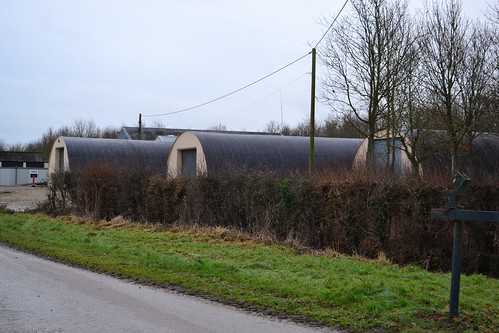
Nissen huts once used by technical staff are now part of the farm complex.

1651 Heavy Conversion Unit (HCU) were one of three such units still operating the Stirling, the remainder having switched to Lancasters or Halifaxes previously. Whilst at Wratting Common, 1651 HCU would convert crews to four engined heavies, a task much-needed as the toll of recent attacks on the German heartland was beginning to bite. Now withdrawn from front line bombing duties, Stirling crews were feeling a little pushed out, often left by the crews of Lancasters and Halifaxes who rose to the higher levels to avoid the fighters and flak. The conversion to Lancasters by Bomber Command was long and slow, the poor winter of 1943/44 playing a large part in its delay, restricting flying hours and crew training. Once ‘passed’ on Stirlings, crews would go to Lancaster finishing Schools, honing their skills on a much more adored aircraft.

The HCU would remain here for a year, suffering its own share of problems and accidents. Within the first week one Stirling would crash just 20 minutes after take off whilst on an emergency approach to nearby RAF Downham Market.  After losing power the aircraft spun violently crashing into the ground. Thankfully and very remarkably, all the crew escaped with minor injuries.

In June 1944, the renowned undercarriage of the Stirling would lead to problems for the ground crews of Wratting Common. On the night of 6th June, Stirling BF473 landed on the runway at Wratting Common whereupon its port tyre burst. On departing the aircraft, leaving it to the ground crews to recover, the crew left and headed back for their debriefing. Just a few minutes behind them though, was Wellington JA619 of 69 Squadron at RAF Northolt. Suffering engine trouble, the Wellington made an emergency approach unaware of the huge obstacle that lay ahead. The two aircraft collided, creating a huge fireball that took both RAF and local fire crews several hours to extinguish. In the incident, two of the Wellington crew received injuries and a further two were killed, their bodies were not recovered until the next morning after the fire had been put out.

Further training and minor accidents continued, July 1944, saw one major loss with the crash of Stirling MK.III LK565 ‘QQ-R’. Whilst banking, the pilot F/S. DH Wilson lost control of the aircraft causing it to crash killing all eight on board; the eighth man being an additional navigator.

The year progressed and more crews were turned out. Spares for the Stirling became scarce and eventually the HCU was itself to convert to the Lancaster, the Stirlings later being disposed off. With that, 1651 HCU pulled out of Wratting Common leaving only a front line Lancaster Squadron, who arrived eight days previously, the  only operational unit using Wratting Common.

195 Sqn, previously a Typhoon Squadron, had reformed at Witchford from ‘C’ flight of 115 Squadron. Flying the Lancaster MK.I and III, it arrived at Wratting Common on November 13th 1944, staying until August 1945 where upon it was disbanded.

By now the RAF bomber crews had all but total control of the skies, carrying out a number of raids in daylight such was the state of the German defences. With attacks on Merseburg, Dortmund, Oberhausen and Hamm, losses were low, around 1%, considerably lower than figures previously seen. The high morale of bomber command was about to take a battering though, in the daylight raid on the 12th December 1944 on Witten, a town that had seen extreme violence on the night of Kristallnacht of 9th/10th November 1938.

During the raid a force of 140 Lancasters from 3 Group attacked the steel works of Ruhrstahl, which made steel used in the production of aircraft, tanks and other armaments. In the attack, nine Lancasters were lost and the steel works were missed by bombs. Of these, 195 Sqn lost four Lancasters: HK697 ‘A4-C‘; NG351 ‘JE-E‘; PB112 ‘JE-H‘ and PB196 ‘JE-D‘. One crew survived a crash landing, two other crewmen were taken prisoner but the remainder were all killed – a terrible night for Bomber Command and for 195 Sqn in particular.

As the war neared its conclusion further raids were carried out, losses fell as defences weakened, a mix of both day and night sorties saw operations to Munich, Duisburg, Dortmund, Dresden and once again Berlin. 195 Sqn’s last operational bombing sortie took place on April 24th 1945, following which they took part in Operation ‘Manna‘, dropping food supplies to the starving Dutch people.

After this, 195 Sqn began the operations to bring home the many POWs in Operation ‘Exodus’, a task they took great pride in. On May 7th 1945, the last flight took place from Wratting Common and the squadron was disbanded on August 14th. No longer required, Wratting Common airfield was closed, and within eight months its hangar doors were shut for the final time, the site then returned to agriculture a state in which it survives in today.

RAF Wratting Common

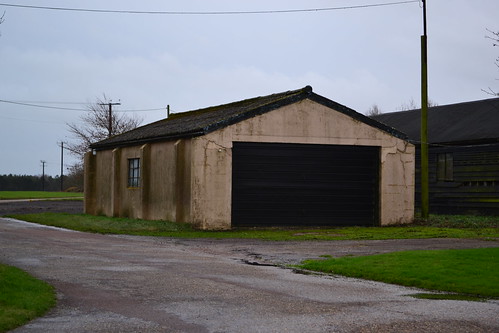
One of the few permanent buildings left on the technical site.

Wratting Common was a short-lived airfield, its crews took part in many of Bomber Command’s most fierce-some air battles, losing a large number of men in the process. Whilst not the enormous toll we’ve come to expect from bomber squadrons, it none the less suffered the terrible injustices of war, and the loss of life that scarred so many families for so long. Long may they be remembered.

The efforts of the many Bomber Command crews were never forgotten though, and land owned by the Vestey family was donated for a memorial that was organised through the efforts of numerous people. Some of the original buildings have been refurbished and are now used by the local farm, several of the hangars remain also in use by local companies, by using them they are at least preserving them.

If approaching from the Haverhill direction, the first structures you see are the two hangers, a T2 and a B1, either side of the road. The B1 to your left and the T2 to your right, both linked across the road by a former track and dispersal point. There would have been four spectacle dispersal points here, all now removed. A footpath near to this point does cross part of the airfield site, allowing some access to remnants of the perimeter tracks. Continue along this road and then turn right, you will then come across Weston Woods Farm. This is the former entrance to the airfield site and here stands the memorial and a number of buildings owned by the farm. In the distance, you can see a further T2, and a small group of Nissen huts again owned by the farm. This area was once the technical area, stores, Motor Transport huts and a range of technical buildings were plentiful in the late 1940s. Now reduced to nothing more than a handful, they are reminders of the days when the RAF’s heavy bombers graced the site.

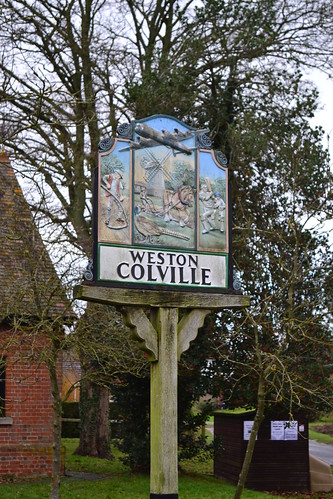
A short distance along the road from here was the operations block (now gone) and turning left at the junction, the first of the domestic sites – Site 7. The road between here and the nearby village of Weston Colville are where the majority of these site stood, the basic concrete entrances being the only significant indication of anything being here. The village sign at Weston Colville displays a Stirling indicating its links to the airfield and the domestic sites that once stood on this ground.

With little of this site remaining, a handful of buildings, the memorial and a well designed information board, keep the history of those young men who flew from here in the few short years of its existence alive, their stories shall live on as will the memories of the fight they took deep into the heart of the Nazi homeland.

From Wratting Common we head south again, turning back on our tracks and returning toward Haverhill. From here we continue on with our trail around Britain’s airfields and back once more into the counties of Suffolk and Essex.

RAF Wratting Common

Weston Colville village sign depicts its links with Wratting Common, the village being home to the many domestic sites of the airfield.

Sources, notes and further Reading.

*1 Chorley., W. R., “Bomber Command Losses 1943“, Midland Counties Publications, 1996.

A book of remembrance is thought to be in St Mary’s Church, West Wickham. Sadly on the day I visited, the church was unusually locked.

A website dedicated to those who flew from Wratting Common has a lot of additional information and photographs, it is certainly worth a visit.

RAF Stradishall – Disaster for 214 Squadron

In the second part of RAF Stradishall, we carry on from part 1, looking at the terrible circumstances around 214 Squadron’s worst night. The developments of Stradishall in the later war years and the post war development with the arrival of the Cold War and the jet age.

The raid would be to Hanau railways yards located 25 km east of Frankfurt am Main. During the raid thirty-five Wellingtons and fourteen Hampdens from  both 57 Squadron (RAF Feltwell) and 214 Sqn (RAF Stradishall) would be dispatched. Take off was between 20:00 and 21:00 hrs and the attack by 214 Sqn would be carried out at heights as low as 400 feet using a mix of 250 lb and 500 lb bombs with impact fuses and some 3 hour delay fuses. During the attack, railway lines, bridges and carriages were hit, explosions were seen and the gunners strafed stationary trains and gun positions. The bomb aiming and shooting was reported as ‘good’.*3

However, of the fourteen 214 Sqn Wellingtons that left, seven were lost and a further Wellington was hit in both engines by light flak the pilot nursing it back to England. Of those seven lost, one airman, Sgt. C. Davidson was taken prisoner of war, four have no known grave and the remaining thirty-seven all died, and remain buried in graves across Belgium and Germany. Truly a terrible night for 214 Sqn. 57 Squadron fared little better, losing five aircraft with the deaths of twenty-five airmen, the remaining five being taken prisoner.

Further losses that month were restricted to just odd aircraft with the last loss being recorded on the night of 28th/29th April, with all crewmen being lost. Before the month would be out, 214 would begin the conversion to Stirlings, a new start and a new challenge.

The Stirling would prove to be a robust but under performing aircraft, its short wingspan and subsequent lack of lift, proving to be its biggest downfall. 214 Sqn would, during the conversion programme, write off nine aircraft, much of this though being as a result of operational activity, some however, due to pilot error or accidents. The first incident occurring on May 5th, 1942, approximately one week into the programme, when Stirling N6092 piloted by F/O. Gasper and Sgt. M Savage, swung on take off resulting in its undercarriage collapsing.

In the October 1942, 214 Sqn would leave for the final time, moving off to Stradishall’s satellite airfield, RAF Chedburgh, where they remained until December 1943. Following this they transferred to RAF Downham Market. The last loss of a 214 aircraft at Stradishall being on the night of September 19th/20th with the loss of Stirling ‘BU-U’ R9356 along with four of the seven crew, the remaining three being taken prisoners. By the end of 1942, 214 Sqn would have lost thirty-three Stirlings, twice that of the Wellington, all-in-all a huge loss of life.


RAF Stradishall

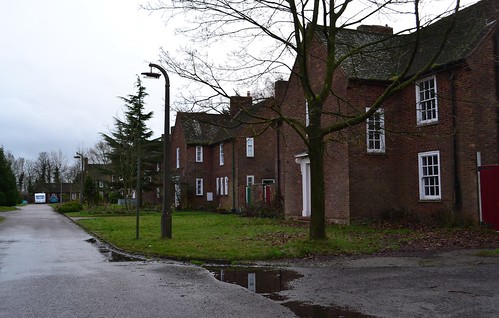
Former Married quarters are now private dwellings, but still retain that feel they had when they were first built.

The December of 1944 not only saw the departure, for the last time, of the Stirling as a heavy bomber, but it heralded the arrival of the Lancaster, the remarkable four-engined bomber that became the backbone of Bomber Command. In total 7,377 of the bombers were produced, including 430 that were constructed in Canada. A remarkable aircraft born out of the much under-powered and disliked Avro Manchester, it went on to fly over 156,000 sorties, dropping over 50 million incendiary bombs and over 608,000 tons of HE bombs.

186 Sqn would be the first unit here with the Lancaster both the MK.I and the MK.III, operating them in a number of missions over occupied Europe.

One of the saddest ends to the war and the operations of 186 Squadron was on the night of April 134th/14th. Whilst returning from bombing the U-boat yards at Kiel, two Lancasters: P8483  ‘X’ and P8488 ‘J’ collided at 02:26. Five of the crew from AP-X were killed, either instantly or as a result of injuries sustained, whilst all seven of AP-J lost their lives. This loss would account for a high proportion of the squadron’s losses, 186 Sqn only losing nine Lancasters in the six months of residency – a considerable change to the carnage suffered at Stradishall earlier on in the war. 186 Sqn would finally be disbanded here in July 1945.

Over the next four years, there would be a return of both the Stirling and the Lancaster, but this time in the transport role, as Stradishall was passed over to Transport Command. No. 51 Sqn, and No. 158 Sqn both flying Stirlings (158 Sqn being disbanded at Stradishall) 35 Sqn, 115 Sqn, 149 Sqn and 207 Sqn all operating various models of the Lancaster until February 1949.

There would then be a lull in operations at Stradishall between April and July 1949 whilst the airfield was put into care and maintenance. Following this 203 Advanced Flying School (AFS) moved in with a range of aircraft types, including the Meteor and the Vampire. Also thrown into the mix were a number of piston engined aircraft, notably the Spitfire XIV, XVI and XVIII, along with Tempests, Beaufighters and Mosquito T3s. Other training aircraft also came along covering everything from the Tiger Moth to the modern jet fighter. A new age was dawning.

On the night of August 31st and September 1st 1949, 203 AFS and 226 Operational Conversion Unit (OCU) at Driffield, would both disband and reopen under each other’s titles, the new 226 OCU now operating as the training unit converting pilots to jet aircraft.

RAF Stradishall

To the left was the main airfield now covered by a solar farm, to the right would have been the hangars, the original apron concrete still visible.

The post war years of the 1950s would see Stradishall thrown back into front line operations once more, this time there would be no heavy bombers though, but there would be plenty of front line fighters.

First along were the night fighter variants of the Meteor (NF.11) and Venom (NF.3) between March 1955 and March 1957, a residency for a reformed 125 Squadron that coincided with 245 Squadron only 3 months behind them. No. 245 swapping the Meteor for the Hunter before being disbanded in June that year.

No. 89 Squadron (another unit reformed in December 1955) saw the arrival of the new delta wing Javelins FAW6 & FAW2 working alongside the ageing Venom Night Fighters. They flew these aircraft for thirteen months before being disbanded once more, and then renamed as 85 Squadron whilst here at Stradishall. After this re-branding they continued to fly the Javelins. In 1959 they too departed Stradishall for RAF West Malling and then onto RAF West Raynham, where they too disbanded once more.

1957 saw more of the same, 152 Squadron yo-yoing between Stradishall and Wattisham, finally disbanding here in July 1958 with 263 Squadron following a similar pattern, also disbanding here in the same month with their Hunter F.6s.

In July 1958, No. 1 Squadron were yet another unit to reform here, carrying on from where 263 Sqn left off. After replacing the F.6s of 263 Sqn with FGA.9s in the fighter / strike role, they finally departed to Waterbeach, eventually becoming a front line Harrier unit at Cottesmore.

Gradually operations at Stradishall were beginning to wind down. In June 1959 No. 54 Squadron also replaced the Hunter F.6s with FGA.9s before they too departed for Waterbeach in Cambridgeshire. 54 Sqn went on to fly both the Phantom and the Jaguar as front line operational units, all iconic aircraft of the Cold War. A very short spell by three Hunter squadrons led to the eventual closure of Stradishall in 1960 as a front line fighter station; 208, 111 and 43 Sqns all playing a minor part in the final operations at this famous airfield. The last flying unit No.1 Air Navigation School (ANS) finally closing the station doors as they too disbanded on August 26th 1970, being absorbed by No. 6 Flying Training School.

RAF Stradishall

Some older buildings can still be found outside the grounds of the Prison.

A considerable number of non-operational units would also operate from Stradishall throughout its operational life such as 21 Blind Approach Training Flight,  meaning just short of 50 flying units would use the facilities at Stradishall, all helping to train and prepare aircrews for the RAF and the defence of Britain.

Stradishall’s long and distinguished aviation history finally came to a close when it was sold off and handed over to HM Prison Service, becoming as it is today, HMP Highpoint Prison (North) and HMP Highpoint Prison (South). A rather ungainly ending to a remarkably historic airfield.

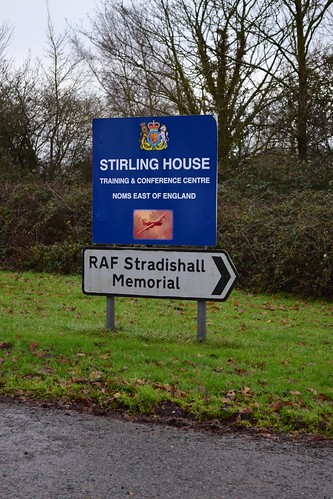
Stradishall is located a few miles south-west of Chedburgh, the main A143 dissects the two prison blocks, the north side being the former accommodation area, with the south block being the technical area and main airfield site. Access to the site is therefore limited, however, the former officers mess and associated buildings are available to view, as are a number of former technical buildings. A large memorial is currently displayed outside the officer’s mess building, named Stirling House  in memory of the aircraft type that flew from here, and it is open to the public. The foyer of the building, now a Prison Officer Training facility, is opened, and holds a roll of Honour, for those lost at the airfield.

RAF Stradishall

The current Prison Officers Training facility is named after the ill-fated Stirling that flew from RAF Stradishall. The Memorial being well sign posted.

Through the high security fencing, and around the site a number of buildings can still be seen, the familiar layout and design being standard of wartime and post war airfields. By turning off the A143 prior to reaching the memorial site, a small back access road allows public access to the airfield site. This is now, in part, a conservation area where the runways have all been removed, parts of the perimeter track do still remain and public access is permitted. The runways have been replaced by a solar farm, large panels cover the entire area and all are encased in high security fencing with closed circuit TV preventing you from wandering too close to the high-tech plant.

Walking along the northern side of the airfield, views can be seen of the accommodation area, again a number of former buildings can be seen through the fencing, their style typical of the expansion period design.

RAF Stradishall

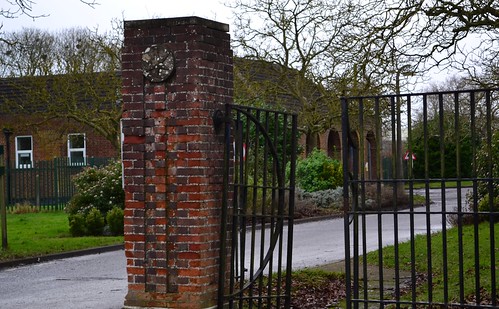
The dilapidated gateway hides many original buildings and a layout that reflects airfield design of the expansion period.

Back on the main road, turning left passing the prison, a turn off gives access to the aforementioned officers mess and memorial, it is well signposted, and continuing on, brings you to the former married quarters, now private housing, again typical of airfield design. Across the road from here, a farm track still has a small number of buildings now in a very poor state, this would have been an entrance to the accommodation area behind the current north side Prison.  They are both quite well hidden by undergrowth but they are visible with a little effort.

Stradishall, like many of the early expansion period airfields, with its neo-Georgian style architecture and well designed layout, lasted well into the cold war period. These early examples which set the standard for future designs, proved to be long-lasting and robust, unlike many of their later counterparts hastily built with temporary accommodation. Whilst a rather unfitting end to a long and distinguished life, the transformation into a prison has in part, been its saviour, and one that has preserved many of its fine buildings for the foreseeable future at least.

Sources and Further Reading.

*1 419 (Special Duties) Flight were initially formed at North Weald on 21st August 1940, being  disbanded and re designated 1419 (Special Duties ) Flight on 1st March 1941 at Stradishall. They in turn were disbanded on 25th August 1941 to be reformed at Newmarket as 138 Sqn. they moved back to Stradishall on 16th December 1941. In February 1942, the nucleus of 138 Sqn formed 161 Sqn at Newmarket continuing the role of SOE operations from there.

*2 Grehan, J., Mace, M., “Unearthing Churchill’s Secret Army: The Official List of SOE Casualties and Their Stories“, Pen and Sword Military, 2012

*3 ORB 214 Sqn: AIR\27\1321\8 National Archives.

RAF Stradishall – The early years.

Moving on from RAF Chedburgh, we continue south-west along the A143 to another former bomber airfield, and the parent station of Chedburgh. This next site has a history that dates back to the late 1930s and is one that has many of its original buildings still in situ, many thankfully still being used albeit by a completely different organisation.

The next stop on this trail is the historically famous airfield the former RAF Stradishall.

RAF Stradishall.

RAF Stradishall has a rather unique history, it was one of the first to be built during the expansion period of Britain’s Air Force beginning in 1935.  A series of Schemes, this programme was to develop the RAF over a period of years to prepare it for the forth coming war; a series of schemes that continued well into the war and created the basis of what we see today around Britain’s forgotten landscape.

This first scheme, Scheme ‘A’ (adopted by the Government in July 1934), set the bench mark by which all future schemes would develop, and called for a front line total of 1,544 aircraft within the following five years. Of these aircraft, 1,252 would be allocated specifically for ‘home defence’. This scheme brought military aviation back to the north of England, and to the eastern counties of Norfolk and Suffolk. Under this scheme, a number of airfields would be built or developed, of which Marham (the first completed under these schemes), Feltwell and Stradishall were among the first. These airfields were designed as “non-dispersed” airfields, where all domestic sites were located close to the main airfield site, and not spread about the surrounding area as was common practice in later airfield designs. At this stage, the dangers of an air attack were not being whole heartedly considered, and such an attack could have proven devastating if bombs had been accurately dropped.

Thus in 1938 Stradishall was born, its neo-Georgian style buildings built-in line with common agreements and local features. Within the grounds of the airfield accommodation blocks provided rooms for just over 2,500 personnel of mixed rank, and all tightly packed in within the main airfield site.

In these pre-war years, the development of hard runways and large airfields was a new phenomena, hard surfaces being a new aspect still very much a topic of considerable controversy. By now, Bomber Command had realised that the new era of bombers would call for hard runways on its airfields, and so they pushed the Government on allowing these to be developed. However, before any firm decisions could be made, trials would need to be carried out to determine whether or not they were indeed needed and if so, how they should be best constructed.

The test to determine these needs was to take a Whitley bomber, laden to equal its full operational weight, and taxi it across a grassed surface.  A rather primitive assessment, it was intended to ascertain the effects of the aircraft on the ground beneath. Trials were first carried out at Farnborough and then Odiham, and these were generally successful, the Whitley only bogging down on recently disturbed soils. Further trials were then carried out here at Stradishall in March 1938, and the results were a little more mixed. Whilst no take offs or landings took place during these trials, the general agreement was that more powerful bombers would have no problems using grassed surfaces, as long as the ground was properly prepared and well maintained. All well and good when the soils were dry and well-drained.

However, Dowding continued to press home the need for hard surfaces, and by April 1939, it had finally been recognised by the Air Ministry that Dowding was indeed right. A number of fighter and bomber airfields were then designated to have hard runways, of which Stradishall was one. These initial runways were only 800 yards long and 50 yards wide, extended later that year to 1,000 yards long, as aircraft were repeatedly running off the ends of the runways on to the grassed areas. Over the years Stradishall would be expanded and further developed, its longest runway eventually extending to 2,000 yards.

Stradishall was also one of the first batch of airfields to have provisions for the new idea of dispersing aircraft around the perimeter. To meet this requirement, hard stands were created to take parked aircraft between sorties, thus avoiding the pre-war practice of collective storage, and so reducing the risk of damage should an attacking force arrive – a practice not necessarily extended to the accommodation! By the end of development, Stradishall would have a total of 36 hardstands of mixed types, the extension of the runway being responsible for the removal and subsequent replacement of some. For maintenance, five ‘C’ type hangars and three ‘T2’ hangars were built, again standard designs that would be later superseded as the need required.

As Stradishall was one of this first batch of new airfields, it would also be used for trials of airfield camouflaging, particularly as the now large concrete expanses would reveal the tell-tale sign of a military airfield. On wet days the sun would shine off these surfaces making the site highly visible for some considerable distance. Initial steps at Stradishall used fine coloured slag chippings added to the surface of the paved areas. Whilst generally successful, and initially adopted at many bomber stations, Fighter Command refused the idea as too many aircraft were suffering burst or damaged tyres as a result of the sharp stones being used. Something that is reflected in many casualty records of airfields around the country.

RAF Stradishall

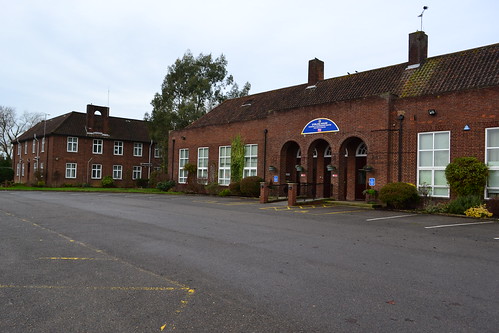
The Type ‘B’ Officers Mess at Stradishall is now a Prison Officers Training Facility. The Officers quarters are located in wings on either side of the mess hall.

On opening Stradishall would fall under the command of 3 Group Bomber Command, and would operate as an RAF airfield until as late as 1970, being home to 27 different operational front line squadrons during this time. Many of these would be formed here and many, particularly those post-war, would be disbanded here, giving Stradishall a long and diverse history.

The first squadrons to arrive did so on March 10th 1938. No. 9 Sqn and No. 148 Sqn (RAF) arriving with Heyford III and the Vickers Wellesley respectively. 148 Sqn replaced these outdated Wellesleys with the Heyfords in November, and then again replacing these with both the Wellington and Anson before departing for Harwell on September 6th 1939. No. 9 Sqn also replaced their aircraft with Wellingtons in January 1939, themselves departing on July 7th that same year.

It was during a night training flight, on November 14th 1938, that Wing Commander Harry A. Smith MC along with his navigator Pilot Officer Aubrey W. Jackson would be killed in Heyford III K5194, when the aircraft undershot the airfield striking trees outside the airfield boundary. The crash was so forceful that the aircraft burst into flames killing both airmen.

Wing Commander Smith MC qualified as a pilot whilst in the Royal Flying Corps in 1916, and was the first of his rank to be killed since the inception of Bomber Command in July 1936. He had been awarded the Military Cross ‘for gallantry and distinguished service in the field‘ in 1918.

Pilot Officer Jackson was appointed for a Short Service Commission in January 1937, and later a Permanent Commission. He was only 20 years old at the time of his death.

Both crewmen are buried in Stradishall’s local cemetery.

St. Margaret of Antioch, Stradishall

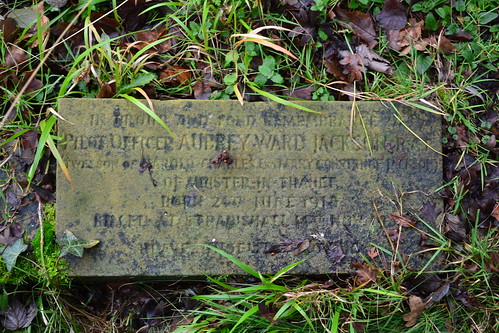
A very much less than grand grave stone marks the plot of P.O. Aubrey W. Jackson, killed on November 14th 1938 on a night training flight.

St. Margaret of Antioch, Stradishall

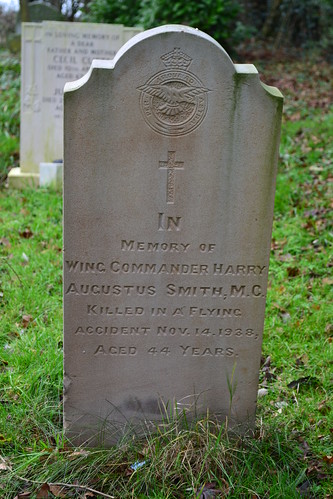
Wing Commander Smith, killed alongside P.O. Jackson on a night training flight. He was the first of his rank to die since the formation of Bomber Command.

Two more squadrons arrived here in 1939. No. 75 Sqn operated the Wellington MK. I from July, departing here just after the outbreak of war in September, and 236 Sqn flying Blenheims between the end of October and December that same year. 236 Sqn were reformed here after being disbanded in 1919, and after replacing the Night-Fighter Blenheims with Beaufighters, they went on with the type until the end of the war and disbandment once more. Almost simultaneously, 254 Squadron reformed here in October 1939, also with Blenheims. They remained here building up to strength before moving to RAF Sutton Bridge in Lincolnshire in December – one of many ‘short stay’ units to operate from Stradishall during its life.

This pattern would set the general precedence for the coming years, with bizarrely, 1940 seeing what must have been one of the shortest lived squadrons of the war. No. 148 Sqn being reformed on April 30th with Wellingtons only to be disbanded some twenty days later!

This year saw three further squadrons arrive at Stradishall: 150 Sqn on June 15th, with the Fairy Battle (the only single engined front line aircraft to be used here during the war), whilst on their way to RAF Newton; a detachment of Wellington MK.IC from 311 Sqn based at East Wretham (Sept); and 214 Sqn flying three variants of Wellington between 14th February 1940 and 28th April 1942. No. 214 Sqn would be the main unit to operate from here during this part of the war, and would suffer a high number of casualties whilst here.

On June 6th 1940, 214 Sqn Wellington IA ‘N2993’ piloted by F/O. John F. Nicholson (s/n 70501), would take off on a routine night flying practice flight. During the flight, it is thought that F/O. Nicholson became blinded by searchlights throwing the aircraft out of control. Unable to regain that control, the aircraft came down near to Ely, Cambridgeshire, killing the five crewmen along with an additional Leading Aircraftman (LAC) Maurice Peling who had joined them for the flight. A tragic accident that needlessly took the lives of many young men. F/O. Nicholson is buried in the local cemetery at Stradishall, whilst the remainder of the crew are buried in different cemeteries scattered around the country.

St. Margaret of Antioch, Stradishall

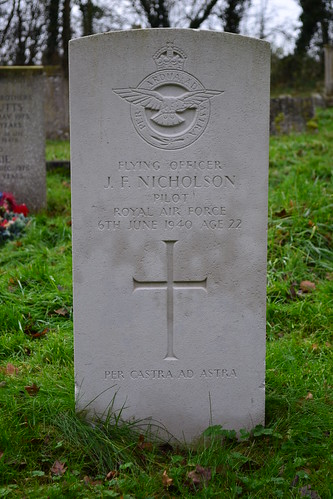
F/O. J. Nicholson was killed when he lost control of his Wellington on the night of June 6th 1940.

214 Sqn began operations from Stradishall on the night of June 14th/15th, the day German forces began entering Paris. This first raid was to the Black Forest region of Germany, a mission that was relatively uneventful.

Joining 214 Sqn at Stradishall was another unit, 138 Sqn*1 between December 1941 and March 1942. Flying a mix of aircraft, including the Lysander, Whitley, and later: Liberator, Stirling and Halifax, they would perform duties associated with the Special Operations Executive (SOE) carrying out clandestine missions dropping agents behind enemy lines.

It was one of these aircraft, Lysander III T1508, that crashed in January, nosing over near to the French town of Issoudun, a medieval town that bordered the regions of occupied France and ‘free’ France. The towns people protected many wanted resistance supporters, and so it was the scene of many heroic acts. From this particular accident, Squadron Leader J. Nesbit-Dufort managed to escape, evading capture and eventually returning to England where he was awarded the DSO for his actions. Needing to destroy the aircraft, locals pushed the Lysander onto nearby railway lines where it was obliterated after being hit by a passing train*2. It is believed that this was the first Lysander to be lost on these clandestine operations.

This night of January 28th/29th 1942, was a particularly bad night for Stradishall, with three aircraft being lost, two from 138 Squadron and one from 214 Squadron. Thirteen souls were lost that night none of which have any known grave.

1942 would also see a short one month stay by the Wellingtons of 101 Squadron, a detachment of 109 Squadron, and the accommodation of 215 Squadron’s ground echelon. Formed at Newmarket, the ground crews were posted to India whilst the air echelons were formed up at Waterbeach joining them with Wellingtons in April.

An updating of Wellington MK.Is with the MK.VI saw the remainder of 109 Squadron move into Stradishall, only leaving a small detachment at Upper Heyford – a residency that only lasted 4 months between April and July 1942. As 109 Sqn left, Stradishall was joined by the Heavy Conversion Unit 1657 HCU.

Formed as a bomber training unit through the merger of No. 7, 101, 149 and 218 Squadron Conversion Flights and 1427 (Training Flight), it would also operate the Stirling, and later the Lancaster along with some smaller aircraft such as the Airspeed Oxford. They would remain here until late 1944 when they too were finally disbanded. This meant that 1943 was quieter than usual, there wasn’t any sign of the previous ebbing and flowing that had taken place in the preceding years.

With a focus on training, few of these aircraft were used for ‘operational’ sorties until the closing stages of the war. That said, there were still a number of accidents and crashes that resulted in injury. A number of these were due to technical issues, engine failure, engine fires or undercarriage problems, some were due to pilot error. One of the earliest incidents here was that of Stirling MK.I W7470 which crashed, after suffering engine problems over County Durham. The accident killed two crewmen and injured a further two.

After a short spell at Honnington, 214 Sqn would join 1657 HCU, also replacing the Wellington with the ill-fated Short Stirling MK.I in April 1942. But the last flights of the Wellington would not be a good one. The night of April 1st/2nd 1942 would go down as 214 Sqn’s worst on record, and one that would prove devastating to the crews left behind.

In part two of RAF Stradishall, we look at the later war years, the terribly sad events that scarred 214 Squadron, and Stradishall’s post war development. The dawning of the jet age.

November 1938 -Tragedy at Stradishall

Whilst researching a forthcoming trail, I discovered the story of two airmen who were both killed in an accident, and are both buried in the local village cemetery.

Their gravestones are sadly much less ‘grand’ than many of the other airmen in the cemetery, but their departure was none the less, nothing short of a tragedy, and in no way less of a sacrifice than any other loss.

It was during a night training flight, on November 14th 1938, that Wing Commander Harry A. Smith MC, along with his navigator Pilot Officer Aubrey W. Jackson, both of No. 9  Squadron (RAF),  would be killed in a Handley Page Heyford III reg: K5194, when the aircraft undershot the airfield striking trees outside the airfield boundary. The crash was so forceful that the aircraft burst into flames killing both airmen.

Wing Commander Smith MC qualified as a pilot whilst in the Royal Flying Corps in 1916, and was the first of his rank to be killed since the inception of Bomber Command in July 1936. He had been awarded the Military Cross ‘for gallantry and distinguished service in the field‘ in 1918.

Pilot Officer Jackson was appointed for a Short Service Commission in January 1937, and later a Permanent Commission. He was only 20 years old at the time of his death.

Both crewmen are buried in Stradishall’s local cemetery.

St. Margaret of Antioch, Stradishall

A very ordinary grave stone marks the plot of P.O. Aubrey W. Jackson, killed on November 14th 1938 on a night training flight.

St. Margaret of Antioch, Stradishall

Wing Commander Smith, killed alongside P.O. Jackson on a night training flight. He was the first of his rank to die since the formation of Bomber Command.

4th June 1944 – Death of a Lancaster Crew

On June 3rd 1944, Lancaster ND841 ‘F2-D’ piloted by F/O. George. A. Young (s/n: 134149) RAFVR 635 Squadron, was detailed to attack Calais as part of the preparations for D-Day. There would be eight other aircraft from RAF Downham Market also detailed for the mission and take off would be late that evening.

The mission as a whole would involve 127 Lancasters and 8 Mosquitoes of No.1, 3 and 8 Groups and the targets would be the gun batteries at both Calais and Wimerereux. It was a  diversionary raid as part of Operation “Fortitude South“, to fool the Germans into believing the invasion would occur in the Pas-de-Calais region.

At 28 minutes past midnight, F/O. Young lined the Lancaster up on the runway, opened the throttles and began the long run down the runway. As the Lancaster approached take off, it began to swing striking the roof of a B1 Hangar. In an uncontrollable state the aircraft crashed just outside the airfield killing all on board.

All other eight aircraft took off and returned safely after having dropped their bombs.

On board Lancaster F2-D that night was:

Pilot: F.O. George Ambrose Young, aged 24 (s/n: 134149) RAFVR.
Flight Engineer: Sgt. Thomas Snowball, aged 32 (s/n: 1100769) RAFVR
Navigator: F.Sgt. Howard Pritchard, aged 22 (s/n: 1578502) RAFVR
Bomb Aimer: F.O. Walter Thomas Olyott, aged 21 (s/n: 151238). RAFVR
Wireless Operator / Gunner: F.Sgt. Robert Sadler, aged 23 (s/n: 1526058). RAFVR
Air Gunner: F.Sgt. Stanley Wharton, aged 30 (s/n: 1578013) RAFVR
Air Gunner: F.Sgt. Charles Patrick Nallen, aged 20 (s/n: 427537) RAAF

The Operations record book (AIR 27/2155/7) for that day simply  states:

3.6.44  ‘D’ F/O Young G.A. hit hangar after taking off and crashed on airfield when large bomb exploded and the crew all killed.  8 aircraft returned to base .

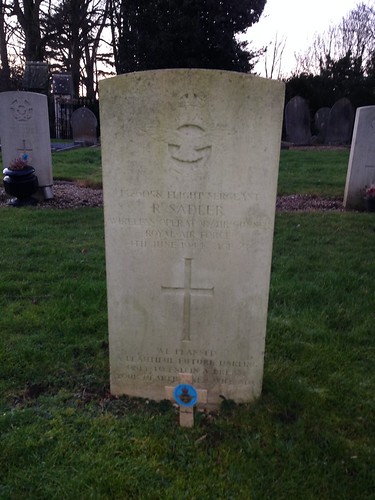
Three of the crew are buried in Kings Walk Cemetery, Downham Market, a short distance from the airfield.

Downham Market Cemetery

F.Sgt. Stanley Wharton (RAFVR)

Downham Market Cemetery

F.Sgt. Robert Sadler (RAFVR)

Downham Market Cemetery

F.O. Walter Thomas Olyott (RAFVR)

RAF Chedburgh – An appalling loss of life.

In this next trail, we start just a few miles to the south-west of Bury St. Edmunds in Suffolk, where we visit a number of airfields that were associated with the heavy bombers of the RAF’s Bomber Command.

Our first stop, although a satellite, more than earned its rightful place in the history books of aviation. It is an airfield where large numbers of the ill-fated Stirling flew many missions over occupied Europe, where the staggering statistics of lost men and machines speak for themselves.

Now little more than fields and a small industrial estate, the remnants of this wartime airfield stand as reminders of those dark days in the 1940s when night after night, young men flew enormous machines over enemy territory to drop their deadly payload on heavily defended industrial targets.

We begin our next trip at the former airfield RAF Chedburgh, home to the mighty four-engined bombers of No. 3 Group Bomber Command of the Royal Air Force.

RAF Chedburgh.

Built in 1942 (by John Laing and Son Ltd) as a satellite for RAF Stradishall, Chedburgh would be built to the Class A specification, a later addition to the RAF’s war effort. Being a bomber station Chedburgh would have three runways made of concrete, the initial construction being one of 2,000 yards and two of 1,400 yards, all the standard 50 yards wide, as was the standard specification brought in during 1941. Later on, these would be extended giving Chedburgh much longer runways than many of its counterparts, i.e. one at 3,000 yards and two at 2,000 yards. Having runways this long, meant that heavy bombers could use the site when in trouble, something that Chedburgh would get used to very quickly.

With the village of Chedburgh to the north of the site, directly opposite the main gate; the technical area along the north-eastern side of the main runway, and the bomb store to the east, Chedburgh would have two T2 hangars, a B1 and later on 3 glider hangars. Dotted around the perimeter track were a number of dispersals comprising 34 pan styles and 2 looped.

RAF Chedburgh

Chedburgh village sign reflects it aviation history.

Whilst housing only two major squadrons 214 Squadron and 620 Squadron, it would also be home to a small number of other operational units, 218, 301, 304 Sqns and 1653 Heavy Conversion Unit (HCU).

Opening under the control of No. 3 Group, on September 7th 1942, the first resident unit was 214 Squadron (RAF) flying the Stirling MK. I, a model they operated until as late as February 1944. The bulk of the unit arrived in the October, with operations beginning very soon after. Within four months they would begin replacing some of these models with the upgraded MK.III, also operating these until the beginning of 1944 and after transferring to RAF Downham Market in Norfolk.

As with many airfields at this time, the arrival of personnel preceded the completion of the works, development continuing well into the operational time of its residents, something that would cause a problem in the coming months.

It was in March of 1943 that the first casualties would occur, the night of March 1st/2nd being a baptism of fire for 214 Sqn. Stirling MK. I (R9143) BU-E piloted by F/S. J. Lyall (RCAF) would be hit by flak, she was badly damaged, and then abandoned by her crew. As he descended from the stricken aircraft, F/O. Hotson (RNZAF) would be hit by a splintering shell – the wounding he received as a result would be fatal. The remainder of the crew all escaped the aircraft safely but were later captured by the Germans and incarcerated. A multi-national crew, this loss was to be followed just two nights later with the loss of another Stirling, ‘BU-C’, but this time none of the seven crewmen were to survive.

Then on the next night, 5th/6th March, whilst on operations to Essen (the 100,000th sortie by RAF aircraft), Stirling BK662 ‘BU-K’ crashed into the North Sea about 30 km north-northwest of Ijmuiden. Only one of the crew, Air Gunner Sgt. William H. Trotter (s/n: 1128255) was ever found, the rest of the crew remaining ‘missing in action’. This was the first Stirling to be listed as such since the squadron’s operations began. This raid would prove devastating, taking the lives of 75 RAF airmen, but the War Office considered it a major success in terms of  industrial damage to the German war machine. The targeted Krupps factory, which sat in the centre of over 100 acres of industrialised area, was devastated by both accurate marking and then the subsequent bombing.

Throughout this month there were further loses to the squadron: Stirlings ‘BU-Q’ and  ‘BU-A’ (in which F/S. D Moore (RCAF) and Sgt. T. Wilson were both awarded the George medal for saving the life of their companion Sgt. J. Flack), along with ‘BU-M’ were all lost; ‘BU-M’ losing all but one crewman. Another aircraft, ‘BU-L’, lost all seven aircrew  on the night of March 27th/28th, and closing March off, was a collision between Stirlings BK663 and EF362, which left several more crewmen either injured or dead. Although many losses were as a direct result of flak or night fighters, the cracks were beginning to show, and the poor performance of the Stirling was becoming evermore apparent.

It was during this year on 17th June 1943, that Chedburgh’s second main operational unit would be formed, 620 Sqn (RAF), also carrying out bomber operations, again with the Stirling MK. I and later in the August, the MK. III. Also part of 3 Group Bomber Command, 620 Sqn were created through the streamlining of 214 Sqn and 149 Sqn at nearby Lakenheath. The move reduced each of the two former squadrons from three flights to two,  releasing ‘C’ Flight of 214 Sqn who were already stationed here at Chedburgh.

RAF Chedburgh

Parts of the perimeter track and runways remain as tracks used for storage.

As many of these crews were already well established and experienced, there would be no delay in commencing operations, the first sortie occurring on the night of the 19th June 1943 – two days after their formation. The first casualties occurred three days later on the night of 22nd/23rd June 1943, just a few days into their operational campaign. There then followed five months of heavy operational activity, a period in which the Stirling and its crews would be pushed to the very limit and beyond. The shortcomings of the aircraft being realised further more.

Being on a partially built airfield would be the cause of the demise of Stirling EF336 (QS-D) which swung on take off and ran into the partially constructed perimeter track. The uneven surface caused the undercarriage to collapse, and whilst there were no injuries to the crew, the aircraft was written off.

The poor service ceiling of the Stirling led to several aircraft being damaged through falling bombs from aircraft flying above. A number of Stirlings were recorded returning to bases, including Chedburgh, with damage to the air frames, damage caused by these falling ‘friendly’ bombs!  However, the extent of this damage did give great credit to the aircraft, showing both its robustness and strength in design; something that often gets forgotten when talking about the Stirling in operations.

The next few months for 620 Sqn would be filled with a mix of operational sorties, mining operations (Gardening) and training flights, including both ‘Bullseye‘ and ‘Eric‘; testing the home defence searchlight and AA batteries both at night and during the day. During a fighter affiliation exercise on July 2nd, two 620 Squadron aircraft collided, ‘EF394’ (QS-V) and BK724 (QS-Y)  killing fifteen and injuring two. One of those killed, Flight Mechanic AIC Arthur Haigh (s/n: 1768277) was only 18 years old, and one of five ground crew who were aboard the two aircraft that day.

Both 214 Sqn and 620 Sqn would go on for the next few months taking part in some of the war’s largest bomber missions including Hamburg, Essen and Remscheid. A number of aircraft would be lost and many aircrew along with them. The worst recorded night for 620 Sqn was the night operation on August 27th/28th, 1943 to Nuremberg, when three aircraft were shot down, all Stirling MK.IIIs: BF576 (QS-F) piloted by Sgt. Frank Eeles (s/n: 1531789); EE942 (QS-R) piloted by Flt. Sgt. John F. Nichols (s/n: 1318759) and EF451 (QS-D) piloted by Sgt. William H. Duroe (s/n: 658365). These three losses accounted for sixteen deaths and five taken as POWs, there were no other survivors.

The last 214 Sqn Stirling to be written off during bombing missions occurred on the night of November 22nd/23rd, 1943. Whilst on a mission to Berlin, Stirling EF445 (BU-J) was hit by flak, attacked by a FW-190 and then suffered icing. The resultant damage along with a lack of fuel, caused the pilot to ditch in the North Sea with the loss of two crewmen: pilot F/S. George A. Atkinson (s/n: 1485104) and Sgt. W. Sweeney (RCAF) (s/n: R/79844).

620’s stay at Chedburgh would be fairly short-lived, taking part in their final operation on the night of November 19th/20th, 1943 to Leverkusen. They then departed Chedburgh at the end of that month after suffering a heavy toll on their numbers and a devastating start to their war. By now the limitations of the Stirling were very well-known, and it was already being replaced by the much favoured Lancaster. In the short five months it had existed, the squadron had lost eighteen of its aircraft in operations, and a further six in accidents, statistics that are however, overshadowed by the loss of ninety-three lives. 620 Sqn left both Chedburgh and Bomber Command to join other units at RAF Leicester East and the Allied Expeditionary Air Force in November, where the unit was to perform Airborne operations along side 196 Sqn and 1665 Heavy Conversion Unit (HCU). A role that 620 performed for the remainder of the war.

With their departure came the arrival of another Stirling squadron, 1653 HCU, a Stirling training unit rather than a front line operational squadron. A month later 214 Sqn would also leave Chedburgh taking their Stirlings to Downham Market and then onto Sculthorpe where they replaced them with the B-17 Flying Fortress.

A P-51 Mustang (5Q-Q, serial number 42-106672) of the 504th Fighter Squadron, 339th Fighter Group, that has crash landed at Chedburgh, 18 May 1944. (IWM FRE 2784)

1653 HCU, as a training unit, would also have it share of accidents and losses, many due to technical problems, but some due to pilot error. A number of accidents were caused by tyres blowing, and some were caused by engine failures, the bravery of these pilots in dealing with these matters being no less than exemplary. One such incident being that of F/O. Hannah and his crew, who took off at 20:50 on the evening of November 3rd 1944, on a radar training flight. Immediately after take off both port engines cut out, something that was almost fatal in a Stirling. The aircraft, virtually uncontrollable, was heading towards a row of cottages but the crew managed to turn it  away missing the houses but colliding with a row of trees instead. All of the crew were injured to varying degrees – one fatally. Sgt. Eddie (RCAF) dying in the resultant crash.

After a year of being at Chedburgh, 1653 HCU would also depart (December 1944) by which time the Lancaster was well and truly the main bomber of the RAF. This late stage of the war would not be the end of Chedburgh though, Bomber Command retaining its use, sending the Lancasters I and III of 218 (Gold Coast)*1 Squadron here from RAF Methwold.

On December 2nd 1944 the first ground units began to arrive, with flying personnel arriving on the 5th, after much-needed runway repairs were completed. The airfield reopened with the arrival of eighteen Lancasters, formed into three new flights, of which thirteen would undertake operations on the 8th, to the railway yards at Duisburg – their first from Chedburgh. Both this mission and that of the 11th to the marshalling yards at Osterfeld, were heavily restricted by thick cloud, and so G-H navigation aids were used in conjunction with ‘Oboe‘.

For the majority of the remainder of the war Bomber Command continued its strategic missions against German cities, with marshalling yards and oil refineries being other major targets. It was of course this continued use of bomber aircraft against what was now a demoralised and weakened German population, that led to the outcry over Harris’s continued attacks on German cities. A controversial action that led to his move away from the lime light at the war’s end, and the lack of recognition for bomber commands efforts throughout the conflict.

218 Sqn would continue on though. The winter of 1944 / 45 proving to be one of the worst weather wise, many missions were either scrubbed or carried out in poor weather. On the night of January 1st/2nd 1945, one hundred and forty-six aircraft of No. 3 Group were tasked with the attack on Vohwinkel railway yards. During the attack in which 218 Sqn were a part, two aircraft were hit by heavy anti-aircraft fire from American guns below. One of these was 218 Sqn Lancaster MK. I PB768 (XH-B) piloted by 20 yr old Australian F/O. Robert G. Grivell. The accuracy of these guns was ironically excellent, hitting the aircraft not once but twice, causing it to spin uncontrollably toward the ground. All but one of the crew were killed in the ensuing crash.

It was during this period that the RAF began daylight bombing missions too, such was the poor state of the defending Luftwaffe. Numerous missions over the next weeks led to attacks on the coking plants at both Datteln and Hattingen, repeated again on March 17th in attacks at Huls (and Dortmund). Hattingen was again attacked by 218 Sqn aircraft on the 18th without loss.

ROYAL AIR FORCE BOMBER COMMAND, 1942-1945.

Mechanics at work on an engine of Lancaster B Mk. III, (LM577) ‘HA-Q’ “Edith”, of No. 218 Squadron. On March 19th 1945, this aircraft was hit by flak over Gelsenkirchen damaging the rear turret and injuring the gunner’s eye. LM577 went on to complete more flying hours than any other Lancaster on the station.(© IWM (CH 15460))

The remainder of the war would see 218 Sqn fly from Chedburgh, completing many missions until the war’s end. During Operation ‘Manna‘ in which the German Army lifted an embargo on food transport into Holland, ten Lancasters of 218 Squadron dropped food supplies to the starving Dutch below. Understandably April had seen fewer operations than in previous months, but with May seeing many more food trips to the Hague, 218 Squadron leapt to the top of the leader board for operational tours, overtaking both 77 Sqn and 115 Sqn their closest friendly ‘competitors’. With further flights under ‘Manna‘, and then repatriation flights under both ‘Dodge‘ and ‘Exodus‘ 218 Sqn continued to operate the long haul flights into European territory.

During August the big wind down began, and the Lancasters were gradually flown out of Chedburgh for disposal. Then on the 10th, 218 (Gold Coast) Squadron was finally disbanded, and the various crews sent home to their respective territories across the globe.

On August 27th 1945, the last two Lancasters departed Chedburgh, and all was very quiet for those left behind. Then in September, two Polish bomber squadrons arrived, both 301 and 304 Sqns remaining here until they were also disbanded a year later on December 18th, 1946; their Warwicks, Wellingtons and Halifaxes being no doubt scrapped. Whilst here, the Polish squadrons flew long-range transport flights, retaining at least some link to the heavy aircraft and long-range flights that had been common only a year or so before.

Over the remaining years the airfield, like many, has reduced to both agriculture and industrial use. The watch Office has been heavily modified and lies hidden within an industrial complex that has completely taken over the former technical site. A number of these original buildings still survive and visible from the main A143 Bury St. Edmunds to Haverhill road, the road that separates the airfield from the village opposite. The runways and perimeter tracks, visible only in small parts, are mere concrete platforms, now used to store farm produce and machinery, rather than the lumbering bombers of RAF Bomber Command.

The huts used to house the 1,600 RAF personnel and 240 WAAFs, have all been removed, as have the thirty-six hardstands – the airfield site now being completely agricultural.

RAF Chedburgh

Some technical buildings remain in use today.

Whilst Chedburgh was only built as a satellite airfield, by the end of the war it had been witness to many great sacrifices. Eighty-three aircraft had been lost on operations, all but 12 being Stirlings; eighteen from 620 Sqn and fifty from 214 Sqn. For a period of only fourteen months for 214 Sqn and five for 620 Sqn, this was an appalling loss of life, and one that was sadly mirrored by many bomber squadrons across the British Isles in the 1940s.

Sources and further reading

Much of the specific detail for these loses came from the Chorley, W.R., “Bomber Command Losses series”, published by Midland Counties Publications.

*1 A number of books are available on this squadron. One written by Ron Warburton, ‘Ron’s War‘ chronicles the life of a Flight Engineer of a Lancaster in 218 (Gold Coast) Sqn whilst at Chedburgh in 1945. It is published by RW Press, and available online. ISBN-13: 978-0983178804

A second book is also available, “From St Vith to Victory: 218 (Gold Coast) Squadron and the Campaign Against Nazi Germany“, written by Stephen Smith, and published by Pen and Sword Aviation in 2010 (ISBN10 1473855403). It details the life of 218 (Gold Coast Sqn) from its inception through to its disbandment in 1945.

A blog has also been set up dedicated to those who served in 218 (Gold Coast) Sqn and it gives a detailed history from 1936-1945. It has also been created by Stephen Smith who has also published other books relating to 218 Sqn including “A Short War” and “A Stirling Effort” which relates specifically to their time at RAF Downham Market.  https://218squadron.wordpress.com/

September 8th 1943 – Tragedy at RAF Mepal.

On the night of September 8/9th 1943,  a force of 257 aircraft comprising 119 Wellingtons, 112 Stirlings, 16 Mosquitoes and 10 Halifaxes took off from various bases around the U.K. to bomb the Nazi gun positions at Boulogne. Included in this force were aircraft from the RAF’s Operational Training Units, and for the first time of the war, five B-17s flown by US aircrews of the USAAF’s 422nd BS, 305th BG at Grafton Underwood. This was the first of eight such missions to test the feasibility of the USAAF carrying out night operations over Europe.  After the remaining seven missions, in which the squadron had dropped 68 tons of bombs, the idea was scrapped, the concept considered ‘uneconomical’ although the aircraft themselves proved to be more than capable of the operations.

The Gun battery targeted, was the emplacement that housed the Germans’ long-range guns, and the target wold be marked by Oboe Mosquitoes. With good weather and clear visibility, navigation was excellent, allowing the main force to successfully drop their bombs in the target area causing several huge explosions. However, not many fires were seen burning and the mission was not recorded as a success. Reports subsequently showed that the emplacement was undamaged due to both inaccurate marking by Pathfinders, and bombing by the main force. However, as both anti-aircraft fire and night fighter activity were light, no aircraft were lost during the flight making it a rather an uneventful night.

However, the mission was not all plain sailing, and whilst all crews returned, the night was marred by some very tragic events.

Three Stirlings were to take off from their various bases that night: at 21:00 hrs from Chedburgh, Stirling MK. III, EF136, piloted by F/S. R. Bunce of 620 Sqn; at 21:30, another Stirling MK.III, from 75 Sqn at RAF Mepal, BK809 ‘JN-T*1‘ piloted by F/O I.R.Menzies of the RNZAF; and lastly at 21:58 also from Chedburgh, Stirling MK. I, R9288 ‘BU-Q’ piloted by N.J. Tutt  of 214 Sqn.  Unfortunately all three aircraft were to suffer the same and uncanny fate, swinging violently on take off. The first EF136 crashed almost immediately, the second BK809 struck a fuel bowser, and the third R9288 ended up in the bomb dump. Miraculously in both the Chedburgh incidents there were no casualties at all, all fourteen crew men surviving what must have been one of their luckiest escapes of the war! The same cannot be said for the second though.

Stirling BK809 was part of a seventeen strong force of 75 Sqn aircraft. Each aircraft was carrying its full load made up of 1,000lb and 500lb bombs. As the Stirling was running along the runway, it swung violently, striking a fuel bowser which sent it careering into houses bordering the edge of the airfield.

One of the occupants of one of the houses, Mr. P. Smith, saw the aircraft approaching and ran into the street to warn others to get clear. As the aircraft struck the rear of the houses, it burst into flames causing some of the bombs to detonate. This brought considerable rubble down on the occupants of the second house, Mr and Mrs John Randall.

Mrs Randall managed to get out, her legs injured, whereupon she was met by a local fireman, Mr. A.E. Kirby of the National Fire Service. Mr. Kirby went on to help search in the wreckage of the house until his attempts were thwarted by another explosion. His body, along with that of Mr. Randall, was found the next day.

Two other people were also killed that night trying to provide assistance, those being F/Sgt Peter Gerald Dobson, RNZAF and Section Officer Joan Marjorie Easton WAAF. F/Sgt. Dobson was later mentioned in despatches. Three members of the crew lost their lives as a result of the accident, F/O. Menzies and F/O. N. Gale both died in the actual crash whilst Sgt. A. Mellor died later from injuries sustained in the accident.

A number of others were injured in the crash and one further member of the squadron, Cpl Terence Henry King B.E.M, was awarded the British Empire Medal “for his bravery that night in giving assistance“.

The mission on the night of September 8/9th 1943 will not go down as one of the most remarkable, even though  it was unique in many respects, but it will be remembered for the sad loss of crews, serving officers and civilians alike in what was a very tragic and sad event.

The crew of Stirling BK809 were:

F/O. Ian Robert Menzies RNZAF NZ415002. (Pilot).
P/O. Derek Albert Arthur Cordery RAFVR 136360. (Nav).
P/O. Norman Hathway Gale RAFVR 849986. (B/A).
Sgt. Ralph Herbert Barker RNZAF NZ417189. (W/O).
Sgt. Albert Leslie Mellor RAFVR 943914. (Flt. Eng).
Sgt. Bullivant G RAFVR 1395379. (Upp. G)
Sgt. Stewart Donald Muir RNZAF NZ416967. (R/G).

RAF Mepal was visited in Trail 11.

Sources and Further Reading.

*1 Chorley, 1996 “Bomber Command Losses 1943” notes this aircraft as AA-T.

Chorley, W.R., “Bomber Command Losses – 1943“, Midland Counties, (1996)

Middlebrook M., & Everitt C., “The Bomber Command War Diaries”  Midland Publishing, (1996)

Further details of this accident, the crews and those involved can be found on the 75 (NZ) Sqn blog. This includes the gravestones of those killed and a newspaper report of the event.

My thanks also go to Neil Bright (Twitter handle @Blitz_Detective) for the initial  information.