In Part 4, we saw how the arrival of the 305th Bombardment Group under Col. Curtis LeMay transformed Chelveston into a hub of innovation and determination. LeMay’s leadership and forward-thinking tactics shaped the group’s early operations, pioneering formation flying and lead-bomber bombing methods that would improve accuracy and survivability. Despite harsh conditions and a steep learning curve, the 305th quickly developed into a highly effective unit, setting the standard for future B-17 operations and laying the groundwork for its critical role in the air war over Europe.
Crews, Combat, and Cinematic Fame: Chelveston in 1943
Back in the United States, interest in joining the Army Air Forces remained high, fuelled in part by carefully crafted propaganda films designed to sustain public support and encourage enlistment. During the winter of 1942–43, both Bassingbourn and Chelveston became film locations for director William Wyler, who was already renowned for Mrs Miniver. His documentary-style productions would immortalise one particular B-17 – ‘Memphis Belle’, securing her place as perhaps the most famous Flying Fortress of them all.
Despite all these ventures back home, the USAAF remained an infant unit, who faced an ever increasing number and ferocity of air battles as 1943 dawned. The cold of January 3rd would see the 305th leading yet another attack on the submarine pens at St. Nazaire, which had so far proven indestructible. Not only were there heavy and accurate flak batteries protecting them, but the pen’s walls, over 9m thick, were impenetrable by any current weapon in the military arsenal.
For the bombers, the long, straight run in to the target seemed like running a gauntlet, met with a well-planned barrage placed in front of the bombers, it was a daunting sight for any crew to face. It was so fierce, that of the eighty-five aircraft sent out that day, seven were classified as missing, whilst more than half of those remaining suffered flak damage of varying degrees.
Carrying 1,000 lb General Purpose bombs, some 171 tonnes were released, a mere drop in the ocean compared to figures achieved later in the war – and it barely scratched the surface of the pens.
Although seen as a successful operation, it had seen the highest loss of the 8th Air Force’s war so far, and with two aircraft crash landing on return after getting lost – the lack of experience of these fledging crews was becoming evermore evident.
Despite the losses and cold though, there was no let up for the crews of the 305th. On the 27th January, they were once again in the winter skies. This time it would be Germany itself, and the 8th Air Force’s first venture in the Nazi airspace.
The target for the day was Vegesack on the Wesser river, seen as a priority target for air operations. However, once over the continent, the bombers were faced with thick cloud and little chance of finding the target, let alone bombing it. Turning to their secondary target, they headed for Wilhelmshaven, where they found only moderate flak and light fighter cover.
As a result, loses were light that day, three aircraft went down, one of which was a Chelveston bomber 41-24637 (KY-F), and even though many bombs fell harmlessly away from the target area, the mission was still widely celebrated and praised by the press.
The loss of the B-17 brought home the brutality of what they were facing. Although some of the crew managed to bail out (five were taken as POWs) another five were killed; the ball turret gunner Sgt. Roy Whitney and tail gunner S. Sgt. Robert Ames were killed in the attack. The other three, were attacked by fighters as they parachuted through the sky, two of whom, T.Sgt. Bernice Farmer and S. Sgt. Jerome Kissleheff were killed. The last crewman, S. Sgt. Le Roy Mason, died after hitting the ground, his parachute shot to pieces.*9
Trial by Fire: The 305th’s Gruelling February Raids
Typically, the opening days of February were marked by persistent poor weather, which resulted in several planned missions being abandoned, some even after the Fortresses had departed England. On 4th February, however, the 305th did manage to get airborne, dispatching eighteen aircraft toward Hamm. Although faced with adverse weather, the formation were undeterred, instead diverting to their secondary target – Emden.
Despite their determination and ‘Can do’ attitude, none of the 305th’s aircraft succeeded in bombing the target. What’s worse, the mission also proved costly, as one aircraft 41-24593 (WF-G) ‘El Lobo’, collided head-on with a FW-109 after it was hit by flak. Another B-17 was shot down by a twin-engined fighter – the likes of which had not been seen in the skies before.
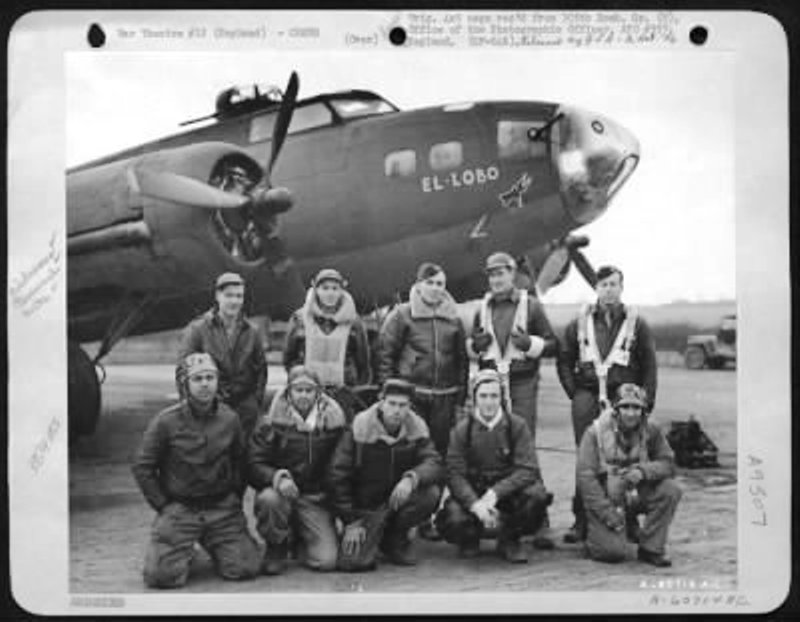
‘El. Lobo’ and her crew before being lost over Hamm (IWM UPL 13288).
Later in the month, on 26th February, the 305th took part in another operation to Germany. The primary objective here was the Focke-Wulf factory at Bremen, with orders to divert to the submarine pens at Wilhelmshaven should weather conditions once again prevent an effective attack.
After briefing for Bremen, twenty B-17s of the 305th joined with other B-17s of the 91st, (20), 303rd (19) and 306th (17), and seventeen B-24s of the 44th and 93rd BGs. Forming up over the Norfolk coast, the whole formation was led by the 305th.
Heading toward the target, they quickly became weakened. In the first one hundred miles, some twenty aircraft turned back, either through mechanical issues or personnel problems. As a result, the protective firepower of the group was significantly reduced, and those who were left faced a greater risk from attack.
On reaching Baltyrum Island, the formation began its descent toward the target. At this point, they were attacked by a lone fighter, an FW-190, only to be replaced minutes later by others from 12./JG1. Continuing on, the formation reached Oldenburg , albeit relatively unscathed. Here the formation experienced cloud cover, and the decision was made by Major J. Preston, the formation commander, to turn 1800 north, and head to the secondary target Wilhelmshaven.
Due to various reasons, the normally faster B-24s were unable to keep up with the B-17s, and three aircraft from the 44th, began to lag behind. Being vulnerable away from the protective firepower of the bigger formation, they were immediately attacked by enemy fighters, with two being brought down.
Over the next forty minutes or so, seven aircraft were shot down during a blistering attack by a mix of Me-109s, FW-190s, Ju-88s and Me-110s, who were not only firing canons into the formation, but dropping aerial bombs as well. Two of those lost during the melee were from the 305th whilst others from the same group were severely damaged.
On board one of those B-17s was 2nd. Lt. James Moberly, in 41-24617 ‘Southern Comfort’, but Moberly’s story is one of luck more than good judgement. Increasing crew injuries had led to them being advised to wear steel helmets, which were proving to be cumbersome and awkward in the heat of battle, many choosing not to wear them. Moberly had decided that day to wear his, a decision that would save his life.
Whilst firing one of the nose guns, a cannon shell struck the aircraft exploding just above his head, the force knocking him down so hard, he cracked the navigator table. After looking at the rather large hole in the fuselage, he examined his helmet to find several large dents caused by the shell that would otherwise have probably killed or at best, severely wounded him. From then on, he was convinced of the helmet’s benefits and it always went with him.
The plane was so badly damaged by flak in the attack, that one engine was knocked out, discharging oil over the wing. Furthermore, a four-foot hole had been blown in the rudder and the aircraft was riddled from nose to tail by bullets and canon fire. On setting a hopeful course for home, the pilot asked those aboard to pray, a last ditch effort to save the aircraft and its crew. Whether through God’s help, or pure determination and will power, they reached Chelveston, and the pilot placed the aircraft down on the runway. Once news got out about their exploits, they became known as the crew that ‘prayed’ their aircraft back.
In another one of these aircraft B-17F 41-24604 ‘Arkie’ [KY:D], was pilot Everett E. Tribbett who, after baling out, was captured and sent to Frankfurt before ending up at Stalag Luft III. Once inside, his skills were quickly put to good use, becoming involved in clandestine radios within the camp – an activity that would have had severe consequences if discovered. The aircraft meanwhile, named after Tribbett’s wife, came down at Hookseil, ten miles north of Wilhelmshaven.
In a third B-17, 41-24623, the ball turret gunner, S. Sgt. Lee ‘Shorty’ Gordon was captured after baling out of his stricken aircraft. His determination to ‘get home’, though, led to him escaping no less than a reported five times, even using his diminutive size to pose as a child in one failed attempt.
Gordon’s story was initially told in the Air Force’s Service Journal just after he was reported missing in action; followed in 1944 by the boy’s comic True Comic. It was later recalled in both The Writing 69th by Jim Hamilton (1999) and Air Gunner by Andy Rooney & Bud Hutton. As the first US airman to escape and make his way home, Gordon was awarded the Silver Star.*10
Gordon was only one of five survivors from the downed plane, each one of them being located in the mid and rear sections of the stricken aircraft.
Whilst the formation had taken a beating, the 303rd BG from Molesworth reported no damage at all. By contrast, Chelveston’s 305th reported fourteen aircraft damaged, from flak, cannon fire, or even falling shell cases from nearby aircraft.
Several enemy aircraft were claimed as either ‘kills’ or ‘damaged’ that day, but as with many of these early claims, the numbers of actual enemy aircraft shot down, was for various reasons, hugely exaggerated. It is now known that only one enemy aircraft was lost that day, a considerable difference, but an understandable one at that. Of the ninety-three bombers that took off on that mission, only sixty-five managed to bomb the target. It had been a difficult day for the Eighth, and one the 305th was relieved to leave behind.
Spring 1943: Hardship, Heroism, and American Takeover
But the winter had taken its toll. By the time spring arrived, the 305th had lost nearly half its crews, whilst the other fledgling groups were down to almost a fifth of their original number. Men on sick leave, or in hospital beds were ordered back into their aircraft, reports of fights, random gunfire in dormitories and aggressive behaviour were becoming commonplace. The mental state of some had deteriorated to new levels, resulting in temporary blindness, extreme behaviours and mental stress that affected many. In fear of being labelled as cowards, many hid their true feelings lashing out at those closest to them. The air force’s answer was swift, to demote, move or even discharge these men before they ‘infected’ those around them.
With an aim to boost morale and lift falling spirits, the personnel of Chelveston were treated to a little bit of joy. On April 19th 1943 the airfield was officially handed over, by the RAF, to full American control. In a short, but simple ceremony, in which the Stars and Stripes were hoisted, Flt. Lt. H. W. Davies RAF handed over control to Brig-Gen Fredrick Lewis Anderson, of the 1st Bombardment Group USAAF. Chelveston was at last now officially an American base and would be known as Station 105.
Despite losses and misgivings though, the 305th were beginning to take centre stage in the air war. April’s first operation, on the 4th, saw them the lead group once more. After departing Chelveston in the late morning, they joined with the three other B-17 groups in the UK: the 91st, 303rd and 306th, taking an incredible three hours to form up and achieve cruising altitude. The escort of Spitfires that had joined them, had little to do on the way to the target, as the Luftwaffe were strangely no where to be seen.
Of the entire formation, the 305th achieved the most accurate bombing results, with a high proportion of their bombs falling on the target itself. This accuracy resulted in damage to a number of the Renault factory buildings, reputedly putting them out of action for several months afterwards.
On the flight home however, the 305th once again learned what it meant to be the lead group, when a large formation of enemy fighters struck head-on in a fierce, determined attack. It was here that three of the 305th’s B-17s went down and a forth would be forced to land away with wounded onboard at Dunsfold airfield.
Although the Chelveston group had taken a beating, they had also set a record. The gunners of ‘Dry Martini 4th’ claiming an unprecedented ten enemy aircraft shot down, half of those claimed that day by the entire 305th. For this and for showing great determination in leading the formation, on return, the 305th received its first Distinguished Unit Citation (DUC).
In Part 6, the 305th, still a relatively new and thinly stretched force, faced unprecedented challenges as the Eighth Air Force began flying ever-larger formations into increasingly hostile skies. From record-setting mass raids in May to the punishing assaults over Schweinfurt, Chelveston’s crews were pushed to the limits of endurance, bravery, and ingenuity, earning medals and accolades even as friends and aircraft were lost around them. As winter 1944 approached, with new navigation technology and record-breaking missions on the horizon, the 305th were about to step into a phase of the air war that would test everything they had learned – and threaten to change the course of the Eighth Air Force forever.
The whole story of Chelveston can be read in Trail 66. Northants and Bedfordshire (Part 2)
 Aviation Trails