In Part 1, we saw how RAF Chelveston began its life in 1940 on land straddling the Bedfordshire–Northamptonshire border as part of Britain’s wartime airfield expansion programme. Initially referred to as Shelton during planning, the station opens in 1941 with basic grass runways before gradually developing into a standard three-runway bomber airfield. In time it would pass into American control as USAAF Station 105.
1941 – From Opening to Operational Beginnings:
Chelveston airfield officially opened its doors on August 15th 1941, as RAF Chelveston, and initially fell under the control of Flying Officer J.B. Townsend, 2 Group, RAF Bomber Command. Still in the process of construction, the airfield was parented by RAF Polebrook, a relationship that dissolved upon Chelveston gaining its full self-governing status on 2nd September that same year.
To provide protection from attack, RAF Podington (now the Santa Pod drag strip) was allocated as a satellite station, and a decoy or ‘Q’ site (Q144A) was constructed at Swineshead. In addition to these measures, an airfield defence unit, 2819 Defence Squadron, was established here with twelve Bofor anti-aircraft guns, providing protection from any roaming enemy aircraft.
Immediately on transfer of the airfield to the RAF, permission was granted to extend the three runways, the main from 4,100 ft to 6,000 ft and the second from 3,700 ft to 4,167 ft. The third, would remain at 3,700 ft for the time being. These extensions, along with further general updating, would eventually bring the airfield up to the Class ‘A’ standard format, making it suitable for the allied heavy bomber fleet. However, progress was slow, and this degree of modernisation would not be achieved for another two years or so.
Construction work therefore continued well into 1942. In addition to the runway extensions, the bulk of the ‘frying pan’ style dispersals were also added, and the accommodation area was extended, enabling upward of some 3,000 personnel to be located here. The bomb store was also added at this point, and the technical area was extended to include a wider range of technical buildings and stores.
The RAF’s 2 Group remained in control of Chelveston for only two months, ownership then transferring to 8 Group in October 1941. 8 Group were a former World War 1 group, who would go on to disband and reform again later, as the famous ‘Pathfinders’ under Donald Bennett.
Although 8 Group was a bomber group, Chelveston’s first resident flying unit would not reflect that role. The new runways, not yet fully completed and strengthened, were incapable of bearing the heavy loads imposed by Bomber Command’s aircraft. Instead, The small, light aircraft of the Central Gunnery School (CGS) were brought in as a temporary measure, giving the unit a much-needed operating base. Lacking a permanent home and sufficient space to operate, the school also maintained a presence at nearby RAF Thurleigh, effectively dividing its activities between the two airfields. The CGS was a long standing organisation, made up of several components including the Pilot Gunnery Instructor’s Training Wing, and were destined to eventually move to RAF Sutton Bridge in Lincolnshire. The CGS, being a training unit, trained gunnery instructors for both fighters and bombers.
From British Training to American Arrival: Chelveston in Transition
The CGS remained at Chelveston only briefly, departing in stages during February and March 1942 once the extension and upgrading works had been largely completed. Initially, part of the training wing relocated to RAF Wittering in Cambridgeshire, before re-joining the remainder of the unit at Sutton Bridge in Lincolnshire the following month. Once reunited, the CGS became one of the largest, single training establishments of the war.
The lull at Chelveston between the CGS’s departure and the arrival of its successor proved far from uneventful though. On 8th May 1942, a tragic accident occurred – and one that was witnessed by only a handful of observers. On that day, a visiting Wellington IC (R1412) of No. 21 OTU, RAF Moreton-in-Marsh, landed at Chelveston and promptly began transferring aircrew to another aircraft preparing to depart. One of the passengers – Air Gunner Sgt. Matthew Callaghan (s/n: 1069247), RAFVR – stepped down from the Wellington and headed over towards the waiting aircraft. Distracted momentarily, he misjudged his position and was killed when he ran into a spinning propellor of the Wellington. He was just a week short of his 27th birthday.*2*3
The tragedy didn’t stop progress though, and two days later a small detachment of the Airborne Forces Experimental Establishment (AFEE)*4 arrived at Chelveston. This small unit was present to test airborne equipment and techniques – the methods and apparatus used to transport men and materiel to the battlefield.
Tracing its origins to the Central Landing School at RAF Ringway in June 1940, the AFEE was established in response to Churchill’s directive for a corps of expert parachutists; later expanding its remit to include gliders and, eventually, rotary-wing aircraft.
At Chelveston though, the newly developed AFEE would use Airspeed Horsa gliders along with their tow aircraft, both the Whitley and the Short Stirling, to test safe loading methods for a range of equipment. A specialist unit, they would go on to test both the General Aircraft Hotspur glider and the Hamilcar, adding to those which provided much needed transport to the continent on both D-day and in Operation ‘Market Garden’.
It was during one of these trials, on 3rd June 1942, that the airframe of Hotspur BT500, suffered severe stress resulting in the aircraft breaking up in mid-air near to the small village of Denford in Northamptonshire. Luckily, the two crew, both of whom were Polish, managed to bale out of the glider, one suffering minor injuries as he did so.
Later in that same June, Chelveston received its second airborne group, an arrival that suggested a potential new owner in the months to come. The American unit, the 60th Transport Group (TG), comprised of the 10th, 11th and 12th Transport Squadrons operating a variant of the C-47 Dakota. They arrived in staggered sections bringing with them ninety-three officers along with 727 other ranks and fifty-two aircraft all under the command of Lieutenant Colonel A. J. Kerwin Malone. *5
This initial American allocation, would indeed lead to a new ownership of RAF Chelveston. But, with no immediate official ceremony, the change was gradual, and ownership wouldn’t be cemented until the end of the year once all the resident British units had departed.
Activated on 1st December 1940, at Olmsted Air Field in Pennsylvania, the 60th Transport Group was one of the oldest transport groups in the United States Army Air Force, and is said to be the first to deploy overseas to the European theatre of operations*6. Following its initial training period, the unit prepared for overseas service, with the ground echelon crossing to the United Kingdom onboard the Queen Elizabeth, while the air echelon made the longer, northern transatlantic journey via Greenland; arriving in England around 12th June 1942.
On arrival, the men of the 60th were formally briefed on their conduct both on and off the station, and reflecting common fears of attack, were instructed to carry firearms at all times. Supported by a detachment of RAF personnel led by Squadron Leader Clayton, they also received instruction on the operation of British airfields and the complexities of a busy UK airspace.
Initially, the group’s role centred on transporting goods between air depots and operational airfields, but this sedate role was soon changed to training with the US Army’s airborne 2nd Battalion, 503rd Parachute Infantry Regiment. This relationship lead to the battalion’s first parachute jump over England. As their responsibilities grew, the 60th also began training for specialised operations, a shift formally recognised in mid-July 1942 with its redesignation as the 60th Troop Carrier Group.
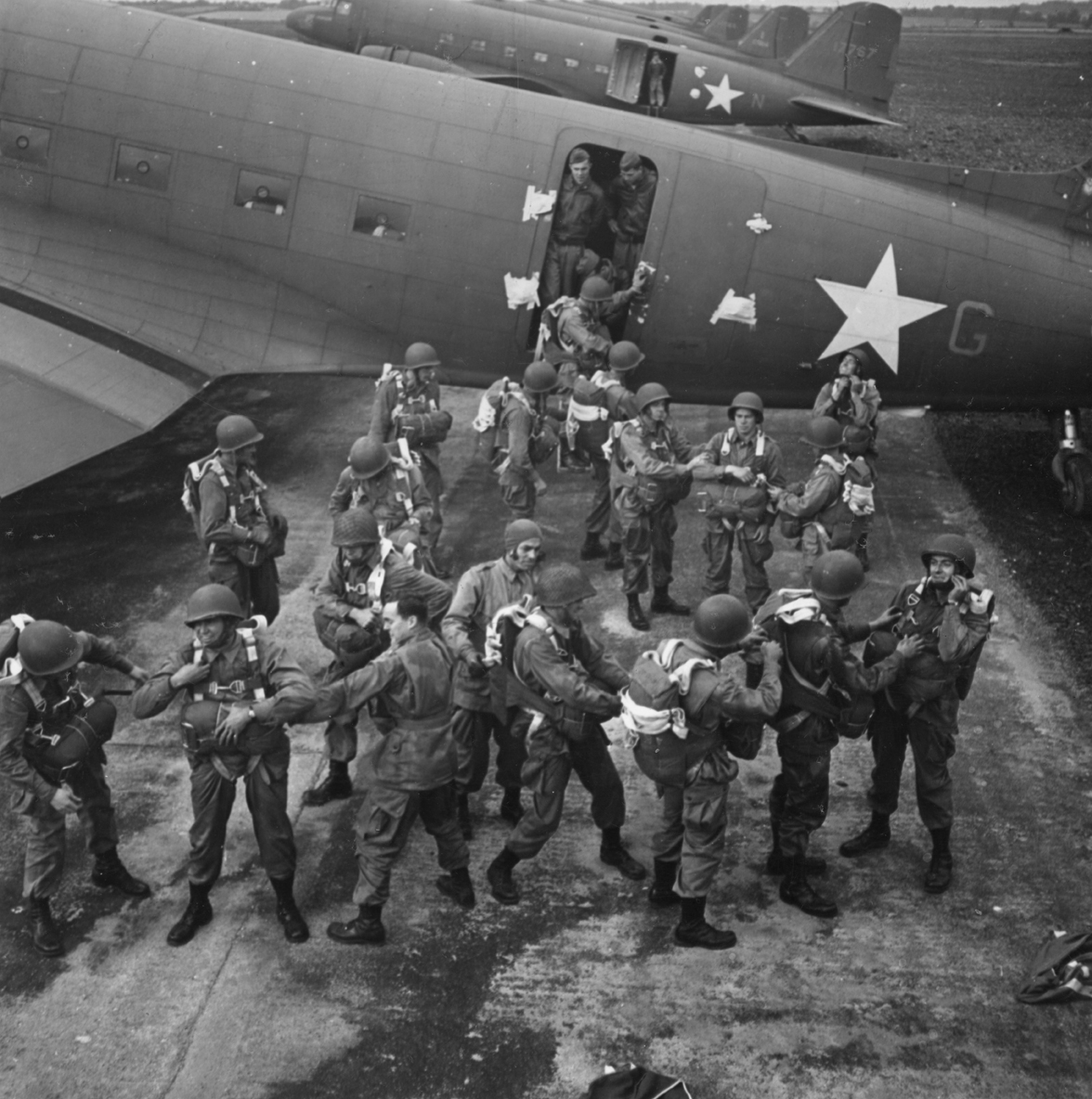
Paratroopers of the 503rd US Parachute Infantry Regiment prepare to board a C-47 Skytrain of the 60th Troop Carrier Group.. Another C-47 (serial number 41-7767) is visible in the background (Not Chelveston FRE3377).
However, the 60th’s stay at Chelveston would also be short lived; in early August, they departed the airfield stopping off briefly at RAF Aldermaston before transiting to the 12th Air Force and the North Africa campaign. On departure, they took the airborne forces with whom they had been training, with them. Whilst in North Africa, they would take part in many airborne operations including both the invasion of Sicily and the liberation of Greece, remaining in the Mediterranean theatre for the duration of the war.
The departure of the 60 TCG was not as smooth as one would wish for however. The poor British weather hampered the move, causing it to be delayed on several occasions. When it did finally get away, the second section had to make an unscheduled stop at a nearby airfield as it was approached by a lone German Me110 fighter. Intercepted by RAF Spitfires, the roaming 110 was quickly despatched and the TCG were allowed to continue on their way unhampered. *7
After their departure, Chelveston received a series of visits and inspections by senior Allied figures. These visits sparked rumours of an impending change in operations, and began with Group Captain Donald ‘Don’ Bennett, commander of the newly-formed Pathfinder Force within RAF Bomber Command, who was accompanied by Colonel Duncan of the USAAF. A few days later, the airfield was visited by Brigadier General Ira C. Eaker. It was in the aftermath of Eaker’s visit that ownership of Chelveston truly changed, marking the beginning of a new chapter in the airfield’s long and distinguished career.
In the next part of Chelveston’s history, we see the airfield finally step onto the operational stage. With the arrival of the USAAF’s 301st Bombardment Group and the first B-17 Flying Fortresses, the station began launching real combat missions over occupied Europe. What followed were the opening operations, early trials, and first losses that marked Chelveston’s transition from a developing airfield into an active participant in the Allied air offensive.
The whole story of Chelveston can be read in Trail 66. Northants and Bedfordshire (Part 2)
 Aviation Trails