Last time, in Part 3, we followed the 306th Bomb Group through their difficult arrival at Thurleigh, enduring poor conditions, training accidents, and costly missions over occupied Europe. Despite setbacks- including the loss of Captain Paul Adams’s crew – the Group adapted, honed their tactics, and began proving themselves in battle. Now, as 1943 drew on, the challenges only grow sharper: missions stretched deeper into enemy territory, German resistance stiffened, and the winter skies of northern Europe offered no mercy. For the 306th, the coming year would demand courage and endurance on a scale they had never faced before.
Another party of officials along with a squad of Brigadier Generals returned to Thurleigh on July 27th, the event being to present the Congressional Medal of Honour to Sgt. Maynard Smith who, as ball turret gunner, performed admirably on May 1st 1943. The B-17 he was in, had been attacked by three enemy aircraft setting it on fire. Three of the crew baled out leaving Lt. Smith to douse the fire enabling pilot Lt. Johnson to save the aircraft by landing it in south-west England.
As summer gave way to autumn, the toll on men became increasingly evident. The four Groups of the Eighth Air Force that had led the way from the summer of 1942 – the 91st, 303rd, 305th and 306th, were all exhausted and battle weary. Signs of stress and ‘battle fatigue’ were becoming more and more common. Heavy drinking, temporary blindness, shaking, insomnia, nausea, weight loss, horrific nightmares and violent tempers were a mere scratch on the surface of what was being witnessed. The men desperately needed rest, yet reinforcements and replacements were slow to arrive, leaving them to continue missions under increasingly perilous odds.
![USAAF personnel on the control tower at Thurleigh airfield [Z50-122-45]](https://bedsarchives.bedford.gov.uk/CommunityHistories/Thurleigh/ThurleighImages/USAAF%20personnel%20on%20the%20control%20tower%20at%20Thurleigh%20.jpg)
USAAF personnel on the control tower at Thurleigh airfield [ref: Z50/122/45] (Bedfordshire Archives website)
Return to Schweinfurt: The October 14th Massacre
When the mission curtain was drawn back on October 14th, the air in the briefing room must have felt heavy – Schweinfurt. The first trip there after the disastrous mission of August 17th, 1943, which almost caused the collapse of the Eighth Air Force, with the loss of so many aircraft.
In amongst the various crews, those who had experienced that traumatic event cursed and dropped their heads, whilst newcomers struggled to grasp the danger.
Schweinfurt lay deep int heart of the Nazi homeland, almost to the Czechoslovakian border. To get there, formations had to fly 500 miles into enemy territory, a six hour flight of which four were on oxygen and at altitude. Every step of the way was heavily defended by Flak and fighters, the odds of returning dropped like a stone.
The 306th dispatched eighteen aircraft, take off time 10:25 hrs, making a total of 320 aircraft from the 1st, 2nd and 3rd Bombardment Divisions. 196 P-47s would escort, but only just into enemy territory leaving the bombers to fend for themselves in the face of several hundred fierce and deadly accurate 88mm anti-aircraft guns.
The 368th “Eager Beavers” were fortunately for them, rostered ‘off’ that week and so did not take part. The 369th provided seven, the 368th and 423rd the remainder between them.
The mission was to go wrong from the start. Bad weather caused issues with forming up, mechanical problems prevented a full ‘maximum effort’. Groups were lost in thick cloud over England and several become lost and out of formation when they did get to their allocated station. For the 306th, they were able to put up eighteen aircraft, in the high position above the 92nd BG led by Colonel Peaslee.
Once over enemy territory three B-17s of the 306th were forced to return due to mechanical problems, then at around 1:00pm, the escorting P-47s had to leave, and immediately swarms of around 300 Luftwaffe fighters pounced on the bomber stream. Between the Rhine and the target, rockets and bombs were dropped on the bombers many exploding harmlessly in the open, but canon fire from forward attacking fighters, as many as twenty at a time, ripped into the B-17s. One crewman described the scene like a ‘parachute invasion’ with so many chutes being deployed from falling bombers.*16
By the time they had begun the bomb run, the 306th were down to just six aircraft, the 92nd eight – only marginally more than other units. Over the target, the 306th had just five bombers dropping their ordnance, ten were missing all believed shot down. Of those five, four had received heavy damage from flak, canon or rockets leaving only one untouched.

A common site at many airfields across Britain. Thurleigh ambulances await the return of their bombers. (IWM UPL 18748)
The return flight home was thankfully ‘uneventful’, the Luftwaffe fighters concentrating on those bombers still approaching or arriving over the city. But the 306th had been decimated, all but one aircraft having been shot down, returned early, damaged by flak or canon. Estimates afterwards suggest that 75% of Schweinfurt’s ball-bearing industry (which produced 50% of Germany’s total output) had been destroyed. As good as the results were thought to be, Schweinfurt had once again been a slaughter for the Thurleigh men.
The next day the 306th was stood down, there simply wasn’t enough aircraft to put up, it had been another black day indeed for those stationed at Thurleigh.
Words of Recognition, Echoes of Sacrifice
A week later Sir Charles Portal, Air Marshall said in acknowledgement to the efforts of the Eighth, “The U.S. Eighth Air Force has earned for itself during the past weeks a reputation that the Royal Air Force will never forget. The Schweinfurt raid may well go down in history as one of the decisive air actions of this war, and it may prove to have saved countless lives by depriving the enemy of a great part of his means of resistance.” *17
Into a New Year: Transition and Tension at Thurleigh
As time always does, 1943 merged into 1944 and the war rolled on. Progress in Europe was slow but behind the scenes plans were afoot for the invasion of the continent. With poor weather, flights were limited and as a result January bore witness to just a small number of losses, with almost all aircraft returning safely to base.
On the ground, training continued with a gas training exercise on the base. What was meant to be a safe exercise turned out to be anything but. Driven by the wind, gas was blown over neighbouring fields where farmer Arthur Filsell was working. The gas, needless to say, caused him severe health issues. *18
January’s record was reflected in February, with the 306th achieving a new record for missions – twelve – almost one every two days of the month. It was also the month that saw the death of Lt. Roskovitch, the first airman to achieve his mission quota of twenty-five operations previously. Throughout the month, losses were minimal, but damage from accurate and intense flak was high, with many aircraft returning with extensive damage – such was the strength of the B-17.
As the invasion plans came nearer to their fruition, new records were set again at Thurleigh. The number of operations flown increased from February’s twelve to sixteen, and as an ironic reward, the number of operations in a tour also increased, rising from twenty-five to thirty. With the Luftwaffe noted by their absence, the chances of survival were thought to be increasing.
Shattered Hopes: The Oberpfaffenhofen Disaster
However, the optimism was to bite back not long after. In April 1944, another mission took twenty-five aircraft to Oberpfaffenhoffen in southern Germany, a long route that took them across the German heartland. The twenty-five B-17s were part of a much larger formation of thirteen Combat Wings totalling 524 B-17s and 230 B-24s, that spilt to attack three targets: Leipheim, Gablingen and Oberpfaffenhoffen.
Departing at 09:00 hrs, the 306th’s group, made up of sixteen aircraft in the low group, six in the high and another six as spares, headed to Beachy Head where they formed up and departed to France at 11:00 hrs. Keeping south of Paris they headed to Stuttgart and onto Augsburg. At 12:50 the P-47 escort had to return home reaching the extent of their flying endurance. Immediately, enemy aircraft honed in on the formation strategically attacking the group leaders. A few widely spread Mustangs gave what support they could, but the shear numbers of enemy aircraft simply overwhelmed them.
By 12:35 the full might of the Luftwaffe had been unleashed, and for forty minutes they attacked continuously using a new full frontal wave consisting of between four and eleven fighters at a time. In conjunction, the enemy attacked from both the 2:00 and 11:00 positions splitting the defensive fire-power of the bombers.
Flak was ‘meagre’ but very accurate causing extensive damage to a number of aircraft and bringing one down. Fighter attacks brought down another nine.
The 306th had again been decimated. Almost half of those sent out failed to return, of those that did many had damage and / or casualties. The ‘soft’ targets of early 1944 could no longer be deemed ‘soft’.*19
The Path to Invasion: Record-Breaking in May; D-Day and Beyond
As raids intensified the Groups returned to Berlin, the 306th hitting Berlin no less than four times in May. Another new high was set in both the number of sorties flown, and with the tonnage of bombs dropped. In addition, another new record of twenty operations was set for the month. Despite this, losses were zero, whilst claiming several enemy aircraft shot down or damaged.
On D-Day, 6th June, the 306th supported ground troops as they breached the Normandy beachhead. Bombing howitzer installations inland, road junctions at Caen and Bridges over the River Orne; they encountered a great deal of heavy cloud. With many aircraft resorting to PFF equipment, results were difficult to ascertain. A change in targets mid month then saw the group sent to bomb ‘Noball‘ targets, the “Pilotless planes launching platforms” (V1) in France, but low cloud prevented bombing and all but two aircraft brought their bombs home.
By the end of the month the group were back to Berlin, bombing targets in the city. With another increase in operations, especially in support of D-Day, more records were again broken. A greater tonnage of bombs were dropped in this month than in the first eight months of their tour of operations. In addition, and despite the high records, losses were amongst the lowest in any 30 day period. Post D-Day, the limit of thirty operations was increased yet again to an incredible thirty-five. Even with the increase, many gunners were reported to be nearing the end of their tour, many not having fired at an enemy aircraft as they had been so absent from the combat zone.
A Royal Tribute: The ‘Rose of York‘ Christening
The 6th July 1944, saw a highlight with a royal visit for a special christening. The party included HRH Princess Elizabeth who was here to christen B-17 #42-102547 “Rose of York“. Joining her were King George VI, Queen Elizabeth, Lady Patricia Hambleden (Lady in waiting) and a selection of other Royal Guests and Generals including Lt. General James Doolittle.
Just prior to the dedication taking place, a formation of fifty-two B-17s flew over the airfield marking the occasion. The Princess then broke a bottle of cider over the chin turret and met each member of the crew in turn. After a tour of the airfield and lunch in the mess, the Royal party departed having made a huge impact on the personnel on the base.

King George VI, Queen Elizabeth, Princess Elizabeth and General James Doolittle, visit the 306th BG in order to christen B-17 “Rose of York” in honour of the Princess. (@IWM FRE 1155)
Accidents and Celebrations: Summer at Thurleigh
With such poor weather dominating the summer months that year, many bombs already fused and live, were brought back home to Thurleigh. These were placed in a distant revetment for safety but on the 30th July, one went off causing a chain reaction that led to twenty-four exploding, shaking the distant windows of the headquarter’s building. No one was hurt in the blast, which saw a huge column of black smoke rise high into the Thurleigh sky. A nearby B-17 was so severely damaged it had to be written off and earmarked for salvage.
A week later, another twenty-four bombs were detonated in a controlled explosion. The location of the ‘dump’, whilst being the safest option, had prevented aircraft from using the taxiway, but now they were all cleared away, the perimeter track was opened and ground movements could operate easily once more.
The 9th September marked the second anniversary of the 306th’s presence in the European Theatre of Operations. To celebrate the day, the entire group was given the day off to watch and enjoy a range of entertainment including a carnival, ball games and music performed by Glenn Miller’s band. Dances were held in the hangar and personnel had the opportunity to view a Ju88, Me109 and FW 190 that had all been captured. The only low point of the day being the sad news of the suicide of Corporal Robert Bickston of the 367th BS.
Chaff, Fog, and Tragedy: Autumn in the Air
By now, the Americans had been using ‘chaff’ for some time, a product like the RAF’s ‘Window’ which utilised strips of metal foil that caused interference and confusion on the enemy radar screens. To test this further and determine exactly what interference it did cause and which method of discharge was the best, crews of the 306th flew to Farnborough to perform four runs depositing ‘chaff’ from various points in the aircraft. These tests began on September 19th, with the first run dropping no chaff at all, thus giving a base line indication. On the second, it was discharged by the radio operator from his position in the aircraft. On the third, the discharge point was moved to the bomb bay “Razzle Dazzle style” (a more chaotic and less organised style) and on the last run, the chaff was dropped prior to the aircraft turning onto the bomb-run. Once completed, the data was assimilated and all the results examined. These proved to be “very interesting and informational“.*20
Britain’s weather had long been a challenge for flying operations, and the autumn of 1944 offered no respite. Poor visibility was a constant hazard, often contributing to accidents both in the air and on the ground. While clear skies typically reduced the risk, they were no guarantee of safety. A brief lapse in concentration could, and often did, result in disaster – as the 306th Bomb Group tragically discovered on 22 October 1944.
As the formation made its way back across the North Sea from Hannover, two B-17s from the same squadron collided mid-air. The first, B-17 #44-8099 of the 423rd Bomb Squadron, flown by 1st Lt. Harry Aylea Jr., was in the No. 1 position of the high squadron. Flying nearby in the No. 4 slot was B-17 #43-37976, nicknamed “Suzy”, piloted by Captain Joseph Mathis.
At around 12,000 feet, with a total of 19 airmen on board the two aircraft (ten and nine respectively), the lead bomber began to climb, reducing speed as it did so. Suzy, flying very close beneath, attempted to maintain position – but the gap was too tight. The aircraft collided, sending both into uncontrollable spins. As they fell from the sky, Suzy exploded.
The crash occurred over water, and an immediate air-sea rescue operation was launched to search for survivors. Of the nineteen men aboard, only one was found alive – Staff Sergeant H. Key Jr., the tail gunner from #44-8099. Two bodies were later recovered, but the rest were declared missing in action.
Meanwhile, as the surviving aircraft neared their home bases, the weather over Bedfordshire worsened rapidly. Visibility dropped, and in the poor conditions two returning formations of Chelveston’s 305th Bomb Group – approached from different directions – crossing paths directly over Thurleigh airfield. A collision then followed, with both aircraft exploding on impact and scattering wreckage across the station. Much of the debris fell onto the 367th’s dispersal area. Tragically, there were no survivors and the weather had claimed yet more victims.
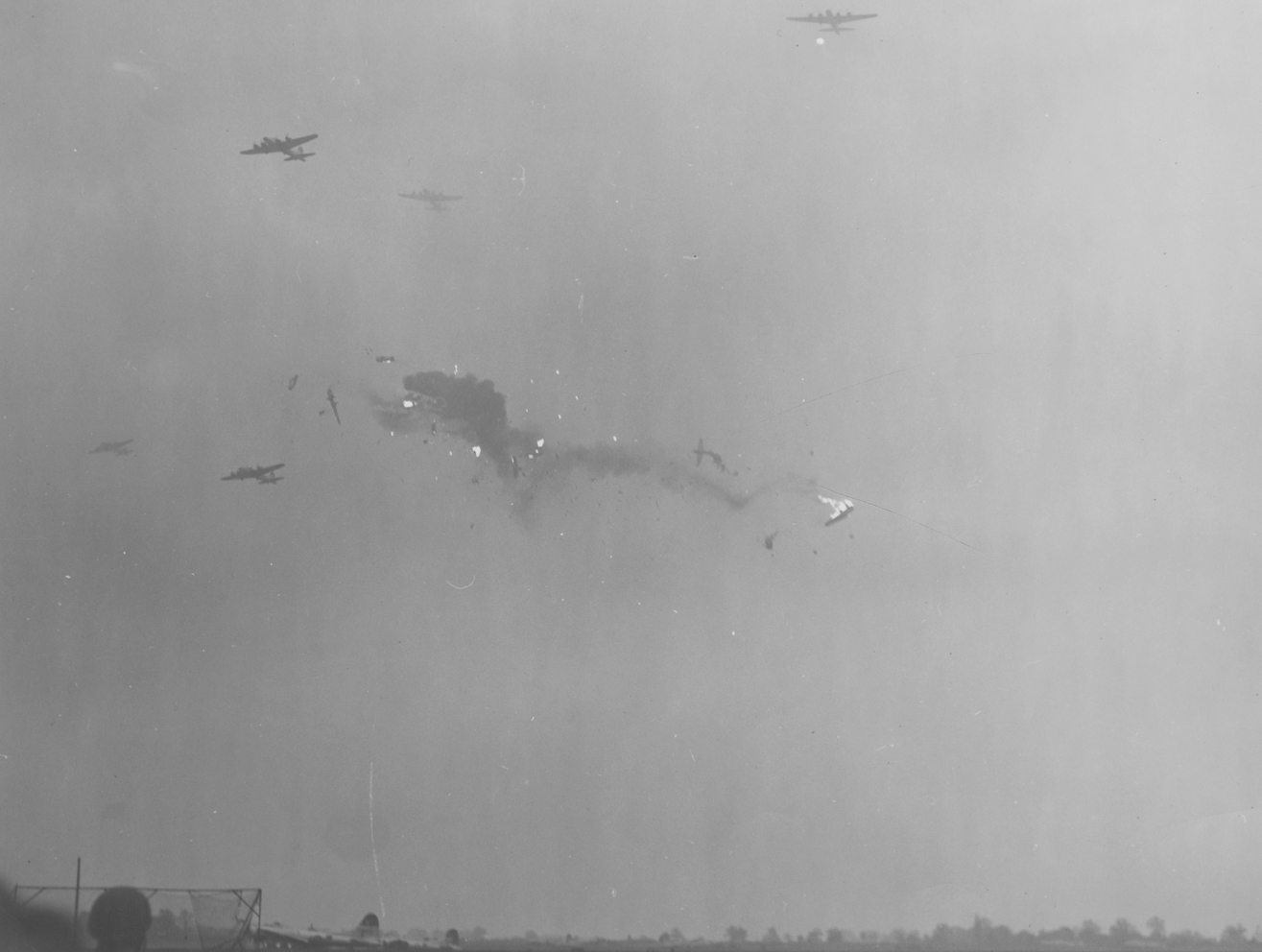
Two B-17s of the 305th BG collide over Thurleigh in thick fog. October 22nd, 1944, (IWMFRE 10489)
The poor weather prevented many flights over the following weeks, and so ground talks took up a large portion of aircrew time. Despite this, fourteen missions were carried out, two visually and twelve using PFF with generally good results. To date, some 73,000 hours of flying had taken place and 160 aircraft had been lost to various causes, many along with their crews.
This poor weather continued on almost relentlessly into the last months of the year scrubbing many operations into mainland Europe. But, undaunted, 1945 arrived and 1944 was seen out in style at Thurleigh airfield. Christmas meals were served to those on base, whilst some who had managed to get airborne, had diverted to other bases forcing them to have their celebrations elsewhere. New Year likewise was celebrated with large quantities of music, food and needless to say drink. Spirits were high, and many personnel were convinced that the new year would bring an end to what now seemed to be an endless conflict.
The end of the year also signified the end of the inter-base football season. Thurleigh played three matches culminating in a 12-0 victory over fellow teams at Grafton Underwood. On the sports field as in the air, the year had ended with Thurleigh achieving good successes; four wins, two losses and three ties.
Christmas at War: The End of 1944 and the Final Push into 1945
Unbeknown to everyone, including those at Thurleigh, 1945 would indeed see the end of the war. With only five more months to go, their gut feelings and hopes of peace, were finally coming to fruition.
The beginnings of 1945 saw major movements in Europe on both the eastern and western fronts. The Russians, making huge advances into German held territory, were driving their way into Germany. From the Baltic to the Carpathian Mountains five enormous armies pushed to the banks of the Oder, a mere 40 miles from the German capital Berlin.
Battling the extreme cold weather and constant fog, the western armies were held in the Ardennes facing a strong and determined enemy who were now making a last ditch effort to break through the allied lines. But as the poor weather continued, many flights from UK bases were prevented from occurring and thus dropping much needed supplies to both those on the entrenched front line and those serving behind in hospitals and support services.
But some flights did get away; the 306th managing to play their part by flying 544 sorties in January, attacking mainly enemy communication centres along the front. With low fuel stocks and a high attrition of experienced crews, the Luftwaffe were largely unopposing, so losses for the Thurleigh crews were kept to a minimum.
With the eventual breakout of the Ardennes, the German front began to crumble. The Eighth Air Force and the 306th made a return to Berlin causing further considerable damage to the city, and as the allied forces pushed ever further into Germany, Thurleigh supported the advance with crews hitting numerous strategic targets: oil, communication lines, transportation routes, military camps and jet airfields among many others. With bordering on almost total control of the sky no aircraft were lost by the 306th.
But as the allied forces pushed toward the capital, the U-boat menace remained at large. Submarine pens located along the coast were still in operation and needed eliminating. The problem with these structures was that they were very difficult to not only hit, but to destroy as well, largely due to the incredibly thick reinforced concrete they were constructed of. The RAF and USAAF had tried countless times to destroy these buildings with little success: conventional weapons simply ‘bouncing off’ like ping pong balls.
Secret Weapons: The Disney Bomb Trials
With both the British and Americans carrying out investigations and trials into new and more powerful bombs, the possibility of destroying these bunkers moved slowly closer. It was thought, a British development, the ‘Disney bomb’, may provide the answer.
The bomb, designed by a Royal Naval Captain, Edward Terrell, was of a long thin design that could be slung beneath a heavy bomber and launched at its target from a high altitude. With added rocket propulsion, the bomb could reach speeds just short of 1,000 mph punching its way through thick concrete into the pen where it would explode destroying the contents in this case the U-Boat.
Although a British design, the USAAF trialled it between February and April 1945, with the 306th using them for the first time in an operation on March 30th against the Submarine pens near to Farge on the Vesser River. Major Witt led twelve aircraft, (including two PFF) in two groups of six. Unfortunately, 4/10th cloud cover, forced the lead group into making four passes over the target before they could get a good sighting and thus release their bombs.
Whilst the reports after the raid were good, little was gained long term from the Disney bombs as they were too difficult to accurately use against such small targets from high altitude, and so the trials ended without any major successes.
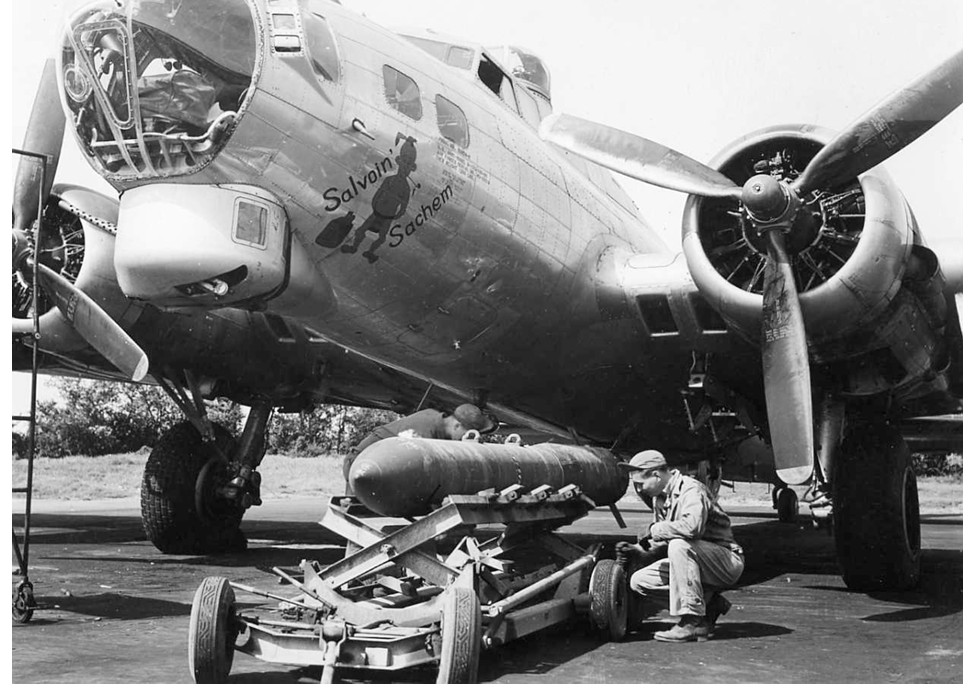
B-17 #43-38910 ‘Salvoin Sachem‘ with Disney Bomb on a Torpedo trailer. The bomb carrier can be seen between the engine and the fuselage. *21
War’s End: Honour, Reflection and the Final Missions
With both east and west fronts meeting up in April 1945, the German war machine effectively collapsed. Doenitz took over after Hitler’s death and Berlin fell into allied hands. The 306th completed fifteen sorties, but no bombings were carried out after the 19th due to potential targets being overrun by the allied forces and so risking ‘friendly fire’ incidents.
After that, the Group essentially stood down. A few leaflets flights were made by the 369th dropping newspaper, propaganda leaflets and other material over Holland, Belgium and Germany.
During May and the last days of the war, these leaflet drops became the norm along with ‘cooks’ tours over Europe. Essentially tours for ground staff, allowing them to see for themselves the damage inflicted on Nazi Germany by the combined heavy bombing of the RAF and USAAF.
When peace was declared and the war finally over, the 306th stood tall. After participating in some of the fiercest air battles of the Second World War, they had come through with great achievements. Tales of heroism were rewarded with two Medals of Honour and Purple Hearts were numerous. The 369th BS had flown an unprecedented forty-two consecutive missions without loss. As a group though, losses had been incurred, and many young and brave men had been lost in the fight against Nazi Germany. Some 177 aircraft had been shot down or lost, and over 730 men had been killed with over 800 more taken prisoner. The 306th had played their part with great courage and sacrifice.
Part 5 takes us beyond the climate of conflict and into the work of research and development. Thurleigh becomes a hub of aviation excellence, the experimentation takes over and a new owner eventually takes control.
The entire history can be read in Trail 65.
 Aviation Trails