On June 3rd 1944, Lancaster ND841 ‘F2-D’ piloted by Flying Officer George. A. Young (s/n: 134149) RAFVR 635 Squadron, was detailed to mark and attack Calais as part of the preparations for D-Day. There would be eight other aircraft from RAF Downham Market also detailed for the mission and take off would be late that evening.
Initially, the aircraft and crew, were designated for training, but that night, nine aircraft and crews, were then detailed for operations to Calais, including F.O. Young’s crew in ‘D-Dog’. They were given orders to mark a coastal defence battery, as part of the preparations for the forthcoming D-Day invasion.
The mission as a whole would involve 127 Lancasters and 8 Mosquitoes of No.1, 3 and 8 Groups and the targets would be the gun batteries at both Calais and Wimerereux. It was a diversionary raid as part of Operation “Fortitude South“, to fool the Germans into believing the invasion would occur in the Pas-de-Calais region.
At 28 minutes past midnight, F.O. Young lined the Lancaster up, opened the throttles and began the long run down the runway. As the aircraft approached take off, it began to swing striking the roof of a B1 Hangar nearby. In an uncontrollable state the aircraft crashed just outside the airfield killing all those on board.
All other eight aircraft took off and returned safely after having dropped their bombs as instructed.
On board Lancaster ‘F2-D’ that night were:

Lancaster ND841 ‘D’ and its crew before the fatal crash on June 4th 1944.
Pilot: F.O. George Ambrose Young, aged 24 (s/n: 134149) RAFVR.
Flight Engineer: Sgt. Thomas Snowball, aged 32 (s/n: 1100769) RAFVR
Navigator: Flt. Sgt. Howard Pritchard, aged 22 (s/n: 1578502) RAFVR
Bomb Aimer: F.O. Walter Thomas Olyott, aged 21 (s/n: 151238). RAFVR
Wireless Operator / Gunner: F.Sgt. Robert Sadler, aged 23 (s/n: 1526058). RAFVR
Air Gunner: Flt Sgt. Stanley Wharton, aged 30 (s/n: 1578013) RAFVR
Air Gunner: Flt Sgt. Charles Patrick Nallen, aged 20 (s/n: 427537) RAAF
The Squadron’s Operation’s Record Book (AIR 27/2155/7) for that day simply states:
3.6.44 ‘D’ F/O Young G.A. hit hangar after taking off and crashed on airfield when large bomb exploded and the crew all killed. 8 aircraft returned to base .
Three of the crew are buried in Kings Walk Cemetery, Downham Market, a short distance from the airfield.

F.Sgt. Stanley Wharton (RAFVR)
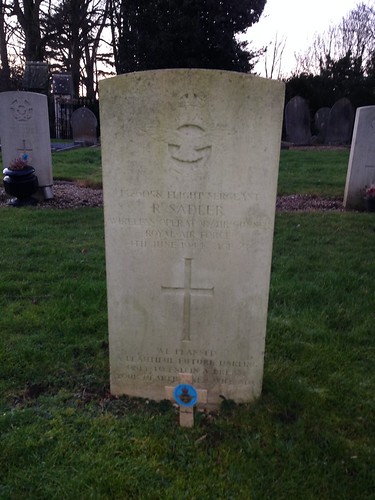
F.Sgt. Robert Sadler (RAFVR)

F.O. Walter Thomas Olyott (RAFVR)
 Aviation Trails
Sadly, another of those wartime accidents, so similar to many others. A tragically short end to 8 short lives.
LikeLiked by 1 person
It was indeed Mitch. Very sad and very tragic.
LikeLiked by 1 person
Hi Andy, Way too many Airmen died taking off from the base. Why do bombs blow off when they were not arned yet. Seven of the 12, 500lb bombs lit off on Joyride. Just another sad story, but well worth remembering. Wonder if their families will see this article? Bill
LikeLiked by 1 person
Hi Bill, indeed. Way too many did die at that point, crashing, swinging or the like. An aircraft full of fuel and explosives is in itself a bomb waiting to go off and it doesn’t take much to make it do so. I think I the answer lies not only in the difference between British and American bombs but the type of bomb and fuse too. US bombs, as you know, were armed whilst in the air, and some even had two fuses to prevent accidental explosion. British bombs, from my understanding, were armed once they were put in the aircraft ie on the ground.
A bomb falling from the aircraft can hit the ground sufficiently hard enough to accidentally detonate it, especially when it’s taken off and flying. There certainly have been many cases of aircraft being destroyed by bombs on the ground or prematurely, including Joyride and of course the major explosion at Alconbury which caused untold damage. It is very sad indeed to hear about. I e not heard from any family members so I don’t know I’m afraid if they do.
LikeLiked by 1 person
Interesting. I did not know the RAF armed their bombs before taking off. Could it be that the bomb placement on the aircraft was harder to reach from inside the plane to arm them?
LikeLiked by 1 person
British bombers had enclosed bomb bays, ie not accessible from within the aircraft and so had wires connected to the bomb aimers switches. The bombs had their pins removed on the ground and then raised into the bomb bay where arming wires were attached to the bomb. This, in theory, prevented bombs going off prematurely. Once loaded, wires were attached to the mechanism linked to the bomb aimers switches. When activated, these pulled the pin out and allowed the bomb to be armed as it fell by a rotating propellor.
Accidents were possibly more likely to happen when loading into the aircraft as the pin had been removed at that point. This, I’d imagine, depends upon the type of bomb in use.
LikeLiked by 1 person