Whilst researching a forthcoming trail, I discovered the story of two airmen who were both killed in an accident, and are both buried in the local village cemetery.
Their gravestones are sadly much less ‘grand’ than many of the other airmen in the cemetery, but their departure was none the less, nothing short of a tragedy, and in no way less of a sacrifice than any other loss.
It was during a night training flight, on November 14th 1938, that Wing Commander Harry A. Smith MC, along with his navigator Pilot Officer Aubrey W. Jackson, both of No. 9 Squadron (RAF), would be killed in a Handley Page Heyford III reg: K5194, when the aircraft undershot the airfield striking trees outside the airfield boundary. The crash was so forceful that the aircraft burst into flames killing both airmen.
Wing Commander Smith MC qualified as a pilot whilst in the Royal Flying Corps in 1916, and was the first of his rank to be killed since the inception of Bomber Command in July 1936. He had been awarded the Military Cross ‘for gallantry and distinguished service in the field‘ in 1918.
Pilot Officer Jackson was appointed for a Short Service Commission in January 1937, and later a Permanent Commission. He was only 20 years old at the time of his death.
Both crewmen are buried in Stradishall’s local cemetery.
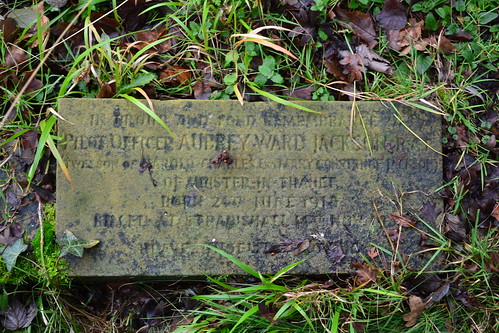
A very ordinary grave stone marks the plot of P.O. Aubrey W. Jackson, killed on November 14th 1938 on a night training flight.
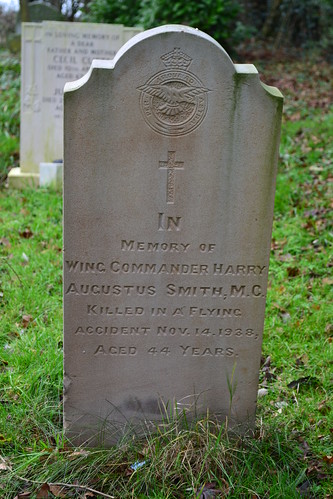
Wing Commander Smith, killed alongside P.O. Jackson on a night training flight. He was the first of his rank to die since the formation of Bomber Command.
 Aviation Trails
Wing Commander Harry Augustus Smith was my grandfather. I’m trying to find out about him and to see a photograph of him. He and my Grandmother were divorced but she still received the letter from HM Forces to notify her of his death at RAF Stradishall. I would be very grateful for any further information or details how I can find out more. Thank you so much.
LikeLiked by 1 person
Hi thanks for getting in touch. As a relative you are able to obtain his service records through the national archives. If you go to their website there is information and ‘live chats’ available where they will direct you. I believe there are charges involved but they will confirm the exact amount and the process you need to go through to apply for them. Good luck, I hope you find what you’re looking for.
LikeLike
One of those tragic military accidents but you’re so right about it being sad that the gravestones are becoming so worn. Especially given the attention given to those that died in conflict.
LikeLiked by 1 person
Tragic – I seem to use that word over and over, but here it is again. The ultimate sacrifice.
Thanks for all your hard work Andy.
fran
LikeLiked by 1 person
It was a tragic time Fran. Thank you.
LikeLike
Thanks very much for keeping those two men’s sacrifices alive for a little longer. The researches I am doing at the moment reveal a very similar steady “drip, drip” of death, just among our school’s old boys. Russell Cruddas Lansberry killed between April 17-19th 1951 in HMS Affray. George Norman Hancock killed on March 31st 1954 in a Gloster Meteor. And the extravagantly named Lieutenant Cyril Amyatt Wyse Amyatt-Burney, murdered in northern Nigeria on an unknown date just before December 15th 1903. All long forgotten sadly.
LikeLiked by 1 person
That certainly is a name to behold. There are sadly many like this, who have all but been forgotten, it is sad, and they deserve more. What surprised me in particular was the rather ‘tame’ stone that is all but worn away.
LikeLike
It is a noble thing to keep their memory alive Andy. Thanks for a moving post.
LikeLiked by 1 person
Thank you Rich.
LikeLiked by 1 person