Continuing on Trail 38, we depart Swanton Morley and travel south-east toward the former RAF / USAAF base at Hethel. Here we find fast cars, a museum, and more remnants of yesteryear. On the way, we pass-by another former RFC airfield from the First World War – the Home Defence Station at Hingham.
Hingham Home Defence Station.
There is considerable speculation about the true location of Hingham airfield. It is sadly one of those sites that has long since gone, and its history is now so blurred that its true location is not accurately known. It is known however, that it housed only three squadrons in its very short life: 51 (HD), 100 and 102, but only 51 Sqn remained for any period of time, thus making it the sole unit to have flown actively from this airfield.
A grass site, it was believed to be located near to the village of Hingham in Norfolk, some 12 miles south-west of Norwich, however, some sources cite it as Scoulton (latterly Watton airfield) located a few miles to the west of here. Wherever the true whereabouts of Hingham are, it is known that it did play a small but important part in the defence of Great Britain, and therefore worthy of a thought as we pass by.
Following the reorganisation of the RFC and RNAS in 1916, it was known that 51 (HD) transferred from Thetford to Hingham, arriving at the fledgling airfield on 23rd September 1916, with the Royal Aircraft Factory BE12s. With detachments at Harling Road, Mattishall and Narborough, they were widely spread and would operate solely in the Home Defence role. These airfields were designated Home Defence Stations of which there were two, the ‘Flight‘ station (the smaller of the two) and the ‘Squadron‘ Station, the larger and main station. It is very likely that Hingham was designated as a Flight Station.
In October 1916, 51 (HD) replaced with the BE12s with two-seat FE2bs and then with further RAE aircraft, the BE2e, in December 1916. The Hingham flight moved to Marham in early august 1917, whilst the Mattishall flight remained where they were. ‘B’ flight moved west to Tydd St. Mary, a small airfield located on the Lincolnshire / Cambridgeshire border.
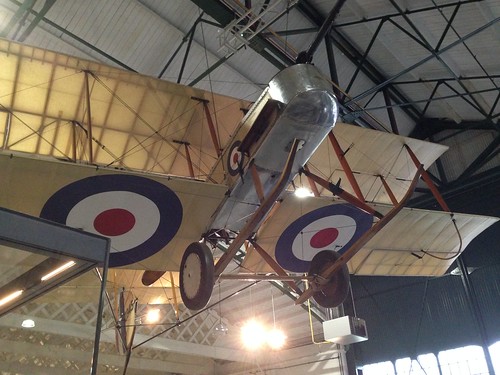
The Royal Aircraft Factory F.E.2b at Hendon, London
Throughout the war 51 (HD) squadron fought against the Zeppelins that foraged over the eastern counties. By flying across the North Sea and then turning into The Wash, they were aiming to reach targets as far afield as Liverpool, Coventry and London.
One of several Home Defence airfields in this region, the role of Hingham aircraft (and the other Home Defence units around here), was to protect these industrial areas by intercepting the Zeppelins before they were able to fly further inland.
However, in the early days of the war, Zeppelins were able to fly at greater speeds and altitudes than many of the RFC aircraft that were available, and so the number of RFC ‘kills’ were relatively light. Many of these German Naval airships were able to wander almost at will around the Fens of Cambridge and Lincolnshire dropping their bombs wherever they pleased. It was this lack of a strong defence strategy that perpetuated the creation of the Home Defence squadrons. This new organisation along with improvements and developments in both ammunition and aircraft performance, began to improve the ‘kill’ success rates, and gradually the number of raids decreased. 51 (HD) Sqn played a pivotal part in this role, attacking Zeppelins on a number of occasions in these mid-war years.
It was during this time that two new RFC squadrons would be formed at Hingham. On February 11th 1917, the nucleus of 51 Sqn were relocated here to form the new 100 Sqn, whilst on August 9th that same year, the new 102 Sqn was formed. Both these units would train in the night bombing role and then go on to attack airfields and troops in Northern France in support of the stagnating Allied ground troops.
A stay of about 6 weeks for 102 Sqn and 12 days for 100 Sqn saw them both depart to pastures new, St. Andre-aux-Bois in France and Farnborough in the south of England respectively. It was at these locations that they would collect their operational aircraft before reuniting in Northern France in March that year.
After 51 (HD) squadron left Hingham, the site was never used again by the military and it was subsequently closed down. Whatever structures that were there were presumably sold off in the post war RAF cutbacks, and the field returned to agriculture with all traces, if any, removed – Hingham’s short history had finally come to a close.
Hingham was a small airfield that played its own small part in the defence of the Eastern counties. Whilst its true location is sadly not known, it is certainly worthy of a thought as we travel between two much larger, and perhaps much more significant sites, in this historical part of Norfolk.
 Aviation Trails