I was recently contacted by Trevor Danks, a volunteer during the restoration of Vulcan XH558, until 2015, the world’s last flying Vulcan bomber. Trevor very kindly sent me his memories along with a selection of his photos, taken whilst working as a volunteer during the aircraft’s restoration.
The Vulcan’s final farewell flight took place on October 28th 2015.
My sincere thanks go to Trevor for sharing his memories and photos with me.
Memories of a Vulcan XH558 Restoration Volunteer.
I joined the 558 Club at the RIAT 2000 at RAF Cottesmore. At that time I was unable to play any active part due to work commitments. However by 2005 I was semi retired and when the request came out for volunteers to help out with the restoration of XH558, I replied immediately.
I had been an Airframe Mechanic during my National Service in the RAF between 1955 and 1957. I had been fortunate to be posted to 232 OCU Valiant Squadron at RAF Gaydon and became a member of a ground crew on a Valiant. So the prospect of being in close proximity to the Vulcan was an exciting prospect.
Following the first call for volunteers an e-mail was sent out asking if anyone knew someone who could do a drawing of the hangar at Bruntingthorpe, at minimum cost. I replied by e-mail to say that I would do it on my CAD system at no cost as part of my volunteer work. So on a cold April morning in 2005, I met Colin Marshall at Bruntingthorpe to discuss what was required. The first task was to take measurements of the hangar. I was also supplied with a drawing of the Vulcan which had to be shown in position in the hangar. Another volunteer, Derek Bates, helped with the measuring of the hangar. The original drawing was to be part of a document for the Heritage Lottery Fund. However as time passed the drawing was amended a few times and the later version is shown below, which shows the visitors walkway.
Hangar Layout (Bruntingthorpe).
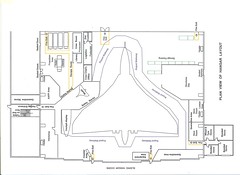
The Hangar layout at Bruntingthorpe (Trevor Danks)
I became a member of the Wednesday Crew (See photo) together with a number of other volunteers. On that day there were a basic six of us who, from the start, did a variety of jobs. In the beginning we helped to set up the hangar to meet the requirements of Marshall Aerospace, the hangar becoming part of their engineering facilities located at Cambridge. Apart from the tidying up, dismantling or erecting shelving and racking, we participated in the setting up of the technical library, under the supervision of Frank Edmondson, this held all the Air Publications (AP’s).
Our main task lay with the 600 tons of spares held in the Deep Store, better known as “The Shed”. Over the days of the restoration we sorted, counted, placed in boxes and put the spares in the racking. This information was input to the computer. After which we then had to find and retrieve spares as and when required by the engineers. All this was carried out under the supervision of Simon Chipman. We were a happy bunch beavering away in The Shed, sometimes very hot and sometimes very cold depending on the time of the year. During tea and lunchtime breaks in the Airfield Diner we would reminisce about our days in the RAF or times past when the Vulcan was flying at displays.
In August 2006 it had reached a critical point where more finance was need to be able to complete the restoration. A fund raising operation had been carried out but the trust was still £500,000 short so the paid employees had been put on notice to end their employment. Everyone was convinced that it looked as this was to be the end of the project. After the aircraft had been rolled out to loud cheers a louder cheer went up as Sir Michael Knight, Chairman of VTTS Trust, announced a donation of £500,000 had been received from a mystery donor. The donor turned out to be Jack Hayward, owner at the time of Wolves football club.
When the Vulcan finally got to the stage of emerging from the hangar for such as engine runs we joined together with all the other volunteers who came on other days of the week. This usually required us to do a ‘FOD Plod’ which entailed us doing a walk of where the Vulcan was to pass, picking up any debris lying about. The first time the Vulcan was taken out for an engine test run, it was taken to a dispersal pad on the edge of the airfield. Having run the engines individually the time came to run them together up to 75% full power. I and a colleague were stationed on the perimeter track to prevent anyone coming along it. As the power increased we noticed a shed on the side of the perimeter track beginning to move. We quickly flagged the ground crew to shut down before the shed disappeared into the trees. The aircraft was then repositioned to continue the engine run.
First Flight.
The most enjoyable FOD Plod was on 18th October 2007 when we were all out on the runway at 7.30am as dawn broke. The expectancy on that day was electric; our little crew had been appointed as the emergency team in the team bus with the task of dashing to an emergency entrance on the edge of the airfield. This was to let in emergency vehicles in the event of a mishap. Fortunately the day blossomed into a beautiful day both weather-wise and the rebirth of a much loved aircraft. When the crew of XH558 let off the brakes and that famous engine “Howl” was heard, one minute it was rushing down the runway and the next 100 feet up as it went past us in the viewing area. We cheered like mad and hugged each other with not a dry eye in the house.

Sqd. Ldr Dave Thomas – VOC Display Pilot: AEO Barry Masefield – VOC AEO & Radio Op.: Sqd Ldr Al McDicken – Marshalls’ Test Pilot
This was not the end but the beginning, as much had to done to get it to the stage of giving a display at the Waddington Air Show in 2008. There were other engine runs and flights, with XH558 getting her certificate to display just two days before the first day of the Air Show. All the time the Vulcan remained at Bruntingthorpe I continued to visit there on a Wednesday. When it moved to RAF Lyneham and the office to Hinckley, I changed my visits to Hinckley and became part of the education team. From this I developed my Power Point presentation to give talks about the restoration time. However I retain the happy memories of our days at Bruntingthorpe and count myself very lucky to have been part of what can only be described as a great adventure. I was at Waddington for that first display and also managed to attend the day she flew with the two Lancaster bombers.
Since those days I have managed to visit Robin Hood Airport on a couple of occasions. The last time I managed to get the signatures of Taff Stone and Andrew Edmondson added to all the other signatures in my copy of Vulcan 607.
Photo Collection.
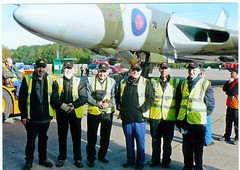
‘The Wednesday Crew’ – John, Trevor, Peter, Dave, Bob and Vic.

Volunteers with ‘Brunty Bear’ (XH558 Mascot) On head centre front row.
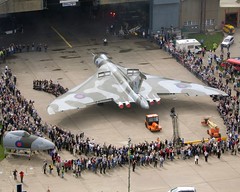
Roll Out Day – XH558 Outside for first time August 2006.
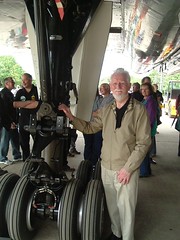
With Starboard Undercarriage Leg on Roll Out Day.
First Flight.
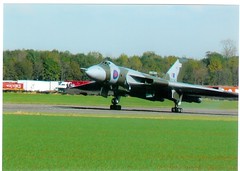
Nose Wheel Off for First flight.

Volunteers after the First flight.
Start of Display Season.
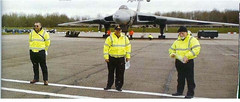
Starting ‘Fod Plod’ along runway April 2008 ready for display Season. (John, Bob, Trevor).
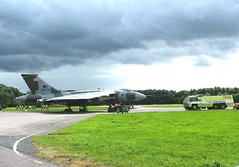
At RAF Lyneham.
Trevor Danks – VOC Volunteer.
Founding Guardian No. 338.
My personal thanks again to Trevor and all the volunteers who took part in the restoration and displaying of XH558 and also to those who continue to work for her preservation.


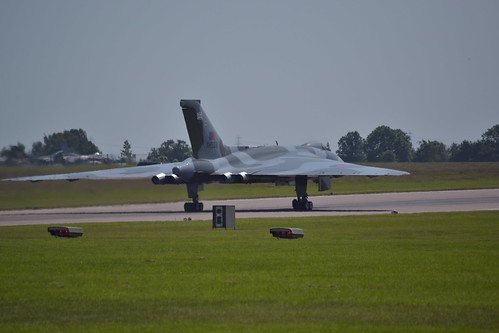

 Aviation Trails